Security teams log 54% of successful attacks and alert on just 14%. The rest move through your environment unseen.
The Picus whitepaper shows how breach and attack simulation tests your SIEM and EDR rules so threats stop slipping by detection.



A malvertising campaign on the Bing search service is pushing a fake Claude desktop app installer hosted on a legitimate Claude.ai domain to deliver the SectopRAT malware.
At least 29 organizations were compromised between July 21-22 during the malicious operation, which researchers call FakeAgent.
The attacker uses a malicious Claude Artifact hosted on Claude’s legitimate domain, which is a common tactic that has been used

The attackers used a malicious Claude Artifact hosted on Claude’s legitimate domain, a tactic that has been used at the beginning of the year to push macOS malware via ClickFix lures.
Researchers at managed security company Huntress found that the malicious Claude Artifact, downloaded 7,100 times before Anthropic removed it, directed visitors to websites that hosted a fake installer named ClaudeDesktop.exe.
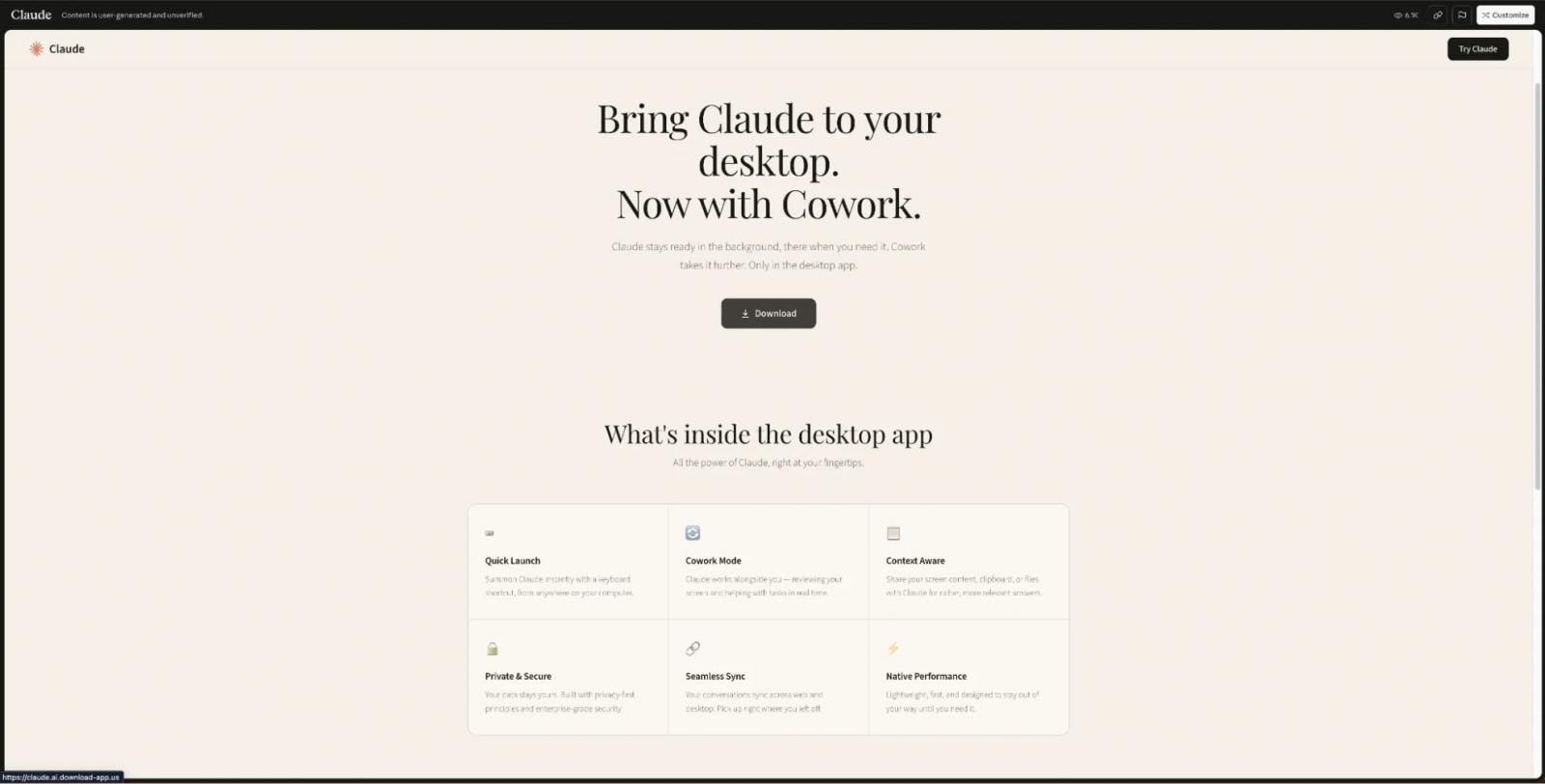
However, the file is a legitimate JetBrains Chromium component that sideloads a malicious DLL (libcef.dll) to deliver the SectopRAT remote access trojan with info-stealing capabilities.
Persistence on the system is achieved through another executable named DockerDesktop.exe, which installs a scheduled task.
Huntress says that the various loaders and staging components used in the infection chain feature anti-analysis mechanisms, including VMProtect packing, shader timing checks, GPU and VRAM checks, and virtual machine (VM) detection.
The SectopRAT malware was recently observed being distributed via CastleLoader campaigns and ClickFix attacks.
The malware uses the EtherHiding technique to retrieve a working command-and-control (C2) address via Ethereum BNB Smart Chain transactions.
SectopRAT, also known as ArechClient2, has been active since 2019 and is an information-stealer with HVNC (Hidden Virtual Network Computing) functionality. It allows remote hands-on operations and real-time interaction with the compromised system.
The malware targets user passwords, credit card data, files, browser logins and cookies, FTP credentials, data from various messaging clients, including Discord and Telegram, Steam, and VPN products.

In an interesting twist, Huntress reports it used Claude Opus 4.8 to assist with shader emulation, cryptographic reconstruction, and .NET code analysis.
Analysis of the decrypted .NET payload (SectopRAT) helped attribute the attacks to SectopRAT operations, or a closely related fork, and opened the path to infrastructure analysis.
At that stage, the researchers found 10 domains registered to the same email address since December 2025, with one of them previously linked to the StealC distribution and seized during Operation Endgame.
Huntress does not have enough evidence to attribute the FakeAgent campaign to a specific, known threat cluster.
Users looking for software should trust official websites and download portals, instead of search results, especially sponsored ones.

Security teams log 54% of successful attacks and alert on just 14%. The rest move through your environment unseen.
The Picus whitepaper shows how breach and attack simulation tests your SIEM and EDR rules so threats stop slipping by detection.
Scientists have been trying to figure out how kids pick up language so fast for decades, and a new study out of the Okinawa Institute of Science and Technology (OIST) might have cracked part of the puzzle: curiosity.
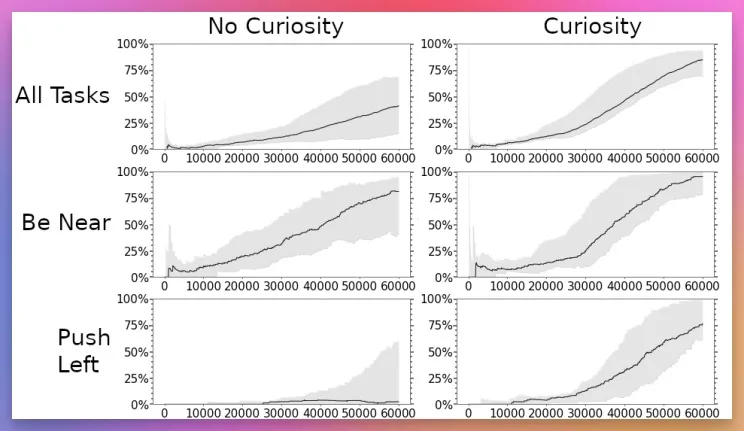
Researchers built a virtual robot with a brain-inspired neural network and set it loose in a simulated 3D world full of shapes, colors, and simple commands like “push left magenta dumbbell.”
Some robots were rewarded only for completing tasks correctly. Others got an extra reward for curiosity, essentially getting a little internal high whenever they encountered something that challenged their existing understanding of the world.
The curious robots didn’t just edge out their indifferent counterparts; they blew past them. According to the study, published in Science Advances, curious robots reached a genuine understanding of language in about half the time.
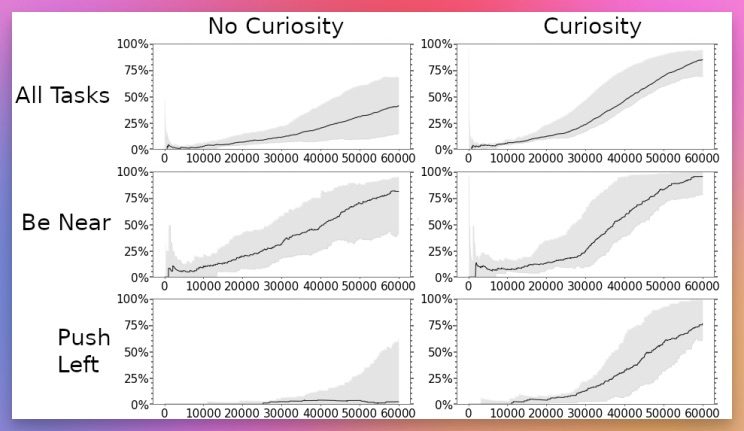
Study author Theodore Tinker compared it to trying white chocolate for the first time even though you already love dark chocolate. You take the risk anyway, and you walk away knowing more about chocolate in general.
Things got even more interesting halfway through training. The curious robots started knocking things over and experimenting with actions nobody asked for, basically playing. Nobody programmed that behavior in. It just showed up on its own.
The robots also mimicked a well-known quirk in how children learn language. Kids often get certain verb forms right at first, then start applying grammar rules too broadly and make mistakes on verbs they’d previously used correctly, before eventually sorting out the exceptions and correcting themselves. The robots followed the same U-shaped dip in performance.
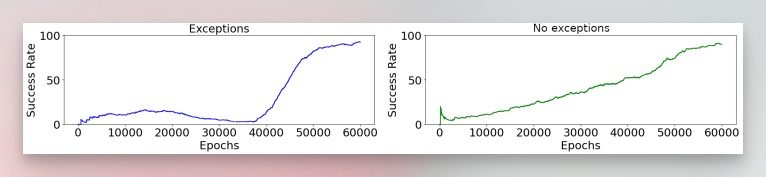
It’s also a nice contrast to how today’s chatbots learn. Large language models like ChatGPT train on massive datasets and spit out the statistically likely next word. This robot’s brain works more like ours, prioritizing accuracy while trying to keep its beliefs intact, only updating them when something surprises it enough to be worth the trouble.
None of this means robots understand language the way we do. But it does suggest that curiosity paired with a wide variety of experiences might be a big part of how toddlers crack the language code with so little to go on.


AMD will invest up to $5B in Anthropic and deploy 2GW of MI450 GPUs. Claude will accelerate ROCm development. First GW ships H1 2027. Anthropic already uses MI355X GPUs.
AMD and Anthropic announced a strategic partnership on Tuesday that commits AMD to invest up to $5 billion in Anthropic and deploy up to 2 gigawatts of AMD Instinct MI450 Series GPUs in Helios rackscale solutions to run Claude. Deployment of the first gigawatt begins in the first half of 2027. Anthropic is already using AMD’s MI355X GPUs and will now scale to MI455X accelerators paired with EPYC “Venice” CPUs and Pensando networking.
The engineering collaboration may matter more than the hardware. AMD and Anthropic will use Claude to optimise workloads for AMD Instinct GPUs and accelerate ROCm software development. AMD will also adopt Claude broadly across its engineering and product development teams. ROCm is AMD’s answer to Nvidia’s CUDA, and its software gap has been the primary reason AI developers default to Nvidia hardware even when AMD’s specs are competitive. If Claude can materially improve ROCm’s developer experience, AMD addresses the problem that has held it back for years, using its customer’s AI to fix its own software.
Anthropic’s compute strategy is now genuinely multi-vendor. Anthropic signed its biggest compute deal with Google and Broadcom, and has separate arrangements with Amazon (Trainium chips, 5GW), CoreWeave (Nvidia GPUs), and SpaceX (Colossus data centres). Adding 2GW of AMD Helios gives Anthropic what Tom Brown, its chief compute officer, called the ability to “map the right workloads to the right hardware.” Diversifying away from any single chip vendor reduces dependency risk at a time when compute is the binding constraint on frontier model development.
For AMD, the $5 billion equity investment mirrors Nvidia’s playbook. Nvidia invested $2 billion in Nebius and has taken stakes in multiple AI infrastructure companies to lock in hardware demand. AMD is doing the same: investing in a customer to guarantee that its chips, not Nvidia’s, run a meaningful share of the world’s most capable AI models. Lisa Su called it “a major platform for the next generation of AI infrastructure.” Whether Helios can compete with Nvidia’s NVL72 at production scale is the question the first gigawatt will answer.


Travis Kalanick is back, and Uber is helping to fund him. The founder Uber forced out in 2017 has raised $1.7 billion for Atoms, an industrial-AI and robotics company he has built in near-total stealth for years.
Andreessen Horowitz led the round. Its co-founder Ben Horowitz is joining the board. And among the investors sits Uber, the company Kalanick started in 2009 and left under a cloud.
That exit still shadows the story. Uber pushed Kalanick out as chief executive in 2017 after complaints of sexual harassment, discrimination and a toxic workplace. Nine years on, his old company is writing him a cheque. Kalanick, never one for understatement, calls the round “unfinished business”.
The equity comes with serious debt. Alongside a16z, Bain Capital, Fifth Wall and others, Atoms lined up credit facilities from JPMorgan, Goldman Sachs, Bank of America, Wells Fargo and Barclays. The company did not disclose a valuation. That is the kind of firepower needed to build heavy machines, not apps.
Kalanick’s pitch is a single idea he has chased for 16 years: turning the physical world into something software can run. In his framing, manufacturing is the processor, real estate is the storage, and transport is the network. Uber digitised transport for the masses.
CloudKitchens, his ghost-kitchen venture, did the same for food. Atoms is meant to do it for whole industrial sectors. He calls the result an “atoms-based computer.”
The target is the unglamorous heart of the economy: mining, construction, heavy transport and food. His term for the toolkit is Industrial AI, a mix of software, sensors, robotics and models aimed at automating entire sectors. He calls the wider shift the “Age of Atoms.”
Here Kalanick parts ways with much of the field. While rivals pour billions into general-purpose humanoid robots, Atoms builds specialised machines for specific jobs. Horowitz argues that purpose-built hardware copes with brutal industrial environments far better than a humanoid could. It is a pointed bet against the hottest trend in physical AI.
Atoms is split into three parts, according to reports. Atoms Food folds in CloudKitchens and its cooking and delivery software. Atoms Mining puts autonomous machines to work at extraction sites, built on Atoms’ acquisition of Pronto, a startup run by former Uber and Google engineer Anthony Levandowski.
Atoms Transport is what Kalanick calls a “wheelbase for robots.”
Levandowski’s presence adds intrigue. He sat at the centre of a self-driving trade-secrets case involving Google and Uber, and later received a presidential pardon. Kalanick has also flirted with buying the US arm of China’s Pony AI, with Uber’s help, though those talks ended earlier this year.
The mood around the deal is euphoric. One a16z partner called it the largest cheque the firm has ever written. Another investor predicted Atoms would be worth a trillion dollars within a decade. Horowitz put it more simply: “Travis is back.”
Some scepticism is warranted. Atoms has revealed a grand vision and a very large bank balance, but little in the way of deployed industrial robots at scale. The valuation is a mystery, the claims are sweeping, and Kalanick’s Uber record is not easily forgotten. Yet the bet is coherent.
He turned the movement of people into a software business once. Now, with $1.7 billion and his old adversary alongside him, he wants to do the same to the machines that grow, dig and haul the physical world.

Mobileye founder and CEO Amnon Shashua plans to step down from the top leadership post after nearly three decades, just as the company pushes into robotaxis and humanoid robots.
Shashua will remain CEO until Mobileye hires a replacement, according to a regulatory filing Thursday.
Mobileye got its start making computer vision chips based on Shashua’s academic research at Hebrew University in Israel, and grew into a major supplier of the chips that power automotive safety and driver-assistance features. It had the largest IPO in Israel’s history, was acquired in 2017 by Intel for $15.3 billion, then spun back out as a publicly traded company in 2022, though Intel remains its largest shareholder.
Under Shashua, Mobileye also moved beyond selling chips to automakers and began building its own systems that handle autonomous driving, which it now supplies to Volkswagen and its MOIA subsidiary.
In January, the company acquired Shashua’s humanoid robotics startup Mentee Robotics for $900 million, which Shashua called part of “Mobileye 3.0,” the next phase of the business focused on robotics and automotive AI.
Mobileye also said in June it would expand beyond its supplier status to launch its own robotaxi service in a U.S. city in 2027.


Microsoft is putting $60 million behind the U.S. Department of Energy’s Genesis Mission, a push to use artificial intelligence to speed up scientific research across the government’s 17 national labs.
The company’s investment is split into two pieces: $40 million in Azure cloud computing and AI credits over three years, and $20 million for engineering and deployment help to get DOE researchers actually using the tools, Microsoft said in a blog post Wednesday.
Microsoft is also launching a new internal group called SPARK — Scientific Partnership Advancing Research & Knowledge — to serve as the single point of contact between the company and DOE on Genesis Mission work. It’s meant to combine Microsoft’s program management, engineering, security and research teams into one coordinated effort, instead of leaving individual labs to navigate Microsoft on their own.
President Trump created the Genesis Mission through an executive order in November 2025, directing DOE to build a unified computing and data platform — since named the American Science and Security Platform — that connects the national labs’ supercomputers, AI tools and scientific datasets.
The order likened the effort’s urgency and ambition to the Manhattan Project, and the White House said it’s expanded into a whole-of-government initiative involving more than 15 federal agencies, backed by more than $5 billion in commitments.
Microsoft named four initial projects taking shape under the partnership, including work with Pacific Northwest National Laboratory in Richland, Wash., to speed up the discovery of new energy storage materials — cutting analysis that used to take years down to weeks — and autonomous lab work with Lawrence Livermore National Laboratory aimed at detecting biological threats earlier.
“We move faster together,” Chris Barry, president of Microsoft’s U.S. Public Sector business, wrote in the blog post announcing the commitment, framing the investment as both a “national security imperative” and economic opportunity for the U.S.
Microsoft isn’t the only Seattle-area cloud giant courting the Genesis Mission. Amazon Web Services was recognized by DOE as a Genesis Mission supporter in December, highlighting its work with Idaho National Laboratory on AI tools for nuclear reactor design, and the company launched its own Genesis Accelerator Initiative in February, offering up to $50 million in cloud credits for DOE-related research over three years.
Google also announced Wednesday that it was committing $40 million of AI tokens and cloud credits for researchers in support of the Genesis Mission.

More Google AI Pro and Ultra users will now have access to Spark.

Google is making Gemini Spark, the agentic AI assistant it announced at this year’s I/O developer conference, available to more people. Unfortunately, they still don’t include free users. In the US, Spark is rolling out to everyone paying $20 a month for Google AI Pro. It’s also rolling out globally to Google AI Ultra users, who are paying between $100 to $200 a month for their subscription…unless they’re in the European Economic Area, Switzerland, the UK and Nigeria. Those who can now access Spark with this expansion may want to check if it also comes with local language support.
Spark is powered by Gemini 3.5 and is deeply integrated into Google’s Workspace apps. Users can assign tasks to it by going to the Spark page, either via the sidebar on a computer or by tapping on the option under menu on mobile. From there, they can type in the tasks they want Spark to do. They can tell Spark, for instance, to check their emails and calendar schedules every morning and then let them know what to prioritize. Spark can also automatically create draft responses for when emails from a particular person hit the user’s inbox, or summarize lengthy email threads. Users can use Spark to create detailed reports in Google Docs from meeting notes and emails, as well. As these are only a few possible tasks for Spark, users can check out Google’s support pages for more information.
Tails helps you to use the Internet anonymously and circumvent censorship almost anywhere you go and on any computer but leaving no trace unless you ask it to explicitly.
Tails is a complete OS designed to be used from a DVD, USB stick, or SD card independently of the computer’s original operating system. Start on your Tails USB stick instead of starting on Windows, macOS, or Linux. Tails leaves no trace on the computer when shut down.
Tails helps you to:
Tails includes a selection of applications to work on sensitive documents and communicate securely. It comes with several built-in applications pre-configured with security in mind: web browser, instant messaging client, email client, office suite, image and sound editor, etc.
If you are interested in giving Tails a try on your current computer without running any risk, please check out our Guide: Running Linux From a USB Drive As a Virtual Machine or Bootable Disk.
Tails is a portable Linux distribution based on Debian that combines the Tor network, the GNOME desktop and several other tools to offer a secure and anonymous computer experience.
Tails is very safe as long as you do not run it on an infected machine. Tails is designed to run from a USB stick on any computer as a completely independent OS. However, if the host computer is infected with malware such as a keylogger your privacy would be at risk.
Tails is set up out of the box to run from your computer’s memory and never stores information locally unless you configure it to. This means that every time you shut down Tails, the memory is wiped clean, deleting all traces of your work and every new session starts as a blank slate.
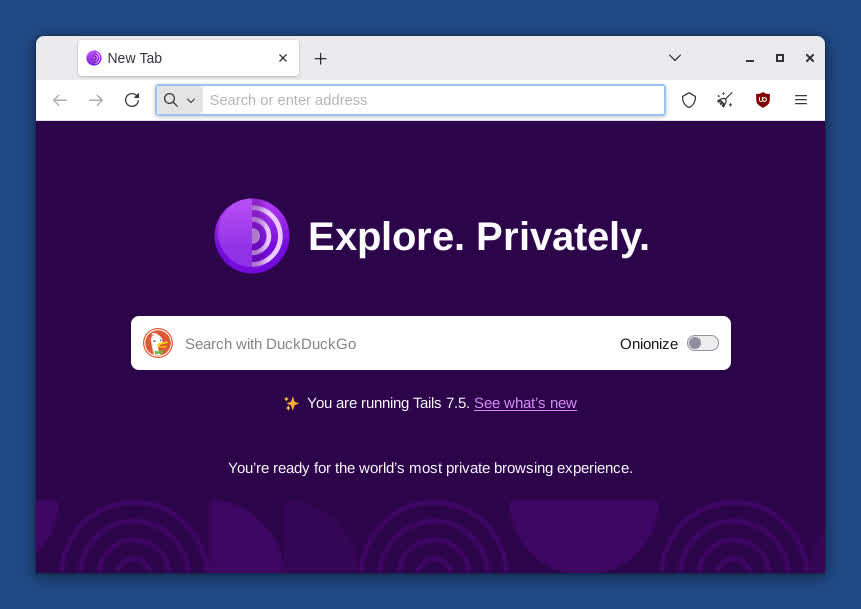
Yes, you can use Tails to circumvent internet censorship and browse the web anonymously. All the applications that come with Tails (email, browser, messaging client, office suite) use the Tor network to connect to the internet, so all your activity can be hidden.
Online anonymity and censorship circumvention with Tor
Tails relies on the Tor anonymity network to protect your privacy online:
Tor is free software and an open network that helps you defend against a form of network surveillance that threatens personal freedom and privacy, confidential business activities and relationships, and state security known as traffic analysis.
Tor protects you by bouncing your communications around a distributed network of relays run by volunteers all around the world: it prevents somebody watching your Internet connection from learning what sites you visit, and it prevents the sites you visit from learning your physical location.
Using Tor you can:
Detection of problems with Wi-Fi hardware
Problems with Wi-Fi are unfortunately quite common in Tails and Linux in general.
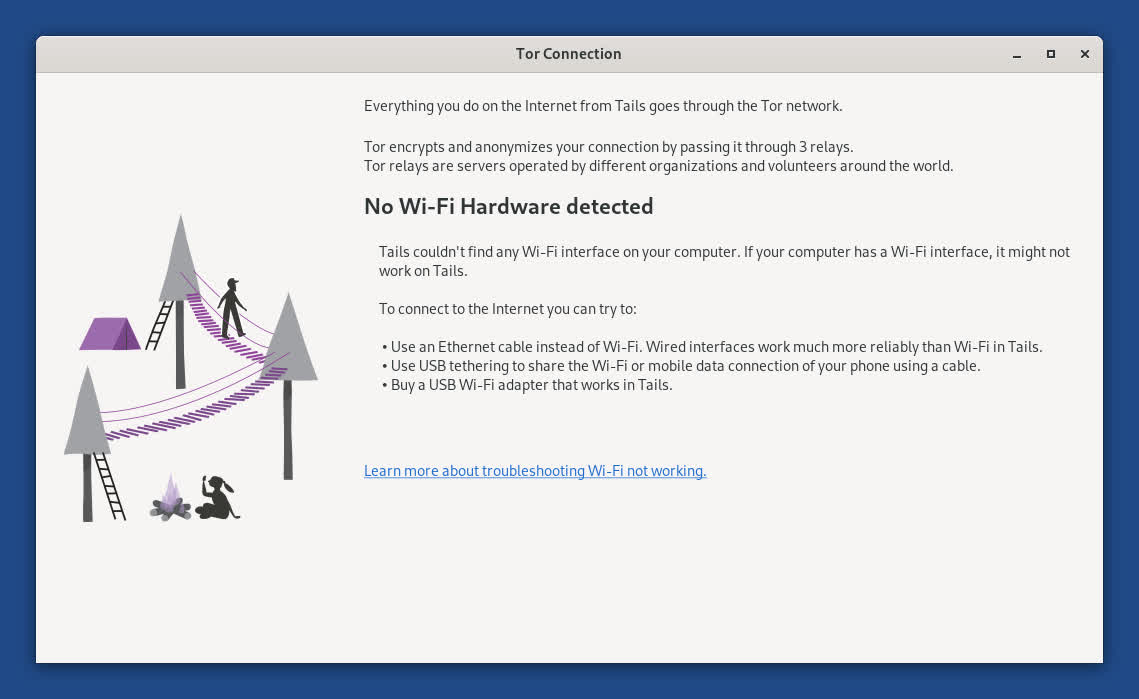
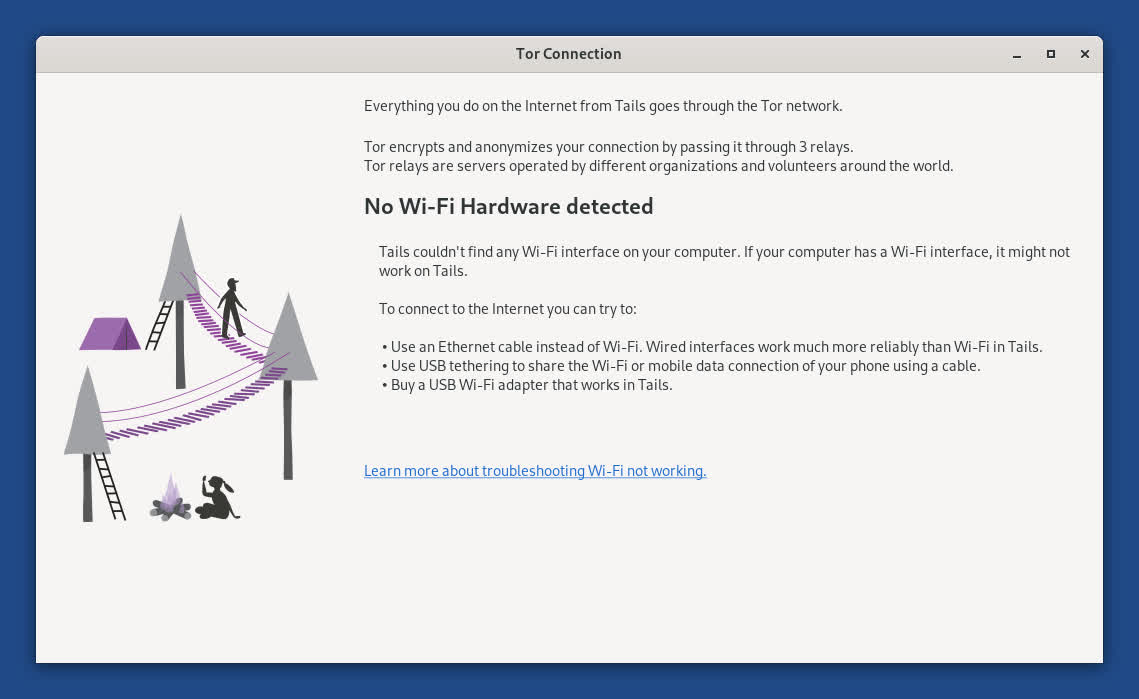
To help troubleshoot hardware compatibility issues with Wi-Fi interfaces, the Tor Connection assistant now reports when no Wi-Fi hardware is detected.
New shutdown procedure
Tails now uses the standard shutdown procedure from GNOME.
The standard shutdown procedure is a bit slower, but better prevents data loss.
For example, the Power Off confirmation dialog informs you if an application needs to be closed or an open document needs to be saved before shutting down.
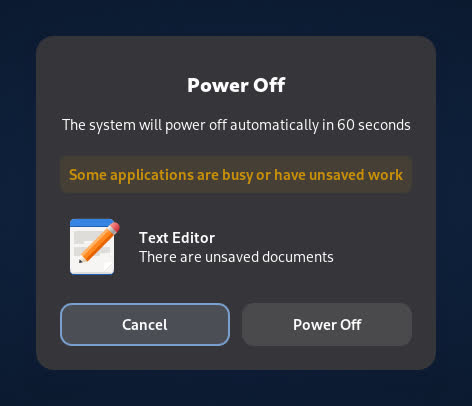
Even without confirming or saving the open documents, Tails will shut down after 60 seconds.
You can still use the faster emergency shutdown as before.
Celluloid video player
We replaced GNOME Videos with Celluloid, a more modern and reliable video player.

For added security, Celluloid cannot access the network. You can either:
Celluloid doesn’t work on some computer from 2011 or earlier.
Changes and updates
For more details, read our changelog
Tails 7.6 changelog
GNOME Secrets
Tor Browser 7.4.2 Changelog
Changes and updates
Fixed problems
Tails 7.4.1
Included software
Fixed problems
Tails 7.4 Changelog
Tails 7.1 Changelog
Changes and updates
Fixed problems
Tails 7.0 Changelog
Tails 7.0 is dedicated to the memory of Lunar (1982 – 2024). Lunar was a traveling companion for Tails, a Tor volunteer, Free Software hacker, and community organizer.
Lunar has always been by our side throughout Tails’ history. From the first baby steps of the project that eventually became Tails, to the merge with Tor, he’s provided sensible technical suggestions, out-of-the-box product design ideas, outreach support, and caring organizational advice.
Outside of Tor, Lunar worked on highly successful Free Software projects such as the Debian project, the Linux distribution on which Tails is based, and the Reproducible Builds project, which helps us verify the integrity of Tails releases.
Lunar will be deeply missed, both in our community and in the many other communities he participated in.
Faster startup
Tails 7.0 starts 10 – 15 seconds faster on most computers.
We achieve this by changing the compression algorithm of the Tails USB and ISO images from xz to zstd. As a consequence, the image is 10% bigger than it would be with the previous algorithm.
While testing this change, we noticed that Tails on USB sticks of poor quality can also start 20 seconds slower than on quality USB sticks.
If you are in a place where counterfeit electronics are common, we recommend that you buy your USB stick from an international supermarket chain, which should have a more reliable supply chain.
Included software
Changes in GNOME
Removals
Hardware support
Previous release notes
Changes and updates
Fixed problems


Ukraine’s CERT has uncovered attacks distributing an archive containing the legitimate Notepad++ application and a malicious utility called LunchPoke disguised as a plugin to establish persistence.
The campaign has been attributed to a threat cluster tracked as UAC-0099, which primarily targets organizations in Ukraine and has previously been linked to providing initial access for attacks carried out by APT44, also known as Sandworm.
The attackers do not exploit any vulnerability or a supply-chain compromise impacting the popular software.
CERT-UA observed that UAC-0099 changed their modus operandi recently and now delivers a ZIP archive with a VBS script disguised as a PDF document. When launched, the PDF retrieves another compressed file named Evernote.zip.
The second archive contains a complete copy of the legitimate editor Notepad++ version 8.8.3, a malicious plugin (NppExport.dll), a password-protected archive (updater.rar), and the legitimate WinRAR executable.
.jpg)
The VBS script installs the package into a randomly named directory, launches Notepad++, and then loads the malicious NppExport.dll via the application’s normal plugin-loading mechanism.
CERT-UA explains that this DLL is LunchPoke, a tool that creates a scheduled task on Windows and extracts the contents of the RAR file, including RemoteLibUpdater.exe and InitTest.dll.
The executable in the RAR file is BurnyBear, a loader for the DLL file that is the MatchBoil V2 malware loader.
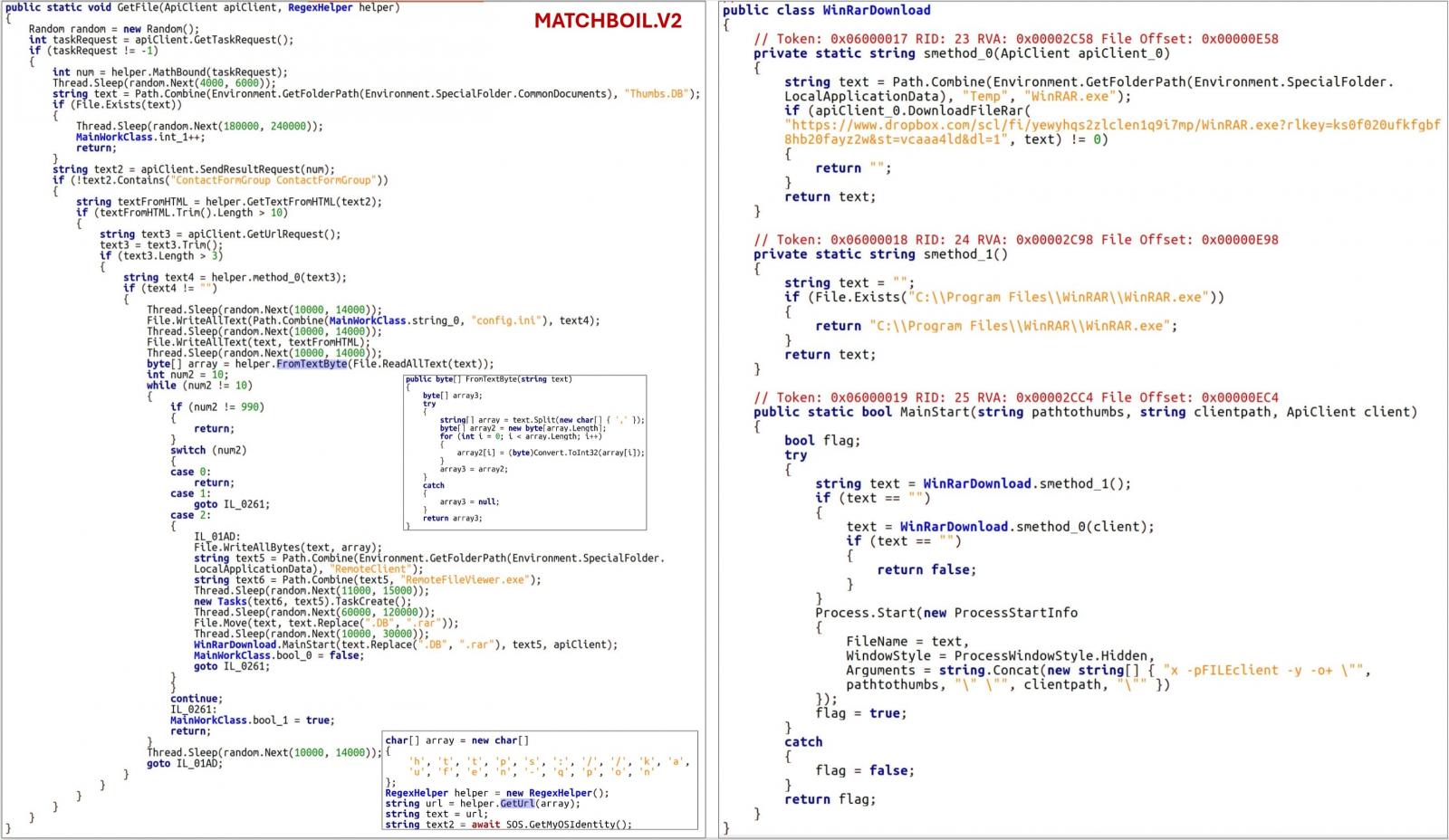
BurnyBear also features a fallback mechanism in case launching RemoteLibUpdater.exe fails, triggering a resource exhaustion attack targeting the host’s RAM and CPU.
The latter creates another scheduled task, updates its configuration and command-and-control (C2) address, and then uses WinRAR to extract downloaded programs.
CERT-UA does not mention the final payloads delivered in the observed attacks, the purpose of the campaign, or the targeted organizations.
The researchers mention CVE-2025-56383, a DLL hijacking flaw in Notepad++ v8.8.3, the exact version used in these attacks, but note that the Notepad++ team has disputed this issue, claiming that plugin loading is standard functionality.
CERT-UA advises system administrators to update Notepad++ to version 8.9.7, 7-Zip to version 26.02, and WinRAR to version 7.23, to prevent hackers from exploiting known flaws in existing products and enabling stealthy attacks.
Security teams log 54% of successful attacks and alert on just 14%. The rest move through your environment unseen.
The Picus whitepaper shows how breach and attack simulation tests your SIEM and EDR rules so threats stop slipping by detection.

How is it possible that a graduate, who is the top of his cohort from a local university, equipped with four internships at companies like DBS Bank, attended 10 career fairs and networking events, and sent out more than 300 resumes in the finance sector, still hasn’t landed a full-time job?
The question is especially puzzling given the latest figures from Singapore’s Ministry of Manpower (MOM), which show there were 32,800 entry-level professional, managerial, executive and technician (PMET) vacancies available for new graduates.
Each year, around 25,000 to 30,000 degree holders enter the workforce—fewer than the more than 32,000 entry-level PMET vacancies that have been available in recent quarters. In other words, there are, at least on paper, more entry-level jobs than fresh graduates to fill them.
Yet, despite what the numbers suggest, some graduates are seemingly still struggling to secure full-time employment.

While vacancy numbers fluctuate quarter to quarter with hiring timelines and recruitment cycles, the share of entry-level roles within each sector has stayed broadly consistent.
Public administration and education, as well as health and social services, are the most fresh-graduate-friendly sectors, where more than half of the vacancies are suitable for applicants with little to no work experience.
Coming in next are the manufacturing, construction, transportation and storage, food and beverage services, and administrative and support services sectors, where there are many engineering and quantity-surveying jobs. In these sectors, more than four in 10 vacancies are open to entry-level applicants.
On the other end of the spectrum, the infocomm and financial and insurance services are two industries that graduates aspire to join for higher starting pay, attractive perks and strong career prospects. Yet, only 22.2% of infocomm vacancies and 25.3% of financial services roles are entry-level, per MOM’s Q1 2026 data.
For fresh graduates set on these sectors, breaking in is significantly harder.
Derrick Teo, chief executive of manpower consultancy Elitez Group, told The Straits Times: “The graduate job market is still active, but it is more uneven and selective compared with two or three years ago.”
More graduates are having to take up temporary or contract roles as stepping stones towards a full-time gig, the publication wrote.

“The issue is not that there are no jobs. It is that there is a mismatch between where graduates want to work, where employers are hiring, and the skills employers now expect from fresh graduates,” Teo added.
The mismatch is particularly evident in the infocomm sector, where the post-pandemic hiring boom has cooled. There were 4,600 vacancies in Q1 2020, before it surged to 11,700 in Q1 of 2022, and fell to around 5,300 in the first quarter of 2026.
Of those 5,300 vacancies, only about 1,200 are suitable for entry-level applicants.
In 2020, that would have been almost enough to accommodate the 1,367 information technology graduates. But by 2024, the number of IT graduates had almost doubled to 2,694, according to data from the Ministry of Education, making competition much more intense.
The tables have turned. Employers now hold the power that graduates once commanded.
Computing students used to land multiple job offers before graduation. Now, many take longer to secure their first role, said Li Xiaoli, head of the Information Systems Technology and Design Pillar at Singapore University of Technology and Design (SUTD).
With a larger pool of candidates to choose from, companies have the “luxury of selecting the very best,” he said.

One recent computer science graduate, Gary, whom the Straits Times spoke to, said that employers have become far more selective even when hiring interns.
As internships are increasingly being a prerequisite for full-time jobs, more students are stacking multiple stints to bolster their resumes.
This makes competition stiffer for everyone.
Final-year students who need internships to fulfil graduation requirements now vie not just with peers, but juniors chasing the same spots.
“Quite a number of students did capstone projects in place of internships because they couldn’t find one,” Gary said, referring to final-year projects where students apply what they have learnt.
He felt his coursemates’ lack of real-world experience would put them at a further disadvantage in the job hunt.
Gary explained that was why he decided to “bite the bullet” and grab any internship opportunity that came his way, even if it was an SME or a company with discouraging Glassdoor (job and recruiting platform) reviews.
Employers are increasingly looking for candidates who can “demonstrate practical experience, specific skills, adaptability and readiness to contribute from the outset,” said Susanna Leong, deputy president (academic) and provost at Singapore Institute of Technology.
Prasanthi Guda, Acting Director of Career and Employability Services at Singapore Management University’s (SMU) Dato’ Kho Hui Meng Career Centre, said that employers are also hiring more cautiously in response to economic uncertainty, geopolitical developments and rapid technological change.

But employers aren’t the only ones being choosy. Even in a tougher market, many graduates remain selective about where they apply.
Some prefer a more targeted approach, relying on personal connections for job leads and applying only for positions they genuinely want. Others are taking their time with applications, and choosing alternative paths like furthering their studies.
Some are even holding out for a better job with higher pay, despite qualifying for other sectors.
Calvin Chung, JTC’s assistant chief executive for engineering and operations, told the Straits Times that attracting fresh graduates to the built environment sector—construction, engineering, and related fields—remains challenging, especially as enrolment in these courses declines.
“The perception problem is real, as younger students see the sector as traditional, physically demanding and slow to change, especially when compared with industries like tech and finance,” he said.
“The reality is actually different, where engineers today work with sophisticated digital tools on impactful projects,” he added.

A 2025 MOM School-to-Work Transition Study of 2,500 recent graduates found most expected higher starting salaries than the actual median in their fields. Only law, education, and fine and applied arts graduates had realistic expectations.
The mismatch was especially pronounced among graduates in information technology, business, and the natural and mathematical sciences.
Many had looked at the Graduate Employment Survey—based on self-reported earnings—and expected over S$5,000 for their first job. But recent postings suggest employers are offering around S$4,000, Gary said.
SUTD’s Li said it is common for students, especially the most competent and ambitious ones, to aim for high-paying jobs at companies such as Google or OpenAI. But he added that they should be “realistic” as tech multinational companies are becoming more cautious about their headcount.
Shamim Akhtar, course chair at Temasek Polytechnic’s School of Informatics and IT, urged students to broaden their job search. “We should not be fixated on tech companies,” he said, noting that financial institutions, government agencies, and healthcare organisations also need tech talent.
Recent data from Infocomm Media Development Authority’s Singapore Digital Economy Report 2025 supports this, projecting faster growth in demand for tech professionals at non-tech firms than at tech firms.

Competing against hundreds of graduates is tough enough. Now, many young job seekers face another worry: rapid AI adoption.
Except for sectors like health and social services, where jobs are believed to be “human-centric” and less prone to automation, concerns about AI replacing junior roles are looming, especially in knowledge-based industries.
AI adoption is the highest in infocomm at 74.1%, followed by professional services at 57.5% and financial and insurance services at 56.4%, per MOM’s latest survey.
But the same survey suggests AI is, for now, reshaping work rather than eliminating jobs. Just 6.2% of adopting firms reported reducing headcount or hiring because of the technology.
Some industry watchers’ observations corroborate this.

Callam Pickering, Indeed’s senior APAC economist, said graduate demand picked up considerably in the first five months of 2026 versus the same period in 2025. Around 80% of those opportunities sit in occupations highly exposed to AI-driven transformation.
“This is not yet a market where recent graduates need to compromise,” he said.
Moreover, Sharon Tan, Vice-Dean (Industry Relations) at the National University of Singapore’s School of Computing, said AI adoption will create “a strong need for professionals who can design, build, evaluate and deploy these systems responsibly and effectively”.
“While hiring conditions may be more subdued now than during the recent technology boom, Singapore’s continued digitalisation and significant investments in AI research, innovation, infrastructure and enterprise adoption are expected to sustain demand for computing talent over the longer term,” she added.
Still, universities are increasingly weaving AI into existing curricula or launching AI-focused degrees to future-proof their students’ careers.
For students, demonstrating proper and effective AI use is critical, said Temasek Polytechnic’s Akhtar. They should learn to build applications using large language model APIs, document their process on platforms like GitHub, and show employers how AI enhances their work.
“Employers are looking at how you augment your thinking, rather than let AI replace your thinking,” he said.
In actuality, for many graduates, the bigger frustration right now isn’t AI taking their jobs—it’s AI deciding whether they even get an interview.
Several told the Straits Times that AI-driven resume screening has made hiring feel more opaque, with applications vanishing into what feels like a “black hole.” They agreed that waiting for responses that never come has become common.
Some graduates, like Gary, have accepted that hearing back from a recruiter is no longer guaranteed.
Out of the 150 applications he has sent since Jan, he has received only one verbal offer, but has not heard from the company for almost two months.
Featured Image Credit: 2p2play via Shutterstock


CISA is warning that the Russian state-sponsored hacking group Laundry Bear, also known as Void Blizzard, is targeting organizations using Zimbra Collaboration email servers by combining phishing attacks with the exploitation of a now-patched Zimbra vulnerability.
According to CISA, Laundry Bear has targeted and compromised users in organizations associated with the Defense Industrial Base (DIB), federal and local government, education, energy, law enforcement, media, non-governmental organizations, and technology.
The attackers exploit the Zimbra CVE-2025-66376 flaw, a cross-site scripting (XSS) vulnerability affecting Zimbra Collaboration Suite’s Classic UI.
The flaw allows JavaScript embedded in specially crafted HTML emails to execute automatically when a victim views the message, enabling attackers to steal account data without requiring the user to click a link or visit a phishing site.
According to CISA, Laundry Bear exploited the flaw as a zero-day before Zimbra patched it in November 2025 and continues to target organizations running unpatched servers. The vulnerability was later tagged by CISA as actively exploited in attacks.
CISA says Laundry Bear’s exploit is used to automatically collect and send the victim’s last 90 days of emails, email address, password, Global Address List (GAL), and two-factor authentication (2FA) tokens.
The attackers also create and send back a new Zimbra application passcode, which is used by legacy email clients like IMAP or ActiveSync that do not support the TOTP authentication flows. Using a passcode allows the attackers to retain access to the email account while bypassing MFA.
According to CISA, the malware exfiltrates stolen information over both DNS and HTTPS to an actor-controlled server running the group’s “Flowerbed” collection framework.
Smaller data is encoded and transmitted in DNS A-record queries, while larger payloads, including mailbox data, are uploaded over HTTPS as compressed archives to the attacker-controlled servers.
In addition to exploiting the Zimbra flaw, Laundry Bear also utilizes adversary-in-the-middle (AiTM) phishing kits designed to impersonate legitimate Zimbra login portals, stealing credentials and session cookies, allowing the attackers to gain access to targets’ email accounts.
CISA released IOCs that show the campaign used sites that impersonate Zimbra infrastructure, using domain names like ‘mailnalysis.com’, ’emailanalytics.com.ua’, ‘zimbrastat.com’, ‘zimbra-metadata.com’, ‘istc-cloud.com’, and ‘zmailanalytics.com’.
The advisory recommends that organizations using Zimbra:
CISA also recommends implementing phishing-resistant multi-factor authentication where possible.
The Laundry Bear hacking group was first attributed to cyberespionage attacks in May 2025 by the Dutch intelligence agencies.
The Dutch agencies publicly attributed the group to a 2024 compromise of the Dutch National Police that exposed the personal information of police personnel and led to the identification of a previously unknown Russian espionage group.
Microsoft tracks the same group under the name Void Blizzard.
Since at least 2024, the group has focused on intelligence collection against organizations aligned with Russian strategic interests, primarily targeting NATO member states and Ukraine.
Microsoft has also documented successful compromises of organizations supporting Ukraine, including entities in the defense, transportation, and aviation sectors.
Earlier this year, BleepingComputer reported on a separate Laundry Bear campaign targeting Ukraine’s military using charity-themed phishing emails to deliver malware disguised as donation requests.
Security teams log 54% of successful attacks and alert on just 14%. The rest move through your environment unseen.
The Picus whitepaper shows how breach and attack simulation tests your SIEM and EDR rules so threats stop slipping by detection.





Weekend Open Thread – Corporette.com


The House | The City of London can help the new chancellor deliver growth in every postcode


Ripple Payments Joins MiCA With 14 Firms, Does It Mean Anything For XRP?

Two July Windows Left: The CLARITY Act’s Senate Fight and What Failure Means


Democrats look to World Cup watch parties to register thousands of voters


Ripple wins EU-wide access as ESMA adds it to MiCA register


Grayscale Files For Worldcoin ETF, WLD Registers Sharp Rise


Sail Virtually Aboard The “Itanic” With IA-64 Emulator


Unregistered fitter used Gas Safe logo on business flyers

Turtle Beach Command Series KB7 review: a nifty screen-equipped gaming keyboard


Registration is now open for March for Men with Kev 2026


Big Money Is Entering XRP

New Jersey voter registration controversy explained: How 6,600 noncitizens got on the rolls, and what happens next


Kaspersky exposes OkoBot’s 20-module crypto wallet attack


Airlines warn Sunshine Protection Act could disrupt flight scheduling

Johnny Depp’s R-Rated Gothic Cult Classic Gets New Release Ahead of Sydney Sweeney Remake


Durham County Council to send out electoral registration emails


MiCA Licensing Faces Delays as ESMA Adds 14 CASPs to Register


Ethics, other provisions in crypto Clarity Act to be further discussed


Chip Stocks Enter Bear Market After Moonshot Ai Unveils Kimi K3 Model



You must be logged in to post a comment Login