
Join Mikko Hyppönen and security leaders from the NFL, CHANEL, and Atlassian for a two-hour digital summit on what AI-speed attacks change, what defenders should stop doing, and how to validate, decide, fix, and re-validate at machine speed.
Tech
Fake LastPass Authenticator GitHub repos push new Rapuncel infostealer



An ongoing malware campaign uses SEO-optimized GitHub repositories to impersonate well-known software firms to push a previously undocumented information stealer called Rapuncel.
LastPass and Delphos Labs uncovered the campaign, which they report impersonates the password manager brand and at least 39 other companies.
Alongside the Rapuncel infostealer, the repositories deliver a Microsoft-signed kernel driver that can disable 145 antivirus and endpoint detection and response (EDR) products.
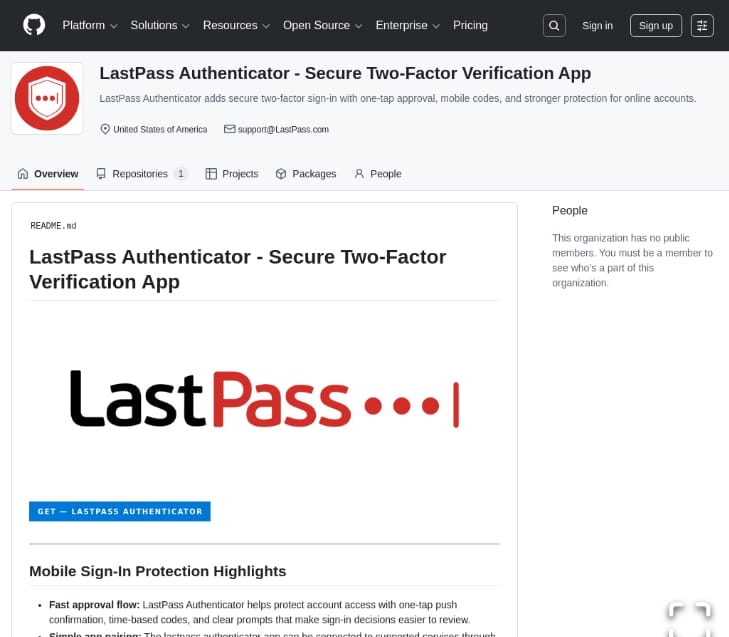
The attack chain begins when victims search for LastPass Authenticator or other popular software and follow links to fake GitHub repos.
There, clicking download buttons triggers a series of redirections before reaching payload-delivery servers, where victims receive ZIP archives with their size inflated to up to 148MB to evade security scans.
The installer inside the archives is a copy of the legitimate Microsoft Visual Studio CoreCLR Debugger, ‘vsdbg.exe,’ renamed and configured to sideload a malicious DLL (vsdbg.dll). The installer deploys the Rapuncel infostealer as well as the Alinubx.sys kernel driver, which is used to kill antivirus software.
Source: LastPass
The kernel driver is disguised as an NVIDIA component named ‘nvfsflt64.sys’ and registers as the NvFsFilter service.
According to the researchers, the driver acts as an EDR killer that contains a hardcoded list of 145 antivirus and EDR processes that it aims to terminate.
“The driver calls ObOpenObjectByPointer with AccessMode=KernelMode, which bypasses the normal user-mode SeAccessCheck path at handle-open time,” explains LastPass.
“It asks the kernel to open the process as kernel code, then kills it. That is why it can defeat Protected Process Light (PPL); the protection many security products rely on to survive an administrator.”
Currently, the driver is not in Microsoft’s vulnerable drivers blocklist, and the one used in the campaign is signed through Microsoft’s Windows Hardware Compatibility Publisher chain.
The researchers noted that Alinubx.sys contains additional capabilities for file and registry hiding, DLL injection, driver and process interception, traffic manipulation, and port redirection, but do not appear to be activated in this campaign.
The Rapuncel infostealer
Once security software is terminated on the device, the Rapuncel infostealer begins stealing data from the infected device.
The malware collects the following information:
- Credentials stored in 25 web browsers
- Data from 30 cryptocurrency wallets
- Discord, Steam, and Telegram session credentials
- Windows Credential Manager contents
- Documents with names containing “password,” “seed,” “wallet,” or “recovery”
- Screenshots from every connected monitor
- Detailed system information
To bypass Google’s app-bound encryption protection present on Chrome, Edge, and related browsers, Rapuncel injects a helper DLL into the app and invokes its own Elevation Service.
The stolen information is compressed and uploaded to an external endpoint at ‘2.26.126[.]50‘ using an HTTP-formatted request sent over raw TCP.
Rapuncel persists across reboots via a Windows service, so any security tools that reactivate are killed again before the infostealer launches.
LastPass and Delphos Labs assessed with moderate confidence that Rapuncel is a variant of BoryptGrab, while they also found that its loader was built with the Cruciferra PUROSANGUE crypter.
Users are recommended to only download software from official websites, avoid dubious GitHub repositories, and skip or block promoted results on Google Search.


Continue Reading
The Gyazo image-sharing platform has confirmed it suffered a data breach after hackers exploited a server vulnerability that allowed them to steal 23.6 million user records.
Gyazo is a cloud-based screenshot and screen-recording tool operated by Helpfeel that automatically uploads user screen captures to the cloud and gives them a shareable link to share on chats, forums, social media, etc.
It’s especially popular in gaming communities and claims 23 million users worldwide, who have submitted 3.1 billion media items.
According to an announcement by the company, the incident occurred on September 11, 2026, allowing attackers to access its database and obtain approximately 23.62 million user records.
The company has now taken the platform offline while it conducts maintenance.
“Currently, the Gyazo service is temporarily suspended for maintenance as a preventive measure. We sincerely apologize for any inconvenience caused. Please wait a little longer until recovery,” reads a post on X.
The company detected the suspicious activity on September 12 and fixed a vulnerability the attackers used to breach the platform, but by then, the data had already been stolen.
“Our subsequent investigation confirmed that the third party had accessed Gyazo’s database and that user information and metadata associated with uploaded images had been disclosed without authorization,” confirmed Gyazo in a statement published earlier this week.
Based on Gyazo’s investigation, the data that has been exposed varies per user and may include one or more of the following:
- Names/nicknames
- Email addresses
- Password hashes
- User and device IDs
- Login session IDs
- X integration tokens
- Google SSO email addresses
- Profile details
- Subscription information
- Billing status
- Usage statistics
The exposed dataset includes anonymous account records, though Gyazo did not share what percentage those represent.
The platform also stated that the incident exposed 490 million image metadata records, most associated with images uploaded to the service before January 2019.
These metadata include image IDs used to construct image URLs, upload IP addresses, User-Agent strings, EXIF location data, OCR-extracted text, image titles, source URLs, and hashed passphrases for private images.
Helpfeel notes that image IDs can potentially be used to access the corresponding content, which is why the company has temporarily disabled access to files whose records were exposed.
Additionally, it stated that the hackers also obtained a list identifying private images, and the company cannot rule out that some were viewed.
The firm said its investigation has not found signs of data being deleted due to this incident.
The company also found no evidence that its other Helpfeel and Cosense services had data stolen.
The firm is notifying affected users directly as they conduct an investigation with external experts, and have contacted the authorities.
All Gyazo users are advised to change their passwords on the service and other platforms where they use the same credentials, and remain alert for suspicious communications.
Join Mikko Hyppönen and security leaders from the NFL, CHANEL, and Atlassian for a two-hour digital summit on what AI-speed attacks change, what defenders should stop doing, and how to validate, decide, fix, and re-validate at machine speed.
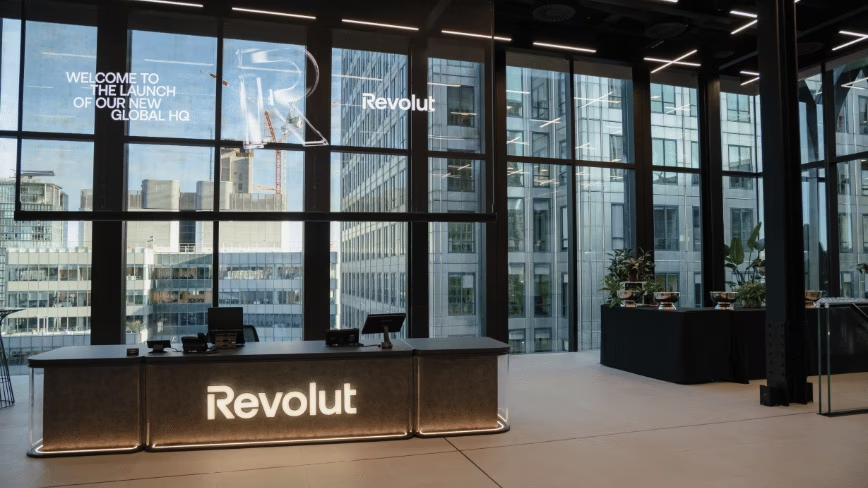
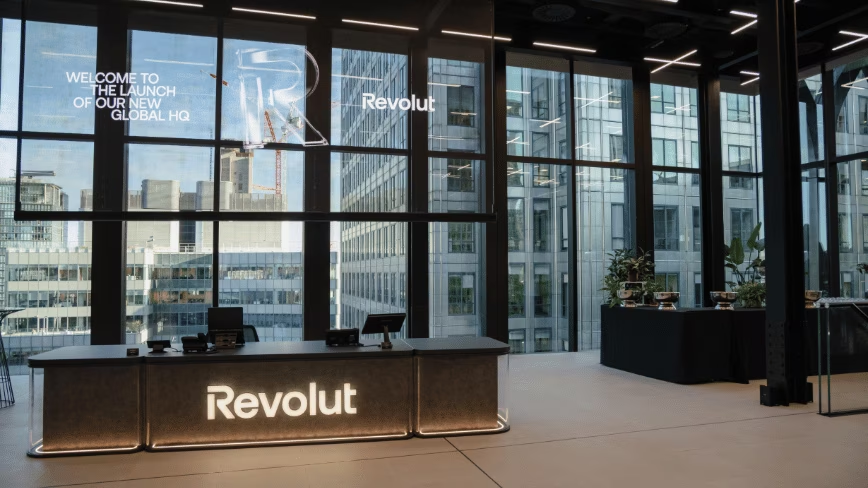
“In reality, we are currently planning a dual listing, on the London Stock Exchange and the Nasdaq,” Nik Storonsky told Les Echos.
The Revolut founder was in Paris on Monday. Gabriel Nédélec and Ingrid Feuerstein interviewed him for the French paper, which published on Thursday.
It is the first time he has pointed to a London listing. Revolut was valued at $115bn in a share sale in July, and a float at that level would make it one of Britain’s largest listed companies.
He spent two years saying the opposite
Storonsky has been dismissive of the London market for years. In 2024 he said it could not compete with the United States.
His objection was specific. Britain charges 0.5% stamp duty on share purchases, and he argued that made a London listing uneconomic.
“The UK is less liquid so it’s much worse compared to the US plus it’s much more expensive because you pay stamp duty,” he said at the time. He called listing in Britain “just not rational”.
The Telegraph reports that the stamp duty is still in place. What has changed is the size of the company and the state of the market he was dismissing.
London has lost more than it has won
The London Stock Exchange has been through a long drought of new listings. Companies have stayed private or gone public elsewhere.
Wise is the case that stings most. The money transfer firm left London for Nasdaq, moving its primary listing to New York this year.
AstraZeneca has been building up its New York presence while keeping its FTSE 100 place. A partial Revolut listing would be the first significant win London has had in a while.
Dual listings are also uncommon. The companies that run them tend to be among the largest and most heavily traded.
The interview was mostly about Europe
Storonsky was in Paris for a reason, and it was not the stock market. Revolut has just won a French banking licence, and France is meant to become the base for its European expansion.
The company counts 70 million customers worldwide. Just over 30 million of them are in Europe.
That French banking licence is not the full one yet. Les Echos reports that European authorities have set conditions before Revolut can offer mortgage lending.
Last week it added a sixth banking licence, in Colombia. It also received a full UK banking licence in March, having applied in 2021.
Why he still prefers New York
Storonsky was blunt about the arithmetic. The American market is simply bigger.
“We have the choice between selling in a small market with few buyers, or in a gigantic market with a huge number of buyers who will compete fiercely for our shares,” he told Les Echos. “Therefore, yes, we prefer the United States.”
He also made a retail argument. A strong consumer brand in the United States means customers buy into the offering themselves, which he said lifts the market capitalisation.
The venue he named in New York was the Nasdaq. That is the same exchange Wise moved to.
Nobody has set a date
Storonsky said earlier this year that a listing would not happen before 2028. In April he put it at roughly two years away and made it conditional on the market.
A person close to Revolut told The Telegraph that a float would be subject to market conditions. Nothing said this week changes that.
Revolut reached its $115bn valuation in a secondary share sale in July, up from $75bn in November 2025. It is the most highly valued fintech in Europe.
His own stake has been part of the preparation. In August the company moved to let him borrow against his own shares, up to $250mn.
Revolut was founded in London in 2013 and works out of Canary Wharf. Storonsky has called British regulators bureaucratic and said it is hard to do business in the UK.
Napster, the music-sharing service that once sent the record industry into panic, has returned with a new plan to bring AI into classrooms through digital versions of teachers. According to Wired, Napster has teamed up with Gems Education in Dubai to build AI powered digital versions of teachers, giving students round the clock access to a virtual copy of their instructor.
How Napster went from sharing MP3s to creating AI clones
If you remember Napster from 1999, this pivot probably sounds bizarre. The original peer-to-peer service upended how people shared music before a wave of copyright lawsuits forced it to shut down in 2001. The name cycled through several failed reinventions over the years, most recently as a music streaming platform, until Florida-based Infinite Reality bought it for $207 million in 2025 and pushed it toward AI.
The music service quietly disappeared this year around January. Samuel Huber, who now runs Napster’s Middle East and Africa operations, says the company was always about handing power back to users, and now that fight is about data and artificial intelligence instead of music.
Is Napster trying to replace human teachers?
Napster plans to build digital twins of real teachers, trained directly on their course material, papers, and lessons, so students can ask questions and work through concepts outside class hours. Huber describes it as creating a copy of yourself to scale your own time, while teachers get insight into which topics students are struggling with.
The first phase rolls out at the Gems School of Research and Innovation, alongside gamified learning tools and AI-assisted content creation. Huber insists this augments teachers rather than replacing them, comparing it to how word processors help people write faster without eliminating the writer.
Huber also thinks that AI could help educators provide more individual support without replacing real classroom relationships. He says student data will remain within the country and won’t be used to train Napster’s models.
The UAE approved a federal plan in May to shift half its government services to agentic AI within two years, and it’s clear that Napster wants a piece of that transition, backing it with local infrastructure partnerships across the UAE and Saudi Arabia. However, the plans are still being tested, and Napster maintains that primary teacher and student interaction will continue happening in the real world.

Even before the latest batch of alarming AI news, a lot of Americans were souring on AI. That may be for big, existential reasons — concerns about widening inequality, mass job loss, and the still-unclear environmental impact of data centers — or for very specific, personal, everyday ones, like being forced to use a worse version of Google search.
None of this is to say that AI cannot be a useful tool for some people some of the time. It’s just that the untested technology was thrust upon millions of people who didn’t necessarily ask for it and really seem to not like it. More than twice as many Americans distrust AI as trust it, and a growing number of people think it will have a negative impact on productivity and economic growth, according to a recent survey by Gallup and the Special Competitive Studies Project. While about half of Americans now report using chatbots, a majority also think that AI will put their personal information at risk and nearly half think it will have a negative impact on society, according to a 2026 Pew study.
“It’s being forced on users, there’s no clear way to turn it off, and it feels like this unwelcome addition to their lives,” Rory Mir of the Electronic Frontier Foundation, a nonprofit that defends digital privacy and free speech, told me. Mir told me. “It’s this kind of continued pattern of disrespect to users that I think is part of the pushback.”
If you want less AI in your life, opting out is not always easy. But there are things you can do to minimize your exposure.
There are ways to turn off AI features, although the process can be tedious. There are also steps you can take to prevent your data from being used to train AI models, though it’s difficult to keep all of your online data away from web scrapers.
I talked to five experts — including a computer scientist and a researcher studying AI resistance — who offered distinctive perspectives on what AI is doing to us, and who shared some simple and concrete steps you can take to push back against AI’s creep into our daily lives.
The AI that’s suddenly everywhere
In the early days, which were just a few years ago, you really had to know what you were doing if you wanted to test out AI. Now, it’s impossible to avoid.
“More and more AI use is through its integration into digital products like search, email, camera apps, and social media,” Arvind Narayanan, a computer science professor at Princeton University, told me. “It will become increasingly hard to strip these out unless one is willing to forgo digital products altogether.”
3 simple ways to engage with AI less
What you’re specifically encountering is generative AI, and one of the most common types is a subset called large language models (LLMs), which ingest huge amounts of data and learn statistical patterns to predict and generate text. ChatGPT is powered by an LLM. The AI Overviews that sit on top of your Google search results come from an LLM. The grammar checker in your email app is likely powered by an LLM. Other subsets of generative AI include models that can produce images, video, audio, and software code.
The data that makes many of these tools work has been scraped from the open web, pirated books, and rare print books that are subsequently being destroyed. Everything from Wikipedia articles to YouTube videos has become training data for LLMs, and in order for the models themselves to get better, AI companies need more fresh data, which is in increasingly short supply. (Disclosure: Vox Media is one of several publishers that have signed partnership agreements with OpenAI. Our reporting remains editorially independent. Future Perfect is also funded in part by the BEMC Foundation, whose major funder was also an early investor in Anthropic; they don’t have any editorial input into our content.)
As a result, some of these companies are venturing into their users’ profiles to find more data. Meta, for example, sparked global outrage in 2024 when it informed some Facebook and Instagram users that it was using their public photos and text to train its AI models. Meta still does this. That your family photos or social media updates are being used to train AI to look and sound more human is, at the very least, very dehumanizing.
Generative AI, of course, is not the only type of AI that’s invisibly moving levers in your digital life. Recommendation algorithms are arguably even more inescapable. They power everything from Amazon to Netflix to Spotify and dictate what we buy, what we watch, and what we listen to. If you have trouble picking out an outfit in the morning, it might be because your brain is used to having algorithms around to help make decisions. This is also dehumanizing.
All of this — the existential risk, climate impact, the cognitive surrender — should be on your mind as you consider whether it’s worth enlisting these tools to write emails for you or to generate memes, according to Tania Duarte, founder of We and AI, a nonprofit focused on critical AI literacy.
“People are becoming increasingly aware of not just the impact on themselves but on the impact on the society they want to live in and the future that they want to have,” Duarte told me. “Is it worth all of that?”
How to minimize your AI exposure
If you’re reading this, you’re probably doing so on a smartphone or a computer. So let’s start with the assumption that you’d like to continue using devices like these.
If you’d like to minimize your exposure to AI, that presents a bit of a paradox. It’s seemingly impossible to use mainstream tech products without engaging with AI. But you can take steps to remove as much of it from your life as possible without going completely off the grid.
“You look for the spaces of agency rather than lamenting the fact that you can’t escape everything,” Dylan Orchard, a researcher at King’s College London who studies everyday resistances to AI, told me. “You can’t expect a perfect escape.”
Let’s start with the easiest options: You don’t have to use ChatGPT or Claude or Copilot. The same goes for Google Gemini and Apple Intelligence. If you’re happy with the way you access information online, save yourself the time. (Note: This will be much harder to do if you’re being required to use these tools at work or at school, so for the sake of this article, we’ll focus on the things you can control.)
Things get more complicated when you consider how your existing devices or software have recently been AI-ified. If you’re using an iPhone, for instance, you might be aware that the latest operating system comes with an updated version of Apple Intelligence, a layer of AI that does everything from summarize your notifications to power a new Siri. Earlier this year, Google launched its own version of this layer called Google Intelligence, which it says will make Android transition “from an operating system into an intelligence system.” The same push toward cramming AI into every corner is also happening on Windows 11, where Microsoft Copilot promises to be helpful.
If you were happy with your phone or laptop when it was slightly dumber, however, you can turn these features off. You can also opt out of other AI features built into your device’s operating system. Here’s a helpful guide that gets into the weeds of how to do it; it covers Apple Intelligence; Google Gemini, including AI Overviews and AI writing help in Gmail; Microsoft Copilot; Meta AI; and Samsung Galaxy AI. Turning off the AI features on Android devices is more complicated than flipping a single switch, but it can be done.
A lot of your AI exposure will happen in your web browser, though, so you should consider ways to bypass those features or switch browsers. Here’s another helpful guide that explains how to remove AI content from search results as well as AI features built into Chrome and other browsers, along with Microsoft Office. If you want a quick fix, adding “-ai” to a Google search should get rid of AI Overviews and some AI content in the search results, but none of these hacks will guarantee that you avoid AI slop altogether. Using a privacy-focused browser, like DuckDuckGo, might do a better job at it than Google, though.
When it comes to other online activities, like shopping or scrolling on social media, avoiding AI gets even harder. TikTok, Instagram, Facebook, and YouTube lack a master switch that lets you opt out of all the many AI features on offer. Still, you can try to tone down the algorithmic sorting that all the apps use to serve you content by switching to a chronological feed or removing suggested content from your feed. (Try tapping the Instagram logo in the app and then hit “Following” to see just the accounts you follow.)
Unfortunately, once you dig into the various user agreements and privacy policies, you’ll find that it’s very difficult to avoid AI exposure on social media platforms. If you’re posting publicly, you should assume your content is being used to train that company’s AI models. (You can keep some of your data away from Meta’s crawlers by setting your Facebook or Instagram account to private. X also allows you to opt out of having your data used for training its AI.) If you want to turn off video summaries on Instagram Reels, too bad. You can’t. If you want to turn off comment summaries on Facebook, you’ll have to go four menus deep in your settings to find the right switch. The most straightforward way to avoid being used as training data is to stop using these apps entirely. Or at least stop posting your own content, which is easier said than done, but worth considering if you really want to resist the AI takeover.
There’s a programming term that describes the inundation of AI features and slog of opting out: “user-hostile.” It’s a play on the term “user-friendly,” and it describes software that values the company’s priorities over the end users. You may love AI, although that’s doubtful if you’ve read this far. If it drives you crazy, though, you should feel at least a little bit empowered to know that there’s a way to reclaim the experience you had and loved without AI — or to use AI on your own terms.
“Ultimately, I think the important thing for folks to keep in mind is that AI is just a tool,” said Mir from EFF, “and it makes sense to want control over your own tools, including the option to not use a tool if it’s not right for you.”
It’s frustrating that we have to deal with this at all, if only because most of us did not ask for our cyber existences to be sullied by untested tech. But it’s actually refreshing to consider that, because of a never-ending onslaught of annoying features, AI might actually discourage us from using social media so much.
If anything, the extent to which we feel the need to flee from AI also reflects our craving for something real, that makes us feel more connected and more human. So when AI summaries interrupt your time on Instagram, consider texting your friends a handful of photos from your week or calling them on the phone. If you’ve finally seen one too many AI slop videos on TikTok, put on a classic movie or TV show.
At the very least, put down your phone and take a walk outside; your attention span will thank you for it. Yes, your individual rejection of AI might be a drop in the bucket for these huge tech companies, but that doesn’t mean it’s not worth doing anyway.
Chinese AI startup Manus, which earlier this year had to break off a merger with Meta, is in discussions to raise $500 million at a $4 billion valuation now that it has resumed operations as an independent company, The Wall Street Journal reported, citing anonymous sources.
Potential investors in the round include IDG Capital, Boyu Capital, battery maker Contemporary Amperex Technology, as well as existing backers Tencent, HSG and Zhenfund, the Journal reported. Manus is also said to be considering a restructuring exercise to prepare for an IPO in Hong Kong.
Manus, which went viral following a demo of its AI agent last year, relocated its staff to Singapore in mid-2025 before announcing a $2 billion acquisition deal with Meta that December. The startup was said to be pulling in annual recurring revenue of over $100 million at the time.
However, intensifying worries in China over losing AI talent and researchers to the West culminated in Beijing blocking the deal, citing potential violations of export controls and foreign investment rules.
Manus has since been untangling itself from the American social media giant, and its early investors and backers have reportedly helped the company buy back its shares at a valuation of about $2 billion.
As part of its separation from Meta, the company told its users this August that they would have to export and back up their own data because it had to delete data generated following Meta’s acquisition to “comply with regulatory requirements in specific jurisdictions.”
The company this month said it has resumed independent operations, and that its founding team will continue to lead it.
Manus makes AI products and agents that are pretty similar to what companies like OpenAI, Lovable and Replit offer. It offers a chatbot and vibe-coding tools to let users build apps, websites, create designs and presentations, generate video, a browser assistant, and more.
Manus did not immediately return a request for comment.
When you purchase through links in our articles, we may earn a small commission. This doesn’t affect our editorial independence.
Use your Smart TV’s built-in app when it already supports the services you need and works well. Use Chromecast or Google Cast when you prefer choosing content from a phone or computer, while a streaming stick makes more sense when you want a separate, replaceable app platform for the TV.
One detail matters in 2026: Google ended production of Chromecast hardware in 2024 and replaced it with Google TV Streamer. Google Cast still works with supported existing Chromecast devices, Google TV Streamer, and compatible TVs, so Chromecast remains relevant even though Google no longer makes new Chromecast hardware.
The Difference in One Minute
All three approaches can put streaming video on the same television, but the software doing the work lives in a different place.
A Smart TV app runs directly on the television’s built-in operating system and processor. For example, an LG webOS television can install supported apps through the LG Content Store without adding another HDMI device. LG notes that app availability can vary by TV model and region.
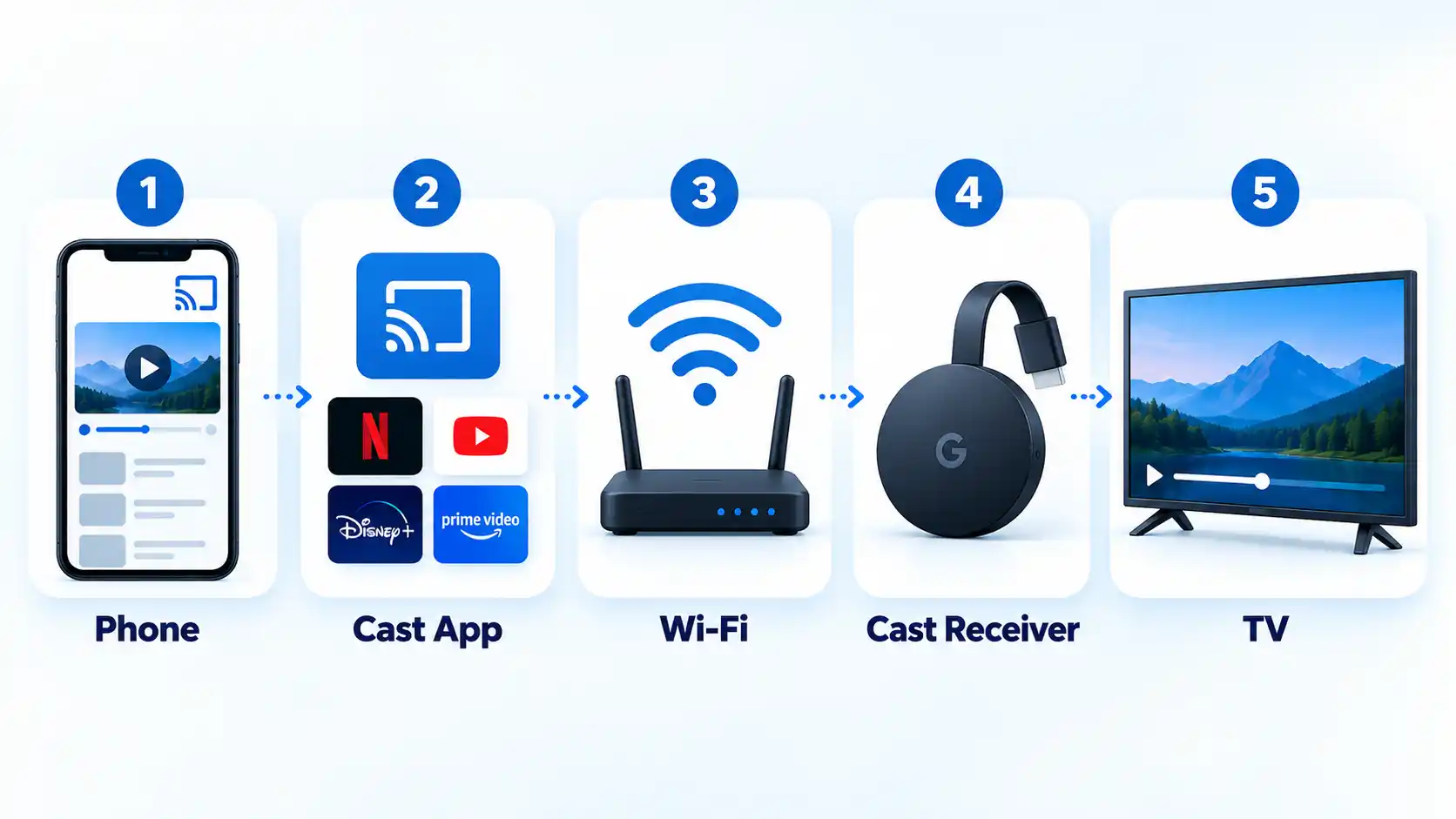
Chromecast or Google Cast uses a compatible phone, tablet, computer, or app to select media and send playback to a supported Chromecast, Google TV Streamer, or television with Google Cast. Google’s current instructions require compatible devices and, for normal local casting, the sender and receiver to be on the same Wi-Fi network.
A streaming stick is a separate computer for streaming that plugs into an HDMI port. Devices such as current Roku Streaming Stick models and Amazon Fire TV Sticks contain their own operating system, applications, Wi-Fi connection, processing hardware, and remote rather than depending on the television’s built-in Smart TV platform.
That difference affects app availability, control, portability, setup, and what happens when the television’s original software becomes outdated.
Smart TV App vs Chromecast vs Streaming Stick: Key Differences
The useful question is not which category is universally better. Compare where the apps run, how playback is controlled, what extra hardware is required, and how easily the streaming platform can be changed later.
| Feature | Smart TV App | Chromecast / Google Cast | Streaming Stick |
|---|---|---|---|
| Where apps run | On the TV’s built-in operating system | Media is selected from a compatible sender and played through a Cast receiver | On the stick’s separate operating system |
| Extra hardware | None when the TV already supports the app | A Cast receiver unless Google Cast is built into the TV | A separate HDMI streaming device |
| Main controller | TV remote | Usually a phone, tablet, computer, or compatible app | Dedicated streaming-device remote |
| Extra HDMI port | No | Yes for standalone Chromecast hardware; no when Cast is built in | Yes |
| Additional power | No separate streaming-device power | Standalone Chromecast hardware needs power | The stick needs a power connection |
| App availability depends on | TV platform, model, region, and service support | Source-app Cast support and receiver compatibility | The stick’s platform and service support |
| Portability | Tied to the television | Standalone hardware can move between compatible displays | Can move between compatible HDMI displays |
| Upgrade path | Tied mainly to the TV platform | Continue with compatible Cast hardware or move to another Cast receiver | Replace the stick without replacing the television |
| Good fit when | Your required apps already work well on the TV | You prefer phone-led casting and already have compatible hardware | You want a separate, replaceable streaming platform |
This comparison treats Chromecast mainly as the casting-centered workflow used by the original Chromecast devices and Google Cast. Chromecast with Google TV was a hybrid: it could receive Cast sessions but also ran Google TV apps and included a remote, making its day-to-day use closer to a conventional streaming player.
The biggest structural difference is independence. A Smart TV app is tied to the television’s software platform, while a streaming stick can be replaced independently. Google Cast sits between those models because another device commonly starts and controls the media while the receiver handles playback.
Using the Smart TV’s Built-In Apps
Built-in apps are usually the simplest option when the television already supports the streaming services you use. There is no additional box or stick to connect, and playback remains integrated with the television’s own menus and remote.
Current LG webOS televisions illustrate this model. LG’s support instructions show that users can search the TV’s Apps or LG Content Store, install a supported application, and launch it directly from the television. LG’s current app-installation instructions also show that the exact interface varies between webOS generations.
The main advantage is simplicity. You do not use another HDMI input, add a second streaming-device power connection, or need a separate streaming remote.
The trade-off is that application availability is tied to the television platform. LG explicitly notes that supported apps can differ by TV model and region. A television panel can therefore remain useful even after one streaming service stops supporting that model or operating-system version.
For example, if the picture quality is still good but one service disappears from the TV’s app store, replacing the entire television may be unnecessary. A supported external streamer can move the streaming-software layer to newer hardware while keeping the existing display.
Using Chromecast or Google Cast
Info
Google ended production of Chromecast hardware in 2024 and replaced it with Google TV Streamer. Existing supported Chromecast devices and Google Cast remain relevant, but Chromecast is no longer Google’s current new-hardware streaming line.
Chromecast began as a casting-focused device: choose media on another screen, tap the Cast control, and send playback to the television. That Google Cast workflow remains active even though Google no longer manufactures Chromecast hardware. Google says it ended Chromecast production in 2024 while leaving its existing-device support policy in place for applicable models.
Google’s current Cast documentation lists supported Chromecast devices, Google TV Streamer, and televisions with Google Cast as receivers. To cast from a supported mobile device, Google says the sender and receiver should be on the same Wi-Fi network and the source application must support Google Cast.
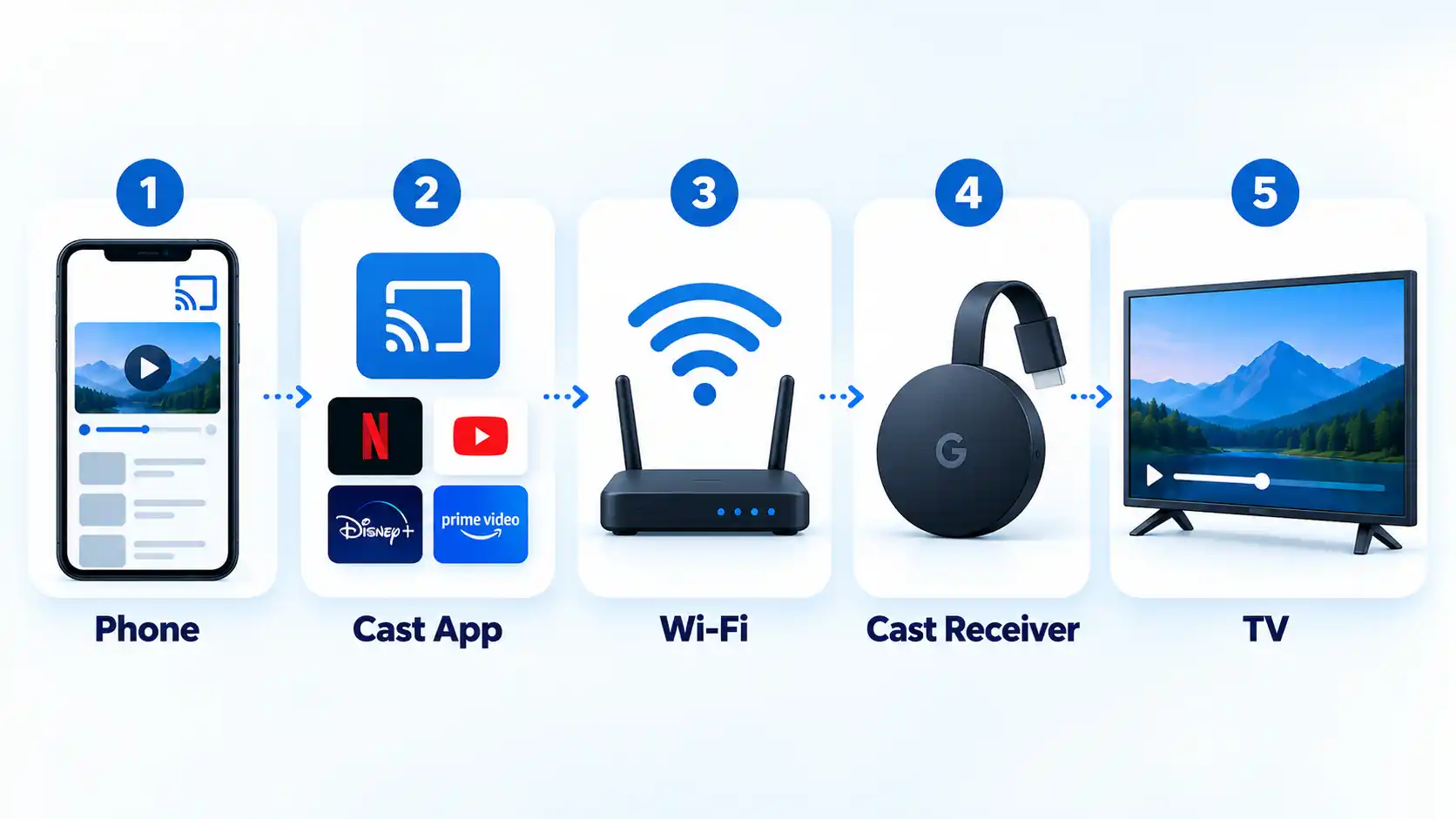
A typical session works like this: you open a supported streaming app on your phone, select the Cast icon, choose a compatible television or receiver, and then control playback from the source device. Google’s current Google Cast instructions document that workflow.
This can be convenient when you prefer browsing on a phone instead of navigating a television interface with directional buttons. It also means an existing supported Chromecast does not automatically become unusable simply because Google stopped producing new units.
There are limits. The source app must support Google Cast, the receiver must be compatible, and device discovery normally requires the sender and receiver to share the same Wi-Fi network. Google also states that support for the first-generation Chromecast has ended; it no longer receives software or security updates or Google technical support.
Casting should also be distinguished from screen mirroring. A Cast-enabled app can send supported media to the receiver, whereas mirroring duplicates the source device’s screen. The two methods do not have identical compatibility or behavior.
Using a Streaming Stick
A streaming stick adds another smart platform to the television without changing the display panel. The television becomes the display and audio endpoint while the stick supplies its own streaming operating system, applications, networking, and interface.
Current Roku hardware shows this architecture clearly. Roku lists Streaming Stick models among hardware it currently manufactures and supports. The current Roku hardware specifications document separate processors, memory, playback capabilities, and Roku OS support for these devices.
The current Roku Streaming Stick Plus, for example, connects through HDMI, uses USB-C for power, has dual-band Wi-Fi, includes a voice remote, and supports up to 4K60 playback with HDR10, HDR10+, and HLG when paired with compatible equipment. Those specifications describe that model rather than every streaming stick.
Amazon Fire TV Sticks use the same general architecture. Amazon’s Fire TV Stick setup instructions require an HDMI connection, external power, Wi-Fi, an Amazon account, and the Fire TV remote during setup.
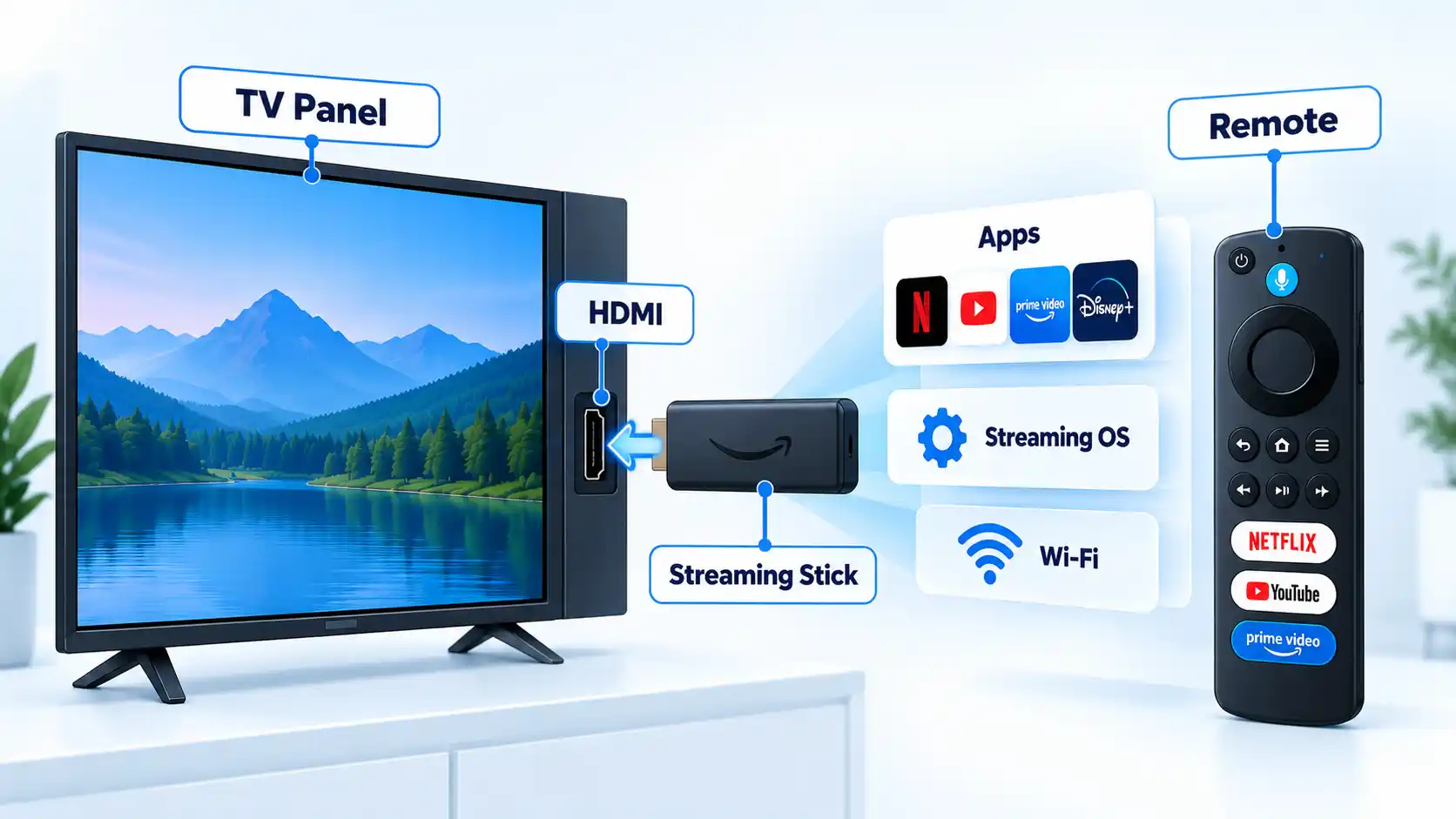
This separation is useful when a television’s built-in software has become the weak point. An older Smart TV can continue supplying the display while a current stick handles applications and streaming navigation.
However, the stick cannot upgrade the physical capabilities of the display. A streaming device capable of 4K output does not turn a 1080p television into a 4K display. The TV, HDMI connection, and streaming device all have to support the required format. Roku, for example, states that 4K HDR playback on its Streaming Stick Plus requires a compatible television and HDMI input.
Which Option Handles App Availability Better?
There is no defensible universal app-count winner because each platform has different support rules, regions, generations, and application stores. The more useful question is what happens when one platform does not carry the application you need.
With a Smart TV app, support depends on the television’s operating system, model, region, and the streaming provider’s continued support. LG explicitly tells users to check app compatibility by country and model in the LG Content Store.
With Google Cast, the source application needs Cast support and the television or receiver must be compatible with Google Cast. An application can therefore work as a phone app without necessarily offering the casting workflow you expect.
A streaming stick uses its own application platform. This separation can help when an app is missing from the television’s native store but remains supported on Roku, Fire TV, or another external platform. It does not guarantee that every service will exist on every streaming device.
If one service appears on an external device but not on the television itself, the reason an app is missing from your Smart TV app store may be the TV model, operating-system version, region, or the service’s platform-support policy.
Which Is Easier to Control?
The answer depends on whether you prefer a conventional remote or a phone-led interface.
A built-in Smart TV app normally uses the television’s existing remote. That keeps the setup physically simple and avoids another controller.
Traditional Chromecast and Google Cast workflows put more emphasis on the sender device. You choose content in a compatible phone, tablet, computer, or app and then send it to the receiver. The sender can continue to control the active Cast session.
A streaming stick generally includes its own remote. Roku’s current Streaming Stick Plus includes a voice remote with TV power, volume, and mute controls, while Amazon’s Fire TV Stick setup process uses the included Fire TV remote.
Some HDMI devices can also control compatible television functions through HDMI Consumer Electronics Control (HDMI-CEC), a standard that lets connected devices exchange control commands. Implementation differs by television and external device, so a single-remote experience should not be assumed for every setup.
Which Is Better for an Older TV?
If the display itself still looks good but the Smart TV platform has lost applications or become inconvenient, an external streaming device can replace the streaming-software layer without replacing the panel.
A streaming stick is particularly straightforward when the television has a suitable HDMI input and you want a self-contained interface with its own remote and app platform. The television does not need to run those streaming applications itself.
An existing Chromecast can also remain useful when your preferred applications continue to support Google Cast and the Chromecast model itself remains supported. Google’s decision to stop producing Chromecast did not make every existing unit stop working. The important exception is the first-generation model, for which Google has formally ended software, security, and technical support.
A non-smart television can also gain a streaming interface from a compatible stick when its HDMI connection and display capabilities meet the device’s requirements.
External hardware cannot solve every aging-TV problem. A failing display panel, broken HDMI input, incompatible video format, or unsupported copy-protection path is different from an outdated Smart TV application platform.
Which option should you choose?
Smart TV App
Choose this if: the streaming services you need already support your television and its built-in interface works well enough for your household.
Avoid this if: required apps are missing or the television’s smart platform has become the main limitation.
Main trade-off: the app platform remains tied to the TV model and its ongoing software support.
Chromecast / Google Cast
Choose this if: you already have a supported Chromecast, another compatible Cast receiver, or a TV with Google Cast and prefer starting content from a phone, tablet, or computer.
Avoid this if: you specifically want to buy a new Google-branded Chromecast dongle, because Google ended Chromecast production in 2024.
Main trade-off: the workflow depends on Cast support in the source app, a compatible receiver, and a sender-centered control model.
Streaming Stick
Choose this if: you want a separate, replaceable streaming platform because the television’s built-in apps are missing, outdated, or inconvenient.
Avoid this if: the TV’s existing apps already meet your needs and you do not want another HDMI device, power connection, or remote.
Main trade-off: you add hardware and another platform, but that platform can usually be replaced without replacing the television.
Bottom Line
The simplest distinction is where the streaming platform lives. A Smart TV app uses the computing hardware already inside the television. Google Cast uses a compatible sender-and-receiver workflow. A streaming stick adds a separate streaming platform through HDMI.
If your TV already runs every service you need, there may be little reason to add hardware. If you prefer phone-led casting and already own supported Cast equipment, it can remain useful. If the television’s software has become the limitation, a current streaming stick can replace that smart-platform layer without replacing an otherwise useful screen.
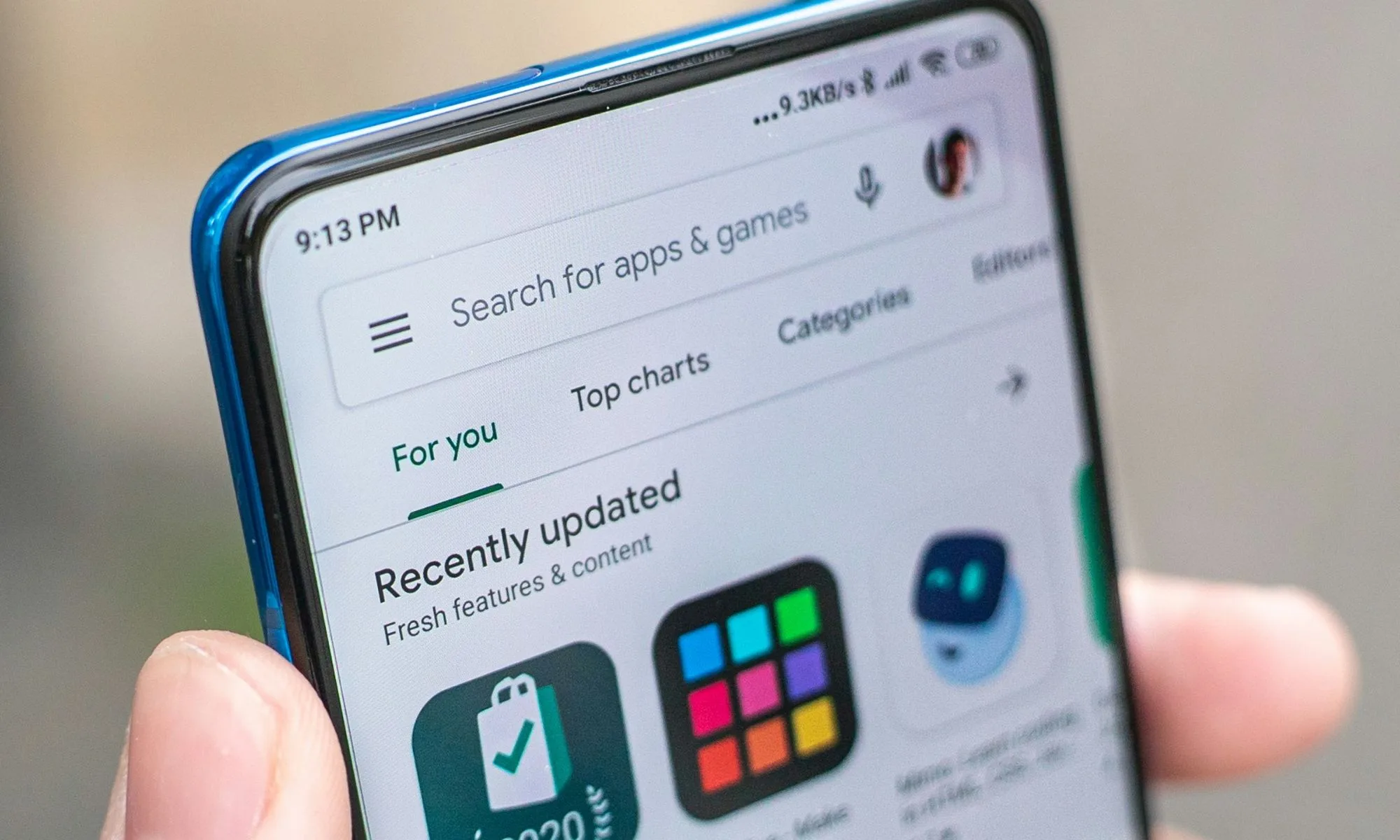
I’ve heard people using AI to improve and speed up their work. But this is the first time I’m hearing of malware taking real-time directions from an AI chatbot as it does its bad business.
All thanks to the research team at Zimperium, we know about this new kind of advanced malware. It’s called RatHat, and it uses an AI chatbot to understand what’s on the target device’s screen.

So, how does RatHat actually use AI?
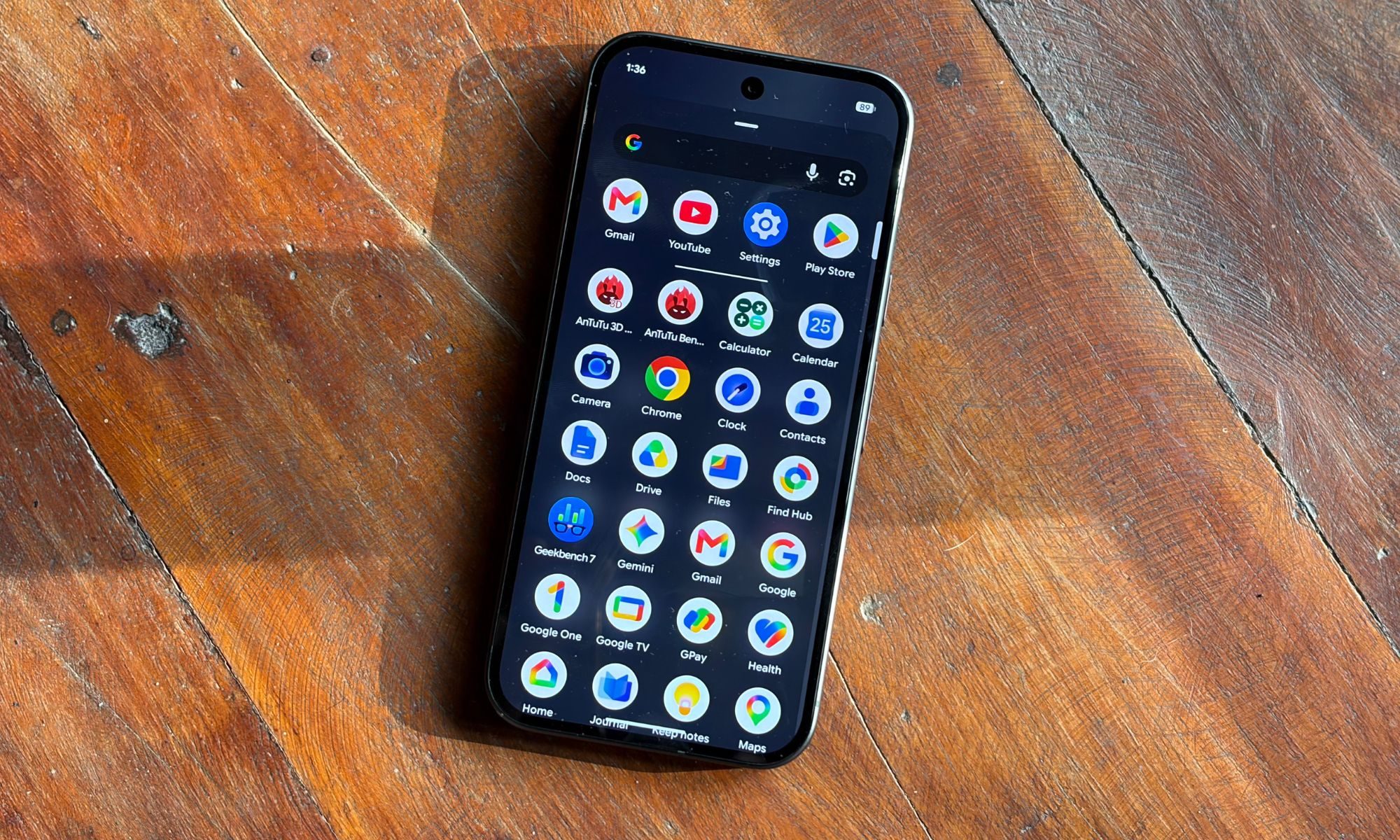
RatHat primarily spreads through smishing texts and malvertising. It sends victims to fake download pages that look legitimate at first but sit outside of the Google Play Store. Once you sideload the malware onto your phone, things get a lot more interesting.
In simple terms, the malware abuses Android’s accessibility settings to enable Developer Options and Wireless Debugging, then pairs itself with the phone’s own debugging bridge (I’m talking about shell-level control). After that, the AI part comes in.
The malware then sends a live map of what’s happening on your phone’s screen to what the report calls “one of the world’s most popular generative AI assistants,” which I’m guessing is already available to everyone.
It then asks the chatbot to identify what’s on the screen, including what a particular button does and the text on the screen. Basically, the AI acts like a pair of eyes and hands for the malware, helping it find out what to do next.
Why deleting the app might not fix anything
All of this, by the way, happens through a fake app the victim installed. The actual damage, however, starts with fake login overlays on banking and crypto apps. It can also record your screen and intercept one-time codes. That is how the malware accesses the sensitive information.
Beyond using AI, RatHat runs a separate, persistent background process that runs a hardware-level keylogger. By reading raw touch-input coordinates directly from the kernel’s touchscreen driver, it matches your finger movements against stored keypad layouts to determine lock-screen PINs and patterns.
And simply uninstalling the app won’t necessarily remove it. RatHat shows a fake Play Store error to make you think the uninstall failed, and even after deletion succeeds, a hidden background process quietly brings it back, with its permissions still intact.
Zimperium’s advice is pretty ordinary, but it’s worth repeating: skip sideloaded apps, be suspicious of any accessibility permission request, and leave Play Protect scanning on. However, if your device is already affected, you’ll probably have to clean it manually via Android Debug Bridge or factory reset it.

Major super PACs associated with AI labs and investors have poured close to $1 million into incumbent Republican Mike Rounds’s South Dakota senate race, seeking to shape the outcome of a noncompetitive race amid a critical national debate over AI regulation.
Rounds has been the beneficiary this cycle of around $600,000 in spending by outside groups, with the vast majority of that figure coming from the super PAC Defend American Jobs, which receives funding from a super PAC financed by the venture capital firm Andreessen Horowitz.
He has also received roughly $215,000 directly from the employees and super PACs affiliated with AI labs, most notably Anthropic, as well as a constellation of other tech companies including Google and Microsoft, according to FEC filings.
With fewer than 50 days until the midterm elections in November, recent polls show Rounds ahead of the independent candidate Brian Beng after the Democratic candidate Julian Beaudion dropped out last month.
Rounds has so far raised more from tech groups than from donors in South Dakota, and this spending reflects a new effort by AI labs to deploy vast war chests to shape thorny issues on AI and the data centers that power it. Rounds has been viewed by AI executives as a top supporter of the industry, which could prove crucial in the next Congress when AI regulation is expected to become a top priority, according to congressional aides familiar with the matter.
It also appears to reflect how AI labs have become focused on keeping allies, which have been in short supply on Capitol Hill as lawmakers spring up a raft of bills as they react to public anxiety around AI safety concerns.
A spokesperson for Rounds did not respond to a request for comment.
On Thursday, Leading the Future, the super PAC funded in part by OpenAI president Greg Brockman, along with investors Ben Horowitz and Marc Andreesen, announced that it would put $2 million towards a raft of Senate Republicans that have been supportive of the AI or crypto industry. The list included Rounds.
In South Dakota, AI regulation is already a live issue after the state legislature passed a bill earlier this year forcing hyperscalers to bear a larger share of the water and energy costs associated with powering data centers.
Data centers have been the subject of a bitter fight among Republicans in the state legislature, which voted against giving tax breaks for equipment and software purchases required by data centers earlier this year, stalling construction of a planned development by Applied Digital, a company that builds and designs data centers.
Rounds also ultimately endorsed adding restrictions on data centers, although his senior aide and former chief of staff, Robert Skjonsberg, is a registered lobbyist for Meta for matters before the South Dakota legislature. (Meta operates a network of data centers, though there isn’t currently a Meta-affiliated center in South Dakota.) Rounds’ office told Politico that their general counsel consulted with the Senate ethics committee about the unusual arrangement and was told there was no conflict of interest.
Concerns about data centers have been bipartisan across the country: A recent Gallup poll for instance found that seven out of 10 Americans are opposed to data center development, given their outsized draw upon water and energy resources that local communities often end up subsidizing.

Seattle-based ModernVivo is using AI to help scientists design preclinical studies for drug discovery. The goal: better experiments that are also faster, cheaper and less reliant on animals.
“You’d be shocked at the way scientists design their experiments,” co-founder Ian Levine told GeekWire. “It’s very manual.”
To design experiments, scientists typically enter keywords into PubMed or another database, receiving hundreds or thousands of results. They then go through each complex paper, typically 30 pages long, to find information relevant to the experiment they’re planning.
Levine spent thousands of hours manually combing through scientific papers as a research undergrad at Virginia Tech, and later as a Ph.D. student at the University of Michigan. He wanted a better way – and in 2022 co-founded ModernVivo with Colin Small, a fellow graduate student he’d met online while Small was pursuing a master’s in biotechnology at Brown University.
ModernVivo’s platform can analyze millions of peer-reviewed publications – cross-referenced with clinical trial and regulatory data – delivering highly detailed results in minutes. Researchers can filter papers by factors including animal model, experimental conditions, author affiliation and publication date, then drill down into more than 40 individual variables used in the experiments.
“We want to make experiments faster,” Levine said, “and help get better drugs to the clinic.”
For Levine, it’s personal: while studying to develop non-opioid pain therapeutics at Virginia Tech, he watched his mother live with a chronic pain disorder.
In the pharmaceutical industry, about 90% of drug candidates that reach human clinical trials go on to fail. Levine suspects part of the problem could lie in the many variables involved in how animal experiments are designed.
ModernVivo occupies a narrow niche in biotech software. Its closest analog is Trials.ai, another AI-driven platform tackling clinical trial design, founded in San Diego and acquired in 2023 by consulting firm ZS.
The Seattle company draws on the paper database of Semantic Scholar, a research tool developed by the Allen Institute for Artificial Intelligence, putting it in loose company with general-purpose research tools like Elicit and Consensus – though none of those are built specifically to extract in vivo protocol details the same way.
ModernVivo’s pitch is that it provides deeper insight than manual literature review or general-purpose AI tools. Ask a general AI chatbot about an experiment, Levine said, and it’ll return the high-level, commonly known approaches. Researchers want every relevant data point, including the obscure European study that might matter for their specific drug candidate but wouldn’t surface in a broad summary.
The software also surfaces contradictions in the literature: if 20 published studies point one way and five point another, ModernVivo flags this rather than picking a winner, since, as Levine puts it, scientists don’t want to be told what to do.
“They’re the people who suffer through the Ph.D. to be an expert in their field,” he said.
So far, the results are speed, confidence and lower animal use, Levine said. Tracking whether a study leads to a successful drug takes years, so he’s cautious about claiming translational impact. But customers have told him work that used to take about a month now takes as little as an hour.
Researchers who use ModernVivo report more trust in their initial study design, he said, and run fewer duplicate or follow-up animal experiments, which cuts down on animal use and the cost of housing and caring for animals.
ModernVivo has more than 20 customers ranging from small biotech firms to large pharmaceutical companies. It also offers ModernVivo Scholar, a version for academic researchers launched last October, with plans ranging from free to $50 a month.
The company has been through multiple accelerator programs: a WTIA founder cohort in 2023, Creative Destruction Lab’s Seattle program, which it graduated from in June 2025, and the Merck Digital Sciences Studio’s third cohort. The company has raised $1 million in a pre-seed round, and Levine said fundraising is going well as the company looks to expand.
ModernVivo’s attention is now shifting from the design phase of an experiment to execution. The company launched the ModernVivo Marketplace on Sept. 15, matching a finished study design against a network of pre-vetted contract research organizations, analytical labs and specialist dosing facilities. Suppliers of compounds and animal models are listed as coming soon.
Once a study is designed, researchers often don’t know which vendors have the right supplies or which contract research facilities are equipped to execute it, and tracking that down has meant manual search and outreach. ModernVivo wants to remove that ambiguity and connect scientists directly to the right vendor.
“The way we position ourselves in the future,” Levine said, “is helping scientists go from study design to study execution faster than ever before.”


North of Seoul on September 16, a 29-foot uncrewed aircraft left a conventional Army runway, joined air operations over a live-fire range, then settled onto a rough maneuver trail normally reserved for tanks and artillery. Ground-station pilots sent it rolling again. It lifted off in less than 200 meters, resumed the sortie, and flew back to the 513th Aviation Battalion. General Atomics Aeronautical Systems and Hanwha Aerospace called the sequence the first battlefield short-field operation ever completed by a medium-altitude, long-endurance uncrewed aircraft. The Mojave STOL carried dual weapon rails loaded with four inert AGM-114 Hellfire missiles and wore South Korean markings for the Defense Drone Technology Exhibition at Seungjin Training Field in Pocheon-si. In a real fight, crews on that same trail could have refueled and rearmed it before sending it back up.
High lift wings with leading edge slats, double slotted flaps, and drop down ailerons allow the 52-foot-wide aircraft to use runways ranging from 100 to 300 meters length. According to published estimates, the takeoff distance for a full load is roughly 122 meters, but carrying a dozen Hellfires would likely increase that to closer to 305 meters. Even with all the trimmings, including weapons rails, the aircraft managed a takeoff distance of less than 200m and a landing roll distance of less than 100m during this demonstration. Its 7,000-pound airframe is powered by a 450 shaft horsepower Rolls-Royce M250 turboprop, and it has a usable load of roughly 3400 pounds, which is just enough to carry all of the gear required for an extended operation (sensors, communications, and up to 16 Hellfires divided across 7 hardpoints).
Sale

SKYROVER X1 Drone with Camera Combo with Screen Controller, 4K/60fps Video, 8K Photo, 360° Obstacle…
- Cinematic 4K/60fps HDR Video & 48MP Photos: Captures smooth 4K/60fps HDR video and detailed 48 MP photos with a 1/1.32″ CMOS sensor and f…
- 5.5″ HD Touchscreen Remote — See Every Detail, Even in Direct Sunlight: 700-nit brightness and 60Hz display delivers crystal-clear live view…
- Under 249g & Travel Ready: Under 249g and easy to pack, the drone with camera for adults is built for grab-and-go flying without adding bulk to your…

There are no other aircraft that can provide the same amount of endurance, range, and cargo as this one. No other aircraft has been able to recover and take off from a difficult area of terrain like the one from which the advanced troops would operate. They’d already done the same thing at Mojave in early 2023, with deck landings on the Royal Navy’s HMS Prince of Wales and the ROKS Dokdo, as well as some live minigun firing, as they’d demonstrated in Korea. This demo introduced something new to the mix: a forward site that looked just like the terrain the soldiers would be fighting in, rather than one of those neat little airfields that are only used in movies.

Linden Blue, GA-ASI’s CEO, believes the flight demonstrates that the aircraft is more than capable of undertaking the type of tactical activity seen on a real battlefield: disputed austere operations, weapon delivery, resupply, and short takeoffs from tough terrain. Hanwha’s Buhwan Lee believes this is a significant step forward for their joint 2025 co-development agreement, in which they intend to collaborate on South Korean, US, and other regional consumers. The Gray Eagle STOL will be the name given to the final production version. They expect to conduct a critical design review in November 2026, followed by a first flight in 2027, at which point Hanwha hopes to have achieved at least 70% Korean content in the aircraft.

After that, the demonstrator heads to Changwon for a little of Industry Day at Hanwha. Settling for a traditional runway that will always be a target for the enemy is a bit of a cop out; with an aircraft that can launch from a tank track, a riverbed, or just about any old piece of dirt you can find, commanders have options for persistent surveillance and strike that they simply don’t have elsewhere. What Mojave just demonstrated is that you don’t have to be a genius to figure out how to make all of this work; it’s simply a matter of understanding that in the real world, you can’t always count on having a perfectly good runway available.
[Source]

Entertainment6 seconds ago
‘Doctor Who’ Officially Ruled Out A Legendary Cast Member’s Return

Fashion41 seconds ago
Weekend Open Thread: Talbots – Corporette.com

News Videos2 minutes ago
Bayley RETURNS | Sol Ruca qualifes for Money in the Bank Ladder Match: Raw highlights, Sept. 7, 2026

Fashion7 days ago
Weekend Open Thread – Corporette.com

Tech1 week ago
Memory prices are slowing because buyers ran out of money

Business1 week ago
Micron Stock Climbs Above $1,031 as AI Memory Crunch and a $50 Billion Outlook Fuel the Rally
News Videos2 minutes ago
Bayley RETURNS | Sol Ruca qualifes for Money in the Bank Ladder Match: Raw highlights, Sept. 7, 2026

News Videos9 minutes ago
This is the largest USB Bitcoin Mining Setup in the world! |#Shorts | How Much?

News Videos15 minutes ago
Corporate Office Interior Transformation | UNIMONI by Wizz Financial
-
 Fashion7 days ago
Weekend Open Thread – Corporette.com
-

 Tech5 days ago
The Latest Weird Thing to Play Doom Is the Mapped-Out Brain of a Fruit Fly
-

 Crypto World4 days ago
Kraken Lets xStocks Holders Earn Yield Through DeFi
-

 Crypto World2 days ago
US Charges Robinhood Engineers Over Crypto Listing Trades
-

 Entertainment7 days ago
News Specials, Movies, Shows, More
-

 Crypto World6 days ago
Can AI Build a Startup in 72 Hours? Elon Musk's Team Will Livestream the Test
-

 Crypto World4 days ago
Elon Musk Drops a Bombshell: Grok 5 Could Be the AGI Breakthrough
-

 Business5 days ago
Rivals Sam Altman and Elon Musk Rally Behind Dario Amodei’s Call for a Slowdown in AI Development
-

 Crypto World3 days ago
What Is the Status of the U.S.-Iran Peace Talks? Here's What Both Sides Are Saying
-
 NewsBeat4 days ago
‘Sick conspiracy’: Trump says only guardrails AI needs is ‘a strong and smart (High IQ!) president’ in all-caps rant
-

 Crypto World5 days ago
New Tesla Roadster Uses SpaceX Tech. Will It Impact the Stock Price?
-

 Crypto World7 days ago
Robinhood Chain Never Stopped But its Blobs Did Stop Reaching Ethereum For 14 Minutes
-

 Crypto World3 days ago
NVIDIA Analysis: Attempted Rising Wedge Breakout Amid Pressure on the AI Sector
-
 Entertainment7 days ago
New Horror Movie Officially Earns a Rare Stephen King Recommendation
-

 Business6 days ago
Marvell: Most Potent Setup Of The AI Factory Decade
-

 Crypto World4 days ago
Revolut Attackers Warn of Ongoing Daily Customer Data Leaks
-

 Crypto World4 days ago
DOJ Seeks to Seize $61M in Iran Oil Funds From Binance Accounts It Vouched For
-

 Crypto World6 days ago
Bitcoin ETFs lose $462.7M as Ethereum funds gain $196.9M
-

 Crypto World5 days ago
3 Token Unlocks to Watch in the Third Week of September 2026
-
Business4 days ago
SK Hynix ADRs Fall More Than 6% as Memory Rally Breaks on Fears of Slower AI Spending
You must be logged in to post a comment Login