









Connect with us

Tech

First Look at ESOX X2, an Electric UGV with Four Quiet Motors and a Thousand Newton-Meters for the Last Mile

Published

on

ESOX X2 Unmanned Ground Vehicle UGV
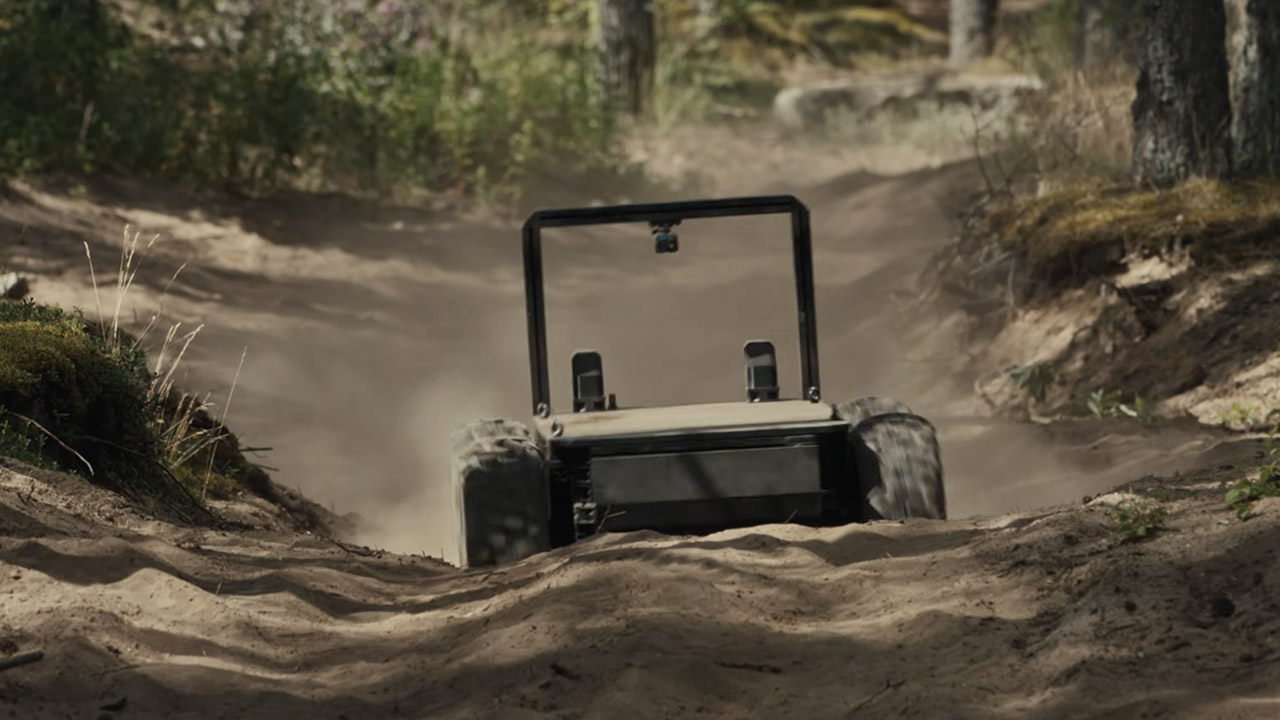
Soldiers still burn hours and calories moving water, ammunition, and radios across ground that wrecks ordinary trucks. Pack animals once filled that gap. Conventional electric robots often stall in the same mud, sand, snow, and rubble because their motors sit in the middle of the chassis and feed torque through gearboxes and shafts that lose grip the moment the surface turns ugly. ESOX Group finished a compact uncrewed platform, called the X2, this summer that tries to skip that failure.


Four in-wheel motors, specifically Theron motors, lie within the hubs and produce 1,000 newton meters of torque, 250 of which goes to each corner. That’s a lot of power without the need for a gearbox or driveshaft, or the additional weight that comes with them. Devan Roberts, their VP of defense programs, believes that this arrangement eliminates all known flaws in uncrewed ground vehicles and that nothing, no terrain, gradient, or payload, can halt it in its tracks. These motors are relatively quiet and cold to run, which is significant because heat and noise will not trip all of the sensors designed to detect engine signatures.


Amphibious Remote Control Car, 1:18 Monster Truck Toys for Boys RC Cars
  • 2.4 GHz Remote Control Car – 1:18 scale cool design, waterproof RC truck toys made of premium material and sturdy, with LED lights, waterproof remote…
  • High Quality & DIY Removable Toys RC Cars – This remote control monster truck structure design quality, flexibility and strength in one. The rc truck…
  • All Terrain Amphibious Monster Truck – 4-wheel drive off-road design rc trucks for kids, with high-quality tires (shock absorption, strong grip…

ESOX X2 Unmanned Ground Vehicle UGV
The platform weighs 300 kilograms (about 661 pounds), and testers have already successfully loaded another 300 kilos to match the vehicle’s weight. Later on, they hope to increase it to 600 kilograms. An 8 kilowatt hour solid-state battery powers things, divided into two 4 kilowatt hour modules. ESOX asserts that this chemistry stores about twice the energy of lithium-ion cells found in fielded military vehicles, giving them a longer range or allowing them to battle for the same amount of time but with less weight. If that wasn’t enough, the batteries have a lesser fire danger than liquid electrolyte packs.

ESOX X2 Unmanned Ground Vehicle UGV
The chassis is much smaller than a typical four-by-four, and early test cars included 12 inch motors in a tank-steer layout, as well as some sophisticated airless tires designed to withstand punctures. ESOX OS software allows engineers to create a digital twin of the vehicle before they begin connecting gear together. Once deployed, the device begins transmitting live telematics and sensor data and accepts over-the-air updates for the duration of the vehicle’s life. All of the sensor packages, autonomous modes, and communication layers can be altered without affecting the motors or batteries, so you can essentially keep the core and construct your own versions around it.

ESOX X2 Unmanned Ground Vehicle UGV
ESOX Group is very new, having formed from Donut Lab’s defense division and combined with Finnish unmanned systems expert ESOX Aero in late 2025. They have teams in the UK, Finland, and Estonia, and their CEO, Dan Walmsley, previously worked at McLaren Automotive. They unveiled a tech demonstrator at CES 2026, and customer pilots began in late August, once the platform was declared ready. Any Tank Steer metrics, like as 120kW peak and over 200 kilometers of range, refer to the general design rather than the specific 1,000-newton-meter X2 configuration that is currently being tested.
[Source]

Source link

Advertisement
Continue Reading
Click to comment

You must be logged in to post a comment Login

Leave a Reply

Tech

Responsible AI for Higher Education

Published

on

This interactive webinar will introduce the different types of AI, address the concerns with AI, share how we IBM are approaching Responsible AI, and offer guidance to students about what they can do – as individuals, and members of their IEEE chapters. Participants will also have the opportunity to to apply the Responsible AI approach to a particular use case – IBM Bob, a software development life cycle agent, and Q&A. This will be an interactive session, so have phones ready to engage!

Register now for this free webinar!

Source link

Advertisement
Continue Reading

Tech

What Are The Differences Between Them?

Published

on

Both serve the same purposes, but there are some subtle differences.

Apple Wallet and Google Wallet, as their names suggest, have similar purposes. You use them as your digital wallet: a secure place to keep your payment cards, tickets and other everyday passes on your phone. Apple Pay and Google Pay are the services that handle the payments, but it’s the Wallet apps that store everything. The names are often used interchangeably, though they refer to different parts of a connected process.

As long as the retailer accepts mobile payments and your card’s payment network, and your card provider supports the wallet service, you should be able to use your digital cards to pay in-store and online. Which one you use is dictated by whether you own an iPhone or an Android phone. They’re both similar in the basics, but have some differences in what you can add and how you’re able to use them.

Advertisement

Both tools offer similar core functionality

Google and Apple both want the Wallet app to be your go-to place for everything you’d otherwise stick in your physical wallet or purse. Credit and debit cards are the obvious items, but this also also includes loyalty cards, gift cards, boarding passes, event tickets, and train or bus tickets. It can even hold NFC-supported passes, like a digital hotel key or car key, as well as workplace access cards for buildings. This all depends on your location and whether the company providing the pass supports digital wallets. As long as NFC support is there, there’s a chance it’ll work.

Getting your payment cards into either app is straightforward. In Apple Wallet, tap the plus button and choose Debit or Credit Card. In Google Wallet, tap Add to Wallet > Payment card. You’ll need to follow the prompts, then verify with your bank or card provider. As long as the issuing entity supports this function, the card should then be set up for you to use.

Some differences become apparent in support for other passes. Apple Wallet expects items you’re adding to officially support digital wallets; you’ll usually see an Add to Apple Wallet button in emails, apps or similar. This is useful, as it means the Wallet app can support specific features. For instance, if an airline supports it, a boarding pass will automatically update with gate numbers, while also showing up on your Apple Watch. The experience is uniform, with a strict Apple template for passes and cards. Though in iOS 27, you can now add custom passes for otherwise unsupported items. 

Google Wallet has been more flexible for a longer time. It offers official Add to Google Wallet passes and can also import tickets and boarding passes from your Gmail inbox. More importantly, though, is its Everything Else option for digitizing photos of random cards and passes in your wallet. This makes it easy to store a parking, library or gym card. They’ll lack the live updates, but this support means you can move to a fully digital setup, even for the analog items in your wallet.

Advertisement

Apple Wallet keeps you going when your battery dies

Both Google Wallet and Apple Wallet are supposed to offer seamless experiences, which they do for the most part. Google Wallet is accessible through a web interface, while Apple Wallet isn’t. 

To pay in-person using an iPhone with Face ID, you’ll normally double-click the side button, authenticate with your face or passcode, then hold your phone near the reader. Older iPhones use Touch ID instead. With Google Wallet, you don’t need to press a button; just unlock your phone and hold it near the contactless reader. Your default card will handle the payment; you’ll need to open the app to choose another card. With Apple Wallet, you can pick a card before paying.

You can customize this slightly. If your iPhone has the Action button, you can assign a Shortcut to open Wallet, although this isn’t terribly useful since double-pressing the Side button already does this. Google Wallet supports shortcuts too, including a double-press of the power button on certain Pixel phones. This is worth using if you often pay with different cards.

Advertisement

You can also pay from your wrist with an Apple Watch or a compatible NFC-enabled Wear OS watch. Double-click the side button on Apple Watch or open Google Wallet on Wear OS, then hold your watch near the reader to make the payment.

Both apps can quickly make transit payments without authentication when you hop onto a supported bus, train or tram. Apple Wallet’s Express Mode lets you use eligible cards without waking or unlocking your iPhone, while Google Wallet’s Express Pay will also make transit payments without verification (though your phone screen needs to be on). Apple’s got the advantage here: on supported iPhones, eligible Express Cards can work for up to five hours after the battery runs out. This doesn’t work if you turn off the phone yourself.

Advertisement

Digital ID support depends on where you live

Digital IDs are a little more complicated. Unlike the banking world, support for digital IDs rests on states and governments. Thus, where you live matters more than anything, and advancements can take a long time. 

Google Wallet can create an ID pass from a passport issued by certain countries, but it isn’t a replacement for the physical document and won’t be universally accepted. Apple lets you add a driver’s license or state ID from participating US states and territories, but you’ll still need your physical ID wherever the digital version isn’t accepted (a lot of places, currently). Google Wallet also supports digital IDs, but like Apple Wallet, the support varies.

Even if your government has a digital ID program, there’s no guarantee that it’ll include support for Google Wallet or Apple Wallet. For instance, in the UK, plans for a digital driver’s license that acts as a form of ID and is intended as an alternative to photographic ID cards are still progressing. However, the British government has said these will be exclusively available in a separate app called the GOV.UK Wallet, and won’t be available for mainstream wallet apps. Google Wallet offers ID pass support in the UK, but it isn’t officially recognized.

Otherwise, Apple Wallet and Google Wallet have under-the-hood differences in how they process payments. Apple doesn’t store your transaction history or your true card details on its servers, while Google does collect details about your purchases and keeps your real card number on its servers. Both are secure, but Apple Wallet definitely gets points for privacy.

These differences are light enough that they’re worth being aware of even if they probably won’t tip you into buying a phone from the other side. Unless you’re considering Samsung Wallet on Android, your choice comes down to your phone’s ecosystem.

Advertisement

Source link

Advertisement
Continue Reading

Tech

Scammers are cashing in on the hype surrounding Apple’s latest iPhones

Published

on


As Apple’s newest iPhones hit the market, scammers are exploiting the hype with fake sites in the UK and unauthorized charges in Hong Kong.

Source link

Continue Reading

Tech

Hackaday Europe 2026: Space Oddities

Published

on

If you’re in motorsport, or maritime, or mining fields, you can always call on a technician to come down and fix something when it’s broken. You can lay hands on the parts, reconfigure things, make repairs, and get something working again. In space, that’s seldom possible. If you’re lucky enough to have a manned mission, you might be able to make some running repairs; if you’re working with an unmanned robot, probe, or satellite, your potions are altogether more limited. If you can’t find a fix, it’s game over—a particularly brutal result when huge budgets and years of work are on the line.

Janelle Wellons came down to Hackaday Europe to talk about space. More particularly, the engineering and debugging operations that keep all sorts of space programs alive. Her talk dives into some of the creative solutions engineers have had to come up with to save million-dollar missions from becoming unrecoverable boondoggles.

Janelle came down to Hackaday Europe to talk about space, because she lives and breathes it. An experienced aerospace engineer, she’s worked at NASA JPL and iSpace, contributing to the success of missions taking place far from our humble globe. She drew on that experience to talk through what it takes to keep a mission on the rails when things go a little sideways, which happens in space, just as it does anywhere else.
Advertisement
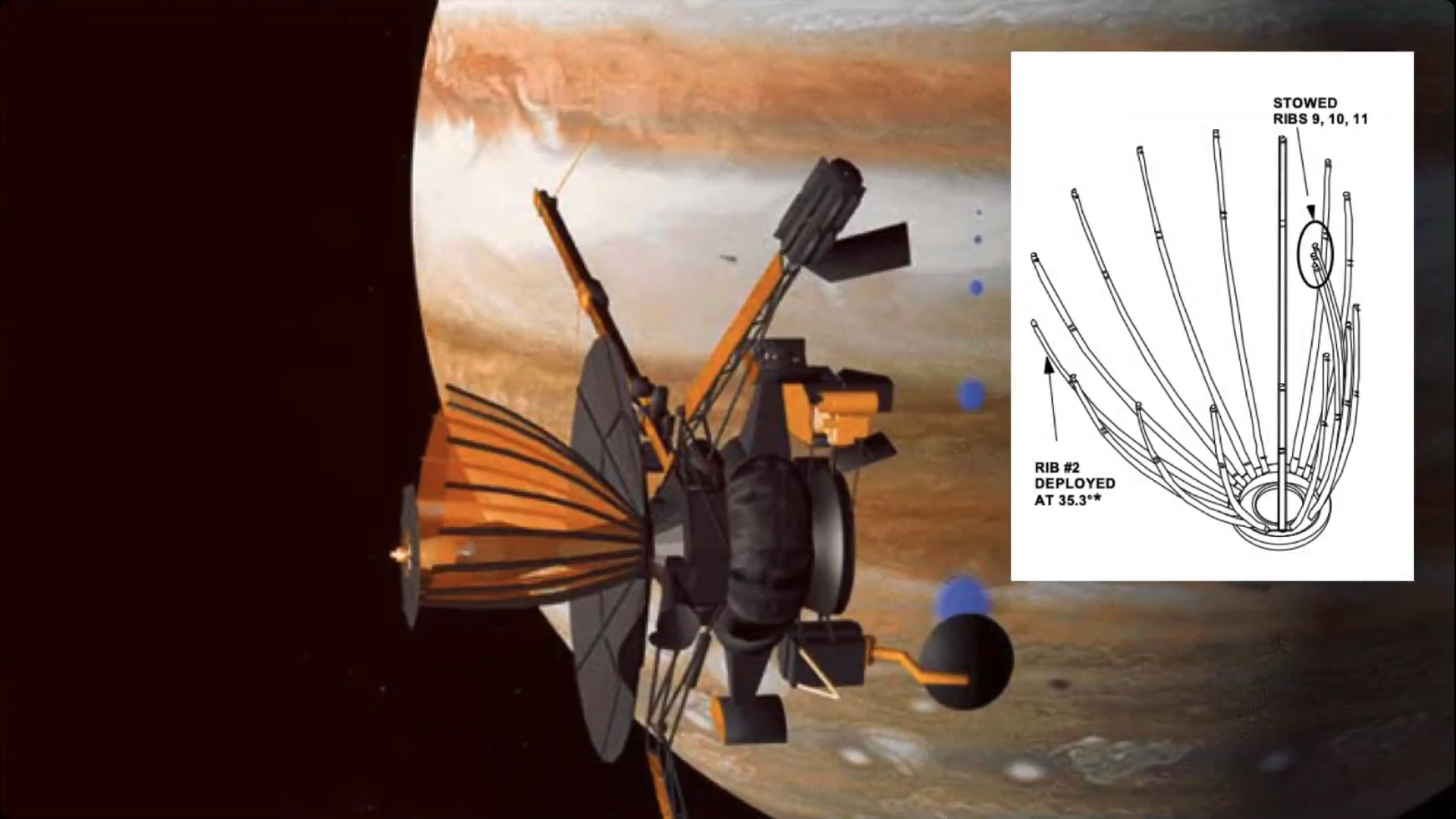
Galileo was supposed to have a powerful high-bandwidth link back to Earth. When the antenna failed to deploy, NASA engineers had to get creative to find a solution, as Janelle explains in her talk. Credit: talk slides

A fantastic example of that, retold in her talk, is the Galileo mission. It was built to travel far across the solar system, eventually winding up at Jupiter to study the Red Giant and its moons.  The probe was engineered with a pair of communication systems—a low-gain antenna for vital signs and management, and a high-gain antenna for sending science data and images back to Earth. The high-gain antenna was key to the mission, capable of offering 10,000 times the bandwidth of the low-gain antenna.

Tragically, though, the high-gain antenna never got to play its starring role. It didn’t deploy properly after launch, and that left NASA with a probe capable of capturing all this fantastic science data, but no way to send it home at a reasonable data rate. Janelle steps through the multiple hacks that make the most of the communication link with the low-gain antenna. NASA engineers whipped up compression algorithms for images and science data, and figured out how to array several Deep Space Network antennas for better signal. This netted an effective data transfer rate of 1,000 bits/second with the low gain antenna. It was still a far cry from the 134 kilobits per second that should have been possible with the high-gain antenna, but a huge leap forward from the 8-16 bits originally possible with the low-gain rig. Ultimately, it saved the mission, allowing the capture of mountains of scientific data on the largest planet in the solar system.

“NASA Astronaut Christina Cook is also working through troubleshooting steps of the waste management system that’s aboard the Integrity spacecraft.” – Ground control, Artemis II mission, 2026
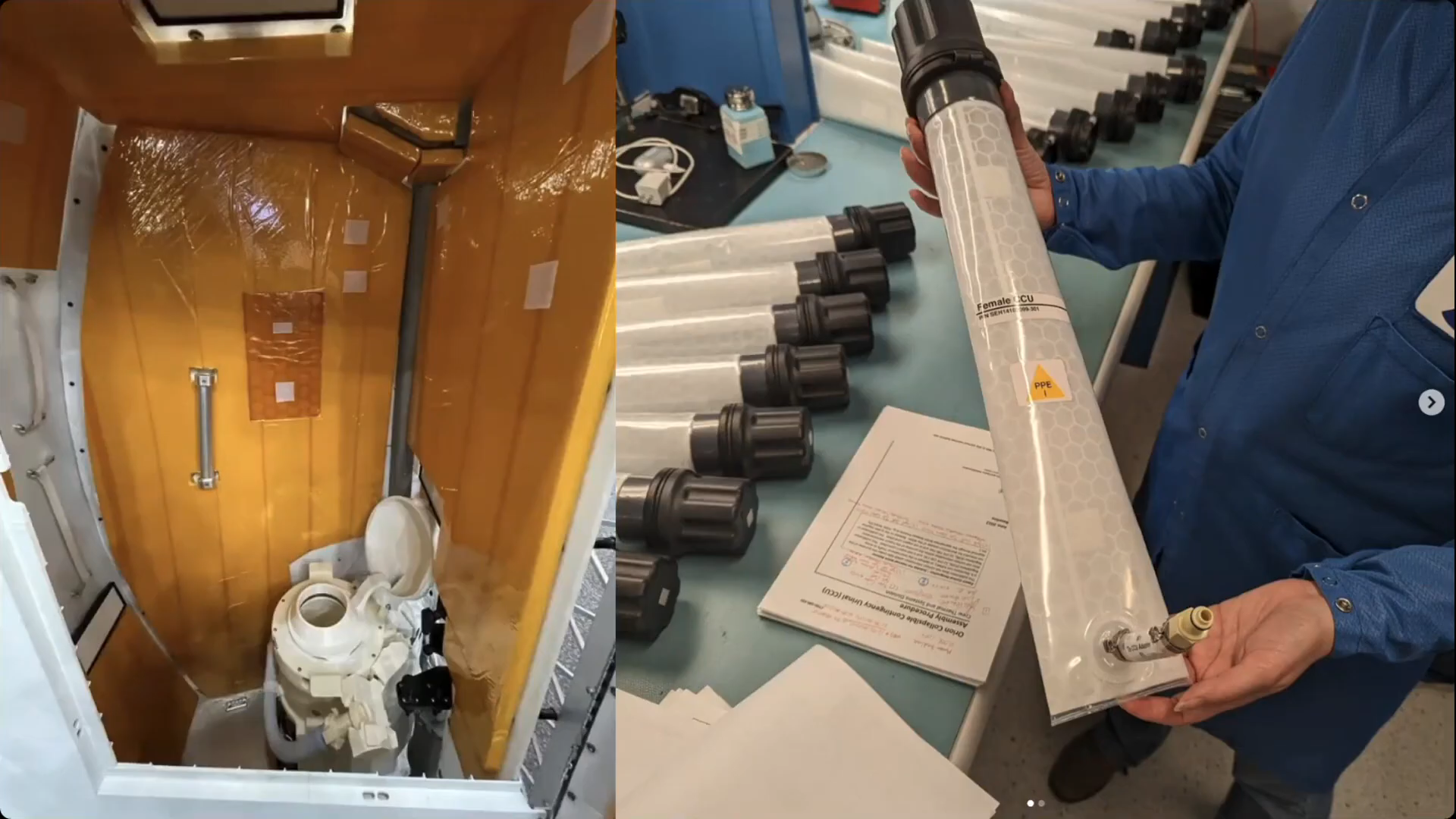
Left—the Artemis II toilet, a leap forward in space-based waste management technology. When it’s working, anyway. Right—the collapsible contingency urinals (CCU) used to capture and store liquid waste when the Artemis II’s main toilet was out of order. Credit: talk slides

Another great story told by Janelle concerned the Artemis II mission. The lunar flyby was part of NASA’s efforts to eventually return to the Moon itself, and was notable for debuting some special new hardware—the toilet. Unlike previous visits to the moon as part of the Apollo program, Artemis astronauts travel in luxury, with a proper commode built to handle the specific requirements of the zero-gravity space environment. Unfortunately, though, this new hardware had plenty of teething problems.

Early attempts to repair the system involved attempting to reprime the toilet’s pump by adding water to the system. It wasn’t long before the toilet threw another error, though. On the short-duration Artemis II mission, the toilet was set up to vent urine to space. Only, venting wasn’t working—with the suspicion being that the vent pipes had frozen over. The trick to solve this was simple—turning the spacecraft to face the vents towards the sun, so as to heat them enough to melt the blockage. Janelle also notes that during the multiple periods the toilet was down, the astronauts had to rely on alternative means of passing waste—showing a slide of the “collapsible contingency urinals” that did the job.
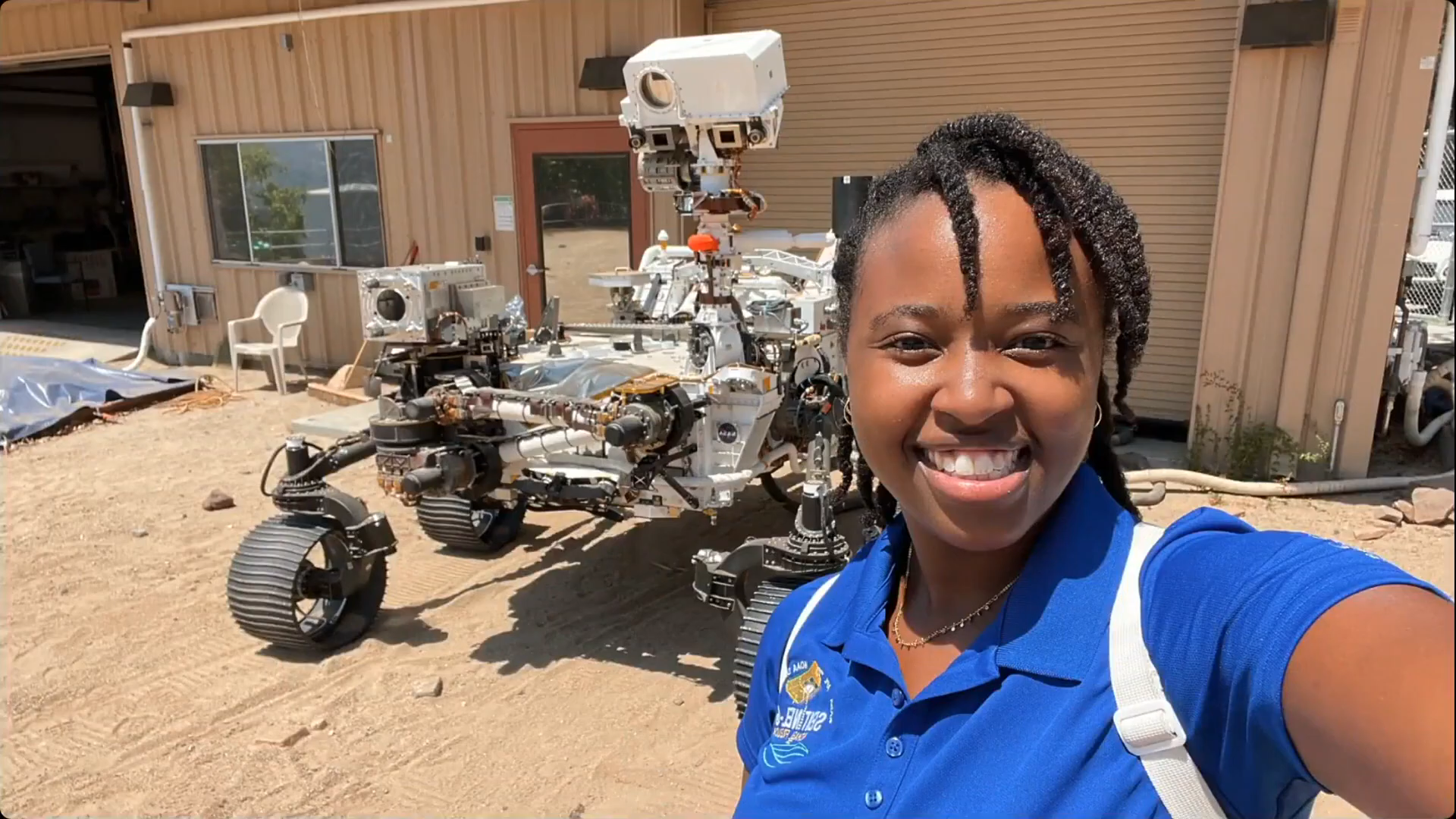
Janelle’s selfie, taken with the Perseverance twin rover at NASA JPL. Credit: Talk slides

There’s also a great look at Perseverance’s twin, which lives here on Earth. Janelle has been down to the Mars yard at NASA’s Jet Propulsion Laboratory, where engineers, in her words—”test before you do.” The problem is, when you’re driving a robot on a foreign planet, you can’t just send someone over to repair a broken wheel or flip it back up if it tips over. Thus, many maneuvers and operations are rehearsed in the Mars yard with the twin of Perseverance, running it over recreated obstacles to determine a safe plan of attack.


Source link

Advertisement
Continue Reading

Tech

Valve’s Steam Frame VR Headset Starts At $1,059 And Ships With Half Life: Alyx

Published

on

Valve has unveiled pricing for its new VR headset, and like the Steam Machine, it’s bound to be controversial. The Steam Frame headset will start at $1,059 for the 256GB model and rise to $1,299 for the 1TB version, including the controllers. For that sum, you’ll also get a rebuilt version of Half-Life Alyx, Valve’s 2020 PC VR game, that runs entirely on the headset. 

Valve also unveiled several optional accessories available at launch. The PSU to charge the built-in 21.6Wh battery will cost $29 USD, though you won’t need one if you already have a high-power USB-C charger. You can also get an Accessory Replacement Kit for $49 (one face gasket, one head cushion and one light blocker) and an Ergonomic Accessories Kit for $59 (two controller hand straps, two controller hand strap battery doors, one headset top strap and one extended light blocker).

Along with those, you’ll eventually be able to order prescription lenses from Zenni Optical, while Arcturus plans to release an RGB camera. Prices for those items have yet to be revealed. 

The Steam Frame launched without the delays of the Steam Machine, but Valve will still have a rather onerous reservation ordering system. First, sign up for the model you’d like to buy between now and September 17th at 10 AM PT. Valve will then do a one-time randomization to determine the order, and buyers will receive an email on the 17th indicating whether they’re on the reservation list or waitlist. Anyone signing up after September 17th will be added to the back of the waitlist. Presumably, the company has fixed the issues it previously had with those lists.

Advertisement

The company expects to send the first batch of purchase emails on September 18th and will continue to do so as availability allows. If you’re on the waitlist, it means that there aren’t enough Steam Frames available for reservation, and you’ll be notified once there are. 

Valve also confirmed some new features added since the Steam Frame’s review period started. The number of standalone verified titles has grown to 130, and the headset will initially support Gamepad mode (for 2D games) within the unified dashboard. The company has also improved multi-link streaming, input focus, depth projection and visual sharpness. 

As for Half-Life: Alyx, Valve initially didn’t think it could rejig the game to run on the headset. However, the company claims that “foveated rendering and eye tracking turned out to be a silver bullet,” letting them avoid changing any assets or degrading the gameplay experience. Still, it took “over a year” of extra software work within the Vulkan drivers and SteamVR, which will also benefit other games running on Steam Frame. With the headset, buyers will receive a voucher for Half-Life: Alyx by logging into Steam Frame and heading to settings.

Advertisement

Source link

Continue Reading

Tech

New York and Los Angeles Ban Student-Facing AI (For Now). Should Other Schools Follow?

Published

on

Within the first three days of September, three announcements regarding young students’ access to generative artificial intelligence (AI) made national headlines. 

On Sept. 2, New York City announced a one-year moratorium on student-facing generative AI use for public elementary and middle school students. Later that day, Los Angeles Unified School District announced the implementation of a moratorium of its own, restricting access to generative AI tools on all student-issued devices across all grades for the 2026-27 school year. 

The next day, the American Psychological Association (APA) released a report recommending thorough analysis of edtech tools to ensure they help students learn, citing generative AI as a particular risk. 

The flurry of caution underscores the education field’s attempts at taking a thoughtful approach when choosing AI tools. With the academic year just starting, educators are balancing the popularity of AI among students and the cautious approach to adopting classroom tools. 

Advertisement

The Case for Caution

Nicole Barnes, APA’s executive lead psychologist for education and lead author of the report, decided to pursue the issue after mistaking her son’s kindergarten homework for a video game during the COVID-19 pandemic.

“It was at that point where I realized that psychology, and the learning sciences in particular, had a lot to contribute to the development of edtech apps,” she says.

Barnes worries that too many edtech apps mislead the public on their effectiveness in helping students learn by using engagement and usage data as a proxy. “While there is a relationship between these two constructs, one does not equal the other,” she says.

Barnes sees the same issues with the current AI tools, as reflected in the report, which comes as AI’s presence in classrooms continues to grow.

Advertisement

In a recent IBM survey, 76% of middle school teachers and 73% of high school teachers reported using AI in their classrooms on a weekly basis. 

The moratoriums from the two largest school districts in the country seem to represent a departure from this trend. The rest of the five largest districts encourage thoughtful AI use:

  • Chicago Public Schools allows use of district-approved, age-appropriate tools in all schools, with guidance tailored to students, staff, families and vendors. 

  • Clark County School District in Nevada similarly allows district-approved tools across all schools, with more general district-wide guidelines. 

  • Miami-Dade County Public Schools approved a measure to develop AI use guidelines after implementing one of the largest district rollouts of student-facing AI in the country. 

Barnes thinks New York City and Los Angeles could set an example for other districts.

“I am viewing what New York and Los Angeles are doing as a pause. And to me, this pause is a reminder that schools do not need to let the market or outside forces set the speed of childhood,” she says. “They can slow down enough to ask, what does this tool do? What learning does it protect? What is the risk that it might introduce?”

Advertisement

Turning Restrictions into Lessons

With the NY and LA decisions making such big waves, teachers may be left wondering if their districts will adopt similar restrictions or wait to see what happens.

“I have the gut feeling that they will probably follow suit,” says Dan Clark, a middle school teacher at Lafayette Preparatory School in St. Louis, Missouri, and a Voices of Change Fellow. 

Rather than shutting down conversation, Clark argues that AI restrictions force an essential dialogue. When his district recently locked the use of the AI overview in web searches on school-issued devices, it opened the door for students to critically analyze the tool and its outputs.

“My kids have asked, ‘Why did you do this? Why did you get rid of it?’ And to me, that’s an educational opportunity,” Clark says. “I love that they’re asking us so that we can sit down and talk about why.”

Advertisement

He believes that structured discussion about the positives and negatives of AI is the key to getting buy-in for any decision.

“[Kids are] going to find ways around [restrictions]. They’re way smarter than us,” Clark says. “If we’re not involving them in the process of their own learning, I feel like that is a missed opportunity.”

What Happens Now

As districts deliberate their own next steps, Barnes recommends that before decisions are made, those involved should evaluate AI tools for evidence that they help students learn. From there, if they do decide to allow AI in classrooms, she says it takes a full community effort to craft AI policies.

“The responsibility can’t just sit with one teacher or one parent or with one child,” Barnes says. “Even teachers certainly need classroom guidance. School leaders need procurement and implementation standards. Districts are going to need evidence requirements and data protections, and policymakers need to set clear expectations for claims about children’s learning and development.”

Advertisement

Whether districts opt for temporary moratoriums or cautious rollouts, most educators agree on one thing: a blanket ban without critical dialogue is a missed opportunity. The real work lies in interrogating tech alongside students.

Clark agrees that openness is essential.

“When we just say, ‘There’s a ban. Don’t ask. Let’s not talk about it. Let’s pretend it doesn’t exist…’ It’s not really helping anybody,” he says. “That’s a Band-Aid on a much bigger problem.”

Source link

Advertisement
Continue Reading

Tech

Streaming TV Prices Rising Faster Than Cable Ever Did

Published

on

from the meet-the-new-boss dept

Now that streaming subscriber growth has slowed, we’ve noted repeatedly how the streaming TV sector is falling into all of the bad habits that ultimately doomed traditional cable TV.

That has involved chasing pointless “growth for growth’s sake” megamergers, imposing bottomless price hikes and new annoying restrictions on customers, undermining labor, and cutting corners on product quality in a bid to give Wall Street that sweet, impossible, unlimited, quarterly growth it demands.

Streaming TV prices hikes are coming so fast and furious, they’re outpacing many of the ridiculous traditional cable TV price hikes we saw during the cord cutting revolution:

“Over the course of the past 12 months, streaming rates have collectively risen 11.8 percent. The biggest year of increase was 2023, when the streamers shot up an average of 17.7 percent. A Hollywood Reporter analysis of Bureau of Labor Statistics data shows cable and satellite prices, by comparison, rose an annual average of 3.9 percent — excluding a deregulation surge of the late 1980s, when the index peaked at 14 percent. But that was a seismic shift provoked by a federal intervention rather than, say, because Widow’s Bay is a good show, or “we’re pretty sure we can get away with this.”

That shouldn’t really surprise anyone. Many of the same cable TV executives that enshittified traditional cable TV have moved on to streaming. And all the same quarterly growth pressures still apply. It’s not good enough to offer a good, affordable product people like; impossible scale is a siren song that, sooner or later, leaves many of these companies thrashed on the rocks.

Advertisement

There remain some notable positives though. Users are still free to subscribe to a streaming service, binge watch everything of interest, and then cancel to save money. That’s a big improvement from the traditional days of the bloated cable TV bundle.

Initially, streaming TV providers saw significantly higher customer satisfaction scores that big TV providers like Comcast. But that’s slowly changed over the last few years, as frustration with streaming TV grows and traditional cable TV providers try a little harder to improve. The latest American Customer Satisfaction Index (ACSI) scores now show tech companies and traditional cable companies neck and neck:

“The results arrive during a period of rising subscription costs and mounting consumer fatigue. Deloitte’s 2026 Digital Media Trends survey found that 73% of streaming consumers are frustrated with rising prices, around 40% cancel at least one paid service each year, and 61% say they would cancel their favorite service if monthly costs rose by just $5. The average subscribing household spends $69 per month on four streaming video services.”

What happens next? Well you can see that with growth saturated, media giants have started shifting their attention to mergers and consolidation, just like traditional cable, phone, and media companies did. That means even more price hikes to pay off debt, significant layoffs, and corner cutting that results in lower-quality overall product.

I suspect once they’re more meaningfully consolidated and fully enshittified, they’ll find some creative way to make cancelling and resubscribing annoying, especially if the U.S. continues its steady trend of lobotomizing its regulators at the behest of corporate power.

Advertisement

That could most likely come in the form of telecom and media companies merging and then tethering your subscription tightly to wireless phone and internet discounts. Or simply going the AOL route and make cancellation annoying as hell. Who is going to stop them? The Trump FTC?

Ultimately this enshittification will result in more and more users flocking to free or cheap short form video alternatives. Or simply reverting to piracy, at which point (and I’m sorry to keep beating this dead horse) all the execs responsible will blame everything (VPNs, generational entitlement, China) but themselves.

Filed Under: competition, consumers, disruption, satisfaction, streaming, tv, video

Companies: amazon, disney, netflix

Advertisement

Source link

Continue Reading

Tech

Apple’s iPhone 18 Pro vs. 14 Pro: The Four-Year Difference Between Apple’s Pro Phones

Published

on

Apple has just announced its latest premium flagship, the iPhone 18 Pro, at the company’s recent Surprise and Shine event on Wednesday. With a starting price of $1,199, the iPhone 18 Pro has a few new features over its predecessor, such as a variable aperture camera and a faster A20 Pro chip. But that probably isn’t enough to prompt most people with an iPhone 15 Pro, 16 Pro or 17 Pro — all of which are still excellent.

If you’re still holding on to the iPhone 14 Pro, however, that’s another story. Not only has it been four years since that phone debuted, but it’s also the last Pro-level iPhone to have a Lightning connection; every iPhone since has a USB-C port. Lightning accessories and adapters still exist for now, but they’ll eventually be harder to find. Meanwhile, USB-C is a lot more ubiquitous. 

Beyond moving on from older hardware and aging batteries, upgrading to the iPhone 18 Pro is also a leap forward in terms of specs and features. Some things remain the same, but there are a lot of upgrades too. Four years make a pretty big difference in the phone world. 

Here’s a more detailed breakdown outlining the difference between the iPhone 14 Pro and the iPhone 18 Pro. 

Advertisement
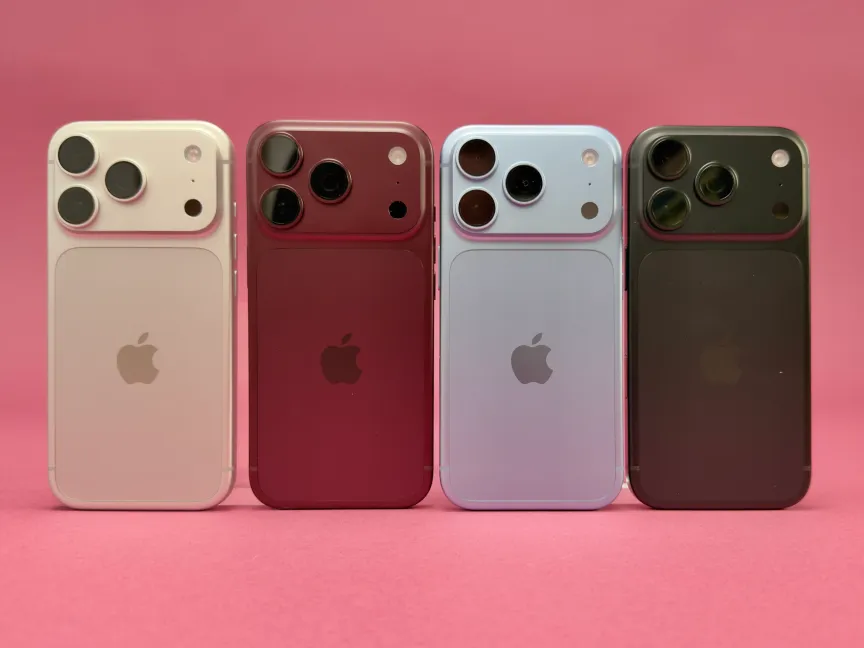
Four iPhone 18 Pro max models
Apple’s iPhone 18 Pro line comes in four colors: silver, burgundy, glacier and black.

Design and display

Display-wise, the 14 Pro and the 18 Pro might seem rather similar. The iPhone 14 Pro has a 6.1-inch Super Retina XDR OLED display with a 120Hz refresh rate, while the iPhone 18 Pro has a slightly bigger 6.3-inch OLED display, also with a 120Hz refresh rate. Both also have 460ppi.

There are a few notable differences, however. The iPhone 18 Pro does have 3,000 nits of peak brightness, while the iPhone 14 Pro has only 1,000 nits of peak brightness. The 18 Pro also features an upgraded Dynamic Island with additional features that can show three activities at once

As for design, the iPhone 18 Pro has an action button and a camera control button on the side, adding additional functionality to the phone. 

The Dynamic Island debuted on the iPhone 14 Pro (pictured), but is now able to show three different activities at once on the iPhone 18 Pro.

Celso Bulgatti/CNET

Cameras

The iPhone 18 Pro represents a pretty significant upgrade in the camera department, especially over the iPhone 14 Pro. The iPhone 14 Pro has three rear cameras: a 48-megapixel wide, a 12-megapixel ultrawide and a 12-megapixel telephoto. This was pretty advanced at the time, but Apple has added a lot of new camera features in the years since

The iPhone 18 Pro has three rear cameras, which are all 48 megapixels across the board. It also has a variable aperture, which offers additional flexibility, especially when shooting in low-light conditions. 

Advertisement

The same goes for the front-facing camera. While the iPhone 14 Pro has a 12-megapixel camera, the iPhone 18 Pro has an 18-megapixel one. On top of that, the 18 Pro has the Center Stage capability introduced with the iPhone 17 models that automatically switches between portrait and landscape orientations without needing to rotate your phone. 

iPhone 18 Pro Hands-On: Huge Advancements in Photography

Battery and performance

While Apple doesn’t disclose official battery specs in the US, we can surmise that the iPhone 18 Pro does have improved battery life over the iPhone 14 Pro. According to Apple, the iPhone 18 Pro delivers up to 36 hours of video playback per charge, while the iPhone 14 Pro has just 23 hours of video playback per charge. The iPhone 18 Pro has wireless charging of up to 25 watts, while the iPhone 14 Pro has MagSafe charging of up to 15 watts. 

Another huge leap between the two phones is in the performance department. While the iPhone 14 Pro ships with the A16 Bionic chip, the iPhone 18 Pro ships with the A20 Pro processor, which should result in faster apps, smoother multitasking and a superior gaming experience. 

Getting the iPhone 18 Pro is also a good option if you’re considering a phone with more storage. While the 14 Pro maxes out at 1TB of storage, the 18 Pro is available in a 2TB variant. You’ll have to pay a high cost for it ($2,399 retail), but at least it’s available if you want it. 

To further compare the iPhone 18 Pro and the iPhone 14 Pro, check out the comparison chart below.

Advertisement

Apple iPhone 18 Pro vs. Apple iPhone 14 Pro

iPhone 18 Pro iPhone 14 Pro
Display size, tech, resolution, refresh rate 6.3-inch OLED, 2,622×1,206 pixels, 120Hz refresh rate 6.1-inch Super Retina XDR OLED display; 120Hz Adaptive Refresh Rate; 2,556×1,179 pixels
Pixel density 460 ppi 460 ppi
Dimensions (inches) 5.9 x 2.3 x 0.3 in 5.81 x 2.81 x 0.31 in.
Dimensions (millimeters) 150 x 71.9 x 8.75mm 147.5 x 71.5 x 7.85mm
Weight (grams, ounces) 211 g (7.4 oz) 206g (7.27 oz)
Mobile software iOS 27 iOS 16
Camera 48-megapixel (wide), 48-megapixel (ultrawide), 48-megapixel (telephoto) 48-megapixel (wide), 12-megapixel (ultrawide), 12-megapixel (telephoto)
Front-facing camera 18-megapixel 12-megapixel
Video capture 4K at 60fps 4K at 60 fps
Processor A20 Pro Apple A16 Bionic
RAM + storage RAM N/A + 256GB, 512GB, 1TB, 2TB RAM NA; 128GB, 256GB, 512GB, 1TB
Expandable storage None None
Battery Up to 24 hours Undisclosed; Apple claims 23 hours of video playback
Fingerprint sensor None (Face ID) None (Face ID)
Connector USB-C Lightning
Headphone jack None None
Special features Apple N1 wireless networking chip (Wi-Fi 7 (802.11be) with 2×2 MIMO), Bluetooth 6, Thread. Action button. Camera Control button. Dynamic Island. Apple Intelligence. Visual Intelligence. Siri AI. Dual eSIM. 1 to 3,000 nits brightness display range. IP68 resistance. Colors: black, silver, glacier, burgundy. Fast charge up to 50% in 20 minutes using 40W adapter or higher via charging cable. Fast charge up to 50% in 30 minutes using 30W adapter or higher via MagSafe Charger. Dynamic Island; Always-On display; 5G enabled; MagSafe; water resistant (IP68); wireless charging; dual-SIM capabilities (e-SIM)
US price starts at $1,199 (256GB); $1,399 (512GB); $1,799 (1TB); $2,399 (2TB) $999 (128GB), $1,099 (256GB), $1,299 (512GB), $1,499 (1TB)

Source link

Advertisement
Continue Reading

Tech

Sexually Explicit Deepfake Sites Target 100-Plus Politicians in Europe

Published

on

Almost 150 politicians across Europe have been included on harmful deepfake pornography websites over the last few years, according to new research seen by WIRED. Some of the politicians, who are overwhelmingly women, have had their likeness included in explicit videos, while others have names and photos listed in disturbing database-like entries that can link to deepfake creation tools.

Analysis of around 160 domains that host deepfake abuse and other nonconsensual sexual content, by researcher Benjamin Shultz, has found that at least 138 women members of parliament (MPs) from 22 European Union countries have appeared or been mentioned on the sites. In contrast, only nine male MPs were referenced in any way. By Shultz’s calculations, it is 33 times more likely for women MPs to be targeted by deepfake ecosystems.

“Deepfake porn is part of a much bigger trend of online hate and intimidation against women and female politicians,” says Suzanne Kröger, a Dutch member of parliament with the Progressive Netherlands group, who was impacted. Kröger, who expressed anger at what the research uncovered, says the findings are “really deeply disturbing” and help to reveal the scale of abuse. “We are politicians, we have a platform and speak out,” Kröger says. “But meanwhile, there are millions of women victims of these criminal acts.”

The research, which has been published by German digital democracy think tank Agora Digitale Transformation, focuses on national members of parliament from all 27 countries in the European Union. Shultz, a fellow at Agora and the lead researcher at the American Sunlight Project, compiled the details of more than 5,800 members of parliaments across Europe in July and then used custom search engines to find where they appeared across the deepfake websites. (The research does not include members of the European Parliament).

Advertisement

Politicians from Germany, the Netherlands, Italy, and France appeared on the websites the most, according to the findings, and the more senior a politician is, the more likely they were to be targeted. Shultz alerted all of the MPs individually and provided guidance on how the content may be removed. The websites also include depictions of celebrities, journalists, and other public figures, he says. WIRED is not naming the websites in order to not drive further attention to the abusive images.

Multiple researchers and lawmakers say that while politicians have been targeted with deepfakes for years, it can damage democratic practices and create chilling effects that may stop women and girls from becoming public figures. “This discourages women from taking office in the first place and also crowds these women out of public life,” Shultz says. “There’s so much evidence to support that this does real psychological damage. This also does reputational damage for the future if they want to fade out of politics and have another career.”

“Deepfake videos are used to intimidate politicians but also to belittle women,” says Sarah Dobbe, a Dutch Socialist Party MP, who was impacted. “It is very important that if a woman or girl is victimized in this way, she can get direct support if needed, and that the content is removed quickly.”

Across the sites he monitored, Shultz categorized multiple categories of abusive content or behavior. His results include instances where MPs appeared in content that was actively being hosted by the sites, indexed results where content had been removed, and also a number of profiles and “gateways” where potentially new content could be created.

Advertisement

Multiple websites hosted pages that include the names of MPs, official photos, and in some cases their social media profiles or personal information. Some included sections “rating” the women’s bodies, Shultz’s report says. Often next to these MP biographies were links to so-called nudifier apps or the websites’ own tools that claimed to digitally undress people. “It has all the images, all the information, and a direct link to the tool, and in three clicks you can generate,” Shultz says. “That’s just as bad as actually hosting the content.”

Since AI-created deepfakes first emerged at the end of 2017, the underlying technology to produce them has become much more accessible, and the output of the tools has become more realistic. Over time, millions of nonconsensual AI images and videos have been created, mostly by men and boys, and are often used to harass, intimidate, or blackmail women and girls, including at almost 100 schools around the world.

“These platforms are designed to run like businesses,” says Henry Ajder, an AI adviser and deepfake expert who has been tracking the ecosystem since 2018. He says that while it is not surprising that politicians are being targeted in this way, the findings are helpful for officials in Europe to understand the severity of the issue. “The whole infrastructure is set up to do this at scale with ease,” he says.

Source link

Advertisement
Continue Reading

Tech

RC Test Flight Goes Self-Driving to See if R/C Cars Can Hit 100,000 Scale Miles on a Buried Wire

Published

on

R/C Car 100,000 Scale Mile Drive Experiment
Four years after Daniel Riley first lashed remote-control crawlers to a backyard tether and asked whether any of them could rack up 100,000 scale miles, he ran the experiment again. This time the cars steered themselves. In the original 2022 test, a spinning line kept every vehicle on a circle, which also loaded one side of the drivetrain harder than the other and turned wear into a lopsided argument. For the Self Driving Edition, Riley laid a perimeter wire through his yard, borrowed the sensing idea from robot lawn mowers, and taught an Arduino to twitch a steering servo whenever a coil on the bumper drifted off the signal.


Later, he combined all of this into a package called Trail Tracer. A cheap crawler and an expensive crawler spent months crawling the same nasty track, grinding to a halt on their charge strips as rain, mud, rats, snow, and ice each tried to put an end to the runs. The competitors were an Exceed RC Mad Watt 10, a $169 top-of-the-line crawler with metal U-joints and a main gear that was a little too exposed for comfort, and a Stirlingkit YK6101, a $769 1/10-scale 6×6 with a top-notch all-metal chassis, portal axles, lockable diffs, a two-speed gearbox, and a 750-size brushed motor.


LEGO Technic Dodge Viper GTS-R Sports Car 42234
  • RACE CAR BUILDING TOY – Kids can assemble their dream vehicle with the LEGO Technic Dodge Viper GTS-R Sports Car (42234) building toy for boys and…
  • TOY CAR WITH AUTHENTIC DETAILS – Discover realistic features like a V10 engine with moving pistons, an opening hood and doors, a differential and an…
  • FORZA HORIZON 6 UNLOCKABLE – Get a special LEGO Technic livery in the Forza Horizon 6 video game – please note that a copy of the game is required…

R/C Car 100,000 Scale Mile Drive Experiment
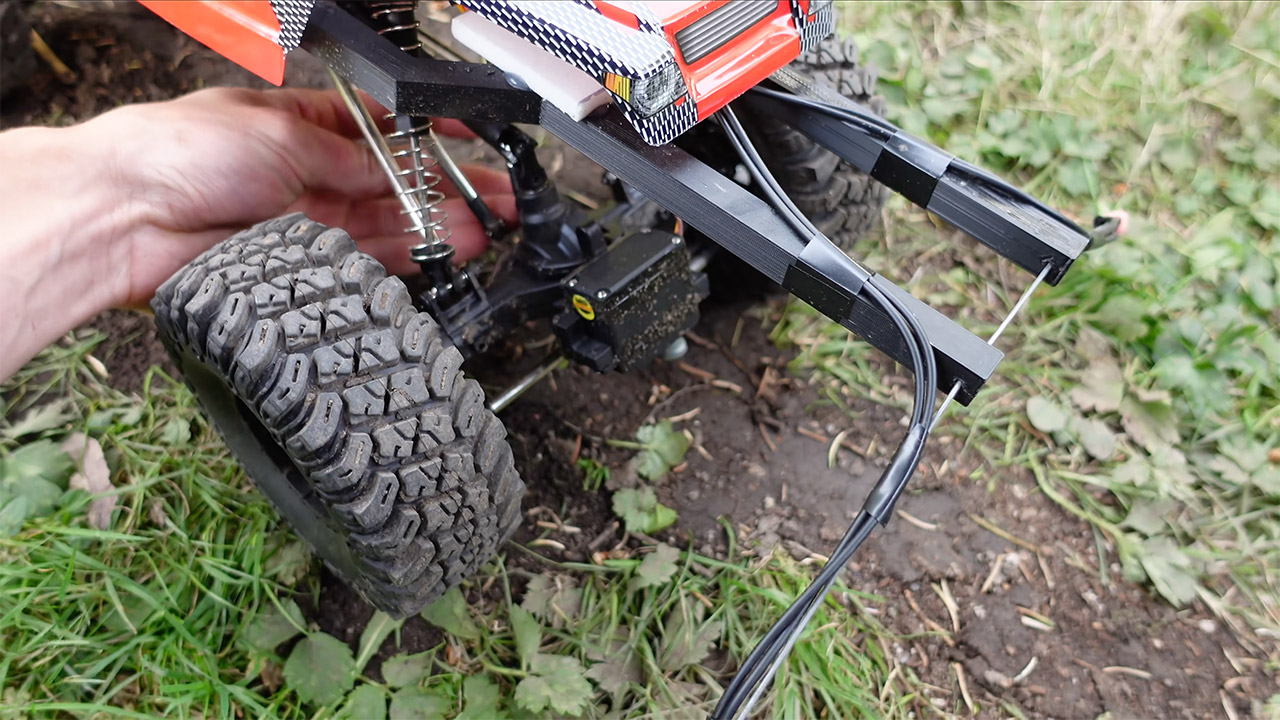
Riley was sure to keep the YK in low range, however, to prevent it from outrunning the wire. Building the track was its own mini-project. Wire segments were rewired (after the rats had bitten them to pieces, they had to be re-soldered and reburied). Then there were the turns, a nasty downhill run, and a swampy low place that caused the cars to oscillate all over the track, all of which required hours of controller tuning to perfect. To top it all off, the charge contacts were constantly sparking until he switched to a bench supply. Then there was his faithful lap timer, a spring-loaded board that recorded each pass. He also installed an FPV camera so he could watch from inside when the weather got bad.

R/C Car 100,000 Scale Mile Drive Experiment
Cheap hardware folded first. After the bolt in one of its gears had a bit too little thread and fell loose from its lock nut (fortunately not scored, so it wasn’t a death sentence), the Mad Watt’s open spur gear simply chewed itself bald on all the grit. Riley finally drove about 75 miles on that chassis, which is equivalent to 750 scale miles at 1/10 scale. The drivetrain ultimately failed. He changed gears and deemed it ordinary maintenance, which is quite generous if you’ve ever had a toy with its teeth sticking out in the mud.

R/C Car 100,000 Scale Mile Drive Experiment
The YK6101, on the other hand, simply kept trucking. By the fall, it had completed several thousand laps and a staggering 356 miles in the real world (or 3,560 scale miles, to give you a better sense) and was only beginning to show signs of wear in the form of extra steering slop and a bit of a wobble sliding down the hill when the controller was turned up to the utmost. The soft tires even broke through a few inches of ice. Of course, frozen ground helped for a time, but the thaw converted the track into soup, forcing Riley to dump a load of gravel, dirt, and concrete powder into the ruts to keep them from eating the axles.

R/C Car 100,000 Scale Mile Drive Experiment
Not a single car reached 100,000 scale miles. That’s a milestone equivalent to 10,000 real-world miles of crawling on a toy truck size, which would imply years of continuous use even if everything kept together, which it didn’t, but what the sequel actually proved was far more interesting. A tethered circle of wire is essentially a devious torture device. A wire-guided self-charging loop that is much more in line with how real vehicles live, as both sides of the drivetrain are worn down, the steering is constantly stressed, water and dirt find their way in through every small gap, and the only thing holding it together is whatever you’ve managed to reinforce the metal with.

R/C Car 100,000 Scale Mile Drive Experiment
Exposed gears wear out. Sealed gears, good steel shafts, and a chassis that can be easily disassembled into a plethora of spare parts make for a winning combination. Riley continues to manage the YK with a skeleton workforce, selling Trail Tracer devices so others can go lay a wire in their own garden, and the 100,000-mile mark remains, effectively a running joke that may become old news if someone simply refuses to give up. For now the interesting result is the gap. Seven hundred fifty scale miles on the bargain crawler. More than three thousand and counting on the 6×6. Same yard, same weather, same buried wire, and a very loud lesson about what you get when you pay for the metal.

Source link

Advertisement
Continue Reading

Trending

Copyright © 2025