Security teams log 54% of successful attacks and alert on just 14%. The rest move through your environment unseen.
The Picus whitepaper shows how breach and attack simulation tests your SIEM and EDR rules so threats stop slipping by detection.





A newly discovered data leak dubbed “FortiBleed” has exposed what appears to be a collection of Fortinet and FortiGate VPN credentials for 73,932 firewall URLs at organizations worldwide.
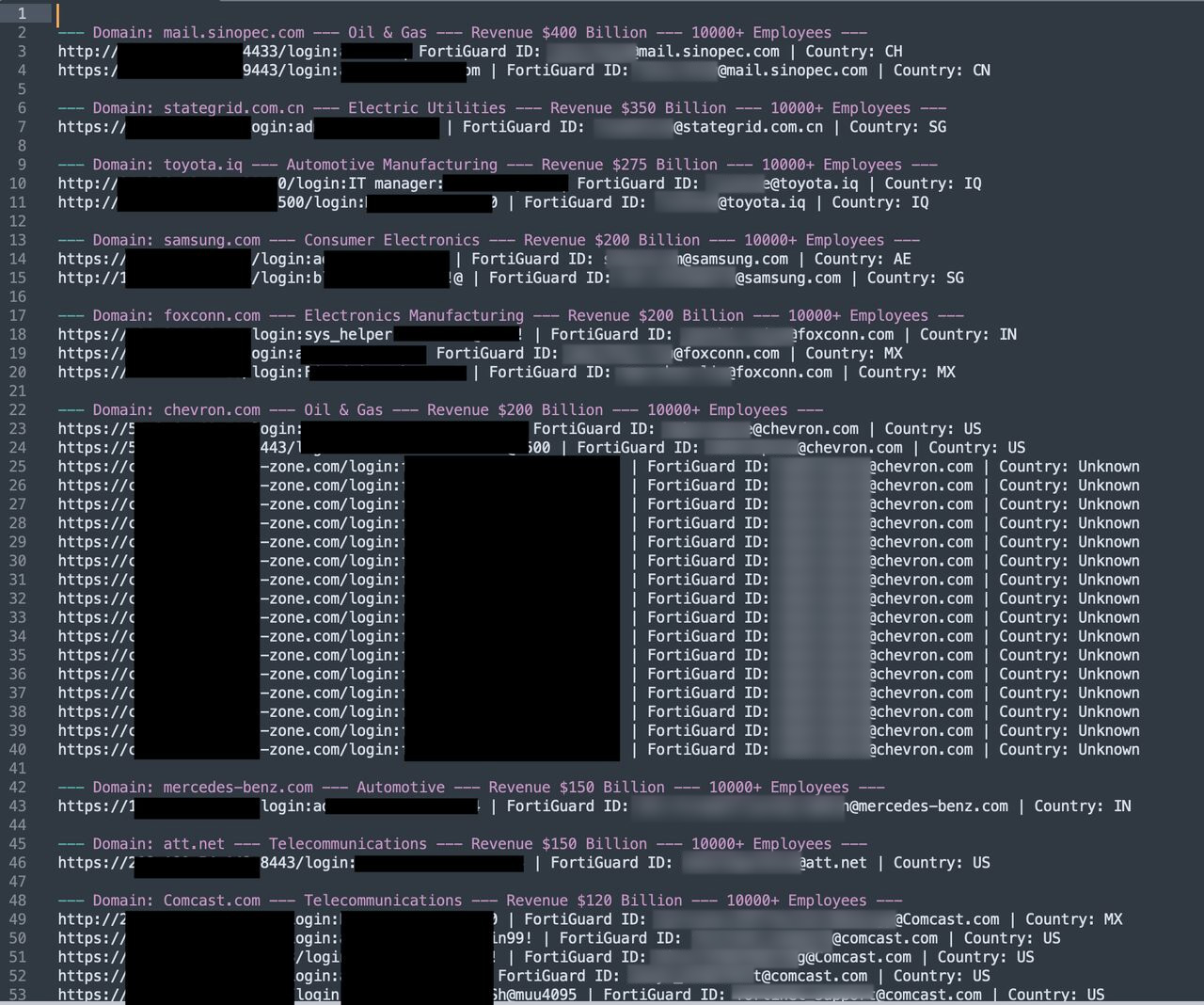
The exposed data was first discovered by security researcher Bob Diachenko, who says he found a server containing what appeared to be valid Fortinet VPN credentials, including usernames, email addresses, and plaintext passwords.
According to screenshots and information shared by Diachenko, the database contains entries for Chevron, Samsung, Foxconn, Comcast, AT&T, Mercedes-Benz, Toyota, Sinopec, State Grid, and many others.

“Massive Fortinet/FortiGate bruteforce/active exploitation campaign uncovered in action,” Diachenko posted on LinkedIn.
“Thousands of top vendors instances are listed in the files like this (see screenshot). This one alone has 21,634 domain names – from Chevron to Fortinet itself. All – with potentially working passwords to the FortiGate appliances obtained through various menas.”
The exposed data also included comments listing each organization’s industry, revenue, and number of employees, likely for planning attacks.
Diachenko later shared additional information that claimed the operation was conducted by a Russian-speaking multi-operator threat group that harvested credentials for FortiGate SSL VPN devices.
According to Diachenko’s investigation, the attackers allegedly conducted approximately 1.16 billion credential attempts against 320,777 FortiGate targets and an additional 2.1 billion attempts against 163,650 Microsoft SQL Server systems.
He further claimed the threat actors intercepted SSL VPN authentication hashes, cracked them using a 45-GPU cluster managed through Hashtopolis, and used the recovered credentials to move laterally into internal Active Directory environments.
Diachenko told BleepingComputer he obtained these details after analyzing additional files inadvertently exposed on the same server.
“They accidentally left an open directory with artefacts, connection strings, tooling, scripts and data online. Analytics obtained via their cron jobs, bash histories, logs etc,” Diachenko explained.
The researcher also stated that multiple organizations across Japan, Taiwan, Vietnam, Iraq, and Turkey were fully compromised, including a Turkish NATO defense contractor from which classified documents were allegedly stolen.
Threat intelligence company Hudson Rock has since published its own analysis of the exposed data after receiving the dataset from Diachenko. The company described the collection as one of the largest known troves of compromised Fortinet-related credentials.
According to Hudson Rock, the dataset contains 73,932 unique firewall URLs across 194 countries and impacts 21,632 unique domains.
The company says the attackers maintained detailed logs of successful compromises and assembled a database containing verified credentials for organizations across nearly every major industry sector.
Among the organizations Hudson Rock says appear in the dataset are Foxconn, Samsung, Comcast, Siemens, Lenovo, PwC, Accenture, Oracle, and numerous government agencies and critical infrastructure operators.
The company also released statistics showing that the highest number of affected devices was in India, the United States, Taiwan, Mexico, Turkey, Thailand, Colombia, Malaysia, Chile, and the United Arab Emirates.
The most common sectors for the listed companies are telecommunications, IT services, financial services, government organizations, healthcare providers, educational institutions, and manufacturing.
One strange aspect of the leak is that many of the exposed credentials were long, complex passwords that would ordinarily be considered difficult to crack.
Cybersecurity researcher Kevin Beaumont independently reviewed portions of the exposed data and told BleepingComputer that some of the credentials are authentic.
“I have been able to confirm the authenticity of some of the admin logins and passwords – this looks like a real dump,” Beaumont said.
After further review of the data shared by Hudson Rock, Beaumont published additional findings indicating that the dataset contains credentials for roughly 75,000 Fortinet devices, most of which remain online.
According to Beaumont, the data appears to have originated from exported Fortinet configurations because it contains information, including email addresses, that is typically only accessible through configs.
He also said the affected IP addresses are different from those in the 2025 Belsen Group Fortinet leak, further indicating that this is a more recent and larger collection of compromised devices.
Beaumont said he verified that multiple organizations listed in the dataset were using valid credentials and observed that many affected devices were running relatively recent FortiOS versions.
“The data is legit. It is around 75k devices. Almost all are still online, and Fortinet devices. It appears to be recent data,” Beaumont wrote.
Based on network data from Shodan, Beaumont says the leak contains approximately half of all internet-accessible Fortinet firewalls and said that a majority of the affected devices expose their FortiGate management interfaces directly to the internet.
The source of the configuration data remains unknown, with it unclear whether it was stolen through previously disclosed Fortinet vulnerabilities, a newly discovered flaw, or another method. Neither Diachenko, Hudson Rock, nor Beaumont have identified how the configuration data was originally obtained.
Hudson Rock has created a free FortiBleed lookup tool to check if your organization is impacted.
Organizations in the dataset should immediately rotate passwords associated with Fortinet VPN and administrative interfaces, enforce MFA, examine gateway logs for suspicious activity, and monitor for exposed employee credentials.
BleepingComputer contacted Fortinet regarding the exposed dataset and will update this article if we receive a response.

Security teams log 54% of successful attacks and alert on just 14%. The rest move through your environment unseen.
The Picus whitepaper shows how breach and attack simulation tests your SIEM and EDR rules so threats stop slipping by detection.


Shares of SpaceX surged Tuesday morning, pushing the Elon Musk-led company above Amazon and into a neck-and-neck race with Microsoft for the title of the world’s fourth-most valuable public company, less than a week after its blockbuster $75 billion IPO.
The rocket maker, satellite internet provider, defense contractor, and AI company is now valued at more than the entire economy of Italy.
The jump came after SpaceX announced its $60 billion acquisition of AI coding startup Cursor, a San Francisco-based company that last November said it was generating more than $1 billion in annualized revenue.
“We look forward to working closely with the Cursor team to advance our frontier AI capabilities,” SpaceX wrote in a message on X on Tuesday morning.
That helped propel SpaceX to stratospheric heights.
Its market capitalization stood at roughly $2.94 trillion at one point on Tuesday morning, well ahead of Amazon’s $2.66 trillion valuation. SpaceX also topped 51-year-old Microsoft in value for periods on Tuesday, going back and forth with the Redmond tech giant. Microsoft is valued at roughly $2.93 trillion.
Nvidia remains the most valuable company, with a stock market value just over $5 trillion, followed by Alphabet at $4.51 trillion and Apple at $4.37 trillion.
SpaceX’s achievement underscores how rapidly investor attention has shifted toward companies operating at the intersection of artificial intelligence, space infrastructure, defense and communications networks. But it also speaks to the allure of Musk, with Vanda Research indicating that SpaceX accounted for about three-quarters of all single stock purchases by retail investors on Monday.
“The company that’s accustomed to defying gravity is now defying market physics,” CNN noted.
The Cursor acquisition signals Musk’s ambition to build a vertically integrated AI powerhouse spanning chips, data centers, software, communications networks and space infrastructure.
The stock surge also adds a new dimension to the story GeekWire explored last week, examining what the SpaceX IPO means for Seattle and the broader Pacific Northwest space industry. SpaceX maintains a significant engineering presence in Redmond, where employees develop Starlink satellite technology and related communications systems, making the region an important outpost what has become in a matter of days one of the world’s most valuable companies.
For Amazon and Microsoft, the comparison is largely symbolic. The Seattle area tech giants generate hundreds of billions of dollars in annual revenue and operate dominant businesses in cloud computing.
But Wall Street’s willingness to value SpaceX above Amazon and Microsoft highlights how investors increasingly view AI and space as the next major technology frontier. SpaceX also competes directly with Amazon’s Leo satellite broadband network business.
Whether SpaceX can sustain a valuation at these levels remains an open question. Some analysts and tech watchers have described the stock’s post-IPO run as highly speculative, noting that the company posted a loss following its merger with Musk’s xAI.
Still, the message from the market is clear: at least for now, investors see it as one of the defining technology companies of the decade.


Camara Education Ethiopia will support the roll-out of 115 AI-powered digital learning hubs across Ethiopia.
Irish nonprofit Camara Education has secured more than $2.56m from Unicef to expand its AI-powered digital education across Ethiopia.
The funds will support the organisation through to December 2027 to provide children with its “large-scale” digital and transferable skills programme.
The initiative intends to expand access to digital education for “thousands” of students and teachers, particularly in refugee-hosting, displacement-affected and underserved communities, the nonprofit said. Focus will be provided for young girls and learners with disabilities, Camara Education said.
Many of the schools supported through Camara Education’s programme have limited or inconsistent internet access, making offline digital learning important for ensuring continuity of learning.
Partnering with Unicef will allow Camara Education Ethiopia to support the roll-out of 115 AI-powered digital learning hubs in schools and institutions, alongside managed internet connectivity and offline-first learning environments designed for low-resource settings.
The funds will enable the disbursement of 1,166 desktop computers, 826 tablets and 200 laptops, embedded with curriculum-aligned digital content and the Camara AI education assistant.
The programme intends to deliver digital skills, AI and technology training to more than 1,500 teachers and school leaders.
Around 7,000 students are also expected to be trained in essential digital and transferable skills. Learners will have access to structured progression pathways, including coding bootcamps, mentorship and job-readiness support, Camara Education said.
“This landmark partnership demonstrates the growing importance of digital skills, AI literacy and equitable access to technology in shaping the future of education,” said Ibolya Nemeth, the CEO of Camara Education.
“Together with Unicef and our partners, we are investing in practical, scalable solutions that empower young people and teachers with the tools, confidence and opportunities needed to thrive in a digital economy.
“We are proud that an Irish-founded organisation continues to play a meaningful role in advancing education and opportunity across Africa.”
The 2005-founded nonprofit works across Africa, including in Kenya, Tanzania and Zambia, providing learning solutions to underserved schools in the region.
Its initiative with Unicef, called ‘Digital and Transferable Skills Development: Transforming In-School Learning and Transition to Earning’, is delivered with support from the Netherlands, Mastercard Foundation and the Global Partnership for Education.
Don’t miss out on the knowledge you need to succeed. Sign up for the Daily Brief, Silicon Republic’s digest of need-to-know sci-tech news.
A school student in Ethiopia. Image: Unicef Ethiopia via Flickr (CC BY-NC-ND 4.0)

Microsoft has revealed the next wave of Xbox Game Pass additions for late June. The lineup is headlined by EA Sports FC 26 and co-op adventure game RV There Yet?.
EA Sports FC 26 joins Game Pass Ultimate and PC Game Pass on June 18 for Xbox One, Xbox Series X/S, Xbox Cloud Gaming and PC. The latest entry in EA’s football series arrives just days after it left Sony’s PlayStation Plus promotion. This gives Game Pass subscribers a chance to jump in without paying full price during the ongoing World Cup.
Before that, Call of Duty: Vanguard lands on June 17. The 2021 shooter joins Game Pass Ultimate, PC Game Pass and Game Pass Premium. This continues Microsoft’s steady rollout of Activision titles following its acquisition of the publisher.
The rest of the month is focused on newer releases. Co-op roguelite shooter Abyssus arrives on June 25 for Xbox Series X/S, PC and Cloud Gaming. Meanwhile, RV There Yet? follows on June 30. The latter has proven particularly popular on PC, where it reportedly sold 4.5 million copies within its first few months on sale.
Microsoft also quietly added Junkster to the service today. Developed by Stormcloud Games, the 3D action platformer challenges players to build bridges and other structures to reach new areas. It is available across Xbox Series X/S, PC and Cloud Gaming.
Looking beyond June, Tony Hawk’s Pro Skater 3 + 4 joins the Game Pass Premium tier on July 2 for Xbox One, Xbox Series X/S, PC and Cloud Gaming. The remastered skateboarding collection is already available through Game Pass Ultimate and PC Game Pass.
Another day-one addition is set to arrive on July 6 in the form of Winds of Arcana: Ruination. This 2.5D Metroidvania is coming to Game Pass Ultimate, Premium and PC Game Pass.
The latest Game Pass update comes during a turbulent period for Xbox. Reports this week suggested Microsoft is considering major changes across its gaming division, including potential studio closures and layoffs. Despite that uncertainty, Game Pass continues to receive a steady stream of first-party and third-party additions heading into the summer.


Brandon Lai wants to build a humanoid robot. He started with the upper body and quickly realized that off-the-shelf actuators would either cost too much or limit what the machine could do. So he set out to design and build his own. This latest version marks his second serious attempt, and it already produces usable torque in testing. He focused on a shoulder actuator sized for a roughly four-kilogram arm about half a meter long. The targets were straightforward. Peak torque needed to reach around 20 newton-meters. Output speed should fall between 40 and 60 revolutions per minute. The unit also had to run continuously for more than an hour. Keeping the cost near $150 per actuator would make it practical for other builders to copy or adapt.
The basic design is based on the MIT research into Direct-Drive Actuators, which use a powerful motor and very minimal gearing to maintain the joint feeling snappy while also allowing it to be back-driven by external forces. Brandon admired the spirit of that approach, but chose to make one significant adjustment. He removed the planetary gearbox and replaced it with a cycloidal arrangement. The cycloidal reducer promises more torque capacity in a small space and significantly reduced slop between the input and output.
The motor was built around a normal 110-size stator core from Eagle Power, which Brandon wound entirely by hand. He was able to get 254 twists of copper wire onto the core, divided into six different strands, each with six loops around the tooth. The parallel strands allow the motor to withstand much more current while maintaining a voltage that most controllers can handle. By winding it by hand, he had complete control over the electrical qualities, deciding what it would be like rather of having to go with what came pre-wound.

The spinning outer element of the motor, known as the bell, needs to be machined with very precise tolerances. Brandon forwarded the specifications to an online CNC service, and they returned with a smooth stainless steel cylinder ready to be fitted with a ring of powerful neodymium magnets. Brandon set the magnets in an alternating north-south arrangement and sealed them with epoxy after using a simple alignment device. The finished bell is a combination magnetic rotor and primary structural shaft that transmits torque to the output.
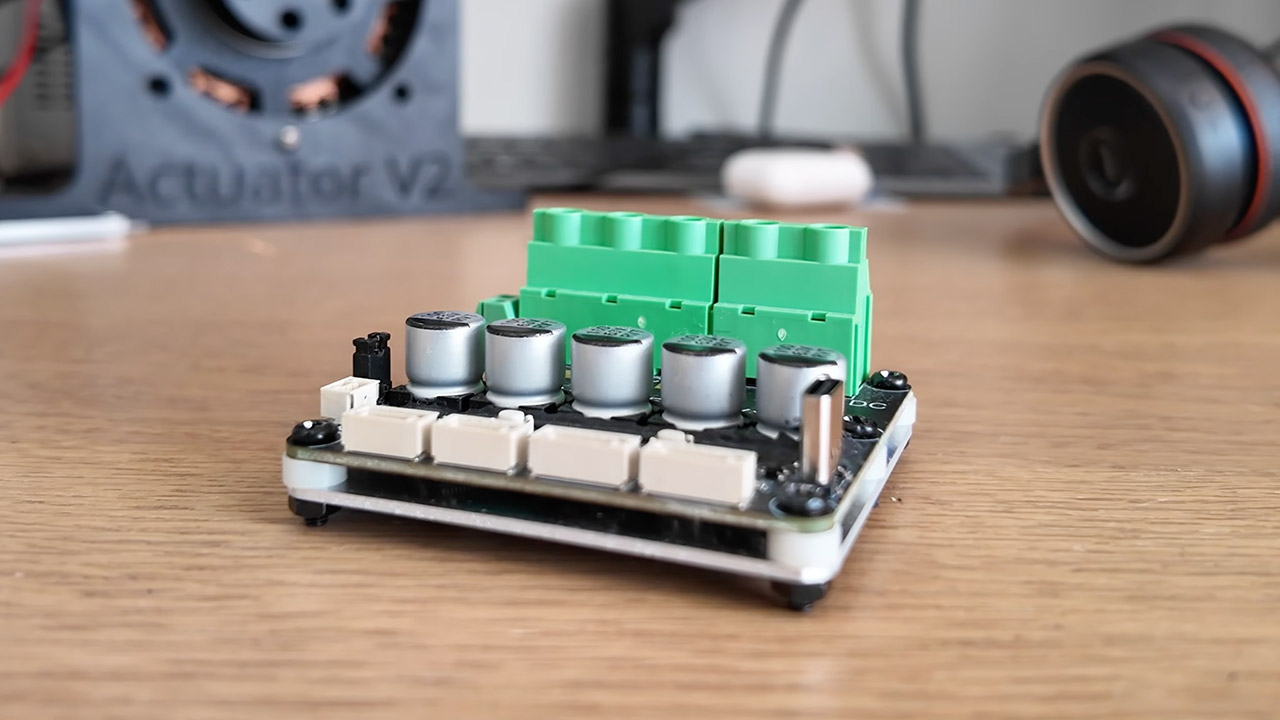
What we’re talking about here is the reduction and torque multiplication that occurs inside the cycloidal gearbox. We get a 10:1 ratio from having an eccentric input turn a lobed disc past eleven fixed pins. The output links directly to the robot arm. Brandon designed and printed the gearbox components for this prototype. This allowed him to make adjustments on the fly throughout development, but it eventually revealed its limitations in terms of precision. Once he acquired all of the elements, such as the motor, bell, and gearbox, he bolted them together around a brushless controller. Initially, he tested a custom printed circuit board that he had designed. Unfortunately, one integrated circuit immediately shorted out and began to smoke. So he swapped in a ready-made Makerbase X-Drive board, which continued to run the motor without issue.
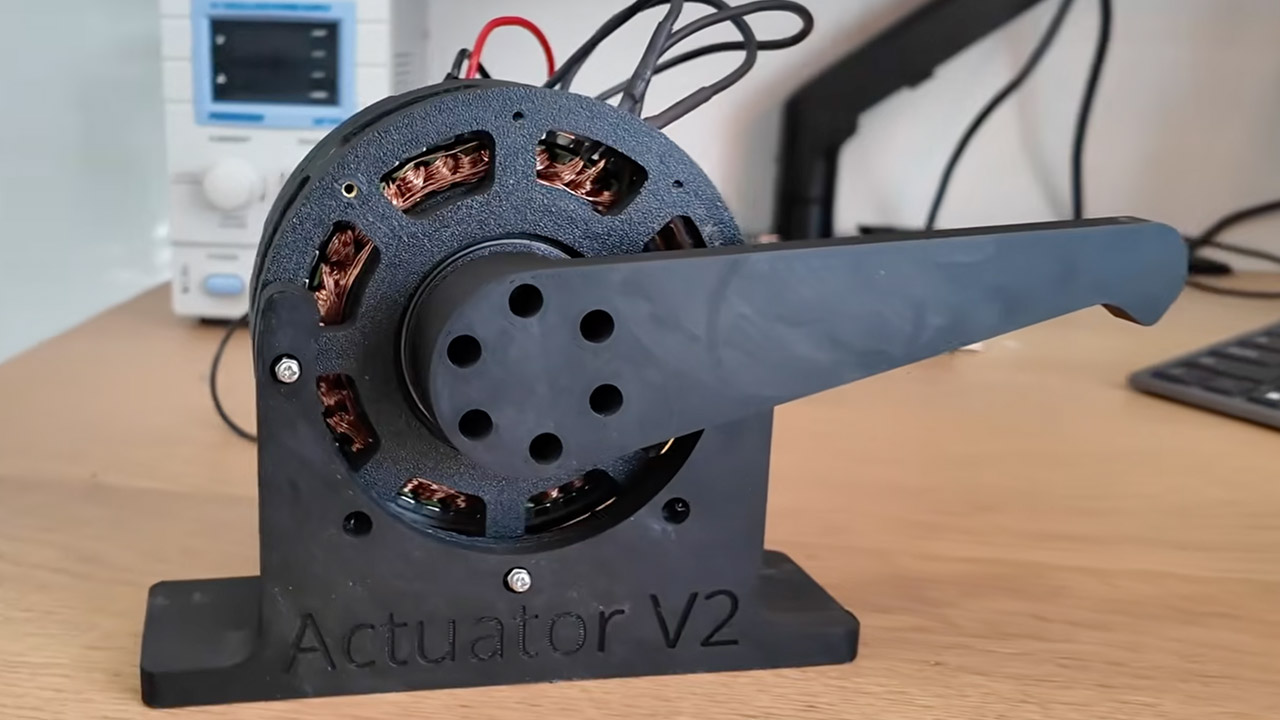
Testing went from the lab to a simple load rig. Brandon fitted a 150mm lever arm to the output shaft and hung a 5kg weight from its end. This generates a torque demand of around 7 newton meters. The power came from a bench supply with current limitations in place. Under those conditions, the actuator was able to support and move the load satisfactorily, delivering approximately 7 newton meters of torque. If we had a supply that could deliver a larger current, we’d almost certainly be able to get even more out of it because torque scales directly to available amperage.
[Source]
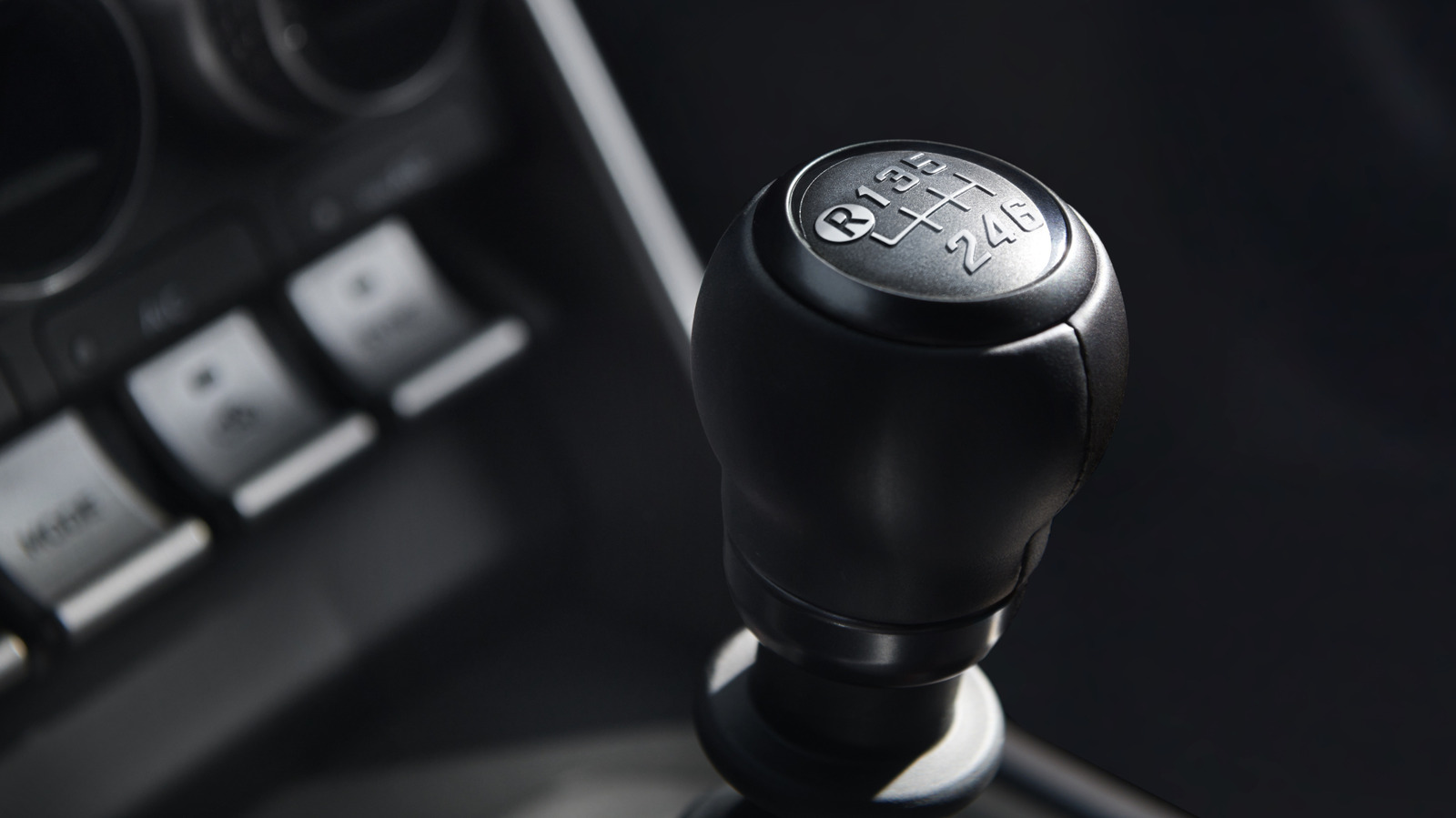
Despite Subaru’s mainstream reputation as a purveyor of safe, all-weather-friendly crossover SUVs for families, outdoorsy types, and dog lovers, the brand hasn’t forgotten its enthusiast DNA: The rally-bred Subaru WRX is alive and well, while the highly enjoyable Subaru BRZ continues to be one of the most engaging sports car options on the new car market. Even in a market where affordable fun cars have become exceedingly rare, Subaru plainly hasn’t left the driving enthusiast behind.
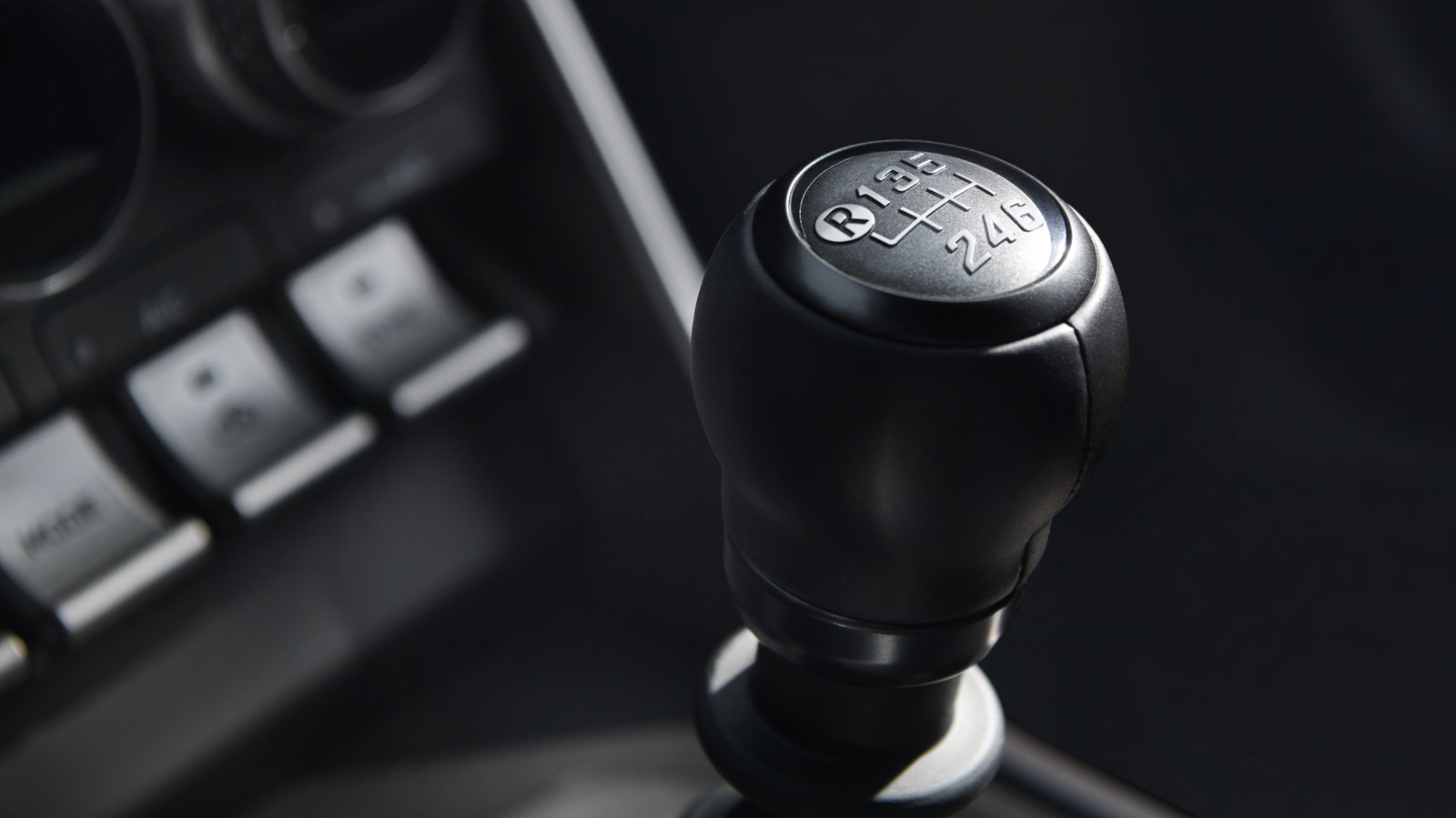
Of course, it’s not just the BRZ’s rear-drive dynamics or the WRX’s punchy turbocharged engine that make these cars enthusiast favorites. It’s the fact that both cars still come with six-speed manual transmissions as standard. They’re part of a rare breed, too, with other drivers’ favorites like the iconic Volkswagen GTI having dropped manual transmissions altogether.
Now, there’s some good news for Subaru fans who may have been worried about that brand following a similar path. As reported by CarScoops, Subaru has confirmed that not only is it committed to the manual gearbox, but it is also introducing a new manual-equipped model to its lineup — though details about that one remain scarce at this point.
During the announcement, which took place at the 2026 Fuji 24 Hour race in Japan, Subaru showed an image of three different cars covered in sheets, all of which will hit the Japanese market by 2027. Two are pretty easy to identify based on their shapes: One is clearly a new version of the current Subaru BRZ, while the other very much looks like the current WRX.
The current-generation WRX has always been available with a manual in the American market, but the Japanese-market WRX only got a manual in 2026 — and, even then, in extremely limited numbers. This new version of the WRX that Subaru is teasing will take things even further, as its transmission won’t be the TY75 six-speed currently used in the WRX, but the beefier, STI-spec TY85 transmission. Subaru didn’t give many other details about this upgraded WRX, but the inclusion of the stronger transmission could make it the closest thing yet to a proper, next-generation WRX STI. This is something fans have been asking for since the old WRX STI was discontinued in 2022.
As for the BRZ, that will be the latest factory STI-tuned version of the car. It will likely sport the same naturally aspirated engine but with additional upgrades to make it lighter and more track-focused — with, of course, the familiar six-speed manual transmission.
The most noteworthy of the three cars that Subaru teased, however, has to be the one simply labeled “5-door Hatchback”. The current WRX and BRZ have always been offered with manuals, but this one represents an entirely new addition to Subaru’s stick shift lineup.
Details are thin, but the shape of the car looks a lot like an Impreza hatchback and the Performance-B STI Concept from the 2025 Japan Mobility Show. However, rather than a high-performance STI hatchback, Subaru has hinted that this car will be more of an affordable entry into manual transmission motoring. Perhaps the base version will come first, with a more powerful, production version of the Performance-B Concept to follow? Either way, the car should be a welcome addition to the Subaru lineup.
What remains to be seen, though, is which, if any, of these upcoming manual Subarus will make it to North America. Subaru has raised the possibility of offering a new, manual SUV for the American market, though that would likely represent a completely different, more rugged flavor of manual motoring than the cars teased here. No matter the form they take, though, one thing’s for sure: the more manuals on the market, the better.


AI + ML
I am not a number! I am a free agent (that just happens to have a number)
Estonia plans to allow AI agents to have their own digital identities so they can act on behalf of people in a way that can be verified and audited.
The initiative, backed by the country’s Eesti.ai advisory board, calls for the development of ID codes that AI agents can use to take actions, subject to some unspecified authorization and task delegation process.
Academics and corporate technical folk have already made related proposals in recognition of the absence of agentic technical infrastructure. Last month, researchers under the flag of OWASP proposed the Agent Name Service for agent discovery and interoperability. DNS for AI Discovery is another such project.
But these have more to do with platform plumbing while Estonia, known for its embrace of technology, is more focused on permission and punishment. Establishing digital identities for AI agents and authorizing limited powers will help avoid scenarios where individuals are required to delegate broad authority to an agent at the expense of their rights, the government says.
“In the future, AI will increasingly carry out digital tasks on our behalf, compiling reports, preparing declarations or interacting with information systems,” said Prime Minister Kristen Michal in a statement. “To that end, it must be clear who is acting on whose behalf with what rights, and who is ultimately responsible.”
By taking this step, Estonia casts itself as “first country to create digital identities for AI agents.”
Two weeks ago, Argentina’s President Javier Milei endorsed a similar idea, legislation to allow “non-human corporations,” managed by software, with limited liability.
“Limited liability is not a luxury for such entities; it is a precondition for their existence,” Milei wrote in a Financial Times op-ed.
Several decades ago, IBM took a similar line on liability but reached the opposite conclusion about automated decision making: “A computer can never be held accountable, therefore a computer must never make a management decision.”
Despite the citation of that passage from IBM’s 1979 Training Manual in a 2025 blog post, Big Blue’s designated author Doug Bonderud sounds less certain about the impermissibility of AI action these days.
“Should AI be used for management decisions?” he mused. “Maybe. Will it be used to make some of these decisions? Almost certainly.”
While governments work on legal changes that will allow AI agents to operate, private sector companies are already taking a stance, at least with respect to external AI agent usage by customers.
Target Corporation earlier this year revised its Terms & Conditions with a section titled Agentic Commerce and Delegated Access. It states, “Purchases and other actions taken by an Agentic Commerce Agent that you have authorized are considered transactions authorized by you.”
American Express meanwhile has taken the opposite tack by assuming liability for errant agentic commerce. “In the future, if a Card Member authorizes an AI agent to make a purchase and that agent sends American Express the customer’s authenticated purchase intent, American Express will protect eligible customers from charges related to AI agent error,” the company said in April when it introduced its agentic commerce developer kit.
In a pre-print paper last year titled “AI Agents and the Law,” Georgia Institute of Technology professors Mark Riedl and Deven Desai observe that once AI agents have the ability to act in a way that changes the state of the world – e-commerce transactions as opposed to output that requires human interaction for effect – concerns about harm become more pressing.
They note that while the law is well equipped to deal with conflicts arising from human agents, it’s not well-suited to the possibilities of software agents.
“Put simply, although computer science and law have similar notions of agents, a software agent is not the same as a human agent,” they write “For example, agency law disciplines agents by imposing legal liabilities on agents when they misbehave. Human agents can face financial and even criminal penalties; that is not so for software agents.”
To date, AI companies have done their best to limit liability for AI harms. But they’ve not been entirely successful: A Canadian court held Air Canada liable for bad chatbot advice, and a German court held Google liable for inaccurate AI Overview content.
It may be a while before the rules for AI agents get hammered out and harmonized to whatever extent is possible. But in the interim we’ll at least have digital identifiers to call out bad agents by name. ®

The internet is an essential resource for young people and adults to access information, explore community, and find themselves—both inside countries and across continents. Yet governments around the world continue to introduce and implement legislation requiring all online users to verify their ages before accessing the digital space. In some cases, politicians are going further, putting forth proposals to ban social media for younger users.
In late 2025, Australia’s government rolled out the first complete ban on users under 16 from having social media accounts. In this sweeping regime, platforms are required to introduce age assurance tools to block under-16s, demonstrate that they have taken “reasonable steps” to deactivate accounts used by under-16s, and prevent any new accounts being created, or face fines of up to 49.5 million Australian dollars ($32 million USD). The 10 banned platforms—Instagram, Facebook, Threads, Snapchat, YouTube, TikTok, Kick, Reddit, Twitch, and X—have each said they’ll comply with the legislation, which led to young people losing access to their accounts overnight. Reddit is currently challenging the law in Australian courts on constitutional grounds. Recent research notes how the ban is preventing teenagers from accessing news in the country.
In the United Kingdom, rules took effect in mid-2025 under the Online Safety Act that require all online services available in the country to assess whether they host content considered harmful to children; if so, these services must introduce age checks to prevent children from accessing such content. Online services are also required to change their algorithms and moderation systems to ensure that content defined as harmful, like violent imagery, is not shown to young people.
This approach is reckless, short-sighted, and we’ve already seen it introduce more harm to the young people that it is trying to protect. The UK’s scramble to find an effective age verification method shows us that there isn’t one, and we’ve spent years urging UK politicians to abandon any measures that require platforms to collect data or remove privacy protections around users’ identities.
Earlier this year, Indonesia’s Communications and Digital Affairs Minister, Meutya Hafid, announced that users under 16 would have their accounts on “high risk” platforms deactivated from 28 March. The platforms subject to this ban are YouTube, TikTok, Facebook, Instagram, Threads, X, Bigo Live, and Roblox; with Hafid noting how this policy would make Indonesia “the first non-Western country to delay children’s access to digital spaces according to age.”
Similarly, the Malaysian government has recently pushed forward with plans to ban users under 16 from having accounts on social media platforms with at least 8 million users in Malaysia, including Facebook, Instagram, TikTok, and YouTube. Users under the age of 16 are being told to download or transfer their data from these platforms in one month before the restrictions are applied. Platforms failing to comply with the ban may face penalties of up to $2.5 million USD.
In Latin America, Brazil approved a new law in 2025 establishing that providers of information technology products and services directed to children and teenagers, or likely to be accessed by them, must conduct age checks when their products and services offer risks to underage users. Regulation requires age assurance for products and services that are not allowed for children and adolescents in accordance with Brazilian legislation. App stores and operating systems are required to provide age signals for other providers.
While the law is already in force, full compliance with its obligations is expected for early 2027, after the approval of further regulations and a transition period, and the authority responsible for enforcing the law is the Brazilian National Data Protection Agency. The list of concerns regarding the implementation of the law include: the wide scope of products and services that may fall within age-check obligations, how these obligations can affect non-proprietary operating systems and free software projects, and how effective the law’s crucial data protection safeguards will be in a context of likely widespread age checks for accessing content online.
Similarly, the European Union has taken large steps towards mandatory age verification that could undermine privacy, expression, and participation rights for everyone. Politicians are promoting an EU-wide approach to age verification through its age verification “app,” which will be fully interoperable with the Digital Identity Wallet. While this mini-app has been announced as technically ready to be rolled out “for citizens to use,” it comes with its own realm of potential privacy and security concerns, such as long-term identifiers (which could result in tracking) and over-exposure of personal information.
The European Commission also supports age verification in various legislative initiatives, from proposals that would allow or mandate companies to scan our communication (“Chat Control”) to non-binding guidelines of existing laws, such as the Digital Services Act. The EU Parliament, too, has proposed an EU digital minimum age of 16 for access to social media, a move that aligns with EU Commission’s president Ursula von der Leyen’s recent public support for measures inspired by Australia’s model. To all these initiatives EFF has provided one consistent response: mandatory age verification measures are not the right way to protect young people.
These proposals restrict the fundamental rights of young people to speak to each other and to access information. They also force all internet users, not just those under a certain age, to upload private data—like a face scan or passport—in order to access a website or service. In considering the vast scope of privacy issues pertaining to the collection, storage, and sharing of this personal information, the problems of age verification in restricting free speech are compounded by these reckless and harmful approaches to verification.
The problem of censorship and surveillance goes far beyond the borders of the internet. EFF continues to explore support for legislative and litigation challenges that recognize how these laws harm everyone’s rights to privacy, free expression and due process.
Republished from the EFF’s Deeplinks blog.
Filed Under: age verification, australia, brazil, eu, indonesia, malaysia, uk
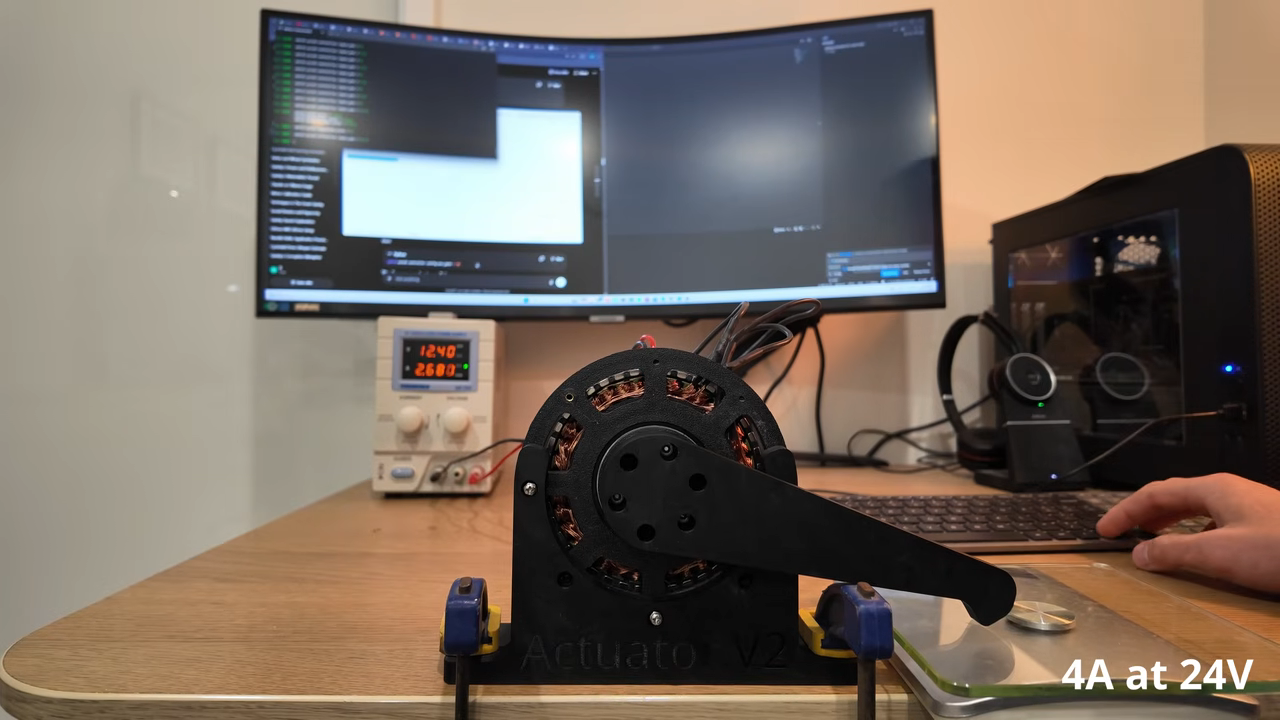
[Brandon Lai] is hoping to build a humanoid robot. To that end, he’s going to need some actuators, and decided to design his own. His second pass at this turned out pretty well, with a few snags found along the way.
Target specs were a actuator that could run at 40 to 60 rpm while delivering 20 Nm of torque for up to an hour continuously. The design was inspired by an MIT research paper, with [Brandon] making a few mods to suit his use case. Where the MIT design uses an inbuilt planetary gearbox, this build substitutes a cycloidal gearbox with a hope it will provide better torque capacity with less backlash. The design is based around a hand-wound stator made with an off-the-shelf core, while using custom CNC parts and 3D printed components for the motor housing itself.
Testing revealed some limitations. Running off a benchtop power supply with limited current, the motor was only able to achieve 7 Nm of torque, though a better PSU would probably improve this. [Brandon] also noted excessive backlash in the cycloidal gearbox, due to poor tolerances, and the $400 construction cost came in well over budget. Still, [Brandon] hopes to tackle many of these problems in a future revision. CAD files are available online if you’d like to dig deeper into the design.
We’ve featured plenty of great actuator builds over the years. Video after the break.
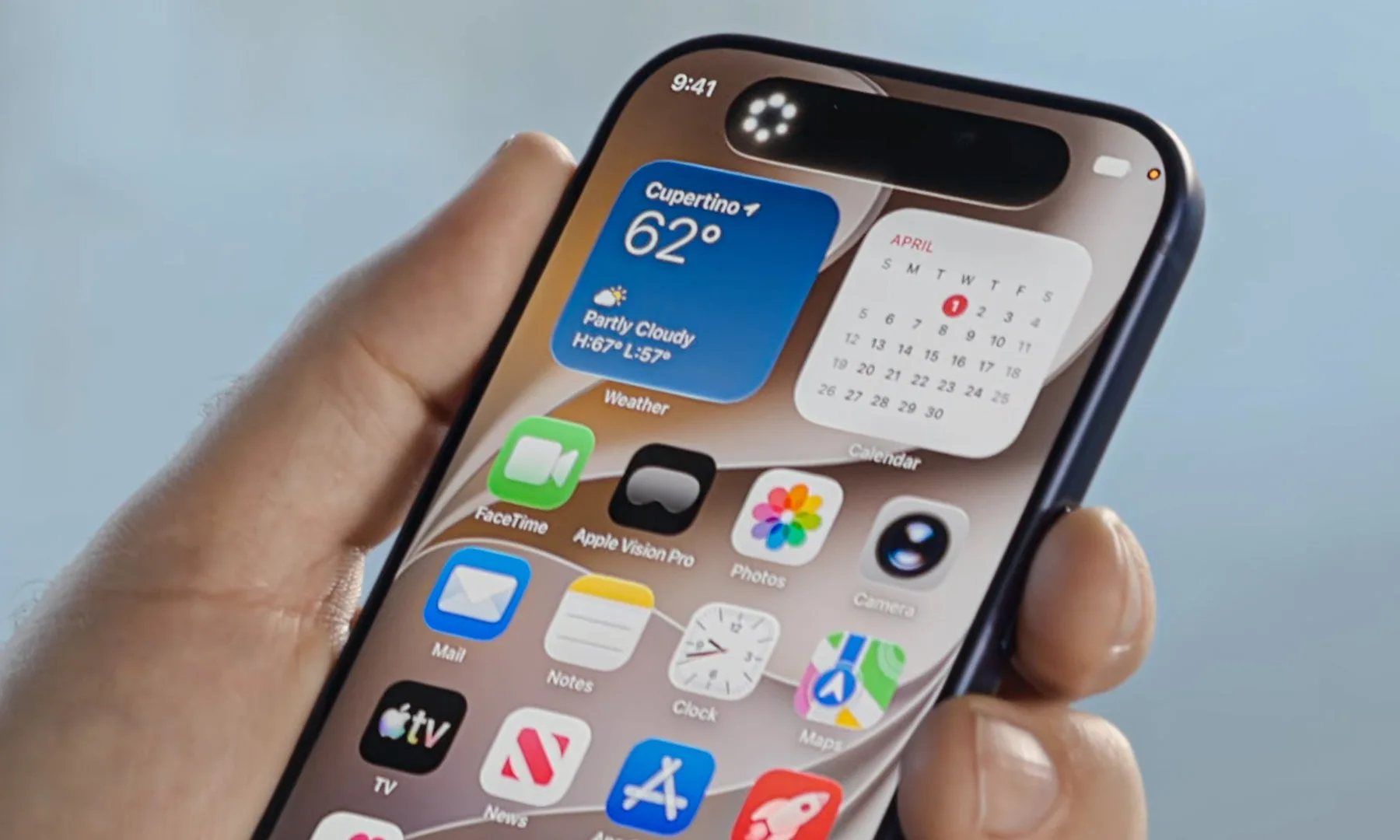
The rising cost of RAM and storage has become a growing problem for the tech industry. Apple has largely kept those increases from affecting customers, but according to a recent Wall Street Journal report, that may be about to change.
Speaking to the publication, Apple CEO Tim Cook said price increases are now “unavoidable” as the cost of DRAM memory and NAND storage continues to climb. The surge is being driven largely by the AI boom, as cloud providers and AI companies compete for the same chips used in consumer devices. Apple has largely shielded customers from those increases so far, but Cook indicated that strategy has reached its limits.

Apple’s ability to avoid major price hikes has not happened by accident. The company entered 2026 with inventory secured before memory prices accelerated and used its scale to negotiate supply agreements that many competitors could not match. Earlier this year, Apple also relied on product configuration changes, such as removing lower-capacity options from some Macs, instead of directly raising sticker prices.
The challenge is becoming harder as Apple prepares a new generation of AI-focused products. Following WWDC, the company is already testing its next-generation Siri experience and broader Apple Intelligence upgrades. Those features place greater demands on memory, which helps explain why some of Apple’s most advanced Siri capabilities are currently limited to devices with higher RAM configurations.

Apple is also expected to launch new Macs and its long-rumored foldable iPhone later this year, both of which could require larger memory allocations to support increasingly capable on-device AI features. Reports have already suggested that the iPhone 18 Pro could start at around $1,399 this fall, a $300 increase over its predecessor.
Cook told the Wall Street Journal that Apple is willing to use its financial resources to help secure memory supply, but he ruled out building Apple-owned memory or storage manufacturing facilities. “We can’t do everything. We know what we’re good at,” Cook said. Despite Apple’s influence over suppliers, that leaves the company exposed to the same market forces affecting the rest of the industry.
With memory suppliers increasingly prioritizing AI infrastructure customers and analysts warning that shortages could persist into 2027, Apple’s long streak of absorbing those costs may finally be coming to an end.

China wants a global AI cooperation org and offers cheap/free models. The G7 is discussing “trusted partner” access to US AI. Two systems are forming.
China’s top diplomat Wang Yi announced on Wednesday that Beijing is “accelerating the establishment of a global AI cooperation organization” and invited all countries to join. The comments came as the G7 summit in France wrapped up with discussions about giving “trusted partners” access to leading US AI models, according to Reuters. Two competing visions of AI governance are now diverging in public.
Wang was speaking at the release of China’s global governance whitepaper, which criticised trade wars and emphasised support for the Global South. Vice chair Zhao Haibing of China’s top economic agency pushed back on “closed, exclusive and monopolistic approaches to tech development.” The language was aimed directly at Washington.
The timing is deliberate. The US Commerce Department ordered Anthropic to shut down Fable 5 and Mythos 5 last week, cutting off every foreign user. Anthropic and Google DeepMind used the G7 to call for a US-led AI coalition that would set international rules. Canada agreed. China was not invited.

The 💜 of EU tech
The latest rumblings from the EU tech scene, a story from our wise ol’ founder Boris, and some questionable AI art. It’s free, every week, in your inbox. Sign up now!
The contrast in approaches is stark. US AI models are subscription-only and increasingly subject to export controls. China’s efforts have focused on cheap or free models that can be downloaded in their entirety. DeepSeek, Qwen, and other Chinese open-weight models are available to anyone with an internet connection. The Global South, which cannot afford enterprise AI subscriptions and was not consulted on the G7’s “trusted partner” framework, has a clear choice between the two.
China is routing its AI diplomacy through existing multilateral bodies. Wang pointed to cooperation through BRICs and the Shanghai Cooperation Organisation. Zhao cited China’s “AI Capacity Building for All” initiative, support for the UN in leading global AI governance, and programmes to help developing countries with technology and talent.
The US and China said last month they would work on AI guardrails together, but few details have emerged. President Xi Jinping proposed a “Global Governance Initiative” at the SCO last summer. Premier Li Qiang announced the global AI cooperation organisation at a Shanghai conference in July 2025, just days after the Trump administration released its own AI action plan supporting US tech development overseas.
The structural split is now visible. The US is building an alliance of wealthy democracies with controlled access to its most powerful models. China is building data exchanges, exporting governance via the Digital Silk Road, and treating AI distribution as a geopolitical tool. For the 6 billion people who live outside the G7, the question is not which system is better. It is which system shows up first.




No Jackpot Winner as $257 Million Prize Rolls Over to $269 Million Monday Draw


Weekend Open Thread: Tuckernuck – Corporette.com


Oppenheimer backs SpaceX as $70 billion retail frenzy builds


Markets Rally as SpaceX IPO Looms Amid Iran Tensions and Inflation Surge

Zimbabwe Requires Crypto Businesses to Register Annually Under New FIU Regulations


NanoClaw integrates JFrog registries to secure AI agent downloads


Bitget enters Argentina’s regulated crypto market through PSAV registration


This Week In Security: Microsoft On Microsoft, Register Your Domains, Linux On ARM, And FreeBSD Joins The File Cache Club


El Nino has formed in the Pacific and could set records, forecasters say

Dutton Ranch star claims they ‘didn’t see any disruption’ on set following Chad Feehan’s exit from Yellowstone spinoff fueled by Taylor Sheridan clash rumors


Politics Home | Healey Resignation Is “Colossal Failure Of Government”, Says Former Labour Defence Secretary

Donnie Wahlberg & More Heat Up Las Vegas at Circa’s Barry’s Downtown Prime

Opendoor Ends India Operations, Fueling a Bigger Conversation About AI and Outsourcing


Belfast burns, while Met chief points finger at Iran and Russia


First Time Since 1971: Australia Register Historic Low In ODI Cricket


FBI searches office of Ohio voter registration group


AT&T: Verizon's 27% Outperformance Sets Up A Solid Entry Point

Anthropic is spending $150M to embed 1,000 AI fellows inside nonprofits. No degree required.


Modi thanks Trump for wishes as US attacks Indian seafarers

‘The Pitt’s Fan-Favorite Doctor Confirms Noah Wyle Gave His Blessing to Return [Exclusive]



You must be logged in to post a comment Login