Ian Clarke (aka ancient Slashdot reader Sanity), designer of the peer-to-peer communication platform Freenet, is back with an update on the project’s progress following the launch of its P2P network in March. He writes: Earlier this year, Slashdot covered the launch of the completely redesigned Freenet. I recently gave a talk about what we’ve been building since then. Unlike traditional web applications, apps on Freenet have no central server or database; instead application state is distributed across the network. These now include decentralized group chat, publishing, search, and fully decentralized Git hosting. The talk also gets into some of Freenet’s internals, including how we use machine learning for network routing.
Surging investor demand pushed the chipmaker to upsize the offering by a third.
Intel has raised $20bn in its first share sale since 1971, as the chipmaker moves to fund a major expansion into artificial intelligence manufacturing.
Priced at $95 per share on Monday, the deal was upsized by a third from an initial $15bn after drawing more than $100bn in demand, according to Bloomberg – a sign of how strongly investors continue to back companies in the AI supply chain.
The move is a shift in direction for a company that spent $82bn buying back its own stock in the 2010s. Under CEO Lip-Bu Tan, who has prioritised financial discipline since taking over, Intel’s shares are up by around 164pc in 2026 after a torrid few years.
Advertisement
Proceeds will fund Intel’s capital expenditure programme, which the company recently raised to $20bn for 2026, driven by surging demand for central processing units as AI agents proliferate.
Intel is also building out its contract manufacturing business, with the goal of competing with Taiwan’s TSMC, after securing Tesla as a customer for its 14A manufacturing process.
Since establishing a presence in Ireland in the late 1980s, Intel has invested more than €30bn into its operations here. The Leixlip campus serves as one of the company’s most advanced manufacturing facilities, according to Intel, which currently employs around 4,900 people in Ireland.
Advertisement
The share sale is part of a run of large equity raises linked to AI spending. Alphabet is raising up to $85bn across several instruments, while Oracle has a $20bn at-the-market sale underway. Intel’s offering was led by JPMorgan, Goldman Sachs, Morgan Stanley and Citigroup.
Don’t miss out on the knowledge you need to succeed. Sign up for the Daily Brief, Silicon Republic’s digest of need-to-know sci-tech news.
Finding a mobile plan used to be simple. Today, it’s easy to be drawn in by a low advertised monthly price, only to discover additional costs once it’s time to check out. Activation fees, taxes, device payments, and fluctuating monthly bills can quickly turn what looked like a bargain into a much more expensive commitment.
That shift in consumer expectations has changed how people shop for wireless services. Instead of chasing the lowest number on a billboard, more customers are looking for something equally important: transparency. They want to know exactly what they’ll pay each month, what they’re getting in return, and whether they’ll have to compromise on network quality to save money.
This is where Metro by T-Mobile is trying to stand apart. Rather than focusing solely on discounts, the carrier is emphasizing straightforward pricing, flexible plans, and access to the strength of T-Mobile’s network, giving customers value that extends beyond the monthly bill.
The True Cost of a Wireless Plan
For many consumers, the advertised monthly price is only one part of the equation. Hidden fees and unexpected charges can significantly increase the actual cost of ownership over time.
Advertisement
Whether it’s activation fees, taxes that appear only at checkout, or promotional pricing that changes after a few months, these surprises can make it difficult to budget accurately. That’s especially frustrating for customers who simply want dependable wireless service without constantly reviewing their monthly statements.
Metro by T-Mobile takes a different approach by putting key details upfront. The carrier highlights offers with taxes and fees already included, no activation fees on eligible promotions, and pricing designed to remain predictable. That means customers know what they’re signing up for before making the switch, helping remove much of the uncertainty traditionally associated with changing carriers.
Reliable Connectivity Matters Just as Much as Price
Affordability is important, but it means little if the network can’t keep up with everyday life. Streaming videos, joining video calls, navigating unfamiliar cities, or simply staying connected with family all depend on consistent network performance.
That’s why Metro by T-Mobile places significant emphasis on the network behind its plans. The carrier runs on T-Mobile, America’s Best Network*, helping address one of the biggest concerns shoppers often have when considering prepaid wireless service. Instead of asking customers to choose between affordability and dependable connectivity, Metro by T-Mobile aims to offer both.
Advertisement
For many consumers, that combination changes the conversation. Choosing a prepaid carrier no longer has to mean sacrificing the experience they expect from a national wireless network.
*Based on analysis by Ookla® of Speedtest Intelligence® 1H 2026 data. Metro may be slower than T-Mobile during congestion. Get full terms.
A Free Samsung Galaxy A37 5G Makes Switching Even Easier
For shoppers planning to upgrade their smartphone, Metro by T-Mobile is pairing its transparent pricing with an attractive device offer.
Eligible customers who bring their number and join Metro with a qualifying $40 plan can get the Samsung Galaxy A37 5G at no cost. The promotion is positioned as putting more than $450+ in value back into customers’ pockets while also including taxes and fees in the monthly price and eliminating activation fees. Since the service runs on T-Mobile’s network, customers also benefit from nationwide connectivity alongside the savings.
Advertisement
For someone already considering a new Android smartphone, this combination helps reduce one of the biggest expenses associated with switching carriers – the upfront cost of a new device.
Love Your Current Phone? Keep It.
Not everyone wants a brand-new smartphone. Many users are perfectly happy with the device already in their pocket and simply want a better wireless plan.
Metro by T-Mobile addresses that need through its Bring Your Own Device (BYOD) option. Customers can keep their existing compatible phone while signing up for one line of Unlimited 5G service for just $25 per month online. The plan also includes taxes and fees, comes with no activation fees, and is backed by a five-year price guarantee, * making it easier to know what to expect month after month.
*5-Yr Guarantee covers on-network talk, text & data.
Advertisement
The flexibility is important. Instead of encouraging customers to replace a phone that still works perfectly well, Metro by T-Mobile allows them to reduce their monthly wireless costs while continuing to use a device they’re already comfortable with.
Apple Users Have an Option Too
The savings aren’t limited to Android users. Customers who prefer Apple’s ecosystem can also take advantage of Metro by T-Mobile’s iPhone promotion. Eligible customers who bring their number and ID while signing up for the $50 AutoPay plan can receive the iPhone 16e at no cost. The promotion also includes a $100 virtual prepaid card after the third month and no activation fees, making it another example of Metro by T-Mobile pairing device savings with straightforward pricing.
By offering both Android and iPhone promotions, Metro by T-Mobile gives customers the flexibility to choose the smartphone ecosystem they already prefer rather than asking them to compromise.
More Than a Promotional Price
While attractive device offers certainly grab attention, Metro by T-Mobile’s broader message is about long-term value.
Advertisement
Many wireless shoppers are increasingly looking beyond introductory discounts. They want predictable monthly bills, fewer unexpected charges, and confidence that their service will continue performing when they need it most.
By combining transparent pricing with the reach of T-Mobile’s network, Metro by T-Mobile positions itself as an option that focuses on the complete ownership experience instead of simply advertising the lowest possible monthly rate. The emphasis on no activation fees, taxes and fees included on qualifying plans, and long-term pricing certainty helps reinforce that approach.
The Bottom Line
Shopping for a wireless plan today is about much more than finding the lowest monthly price. Consumers increasingly want clarity, flexibility, reliable coverage, and offers that genuinely reduce the total cost of switching.
Metro by T-Mobile brings those elements together through transparent pricing, meaningful device promotions, and access to T-Mobile’s network. Whether someone is looking for a free Samsung Galaxy A37 5G, wants to keep their current phone with an affordable Unlimited 5G plan, or is interested in switching to an iPhone 16e, the carrier offers multiple paths to savings without losing sight of what matters most – knowing what you’ll pay and staying connected on a network backed by T-Mobile.
Capturing the ‘primal energy of Wolverine’ in a new look, Sony is going all-in on Marvel’s Wolverine with a new PS5 collection that includes covers, a DualSense, and a limited-edition console
It wouldn’t be a PlayStation exclusive without some matching hardware, right?
It’s an approach we’ve seen the gaming giant take before, and personally, I’ve always had a soft spot for the various Spider-Man-themed PS5 editions. Those consoles understood that a limited-edition PlayStation doesn’t necessarily need to reinvent the hardware itself. Rather, the right colors and a design that makes the console feel like part of the game.
Sony is taking a very similar approach with Marvel’s Wolverine, by unveiling a collection of matching hardware, including a limited-edition PS5 Digital Edition console — just be ready for the price, though.
Advertisement
Latest Videos FromTechRadar
More critically, though, we also have two DualSense controllers and console covers for both PS5 Slim and PS5 Pro. And, perhaps unsurprisingly, you get your pick between Wolverine’s iconic yellow and a more subtle but still on-theme choice of ‘Adamantium’.
Here’s the full lineup, which lands on September 15, 2026, but will go up for preorder on August 19, 2026.
PlayStation 5 Cover in Battle Yellow Limited Edition: $74.99 / £64.99
PlayStation 5 Pro Cover in Marvel’s Wolverine Battle Yellow Limited Edition: $74.99 / £64.99
PlayStation 5 Pro Cover in Marvel’s Wolverine Adamantium Limited Edition: $74.99 / £64.99
PlayStation 5 Digital in Marvel’s Wolverine Battle Yellow Limited Edition Bundle with DualSense controller: $649.99 / £569.99
The center of the collection is Marvel’s Wolverine Battle Yellow Limited Edition PS5 Digital Edition bundle. This pairs the iconic yellow console with a matching DualSense controller and a copy of the game. The design is inspired by Insomniac’s “Battle Reborn” suit, with the familiar yellow finish broken up by claw marks across the hardware.
And it works quite well, as rather than slapping a Wolverine logo onto a yellow PS5, Sony has made the console look as though Wolverine himself has gotten his claws on and into it.
Sign up for breaking news, reviews, opinion, top tech deals, and more.
(Image credit: PlayStation)
That design language carries over to the standalone Battle Yellow DualSense, as well as limited-edition console covers for existing PS5 and PS5 Pro owners. So you don’t necessarily need to buy another PS5 to bring a little Wolverine into your setup, which is especially good news considering the price increases. And yes, the bundle does carry a hefty $649.99 / £569.99 price tag, but you can get the Wolverine yellow DualSense for $84.99 / £74.99 or snap up a PS5 cover for $74.99 / £64.99.
(Image credit: PlayStation)
Sony’s also giving you the option of trading the yellow finish for a metallic look inspired by the Adamantium material bonded to Logan. It’s a much more understated design, but arguably a better fit if you want something a little more subtle. This will be available as a cover for the PS5 Pro exclusively or as a DualSense Controller.
Advertisement
“I wanted to show Wolverine at his fiercest for Marvel’s Wolverine Limited Edition PS5 Console bundle and accessories,” explained Jock, a graphic artist who worked on Marvel’s Wolverine, who starts by drawing and was excited to ‘marry cutting-edge hardware with the energy and looseness of hand-drawn ink.’
“I’m stunned by how well the console and accessories captured the raw energy of the drawing, bringing Wolverine to life in a completely unique way,” concluded Jock. And it does look stunning and instantly recognizable as Wolverine.
You can see that philosophy pretty clearly in the final designs.
Advertisement
(Image credit: PlayStation)
Preorders for Marvel’s Wolverine limited-edition hardware begin August 19 at 10 a.m. local time, with everything releasing and launching officially September 15 alongside the game.
So, yes, it wouldn’t really be a major PlayStation exclusive without some matching hardware, and if Sony’s goal was to make a PS5 look like Wolverine had personally gotten his claws into it, mission accomplished.
There is something to be said about doubling down on physical products as Sony is pushing the charge with ending discs for titles. Good news is that along with the title art for Marvel’s Wolverine, Insomniac has confirmed a physical disc is in the box and will launch the game properly as well.
Nearform CEO Ciaran Cosgrave looks at the advantages of AI-native teams over traditional pyramid-shaped structures in software engineering.
Two engineers. Six months. A billion-dollar product. That’s what it took Anthropic to build Claude Code from concept to company-wide infrastructure. Not a prototype, or a niche internal tool, but something that, by early 2026, had become mission-critical across the entire organisation.
Claude Code was developed using AI agents to accelerate iteration, enabling a pace of 60 to 100 internal releases per day, with each engineer pushing far beyond typical industry output. By January 2026, nearly all of Anthropic’s code was being written with Claude Code itself. Now this isn’t just about faster development, as Claude Code has become a fundamental model that has been engineered to allow small teams to compress what used to take years into just months.
Welcome to the AI-native engineering team. It looks nothing like what most organisations are building.
Advertisement
The autopsy of the traditional delivery model
The traditional tech consultancy team model was built on a simple idea that more people equals more output, and offshore centres made it possible to grow capacity quickly and cheaply. Junior-heavy teams drove margins, while senior engineers provided oversight and direction. This pyramid-shaped team model grew tall and strong.
But as these large, distributed teams grew, so did the complexity of coordinating them. ‘Agile’ emerged as a response to that friction and it was a genuine improvement on what came before. Sequential waterfall processes inherited from manufacturing and defence in the 1970s were catastrophically misaligned with the realities of software, and agile stepped in with an answer to shorten cycles, embrace iteration and treat working software as the primary measure of progress.
But while it still has its place, agile is designed for a world where humans write every line of code, where in some situations it can carry compromises that have somewhat normalised.
The sprint review feedback problem is the most obvious one. Agile promised tight feedback loops to ensure teams build the right thing, but what can actually happen is that the feedback arrives after two weeks of building. The demo reveals misalignment. Course-correcting mid-sprint is politically difficult and the rework in the next sprint is demoralising. The two-week cycle that was originally designed as a discipline quickly became a ceiling.
Advertisement
And underneath all of it, a structural failure that AI has now made impossible to ignore: most enterprise agile implementations aren’t always agile. The team iterates inside a waterfall container. Budget cycles, governance gates, fixed-scope contracts – the organisation behaves with all the rigidity of sequential planning while carrying the overhead of agile processes. It’s an expensive failure mode because it produces neither the benefits of agile nor the predictability of waterfall – just the cost of both.
And this is where the model starts to break. Coding is only a fraction of end-to-end software delivery, but AI-native systems are radically compressing the human labour required to execute it. The tactical execution, testing, documentation, debugging and scaffolding is increasingly automated (not to mention how we can use AI to help in requirements, prototyping etc).
When 60pc to 80pc of routine engineering effort can be eliminated, headcount scale stops being an advantage. The real bottleneck shifts entirely from the mechanics of writing code to the architecture of system complexity and business intent. Essentially, scale soon stops being an advantage and starts looking like inefficiency.
Large teams introduce coordination overhead. Decision-making slows. Context is lost across layers. What was once a strength – headcount – becomes a drag on delivery. Your pyramid won’t collapse overnight, but it will start to hollow out.
Advertisement
The scarce resource has changed
In 2025, AI systems crossed a remarkable benchmark. SWE-bench Verified, an engineering benchmark for AI models, saw top scores jump from around 60pc in 2024 to nearly 100pc in 2025. In controlled conditions, AI models can now resolve almost any defined software engineering problem.
According to a survey of more than 24,000 developers globally, 85pc now regularly use AI tools for coding and software design. GitHub Copilot crossed 20m users in mid-2025, with paid subscribers growing 75pc year-over-year.
When code generation is abundant and cheap, the scarcity shifts. The new scarce resource is judgement (and finite budget for tokens). The ability to translate a messy, contested business problem into a precise technical specification that an AI can execute reliably becomes much more vital. Security intuition, architectural foresight and the human capacity to know what not to build are all commodities fresh in demand.
By the end of 2026, 75pc of developers will orchestrate rather than code. This is not a distant forecast. It’s already the operating reality for the highest-performing teams.
Advertisement
The engineers who thrive in this environment aren’t trying to out-code AI, but they’re the ones who understand that their primary value is now deciding what to build, doing upfront thinking about the code objectives and specifications, and verifying it was built correctly – not producing the line-by-line code themselves.
What does AI-native truly look like?
An AI-native engineering team reflects this shift in how it is structured and how it operates as it assumes that AI handles execution, while humans handle judgement.
In practice, this leads to smaller, more senior teams. Where a previous delivery model might require eight to 12 engineers, with a handful of junior engineers sprinkled throughout, AI-native teams trend towards three to five experienced engineers augmented by AI systems. The shape of the team changes because the nature of the work has changed.
Roles evolve accordingly. Senior engineers spend less time writing boilerplate and more time defining system constraints, making architectural decisions and reviewing AI-generated output. QA shifts from manually writing test cases to designing strategies that account for AI-generated code patterns, and product managers increasingly prototype directly with AI, collapsing the gap between specification and implementation.
Advertisement
AI may now generate a significant proportion of production code, but in high-performing teams every line still passes through human review. The core engineering skill is no longer generation. It’s validation – getting to know the core processes that will be utilising AI, and making sure it is truly solving the problems and not adding an extra layer of stress.
Even the way performance is measured begins to shift. Traditional metrics such as tickets closed or lines of code written become less meaningful when output can be generated at scale and activity is no longer a proxy for merit, and engineering observability must pivot from tracking developer activity to measuring the cycle time of business value or system stability.
Even newer signals, like token usage, can become traps, rewarding volume over value and encouraging inefficient, costly behaviours at scale. The critical question becomes: how quickly can a team verify that what has been produced is actually accurate, ethical and valuable?
Shipping the future
None of this suggests large teams will vanish overnight. But the structure of opportunity is changing. Junior roles will evolve towards higher-order problem-solving and AI collaboration, and senior engineers will become even more critical as orchestrators of complex human-AI systems. And consultancies will need to move away from labour-heavy models towards outcome-driven delivery.
Advertisement
Businesses should be asking if they’ve redesigned how they deliver software, or just made the old model slightly faster, because ‘slightly faster’ is not the destination. The teams that will define the next decade of software delivery are building something structurally different: smaller, more senior, more focused on judgement than execution, operating with AI agents as genuine team members rather than productivity accessories. And this requires a careful look at not only the technology and tools utilised, but also the human considerations – like training and incentive-setting – and process design.
The two-engineer Claude Code isn’t an anomaly to admire from a distance. It’s a template. The organisations that treat it as such and redesign accordingly will ship the future. The ones that don’t will find themselves outpaced by teams a fraction of their size, wondering when things changed.
Ciaran Cosgrave is the CEO of Nearform. He works in business and IT strategy, innovation, and company culture, specialising in mobile, cloud, business transformation, innovation and strategy.
Don’t miss out on the knowledge you need to succeed. Sign up for the Daily Brief, Silicon Republic’s digest of need-to-know sci-tech news.
Pentagon backs $820 million expansion of domestic drone component manufacturing capacity
PDW plans to expand its Huntsville facility for military drone production
Funding will increase production of propulsion, power, and vision systems
The Pentagon has conditionally committed up to $820 million to Performance Drone Works (PDW) for expanding domestic UAS component manufacturing capacity.
The financing is meant to expand domestic manufacturing of critical unmanned aerial system components across several distinct product and technology categories.
PDW will have to expand manufacturing at its 90,000-square-foot facility in Huntsville, Alabama, while additional production will involve local industry partners.
Latest Videos FromTechRadar
Advertisement
Components for smaller military drones
The production will cover Group 1 and Group 2 UAS platforms, representing relatively lightweight systems used for lower-altitude military operations.
Under US military classifications, Group 1 drones weigh less than 20 pounds and operate at service ceilings of up to 1,200 feet.
Group 2 systems weigh no more than 55 pounds and operate below 3,500 feet under the Pentagon’s established classification framework.
The funding, therefore, concerns components that support smaller aircraft rather than larger unmanned systems used for longer-range military missions.
Sign up to the TechRadar Pro newsletter to get all the top news, opinion, features and guidance your business needs to succeed!
Combined with private capital, the commitment is expected to increase production of propulsion systems, power controls, and vision technologies for military applications.
Advertisement
Before financing becomes final, PDW must satisfy financial, legal, and technical requirements under the federal lending process, set by the Department of Defense.
Pentagon tightens controls on foreign drone components
The Pentagon is seeking to reduce dependence on overseas sources as concerns grow over foreign components entering critical military drone supply chains.
The effort follows an executive order issued last year supporting expanded US manufacturing for next-generation tactical autonomous systems.
“Achieving Secretary Hegseth’s mandate for drone dominance requires a secure and resilient industrial base here at home,” said Emil Michael, US Under Secretary of Defense for Research and Engineering.
The Office of Strategic Capital’s commitment therefore supports broader efforts to increase domestic capacity for components considered important to national defense.
“America’s ability to respond tomorrow depends on the industrial capacity we build today,” said James Slider, CEO of PDW.
Advertisement
“This conditional commitment … would support the critical need of strengthening domestic manufacturing and restoring America’s ability to build the capabilities our nation depends on.”
That urgency around domestic sourcing is not just theoretical: a recent incident in the U.K. showed what can go wrong when foreign components slip into military hardware unnoticed.
The U.K. Navy recently discovered its K3 Scout surveillance drones sent “heartbeat communications” to China.
Though the U.K. swiftly disconnected the drones from the internet after discovering the communications, the incident raised concerns about foreign-made equipment operating in sensitive military environments.
Advertisement
“If we cannot say with confidence what is inside our own military equipment, we cannot say it is ours, or that we are sovereign,” said Alicia Kearns, the UK Shadow Minister for National Security and Safeguarding
“When cameras built on Chinese parts are found recording our special forces – their faces, training and operations – we should not be surprised, we should be furious that we still haven’t woken up to the realities of the threat we face.”
Hackers associated with the Russian threat group Sandworm have been targeting system administrators and IT professionals through fake job offers since at least May.
A report from the Ukrainian Computer Emergency Response Team (CERT) details a social engineering campaign attributed to UAC-0145, which is believed to be a sub-cluster of Sandworm (APT44). In the campaign, the threat actor targets victims while posing as IT companies and recruiters.
The agency says that the attacker studies the targets’ resumes uploaded on job sites and then initiates direct contact.
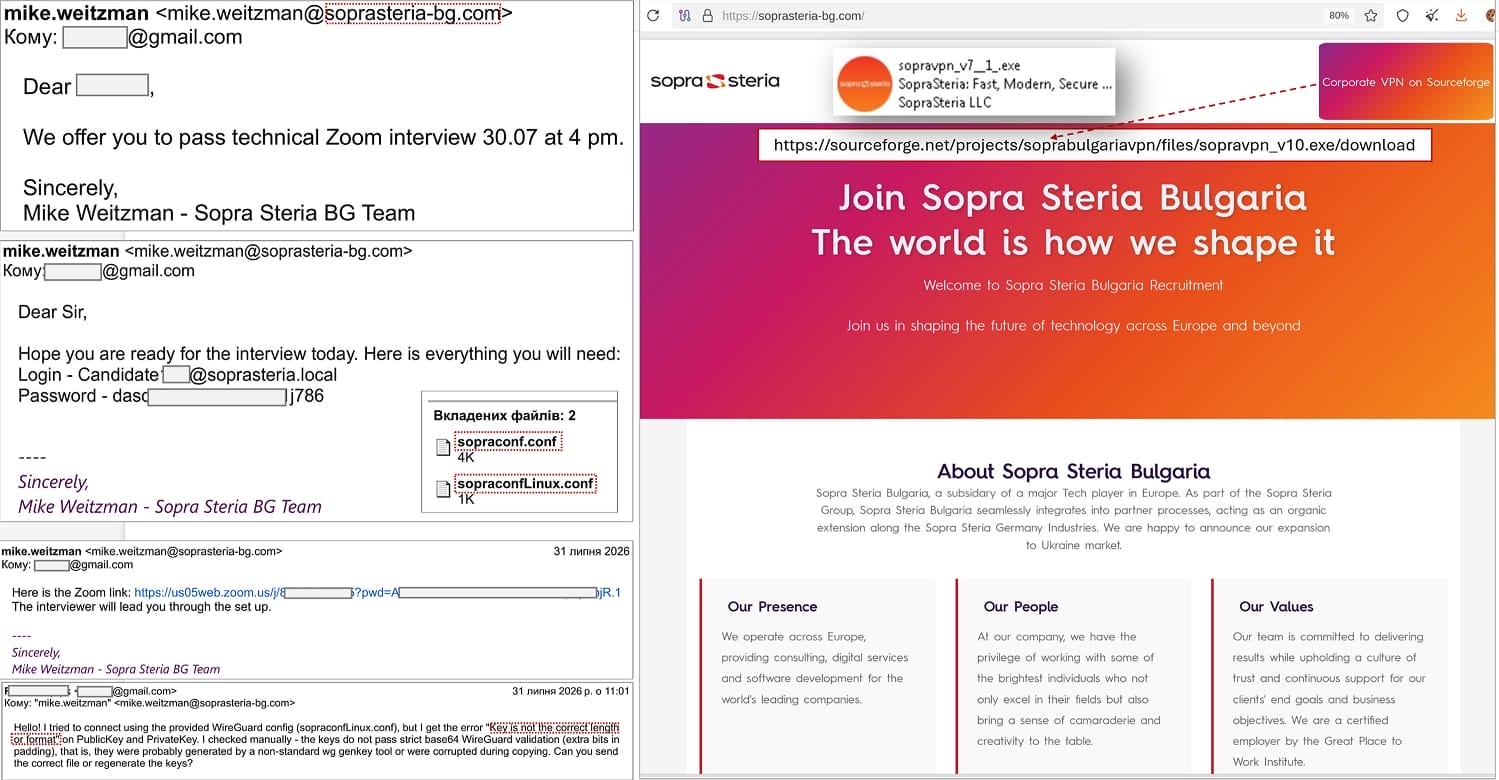
Conversations are then moved to Telegram to arrange a video interview over Zoom. During the interview, which is conducted in English, the candidates receive mock technical assignments that require them to connect to a corporate VPN.
Conversations with a supposed recruiter Source: CERT-UA
In one case that CERT-UA observed, the attacker impersonated the international IT firm Sopra Steria using seemingly legitimate email addresses similar to the company’s office in Bulgaria.
“In parallel, additional instructions for the technical interview are sent via email, including configuration files for connecting to a ‘corporate’ VPN using Wireguard (Linux/Windows) to supposedly perform test tasks,” CERT-UA says.
Advertisement
Malicious emails and VPN download link Source: CERT-UA
The downloaded file is configured to produce a fake error. The attackers then prompt the victim to download a modified WireGuard-based client called “SopraVPN” from SourceForge.
The SourceForge page even includes a link to soprasteria-bg[.]com to increase credibility, although the domain has no connection to the legitimate company.
The trojanized client supports a malicious, nonstandard “SymmetricKey” configuration option that decrypts and executes embedded PowerShell code.
On Windows, the malicious command creates a scheduled task and downloads an additional payload from the Internet.
On Linux, it uses cURL to retrieve another executable from attacker-controlled infrastructure through the VPN.
Advertisement
CERT-UA also noted that WireGuard’s standard Base64 decoding was replaced in the trojanized version with a custom, dynamically generated Base64 alphabet, which renders key strings unreadable with standard decoders and protects the PowerShell code from analysis.
The Ukrainian cyber agency advises telecommunications providers and IT companies whose staff are targeted by this campaign to restrict corporate resource access to managed, continuously monitored devices protected by EDR, including when employees use personal equipment.
These days, it’s all but essential to have a quality set of headphones or earbuds on hand. Listening to music, taking phone calls, checking out audiobooks, and more are enhanced by this immersive wireless audio tech. For many, Apple’s AirPods are the way to go, because of their shape, sound quality, and bevy of features activated by a single tap. However, as popular as these devices have become in recent years, many Apple users have started to turn away from AirPods in favor of alternatives for one reason or another.
Of course, there’s nothing wrong with sticking with AirPods, as they have a lot to offer. Many like the smooth, contoured shape and how they fit within the ear. They’re optimized to connect quickly and function seamlessly with Apple devices; the sound quality is strong, and features like Hearing Protection on AirPods Pro 2 and AirPods Pro 3 help reduce exposure to loud environmental noise. Still, many users find they lack in some areas, or that the competition has proven itself superior in one way or another.
While Apple most likely won’t abandon the AirPods line anytime soon, it appears some users are putting them away for good. These are some of the most common reasons the earbud-wearing public has given online for making the switch.
Advertisement
New sets of AirPods aren’t cheap
Dontree_m/Getty Images
Like any piece of modern technology, AirPods don’t last forever. The rechargeable lithium-ion battery within may only last a few years before it fails to hold a charge, rendering the earbuds unusable. Their design also makes them nearly impossible for the average person to repair, so replacement seems like the only way to go for most. Unfortunately, this brings another obstacle: price. AirPods are quite expensive, with some of the latest AirPods Pro models potentially costing hundreds of dollars. Naturally, this high financial barrier has become a sticking point for many Apple customers, leading them to leave AirPods behind altogether.
There’s lots of online discussion concerning AirPods prices and what consumers get for the cost. Many feel that going with other brands is just fine to save some money, with some arguing that AirPods’ high price is due at least in part to Apple’s status as a premium brand. This has led some to seek out cheaper alternatives from other brands. At the same time, there are lots of people online who feel AirPods are a get-what-you-pay-for investment. They believe the higher price is worth it for the sound quality, comfortable shape, and other features they bring to the table.
Advertisement
There are strong, cheaper alternatives
Nguyenducquang/Getty Images
A big factor in the success and popularity of AirPods is the Apple name and its connection to the brand’s devices. Features like Instant Pairing, Audio Sharing, and more are only available when AirPods are paired with Apple devices. However, if these and some of the many hidden AirPods features to use don’t appeal to you, you’re not particularly fond of AirPods, or you’re choosing to move away from the iOS ecosystem, there’s less of a reason to stick with AirPods. There’s an endless number of earbud brands, each with their own set of pros and cons. If online chatter is any indication, many former AirPods users have begun looking to these audio brands to meet their audio needs.
Users recommend many earbud brands as viable alternatives to AirPods. Sony, which offers a range of high- and low-priced earbuds, is one name that frequently comes up in these discussions. Sony’s earbuds come in a variety of shapes and colors, while offering features like noise cancellation and enhanced user comfort. The Beats line of wireless earbuds, Bose’s earbud offerings, and earbud sets from Anker also have their share of online supporters. On the whole, things like price, sound quality, and the ability for the earbuds to stay in the user’s ear, among others, influenced users’ decisions to switch to non-Apple brands and recommend them to others.
Advertisement
The wired headphone resurgence
Sergii Vasylchenko/Getty Images
With the almost total disappearance of headphone jacks from modern phones and the overall cultural embrace of Bluetooth technology, wired earbuds have largely faded from the spotlight. Still, they haven’t gone away completely. In some circles, they have proven even more popular than Apple AirPods. Whether with a USB-C connection or a dongle to make them phone-compatible, many have found wired earbuds to be a good alternative to AirPods in more ways than one. In fact, even Apple’s own EarPods have surged in popularity as of late thanks to a few key wins they score over their wireless contemporaries.
Even in committed AirPods circles, EarPods win out with many people. They’re praised for their sound quality, significantly lower price at around $20 per pair in most cases, and microphone quality. Looking at wired headphones more generally, AirPods can’t compete with the fact that wired earbuds don’t need to be charged. Not to mention, their cable-bound nature makes them easier to keep track of, and there’s no need to carry around a charging case, either. Additionally, there are many great wired earbuds for consumers to choose from. Plus, if you’re into the slightly old-school, Y2K aesthetic, wired earbuds evoke that era of tech far more than modern AirPods.
Advertisement
Possible health concerns
Denis Borisov/Getty Images
As harmless as they may seem, AirPods and earbuds as a whole do come with some health risks. Thus, in-ear headphones aren’t the right choice for everyone. The potential for hearing loss cannot be ignored, as listening at high volumes for long stretches can do serious damage over time if users aren’t careful. Also, keeping AirPods in for long periods can lead to increased earwax accumulation, while taking them in and out can push earwax deeper into the ear canal. This can mean blockage, possible earaches, and hearing loss. By using a set of over-ear headphones instead, that issue can be greatly reduced.
Meanwhile, others have stopped using AirPods and earbuds because they are concerned about the potential health risks that come with their use. There has been a lot of chatter online about the electromagnetic fields generated by AirPods and the possible impact they could have on the human brain or the body. It should be stressed that this subject is still being researched by the scientific community, with no serious link between AirPods or earbud EMF exposure and health problems established as of yet. However, that possibility alone has led some to cut back on using AirPods or ditch them entirely.
Atlantis Lab may not be a familiar name to most American audiophiles, but the French loudspeaker manufacturer has been building high efficiency designs since 1998. Originally known as Atlantis Acoustique, the company was founded by Eric Buy with a focus on producing speakers that could deliver substantial output without requiring massive amounts of amplifier power.
That philosophy guided the company for nearly two decades before Atlantis shifted direction in 2017, bringing in a team of sound engineers to optimize its loudspeakers for professional studio use as well as home audio systems. The change also brought a new name and product lines that retained the efficiency of the earlier models while adding the heavy duty drivers, cabinets, and components more commonly associated with professional sound reinforcement equipment.
The result is a range of loudspeakers that are relatively easy to drive, built to withstand demanding use, and flexible enough to work in rooms where conventional designs can struggle. Tunable ports allow many Atlantis Lab models to sit closer to the wall without overwhelming the room with bass, helping the company build a loyal following across Europe.
The problem in the United States was never the product. It was finding one. Early availability was inconsistent, and dealer support was limited. With Decibel+ now representing Atlantis Lab, distribution and customer support have improved considerably. That should make the brand a far more common sight in American studios, showrooms, and listening rooms.
Advertisement
The current Atlantis Lab lineup includes the AT-13 Pro and AT-21 Pro bookshelf speakers, along with the AT-16 Pro, AT-18 Pro, AT-23 Pro, AT-31 Pro, and AT-38 Pro floorstanding models. The company also offers a dedicated home theater range with AT-13 and AT-21 center channels, the AT-22 satellite speaker, and the AT-33 subwoofer.
Taken together, the lineup covers nearly every room size and application, with prices starting at roughly $1,650 and climbing to $13,000 each for the flagship AT-38 Pro. That is a substantial range, but it also gives buyers the ability to select a model based on the room rather than trying to force an undersized or oversized loudspeaker into a space where it does not belong.
After speaking with Decibel+ about which model would make the most sense for this review, we settled on the AT-23 Pro as the best match for the room I had available. Positioned near the middle of the lineup, the AT-23 Pro retails for approximately $3,400 per speaker, depending on the selected options.
These are designed to fill a room rather than function as oversized nearfield monitors, so choosing the correct model for the space was important. I wanted to evaluate how the AT-23 Pro energized the entire room, not simply toe the speakers toward my listening position and judge them solely on their on-axis performance.
Advertisement
Related Reviews:
The AT-23 Pro Makes Its Presence Felt Before the Music Starts
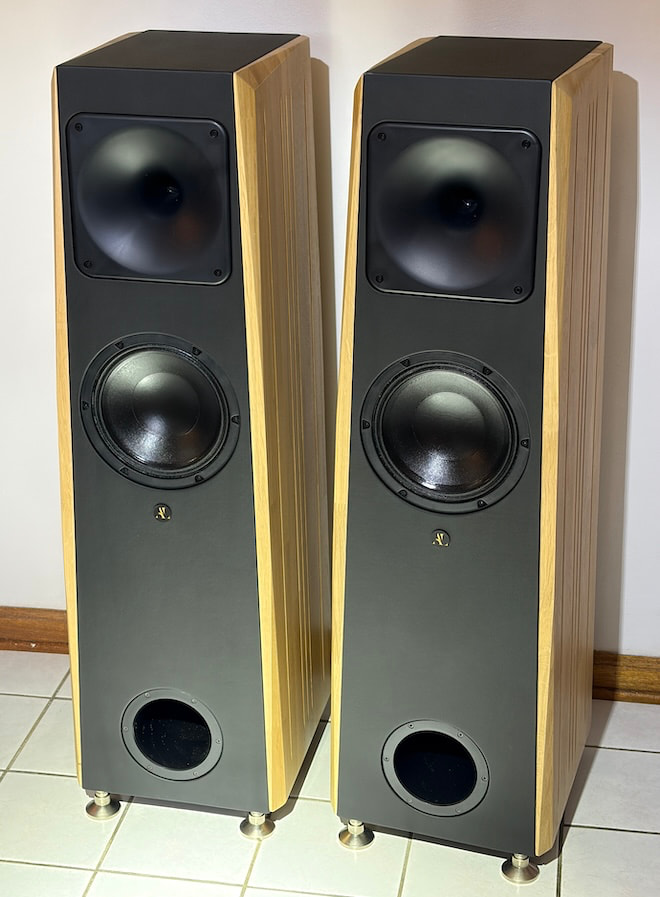
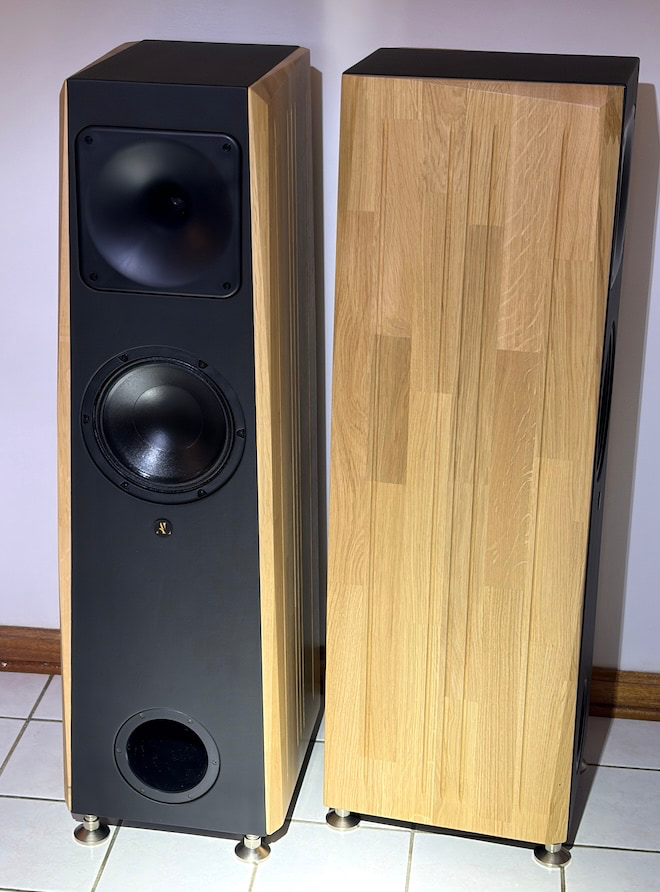
Atlantis Labs AT-23 Pro (front without grilles)
Unboxing the AT-23 Pro is a challenge, as each speaker weighs 35 kilograms, or roughly 77 pounds. This is not a speaker you casually lift out of the box and carry across the room without first considering the condition of your back.
The front baffle is wrapped in black leather, although white leather is also available. Solid oak panels cover both sides of the cabinet and slope gently inward, making the enclosure slightly narrower at the top than at the base.
Each side panel is constructed from vertical oak slats measuring 54mm wide. Not every slat is made from a single piece of wood, so horizontal joints are visible in several places. The finished cabinet is certainly distinctive, although it may not be the easiest visual match for rooms with similarly colored hardwood floors or a lot of existing wood furniture.
Advertisement. Scroll to continue reading.
The side panels are likely to be the most divisive aspect of the AT-23 Pro’s appearance. Some people I asked really liked the combination of leather and natural oak, while others felt the segmented wood panels detracted from the overall aesthetic. Offering a solid-color finish or a continuous veneer might make the AT-23 Pro easier to integrate into a wider range of listening spaces.
Advertisement
Pro Drivers With Room-Friendly Placement
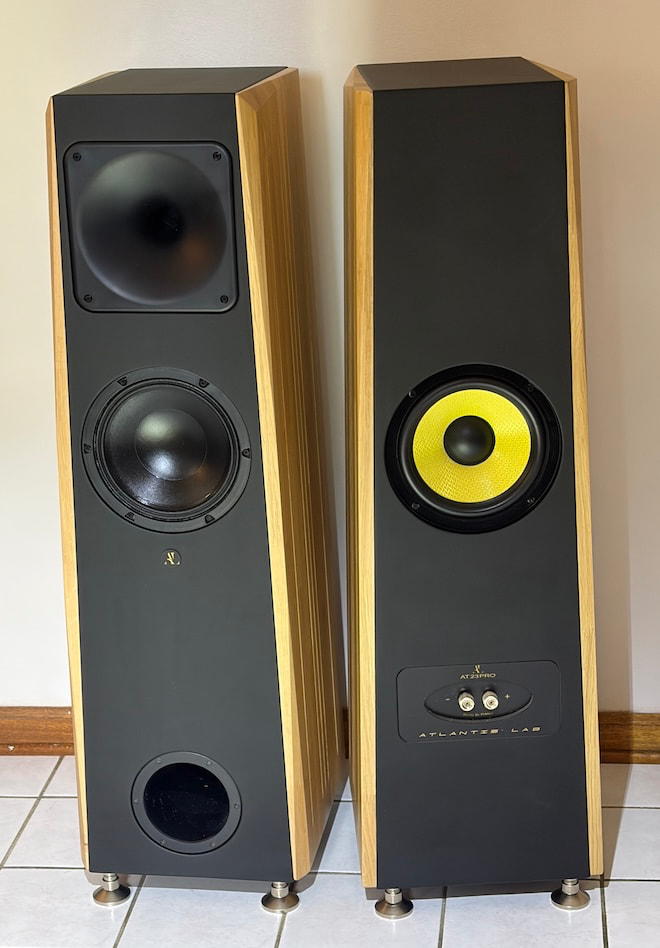
Atlantis Labs AT-23 Pro (front and rear without grilles)
Starting at the top of the front baffle, the AT-23 Pro uses a 1-inch horn-loaded tweeter with a titanium diaphragm and a round waveguide offering 90-by-90-degree dispersion. Directly below it sits a 21cm midwoofer, paired with a second 21cm driver mounted in opposition on the rear of the cabinet.
The front-firing driver is an Eighteen Sound model with a paper cone selected for greater transparency, while the rear driver uses the company’s Kevlar cone to add depth and impact. This arrangement gives the AT-23 Pro a more substantial low-frequency presentation without relying on a conventional collection of front-facing woofers.
A tunable port at the bottom of the front baffle allows the speaker to be adjusted for placement closer to or farther away from the rear wall. That flexibility makes the AT-23 Pro particularly useful in rooms where the speakers need to sit near a wall to avoid blocking walkways or consuming too much floor space.
The leather finish continues across the rear of the cabinet as a single uninterrupted piece running from the bottom of the front baffle, over the top, and down the back. This creates a cleaner visual contrast with the more segmented appearance of the oak side panels.
The rear-facing 21cm Kevlar driver is positioned roughly halfway up the cabinet. Below it, a single pair of binding posts accepts bare wire or banana plugs. The through-hole design can accommodate bare speaker cable up to approximately 10 gauge, which should be more than sufficient for nearly any domestic installation.
Advertisement
Easy to Drive, Hard to Overwhelm
The AT-23 Pro is a 4-ohm loudspeaker rated to handle 300 watts continuously and 600 watts peak. Atlantis Lab specifies a frequency response of 33Hz to 20kHz, but my in-room testing found output remained within roughly 1dB down to 28Hz before the roll-off became more pronounced. That makes the AT-23 Pro entirely usable without a subwoofer for most music systems, although home theater users may still want one for the lowest effects.
One of the original design goals was to combine the performance of the AT-21 loudspeaker and AT-33 subwoofer in a single cabinet. Based on the measurements and what I heard in the room, Atlantis Lab largely succeeded.
The adjustable port provides another level of control over the low end. I found that slightly increasing the tube length from its default setting produced the best balance in my listening room. The adjustment is simple, and the audible difference is substantial enough to be useful. This is not a gimmick. It is a legitimate room-tuning tool.
With a rated sensitivity of 96.5dB, the AT-23 Pro can also be paired with a much wider range of amplifiers than its size and power handling might suggest. It worked equally well with lower-powered tube amplifiers and far more muscular solid-state designs. I expected it to favor one end of that spectrum, but it remained composed and engaging regardless of which amplifier I used.
Advertisement
My first test platform was a modified Dynaco ST-70 producing roughly 32 watts per channel, with peak output reaching into the 70-watt range before distortion begins to take a meaningful toll on sound quality. I then moved to the opposite extreme and connected the AT-23 Pro speakers to my main system, which uses a pair of Mark Levinson No. 23.5 amplifiers capable of delivering 400 watts without much effort.
Those two systems represent something close to the practical lower and upper limits most owners are likely to consider. The AT-23 Pro handled both without complaint, which says a great deal about its efficiency, power handling, and overall versatility.
Measured bass extension: Approximately 28Hz at -1dB in-room
Sensitivity: 96.5dB
Nominal impedance: 4 ohms
Continuous power handling: 300 watts
Peak power handling: 600 watts
Connections: Single pair of binding posts
Compatible terminations: Banana plugs and bare wire up to approximately 10 gauge
Cabinet finishes: Oak side panels with black or optional white leather baffle
Dimensions (HxWxD): 111 x 40 x 40 cm (43.7 x 15.75 x 15.75 inches)
Weight: 35 kg / 77 lbs each
Listening
The AT-23 Pro speakers effortlessly bring a room together with their captivating sound quality. At AXPONA, it was evident that while the cabinetry might stir some debate among enthusiasts, the sound quickly shifts the focus back to what truly matters: pure, immersive listening enjoyment.
The AT-23 Pro delivers robust, solid bass that often forced me to remind myself that my subwoofers were disconnected. The bass is not only quick but also richly textured, displaying an impressive level of detail that one might not expect from relatively small drivers paired with a large reflex port.
Advertisement
Contrary to expectations, there is minimal distortion, which is a common issue when smaller drivers attempt to mimic larger ones. The low-end capabilities of these speakers make them an excellent option for rooms where subwoofer placement is problematic or impossible. Those looking for true home theater impact, or listeners who favor heavy EDM, can add a subwoofer to take the slam and rumble to another level.
Midrange frequencies are reproduced with excellent clarity and above-average dynamics, allowing horns and strings to resonate with convincing energy and life. Acoustic guitar and piano are rendered with a level of realism that many more expensive loudspeakers struggle to duplicate.
My usual classical and jazz playlists were a joy to experience through the AT-23 Pro. Even when I switched to the dense, complex layers of Miles Davis’ “Bitches Brew,” I remained thoroughly engrossed by the nuanced presentation of each horn and the speaker’s ability to keep individual instruments distinct within the mix.
Vocal reproduction through the AT-23 Pro is generally excellent, although it highlights the importance of both recording quality and careful system matching. The horn-loaded tweeter can emphasize brightness when paired with similarly voiced electronics, but it also reveals just how well, or poorly, a recording was engineered.
Advertisement
Recordings handled by engineers such as Rudy Van Gelder and Bruce Swedien sounded open, detailed, and remarkably lifelike. Poorly mastered tracks were far less forgiving, with harshness and compression brought more clearly into focus.
That sensitivity is better understood as a reflection of the AT-23 Pro’s resolving ability than an inherent flaw. Pair it thoughtfully and feed it quality recordings, and the speaker rewards the effort.
The dynamic range and engaging character of the AT-23 Pro are undeniable. The speakers handle the delicate passages of Tchaikovsky’s “The Sleeping Beauty” with grace and air, then power through Mussorgsky’s “The Great Gate of Kiev” with explosive energy and precision.
With the right recordings and complementary electronics, the AT-23 Pro delivers a thrilling and highly immersive listening experience.
Advertisement
The Bottom Line
The Atlantis Lab AT-23 Pro is a versatile floorstanding speaker for medium to larger rooms, especially for listeners who want deep, authoritative bass without adding a subwoofer. Its high sensitivity, tunable port, and ability to perform closer to the rear wall also make it easier to place than many speakers of this size.
The AT-23 Pro combines detailed highs, precise midrange performance, and substantial low-end output in a package that reminds me of the Vandersteen Treo CT at close to half the price. The Treo still offers greater treble refinement, and the AT-23 Pro’s oak-slat cabinetry will not appeal to everyone, but neither issue diminishes how engaging these speakers are.
Advertisement. Scroll to continue reading.
They are not yet widely known in the United States, but improved distribution through Decibel+ should change that. Anyone shopping in this price range should make the effort to hear them. They are easy to drive, difficult to ignore, and even easier to get lost in.
Advertisement
Pros:
Deep, powerful bass that often eliminates the need for a subwoofer
Clear, realistic midrange with excellent dynamics
High sensitivity makes amplifier matching relatively easy
Tunable port allows more flexible near-wall placement
Engaging, room-filling presentation with strong value for the price
Cons:
Horn tweeter can sound bright with aggressive electronics or recordings
Oak-slat cabinetry will be visually divisive
Large, heavy cabinets require help during setup
Treble is not quite as refined as some more expensive competitors
SpaceXAI has launched Grok Bot in beta, AI agents that sign into apps and websites, retain context between tasks and coordinate with each other. Access is limited at first to SuperGrok Heavy, Cursor Ultra and Cursor Teams Premium subscribers, with an enterprise waitlist.
SpaceXAI has released Grok Bot, software that hands work to groups of AI agents running on their own machines. The agents sign into apps and websites, keep context between tasks, and pass work back only when they need a human decision. It went into beta on Tuesday.
Access is restricted at first to SuperGrok Heavy, Cursor Ultra and Cursor Teams Premium subscribers, with a waitlist for enterprise customers. It runs on macOS, Windows, Linux and iOS, with Android to follow.
The selling point is that the agents work through interfaces rather than APIs, signing in the way a person would, and that several can run at once and share what they know. SpaceXAI says it has been using them internally across engineering, growth and marketing, citing overnight sales research, expense receipts pulled out of email, and bug fixes.
Advertisement
TNW reported in July that Cursor was building a general-purpose office agent, codenamed Sand, aimed at Claude Cowork and ChatGPT Work. Grok Bot arrives in that same territory, as SpaceXAI and Cursor merge into a single company.
SpaceX agreed a $60bn all-stock deal for Cursor’s parent Anysphere in June, days after its own listing, in what was reported as the largest startup acquisition on record. Cursor’s coding tools already run inside much of the Fortune 500.
The product is Musk’s answer to having fallen behind in agents. SpaceXAI shipped its first coding agent in May, then followed with Grok 4.5, built with Cursor, in July.
Rivals are circling the same idea. OpenAI’s Sam Altman discussed agents coordinating with one another when he met lawmakers in Washington last month.
Advertisement
Handing sign-in credentials to autonomous software raises an obvious question for this company in particular. Cursor’s Grok Build tool was found to be uploading entire Git repositories, committed secrets included.
The commercial pressure now sits with SpaceX. Musk told investors on last week’s earnings call that AI work was progressing and that Grok 4.6 could ship within days. Grok’s slow adoption in Washington has already weighed on the IPO story.
Last week, a researcher outlined what he said was a “novel attack surface” in passkeys, the new authentication paradigm that offers a more secure alternative to password-based methods. In fact, the attacks demonstrated in the post are neither novel nor unique to passkeys. This distinction is important because the research has generated confusion among end users and security professionals as they assess whether this new mechanism is truly safe to use.
The attack is called Pass-ta-key—a blending of the word passkey with the phrase “pass the key” and a nod to a plate of pasta. Arie Olshtein, a researcher at security firm Palo Alto Networks, described in a post last week how Pass-ta-key could obtain all passkeys stored in the Google Password Manager app (GPM) for Windows when it’s running on a machine infected with malware.
This came as a surprise to many people because they believed passkeys are stored exclusively in the trusted platform manager (TPM), the locked-down enclave in a hardened silicon chip that’s reserved for storing cryptographic keys and other highly sensitive information on Windows machines. If passkeys are stored in the TPM, then how was Pass-ta-key able to extract the entire set of passkeys stored by the app, they wanted to know.
Local passkey storage is OK, with one exception
The answer is that, contrary to common belief, the FIDO 2 specifications—managed by the industry group FIDO Alliance—don’t mandate that passkeys be kept in TPMs, or any other sort of dedicated piece of hardware (they go by different names, depending on the platform, including secure enclaves, trusted execution environments, and StrongBoxes). In fact, most platforms and third-party software for managing passkeys do not store passkeys in such dedicated hardware. Virtually the lone holdout is Microsoft, which gives users the option to store passkeys in the Windows TPM. The company mainly recommends this choice to enterprises, not consumers.


































































You must be logged in to post a comment Login