
Nothing has made me appreciate the sheer scale and power of targeted advertising like having children. Months before the births of both my kids, it felt like every ad I encountered wanted to sell me baby products. And on seemingly every product were the same two words in bold letters: plant-based.
Tech
From plant-based diapers to bioplastics: How marketing took over the baby aisle


I’m not kidding. Diapers, baby wipes, teething rings, bath toys — it’s all plant-based these days. Once I saw the phrase on baby products, I started to notice it everywhere. There are plant-based foods, of course (like Impossible burgers and Beyond sausage). There’s plant-based protein, which is kind of like the plant-based meat only less meaty and now showing up in weird places like breakfast cereal. And once you leave the grocery store, you can find plant-based cosmetics, cleaning products, toothbrushes, sneakers, phone cases, and yoga mats. Don’t forget the plant-based packaging to wrap it all up.
It wasn’t immediately clear to me what plants did to deserve the spotlight here. I knew that plant-based foods tend to be better for people and for the environment. But was the same true for plant-based plastics, fabrics, and chemicals?
Still, as a dad trying to keep my kids from harm, I hoped for the best. I bought the plant-based diapers, wipes, and toys. On their labels, alongside the term “plant-based” were words like “eco” and “food-grade,” which signaled two big things to me as a consumer: safe and sustainable. The vast majority of plastics, for instance, are made from fossil fuels, which are damaging to everyone, and microplastics, the tiny synthetic particles left over as plastic breaks down, are showing up in our water supply and our bodies.
- The “plant-based” label has started showing up on everything from diapers to phone cases in recent years, signaling a product is “safe” and “sustainable” even when there’s no evidence for that.
- The term is essentially unregulated and poorly defined, so “plant-based” products can still contain harmful chemicals.
- Treat “plant-based” as a starting point, not a guarantee. Look for products that are transparent about their ingredients or that have credible certifications, like organic.
On the other hand, I’ve seen how brands prey on consumers’ anxieties and use greenwashing to make them seem healthier and more sustainable. Is the boom in plant-based products more of the same? I decided to find out.
Don’t you dare call it vegan
You can trace the term plant-based back to the early 1980s, when a nutritional biochemist named Thomas Colin Campbell was presenting a paper to the National Institutes of Health research grant committee. It was about the role of nutrition in cancer and the benefits of consuming more vegetables, fruit, and grains, rather than meat, but Campbell thought calling the diet vegetarian would be polarizing to the committee. “My solution was to choose ‘plant-based’ for lack of a better word,” Campbell later wrote. He later expanded the description of the diet to “whole food, plant-based.”
The term slowly entered the mainstream in the decades that followed, but Campbell has said it really took off after the success of his 2005 book The China Study. The book is based on a study of the lifestyles of 6,500 Chinese people and linked plant-based diets to lower rates of cancer. It was only a couple years later that Michael Pollan coined his now famous mantra, “Eat food, not too much, mostly plants,” in a New York Times Magazine story that he later adapted into the bestseller The Omnivore’s Dilemma. This is also broadly when we saw the rise of flexitarianism, the diet that’s mostly plants but allows for a little meat or fish.
Plant-based products invaded the grocery store in the 2010s. While labeling something as “vegetarian” or “vegan” might turn some consumers away, the plant-based moniker offered the perfect mix of natural and approachable. After all, who doesn’t like plants? Following a significant rise in the number of new food and drink products labeled as plant-based between 2012 and 2018, the number of plant-based packaged goods increased by 302 percent from 2018 to 2022.
The jump from food to all kinds of consumer products happened for several converging reasons around this time.There was the federal government’s push for more biobased products through the expanded Farm Bill of 2018, as well as the bioplastic industry’s newfound ability to scale up its production. More brands bet on plant-based branding (LEGO released its first plant-based pieces, which were made of sugarcane-based polyethylene, that same year). In 2020, Pampers brought the trend to the mainstream baby market with its Pure diapers, which had plant-based liners.
All of these plant-based products are supposedly engineered to be better in some way. Plant-based cosmetics that are supposed to be better for your skin (although not as good as human-based cosmetics apparently). Plant-based cleaners are supposed to be better for the air quality in your home. Plant-based packaging is supposed to be better for the planet.
The problem is that “plant-based” doesn’t have an agreed-upon definition (nor does “better”), and the label isn’t regulated in any way. When you see something bearing the “certified organic” or “Fair Trade Certified” seal, you know that it’s met a strict set of requirements established by the United States Department of Agriculture (USDA) and Fair Trade USA, respectively. But there’s nothing stopping a company from slapping “plant-based” on its packaging, just like there are no regulations limiting the use of the terms “natural” or “green.” In 2025, the Federal Drug Administration (FDA) released draft guidance on “plant-based” labeling, but those recommendations are nonbinding.
“I wonder if ‘plant-based’ is a new ‘natural,’ because saying something is natural has obviously been played out,” Josée Johnston, a sociology professor at the University of Toronto, told Vox. “Nobody takes that seriously anymore.”
Plant-based items aren’t necessarily appealing to consumers just because we think they’re good. They also represent the absence of bad. The label makes you believe that because an item isn’t made of conventional plastic, it must be free of the microplastics that might invade your bloodstream and settle into your brain. Surely it won’t take centuries to decompose in a landfill.
But just as products billed as “natural” aren’t necessarily free of artificial ingredients, products marketed as plant-based are full of things that aren’t plants — some of which are quite dangerous. They can include things like PFAS, which are known as forever chemicals because they break down slowly and accumulate in the body, which are linked to serious health problems, like cancer and weakened immune systems among children. Chemicals in plant-based products can also emit volatile organic compounds, or VOCs, which are a form of air pollution that can cause respiratory problems in the short term and, in the long term, also cancer.
Plastic that’s plant-based rather than petroleum-based sounds like it would be biodegradable, too. But the most popular bioplastic, known as polylactic acid, or PLA, actually requires specific industrial composting conditions to break down efficiently. In other words, you can’t just dump bioplastics into your backyard compost bin and expect them to fertilize your garden. If you put a PLA-based plastic bottle in your garden, it actually could take centuries to decompose.
Shifting to these plant-based materials can have positive effects. In general, using bioproducts over fossil fuel-based products can help lower emissions and reduce landfill waste, when managed properly. But they also come with climate consequences of their own. For example, growing plants requires less land than livestock, but it still takes up a lot of land. Meanwhile, if bioplastics aren’t composted in a particular way, they act like petroleum-based plastic in landfills and the environment. They don’t break down, but they do produce methane, a powerful greenhouse gas.
None of this necessarily means you should avoid plant-based products. It just takes some extra work to know what’s in them — and what to do with them when you’re done.
How to make sense of plant-based marketing
It’s hard navigating the world while watching it burn. Many people, rightly, want to do their part to make things better, but it’s easy to feel overwhelmed and powerless. When companies offer us products that make us feel better about all kinds of things — our carbon footprint, our health, our safety — they are really selling us a sense of agency. You buy organic produce, because you’re worried about how the conventional stuff was produced. You buy bioplastics, because you think they’re less likely to break down into microplastics. You buy plant-based diapers, because you think the regular ones will harm your baby. Norah MacKendrick, a sociologist at Rutgers, calls this cautious consumerism and says that it’s not a bad thing.
“Americans know, on some level, that the ingredients in the products on their store shelves, from baby food to diapers, haven’t been carefully vetted for their impacts on health — not by any governmental body or by the companies themselves,” she told Vox.
“People do have a sense that the way we’re consuming is not sustainable,” said Johnston, the University of Toronto professor. “They’re more aware of plastics in the environment, plastics in water, and so I think they’re going to be drawn to products that offer them a way out, a way to manage that dissonance and discomfort in everyday life.”
It’s frustrating, then, that the plant-based moniker is functionally useless. The onus is on shoppers, often women, to do the research and figure out which products live up to their implied promise of being healthy or environmentally friendly or simply not as harmful as the conventional thing.
Plant-based products are no panacea. They’re also not necessarily bad products. In terms of measurable impact, however, there’s still a lot we don’t know.
There is a mountain of evidence that plant-based foods are better for the environment. Transitioning everyone from meat-based to plant-based diets, for instance, could reduce diet-related land use by 76 percent and reduce greenhouse gas emissions by nearly 50 percent. Meanwhile, consuming a whole foods, plant-based diet can reduce the risk of heart disease by 25 percent, according to one meta-analysis. Michael Pollan’s mantra holds up.
Things get a bit trickier when it comes to other plant-based products, and even more difficult when it comes to items for babies. When you’re looking at the environmental impact, there’s good evidence that plant-based plastics, which are often made of corn or sugarcane, tend to have a smaller carbon footprint and to be more biodegradable. But that corn or sugarcane has to be grown somewhere, which means using resources like land and water. Plus, as mentioned above, PLAs require industrial processes for proper composting. If you just bury a “compostable” plant-based plastic fork in your backyard, there’s a chance it will decompose about as slowly as petroleum-based plastic. Plant-based plastics may also include additives, including bisphenol A or (BPA) or phthalates, which can disrupt your endocrine system.
Similar patterns pop up when you’re talking about plant-based textiles, beauty products, and cleaners. They’re probably better than their conventional counterparts, but there are caveats. Some “vegan leather,” for instance, might get billed as plant-based but is actually just regular, petroleum-based plastic. (The New York Times called this rebranding “a marketing masterstroke meant to suggest environmental virtue.”) A lot of plant-based fabric is actually man-made cellulosic fibers (MMCFs), like viscose, rayon, or lyocell, which are energy intensive to produce.
All of these products come with their own set of health concerns. Plant-based textiles can be treated with PFAS for waterproofing (vegan leather is a particularly bad offender). Plant-based cosmetics and cleaners can be made with fragrances and chemicals that emit VOCs. And even though something is plant-based, it could still contain allergens or irritants. We also still don’t fully understand what microplastics are doing to our bodies, but plant-based plastics can get micro-sized, too. Research shows that bioplastics degrade and produce micro- and nanoscale pollution, just like conventional plastics, and they present new problems because we know even less about what they do to humans and to the environment. (If you’re still confused about recycling plastic, which is warranted because it’s confusing, check out this guide.)
You might read all of this and assume everything is awful and dangerous, which is fair. But I look at it as evidence that all products are more complicated than a single ingredient, whether that’s petroleum or corn. It can be intimidating to wade through the alphabet soup of chemicals and certifications to know what’s safe, according to Sheela Sathyanarayana, a pediatrician who runs a lab at Seattle Children’s Hospital studying how chemicals affect children.
“This is very hard at the individual consumer level,“ said Sathyanarayana, who points to the Environmental Working Group as a good resource. “But overall there is not one space that talks both about ecological sustainability and chemical human safety together (that I know of).”
If you’re cautious about how that product may affect the planet, you, or your baby, take a closer look. Seek out companies that not only say they use good ingredients, but also say they avoid harmful ingredients. Here’s a list of brands that claim they avoid PFAS, for example. You can also look for independent certifications, like OEKO-TEX Standard for textiles, as well as government programs, like Safer Choice from the Environmental Protection Agency or BioPreferred from the USDA for authoritative information. Again, the term plant-based is not regulated, so it alone is not a good guide.
I’ll confess, I bought some plant-based diapers from a brand called Dyper. They were billed as non-toxic, chlorine free, charcoal-enhanced, stuffed with wood pulp from responsibly managed forests, and theoretically compostable. The problem was that they were stiff as a board, and they leaked. They also cost more than double what I’d been buying for my kid — roughly a dollar a diaper versus less than 50 cents. If I wanted to compost the dirty diapers, I’d have to bag them up and call for a truck to come pick them up and take them to a special industrial composting facility.
It just shows how much work it takes to be a cautious consumer. That doesn’t mean you shouldn’t do it. If you see something’s plant-based, that might catch your attention, but dig into the details to figure out just how good that product is for the environment or for you. If you’re shopping for a baby, you’ll want to be extra careful to look out for certain chemicals, especially phthalates, PFAS, and VOCs. But admittedly, this is especially challenging when it comes to diapers; companies don’t have to list the ingredients in their diapers (except in New York, where it recently became required by law).
In your quest for safe and sustainable products, there is ultimately the option of just buying less stuff or buying secondhand. That’s not an option with disposable diapers, of course, but it’s a great course of action when it comes to clothes, furniture, and home goods.
When all else fails, try buying something that’s completely, verifiably natural. Lately, I’ve been seeing a lot more natural rubber baby products. There are teethers, bath toys, and pacifiers. Natural rubber is just tree sap, so it seems safe enough. Natural rubber can also grow mold, however. If only anything could be simple.
A version of this story was also published in the User Friendly newsletter. Sign up here so you don’t miss the next one!

Continue Reading

Looking for a different day?
A new Quordle puzzle appears at midnight each day for your time zone – which means that some people are always playing ‘today’s game’ while others are playing ‘yesterday’s’. If you’re looking for Friday’s puzzle instead then click here: Quordle hints and answers for Friday, April 3 (game #1530).
Quordle was one of the original Wordle alternatives and is still going strong now more than 1,400 games later. It offers a genuine challenge, though, so read on if you need some Quordle hints today – or scroll down further for the answers.
SPOILER WARNING: Information about Quordle today is below, so don’t read on if you don’t want to know the answers.
Article continues below
Quordle today (game #1531) – hint #1 – Vowels
How many different vowels are in Quordle today?
• The number of different vowels in Quordle today is 3*.
* Note that by vowel we mean the five standard vowels (A, E, I, O, U), not Y (which is sometimes counted as a vowel too).
Quordle today (game #1531) – hint #2 – repeated letters
Do any of today’s Quordle answers contain repeated letters?
• The number of Quordle answers containing a repeated letter today is 1.
Quordle today (game #1531) – hint #3 – uncommon letters
Do the letters Q, Z, X or J appear in Quordle today?
• No. None of Q, Z, X or J appear among today’s Quordle answers.
Quordle today (game #1531) – hint #4 – starting letters (1)
Do any of today’s Quordle puzzles start with the same letter?
• The number of today’s Quordle answers starting with the same letter is 0.
If you just want to know the answers at this stage, simply scroll down. If you’re not ready yet then here’s one more clue to make things a lot easier:
Quordle today (game #1531) – hint #5 – starting letters (2)
What letters do today’s Quordle answers start with?
• M
• C
• D
• S
Right, the answers are below, so DO NOT SCROLL ANY FURTHER IF YOU DON’T WANT TO SEE THEM.
Quordle today (game #1531) – the answers

The answers to today’s Quordle, game #1531, are…
Another game where I came close to losing.
This time bad luck with two guesses — “drive” instead of DRIER and “hotel” instead of MOTEL — put me close to the edge, but I just about survived.
Daily Sequence today (game #1531) – the answers

The answers to today’s Quordle Daily Sequence, game #1531, are…
Quordle answers: The past 20
- Quordle #1530, Friday, 3 April: PINEY, TRUSS, HALVE, SPOOF
- Quordle #1529, Thursday, 2 April: LEAPT, MECCA, TRAIT, REFER
- Quordle #1528, Wednesday, 1 April: SEVEN, PRIOR, ADAGE, AUDIO
- Quordle #1527, Tuesday, 31 March: SMACK, HAPPY, LYING, PULPY
- Quordle #1526, Monday, 30 March: CHESS, ALLOT, SCONE, DITTY
- Quordle #1525, Sunday, 29 March: DELAY, STONY, MONTH, PARTY
- Quordle #1524, Saturday, 28 March: BRAWN, FELLA, SCALY, BRUNT
- Quordle #1523, Friday, 27 March: GROIN, WRONG, SKUNK, SHALL
- Quordle #1522, Thursday, 26 March: HOBBY, COULD, MORPH, LEDGE
- Quordle #1521, Wednesday, 25 March: BLUSH, GRIND, AWASH, SCALP
- Quordle #1520, Tuesday, 24 March: MADAM, BLACK, USING, VOICE
- Quordle #1519, Monday, 23 March: BAGEL, HOARD, AUGUR, TANGY
- Quordle #1518, Sunday, 22 March: SPLAT, BACON, CAIRN, AWFUL
- Quordle #1517, Saturday, 21 March: LEVEL, MAPLE, BRAID, CORAL
- Quordle #1516, Friday, 20 March: BUSED, FRONT, JEWEL, TRIPE
- Quordle #1515, Thursday, 19 March: DIRGE, VERVE, MAKER, FROZE
- Quordle #1514, Wednesday, 18 March: CLIFF, EXPEL, PRIZE, FROCK
- Quordle #1513, Tuesday, 17 March: GREET, BROOD, GRIME, SQUAT
- Quordle #1512, Monday, 16 March: MURKY, AGENT, SONIC, ALARM
- Quordle #1511, Sunday, 15 March: GRILL, WALTZ, TROVE, TOTAL
We may receive a commission on purchases made from links.
Every time you head to the hardware store, it seems like there’s a new cordless version of a tool you already own or a big company launching a tool to solve a problem you didn’t even know you had. It can be tough to navigate the constantly rotating inventory of hardware stores, whether you’re shopping in stores or online. Deciding what’s actually worth your hard-earned money is a hassle for both new homeowners building a tool collection from scratch and seasoned veterans simply looking to spend some extra cash on a new useful tool.
Of course, different renovation projects require different tools. Giving your bathroom a modern makeover is a much more involved project than organizing and hanging a photo wall. While each project might require a few specialized tools, there’s still a wealth of tools most homeowners would consider essential to have on deck at all times. We’ve rounded up 12 of these go-to tools, all of which are affordably priced under $75, well-reviewed, and can easily prove their worth after just a few uses.
Vonforn Paint Sprayer
If you have a ton of painting planned for future renovations, a paint sprayer will make the process much faster and easier. The Vonforn Paint Sprayer is equipped with a 700-watt motor, an attached container that can hold up to 1200 milliliters of paint, and adjustable flow control with four different nozzle sizes, including 1mm, 1.5mm, 2mm, and 3mm.
There are also three spraying patterns you can swap between — horizontal, vertical, and circular — to suit the needs of different projects. You can use this sprayer to put a fresh color on iron patio furniture or your kitchen chairs, to liven up an entire room in your home, or to paint pretty much anything else you can think of, including fences, doors, and cabinets.
Vonforn’s sprayer tool comes with a dust blowing joint that makes it easy to clear away dust and debris from the surface you’re about to paint. Then, cleaning up after you’re done painting is just as simple. The sprayer comes with a nozzle cleaning needle and a cleaning brush for the parts you’ll need to manually clean, and you can hook up the cleaning connector to your faucet to wash out any paint coating the pipe inside.
Ryobi One+ 18V Cordless Drill/Driver Kit with Battery, Charger, and Bits
One of the best home improvement tools you can invest your money in is a good drill. The Ryobi One+ 18V Cordless Drill/Driver slides in at just under $75 and comes with a battery, a charger, and a 40-Piece Impact Drive Kit. Among the kit’s 40 total pieces, there are 14 one-inch impact drive bits, 12 black oxide drill bits, four bradpoint drill bits, four two-inch impact drive bits, three impact nut drivers, two woodboring spade bits, one impact magnetic bit holder, and a clear case to neatly hold everything.
As for the drill itself, it features a 3/8-inch keyless chuck, a variable speed trigger with possible speeds up to 600 RPM, and a built-in LED light to help you work in dark spots. Thanks to its lightweight of 2.8 pounds (without the battery), it’s comfortable to hold for long projects, and there’s an easy button to switch it between forward and reverse modes. And like many of Ryobi’s power tools, this 18V Cordless Drill is backed by a 3-year manufacturer’s warranty.
Motovera Self-Leveling Laser Level with Tripod
The laser level is easily one of the most underrated home improvement tools. You might not need it often, but when you need to hang some pictures, curtains, or any other decor piece in your home, you’ll be grateful for your laser level. The Motovera Self-Leveling Laser Level is quite an affordable option, and it comes with an aluminum tripod to make the process of hanging anything even easier. The tripod can extend from 15 to 46 inches in height, swivel a complete 360 degrees, and tilt 90 degrees.
The level is equipped with a green light that Motovera says is about four times the brightness of standard red lasers and stays visible on walls up to 100 feet away from the level. If you don’t need 100% brightness, you can adjust it down in 25% increments. You can manually set the laser’s trajectory or use the built-in self-leveling mode, which can level within about four degrees of accuracy. If you need to hang something outside in drizzly or dusty conditions, no worries. The level has IP54 dust and water resistance, and it’s able to survive accidental drops from up to 30 inches.
Skil 15-Amp Circular Saw
If you take on lofty home improvement projects, you might benefit from adding a circular saw to your collection. For quickly making precise, straight cuts in wood, metal, plastic, and other materials, there’s no better tool than a circular saw. The Skil 15-Amp, 7.25-Inch Circular Saw, in particular, is one home improvement tool designed to last a long time and carry you through hundreds of renovation projects.
This circular saw by Skil features a 24-tooth, 7.25-inch carbide blade, a 15-amp motor capable of working up to 5,300 RPM, a 51-degree bevel capacity with a positive stop at 45 degrees, and a durable bag to neatly pack it away when you’re not using it. There are also quite a few built-in safety features, like a laser to guide you while making cuts, a spindle lock to make it easier to swap out the blade, and a guarded trigger paired with a power-on indicator to prevent accidental starts. Then, a built-in dust blower helps keep the area and your line of sight free of sawdust while working.
Kobalt 158-Piece Household Tool Set with Folding Case
A must-have home improvement tool for renters and homeowners is a solid set of basic tools. It doesn’t necessarily need to be super fancy or high-quality, but it should ideally have a good mix of screwdrivers and other tools needed to hang pictures, put furniture together, and carry out simple repairs around your home. For a budget of $75 or less, we’re fans of the Kobalt 158-Piece Household Tool Set from Lowe’s.
Inside, there’s a 12-foot tape measure, a fiberglass hammer, some scissors, a nine-inch liquid level, a set of eight Metric and eight SAE hex keys, some pliers, an adjustable wrench, multiple precision screwdrivers, and a screwdriver handle with 20 essential bits — and that’s not even naming everything included among this kit’s 158 pieces, many of which are made with Chrome Vanadium steel. To keep everything organized well, this Kobalt kit comes with a hard storage case and molded spots for each included tool.
If this $60 household tool set is out of your price range, no problem. Instead, take a look at the best home improvement tools under $10 we rounded up to start your collection.
Dremel 3100 Rotary Tool Kit
If you love putting finishing touches on each renovation project, a rotary tool kit is a must. You can use a good rotary tool to make small, precise cuts, sand surfaces, drill, engrave, carve, sharpen, grind, clean, and polish all kinds of materials, including wood, brass, metal, seashells, terracotta, and more. For less than $75, this Dremel 3100 Rotary Tool Kit comes with the rotary tool itself, an extra attachment, and 15 accessories. If you opt for only the rotary tool and a few accessories, you can often find this home improvement tool for under $50.
Dremel’s 3100 Rotary Tool features a 1.2-amp, variable speed motor with five total speeds between 5,000 and 35,000 RPM to experiment with. It has an EZ twist nose cap that makes swapping out accessories a breeze, a lightweight main body that’s easy to grip and made with 65% recycled plastic, and a 6-foot power cord that allows you plenty of room to work without needing to worry about the battery dying mid-project.
Workpro 8-Piece Flex-Head Ratcheting Wrench Set
This Workpro 8-Piece Ratcheting Wrench Set may be more expensive than a basic wrench set, but if you’ve ever worked on a project that involves using wrenches a lot, you know how invaluable the ‘ratcheting’ feature can be in a tool set. Here are all the sizes included in this particular set: 5/16, 3/8, 7/16, 1/2, 9/16, 5/8, 11/16, and 3/4 inches. It’s easy to use any of these wrenches in tight spaces, thanks to each wrench being equipped with a 180-degree pivoting head and a 72-tooth ratchet gear that needs only a five-degree swing arc.
Plus, the quality you get from Workpro’s wrenches is pretty great. Each of the wrenches in this set is constructed with heat-treated Chrome Vanadium steel and nickel-plated to prevent rust and corrosion. To further protect the tools, the set comes with a rolling pouch that’s made with durable, tear-resistant 1680D polyester material, has pockets with size markings for each wrench, and has four total fasteners to ensure the wrenches stay put while traveling.
Stanley 6-Gallon Wet/Dry Shop Vacuum
If the only byproduct your renovation project has stirred up is a little dust and other small debris, you can probably use your home vacuum to clean up. But for many home improvement projects, there are nails, staples, big chunks of wood or sheetrock, other large materials, and occasionally liquids — all of which shouldn’t be sucked up by your everyday vacuum. Instead, you need a shop vac.
A good choice under $75 is Stanley’s 6-Gallon Shop Vacuum, equipped with a four peak-horsepower motor that promises powerful suction for dry debris and wet spills. In addition to seamlessly cleaning up these messes, it’s also capable of blowing air, great for clearing away leaves in your yard, quickly drying swimsuits, or airing up some inflatables.
With its 10-foot power cord, 6-foot hose, and two extension wands, you can clean over 16 feet away from an outlet. It also comes with a ton of accessories, including a crevice nozzle that’s great for cleaning vehicle seats, a floor nozzle, a gulper nozzle, a foam filter for wet debris, a reusable filter for dry debris, and a disposable filter bag. There are four spots above each wheel where you can store up to four nozzles or wand accessories.
Wetols 27-in-1 Multi-Tool
Sometimes, multi-tools can be seen as a tool that’s only useful for outdoor enthusiasts or trades professionals, but they’re also insanely practical for DIYers taking on multiple home improvement tasks. By definition, they’re packed with multiple tools in a compact, pocket-sized footprint, and many of the tools they include are ones used frequently in renovation projects. For its value, we love the Wetols 27-in-1 Multi-Tool. It’s well under $75 (and often goes on sale for much less), made with hardened stainless steel that’s resistant to rust and corrosion, and comes with so many tiny yet quality tools.
Just to name a few of its most helpful tools for tackling home projects, it’s equipped with a small hammer, needle nose pliers, soft and hard wire cutters, a double tooth saw, a serrated blade, a knife, and multiple different screwdriver bits. Less practical tools that are still neat include a fire starter, a window breaker, a whistle, a wood and metal file, and an opener for bottles and cans. If you wanted a cheaper multi-tool with less tools, check out Wetols’ 21-in-1 Multi-Tool, a stellar option that’s surprised many Amazon users with impressive quality for its price.
Kobalt 15-Inch Carbon Steel Pry Bar
Sometimes, the best tool for the job isn’t the smartest or the most powerful; it’s the simplest. This 15-Inch Carbon Steel Pry Bar by Kobalt isn’t much to look at, but it’s capable of quite a lot. It’s essentially a long, thin bar of forged and heat-treated carbon steel with a matte finish, all coming together to increase its strength, durability, and wear resistance.
This unassuming pry bar will keep your home repairs simple, especially when it comes to the demolition portion of a project. On one end of the bar, there are two different slots to help you safely pull nails out of wood, metal, flooring, and other materials. Then, if you need to lift or separate wooden boards, baseboard trim, clapboard siding, or pretty much any other material, you can use the pry bar’s other end to get great leverage. Plus, if you need to remove a small amount of drywall, you can simply use the pry bar instead of opting for a dedicated mallet or hammer.
Bauer 5-Inch Random Orbit Palm Sander
Countless home improvement projects involve sanding. While you can certainly take on the process manually with individual sandpaper sheets or tackle small areas with a rotary tool, nothing can really compare with a power random orbit palm sander for big projects. A simple power sander is one home improvement tool some people don’t realize exists, but once you use one, you’ll wonder why you didn’t grab one sooner.
To save quite a bit of money on this helpful power tool, we’d recommend looking for the Bauer 5-Inch Random Orbit Palm Sander at affordable retailer Harbor Freight. This sander features a grippy rubber handle, variable six-speed control, a dust collection chamber, and a 2.8-amp, fan-cooled motor with sealed bearings that’s capable of producing up to 13,000 OPM (orbits per minute). Its random orbital action moves only 3/32 of an inch to give your surface a swirl-free finish, and the six-foot power cord gives you adequate leeway to move around.
Quinn 66-Piece SAE and Metric Socket Set
Owning a socket set allows you to work on your vehicles as well as bicycles, some furniture, and various home improvement tasks. That said, for most homeowners or renters who rely on a mechanic for vehicle-related work, there’s no need to spend an arm and a leg on a super high-quality socket set. Instead, opt for an affordable yet reliable option through Harbor Freight, like this Quinn 66-Piece SAE and Metric Socket Set.
Quinn’s Socket Set comes with three 72-tooth, quick-release ratchets, three extension bars of various sizes, 26 1/4-inch sockets, 28 3/8-inch sockets, and six 1/2-inch sockets. All the sockets and ratchets are crafted with Chrome Vanadium steel to boost durability and resistance to rust, scratches, and corrosion. Then, every socket features a high-visibility marking and the SAE and Metric sockets are color-coded to make it easier to grab exactly what you’re looking for. To keep the whole set organized, each piece has its own dedicated spot in the included blow-molded storage case.
Methodology
To create this list of home improvement tools that are actually worth your money, we used specific criteria to guide us while searching online stores. Each tool we selected needed to have at least 100 reviews, an average rating of at least 4 stars, and a price below $75. That said, except for a few items on this list, most items have well over 1,000 reviews and an average rating of at least 4.6 stars.
We scoured hundreds of possible tools online at these popular hardware retailers: Amazon, Lowe’s, Home Depot, and Harbor Freight. We tried to choose a good mix of tools that are essential for new homeowners to start their collection with, as well as tools that established homeowners might not have yet, but are incredibly useful.

Great iPad Accessories
iPad accessories are endless. Below, we’ve highlighted some of our favorites to round out your tablet experience, and you can find more in our Best iPad Accessories guide.
Zugu Case for $50+: This is our favorite folio case for the iPad for multiple reasons. It’s not only durable (complete with a rigid bumper), but it also has a magnetized cover that stays shut and a flap that allows you to position the screen at eight different angles. The case is magnetic, allowing you to stick it on the fridge securely. It’s also reasonably priced, comes in an array of colors, and has a spot for your Apple Pencil.
Satechi M1 Wireless Mouse for $25: We’re already big fans of Satechi’s accessories at WIRED, and this mouse didn’t disappoint. It has a comfortable ergonomic design, a sleek aluminum finish, and smooth scrolling. It has great battery life too—with a built-in lithium-ion battery, I’ve been using it for the past four months and have yet to charge it.
Mageasy CoverBuddy Case (iPad Pro) for $70: This case allows you to magnetically connect it to Apple’s Magic Keyboard case without having to take off the case each time. It feels durable and doesn’t add too much bulk to the iPad. There’s also a slot for the Apple Pencil Pro or the USB-C version. The company also offers the CoverBuddy Lite for the iPad Air (M2).
Photograph: Brenda Stolyar
-SOURCE-Brenda-Stolyar.jpg)
Logitech Combo Touch (10th-Gen) for $260: The Combo Touch (8/10, WIRED Recommends) comes with a built-in keyboard, trackpad, and kickstand, making it ideal for getting work done on your iPad. It’s also detachable, so you can easily remove the keyboard when you don’t need it. It connects via Apple’s Smart Connector, meaning you never need to tinker with Bluetooth or bother charging it. It’s also available for the iPad Pro (M4) and M5 (although it does add a bit of weight to such a thin tablet) and the iPad Air (M2).
Casetify Impact Screen Protector for $56: If you’re worried about damaging your iPad screen, I recommend this protector from Casetify. It’s super thin, has excellent touch sensitivity, and is mostly fingerprint-resistant (I’ve wiped some smudges here and there). It’s painless to apply—the company supplies a microfiber cloth, a de-dusting sticker, and wet and dry wipes.
Paperlike Charcoal Folio Case for $70: Paperlike is known for its screen protector, but the company also offers a great case. It’s designed to feel like a sketchbook, complete with a polyester fabric cover that feels lightweight and high-quality. You can also prop your iPad up at two different levels. It doesn’t come with an Apple Pencil slot, but there is a large flap closure that keeps it from falling out. I tested it with the iPad Air, but it’s also available for the iPad Pro (both sizes).

Twelve South StayGo Mini USB-C Hub for $60: Ports are limited regardless of the iPad model. This hub from Twelve South has an 85-watt USB-C port with passthrough charging, a USB-A port, an HDMI port, and a headphone jack. If you have trouble fitting it on an iPad with a case, the included socket-USB-C-to-plug-USB-C cable will fix this.
Apple Magic Trackpad (USB-C) for $140: For a spacious trackpad, the Magic Trackpad 2 is a great choice. Instead of physical buttons, it has Force Touch sensors where you can feel different levels of pressure on the pad. With support for various iPadOS gestures, you won’t have to touch the screen as much. It automatically pairs with your iPad via Bluetooth and recharges with the Lightning port.
Twelve South HoverBar Duo 2.0 for $80: The HoverBar serves two purposes. You can mount it to the side of your bed, kitchen counter, or shelf (to view content comfortably and hands-free), or you can use the included stand at your desk. With the 2nd-gen version, you can now remove the arm from the clamp and attach it directly to the stand, making it easier to swap between both modes.
Power up with unlimited access to WIRED. Get best-in-class reporting and exclusive subscriber content that’s too important to ignore. Subscribe Today.
Looking for a different day?
A new NYT Connections puzzle appears at midnight each day for your time zone – which means that some people are always playing ‘today’s game’ while others are playing ‘yesterday’s’. If you’re looking for Friday’s puzzle instead then click here: NYT Connections hints and answers for Friday, April 3 (game #1027).
Good morning! Let’s play Connections, the NYT’s clever word game that challenges you to group answers in various categories. It can be tough, so read on if you need Connections hints.
SPOILER WARNING: Information about NYT Connections today is below, so don’t read on if you don’t want to know the answers.
Article continues below
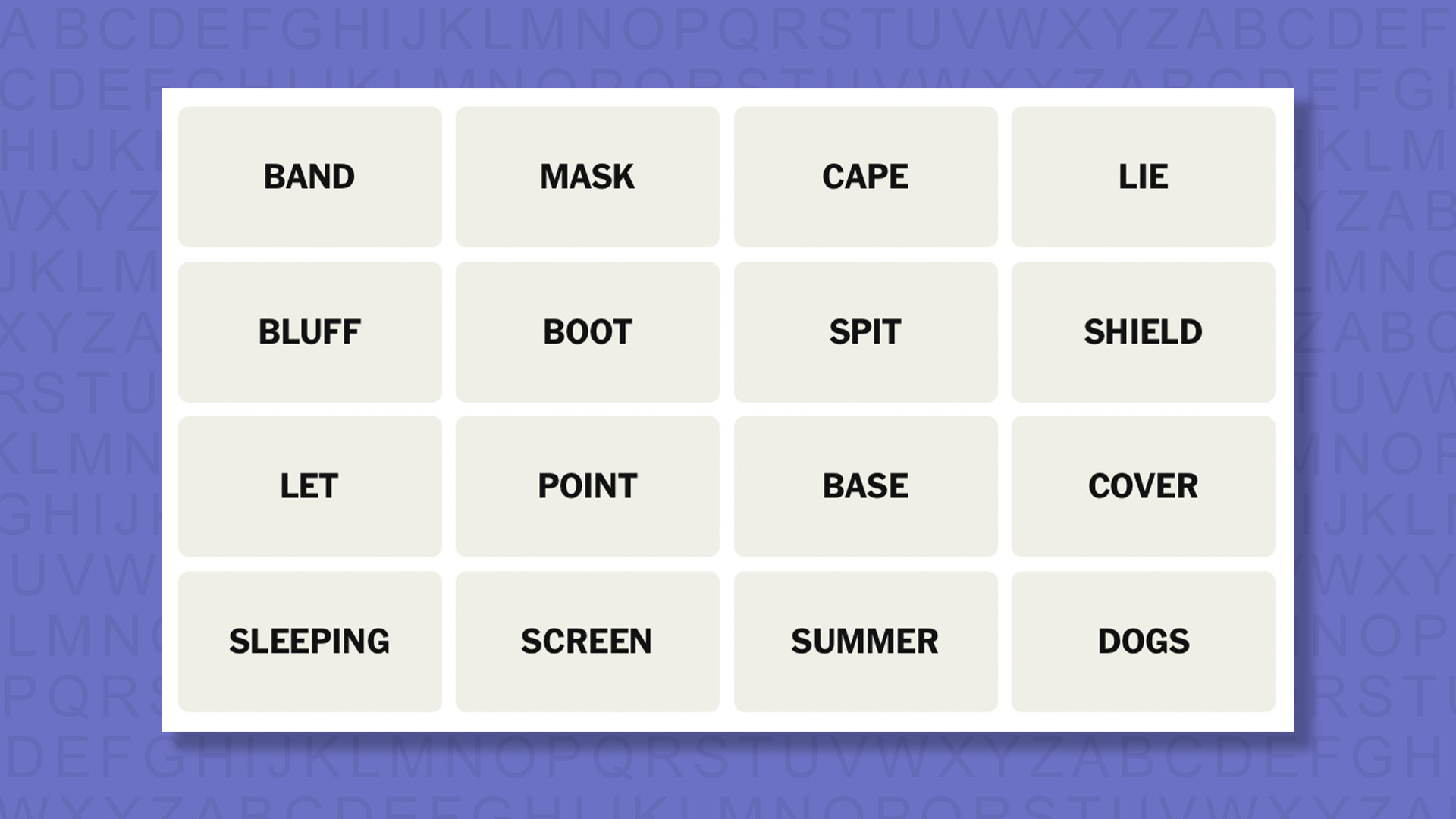
NYT Connections today (game #1028) – today’s words

Today’s NYT Connections words are…
- BAND
- MASK
- САРЕ
- LIE
- BLUFF
- BOOT
- SPIT
- SHIELD
- LET
- POINT
- BASE
- COVER
- SLEEPING
- SCREEN
- SUMMER
- DOGS
NYT Connections today (game #1028) – hint #1 – group hints
What are some clues for today’s NYT Connections groups?
- YELLOW: Say what you see
- GREEN: Slightly hidden
- BLUE: Seaside geography
- PURPLE: Add a word that rhymes with “lamp”
Need more clues?
We’re firmly in spoiler territory now, but read on if you want to know what the four theme answers are for today’s NYT Connections puzzles…
NYT Connections today (game #1028) – hint #2 – group answers
What are the answers for today’s NYT Connections groups?
- YELLOW: “LET SLEEPING DOGS LIE”
- GREEN: OBSCURE
- BLUE: COASTAL LANDFORMS
- PURPLE: ____ CAMP
Right, the answers are below, so DO NOT SCROLL ANY FURTHER IF YOU DON’T WANT TO SEE THEM.
NYT Connections today (game #1028) – the answers

The answers to today’s Connections, game #1028, are…
- YELLOW: “LET SLEEPING DOGS LIE” DOGS, LET, LIE, SLEEPING
- GREEN: OBSCURE COVER, MASK, SCREEN, SHIELD
- BLUE: COASTAL LANDFORMS BLUFF, CAPE, POINT, SPIT
- PURPLE: ____ CAMP BAND, BASE, BOOT, SUMMER
- My rating: Easy
- My score: Perfect
Am I the only person who really dislikes it when the four tiles form the name of the category like today’s yellow group “LET SLEEPING DOGS LIE” with its tiles LET, SLEEPING, DOGS, and LIE? My reason is that often Connections will tease us with groups just like this, that seem obvious, but when you submit them they are just a trick to fool us into a mistake.
Apologies, I shall wind my neck in now.
Irritations aside this was a relatively straightforward game — probably down to that one big red herring that wasn’t actually a red herring, making the deployment of all other red herrings moot.
Yesterday’s NYT Connections answers (Friday, April 3, game #1027)
- YELLOW: CATTY MEAN, PETTY, SMALL, SNIDE
- GREEN: HANKER (FOR) JONES, LONG, LUST, THIRST
- BLUE: COCKTAIL GLASSES COLLINS, HURRICANE, ROCKS, ZOMBIE
- PURPLE: ____ CONTROL CRUISE, DAMAGE, GROUND, MISSION
What is NYT Connections?
NYT Connections is one of several increasingly popular word games made by the New York Times. It challenges you to find groups of four items that share something in common, and each group has a different difficulty level: green is easy, yellow a little harder, blue often quite tough and purple usually very difficult.
On the plus side, you don’t technically need to solve the final one, as you’ll be able to answer that one by a process of elimination. What’s more, you can make up to four mistakes, which gives you a little bit of breathing room.
It’s a little more involved than something like Wordle, however, and there are plenty of opportunities for the game to trip you up with tricks. For instance, watch out for homophones and other word games that could disguise the answers.
It’s playable for free via the NYT Games site on desktop or mobile.

Just when things had started to feel quiet on the PlayStation front, a fresh wave of leaks has stirred the pot again. There’s chatter around the PlayStation 6, a next-gen handheld, and even some behind-the-scenes changes that hint at how Sony is preparing for what’s next.

None of this is official, of course, but even if part of it holds up, Sony isn’t just building new hardware, but also laying the groundwork for how that hardware will actually work.
What do the latest PlayStation leaks actually say?
According to trusted leaker Moore’s Law is Dead, the biggest headline is around the PlayStation 6, which may not be as far away as expected. Early details suggest that Sony is already deep into development, with timelines hinting at a launch window that’s closer than the typical console cycle would suggest.

But that’s only part of the story. Alongside the PS6 chatter, there’s renewed talk of a dedicated PlayStation handheld. Unlike the PlayStation Portal, which is more of a remote-play device, this new handheld is rumored to be a standalone system capable of running games natively. Think of it as the new PSP or PS Vita.

Another interesting detail is around “PlayGo,” which has reportedly been introduced in the latest PS5 SDK. Think of it as Sony’s version of Xbox’s Smart Delivery. It allows developers to break games into smaller chunks, so each device only downloads the assets it actually needs. That means a standard PS5 wouldn’t need to download higher-resolution textures meant for a PS5 Pro, and potentially, future devices could follow the same logic.
PS6 pricing leaks sound surprisingly… reasonable
According to MLID, now might not be the best time to drop $900 on a PS5 Pro. The claim is pretty bold, but they suggest skipping the current-gen upgrade and waiting, because the base PlayStation 6 could actually end up being cheaper than the PS5 Pro. The reasoning? Sony is reportedly designing the PS6 from the ground up to be more cost-efficient, with cheaper cooling, power delivery, and overall manufacturing.
In fact, some estimates even suggest a bill of materials around $750, which could keep the final price comfortably below $1,000. That’s actually quite cheaper, compared to Microsoft’s upcoming Project Helix, which could go up to $1200. Then again, these are still early leaks and far from official, so it’s worth taking all of this with a pinch of salt for now.

Microsoft plans to invest $10 billion in Japan from 2026 to 2029 to expand AI infrastructure, boost local cloud capacity, train 1 million engineers and developers, and deepen cybersecurity cooperation with the Japanese government. Reuters reports: The investment includes the training of 1 million engineers and developers by 2030, Microsoft said, which was unveiled during a visit to Tokyo by Vice Chair and President Brad Smith. In a statement, the company said the plan aligns with Prime Minister Sanae Takaichi’s goal to boost growth through advanced, strategic technologies while safeguarding national security.
Microsoft will work with domestic firms including SoftBank and Sakura Internet to expand Japan-based AI computing capacity, allowing Ecompanies and government agencies to keep sensitive data within the country while accessing Microsoft Azure services, it said. It will also deepen cooperation with Japanese authorities on sharing intelligence related to cyber threats and crime prevention.

from the reinventing-software dept
Most of the discussions about the impact of the latest generative AI systems on copyright have centered on text, images and video. That’s no surprise, since writers, artists and film-makers feel very strongly about their creations, and members of the public can relate easily to the issues that AI raises for this kind of creativity. But there’s another creative domain that has been massively affected by genAI: software engineering. More and more professional coders are using generative AI to write major elements of their projects for them. Some top engineers even claim that they have stopped coding completely, and now act more as a manager for the AI generation of code, because the available tools are now so powerful. This applies in the world of open source software too. But a recent incident shows that it raises some interesting copyright issues there that are likely to affect the entire software world.
It concerns a project called chardet, “a universal character encoding detector for Python. It analyzes byte strings and returns the detected encoding, confidence score, and language.” A long and detailed post on Ars Technica explains what has happened recently:
The [chardet] repository was originally written by coder Mark Pilgrim in 2006 and released under an LGPL license that placed strict limits on how it could be reused and redistributed.
Dan Blanchard took over maintenance of the repository in 2012 but waded into some controversy with the release of version 7.0 of chardet last week. Blanchard described that overhaul as “a ground-up, MIT-licensed rewrite” of the entire library built with the help of Claude Code to be “much faster and more accurate” than what came before.
Licensing lies at the heart of open source. When Richard Stallman invented the concept of free software, he did so using a new kind of software license, the GPL. This allows anyone to use and modify software released under the GPL, provided they release their own code under the same license. As the above description makes clear, chardet was originally released under the LGPL – one of the GPL variants – but version 7.0 is licensed under the much more permissive MIT license. According to Ars Technica:
Blanchard says he was able to accomplish this “AI clean room” process by first specifying an architecture in a design document and writing out some requirements to Claude Code. After that, Blanchard “started in an empty repository with no access to the old source tree and explicitly instructed Claude not to base anything on LGPL/GPL-licensed code.”
That is, generative AI would appear to allow open source licenses like the GPL to be circumvented by rewriting the code without copying anything directly from the original. That’s possible because AI is now so good at coding that the results can be better than the original, as Blanchard proved with version 7.0 of chardet. And because it is new code, it can be released under any license. In fact, it is quite possible that code produced by genAI is not covered by copyright at all, for the same reason that artistic output created solely by AI can’t be copyrighted. If the license can be changed or simply cancelled in this way, then there is no way to force people to release their own variants only under the GPL, as Stallman intended. Similarly, the incentive for people to contribute their own improvements to the main version is diminished.
The ramifications extend even further. These kind of “AI clean room” implementations could be used to make new versions of any proprietary software. That’s been possible for decades – Stallman’s 1983 GNU project is itself a clean-room version of Unix – but generally requires many skilled coders working for long periods to achieve. The arrival of highly-capable genAI coding tools has brought down the cost by many orders of magnitude, which means it is relatively inexpensive and quick to produce new versions of any software.
In effect, generative AI coding systems make copyright irrelevant for software, both open source and proprietary. That’s because what is important about computer code is not the details of how it is written, but what it does. AI systems can be guided to create drop-in replacements for other software that are functionally identical, but with completely different code underneath.
Companies that license their proprietary software will probably still be able to do so by offering support packages plus the promise that they take legal responsibility for their code in a way that AI-generated alternatives don’t: businesses would pay for a promise of reliability plus the ability to sue someone when things go wrong. But for the open source world these are not relevant. As a result, the latest progress in AI coding seems a serious threat to the underlying development model that has worked well for the last 40 years, and which underpins most software in use today. But a wise post by Salvatore “antirez” Sanfilippo sees opportunities too:
AI can unlock a lot of good things in the field of open source software. Many passionate individuals write open source because they hate their day job, and want to make something they love, or they write open source because they want to be part of something bigger than economic interests. A lot of open source software is either written in the free time, or with severe constraints on the amount of people that are allocated for the project, or – even worse – with limiting conditions imposed by the companies paying for the developments. Now that code is every day less important than ideas, open source can be strongly accelerated by AI. The four hours allocated over the weekend will bring 10x the fruits, in the right hands (AI coding is not for everybody, as good coding and design is not for everybody).
Perhaps a new kind of open source will emerge – Open Source 2.0 – one in which people do not contribute their software patches to a project, as they do today, but instead send their prompts that produce better versions. People might start working directly on the prompts, collaborating on ways to fine tune them. It’s open source hacking but functioning at a level above the code itself.
One possibility is that such an approach could go some way to solving the so-called “Nebraska problem”: the fact that key parts of modern digital infrastructure are underpinned up by “a project some random person in Nebraska has been thanklessly maintaining since 2003”. That person may not receive many more thanks than they have in the past, but with AI assistants constantly checking, rewriting and improving the code, at least the selfless dedication to their project becomes a little less onerous, and thus a little less likely to lead to programmer burn out.
Follow me @glynmoody on Mastodon and on Bluesky. Originally published to Walled Culture.
Filed Under: chardet, copyright, licensing, open source, relicensing
A new report dubbed “BrowserGate” warns that Microsoft’s LinkedIn is using hidden JavaScript scripts on its website to scan visitors’ browsers for installed extensions and collect device data.
According to a report by Fairlinked e.V., which claims to be an association of commercial LinkedIn users, Microsoft’s platform injects JavaScript into user sessions that checks for thousands of browser extensions and links the results to identifiable user profiles.
The author claims that this behavior is used to collect sensitive personal and corporate information, as LinkedIn accounts are tied to real identities, employers, and job roles.
“LinkedIn scans for over 200 products that directly compete with its own sales tools, including Apollo, Lusha, and ZoomInfo. Because LinkedIn knows each user’s employer, it can map which companies use which competitor products. It is extracting the customer lists of thousands of software companies from their users’ browsers without anyone’s knowledge,’ the report says.
“Then it uses what it finds. LinkedIn has already sent enforcement threats to users of third-party tools, using data obtained through this covert scanning to identify its targets.”
BleepingComputer has independently confirmed part of these claims through our own testing, during which we observed a JavaScript file with a randomized filename being loaded by LinkedIn’s website.
This script checked for 6,236 browser extensions by attempting to access file resources associated with a specific extension ID, a known technique for detecting whether extensions are installed.
This fingerprinting script was previously reported in 2025, but it was only detecting approximately 2,000 extensions at that time. A different GitHub repository from two months ago shows 3,000 extensions being detected, demonstrating that the number of detected extensions continues to grow.

Source: BleepingComputer
While many of the extensions that are scanned for are related to LinkedIn, the script also strangely detected language and grammar extensions, tools for tax professionals, and other seemingly unrelated features.
The script also collects a wide range of browser and device data, including CPU core count, available memory, screen resolution, timezone, language settings, battery status, audio information, and storage features.

Source: BleepingComputer
BleepingComputer could not verify the claims in the BrowserGate report about the use of the data or whether it is shared with third-party companies.
However, similar fingerprinting techniques have been used in the past to build unique browser profiles, which can enable tracking users across websites.
LinkedIn denies data use allegations
LinkedIn does not dispute that it detects specific browser extensions, telling BleepingComputer that the info is used to protect the platform and its users.
However, the company claims the report is from someone whose account was banned for scraping LinkedIn content and violating the site’s terms of use.
“The claims made on the website linked here are plain wrong. The person behind them is subject to an account restriction for scraping and other violations of LinkedIn’s Terms of Service.
To protect the privacy of our members, their data, and to ensure site stability, we do look for extensions that scrape data without members’ consent or otherwise violate LinkedIn’s Terms of Service.
Here’s why: some extensions have static resources (images, javascript) available to inject into our webpages. We can detect the presence of these extensions by checking if that static resource URL exists. This detection is visible inside the Chrome developer console. We use this data to determine which extensions violate our terms, to inform and improve our technical defenses, and to understand why a member account might be fetching an inordinate amount of other members’ data, which at scale, impacts site stability. We do not use this data to infer sensitive information about members.
For additional context, in retaliation for this website owner’s account restriction, they attempted to obtain an injunction in Germany, alleging LinkedIn had violated various laws. The court ruled against them and found their claims against LinkedIn had no merit, and in fact, this individual’s own data practices ran afoul of the law.
Unfortunately, this is a case of an individual who lost in the court of law, but is seeking to re-litigate in the court of public opinion without regard for accuracy.”
LinkedIn claims the BrowserGate report stems from a dispute involving the developer of a LinkedIn-related browser extension called “Teamfluence,” which LinkedIn says it restricted for violating the platform’s terms.
In documents shared with BleepingComputer, a German court denied the developer’s request for a preliminary injunction, finding that LinkedIn’s actions did not constitute unlawful obstruction or discrimination.
The court also found that automated data collection alone could infringe upon LinkedIn’s terms of use and that it was entitled to block the accounts to protect its platform.
LinkedIn argues the BrowserGate report is an attempt to re-litigate that dispute publicly.
Regardless of the reasons for the report, one point is undisputed.
LinkedIn’s site uses a fingerprinting script that detects over 6,000 extensions running in a Chromium browser, along with other data about a visitor’s system.
This is not the first time that companies have used aggressive fingerprinting scripts to detect programs running on a visitor’s device.
In 2021, eBay was found to use JavaScript to perform automated port scans on visitors’ devices to determine whether they were running various remote support software.
While eBay never confirmed why they were using these scripts, it was widely believed that they were used to block fraud on compromised devices.
It was later discovered that numerous other companies were using the same fingerprinting script, including Citibank, TD Bank, Ameriprise, Chick-fil-A, Lendup, BeachBody, Equifax IQ connect, TIAA-CREF, Sky, GumTree, and WePay.

Automated pentesting proves the path exists. BAS proves whether your controls stop it. Most teams run one without the other.
This whitepaper maps six validation surfaces, shows where coverage ends, and provides practitioners with three diagnostic questions for any tool evaluation.
Anthropic just pulled a move that’s… let’s just say, not going to win it many fans among power users. One of the most popular ways to supercharge Claude, using OpenClaw, is effectively being paywalled out of existence. And yeah, it’s as messy as it sounds.
Anthropic just made OpenClaw way more expensive
According to Anthropic Claude Code exec Boris Cherny, Anthropic has changed how Claude subscriptions work. Starting now, your regular Claude subscription no longer covers usage through third-party tools. Instead, that usage gets kicked into a separate pay-as-you-go billing system.
So what does that mean? Essentially, the hack that many users relied on, which was using Claude credits inside OpenClaw to run more advanced workflows, is basically dead. If someone still wants that setup, they’ll now have to pay extra on top of their subscription, either through usage bundles or API access.

And it’s not like OpenClaw was some niche experiment either. It blew up because it could handle real-world tasks like emails, calendars, and even flight check-ins, turning Claude into something closer to an actual assistant. But that popularity seems to have backfired, reportedly putting pressure on Anthropic’s infrastructure and forcing this clampdown.
This feels less like a tweak… and more like a crackdown
Let’s be real, this isn’t just a pricing change, it’s a pretty clear signal. Anthropic seems to be drawing a hard line: if you’re using Claude in ways they didn’t design (or monetize properly), expect that door to close quickly.
There’s also a bit of strategy baked in here. By making third-party usage more expensive, Anthropic nudges users toward its own ecosystem, like Claude Cowork. That’s great for control, but not so great if you liked mixing and matching tools to build your own workflows. To soften the blow, the company is offering a one-time credit equal to a month’s subscription and discounted bundles. But let’s be honest, that feels more like a transition cushion than a real solution.
from the good-bad-decision dept
The Supreme Court’s decision last year in U.S. v. Skirmetti, upholding a law depriving young trans people the healthcare they need, is insupportable, rendering people unequal in a way the Constitution cannot possibly suborn. But its new decision in Chiles v. Salazar regarding the First Amendment standard to use regarding Colorado’s law regarding conversion therapy is different. Despite its similar subject matter relating to sexual orientation and gender identity sounding similar to Skirmetti, it’s actually another 303 Creative, another case that endorsed bigoted views unacceptably hostile to LGBTQ+ people. But for much the same reason that 303 Creative was an important articulation of the First Amendment’s expansive protection—despite the apparent prejudice the plaintiff (and the Court) advanced—so is this decision.
That’s what’s good about this decision, that it recognizes that the First Amendment operates in the professional licensing space and requires heightened scrutiny before states can be permitted to constrain licensing when those constraints are predicated on viewpoints expressed by the licensee, including as part of the provision of services. Heightened scrutiny is what makes the First Amendment’s protections meaningful, and the Court has not always been consistent or coherent in requiring it, particularly with respect to licensure. But when heightened scrutiny isn’t required, it becomes much harder to fight censorial actions taken by the government, including those driven by animus, and including those driven by anti-LGBTQ+ animus—which would also include those actions targeted at therapists supporting LGBTQ+ patients, such as those recently announced by Ken Paxton in Texas. This Supreme Court decision now makes it much, much harder for him to get away with silencing those therapists whose therapy affirmed their patients’ identity by putting their license at risk if they do.
The main problem with this decision however is that the Court picked a law prohibiting conversion therapy as the moment to finally articulate that heightened scrutiny applies with respect to licensing, including medical licensing. Conversion therapy, as Justice Jackson described in her dissenting opinion, is a scientifically-discredited approach “designed to ‘convert’ a person’s sexual orientation or gender identity, so that the person will become heterosexual or cisgender.” [Dissent p.3]. Historically it has been provided via “aversive modalities,” that many have likened to torture, such as “inducing nausea, vomiting, or paralysis in patients or subjecting them to severe electric shocks to telling patients to snap an elastic band on their wrists in response to nonconforming thoughts.” [Dissent p.3]
Importantly, however, to the extent that any law prohibits these practices, those laws remain in force—this decision does not affect such laws. (“The question before us is a narrow one. Ms. Chiles does not question that Colorado’s law banning conversion therapy has some constitutionally sound applications. She does not take issue with the State’s effort to prohibit what she herself calls ‘long-abandoned, aversive’ physical interventions.” [Majority p.7]). But it does reach conversion therapy delivered via talk therapy, where therapists “seek to encourage patients to change their behavior in an attempt to ‘change’ their identity” still are. [Dissent p.3]. As Jackson explained, this approach also causes real harm. [Dissent p.4-5]. And it’s a kind of harm that states like Colorado, who passed the law challenged here, have an interest in stopping. [Dissent p.5-7].
Making it hard for states to do so raises a number of concerns, such as that the decision will give a veneer of legitimacy to conversion therapy and stoke the hostile anti-LGBTQ+ attitudes driving it, as well as create the risk that conversion therapy, at least insofar as it includes talk therapy, might be something that minors could be legally subjected to in Colorado and elsewhere. There is also the fear that even if the Court has now articulated a good rule about heightened scrutiny it will only remember to apply it in cases like these where it will lead to results consistent with the Court majority’s biases—in other words, while the Court may be happy to subject Colorado’s anti-conversion therapy rule to strict scrutiny, there is the fear that it will conveniently forget to apply it to, say, Texas’s law trying to punish those who refuse to engage in it.
It also raises a collateral concern even on the speech-protection front, that subjecting licensure requirements to strict scrutiny could have the practical effect of diluting the standard. As Jackson also noted, we have long allowed states to regulate medical professionals, [Dissent p.8], as well as other licensed professionals like lawyers, and much of the regulation is directed to how licensed practitioners speak in some way as they provide their services. Perhaps all these efforts could actually pass strict scrutiny. In fact, it’s even still possible that Colorado’s law might yet survive it; although Justice Gorsuch’s majority opinion casts some doubt, the case is not over.
Rather than deciding it for themselves, the Court remanded the case back to the lower courts to this time apply the more exacting strict scrutiny standard rather than the less-demanding rational basis review they originally applied. Presumably there will be more opportunity for briefing and argument to show how the particular harm of conversion therapy creates the compelling state interest Colorado needed to act, and that its prohibition of licensed therapists from providing it via talk therapy is a remedy that is sufficiently narrowly tailored.
But the problem with applying strict scrutiny to so much regulation targeting licensing is that it might start to become too easy to satisfy when there are strong policy reasons to favor the government action, and as a result strict scrutiny will no longer be useful as a standard if it essentially allows everything, instead of being a meaningful filter. There are after all always compelling reasons for the government to care about the quality of the services licensees deliver via their professional expression, but just because the government has a valid reason to regulate does not mean that everything it does to regulate is constitutional.
Strict scrutiny also requires that the state action be narrowly tailored, in addition to being motivated by a compelling reason, and it’s too easy for courts to skip that part of the analysis, as we saw with the TikTok ban when it was somehow blessed by the DC Circuit. And the fear is that the more strict scrutiny is applied to what is fairly ordinary state regulation—of licensed practitioners—the more likely it will have the practical effect of creating precedent that dilutes the standard so that it is no longer so strict when we need it to be, especially for state action that is more exceptional. (On the TikTok ban the Supreme Court had greenlighted it using a lesser standard, which was itself extremely problematic as the ban should have been found unconstitutional, but at least the tool that should have applied to it remained sharp for future use, rather than dulled by this bad decision.)
On the other hand, a decision upholding the lower courts’ use of rational basis review would have done no one any favors. As Justice Kagan wrote in her concurrence, joined by Justice Sotomayor, it is easy to imagine a law that mirrors what the Colorado one does, prohibiting talk therapy that accepts LGBTQ+ identity instead of challenges it, and now advocates are left with a much more powerful tool to challenge it.
Of course, it does not matter what the State’s preferred side is. Consider a hypothetical law that is the mirror image of Colorado’s. Instead of barring talk therapy designed to change a minor’s sexual orientation or gender identity, this law bars therapy affirming those things. As Ms. Chiles readily acknowledges, the First Amendment would apply in the identical way. [Concurrence p.3]
As Texas shows, such a situation is not hypothetical. But now with this decision people challenging such censorial government efforts can turn to long-established First Amendment doctrine in their fight. And the doctrine remains stable, rather than something now swiss-cheesed with bespoke exceptions tied to certain policy preferences. No matter how valid those preferences, if they can be given special constitutional treatment then so can the bad ones. This decision helps buttress the guardrails preventing speech from being protected or not based on whether the government likes it, which is the whole reason we have the First Amendment, to make sure government preferences cannot dictate what views people can express.
Which is especially important when the courts cannot be trusted to overcome their biases to have good sense about which policy preferences are good and bad. The Supreme Court of course only has itself to blame that the public is so primed to believe that its decisions are driven by its biases and not neutral, sustainable doctrine. But nevertheless this decision still stands as an important declaration of law that is consistent with existing First Amendment jurisprudence and one that will ultimately leave everyone, including those challenging government actions attacking LGBTQ+ interests, far better off than if the Court had let the lower courts’ decisions invalidating the law stand after using a less speech-protective rule. In fact it will be an important one for anyone fighting censorship in any context, including those we generally talk about here, to use, because with this decision, the rule that has long been the rule remains the rule: when a government action non-incidentally touches on speech, is content-based, and is not viewpoint neutral, strict scrutiny applies.
Per this decision, a law targeting what therapists can say inherently involves speech, and not in an incidental way. And it targets it in a way that is not viewpoint-neutral; it has a specific preference, that conversion therapy is bad. As a result, as a law that targets the content of speech in a way that is not viewpoint-neutral, strict scrutiny, a more exacting standard than the rational basis review the lower courts had used, is required.
Turning to the merits, both the district court and the Tenth Circuit denied Ms. Chiles’s request for a preliminary injunction. The courts recognized that Ms. Chiles provides only “talk therapy.” And they acknowledged that Colorado’s law regulates the “verbal language” she may use. But, the courts held, the main thrust of the State’s law is to delineate which “treatments” and “therapeutic modalit[ies]” are permissible. Accordingly, the courts reasoned that Colorado’s law is best understood as regulating “professional conduct.” At most, they continued, Colorado’s law regulates speech only “incidentally” to professional conduct. As a result, the courts concluded, Colorado’s law triggers no more than “rational basis review” under the First Amendment, requiring the State to show merely that its law is rationally related to a legitimate governmental interest. Because the State satisfied that standard, the courts held that Ms. Chiles was not entitled to the relief she sought. [Majority p.6]
[…]
Consistent with the First Amendment’s jealous protections for the individual’s right to think and speak freely, this Court has long held that laws regulating speech based on its subject matter or “communicative content” are “presumptively unconstitutional.” Reed v. Town of Gilbert, 576 U. S. 155, 163 (2015). As a general rule, such “content-based” restrictions trigger “strict scrutiny,” a demanding standard that requires the government to prove its restriction on speech is “narrowly tailored to serve compelling state interests.” Ibid. Under that test, it is ” ‘rare that a regulation . . . will ever be permissible.’ ” Brown v. Entertainment Merchants Assn., 564 U. S. 786, 799 (2011) (quoting United States v. Playboy Entertainment Group, Inc., 529 U. S. 803, 818 (2000)).
We have recognized, as well, the even greater dangers associated with regulations that discriminate based on the speaker’s point of view. When the government seeks not just to restrict speech based on its subject matter, but also seeks to dictate what particular “opinion or perspective” individuals may express on that subject, “the violation of the First Amendment is all the more blatant.” Rosenberger v. Rector and Visitors of Univ. of Va., 515 U. S. 819, 829 (1995). “Viewpoint discrimination,” as we have put it, represents “an egregious form” of content regulation, and governments in this country must nearly always “abstain” from it. Ibid.; see also Iancu v. Brunetti, 588 U. S. 388, 393 (2019) (describing “the bedrock First Amendment principle that the government cannot discriminate” based on view-point (internal quotation marks omitted)); Good News Club v. Milford Central School, 533 U. S. 98, 112–113 (2001); Barnette, 319 U. S., at 642. [Majority p.8-9]
[…]
As applied here, Colorado’s law does not just regulate the content of Ms. Chiles’s speech. It goes a step further, prescribing what views she may and may not express. For a gay client, Ms. Chiles may express “[a]cceptance, support, and understanding for the facilitation of . . . identity exploration.” For a client “undergoing gender transition,” Ms. Chiles may likewise offer words of “[a]ssistance.” But if a gay or transgender client seeks her counsel in the hope of changing his sexual orientation or gender identity, Ms. Chiles cannot provide it. The law forbids her from saying anything that “attempts . . . to change” a client’s “sexual orientation or gender identity,” including anything that might represent an “effor[t] to change [her client’s] behaviors or gender expressions or . . . romantic attraction[s].” [Majority p.13]
But even if the law as it stands can’t survive strict scrutiny, in her concurrence, joined by Justice Sotomayor, Justice Kagan suggested ways the law might be amended so that it could be upheld.
It would, however, be less [likely to be unconstitutional] if the law under review was content based but viewpoint neutral. Such content-based laws, as the Court explains, trigger strict scrutiny “[a]s a general rule.” But our precedents respecting those laws recognize complexity and nuance. We apply our most demanding standard when there is any “realistic possibility that official suppression of ideas is afoot”—when, that is, a (merely) content-based law may reasonably be thought to pose the dangers that viewpoint-based laws always do. Davenport v. Washington Ed. Assn., 551 U. S. 177, 189 (2007). But when that is not the case—when a law, though based on content, raises no real concern that the government is censoring disfavored ideas—then we have not infrequently “relax[ed] our guard.” Reed, 576 U. S., at 183 (opinion of KAGAN, J.); see Davenport, 551 U. S., at 188 (noting the “numerous situations in which [the] risk” of a content-based law “driv[ing] certain ideas or viewpoints from the marketplace” is “attenuated” or “inconsequential, so that strict scrutiny is unwarranted”). Just two Terms ago, for example, the Court declined to apply strict scrutiny to a content-based but viewpoint-neutral trademark restriction. See Vidal v. Elster, 602 U. S. 286, 295 (2024); id., at 312 (BARRETT, J., concurring in part); id., at 329–330 (SOTOMAYOR, J., concurring in judgment). In the trademark context, as in some others, experience and reason alike showed “no significant danger of idea or viewpoint” bias. R. A. V., 505 U. S., at 388.
The same may well be true of content-based but viewpoint-neutral laws regulating speech in doctors’ and counselors’ offices.* Medical care typically involves speech, so the regulation of medical care (which is, of course, pervasive) may involve speech restrictions. And those restrictions will generally refer to the speech’s content. Cf. Reed, 576 U. S., at 177 (Breyer, J., concurring in judgment) (noting that “[r]egulatory programs” addressing speech “inevitably involve content discrimination”). But laws of that kind may not pose the risk of censorship—of “official suppression of ideas”—that appropriately triggers our most rigorous review. R. A. V., 505 U. S., at 390. And that means the “difference between viewpoint-based and viewpoint-neutral content discrimination” in the health-care context could prove “decisive.” Vidal, 602 U. S., at 330 (opinion of SOTOMAYOR, J.). Fuller consideration of that question, though, can wait for another day. We need not here decide how to assess viewpoint-neutral laws regulating health providers’ expression because, as the Court holds, Colorado’s is not one. [Concurrence p.3-4]
Ultimately, despite all of the concerns, the decision is still a good one that will leave everyone better off. And not just for cases that reach the Supreme Court but in every state and federal court hearing every challenge of laws trying to penalize certain views, including those accepting of LGBTQ+ identities. Whereas a decision to the contrary, one that would have allowed a rational basis standard to be the test for the law’s constitutionality, could be used to defend laws that, instead of fighting LGBTQ+ prejudice as this one tried to do, instead advanced it. As Texas illustrates, already there are examples of certain government actors attempting to impose their biased viewpoints via licensing requirements for therapists. This decision, even if it may stand as an individual reflection of LGBTQ+ animus by this Supreme Court, still makes further state action motivated by it that much harder for any government actor to impose.
Filed Under: 1st amendment, chiles v. salazar, colorado, conversion therapy, free speech, strict scrutiny, supreme court
Business8 seconds ago
Form 13D/A TripAdvisor For: 3 April

Sports4 minutes ago
Shreyas Iyer in trouble: PBKS captain fined, one step away from ban | Cricket News

Tech5 minutes ago
Quordle hints and answers for Saturday, April 4 (game #1531)


-

 NewsBeat1 day ago
Steven Gerrard disagrees with Gary Neville over ‘shock’ Chelsea and Arsenal claim | Football
-

 Business1 day ago
No Jackpot Winner and $194 Million Prize Rolls Over
-
Entertainment5 days ago
Fans slam 'heartbreaking' Barbie Dream Fest convention debacle with 'cardboard cutout' experience
-

 Fashion9 hours ago
Weekend Open Thread: Spanx – Corporette.com
-

 Crypto World2 days ago
Gold Price Prediction: Worst Month in 17 Years fo Save Haven Rock
-

 Tech5 days ago
The Pixel 10a doesn’t have a camera bump, and it’s great
-
 Entertainment6 days ago
Lana Del Rey Celebrates Her Husband’s 51st Birthday In New Post
-
Crypto World4 days ago
Dems press CFTC, ethics board on prediction-market insider trades
-

 Tech5 days ago
Avatar Legends: The Fighting Game comes out in July and it looks pretty slick
-

 Sports3 days ago
Tallest college basketball player ever, standing at 7-foot-9, entering transfer portal
-

 Tech4 days ago
EE TV is using AI to help you find something to watch
-

 Fashion6 days ago
Amazon Sundays: Soft Spring Layers
-

 Business2 days ago
Login and Checkout Issues Spark Merchant Frustration
-

 Tech6 days ago
Elon Musk’s last co-founder reportedly leaves xAI
-

 Tech4 days ago
How to back up your iPhone & iPad to your Mac before something goes wrong
-

 Tech4 days ago
Apple will hide your email address from apps and websites, but not cops
-

 Politics4 days ago
Should Trump Be Scared Strait?
-

 Crypto World4 days ago
U.S. rule change may open trillions in 401(k) funds to crypto
-

 Tech4 days ago
Flipsnack and the shift toward motion-first business content with living visuals
-

 Fashion5 days ago
The Best Spring Trends of 2026
You must be logged in to post a comment Login