

Join Mikko Hyppönen and security leaders from the NFL, CHANEL, and Atlassian for a two-hour digital summit on what AI-speed attacks change, what defenders should stop doing, and how to validate, decide, fix, and re-validate at machine speed.
Tech
Gears of War: E-Day’s final PC specs target 4K at 60 FPS with an RTX 5070 Ti, but upscaling is required at all levels


Highly anticipated: We’re only a few weeks away from the release of Gears of War: E-Day, and that means the final PC system requirements have been revealed. This is yet another game where all the listed configurations use upscaling, so hitting 4K/60+ FPS with an RTX 5070 Ti isn’t achieved natively.
Gears of War: E-Day’s system specs first appeared on its Steam page back in June, but the listings were for Minimum and Recommended specs, with no mention of resolutions, presets, upscaling, etc.
Now, developer The Coalition has revealed the final set of requirements ahead of the game’s October 6 release.

The minimum specs remain the same, requiring just an RTX 5050/RTX 2060 or Radeon RX 6600/RX 9060 combined with an Intel i7-6850K/i5-10400/Ryzen 5 2600X. We now know that this uses a Medium graphics preset and aims for 60 FPS at 1080p.
However, we also know that all the listings are using upscaling, though there’s no mention of whether they are set to Quality, Balanced, Performance, or Ultra Performance. The recommended configuration uses a High graphics preset and aims for 1440p at 60 FPS and higher.
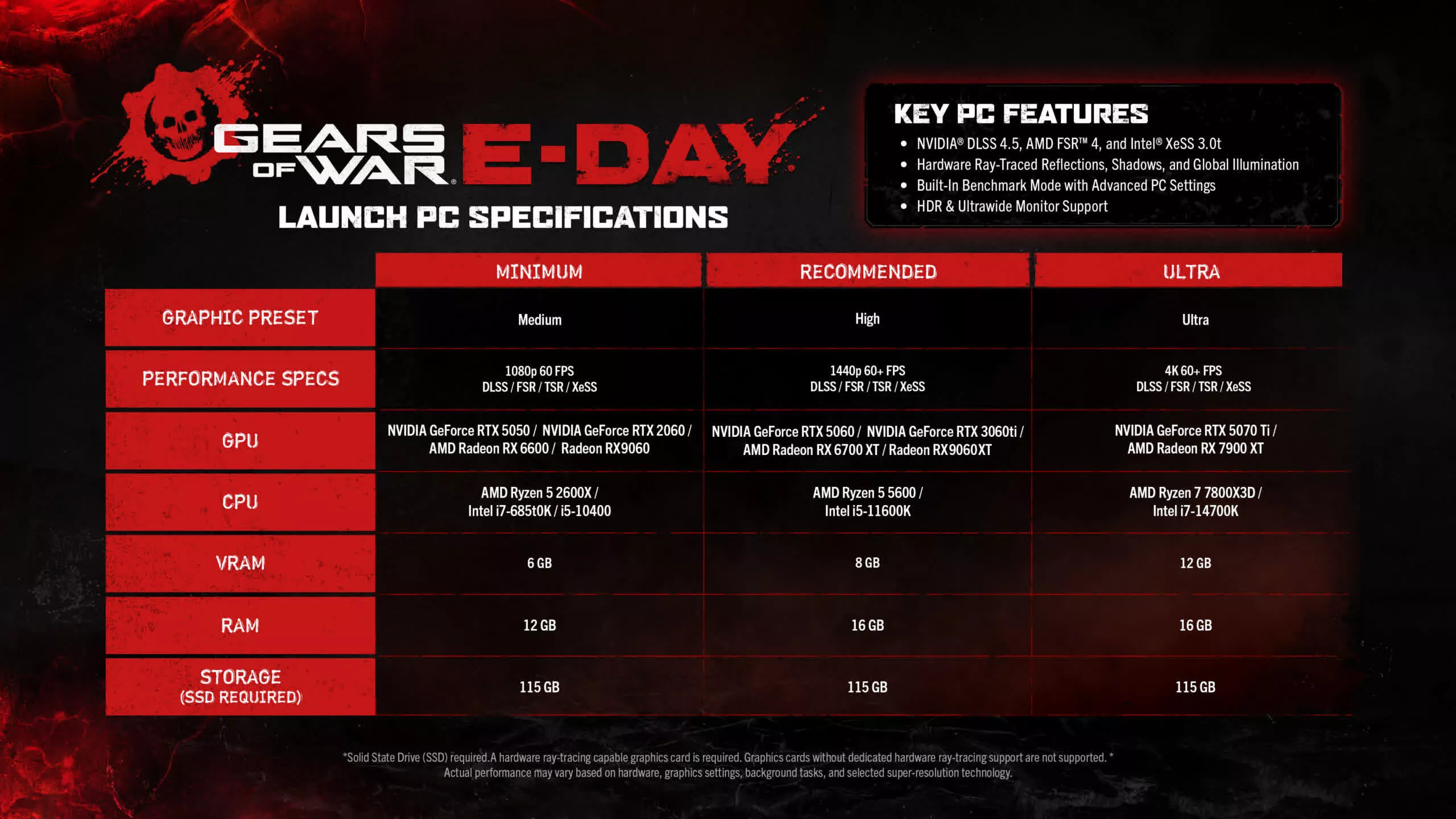
Interestingly, The Coalition has removed the Arc A580 (minimum) and Arc B580 (recommended) from the hardware list. It does list Intel XeSS 3.0, so those with Intel GPUs shouldn’t worry.
The new addition is the Ultra spec category: 4K/60+ FPS at Ultra graphics. It asks for at least an RTX 5070 Ti or Radeon RX 7900 XT combined with an Intel i7-14700K or Ryzen 7 7800X3D.

Another change is the storage requirement. It previously asked for 130GB of free SSD space, but that’s been reduced by 15GB to 115GB. It’s still a lot, but any reduction is welcome.
There’s also a disclaimer at the bottom that warns graphics cards without dedicated hardware ray tracing support are not supported by the next Gears of War entry.

It seems that most games’ system requirements these days include the use of upscaling. It used to be that studios would be less forthcoming about this fact, but this is changing. Control Resonant, for example, even shows the actual upscaler preset for each requirement level. The PC requirements for Blood of the Dawnwalker also specified the use of upscaling, but the recently revealed hardware requirements for Fable don’t clarify whether the performance targets are achieved natively.

Pre-installation for Gears of War: E-Day begins on September 29. Premium Edition owners can start playing on October 1, five days before the full launch.
Continue Reading

I’ve heard people using AI to improve and speed up their work. But this is the first time I’m hearing of malware taking real-time directions from an AI chatbot as it does its bad business.
All thanks to the research team at Zimperium, we know about this new kind of advanced malware. It’s called RatHat, and it uses an AI chatbot to understand what’s on the target device’s screen.

So, how does RatHat actually use AI?
RatHat primarily spreads through smishing texts and malvertising. It sends victims to fake download pages that look legitimate at first but sit outside of the Google Play Store. Once you sideload the malware onto your phone, things get a lot more interesting.
In simple terms, the malware abuses Android’s accessibility settings to enable Developer Options and Wireless Debugging, then pairs itself with the phone’s own debugging bridge (I’m talking about shell-level control). After that, the AI part comes in.
The malware then sends a live map of what’s happening on your phone’s screen to what the report calls “one of the world’s most popular generative AI assistants,” which I’m guessing is already available to everyone.
It then asks the chatbot to identify what’s on the screen, including what a particular button does and the text on the screen. Basically, the AI acts like a pair of eyes and hands for the malware, helping it find out what to do next.

Why deleting the app might not fix anything
All of this, by the way, happens through a fake app the victim installed. The actual damage, however, starts with fake login overlays on banking and crypto apps. It can also record your screen and intercept one-time codes. That is how the malware accesses the sensitive information.
Beyond using AI, RatHat runs a separate, persistent background process that runs a hardware-level keylogger. By reading raw touch-input coordinates directly from the kernel’s touchscreen driver, it matches your finger movements against stored keypad layouts to determine lock-screen PINs and patterns.
And simply uninstalling the app won’t necessarily remove it. RatHat shows a fake Play Store error to make you think the uninstall failed, and even after deletion succeeds, a hidden background process quietly brings it back, with its permissions still intact.
Zimperium’s advice is pretty ordinary, but it’s worth repeating: skip sideloaded apps, be suspicious of any accessibility permission request, and leave Play Protect scanning on. However, if your device is already affected, you’ll probably have to clean it manually via Android Debug Bridge or factory reset it.

Major super PACs associated with AI labs and investors have poured close to $1 million into incumbent Republican Mike Rounds’s South Dakota senate race, seeking to shape the outcome of a noncompetitive race amid a critical national debate over AI regulation.
Rounds has been the beneficiary this cycle of around $600,000 in spending by outside groups, with the vast majority of that figure coming from the super PAC Defend American Jobs, which receives funding from a super PAC financed by the venture capital firm Andreessen Horowitz.
He has also received roughly $215,000 directly from the employees and super PACs affiliated with AI labs, most notably Anthropic, as well as a constellation of other tech companies including Google and Microsoft, according to FEC filings.
With fewer than 50 days until the midterm elections in November, recent polls show Rounds ahead of the independent candidate Brian Beng after the Democratic candidate Julian Beaudion dropped out last month.
Rounds has so far raised more from tech groups than from donors in South Dakota, and this spending reflects a new effort by AI labs to deploy vast war chests to shape thorny issues on AI and the data centers that power it. Rounds has been viewed by AI executives as a top supporter of the industry, which could prove crucial in the next Congress when AI regulation is expected to become a top priority, according to congressional aides familiar with the matter.
It also appears to reflect how AI labs have become focused on keeping allies, which have been in short supply on Capitol Hill as lawmakers spring up a raft of bills as they react to public anxiety around AI safety concerns.
A spokesperson for Rounds did not respond to a request for comment.
On Thursday, Leading the Future, the super PAC funded in part by OpenAI president Greg Brockman, along with investors Ben Horowitz and Marc Andreesen, announced that it would put $2 million towards a raft of Senate Republicans that have been supportive of the AI or crypto industry. The list included Rounds.
In South Dakota, AI regulation is already a live issue after the state legislature passed a bill earlier this year forcing hyperscalers to bear a larger share of the water and energy costs associated with powering data centers.
Data centers have been the subject of a bitter fight among Republicans in the state legislature, which voted against giving tax breaks for equipment and software purchases required by data centers earlier this year, stalling construction of a planned development by Applied Digital, a company that builds and designs data centers.
Rounds also ultimately endorsed adding restrictions on data centers, although his senior aide and former chief of staff, Robert Skjonsberg, is a registered lobbyist for Meta for matters before the South Dakota legislature. (Meta operates a network of data centers, though there isn’t currently a Meta-affiliated center in South Dakota.) Rounds’ office told Politico that their general counsel consulted with the Senate ethics committee about the unusual arrangement and was told there was no conflict of interest.
Concerns about data centers have been bipartisan across the country: A recent Gallup poll for instance found that seven out of 10 Americans are opposed to data center development, given their outsized draw upon water and energy resources that local communities often end up subsidizing.

Seattle-based ModernVivo is using AI to help scientists design preclinical studies for drug discovery. The goal: better experiments that are also faster, cheaper and less reliant on animals.
“You’d be shocked at the way scientists design their experiments,” co-founder Ian Levine told GeekWire. “It’s very manual.”
To design experiments, scientists typically enter keywords into PubMed or another database, receiving hundreds or thousands of results. They then go through each complex paper, typically 30 pages long, to find information relevant to the experiment they’re planning.
Levine spent thousands of hours manually combing through scientific papers as a research undergrad at Virginia Tech, and later as a Ph.D. student at the University of Michigan. He wanted a better way – and in 2022 co-founded ModernVivo with Colin Small, a fellow graduate student he’d met online while Small was pursuing a master’s in biotechnology at Brown University.
ModernVivo’s platform can analyze millions of peer-reviewed publications – cross-referenced with clinical trial and regulatory data – delivering highly detailed results in minutes. Researchers can filter papers by factors including animal model, experimental conditions, author affiliation and publication date, then drill down into more than 40 individual variables used in the experiments.
“We want to make experiments faster,” Levine said, “and help get better drugs to the clinic.”
For Levine, it’s personal: while studying to develop non-opioid pain therapeutics at Virginia Tech, he watched his mother live with a chronic pain disorder.
In the pharmaceutical industry, about 90% of drug candidates that reach human clinical trials go on to fail. Levine suspects part of the problem could lie in the many variables involved in how animal experiments are designed.
ModernVivo occupies a narrow niche in biotech software. Its closest analog is Trials.ai, another AI-driven platform tackling clinical trial design, founded in San Diego and acquired in 2023 by consulting firm ZS.
The Seattle company draws on the paper database of Semantic Scholar, a research tool developed by the Allen Institute for Artificial Intelligence, putting it in loose company with general-purpose research tools like Elicit and Consensus – though none of those are built specifically to extract in vivo protocol details the same way.
ModernVivo’s pitch is that it provides deeper insight than manual literature review or general-purpose AI tools. Ask a general AI chatbot about an experiment, Levine said, and it’ll return the high-level, commonly known approaches. Researchers want every relevant data point, including the obscure European study that might matter for their specific drug candidate but wouldn’t surface in a broad summary.
The software also surfaces contradictions in the literature: if 20 published studies point one way and five point another, ModernVivo flags this rather than picking a winner, since, as Levine puts it, scientists don’t want to be told what to do.
“They’re the people who suffer through the Ph.D. to be an expert in their field,” he said.
So far, the results are speed, confidence and lower animal use, Levine said. Tracking whether a study leads to a successful drug takes years, so he’s cautious about claiming translational impact. But customers have told him work that used to take about a month now takes as little as an hour.
Researchers who use ModernVivo report more trust in their initial study design, he said, and run fewer duplicate or follow-up animal experiments, which cuts down on animal use and the cost of housing and caring for animals.
ModernVivo has more than 20 customers ranging from small biotech firms to large pharmaceutical companies. It also offers ModernVivo Scholar, a version for academic researchers launched last October, with plans ranging from free to $50 a month.
The company has been through multiple accelerator programs: a WTIA founder cohort in 2023, Creative Destruction Lab’s Seattle program, which it graduated from in June 2025, and the Merck Digital Sciences Studio’s third cohort. The company has raised $1 million in a pre-seed round, and Levine said fundraising is going well as the company looks to expand.
ModernVivo’s attention is now shifting from the design phase of an experiment to execution. The company launched the ModernVivo Marketplace on Sept. 15, matching a finished study design against a network of pre-vetted contract research organizations, analytical labs and specialist dosing facilities. Suppliers of compounds and animal models are listed as coming soon.
Once a study is designed, researchers often don’t know which vendors have the right supplies or which contract research facilities are equipped to execute it, and tracking that down has meant manual search and outreach. ModernVivo wants to remove that ambiguity and connect scientists directly to the right vendor.
“The way we position ourselves in the future,” Levine said, “is helping scientists go from study design to study execution faster than ever before.”


North of Seoul on September 16, a 29-foot uncrewed aircraft left a conventional Army runway, joined air operations over a live-fire range, then settled onto a rough maneuver trail normally reserved for tanks and artillery. Ground-station pilots sent it rolling again. It lifted off in less than 200 meters, resumed the sortie, and flew back to the 513th Aviation Battalion. General Atomics Aeronautical Systems and Hanwha Aerospace called the sequence the first battlefield short-field operation ever completed by a medium-altitude, long-endurance uncrewed aircraft. The Mojave STOL carried dual weapon rails loaded with four inert AGM-114 Hellfire missiles and wore South Korean markings for the Defense Drone Technology Exhibition at Seungjin Training Field in Pocheon-si. In a real fight, crews on that same trail could have refueled and rearmed it before sending it back up.
High lift wings with leading edge slats, double slotted flaps, and drop down ailerons allow the 52-foot-wide aircraft to use runways ranging from 100 to 300 meters length. According to published estimates, the takeoff distance for a full load is roughly 122 meters, but carrying a dozen Hellfires would likely increase that to closer to 305 meters. Even with all the trimmings, including weapons rails, the aircraft managed a takeoff distance of less than 200m and a landing roll distance of less than 100m during this demonstration. Its 7,000-pound airframe is powered by a 450 shaft horsepower Rolls-Royce M250 turboprop, and it has a usable load of roughly 3400 pounds, which is just enough to carry all of the gear required for an extended operation (sensors, communications, and up to 16 Hellfires divided across 7 hardpoints).
Sale

SKYROVER X1 Drone with Camera Combo with Screen Controller, 4K/60fps Video, 8K Photo, 360° Obstacle…
- Cinematic 4K/60fps HDR Video & 48MP Photos: Captures smooth 4K/60fps HDR video and detailed 48 MP photos with a 1/1.32″ CMOS sensor and f…
- 5.5″ HD Touchscreen Remote — See Every Detail, Even in Direct Sunlight: 700-nit brightness and 60Hz display delivers crystal-clear live view…
- Under 249g & Travel Ready: Under 249g and easy to pack, the drone with camera for adults is built for grab-and-go flying without adding bulk to your…

There are no other aircraft that can provide the same amount of endurance, range, and cargo as this one. No other aircraft has been able to recover and take off from a difficult area of terrain like the one from which the advanced troops would operate. They’d already done the same thing at Mojave in early 2023, with deck landings on the Royal Navy’s HMS Prince of Wales and the ROKS Dokdo, as well as some live minigun firing, as they’d demonstrated in Korea. This demo introduced something new to the mix: a forward site that looked just like the terrain the soldiers would be fighting in, rather than one of those neat little airfields that are only used in movies.

Linden Blue, GA-ASI’s CEO, believes the flight demonstrates that the aircraft is more than capable of undertaking the type of tactical activity seen on a real battlefield: disputed austere operations, weapon delivery, resupply, and short takeoffs from tough terrain. Hanwha’s Buhwan Lee believes this is a significant step forward for their joint 2025 co-development agreement, in which they intend to collaborate on South Korean, US, and other regional consumers. The Gray Eagle STOL will be the name given to the final production version. They expect to conduct a critical design review in November 2026, followed by a first flight in 2027, at which point Hanwha hopes to have achieved at least 70% Korean content in the aircraft.

After that, the demonstrator heads to Changwon for a little of Industry Day at Hanwha. Settling for a traditional runway that will always be a target for the enemy is a bit of a cop out; with an aircraft that can launch from a tank track, a riverbed, or just about any old piece of dirt you can find, commanders have options for persistent surveillance and strike that they simply don’t have elsewhere. What Mojave just demonstrated is that you don’t have to be a genius to figure out how to make all of this work; it’s simply a matter of understanding that in the real world, you can’t always count on having a perfectly good runway available.
[Source]


An ongoing malware campaign uses SEO-optimized GitHub repositories to impersonate well-known software firms to push a previously undocumented information stealer called Rapuncel.
LastPass and Delphos Labs uncovered the campaign, which they report impersonates the password manager brand and at least 39 other companies.
Alongside the Rapuncel infostealer, the repositories deliver a Microsoft-signed kernel driver that can disable 145 antivirus and endpoint detection and response (EDR) products.
The attack chain begins when victims search for LastPass Authenticator or other popular software and follow links to fake GitHub repos.
There, clicking download buttons triggers a series of redirections before reaching payload-delivery servers, where victims receive ZIP archives with their size inflated to up to 148MB to evade security scans.
The installer inside the archives is a copy of the legitimate Microsoft Visual Studio CoreCLR Debugger, ‘vsdbg.exe,’ renamed and configured to sideload a malicious DLL (vsdbg.dll). The installer deploys the Rapuncel infostealer as well as the Alinubx.sys kernel driver, which is used to kill antivirus software.

Source: LastPass
The kernel driver is disguised as an NVIDIA component named ‘nvfsflt64.sys’ and registers as the NvFsFilter service.
According to the researchers, the driver acts as an EDR killer that contains a hardcoded list of 145 antivirus and EDR processes that it aims to terminate.
“The driver calls ObOpenObjectByPointer with AccessMode=KernelMode, which bypasses the normal user-mode SeAccessCheck path at handle-open time,” explains LastPass.
“It asks the kernel to open the process as kernel code, then kills it. That is why it can defeat Protected Process Light (PPL); the protection many security products rely on to survive an administrator.”
Currently, the driver is not in Microsoft’s vulnerable drivers blocklist, and the one used in the campaign is signed through Microsoft’s Windows Hardware Compatibility Publisher chain.
The researchers noted that Alinubx.sys contains additional capabilities for file and registry hiding, DLL injection, driver and process interception, traffic manipulation, and port redirection, but do not appear to be activated in this campaign.
The Rapuncel infostealer
Once security software is terminated on the device, the Rapuncel infostealer begins stealing data from the infected device.
The malware collects the following information:
- Credentials stored in 25 web browsers
- Data from 30 cryptocurrency wallets
- Discord, Steam, and Telegram session credentials
- Windows Credential Manager contents
- Documents with names containing “password,” “seed,” “wallet,” or “recovery”
- Screenshots from every connected monitor
- Detailed system information
To bypass Google’s app-bound encryption protection present on Chrome, Edge, and related browsers, Rapuncel injects a helper DLL into the app and invokes its own Elevation Service.
The stolen information is compressed and uploaded to an external endpoint at ‘2.26.126[.]50‘ using an HTTP-formatted request sent over raw TCP.
Rapuncel persists across reboots via a Windows service, so any security tools that reactivate are killed again before the infostealer launches.
LastPass and Delphos Labs assessed with moderate confidence that Rapuncel is a variant of BoryptGrab, while they also found that its loader was built with the Cruciferra PUROSANGUE crypter.
Users are recommended to only download software from official websites, avoid dubious GitHub repositories, and skip or block promoted results on Google Search.


In brief: Aside from concerns about human extinction or a massive financial bubble, one of generative AI’s biggest controversies is how tech giants train their models. While OpenAI and Microsoft claim that training AI on copyrighted material falls under fair use, internal comments from the companies could suggest otherwise.
Brent Hecht, Microsoft’s director of applied science, predicted that people worldwide would view large language models as theft on an unprecedented scale, according to court documents released Thursday. The comments appear to counter Microsoft and OpenAI’s public defense against an ongoing lawsuit brought by news outlets.
In the case’s latest filing, Hecht said generative AI could be the largest labor theft in human history while describing how Microsoft, OpenAI, and other AI companies train their models on massive amounts of material from the open internet. The practice lies at the heart of the copyright lawsuit that The New York Times filed in late 2023.
Microsoft and OpenAI argue that training AI models on articles from the NYT and other publications falls under fair use, similar to a student reading books. The defendants also claim that generative AI output based on those articles sufficiently transforms the original material.

However, Thursday’s filing contains internal comments from OpenAI that highlight AI’s ability to reproduce news articles. For example, OpenAI executive Greg Brockman admitted that ChatGPT can predict and complete sentences from NYT articles when working with the outlet’s material. Hecht also argued that winning the lawsuit might require the defendants to “make a complete mockery of the idea of fair use.”
OpenAI has also previously admitted that training AI without accessing copyrighted material is impossible. Former Meta executive Nick Clegg echoed that view last year, claiming AI would die almost immediately if copyright law were enforced against it.
Meanwhile, AI companies have continued training their models on reams of user data, articles, and other material. Meta drew controversy for training its AI on employee behavior, Microsoft’s GitHub Copilot trains on user data unless users opt out, and Twitch only started allowing streamers to opt out after training on their material for years. AI developers are also quietly buying, scanning, and destroying millions of books to gather more training material.
Generative AI’s impact on the news business model is another pillar of the NYT’s lawsuit. Google and other search engines now provide AI-generated summaries of information from articles in response to user queries, potentially discouraging readers from visiting news websites. In this week’s court filing, an OpenAI executive involved in ChatGPT’s development said publishers face an existential threat from AI.
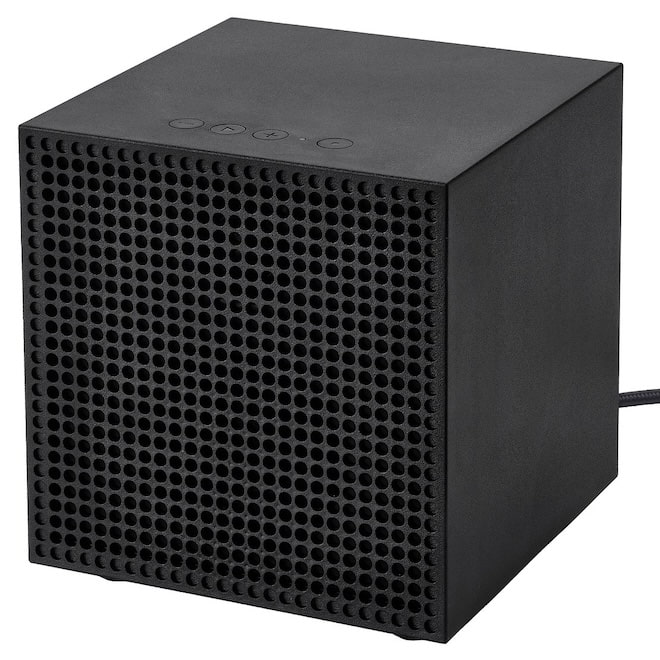
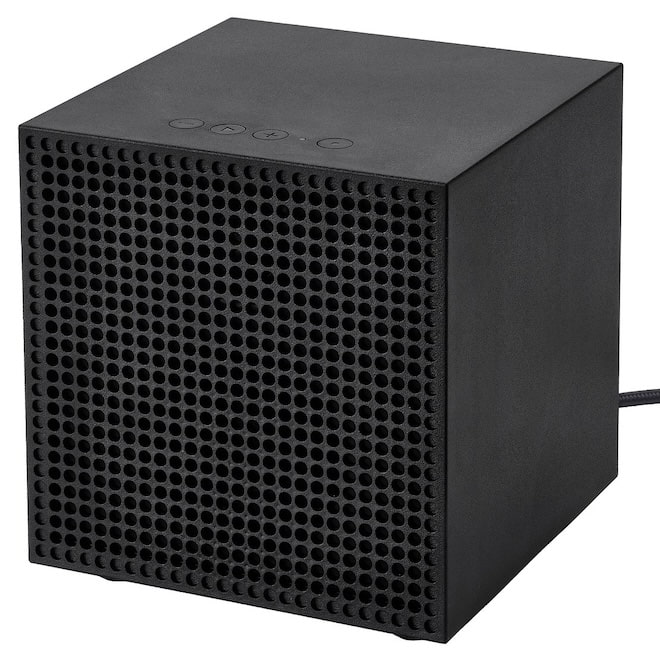
Leave it to IKEA to name its new indoor Bluetooth speaker BADKRUKA, a Swedish word for someone who is reluctant or afraid to get into cold water. That is particularly appropriate because the $59.99 BADKRUKA carries only an IP20 rating and has absolutely no business going swimming.
The name may be amusing, but IKEA has taken a surprisingly practical approach to the speaker itself. BADKRUKA combines Bluetooth with 3.5mm analog and optical digital inputs, along with Spotify Tap, three EQ settings, multi-speaker operation and the ability to pair two BADKRUKA speakers for actual stereo playback. IKEA even includes the optical cable.
That does not suddenly make BADKRUKA a $60 replacement for a serious pair of active loudspeakers. We have not heard it yet. But IKEA has given budget buyers considerably more flexibility than we normally see at this price.
IKEA has been rebuilding its audio lineup since ending its long-running partnership with Sonos. We previously looked at the company’s BLOMPRAKT and NATTBAD Bluetooth speakers and the end of the IKEA and Sonos SYMFONISK collaboration.
More Than Another Bluetooth Box
BADKRUKA uses a woofer and tweeter configuration powered by 25 watts of total amplification, with IKEA specifying a frequency range of 50Hz to 20kHz at -6 dB. The enclosure measures 6.25 inches wide and deep and 6.875 inches tall, making it small enough for a desk, bedroom or shelf beside a television.
The optical input is what changes the equation.
Most modern televisions still provide an optical digital output, which means BADKRUKA can function as a very inexpensive alternative to the television’s built-in speakers. Buy two and IKEA says they can operate as a stereo pair with distinct left and right channels.
There is no HDMI ARC here, so television volume control will not be as seamless as it would be with a soundbar or more sophisticated active loudspeaker system. IKEA also does not list Wi-Fi streaming, AirPlay, Google Cast or other network playback features.
At $59.99, that feels less like an omission than a reminder of what this thing costs.

Spotify Tap and Multi-Speaker Playback
BADKRUKA supports Spotify Tap, allowing playback to resume from a paired device with a button press. Pressing the Spotify button again can generate another selection based on the listener’s history.
IKEA has also included its multi-speaker mode, which allows BADKRUKA to play alongside other compatible IKEA Bluetooth speakers. That mode distributes the same mono signal to multiple speakers, while stereo pairing is reserved for two BADKRUKA units.
Three built-in EQ settings provide some control over the presentation, although IKEA does not provide detailed response curves for the presets.
BADKRUKA vs. NATTBAD
The more interesting comparison comes from inside IKEA’s own catalog.

The existing NATTBAD costs $49.99 and provides 10 watts of amplification through a single 2.8-inch full-range driver, with a specified frequency range of 75Hz to 18.5kHz. It supports Bluetooth, Spotify Tap and multi-speaker playback but does not offer stereo pairing, optical or 3.5mm analog input.
For another $10, BADKRUKA increases rated output to 25 watts, uses separate woofer and tweeter drivers, extends the claimed low-frequency response to 50Hz and adds both wired inputs and stereo operation.
We have not compared the two sonically, so specifications should not be confused with a listening test. But unless the smaller NATTBAD design is the primary attraction, BADKRUKA looks like the much stronger value on paper.

IKEA BADKRUKA Specifications
- Speaker Configuration: Woofer and tweeter
- Total Power Output: 25 watts
- Frequency Range: 50Hz to 20kHz (-6 dB)
- Wireless Input: Bluetooth
- Digital Input: Optical TOSLINK
- Analog Input: 3.5mm
- Spotify Tap: Yes
- Stereo Pairing: Yes
- Multi-Speaker Mode: Yes
- EQ: 3 settings
- IP Rating: IP20
- Dimensions: 6.25 x 6.25 x 6.875 inches
- Included Accessory: Optical cable
- Designer: Ola Wihlborg
The Bottom Line
We are not expecting the IKEA BADKRUKA to send KEF, Sonos or Audioengine executives scrambling into emergency meetings. That would be asking rather a lot from something sold by the same company that expects you to assemble your own dresser with an Allen key.
What makes BADKRUKA interesting is that IKEA has resisted turning it into another Bluetooth-only lifestyle product. Optical and analog inputs make it useful with televisions, computers and other sources, while stereo pairing gives buyers an inexpensive upgrade path if one speaker is not enough.
At $59.99 each, a pair costs $119.98.
That might be the more interesting story.
Price & Availability
The IKEA BADKRUKA Bluetooth Speaker is $59.99 each at IKEA in the United States in black and pink finishes. Availability may vary by store and delivery location.
Related Reading:

Uh oh, we got a cute alert! It’s Bezzy, your adorable, cuddly, anthropomorphized server-rack and stuffed-animal friend! Give this soft lil’ doll a squeeze, and it shall sing you its telltale song: the piercing, grinding ambient squeals emitted from a real US data center.
The Bezzy doll is a stuffed plushie made in a satirical collaboration between the New York–based creative studio Basura and Big Data, the musical project of producer Alan Wilkis, best known for the song “Dangerous,” a 2013 collaboration with the band Joywave. The joint project, which is coming out the same day as a new Big Data single, is called Adopt a Data Center. The goal is to present people with a “cuddly introduction to life with a real data center.”
Data Centers are very un-vogue right now. Built out by all the big AI companies to power their increasingly power-hungry AI tools, data centers have spread across thousands of acres of land in the US. They have been heavily criticized for their energy consumption and expansion of gas power. They have also proven to be audibly annoying, stirring up complaints about noise pollution from those nearby.
The Adopt a Data Center stunt aims to make people think differently about how services produced by data centers fit into their lives. That manifests as a plush stuffie that looks like a server rack in a data center, albeit with long arms and legs and googly eyes. It’s cute in the way Don’t Hug Me I’m Scared is cute. Squeeze Bezzy’s torso and the sound bursts out. It’s a screeching few seconds of a recording taken by a neighbor of a data center in Virginia. The tag on the Bezzy plushie reads, “Hug me for ear-piercing forever hum.”
“We picked this recording as it was the clearest and most suitably irritating,” wrote Rajeev Basu, the founder of Basura, in an email to WIRED. In an interview with the person who recorded the audio, Basu says they described the sound as “like a car alarm going off nonstop. It’s high-pitched, and it’s all you can focus on.”
Basura has worked on other projects like making luxury wear for dogs and a partnership with Yerba Madre that made dirt shoes designed to break apart during a walk to spread wildflower seeds.
Along with Bezzy, the data centers project includes a collection of stickers that say things like “Every data center deserves a forever home” and “Open your heart. And your power grid.” Basu says the project is the result of dozens of interviews with people who live near data centers in the US. The website itself reads, “Adopt a data center: All they ask for is everything.”


“We did not set out to build another health insurance company,” said Ty Wang, co-founder and chief executive of Angle Health. The aim, he told the Wall Street Journal, was to stop “this kind of death spiral of cost within our healthcare system.”
His company has just raised $600m at a $2.7bn valuation. Vitruvian Partners led it. The growth investor keeps its headquarters in London.
The timing is not accidental. American employers face the largest jump in health insurance costs in twenty years, and small firms carry the worst of it.
Angle Health sells health cover to American small businesses. It says it now serves more than 5,000 employers across 47 states, some with as few as two staff.
Most of the round priced below the headline
The $600m is not one cheque. Angle Health’s own announcement splits it into a $200m Series C and a $400m tender offer.
The tender offer is the larger part, and it is not new money for the company. It buys shares from existing holders, giving early backers a way out.
The company puts a single $2.7bn figure on the whole thing. The Wall Street Journal, which broke the deal an hour before the release went out, reports that the $400m secondary priced at $2.5bn.
That gap is worth noting. The headline valuation applies to the fresh capital, not to the two thirds of the round that changed hands between investors.
Wang also says the company was not looking to raise. It had little debt and was already growing, and the round arrived less than ten months after its Series B. Other founders have made the same claim this year.
Two Palantir engineers who met at school
Wang and chief technology officer Anirban Gangopadhyay founded the company in 2019. It began trading in 2021.
The pair met as high-school students on the Stokes Educational Scholarship programme, a US government scheme that funds college places for students heading into national security work. They later worked together at Palantir.
They say they built it to close one gap. Staff at small firms get less than staff at large technology companies.
“Access to great healthcare shouldn’t depend on the size of the company you work for,” Wang said in the announcement.
What it actually sells
The product is a benefits platform with underwriting attached. Brokers use a tool called Benefit Builder to generate firm quotes in minutes from a staff census, then adjust plans in real time.
The company describes itself as the first AI-native healthcare benefits platform. Its system steers members towards cheaper settings for the same treatment.
Examples it gives include at-home infusions, free-standing imaging centres rather than hospital departments, and international prescription sourcing. Jeremy Gelber, the Vitruvian partner who led the deal, framed the advantage as volume of options.
“Because of AI, they’re able to manage thousands of different designs,” Gelber said.
Two other tools sit alongside it. Quote-to-Card handles implementation, and a Health Scorecard rates plans, which the company calls a first for group underwriting.
Angle Health has also signed care delivery partnerships. Those cover high-cost medications, infusions, outpatient surgery and radiology. The company says the arrangements cut cost without cutting quality.
Several European benefits platforms are chasing the same administrative layer, though none underwrites its own cover.
The numbers the company is claiming
Angle Health reports 120% year-on-year growth and four consecutive quarters of profitability, on both an EBITDA and a net income basis. It oversees close to $1bn in annualised premium equivalents.
Its customer count and revenue both more than doubled in the most recent year, according to the WSJ.
The figure it leans on hardest is renewal pricing. It says median increases for its customers run at 5% to 7%.
It contrasts that with an 18% median for small and midsize businesses, citing a June 2026 study by Morgan Health, a JPMorganChase unit. Consulting firm WTW projects an 11.1% rise in US employer healthcare costs in 2027, the steepest in more than two decades.
Every one of those figures comes from the company. Nobody has independently audited them. A profitability claim from a firm carrying insurance risk reads as a statement of position rather than a settled fact.
The company frames the opportunity around who employs Americans. Small businesses employ close to half the US workforce, and federal data has shown their headcount growing faster than that of larger firms.
The investor is the part that travels
The buyer list is the reason this matters outside the United States. Vitruvian Partners runs more than $23bn in active funds from offices including London, Munich, Madrid, Stockholm and Luxembourg.
Its portfolio is a roll call of European exits: Skyscanner, Just Eat, Wise, Darktrace, Global-e and EasyPark. It also backed Hinge Health, which gives it a route into the same American employer-benefits market.
European growth funds have spent the year raising larger vehicles, and the question has been where that money goes. Here a European firm has written the anchor cheque into a US healthcare business at $2.7bn.
New investor Town Hall Ventures joined the round. Andy Slavitt co-founded that firm. He held health policy roles under Barack Obama and Joe Biden.
Existing backers Blumberg Capital, Portage Ventures, PruVen Capital and Y Combinator all took part. Portage led a $134m round in December, and the WSJ reports the new mark more than doubles that valuation.
The deal closes later this month, the company says. European insurtech has produced its own unicorns this year, though none yet at this scale in health cover.
Public furor is hard to maintain. It takes a concerted effort from people who have a lot to lose. Not only do they not have anything to gain (financially or otherwise) from engaging in protests, but they face the real possibility of arrests, job losses, beatings, or actual death.
On the other hand, the Trump administration has nothing to lose. It’s not only playing with house money, but it’s infested with racist psychopaths willing to sacrifice an entire nation and its constitutional ideals if that means it might be able to forcibly eject anyone who looks a bit Mexican.
The “worst of the worst” claim made to justify ICE’s violent, unconstitutional tactics was always a dodge. Even before Trump took office for the first time, the data showed migrants committed criminal acts at rates much lower than US citizens. Racists then tried to claim that throwing Black people out of the data would show migrants crossing the border from the south would prove them right. It didn’t, even when those studying the data decided to meet racists halfway and factor in race, rather than citizenship.
In recent weeks, the administration has managed to get somewhat close to the arrest quotas set by resident ghoul Stephen Miller and new ICE boss Markwayne Mullin. What hasn’t changed are the facts: the people being arrested, detained indefinitely, denied access to their civil rights, and summarily ejected to whatever hellhole wants cash in exchange for new government violence victims simply are not criminals, especially not of the violent variety.
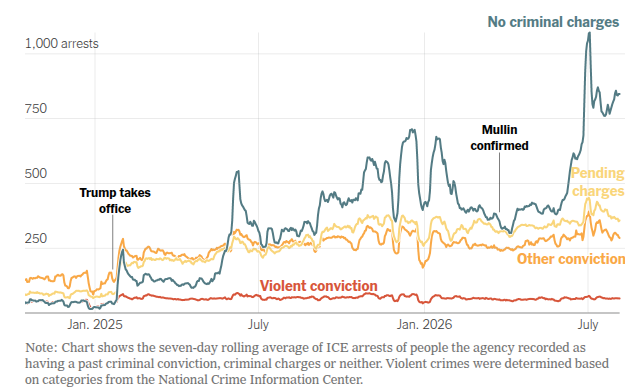
This report from the New York Times breaks down the numbers. We’ll start with this chart, which shows the violent crime rates have remained consistent throughout Trump’s second White House residency. The only thing that has changed is how many people are being swept up by ICE’s roving kidnapping squads.

That nearly-flat line at the bottom is the violent crime rate. Everything else is the escalation of the Trump administration, which continues to pretend it’s the best at hunting down migrant criminals.
The Trump administration is deliberately wrong about the migrant crime rate. The DHS social media feeds are filled with narratives about arresting individuals who have committed serious crimes, but it’s the most extreme form of cherry-picking. For every social media blast about some person ICE has picked up and deported, thousands of arrests of people who are, in most cases, either trying their best to follow the legal path to residency or have lived here for years, if not decades, and done nothing more than work their asses off in hopes of securing the American Dream.
What’s worse is that ICE is back to generating negative press on a daily basis due to its proclivity for engaging in excessive force. But this indirect pressure isn’t working. Neither are the multiple efforts being made around the nation to disrupt opportunistic arrests by ICE officers. The administration has the upper hand.
Overall, immigration arrests rose to record highs with 43,000 ICE arrests in June and 49,000 in July. Two fatal shootings involving Immigration and Customs Enforcement agents, in Texas and Maine, drew outrage but did not meaningfully slow the pace of arrests.
Unofficially (lest it be accused of setting quotas), Trump wants 2,000 arrests per day. The inhumane ghoul currently d/b/a White House advisor, Stephen Miller, has been calling for 3,000 arrests since day one of Trump’s second administration.
The numbers are getting up there, and even a number of murders committed by immigration officers hasn’t managed to slow this down. Neither has the lack of evidence of criminal activity by the people arrested, detained, denied rights, and deported by the Trump administration.
What’s been happening since Trump took office for a second time is a decimation of the US workforce and the ejection of people who pay more taxes and use fewer social services than US citizens. And that’s before you factor in the violent crime rate, which is far lower than the numbers generated by people Trump pretends he’s trying to protect by authorizing opportunistic raids of any place day laborers might be found.
This administration pretends it’s the last hope for law and order, even though it routinely violates laws and disrupts public order. The GOP party made political hay for years by pretending Democrats would bankrupt America financially, if not morally. But while ICE officers kill people and get away with it, Trump’s party has managed to run up a $40 trillion tab, taking us past the watershed mark of the national GDP.
Meanwhile — as the NYT report points out — the administration is leveraging its relationships with red state politicians to juice its arrest stats. The largest increases in arrests in July occurred in Florida, Wyoming, Texas, and Arizona. Blue states saw a drop but only because ICE finds it much easier to engage in bigoted enforcement in states that are run by MAGA-loving bigots.
There’s nothing in this effort that even slightly suggests Trump’s mass deportation efforts have anything to do with making this country safer. It’s always been about making this country whiter and more supportive of whatever Nazi-esque efforts Trump 2.0 decides to pursue next.
Business30 seconds ago
HB Fuller stock hits 52-week low at 48.6 USD

Crypto World1 minute ago
Stock Market Today: Dow Pressured As Yields Hit 5%; Strategy Soars As Bitcoin Price Tops $80,500 (Live Coverage)

Entertainment4 minutes ago
Sexologist Talks “Vabbing,” Open Marriage, More



-

 Fashion7 days ago
Weekend Open Thread – Corporette.com
-

 Tech5 days ago
The Latest Weird Thing to Play Doom Is the Mapped-Out Brain of a Fruit Fly
-

 Crypto World4 days ago
Kraken Lets xStocks Holders Earn Yield Through DeFi
-

 Crypto World2 days ago
US Charges Robinhood Engineers Over Crypto Listing Trades
-

 Entertainment7 days ago
News Specials, Movies, Shows, More
-

 Crypto World6 days ago
Can AI Build a Startup in 72 Hours? Elon Musk's Team Will Livestream the Test
-

 Crypto World4 days ago
Elon Musk Drops a Bombshell: Grok 5 Could Be the AGI Breakthrough
-

 Business5 days ago
Rivals Sam Altman and Elon Musk Rally Behind Dario Amodei’s Call for a Slowdown in AI Development
-

 Crypto World3 days ago
What Is the Status of the U.S.-Iran Peace Talks? Here's What Both Sides Are Saying
-
 NewsBeat4 days ago
‘Sick conspiracy’: Trump says only guardrails AI needs is ‘a strong and smart (High IQ!) president’ in all-caps rant
-
 Crypto World5 days ago
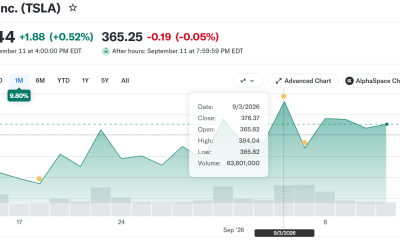
New Tesla Roadster Uses SpaceX Tech. Will It Impact the Stock Price?
-

 Crypto World7 days ago
Robinhood Chain Never Stopped But its Blobs Did Stop Reaching Ethereum For 14 Minutes
-

 Crypto World3 days ago
NVIDIA Analysis: Attempted Rising Wedge Breakout Amid Pressure on the AI Sector
-
 Entertainment7 days ago
New Horror Movie Officially Earns a Rare Stephen King Recommendation
-

 Business6 days ago
Marvell: Most Potent Setup Of The AI Factory Decade
-

 Crypto World4 days ago
Revolut Attackers Warn of Ongoing Daily Customer Data Leaks
-

 Crypto World4 days ago
DOJ Seeks to Seize $61M in Iran Oil Funds From Binance Accounts It Vouched For
-

 Crypto World6 days ago
Bitcoin ETFs lose $462.7M as Ethereum funds gain $196.9M
-

 Crypto World4 days ago
3 Token Unlocks to Watch in the Third Week of September 2026
-
Crypto World4 days ago
Can Circle’s Arc Repeat Robinhood Chain’s Meme Coin Boom?
You must be logged in to post a comment Login