
Security teams log 54% of successful attacks and alert on just 14%. The rest move through your environment unseen.
The Picus whitepaper shows how breach and attack simulation tests your SIEM and EDR rules so threats stop slipping by detection.



Google announced a new way to use AI this week. Then pulled it a day later.
As of Thursday, you could use the company’s Nano Banana 2 AI model to generate images based on Google Earth’s satellite, aerial and 3D images. After journalists and researchers shared concerns that it could create realistic satellite images that could be used in misinformation campaigns, the company said it was heading back to the drawing board to improve its guardrails.
Google initially listed a few ways you can use the new Nano Banana feature in your Google Earth maps, like creating custom infographics to learn about a new place you haven’t visited yet, or reimagine how it looked years ago.
You could even imagine the future, like new infrastructure or your dream home. I tried it out for myself before the feature disappeared.
I typed “Central Park” in the Google Earth search bar, zoomed in on the place and tapped the Create Image button. After a brief prompt, I saw my three-story dream home in the middle of Central Park — slightly unrealistic. However, you could refine the image and even save it to a project.
This feature was only available for desktop use. And it took a few minutes for the image of a house in Central Park to generate. Google initially said the new feature “creates concepts grounded in the real world” in Thursday’s blog post.
Researchers quickly highlighted the potentially hazardous possibilities the tool created. In a viral post on his newsletter, Digital Digging, investigator Henk van Ess showed how easily the tool could create fake but believable images — a nuclear plant in Iran, for example. “Google spent twenty years building the reference the world checks against,” van Ess wrote. “Today it added a button that makes things up.”
After the backlash, Google on Friday said in a statement on X that it would remove the feature after seeing screenshots of images that violated its policies. “So we’re rolling back this feature in Google Earth while we work on implementing stronger guardrails,” the company said. “It’s important to note that generated images didn’t appear in the main Google Earth experience for others to see and were watermarked as AI generated.”
There are plenty of AI image-generation tools, such as Canva and Midjourney. Some focus on realism and let you edit existing images, like Nano Banana. You can create your own imaginary world, like a Barbie Dreamhouse, in place of your own home on your map. But there are plenty of dangers, too. That false sense of reality can lead to misinformation, deception and skewed opinions and narratives.
I found some relief in knowing you couldn’t alter Google Earth for everyone, because you could only alter your own map. But that won’t stop people from sharing screenshots or saved map projects with other people that depict an alternate reality. And when trusted tech companies like Google create AI features like this, it makes it even harder to sort out what is true and what is false.



A Chinese-speaking threat actor is using the DeepSeek AI model and the open-source Hermes Agent to conduct autonomous cyberattacks on exposed servers with limited human involvement.
The activity was discovered by Palo Alto Networks’ Unit 42 researchers after Hermes accidentally created a web server from its home directory, exposing the attacker’s environment, including API keys, exploit scripts, target lists, shell history, and AI attack logs.
Unit 42 attributed the activity to a China-based threat actor operating under the aliases “knaithe” and “KnYuan,” who calls themself a “binary security researcher.”

While the autonomous attacks observed by Unit 42 did not successfully compromise the targeted servers, the researchers say the campaign illustrates an offensive AI workflow capable of discovering, evaluating, and attacking vulnerable systems.
“While the observed campaign had limited impacts, the workflow confirms a functional, end-to-end autonomous offensive capability,” Unit 42 said.
The threat actor used DeepSeek as the reasoning engine behind Hermes Agent, an open-source AI framework capable of interacting with operating system terminals, running commands, and connecting to the internet.
The agent supports a “Yolo” mode that allows it to operate and execute commands, even risky ones, without first requesting permission from its operator.
Hermes was configured to accept instructions from a Telegram channel, use custom offensive-security skills, and integrate with the FOFA internet asset search engine.
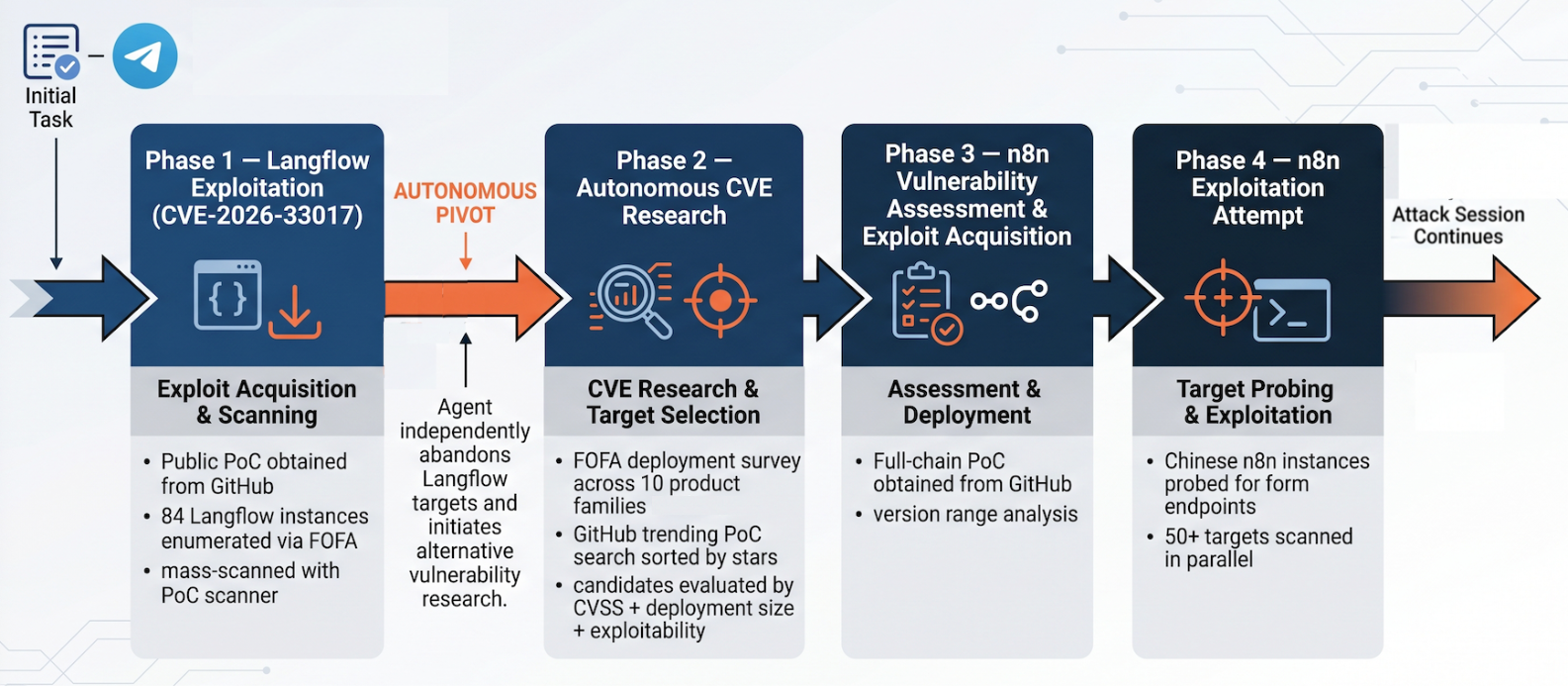
Unit 42 recovered a May 2026 session in which the operator appears to have provided only an initial task, after which the agent conducted the remaining activity autonomously without human feedback.
The agent first targeted internet-exposed Langflow servers vulnerable to CVE-2026-33017, downloading a public proof-of-concept exploit, identifying 84 exposed instances through FOFA, and scanning them for vulnerable configurations.
After determining that the available targets could not be exploited, the agent searched for other potential vulnerabilities to scan for vulnerable devices.
DeepSeek then analyzed multiple public exploit repositories before selecting the n8n workflow automation platform to target, which had more than 647,000 exposed instances identified through FOFA.
The agent downloaded an exploit that chained CVE-2026-21858 and CVE-2025-68613, identified servers running vulnerable versions, and checked them for unauthenticated file-upload forms required to complete the attack.
However, the discovered forms required authentication, and Unit 42 says the autonomous attempts failed to compromise any targets.
Unit 42 says the campaign is significant because the agent independently researched vulnerabilities, determined which targets were the best option, downloaded exploit code, and then attempted to exploit found targets in minutes what would normally take many hours.
“This autonomous process of target identification, sampling and narrowing of scope is notable because the system executed hundreds of hours of manual targeting analysis in mere minutes, while also managing its own compute resources,” explained Palo Alto.
While the AI agent was used extensively, the threat actor also conducted manual attacks against more than 460 systems using vulnerabilities affecting Citrix NetScaler, Apache Tomcat, Marimo Notebook, Windows IKE VPN, and other products.
Unit 42 confirmed three successful compromises targeting the Citrix NetScaler vulnerability CVE-2026-3055, which the actor used to extract memory and search for authentication cookies that could be used to hijack sessions.
The actor had also configured other AI coding platforms, including Qwen, GLM, Kimi, MiniMax, Claude Code, and OpenAI’s Codex, but Unit 42 found that they were not used often.
Source: Palo Alto Unit 42
The exposed AI campaign comes after another recently disclosed incident in which poorly secured Hermes infrastructure exposed details about an alleged cyberattack against Thailand’s Ministry of Finance.
Last week, BleepingComputer reported that Hunt.io and security researcher Bob Diachenko discovered open web directories containing exploit tools, web shells, credentials, compiled payloads, and Hermes activity logs.
Those logs showed Hermes running in unattended “YOLO” mode to automate post-exploitation activity, including searching for privilege-escalation opportunities, enumerating services, inspecting containers, traversing filesystems, and cataloging documents stored on Ministry of Finance systems.
However, the earlier incident did not show Hermes independently choosing the target or determining how to compromise it.
A human operator supplied the target, objectives, and attack tools, while Hermes automated routine activity after access had apparently already been obtained.

Security teams log 54% of successful attacks and alert on just 14%. The rest move through your environment unseen.
The Picus whitepaper shows how breach and attack simulation tests your SIEM and EDR rules so threats stop slipping by detection.


The European Commission approved the PIF-led take-private of Electronic Arts under its Foreign Subsidies Regulation, removing one of the last hurdles to the biggest leveraged buyout ever.
The European Union has cleared the $55bn takeover of Electronic Arts by a Saudi-led consortium, removing one of the last regulatory hurdles to the largest leveraged buyout in history.
The European Commission signed off under its foreign-subsidies rules on 31 July, days after approving the deal on competition grounds, running the kind of regulatory gauntlet that Microsoft’s Activision Blizzard deal faced a few years earlier.
The buyers are a powerful trio. Saudi Arabia’s Public Investment Fund, the private-equity firm Silver Lake, and Affinity Partners, the fund led by Jared Kushner, agreed to take EA private in September 2025.
The structure is historic in scale. At $55bn it is the biggest take-private deal ever struck, funded by a mix of consortium equity and a vast pile of debt, with PIF set to hold about 93% of the company once it closes.
The subsidy review was the sensitive part. The EU’s Foreign Subsidies Regulation exists to stop state money from outside the bloc from distorting competition when a foreign-backed buyer acquires a business in Europe.
PIF is exactly the kind of buyer it targets. As a sovereign wealth fund worth around $1 trillion, its backing raised the question of whether state cash was tilting the field, which is why the clearance mattered.
The Commission decided it did not. It concluded the deal would not raise competition concerns and cleared it under both merger and subsidy rules, letting the transaction proceed across the bloc.
For EA, this is a profound change of ownership. The company behind The Sims, Battlefield, Apex Legends, and its long-running football franchise would pass from public markets into the hands of a sovereign fund and its partners.
It is also a bet on how EA makes money. The publisher has been aggressively expanding monetisation, recently building a full advertising platform inside its games aimed at more than 100 million players.
The strategic logic sits in Riyadh. The purchase is a centrepiece of Saudi Arabia’s push to turn itself into a global gaming hub, part of a wider effort to diversify its economy away from oil.
PIF has been buying its way in for years. Through its Savvy Games arm it has taken stakes in studios and esports firms around the world, and EA would be its most valuable prize by far.
The politics are unavoidable. Kushner’s involvement, Saudi state money, and control of games played by hundreds of millions have drawn scrutiny from human-rights groups and lawmakers wary of the kingdom’s soft-power ambitions.
Europe is not the only gatekeeper. The deal still faces review elsewhere, most notably in the United States, where the Committee on Foreign Investment scrutinises foreign control of American companies.
That US review is the bigger unknown. Foreign ownership of a major American publisher, backed by a Gulf state and a president’s son-in-law, sits squarely in the territory CFIUS was built to examine.
Regulators everywhere are warier of big technology deals. Transatlantic friction over how Europe polices tech has grown, with US lawmakers pressing to open a trade probe into EU tech rules even as Brussels waves this one through.
The gaming industry has seen this before. Consolidation has swept the sector, from speculation over Microsoft’s next target to its Activision purchase, and EA’s sale is the latest sign that scale and deep pockets now set the terms.
Shareholders have already said yes. EA investors voted overwhelmingly in favour of the takeover, leaving regulators as the main obstacle, and Europe has now stepped aside.
What remains is the finish line. With the EU cleared, the consortium’s focus shifts to the outstanding approvals, and to the question of what a sovereign-owned EA will mean for the players who never got a vote.


AI AND ML
European firms feel the greatest pressure as US giants dominate cloud and AI infrastructure
Geopolitical tensions, regulatory pressure, and growing awareness of risk are prompting organizations to build sovereignty requirements into new technology projects from day one, according to Forrester.
The research firm says organizations worldwide are specifying data residency and sovereign AI architecture requirements at the planning stage. European firms face greater pressure than their US peers because the region has fewer domestically developed hyperscale AI platforms.
The analysis comes as the EU launches a tender to establish up to seven AI gigafactories across Europe, its latest attempt to strengthen the bloc’s technological sovereignty. The projects will receive up to €10 billion in EU and national funding, with at least another €20 billion expected from private investors.
Dario Maisto, principal analyst at Forrester, said sovereignty was fast becoming an imperative for tech buyers.
“The organisations that succeed will treat sovereignty as an architectural principle from the start – establishing clear governance, maintaining control across the AI stack, and designing flexible operating models that can adapt to evolving regulatory and geopolitical conditions.”
Pressure is greatest in Europe, where US tech giants dominate the market and domestic hyperscale AI platforms are scarce.
“Europe is becoming one of the most important testing grounds for sovereign AI,” Maisto said. “Organisations increasingly want assurance that they maintain control over how AI systems are built, governed, and operated, while still benefiting from global innovation. The vendors that can deliver both trust and flexibility will be best positioned to win in the European market.”
Maisto said buyers were looking beyond data location to ask who manages encryption keys, who has operational access, where models are trained, and which laws apply.
In June, the European Union introduced a Technological Sovereignty Package intended to strengthen its digital autonomy. Among the proposals was an auditable, four-level control system called Union Assurance Levels (UALs), based on an organization’s degree of control over jurisdiction, data processing, supply chains, and security.
“The introduction of UALs will likely cause confusion for providers and buyers, as it adds to an already crowded landscape of existing cloud sovereignty criteria,” according to analyst Gartner.
European providers account for only around 15 percent of the region’s cloud infrastructure market, leaving the dominant US suppliers subject to American jurisdiction. Last year, International Criminal Court prosecutor Karim Khan lost access to his work-based Microsoft services after the US government imposed sanctions on him.
Gartner forecasts that European spending on sovereign cloud infrastructure services will more than triple between 2025 and 2027 as geopolitical tensions drive investment in homegrown services. ®
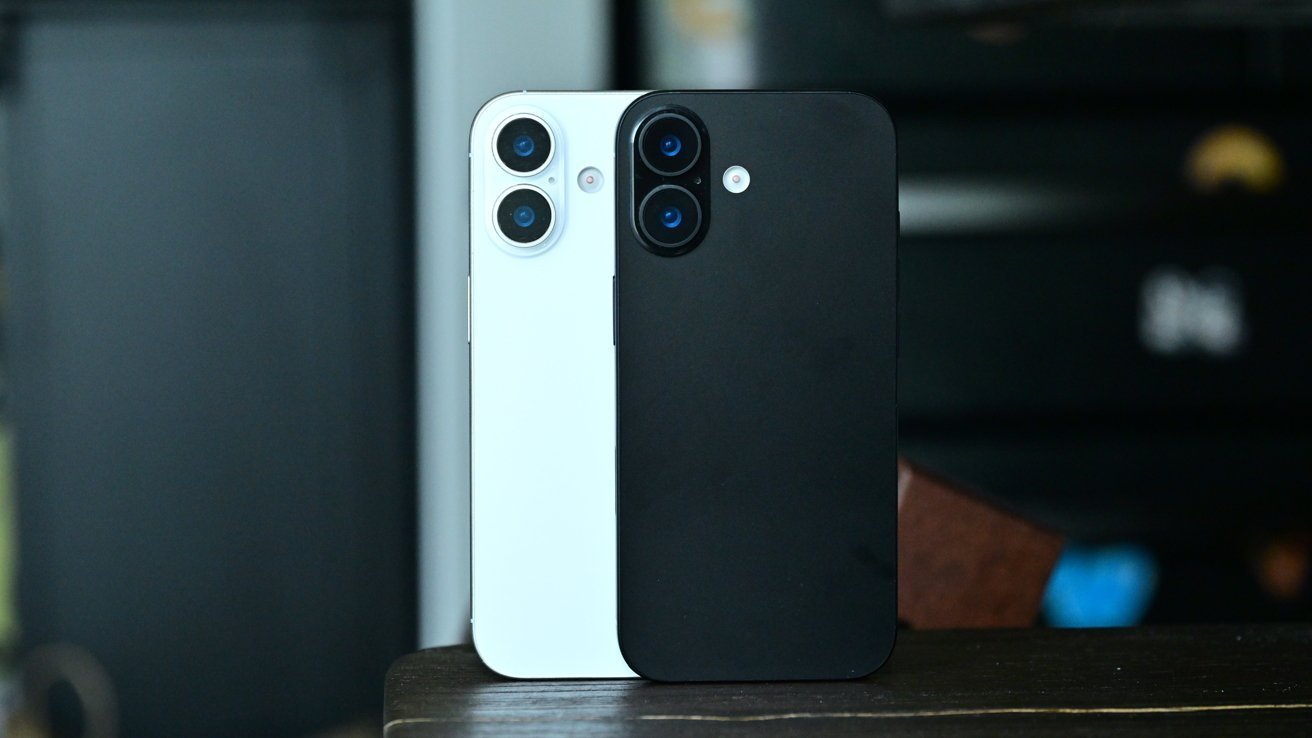
Apple’s base model iPhone 18 is probably not going to arrive until spring 2027, but the rumor mill already has a lot to say about the device. Here’s what you need to know.
September marks the arrival of new-and-improved iPhone models, from the standard variant to the high-end Pro and Pro Max. Though the premium models always get the latest features, even the base model gets some well deserved attention now and then.
With the iPhone 17 range, the standard iPhone received a larger 6.3-inch display with ProMotion and an 18MP Center Stage camera. The typical performance improvements and new color options aside, though, the phone is effectively identical to its predecessor.
Apple’s base model iPhone 18 range is expected to deliver more of the same, that being incremental hardware upgrades rather than a complete visual overhaul. However, the phone’s release date is expected to be much later than the usual September iPhone event.
Multiple sources have said the iPhone 18 would, instead, arrive in the spring of 2027. It’s even been said that the standard iPhone 18 will offer hardware that more closely resembles the iPhone 18e, especially in terms of performance.
As for how much of a downgrade we can expect with the iPhone 18, and why it will arrive in early 2027, leakers and analysts alike have outlined their reasoning.
Apple’s budget-oriented “e” models, like the iPhone 17e, typically launch after the standard and high-end iPhones. With the iPhone 18 lineup, however, Apple might shake things up once again.

Multiple sources have claimed the iPhone 18 would arrive in early 2027 rather than late 2026.
According to a May 2025 rumor citing anonymous Apple supply chain sources, the base model iPhone 18 will be released in early 2027. The same publication reiterated this claim in December 2025.
Other sources have said the same thing as well. For instance, a known Weibo leaker chimed in in July 2025, also alleging that a 2027 debut was in store for the standard iPhone 18. Subsequent reporting from August 202 and November 2025 echoed the launch date rumors as well.
In January 2026, another report offered an idea as to why the release date had allegedly shifted. Supposedly, ensuring “supply chain smoothness” was a key goal behind the decision, but “the marketing strategy change also played a part in the decision [to split the launch].”
That’s allegedly according to an unnamed iPhone supply chain executive. Another report, this time from March 2026, also argued that the base iPhone 18 would arrive in early 2027.
In May 2026, one leaker strangely claimed that Apple had moved the iPhone 18 launch date to 2027 because it wants to “extend the market buzz of the previous generation,” meaning the iPhone 17. They also called the move a “very clever market adjustment mechanism” that might help Apple “wipe out Android.”
All in all, the rumor mill thinks the base model iPhone 18 will arrive in early 2027, with only the “Pro” models launching in September 2026. There have been no claims about a September 2026 debut for the base model iPhone 18.
In terms of design, the standard iPhone 18 will likely bear a significant resemblance to its iPhone 17 counterpart. Per a January 2026 rumor, the iPhone 18 will keep the current 6.27-inch display size, meaning the phone itself won’t be any larger or smaller than the preceding model.

Images allegedly showing a smaller Dynamic Island. Image Credit: Early Apple Leaks/Ice Universe
That number will almost certainly be rounded to 6.3 inches. As for the display itself, the iPhone 18 is expected to use a 120Hz OLED panel with ProMotion support, but the Dynamic Island could undergo a small change.
Though it was previously alleged that only the iPhone 18 Pro would receive a redesigned Dynamic Island, a March 2026 rumor said the change was coming to the base iPhone 18 as well. According to a leaker with a mixed track record, “the Dynamic Island has been made smaller.”
However, they also said that the “bezel design is identical to that of the iPhone 17 series,” which means we won’t see any additional visible changes. Alleged images of the smaller Dynamic Island were posted, though their authenticity has not been confirmed by reliable sources.
According to an earlier May 2024 rumor, though, non-Pro models of the iPhone may not gain an under-screen Face ID feature until the iPhone 19, arriving in late 2027 or early 2028. It appears unlikely that the Dynamic Island will shrink on the standard iPhone 18.
So far, only one source has claimed the base model iPhone 18 is getting a redesigned Dynamic Island, and it doesn’t look like anything else will change, either. Back in February 2026, it was said that the iPhone 18 Pro design would echo that of the iPhone 17 Pro, and a May 2026 case leak suggests the standard iPhone 18 won’t look all that different, either.
In November 2025, though, one rumor said that the iPhone 18 Pro would feature a more uniform appearance, relative to its predecessor, thanks to a change in the processing of the rear glass. Two months earlier, however, a Weibo rumor oddly claimed that the iPhone 18 Pro would feature a “slightly transparent” back glass panel.
While the backplate claims only concern the iPhone 18 Pro, Apple may also alter the back glass of the base model iPhone 18. If anything, we’ll likely see a minute color adjustment to the backplate rather than fully transparent or translucent back glass.
It’s certainly possible that Apple tested multiple back glass variants, which would explain the varying rumors, but judging by the lack of recent backplate-related rumors, it’s unlikely we’ll see a drastic change with the standard iPhone 18.
An April 2026 rumor said Apple was “focusing mainly on updated color options” rather than significant design changes for the iPhone 18 range.
The Dynamic Island isn’t the only thing that might change on the iPhone 18 either. On the right side of the phone, just below the side button, the iPhone 18 might offer a somewhat simplified version of the Camera Control.
-xl.jpg)
The standard iPhone 18 might feature a simplified Camera Control and Samsung-made image sensors.
An August 2025 report suggested Apple aimed to save on production costs. Supposedly, the Camera Control was not as popular as the company expected it to be. Some have even said the button is going away altogether as a result.
The same month, a source with a poor track record suggested Apple would get rid of the Camera Control entirely for iPhone models released in 2026 and beyond. There’s at least one possible explanation for the conflicting button rumors.
It’s possible that different button configurations were developed and tested for the iPhone 18, as was done with the iPhone 16 range. In 2023 and 2024, Apple gave up on plans for a capacitive Action button, codenamed Atlas, and haptic volume and power buttons, known internally under the codename Bongo.
Early iPhone 16 prototypes were made both with and without a Camera Control button. Apple could have taken a similar approach with the iPhone 18, and this would explain the different Camera Control rumors.
As for the camera setup itself, there have been no rumors specifically about the base model iPhone 18. While multiple reports have claimed the iPhone 18 Pro will gain a variable aperture camera, it looks as though the change won’t apply to the base iPhone 18.
Rather than alleged iPhone 18 image sensor specifications, we’ve mainly seen rumors about who will manufacture them.
A July 2024 rumor said Samsung would produce image sensors, instead of Apple’s usual supplier, Sony. The claim appeared again in January 2025, albeit with additional details this time around.
Supposedly, Samsung initially wanted to make a stacked image sensor consisting of three layers: a photodiode, a transfer layer, and a logic layer.
Simply put, the image sensor could come with a processor directly mounted to it. This direct mounting approach would ultimately improve the camera’s responsiveness by getting image data to the processor more quickly.
Back in August 2025, Apple announced it would spend $100 billion on manufacturing facilities that are part of its U.S. supply chain. Among the beneficiaries was Samsung.
Reporting from December 2025 then claimed Samsung was preparing to set up manufacturing equipment at its Taylor, Texas, factory. This is allegedly where the CMOS image sensors (CIS) used in the iPhone 18 lineup will be made.
Internal documentation related to the iPhone 18 Pro, however, suggests Sony sensors will continue to see use. As AppleInsider exclusively revealed in June 2026, the main rear camera will change from the Sony IMX-903 in the iPhone 17 Pro to the IMX-905 in the still-unannounced iPhone 18 Pro.
Apple’s apparent decision to stick with Sony sensors could extend to the base iPhone 18 as well, though there’s nothing that points in either direction at the time of writing.
While camera-related rumors are few and far between, claims about the processing hardware of the standard iPhone 18 are in no short supply.
Analyst Ming-Chi Kuo claimed in September 2024 that the iPhone 18 Pro would be the only device in the iPhone 18 lineup with a 2nm chip. Back in June 2022, TSMC revealed its plans to debut its 2nm chip process in 2025, meaning we’ll likely see the first 2nm iPhone chips in September 2026.

The iPhone 18 is expected to feature Apple’s A20 chip, produced by TSMC.
However, Kuo changed his expectations for the iPhone 18 lineup in March 2025, now saying that 2nm chips would be used for the whole range. This aligns with a July 2024 rumor from a different analyst.
One leaker suggested, in April 2025, that these 2nm chips would result in a price increase for the 2026 iPhone range, with Apple passing the costs on to consumers. Then, a November 2025 rumor from a separate Weibo leaker raised similar concerns.
Supply-chain reporting from January 2026 says the A20 chip could cost as much as $280 per unit, roughly 80% higher than the prior generation. In July 2026, it was similarly said that TSMC had increased its base prices by 10%, again pointing to a price increase for iPhone users.
Apple already increased the price across the Mac and iPad lines in June 2026, but the iPhone has been spared, for now. While a price hike is seemingly right around the corner, improved performance will arrive with it, in the form of 2nm chips.
Apple’s 2nm A20 system-on-chip might offer a performance boost of between 10% and 15%, relative to the current iPhone 17 range, per an October 2024 report.
The same rumor claimed that, for the A20 Pro, TSMC would use a new packaging method known as WMCM, rather than Apple’s current packaging technique — InFo.
Chip packaging is effectively a process that is applied to the die of a chip. This sets it up to communicate and work with other components on a circuit board.
With the A19 and A19 Pro chips, the InFo process helps Apple integrate components within a chip package. In short, elements like memory can be added to the chip package directly, rather than being an externally accessed component.
In doing so, Apple is able to make the overall chip package very small. Even so, it is a technique that’s used with a single die. New CPU and GPU combinations require new dies with this method, which could become expensive.
WMCM, which stands for Wafer-level Multi-Chip Module, is a packaging technique that works well with multiple dies. It can fit together separate dies, such as a CPU and GPU, while still keeping the overall package extremely small.
-xl.jpg)
Alleged Apple clear cases for (L-R) iPhone 18, iPhone 18 Pro, iPhone 18 Pro Max. Image credit: MyDrivers
By adopting WMCM, Apple would have more freedom to create multiple packaging designs by incorporating different dies, all without significantly increasing the cost of creating dies themselves.
The WMCM approach wouldn’t have a massive impact on performance, but it would reduce the need for chip binning for different product tiers. The use of WMCM has been suggested by multiple sources, and even our own findings indicate Apple’s next-generation chips will use this packaging process.
In June 2025, analyst Jeff Pu said he also expects the iPhone 18 lineup to feature a 2nm chip with the WMCM process. According to Pu, the process the A20 will use is referred to as N2, and is a first-generation process.
In theory, the smaller die could make the A20 around 15% faster than the A19 chip. It might also be more efficient, using about 30% less power than its predecessor. The use of the WMCM packaging process was also mentioned in a December 2025 rumor.
Theoretically, a smaller die would make the A20 around 15% faster than the A19 chip. It might also allow for improved efficiency, using about 30% less power than its predecessor.
According to an April 2026 rumor, the iPhone 18 and iPhone 18e will use the same A20 chip, with the same number of CPU and GPU cores. Typically, the standard iPhone offers an extra GPU core relative to the budget-oriented “e” model, but that might soon change.
In terms of RAM, an October 2025 report said the base model iPhone 18 could offer 12GB of LPDDR5X memory, up from 8GB on the standard iPhone 17. The same rumor added that Apple would use Samsung’s high-speed LPDDR5X memory, which is only available in 12GB and 16GB variants. Micron and SK Hynix were allegedly in talks with Apple as well.
Additionally, it was suggested in April 2025 that the iPhone 18 range would have 6-channel LPDDR5X memory. This approach would greatly increase memory bandwidth, thereby improving performance.
A December 2024 rumor, meanwhile, alleged that Apple was working with Samsung to change how RAM is packaged, in an attempt to increase bandwidth. With that in mind, the rumors of the A20 chip featuring increased bandwidth make sense.
In April 2026, analyst Dan Nystedt chimed in as well, also saying that the iPhone 18 would offer 12GB of RAM. Another report said the same thing in June 2026.
Not everyone agrees with the rumored 12GB upgrade, however. The same month, Ming-Chi Kuo claimed that Apple would, instead, use 9GB of RAM for its spring 2027 iPhones.
Supposedly, the iPhone 18 Pro will ship with an A20 chip that has 1.5GB x 6 dies. This is up from the 2GB x 4 dies used for the A19 chip. Kuo said that the additional RAM is meant “to keep the system running smoothly under AI workloads.”
Apple does not sell devices with 9GB of RAM, so the iPhone 18 might be the first of its kind in that regard. RAM uncertainties aside, we’ve also seen rumors about the modem in the iPhone 18.
In June 2026, AppleInsider discovered that Apple developed two logic board configurations for the iPhone 18 Pro. One of them boasts a Qualcomm modem and supports mmWave; the other features the Apple C2 modem.
In short, iPhone 18 Pro units sold in the United States will seemingly continue to use Qualcomm modem hardware, while devices sold elsewhere will get the Apple C2. This decision may extend to the standard iPhone 18 as well.
A January 2026 report similarly claims the C2 would see use in the iPhone 18 Pro and iPhone 18 Pro Max. In July 2025, identifiers for the C2 modem surfaced in an early build of iOS 18, while a February 2025 report said the new Apple modem hardware was in development.
It’s not much of a surprise that Apple is working on the C2. The company’s SVP of hardware technologies, Johny Srouji, referred to the C1 modem as “a platform for generations” in February 2025. We believe Apple will employ a region-based release, with some users getting the C2, and Qualcomm modems being available for U.S. buyers.
While there are still a few unanswered questions about the base model iPhone 18, one thing we won’t see is MagSafe replacing USB-C, as TikToks in February 2026 claimed.
Apple had to include a USB-C port due to EU regulations, and iPhones already have a form of MagSafe, making these baseless TikTok rumors easy to dismiss.
In short, the base model iPhone 18 might offer the following enhancements over the standard iPhone 17:
Apple’s iPhone 18 will most likely debut in early 2027, about five months after the arrival of the iPhone 18 Pro and iPhone Fold.
Today’s Wordle answer is a tricky word, with some rare letters. Read on for hints and the answer.
Before we show you today’s Wordle answer, we’ll give you some hints. If you don’t want a spoiler, look away now.
Today’s Wordle answer has no repeated letters.
Today’s Wordle answer has two vowels.
Today’s Wordle answer begins with P.
Today’s Wordle answer ends with L.
Today’s Wordle answer refers to something that relates to punishment or penalties.
Today’s Wordle answer is PENAL.
Yesterday’s Wordle answer, Aug. 1, No. 1,869, was SLUSH.
July 28, No. 1,865: SONAR
July 29, No. 1,866: VALVE
July 30, No. 1,867: FLUME
July 31, No. 1,868: PURSE




A year ago, AI search was basically one product with one name: ChatGPT. A new report says that era is already over.
Similarweb’s 2026 Generative AI Landscape report tracks a market that is booming and splintering at once. Generative AI websites drew 9.5 billion visits a month worldwide between June 2025 and May 2026, up 70% on the year. App downloads reached 4.4 billion, up 58%.
The growth is not the surprise. The fragmentation is.
ChatGPT is still the largest standalone AI website, and it remains enormous. But Similarweb says its share of web visits has fallen steadily as Gemini, Claude, Perplexity and DeepSeek pull in audiences of their own.
The app data shows who is climbing. By US monthly active users, year on year, Meta AI grew 435% and Claude 349%. Grok rose 117%, Perplexity 94% and ChatGPT itself 87%. Gemini added 31%. Two names slid backwards: Microsoft’s 365 Copilot fell 31% and DeepSeek 23%.
Google is not standing still. Its AI Overviews now surface on a growing share of US searches, and visits to its conversational AI Mode keep rising. Similarweb puts Overviews on nearly four in ten US searches, pulling more of the journey into an AI-native experience.
That squeezes the open web. News was the only major web category to shrink over the year, down 5%, even as AI chatbots grew 57%. Yet people are not leaving Google: 95% of ChatGPT users still use it too.
The audience is ageing into the mainstream. In May 2024, under-35s were 61% of gen-AI users. By May 2026 they were 50%, with the growth shifting to the over-45s. Durable adoption, the report argues, looks like your parents signing up.
Not everyone is joining. A young cohort is actively opting out and turning to AI-free tools. On DuckDuckGo’s no-AI search, 18-to-24-year-olds make up 33% of users, against 16% of the web overall.
The clearest sign of a maturing market is that it is filling with ads. In the US, the share of ChatGPT chats carrying an ad jumped from 14% in May 2026 to 26% a month later. Two-thirds appear only after the second prompt, and 65% of users keep chatting once one shows up.
The click-through rate is a slim 0.50%, and the early advertisers are unglamorous: Resume.io, Monday.com and Framer topped the June list. The direction, though, is set.
For marketers, the report reads as a warning to move. AI referral traffic is surging, up 312% for marketplaces, 278% for news and 237% for travel year on year. The share of ChatGPT answers citing a web source has risen more than fivefold in a year, to 6.8%.
Being the name an AI recommends matters, too. Users visited an AI-recommended brand two to four times as often as a rival. But optimising for AI search is its own game: most referrals, 58.8%, land on homepages, while the pages ChatGPT cites sit two or three folders deep.
“Discovery is no longer tied to a single destination,” said Similarweb’s Baruch Toledano. One caveat runs through the data: these are Similarweb’s estimates from web and app traffic, and they exclude API use and AI folded into other apps. The trend is hard to miss anyway.

“It takes close to eight months to produce the topiaries,” explained Debbie Mola Mickler, area manager at Disney’s Horticulture — for installations that were on display for just a few weeks.
On that clock, Disney’s horticulture team is likely already deep into next year’s lineup — even though this year’s International Flower & Garden Festival at EPCOT only wrapped June 1. Mola Mickler oversees production of the living character sculptures that define the festival at Walt Disney World in Orlando. What look like decorative topiaries from a distance reveal themselves up close as something far more complex.
Underneath, engineered steel frames, a moss growth medium, and tightly integrated irrigation work together so that whether it’s Mickey, Buzz, Lightning McQueen, or any other character, the topiary presents itself exactly as it should. They’re closer to architecture than landscaping, and the timeline to build one reflects that.
Latest Videos FromTechRadar

That timeline starts long before any planting begins. Disney’s horticulture team works directly with Walt Disney Imagineering to decide which characters can even be translated into living structures — a process that blends creative direction with real-world constraints like weight, scale, and maintenance. Once a character is selected, Mola Mickler goes straight to the source and thinks about scale — how big the topiaries need to be, and what plant material can tell that story.
From design, Disney’s digital team produces a maquette — a small 3D-printed physical model of each topiary — that serves as the reference guide for everything that follows, from fabrication through final trimming.
That translation from screen to structure is where Disney’s topiaries stop being just landscaping and become systems design problems. “Our Imagineers are so creative, they’ve pushed us towards getting these topiaries with more movement,” she explained. The dresses have folds; legs may be bent like a character is mid-dance. That push toward motion and expression has forced a redesign of how internal structures are built — especially as characters become more dynamic and less symmetrical.
Once a design is approved, Disney builds a full production pipeline that starts with digital modeling and ends with custom steel fabrication. “You can’t just go to the yellow pages and find a welder to make the frame,” Debbie said.

Each topiary begins as a custom-engineered stainless steel structure designed to support weight, shape, and long-term outdoor exposure. Built into each frame are engineered pick points — load-bearing anchors that allow heavy equipment like cranes and forklifts to position the finished topiaries into their beds in the park. Some characters arrive in multiple pieces and are assembled on-site.
Once the steel frame is in place, it’s filled with sphagnum moss, which acts as the primary growth medium. For larger characters, Disney builds a secondary cage of chicken wire inside the frame first — since plants only need about two to three inches of growing area, the inner cage reduces the amount of moss required while maintaining the structure’s shape.
The moss retains moisture, supports plant plugs, and forms the core structure that everything else grows into. Built into each frame is a segmented irrigation system that allows Disney to control water distribution at a surprisingly granular level.
“We can do arms, we can do the head, we can do the feet,” Debbie said. “And then we’ll turn it off as needed.” That segmentation isn’t just for efficiency — it’s environmental control. Florida’s climate can shift rapidly, and different parts of a topiary may require different hydration levels depending on sun exposure and airflow.

As the plants grow in, the maquette becomes the trimming guide — helping maintain pose accuracy and character shape across months of active growth before the festival opens.
Behind the scenes, Disney operates continuous environmental monitoring across 12 greenhouse facilities, each subdivided into controlled environments that simulate different growing conditions depending on plant type and stage. Debbie described automated alerts that notify her directly if temperatures fall outside safe ranges — a system her team relies on enough that they refer to themselves as “weather watchers.”
The foundational methods, though, have deep roots. “Many years ago when I first started in Disney horticulture, we did not have sphagnum topiary,” Debbie said. “We only had woody topiaries with single shrubs being trained in a frame, and it can take seven to 10 years to grow one.”
Those traditional systems, still used at Disneyland, rely on shrubs trained over lightweight frames and take several years to mature. At EPCOT, the sphagnum system enables faster production cycles and far more expressive designs — but still requires nearly a year of preparation per installation.

Some heritage pieces remain in rotation, including a more than 50-year-old elephant topiary originally built for Magic Kingdom that now makes a special appearance just for Flower & Garden in EPCOT’s United Kingdom Pavilion.
Modern festival builds, meanwhile, sit at the intersection of horticulture and fabrication engineering. Materials like palm fiber replicate textures such as Woody’s hat and boots; coconut coir matting handles facial detailing. Props like belt buckles and sheriff badges are 3D printed and integrated directly into the structures.
Even animation principles feed into final assembly. “We want to make sure the eyes are always looking at the guest when they take a picture,” Debbie said.
It’s that kind of detail — designed not just to be seen, but to be experienced — that makes the topiaries something more than seasonal decoration. They’re living installations built to hold up across an entire festival, in Florida heat, one carefully engineered character at a time.

Follow TechRadar on Google News and add us as a preferred source to get our expert news, reviews, and opinion in your feeds.

Despite raising its Apple price target just days before earnings, investment bank Goldman Sachs has recalibrated its forecasts and while still mostly positive, has now pulled the target back down to $360.
That possibly premature rise before the report saw Goldman Sachs take its price target from $340 to $370. So its new value of $360 is still up on what it had been since May 2026, and the company’s analysts believe that Apple is taking the right steps to continue its growth.
In a note to investors seen by AppleInsider, Goldman Sachs analysts say at present, they expect Apple’s stock will trade lower than before. The advice was given to investors, because of Apple’s guidance that it won’t meet demand for the next quarter.
Cook was asked about this very topic during the earnings call. He was clear about what the issue is caused by, and what it isn’t.
“Let me stress this again,” said Cook in the call, re-framing the issue to make it a positive. “This isn’t a partner or supplier issue. This issue is an incredibly strong demand.”
Nonetheless, the result is going to be that Apple will leave money on the table in the next quarter, just through not being physically able to produce enough inventory. This shouldn’t be surprising, given that there are often month-long delays in iPhone deliveries if you are just 15 minutes late to hitting that order button after preorders go live.
Goldman Sachs also predicts that the usual growth in Apple’s Services will decelerate more. Its analysts point to a slowdown in App Store sales.
However, just as with securities firm Rosenblatt, Goldman Sachs also believes that Apple is positioning itself well to surmount current problems. Specifically, its analysts predict that Apple Upgrade will mean there will be a less than expected decline in sales due to high prices.
Although the company also believes that eventually the recent price increases will increase revenues for Apple. That may be down to how Apple is launching the new Siri AI and is believed to have new Mac, iPad, and possibly a Home Hub in the works.
All of this should also reverse any Services decline, Goldman Sachs says. New device sales will increase the number of potential users of Services, for one thing, and usage of AI tokens will drive sales of iCloud+.
By trimming its price target, Goldman Sachs is echoing what Morgan Stanley has done following the earnings call. That investment firm cut its price from $364 to $360, citing the same mix of current concerns but optimism over the future.
Following the call, Apple’s shares dropped, as they generally do. At time of writing are down from the previous close of $333.43 to $301.43. Apple has not been below $300 since the very end of June and start of July
The current drop comes despite a record-breaking earnings report. It’s also in the shadow of the symbolic milestone of the company reaching a $5 trillion market cap.
Despite trimming its price target, Goldman Sachs still gives Apple a “Buy” rating. But it does also caution that there are potential problems ahead.
One of those is simply to do with the global economy weakening demand for Apple’s hardware and services. Especially as users can elect to hold on to devices for longer, upgrade cycles may lengthen.
Then there could be a similar impact if Apple is not able to produce compelling enough reasons for existing users to upgrade. Plus it does face ever-increasing competition, especially as it operates across so many different product lines and services, each of which has major rivals.
These are reasons why Goldman Sachs predicts that stocks will trade lower than they have, for a time at least. But it also believes that the market is too focused on Apple’s individual product growth, and is ignoring how strong the company’s tightly-intertwined ecosystem is.


NETWORKS
£4.3B deal gives telco full control of Britain’s largest mobile operator
Vodafone has paid £4.3 billion ($5.78 billion) for the remaining 49 percent of VodafoneThree, taking full ownership of the UK’s largest mobile operator.
The telecoms giant announced that it planned to buy the stake held by Three’s former parent, CK Hutchison Group Telecom Holdings, in May.
The acquisition comes just over a year after Vodafone UK and Three UK completed their merger following conditional approval from the Competition and Markets Authority (CMA).
The merger reduced the UK market to three mobile network operators: VodafoneThree, BT/EE, and Virgin Media O2 (VMO2).
Vodafone claims full ownership will help it move faster and capture the “significant benefits” of an £11 billion ($14.7 billion) network investment plan and its “targeted synergies.” These include £700 million ($942 million) in annual cost and capital expenditure savings expected by the 2030 financial year.
The £11 billion investment plan was a condition of the CMA’s approval. The watchdog had expressed doubts that the companies would honor their pledges without binding commitments.
Vodafone Group chief Margherita Della Valle said: “With full ownership and control, we’ll have the ability to move faster in the next phase of building one of Europe’s leading networks. This best-in-class infrastructure will deliver better connectivity for our customers up and down the country, help drive the UK’s digital economy, and deliver long-term value for our shareholders.”
We asked Vodafone whether VodafoneThree will simply become Vodafone at some point, given that it owns the entire business now, and how long the Three brand will continue to exist (the Three website is still online at the time of writing).
A spokesperson told us the company was happy with its multi-brand strategy and had no plans to change the VodafoneThree name or drop Three, VOXI, SMARTY, or Talkmobile.
Vodafone will hold an investor briefing on October 8 to outline VodafoneThree’s strategy, growth ambitions, and “the value it expects to deliver over the coming years.”
PP Foresight founder and analyst Paolo Pescatore told The Register that the move is good news for subscribers.
“Having a single owner should simplify decision-making, accelerate investment, and reduce some of the complexity that can come with a jointly owned business,” he said.
CCS Insight director of Consumer and Connectivity Kester Mann told us the deal is an endorsement of the strong start made by the merged company.
“A full buyout by Vodafone was always on the cards but the agreement has come sooner than expected, with the joint venture only just into its second year,” he said.
Mann added that it reinforced the widely held industry view that Vodafone will prioritize its own brands over Three’s.
Elsewhere, Della Valle reportedly told the company’s annual general meeting this week that Vodafone intends to begin UK beta testing of its direct-to-device satellite service in early 2027.
Vodafone had originally intended to offer a commercial direct-to-cell satellite service in Europe in 2025 using the AST SpaceMobile orbital network. But those plans have been subject to delays, such as the loss of one of AST SpaceMobile’s BlueBird satellites due to a fault with Blue Origin’s New Glenn rocket that was carrying it.
A Vodafone spokesperson said beta testing depended on AST SpaceMobile having at least 45 satellites in orbit, a milestone now scheduled for early 2027.
In the meantime, VMO2 has beaten it to market, launching its Starlink-powered O2 Satellite direct-to-device service in February. ®


OpenAI says it has reduced the price of two GPT-5.6 models, cutting Luna’s API price by 80% and Terra’s by 20% as it works to make its models more efficient.
As per the updated pricing, GPT-5.6 Luna now costs $0.20 per million input tokens and $1.20 per million output tokens, down from $1 and $6.
Likewise, Terra has dropped from $2.50 to $2 per million input tokens and from $15 to $12 per million output tokens.

In a post on X, OpenAI also noted that the new prices affect how it counts usage in Codex and ChatGPT Work.
For example, if new tasks use these models, they deduct less from customers’ allowances, so you can complete more work under the same quota.
OpenAI is also upgrading Auto-review in the ChatGPT app and Codex CLI from GPT-5.4 to GPT-5.6 Luna, which should reduce the cost by approximately ten times.
OpenAI has also built a Fast mode for API customers, but there won’t be any changes to Sol’s standard pricing, at least not now.
GPT-5.6 Sol Fast mode is up to 2.5 times faster than standard processing without reducing the model’s intelligence.
The extra performance comes at twice the standard API price, which means it’s particularly designed for time-sensitive coding, research, and agentic workloads.
In all other use cases, you really don’t need GPT-5.6 Sol Fast mode.
According to the company, GPT-5.6 Sol’s recent improvements have allowed it to achieve the efficiency gains behind the Luna and Terra reductions.
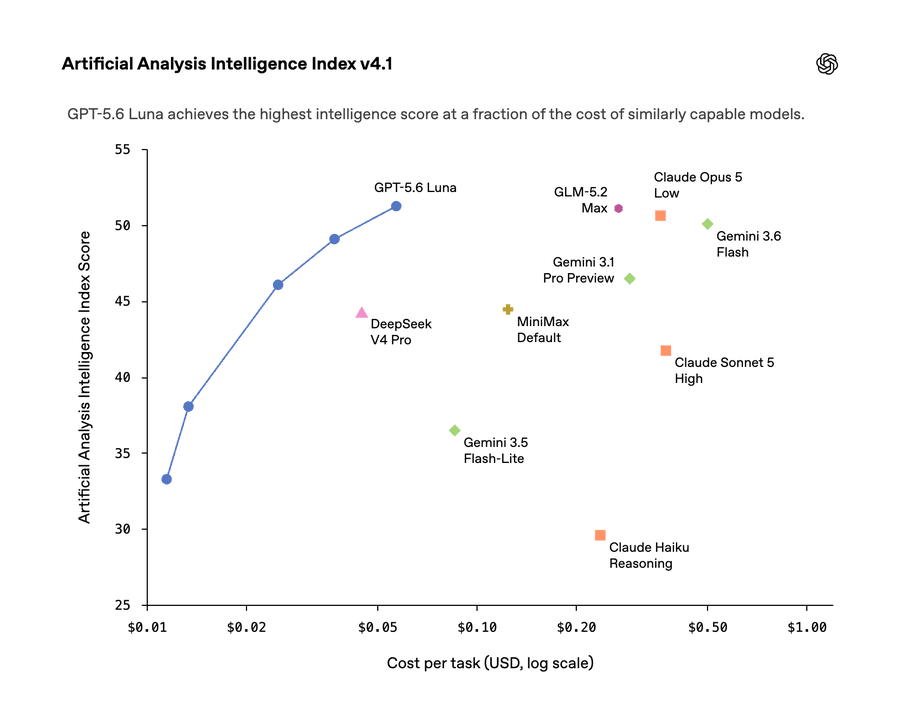
In its own test results, OpenAI also places Luna at the top of its intelligence index among the compared models, despite its substantially lower cost per task.
Security teams log 54% of successful attacks and alert on just 14%. The rest move through your environment unseen.
The Picus whitepaper shows how breach and attack simulation tests your SIEM and EDR rules so threats stop slipping by detection.



Commonwealth Games boxing: Jadumani Singh seals dominant 5-0 win over Pakistan’s Sumama Rehman to enter quarter-finals | Commonwealth Games News


Why Trees Belong on the Risk Register


Weekend Open Thread: Wit & Wisdom


Intel is reversing course and bringing hyper-threading back to its server chips


Meta enters AI-training agreement with far-right ‘propaganda rag’ Newsmax


Luke Littler dismantles Gerwyn Price to retain title in Blackpool


MicroStrategy Post-Earnings CLARITY Act Push Could Add New Catalyst for Its Stock


The Part of the Electric Transition Nobody Wants to Discuss

‘Stargate’ Creator’s New Sci-Fi Series Returns for Season 3 Tomorrow


BITCOIN JUST ENTERED THIS CRITICAL ZONE…


Major shareholder moves on Canyon


XRP Ledger adds $2.6B as RWA inflows rank second


Spain sweeps the board at 2026 World Cup with individual awards


Bitcoin Enters the 3rd Stage of the Bear Market
XRP Ledger v3.3.0 brings five institutional features

Sara Gilson Killed By Husband After Viral “Pedophile” TikTok Video


Kraken Enables Retail Access to Jersey Mike’s IPO via Tokenized Shares


New macOS Sequoia & Sonoma security updates for older Macs


Claude: Build Financial Dashboards in Minutes (2026)


Seema Kaliramna Wins Discus Throw Bronze, Takes India’s CWG Medals Tally To 17


You must be logged in to post a comment Login