



Security teams log 54% of successful attacks and alert on just 14%. The rest move through your environment unseen.
The Picus whitepaper shows how breach and attack simulation tests your SIEM and EDR rules so threats stop slipping by detection.
Govee has been on a roll lately introducing new lights with interesting designs and abilities. The Smart Ceiling Ultra is a decent addition, even with limited Apple ecosystem functionality.
I’ve tested several Govee lighting solutions previously, and none were a disappointment. My biggest issue then, which continues to today, is Govee’s insistence on using its app for most functions.
The Govee 21-inch Smart Ceiling Light Ultra is a large circular light with an LED panel that faces the user and a separately addressable ring of lights at the top. The LED panel is low resolution, so while it can display images, they’re blurry and non-distinct.
The images are shown through Govee’s scene functionality found in the Govee app. Users can choose from plenty of options offered by Govee and other users, or make some themselves.
Since the Govee 21-inch Smart Ceiling Light Ultra is Matter certified, it can be added to Apple Home. The only problem is that it shows up as a single addressable light.
Govee doesn’t offer its capabilities as scenes, nor does it split out the upper and lower lights as separate units. I’m glad it’s in Apple Home at all, but requiring me to open the Govee app for specific actions is frustrating.
Let’s get into the details.
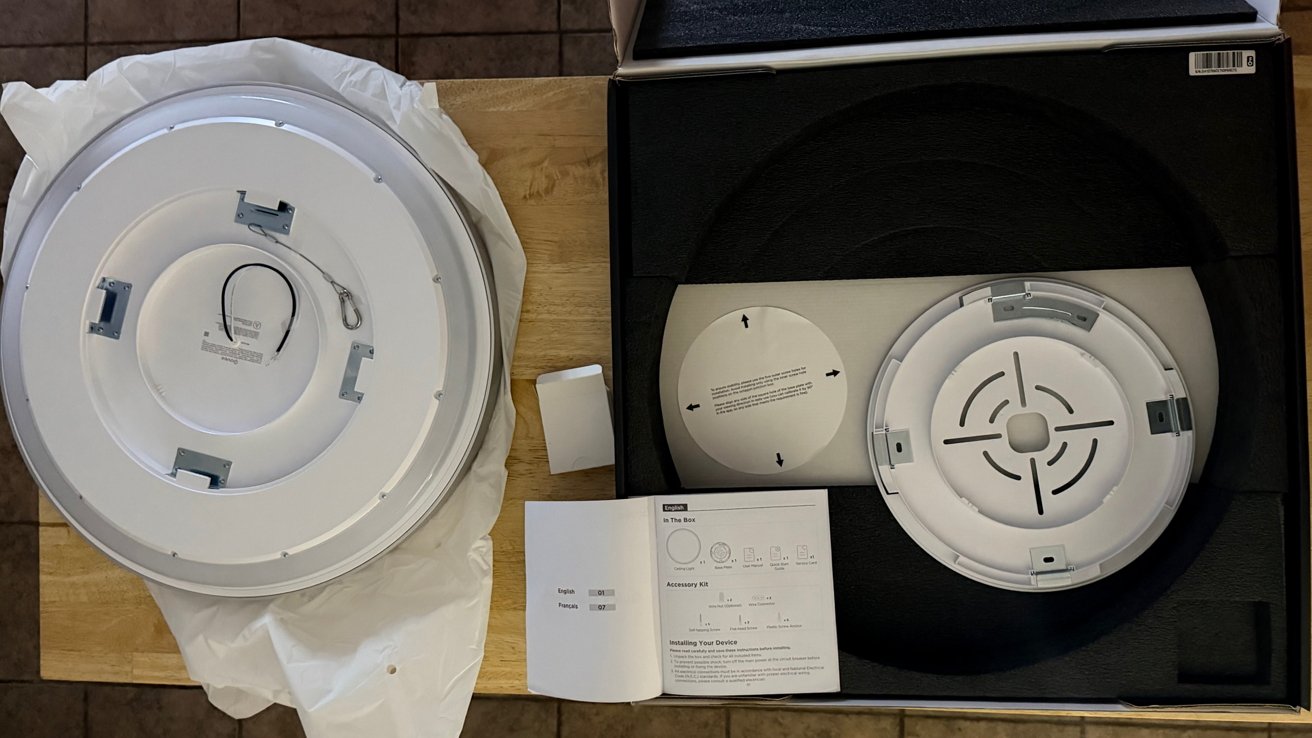
Installation of the Govee Smart Ceiling Light is very easy and straightforward. There are plenty of holes for screws and the weight is well distributed.
A cable attached to a carabiner keeps the light suspended from the ceiling even when not mounted. It screws into place, but it can be a bit awkward to line up so it fits and the cable doesn’t get in the way.
Once you’ve got it attached, that’s it. It is ready to use and calibrate in the app.
Users can set which direction the light is facing, but it isn’t granular like you might think. It can only be set to one of four cardinal directions, so be sure to line up the light when mounting.
The light looks great with its minimalistic outward design. When on bright white or other temperatures, it resembles a nice ceiling light.
Turn off the bottom light in the Govee app and the separate top ring light can provide some warm ambient lighting. Sadly, the separate lights can’t be addressed individually in Apple Home.
The bottom light is capable of producing hazy images and animations. It’s neat that it works at all, but I do wonder about the utility.
This is one of the most party tricks of party tricks in smart home lighting I’ve seen in a while. It’s not that it isn’t interesting, but like all novelties, it wears off quickly.
I can get a response from guests by showing them how it can do more than illuminate the room. The presets for a sunset, rainbow, and a blurry Mona Lisa are simple demos.
Users can design their own patterns or upload photos for use in the light. It works well enough, but the feature works best with images that are already quite distinct and identifiable.
This image in a light thing is cool, and is an evolution of how Govee’s other smart lights work. For example, I can get Snake or Galaga to animate on the light curtain.
Sure, the Ceiling Light doesn’t necessarily need to be mounted to the ceiling. But I wouldn’t buy this as an image display either.
At over $200, triple the cost of other smart ceiling disc lights, I’m not sure “blurry Mona Lisa” is enough.
I remember loving tinkering with smart home devices just as much as I liked playing around with clock widgets on Android. But in both situations, at some point, you just need to get on with using the device.
My life gets busier by the day, somehow, and I don’t exactly want to have a bunch of overhead for everything in my tech world. It’s one of the many reasons I chose Apple products.
Sure, you can get fiddly with Apple stuff these days, but it all just works out of the box. I’m not having the same experience with Govee.
There’s enough overhead to everything that I often default to powering the thing on and letting it run at whatever it was doing before. Or, at the least, I set a color or temperature in Apple Home.
The Govee app has some options for automation and quick actions, though the app’s more advanced functions aren’t the easiest to navigate. For example, to set up a quick action that turns off the bottom light, I can’t simply set that up within the provided device actions.
Instead, I have to know that I need a device snapshot. You go to the light, turn off the bottom light, select your color or temperature of the top light, then tap a snapshot button hiding on the right side.
Then, I can use that snapshot to create a quick action, which can then be donated to Siri and Shortcuts. It’s simply too many steps that I had to figure out on my own to get what should be a simple task done.
I can use these donated Shortcuts to create my own automations tied to other Apple Home products, so it’s at least possible. However, these automations are found in Shortcuts, not the Home app, thus creating yet another silo to manage.
Govee 21-inch Smart Ceiling Light Ultra review: a special Shortcut would be needed to make this rainbow appear without the Govee app
I could also automate how the light displays scenes, colors, or brightness from the Govee app. Again, I don’t want yet another place to manage automations.
It isn’t really a problem when you have one or two devices in an ecosystem with a couple of apps to manage. The issue is that if I want to automate the full functionality of everything in my home, I need access to several separate apps.
Instead of everything working in Apple Home thanks to Matter, as is the promise, I’m now having to remember which light bulb or fixture belongs to which app. If an automation goes wrong, I could end up in one of six apps trying to find the culprit.
The situation isn’t Govee’s fault, but given the specific functionality of this ceiling light, and its price, it is Govee’s problem. If I buy this light, install it, and almost never use the scenes because they’re buried in a third-party app, then that image and animation functionality may as well not exist.
Govee 21-inch Smart Ceiling Light Ultra review: the Other folder is doing a lot of smart home heavy lifting
If the whole point of Matter is to allow interoperability across device manufacturers, then it should be the full operation of a device’s capabilities. Not just the ability to turn the device on and off.
I’m encountering similar problems with SwitchBot, which I’ll get into with a later review.
Matter has definitely made it so everything in your smart home can show up in the Apple Home app. But if I still have to manage device connection, updates, and features in a separate app, I don’t really understand the point.
No, Home Assistant isn’t really an option either.
Let me put it another way. Okay, I can manage scenes or the separate lights from the Govee app, specific Siri phrases, or Shortcuts, but not the Home app.
As the designated smart home power user, fine, I might even try to deal with that situation through complex automation. However, I’m not the only one who lives here.
Let’s say I set up an automation to turn off the bottom light and set the top ring light to red at 9 p.m. If my wife Natalie walks into the kitchen and needs the overhead light to turn on, it isn’t exactly obvious what needs to happen.
Govee 21-inch Smart Ceiling Light Ultra review: making the light red is easy, turning off just one of the two lights here is not
Sure I can teach her that she simply needs to power off the light then power it back on, select a new color or temperature, then set the brightness, but that’s silly. Telling Siri to turn on the kitchen light won’t work either because technically, in the Home app, it is on.
I could create a specific Shortcut with a specific phrase for setting the bottom light to on at a specific color and brightness. Sure, one light, one app, or one phrase is easy to remember, but not when it’s 50 lights, six apps, and dozens of possible phrases.
That’s not how this should be operating in 2026.
Apple Home and Matter are meant to make this unified and simple. I don’t know what Apple, Govee, or Matter need to do to get this right, but today, it isn’t good enough.
Most of the issues with the Govee 21-inch Smart Ceiling Light Ultra aren’t its fault. Apple hasn’t made it easy for developers to get their device functionality into Apple Home as scenes.
Apparently, in Nanoleaf’s case, it took a lot of work directly with Apple to get scene support for its shape lights. Nanoleaf also recently released a 14-inch disc ceiling light for $80.
It is smaller than Govee’s, but it will integrate with your Apple Home better. Between the two, I’m not sure why I’d choose Govee’s unless I was using their app more versus Apple Home.
Govee’s offering is great fun and interesting, but I’m increasingly aware of just how many smart home apps I have installed on my iPhone. At least Shortcuts lets me tie more advanced features together where Apple Home falls short.
While this overhead light has cool image and animation support, 90% of the time it’s a plain white light for my kitchen. I’m happy Matter allows that much, but it’s the bare minimum, and that’s increasingly not enough to justify high prices.
I hope Govee can find ways to bring more of its device functionality to Apple Home. I don’t want to be fussed with a separate app every time I want to turn on just the ring light on top or set a specific image in the bottom.
Shortcuts and Siri are Govee’s saving grace here. They are both older systems based on donated actions, but are better than nothing.
Really, I’d probably complain much less if Govee had split up the two lights in Matter and Apple Home. At least then the only real problem is lack of scene control from the Apple Home app.
Power users can get by with automations, multiple apps, and loose connections across ecosystems. That’s not viable for a light in a living space that everyone needs to control.
This is an excellent light that will look great in your den, kitchen, or living room. Its ability to show low-resolution images and animations makes it unique.
If you’re all-in on Apple Home, you might find it frustrating that most of the device’s functionality is tied to Govee’s app. From that angle, it earns this average score.
Get the Govee 21-inch Smart Ceiling Light Ultra for a discounted $209.99 from Govee, down from $259.99. It is also available on Amazon for $219.99.
Professional development is crucial in ensuring teachers can put AI to work effectively. But a recent study from Texas Tech University found that PD around AI may not be readily available in rural schools.
“The resources are limited. There is not much support out there for our rural educators,” says Nikkolina Prueitt, a co-author of the study. For rural schools to get the most out of AI, “we will need to build that knowledge base.”
Closing the Gap
AI has the potential to give rural teachers a pedagogical boost. It can provide instructional support, “like creating differentiated instruction, adapting lessons, drafting individualized education plans,” Prueitt says.
And AI can expand rural students’ understanding of the world, says Amanda Robinson, an elementary teacher at Pikeville Elementary, a Title I school in Eastern Kentucky. “AI opens the students’ horizons.”
In a rural community, AI can students to “experience new learning, outside of their communities,” said Dr. LeeAnn Lindsey, director of edtech and innovation at Northern Arizona University. But she sees rural schools struggle to embrace that potential, due in part to a lack of in-house expertise. “Our big urban and suburban school districts, they have technology integration coaches who have been diving into the AI work for the past three years,” she says. “Rural school districts often don’t.”
To help close the gap, Northern Arizona last fall led a collaborative effort to offer PD around AI in three rural school districts in the state. Each district made available its superintendent, an instructional leader, and three classroom teachers for training over the course of two and a half months.
This was action-oriented PD. “They identified problems of practice in their own classroom that they wanted to address. Some of them looked at writing skills, some looked at student engagement, some looked at relevance of their lessons,” Lindsey says.
“They learned the AI specific to the area that they wanted to address,” she adds. “Then they actually took those solutions into their classroom and collected data to find out if AI would really help them solve that problem.”

At Pikeville Elementary, Robinson gets professional training from a district learning coach, who helps teachers understand the current AI tools. “She tends to do them about twice a month, as her schedule permits, after school for about an hour. And then also she works with you one-on-one during your planning periods, if you need that,” Robinson says.

The AI training has helped improve Robinson’s instruction, she says. For example, she has leveraged her AI knowledge to develop a chatbot that helps students explore animal adaptations in certain habitats. PD around AI “gives us the opportunity to provide our students with more opportunities and more in-depth ways of thinking,” she says.
Building an AI PD Effort
However, success stories like Robinson’s are outliers. The Texas Tech paper found that a lack of professional development resources often hinders AI adoption in rural schools. While tight budgets can make it hard to mount AI training, there are ways that schools can move forward with AI training.
Prueitt says it’s important that schools use their limited resources to mount the right kind of professional development. Rather than focus on specific AI tools, PD in K-12 should focus on “AI literacy and the foundational knowledge around AI,” she says. When teachers have a firm grounding in the basics, they’ re able to evaluate the tools effectively, “and that’s where it starts to grow and to be super useful for these rural educators,” she says, adding that the Center for Innovation, Design, and Digital Learning (CIDDL) is a great resource for educators.
School leaders should also focus on the big-picture intent of that training. “Our information and decision-making landscape is changing,” says Lindsey. “Our students need to be well versed in this changing information economy and the changing workforce.” Rural schools should prepare students for work in an increasingly tech-driven economy, she says, and PD around AI should reflect that intent.
Robinson has seen first-hand the value in that approach. “In our area, our students only see the jobs that are there within our communities. As teachers introducing AI, we are giving them more opportunities to become digitally literate,” she says. “As they start looking into universities in college, we’re putting them on a level playing field, instead of leaving our children behind.”
As schools look to meet that mark, “there are programs and grants that rural districts can apply for, to be part of professional development experiences like the one we offered,” Lindsey says, noting that the training was offered was for free.
“The first step would be to look at the resources available in your state,” Prueitt says. Her institution offers free professional development opportunities to rural schools, including a recent two-day AI workshop for special educators.
State and regional education service centers can also help rural schools ramp up PD programs, Prueitt adds, and they can help those schools understand how PD can be best support teachers’ efforts to ramp up AI. That will include not just training on what AI can do in the classroom, but also instruction on how to use it appropriately.
A key question around classroom AI remains: “How do we use it ethically?” Prueitt says. The right PD will help teachers to not only make effective use of AI, but to do so “in a way that still keeps that human in the loop.”
Robinson points to ethics as a key element of professional training around AI. She had previously taught K-6 technology and now is pivoting back to teaching writing and grammar, and while she’s looking forward to more PD to get familiar with the tools, she’s also aware of the limitations.
Chatbots for example can score students’ writing based on the rubric, before assignments are handed in. But “it will not eliminate my one-on-one conferencing,” she said. Rather, the AI can give students insight into their work, “so that I can show them where we can improve on this.”
Ever looked at an ad and wondered if a real person made it or if it was AI generated in seconds? Google is now giving you a way to find out.
The company just announced a new AI transparency label that tells you whether an ad was created or edited using generative AI tools. The label lives inside Google’s My Ad Center, and it is rolling out across Google Search, YouTube, and Discover globally.
Finding it is straightforward. Tap the three-dot menu or the info button on any ad, and you will see a “How this ad was made” section. If the ad was made using AI, you may see a label saying “Created or edited with AI.”

For ads made using Google’s own generative AI advertising tools, the label gets applied automatically, so you do not have to rely on the advertiser to disclose anything. If an advertiser uses a third-party AI tool instead, they can manually disclose that information through My Ad Center. In some countries, local regulations may also require AI labels to appear directly on the ad itself.
As AI-generated images and videos become more realistic, it is becoming harder to tell how advertising content was created. Google says the new labels are meant to give people more transparency while helping advertisers keep up with evolving industry standards.
The company has already introduced disclosures for digitally altered political ads and expanded support for technologies such as SynthID, which also powers Google Photos’ AI image watermarks, and C2PA, a standard that Google is also bringing to Google Messages to help identify AI-generated images in chats.
Google is also testing ways to show AI-generated image labels directly in Google Search and has expanded Gemini’s ability to help users spot AI-generated videos. The new ad labels build on those efforts by bringing similar transparency to commercial advertising.
Bari Weiss is seeking out friendly interviewers at the New York Times to try and “calm the firestorm engulfing her leadership of CBS News.” By “leadership” of course they mean censoring stories critical of the president, letting Benjamin Netanyahu pick his own interviewer (who he knows won’t press him on war crimes), firing a bunch of industry veterans, and just generally being an unqualified, fail-upward clod.
As we’ve long explored, Weiss wasn’t hired to do journalism. She was hired to do right wing agitprop. But given she’s not good at that either, CBS just saw its lowest ratings in a quarter century.
Undaunted, Weiss is continuing her efforts to “reshape” CBS into something Larry Ellison and other U.S. oligarchs approve of. As a result she’s apparently accelerated efforts to hire a bunch of right wing Brits, most of them with associations to Rupert Murdoch’s sprawling right wing tabloid empire. Said Brits will, curiously enough, tell you that hiring a bunch of white right wing Brits is a wonderful idea:
“According to several figures familiar with her thinking, however, the hires are no coincidence. “She’s been looking at various Brits that might add a bit of opinion/attitude diversity to US media, instead of the dominant, predictable Columbia Journalism School uniformity. Not a bad idea,” said Andrew Neil, the former editor of Rupert Murdoch’s Sunday Times, who supported her hiring of Phillips.”
Hiring a bunch of white male right wing protectors of the extraction class (and global autocrats) as the pinnacle of “opinion diversity” is a theme you’ll see constantly throughout Weiss’ demolition and repurposing of CBS. Because said British tabloiders sometimes break gossip on politicians and celebrities (often illegally) they’re framed as tough journalists:
“A CBS News source, describing Weiss’s interest in British journalists, said: “They do the kind of things that Bari is looking for; it’s not puff pieces and kid gloves.”
Rupert Murdoch’s longstanding skill wasn’t just to make right wing propaganda, but right wing propaganda that entertained and drew ratings and subscriptions. A soup of agitprop infotainment. To date there’s absolutely zero indication that Weiss and Ellison have any knack for that whatsoever, so they’re attempting to hire Rupert Murdoch adjacent folks who do.
Even then, it’s no longer the same world Rupert Murdoch thrived in. Broadcast TV is dying, social media is ever evolving, and (as we’ve seen at outlets like the Jeff Bezos Washington Post), people aren’t really in the mood for right wing billionaire simping agitprop. With any luck, the “new” CBS will collapse under the load of Warner Bros debt long before Weiss and company figure out the right formula.
Filed Under: bari weiss, consolidation, journalism, media, news, propaganda, rupert murdoch
Companies: cbs, paramount
Nearly half of employees in Singapore expect their jobs to be affected by restructuring, automation or cost-cutting measures in 2026, according to Morgan McKinley’s latest 2026 Workplace Trends Report.
At 49%, the figure is significantly higher than the global average of 37%.
The finding comes amid growing uncertainty in Singapore’s labour market.
While overall employment has continued to grow, larger employers have become increasingly cautious about hiring, with more planning to reduce headcount this year. Recent Ministry of Manpower data also showed retrenchments climbed to their highest quarterly level since 2023, while job vacancies declined.
While Morgan McKinley did not provide Singapore-specific figures for how employees are responding to job insecurity, the global findings suggest many workers are already taking steps to future-proof their careers.
Among employees who fear losing their jobs, 85% said they would start looking for a new role, while 64% said they would invest in new skills or additional qualifications.
The findings suggest that workers increasingly view upskilling and career mobility as ways to stay competitive amid economic uncertainty and rapid technological change.
Alongside concerns over job security, employees in Singapore are also spending considerably more time in physical workplaces.
The report found that 37% of employees in Singapore work from the office five days a week, more than double the global average of 17%. Among the markets surveyed, only Hong Kong recorded a higher proportion at 60%, making Singapore one of the world’s most office-centric employment markets.
However, this doesn’t necessarily reflect what employees want.
Globally, only 9% of respondents said they would choose to work from the office five days a week if given the option, with most preferring hybrid arrangements instead.
The findings highlight an ongoing disconnect between employee preferences and workplace policies in many markets.
Morgan McKinley’s findings are based on responses from 2,799 employees and 214 employers across the participating markets, collected through an online survey in late 2025.
While Singapore’s labour market continued to expand in the first quarter of 2026—with total employment rising by 9,400, marking the 18th consecutive quarter of growth since the fourth quarter of 2021—the survey suggests that workers remain concerned about what lies ahead.
Featured Image Credit: Ministry of Manpower
SAP has talked its way out of an EU antitrust fine. The European Commission said it would accept a set of commitments from the German software group, closing an investigation into how SAP handles maintenance and support for its on-premise enterprise software and sparing it a penalty that could have run into the billions. It is the kind of negotiated exit that has become Brussels’ preferred outcome in complex tech cases.
The case dates to September 2025, when regulators opened a probe into concerns that SAP’s practices restricted competition in the aftermarket for maintenance and support of its software.
The worry was familiar in enterprise software: once a customer is locked into a core system, the terms attached to keeping it running can quietly foreclose rivals who might otherwise offer cheaper or better support.
SAP’s answer was a package of concessions rather than a fight. The company agreed to offer an alternative method for calculating the licence fees on which maintenance and service charges are based, a technical change that goes to the heart of how customers get priced into staying.
It also agreed to scrap reinstatement fees and to reduce back-maintenance charges for customers who leave and later return. Those fees are the sort of friction that makes switching support providers expensive enough that many customers simply do not bother, which is precisely the effect regulators objected to.
A further commitment lets customers terminate their licences in specific circumstances, including insolvency or bankruptcy, giving businesses in distress an exit they did not previously have. Taken together, the measures are designed to make leaving, pausing or switching SAP support a real option rather than a theoretical one.
The commitments will apply globally and run for 10 years, an unusually long and broad undertaking that turns a European settlement into a worldwide change in how SAP treats its customers. For a company whose installed base spans most of the world’s large enterprises, the reach matters as much as the substance.
The outcome fits a pattern in the Commission’s recent enforcement. Rather than litigate to a fine and years of appeals, Brussels has increasingly used commitment decisions to extract behavioural change quickly, the same instrument it has reached for while probing hardware and medtech markets from chips to dental aligners.
The company avoids a penalty and an admission; the regulator gets enforceable promises without the delay of a full case.
For SAP, the calculus is straightforward. A fine would have been a one-off cost, but a formal infringement finding would have handed ammunition to customers and rivals for years.
Settling on commitments removes the legal overhang while letting the company frame the changes as a customer-friendly gesture rather than a defeat.
The concessions are not costless. Making it easier to leave, and cheaper to come back, chips away at the recurring maintenance revenue that has long been one of the most dependable parts of SAP’s business. How much it actually loosens customers’ grip depends on whether third-party support providers can now compete on terms that were previously stacked against them.
There is a strategic backdrop, too. SAP has spent years steering customers off on-premise systems and onto its cloud subscriptions, and the aftermarket the Commission scrutinised is tied to the older, installed-software world the company is trying to move beyond. Loosening its grip on legacy support is easier to concede when the future is meant to be somewhere else.
That is the open question the settlement leaves behind. The Commission has changed the rules of the aftermarket on paper; whether customers use their new room to move, or stay put out of habit, is something the next decade will decide. For now, SAP keeps its money, its market and a ten-year promise to behave.
Presented by Oracle NetSuite
Every major technology transition produces a set of assumptions about where the market is headed. The assumptions are often directionally correct, but they tend to underestimate the degree to which organizations adapt new technologies to their own circumstances. AI is following a similar trajectory.
Many current discussions about enterprise AI assume a future in which employees interact with business systems through a common interface. The details vary depending on the prediction, but the destination often looks similar: a conversational system that becomes the primary way people access information, complete tasks, and interact with software.
The history of enterprise technology suggests a more complicated outcome. Organizations rarely adopt new capabilities uniformly because different parts of the business operate under different constraints. A finance team responsible for reporting accuracy, controls, and approvals approaches technology differently than an analytics group exploring operational data. Both groups have different requirements than a customer service organization focused on response times and case resolution. Even when there is broad agreement that a technology is valuable, the path to adoption tends to vary across functions.
The shift to cloud software followed this pattern — some organizations moved aggressively while others spent years operating hybrid environments. Different departments often modernized on different timelines, reflecting the priorities of the work itself rather than any industry consensus about the correct pace of adoption.
AI has accelerated many aspects of technology development, but it has not changed this underlying dynamic. Organizations still evaluate new capabilities through the lens of existing processes, responsibilities, and operational requirements.
For some employees, the most useful AI capabilities may be the least visible ones. A finance manager closing the books is often less interested in a new interface than in shortening a reporting cycle. An operations leader dealing with inventory issues is usually focused on identifying problems earlier and resolving them more quickly. In these situations, the value of AI comes from reducing the amount of effort required to complete existing work.
At the same time, another group of users increasingly wants direct interaction with AI systems. Analysts, planners, and operational teams often benefit from the ability to explore information conversationally, compare scenarios, and investigate questions that do not fit neatly into predefined reports. For these users, the interface itself becomes valuable because it provides a more flexible way to work with business information.
A customer service representative handling a high volume of inquiries has different requirements than a financial analyst investigating a trend in operating expenses. One benefits from information appearing automatically within an existing process while the other may benefit from the freedom to ask follow-up questions, explore alternative explanations, and move through data more dynamically.
Many organizations are discovering that both patterns exist simultaneously, which reflects a broader reality about how businesses evolve. Operational complexity accumulates gradually, systems multiply, and processes become fragmented. Information becomes distributed across applications, reports, spreadsheets, and workflows and employees spend increasing amounts of time locating information before they can begin acting on it.
Much of the value created by enterprise software over the last several decades came from reducing that fragmentation. Bringing financials, operations, inventory, customer information, planning, and reporting into a common system created a more complete picture of how the business was operating.
AI is beginning to address a related problem. Once information exists within connected systems, employees still need to find it, interpret it, and apply it. Reporting cycles consume time. Routine questions require investigation. Managers often spend considerable effort assembling information before they can make decisions. As organizations grow, these activities become increasingly expensive because they consume attention from people whose expertise is often in short supply.
AI’s promise is to reduce the effort required to move from information to action.
At Dura Software, AI-connected workflows are helping automate portions of revenue reporting that previously required manual preparation during each reporting cycle. Sloan Session, CFO at Dura Software, described the arrangement in practical terms: “The agents handle the pull. The humans handle the judgment and the personal touch.”
That observation captures an important aspect of current AI adoption. Most organizations are not attempting to remove judgment from business processes. They are trying to reduce the amount of time spent gathering, organizing, and preparing information so that experienced employees can focus on the decisions that require expertise.
A similar pattern emerged at S&B Filters. Employees previously spent several minutes during customer interactions collecting backorder information from multiple systems. By connecting AI to operational data, the company reduced that process to seconds and eventually extended the capability directly to customers through self-service.
In both cases, the benefit comes from reducing the friction associated with finding and using information rather than introducing a new interface. The moment information becomes easier to access, questions about access itself become more important. Permissions, approval structures, and security policies exist because businesses need mechanisms for controlling access to information and managing risk. Those requirements do not disappear when employees begin interacting with data through AI systems. If anything, they become more important because AI can make information easier to access.
Berry Carter, CEO of S&B Filters, described the principle clearly. If a user cannot access specific information within NetSuite, that user should not gain access to the same information through an AI assistant. The statement sounds obvious. Implementing it consistently across systems, workflows, and models requires considerably more discipline than the statement itself suggests.
Lauren Polasek, former NetSuite administrator and board member of the Texas NetSuite User Group, recently made a related point. Connecting technology is often the easier part. Organizations still need to determine which tools should be used, who should have access to them, and how governance should evolve as adoption expands.
This is one reason predictions about a single AI interface are difficult to reconcile with how enterprises actually operate. The requirements of a finance organization closing the books are different from those of a customer service team handling thousands of interactions each day. Some AI capabilities will be embedded directly into business processes where employees may barely notice them. Others will provide more direct access to operational information through conversational systems. Many businesses will end up using both approaches because the underlying work is different.
That perspective has shaped how we think about AI at NetSuite. Some customers want AI embedded directly within operational workflows. Others want the ability to connect NetSuite data to external models and assistants so they can interact with business information through tools that are already part of their daily work. Increasingly, organizations are asking for both.
The NetSuite AI Connector Service and our support for Model Context Protocol (MCP) were designed with that reality in mind. The goal is to allow organizations to connect business information securely to the workflows and systems that make sense for them while continuing to benefit from AI capabilities built directly into NetSuite.
The history of enterprise software suggests that adoption rarely follows a straight line. As organizations adopt AI, business leaders should identify the business objective and the workflows involved so they can match the solution to the reality of the work.
Sponsored articles are content produced by a company that is either paying for the post or has a business relationship with VentureBeat, and they’re always clearly marked. For more information, contact sales@venturebeat.com.
With over 200,000 residents and 35,000 college students, Worcester, Massachusetts, is the second-largest city in New England. Worcester’s history stretches back even further than this country’s birth date of July 1776. It was first incorporated as a town in 1722, making it a true 300-year-old tercentennial municipality. In 1848, it surpassed the required 12,000 residents and officially became a “city.”
In January of 1849, the Board of Aldermen and the Common Council came up with the city’s first official seal — “a circular form, having in the center as a device, the figure of a heart.” A motto that read “With Heart and Hand” was also proposed. The motto failed, but the seal passed with some tweaks (like the wreath). What’s more, Worcester is located in the center of the state, all of which led to it becoming known as the “Heart of the Commonwealth.” It’s for this reason that street signs in Worcester today are adorned with hearts.
However, 1848 was an altogether interesting year. Aside from Worcester becoming an official city, uprisings and insurrections were happening all around the world. There were so many, in fact, that it eventually became known as the “Year of Revolutions.” Even amidst all that chaos, an interesting phenomenon was taking shape in the region that would help make the beating heart of this little burgh, shall we say, all the more lovely. It’s also a source of confusion regarding why hearts were placed on its street signs.
The Valentine’s Day that we all know today began in England in the mid-17th century, long before people were shopping for romantic gifts online. According to Worcester’s historical society, some smart entrepreneurs in the area began creating the Valentine card industry here in the U.S. Worcester resident Esther Howland began making them and used her friends to put them together, in … you guessed it — 1848, and became known as the “mother of the American valentine.” Oddly, you won’t find the color red or any hearts adorning Howland’s early creations.
Despite the coincidental timing, the success of Esther’s cards had absolutely nothing to do with why the city’s modern street signs have hearts on them. Still, it’s easy to see why folks, even today (e.g., the NPR affiliate WBUR in Boston), assume they’re meant to honor the Victorian-era entrepreneur rather than the city’s “Heart of the Commonwealth” moniker.
In the historical scheme of things, Worcester’s heartfelt street signs are a fairly recent development – and, unlike some confusing road signs, their meaning is rooted in civic identity rather than traffic rules. Exactly when they first officially appeared can’t be tracked, but accounts from residents claim they started popping up around 2009 or 2010. That’s when the city’s Department of Public Works (DPW) began experimenting with new signage, placing a red heart before the street name to better reflect the “Heart of the Commonwealth” moniker.

Certification came through in spring 2026 for something pilots of small planes have wanted for decades. Shark Aero’s Shark 600 now carries the first active turbulence-cancelling system approved for a light aircraft. The optional setup cuts the jarring effects of rough air by more than 80 percent, according to the developers. A 600-kilogram-class machine suddenly behaves as if it carries the mass and stability of something far heavier.
Shark Aero’s aircraft production facility is located in Senica, Slovakia. The design team chose a carbon-fiber and glass-fiber composite construction, integrating the components in a sandwich design to attain the ideal combination of strength and lightweight. With a low-wing configuration, retractable tricycle landing gear, and a tandem cockpit, it resembles a pint-sized fighter or an extremely high-performance sailplane. The canopy is wide open for visibility, and the pilot benefits from side-stick controls as well as a cockpit arrangement that is purposely modeled after those found in jets to cut the effort to a minimum. The seats may be changed in any direction and are made of carbon shells with aviation-grade leather or Alcantara trim.
Sale
The dimensions are quite compact, with a wingspan of 7.9 meters, a length of 6.85 meters, and a height of 2.5 meters, while the wing area is 9.5 square meters. The wing loading is 63 kilograms per square meter, or around 13 pounds per square foot, resulting in an empty weight of 350-361 kilos for a well-equipped model. The maximum takeoff weight is 600 kilograms, which leaves you with a useable load of 230 to 250 kilograms, depending on the options and fuel you choose.

A 100-hp Rotax 912 ULS flat-four engine provides power. That gives you 5,800 rpm for launch, but it reduces to 92 horsepower for continuous cruising. A two-blade constant-speed Woodcomp propeller provides power to the thrust. You have the option of starting with a 100-litre fuel tank or a 150-litre tank. If you want to take things to the next level, the Shark 600 T has a more powerful engine that allows for faster cruise speeds and better performance at high altitudes.

The actual story here is the new turbulence cancellation technology that they’ve installed, which has been years in the making. Turbulence Solutions worked on it for seven or eight years before receiving Austrian certification for the Shark 600, making it the first aircraft in its class allowed to fly with active cancellation. They are now selling the arrangement as a factory option for new builds, including the turbo model.

The system is quite innovative, as it employs a probe to measure the vertical air motion approaching the wing and a computer to calculate how that would push or drop the aircraft. Then there are these little surfaces known as turbulence flaplets, which appear on the existing flaps and move to create opposing forces, canceling out the bump. The entire process occurs quickly enough to cancel out the majority of the vertical acceleration before the pilot or passenger realizes what’s going on. Demonstrations and test data indicate a significant reduction from ±0.5 g to 0.1 g under the same settings.
While Skullcandy has had a rather quiet 2026, that all looks set to change in a few days. On the Utah brand’s website, it’s begun teasing a brand-new audio product.
But what? Well, I’ve turned into that Charlie Day It’s-Always-Sunny corkboard meme, and I think I’ve figured it out. No, Skullcandy hasn’t secretly tipped me off; I’ve just written about it long enough to know a few things.
Let’s review the evidence. A timer at the top of the page counts down to ‘Mission Launch’; this is set to run down at 7:45pm ET on July 15th (that’s 4:45pm PT, or a quarter to 1am on July 16th in the UK). So we know when the new launch will take place.
A video on the page shows a group of people crowded around a TV, while a presenter tasks them to “make the greatest headphone ever”, emphasizing “give the people something they can feel”. The video looks a little AI-y, but maybe that’s just a style now.
Elsewhere on the website, a link pointing to the aforementioned page refers to “A collaboration. A breakthrough. Something that has never existed before”.
From the evidence, we can glean that these are headphones, as opposed to earbuds, ruling out a Method 540 successor. This is because the website literally says so. I know, give me my Sherlock hat already.
The reference to giving people “something they can feel”, to me, all but guarantees these are part of the Crusher line, as those headphones have bass sliders to boost bass to wild levels. The Crusher 540 Active nearly shook my head off.
It’s also been a while since we saw new Crusher headphones. The Crusher Evo came out in 2020 and the Crusher 2 in 2023, but other than the aforementioned Active pair in 2025, we haven’t seen a proper release since then. Other pairs of cans from the brand, like the Aviator 900, have seen updates more recently. So it’s Crushin’ time.
That all means it’s the Skullcandy Crusher 3 coming, right? Uh — the brand might actually have skipped one, two or 1,077 numbers. As a Redditor noticed a couple months ago, a Crusher 1080 was recently certified by the FCC (as well as a Crusher 720).
The Skullcandy Crusher 1080 ANC passed FCC certification from r/Skullcandy
Skullcandy’s same teaser mentions ‘Sound powered by Bose’ which could well be the collaboration in question, as a few recent Skullcandy devices have been tuned by the noise-nixing giant.
However, that might not be the only collab, because Skullcandy often sees brands design unique skins for its headphones. For example, camo company Realtree has created some funky, nature-inspired models of Method and Crusher devices, and we could see this continue with the 1080.
In terms of actual features, audio specs or the design of the Crusher 1080 we don’t have much at all, as not much more has been leaked. Sorry. At least you won’t have to wait long to find out, as the 15th is getting ever closer.
A former employee of cybersecurity incident response company DigitalMint was sentenced to 70 months in prison for targeting U.S. companies in BlackCat (ALPHV) ransomware attacks.
The FBI linked the BlackCat ransomware gang to more than 60 breaches between November 2021 and March 2022, adding in a separate advisory that the cybercrime group had collected at least $300 million in ransom payments from more than 1,000 victims through September 2023.
41-year-old Angelo Martino was charged and pleaded guilty to his role in some of these attacks, along with two other Sygnia and DigitalMint ransomware negotiators, 28-year-old Kevin Tyler Martin and 33-year-old Ryan Clifford Goldberg.
Martin and Goldberg pleaded guilty in December to conspiracy to obstruct commerce by extortion and were also sentenced to four years in prison each in May.
While Martino was initially identified only as “Co-Conspirator 1” in an October 2025 indictment, he was named in court documents unsealed in March.
According to the court documents, between April 2023 and April 2025, Martino was directly involved in BlackCat ransomware attacks alongside accomplices Ryan Goldberg and Kevin Tyler Martin.
While operating as BlackCat affiliates, the three former Sygnia and DigitalMint employees demanded ransom payments and threatened to leak stolen data before encrypting their systems. The three accomplices paid the BlackCat admins a 20% share of all ransom proceeds for access to the ransomware and extortion portal.
Prosecutors added that Martino had also shared confidential information about victims’ insurance policy limits and negotiation positions with BlackCat ransomware operators while working as a negotiator for five victims, allowing the cybercriminals to extort the maximum possible amount.
Their victims include at least five U.S. organizations, including a financial services firm that paid $25,660,000 and a nonprofit that paid a $26,793,000 ransom, as well as school districts, medical facilities, law firms, and other financial services companies.
DigitalMint CEO Jonathan Solomon previously told BleepingComputer that the company condemned Martin and Martino’s malicious conduct, noting that they were fired immediately after their actions were discovered.
“We strongly condemn these former employees’ criminal behavior, which violated our values, ethical standards, and the law. When we learned about the conduct, we immediately terminated both individuals,” Solomon said.
Security teams log 54% of successful attacks and alert on just 14%. The rest move through your environment unseen.
The Picus whitepaper shows how breach and attack simulation tests your SIEM and EDR rules so threats stop slipping by detection.
Weekend Open Thread: High Hopes
Taylor Swift and Travis Kelce wedding staffer hilariously struggles to keep her cool while checking in megastars
Standard Chartered Secures MiCA License as ESMA Adds 37 New Crypto Firms
Open Thread: What Great Books Have You Read Recently?
The House | “Reframing the debate from a binary discussion of winners and losers”: Yuan Yang reviews ‘We Are Not Machines’
Loro Piana Fall 2026 Enters Houston’s Art Scene
Whats Hidden Inside This Cash Register? #treasure #reselling #money
Anthropic’s new “J-lens” reveals a silent workspace inside Claude that mirrors a leading theory of consciousness
ESMA Expands Crypto Register by 37 Firms Following MiCA Transition Period
AXT Shares Jump Nearly 14% as Semiconductor Materials Maker Rebounds on AI-Linked Indium Phosphide Demand
Joshua Pacio ‘more complete’ ahead of ONE rematch vs Malachiev
South Africa proposes crypto tax guidance under existing rules
SK hynix (000660.KS) Stock Dips as $28B Nasdaq ADR Offering Drives AI Memory Expansion
Best Time to Enter Small Caps Right Now? Another Bull Run? | Financially Free
Lenovo laptops are now shipping with YMTC SSDs, a sign of Chinese NAND entering the mainstream
We have punished the disrespect
Avoid entering in FOMO #bitcoin #cryptocurrency #trading #scalping
Anthropic brings Claude Cowork to mobile and web as usage data shows most users aren’t coding
$1,000 Credit Alert! BlockDAG X Exchange Pre-Registration Now Officially Open, Polkadot Dips & Zcash Rebounds
Neuralink Threads Its Way Straight Through the Brain’s Armor
You must be logged in to post a comment Login