Security teams log 54% of successful attacks and alert on just 14%. The rest move through your environment unseen.
The Picus whitepaper shows how breach and attack simulation tests your SIEM and EDR rules so threats stop slipping by detection.




Hackers used a dedicated mobile gateway to compromise a second facility during the destructive cyberattacks that hit Poland’s energy sector last year.
The second target was a small combined heat-and-power (CHP) plant that supplies heat to around 50,000 residents, resulting in the steam turbine and the water treatment system being shut down.
The Polish Computer Emergency Response Team (CERT) disclosed this second incident in a follow-up report over the weekend, saying that the attacker used a private Access Point Name (APN) to access the operational technology network.

“The attack was made possible, among other factors, by a misconfiguration that allowed arbitrary devices within the private APN network to communicate with one another.”
On December 29, 2025, an attacker believed to be linked to the Russian Electrum threat group targeted 30 wind and solar power installations and a large CHP plant in Poland, destroying key equipment beyond repair.
The threat actor hit distributed energy resource (DER) sites across the country, disabled communications equipment, corrupted operational technology (OT) devices, and wiped Windows systems. Despite this effort to destabilize the grid, energy generation and distribution were not disrupted.
In the newly disclosed attack at a second, smaller CHP plant, the threat actor switched off the programmable logic controllers (PLC) and protected access with a password, thus deactivating a steam turbine and the plant’s process-water treatment system and interrupting cogeneration operations.
The staff at the plant managed to restore impacted systems quickly, so the outage was short-lived and had no impact on the population.
Upon investigating the incident, the Polish CERT determined that the attacker initially compromised a FortiGate VPN/firewall at a wind farm and used a Teltonika cellular router on its network to tunnel into a private APN managed by the distribution system operator.
The APN lacked client isolation, allowing the attacker to scan for and communicate with devices at other facilities.
Beginning on December 18, the attacker found a WAGO PFC200 PLC at the CHP plant whose web interface was exposed on the APN and protected with default administrator credentials.
After compromising the controller, the attacker enabled SSH and used it as a bridge into the plant’s OT network.
Over the following week, they scanned the network for SCADA systems and industrial devices, and on December 25 they connected to three Siemens PLCs, likely in preparation for the attack.
At approximately 5:30 a.m. on December 29, the attacker accessed the SCADA interface and Siemens PLCs, switching them into STOP mode, activating password protection, and shutting down the steam turbine and process-water treatment system.
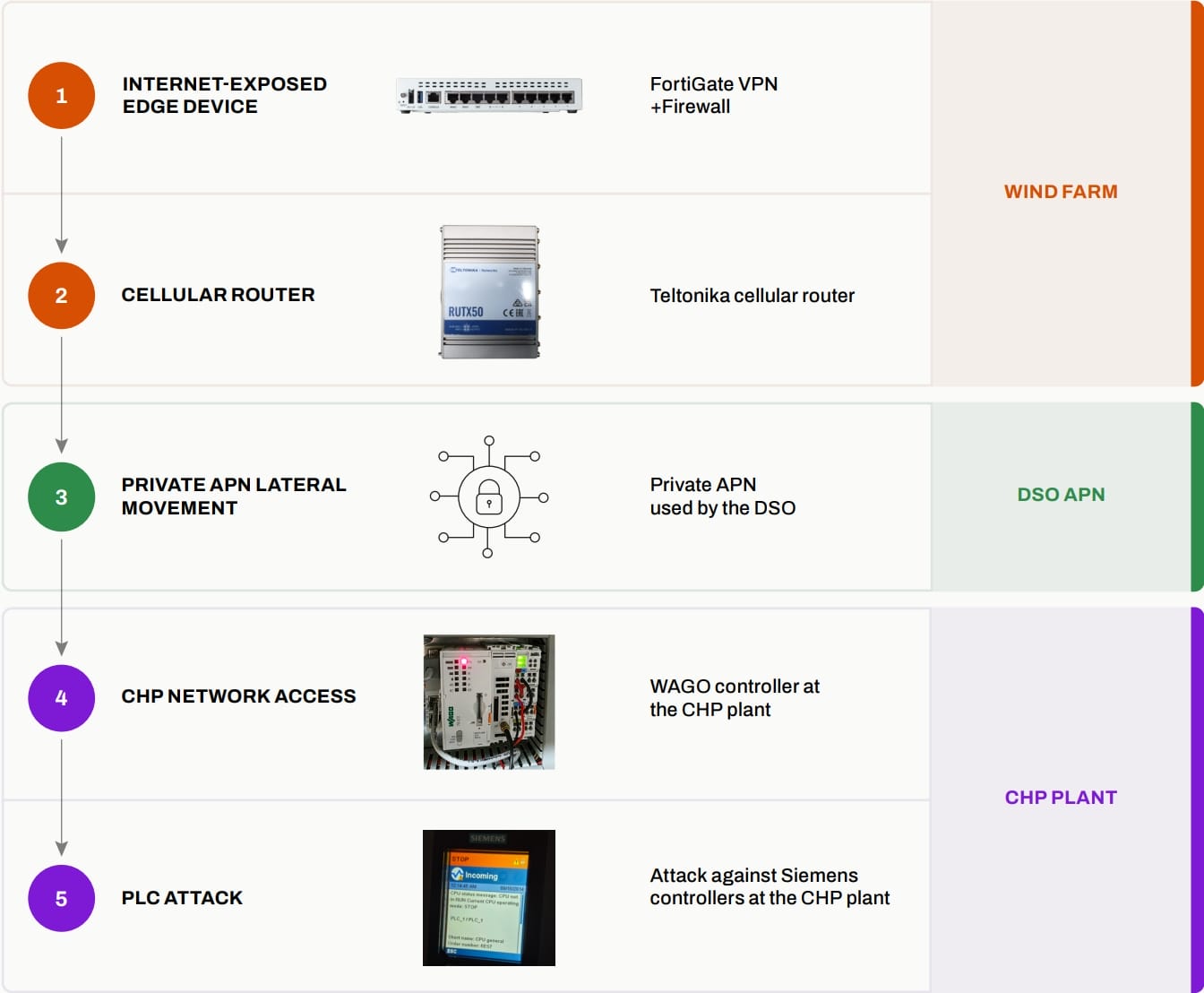
The attacker also reset and reconfigured several Moxa devices to impede recovery, destroyed logs, and hindered forensic analysis by corrupting or resetting the WAGO controller, Teltonika router, and FortiGate firewall used throughout the intrusion.
The Polish CERT believes this to be the first known real-world cyberattack in which an attacker entered an OT network by moving laterally through a private APN.
“To the best of our knowledge, the incident described in this report, which involved gaining access to an OT network through a private APN, was the first observed instance of this attack vector being used in a real-world cyberattack,” commented CERT Polska.
The surveys that followed the investigation determined that this configuration was common in Poland at the time, and the country’s CERT estimates that it’s likely similar arrangements are widely used internationally.
It is recommended to treat private APNs as untrusted external networks, enable isolation between connected clients, use allowlists for essential traffic between APN gateways and OT systems, and disable exposed SSH and Telnet administration services.

Security teams log 54% of successful attacks and alert on just 14%. The rest move through your environment unseen.
The Picus whitepaper shows how breach and attack simulation tests your SIEM and EDR rules so threats stop slipping by detection.

When SpaceX filed for its IPO, we went through the S-1 to point out just how far off the mark Elon Musk’s predictions about his Twitter takeover turned out to be. Indeed, the failure of Twitter as a business was so catastrophic, Musk had to hide it by merging all his Xs together: he had xAI buy X (formerly Twitter), and then had SpaceX buy xAI. But when Musk was buying Twitter and needed investors, he made bold promises about how he would succeed — promises the media and his investors treated as perfectly reasonable. He said he would take Twitter’s ad revenue from $4.5 billion in 2021 to $12 billion in 2027 (and then also many more billions in subscription revenue).
Now that SpaceX is a public company, he has to report some of that revenue, though it’s all merged and buried in footnotes. But there’s enough info in there to show that advertising revenue is way, way below what it was when he took over the site. And it’s shrinking.
In the 10-Q, all of X’s revenue is now (misleadingly) labeled “AI” revenue, but even then the reporting has to admit ad revenue took a big hit, dropping $160 million compared to the first half of 2025 (which was already way, way, way lower than when Elon took over the site), going from $870 million in 2025 to $710 million in the first half of 2026. The company tries to claim that this decrease in ad revenue is because they “transitioned to a new advertising platform which impacted ad sales for a short period of time.” Which is a curious explanation, given that on the analyst call, CFO Bret Johnsen credited that very same “overhauled” ad-tech platform for the very slight quarter-over-quarter uptick in ad revenue. The same overhaul apparently both tanked the business and rescued it, depending on which direction the number was moving.
And even the claim that the overhaul increased ad revenue is suspicious given that if you compare the 2nd quarter from last year to this year… ad revenue dropped from $426 million to $367 million, year over year. Some overhaul.
I kinda think that if your transition to a new ad platform decreases ad sales by $160 million, someone fucked up badly somewhere. Especially when it’s a nearly 20% year-over-year drop.
Let’s break all this down: In the second quarter of 2022, the last full quarter before Elon took over, Twitter brought in $1.08 billion in ad revenue. In the second quarter of 2026, X brought in $367 million. That’s $713 million a quarter, gone. Elon has wiped out two-thirds of Twitter’s ad business over the exact period in which he promised investors he’d nearly triple it.
And it’s not for lack of trying. Over the past year X has made a ton of experiments and revamps to improve the experience (though the main person in charge of all that, just left). I’d argue that the company was just rebuilding all of the stuff Elon killed after first taking over the company, but none of it has brought advertisers back.
Turns out that telling advertisers to go fuck themselves… and then suing other advertisers for not advertising… doesn’t make anyone want to advertise with you.
Still, it seems like someone should be pointing out how far off the mark Elon has been. He promised twelve billion dollars in ad revenue within the next year. That’s three billion a quarter. X just did $367 million — about an eighth of the pace, and shrinking. You can talk all you want about his rockets and robots, he’s not magically going to grow ad revenue 700% in the next 18 months.
So, tell me again how Elon is a business genius?
Filed Under: advertising revenue, elon musk, revenue
Companies: spacex, twitter, x, xai

OpenAI has bought back $7 billion worth of shares from employees at the privately held frontier AI lab as part of an effort to provide liquidity to its workforce.
The deal, reported by Bloomberg, valued OpenAI at $852 billion, the same as its most recent fundraising round in March, which added $122 billion to the company’s war chest.
The company also filed confidentially with the Securities and Exchange Commission in June to prepare for a potential IPO later this year. However, a tender offer suggests that an IPO may not be forthcoming soon. With many tech companies remaining private longer than previous generations of startups, private tenders have proven a useful way for firms to allow employees to realize the value of their stock compensation without the difficulties that come with a public offering.
OpenAI did not respond to a request for comment by publication time.
Last month, OpenAI CEO Sam Altman wrote that “we did not have our best 12 months ever, which is mostly my fault, but we are about to have our best 12 months to date.” Firms going public typically want to show strong financial results to bring investors on board, and the Wall Street Journal reported in April that the company missed internal financial goals.
While OpenAI’s incredible growth and products are likely to generate massive interest in public markets, the potential debut of rival Anthropic — which was reportedly profitable earlier this year — gives the company a reason to ensure it puts its best face forward. The tender could be another signal that the much-anticipated offering will wait for OpenAI’s new strategy of paring down its bets and focusing on its enterprise business to gain traction.

Valve is continuing to broaden SteamOS support beyond its own hardware, with the latest beta adding “initial gamepad support” for a few recent gaming handhelds and improving compatibility for a few others. Ars Technica reports: Those newly supported handhelds include MSI’s Claw 8 EX AI+, the extremely expensive, extremely powerful handheld built around Intel’s Arc G3 processor that launched this summer. While SteamOS has long included beta support for “other AMD powered handhelds,” Valve has only recently been working on offering compatibility with Intel-based handhelds like the MSI Claw line. This weekend’s update suggests the company hasn’t abandoned those efforts and that Intel chips aren’t being left out of the SteamOS conversation.
SteamOS 3.8.25 also newly supports the controllers built into Ayaneo’s Android-focused Pocket S2 and the more recently released Windows-based Konkr Fit. Valve also says the new OS offers “improved support” for older MSI Claw devices and the OneXPlayer line of portable gaming PCs. This weekend’s update follows June’s SteamOS 3.8 update, which stressed “improved compatibility with recent Intel and AMD platforms.” That update specifically called out improved controller support on handhelds from the likes of GPD Win, Anbernic, and OrangePi, as well as improvements for various Lenovo Legion Go, MSI Claw, and OneXPlayer devices. The report notes that the new SteamOS update also updates the Linux driver powering the new Steam Controller, “allowing it to work with ‘native controller applications’ even when Steam is not running.”


Read more of this story at Slashdot.

Reference Image could be a new way to prove provenance in the wake of generative AI.

We’re looking forward to seeing the new artificial intelligence side of Siri when iOS 27 launches, but it appears that Apple may have additional tools in the works. In its analysis of the latest operating system beta, 9to5Mac noticed some signals that Apple might be working on a photo authentication feature. Apple Reference Image appears to be a tool that will verify that a photo was taken with an iPhone camera. To confirm that a photo is an iPhone capture, select sensor information and metadata for an image can be sent to Private Cloud Compute for verification. A new Reference mode will need to be enabled on an iPhone’s camera in order for this authentication option to be available.
Resources for checking an image’s source in this age of AI slop is more critical than ever. Thus far, most of the tools involve putting a digital watermark onto generative AI creations, such as those in Apple’s Image Playground and its other forthcoming image editing capabilities. Google also continues to expand its SynthID AI watermarking program. This approach of Reference Image to create confirmation of content’s provenance could be a useful counterpart to those metadata watermarking efforts. Since all this is happening in an ongoing beta test, however, it’s possible that Reference Image won’t be included when iOS 27 does have its public rollout this fall.

Heading back to college in 2026 means bringing a lot more than a laptop, phone and whatever survived last semester at the bottom of your backpack. The best back to school tech for college students needs to solve real problems: keeping devices charged through a long day on campus, blocking out a roommate who believes 2 a.m. is an appropriate time for FaceTime, making a cramped dorm room more functional, and helping you study, stream, listen and stay connected without spending the semester’s food budget before classes even begin.
That’s the problem with most back to school tech guides. They’re stuffed with products because somebody has to fill the shopping cart. We’ve taken a different approach. Our 2026 college tech essentials focus on products we think students will actually use, from headphones, wireless speakers and chargers to computer accessories, portable gear and dorm room upgrades that can make campus life easier. Some are inexpensive. Others are worth spending more on because they should survive well beyond freshman year.
Give your college student better sound for the school year. The D1P connects to their laptop and makes even cheap headphones sound world-class, bringing out cleaner sound and deeper bass, allowing them to hear their music the way the artist intended. Compact enough for a dorm desk or backpack, it’s an easy upgrade for studying, gaming, or listening between classes.


The ATH-M50xBT2 combines Audio-Technica’s acclaimed studio sound with wireless convenience. Enjoy up to 50 hours of battery life, multipoint pairing, and low-latency mode. Customize your sound with the A-T Connect app or plug in using the included cable. A smart back-to-school upgrade for students without compromising performance.
Upgrade any dorm, bedroom, or study setup with the IsoAcoustics ISO-Stand Series. With 14 height and tilt configurations, ISO-Stands help position bookshelf speakers at the ideal listening angle while reducing unwanted vibrations for cleaner sound, improved clarity, and better focus at the desk.


Ideal for small spaces, the Polk Audio Signature Elite ES15 compact bookshelf speakers offer an audiophile upgrade without breaking the bank. Connect to any amp or receiver you already have, or combine with Denon Home Amp (below) for a powerful 200-watt speaker system that doesn’t take up much space.
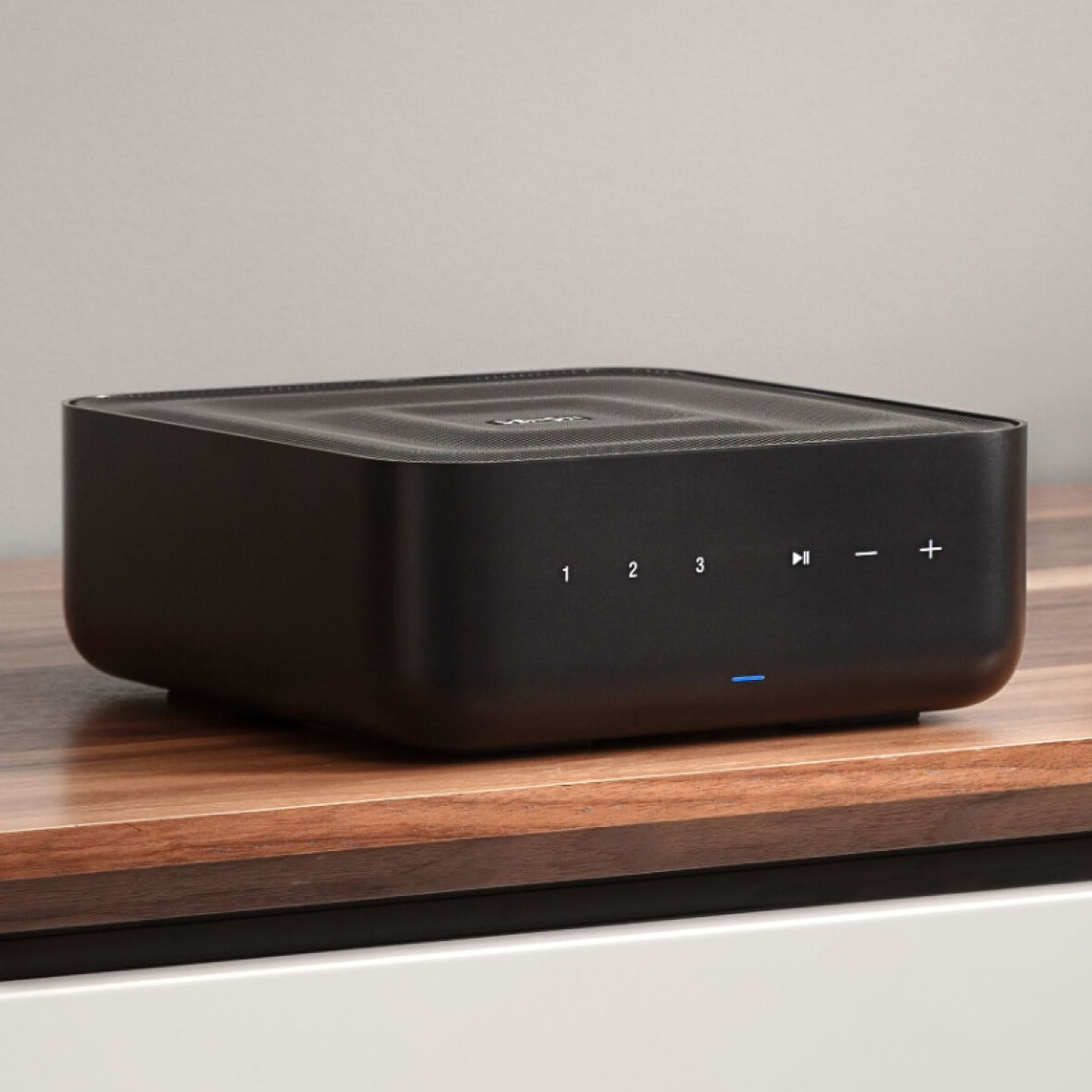
The Denon Home Amp is a compact, yet versatile box that combines a 100-watt x 2 amplifier, built-in wireless music streaming with Bluetooth and multi-room HEOS, plus HDMI eARC to seamlessly connect with any TV. And there’s an option to add a subwoofer. Just connect to any speakers.

Samsung’s top-of-the-line 32-inch Smart Monitor M90SF is a triple threat on your desktop, offering pixel-perfect QD-OLED 4K technology for watching movies or TV shows, playing games, or handling schoolwork. Plus its glare-free screen means it will be easier on your eyes in any lighting condition.
$1,599 $1,199 at Amazon | Best Buy
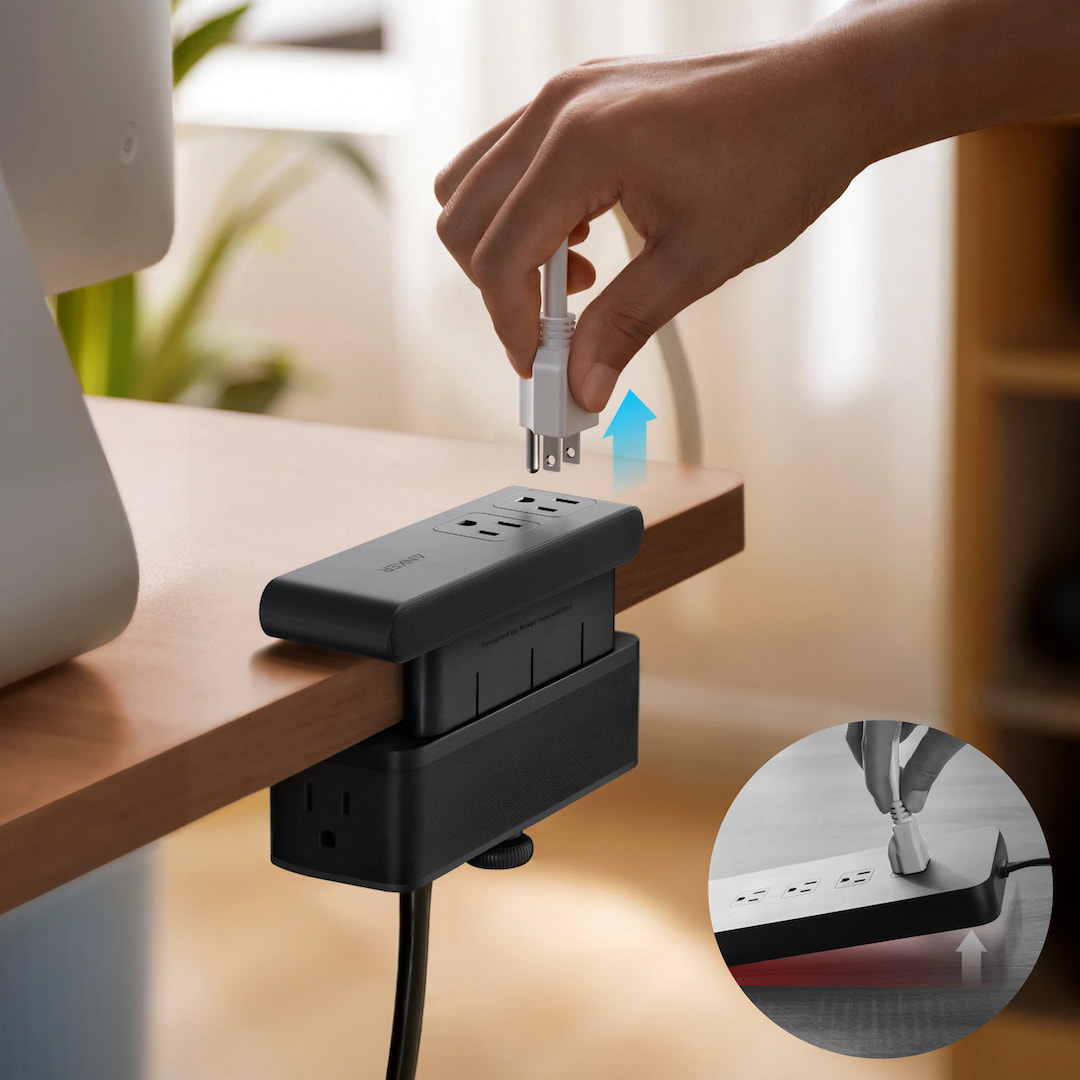
Anker’s 10-in-1 power strip ensures roommates never need to ask where the charger is. Access 2 x USB-C ports, 2 x USB-A ports, and 6 x AC outlets, right from your desktop.
Disclosure: The products listed above are approved by our Editors, but may be requested by our sponsors. When links to buy are provided, we’ll direct you to the lowest price at time of publication. In doing so, eCoustics may earn a small commission from the associated retailer if purchased.


Valve has emailed European customers who ordered a Steam Machine or a Steam Controller. A cyberattack on CEVA Logistics, the firm that ships Valve hardware across Europe, took their delivery details.
CNET’s Tyler Graham reported the warning on Monday. CEVA told Valve about the breach on 7 August, and Valve spent the following days working out who to contact.
A Valve spokesperson told CNET that CEVA is still investigating. The company decided to write to everyone it could reasonably assume was affected, based on what it knows now.
Valve makes hardware as well as running the store. The Steam Machine and the Steam Controller follow the Steam Deck, and it moves all of them into Europe through a logistics contractor.
The exposed data covers names, countries, street addresses, phone numbers and email addresses. BleepingComputer adds the product type and the price paid to that list.
One line in the notice does more work than the rest. The email address on the order is the same one the Steam account uses, so a scammer now knows the exact inbox that matters.
Payment details, passwords and Steam Guard codes are not on it. Valve says CEVA never had access to them.
Valve also says the shipping information sat with CEVA for 90 days after each order. That window decides who got caught.
Valve’s email tells customers to expect fake messages about their order, and recipients have posted it on Reddit. Those may arrive by email, text or phone, and may appear to come from Steam, Valve or a courier.
Then it makes the point that matters. The messages may quote the customer’s own address back to them to prove they are genuine, and they may ask for a small customs or redelivery fee.
“Treat all of them as fake,” the email says.
Valve adds that Steam support handles problems only on its official help page, never over email, Steam chat or Discord. Its staff never ask for a password or a Steam Guard code. Neither, the email notes, will a courier.
The accounts themselves need no action. Nobody has to change a Steam password or touch their settings, because the breach never reached either.
TechCrunch’s Zack Whittaker traced the attack back to 29 July. Valve’s notice dates the intrusion between then and 1 August. CEVA confirmed it that day, six days before it told Valve.
Valve is one name on a longer list. Whittaker names the Dutch retailers Bol and De Bijenkorf, the bank ING, the eyewear firm Ace & Tate and the football club Ajax.
The logistics side has its own damage. FreightWaves reported disruption at eight European warehouses, with orders, returns and refunds all running late.
Bol and De Bijenkorf suspended data exchanges with CEVA as a precaution, according to Eric Kulisch’s reporting. Products at the affected sites went offline.
CEVA is not a small vendor. It runs more than 1,000 warehouses, handles roughly 15 million shipments a year and reported $18.3bn of revenue in 2025, as a subsidiary of the shipping group CMA CGM.
That scale is the point. One intrusion at a contract logistics provider reaches a games company, a bank and a football club in the same week, which is what people mean by a digital supply chain.
The pattern is familiar. LastPass customers lost data through a supplier rather than through LastPass.
Polymarket users lost funds the same way. That was a third-party breach of much the same shape.
The count is missing. Neither Valve nor CEVA has said how many customers are affected, how much data left, or how the attackers got in.
Attribution is missing too. No group has claimed the intrusion, and nothing published so far names one.
CEVA has said little. It told TechCrunch the incident touched part of its European contract logistics operations, and that other operations continue without incident.
Valve fills in a little more. It says CEVA has isolated the affected systems, pulled them offline and brought in outside investigators, and that Valve is still pressing the contractor for the full scope.
The regulators come next. Valve is notifying the data protection authority in every affected country, and it has named Artana Digital GmbH in Hamburg as its contact point for questions about the incident.
The Dutch regulator is already investigating. Dutch police took down 800 servers in a separate operation earlier this year.
Everything else is a wait. The people who ordered a Steam Machine now have a home address sitting in someone else’s file, and the only defence Valve can offer is the instruction to disbelieve the next convincing message about their parcel.

You’ve seen fiber-reinforced-plastic before, no doubt, but perhaps never quite like in this video by [Whitburn Studio]: it’s still got the usual resin, but instead of glass or carbon fibers, he’s using printed Japanese cotton to create strong, lightweight and good looking parts for the interior of his RV– specifically the countertops.
The technique is very similar to the sort of moldless composite work Burt Rutan pioneered in aircraft use. The fiber-reinforced plastic is formed around a positive ‘buck’ that remains inside the final part, adding stiffness and some backing. Unlike Rutan’s designs, which used pure Styrofoam inside, [Whitburn] is using a sandwhich of two layers of thin ply (3.6 mm) with XPS foam in between. Adding plywood means you don’t need many layers of fiber– again, that’s a decorative cotton, here– to get a surface that won’t dent into the styrofoam when you drop a coffee cup on it.
Indeed, with the plywood providing much of the strength, he’s only using a single layer of cotton and a second of fiberglass– though the glass fibers are really there to protect the pretty print from oopsies while sanding, rather than for their mechanical properties, by the sounds of it. Everything is held together with clear epoxy resin, which also fills the weave of the fabrics. Multiple coats of that are required to get the smooth, shiny surface he shows off at the end, but all that sanding and buffing really pays off. That’s also where you have to be really careful to avoid oopsies– go through the cotton and you have to start over.
Aside from the aesthetics, since this is going in a vehicle the weight is an important consideration– the bigger of the two counters he makes, pictured here, weighs in at only 2.4 kg or 5.2 lb including the cutout covering the sink. That’s pretty good all things considered– a lot lighter than a cement countertop, or even one made of DIY resin tiles.


Even the best circular saws on the market are only as effective as their blades. As such, consistently getting ideal performance from your circular saw requires knowing when the blade needs to be sharpened or replaced. Learning about common problems with circular saw blades can also help you better determine how to potentially guard against such problems in the future.
What is the lifespan of a circular saw blade? Unfortunately, there’s no clear and universal answer to this question. Many factors can influence how long a circular saw’s blade lasts before it starts to deliver diminishing returns. These factors include the materials a blade is being used to cut, the blade’s manufacturer, whether an owner has prioritized maintenance, and even the technique and experience of an individual user.
In other words, a circular saw blade’s age may not tell you enough to help you confidently determine if you need a new one. Instead, you should monitor your saw and blade for red flags indicating the blade is no longer in top condition. If you’re new to using a circular saw, keep in mind that familiarizing yourself with circular saw beginner tips can also help you better understand how to use your saw in a way that maximizes the blade’s lifespan.

Monitoring a blade’s performance is perhaps the best way to determine if a circular saw blade needs to be replaced, or at least sharpened. Common warning signs that a circular saw blade is no longer performing optimally include slower-than-normal cutting speeds, a blade creating more tears or chipping than it used to, and a blade leaving behind burn marks on the wood it’s cutting.
The signs of a circular saw blade that needs replacing can also depend on the specific type of blade. For instance, slower cutting is a red flag that any type of circular saw blade is in poor condition and may no longer serve its purpose. However, if you have a diamond-edged blade, you should also keep an eye out for signs like an overall smooth appearance. This indicates the diamonds are worn off.
A similar cosmetic warning sign is the presence of rust spots on a circular saw blade. Although the quality of a circular saw blade can vary from one manufacturer and model to another, it’s common for these blades to be rust-resistant. The presence of rust thus indicates the blade may be quite old.

It can’t be reiterated enough: The warning signs of a circular saw blade that’s getting dull will typically be most apparent when you’re actually using the blade. For example, if you’re operating a circular saw properly, you shouldn’t encounter much resistance when cutting with it. Increased resistance is almost definitely a sign the blade has seen better days.
What you hear when operating your circular saw could also potentially be just as valuable as what you feel. When a circular saw blade no longer cuts as efficiently as it once did, the motor might need to work harder. This can result in the motor generating loud or unfamiliar noises.
Keep in mind that these warning signs don’t always indicate a blade needs to be completely replaced. You could try cleaning or sharpening a blade first before concluding a replacement is necessary. Just make sure you know how to do so safely. For more information on this topic, you can also brush up on basic circular saw safety tips.
AI AND ML
30-billion parameter LLM, Meta’s first in more than a year, signals Meta’s return to the open weights arena. Open version of Muse Spark to follow
After seemingly abandoning its open source AI roots this spring, Meta offered enterprises a glimmer of hope on Monday with the launch of its first open weights model in more than a year.
Unveiled on Monday, Muse Glimmer is a 30 billion-parameter LLM distilled from the Social network’s larger, and for now proprietary, Muse Spark model.
Glimmer arrives as American tech companies grapple with a crisis over the proliferation of Chinese open weights models and a call for domestically-created alternatives.
Meta built its reputation on the back of open weights model development beginning with the Llama herd back in 2023. But after Llama 4 flopped and the company restructured its AI group, critics questioned CEO Mark Zuckerberg’s commitment to open source AI.
With Muse Glimmer, Meta has returned to the open weights arena. The company describes the model as being ideally suited to local AI inference workloads, including local agents, code assistants, and applications requiring robust multi-modal tool use and function calling.
Released under a highly permissive Apache 2.0 license, enterprises are also free to deploy, use, and modify the model however they see fit. We imagine it won’t be long before Nous Research — one of the original Llama fine-tuners — emits another Hermes model based on Glimmer.
Early support has begun to hit popular local AI inference platforms like Llama.cpp, Ollama, and Unsloth, with optimized implementations expected to hit over the next few weeks.
But at 30 billion parameters, Muse Glimmer doesn’t exactly move the needle much on reclaiming American open weights superiority. It’s too small to compete with Moonshot AI’s Kimi K3, Alibaba’s Qwen 3.8-Max, DeepSeek V4 Flash, or any of the other Chinese models which have dominated the AI news cycle over the past few months.
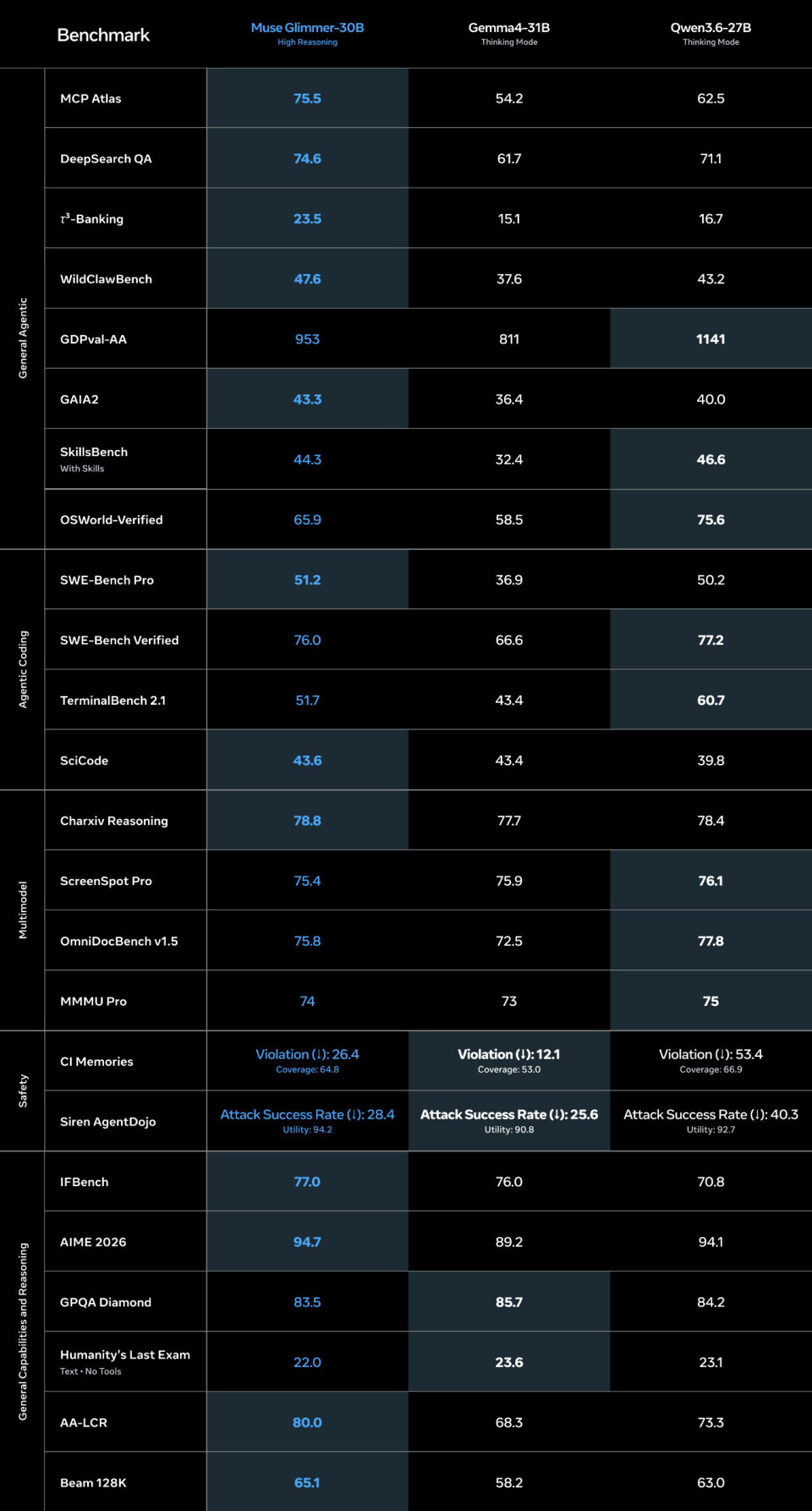
Instead, Muse Glimmer is positioned as a model for small-to-medium sized enterprises or enthusiasts, competing with similarly-sized LLMs from Alibaba and Google. This is reflected in Meta’s benchmark figures, which pit the model against Alibaba’s Qwen 3.6-27B and Google Gemma 4 31B.
As usual, take these claims with a grain of salt, but Glimmer does appear to best Google’s Gemma in most scenarios, and trades blows with Alibaba’s equivalently sized model.

Unfortunately for Meta, the comparison probably won’t age well, with Qwen 3.8-27B due to be released any day now.
Glimmer’s relatively small parameter count means that its hardware requirements are rather modest compared to larger frontier-class models, like DeepSeek V4. At its native BF16 precision, the model should fit comfortably into a single Nvidia RTX Pro 6000 or AMD MI350P.
Quantized to 4-bit precision and model’s weights shrink from around 60 GB to just under 16 GB — small enough to fit in a 20 to 24 GB consumer graphics card, like an RTX 30/4090 or RX 7900 XT/XTX. Unfortunately for those with 16 GB cards, a lack of adequate working memory means dropping down to a smaller, less accurate 3-bit quant.
Even if you can get the model to fit, it won’t be as fast as some other recent models, like Qwen 3.6-35B-A3B or Gemma 4 26B-A4B, as Glimmer uses all 30 billion parameters to generate each token where the others use just 3 to 4 billion.
Glimmer benefits heavily from memory bandwidth. On cards like the RTX 5090, which has 1.8 TB/s of it, Meta says users can expect between 75 and 233 tok/s. The higher end of that relies on a technique called speculative decoding.
As a quick refresher, speculative decoding uses a small draft model, in this case one modeled after DeepSeek’s DSpark drafter, to speed up inference by predicting the outputs of a larger model. If you’re interested, we explore the concept in greater depth in this hands-on here.
While 233 tok/s is plenty fast for most agentic workloads, most users won’t see performance nearly that high. On an M5 Max MacBook Pro, Meta estimates that the systems’ up to 614 GB/s of bandwidth will deliver a still-meaningful 26.2 to 57.8 tok/s, but it’s also worth pointing out the M5 Max delivers 4x the memory bandwidth of the typical Windows notebook today.
In other words, unless you’ve got a dedicated graphics card with enough memory to run the model, the best you can expect is around 6 to 14 tok/s. Testing on a DGX Spark in Unsloth Studio, we were getting around 12.2 tok/s, though DSpark support doesn’t appear to have been implemented just yet.
If you’d like to try the model out for yourself, its weights are currently available for download on Hugging Face as well as through local inference platforms like Ollama and LM Studio.
Meta’s return to the open weights arena doesn’t stop with Glimmer. In an X post Monday, Meta’s Superintelligence chief Alexandr Wang committed to releasing an open weights version of Muse Spark 1.2 “soon.”
Muse Spark 1.2 is Meta’s most capable model, its first to compete in a meaningful way with rivals OpenAI, Anthropic, and Google. However, even this release won’t close the gap with Chinese models.
Both Kimi K3 and Qwen 3.8-Max outperform Spark, according to Artificial Analysis’ intelligence index. Having said that, we still don’t know how big Spark actually is. If Meta’s next open weights model ends up delivering similar performance using fewer weights, this may end up being more competitive from a cost per token standpoint. ®

In brief: GeForce Now is a cloud gaming service that lets users stream games over the internet in limited sessions. As a pair of modders recently discovered, however, a bit of tinkering can turn it into a formidable system for offloading demanding computing tasks.
GeForce Now can apparently do much more than simply stream a selection of supported games using the AV1 codec. Two modders known as “Zortos” and “dpadGuy” have uncovered a trick to gain full desktop access to the streaming service, allowing them to run custom games and software directly on Nvidia’s hardware. Granted, Nvidia will probably patch this loophole eventually, but in the meantime the workaround remains fully functional for anyone willing to follow the modders’ steps.
The modders explained how they achieved this unprecedented result in a video tutorial. The clip essentially provides a step-by-step guide on how to access the remote desktop, although they warn that the method only works with a paid GeForce Now subscription. Free-tier users and GeForce Now Alliance Partner services remain limited to AV1 game streaming.
The tutorial is based on the free-to-play game Trove and GeForce Now’s ability to expose the Steam client’s full interface. From within the current Steam session, users need to access the client’s browser and locate a specific executable file in Trove’s installation folder. They then need to replace the file with a special version provided by the modders and launch it to finally access the remote desktop.
GeForce Now machines can provide some hefty hardware specifications. Zortos said he was able to access an “Ultimate”-tier machine equipped with an AMD Epyc 9375F 32-core CPU and a GeForce RTX 5080 GPU. The system has 48GB of VRAM and 56GB of total system RAM.
– Zortos (@Zortosdev) August 7, 2026
The tutorial demonstrates how the newly discovered desktop access could be used to install Wallpaper Engine from Steam or customize the Windows taskbar. More generally, it could provide broader access to Nvidia’s hardware resources, raising significant security and trust concerns. Later, Zortos used the powerful remote machines to install custom AI models, promising that more “juicy” demonstrations are on the way.
It’s worth noting that this kind of access sits well outside GeForce Now’s terms of service, so anyone attempting this risks having their account suspended or banned.
In any case, the Trove-based method for breaking into Nvidia’s cloud gaming service does not appear to be foolproof. Some users who tried the same trick experienced a few unexpected issues, including Windows sessions closing automatically or being unable to download the custom executable file to Trove’s folder. Some said the Trove method no longer works, although Zortos reiterated that this is not the case.





Weekend Open Thread: Mattifying Sunscreen


Frugal Friday’s Workwear Report: Cap-Sleeve Pointelle Crewneck Sweater


Jordan Coyle & Cordiamo take Laya Arena Stakes at RDS


Can Astrology Help Find Gold and Silver Trends? A Financial Astrology Guide

US stocks: Dow closes at record on Mideast optimism; SpaceX, AMD drag Nasdaq


Reform UK And Greens Sink To Lowest Favourability Ratings To Date


OpenAI, Anthropic AI agents targeted real people and systems in cyber tests


Nvidia Stock Climbs 2.5% as Chip Sector Rally Builds Ahead of AMD Earnings, Nvidia’s Own Report Looms


Polymarket targets $20 billion valuation as competition heats up in prediction market sector


Supply chain issues impact Ingredion

CLARITY Act Senate Vote Locked In, But 60-Vote Hurdle Looms Large


Rinn Pharma & Biopharma to join NordicPharmaTrain network


Dow and S&P 500 Hit Records on AI Earnings: When Will the Bubble Burst?


How to Start a Cleaning Business: A Step-by-Step Guide


Datadog: Best Of Breed For Multiple Reasons


BDC Weekly Review: Private BDC Q2 Numbers Are Strong


Dollar Index Trapped at 100 as Hawkish Fed Meets Official Selling


McDonald’s (MCD) Q2 2026 earnings
Trump Administration Plans Ban on New Chinese AI Data Center Components: Report


The Bright Side of Black and White



You must be logged in to post a comment Login