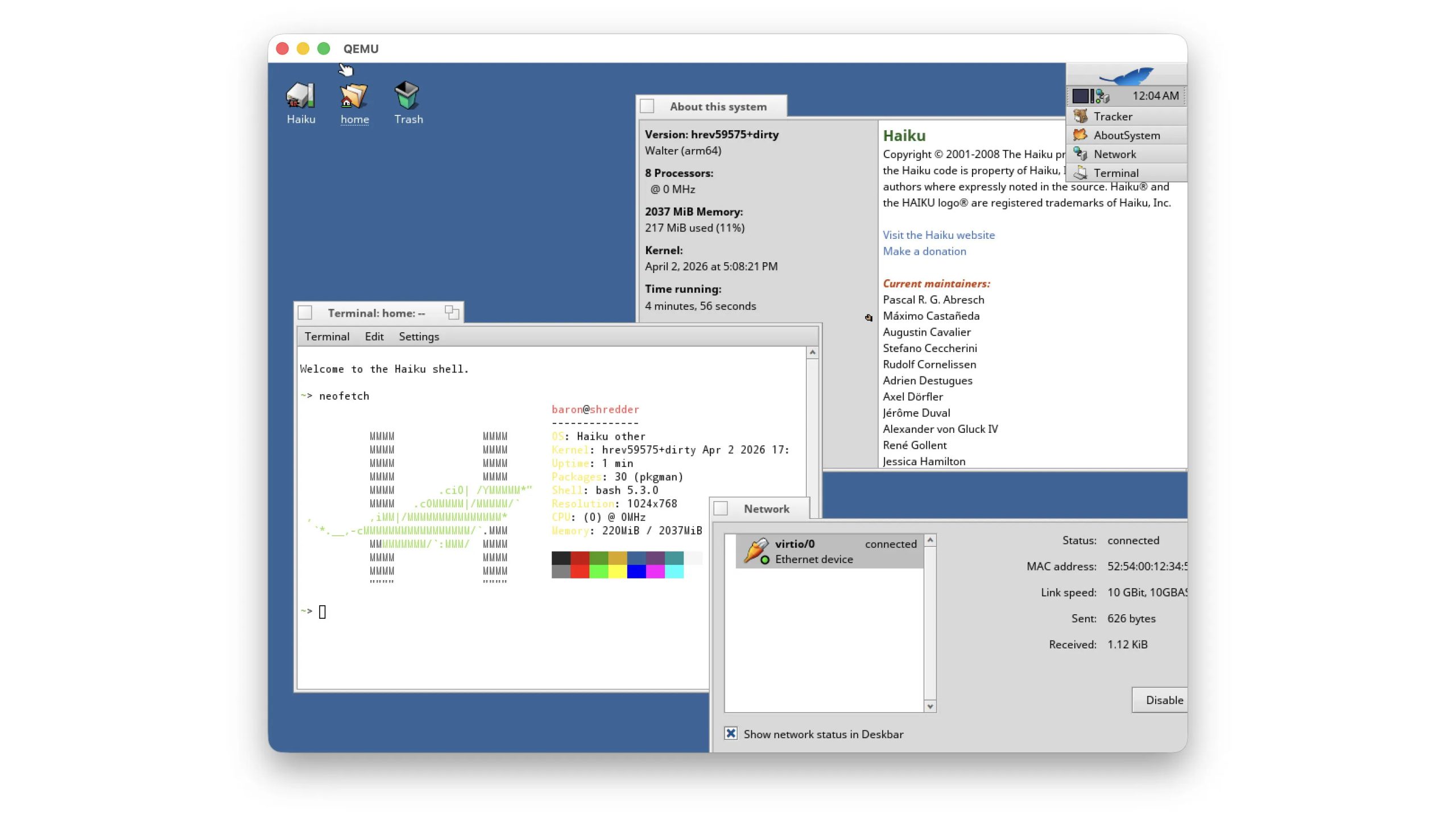
Ever since it was called OpenBeOS, Haiku has targeted the x86 platform. That makes good sense: it’s hard enough maintaining a niche system on ubiquitous hardware. But x86 isn’t the only game in town anymore. Apple’s doing very well on ARM, Linux runs on oodles of ARM SBCs, and even Windows uh, exists, on that architecture, so why not Haiku? That’s what [smrobtzz] figured, and thanks to his work you can now run Haiku on ARM, in QEMU.
There’s no image available as yet — you still need to bootstrap your own from a working system, and ironically that system cannot be Haiku. [smrobtzz] apparently used MacOS, which makes sense as his ultimate goal is apparently to go where only Aishi Linux has gone before and boot Haiku on his M1 MacBook. There had been previous efforts to get Haiku going on Raspberry Pi hardware, which seems logical considering how lightweight the operating system is, but they’re apparently nowhere near booting either. QEMU is a good start.

Interestingly, according to the ports page, Haiku is “functional” on both RISC V QEMU and the now-discontinued HiFive Unmatched SBC. We don’t seem to have covered it, but that milestone happened five year ago. Given how most RISC V boards currently available are a bit slow for modern desktop Linux, Haiku would likely be a breath of fresh air. The BeOS-descended system might be single user, but it’s snappy.
When it comes to universal pre-kindergarten, California has made significant progress — 62 percent of 4-year-olds were enrolled in publicly funded early childhood programs in 2024–25, up from 42% in 2019–20, according to a new Learning Policy Institute report.
Transitional kindergarten (TK) alone enrolled 55 percent of 4-year-olds, or about 177,000 children. But access remains uneven: nearly 4 in 10 4-year-olds still aren’t enrolled, and the share of eligible children actually signing up has declined. Families may be unaware that transitional kindergarten is an option for their children, or they face other barriers to enrolling. This school year marks the first time every 4-year-old in California was guaranteed a transitional kindergarten spot.
The number of California 4-year-olds enrolled in transitional kindergarten and other publicly funded early childhood education programs rose from about 208,300 in 2019-20 to more than 264,000 in 2024-25, a 27 percent increase.
Transitional kindergarten had the largest number of participants, with 177,570 4-year-olds enrolled in 2024-25.
Only a few weeks after overhauling its unlimited phone plans, AT&T has added a new plan to the top of the lineup that offers more data and performance — for a higher price. The AT&T Elite 2.0 plan is available now.
For a single line, Elite 2.0 costs $110 (plus taxes and fees). As more lines are added, the per-line price goes down. AT&T customers can mix and match plans on an account, but if we assume everyone is signing up for the Elite 2.0 plan, the costs break down like this:
• One line: $110 • Two lines: $100 per line, $200 total • Three lines: $85 per line, $255 total • Four lines: $75 per line, $300 total • Five lines: $75 per line, $375 total
Advertisement
To compare it with AT&T’s next-priciest option, the Premium 2.0 plan costs $90 for a single line, or $55 per line on an account with four lines.
What’s included in the AT&T Elite 2.0 plan
For those amounts, the plan includes unlimited high-speed 5G data, prioritized even during network congestion, just like the Premium 2.0 plan, and 250GB of hotspot data (up from 100GB for the other plan). It also includes cellular access for one smartwatch and one tablet per line.
For travelers, Elite 2.0 has unlimited international talk, text and 20GB of high-speed data per month in 210 countries. The Premium 2.0 plan has unlimited talk, text and high-speed data, but only for 20 Latin American countries.
Aside from the data amounts, the Elite 2.0 plan includes AT&T Turbo, a feature normally offered as an add-on that increases data performance for video calling, gaming and streaming on 5G-capable devices. For other plans, AT&T Turbo costs $7 per line per month.
Advertisement
(AT&T Turbo is a separate feature from AT&T Turbo Live, which is designed to boost performance in certain crowded venues such as concerts or sporting events.)
AT&T Elite 2.0 vs Premium 2.0
Price for 1 line, per month
Price for 4 lines, per month
High-speed data
Mobile hotspot
International Call/Data
AT&T Turbo
AT&T Premium 2.0
$90
$220 ($55 per line)
Unlimited
100GB
Unlimited talk, text and high-speed data in 20 Latin American countries; unlimited texting from US to 200+ countries
Not included
AT&T Elite 2.0
$110
$300 ($75 per line)
Unlimited
250GB
Unlimited talk, text and 20GB high-speed data in 210 countries
We spend hours testing every product or service we review, so you can be sure you’re buying the best. Find out more about how we test.
Although I’ve watched countless pieces of media or played dozens of video games and board games that draw on the Cthulhu mythos and the works of HP Lovecraft, I was suddenly struck by one question I don’t think I’ve ever properly considered while writing this review of Big Bad Wolf’s solid investigation puzzler, Cthulhu: The Cosmic Abyss. What does Cthulhu want?
Review info
Platform reviewed: PS5 Available on: PS5,Xbox Series X|S, PC Release date: April 16, 2026
Advertisement
As I’m trawling through audio logs, video diaries, and messages left by a research crew and its billionaire funder in an abandoned underwater facility and an otherworldly city, I witness how they all succumb to the call of the Great Old One and become fixated on bringing about his/its/their return.
And while by the end I’d solved some mysteries and smugly puzzled out how to keep Cthulhu slumbering, I still didn’t know what the big tentacle-faced beast got out of it all apart from a few mindless, raving fans.
Advertisement
Can I be your number one fan?
(Image credit: Big Bad Wolf / Nacon)
I guess you could argue that’s the whole point. Cthulhu is supposed to be a being beyond our comprehension, from a place with impossible geography, so I should just take the win and be happy I was able to stop him from awakening before being subsumed into the fandom.
But while some things may never be understood, Cthulhu: The Cosmic Abyss is all about solving what you can. As an occult investigator, Noah, you use tech and your wits to explore the grotesque and fascinating environments of a flooded bayou to the sunken city of R’lyeh. It’s a game of scanning for clues, absorbing the relevant information, making connections, and figuring out how it will help you stop Cthulhu.
What that ultimately means is that this is a game with a lot of reading, a lot of listening, and a lot of work outside the game, shuffling the facts around inside your brain as you piece it all together. Fortunately, it’s never interrupted by the threat of a monster attack or an enemy stalking you throughout the area like a Soma or Amnesia. Some wrong moves or wayward exploration will result in death, but it’s easy to avoid this if you’re paying attention.
Advertisement
(Image credit: Big Bad Wolf / Nacon)
To help visualise all of your clues, you do get given a mind map of sorts that allows you to move clues around and draw connections where you think they are relevant, but most of the time, the game will prompt you on the important questions that need answering to progress.
Sign up for breaking news, reviews, opinion, top tech deals, and more.
Added to that is an energy system that allows you to analyze clues and items, to better understand what they are and how they can be useful to your investigation. And while this is supposedly a limited resource, each area is full of the fungus that you can use to recharge it (yep, Noah basically powers up like Mario), so I just ended up scanning everything when I had the chance. Because of that, the whole system feels superfluous.
The same goes for the upgrades and augments you can find or earn from special tablets or shrines dotted around each area. You can only equip a limited number based on your maximum capacity, but when all they offer are small bonuses, such as an increase in your scanner range or a chance to restore energy when analyzing clues, the decision of what to equip doesn’t matter all that much.
Advertisement
Fortunately, you can still investigate and puzzle solve fully while both the energy and augment systems just exist in the background without requiring you to engage with them. I can only assume they must have been added to make Cthulhu: The Cosmic Abyss feel more gamey, but I don’t think they add anything of value.
Jarvis, activate ‘see everything’ mode
One aspect you will be engaging with a lot is the sonar built into your AI companion, Key. Using the frequencies you gain from analyzing clues, you can set and search for nearby items that match the frequency. This becomes a loop for part of the game’s puzzle-solving.
(Image credit: Big Bad Wolf / Nacon)
For example, a component made of a specific alloy might be missing from a piece of equipment, so you can scan the surrounding area for alloys that match that frequency to find it. Relatively straightforward, then, but the game does expand on this idea a handful of times by making certain key frequencies harder to find or requiring you to combine frequencies to find more specific items and secrets.
Advertisement
Best bit
(Image credit: Big Bad Wolf / Nacon)
There’s little else quite so satisfying as connecting the dots between various pieces of seemingly unrelated information and working out exactly what you need to do to progress. Cthulhu: The Cosmic Abyss has several moments like this, and when you get deep into a puzzle that comes together in one intricate and elegant solution, you feel like a genius.
I liked it enough as an idea, but as with all of these special vision types in games (I’m looking at you, Arkham detective mode), I ended up simply cycling through what I thought was a relevant frequency and spamming it in each new location to be sure I wasn’t missing any clues.
That’s not to say the game’s puzzles are bad. I did enjoy investigating a lot, with many solutions requiring you to take in all of the information given to you. There are moments where you feel like you are uncovering the secrets of an ancient civilization, learning how to use their bizarre technology, or piecing together the lives and relationships of the original research team as they descended into madness.
Advertisement
What’s also interesting is that chapters give you two possible solutions to the main puzzle: one that pushes you more towards the corrupting influence of Cthulhu, and another (often slightly more elaborate) that lessens the Great Old One’s control over you and the world. It’s a neat idea that rewards you for following a different path than the obvious one and encourages you to fully consider all the clues presented to you.
A sacrifice I am willing to make
(Image credit: Big Bad Wolf / Nacon)
The choices you make can affect the state of the world, characters, and your final ending, so I really appreciate a usually very linear puzzle game offering up some more freeform elements that give you more influence over the story — and a chance to try alternate paths if you feel stuck on one route or are keen for a second playthrough.
I doubt I’ll be diving in again, though, as I feel happy with everything I got out of Cthulhu: The Cosmic Abyss on the first go. It has some rough edges, namely an inconsistent autosave, which meant I had to repeat some steps when loading my game on a few occasions. There are also fussy item manipulation mechanics and some ideas that aren’t fully realised.
Advertisement
However, its core investigation gameplay is strong, and the atmosphere is suitably sinister, so I’m sure anyone who enjoys a puzzle game with a dash of cosmic horror will come away satisfied enough — especially for a budget release.
Should you play Cthulhu: The Cosmic Abyss?
(Image credit: Big Bad Wolf / Nacon)
Play it if…
Advertisement
Don’t play it if…
Accessibility
Cthulhu: The Cosmic Abyss has two difficulty modes: Investigation and Exploration. The first is the standard experience, while the second allows you to ask your AI companion for hints and shows the clues available in each location. You can also set a custom option to tweak how much corruption affects you and how energy is used.
Elsewhere, there are three color blind modes for green, red, and blue color blindness, the option to make subtitles clearer, disable head movement to ease motion sickness, and fully rebind all controls.
I played the whole game in Performance mode and still experienced a few technical hitches and moments of slowdown, so I wouldn’t risk Quality mode without a major patch.
In my time playing, I completed the game once and saw one of the possible endings, although I did have to replay an early chapter three times due to an autosave issue, which should now be fixed in the full release. However, I did still find the autosave unreliable, and that probably bumped up my total playtime by at least an hour.
More than 30 WordPress plugins in the EssentialPlugin package have been compromised with malicious code that allows unauthorized access to websites running them.
A malicious actor planted the backdoor code last year but only recently started pushing it to users via updates, generating spam pages and causing redirects, as per the instructions received from the command-and-control (C2) server.
The compromise affects plugins with hundreds of thousands of active installations and was spotted by Austin Ginder, the founder of managed WordPress hosting provider Anchor Hosting, after receiving a tip about one add-on containing code that allowed third-party access.
Further investigation by Ginder revealed that a backdoor had been present in all plugins within the EssentialPlugin package since August 2025, after the project was acquired in a six-figure deal by a new owner.
EssentialPlugin, established in 2015 as WP Online Support and rebranded in 2021, is a WordPress development firm offering sliders, galleries, marketing tools, WooCommerce extensions, SEO/analytics utilities, and themes.
Advertisement
According to Ginder, the backdoor sat inactive until it was recently activated and silently contacted external infrastructure to fetch a file (‘wp-comments-posts.php’) that injects malware into ‘wp-config.php.’
The downloaded malware is invisible to site owners and uses Ethereum-based C2 address resolution for evasion. Depending on the received instructions, the malware can retrieve “spam links, redirects, and fake pages”.
“The injected code was sophisticated. It fetched spam links, redirects, and fake pages from a command-and-control server. It only showed the spam to Googlebot, making it invisible to site owners,” explained Ginder.
Analysis from WordPress security platform PatchStack shows that the backdoor worked only if the ‘analytics.essentialplugin.com’ endpoint returned with a malicious serialized content.
Advertisement
WordPress action and infection status
WordPress.org responded quickly to the reports of the malicious activity by closing the plugins and pushing a forced update to websites to neutralize the backdoor’s communication and disable its execution path.
However, the developers warned that the action did not clean the wp-config core configuration file, which connects websites to their databases and includes important settings.
The WordPress.org Plugins Team also cautioned administrators with websites running an EssentialPlugin product that while one known location for the backdoor is a file named wp-comments-posts.php, which resembles the legitimate wp-comments-post.php, the malware may also hide in other files.
BleepingComputer has contacted EssentialPlugins for a comment on the reported malicious commit that occurred after the acquisition, but we have not received a response by publishing time.
Advertisement
Automated pentesting proves the path exists. BAS proves whether your controls stop it. Most teams run one without the other.
This whitepaper maps six validation surfaces, shows where coverage ends, and provides practitioners with three diagnostic questions for any tool evaluation.
The Gemini team just announced a bundle deal that lets users get 50% off YouTube Premium for a whole year. But while this sounds solid on paper, this is not a no-strings-attached promo deal.
How do you avail this half-off deal?
This limited-time offer is available for users in the U.S., Brazil, Canada, Germany, France, or Japan and ends April 29. 🎁⏳ Discount offer for 12-months, then @YouTube Premium auto-renews at a reduced rate with Google One bundled purchase. Terms apply.
YouTube Premium still gives you the usual core benefits like ad-free videos, background play, offline downloads, and ad-free YouTube Music. Cutting that price in half for 12 months makes the subscription a lot easier to stomach.
But there is a catch, because of course there is. This is not a broad YouTube Premium discount for everyone. It is tied to Google AI Pro, which sits inside the broader Google One subscription setup. Google’s support page says the YouTube Premium add-on is currently available only to eligible members, and some users may not be able to sign up at all. The company also says the 12-month Google AI Pro trial membership is not eligible for the YouTube add-on bundle.
Why this offer is a Google lock-in perk
Phil Nickinson / Digital Trends
While it may not outright say it, the brand is clearly not just discounting YouTube Premium out of generosity. Just a while back, the company bumped the cloud storage capacity from 2TB to 5TB for Google AI Pro subscribers. So the YouTube Premium deal is just another add-on to make Google AI Pro’s value seem sweeter. The Gemini X post frames it as a “special surprise” for power users, while Google’s own pages position it as part of the bigger Google AI Pro experience.
The company has even tied this benefit to the individual YouTube Premium plan, which is not shareable with family members. Aside from this, the deal is only available in select countries like the US, Brazil, Canada, Germany, Japan, and France. So yes, after the price hike, YouTube Premium is now effectively half the price if you pay for Google One through Google AI Pro. But this is less a straightforward discount and more Google’s latest reminder that the cheapest way to use one of its services increasingly involves subscribing to two.
Microsoft is investigating an issue causing this month’s KB5082063 security update to fail to install on some Windows Server 2025 systems.
On affected systems, users are also reporting seeing 0x800F0983 install errors when trying to deploy the April 2026 cumulative updates.
“Microsoft is monitoring diagnostic data reports on update installation failures and has observed a recurring error on Windows Server 2025 devices when installing the April 2026 Windows security update (the Originating KBs listed above), released on April 14, 2026,” the company says in a service alert spotted by Microsoft MVP Susan Bradley.
“A limited number of affected servers might experience an installation failure accompanied by the error code 800F0983.”
Microsoft says it’s currently looking into this known issue and will share more details as it learns more about the root cause.
Advertisement
On Wednesday, Microsoft also warned IT administrators that some Windows Server 2025 devices will boot into BitLocker recovery after deploying the KB5082063 Windows security update, prompting users to enter a BitLocker key.
However, as the company further explained, this is unlikely to affect home users, as affected configurations are typically found on systems managed by enterprise teams.
This week, Microsoft also finally addressed a bug that has been plaguing Windows servers for 1.5 years, causing systems running Windows Server 2019 and 2022 to upgrade to Windows Server 2025 “unexpectedly.”
While it initially blamed the issue on misconfigured third-party update management software, Microsoft said it had addressed the issue and that customers can once again check for updates through the Windows Settings app.
Automated pentesting proves the path exists. BAS proves whether your controls stop it. Most teams run one without the other.
This whitepaper maps six validation surfaces, shows where coverage ends, and provides practitioners with three diagnostic questions for any tool evaluation.
Oppo is gearing up to expand its flagship range with new models soon. It looks like the Oppo Find X9 Ultra will launch alongside the Find X9s. Along with these phones, the company may also introduce other products, such as the Oppo Watch X3 and Enco Clip 2, at the same event.
Rumored Specifications of Oppo Find X9 Ultra
The Oppo Find X9s is expected to feature a flat display design, which many users prefer for everyday use. The bezels are quite slim at 1.15mm, adding to its premium look. On the front, a hole-punch cutout will house the selfie camera. Moreover, the phone stands out for its button placement: the power and volume buttons are on the left, while another button is on the right.
For photography, Oppo is adding a Hasselblad-tuned triple camera system to the Find X9s. It will feature a 50MP main camera designed to capture clear and sharp images. The camera setup sits inside a square module, and an LED flash is also included.
Another important feature of the phone is its battery, which comes with an impressive capacity of 7,025 mAh. The device will easily handle any task thanks to its powerful battery, whether it’s gaming or video streaming. However, details about the phone’s chipset and performance features remain unknown.
What to Expect from the Find X9s Pro
As of now, it appears the Oppo Find X9s Pro will be released only in China. Among other things, the smartphone will reportedly feature a quadruple-camera module with two 200MP lenses. In addition, it could integrate Oppo’s LUMO image-sensing tech to deliver high-quality shots. As for the display panel, it is expected to be 6.3 inches.
Geekey is an innovative, compact multi-tool like nothing seen before. It’s truly a work of art with engineering that combines everyday common tools into one sleek little punch that delivers endless capability. Geekey features many common tools that have been used for decades and proven essential for everyday fixes. It’s on sale for $23.
Note: The Techdirt Deals Store is powered and curated by StackCommerce. A portion of all sales from Techdirt Deals helps support Techdirt. The products featured do not reflect endorsements by our editorial team.
If you’ve ever have to wipe the drive of a very old Mac, you know you need an old macOS to get it running again. Beyond Restore, Apple only grudgingly allows downloads, but others are trying to make it easier.
You can download installers for most versions of the Mac operating system back to OS X Lion – image credit: Apple
Apple does rather prefer you to use only the latest version of macOS, but it’s not as if it charges you to do so. Eventually you might need to buy a new Mac, so there is some financial upside for the company, but most of the time, the reason to stay up to date is security. If you’re looking for an older macOS version then you know this already, but you also know that the Mac you’re working on will not run macOS Tahoe. In which case, your job is this: Continue Reading on AppleInsider | Discuss on our Forums
Live Nation, which operates the Ticketmaster platform, has been determined to be a monopoly. A federal jury handed down its decision today that the company violated federal and state antitrust rules. This finding won’t surprise anyone who has used Ticketmaster and been sticker-shocked by their final bill. However, it’s unclear what the jury’s decision will mean in practice.
For starters, the judge overseeing the case hasn’t determined what remedies will be applied. The actions could go as far as requiring Live Nation to sell off Ticketmaster. There are also monetary damages to be awarded, which haven’t been set yet. And whatever the judge decides, it’s likely that Live Nation will appeal the decision. In a statement released by Live Nation today, the company noted that there are other motions still pending that could also impact the jury’s ruling. “Of course, Live Nation can and will appeal any unfavorable rulings on these motions,” it said.
The Department of Justice and a group of state and district attorneys general sued Live Nation on monopoly claims in 2024. The government agency reached a settlement with Live Nation last month, but the other parties continued their action. There’s also a separate case being waged by the Federal Trade Commission questioning whether Live Nation colluded with ticket resellers.
Update, April 15, 2025, 6:31PM ET: Added statement from Live Nation.
You must be logged in to post a comment Login