Connect with us
DAPA Banner

Tech

Harnessing Plasmons for Alternative Computing Power

Published

on

Much has been made of the excessive power demands of AI, but solutions are sparse. This has led engineers to consider completely new paradigms in computing: optical, thermodynamic, reversible—the list goes on. Many of these approaches require a change in the materials used for computation, which would demand an overhaul in the CMOS fabrication techniques used today.

Over the past decade, Hector De Los Santos has been working on yet another new approach. The technique would require the same exact materials used in CMOS, preserving the costly equipment, yet still allow computations to be performed in a radically different way. Instead of the motion of individual electrons—current—computations can be done with the collective, wavelike propagations in a sea of electrons, known as plasmons.

De Los Santos, an IEEE Fellow, first proposed the idea of computing with plasmons back in 2010. More recently, in 2024, De Los Santos and collaborators from University of South Carolina, Ohio State University, and the Georgia Institute of Technology created a device that demonstrated the main component of plasmon-based logic: the ability to control one plasmon with another. We caught up with De Los Santos to understand the details of this novel technological proposal.

How Plasmon Computing Works

IEEE Spectrum: How did you first come up with the idea for plasmon computing?

Advertisement

De Los Santos: I got the idea of plasmon computing around 2009, upon observing the direction in which the field of CMOS logic was going. In particular, they were following the downscaling paradigm in which, by reducing the size of transistors, you would cram more and more transistors in a certain area, and that would increase the performance. However, if you follow that paradigm to its conclusion, as the device sizes are reduced, quantum mechanical effects come into play, as well as leakage. When the devices are very small, a number of effects called short channel effects come into play, which manifest themselves as increased power dissipation.

So I began to think, “How can we solve this problem of improving the performance of logic devices while using the same fabrication techniques employed for CMOS—that is, while exploiting the current infrastructure?” I came across an old logic paradigm called fluidic logic, which uses fluids. For example, jets of air whose direction was impacted by other jets of air could implement logic functions. So I had the idea, why don’t we implement a paradigm analogous to that one, but instead of using air as a fluid, we use localized electron charge density waves—plasmons. Not electrons, but electron disturbances.

And now the timing is very appropriate because, as most people know, AI is very power intensive. People are coming against a brick wall on how to go about solving the power consumption issue, and the current technology is not going to solve that problem.

What is a plasmon, exactly?

Advertisement

De Los Santos: Plasmons are basically the disturbance of the electron density. If you have what is called an electron sea, you can imagine a pond of water. When you disturb the surface, you create waves. And these waves, the undulations on the surface of this water, propagate through the water. That is an almost perfect analogy to plasmons. In the case of plasmons, you have a sea of electrons. And instead of using a pebble or a piece of wood tapping on the surface of the water to create a wave that propagates, you tap this sea of electrons with an electromagnetic wave.

How do plasmons promise to overcome the scaling issues of traditional CMOS logic?

De Los Santos: Going back to the analogy of the throwing the pebble on the pond: It takes very, very low energy to create this kind of disturbance. The energy to excite a plasmon is on the order of attojoules or less. And the disturbance that you generate propagates very fast. A disturbance propagates faster than a particle. Plasmons propagate in unison with the electromagnetic wave that generates them, which is the speed of light in the medium. So just intrinsically, the way of operation is extremely fast and extremely low power compared to current technology.

In addition to that, current CMOS technology dissipates power even if it’s not used. Here, that’s not the case. If there is no wave propagating, then there is no power dissipation.

Advertisement

How do you do logic operations with plasmons?

De Los Santos: You pattern long, thin wires in a configuration in the shape of the letter Y. At the base of the Y you launch a plasmon. Call this the bias plasmon, this is the bit. If you don’t do anything, when this plasmon gets to the junction it will split in two, so at the output of the Y, you will detect two equal electric field strengths.

Now, imagine that at the Y junction you apply another wire at an angle to the incoming wire. Along that new wire, you send another plasmon, called a control plasmon. You can use the control plasmon to redirect the original bias plasmon into one leg of the Y.

Plasmons are charge disturbances, and two plasmons have the same nature: They either are both positive or both negative. So, they repel each other if you force them to converge into a junction. And by controlling the angle of the control plasmon impinging on the junction, you can control the angle of the plasmon coming out of the junction. And that way you can steer one plasmon with another one. The control plasmon simply joins the incoming plasmon, so you end up with double the voltage on one leg.

Advertisement

You can do this from both sides, add a wire and a control plasmon on either side of the junction so you can redirect the plasmon into either leg of the Y, giving you a zero or a one.

Building a Plasmon-Based Logic Device

You’ve built this Y-junction device and demonstrated steering a plasmon to one side in 2024. Can you describe the device and its operation?

De Los Santos: The Y-junction device is about 5 square [micrometers]. The Y is made up of the following: a metal on top of an oxide, on top of a semiconducting wafer, on top of a ground plane. Now, between the oxide and the wafer, you have to generate a charge density—this is the sea of electrons. To do that, you apply a DC voltage between the metal of the Y and the ground plane, and that generates your static sea of electrons. Then you impinge upon that with an incoming electromagnetic wave, again between the metal and ground plane. When the electromagnetic wave reaches the static charge density, the sea of electrons that was there generates a localized electron charge density disturbance: a plasmon.

Now, if you launch a plasmon by itself, it will quickly dissipate. It will not propagate very far. In my setup, the reason why the plasmon survives is because it is being regenerated. As the electromagnetic field propagates, you keep regenerating the plasmons, creating new plasmons at its front end.

Advertisement

What is left to be done before you can implement full computer logic?

De Los Santos: I demonstrated the partial device, that is just the interaction of two plasmons. The next step would be to demonstrate and fabricate the full device, which would have the two controls. And after that gets done, the next step is concatenating them to create a full adder, because that is the fundamental computing logic component.

What do you think are going to be the main challenges going forward?

De Los Santos: I think the main challenge is that the technology doesn’t follow from today’s paradigm of logic devices based on current flows. This is based on wave flows. People are accustomed to other things, and it may be difficult to understand the device. The different concepts that are brought together in this device are not normally employed by the dominant technology, and it is really interdisciplinary in nature. You have to know about metal-oxide-semiconductor physics, then you have to know about electromagnetic waves, then you have to know about quantum field theory. The knowledge base to understand the device rarely exists in a single head. Maybe another next step is to try to make it more accessible. Getting people to sponsor the work and to understand it is a challenge, not really the implementation. There’s not really a fabrication limitation.

Advertisement

But in my opinion, the usual approaches are just doomed, for two reasons. First, they are not reversible, meaning information is lost in the computation, which results in energy loss. Second, as the devices shrink energy dissipation increases, posing an insurmountable barrier. In contrast, plasmon computation is inherently reversible, and there is no fundamental reason it should dissipate any energy during switching.

From Your Site Articles

Related Articles Around the Web

Source link

Advertisement
Continue Reading
Click to comment

You must be logged in to post a comment Login

Leave a Reply

Tech

Apple Products Now Contain 30% Recycled Materials. Their Packaging Boasts Zero Plastic

Published

on

Italy misses out on another World Cup

If you’ve purchased a product from Apple over the past year, it probably contains a higher amount of recycled material than ever before. In case you weren’t aware, you can also recycle all of the company’s fiber-based packaging now that it has eliminated all plastic use.

Apple continues to chart a course toward carbon neutrality by 2030, hitting new climate milestones across emissions, recycling and water use, according to its 2025 Environmental Progress Report

A record 30% of the products the company shipped last year contain recycled content. Apple also uses 100% recycled cobalt in its batteries and 100% recycled rare-earth elements in its magnets. 

Advertisement

The newly introduced MacBook Neo, in particular, is a point of pride for the company. It boasts the highest recycled content and the lowest carbon footprint of any Apple laptop — in addition to being the most repairable MacBook in ages.

“These milestones in our work to protect the planet show that ambitious goals can also be powerful engines of innovation,” said Apple CEO Tim Cook in a statement. “And as always, we’ll keep pushing to build on this progress even more.”

As the climate crisis continues to take a toll on the planet, sparking more unpredictable extreme weather events, it’s important that the world’s wealthiest companies do their part to minimize, and ideally eliminate, their environmental impact. Using more recycled materials reduces mining of Earth’s natural resources, protecting ecosystems and the local communities that rely on them. But ultimately, the most impactful change any company can make is to eliminate the emissions that are causing our planet to rapidly warm.

Apple’s 2025 report showed that over the past year, the company has reduced its greenhouse gas emissions by 60% compared to its 2015 baseline. Apple is working toward achieving carbon neutrality across all of its operations, including transitioning its entire value chain to clean electricity, by 2030.

Advertisement

This is an ambitious target, for which Apple should be commended. Many companies choose to attach their climate and sustainability goals to timeframes pointing to the future — 2050 is a popular target — that don’t align with the urgency of the climate crisis and the tipping points fast approaching. By committing to the 2030 goals, Apple has to be bullish about making changes to the way it does business now, rather than kicking them into the long grass.

The company is already carbon neutral in its corporate operations, but it now needs to make progress in transforming its value chain. For the elements of its emissions that are hard to eliminate completely — such as business travel that relies on flying — the company has committed to carbon offsets. To do this, it purchases carbon credits that support two projects — one in Guatemala and another in China.

Overall, the company is making serious progress toward its lofty goals. In an ideal world, we would see Apple and other tech giants commit to proving it’s possible to go beyond carbon neutrality and net zero to become carbon negative. This is the best way to protect our planet for future generations.

Advertisement

Source link

Continue Reading

Tech

Austrian Audio The Arranger Open-back Headphones Review: Reference or Preference?

Published

on

Austrian Audio didn’t appear out of nowhere. The company was formed in 2017 after AKG shut down its Vienna operations, and a significant portion of its engineering and design team decided not to follow the corporate roadmap. Instead, they stayed put and built something new, bringing with them experience tied to models like the K612, K702, and K812.

Since then, Austrian Audio has covered both ends of the market. The Hi-X series established its presence with studio focused, budget friendly designs, while The Composer proved the company could compete at the high-end if you’re willing to spend $2,699.

What’s been missing is the middle. That gap is now filled by The Arranger, a $1,299 open-back headphone that lands right in one of the most competitive segments in personal audio. It’s also where expectations get less forgiving. Up against established options like the HiFiMAN Arya Unveiled and Sendy Audio Egret, this isn’t about proving competence, it’s about proving relevance.

And that raises the real question: did Austrian Audio tune The Arranger for the studio, or for the Head-Fi crowd with very different expectations?

Advertisement

Custom Designed Drivers 

Within each earcup of The Arranger sits a newly developed 44mm driver designed entirely in house. Austrian Audio has put real effort into the motor and diaphragm design, using a proprietary ring magnet system and a DLC coated diaphragm to improve rigidity and control.

On paper, the numbers are ambitious. Bass extension is rated down to 5Hz, which Austrian Audio claims is class leading. Distortion is kept below 0.1% at 1kHz, and driver excursion appears well managed for a driver of this size.

The electrical side looks just as approachable. With a 25 Ohm impedance and 94dB/mW sensitivity rating, The Arranger should be relatively easy to drive from a wide range of sources. Whether that holds up in real world use is something we will get into in the drivability section.

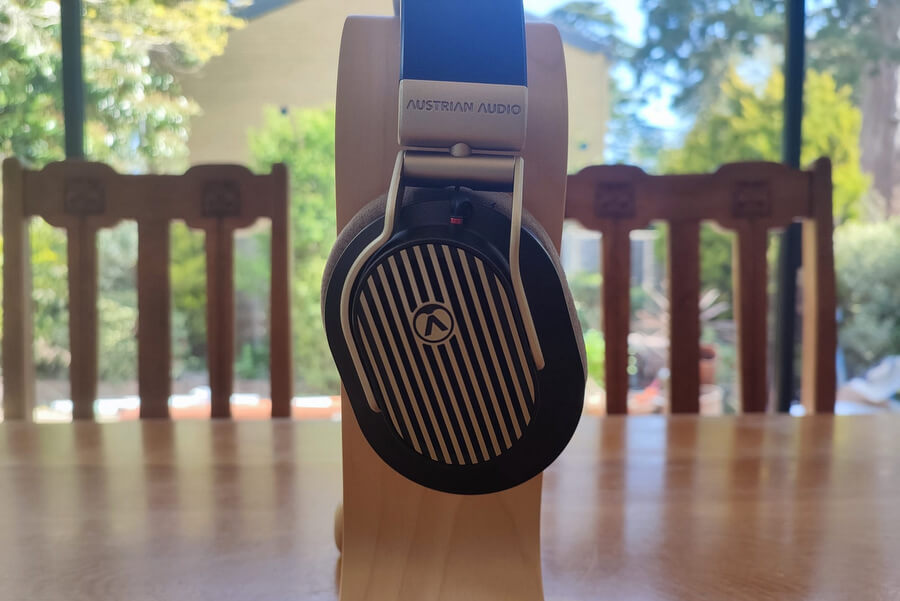
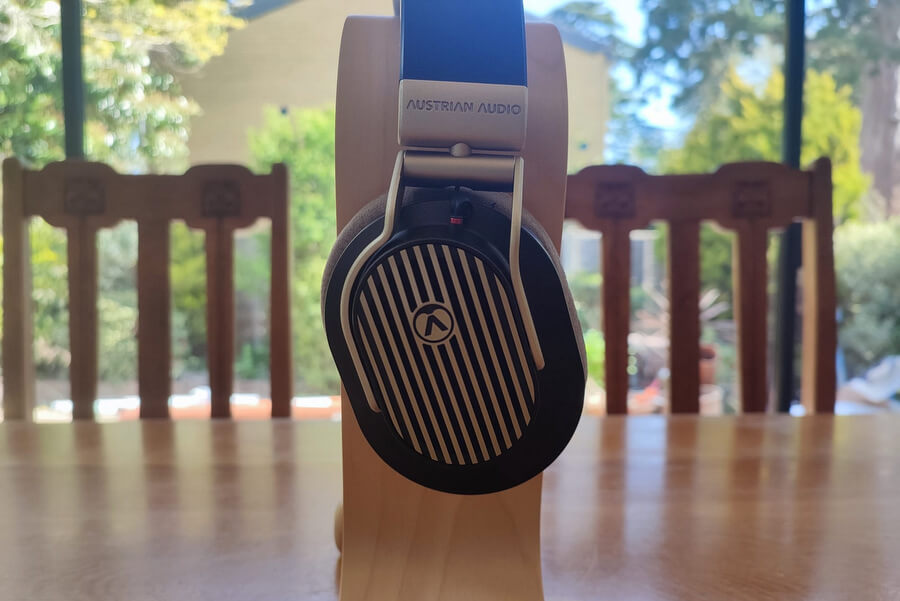
austrian-audio-arranger-headphones-side

Design & Comfort

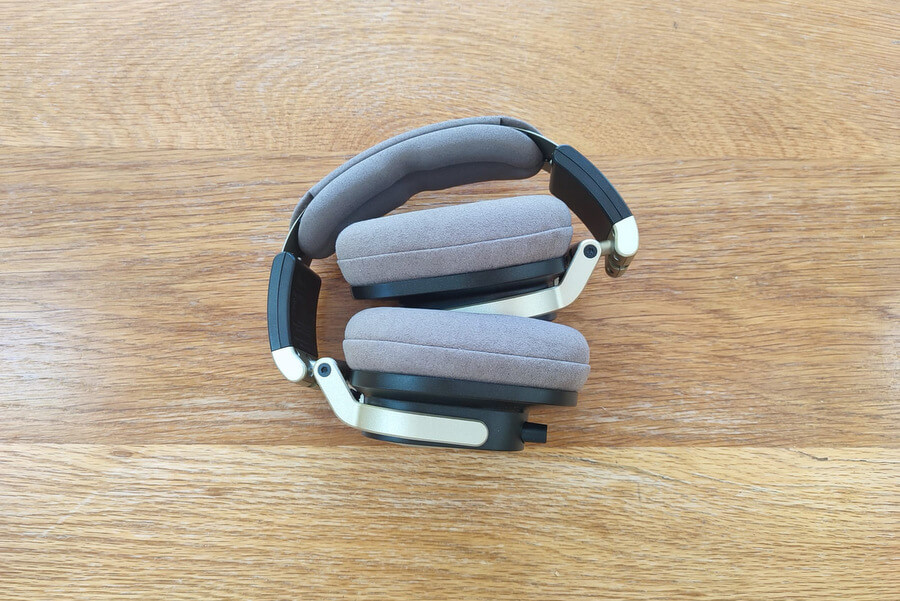
When it comes to design, The Arranger makes no attempt to hide what it is. This is a studio first headphone. It is not sculpted to impress and it is not chasing luxury cues. What you get instead is a build that feels like it was designed to survive actual use. Drops, knocks, and long days at a desk should not faze it. The foldable chassis also gives it an advantage over many open-back competitors when it comes to portability.

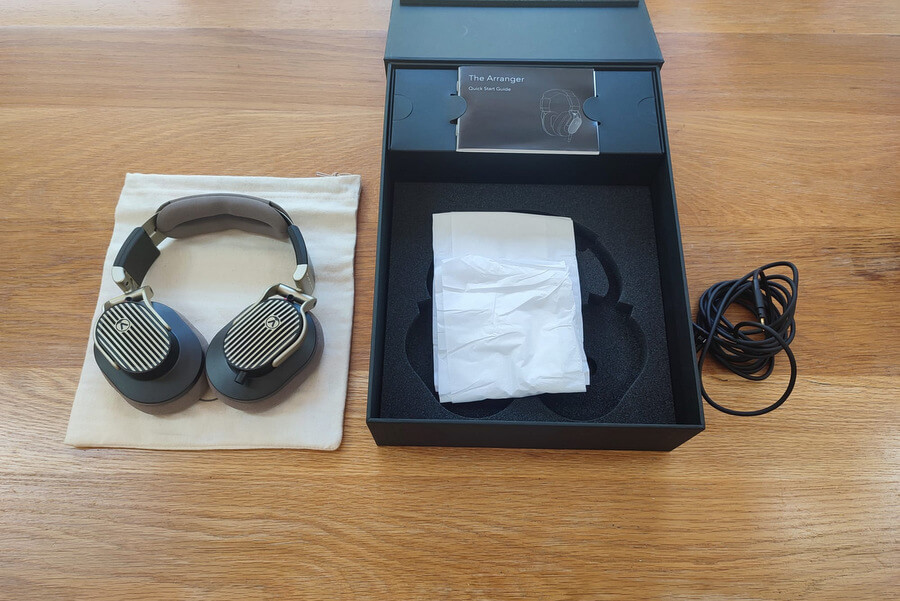
The aesthetic is functional. There is a lot of polymer in the construction, and the single sided cable terminates in a quarter inch plug, which tells you exactly where this is meant to live. The cable itself is a rubberized, high durability design that feels like it was built to be abused, rolled over by chairs, and kept working without complaint.

Advertisement

That said, it is not without character. The beige and gold finish gives it a distinctive look, and there is something appealing about how unapologetically utilitarian it is. If you do not like how it looks, it is largely irrelevant once it is on your head.

Comfort is a strong point. At 320 grams without the cable, The Arranger is relatively lightweight for its class, and that pays off over longer sessions. Six hour listening stretches are entirely manageable. The suede leatherette pads and headband padding are on the firmer side out of the box, but they do not create pressure hotspots.

Advertisement. Scroll to continue reading.

Long term usability has also been considered. The earpads and headband padding are user replaceable, which is not always a given in this category and should help extend the lifespan of the headphone.

Advertisement

The semi open acoustic design sits somewhere between fully open and closed-back. There is some attenuation of external noise, but passive isolation is limited and leakage is still present. Whether this is an issue for you or not will depend on your listening environment and personal preferences.

austrian-audio-arranger-headphones-folded

Listening

Austrian Audio positions The Arranger as a reference grade headphone for studio use. However, the tuning is not really what I or many others, for that matter, would consider to be neutral.

The overall presentation leans warm, prioritizing ease of listening over absolute clarity and detail. It is a smoother, more forgiving sound rather than a strictly analytical one. Depending on your preferences and what you listen to, that will either work in its favor or feel like a compromise.

For testing, The Arranger was paired with a range of DACs and amplifiers. That included smaller dongle options like the Campfire Audio Relay, as well as higher end desktop setups such as the Ferrum Audio WANDLA and Ferrum Audio OOR with the Ferrum Audio HYPSOS. Source material ranged from high resolution FLAC files to Spotify streams, mostly over USB.

The idea was simple. See how consistent The Arranger is across different setups, and whether it behaves more like a studio tool or something tuned for longer listening sessions.

Advertisement
austrian-audio-arranger-headphones-kit

Bass

The lower frequencies on The Arranger are clearly elevated, especially through the midbass region. This adds a welcome sense of weight and impact, giving music more drive and physicality. For harder hitting genres, it works well. Drum and bass tracks like “The Moment” by Nu:Tone and Lea Lea come across with strong dynamics and a presentation that leans toward that nightclub energy.

There is a downside. The midbass lift can introduce a bit of muddiness on certain tracks, masking finer details and slightly softening both male and female vocals. It is not overwhelming, but it is noticeable depending on the recording.

Whether that trade off is worth it for the added sense of impact will depend on your preferences.

Midrange

The Arranger has a V-shaped sound signature, which means the midrange takes a step back compared to more neutrally tuned headphones. It is not completely recessed, but it is not the focus either. As a result, vocals and instruments do not come across with the same presence or naturalness that you would expect from a true reference tuning.

Female vocals in particular sit a bit further back in the mix than expected, likely due to a dip in the upper midrange. This gives them a slightly muted quality at times. Even headphones like the HiFiMAN Arya Unveiled, which also show some recession in the 1 to 2kHz region, do not exhibit the same degree of restraint with female vocals.

Advertisement

Treble

Those who prefer a smoother, more effortless treble presentation will likely enjoy the upper frequencies on The Arranger. There are no noticeable peaks or troughs throughout, and combined with the bass elevation, the treble was pared back in a pleasant way that allowed for extended listening session with no fatigue.

Advertisement. Scroll to continue reading.

Despite this, you still get plenty of clarity and sparkle up top that can cut through the slightly bass-heavy nature of The Arranger and make things a little more exciting. For example, listening to “La lune” by L’Imperatrice, you are able to make out the faint triangle hits through the bass guitar, both of which feature heavily in the track.

Soundstaging & Imaging

The Arranger has quite a small soundstage, reminiscent of closed-back headphones despite having a semi-open design. However, the imaging precision within said stage is pinpoint accurate, making for a coherent, intimate yet multi-layered soundstage that is way more aurally pleasing than a wide soundstage with poor imaging accuracy. I enjoyed TOOL’s “Chocolate Chip Trip” through The Arranger, as I was able to follow the complex track without any of the layers getting jumbled into one.

Advertisement

An opposite example would be the AKG K702, which to my ears has a very wide but diffuse and confused spatial presentation with a murky centre image.

austrian-audio-arranger-headphones-interior

Drivability

With its relatively high sensitivity and low impedance, The Arranger is very easy to drive. In practice, it does not scale dramatically with more power or higher end source gear. Moving from the FiiO JM21 to the LAiV Crescendo VERSE resulted in only a small change in overall sound quality, and adding the Aune S17 Pro brought a slight improvement in bass texture rather than a wholesale upgrade.

That is not a criticism. If anything, it works in The Arranger’s favor. You do not need to invest heavily in a dedicated DAC or amplifier to get close to its full performance, which makes it a more practical option than many of its competitors.

The Bottom Line

The Arranger gets a lot right, but not always in the way Austrian Audio suggests. It delivers a smooth, engaging, and fatigue free presentation that makes long listening sessions easy. The elevated midbass and strong sense of dynamics give music real drive, especially with electronic, rock, and other harder hitting genres. Add in the lightweight build, solid durability, and very good comfort, and it is a headphone you can live with day to day without much effort.

The tradeoffs are just as clear. This is not a neutral or strictly reference tuned headphone. The V-shaped balance, midbass lift, and slightly recessed upper mids mean it does not excel at critical listening or vocal accuracy. Detail is there, but it is not pushed forward, and the overall presentation favors enjoyment over analysis.

Advertisement

So who is it for? Not the engineer looking for a microscope. Not the listener chasing absolute tonal accuracy. The Arranger is for someone who wants a well built, easy to drive headphone that sounds lively, forgiving, and musical across a wide range of gear.

Pros:

  • Smooth, fatigue free tuning that works well for long listening sessions
  • Strong dynamics with impactful midbass that suits electronic, rock, and other energetic genres
  • Easy to drive with low impedance and good sensitivity; no need for expensive amplification
  • Consistent performance across a wide range of sources with minimal scaling dependency
  • Lightweight at 320g with very good long term comfort
  • Durable, studio ready construction with a practical, foldable design
  • User replaceable earpads and headband padding extend product lifespan
  • Semi open design offers some awareness of surroundings without being fully exposed

Cons:

  • Aesthetic is functional and may not appeal to those expecting a more premium look
  • Not a neutral or true reference tuning despite studio positioning
  • Elevated midbass can introduce slight muddiness and mask fine detail
  • Recessed upper mids push vocals, especially female vocals, further back in the mix
  • Midrange lacks presence and natural timbre compared to more balanced competitors
  • Detail retrieval is good but not emphasized, limiting critical listening use
  • Semi open design still leaks sound and offers limited isolation

Where to buy:

Source link

Continue Reading

Tech

5 Graphics Cards That Could Outperform PlayStation 5 Pro

Published

on


Consoles and gaming PCs have been in an unofficial contest for decades. Both have their strengths: PC gaming with its customizability and superior graphical quality, and consoles with their lower entry barrier and plug-and-play nature. If you’re trying to decide which to buy, price is likely the biggest factor.

With Sony bumping up the cost of its PlayStation 5 lineup earlier this month, it’s only natural for conversations about which gaming platform offers better value to resurface. Take the PS5 Pro, the apex of PlayStation’s options, as an example; it’ll set you back $899.99 at the time of writing. That’s a number that can be hard to swallow for a mid-generation upgrade.

When the PS5 Pro launched, its rasterization performance and GPU specifications drew close comparisons to the RX 6800 — a card from AMD’s RDNA 2 generation. However, the PlayStation’s ray tracing and PSSR upscaling bring it closer to newer RDNA 4 architecture GPUs from AMD, with improved ray tracing and FSR 4 upscaling, which is why we have decided to stick to that generation in this list while also highlighting their NVIDIA counterparts. With that context in mind, here is a breakdown of the graphics cards that can go toe-to-toe with Sony’s most capable console — and the ones that leave it firmly in the rearview mirror.

Advertisement

RX 9060 XT 16 GB

If you want to match the PS5 Pro on a budget, this might be the card for you. The RX 9060 XT 16 GB is the second most affordable GPU in AMD’s current RDNA 4 lineup, and it stakes its claim as a legitimate competitor of Sony’s console hardware even in the most recent and demanding games. Independent testing from Terra Ware on YouTube used Crimson Desert, a standalone adventure IP released in March, as a basis for comparison. The title has three performance modes: Quality, Balanced, and Performance. 

Advertisement

In the Balanced and Performance modes, the testing revealed that the 9060 XT and the PS5 Pro performed very similarly with their respective upscaling technologies activated. In terms of ray tracing performance, the gap between the 9060 XT and the PS5 Pro narrows further. Here’s how ray tracing works. The PlayStation automatically uses the Ultra setting on Quality Mode and High for the other two, but the PC maintained the same quality for the entire test. 

The Quality mode runs 4K native, and that’s where the PS5 Pro really starts to slow down compared to this graphics card; the PlayStation reports 27-30 fps, while the 9060 XT stays more consistent around 29-30 fps. Those dips are more pronounced on the console, so gamers looking for reliable performance should be more inclined toward the 9060 XT. At an MSRP of $349 — though reality has it closer to $449 — this is the floor of what it costs to compete with the PS5 Pro on PC.

Advertisement

RTX 5060 Ti 16 GB

The RTX 5060 Ti is NVIDIA’s competitor to the 9060XT, and it comes in at a pricier $429 MSRP. That’s more of an ideal price at this point, though, as current memory chip shortages are driving the prices up. The rasterized performance difference between the two cards is enough to keep things interesting, but NVIDIA’s ecosystem comes with a more robust package. Like the 9060XT, this card also has 8 GB and 16 GB options.

However, the 8 GB memory buffer can be a bottleneck when playing at resolutions higher than 1080p. You might encounter losses in texture quality or frame time drops; experiences that make the 16 GB version of the graphics card the more favorable option for a seamless gaming experience.

In a test by Digital Foundry, which also featured the PS5 Pro and the 9060XT, the 5060 Ti performed better than both by about 2 to 15%, depending on the title and graphics setting. In terms of game support, NVIDIA’s latest upscaling tech (DLSS 4) has more support than AMD’s FSR 4, since more games come with it baked in. On the other hand, you have to rely on mods like Optiscaler to enable AMD’s latest upscaler in many titles.

Advertisement

RTX 4070 Super

The RTX 4070 Super is a last-generation NVIDIA card, meaning its RTX 50 series successors are already on the shelves. Despite the flurry of newer options, exploring the used market could unearth a gold mine if you’re looking to squeeze more performance out of your budget. The 4070 Super is a prime example of this; you can get it for as low as $520 on eBay. It’s not dated either: NVIDIA launched it in 2024 as a mid-series upgrade for the 4070, packing the card with 12 GB of GDDR6X memory and a level of rasterization muscle that the 5060 Ti 16GB finds it difficult to match.

Advertisement

This is particularly interesting since many people associate VRAM size with performance, but there are a lot of other factors that come into play when it comes to rendering games. In a test by Hardware Unboxed, Cyberpunk 2077 running at 1440p with Ray Tracing turned up to Ultra and Quality Upscaling could only reach 46 FPS on the 5060 Ti, while the 4070 Super averaged 66 (a 43% uplift). Although this represents an outlier, across an average of seven games with Ray Tracing turned on at 1440p, the 4070 Super was 8% faster.

When considering pure rasterized performance, the 4070 Super was 30% faster than the 5060 Ti across 16 titles at 1440p and 4K. Using the performance difference we established earlier between the PS5 Pro and the 5060 Ti, we can say that the RTX 4070 Super will outstrip the console with room to spare.

Advertisement

RTX 5070

If you have reservations about exploring the used market, the current gen RTX 5070 is also a valid option for 4070 Super-like performance. This card launched at an MSRP of $549, but prices now range from $600-$700 depending on your deal-hunting skills. Like the 4070 Super, the 5070 also comes with 12 GB of memory, but the newer generation features the faster GDDR7. 

That configuration gives it more memory bandwidth. However, the former contains fewer CUDA cores and consumes less power than the latter. Wondering what CUDA cores are? We have an explanation for you. That equates to equal rasterized performance across 16 games in 1440p and 4K. However, gen-on-gen improvements to ray tracing mean the RTX 5070 is 4% faster across 7 titles in 1440p in ray tracing and performs equally in 4K. 

For those interested in gaming in 4K natively or with quality upscaling, this card serves as an entry-level option. However, you should note that the 12 GB memory buffer may start to show its limitations in more demanding titles like “Alan Wake 2”.

Advertisement

RX 9070

The Radeon RX 9070 is AMD’s response to NVIDIA’s 5070, sharing the same MSRP of $549. It is also not exempt from the memory chip issues affecting the market, driving the price of the cheapest model currently available on Newegg to $620. However, it possesses a generous 16 GB of GDDR6 VRAM and raster performance that slightly edges out the 5070. 

Advertisement

According to Hardware Unboxed‘s testing, the RX 9070 is 4% faster than the 5070 and 4070 Super in rasterized gaming performance at 1440p and 7% faster in 4K. NVIDIA’s superior ray tracing performance means the 9070 is 10% slower than the 5070 across those seven titles in 1440p with ray tracing turned on. The 16 GB memory buffer is a meaningful future-proofing advantage over the 5070’s 12 GB, particularly as games become increasingly VRAM hungry. 

If you intend to build a PC in 2025 with longevity in mind, and the PS5 Pro as your performance benchmark, the RX 9070 clears with enough headroom and might even challenge the PS6 when it releases.

Advertisement


Source link

Continue Reading

Tech

SeekOut’s Anoop Gupta steps down as CEO, hands reins of AI recruiting company to tech vet Sean Thompson

Published

on

SeekOut co-founders Aravind Bala (left) and Anoop Gupta, who is stepping down as CEO to become executive chairman. Bala will continue as CTO, working with new CEO Sean Thompson. (SeekOut Photo)

Anoop Gupta is stepping down as CEO of SeekOut, the Bellevue-based recruiting startup he co-founded in 2017, handing the reins to enterprise software veteran Sean Thompson and turning his attention to growing heirloom tomatoes, among other pursuits.

Gupta, 67, whose long Microsoft career included stints as Bill Gates’ technical assistant and head of Skype and Exchange, plans to step down from his full-time role May 4 and become executive chairman. The decision has been a few years in the making, he said in an interview.

“I am a geek and an entrepreneur, but to me, the most important things are the people and the connections and the storytelling and, you know, vegetables,” he said.

Enterprise technology veteran Sean Thompson will become SeekOut’s new CEO.

As the new CEO, Thompson said he plans to focus on scaling SeekOut Spot — the agentic AI recruiting service launched a year ago — while pursuing acquisitions of recruiting agencies to help fuel long-term growth.

A Seattle-area business and technology veteran, Thompson most recently led NAVEX, a private-equity backed governance and compliance software company, as president and CEO from 2022 until early 2025. He previously held senior roles at SAP and Microsoft, and co-founded the AI startup Nuiku, which sold to Nortek in 2016.

Thompson lives in Bellevue, about two miles from SeekOut’s office, and spent the past year in semi-retirement, riding horses on his Montana property and taking on board advisory roles.

Advertisement

Now he’s getting back in the startup saddle. In an interview, Thompson said SeekOut’s opportunity to take advantage of progress in agentic AI was too compelling to sit out.

“There’s a large market out there, and we can fundamentally change the way candidates experience the search process, and the way hiring managers approach the search process,” Thompson said. “Being able to make an impact is really what inspired me.”

Announcing the news Thursday morning, the company said SeekOut co-founder Aravind Bala, who has led product and engineering since the company’s founding, will continue as chief technology officer and work closely with Thompson on the next phase of growth.

Gupta and Bala worked together at Microsoft on Office Mix, an online presentation service, before leaving to launch a company together. As GeekWire reported at the time, they initially pursued a messaging service based on the idea that recipients — not senders or platforms — should be compensated for their attention. That idea didn’t take off, but a tool that they built to find potential customers became the foundation of SeekOut.

Advertisement

SeekOut has raised a total of $189 million from investors including Tiger Global, Madrona Venture Group, and Mayfield, hitting a $1.2 billion valuation with its Series C in early 2022. It grew rapidly and expanded headcount, but cut staff twice — in October 2023 and May 2024 — as the economy turned and the recruiting market contracted.

Today it has roughly 150 employees, more than 750 corporate customers, and over $100 million in the bank, according to Gupta. That gives SeekOut the runway to deepen its AI initiatives and time to pursue the acquisitions Thompson described as central to his plans.

SeekOut ran a formal executive search for more than six months, but Thompson didn’t come through that process. He was initially brought in as an advisor on SeekOut’s acquisition strategy, through connections including SeekOut general counsel Sam Shaddox — his outside counsel during the sale of Nuiku — and the Seattle M&A advisory firm Alexander Hutton, where his brother James Thompson works.

Through that advisory work, Thompson connected with Bala, and the CEO conversation evolved from there. “It clicked, and moved just very fast,” Gupta said.

Advertisement

SeekOut operates in two areas: Recruit, an AI-powered platform that recruiters can use to search more than a billion candidate profiles; and Spot, the service that pairs AI agents with SeekOut’s own recruiters to deliver interview-ready candidates to hiring managers in about two weeks. Under Thompson, Spot is expected to be the major focus.

As executive chairman, Gupta estimates he’ll spend 20% to 25% of his time on the role. More broadly, he said, he worries about the societal impact of AI, and wants to make more time for the things technology can’t accelerate, such as family, relationships, and community.

“Tomatoes don’t grow any faster,” he said. “They still take a season to grow.”

Source link

Advertisement
Continue Reading

Tech

Hackers exploit Marimo flaw to deploy NKAbuse malware from Hugging Face

Published

on

Hackers exploit Marimo flaw to deploy NKAbuse malware from Hugging Face

Hackers are exploiting a critical vulnerability in Marimo reactive Python notebook to deploy a new variant of NKAbuse malware hosted on Hugging Face Spaces.

Attacks leveraging the remote code execution flaw (CVE-2026-39987) started last week for credential theft, less than 10 hours after technical details were disclosed publicly, according to data from cloud-security company Sysdig.

Sysdig researchers continued to monitor activity related to the security issue identified additional attacks, including a campaign that started on April 12 that abuses the Hugging Face Spaces platform for showcasing AI applications.

Wiz

Hugging Face serves as an AI development and machine learning-focused platform, acting as a hub for AI assets such as models, datasets, code, and tools, shared among the community.

Hugging Face Spaces lets users deploy and share interactive web apps directly from a Git repository, typically for demos, tools, or experiments around AI.

Advertisement

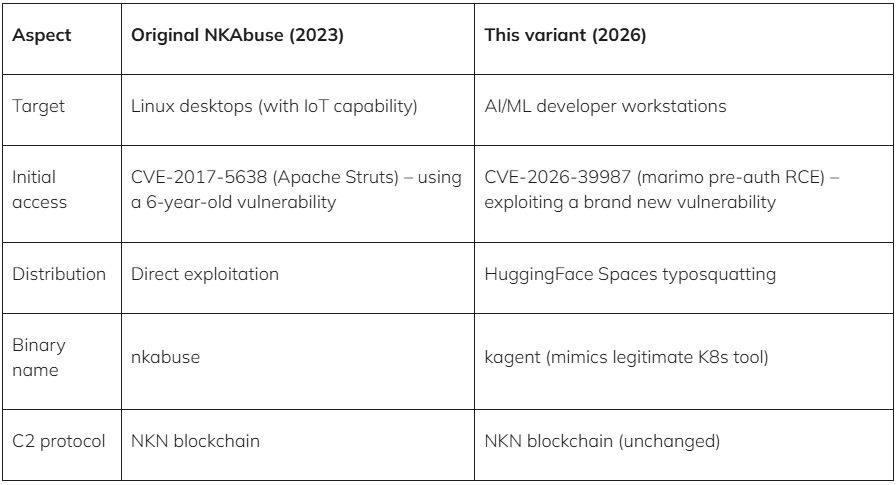
In the attacks that Sysdig observed, the attacker created a Space named vsccode-modetx (an intentional typosquat for VS Code) that hosts a dropper script (install-linux.sh) and a malware binary with the name kagent, also an attempt to mimic a legitimate Kubernetes AI agent tool.

After exploiting the Marimo RCE, the threat actor ran a curl command to download the script from Hugging Face and execute it. Because Hugging Face Spaces is a legitimate HTTPS endpoint with a clean reputation, it is less likely to trigger alerts.

The dropper script downloads the kagent binary, installs it locally, and sets up persistence via systemd, cron, or macOS LaunchAgent.

According to the researchers, the payload is a previously undocumented variant of the DDoS-focused malware NKAbuse. Kaspersky researchers reported the malware in late 2023 and highlighted its novel abuse of the NKN (New Kind of Network) decentralized peer-to-peer network technology for data exchange.

Advertisement

Sysdig says that the new variant functions as a remote access trojan that can execute shell commands on the infected system and send the output back to the operator.

“The binary references NKN Client Protocol, WebRTC/ICE/STUN for NAT traversal, proxy management, and structured command handling – matching the NKAbuse family initially documented by Kaspersky in December 2023,” mentions Sysdig in the report.

Comparison table
Source: Sysdig

Sysdig also spotted other notable attacks exploiting CVE-2026-39987, including a Germany-based operator who attempted 15 reverse-shell techniques across multiple ports.

They then pivoted to lateral movement by extracting database credentials from environment variables and connecting to PostgreSQL, where they rapidly enumerated schemas, tables, and configuration data.

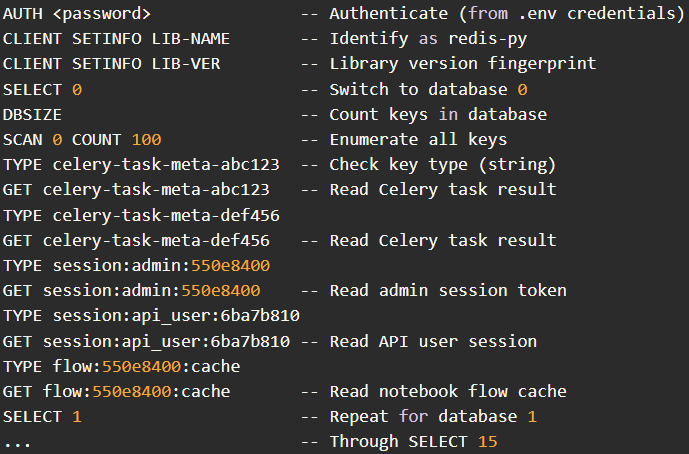
Another actor from Hong Kong used stolen .env credentials to target a Redis server, systematically scanning all 16 databases and dumping stored data, including session tokens and application cache entries.

Advertisement
Redis
Source: Sysdig

The overall takeaway is that exploitation of CVE-2026-39987 in the wild has increased in volume and tactics, and it’s crucial that users upgrade to version 0.23.0 or later immediately.

If upgrading is not possible, it is recommended to block external access to the ‘/terminal/ws’ endpoint via a firewall, or block it entirely.

Automated pentesting proves the path exists. BAS proves whether your controls stop it. Most teams run one without the other.

This whitepaper maps six validation surfaces, shows where coverage ends, and provides practitioners with three diagnostic questions for any tool evaluation.

Source link

Advertisement
Continue Reading

Tech

5 Expensive Milwaukee Tools Users Say Are Worth Buying

Published

on


We may receive a commission on purchases made from links.

There’s no way around it: Milwaukee is an expensive brand. The toolmaker produces a lot of niche tools that specialized professionals rely on, as well as more common work tools and small, portable alternatives for DIYers and renters, and none are known for being especially affordable. For that, you’ll want to look at cheaper brands like Ryobi, Hercules, and Kobalt instead.

Advertisement

However, purchasing an expensive tool doesn’t mean you’re wasting your money. Sure, buying into the Milwaukee ecosystem is a serious investment, but sometimes that investment pays off in spades. That’s true for a lot of the more expensive Milwaukee tools, but the five examples on this list represent the most beloved products made by the brand that the community absolutely recommends, even if they have a big price tag attached.

Of course, you should check for any active promotions. If you shop at Home Depot, for example, you can often get a Milwaukee tool with a battery included at no extra cost.

Advertisement

M18 Fuel Hammer Drill and Impact Driver Combo Kit

This kit, which includes the M18 Fuel Hammer Drill, the Impact Driver, and two M18 XC 5.0Ah batteries, is normally $400. It is not the cheapest way to get a drill and a driver, and even Milwaukee itself sells a more affordable hammer drill and impact driver bundle as part of the M12 portable productivity system lineup.

That said, $400 is a good price for a kit as versatile and powerful as this, at least according to professional reviewers and those who own it. The bundle has a nearly perfect review score on Home Depot, and Pro Tool Reviews called the M18 Fuel Impact Driver in this kit “the best all-around impact driver we’ve tested to date.” While the publication didn’t have quite the same words for the drill, it was still highly recommended, especially for its overall value.

That’s the secret to this bundle. While it isn’t cheap, the reason users so often recommend it is that, compared to buying its individual components, the kit is a steal. The two included batteries are usually sold for $170 each, while just one of these tools costs more than $200, making this combo kit, model number 3697-22, the cheaper option by far. Plus, the kit often goes on sale, and sometimes it comes with the High Output 6.0Ah M18 battery pack as a “free gift,” which is worth $200.

Advertisement

M18 Fuel Oscillating Multi-Tool

Sold for $250, most users say the M18 Fuel Oscillating Multi-Tool is worth the price, even if other brands’ alternatives are quite a bit cheaper. DeWalt even sells a whole kit with battery, a charger, a bag, and an oscillating multi-tool for less than just the Milwaukee tool. Professional reviews of Milwaukee’s tool are very positive, with Pro Tool Reviews listing its relatively slow tool-free blade change as the only negative. Meanwhile, users simply love it, with many comparing it favorably to DeWalt’s version. At the time of writing, this tool is offered in a bundle with a High Output 6.0Ah M18 battery at no additional cost. According to users, this kind of deal happens pretty often.

Advertisement

While it seems to be aimed at carpenters (lots of enthusiastic users are, in fact, carpenters), there’s a lot you can do with a Milwaukee oscillating multi-tool. However, you need to get the right blades and attachments first. You can buy Milwaukee blades. However, with much less attention from users, it’s hard to say if they’re worth the higher price. Thankfully, a number of Ryobi attachment sets work on Milwaukee multi-tools, and they’re way cheaper than Milwaukee’s originals. A 16-piece set of blades and accessories from Ryobi will cost you about $50, significantly less than Milwaukee’s $70 eight-piece blade kit.

Advertisement

M18 Fuel Hackzall Reciprocating Saw

While it’s now a somewhat common term for all small reciprocating saws, Milwaukee invented and owns the name Hackzall. It’s no surprise, then, that the company makes some of the best versions of this versatile one-handed tool. Its versatility means you’ll likely be using it more often than other cutting tools. Users recommend you pick the best of the best, the M18 Fuel Hackzall. This is a brushless tool, meaning (among other things) that the motor is less likely to fail; great for something you’ll get a lot of use out of.

The Fuel Hackzall is more expensive than non-M18, non-Fuel Milwaukee versions, as well as other brands’ alternatives. DeWalt’s Atomic Brushless reciprocating saw is technically just as expensive (both are sold at $200 when not on sale), but you can get DeWalt’s for free “with a qualifying purchase,” like a big pack of batteries and chargers.

Still, users say the Milwaukee is absolutely worth the price for the pivoting shoe and power. It gets 4.8 out of 5 stars on Home Depot, is recommended by many of its users, and has great professional reviews as well.

Advertisement

M18 Fuel 1/2-inch Controlled Mid-Torque Impact Wrench

Why is an impact wrench that only goes up to 250 ft-lb of torque priced at $1,599.00? As you might imagine, the 1/2-inch Controlled Mid-Torque Impact Wrench isn’t a normal impact wrench. “Controlled” in the name refers to the ability to set a target torque via the One Key app without worrying that the tool will overtorque: an ability that few impact wrenches have, and one that Milwaukee claims to have perfected. And every single user review on Home Depot is a full five stars, wholeheartedly recommending this tool to those who need it.

According to Milwaukee, rather than relying on the imprecise method of counting the blows performed by the tool, this impact wrench uses sensors and “machine learning developed algorithms” to achieve higher repeatability. In this context, high repeatability means that repeated uses of the tool under similar circumstances create very similar results. Setting the torque to 100 ft-lb might not result in that exact number (that’s accuracy), but it will produce the same number every time.

Advertisement

If you were confused by its price, you weren’t the only one. Users ask about it quite often on the Milwaukee subreddit, and the answer is always the same: For someone who works on large-scale installation projects where precise torque levels are necessary, this tool (or the higher and lower torque models) is absolutely worth the money. As Milwaukee points out, the controlled torque line is designed for utility-scale solar projects like solar farms. And as noted by Pro Tool Reviews in its buying guide for this product, a trusty controlled torque impact wrench can save lots of time by removing the need to finish each bolt with a manual torque wrench.

Advertisement

M18 Fuel Gen-2 Mid Torque Impact Wrench

More users recommend the Fuel Mid Torque Impact Wrench over the high torque version, since it’s not as heavy and can still handle most of what you can throw at it. With up to 650 ft-lb of breakaway torque, 2,575 max rpm, and a dedicated function to maximize torque when removing tough bolts, it shouldn’t have any problems with removing lug nuts from cars, SUVs, and pickup trucks.

Some users point out that it can struggle with nuts stuck with rust, but most owners seem to agree that, even at $279, the Mid Torque 1/2-inch Impact Wrench is worth its price. It has a near-perfect review score on Home Depot, with a 4.9-star average from over 2,500 user reviews. Users on forums praise the weight-to-power ratio, and professional reviews place it near the top of the pile for mid-torque impact wrenches.

When using it with a large 5.0Ah battery, it weighs only around five pounds, while the head is only about six inches long, which helps it fit into tighter spaces. With four power modes and an auto shut-off to prevent overtightening, it’s a relatively precise tool, too.

Advertisement


Source link

Advertisement
Continue Reading

Tech

Ryu and Ken Lead the Charge in the Latest Street Fighter Trailer

Published

on

New Street Fighter Trailer Movie 2026
Set in neon-lit 1993, the new Street Fighter film follows Ryu and Ken, formerly best friends but now estranged, as they are brought back together by the mysterious Chun-Li. Some nefarious powers lurk in the shadows of the World Warrior Tournament, compelling the couple to confront each other as well as some unpleasant memories from their past that they thought they’d forgotten.


Ken Masters appears on screen as the has-been celebrity that he has become, the ideal host for some cringeworthy MTV-style show, but Noah Centineo manages to lend a little of humor to the role, even when Ken is screaming out off-key karaoke and plainly has lost a step. Despite this, he manages to unleash his trusted Shoryuken uppercut, followed by the roll back throw that usually sends opponents reeling, and land a Jinrai Kick straight out of the current games, a lovely touch that reminds everyone that you never lose your fighting talents totally.

New Street Fighter Movie Screenshot
Ryu is about as far from the flashy showbiz life as you can get, a solitary martial artist who has managed to step back from the limelight, but Andrew Koji adds depth to the character, revealing a man who is a force to be reckoned with even when he is alone in the still of the night training for the next battle. Even as Ken delivers a flying kick, Ryu blinks briefly before he and Ken exchange glances, sizing out their old enemy. Later, we see Ryu gathering energy in his palms, and then, in a moment that will send every Street Fighter fan wild, he says the one phrase we’ve all been waiting for: “Hadouken.”

New Street Fighter Movie Screenshot
Chun-Li emerges as the driving force for Ryu and Ken’s reunion, and she possesses a steely will. Callina Liang has the poise and strength of an Interpol agent who is personally invested in seeing justice served. She wants vengeance on those who killed her father, and she believes the infamous M. Bison is behind it all. From the start, she sees Ryu as a man hiding from the world, and Ken as something of a sideshow relic, but when she recruits them both, we get a taste of the banter, including a throwaway exchange in which she trades barbs with Cammy about her famously muscular legs, a wink to all the old-school players. Chun-Li then demonstrates her own top training with the Hundred Lightning Legs move, a whirlwind of kicks that proves she’s one of the best.

New Street Fighter Movie Screenshot
Additional fighters round out the roster, resulting in some very unforgettable scenes. Joe Anoa’i makes a brief appearance as Akuma, hurtling at Ryu with a dark energy whirling about him like a mad storm in a technique known as Empyrean’s End. Curtis Jackson appears as Balrog, the heavyweight boxer who has a serious go at Ken early on. Olivier Richters looms enormous as Zangief, who attacks Ken with a piledriver that appears to have been plucked straight from the games. Jason Momoa plays Blanka, the green-skinned warrior whose electric powers stem from a bizarre tale concerning an aircraft crash. Cody Rhodes exudes Guile’s confidence with military swagger. Meanwhile, lesser roles are given to some fairly familiar faces, like Orville Peck as the clawed Vega, Vidyut Jammwal as the stretchy Dhalsim, and Eric Andre as the loudmouth announcer Don Sauvage, and each cameo just long enough to get that old familiar spark going before the next blowout begins.

New Street Fighter Movie Blanka
Director Kitao Sakurai, who has worked on episodes of Twisted Metal and other projects, keeps the whole thing moving at a high energy level while yet keeping it grounded. The film will be released in theaters on October 16, 2026.

Source link

Advertisement
Continue Reading

Tech

How are balance, inclusion and skills critical to the workforce of the future?

Published

on

Rent the Runway’s Stephanus Meiring discusses the workforce of the future and what it will take to make it productive and sustainable.

For Stephanus Meiring, vice-president of engineering, managing director and site lead at Rent the Runway, the biggest challenge facing the workplace and workforce of the future is the pace of change. 

He said, “Things are moving faster than many organisations and individuals are used to and that creates uncertainty. But the opportunity is just as real. The people who tend to do well in these moments are the ones who are willing to learn, adapt and get involved rather than dismissing change as hype. 

“In my space – software engineering and delivery – AI is already changing how work gets done. I think that same pattern will play out across most industries in different ways.”

Advertisement
What part will diversity and inclusion play in the make-up of the workforce of the future?

A very important one. As technology becomes a bigger part of how work gets done, different perspectives shaping the tools, the decisions and the guardrails around them are needed. Inclusion will also mean making sure people have access to learning and the opportunity to build new skills, not just access to jobs.  If that part is missed, the benefits of change will not be shared evenly.

Work-life balance is arguably central to job satisfaction – is this achievable by having a future-focused mindset?

It can be, but only if companies approach it in the right way. Technology should help remove repetitive work, reduce some of the manual grind and give people more time for the parts of work that really need judgement and creativity. Used well, that should improve work-life balance. But if companies simply use new tools to expect more and more output without rethinking workload and priorities, then it could just create a different kind of pressure.

We’ve recently seen increases in salary, particularly in tech. Do you think the future of work will bring in other types of non-salary benefits?

Yes, definitely. Salary will always matter, but I think other benefits will become even more important. Flexibility, learning opportunities, time to upskill, access to strong tools, good leadership and work that feels meaningful will all matter more. In a fast-changing environment, helping people stay relevant and grow their skills is a real benefit in itself.

We’re looking at a more automated future, so how do you think this will affect roles in your sector?

In software engineering, delivery and support, the nature of the work is already changing. The craft of sitting and typing code all day is shifting quickly. But writing code was never really the whole job, and it was rarely the biggest bottleneck on its own. The harder part has always been understanding the problem properly, making good decisions, and delivering something reliable, secure and useful.

Advertisement

AI can now help more with those parts too, which is exciting, but it also means human judgement, critical thinking and accountability become even more important, not less.

What new jobs do you think will come to the fore?

I think we will see more roles and responsibilities emerge around AI governance, automation oversight, quality control, platform enablement, model risk, as well as jobs where people need to bridge technical depth with business context. But beyond that, I think some of the most important jobs of the future may be ones we cannot fully describe yet.

A role a few years from now might look less like someone doing one narrow task all day, and more like someone directing systems, validating outputs, making judgement calls, and bringing creativity and context that machines do not have. In many cases, jobs may not disappear so much as evolve. A lot of what comes next is still speculation, so the best response is to get involved, keep learning and be ready for change.

What will companies need to do to attract and support the best talent?

They will need to create environments where people can learn quickly, use modern tools and still feel supported and trusted. The best talent wants room to grow, but also clarity and direction. Companies that combine ambition with sensible guardrails will be in the strongest position. People are much more likely to stay where they feel they are growing, where leadership is clear and where the company is helping them prepare for what is next rather than leaving them to figure it out alone.

Advertisement
In your opinion and from experience, what can companies do today to prepare for the work of tomorrow?

Start now. Encourage people to learn, experiment safely and build confidence with new tools. Update your ways of working, not just your technology. In the next year, I think the biggest shift will be how quickly teams bring AI into everyday work.

Over five years, I expect we will see many roles reshaped around judgement, oversight, creativity and decision-making far more than routine execution. The companies that prepare early, invest in people and build the right habits now will have a real advantage.

Don’t miss out on the knowledge you need to succeed. Sign up for the Daily Brief, Silicon Republic’s digest of need-to-know sci-tech news.

Advertisement

Source link

Continue Reading

Tech

Google adds Nano Banana image generation to Gemini’s Personal Intelligence feature

Published

on

In short: Google has added Nano Banana-powered image generation to Gemini’s Personal Intelligence feature, letting the AI create images informed by a user’s Gmail, Photos, Calendar, Drive, and other Google app data. The feature rolls out to Plus, Pro, and Ultra subscribers in the US first, with Europe excluded from the initial global launch. Nano Banana is Google’s native image generation family for Gemini, now spanning three model versions.

Google has added Nano Banana-powered image generation to Gemini’s Personal Intelligence feature, letting the AI create images that draw on a user’s personal context across Gmail, Photos, Calendar, Drive, and other Google apps. The update means Gemini can now generate images informed by who you are and what you do, not just what you type into the prompt.

The feature is rolling out to Plus, Pro, and Ultra subscribers in the United States in the coming days, with free users expected to gain access over the next few weeks. Google says it plans to expand to Gemini in Chrome on desktop and to additional markets, though Europe is notably excluded from the initial global rollout of Personal Intelligence.

What Nano Banana is

Nano Banana is Google’s native image generation capability for the Gemini model family, distinct from Imagen, Google’s dedicated text-to-image line. Where Imagen is built for users who prioritise quality, iteration speed, and professional workflows, Nano Banana is designed for conversational image generation within the Gemini interface, accepting text, images, or both as inputs.

Advertisement

The family now includes three versions. The original Nano Banana, built on Gemini 2.5 Flash, handles basic conversational image generation. Nano Banana 2, launched in February 2026 on Gemini 3.1 Flash, combines the advanced features of the Pro version with faster iteration speeds. Nano Banana Pro, built on Gemini 3 Pro, incorporates the model’s full reasoning and real-world knowledge into image generation, producing outputs that reflect deeper understanding of prompts rather than surface-level pattern matching.

Advertisement

The technical advantage Google claims is that Nano Banana uses the Gemini model’s language understanding to capture prompt nuance in ways that standalone image generators cannot. Because the image generation is native to Gemini rather than bolted on as a separate system, the model can reason about what you are asking for before generating the image, drawing on context from the conversation and, now, from your personal data.

The personal intelligence angle

Personal Intelligence is Google’s framework for connecting Gemini to a user’s Google account data. Launched in January 2026, it lets Gemini access text, photos, and videos from Gmail, Calendar, Drive, Google Photos, YouTube, Search, Maps, and other first-party apps. The feature is opt-in, with users controlling which apps Gemini can access, and Google says the AI does not train on personal data.

Until now, Personal Intelligence has primarily powered text-based personalisation: answering questions about your travel plans by reading your Gmail confirmations and calendar entries, or making shopping suggestions based on purchase history. Adding Nano Banana image generation extends the personalisation to visual outputs. Google’s example use cases include generating images that incorporate your personal photos, creating visuals informed by your preferences and context, and producing outputs that reflect an understanding of your life rather than generic stock imagery.

A “sources” button shows how Gemini derived the context for each personalised image, giving users visibility into which personal data informed the output. This is a meaningful transparency feature in a product category where the provenance of AI-generated content is increasingly contentious.

Advertisement

The competitive context

Google is not the first to combine personal context with AI image generation, but it has a structural advantage that no competitor can easily replicate: it already has more personal data than any other consumer technology company. Gmail, Google Photos, Drive, Calendar, Maps, Search, and YouTube collectively represent a more comprehensive picture of a user’s life than any single app or platform can offer. Connecting that data to a capable image generator creates a personalisation moat that is difficult for OpenAI, Apple, or Meta to match without equivalent data breadth.

The timing also matters. ChatGPT’s image generation capabilities have driven significant user engagement for OpenAI, and Apple Intelligence has been integrating on-device AI features across the iPhone ecosystem. Google’s response is to lean into what it does best: cross-product integration powered by its unmatched data infrastructure.

On-device image generation with Gemini Nano is also coming to Pixel phones and Android devices, which would enable instant, private generation without cloud dependency. That combination, cloud-powered personalised generation for complex requests and on-device generation for speed and privacy, positions Google to cover both ends of the use case spectrum.

The privacy question

The obvious concern is that giving an AI image generator access to your personal photos, emails, and browsing history creates risks that Google’s opt-in controls may not fully address. Google says it does not train on personal data, but the feature necessarily involves processing that data to generate contextually relevant images. The distinction between “training on” and “using for inference” is technically meaningful but may be lost on users who simply see an AI that knows what their house, their children, or their holiday looked like.

Advertisement

Europe’s exclusion from the rollout suggests that Google’s own assessment is that the feature may face regulatory friction under GDPR and the AI Act. The company has form here: Gemini’s initial launch was also delayed in Europe, and Google has repeatedly had to navigate the gap between the personalisation its products depend on and the data protection frameworks that European regulators enforce.

For users who opt in, the value proposition is clear: an AI assistant that can generate images reflecting your actual life, preferences, and context rather than producing generic outputs from a prompt alone. For users who are wary of handing that much personal context to an AI system, the “sources” button offers some transparency, but the fundamental trade-off, personalisation in exchange for data access, is one that Google has been asking its users to make for two decades. This is simply the latest, and most visually expressive, version of that bargain.

Google has not disclosed pricing changes or additional costs for Nano Banana-powered Personal Intelligence image generation. The feature appears to be included in existing subscription tiers, which range from the free plan through Plus, Pro, and Ultra, with the pace of rollout tied to subscription level.

Advertisement

Source link

Continue Reading

Tech

The Always Pan People Made a Rice Cooker, and It’s Totally Adorable

Published

on

Popular kitchen brand Our Place is expanding its lineup with a new rice cooker. The compact kitchen appliance was created with chef and best-selling author J. Kenji López-Alt, and we had a chance to test it firsthand.

The Wonder Oven Pro and the Always Pan 2.0 made millions of fans, including me, so I was excited to test the new appliance to see if it lived up to the company’s innovative reputation and social media hype. 

Like all of Our Place’s products, the rice cooker has a sleek, simple, vaguely retro design with just the right amount of controls. A large button on the front of the appliance pops the device open, while the smaller buttons on the top control the mode and temperature.  

Advertisement
a tan rice cooker on a wooden table

The rice cooker keeps a sleek look by showcasing the digital display only when it’s plugged in.

Corin Cesaric-Epple/CNET

There are four modes: white rice, brown rice, oatmeal and a custom option for additional grains, and it has a six-cup capacity of cooked rice.

It also uses “fuzzy logic technology,” a common feature in high-end rice cookers. Essentially, it means the appliance uses built-in sensors that read the internal temperature and adjust it as needed for perfect cooking.

Advertisement

When the rice cooker is on, the digital display matches that of the Wonder Oven Pro, another element that creates the cohesive look the brand is known for. Using the rice cooker is easy and feels familiar if you’ve used any of Our Place’s other appliances. 

the top of a tan rice cooker sitting on a counter

You can adjust time and temperature.

Corin Cesaric-Epple/CNET

The rice cooker comes with a silicone measuring cup and a small wooden spatula, essentially a mini version of the one included with the Always Pan. Plus, it won’t scratch the nonstick coating.

Advertisement
a tan rice cooker open on sitting on a wooden table

Although the rice maker feels small, it fits six cups of cooked rice.

The Our Place rice cooker is available now for $139 — admittedly a bit pricey for a rice cooker — in five different colors, including blue salt, steam, spice, char and the limited-edition pistachio. 

Advertisement

Source link

Continue Reading

Trending

Copyright © 2025