Back during World War II, Adolph Hitler dreamed of bombing the United States, but technology at the time literally couldn’t deliver. Nowadays, intercontinental flights are easy, thanks to aerial refueling. That’s how most aircraft in the United States Air Force operate, but the Russian Federation’s Su-34 is a completely different type of jet. The Su-34 Fullback can fly from Moscow to Washington, D.C. without refueling, which is impressive, seeing as that’s a distance of 4,867 miles.
There are several reasons why the Su-34, which Russia has used in the Russo-Ukrainian War, can fly so far. For one, it’s a massive aircraft, measuring 76.5 feet in length with a 48-foot wingspan. Under normal operations, it doesn’t need to go that far. In cases where it might be needed, it can add three PTB-3000 external fuel tanks to its hard points, which normally accommodate weapons, significantly increasing its range. Each of those tanks holds 793 gallons of fuel, which is added to the bomber’s internal fuel capacity.
Advertisement
That fuel capacity gives the Su-34 a ferry range of 2,485 miles. Once you add the external fuel and push the Su-34 to its limits, its range can exceed 4,971 miles. That puts it in range to strike Washington, D.C., though it wouldn’t be able to make a return trip home without refueling. Granted, it’s unlikely that Russia would ever use its Su-34 fleet in such a manner, but it could, making the Su-34 one of the most powerful non-American fighter jets in service.
Advertisement
The Su-34 is the world’s longest-range fighter (currently)
With its added drop tanks, the Su-34 is the world’s longest-range fighter, and it’s not even close. The United States’ longest-range fighter is the F-35C Lightning II, which has an internal fuel capacity of 3,002 gallons. That gives it a range of 1,381 miles. The F-35 doesn’t have drop tanks, but they are being designed for the Block 4 upgrade that’s expected to be complete no sooner than 2031. Of course, aerial refueling can indefinitely extend the F-35’s range.
Still, it pales in comparison to the Su-34. Additionally, the Su-34 will likely receive an upgrade in the form of the AL-51F engine, which was developed for the Su-57 5th-generation fighter. The Su-34 is a 4.5-generation fighter (sometimes referred to as a 4++ generation), thanks to various upgrades that keep it flying. With the introduction of a more fuel-efficient engine, it’s likely that the aircraft’s range will increase significantly, making it a truly intercontinental strategic aircraft.
The Su-34 first entered the Russian inventory in 1990, and it has a proven track record. While it’s unclear how many Russia has, estimates put the Russian Air Force’s inventory at around 123 Su-34s. Production continues, and several have been lost in Ukraine, so the total number in the inventory fluctuates over time. Regardless, Russia probably sees a future where the Su-34 remains an important part of its strategic focus, so it’s likely that the country will continue producing its intercontinental fighter for the foreseeable future.
With so many online messaging services to choose from it’s almost as though the daddy of them all, email, has faded into the background as something you only use for more formal contacts. But it’s still the underpinning of much of the business world’s electronic communication and is likely to stay so for the foreseeable future. The BBC Archive takes us back to a time when email was relatively new, when in 1986 [Lesley Judd] takes a very chunky 1980s laptop on a plane from London to the Netherlands, and sends an email to her colleague at home using a payphone and an acoustic coupler.
There are so many of-their-era quirks in this film it’s difficult to pick, but little things like the aircraft still having smoking and non-smoking areas, there being no sign of a mobile telephone, or the payphone operating in Guilders rather than Euros make it from a different time. Perhaps most interesting though is the email system in use, because this isn’t an internet based service. Instead it’s using Telecom Gold, which was the UK telco BT’s online service offering to businesses, and part of the international Dialcom network. This was a commercial service which hung on until some time in the 1990s when the Internet finally displaced it.
The British writer L. P. Hartley used the phrase “The past is a foreign country; they do things differently there” as the opening sentence of one of his books, and the film below the break certainly brings that to mind. It’s a time that’s within reach, yet the changes in information technology over even the next decade or so would make the tech depicted not just obsolete but almost unrecognizable. Most of us today could sit at a 1996 laptop and send an email, but few of us would be as immediately at home with Telecom Gold.
Looking for the most recent Connections answers? Click here for today’s Connections hints, as well as our daily answers and hints for The New York Times Mini Crossword, Wordle, Connections: Sports Edition and Strands puzzles.
Today’s NYT Connections puzzle is a medium-tough one, I think. I recognized the blue category words right away. Read on for clues and today’s Connections answers.
The Times has a Connections Bot, like the one for Wordle. Go there after you play to receive a numeric score and to have the program analyze your answers. Players who are registered with the Times Games section can now nerd out by following their progress, including the number of puzzles completed, win rate, number of times they nabbed a perfect score and their win streak.
Here are four hints for the groupings in today’s Connections puzzle, ranked from the easiest yellow group to the tough (and sometimes bizarre) purple group.
A new NYT Strands puzzle appears at midnight each day for your time zone – which means that some people are always playing ‘today’s game’ while others are playing ‘yesterday’s’. If you’re looking for Sunday’s puzzle instead then click here: NYT Strands hints and answers for Sunday, May 24 (game #812).
Strands is the NYT’s latest word game after the likes of Wordle, Spelling Bee and Connections – and it’s great fun. It can be difficult, though, so read on for my Strands hints.
Want more word-based fun? Then check out my NYT Connections today and Quordle today pages for hints and answers for those games, and Marc’s Wordle today page for the original viral word game.
Advertisement
SPOILER WARNING: Information about NYT Strands today is below, so don’t read on if you don’t want to know the answers.
Latest Videos From
NYT Strands today (game #803) – hint #1 – today’s theme
What is the theme of today’s NYT Strands?
• Today’s NYT Strands theme is… Thank you
Advertisement
NYT Strands today (game #803) – hint #2 – clue words
Play any of these words to unlock the in-game hints system.
SERVE
MEMO
TRIP
TURN
PROD
RICE
NYT Strands today (game #803) – hint #3 – spangram letters
How many letters are in today’s spangram?
• Spangram has 11 letters
Advertisement
NYT Strands today (game #803) – hint #4 – spangram position
What are two sides of the board that today’s spangram touches?
First side: left, 1st row
Last side: right, 6th row
Right, the answers are below, so DO NOT SCROLL ANY FURTHER IF YOU DON’T WANT TO SEE THEM.
Advertisement
NYT Strands today (game #803) – the answers
(Image credit: New York Times)
The answers to today’s Strands, game #803, are…
SERVICE
SACRIFICE
HONOR
VIRTUE
PROTECTION
SPANGRAM: MEMORIALDAY
My rating: Hard
My score: 1 hint
No surprise about today’s theme, given the date, but I did need a hint to get me started — and even finding non-game words proved tricky. I found myself fixated on the word “office,” which I was convinced was on the board but had entirely hallucinated.
Sign up for breaking news, reviews, opinion, top tech deals, and more.
Advertisement
Today’s words define the core principles of MEMORIALDAY and represent the oath and actions of US military personnel who died while serving their country. It’s a rare Strands theme that genuinely gives you pause.
Among the game words, PROTECTION was the only one that caused me real difficulty. The others felt almost self-selecting once the theme was clear, but PROTECTION took a while longer to materialize on the board.
Advertisement
Yesterday’s NYT Strands answers (Sunday, May 24, game #812)
COIL
SPINDLE
REEL
SPOOL
BOBBIN
WINCH
SCROLL
SPANGRAM: TRYTOUNWIND
What is NYT Strands?
Strands is the NYT’s not-so-new-any-more word game, following Wordle and Connections. It’s now a fully fledged member of the NYT’s games stable that has been running for a year and which can be played on the NYT Games site on desktop or mobile.
I’ve got a full guide to how to play NYT Strands, complete with tips for solving it, so check that out if you’re struggling to beat it each day.
AI “crashed the party” at this year’s Cannes Film Festival, writes The Hollywood Reporter. The festival exposed “the fault lines reshaping cinema,” their article argues, including how “AI is here — and the industry has stopped pretending otherwise.”
A humanoid robot spotted marching up and down the Croisette seemed to sum up the worst AI fears of the film industry — the machines have arrived and they are taking your place. But inside the Palais and the market tents, the conversation over artificial intelligence had moved beyond fear into something more like uneasy acceptance. Fighting AI “is a battle we will lose,” said Demi Moore, a Cannes jury member this year, at the festival’s opening press conference, suggesting the film industry needs to “find ways in which we can work with it.”
That’s not the official Cannes line. The festival has banned films using generative artificial intelligence from its competition lineup. But at the Cannes film market, and in discussions at industry events over the past two weeks, the tone has shifted. AI-friendly tech giant Meta signed on as an official partner to the festival in a multiyear deal. Its AI tools were used to help produce an [out of competition] festival entry: Steven Soderbergh’s documentary John Lennon: The Last Interview. [Meta’s press release announcing the partnership touts “our creator partnerships,” their Meta AI assistant, and “our latest AI and wearable technologies” including Ray-Ban Meta AI features for smartglasses like “AI-powered translations that break down language barriers in real-time”.] At the Marché du Film [film market], there was an “AI for Talent Summit” that took the AI revolution as given, focusing instead on ethical AI use, data sovereignty and on the ways the technology can be used to enhance, rather than replace, creativity.
For the indie film industry, it felt like a turning point.
One of the most important safety advancements to happen to the world of wheeled transport, is the traffic light. If you have a driver’s license, you already know how it works; if the light is red, it means stop, and when the light turns green, it means go. In the United States, when the green light is up, the amber light comes on letting you know it’s time to slow down before it turns red. In Europe, that happens as well, but also, before they turn green, European traffic signals will enable both the red and amber light at the same time.
The amber and red lights illuminating simultaneously indicates that you should prepare to set off. That makes sense and considering Europeans use manual transmissions a lot more, it gives you just the right amount of time to push the clutch in and shift into first.
In some European countries, the green signal also flashes a couple of times to let you know that it’s about to turn red. In the U.S., the amber light does not come on before the change from red to green.
Advertisement
Other key differences between European and American traffic signals
Jorg Greuel/Getty Images
European traffic signals have a few other differences compared to American traffic signals. The colors are the same, and the colors on traffic lights have a pretty interesting origin story. One of the differences is the amber light flashing on its own; American traffic lights have this as well, but it’s usually to warn of pedestrians or other road hazards that are coming up, or they indicate that you should yield to oncoming traffic and pedestrians if you’re making a turn.
In Europe, a flashing yellow traffic light often means that the signal has been disabled, and that you should pay attention to the road sign directly above the traffic light (which could be either right of way or yield). Traffic lights are always disabled when police officers are guiding traffic, and at that point, their signals take precedent over everything else.
Advertisement
What’s more, European traffic signals are also designed around pedestrians and cyclists, since a lot of cycle lanes are often directly next to the road. Speaking of pedestrians, whereas most traffic lights in America will display Walk and Don’t Walk in big capital letters, European traffic lights simply use stick figures. Rhythmic clicking or beeping is also common for pedestrians with impaired eyesight.
A camera placed near or on the traffic light is common in Europe and the U.S. It can be a red-light camera in some European countries and cities, but more often than not, it’s a speed camera that fines you automatically if you’re going above the speed limit.
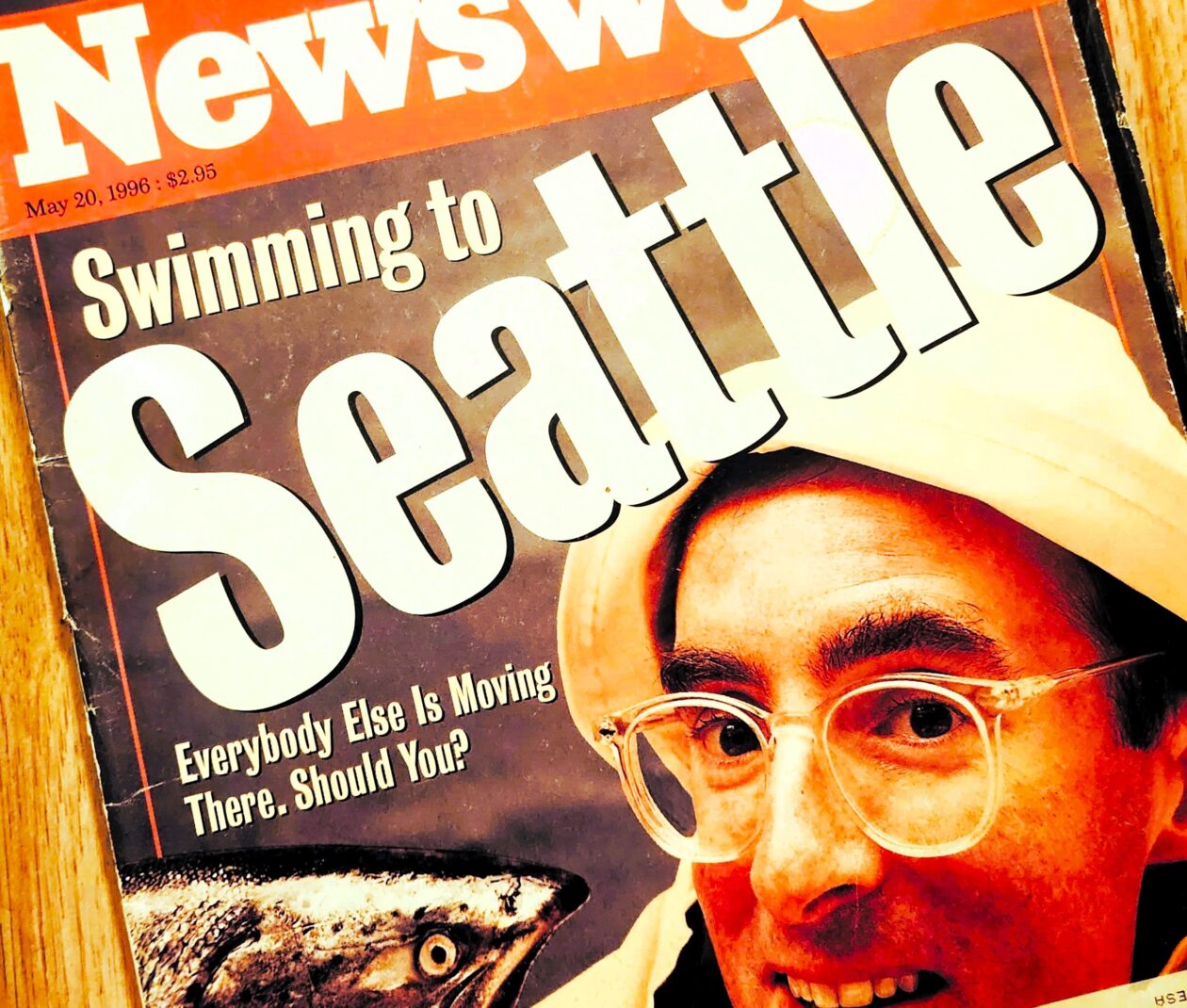
The cover of Newsweek magazine, May 20, 1996 — exactly 30 years ago today.
Take a breath, close your eyes, and think about the words that define Seattle.
Innovative. Outdoorsy. Global. Inventive. Smart. Progressive. Independent. A little reserved. A little weird.
Thirty years ago today, Newsweek magazine published a cover story featuring political journalist Michael Kinsley titled: “Swimming to Seattle: Everybody Else Is Moving There. Should You?”
Back in May 1996, Seattle was emerging as one of America’s great boomtowns: grunge, coffee, software, airplanes, the web. A place with talent, ideas, ambition and room to grow.
Advertisement
It’s one of the reasons why I moved here 30 years ago, from a small town in Ohio.
Today, Seattle remains one of the world’s most important innovation hubs, home to global technology giants, leading AI research, world-class research and extraordinary entrepreneurial talent.
Which is exactly why the city’s shifting national image should concern us.
Because a new narrative about Seattle is taking hold nationally. And unlike the rain-slicker caricatures of the 1990s, this one isn’t charming.
Advertisement
The emerging narrative is this: Seattle has become increasingly ambivalent — even hostile — toward the very industries and innovators that helped build its prosperity.
And it’s not just the national media. Seattle’s KOMO News reported this week on remarks by former Washington state governor Chris Gregoire, who pointed out a ballooning state budget since she left office in 2013.
“I would suggest to you, we don’t really have an income problem, we have a spending problem,” Gregoire said at a meeting hosted by the Association of Washington Business earlier this month.
You may disagree with those headlines. You may dislike the politics behind them. But rhetoric, image and storytelling matter — especially in a moment when cities are competing fiercely for talent, investment, startups and relevance in the AI era.
Advertisement
And right now, Seattle’s story is drifting in the wrong direction.
This week, the chairman of an iconic Seattle company — not operating in the tech industry — told me that the city’s increasingly anti-business image was complicating a national CEO search. Meanwhile, entrepreneurs and investors regularly tell us they feel vilified or unwanted.
We’ve spent more than 50 years importing some of the smartest people on the planet to this corner of the world — people working on things like cancer research, robotics, and yes AI — only to turn around and tell them not to let the door hit them on the way out.
Cities compete on psychology as much as policy. And our psychology is a bit shattered right now.
Advertisement
Six years ago, another national narrative engulfed Seattle during the Capitol Hill Autonomous Zone, or CHAZ — a protest occupation in Seattle’s Capitol Hill neighborhood that formed during the 2020 national reckoning over policing and racial justice.
Living here at the time, I thought much of the national media portrayal was exaggerated. I remember assuring friends and family back in Ohio that Seattle had not, in fact, descended into dystopian chaos despite what cable news suggested.
This moment feels different.
The concern now isn’t lawlessness or political theater. It’s civic drift. And right now, the national headlines resonate. They are telling a real story.
Advertisement
Seattle’s uncertainty about the very economic engine that transformed it into a global city is something that competitors are already beginning to notice.
Contrast Seattle with San Francisco, another progressive West Coast city wrestling with many of the same challenges. Its leaders are aggressively selling a comeback narrative centered on AI, entrepreneurship and reinvention.
Seattle, by comparison, is a city arguing with its own success.
Of course, there has always been a strain of “Lesser Seattle” thinking woven into Seattle’s culture — the instinct to resist growth, keep outsiders away and preserve an earlier version of the city before construction cranes and rapid change arrived.
That sentiment isn’t entirely irrational. Growth brought real costs: affordability challenges, displacement, congestion, inequality.
But it also brought extraordinary opportunities.
Advertisement
And in an era when artificial intelligence is reshaping industries, cities cannot afford to become complacent, confused about their identity, or dismissive of the people and companies driving innovation.
Seattle still has remarkable advantages. But advantages are not permanent.
Cities rise because they project confidence, ambition, and possibility. They decline when they begin treating success as something inevitable — or worse, something suspect.
Maybe that’s why another piece of Seattle culture has been stuck in my head lately: the absurdly catchy 1996 song “Peaches” by the Seattle rock band The Presidents of the United States of America: “I’m movin’ to the country, I’m gonna eat me a lot of peaches.”
Advertisement
The song captured a certain quirky, ironic version of Seattle at the tail end of the grunge era, a city that didn’t take itself too seriously.
Right now, though, Seattle faces a much more serious question: What kind of city does it actually want to become?
The choice seems clear. Move forward, progress, and tell a fresh story of hope in a city that’s still swimming in opportunity.
Ready to portal-jump back into the Morty-verse for Rick and Morty season 9? Perfect – we’ll show you how to watch season 9 from anywhere when episode 1 drops on May 24 in the US. Brits won’t have to wait long this year – season 9 drops on May 25 thanks to HBO Max.
The madcap irreverence that earned Rick and Morty such a huge and loyal following in the first place is still very much the backbone of the show, as demonstrated by Beth and Summer’s altercation with anthropomorphic furniture, the floor turning to lava and the plentiful pop culture riffs, which for the latest instalment include Planet of the Apes and Kill Bill (Pai Mei unleashes the Five-Point-Palm Exploding-Heart-Technique on Rick).
Bewildered? Scroll down to watch the trailer and achieve total clarity… or at least become ever so slightly less perplexed.
Advertisement
Fans hoping to see more of an overarching storyline may be disappointed, although there are signs that poor Morty’s deeply held sadness and exasperation are building towards something. There are introspective elements to some of this season’s sci-fi adventures, and they’re unlikely to reflect too well on Rick.
Read on as we explain how to watch Rick and Morty season 9 from anywhere and potentially for free.
Can I watch Rick and Morty season 9 for free?
Yes. YouTube TV carries Adult Swim as standard, and offers new subscribers a whopping 21-day FREE trial.
That means you can watch at least the first few episodes of Rick and Morty S9 without charge.
Advertisement
Traveling abroad right now? You can use a VPN to access your YouTube TV account as if you were right at home.
Use a VPN to watch Rick and Morty season 9 from anywhere
A VPN is a handy piece of software that can make your device appear as if it’s back in your home country and unlock your usual streaming services. The best VPN right now? We recommend NordVPN – it does everything and comes with up to 75% off.
Advertisement
How to watch Rick and Morty season 9 in the US
Rick and Morty season 9 premieres on Adult Swim at 11pm ET/PT on Sunday, May 24. Further episodes will go out one at a time in the same slot weekly.
If you don’t have the channel on cable, it’s available through YouTube TV, which normally costs $82.99/month but comes with a 21-day FREE trial and $15 off each of your first five months.
Have one of these subscriptions but away when Rick and Morty S9 is on? You can still access your usual streaming services from anywhere by using a VPN.
Advertisement
How to watch Rick and Morty season 9 in the UK
If you’re used to Rick and Morty episodes going out on free-to-air E4 in the UK, it’s all change for season 9, which is – at least initially – exclusive to HBO Max.
New episodes become available every Monday, starting May 25.
HBO Max prices starts at £5.99/month, though it comes bundled with all Sky TV plans.
Advertisement
At the time of writing it isn’t clear if Rick and Morty season 9 will also air on E4. S8 landed a week after its US premiere.
Away from home? You can still connect to your usual streaming services by downloading a VPN and pointing your location back to the UK.
How to watch Rick and Morty season 9 in Canada
In Canada, Rick and Morty season 9 airs on Adult Swim, going out at 11pm ET/PT on Sundays, starting May 24.
Advertisement
Cord cutters can tune in via Stack TV, which carries a number of channels, including Adult Swim, Global TV and National Geographic, and is available via Prime Video, Fubo and more. It’s free to Prime Video subscribers for the first seven days and CA$14.99/month thereafter.
Away from Canada now? Use NordVPN to watch your usual streaming service when overseas.
How to watch Rick and Morty season 9 in Australia
Rick and Morty season 9 premieres on Monday, May 25 on HBO Max in Australia.
Advertisement
A subscription starts at AU$11.99/month.
Outside Australia? Aussies away from home can use a VPN to unblock HBO Max and watch Rick and Morty S9as they would at home.
Rick and Morty season 9 – Need to Know
Advertisement
Rick and Morty season 9 trailer
Rick and Morty | Season 9 Official Trailer | adult swim – YouTube
Season 9 of Rick and Morty premieres in the US and Canada on Sunday, May 24 and continues weekly for 10 episodes.
In the UK and Australia, episodes will arrive a day later, starting from Monday, May 25.
Rick and Morty S9 episode guide
Season 9 of Rick and Morty comprises 10 episodes, which will air in North America on the following schedule:
Episode 1 – Sunday, June 24
Episode 2 – Sunday, June 31
Episode 3 – Sunday, July 7
Episode 4 – Sunday, July 14
Episode 5 – Sunday, June 21
Episode 6 – Sunday, June 28
Episode 7 – Sunday, July 5
Episode 8 – Sunday, July 12
Episode 9 – Sunday, July 19
Episode 10 – Sunday, July 26
We test and review VPN services in the context of legal recreational uses. For example: 1. Accessing a service from another country (subject to the terms and conditions of that service). 2. Protecting your online security and strengthening your online privacy when abroad. We do not support or condone the illegal or malicious use of VPN services. Consuming pirated content that is paid-for is neither endorsed nor approved by Future Publishing.
Getting authentic smoky flavour from a backyard grill usually means committing to a bulky charcoal setup, hours of babysitting the temperature, and a clean-up job that extends well into the evening.
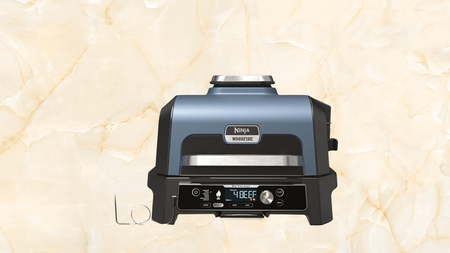
The woodfire flavour here comes from real hardwood pellets, not gas or charcoal, and the integrated smoke box circulates that smoke evenly around the food, so the result tastes genuinely earned rather than artificially added.
Advertisement
Beyond smoking, the grill operates across seven functions, including grilling, air frying, roasting, baking, broiling, and dehydrating, which means it covers the full spread of outdoor cooking without requiring a separate appliance for each method.
Two built-in thermometers let you monitor two different proteins simultaneously and set individual doneness targets for each, which is the kind of practical feature that stops a cook from having to hover anxiously over the grill for the duration of the meal.
The Ninja ProConnect app connects via Wi-Fi and Bluetooth, sending real-time notifications to your phone when the grill is preheated, when to flip, and when your food is ready, so you can actually be present with your guests rather than tethered to the cooking area.
Advertisement
With 180 square inches of cooking space, the Ninja Woodfire Pro Connect handles up to 10 burgers, two full racks of ribs, or a 12-pound brisket in a single cook, which is more than enough capacity for a proper summer gathering.
The stainless steel construction is rated weather-resistant for year-round outdoor storage, meaning it does not need to be hauled inside between uses, and the unit runs on electricity rather than gas, so there is no cylinder to manage or replace.
This is genuinely a strong buy for anyone who wants authentic smoky results without committing to the complexity of traditional BBQ, and a 20% discount heading into summer makes the case even harder to dismiss.
I almost don’t want to call Meshchera a match-three game because I fear that kind of undersells how captivating it is. But, it is a game you play within a six by six grid, in which you have to group matching tiles in clusters of three or more so they may merge and become other, higher value tiles, so that’s the description we’re working with. The atmosphere is off the charts, though, which isn’t something I’m used to finding in these types of games. It has gorgeously detailed artwork and background music that you can get completely lost in.
In Meshchera, you can choose to go for the high score or pick from several challenges that will dictate how you approach the round, like “kill five monsters” or “keep 10 monsters for 10 turns.” The gameboard is a dark marsh that will slowly become overrun with vegetation and creatures, unless you can stay ahead of creep by skillfully matching tiles to condense them into other things. Grasses become flowers, which become trees, campfires, houses, churches, etc. It is a uniquely complex matching game — you’re given next to no information about how the items work or how different elements on the board behave and interact, so you have to figure it out along the way and course-correct as you learn.
khvoshch
I’ve spent quite a bit of time playing Meshchera over the last week, but certain things still elude me. Take the “create and destroy a Monster” challenge. I have absolutely no idea how to create a monster, and that’s not for lack of trying. But, this gives me something to keep working toward even as my high scores nudge higher and higher. The game includes 10 challenges right now, and the developer says more are coming soon. Meshchera is really good, and feels like the kind of game you can revisit ad infinitum. It’s already found itself a home in my folder of “go-to” Playdate games.
Meshchera isn’t available in the Playdate Catalog (yet?), but don’t let that stop you from trying it out. It’s on itch.io at the moment, and sideloading games onto the Playdate is incredibly easy. Once you have the game file, you can just drag and drop it right into your library by signing into your Playdate account and going to the Sideload tab. This can also be done via USB. Panic has a detailed explanation of all the options, if you need some guidance.




































































You must be logged in to post a comment Login