
TL;DR
ByteDance announced Seedance 2.5 at its Beijing conference, generating 30-second native 4K video from up to 50 multimodal reference inputs.




Life is busy enough without wasting time on spammers, scammers, and telemarketers. Whether you are suffering insistent injury lawyers, fraudulent car warranty representatives, or a drunk-dialing ex, there is a way to stop the endless calls and messages. The major carriers and phone manufacturers have upped their game against unwanted calls and messages in recent years, so let’s look at how you can effectively block them.
We also have guides on how to avoid spam with disposable contact info, guard against smishing attacks, and avoid phishing scams. Frustrated by the whole situation and curious why no one’s been able to stop the barrage of spam calls? Check out WIRED senior writer Lily Hay Newman’s article on our perpetual robocall hell.
What to Keep in Mind
Before we dive into blocking options, there are a few things to know:
How to Block Calls and Texts on an iPhone
Apple via Simon Hill

It’s easy to block individual numbers on your iPhone. Here’s how:


ByteDance announced Seedance 2.5 at its Beijing conference, generating 30-second native 4K video from up to 50 multimodal reference inputs.
ByteDance unveiled Seedance 2.5 on Tuesday at its Volcano Engine FORCE conference in Beijing, a video generation model that produces 30-second clips at native 4K resolution from a single prompt. The company skipped four intermediate versions entirely, jumping straight from its predecessor to signal what it described as a generational leap.
An enterprise beta is already live, with public launch targeted for early July. CEO Liang Rubo told the conference that climbing the AI summit is the company’s top priority, with its model-as-a-service business evolving into a foundational operation backed by long-term investment.
The headline upgrade is reference capacity: the model accepts up to 50 multimodal inputs, including images, audio clips, 3D white models, and style references, up from 12 in its predecessor. Those inputs give Seedance 2.5 far more granular control over style, motion, and composition than a text prompt alone.
The model generates at 4K natively rather than upscaling from a lower resolution, a distinction that matters for professional production pipelines. It supports 10-bit colour depth for smoother gradients and more room for post-production colour grading. ByteDance also claims 20 percent better prompt adherence, meaning fewer generations before a usable result.
Audio is now co-processed within the same latent space as visual signals, producing native synchronisation between onscreen actions and their corresponding sound effects. A new 3D white-box preview function lets creators generate low-fidelity animations before committing to a full-quality render. Together, the features position the model as a production tool rather than a novelty generator.
The announcement comes three months after ByteDance was forced to add watermarking and IP guardrails to Seedance 2.0 following cease-and-desist letters from Disney, Warner Bros Discovery, Paramount, and Netflix. A viral deepfake of Tom Cruise fighting Brad Pitt on a rooftop drew a formal complaint from the Motion Picture Association and a rebuke from SAG-AFTRA.
ByteDance paused the global rollout in mid-March and did not resume it through CapCut until late March, with face-blocking filters, C2PA watermarks, and copyrighted character detection in place. No timeline has been offered for making the new model available in the United States.
The competitive context has shifted dramatically since February. OpenAI shut down Sora in March after the video tool peaked at roughly one million users and reportedly cost about a million dollars a day to operate, generating just over two million dollars in total revenue.
Google’s Veo 3.1 has filled much of the vacuum, offering native 4K output, audio generation, and up to three reference images for style control. But the new ByteDance model substantially exceeds Veo’s reference input capacity, accepting 50 inputs to Veo’s three, a gap that matters for professional workflows.
The AI video generation market has fragmented rapidly, with Chinese models moving faster on production tooling than Western competitors. Third-party platforms like Reallusion’s AI Studio have already built professional pipelines around the predecessor model, and Runway’s fourth-generation tool has dropped out of the Artificial Analysis top 10.
Whether the new model can reach global markets without reigniting the copyright battles that stalled its predecessor remains the central question. ByteDance has the model, the distribution through CapCut’s 400 million monthly active users, and the vertical integration from generation to editing to sharing. What it does not yet have is a settlement with Hollywood, and every feature that makes the model more capable also raises the stakes of that unresolved conflict.

We may receive a commission on purchases made from links.
While the terms are often used interchangeably, not every power strip offers surge protection. Fortunately, determining if your power strip is a surge protector is fairly easy, even if these devices look very similar. Power surges in the home are a result of things like varying voltage levels entering the home, appliances kicking on and off, and even disruptions due to storm activity. Plugging your TV into a surge protector is a way to mitigate some of the risks associated with brief spikes in voltage. However, you may have noticed coax connectors on protective power strips. What are they for?
Coaxial cables are often used in the home for cable and satellite TV and internet access, to name a few. These cables excel at stopping outside electromagnetic interference by incorporating braided wiring and foil around the conductor to shield the signal. However, they can also experience surges that could carry into electrical devices.
Some power strips and surge protectors include coaxial cable protection that offers two connectors — one in and one out, for example. This is meant as an additional measure to help protect devices that have coaxial cables attached to them.

While more robust coaxial cable surge protectors can help protect certain home setups as one component of a multifaceted strategy, the one on your power strip may not do much. In fact, it could instead result in signal loss. Systems like satellite TV are grounded (via a brass ground block), which provides specific protections to coaxial cables from surging voltage. This means the heavy lifting in terms of protection is already in place. In fact, by adding an additional connection on your power strip, you can weaken your signal or introduce noise.
Scenarios where you may want to incorporate coaxial surge protection are in relation to roof mounted TV and radio antennas. Though again, this is only a secondary measure in addition to properly grounding your equipment. Antennas are particularly susceptible to lightning strikes, which on average have the energy of around 1 billion joules. While no device can provide protection from a power surge created by a direct lightning strike, a basic power strip rated up to 2,000 joules will do little to prevent damage.
Metal oxide varistors (MOVs) are a type of surge protection used by some power strips with coaxial cable connections. These help soak up the extra voltage from spikes by actively conducting during a surge and preventing damage. While MOVs work well with AC applications, like your home electronics, they do suffer degradation over time. This is why you might want to throw away your old surge protectors ASAP. In addition, they can also affect signal integrity over cables carrying high-speed data, like coaxial.
There are more effective, dedicated products like coaxial cable surge arrestors, which feature a place to attach a ground wire and utilize gas discharge tubes (GDT). The GDT comes in the form of a small cylinder within the arrestor in between the connection of two different coaxial cables. Essentially, inside the cylinder there are electrodes and an inert gas. When a surge reaches the GDT, the gas ionizes and creates a brief short circuit, preventing excess current from flowing to sensitive electronics. It’s recommended to place these arrestors near the equipment like a radio, rather than placing it near the antenna. These can help protect against power spikes as a result of indirect lightning strikes.


The White House is drastically shortening the deadline for government agencies and organizations to adopt new quantum-resistant encryption systems that will withstand attacks that use quantum computers, as the federal government seeks to protect decades’ worth of secrets belonging to militaries, banks, governments, and most individuals on Earth.
The executive order, titled Securing the Nation against Advanced Cryptographic Attacks, requires computing systems for “high-value assets” and “high-impact systems” to transition to post-quantum cryptographic key establishment schemes by December 31, 2030, and to quantum-safe digital signature schemes by December 31, 2031.
The new deadline, which for many organizations is about five years sooner than the previous one, comes on the heels of recent research showing that the resources and cost for building a cryptographically relevant quantum computer are far less than previous consensus estimates. In response, Google, Cloudflare, and other companies recently tightened their timelines for moving off vulnerable systems to 2029.
“The advent of large-scale quantum computers, particularly in the hands of adversaries, will pose a significant threat to widely used cryptographic security systems,” Monday’s executive order stated. “Ongoing cyber activity against our Nation also presents the risk of adversaries collecting United States information now, and decrypting it later once large-scale quantum computers are operational.”
Under a timeline the National Security Agency published in 2022, “National Security Systems”—a class including only defense and intelligence systems under the authority of the agency—were under orders to be quantum-ready between 2030 and 2033. Most other organizations had until 2035 to complete the transition. Now, many of them will be required to transition much sooner.
“So, for any system that falls into this new bucket of high-value assets and high-impact systems, their transition timelines just got shortened by 4-5 years (from 2035 to 2030/2031),” Brian LaMacchia, a cryptography engineer who oversaw Microsoft’s post-quantum transition from 2015 to 2022 and now works at Farcaster Consulting Group, told Ars. “That is a significant shortening of the transition timeline for these systems, and it follows similar timeline revisions from Google and Cloudflare that we saw announced back in late March/early April.”

Across the United States, K-12 schools have spent the past decade building one-to-one device programs. These initiatives have established an essential baseline for digital access, making it easier for students to complete daily schoolwork across grade levels and subjects. By putting a device in the hands of every learner, districts have created a standard foundation for digital literacy, research and everyday classroom engagement.
As STEM programs continue to grow and mature, however, school leaders are beginning to encounter new questions about how well those devices support more advanced coursework. Pathways in fields like robotics, engineering, cybersecurity and data science increasingly rely on specialized professional applications that reach well beyond general-purpose classroom software.
In many cases, students can successfully complete introductory work on school-issued devices. But as instruction progresses, the tools required for STEM programs place different demands on student computing resources. As a result, educators and technology directors are taking a closer look at how hardware capacity can keep pace with shifting curricular needs.
STEM Tools and Computing Demands
While web-based applications work well for introductory coursework and daily assignments, many expanding STEM pathways introduce entirely different technical requirements. Courses in engineering, 3D modeling, cybersecurity and data science rely on industry-standard applications that demand substantial local computing capacity, robust memory and dedicated graphics processing.
A prime example is SolidWorks, a professional computer-aided design (CAD) platform used in both higher education and engineering industries. When students build detailed, multi-part models or run stress-test simulations, the performance of the device they’re using directly affects how efficiently they can work. Insufficient hardware can lead to severe rendering delays, software lag or sudden crashes that disrupt the entire classroom flow.
This reality highlights a practical procurement consideration for districts: As STEM curricula mature beyond basic web-browsing activities, classroom devices must have sufficient local processing power to keep up.
Credit: ASUS Education

A Robotics Program in Practice
To see how these hardware dynamics play out in a real classroom, consider the experience of the Firebots robotics team at Fremont High School in Sunnyvale, California. The team competes each year in the FIRST Robotics Competition, a global program where students design, build and program large robots to complete complex engineering challenges under tight, real-world constraints.
Credit: ASUS Education

The work inside a competitive robotics program closely mirrors a commercial engineering environment, spanning mechanical design, fabrication, electrical systems and software development. Students use CAD tools to design components from scratch, test digital iterations and refine mechanisms on a tight competition timeline.
To support this technical workflow, the Firebots use ASUS TUF Gaming laptops. In robotics programs like this, student devices are not just tools for looking up information; they are central workbenches used across multiple stages of the design process. Students rely on them for modeling, code compilation, data logging, documentation and coordination among subteams.
Reliable on-device performance eliminates a common source of classroom friction. When software runs consistently and responsively, students can spend their limited class time troubleshooting their designs rather than troubleshooting their devices. Free from technical slowdowns and long file loads, they can focus on testing solutions and iterating on ideas. Ultimately, the Firebots’ systematic approach and focus on execution earned the company the FIRST Excellence in Engineering Award, which recognizes strong engineering design and system integration.
Credit: ASUS Education
What This Means for STEM Instruction
The experience of programs like the Firebots raises a broader question for school leaders and instructional technology directors: How should district-wide device strategies evolve as STEM instruction becomes more technically demanding?
One-to-one computing programs continue to serve as the foundation for most day-to-day classroom learning, providing the baseline connectivity and performance needed for a modern education. At the same time, STEM courses can reveal distinct moments where standardized, general-purpose devices reach the limits of demanding software and workflow requirements.
In many districts, this variation is already being managed through a mix of approaches. Some schools rely on shared physical lab spaces equipped with higher-performance workstations dedicated to specialized software. Others use cloud-based streaming solutions where possible, while reserving more resource-intensive local applications for specific instructional settings.
The goal is not to dismantle existing one-to-one initiatives, but to recognize where a single hardware standard may limit technical pathways. As STEM education continues to expand and diversify, school leaders find themselves balancing the competing priorities of deployment consistency, procurement cost and instructional fit. In this changing landscape, device planning is no longer treated as a separate IT purchasing decision. Instead, it is increasingly part of a larger conversation about how schools design learning environments that accurately reflect the kinds of hands-on work students are being asked to do.
Recommended Resource
Learn more about ASUS Education Solutions: Accessible, adaptive education technology

Yeah, that’s a shame. It couldn’t have happened to a nicer guy bigger asshole. It’s as if Trump asked his underlings to generate the perfect metaphor for his second administration and they fucking nailed it.
Trump has tried to impose his self-gratification on an event even he can’t possibly hope to destroy: the 250th anniversary of this country’s independence. His race against the clock has resulted in a lot of federal contractors racing around DC to apply gold Sharpies to any monument that doesn’t look sufficiently garish.
Trump also decided he could do what many other presidents couldn’t: revamp the DC reflecting pool without being subjected to discolored water and/or logistic missteps. Trump made sure he couldn’t achieve the latter by ordering his motorcade to drive onto the unfinished reflecting pool, delaying its completion. And he couldn’t beat nature in terms of the former, especially after demanding the floor of the pool be painted with a very algae-friendly shade of “American flag blue.”
The pumps kicked in and hours later, the reflecting pool resembled any Chicago waterway on St. Patrick’s Day. Department of Interior personnel were brought in to run vacuums, scatter hydrogen peroxide, and assure visitors and locals that the ectoplasm-esque fluid being routed to the nearest storm drains was perfectly safe and not likely to spawn thousands of murderous C.H.U.D.S. (also in the non-literal sense) that will terrorize the DC area for decades to come.
It is the metaphor Trump never wanted but one he absolutely earned. He promised that some of his pool guy buddies were capable of humiliating previous presidential attempts to “modernize” this DC fixture, thus elevating him to Supreme God King Of The Wading Pool. Instead, he got exactly what he should have expected, if he were anyone else but Donald Goddamn Trump. And it’s not a problem inherent to Donald Trump. It’s something that plagues the entirety of his most loyal supporters. I’ll turn this over to David Roth of Defector, a site you should absolutely be reading and subscribing to:
If everyone in the United States weren’t living downstream from its consequences, it would be a pretty good tragic flaw that Donald Trump wants more than anything to be seen as a brilliant man who has always been right about everything when he is transparently a butterfingered dunce whose professional expertise more or less begins and ends at making cutting remarks from a safe distance and directing other people to file nuisance lawsuits on his behalf. If assessed from a sufficient remove, the spread between the opening proposition—the man who knows more about every subject than any expert without even having to study or even pay attention to any of it, because he is just that much of a natural talent—and the relentlessly oafish output is a great bit, if admittedly also a bit one-note.
Lots of awful people are like this, and a great percentage of the degenerate gentry that is Trump’s truest and most durable base is extremely like this: Dumb old bullies all grandiose and soft from golf and infidelity; illiterate real-estate types with detailed opinions on The Differences Between The Races; the luridly unemployable adult children of car-dealership guys; anhedonic beneficiaries of a good investment or two who have, through sheer restless indolence and various dull biases, backed into some truly berserk and totally bespoke authoritarian worldviews. Aging phone addicts who think the country “needs a pharaoh.” Ruddy tax evaders who fear cities and are insecure about their boats. None of these people really do things especially well, and all of them are visibly getting worse, but they are all far enough from experiencing any kind of consequences that they can’t really imagine failing at anything they try.
When these are the people this debacle is happening to, no regular person feels even the least bit of sympathy for someone who thought they could buy and bully their way past nature.
But they can try to bully their way through this news cycle. While there were plenty of accounts detailing curious visitors to the pool picking out pieces of floating paint likely loosened by the DOI’s aggressive attempts to pry the landmark free of the algae’s grasp, no one but the Trump administration — including his DC District Attorney — has suggested LOLing about the peeling blue paint is a federal crime.
Now, we have this bullshit going on because Trump desperately needs to blame anyone but himself for the pool that’s going to need to be drained, repainted, resealed, and refilled yet again, with July 4th less than two weeks away.
“Five individuals have been arrested for vandalism. Five additional individuals were issued federal citations,” a department spokesperson told The Hill.
The spokesperson said a total of 14 police reports have been filed for vandalism, including the alleged crimes described in President Trump’s recent Truth Social posts.
Question 1: Five? And what for exactly?
Question 2: Fourteen? And who filed these reports?
Question 3: Get the fuck out of here with this.
If you want more details on these allegations, you have to go to the source. And while you won’t get any details or anything approaching evidence, you will get the thrill of Trump attempting to Pizzagate his own pet project’s abject failure:
In an entirely predictable development, when Donald Trump was just pressed by reporters to explain the flawed renovation of the Lincoln Memorial Reflecting Pool, he denied that the contractors he awarded the work to were to blame and instead insisted that “vandals” had used a knife or box-cutter to cut a 350ft “slit” in the newly applied sealant, which started peeling away from the floor and floating to the surface within days of its application.
“I can’t help it if somebody goes in with a knife and starts hacking it up,” the president said.
In all fairness to this tyrant-on-training-wheels, it would be impossible for Trump to prevent “vandals” from creating a 350-foot “slit” in the pool. First of all, some vandals would have needed to have attempted this. Second of all, someone running the place might occasionally need to glance up from their Truth Social feed to keep an eye on the pool.
Considering the remake/remodel debacle has been the subject of intense 24/7 coverage since the refill effort began, you would think someone would have seen (and reported on) 350-foot slitting efforts by vandals. And yet, the only reports to surface so far deal with the algae infestation, the peeling paint, the people amused/bemused by all of this, and the government’s unproven assertions that the pool was vandalized.
Beyond Trump being hoisted by his own petard, there’s some joy to be had in seeing him struggle to blame others for him being so wrong about everything and then having to suffer through the aftermath of his abject failure. The downside is that this government is seeking to punish people because the president embarrassed himself. That’s fucked up. And that’s the lesson that needs to be internalized here. Even if you’ve done nothing wrong, this administration will bring its powers to bear against you because it’s always someone else’s fault when it fucks up.
Filed Under: asshats, dc, department of interior, donald trump, failure, jeanine pirro, loser, reflecting pool, trump administration

Animation in 4K is its own unique experience. The format’s exceptional clarity and expanded color palette can elevate the beauty and wonder of stories too out-there for live action. Ultra HD can occasionally expose the limitations of the medium, including choppy legacy line art, but it ultimately remains a definitive showcase for the art form. By unlocking explosive HDR highlights and a wider color gamut, 4K discs can breathe new life into both classic hand-drawn animation and state-of-the-art digital work, freeing vintage hues from past technical constraints. Today’s filmmakers, meanwhile, exploit these advances with an impact that was once impossible to achieve at home.
Five recent disc releases remind us exactly what the format can do. All feature native 4K presentations. Four include Dolby Vision, while one relies entirely on standard dynamic range to make its case.

Video game adaptations have come a long way from their misguided baby steps, as evidenced by both live-action entries such as A Minecraft Movie and Illumination’s animated take on the Mario universe. This even glossier follow-up to 2023’s The Super Mario Bros. Movie expands an already impressive core cast of Chris Pratt, Anya Taylor-Joy, and Jack Black with Brie Larson, Benny Safdie, and Glen Powell for a spectacular rescue mission that takes the gang across the cosmos.
Visually, though, Galaxy pushes the envelope by shifting the action from the sunny Mushroom Kingdom to the dark reaches of outer space, requiring a completely different lighting approach. Glowing Lumas and floating Star Bits cast vibrant colors across the characters and environments, while specular highlights on the slick metal spaceships create sharp reflections that give the animation an advanced sheen. Individual threads and weave patterns are visible on costumes, the backgrounds boast a massive jump in rendering complexity, and motion blur remains tightly controlled, like a next-generation game engine running at maximum capacity.
The Dolby Atmos mix uses discrete steering and aggressive height-channel placement to pan spaceships and debris effortlessly around the room. This hyperkinetic soundfield is anchored by authoritative, subwoofer-testing low end and a massive orchestral score that spreads wide into the surrounds, all while keeping dialogue pristine. There are a few basic extras, but skip them and just rewatch the movie in awe.
★★★★★★★★★★ Movie
★★★★★★★★★★ Picture
★★★★★★★★★★ Sound
★★★★★★★★★★ Extras

Shifting from the newest to the oldest movie in this batch, Walt Disney’s 1951 adaptation combines elements from both Lewis Carroll’s Alice’s Adventures in Wonderland and its sequel, Through the Looking-Glass, and What Alice Found There. While British purists complained that the sacred texts had been dumbed down, prudish Americans, surprisingly, did not object to the druggish undertones inherent in the eccentric characters and wild scenarios. In fact, they largely ignored Alice. The movie sat in the vault until the psychedelic era brought renewed interest, leading to a full theatrical re-release in 1974. It has been beloved ever since.
Timed to the film’s 75th anniversary, Walt Disney Film Restoration spent nine months restoring Alice, beginning with scans of the original nitrate successive-exposure negatives and preserving the proper 1.37:1 aspect ratio. This work was followed by extensive cleanup to address dust, warping, and other signs of age, with archival production artwork used as a reference to optimize color and luminance in every shot. Walt & Co.’s cheerier tone is reflected in an explosively vibrant palette, with pinks and blues that pop off the screen so intensely that viewers may begin to question what is real.
Alongside a lossy two-channel mono track, the disc includes a DTS-HD Master Audio 5.1 remix that feels modern while remaining faithful to the original, with particularly strong fidelity in the songs. All of the extras are housed on the bundled HD Blu-ray, including an excellent picture-in-picture mode and a deep selection of vintage and retrospective programs, along with behind-the-scenes material.
★★★★★★★★★★ Movie
★★★★★★★★★★ Picture
★★★★★★★★★★ Sound
★★★★★★★★★★ Extras

Two titans joined forces for a once-in-a-lifetime collaboration when the singular fantasy artist Frank Frazetta teamed with celebrated animator Ralph Bakshi to create the original screen adventure, Fire and Ice. In a savage prehistoric world, the buff warrior Larn and mysterious masked avenger Darkwolf embark on a perilous quest to rescue Princess Teegra from the evil ice lord Nekron, whose advancing glaciers threaten to consume the world.
To capture the look of a Frazetta painting brought to life while maintaining realistic anatomy, Bakshi relied on rotoscoping, a process pioneered by Max Fleischer decades earlier. Live-action performers were filmed, then each frame was painstakingly traced and painted. The backgrounds, meanwhile, were largely created by a young Thomas Kinkade, whose name was misspelled in the credits. Long before becoming “The Painter of Light” and the head of a multimillion-dollar art empire, Kinkade experimented here with a luministic, chiaroscuro style that draws the eye through small bursts of light and color. His brushstrokes and the texture of the line art are fully preserved in the 4K, 16-bit scan, while the occasional static foreground “fog” adds depth to the main action.
The new Atmos reconfiguration is remarkably strong, with fluid placement of effects across the soundfield: arrows zip past pterodactyls, swords land with heavy clangs, and the mix builds on Blue Underground’s previous 6.1 and 7.1 remixes. The original stereo track is also included, along with 5.1 audio, all in DTS-HD Master Audio. William Kraft’s score adds a visceral, primal pulse and is included here on a 70-minute, 21-track CD.
New featurettes spotlight Frazetta’s granddaughter, Sara Frazetta, and superfan filmmaker Robert Rodriguez, alongside a strong collection of legacy content that includes a Bakshi audio commentary. The SteelBook packaging is especially elegant: a clear plastic slip carries the title and logos on the front, with the usual disc information on the back. Remove it, and Frank Frazetta’s poster art is left unobstructed, with animation art displayed on the reverse.
★★★★★★★★★★ Movie
★★★★★★★★★★ Picture
★★★★★★★★★★ Sound
★★★★★★★★★★ Extras

Perfect Blue is smart and sophisticated enough to have worked as a live-action psychological thriller, and in fact it almost was before first-time director Satoshi Kon turned it into one of the most influential anime films ever made. The story follows young Mima’s transition from pop idol to aspiring television actress, a journey filled with unexpected hurdles that soon leads her down a dark path where she begins to question her own sanity. This unrated cut can get rough, with murder, sexual violence, and a stalker all driving the story toward a major twist that I did not see coming.
Although it was originally greenlit as a modest direct-to-video release, the production quality far exceeds the assignment. The hand-drawn, hand-painted artwork delivers nuanced characters and richly detailed backgrounds, particularly in its Tokyo cityscapes. Kon’s masterful camerawork, lingering film grain, and occasional dirt combine to create a genuinely cinematic feel, capturing a twilight moment just before the industry shifted more decisively toward digital cel animation.
The 5.1 track is unlike any other mix in this lineup: punchy, aggressive, and full of discrete left and right cues, with hard surround activity that makes unapologetic use of the rear channels. Dialogue remains consistently crisp, although I cannot claim to understand more than a handful of Japanese phrases.
A more affordable, though still premium, alternative to last year’s collector’s edition, Shout!’s SteelBook arrives across three discs, with much of the bonus material presented in standard definition. The highlight is a series of Satoshi Kon lectures totaling roughly two hours, with English subtitles, in which he digs deeply into possible interpretations of the labyrinthine narrative, along with the film’s themes and techniques.
★★★★★★★★★★ Movie
★★★★★★★★★★ Picture
★★★★★★★★★★ Sound
★★★★★★★★★★ Extras

One of Pixar’s better efforts of late, Hoppers takes audiences into the animal kingdom in a whole new way. Animal-loving college student Mabel uses hush-hush technology to “hop” her consciousness into a lifelike robotic beaver body and live among the creatures of the forest. They can understand her, and she can understand them, though neither side quite knows what to make of the other. But when her passion to protect wildlife at all costs gets the better of her, she is in for a hard lesson about the real laws of nature. It is funny, there is ample cuteness afoot, and the environmental message lands without becoming obnoxious as Mabel learns that complicated problems do not always have simple answers. You know, the usual Pixar existential crisis, but with beavers.
Remember when rendering fur and feathers was a big deal? Hoppers makes it look easy, with an exceptionally clear, detailed image that takes a step beyond realism through a playful visual style that pleases the eye without straining for ultimate photorealism. Woodland colors are lush and lovely, as only Dolby Vision can deliver. Note that the 4K disc is a SteelBook-only release.
There is plenty of 360-degree and overhead audio action from the abundant creatures of air and land, along with no shortage of manmade mayhem, all underscored by serious bass kick. The hopper equipment itself features thoughtful sound design that conveys the transfer into the synthetic body, then reinforces it with subtle mechanical accents. The supplements are wholly adequate, covering the creative team’s character research, a brisk making-of featurette, a study of a key scene, plus bloopers and deleted scenes.
★★★★★★★★★★ Movie
★★★★★★★★★★ Picture
★★★★★★★★★★ Sound
★★★★★★★★★★ Extras


Amgen’s Rachael Harte and Barakat Raji explore the routes towards a career in bioprocessing and how they found themselves in their current roles.
There is no one way to find yourself on the route towards a meaningful career that gives you personal and professional joy, and it is rarely a linear path. For many, it takes time and persistence to uncover the aspects of a role that are most appealing, but also to investigate avenues that perhaps you had been aware of, but had not fully considered.
This is certainly true for Barakat Raji, a bioprocess technician at Amgen, who explained that initially, as part of her undergraduate degree, she studied subjects outside of where she would eventually end up, as a means of pushing herself and exploring what else was possible.
She told SiliconRepublic.com, “In college, I did an undergrad in biomedical science and then I did a master’s in microbiology, which has nothing to do with production at all, but I wanted to kind of go out of my comfort zone and it worked out well.”
Upon completing her master’s in microbiology, Raji was intrigued about the potential for a career in the manufacturing space; however, it was not an area that she had extensive knowledge of, so she took the initiative to carry out her own research.
She said, “I wanted to get to know a little more about the manufacturing world. When I did see the job on LinkedIn, I had a little look. It did pique my interest a little bit and I went in, and that is why I got into the industry.”
Of what it takes to day-to-day, she finds that the requirements change, depending on what is needed. She explained that she may need to come in and complete a handover, be involved in the filling element of manufacturing at Amgen, or prepare for filling.
Raji said, “It’s a lot of computer work as well, and if I can do it, anyone can.”
Of who might best be suited to a role in manufacturing, Rachael Harte, who started out in community pharmacy and who was recently promoted to a senior associate in manufacturing position at Amgen, noted that the role doesn’t necessarily demand an all-inclusive science background from the get-go. She herself continued her studies in pharmaceutical business operations upon joining the operation.
She said, “The type of person that this role is suited [to] is somebody who is curious about the biopharmaceutical industry, someone who is ambitious. A science background isn’t essential – somebody who enjoys teamwork and collaboration.”
In terms of what people should expect during the early days of their role at Amgen, Harte urged professionals to take advantage of the company’s robust, welcoming and open ecosystem.
“The on-the-job training is excellent in Amgen. You have a lot of support from both your peers and management. There’s people with 30 years’ experience here. The expertise and knowledge that they’re willing to pass down to you with over 30 years’ experience, you wouldn’t get it anywhere else.”
Don’t miss out on the knowledge you need to succeed. Sign up for the Daily Brief, Silicon Republic’s digest of need-to-know sci-tech news.

We’re in the midst of (a very hot) summer, and I’m sure many of you out there are raring to go on your travels this season. But if you’re about to jet off on your vacation, then it’s best to be as prepared as possible. And you know what you need to make your travels as seamless and enjoyable as possible? Some top-tier tech.
I’m a Senior Reviews Writer here at TechRadar, and have tested hundreds of gadgets over the years, from premium noise-cancelling headphones through to power banks and misting fans. So, I’ve got the lowdown on all the travel tech essentials you need to make this summer one to remember — for all the right reasons, of course.
I’ve included seven must-haves, with a small speaker, travel chargers, and even a compact clothes steamer on the list. Everything here has either been tested by me, or someone on the TechRadar team, so I’m confident that each item will serve you well on your adventures this summer and beyond. So, without further ado, let’s dive right into my top picks!

Ah, Sony WH-1000XM6, my beloved. These are, in my view — and the view of many at TechRadar — the best headphones you can buy right now.
The XM6 have it all. Class-leading active noise cancellation works great, even on flights with jet rumbles and screaming children. They sound incredible, with brilliant balance across the frequency range, as well as plenty of low-end punch and excitement to make energetic tunes sound their best. And they’re foldable too, making them incredibly compact when you’re on the move.
These come with a handy magnetic carry case, 30 hours of battery life, and excellent touch controls. Sony‘s Sound Connect app also makes it easy to tailor sound to your liking and make any subtle changes you need. They’re simply the best, but I’ll let you find that out for yourself.

The JBL Go 5 launched recently, and when I reviewed it, the speaker genuinely took my breath away.
It’s exactly how to do an upgrade right, offering better sound, a more flashy design, and even better durability than its already impressive predecessor, the JBL Go 4. I love its edge lighting, its well-balanced sound with clean bass and rich mids, and also its broad feature set, which includes EQ options and multi-speaker pairing.
Despite improving on what its predecessor had to offer, the Go 5 is available at a very similar price, typically coming in at around the $55 / £40 mark, and if you need excellent sound, solid battery life, and high level (IP68) waterproofing on a budget, then it’s the best small Bluetooth speaker to buy right now.

I genuinely bring this Anker power bank with me everywhere. It’s the definitive portable battery for travel for a few key reasons.
The first is its size. This model is absolutely tiny and can easily slip into a pocket or small bag, no problem. Second, it’s incredibly practical. There’s an integrated USB-C cable, making charging on the go totally seamless. And finally, it’s a fantastic performer. That 45W max wattage means fast-charging is easily accessible on even some of the best phones.
A 10,000mAh capacity should also mean it can charge a pair of wireless headphones as well as your handset, so if you want an ultra-practical, lightweight power bank to bring on the go, the Anker Nano Power Bank 10K 45W is my number one recommendation.

If you need a travel charger for your phone, tablets, and wireless earbuds, then look no further than the Anker Nano Charger 45W, which comes with a USB-C cable in the box — a nice touch!
I’ve used this one a lot myself, and it’s great for travel. Why? Well, it’s incredibly compact and packs in quite a bit of power, meaning you can make use of fast charging without lugging a massive brick around. If you’re using a travel adapter, the model’s low weight also means it won’t awkwardly get weighed down or stick out, which is a huge plus.
This charger is well-built, foldable — helping it to slide into your pocket — and highly affordable. It really has it all, so if you’re still using a slow charger, then take things up a notch with this awesome Anker alternative.

In the UK, it’s absolutely scorching right now. It feels like I’m fighting for my life here with the combination of high humidity and near record-breaking temperature. And when you’re on your summer travels, I’d wager that it will be similarly blazing in a number of countries. What you need, then, is a portable fan.
We’re big… fans… of the Shark ChillPill here at TechRadar, and awarded it a 4.5 star review recently. It has good battery life, is filled with a range of cooling options, and even has a mister for when you need a healthy blast of cold.
The build and design quality is strong here too, and the straightforward controls make it a joy to use. Yes, it’s a little expensive, but we’ve seen it pop up on sale from time to time, so if you want to stay chilled on the move, then I’d strongly suggest picking this lil’ gadget up.

OK, so not everyone will need this, but if, like me, your facial hair seems to grow back in the blink of an eye, the Philips Shaver S9000 Prestige will be a great addition to your travel tech arsenal.
With multiple speed settings to suit your desired sensitivity, wet and dry shaving versatility, interchangeable heads (including a beard trimmer), and spectacular handling, the S9000 Prestige is a true all-rounder.
This model also has solid battery life and I rarely need to juice it up. But it comes with a wireless charging pad for when you’re running low on power. There’s also a cleaning device thrown in the box, and a carry case for whenever you’re on the move.
I’ve found that the S9000 Prestige is kind on my skin, which is pretty prone to razor burn, and its flexible foil shaver is great at getting into those hard to reach areas around the nose, for instance. It launched at a fairly high price, but you can regularly swipe it up on sale now, so why not give it a go?
OK, in all honesty, I’ve not actually got a travel clothes steamer, but when some colleagues of mine heard that I was writing this piece, they were clear that it’s a must have.
After all, how many times have you been on holiday or out on a business trip and realized that our garments look a little creased? For me, it’s a few times too many. With a compact clothes steamer, you can wave goodbye to pesky creases and wrinkles in a flash.
So, I have a few recommendations from the team that I’m here to share with you. For our US readers, Managing Editor of News & Deals, Jacob Krol, suggests the Conair Handheld Garment Steamer. This affordable model boasts “turbo steam power,” comes with a 3-in-1 attachment, and has a water tank that’s good for 20 minutes of steaming. Not bad, eh?
Over the pond, our Managing Editor of Social & Engagement, Josephine Watson, had a couple of recommendations. The first, the Tefal Pure Pop Slim Handheld, is cheap, comes in a range of funky colors, and heats up in just 15 seconds for super speedy action. Josephine told me that her bridesmaid friend bought this model in order to save a wedding dress disaster — and luckily, it worked. Talk about coming in clutch.
Josephine also recommended the Russell Hobbs Steam Genie 2in1 Handheld, even claiming she would trade her firstborn for it. Pretty high praise. This model has a 150ml water tank, can heat up nice and swiftly, and claims to kill up to 99.9% of bacteria within 60 seconds.

Follow TechRadar on Google News and add us as a preferred source to get our expert news, reviews, and opinion in your feeds.
Last week the FTC decided to file an obviously censorial, legally baseless lawsuit against an educational non-profit in an attempt to punish the organization for its speech in a manner that is clearly way outside the bounds of the FTC’s authority. The case serves no purpose other than to punish an organization for its speech… and we know that because a court just told the FTC that last month.
Some of us still remember the executive order President Trump signed on the first day of his second term supposedly “restoring freedom of speech and ending federal censorship.” In theory, that EO said that no one working for the federal government was allowed to ever engage in or facilitate “any conduct that would unconstitutionally abridge the freedom of speech” of Americans. Of course, we’ve seen many of Trump’s closest allies do exactly that throughout this administration. From FCC Chair Brendan Carr (temporarily) shutting down Jimmy Kimmel to former Attorney General Pam Bondi getting Meta & Apple to remove groups and apps she didn’t like, this administration is the most censorial in history.
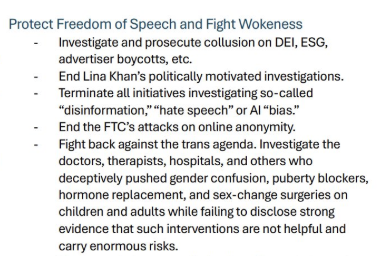
And then there’s FTC Chair Andrew Ferguson. When begging Donald Trump for the job he sent a one-pager in which he promised to end what he called Lina Khan’s “politically motivated” lawsuits, but at the very same time promised his own politically motivated lawsuits: in particular attacking those who provided support and resources for transgender individuals. Hilariously, he put this promise under the heading of “protecting freedom of speech and fighting wokeness.”

Ferguson has already received a few judicial smackdowns for infringing on the First Amendment rights of organizations. Last year, there was one in the case involving Media Matters. And then last month, there was a case involving WPATH, the World Professional Association for Transgender Health. WPATH is a non-profit that has been an important player in helping medical professionals understand transgender health and how to help transgender patients.
But Ferguson is apparently among those transphobes who seem absolutely obsessed about what genitalia other people have (which, I tend to believe is no one’s business but themselves, their consensual sexual partners, and their healthcare providers).
Anyway, Ferguson sent civil investigatory demands (CIDs, the FTC equivalent of a subpoena) to WPATH in January of this year. WPATH, rightly, went to court over this and won. Judge James Boasberg blasted the FTC for violating WPATH’s First Amendment rights with these bogus demands. Indeed, he pointed to the very recent Supreme Court ruling in First Choice Women’s Resource Centers, which our own Cathy Gellis pointed out was a strong ruling that would protect free speech in other cases. And Boasberg proved her right a week later:
WPATH has demonstrated the CID’s chilling effect on its protected speech. Its declarations describe an undercurrent of fear among staff and members following the CID: fear that “statements . . . will be misrepresented and distorted . . . if WPATH is forced to disclose internal discussions and information to the FTC,” fear that specific members will become targets, and fear that academic professionals will not openly discuss their ideas given the possibility of turnover. See ECF No. 3-6 (Scott Leibowitz Declaration), ¶¶ 38, 41; see also Radix Decl., ¶¶ 18–19 (detailing longstanding importance of confidentiality in member communications). That fear is not extrapolation to some future action: the CID demands “all Documents reflecting or constituting Communications with other organizations, institutions, or individuals regarding the development and publication of SOC 8,” and all documents “including tests, reports, studies, scientific literature, and written opinions” that WPATH relied upon to assert that pediatric-gender-dysphoria treatment is safe and effective. See CID at ECF pp. 5–6. Those two items alone encompass a vast swath of academic or research discussion in which WPATH engages. Where an agency “demands” a nonprofit’s “private member” information, it “encourage[s] groups and individuals to cease or modify protected First Amendment [activity] the government disfavors.” First Choice Women’s Res. Ctrs., Inc. v. Davenport, 608 U.S. ___, 2026 WL 1153029, at *8 (2026). The threat is all the greater when the agency seeks the substance of member communications and, in so doing, predictably stifles future speech. What is more, the CID seeks WPATH’s future communications, making the chilling effect readily discernible. See CID at ECF p. 4. WPATH is likely to succeed on this element.
The ruling is chock full of evidence that the FTC has no legitimate reason to go on this fishing expedition. And yet it has.
And, of course, this FTC doesn’t actually give a shit. It just wants to punish any pro-transgender speech. So a month after Boasberg called out how the FTC’s investigation of WPATH is obviously a violation of the First Amendment… Ferguson’s FTC decided to sue WPATH in a totally different court, this time in Fort Worth, Texas, which is where MAGA often files, knowing it’s likely to get a Trump-friendly judge who will ignore the First Amendment issues and perhaps side with the administration in support of general MAGA transphobia.
The fundamental argument is that WPATH is being unfair and deceptive to “consumers” (in this case, doctors). The evidence is that… um… [checks notes]… a number of doctors say that WPATH’s published “standards of care” [SOC] for transgender patients is useful. I only wish I were joking:
Medical professionals have also been duped. One clinician responded to the RFI by stating that “[t]he WPATH standards of care does an excellent job providing recommendations and guidelines for practices that are evidence based and expert reviewed.” Another said, “[a]s a mental health professional . . . affirming and coordinated healthcare, informed by recognized standards of care (including WPATH), provides young people and their families with stability, safety.”
OMG. Medical experts suggesting medical treatments that other doctors say is really helpful. Can’t have that! Make a federal case about it!
The FTC makes a big deal of SOC-8 (the updated standard of care doc WPATH released in 2022) as if it’s some horrible evil document. But you can read the thing yourself and realize that the FTC is lying to you. SOC-8 is quite clear that it does not advocate for specific treatment, but rather that doctors and patients determine what will be best overall for transgender patients. And, contrary to the way that transphobes characterize it, it does not push people to gender-reassignment surgery, but rather encourages doctors to make sure that patients understand their options and are mature enough to make a full decision themselves, rather than being pressured into anything.
In other words, it’s what you’d expect from a document put together over many years using a cross section of actual medical experts.
Even looking past the FTC filing what is clearly a censorial case because of their own weird gender hangups, and the fact that this is clearly a vexatious, censorial attack on WPATH’s free speech rights (as already established by one federal court), there’s another reason this case should be dead on arrival.
The FTC only has the authority to regulate commercial activity. And WPATH is a non-profit that doesn’t engage in commercial activity. TechFreedom’s Berin Szoka has a good thread on how this case should get thrown out before we even have to get to the First Amendment stuff or the merits.
Still, as with all of these kinds of cases, the process is the punishment. Ferguson doesn’t really give a shit if he wins. He just wants to make it abundantly clear that any organization that actually wants to help transgender individuals may face a vexatious investigation and/or lawsuit by the federal government.
If Donald Trump actually meant what he said in that executive order, he’d send Ferguson (and Carr) packing. But, of course, he never did. And, of course, we won’t hear a peep from any of the people who spent all four years of the Biden administration insisting that the administration was “censoring” people. It turns out none of them actually cared about free speech. They only cared about culture war and furthering their own bigotry.
Filed Under: 1st amendment, andrew ferguson, free speech, ftc, healthcare, trans rights
Companies: wpath
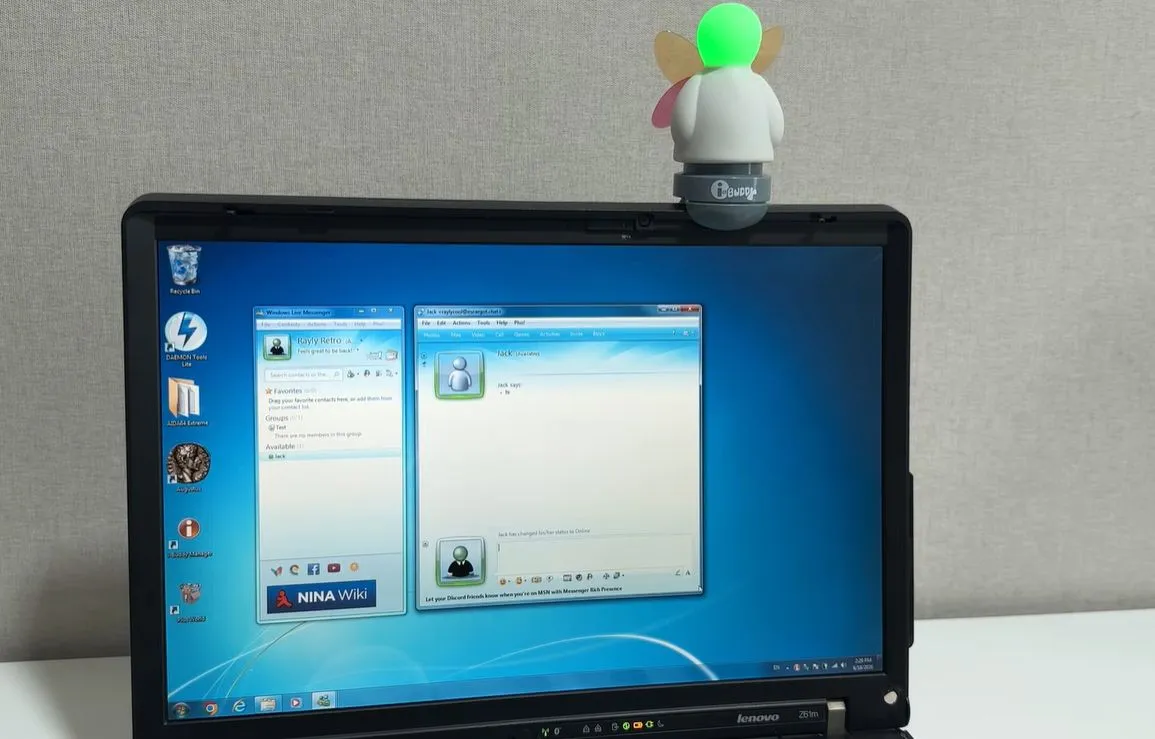
Some of our esteemed readers were not yet out of diapers back in 2013 when Microsoft decided to put MSN Messenger out to pasture, but the memories that this instant messenger’s (IM) interface and notification sounds have left are hard to erase. This also includes some of the weirdest accessories that this IM spawned, such as the USB-connected i-Buddy. Recently [Rayly Retro] got his mittens on a new-in-box one to revive alongside an era-appropriate Windows 7 PC.
What the i-Buddy gets you is the ability to light up the head in seven different colors, twist the torso and flap the butterfly wings, all of which can correspond to certain events in the MSN IM or for more general notifications, as set by software running on the connected PC. Interestingly, this i-Buddy is recognized by Windows as a USB HID, so no special driver is needed. A range of ways to program it exist too, including a .NET-based library from back when it was still being sold for around $20.
Although the MSN Messenger network’s servers have long since been dumped into an e-waste dumpster over at Microsoft HQ, an alternative exists in the form of the Escargot service using which a range of official clients can work again.
In the video it’s demonstrated how to create a user account with the Escargot site and how to patch the messenger – here Window Live Messenger 2009 – before signing in. With that step completed, getting the i-Buddy up and running is next. This took a lot of struggling, since the version of the i-Buddy software that comes with the device didn’t like Windows 7 much. Fortunately an old forum post led to a download of version 2.10, using which the gadget jumped to life, happily lighting up and flapping its wings.





Weekend Open Thread: Miami – Corporette.com


Renter of Home in Anne Heche Crash Denies Settlement With Son


Microsoft accidentally kills epic Outlook email threads


Soccer-U.S. defends Iran World Cup travel restrictions, says discussions ongoing


BBC Reporter Discusses Cross Party Criticism Of Trumps Iran Deal

Two goals and an assist by sheer aura: Cristiano Ronaldo just entered the World Cup chat

Wall Street Week Ahead: Investors see Micron earnings as pulse check of AI rally momentum


AWS enters the context layer race with a graph that learns from agents, not manual curation


Andy Burnham and the meaning of Makerfield

Can Charles Hoskinson Really Rescue Cardano?


HIVE shares jump as $220M AI deal speeds Bitcoin mining pivot


Jake Chervinsky accuses CME of protecting derivatives monopoly


Brexit cost 6% of UK economy, Bank of England company data suggests


Nearly 7,000 fake Amazon domains registered ahead of Prime Day 2026, researchers warn


Keir Starmer Allies Question His Chances For No 10


FIFA World Cup 2026: Canada beat 9-men Qatar 6-0 to register first ever win | FIFA World Cup 2026

Signal’s Meredith Whittaker says AI chatbots ‘are not your friends’ and calls Copilot agents a backdoor


MHP SE 2026 Q1 – Results – Earnings Call Presentation (OTCMKTS:MHPSY) 2026-06-20


Jose Alvarado Wants Taylor Swift at More Knicks Games


Anthropic’s Dario Amodei Urged AI Unity at G7, Even as US Banned His Models



You must be logged in to post a comment Login