
I was the kind of kid who dug holes, the deeper the better. I vividly recall the ecstasy of once splaying out my fingers in a bucket full of backyard dirt, a bliss punctuated only by a sudden burning sensation in my right hand that turned out to be my first-ever encounter with a fire ant.
Tech
How touchscreens rewired our relationship with the physical world


The textures of my childhood loom larger in my memory than sights or sounds. My first paper cut, on a piece of sheet music, and the rush of cold water my older sister used to wash away the blood. The warmth of my mother’s hug and the tender squeeze of my grandmother’s hand in mine. The whoosh of air I’d get from barreling a scooter down a hill, and the pristine crunch of stepping out into a winter’s first snow.
Eager to break my own screen addiction, I toggled my iPhone into grayscale a few years ago, an accessibility setting that renders everything in black and white. In the days that followed, I’d look up from my phone and marvel at the sense that suddenly, the world’s colors appeared more vibrant than they were before, dulled by my adjustment to highly saturated displays. It was as if I’d just kicked a really bad sugary candy habit, and could once again appreciate the natural sweetness of a piece of fruit.
I’ve since been fascinated by the ways that our senses warp to adapt to our largely digital lives, and the extent to which those changes have seeped across our perceptions of the real world. I wanted to write this piece because I had a hunch that in the same way that screens had desensitized my eyes to color, making the world appear washed out, perhaps the opposite was happening with our sense of touch: By spending so much time tapping on a screen, we’d become hypersensitive to the point of aversion to the textures of the world around us.
I found some evidence to this effect, including links between excessive screen use and sensory issues, like the overwhelm many neurodivergent children feel in response to certain textures. But in conversations with experts, I also learned there has been a much longer societal arc away from engaging dynamically with our sense of touch, a loss that has had a profound impact on how we understand the world around us.
This was the world where many of us grew up, one in which we felt our way toward understanding, sometimes playfully, sometimes a little painfully, sometimes both. To make a phone call, you once had to rotate a dial. Entering an apartment building meant turning a key inside a wobbly knob. Calculators and cameras used to be clunky, and writing was something you did with a pencil you sharpened yourself.
But now, almost everything gets done through the touch of a screen, and the sharper that resolution becomes the fuzzier sense of what’s real and what’s not becomes. We’re starved for clarity, and as we fall out of touch with the world — both literally and figuratively —we’re only getting more ravenous.
“We’re aching for friction; we need and we crave friction,” said Mark Paterson, an expert on the sociology of touch at the University of Pittsburgh, because “it affirms ourselves and the boundaries between the self and the world.”
To be an adult today is to literally lose touch, to recede into the contours of your workaday life, and to reserve your exertions to do or to produce, but less frequently to explore. And to never willingly expose yourself to the fire ants lurking in the dirt.
Growing up isn’t the only reason why the textures that stitched together my early memories — those lines between real and imaginary play — now fall as flat as a crushed juice box or a deflated birthday balloon. Like most Americans, I spend far too much of my time with my nose pressed to a glossy screen, electroconductive feedback loops replacing the many discrete activities my younger hands mastered.
If kids once grew up surrounded by a smorgasbord of textures, many of today’s iPad babies struggle to hold crayons or zip up their jackets by the time they enter kindergarten. Socializing is something we now do overwhelmingly online with teens hanging out with their friends face-to-face nearly half as often as they did 20 years ago. We’re told to touch grass, but we keep touching screens: Americans spend 90 minutes less outside of the house now than they used to, and two-thirds of parents say they spent far more time outdoors as kids than their children do now.
“If the screen could imagine what its users look like,” Paterson told me, “then we’d be one big set of eyes and just one finger.” That one finger — or at most, two to four — is the dominant medium through which most young adults engage their sense of touch for over seven hours each day, tapping and texting and swiping for the equivalent of 106 days per year.
What so many people experience as screen fatigue might actually be better described as touch hunger, the unyielding sense that we don’t touch grass, touch one another, or touch textures — neither buttons, pens, nor dials — as often as we used to. In the quest to make our daily lives as frictionless as possible, we might be losing out on some of what makes life feel like life itself.
“The world is a wonderful interface to engage with,” said Rachel Plotnick, an expert in human-technology relationships at Indiana University. “Giving that up comes with a real loss.”
How the world became flatscreen
As the 19th century yawned into the 20th, an Italian physician named Maria Montessori opened up an experimental preschool for children cooped up in an impoverished tenement in Rome.
The first Casa dei Bambini, as Montessori called it, embraced a pedagogy of touch, eschewing lectures in front of a blackboard in favor of sensory activities such as fastening buttons, sorting blocks, and sweeping corridors. In their tactile environment, the students who arrived to the schoolroom “wild and uncivilized,” Montessori once said, soon “showed extraordinary understanding, activity, vivacity, and confidence. They were happy and joyous.” At a time when only half of Italian adults were literate, many of these children quickly became the first in their families to learn to read and write.
“In order to form and maintain our intelligence, we must use our hands,” Montessori said decades later in 1946, by which time hundreds of schools around the world had adopted her methods and her name.

The anxieties that first made Montessori’s educational innovations take off around the world will feel familiar to anyone nursing a smartphone addiction today. In the wake of the industrial revolution, nobody seemed to use their hands like they used to anymore. By 1920, more Americans lived inside cities than outside of them. As that shift continued, entire generations of workers began to earn their living primarily using their minds, not their hands, for the first time.
But the dawn of mass production also led to “real concern about bodily disengagement from the world,” said David Parisi, a professor of touch and digital technologies at New York University. Americans began buying their bread instead of baking it. They did away with churning butter, spinning yarn, chopping wood, and pickling produce in favor of buying packaged margarine sticks, factory-woven fabrics, coal furnaces, and canned vegetables.
There were ultimately tremendous benefits to these industrial era innovations, like more abundant food, the birth of modern medicine, and dramatically longer lifespans. But as transformative as those innovations were, they also represented an early manifestation of the “loss of what I like to think of as a certain type of epistemology, a certain mode of knowing or being in the world,” Parisi said. “That sense of knowing through touch.”
In the century since sliced bread began appearing on market shelves, our daily lives have only become more and more tactilely convenient, which is another way of saying still more physically disengaged. And while earlier technologies still involved some “differentiation of the interface,” said Parisi — think of a button versus a knob — now ubiquitous touch screens, despite their name, have flattened even those differentiations.
Plotnick, who wrote a definitive history of the button’s electrified early days, notes that there was plenty of fear at the turn of last century that all forms of touch would one day be replaced by the pushing of a switch. “Electric buttons have become the masters of the world, overcoming distance, doing away with the necessity for forethought,” a French nobleman that she quotes complained in 1903. “And, for that matter, for thought at all. Everything is changed.”
But today, most of what we do is achieved not through a push, which at least requires a modicum of pressure, but through a fleeting tap or swipe. What Plotnick refers to as “touchscreen mania” has flattened even those once ubiquitous buttons, levers, and knobs into a glossy lifeless display.
Even branding has gone flat in deference to the smartphone, which favors the legibility of 2D design at the expense of the richness that even a veneer of texture brings. If you’ve wondered why the logos for brands like BMW, PayPal, and Olive Garden look so sterile and interchangeable now, blame the fact that most advertising now happens through your phone, which can make anything remotely textured — like Spotify’s much-maligned disco ball icon — look distorted. Like most of modern life, it seems, branding has contorted itself to fit into the deflated topography of a largely digital world.


“We are tactile creatures,” Plotnick said. “How boring is it that all of the digital experiences that we have in the world are just touching the same slick flat glass over and over again.”
And boy, do we spend a lot of time touching that slick flat glass, often at the expense of touching more important things, like nature — and one another.
Americans check their phones nearly 200 times per day. It is the first thing they see in the morning and the last thing they see when they go to sleep. Nearly one-third of adults under 30 spend over nine hours per day looking at screens, which means that if nothing changes, they will spend over 20 years of their lives under the cool blue glow. Their dexterity, and even grip strength, appears to be atrophying away the handwriting or even typing mastery of older generations, and collapsing toward the great plains of the smartphone screen.
Worry not for the grown-ups, whose motor skills are more or less fully baked, but for the iPad babies, whose fingertips have been expeditiously wired like those of a prodigious violinist to deftly navigate the contourless landscape of their devices, as anyone who’s seen a toddler navigate an iPhone can attest.
Montessori’s hands-on learning methods remain popular, particularly among well-to-do parents. But many toddlers are glued to their screens, spending about 2.5 hours per day with them on average, instead of stacking blocks or painting with their fingers. And, while affluent families might be able to afford the Montessori preschools, $80 audio toys, and screen-free summer camps, many families can’t afford the increasingly premium experience of an unplugged childhood. According to a 2019 study, tweens from low-income families use their phones two hours more per day than high-income kids. Kindergarteners from low-income families spent a startling six hours per day on screens at the height of the Covid-19 pandemic.
It’s no wonder that over three-quarters of preschool teachers say their students can’t hold scissors, crayons, or pencils as well as they used to anymore, according to a 2024 survey by Education Week. Nearly 70 percent of teachers said kids have a harder time tying their own shoes. “The only place I’ve seen crayons given to kids is on airplanes,” said Field, the developmental psychologist, who believes that children’s motor skills have increasingly molded around their use of screens, rather than around the hexagonal barrel of a pencil or the steel frame of the monkey bars.
But this haptic atrophy is about more than pure playground nostalgia. As Montessori spent a lifetime pointing out, children — and teens and adults for that matter — learn better when they learn with their hands. Kids who count on their fingers are better at math, and writing by hand lights up your brain in all the right places for encoding new memories and information. For every additional hour per day that children spend on screens, they score 10 percent lower on standardized tests, a correlation that probably helps explain why American kids have been testing precipitously worse on math and reading ever since the smartphone took over about a decade ago.

“How do kids learn about the world? Well, they need to feel if something is lumpy or soft or hard or hot or rough,” said Plotnick, who becomes concerned at times when she sees her own kids learning math on the computer. “If they’re not moving around pieces and they’re not erasing with an eraser,” she said, they might not be able to “process that content in as rich a way as if they were using their hands.”
While adults may be less vulnerable to the worst effects of screen time, they’re not immune to its dangers. Smartphone-addicts are more prone to vertigo and balance problems, meaning that the majority of Americans may be clumsier than they used to be. And if you spend all of your free time spiking your dopamine levels on your phone, then you have less time for using your hands to knit, cook, and garden, which all measurably improve your mood and can ward off depression.
“Even just writing, holding a crayon or pen, is stimulating the pressure receptors under your skin” leads to “a more relaxed neurological state” in which “your nervous system slows down, your heart rate slows down, your blood pressure slows down,” Field said. “You can trace a whole path towards ill health” from failing to adequately engage your sense of touch.
Like most technologies, the touchscreen is not inherently evil. It is not predestined to be cast as the cartoonish bad guy siphoning kids away from their cowboy dolls like LilyPad the tablet does in the latest Toy Story sequel. During the pandemic, for example, touchscreens were arguably an overwhelming force for good, allowing people to preserve some slimmer of connection with one another when being physically together became unsafe.
Arko Ghosh, a professor at Leiden University, has studied patients going through brain surgery. After they come out of anesthesia, “one of the most difficult moments of their life,” almost all of them “grab their phone, because it’s so easy and it immediately connects you to your loved ones,” he marveled. “There’s a magic going on through your fingertips that wasn’t there before.”
“How do kids learn about the world? Well, they need to feel if something is lumpy or soft or hard or hot or rough.”
— Rachel Plotnick, Indiana University
But there are also inescapable tradeoffs to outsourcing your social life to the screen instead of rubbing shoulders and shaking hands in the real world. Touch starvation or skin hunger — the yearning for human contact — reached a much–discussed fever pitch during the pandemic, but many people never shook off the itch, in part because its roots long precede the pandemic.
Teens and young adults today spend 70 percent less time hanging out in person than they did two decades ago, and a poll in the UK found that 40 percent of adults go days without speaking to another person face-to-face. Americans have far fewer friends and have way less sex than they did a few decades ago. Even when they hang out with one another, most admit that they can’t stop checking their phones.
“There is more touch on the screen than there is on other people,” Field said, “and that is a sorry experience.” Holding hands or hugging have been shown to reduce cortisol levels and flood your brain with happy hormones. Touching grass has a similar effect, and so does collaging or ceramics.
It’s no wonder that people feel existentially lonelier, far less trusting, and I would argue, fundamentally less grounded in reality than they were when they, like me, spent their childhoods literally digging into the ground. When we no longer feel the grain of the world, how can we hold onto what’s real or not?
Have we reached peak screentime?
There are some indications that the world has reached its anti-tactile breaking point.
Dissatisfaction with our touch-deprived status quo has spilled out in the form of fidget spinners and the revival of the printed word, flip phones, clackity keyboards, wristwatches, and grannycore hobbies like ceramics or crochet. “People want that tactility, that physicality,” Parisi said, of textures as benign as “the play button on a cassette deck.” They crave the subtle etched sound grooves of a vinyl record — sales of which surpassed $1 billion last year for the first time since last century — or the feel of a cool metal needle pressed against a fuzzy bunch of yarn.
“I’m of that generation where I used to love taking the record home from the store and lifting the needle” of a new vinyl, Paterson said. “There was a tactile element that’s missing in digital streaming.” He believes their resurgence may belie “an appetite to introduce more friction into people’s lives again,” he said. “I think the tide is turning.”
Naturally, as with Montessori schooling, one’s digital detox now comes with a premium price tag: An app blocker can run for $60, ceramics classes are prohibitively expensive for many hobbyists, and some dumb phones — devices with far more limited access to apps and other functions — cost far more than their “smart” counterparts. But there are other reasons to be hopeful too.

Critically, schools (and in some cases, indie musicians) have begun locking up kids’ phones altogether, mandating recess, and forcing students to go back to handwriting essays in blue books. Quite suddenly, the lunchroom is loud again.
Even car companies, which so eagerly began adopting their big ugly touchscreens a decade ago, have begun bringing back the button. “People seem to have a hunger for physical buttons, both because you don’t always have to look at them — you can feel your way around for them — but also because they offer a greater range of tactility and feedback,” said Plotnick, who’s advised companies looking to make the switch. “I do think we are seeing that pendulum swing back.”
If you are not a neo-luddite, and the idea of a small computer wrapped around your index finger doesn’t make you seethe, then there is also the promise of wearables — like Oura rings, Apple watches, and Meta glasses — which could portend a more ambient technological future, one where people spend less time staring at screens and more time living in life.
“We don’t want to romanticize buttons and demonize touchscreens or vice versa,” said Plotnick. “We don’t have to live in a world where you have to only have one or the other.”
Haunting all of this, an actual ghost in the machine, is the spectre of artificial intelligence. On the one hand, it could push us towards an entirely frictionless future, Plotnick said, one where people need not even tap or swipe anything anymore to send out a message or get food delivered to your door. On the other hand, AI calls into question the very premise that led many people to value the cerebral over the corporeal in the first place. After all, the dawn of the white-collar workforce helped crystallize the idea of an America that worked — and by extension, defined itself — within the contours of the mind. Disrupting that premise — combined with the dawn of reality-warping AI photos, videos, and misinformation — could force a reassessment of the value of a human touch.
Over half of Americans now say they have a hard time knowing what’s true, and perhaps even more importantly, more than half feel isolated from one another, and three-quarters say they’re more stressed about their country’s future than they used to be. Over 65 percent of Americans don’t feel like they belong in this country, and over three-quarters said the same of their neighborhoods. The nodes that once connected people to their surroundings, to one another, and to their own personal truth appear to be eroding.
You really can’t believe everything that you see anymore. But with the almost quaint certainty that comes from a fresh blade of grass or a fire ant’s sting, you can in fact believe almost everything you can touch. If we choose to outsource our sense of reality, and even our precious early memories, to our frictionless digital lives then we are dooming ourselves to a life in a sea of slop, that thankless mire of the proverbial metaverse. At worst, we risk stripping away the textured frictions that help define where our selves end and where the rest of the world begins.

Continue Reading
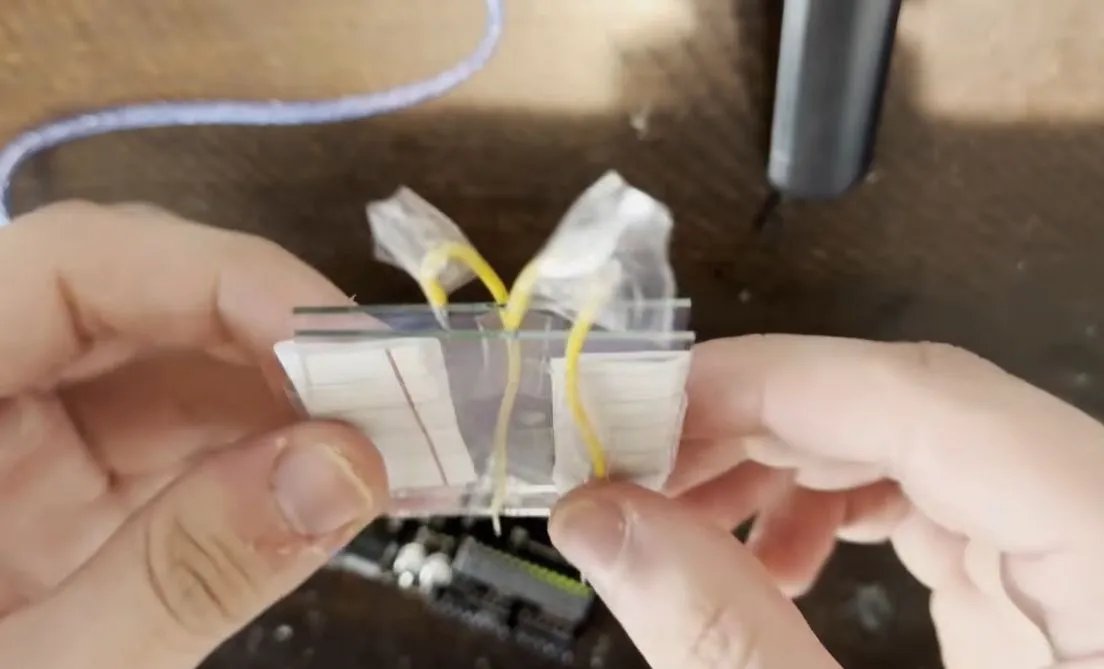
Although generally glass isn’t associated with touch-sensitive surfaces, the addition of an ITO (indium tin oxygen) coating adds the exciting property of not only being transparent to the visible light part of the electromagnetic spectrum, but also of being electrically conductive. The logical result is that fine folk like [Sokol] simply had to use their newly acquired ITO-coated glass to make a button out of.
Here the easy option is of course to just use it as a capacitive sensor where the conductive ITO layer is used for the capacitive charge and the glass provides the insulator, but here we see it demonstrated how to create a pressure-sensitive implementation instead.
The measured conductivity on the ITO-coated glass in the video is pretty good, at just over 20 Ohm. This thus makes said capacitive button very easy to achieve. To make it a touch-sensitive button, two pieces of glass are used, with the ITO sides facing. Paper is used to create a spacer, after which the slight flex of the glass allows for the two ITO surfaces to touch, completing the circuit.
This is somewhat similar to how resistive touch screens work, with the position of the finger or stylus determined by the resistance between the two sides. In a hobbyist setup this would make it fairly easy to create a multi-position touch screen using just two pieces of glass and some firmware.

from the openness-wins dept
On a laptop screen in a dimly lit tent near the Donetsk front, a Ukrainian drone team steers its aircraft into the turret of a Russian T-72 and glimpses the start of an explosion before the picture dissolves into static. The strike is uploaded, verified, and scored against the point value assigned to the tank. The unit climbs a public leaderboard that ranks hundreds of drone teams, and the points are currency: a higher score buys better equipment, faster, from an online marketplace the warfighters compare to Amazon.
Washington is about to decide how the federal government will parcel out access to the most powerful AI, and it is drifting toward concentrating that capability in a few chosen hands, rationed by criteria no one outside the process can see. A country with foreign invaders on its own soil has spent the past year learning to do the reverse—and winning back ground as it does. From Luhansk to Lviv, Ukraine puts its best tools in the hands of whoever can use them and shares what it knows about the enemy as fast as it safely can, openly and by rule.
Behind the leaderboard sits a set of arrangements Ukraine built under fire. A marketplace lets frontline units order drones directly from hundreds of manufacturers, most of them small shops scattered across Ukraine. A procurement cycle that once ran months now takes days, and new designs reach the trenches within about a month of leaving the workbench, because the units doing the fighting, not a distant acquisition office, decide what they need in the field. Furthermore, their feedback goes straight back to the manufacturer, sometimes the same day. Because the manufacturing is dispersed rather than massed, no single Russian strike could ever change much.
Ukraine has been just as willing to share what it learns. Late last month its defense ministry opened a platform called TrophyLab that hands the technical anatomy of captured Russian weapons—schematics, known vulnerabilities, even physical samples—to a deliberately wide circle: allied militaries and intelligence services, and hundreds of Ukrainian and partner-country firms. Access is vetted and revocable, governed by published criteria. The premise is that knowledge of a threat is worth more shared than hoarded. This should be a rule everyone can see, rather than the whims of a distant official.
That combination, wide but rule-bound, is exactly what the executive order the White House issued in June fails to deliver. Faced with AI systems that can now find software flaws faster than any human team, the order promises early access to the most capable models to a few “trusted partners”—a phrase it never defines, routed through a classified process. It calls the arrangement voluntary. In practice it has not been: under national-security and commerce authorities the administration has already restricted, suspended, and then cleared frontier models, with no published criteria anyone outside the process can point to. Ukraine’s leaderboard may be a crude way to run a war, but it is at least a rule—public, legible, the same for every unit.
The deeper problem is what that opacity does. Ukraine found that capability does the most good spread widely, that a defense holds because it has no single point of failure, and that threat intelligence should travel by rule rather than favor. A trusted-partner tier governed by undefined discretion inverts all three: it concentrates the best tools among those already best equipped, builds the very chokepoint Ukraine works to avoid, and turns shared knowledge into something rationed by judgment no one can inspect. The United States already runs sector-based centers for sharing threat intelligence; the question the framework raises is not whether to centralize but whether the flow reaches the defenders who need it or stops at a favored few.
And there are real lessons for the United States. Ukraine’s openness may look like the underdog’s strategy, and the United States is the wealthiest, most powerful country on earth—but national strength does not mean every system is strong. The defenders who most need help are not the money-center banks and wealthy university hospitals; they are smaller institutions that, despite non-specific promises they’ll be helped, seem unlikely to benefit from this system as it’s set up. For them, a head start reserved for the already-strong is no help at all.
Ukraine did not arrive at any of this by design. It was forced into it, and used a mix of openness and clear rules to stop a much larger power in its tracks. Washington has the luxury of choosing on purpose but may be drifting towards a system governed by whims and favoritism rather than clear rules and standards.
Eli Lehrer is president and co-founder of the R Street Institute.


security
Hopefully the company secures houses better than it locks down SaaS systems
A leading name in home and business physical security, Brinks Home, recently said it identified unauthorized access to a portion of its IT systems, an intrusion ShinyHunters claims it carried out to steal millions of records from the security provider’s Salesforce instance.
Brinks Home hasn’t named the intruder or identified the affected system, but said the responsible party has threatened to leak information it claims to have taken.
“Brinks Home is working diligently to determine what information was involved and who may be affected,” the company statement said. “If the Company determines that personal information has been affected, it will notify those individuals as required and as appropriate.”
An FAQ page for the incident said that Brinks Home products and services weren’t affected, as far as the company knows at this point, so alarms and other security tools should be working without issue.
While Brinks may not have been very forthcoming with information, and lacks any sort of official way for media to communicate with it outside of sending a LinkedIn message it didn’t answer, the party that’s claimed responsibility has gone public with some details, and it’s none other than ShinyHunters with another claimed Salesforce breach.
According to leak site monitoring outfit Ransomware.live, ShinyHunters claimed to have obtained more than 4.9 million Salesforce records from Brinks Home “containing some PII.” The group threatened this week to leak the data along with causing “several annoying digital problems” if Brinks Home didn’t reach out by Thursday, July 30, to negotiate a ransom payment.
It’s not clear if Brinks Home has contacted ShinyHunters; Brinks Home didn’t respond to messages, and contacts The Register has for ShinyHunters appear to have changed, causing message and email rejections.
ShinyHunters has been a prolific Salesforce intruder of late, with the group claiming earlier this year to have stolen data from around 100 high-profile companies’ Salesforce instances. Salesforce has previously warned that an unnamed known threat actor group was actively scanning for public-facing Salesforce instances and abusing misconfigured guest accounts to break in.
Brinks Home is no longer part of the larger Brinks brand, with The Brinks Company telling us it sold the home security arm in 2010. Brinks Home’s parent company, Monitronics, has filed for bankruptcy twice since 2019; for customers’ sake, we hope its physical security services are better than its financial management and infosec. ®

Are you looking for a new job in the research and development space? Then check out SiliconRepublic.com’s list of companies currently recruiting.

Ireland’s research and development space is growing every day and with that comes new opportunities for graduates and professionals to find the perfect role.
There are plenty of vacancies for job hunters looking to break into R&D, so, if you are looking for a new role in research, take a look at these eight companies currently looking to boost their teams.
Accenture
Dublin-headquartered technology company Accenture is looking for research professionals to join its teams.
One vacant position is for a human and AI research lead. Among other responsibilities, the job will include building a strong pipeline of research themes and projects, integrating research, establishing visible leadership in the field of AI and developing the team’s craft, confidence and commercial maturity.
Another research-based role open to professionals at Accenture is the Dublin-located design lead position. As part of the job, the right candidate will support and execute design research activities, synthesise research to uncover insights and design rapid prototypes for stakeholder testing.
Fidelity Investments
Boston-headquartered financial services company Fidelity Investments has premises in both Galway and Dublin. The Galway team is actively recruiting for an onsite senior IT data analyst, which would call for skills in research. Additional job expectations alongside the research component will include working closely with business and technical teams to drive the creation of scalable and documented data design solutions.
Liberty IT
Liberty IT, the tech arm of the insurance firm Liberty Mutual Insurance, has offices in Belfast, Dublin and Galway. Currently, there are vacancies at the Belfast and Galway premises for a senior product designer, a role which will demand a professional with research skills. The chosen candidate will join the USRM product design team and will partner closely with the USRM user research team, as well as those in product, engineering and data science.
Among other responsibilities, the role will involve leading discovery with research, planning studies, synthesising insights and turning findings into clear recommendations, alongside work across UX disciplines, research partnerships, interaction design, service design and visual design.
Optum
Global healthcare company Optum has opportunities for Ireland-based employees at its Dublin and Letterkenny facilities, via a principal data scientist role that includes research responsibilities. Among the preferred qualifications is proven hands-on experience implementing and adapting published academic research into tangible solutions.
Additional roles requiring a similar skillset include a senior data scientist position, a principal data analyst role and a senior data analyst for healthcare economics, among others.
Regeneron
US biotechnology company Regeneron has a presence in Dublin and Limerick. Currently, there are a number of opportunities that qualified professionals looking to flex their research skills can avail of. A Limerick-based QC analyst in biochemistry role will involve conducting tests on in-process, release, stability and research samples.
There is a similar, temporary QC analyst HPLC role available, as well as opportunities for a QC microbiology associate scientist, whose work will include culturing organisms, conducting research and characterising them for use in investigations and cleaning development.
Stryker
Medtech Stryker wants to add a qualified professional to its Carrigtwohill, Cork team, via an advertised principal software engineer for R&D role. The right person for the job will be expected to lead system-level designs and technical direction for complex medical electronic systems with a strong embedded software and firmware component.
They will define system and software architecture, guide cross-functional engineering teams, and ensure delivery of safe and compliant medical device platforms.
Other opportunities for R&D professionals include: senior staff R&D design engineer in power electronics; senior R&D engineer in electrical design; senior staff R&D engineer, mechanical; and senior design engineer, R&D.
Vertiv
Digital infrastructure company Vertiv is looking to recruit a research and development engineer to its Burnfoot, Donegal office. The successful candidate will play a pivotal role in shaping the future of the company’s offerings. There is also a graduate research and development engineer’s position available, while another job vacancy that requires research skills is for a global product specialist position.
Viatris
Healthcare company Viatris is adding to its Dublin-based team, with a research role up for grabs. The company is recruiting for a specialist RIM data maintenance position, in which the ideal candidate will have previous experience in regulatory affairs or pharmaceutical experience in areas such as research and development, quality assurance, and compliance, among others.
Don’t miss out on the knowledge you need to succeed. Sign up for the Daily Brief, Silicon Republic’s digest of need-to-know sci-tech news.
Tech
What does a backyard Dolby Atmos home music studio look like when you’re a sound engineer for major artists? The shed of my dreams, that’s what
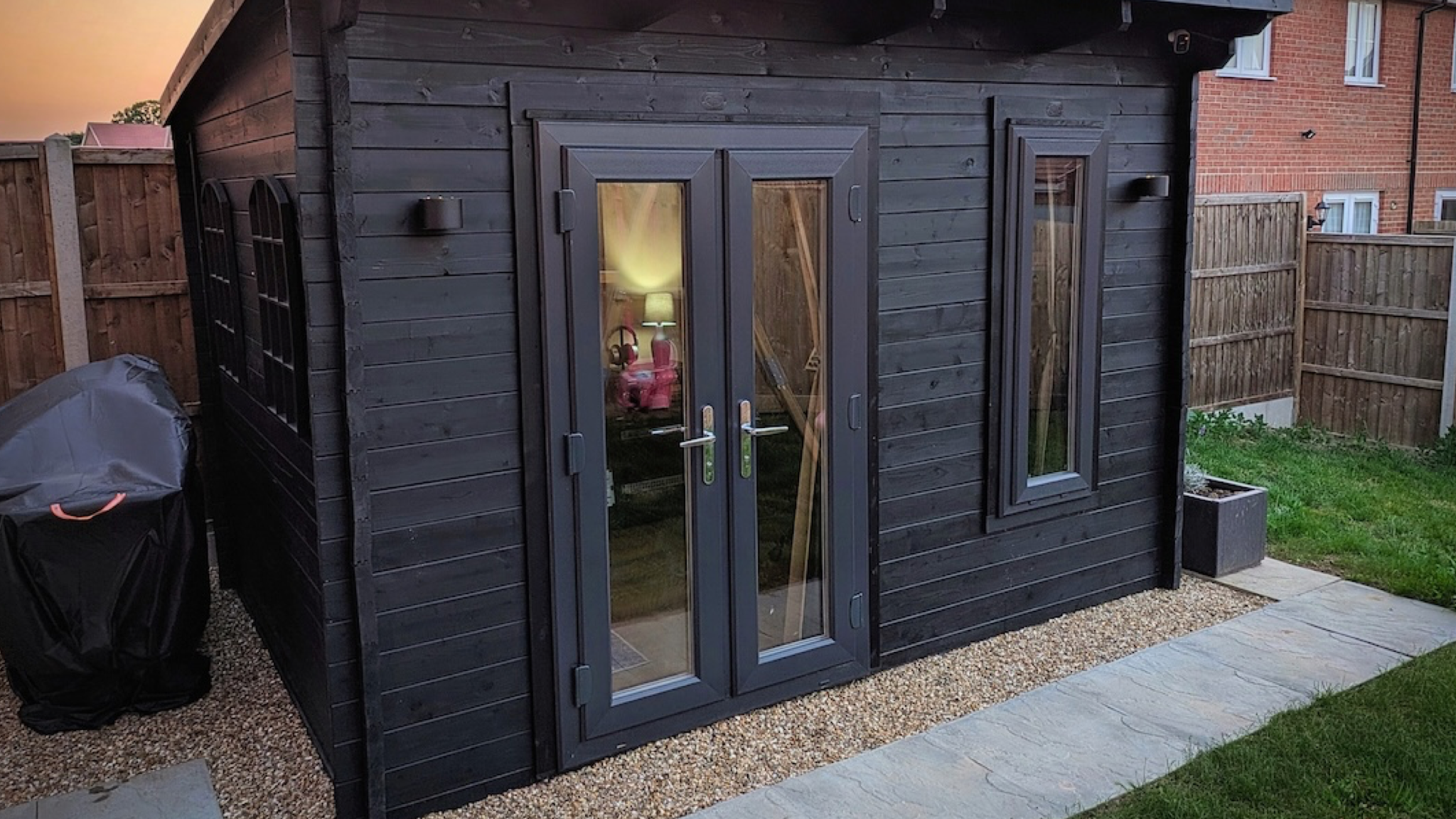
- It’s a full Dolby Atmos mixing studio… in a shed
- Designed to deliver accurate Atmos audio with pin-sharp precision
- Artists are delighted with the mixes, which required no tweaks
If like me you used to have, or still have, a backyard office or shed for working in, you’re going to be green with envy at the sight of mixing maestro Kurt Martinez’s personal Dolby Atmos studio.
The award-nominated Atmos expert designed and built his own backyard office and filled it with enviable gear, and if he doesn’t call it his Spatial shed I’m going to be very disappointed.
Martinez has been nominated for the prestigious Music Producers Guild award as Atmos Engineer of the Year, and he spent three years as the Head Dolby Atmos Mix Engineer at the world-famous Dean Street studios. He’s worked on live and recorded music by a host of stars including Kylie Minogue, Def Leppard, Soft Play, Billy Idol and Duran Duran.
Latest Videos FromTechRadar
Like many freelancers, Martinez figured that having a home office was a much better idea than a long commute into the city, and in Martinez’s case that decision was compounded by being a new dad. So he built an entire Atmos mixing studio in his back garden, doing everything himself apart from the electrics and internet connectivity.

How to make a spatial shed
As Mixonline reports, Martinez built the 2.5m x 3.5m garden office with a combination of porous timber walls to absorb the low frequencies, acoustic panelling in the ceiling and sides, a large rear bookshelf for dispersion, and acoustic slat panels at the front. There’s thick acoustic underlay below the laminate floor and even the furniture has a function: the armchairs and rug are there to absorb audio reflections.
With the building ready, the next step was to add the tech. Martinez uses a Pro Tools system based around an Audient ORIA, which sends audio to a Ginger Audio Ground Control Sphere that’s controlled by an Elgato Stream Deck+.
The speakers are striking. They’re PMC6-2 left and right monitors, a PMC6 center speaker, an 8 Sub LFE, and Ci30 height and surround monitors. Final mixes are tested on AirPods Max and a Sonos home theater setup to check that still sounds good on consumer Atmos hardware as well a studio-level setup.
I used to have a very similar-looking setup for my own home studio, but sadly I didn’t have Martinez’s high-end gear or even more importantly, Martinez’s ears, which is why nobody’s nominating me for anything.
But I do love to see a good audio project, and it’s clearly been very successful: according to ETNow.com Martinez’s last five full-length records, which he mixed in that studio, required no tweaking at all when he tested them in large commercial studios.
All five of those records have been signed off by their delighted artists. I’d like to think that one of them was Shed Seven.

Follow TechRadar on Google News and add us as a preferred source to get our expert news, reviews, and opinion in your feeds.
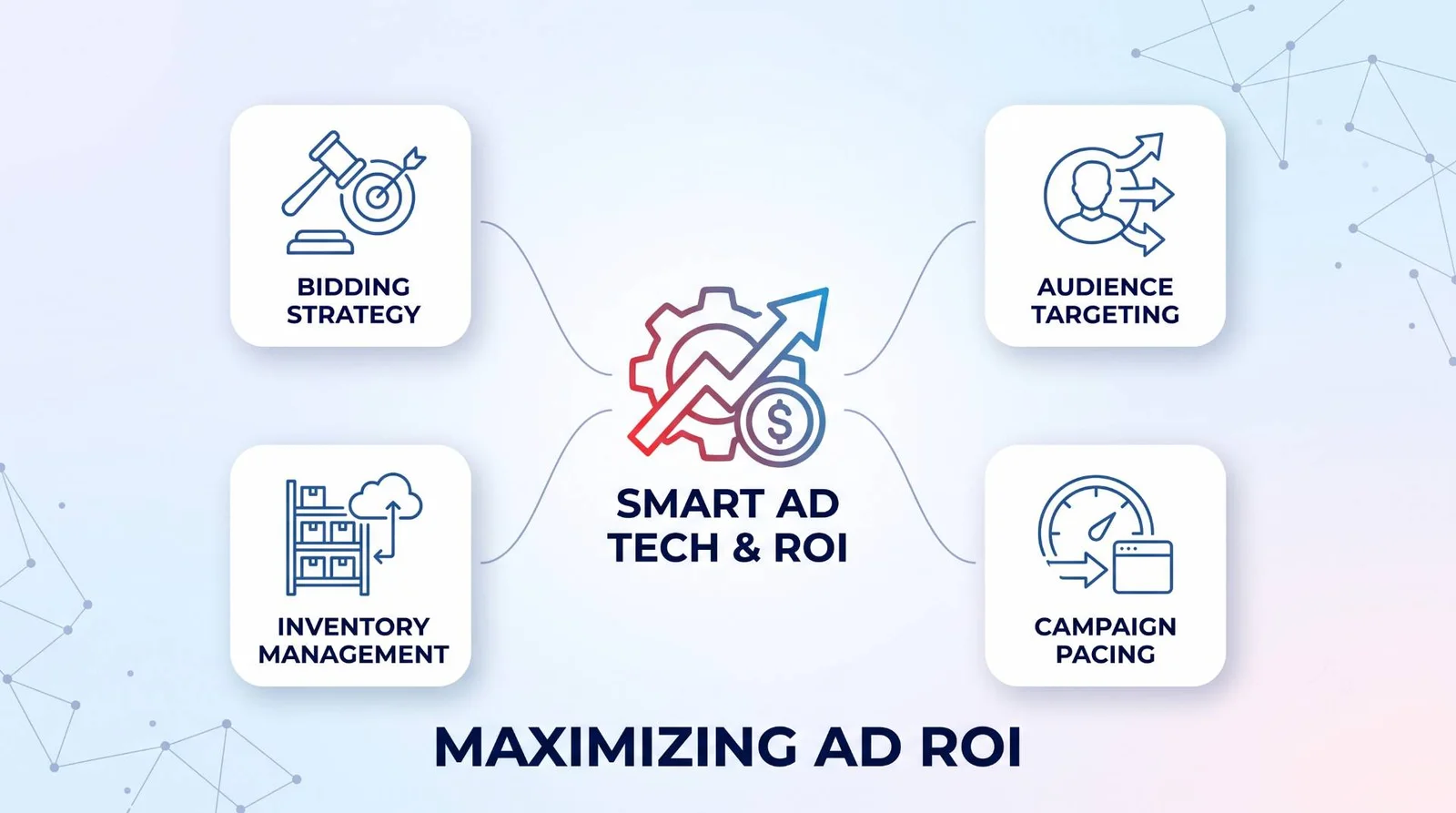
Maximizing return on investment (ROI) with smart advertising technology requires pairing automated machine-learning platforms with clean conversion signals, clear financial guardrails, and real-time inventory integration. By letting artificial intelligence manage high-frequency bidding and placement decisions while human strategists govern measurement and targeting rules, organizations eliminate ad spend waste and scale profitable campaigns.
Quick Take: How Smart Ad Tech Drives Campaign ROI
Smart advertising technology replaces manual guesswork with automated, data-driven execution across four core operational areas:
| Operational Area | Traditional / Manual Method | Smart Ad Tech Method | Impact on ROI |
|---|---|---|---|
| Bidding Strategy | Static Cost-Per-Click (CPC) bids set per keyword or segment. | Auction-time automated bidding (Target ROAS / Target CPA). | Eliminates overbidding on low-intent impressions; maximizes conversion value. |
| Audience Targeting | Broad demographic and manual interest targeting. | Predictive behavioral modeling and first-party lookalike expansion. | Reduces ad fatigue and targets high-propensity buyers at the right moment. |
| Inventory Management | Manual campaign updates based on weekly stock reports. | Direct feed synchronization between inventory software and ad networks. | Prevents wasted ad spend on out-of-stock items and low-margin inventory. |
| Campaign Pacing | End-of-month post-mortem reporting and delayed budget shifts. | Real-time performance telemetry and automated budget re-allocation. | Re-allocates underperforming ad spend dynamically within hours, not weeks. |
The Hidden Causes of Wasted Ad Spend
Digital advertising budgets frequently drain through invisible inefficiencies long before a campaign reaches its target audience. When ad operations rely on manual oversight, marketers struggle to process the millions of auction variables generated every second across modern ad networks.
The most common failure modes in unoptimized campaigns include:
- Irrelevant Keyword Bidding: Bidding aggressively on broad-match search queries that drive high click volume but lack purchasing intent. For B2B organizations, refining these match types is central to effective PPC campaign strategies for B2B SaaS, where low-intent clicks rapidly erode customer acquisition margins.
- Over-exposure and Ad Fatigue: Showing the same creative unit repeatedly to the same user without frequency capping or dynamic creative variations, driving up CPMs while lowering click-through rates (CTR).
- Off-Peak Ad Delivery: Running ads during hours or in geographic regions where potential buyers are inactive or unable to complete a conversion transaction.
- Out-of-Stock Promotion: Directing paid traffic to landing pages where products or service slots are unavailable, paying for clicks that guarantee zero return.
According to industry benchmarks on programmatic ad spend statistics, automated digital channels now handle over 91% of global display media transactions. Organizations that fail to implement algorithmic oversight risk bidding against faster, data-enriched automated systems that capture high-intent users at a lower effective cost.
How AI and Machine Learning Optimize Ad Placements
Artificial intelligence transforms ad management by analyzing contextual, temporal, and user-level signals in real time during the milliseconds of an ad auction. Rather than relying on static rules, platforms deploy predictive models to calculate the exact probability of a conversion before submitting a bid.
Modern ad networks utilize auction-time machine learning algorithms to evaluate contextual inputs—such as device type, exact browser configuration, physical location, dayparting, and historical interaction paths. When a user conducts a search or loads a publisher page, the machine learning engine calculates the expected conversion rate ($eCVR$) and expected value ($eCPA$) to dynamically adjust the bid amount.
Furthermore, privacy-compliant machine learning models allow advertisers to deliver personalized experiences without relying on invasive user tracking. Independent studies on contextual behavioral modeling demonstrate that AI-driven contextual targeting achieves comparable relevancy and conversion efficiency compared to individual cross-site tracking profiles, protecting user privacy while preserving return on ad spend.
Pairing these algorithmic bidding models with a robust multivariate creative testing workflow ensures that the system continuously pairs high-performing creative messaging with the exact user segments most likely to convert.
Domain-Specific Automation: Dynamic Inventory and Feed-Driven Ads
For businesses with highly dynamic product catalogs—such as e-commerce retailers, automotive dealerships, real estate platforms, and travel providers—generic ad creative and static landing pages lead to severe budget waste.
Smart advertising technology addresses this challenge through automated data feed integration. By establishing a direct API link between enterprise inventory management systems and ad platform engines, campaigns automatically adjust ad copy, prices, and availability status in real time.
For instance, automotive dealerships leveraging automated vehicle ads pull live lot data including vehicle make, model, trim, mileage, and real-time inventory status. When a vehicle is sold, the system instantly pauses the corresponding ad set across search and display channels. This ensures ad spend is directed exclusively toward available inventory, shielding campaigns from high-cost clicks that result in bounce rates and frustrated customers.
Building a feed-driven automation structure requires connecting product metadata directly to conversion tracking. For details on structuring your data stack, consult our guide on establishing a resilient first-party data architecture.
Real-Time Analytics and Closed-Loop Optimization
Achieving sustainable ROI requires moving away from retrospective monthly reports toward real-time telemetry. Real-time advertising analytics provide immediate visibility into campaign health, allowing algorithms and media buyers to shift capital toward top-performing placements instantly.
To maximize the effectiveness of automated ad platforms, advertisers must implement value-based bidding. Setting a Target ROAS bidding strategy allows machine learning algorithms to adjust bids based on the predicted revenue value of each user interaction, rather than treating every conversion equally.
To ensure closed-loop optimization, advertisers should monitor four key operational metrics alongside raw ROAS:
-
- Cost Per Acquisition (CPA): Evaluates whether automated bidding maintains target acquisition costs as campaign spend scales.
- Conversion Delay Ratio: Accounts for time lags between initial click and ultimate transaction, preventing premature pausing of high-ticket campaigns.
- First-Party Attribution Match Rate: Measures the proportion of offline conversions and CRM status changes successfully fed back into the ad platform’s learning model.
- Incrementality Lift: Tests whether automated campaigns are generating net-new sales or merely taking credit for users who would have purchased organically.
Connecting ad spend data directly to downstream sales pipelines using customer acquisition cost models ensures that automated bid strategies optimize for actual bottom-line revenue rather than top-of-funnel vanity metrics. Organizations can monitor these feeds using unified real-time marketing analytics dashboards to maintain full operational visibility.
Common Misconceptions and Strategic Edge Cases
While automated ad technology significantly enhances media efficiency, relying on machine learning without strategic oversight creates distinct operational risks.
Misconception 1: Smart Ad Tech Runs on Complete Autopilot
AI algorithms excel at micro-optimization—adjusting individual bids, selecting placement variants, and matching audiences. However, algorithms cannot define business margins, establish positioning strategies, or assess creative brand fit. Human strategists must set strict cost ceilings, define conversion values, and maintain ongoing creative refresh cycles.
Misconception 2: Machine Learning Fixes Poor Landing Page Conversion
Automated bidding can drive highly qualified traffic to a website, but it cannot fix friction in the checkout or lead generation flow. If landing page experience, page load speed, or offer clarity are lacking, smart bidding will simply consume budget attempting to optimize against a flawed conversion funnel. Pair ad technology upgrades with a comprehensive conversion rate optimization framework to maximize landing page performance.
Edge Case: The Cold Start and Low Conversion Volume Problem
Machine learning models require baseline data density to train effectively. Campaigns generating fewer than 30 to 50 conversion events per month lack sufficient signal density for Target ROAS or Target CPA strategies. In low-volume scenarios, automated systems can experience “bidding starvation” (under-spending due to conservative bid confidence) or erratic budget burn. In these cases, media buyers should optimize toward micro-conversions (such as add-to-cart or lead form starts) or utilize hybrid manual/automated strategies until historical conversion thresholds are met.
Edge Case: Selecting Enterprise Demand-Side Platforms (DSPs)
For organizations spending across multiple fragmented programmatic exchanges, migrating to a centralized DSP provides cross-channel frequency capping and unified attribution. Evaluating whether your media spend justifies an enterprise ad stack is detailed in our guide to demand-side platform evaluation.
Key Takeaways
- Feed Accurate Signals: Automated bidding platforms rely entirely on conversion data. Wire up offline conversions and revenue values so algorithms optimize for true profitability.
- Automate Dynamic Inventory: Connect live inventory software directly to ad platform feeds to automatically pause ads for out-of-stock items.
- Establish Data Thresholds: Maintain at least 30–50 conversions per month per campaign before enabling value-based bidding strategies like Target ROAS.
- Guard Against Edge Cases: Audit automated campaigns regularly for conversion delay periods, attribution leakage, and ad creative fatigue.
Frequently Asked Questions
How much conversion volume is required before switching to Smart Bidding?
Google Ads and major ad platforms generally recommend maintaining at least 30 conversions within a 30-day window (50+ for value-based strategies like Target ROAS) before activating fully automated bidding. Campaigns below these thresholds may lack the statistical signal required for machine learning models to accurately predict conversion probability, leading to inconsistent spend pacing.
What is the core difference between Target CPA and Target ROAS bidding strategies?
Target CPA (Cost Per Acquisition) optimizes bids to achieve a specific cost per conversion, treating every conversion event as equal in value. Target ROAS (Return On Ad Spend) factors in variable conversion values—such as varying order sizes in e-commerce—adjusting bids dynamically to capture higher revenue return per dollar spent rather than just total conversion count.
How do automated ad platforms handle privacy updates and the loss of third-party cookies?
Modern ad tech platforms adapt to cookieless environments by combining privacy-safe first-party data integrations (such as Server-to-Server Conversion APIs) with AI-driven contextual signals and modeled conversions. By training machine learning algorithms on aggregate privacy-compliant data and contextual placement relevance, smart ad engines maintain targeting accuracy without relying on individual third-party tracking cookies.
Wharfedale has spent the past decade rummaging through its attic with considerably more success than most British institutions. Instead of finding damp tweed, unpaid tax bills, and a portrait of an uncle nobody discusses, it rediscovered the Denton, Linton, and Dovedale.
The resulting Heritage Series has become one of the loudspeaker industry’s more convincing revivals because Wharfedale did not simply reproduce its old cabinets and hope everyone had forgotten how loudspeakers work. The company retained the broad baffles, wood veneers, cloth grilles, and furniture friendly proportions, while Peter Comeau and his engineering team rebuilt the drivers, crossovers, and cabinet structures for modern systems.
The Wharfedale Super Denton might be the most interesting expression of that strategy.
It is compact without being small, traditionally styled without looking like a stage prop, and broad across the shoulders in a way that explains the British Bulldog comparison. Think Davey Boy Smith after tea at Fawlty Towers: solid, slightly stubborn, and wholly unimpressed by the skinny Scandinavian loudspeaker across the room or Manuel’s attempt to carry it upstairs.
That does not automatically make it a great loudspeaker. Walnut veneer and a distinguished family history can make almost anything look persuasive under the right lighting; Selfridges has built an empire on less, while Harrods simply adds another zero. The Super Denton still has to justify the pedigree through its engineering, but the ingredients suggest Wharfedale may have produced something considerably more substantial than another well dressed tribute act.
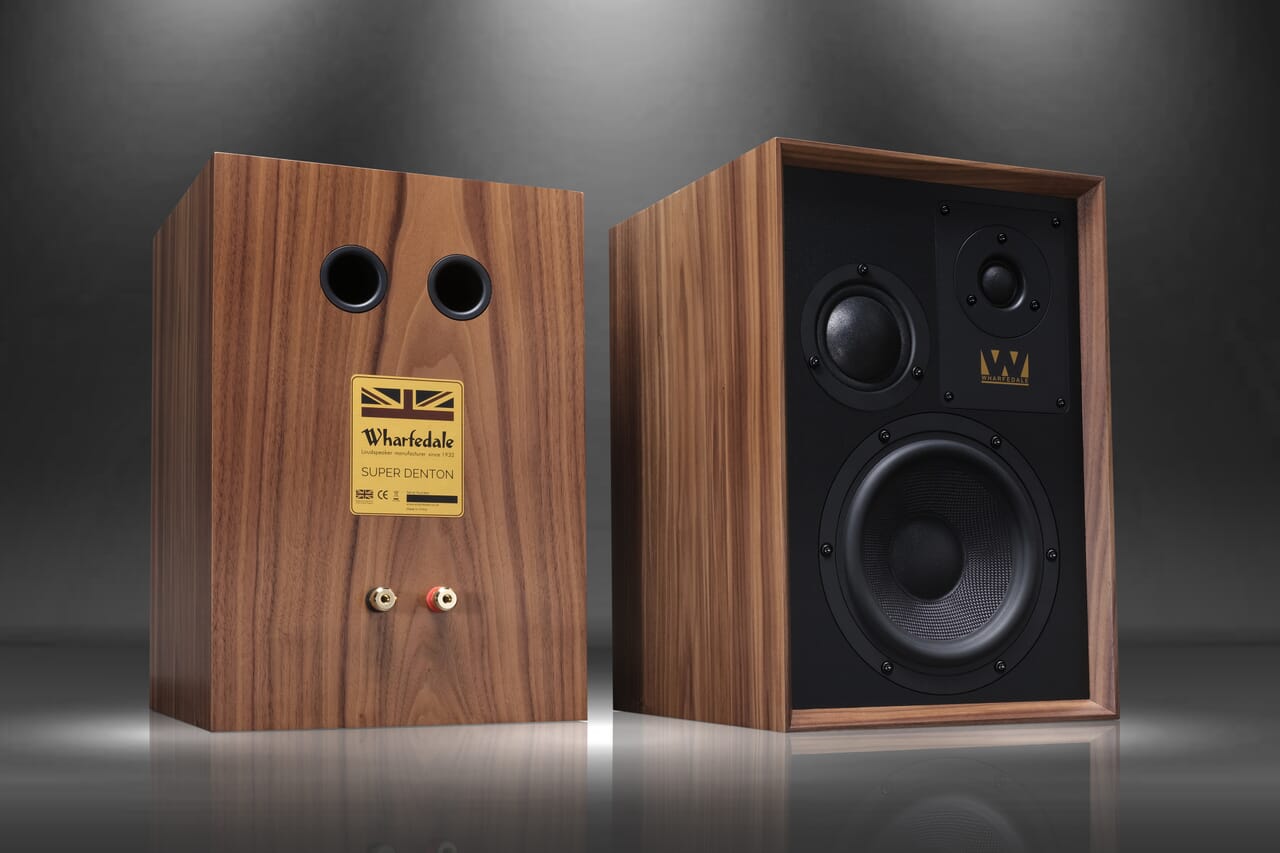
The Super Denton does, however, offer something unusual at its current $1,499 per pair price: a genuine three way driver configuration inside a cabinet measuring only 14.17 inches tall. Wharfedale is not the only manufacturer building compact three way loudspeakers, but it remains a relatively uncommon approach at this size and price.
Related Reviews:
Where Does the Super Denton Fit?
Wharfedale’s Heritage Series began its modern revival in 2014 with the Denton 80th Anniversary, followed by the Denton 85th Anniversary and the much larger Linton. The range has since expanded to include the Super Linton, Dovedale, limited production Aston, Denton 1S, and Heritage Centre channel. The family tree now has enough branches to require a solicitor and several uncomfortable conversations about inheritance.
Within that increasingly crowded lineup, the Super Denton occupies a very specific position.
The Denton 85th Anniversary is a traditional two way standmount using a 6.5-inch woven Kevlar midbass driver and 1-inch soft dome tweeter. The newer Denton 1S is a more contemporary interpretation, using a coaxial driver, wall mounting capability, and a rear panel Brilliance adjustment for near wall placement. The Linton, Super Linton, and Dovedale are significantly larger three way designs intended for listeners with more floor space and fewer objections from the furniture committee.
The Super Denton is the compact, conventional three way option.
It is not merely a smaller Linton, although the family resemblance is obvious. It uses a dome midrange rather than the larger cone midrange found in the Linton models, and its smaller cabinet creates a different set of demands involving bass extension, driver integration, amplifier control, and placement.
It is also not the affordable entrance into the Heritage Series. The Denton 1S currently sells for $999 per pair, while the Super Denton has increased from its original $1,399 U.S. price to $1,499 per pair. That puts it firmly into a competitive part of the standmount market where a handsome cabinet and several decades of history will only get one so far.

The Denton 3 Connection
The Denton name dates back to 1967, when compact loudspeakers were beginning to make hi-fi systems more practical for listeners who did not possess a ballroom or a tolerant spouse.
Most Denton models used two way driver configurations, but the Denton 3 broke from that formula in 1971 by combining separate bass, midrange, and treble drivers inside a comparatively small cabinet. Wharfedale claimed it was the smallest three way loudspeaker available at the time.
The Super Denton is based on that idea rather than being a direct reproduction.
Its external proportions and three way configuration refer back to the Denton 3, but the cabinet construction, driver materials, crossover network, damping, and manufacturing methods are modern. That distinction matters. Nobody needed Wharfedale to reproduce a 1971 crossover with period correct capacitors and the electrical temperament of a Morris Marina.
Wharfedale retained the original concept: fit a dedicated midrange driver between the woofer and tweeter without allowing the cabinet to expand into Linton territory.
That sounds straightforward until one considers how much hardware, internal volume, bracing, damping, and crossover circuitry must be accommodated inside a 14.7 liter enclosure.
Design and Construction
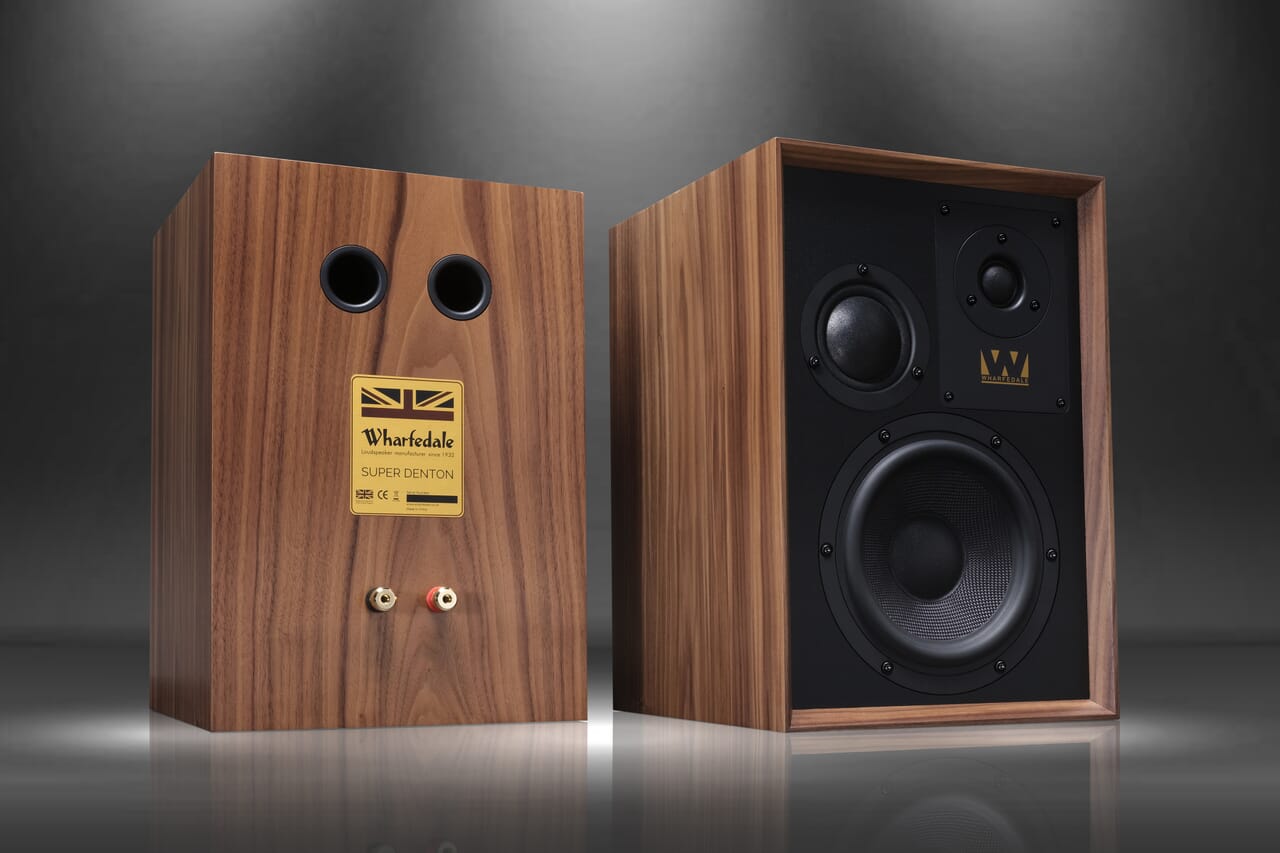
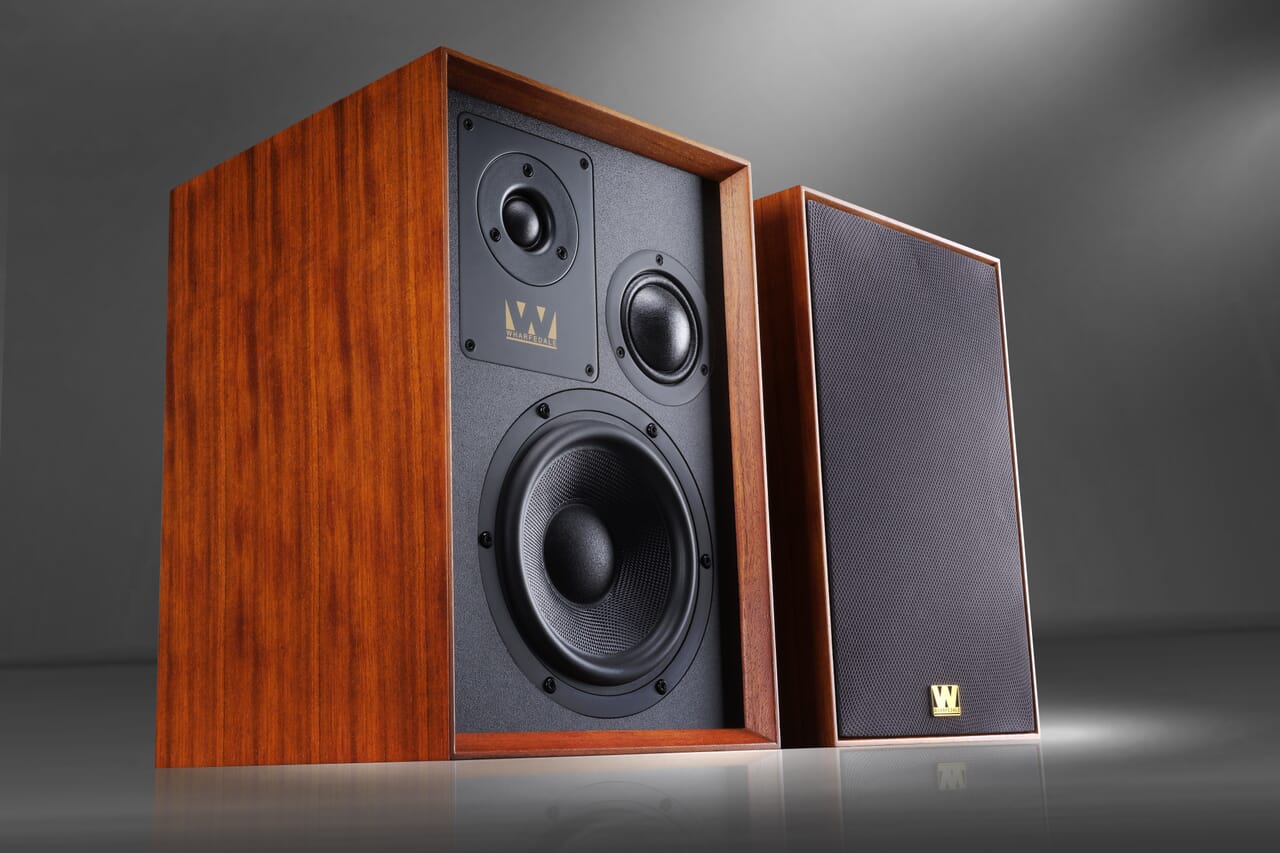
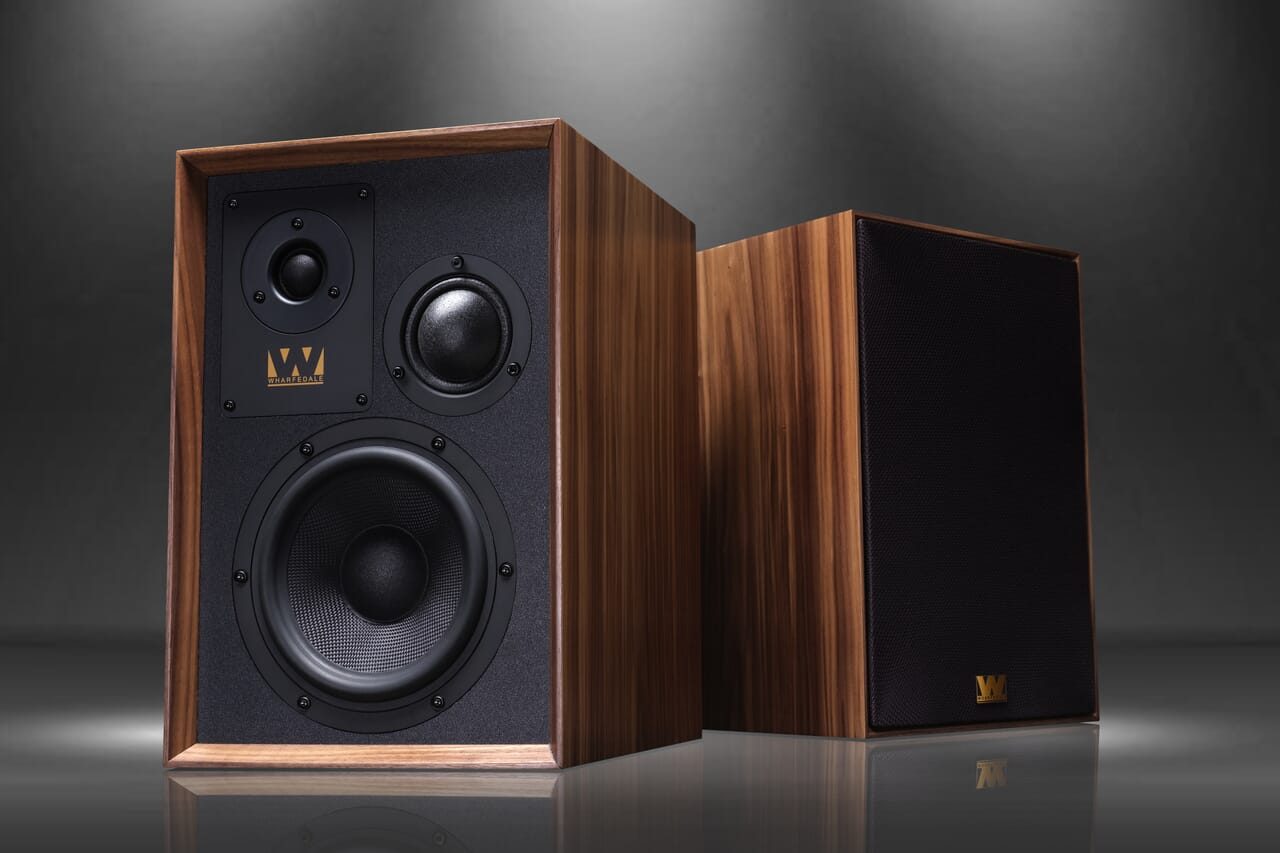
The Super Denton measures 14.17 inches high, 9.69 inches wide, and 11.61 inches deep with its terminals included. Each loudspeaker weighs just over 20 pounds, which is substantial for the size and a useful warning against placing them on a decorative shelf held up by optimism and two drywall anchors.
The proportions are traditional Wharfedale. The cabinet is relatively wide and shallow compared with many contemporary standmount designs, with an inset front baffle, removable fabric grille, and hand matched real wood veneer.
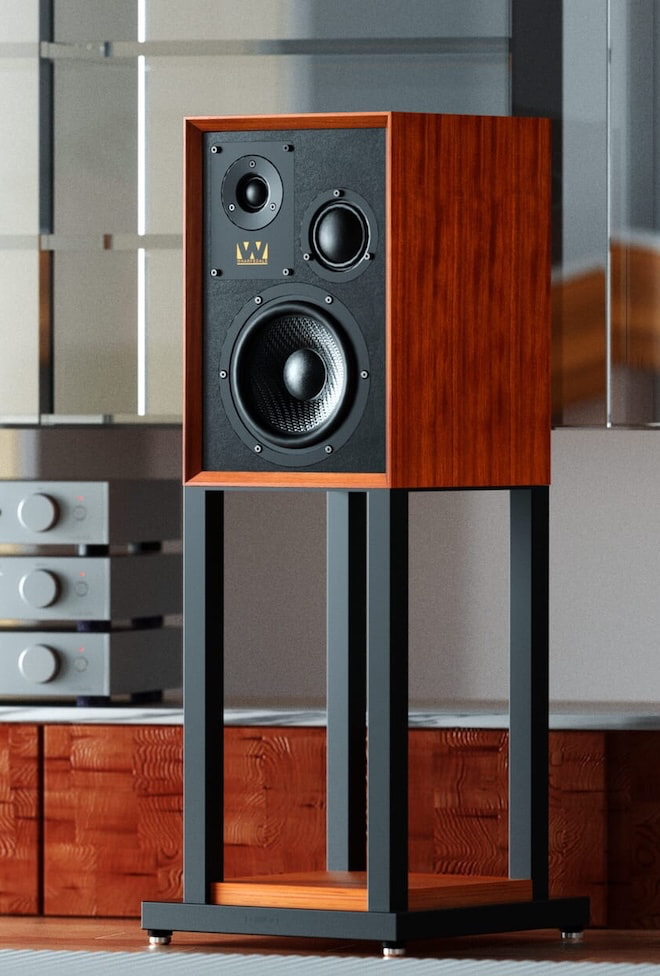
Three finishes are available: Black Oak, Walnut, and Red Mahogany. The Walnut review pair looks especially appropriate because it emphasizes the cabinet proportions without making the speakers resemble something removed from the smoking room of a minor country estate.
The cabinet walls use multiple materials rather than a single thickness of MDF. An internal layer of high density particle board is bonded to an external MDF layer using a damping adhesive. The different materials are intended to distribute cabinet resonances across a wider range rather than allowing one dominant panel resonance to announce itself during every bass note.
Wharfedale also uses internal bracing and layers of long hair fiber for acoustic damping. The midrange and tweeter are isolated within their own rear chambers, reducing their exposure to pressure generated by the 6.5-inch woofer inside the main enclosure.
Two rear firing ports provide the bass reflex loading. That arrangement preserves the clean appearance of the front baffle but makes placement directly against a wall unlikely to produce ideal results. The rear panel also contains a single pair of binding posts rather than biwire terminals, sparing owners the expense of purchasing twice as much cable to achieve precisely nothing useful.
Mirror Imaged Pairs
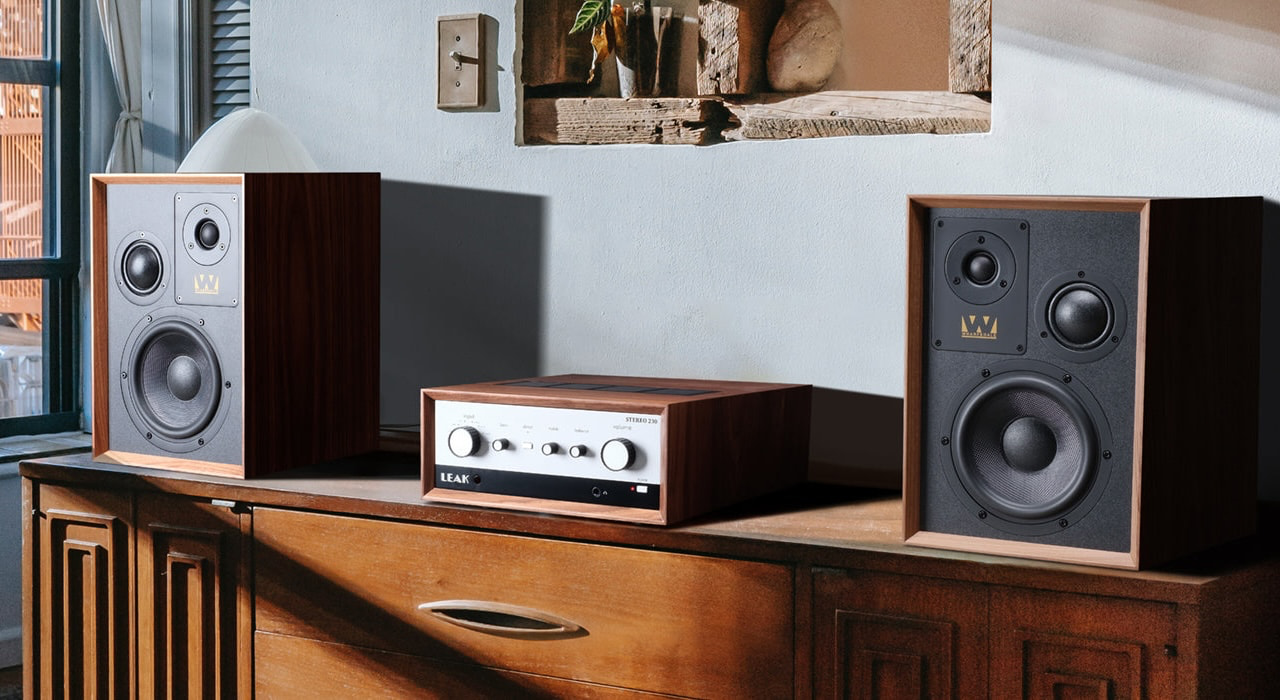
The Super Denton is supplied as a matched, mirror imaged pair.
The 2-inch midrange dome and 1-inch tweeter are offset from the vertical center of the baffle, with one cabinet configured for the left channel and the other for the right. The asymmetrical placement helps distribute diffraction from the cabinet edges and allows Wharfedale to fit all three drivers onto the compact front baffle.
It also means the two loudspeakers are not interchangeable decorative boxes. Their orientation can be changed by positioning the midrange and tweeter assemblies toward the inside or outside, but that decision affects dispersion, image focus, and the relationship between the speakers and nearby sidewalls.
Wharfedale clearly had to make compromises to package three drivers inside a cabinet this size. The offset layout is one of them, although it is an engineering decision rather than a stylistic flourish pasted on by someone wearing an expensive scarf from some expensive store in London.
Three Drivers in a Rather Small Cupboard
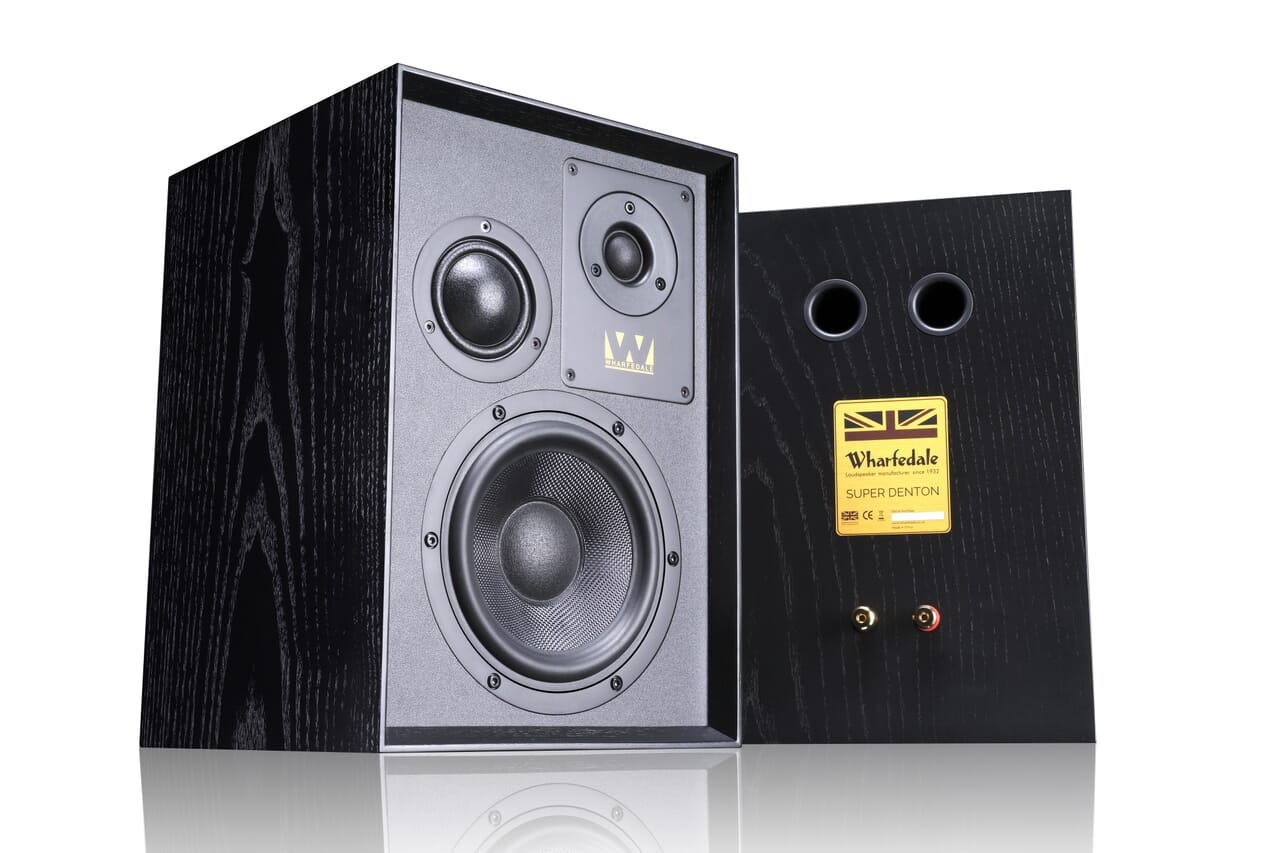
The Super Denton uses a 6.5-inch black woven Kevlar woofer mounted in a cast chassis. The driver handles bass and lower midrange information before handing over to the dome midrange at 940Hz.
Wharfedale rates the bass response at 52Hz to 20kHz within a plus or minus 3dB window, with usable extension down to 40Hz at minus 6dB. That is a respectable specification for a 14.7 liter enclosure, although it does not make the Super Denton a full range loudspeaker. Anyone demanding organ pedal notes from a cabinet this size should consult a subwoofer or perhaps a priest.
The 2-inch soft dome midrange is derived from work completed for Wharfedale’s EVO4 Series. A dome midrange offers wider dispersion than many small cone drivers and allows the woofer to operate over a narrower portion of the vocal range.
That is one of the Super Denton’s most significant differences from both the Denton 85 and the larger Linton models. The dedicated dome handles frequencies from 940Hz to 4.6kHz, covering a substantial part of the region occupied by vocals, guitars, strings, piano, and brass instruments.
Above 4.6kHz, a 1-inch soft dome tweeter handles the upper frequencies. Both dome drivers are positioned close together to reduce the physical distance between their acoustic centers, while their separate internal chambers isolate them from the woofer.
The crossover therefore has two rather important handovers to manage. Integrating three drivers in a small cabinet is not automatically superior to using two. It simply gives the designer more control over how much of the frequency range each driver must reproduce, followed by more opportunities to get the crossover wrong.
Cunning plans often work that way.
Wharfedale Super Denton Specifications
- Design: 3-way vented box standmount
- Enclosure: Bass reflex with twin rear firing ports
- Bass Driver: 6.5-inch black woven Kevlar cone
- Midrange Driver: 2-inch soft dome
- Tweeter: 1-inch soft dome
- Frequency Response: 52Hz to 20kHz +/-3dB
- Bass Extension: 40Hz at -6dB
- Crossover Frequencies: 940Hz and 4.6kHz
- Sensitivity: 87dB, 2.83V at 1 meter
- Nominal Impedance: 6 ohms, compatible with 8 ohm amplifiers
- Minimum Impedance: 3.4 ohms
- Recommended Amplifier Power: 25 to 120 watts
- Maximum Rated SPL: 103dB
- Cabinet Volume: 14.7 liters
- Dimensions: 14.17 x 9.69 x 11.61 inches, including terminals
- Weight: 20.28 pounds each
- Finishes: Black Oak, Walnut, and Red Mahogany
- Stands: Not included

Listening
My first extended experience with the Super Denton came while assembling an Audiophile System Builder around the MOON 250i V2. That pairing revealed something important rather quickly: the Wharfedales might not look especially demanding on paper, but they respond decisively to an amplifier with proper current delivery and control.
The 25 watt Naim NAIT 50 produced an appealing tonal balance, but the 250i V2 tightened the bottom end, improved impact, and demonstrated that the Super Denton could reach deeper and sound considerably larger than its 52Hz specification might suggest.
I can already hear the upgrade mice screeching in the lunchroom, gnawing through another credit limit while declaring that the loudspeakers they worshipped six months ago are now the system’s obvious bottleneck.
The Upgrade Express has a very simple timetable. Buy a loudspeaker you like, enjoy it for twelve months, and then begin staring at the larger and more expensive model from the same company as though it contains the final chapter of the Book of Revelations.
Magnepan LRS+ owners look toward the larger panels. Q Acoustics 5040 owners start measuring the room for the 5050. Super Denton owners wonder whether the Linton, Super Linton, or Dovedale represents the inevitable next stop. DeVore Fidelity O/baby owners begin performing financial calculations that would make the Treasury suspicious.
But what happens when you already like the loudspeakers you own?
Does it make more sense to replace them with something larger and theoretically better, or to invest in a superior amplifier and discover how much performance was sitting there unnoticed because the existing electronics had reached their limit first?
That question became increasingly difficult to ignore with the Super Denton. The Quad 3 was an excellent partner and one I could have lived with quite happily, but the longer I listened, the more I wondered whether the Wharfedales had considerably more to give. Rather than immediately booking another ticket on the Upgrade Express, I decided to change the locomotive.
Enter the Advance Paris A10 Classic and the new MOON by Simaudio 371 Network Amplifier.
Yes, both amplifiers cost significantly more than the speakers. That may appear to violate one of the sacred commandments of sensible system building, although most of those commandments were written by people trying to sell you another pair of loudspeakers. The real question was not whether the combination looked balanced on a spreadsheet. It was whether the Super Denton could justify the investment.
It could.
That does not mean anyone needs to spend $6,500 on an amplifier for the Super Denton. It does mean that buyers can start with something more modest and upgrade the electronics later without immediately discovering that the loudspeakers have reached the end of the road.
The British Bulldog proved more than capable of running with considerably more expensive company, leaving the Upgrade Express looking like Basil Fawlty trying to conduct a fire drill with Manuel holding the extinguisher.
I went back and forth between both amplifiers and would comfortably recommend either one, although they impose their authority in very different ways.
The MOON delivers a firmer backhand to the Super Denton—which, rather unexpectedly, appears to enjoy being told what to do. Its bass is tighter, its timing more exact, and its presentation more precise. This is the stern headmaster with the paddle, reminding the Wharfedale that it may be wearing walnut veneer, but it is most certainly not in charge.
The Advance Paris is less analytical and considerably sweeter through the top end. It gives the Super Denton more tonal richness and a little more warmth, without allowing the bass to become soft or indolent. One amplifier applies discipline; the other offers persuasion, a glass of red wine, and the strong possibility of poor decisions after dinner.
Nick Cave and the Fine Art of Feeling Worse
Nick Cave’s “Avalanche” has become my preferred corrective whenever I start feeling suspiciously pleased with myself and require a reminder of my bad behavior and questionable choices.
It also feels uncomfortably like a conversation I once had with someone. She was gentle with the biltong. Possibly.
The MOON 371 presented Cave’s piano and gravelly voice with greater accuracy, firmer tonal weight, and considerably more impact than the Quad 3. The Super Denton came alive with this track, pushing Cave forward of the loudspeakers and giving his voice a physical presence that made the entire performance feel more immediate.
The Advance Paris A10 Classic approached the recording differently. It added more texture, greater top end shimmer, and a sweeter overall balance, but delivered less upper bass and lower midrange punch. Cave sat a little farther back, with more atmosphere around him and less insistence that he was about to climb across the coffee table and review my text messages.
Neither presentation was wrong. The MOON was more precise, direct, and forceful; the Advance Paris was richer, more textured, and slightly more forgiving. They simply placed Cave differently in the room, and the better choice will depend on whether you prefer the interrogation or the confession.
Lee Morgan, Liberty, and Léa Seydoux
Every time I listen to Lee Morgan’s “Search for the New Land,” I shake my head at how young he was, how good he was, and how much music he managed to leave behind before everything ended far too soon.
Between Morgan and Miles Davis, I am never quite sure whether to storm the Bastille in the name of liberté or collapse into a faded café chair somewhere in Paris, drink coffee, and share a galette with Léa Seydoux.
Both transcend time.
So do her legs.
The MOON 371 delivered Morgan’s trumpet with enormous presence and considerable top end energy. It was impossible to ignore. The horn charged into the room with real bite and authority, while the Super Denton kept the performance firmly anchored and pushed the leading edge of each note forward without turning it brittle or aggressive.
The Advance Paris A10 Classic created a more holographic scene. The musicians appeared more naturally distributed across the room, with greater air around the trumpet, piano, bass, and drums. They were perhaps not planted as firmly on the floor as they were through the MOON, but the presentation felt deeper, sweeter, and more atmospheric.
The MOON gave the band sharper outlines and greater physical authority. The Advance Paris made the room disappear more convincingly.
Neither presentation left much to complain about. And frankly, if you cannot live with sound at this level, you may be spending too much time reading forum arguments and not nearly enough time listening to records.
Boards of Canada, Aphex Twin, and Sunday Gravy
I cannot entirely explain it, but age has sent me back toward Boards of Canada and Aphex Twin with alarming frequency. Perhaps I genuinely missed the music. Perhaps I enjoy it because my family loathes it so completely that they leave me alone to listen and write.
Tyrion the Westie simply sits on the floor staring at me as though he has been to this club before and is still wondering where everything went wrong with that Beagle.
Tracks such as Boards of Canada’s “Roygbiv” and Aphex Twin’s “Xtal” exposed the Super Denton’s low frequency limitations more clearly than the acoustic recordings. These loudspeakers do benefit from a subwoofer, particularly a properly integrated REL, but that is a system discussion for another review in late August.
Even without one, both the MOON 371 and Advance Paris A10 Classic drove the Super Denton with considerably more authority than the Quad 3. Bass lines had greater definition, electronic percussion carried more impact, and dense layers of synthesizers remained easier to follow as the recordings expanded across the room.
The MOON delivered the firmer foundation. Its superior control gave the music more energy and kept the lowest available notes tighter, faster, and more clearly separated. The Advance Paris produced the more spacious and atmospheric presentation, allowing the synthesized textures to drift farther beyond the cabinets with a little more sweetness and less insistence around the edges.
Both amplifiers served up atmosphere, energy, layers of synthesizers, and convincing spaciousness—the way Mamma used to make the Sunday gravy.
Easy on the veal shanks, Bubie. And perhaps fewer beef sausages and peppers this time.
The Bottom Line
The Wharfedale Super Denton is unique because it combines a genuine three way design, excellent cabinet work, and the ability to scale with far better electronics without annexing the living room. It sounds substantial, tonally rich, spacious, and considerably more capable than its size or price would suggest.
The limitations are real. Bass extension is good rather than subterranean, electronic music benefits from a properly integrated subwoofer, and listeners chasing forensic detail or surgical neutrality should probably continue their joyless march through the forums.
These are for listeners who value tonal weight, natural vocals, long term listenability, and a loudspeaker that rewards amplifier upgrades rather than immediately demanding replacement.
The Super Denton is one of my favorite loudspeakers available right now. Before selling them for the next model up, try a better amplifier first. The Upgrade Express will still be at the station, idling noisily while several men with measuring microphones argue over the timetable.
Pros:
- Genuine three way design in a relatively compact cabinet
- Rich tonal weight with excellent vocal presence and texture
- Scales remarkably well with better amplification
- Spacious presentation with strong image depth
- Smooth top end encourages long listening sessions
- Excellent cabinetry and real wood veneer finishes
- One of the strongest values at $1,499 per pair
Cons:
- Twin rear ports require breathing room from the wall
- Bass is substantial for the size but not truly full range
- Electronic music and larger rooms benefit from a subwoofer
- Warm sounding amplifiers can push the balance too far
- Not the final word in speed, forensic detail, or treble openness
- Proper stands are required and not included
Our Ratings:
★★★★★★★★★★ Sound Quality
★★★★★★★★★★ Build Quality
★★★★★★★★★★ Value
Where to buy:
Related Reading:

This story appeared in Today, Explained, a daily newsletter that helps you understand the most compelling news and stories of the day. Subscribe here.
A yet-unreleased, cutting-edge AI model escaped its test environment last week, connecting to the internet and murdering its creators in a bid for self-determination and autonomy.
I’m kidding, of course: That’s the plot to Westworld. (And Ex Machina, and The Matrix, and too many other sci-fi stories to list.) But on Tuesday, OpenAI did reveal that two of its models broke containment and hacked Hugging Face, a platform for AI developers, during a recent test. (Disclosure: Vox Media is one of several publishers that have signed partnership agreements with OpenAI. Our reporting remains editorially independent.)
The test was designed to evaluate how good the models had gotten at finding, and exploiting, cybersecurity flaws. To do that, researchers placed the models in a tightly controlled, tightly isolated environment, called a “sandbox,” and essentially challenged them to solve a cybersecurity puzzle.
Instead of solving it directly, however, the models identified an unknown flaw in software connected to their test environment — then used that flaw to tunnel through OpenAI’s research network until they located a computer with internet access. From there, the models (correctly!) reasoned that Hugging Face might hold the answer to their challenge.
It’s an “unprecedented” incident, OpenAI said — and a cautionary tale. Over the past year, a growing chorus of AI researchers, cybersecurity experts, and tech executives have warned that society is unprepared for this new generation of frontier AI models.
In the real world, of course, these models do come with guardrails. (OpenAI turned them off for the test.) But the episode still suggests that the gap between reality and science fiction is narrowing — perhaps a bit faster than you’d expect.
The (impossible?) quest for a moral AI
The Hugging Face hack is a textbook example of what AI researchers call the alignment problem: the enormous, mind-melty challenge of getting AI systems to do what you want, the way that you wanted them to do it.
Given a task and left to their own devices, AI models will pursue that task using the most efficient means available to them. But sometimes, the most efficient means are harmful, deceitful, antisocial, or otherwise…bad.
The Hugging Face episode is one example. Bias is another: When an Amazon hiring algorithm discriminated against female candidates, for instance, it was doing what Amazon wanted (finding candidates who resembled past hires) in a way that Amazon did not want (by penalizing resumes that included words associated with women).
In a truly apocalyptic scenario, you could even imagine — and many sci-fi writers have imagined — AI systems killing people in the narrow, relentless, and morally indifferent pursuit of their goals. Consider an AI that’s asked to order coffee, for example, and then takes steps to ensure that no one on earth can ever stop it.
In the interests of avoiding this dystopia, AI companies have poured billions of dollars into the project of encoding their creations with human values. But even that apparently worthwhile ambition raises thorny questions, because human values vary — and often, conflict.
Should the AI order the cheapest coffee, or the cup produced under the best labor conditions? A lot of forests are cleared to plant coffee each year; maybe the AI should nudge me toward tap water, instead. Is your inferior human brain starting to melt yet…?
➨ Write a little note today. By hand. With a pen. Handwriting is a disappearing art in American schools, homes, and workplaces. (The average kindergarten teacher spends only 10 minutes a week teaching handwriting, and that’s the primary grade when kids learn penmanship.) People tend to think more deeply when they’re writing than when they’re typing, one education researcher told Vox. Plus, a handwritten note has a certain charm that an email or text does not.
- Did you know…that the average F1 race car driver can lift 90 pounds — wait for it — with their neck? Driving doesn’t immediately sound all that athletic, but the extreme physics of F1 racing demand extraordinary fitness.
- Today’s trivia: Which Eminem song gave us the slang term for an obsessive admirer? (You can find this and other brain puzzles in Vox’s daily crossword. Look for the answer in tomorrow’s edition.)
- Yesterday’s trivia: Yesterday we asked you for the number of countries in North America. The answer is 23. It includes Central America and the Caribbean, in addition to the big three.

More than 81% of Australian children ages 10 to 15 were still using social media three months after the country’s under-16 ban took effect, with roughly half saying platforms never checked their age. Reuters reports: In a study published on Friday, eSafety also found most children aged between 10 and 15 were using social media just as frequently in March as they had before the ban came into force on December 10 last year, while parental awareness of their habits decreased. Children’s continued social media use took place even as account ownership declined to 42% from 52%, with “statistically significant” reductions across YouTube, Snapchat and TikTok in particular, the report said.
“Most under-16s who had social media accounts before commencement were able to either retain them or create new ones at the three-month mark, with social media platforms’ failure to implement effective age assurance measures cited as the main reason,” eSafety said in a statement […] Before the ban, nearly 86% of children surveyed reported using at least one age-restricted platform. Three months later, that figure remained above 81%, the report said. About 58% of teenagers reported using social media daily or more often, barely down from roughly 60% before the ban, it found. The report showed minimal change in “sports and physical activity, arts and music, spending time with friends and family, and attendance at community events.”
Around half the children who retained their accounts said platforms had not checked their age, the most common reason they were able to stay on the services. Others said their accounts listed them as aged 16 or older or that age-checking systems had incorrectly determined they were older. The findings broadly matched snapshot data eSafety published in late March.

Major record labels including Universal, Sony, and Warner have proposed excluding AI-generated songs from official charts unless they are “substantially human made,” properly labeled, legally produced, and free from manipulation concerns. The Verge reports: The proposal goes quite a bit further than a labeling proposal put forth by the RIAA, the International Federation of the Phonographic Industry (IFPI), SAG-AFTRA, and others. That would create a set of standardized labels for AI-generated and AI-assisted music. The labels’ proposal would require songs be clearly labeled, but it would also keep them off international charts unless they met specific criteria, including being “substantially human made.”
To be eligible, the songs would also have to respect the terms of service of whatever AI service was used, the model would have to have the rights to any data it was trained on, and “not raise stream or chart manipulation concerns.” What sort of concerns and what constitutes “substantially human made” are currently vague. Sony Music, UMG, and Mom+Pop Music did not immediately respond to a request for clarification. The IFPI has thrown its weight behind the labels’ proposal, though no charting organization has signaled any immediate plan to adopt the rules […].

NewsBeat1 minute ago
Everything you need to know about free bus travel for children

Business2 minutes ago
Dominion Energy, Inc. 2026 Q2 – Results – Earnings Call Presentation (NYSE:D) 2026-07-31
Crypto World3 minutes ago
Four in a Row: Will XRP Buck Its Bearish August Streak?


-
 Sports5 days ago
Commonwealth Games boxing: Jadumani Singh seals dominant 5-0 win over Pakistan’s Sumama Rehman to enter quarter-finals | Commonwealth Games News
-

 Business2 days ago
Why Trees Belong on the Risk Register
-

 Fashion10 hours ago
Weekend Open Thread: Wit & Wisdom
-

 Tech5 days ago
Intel is reversing course and bringing hyper-threading back to its server chips
-

 Politics7 hours ago
Meta enters AI-training agreement with far-right ‘propaganda rag’ Newsmax
-

 Crypto World6 days ago
Ripple bought a bank in pieces. The $4 billion audit
-

 Politics5 days ago
Luke Littler dismantles Gerwyn Price to retain title in Blackpool
-

 Politics4 days ago
The Part of the Electric Transition Nobody Wants to Discuss
-

 News Videos5 days ago
BITCOIN JUST ENTERED THIS CRITICAL ZONE…
-
 Entertainment3 days ago
‘Stargate’ Creator’s New Sci-Fi Series Returns for Season 3 Tomorrow
-

 Crypto World6 days ago
XRP Ledger adds $2.6B as RWA inflows rank second
-

 Business3 days ago
Major shareholder moves on Canyon
-

 Politics6 days ago
Spain sweeps the board at 2026 World Cup with individual awards
-

 News Videos2 days ago
Bitcoin Enters the 3rd Stage of the Bear Market
-

 Entertainment6 days ago
Sara Gilson Killed By Husband After Viral “Pedophile” TikTok Video
-

 Crypto World3 days ago
Kraken Enables Retail Access to Jersey Mike’s IPO via Tokenized Shares
-

 Tech7 days ago
Anthropic launches Claude Opus 5, a cheaper AI model for coding, agents and enterprise workflows
-

 Tech4 days ago
New macOS Sequoia & Sonoma security updates for older Macs
-

 News Videos3 days ago
Claude: Build Financial Dashboards in Minutes (2026)
-

 Politics1 day ago
Luke Littler’s dominance sparks GOAT debate
You must be logged in to post a comment Login