Taking an established company in a new direction is always a challenging task. Doing so in the midst of one of the biggest evolutions the tech industry has witnessed, even more so. Read Entire Article Source link
UL’s Prof Martin Hayes on his systems theory research, why ‘pi-shaped’ graduates are the future of engineering, and the importance of patience.
Prof Martin Hayes is a professor of digital technologies at University of Limerick (UL) who describes his research as sitting “within the space of systems theory for machine learning and AI”.
Hayes’ research looks at how to manage system resources intelligently when they’re subject to uncertainty or mixed messaging introduced by communication channels, sensors or human operators. A large part of his work focuses on the “robust” performance of AI in safety-critical environments.
“How do we correctly choose settings when an AI system’s outputs feed into decision-making by people, without getting that handoff wrong?” asks Hayes.
Advertisement
“Health is an obvious area where such solutions have to be correct 100pc of the time.
“The alternative has real consequences in terms of negative outcomes – so I’m asking how we can guarantee a health system that will exploit the benefits of AI while working optimally for every citizen every time.”
Hayes tells SiliconRepublic.com that as AI and machine learning technologies move from research labs into safety-critical, high-stakes settings, these systems “can’t simply be accurate on the average”, and that understanding how to build in basic levels of robustness allows technology to be deployed responsibly in regulated domains such as digital health.
“Professionals working in the health system, be they medics, engineers or administrators, need to understand not just how to use AI tools, but how to trust, interrogate, explain and govern them appropriately,” he says. “Without that grounding, adoption either stalls through excessive caution or accelerates without the safeguards that safety-critical settings demand.
Advertisement
“Translational research that provides a foundation for those who are already working in or who wish to participate in the new European Health Data Space is a key focus of my work.”
‘Pi-shaped graduates’
With his work spanning from systems theory to engineering and the real-world domains where these tools get deployed, Hayes says that the interdisciplinary nature of the research is actually a very rewarding part of the job.
In particular, he enjoys the collaborative side of it where he works directly with industry partners, clinicians and SMEs to “understand where the genuine skills gaps are and then translating that into education and research that actually closes them”.
However, according to Hayes the most satisfying part of the job is seeing graduates go on to responsibly deploying this understanding and thinking in the workplace.
Advertisement
“I believe strongly that the future of engineering education revolves around the growth of such ‘pi-shaped’ graduates who have the basic skills in AI-enabled data engineering but who also have the necessary allied health skills to be able to apply those solutions in a safe, human-centred fashion,” he says.
Hayes has worn and continues to wear many hats at UL, where he has worked since 1997.
He is the academic lead for the UL@Work Human Capital Initiative project, which aims to develop digital, industry 4.0 talent through flexible, innovative, technology-enabled, experiential learning. Hayes says his involvement in the UL@Work project has been “hugely insightful”.
“One key takeaway is that universities need to work together and collaborative programmes like Digital Europe are essential in enabling institutions to pool their resources so that they can offer students the bespoke learning that fits their individual needs.”
Advertisement
Hayes is also collaborating with various European universities as principal investigator for a number of Digital Europe projects – such as that of Sustainable Healthcare with Digital Health Data Competence (SUSA).
SUSA is a €12.4m Digital Europe-funded project led by the University of Oulu in Finland that aims to close the digital skills gap in European healthcare and support the EU’s Digital Decade and European Health Data Space ambitions.
The project aims to deliver revamped bachelor’s, master’s and standalone lifelong-learning modules, built around 20 shared SUSA learning objectives that have been benchmarked against frameworks such as the WHO Digital Health Competence Framework.
Hayes is UL’s principal investigator for SUSA, leading the ‘Workpackage’, which frames and co-designs SUSA activities in order to maximise impact.
Advertisement
“We lead in two specific tasks: investigating how to best deliver education on the optimal use of advanced digital technologies in health – particularly XR/AR and digital twin technology – and designing the SUSA employer framework that connects students with industry most efficiently,” he explains.
“UL’s contribution to the SUSA digital ecosystem draws on existing UL@Work advisory board models and Skillnet partnerships to keep the curriculum grounded in current workplace needs.”
Fundamentals and patience
As someone working in such a future-focused research area, we asked Hayes about what advice he might have for someone considering a career similar to his own.
First thing on the list? “Build a strong foundation in the fundamentals,” he says.
Advertisement
By fundamentals, he means systems theory, mathematics and statistics.
“These are what let you adapt, configure and ultimately deploy solutions as the technology moves on,” he explains.
Next, he advises newcomers to seek out interdisciplinary collaboration early and not to be “afraid to work at the boundary between engineering and the domains where it gets applied, whether that’s healthcare, manufacturing or elsewhere”.
“Get involved in industry-facing projects where you can; the most consistent feedback we get from our students is that they’ve always enjoyed it most when they’ve been exposed to real-world constraints either through UL’s co-op education programme or the in-house projects they complete during their studies,” Hayes adds.
Advertisement
“Ultimately this sharpens the R&D questions you ask and makes you a more valuable resource,” he says.
“Finally, be patient. Your career, much like a trustworthy AI system, is built over the long term and will inevitably require you to actively manage many uncertain situations.
“Embracing that challenge will give you the confidence to achieve your goals. Repetition builds competence!”
Don’t miss out on the knowledge you need to succeed. Sign up for the Daily Brief, Silicon Republic’s digest of need-to-know sci-tech news.
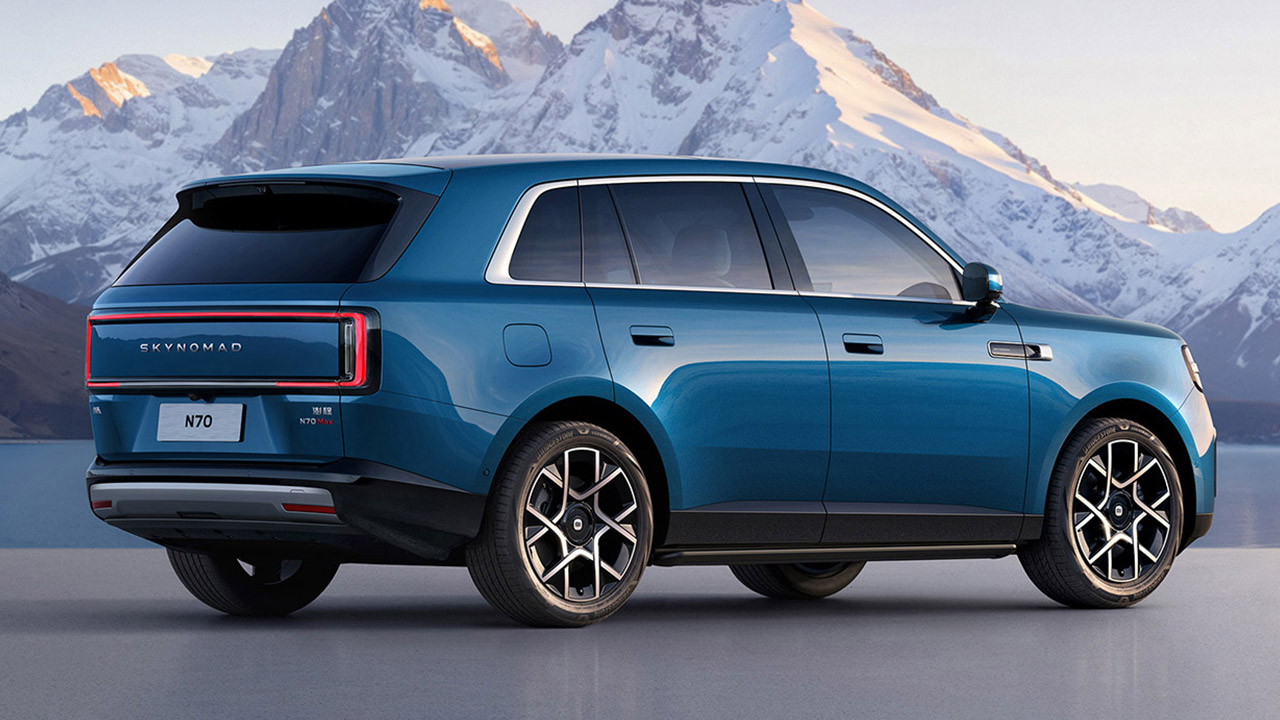
Xiaomi stepped into the large family SUV game on July 30 with the SkyNomad N90 Max, an extended-range electric vehicle built around the idea that a car can serve as living space first and transportation second. Presales opened the same day in China at 299,900 yuan, roughly 44,000 dollars, with official deliveries set for September. The company also showed a smaller five-seat N70 Max sibling starting lower, but the seven-seat N90 Max is the clear centerpiece.
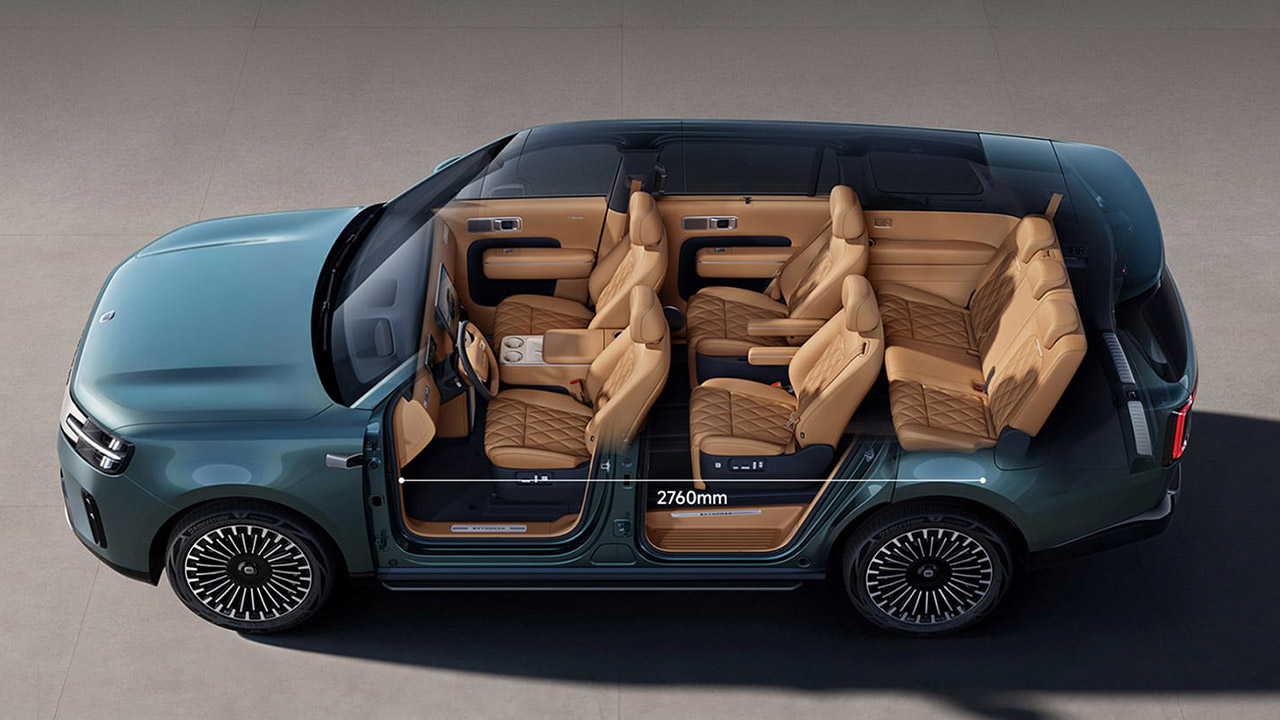
The N90 Max measures 5285 mm in length, 1998 mm in width, and 1825 mm in height, with a wheelbase of 3080 mm. With a completely flat floor and good long seat rails, the groundwork is created for Xiaomi’s Kunlun architecture, a platform designed expressly for this type of customizable cabin rather than driving for driving itself.
49 Min UltraFast Recharging: With upgraded HyperFlash tech, fully recharge at 1,600W—for outage prepping, camping trips, or tailgating events…
2,000W Output via 10 Ports: Delivers 2,000W (3,000W peak) and 1,024Wh capacity. Power up to 10 devices—ideal for emergency backup, remote work…
Compact and Portable: Easily carry, store, and move from room to room, your RV, or even on beach and park outings. C1000 Gen 2 is 14% smaller and…
The N90 Max delivers a powerful punch, thanks to a dual-motor all-wheel-drive system that produces a decent 310 kW (416 horsepower). The rear motor produces 210 kW, and the front one adds another 100 kW to the mix. It takes a decent 5.9 seconds to accelerate from 0 to 100 kilometers per hour. You are limited to 190 km/h, but 0-100 in under 6 seconds gives you an excellent idea of the N90 Max’s capability. A 1.5-liter turbocharged engine from Harbin Dongan serves as a generator, producing 112 kW and charging CALB’s 76 kWh ternary NMC battery. With the battery empty, the N90 Max has a pure-electric range of 464 km on the CLTC cycle. If you put some gas in the tank, you’ll have a total distance of 1705 kilometers (1059 miles). When the battery becomes low, the WLTC cycle consumes approximately 6.26 liters of petrol every 100 kilometers. A 15-minute DC charge adds 285 kilometers to your electric range, while charging from 20 to 80% takes less than 18 minutes.
Advertisement
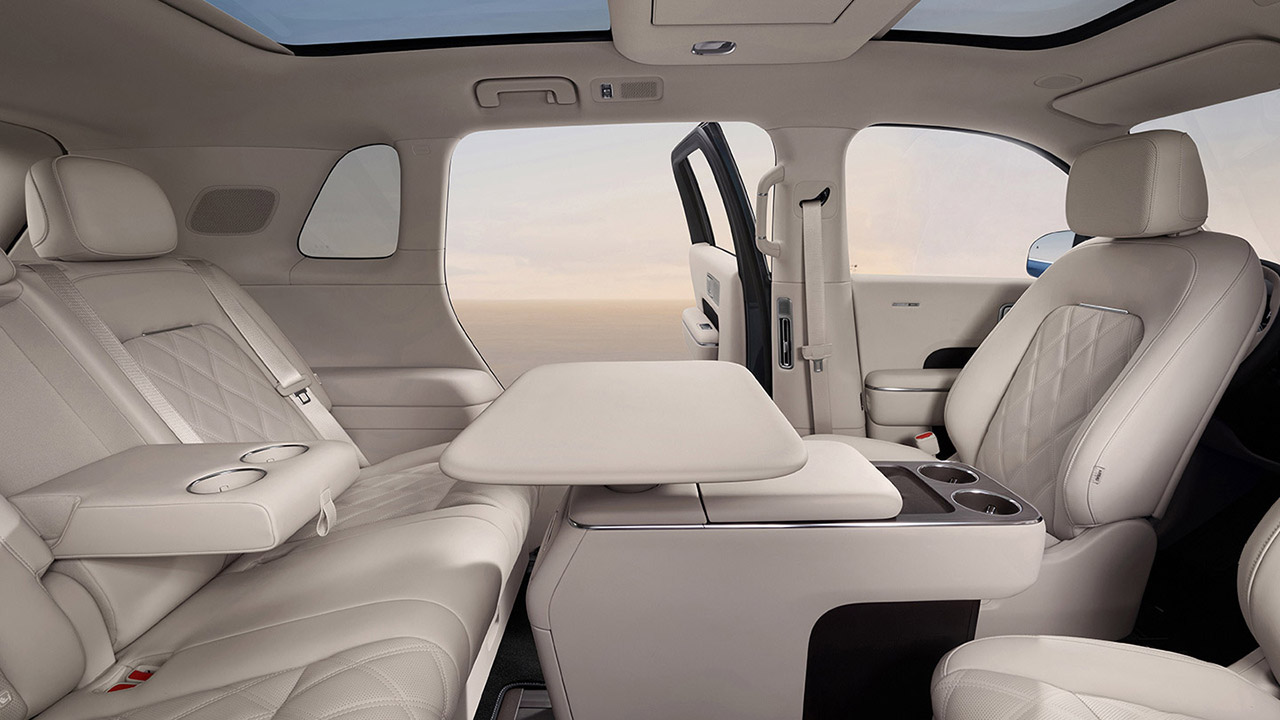
The N90 Max features a 2+2+3 layout. When parked, the front seats will power swivel fully 180 degrees, allowing you and your passengers to face the second row. If you choose the center table, it will slide out of the tunnel, creating a living space up to 1370 mm wide in four-person mode. Second-row seats include zero-gravity designs with footrests and a 16-point massaging system, providing plenty of extra comfort. You also get a 9-liter compressor fridge in the center island, which has cup and phone slots. The N90 Max has some serious sound setup going on, with up to 25 speakers outputting 4,890 watts over a 7.1.4 arrangement. The rear seats feature a 21.4-inch 3K screen, while the driver has a 20-inch head-up display, an 8.8-inch instrument cluster, and a 16.1-inch primary screen. The majority of seat and table adjustments are controlled by voice commands.
Xiaomi describes the parked cabin as a studio for one, a café for two, a lounge for three, or a playroom for the entire family, so it is quite adaptable. The N90 Max Camping Edition exhibits the same flexibility, with a pop-up roof, a rooftop bed platform, tent attachment points, side cabinets, and an optional removable table. This version is suited for five persons and has the same powertrain as the normal N90 Max. The car includes a roof-mounted LiDAR unit as well as a rear-facing solid-state device with an accuracy of a few centimeters. This is combined with some extremely strong computers, courtesy of NVIDIA’s Thor-level technology, as well as Xiaomi’s whole HAD assisted driving package, which includes their XLA cognitive model. The vehicle’s structure is meant to last, with a frame made of high-strength steel and aluminum.
The three rows are connected together by a continuous hot formed door ring that runs the entire width of the vehicle. Underneath, there’s a really innovative suspension system that combines double wishbone front geometry with a multilink rear configuration, and the vehicle can handle a decent soak with a water wading depth of 750mm. It also has enough electricity to keep your electronics charged, with 220 volt charging outlets and 6.6kW vehicle-to-load capability, making it excellent for camping trips or emergency circumstances. The range extender itself operates silently enough that Xiaomi claims the cabin remains as quiet as a pure electric vehicle even when it is powered up. The pre-sales price for the flagship Sky Nomad N90 Max is 299,900 yuan ($44,322), while the somewhat smaller N70 Max is 259,900 yuan ($38,410).
A trip to college—or even to avoid hard nights at home during high school—might come with an expense you didn’t think about: a good office chair. Dorm chairs are hard, awful, and not exactly ergonomic.
Luckily, there are some decent back-to-school office chair deals right now among chairs I can vouch for. My colleagues at WIRED and I have been testing and tracking the best office chairs for more than seven years. The ProtoArc Flexer Pro ($176) is half the price it was last year, probably the best deal at the moment. Others of our budget favorites, like the Staples Dexley ($169), are kinda always “on sale,” and remain among the best available at a low price.
Here are the best affordable office chairs and back-to-school chair deals available for the 2026 school year. Every single chair I recommend here is one we’ve personally tested. Also check out WIRED’s other back-to-school guides, including dorm room essentials and college laptops.
A Steeply Discounted Mid-Range Ergonomic Chair
Photograph: Julian Chokkattu
ProtoArc
Advertisement
Flexer Pro ergonomic Office Chair
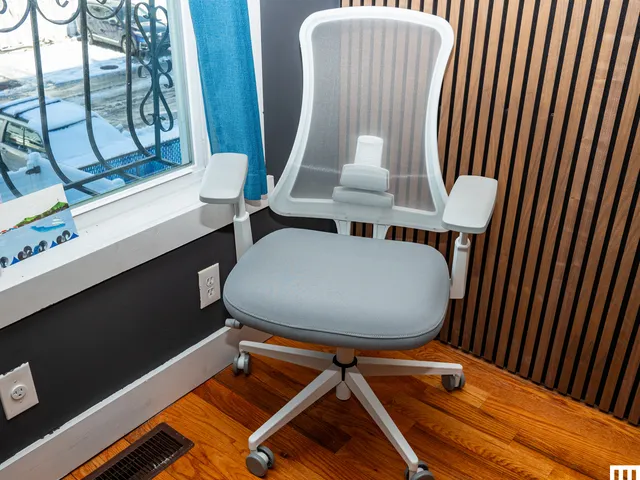
This Flexer Pro ergonomic chair from ProtoArc was a decent deal when it debuted last year at close to $400. But over the past year and month, prices have dropped considerably—this is the lowest price I’ve seen. The chair offers several points of adjustment, including seat pan depth, multiple recline angles, and four-way adjustable armrests.
The build quality and looks are far better than one could generally expect south of $200, with a five-year warranty that’ll get you through those undergrad years. Just note that there’s a detachable lumbar support that can pop off a little too easily from the backrest, and it’s not a great chair for people taller than 6 feet.
WIRED’s Favorite Budget Chair
Photograph: Julian Chokkattu
Staples
Dexley Ergonomic Mesh Swivel Task Chair
Advertisement
Staples basically holds down the discount chair scene, and the Staples Dexley is the best ergonomic chair that can be consistently had below $200. The five-year warranty will take it through most degree programs without a big hit to the wallet and the all-mesh seat offers terrific airflow; the chair is also easy to put together and decently adjustable. The mesh is a little scratchy for shorts wearers, but otherwise this is a solid chair with ergonomics good enough to support the occasional all-nighter.
Amazon plans to launch 5,105 satellites to support new mobile networks
The filing with the FCC highlights voice, data, emergency services, and Internet of Things support
Amazon Leo already has over 390 satellites in orbit, enough to launch the plans ahead of the full deployment
Amazon has confirmed its “low Earth orbit” (LEO) satellite network has submitted an application to the Federal Communications Commission (FCC) to deploy a constellation of 5,105 satellites which will provide voice, data, messaging, emergency services access, and Internet of Things support for under the Amazon Leo Direct-to-Device (D2D) project.
The application follows Amazon’s merger with Globalstar, acquiring the US satellite telecommunications company’s operations, infrastructure, and global licenses and authorizations.
This step into orbit will see Amazon Leo’s existing satellites work alongside the Globalstar HIBLEO and C-3 satellite constellations, kicking off early D2D project support ahead of approval for the full network of comsats.
Latest Videos FromTechRadar
Advertisement
High-speed, low-latency
Much like Starlink, the Amazon Leo network is intended to bridge the connectivity gap between cities and remote communities. It aims to deliver high-speed, low-latency broadband for domestic and enterprise markets, as well as governments, with consumers gaining connectivity via the Leo Nano, Leo Pro, and Leo Ultra high-performance antennae. Meanwhile, mobile devices with satellite-capable chipsets can connect to the satellites without an additional antenna.
Apple iPhones and Apple Watch models are also supported, under a previous agreement to collaborate with Apple. Amazon Leo already delivers data for Emergency SOS, Messages, Find My, and Roadside Assistant to iPhones.
Other partnerships have also been announced that feed into the D2D project. “Telecom operators like Vodafone, DirecTV, Herotel, and Australia’s National Broadband Network […] it plans to continue working with mobile network operators and other partners to deliver on its long-term vision for space-based connectivity.”
Beyond offering connectivity to remote locations, D2D can enable data support for global fleet management, remote operations for supply chains, and IoT connectivity.
Sign up to the TechRadar Pro newsletter to get all the top news, opinion, features and guidance your business needs to succeed!
Advertisement
Amazon Leo’s satellites
Following initial deployment in 2025 with 80+ launches with Arianespace, Blue Origin, SpaceX, and United Launch Alliance, Amazon Leo is aiming at 5,105 low Earth orbit satellites. These units are connected using optical links, capable of high-speed data transfer, with secure gateways networked across the planet, with fiber connectivity.
The D2D satellites are intended to operate across five orbital “shells” – essentially five groups that share the same altitude and inclination. Three shells will cover the mid-latitude, one shell will cover the high-latitude, and the fifth providing coverage for “near-polar” zones. Mid-latitude zones are the world’s most heavily populated regions (North America, Europe, parts of Asia, and southern/central Africa) while the high-latitude coverage aims to deliver high speed internet to the Arctic and sub-Arctic circles.
With increasing demands for mobile data, not just for remote working but also Internet of Things applications, Amazon Leo could prove to be the solution that facilitates home and workplace automation around the world – assuming, of course, that it gets that FCC approval.
The bloc began engaging with Japan over a potential membership in 2024.
Japan has officially joined Horizon Europe, the European Union’s €93.5bn flagship research and innovation programme.
The agreement allows Japanese researchers and organisations to tap EU funding and take part in Horizon Europe on equal footing with the bloc’s member states and the programme’s 22 other associated countries, including the UK, Ukraine, Canada and Israel.
With €93.5bn allocated for a period of six years between 2021 and 2027, Horizon Europe supports cutting-edge research to address global challenges such as the climate crisis, help achieve the United Nations’ Sustainable Development Goals and improve the bloc’s competitiveness and growth.
Advertisement
Japan’s association covers the third pillar of the programme, which has a budget of €52.4bn. This pillar, according to the EU, funds multinational research and innovation projects that address challenges related to climate, energy, health and the digital economy.
Japan will also contribute financially to Horizon Europe’s budget, the EU said, by covering for the Japanese organisations participating in the programme. Transitional arrangements that started in January this year has already enabled organisations from the country to apply for funding calls, it added.
Japan takes the title for the most populous country associated with the programme, with a population of 123m. The bloc began engaging with the country over a potential membership in 2024 and concluded negotiations a year later, it said.
“As Horizon Europe’s 23rd associated country, Japan strengthens a growing global community that believes openness, excellence and international cooperation are essential to turning research into innovation and innovation into prosperity,” said Ekaterina Zaharieva, the EU commissioner for start-ups, research and innovation.
“Science thrives when talent, ideas and innovation cross borders,” she added.
Don’t miss out on the knowledge you need to succeed. Sign up for the Daily Brief, Silicon Republic’s digest of need-to-know sci-tech news.
KEF has spent 65 years proving that loudspeakers do not need to resemble black shipping crates to deliver credible high-end sound. Its LS Wireless range has become a major part of that legacy, with the compact LSX II and larger LS50 Wireless II earning strong reviews by combining amplification, streaming, and KEF’s Uni-Q driver technology in complete stereo systems that do not require a rack full of equipment.
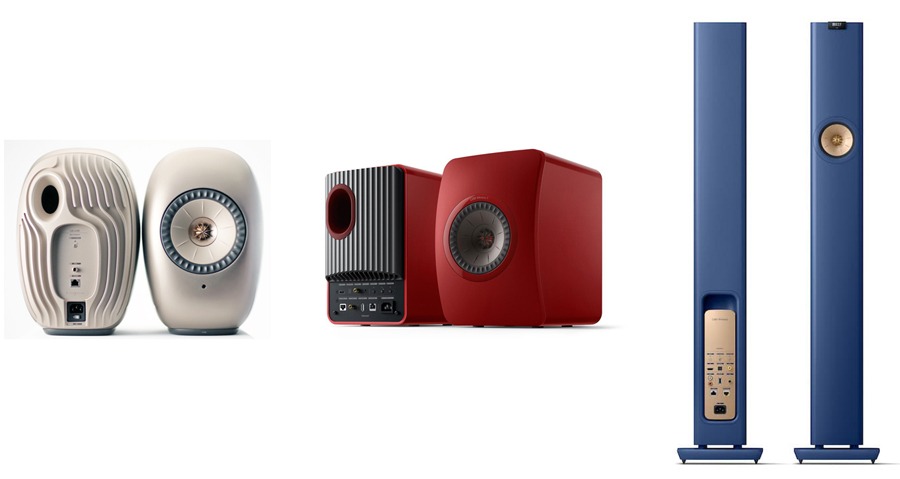
The British manufacturer is now pushing that formula further upscale with the KEF LS LUXE, which it describes as its most ambitious wireless HiFi speaker system to date. Developed with industrial designer Ross Lovegrove, whose previous work with KEF includes the rather less affordable MUON, the LS LUXE is designed to deliver a luxury listening experience without surrendering half the room to loudspeakers, amplifiers, cables, and source components.
The industrial design also has our sci-fi juices flowing. The sculpted enclosure looks less like another pair of compact wireless speakers and more like something that rolled off the Krell assembly line in Forbidden Planet—which is very much a compliment.
Ross Lovegrove Gives the KEF LS LUXE Its Sci-Fi Shape
The LS LUXE is designed as a functional work of art that engages the senses and enhances its surroundings, whether music is playing or not.
Advertisement
The LS LUXE continues KEF’s long-running collaboration with industrial designer Ross Lovegrove, whose previous work for the company includes the towering MUON loudspeaker, Mu3 wireless earphones, Mu7 wireless headphones, and the more recent Muo portable speaker.
Internationally recognized for his sculptural, organic forms, Lovegrove has shaped the LS LUXE into something that refuses to disappear into the background. It is part loudspeaker, part sculpture, and considerably more interesting than another rectangular box covered in fabric.
“At KEF, we have always aimed to redefine the listening experience and make it truly inspiring. LS LUXE is that vision realized,” said Grace Lo, President & Head of Global Marketing at KEF. “True luxury doesn’t announce itself – it transforms the atmosphere of a space, blending design excellence and acoustic mastery in a way that feels both immersive and effortless. When people ask what luxury sounds like, this is our answer.”
The LS LUXE has a rounded, low-diffraction design, robust materials, a flexible decoupling chassis, and an advanced bulk molding compound that enable a purer sound experience, with sharper clarity and deeper bass, setting a new benchmark beyond the gold-standard LS50 Wireless II.
Advertisement
On The Inside
The LS LUXE incorporates KEF’s 12th-generation 6.5-inch Uni-Q driver with Metamaterial Absorption Technology (MAT). For added support, the LS LUXE also includes KEF’s debut of Velocity Control Technology (VECO) for speakers. Working together, Uni-Q, MAT, and VECO are designed to help the LS LUXE deliver a level of performance that belies its compact dimensions.
KEF’s Metamaterial Absorption Technology (MAT) is designed to absorb 99% of the unwanted sound radiating from the rear of the tweeter, reducing distortion and coloration while helping create a wider, more consistent listening area.
The Uni-Q driver assembly is also mechanically decoupled from the cabinet by a flexible chassis, helping isolate it from unwanted vibrations and preserve clarity across the frequency range.
Advertisement. Scroll to continue reading.
The LS LUXE is designed to deliver tighter bass, lower distortion, and greater control across the frequency range. It is also KEF’s first loudspeaker to use Velocity Control Technology (VECO), following the technology’s debut in the XIO soundbar.
Advertisement
The closed-loop system uses a velocity sensor to monitor the movement of the Uni-Q driver in real time. That information is fed to a dedicated amplifier, which corrects inconsistencies in the driver’s motion before they can obscure detail or introduce distortion.
Music Integrity Engine (MIE)
The LS LUXE is designed to preserve detail, tonal accuracy, and clarity at lower listening levels and during longer sessions. Its advanced hardware is supported by KEF’s proprietary Music Integrity Engine (MIE), which uses optimized DSP algorithms to manage the system’s performance across different volume levels.
As the amplifiers and drivers are pushed harder, MIE is designed to maintain balance, definition, and control while reducing the risk of distortion.
Amplication
Each LS LUXE speaker combines a 100-watt Class AB amplifier with a 280-watt Class D current-drive amplifier, for 380 watts of amplification per enclosure.
That hybrid arrangement is unusual in a compact wireless speaker. KEF uses Class AB amplification where finesse matters most and Class D power where greater efficiency and output are required, giving the LS LUXE the headroom to play loudly while keeping distortion under control.
Advertisement
Connectivity
The LS LUXE incorporates KEF’s W2 Wireless Platform, supporting music files at resolutions up to 24-bit/384kHz along with multiroom playback. Listeners can access TIDAL, Amazon Music, Qobuz, Deezer, and other services through KEF Connect, while Spotify Connect, TIDAL Connect, QPlay, AirPlay 2, and Google Cast provide additional streaming options from compatible apps.
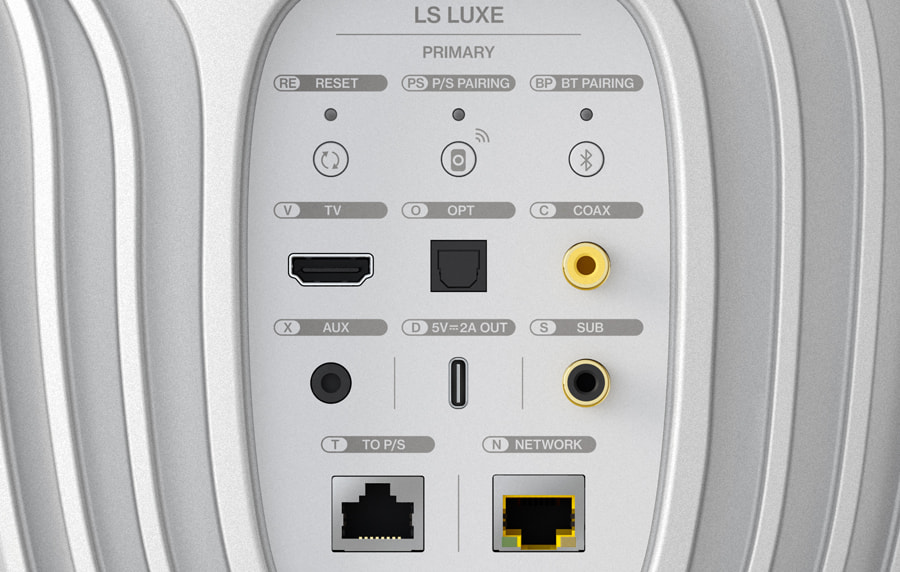
Wired connectivity includes HDMI eARC, analog, optical, and coaxial digital inputs for connecting a television, CD player, game console, or other source component. Dedicated subwoofer outputs are also provided, while support for local NAS drives and compatible music servers gives listeners access to their own digital libraries without relying exclusively on streaming services.
Easy Setup
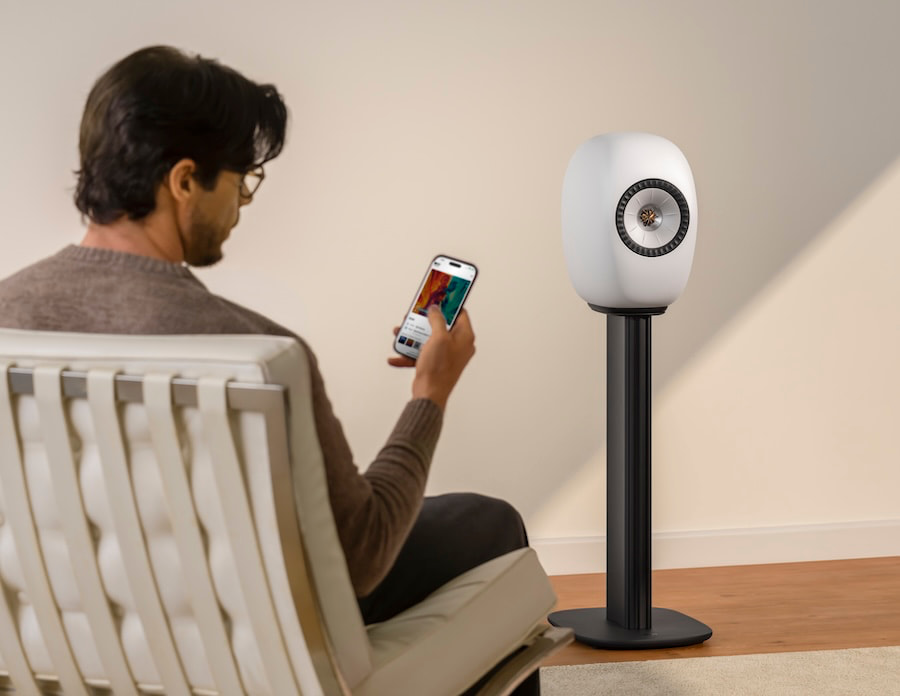
LS LUXE is easy to set up and can be precisely configured through the KEF Connect App (iOS, Android) that allows users to fine-tune the LS LUXE to suit their room and listening preferences. Normal mode provides step-by-step guidance with minimal setup, while Expert mode offers more granular control over EQ settings in decibels.
Advanced Room EQ DSP helps optimize the speakers for their placement and acoustic environment, while dedicated subwoofer presets are designed to simplify integration with KEF’s subwoofer range.
Control and Customization
Volume, source selection, and system settings can be managed through the KEF Connect app or the C3 Remote. Both are designed for straightforward operation, allowing users to enjoy the LS LUXE without navigating an unnecessarily complicated setup.
Advertisement
LS LUXE Finishes and Accessories
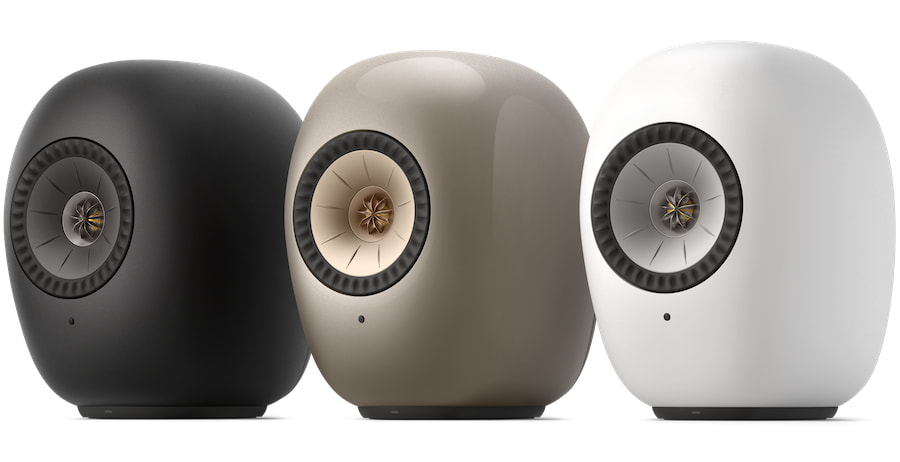
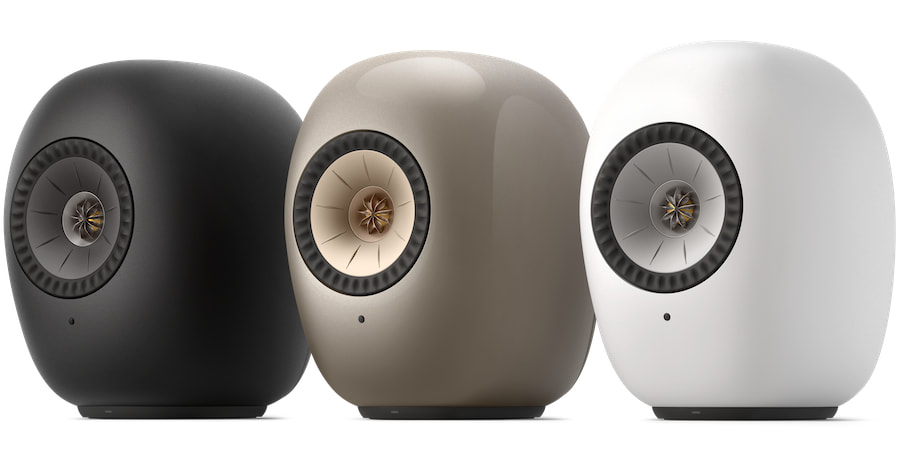
The LS LUXE is available in three finishes: Dusk Titanium, Eclipse Black, and Mineral White. Each pair includes KEF’s C3 Remote, which features an aluminum top plate, backlit buttons, and a customizable favorite button for quick access to frequently used functions.
Advertisement. Scroll to continue reading.
Optional S-LUXE floor stands include integrated cable management for a cleaner installation. KEF’s K-Stream interspeaker cable supports high-resolution signal transfer and allows the speakers to be positioned up to eight meters apart. For added convenience, the KW1 wireless subwoofer adapter kit (available at Amazon) enables a cable-free connection between LS LUXE and KEF subwoofers.
The KEF LS LUXE is more than another compact wireless loudspeaker dressed for Milan Design Week. It is KEF’s attempt to plant its flag at the top of the category, although Focal and Naim’s considerably larger and more expensive DIVA UTOPIA systems might object to the coronation.
What makes the LS LUXE different is the combination of Ross Lovegrove’s sculptural industrial design, KEF’s proven Uni-Q and MAT technologies, and the first use of Velocity Control Technology in a KEF loudspeaker following its debut in the XIO soundbar. VECO monitors driver movement and applies real-time corrections through a feedback loop, while each speaker uses an unusual combination of 100-watt Class A/B and 280-watt Class D current-drive amplification. Few compact wireless systems combine that level of driver control, amplification, streaming support, and visual ambition in one stereo package.
Advertisement
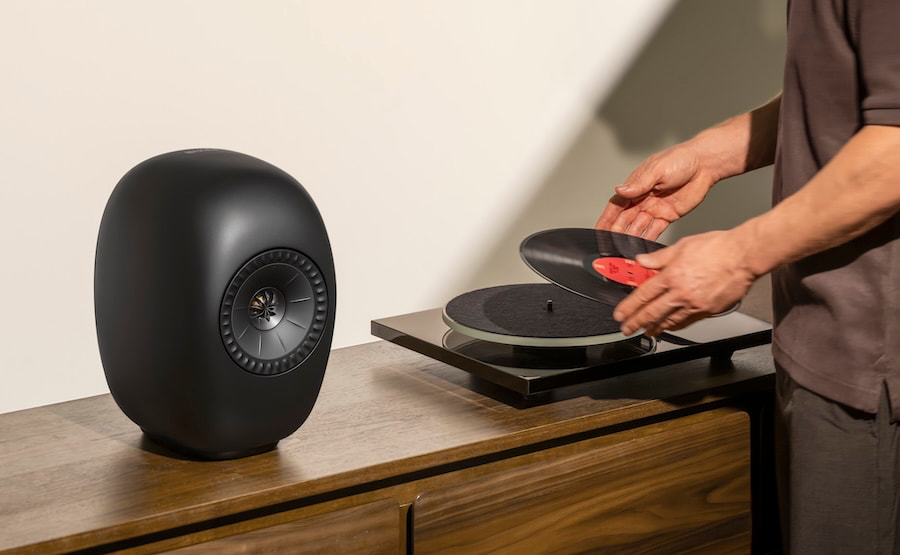
At $3,999.99, however, the omissions matter. The LS LUXE does not include a built-in phono preamplifier, so turntable users will need either a model with an integrated phono stage or a separate external phono preamp. That feels like a missed opportunity for a luxury wireless system aimed partly at audiophiles, especially when the analog revival shows no interest in quietly leaving the room.
It also remains a two-channel speaker system. HDMI eARC makes the LS LUXE a potentially formidable soundbar alternative, but it does not decode Dolby Atmos or DTS. Klipsch’s The Nines II offers both immersive formats, HDMI 2.1 video pass-through, and Dirac Live, while KEF’s own $2,499.99 XIO delivers Dolby Atmos and DTS through a 5.1.2-channel configuration.
The LS LUXE therefore makes the most sense for listeners who want genuine stereo separation, high-resolution streaming, serious amplification, and industrial design that has our sci-fi juices flowing—all without constructing a traditional component system. It is expensive, it leaves vinyl users to supply another box, and home theater buyers can find more immersive alternatives.
But as a compact, high-end wireless stereo system that looks nothing like the competition, the LS LUXE may be KEF’s most convincing argument yet that convenience and ambitious HiFi performance no longer have to occupy separate rooms.
We may receive a commission on purchases made from links.
Vinyl is, as you’re probably tired of hearing by now, huge. Driven by megastars such as Taylor Swift, vinyl sales broke past the $1 billion mark in 2025, capping a meteoric rise in sales of $800 million since 2016. It’s undoubtedly the vanguard of the general resurgence of physical media, and it looks like the format is merely going from strength to strength: According to MusicWeek, vinyl sales grew 16.4% year-on-year in the first half of 2026, setting the stage for another massive 12 months.
Advertisement
This is not a new phenomenon, of course. Vinyl has been back for nearly two decades as of 2026. This means that, unlike the modern cassette player market, which is much smaller, there’s a dizzying number of new turntables out there. From big-name, legacy brands like Technics and Rega to newer entrants like Fluance and U-Turn, there really is a turntable out there for everyone. It just depends, as ever, on how much you’re willing to spend.
Thankfully, you don’t actually have to part with that much cash to get a solid, reliable turntable. There are a handful of great options under the $600 mark that can do a great job and will serve as a solid upgrade, be it from an old thrifted turntable or a cheap all-in-one record player. And while, yes, you could go with one of the latter to really save money, there are plenty of reasons to prefer turntables to record players, and so we’ll focus on the former.
Advertisement
Audio-Technica AT-LP70XBT
I spent over five years working part-time at a record store, and one of our most common recommendations when a customer asked for a starter turntable was the Audio-Technica AT-LP60. While it’s still a great option for absolute beginners, it has some limitations that mean it won’t be for everyone, not least the lack of a significant upgrade path due to its lower-quality fixed cartridge.
The newer Audio-Technica AT-LP70XBT does not, admittedly, resolve that issue entirely, as it still has a tonearm with an integrated cartridge. The difference is that it uses the brand’s VM95 styli, which are higher quality than the ones available to the LP60. They also include higher-end variations like the Shibata-equipped VMN95SH, which is a very capable stylus for the price. The 95C stylus it comes with isn’t amazing, but it’s honestly not that bad, either, and the LP70 sounds good enough to serve most vinyl hobbyists well. Sure, it’s pricier than the LP60 at around $300, but you could conceivably use the LP70XBT as it is for a while and focus your energy on, say, getting acquainted with the quirks of shopping for used vinyl instead.
The LP70XBT has, as the final two letters suggest, Bluetooth connectivity, but those of you interested in wired operation will appreciate the inclusion of a defeatable phono preamp that sounds surprisingly good. It’s also a fully automatic turntable, which is a good newbie-friendly feature. You press a button to start, and it does the rest, including lifting the tonearm once the record ends.
Advertisement
Sony PS-LX310BT
Sony’s PS-LX310BT does not immediately stand out, at least not based on its specs. This isn’t to say that it’s a bad turntable — far from that — but what it offers is not, on paper, unique. It has Bluetooth connectivity and is automatic, both of which are quite common. It also has a not-insignificant downside in the form of an integrated cartridge without any adjustability, which means you can’t really tweak it or get a better cart once your tastes evolve. This makes the Sony essentially plug-and-play, though, which some of you will appreciate.
Advertisement
The reason the PS-LX310BT is on this list is that it sounds remarkably good for the price, and has a decent phono stage as well. No, you’re not getting audiophile-grade output from the Sony, and putting it side-by-side to a higher-end turntable (especially one with a better cartridge) will show up its deficiencies, but what audio it does pump out is very enjoyable. I’ve spent time with one and, while I would never take it over my Technics SL1200, I wouldn’t say it’s leagues worse either.
Sony’s offering is also one of the most living-room-friendly turntables in its $450-ish price bracket, too. While most will probably accept that a turntable will never fully blend into the furniture, the PS-LX310BT’s sleek, unobtrusive lines and minimalist cool do at least mean it won’t stick out like a sore thumb in a modern living space either. Not everyone wants their Hi-Fi setup to be the center of attention, after all.
Advertisement
Fluance RT85 and RT85N
There are quite a lot of options for the buyer seeking a longterm solution and willing to spend $600 to do so. Pro-Ject and Rega have some appealing options in this price range, but we think that the one to go for, and one of the best turntables overall, is the Fluance RT85 or RT85N — especially given its availability in the U.S. and $550 MSRP.
The RT85 is, spec-wise, probably one of the best deals in its price bracket. The standout is the cartridge: The 85 ships with an Ortofon 2M Blue cartridge, which, in my experience, is noticeably better than almost every other cartridge you’ll get on a comparably priced new turntable. It’s not the greatest cart ever, but it’s a detailed performer that’s a cut above carts like the Ortofon 2M Red on the U-Turn Orbit Special, which costs about the same. The Fluance RT85N swaps the Ortofon for the similarly great Nagaoka MP-110, my entry-level cartridge of choice.
Both versions have auto-stop, an MDF plinth and acrylic platter combo, speed control, a fully adjustable tonearm, and a removable headshell for easy cartridge swaps — all features that I guarantee you will find useful if you stick with the vinyl hobby for a few years. No, you don’t get a phono preamp, which means will have to spend more than the RT85’s $550 MSRP, but that’s a small price to pay in the long run. Either way, once you figure that out, though, you’ll be treated to a great-sounding turntable that makes good use of the cartridge it comes with.
Advertisement
Audio-Technica AT-LP120XBT
Most affordable turntables are belt-driven, which means that the motor spins a belt, which then pulls the platter around. It’s a perfectly adequate technology present on cheap and high-end decks alike, but having choice — and the chance to go with an alternative — can only be a good thing. That’s what the Audio-Technica AT-LP120XBT offers. And a lot more besides, of course.
Advertisement
The AT-LP120 is a direct-drive turntable, which means that it has a motor that spins the platter directly. This has some benefits, such as better torque and more stable rotational speed, at the cost of noise from the motor potentially being transmitted to the stylus. As a dyed-in-the-wool direct-drive turntable user, though, I feel that said drawback is somewhat overstated — especially in this context, where you’re not likely to be pairing a $450 turntable with a setup that’s revealing (and expensive) enough to expose any noise issues.
Admittedly, the LP120 isn’t the biggest and best-sounding turntable ever, but it is perfectly adequate for the price, with solid sound quality and an easy upgrade path. You can either swap new VM95 stylus onto the included Audio-Technica cartridge or install an entirely new cartridge, thanks to the standard cartridge mount and fully-adjustable tonearm. You also get a pitch control, support for 78s, a built-in phono preamp, Bluetooth connectivity, and a USB output — although the latter is a bit noisy. None of these are must-haves, but they’re all great value-adds that make the LP120 quite compelling.
Advertisement
U-Turn Orbit Basic and Special
If you’re looking for turntables with the potential to serve you well for a very long time and don’t mind compromising on features to hit lower price points, U-Turn’s Orbit turntables are worth considering. The starter model, the Orbit Basic, comes in at just $249. It’s as basic as turntables can get, with manual switching between 33 and 45 RPM, no tonearm cue lever, fixed tracking weight, and non-adjustable anti-skate.
Not everyone will like the no-frills design, but it delivers on the sound quality front and is a significant upgrade over bad turntables like the $280 Victrola Automatic. Of course, you can get better-sounding turntables, but the Orbit Basic will give you a fine taste of what vinyl can offer — and that’s more than enough for the price. If you’re willing to spend a bit more, you can step up to the $400 Orbit Plus or the $550 Orbit Special. These have better cartridges — an Ortofon OM5E on the Plus and a 2M Red on the Special — and upgraded materials, such as an acrylic platter on the Orbit Plus (versus the MDF platter on the Basic).
If you can afford it, the Orbit Special is the U-Turn product to consider. Not only does it sound genuinely good, it also includes creature comforts like a cue lever and convenient speed switching via a dial. The value proposition does diminish slightly, given that anti-skate and tracking weight are still fixed (not an issue on, say, the Fluance RT85), but it’s a fine purchase if you like U-Turn’s vibe.
Advertisement
Our methodology
Lfo62/Getty Images
To put together this list of affordable turntables, we first had to decide on a definition of “affordable.” We settled on a $600 ceiling, which, while not outright cheap, is relatively affordable considering that higher-end turntables can easily cost $2,500 or more. After setting a cutoff point for price, we then selected a handful of turntables based primarily on professional reviews from reputable publications, combined with hands-on experience.
Generally speaking, we made sure to choose turntables with a reputation for good build quality, enjoyable sound, long-term viability, and solid functionality for a wide range of users with no major deal-breakers. Sub-$600 turntables will never be the final word in terms of vinyl reproduction, materials, or premium design cues, of course, and there will always be compromises, but a good one can and will serve as a great starting point for new record collectors and budding Hi-Fi enthusiasts.
When selecting a new ride-on mower, there are a variety of options available in terms of cutting width, engine performance, and features. One aspect of mower builds that doesn’t receive as much attention is the type of deck. You can find models that feature a stamped or fabricated deck, which are made differently and offer their own advantages. Mower decks are made primarily from steel, but you can also find units comprised of aluminum and even composite.
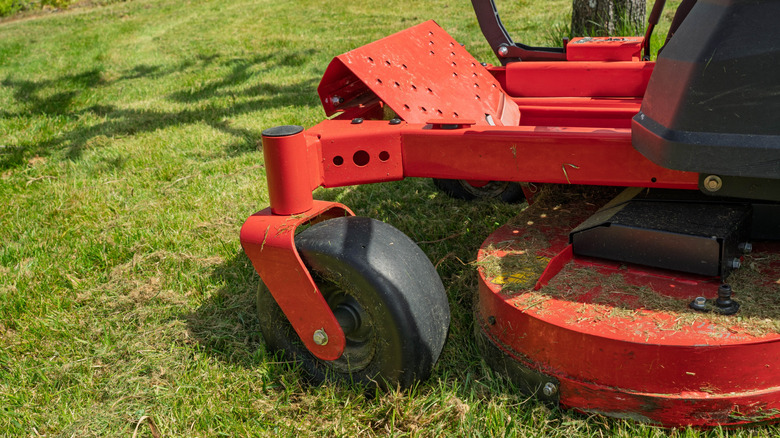
Stamped and fabricated decks differ in their construction, thickness, and appearance. The stamped version is made with thinner material, between 14-and 16-gauge, and is essentially shaped by a premade mold and pressed into form. Visually, you might notice a lack of seams and a rounded design, as it’s made out of a single piece of material. Although, not nearly as tough as fabricated decks, stamped ones are often lighter in weight, and may offer superior performance in terms of how air flows through the unit.
Fabricated decks aren’t made using a mold and press but instead are multiple pieces welded together. Depending on the mower, you could see as low as 7-gauge steel, but not more than 12-gauge, making them thicker than stamped decks and more resistant to impacts and damage. However, they are also heavier and often more expensive, so there are trade-offs. You can spot a fabricated deck by looking closely and noticing the welding beads some models have between pieces at the joints.
Advertisement
Fabricated vs stamped mower deck: which one is better?
Adam bartosik/Shutterstock
The short answer is, it depends. Each type of mower deck provides a best-use case, making it crucial to determine your needs prior to choosing. For instance, you’ll find stamped decks primarily in residential level machines that don’t necessarily require the additional durability. For the average homeowner covering familiar ground, thicker metal wouldn’t add much benefit, unless they happened upon hazardous debris. Though this is often preventable by walking the property prior to mowing, which eliminates at least one of the dangerous mistakes people make when using their lawn mowers.
Where fabricated mowing decks come into play is primarily in the commercial-grade machines utilized by grounds crews and landscapers. These mowers are designed to tackle much larger swaths of land well beyond your typical backyard, with enhanced productivity and durability the primary focus. Although not all machines are created equal, as there are lawn mower brands you should avoid in lieu of those that professionals gravitate toward. With fabricated decks, these machines aren’t as susceptible to debris or contact from obstacles, which is good considering the scope and variety of terrain a commercial mower might encounter. This means the deck can potentially last longer as it holds up to the rigors of commercial work.
This week on Uncanny Valley, we discuss the open- vs. closed-source debate in AI, key players in White House AI policy, and how to stop your chatbot logs from showing up in search-engine results.
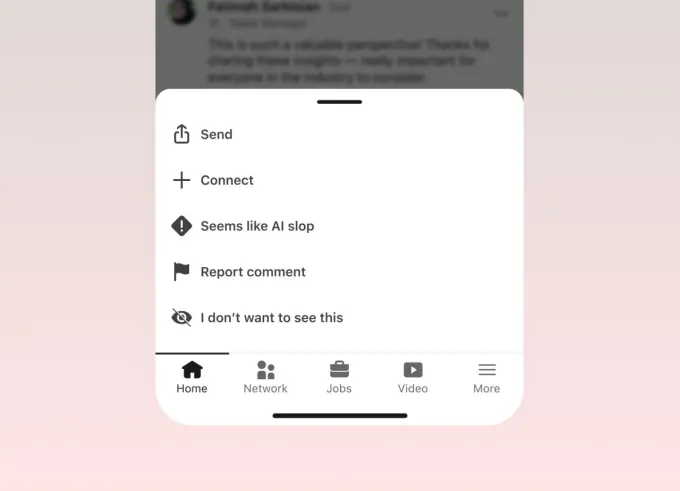
LinkedIn is taking aim at the “AI slop” — low-quality, artificially generated content — filling its feed. On Thursday, the company announced that it’s adding a new feature to let users click a “seems like AI slop” button when someone’s post appears to have been written with AI.
The move reflects a broader shift across online publishing platforms to cut back on AI content, as people have grown frustrated with the computer-written, inauthentic posts filling the web.
Internet infrastructure firm Cloudflare says the problem is just getting worse, as there is now more bot traffic on the web than human-generated requests — a milestone that was reached faster than it had previously predicted.
Advertisement
Image Credits:LinkedIn
In a post on LinkedIn, the company’s Chief Product Officer Hari Srinivasan admitted the Microsoft-owned social network is facing similar problems. “AI slop is a top priority for all of us. We really care about this. People come to LinkedIn to connect with real people and share their real perspectives, ideas, and expertise,” he said.
The exec explained that the new “Seems like AI slop” button is now one of several measures LinkedIn is using to reduce the amount of low-quality, AI-generated content on its platform. The company is also investing in automation defenses, where it now blocks “hundreds of thousands” of automated comment attempts daily, and millions of other automation attempts in just the past couple of months.
Srinivasan said LinkedIn is also introducing new classifiers to identify if a post is AI slop or other low-quality content, which would reduce the amount of slop you’d see in suggested content recommendations from outside your network. (The button ties into this measure as it will provide a source of signal that will allow LinkedIn to tune its AI models to better identify slop.)
Plus, LinkedIn will begin privately flagging in users’ dashboards when people believe their content is coming off as inauthentic due to heavy use of AI. The company believes that this will help posters improve their writing, in the case that they’re simply using AI technology to refine their own work, rather than when they’re posting what’s considered full-on “slop” content.
Notably, the company is pulling its own “enhance your post” feature that had used AI to help you write. It’s replacing it with a feature that proofreads your words, instead of changing your voice.
Advertisement
Other improvements include expanding access to profile and page verification tools, and adding an option to block comments from company pages you no longer want to see, Srinivasan said.
When you purchase through links in our articles, we may earn a small commission. This doesn’t affect our editorial independence.






























































You must be logged in to post a comment Login