Connect with us

Tech

Huawei’s new ultra-light laptop is genuinely ridiculously slim and slender at just 798g – but Western fans might never get their hands on one

Published

on


  • Huawei MateBook Pro S weighs 798g at 11.9mm, with a 14.2-inch 3.1K 120Hz flexible OLED touchscreen and a 54Wh battery
  • The laptop runs HarmonyOS 6.1 rather than Windows and uses a Kirin XE90 SoC, a HiSilicon ARM design on SMIC’s 7nm node, capped at 20W
  • It currently sells only in China, where it starts at 7,999 yuan, with no plans announced for wider availability

Huawei has launched the MateBook Pro S, a 14.2-inch laptop that weighs 798 grams and measures 11.9mm at its thickest point.

The device runs HarmonyOS 6.1 rather than Windows, uses Huawei’s custom Kirin XE90 processor, and went on sale in China on 14 August, with prices starting at 7,999 yuan, roughly just under $1,200 when converted.

Source link

Advertisement
Continue Reading
Click to comment

You must be logged in to post a comment Login

Leave a Reply

Tech

Instead of Fighting AI, Some Teachers Work It Into Their Lessons

Published

on

Last year the writing program at the University of Baltimore used an app that tracks students while they’re writing in Google Docs, offering teachers a video playing back revisions “with a scoreboard of all the edits, pastes and minutes spent on it,” writes the Washington Post. “Is it surveillance? Yes, I think obviously,” says the program’s director.

But was there a better way?

She is one of a dozen educators around the country who told The Post that they’re experimenting with a different approach to student use of generative artificial intelligence this school year. Teachers and professors are throwing out old assignments, installing new policies and protocols, and incorporating AI built for the classroom, rather than feeling forced to choose between returning to pencil and paper or acting like the AI police.

Her new lesson plan even incorporates generative AI in a controlled way to let her evaluate students’ critical thinking skills. She created chatbots using BoodleBox, the university’s AI vendor, that allow instructors to see both sides of the conversation. For an assignment testing students’ ability to make evidence-based arguments, they participate in a simulated school board meeting about banning books. It involves debating chatbots designed by Zeleny with names like the Confrontational Parent. Writing students usually turn in business proposals and research papers. This semester, instructors are starting to ask instead for transcripts of conversations a student had with a chatbot, a handwritten outline of their composition, and a video reflection of how they felt about the work. “In a lot of ways, we have made these assignments harder, but writing should have always had more detailed checkpoints along the way,” she said.

Advertisement

Read more of this story at Slashdot.

Source link

Advertisement
Continue Reading

Tech

How To Talk To A Machine Without Anthropomorphising It

Published

on

LLMs remain a divisive topic in these times. Perhaps we all know someone who’s become over-infatuated with their new robotic friend, or who believes it has made them a genius. [Emily M. Bender] and [Nanna Inie] have written about how people anthropomorphise the LLMs they interact with, and suggested some language tips to avoid that. It’s a couple of months old, but we think Hackaday readers will find it interesting.

Their analysis is interesting, because it looks at the way people talk about LLMs and highlights the unconscious anthropomorphism. The LLM is a piece of software not a person, so why does it “recognise” when it does “speech recognition”, for example. They suggest “automatic transcription” instead. Even “hallucination” implies cognisance that evidently isn’t there. They admit that their suggestion of “undesirable output” isn’t entirely appropriate. They’re on safer ground with “input” and “output” instead of “prompt” and “response”.

Whatever your views on them, it’s evident that LLM usage will be a feature of the world for the forseeable future. The language surrounding them is however capable of evolving, and maybe some of the suggestions here are worth taking note of.

Advertisement

Grappling with our new electronic overlords? Have a look at our AI for Skeptics series.

Source link

Advertisement
Continue Reading

Tech

A Vacuum Tube Computer For The Home

Published

on

The earliest all-electronic computers used vacuum tubes, and most of us will know about machines such as ENIAC or Colossus. Vast machines that required the budget of a country at war to build, andfill very large rooms. It’s very pleasing then to see that a useful vacuum tube computer can be made which has neither of these requirements, as with this example from [Mike] that uses former eastern bloc double-triodes.

It’s an 8-bit design following a von Neumann architecture with 16 instructions, whose operational block diagram would be instantly recognisable to anyone used to working with a 1970s-era 8-bit microcomputer. It follows a NOR-based design in the same manner as the famous NASA machines from the Apollo programme, and as we understand from the description it uses more modern parts for its I/O circuitry. Physically it’s a surprisingly compact wall-mounted unit, and it has an accompanying ex-British Rail flip-digit display as well as a control panel for a simple airship simulator game. There’s a website with full details, if you are interested.

We like this machine, a lot. It may not be the largest computer we’ve seen and it certainly isn’t the first one with vacuum tubes, but it’s a very impressive achievement to have created it. If tubes in computing interest you meanwhile, we took a trip to see the daddy of them all.

Advertisement

Should [Mike] enter this into the Retrocomputing Challenge? We think so.

Source link

Advertisement
Continue Reading

Tech

US watchdog opens probe into Tesla’s Cybercab self-certification

Published

on

offbeat

Wheels turning on the road and in government

Tesla’s Cybercab’s wheels have only just hit the asphalt for its commercial launch and the autonomous vehicle has already attracted the attention of the US National Highway Traffic Safety Administration (NHTSA).

Advertisement

The body announced an investigation into Tesla’s self-certification of the vehicle at the weekend. Central to the probe is the fact that the Cybercab famously lacks conventional controls.

The NHTSA says there are “clear vehicle performance requirements” – stuff like brake controls – that “in order for automakers to access the US market, they must certify that their vehicles meet these standards – subject to oversight from the agency to confirm compliance. When certified vehicles appear to not adhere to these requirements, NHTSA conducts an investigation.”

The NHTSA is updating the requirements for autonomous vehicles designed never to be operated by a human, but Tesla appears to have jumped the gun somewhat, prompting the agency to open an Audit Query (AQ) just hours after the Cybercab began a commercial rollout on the streets of Austin, Texas.

Tesla told the NHTSA that it had certified the Cybercab “as compliant with all applicable Federal Motor Vehicle Safety Standards (FMVSS).”

Advertisement

The vehicles lack permanently attached manual controls such as a brake pedal, accelerator, steering wheel, or mirrors. In the AQ, the agency wrote it intended to “examine the process and technical data on which Tesla relied when certifying the Cybercab and related issues.

“Among other things, NHTSA will consider the extent to which Tesla’s certification depended on determinations that certain FMVSS are inapplicable to the Cybercab.”

Tesla is not the only company with autonomous vehicles ferrying passengers around on US roads without using conventional controls in the cabin. Amazon tentacle Zoox, for example, was granted a two-year exemption [PDF] at the end of July 2026, with the proviso that “not more than 2,500 exempted vehicles are introduced into interstate commerce for commercial deployment in any 12-month period.”

There is therefore precedent. However, the NHTSA wants to see how Tesla came up with its self-certification for the Cybercab. NHTSA Administrator Jonathan Morrison said, “NHTSA fully supports the safe development and deployment of automated vehicles. But as the federal regulator, we need to ensure that all of our laws are followed.”

Advertisement

The agency noted, “When certified vehicles appear to not adhere to these requirements, NHTSA conducts an investigation.” ®

Source link

Continue Reading

Tech

How To Watch The Legend Of Zelda 40th Anniversary Nintendo Direct

Published

on

We’re expecting details about the ‘Ocarina of Time’ and other Zelda projects during the 30-minute stream.

Sometimes, there’s just too much news for a single Nintendo Direct, so the company is doubling up by running two streams this week. Before we take a look at other games coming to the Nintendo Switch 2 in a regular Direct on Wednesday, Nintendo will serve up info on several Legend of Zelda projects with a showcase dedicated to that franchise.

The Legend of Zelda 40th Anniversary Direct will start at 10AM ET on September 8 and run for around 30 minutes. You can watch it on YouTube or the Nintendo Today! app. Alternatively, you can simply click the play button on the video below when the time comes.

Advertisement

Nintendo has confirmed we’ll hear more about its remake of The Legend of Zelda: Ocarina of Time during this Direct. A release date announcement seems likely, as the game is slated to debut sometime this year. If it’s sticking to that window, I imagine Nintendo will release the remake before late November so it’s on store shelves in time for Black Friday.

The company already has Nintendo Switch Sports Resort on the docket for October, so it might just be trying to counterprogram Grand Theft Auto 6 with a November release. The Ocarina of Time remake is one of the few games that could viably sap some attention away from Rockstar’s upcoming blockbuster, in part because the titles will be available on different platforms.

Let’s not forget that Zelda is heading to the big screen next year as well. The Legend of Zelda will hit theaters on April 30, and we should find out more details about the film during this Direct. I suspect we’ll get a short teaser now, and the first proper trailer in a couple of months.

Half an hour is quite a chunk of time to fill with just those two projects, so perhaps Nintendo will have something else up its sleeve to help mark Zelda’s 40th anniversary. For instance, maybe we’ll hear about a remake of The Legend of Zelda: the Wind Waker. Nintendo may also start teasing the next mainline Zelda game too. The company officially announced what would become Tears of the Kingdom in 2019, two years after the release of Breath of the Wild. It’s now been three years since we first dove into Link’s last adventure, so the timing lines up for the first official word on the next one (or perhaps Zelda will take center stage again).

Advertisement

Source link

Advertisement
Continue Reading

Tech

TECNO CAMON Slim 5G Manages to Cram a Gallery Into 6.39 Millimeters

Published

on

TECNO Camon Slim 5G Launch
TECNO spent years treating phones like cameras that happen to make calls. CAMON Slim 5G doubles down on that idea and then flattens the whole package until it sits 6.39 millimeters thick, which is thin enough that a stack of two credit cards still looks bulky next to it. Official launch materials call the handset an art piece you hold in your palm, and the company is not being modest about the paint jobs. Five finishes arrived with the September 7, 2026 announcement: Burgundy Red in fiberglass with a matte velvet grain, Matisse Black with fluorescent green cut-out accents, Rebel Pink on a black body, Van Gogh Blue with a patterned gradient that tries to spin like the sky in The Starry Night, and Neo Mondrian, a photochromic white slab that only shows Piet Mondrian’s grid when ultraviolet light hits it.


The dimensions are 162.58 x 77.27 x 6.39mm, and the launch coverage puts the weight at 190 grams, which is very light considering you’re carrying a 6,000mAh battery in your pocket. A 6.78-inch flat 1.5k AMOLED panel makes up the majority of the phone’s face, with a 144Hz refresh rate with 2160Hz PWM dimming. It also has TUV Rheinland low-blue light certification. The good news is that Wet & Oily Hand Touch Recognition 2.0, Rain Touch, and a Waterproof Case Touch allow you to tap the screen with wet fingers, so a damp commute or a kitchen splatter will not render the screen unusable. The 5G duties are handled by Mediatek’s Dimensity 7300e, which combines four 2.5GHz Cortex-A78 cores with four A55 cores and a Mali G610 GPU. In terms of memory, the phone has 8GB of RAM and either 128 or 256 GB of storage, and it comes with HiOS 16 on top of Android 16 with a promise of three major OS updates and five years of security patches, all with TÜV SÜD backing 60 months of claimed smoothness

Sale


Samsung Galaxy S26 Ultra, Unlocked Android Smartphone, 256GB, Sky Blue
  • PRIVACY DISPLAY: Automatically hide your screen from those beside you. The built-in privacy display can be preset¹ to turn on when receiving…
  • TYPE IT IN. TRANSFORM IT FAST: Enhance any shot in seconds on your smartphone by using Photo Assist² with Galaxy AI.³ Add objects, restore details…
  • NIGHTS, CAPTURED CLEARLY: From gigs to city lights, record and capture moments after dark with clarity using Nightography so your photos and videos…


The cameras in this phone are the major reason you’d consider purchasing one. There’s a 50 megapixel Sony LYTIA 700C sensor that’s 1/1.56 inches in size and uses an f/1.8 lens with closed-loop ball motor autofocus and optical stabilization, as well as AI-driven electronic stabilization and an AI-controlled shutter to provide a three-part stability system. Then there’s the 8-megapixel ultra-wide lens at f2.2, which covers nearly 112 degrees. Super-Zoom Flashsnap allows the software to capture action photographs without the need to press any buttons, and it can even fire off a 2x telephoto shot at speeds of up to 1/11,236 of a second, which is ideal for capturing concert or match photos provided you’re happy with digital zoom rather than a true long lens. Multi-focal pictures have framing options of 24mm, 35mm, and 50mm, and TECNO’s Universal Tone skin tone engine is a fancy piece of kit that will ensure your portraits look their best day or nite. The front-facing camera is 32 megapixels.

Advertisement

TECNO Camon Slim 5G Launch
For such a slim phone, durability shines through. Ratings include IP66, IP68, and IP68’s more heavy-duty cousin IP69, as well as a MIL-STD-810 drop and shock certification. TECNO is making a huge fuss about underwater photography, claiming that it is a true feature rather than a hoax. Charging the 6,000mAh pack takes 45 watts, a drop down from the 60-watt 4G Camon Slim that debuted earlier in 2026, but it allows them to fit a larger battery into a phone that now supports 5G. Along with the phone, you get a magnetic Mag Badge attachment with its own little battery, and it has a 1.73-inch AMOLED display. Bluetooth allows you to connect it as a wearable mini-gallery of images, a remote shutter that works well up to roughly 10 meters, and a selfie preview that allows you to see your own face without having to flip the phone around. The hardware also incorporates two speakers with Dolby Atmos, NFC, an infrared blaster for controlling home appliances, a USB-C connector, and an in-display optical fingerprint reader to complete the package.

TECNO Camon Slim 5G Launch
Pricing is kept locally. Bangladesh is the first market to learn about the prices, with the 8GB plus 256GB model listed at 59,999 taka ($488) during an early September pre-order window, while everyone else is still waiting to find out when it will be available and whether they will receive a 3-month Google AI Plus trial with 2TB of storage in the countries where it is available. CAMON Slim 5G won’t win any speed races against the latest and best silicon, and video max out at 2K30, according to early reports, but that’s not important.
[Source]

Source link

Continue Reading

Tech

Matt Clifford to leave ARIA before Anthropic role becomes a ‘distraction’

Published

on

public sector 

MPs welcome move but still want answers over how the conflict of interest was allowed to arise

Matt Clifford is stepping down as chair of the UK’s taxpayer-funded Advanced Research and Invention Agency (ARIA), just days after saying he intended to keep the job while working for AI giant Anthropic.

Advertisement

Clifford, one of the architects of the UK government’s AI strategy, said in a LinkedIn post on Monday that he would leave ARIA, less than a week after his appointment as Anthropic’s managing director of international affairs prompted warnings of a “clear conflict of interest.”

“Having completed my first full term last month, I have decided to step down to ensure my new role at Anthropic doesn’t become a distraction from ARIA’s incredible work,” he said.

The decision reverses the position outlined when Anthropic announced Clifford’s appointment as managing director of international affairs last week. At the time, he intended to remain as ARIA chair, with safeguards put in place to manage potential conflicts between the two roles.

He said the Secretary of State had asked him to remain until November 6 while a new chair is appointed, and that he had agreed to do so “with appropriate safeguards against potential conflicts in place.”

Advertisement

The overlap between the roles had already attracted scrutiny in Parliament.

Dame Chi Onwurah, Labour MP and chair of the House of Commons Science, Innovation and Technology Committee, warned last week that Clifford’s plan to retain the ARIA role while working for Anthropic created a “clear conflict of interest.”

ARIA invests taxpayer money in high-risk scientific and technological research, including AI-related work. At Anthropic, Clifford will lead the company’s engagement with governments outside North America.

Onwurah welcomed Clifford’s decision on Monday but said questions remained about how the original arrangement was approved.

Advertisement

“It’s right that the conflict of interest between the taxpayer funded ARIA and Anthropic has been addressed through Matt Clifford’s decision to step down as ARIA’s Chair,” she said.

“However, important questions remain. Last week, I wrote to the government seeking clarity on how this situation arose, what conflict of interest assessments were undertaken and what safeguards are in place to protect confidence in ARIA’s governance. I expect a detailed response in the upcoming weeks.”

Clifford has become an influential figure in UK AI policy. As well as chairing ARIA, he helped establish the Frontier AI Taskforce, which later became the AI Security Institute, worked on the UK’s 2023 AI Safety Summit, and wrote the government’s AI Opportunities Action Plan. ®

Source link

Advertisement
Continue Reading

Tech

Uploaded Your ID to a Scam Site? Act Now

Published

on

If you uploaded an ID to a scam website, stop communicating with the operator, preserve evidence, secure any exposed accounts, and contact the document issuer through an independently verified channel. Do not automatically report the physical document lost or pay anyone who promises to delete the uploaded copy.

The correct response depends on whether the website received only an ID image or also obtained a selfie, password, payment information, one-time code, or access to your device. Act on the most sensitive item first.

Quick Take: The First Actions to Complete

Quick Take

  • Do not revisit the website, upload another document, or negotiate with the scammer.
  • Save the URL, messages, receipts, upload confirmation, and a written record of what you submitted.
  • Secure your primary email account before changing less important accounts.
  • Replace any password entered on the site and every reused copy of that password.
  • Contact your bank immediately if you disclosed payment details or sent money.
  • Ask the government agency that issued your ID whether it can flag the document or recommends replacing it.
  • Report the scam through the appropriate cybercrime or consumer-protection service in your country.
  • Monitor account, credit, banking, and mobile-service activity for delayed misuse.

Use phone numbers and web addresses obtained independently from an official government page, bank card, banking app, or account you already trust. Contact details supplied by the suspicious website may lead back to the scammer.

Assess Exactly What the Website Received

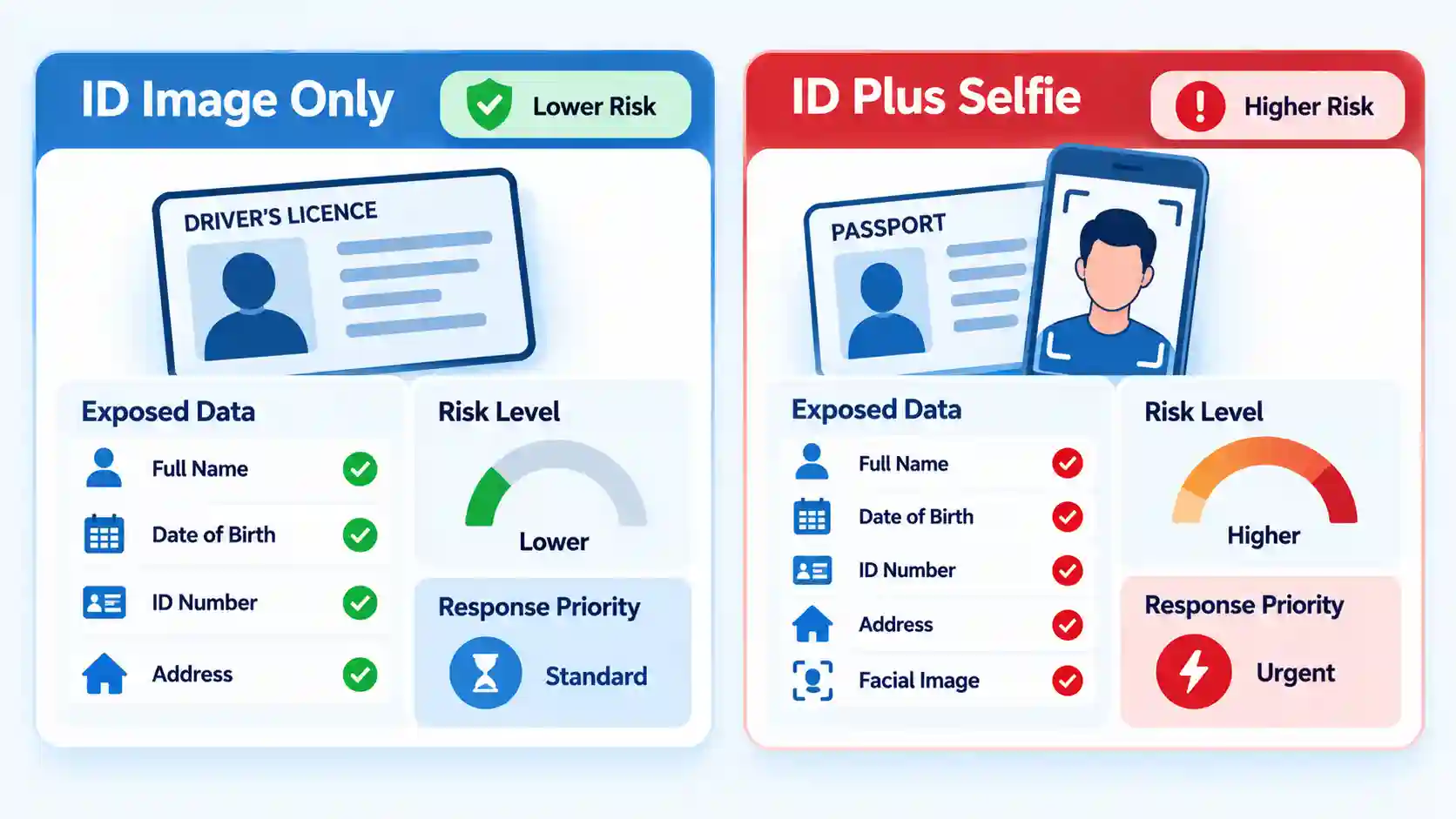
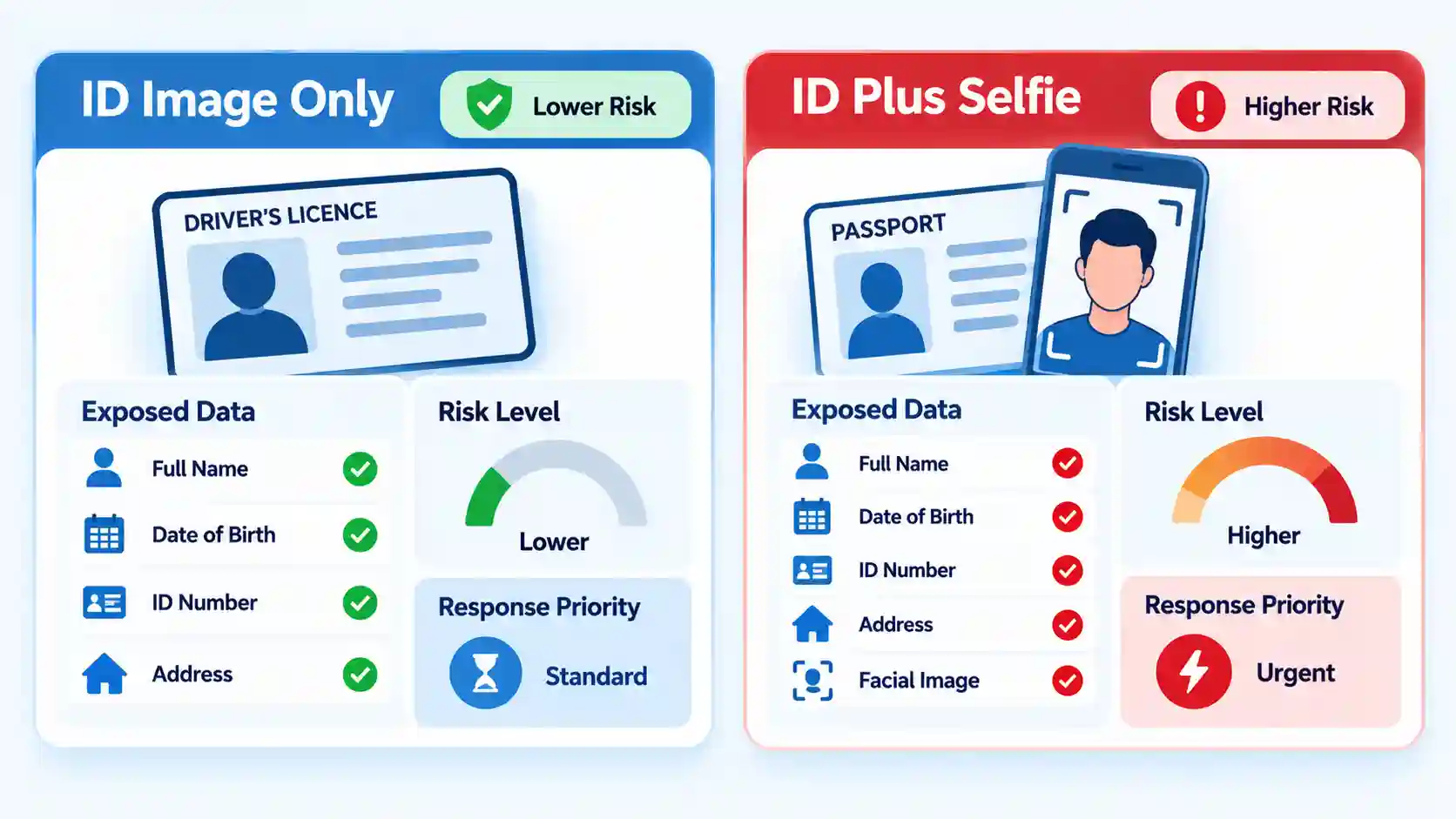
An uploaded ID is not a single, uniform type of exposure. A front image of a driving licence creates a different response requirement from a passport scan combined with a live selfie, email password, and one-time verification code.

Information exposed Principal risk First response
ID image only Impersonation, fraudulent applications, or more convincing follow-up scams Preserve evidence, notify the issuer, report the site, and monitor for misuse
ID plus selfie or video Attempted remote identity verification in your name Treat the incident as higher risk and watch for new financial, telecom, or platform accounts
ID plus password Account takeover, especially if the password was reused Secure email, replace reused passwords, revoke sessions, and enable MFA
ID plus bank or card details Unauthorized transactions or social engineering against your bank Contact the financial institution through its official fraud channel
ID plus one-time code An account reset, login, payment, or enrolment may already have been authorized Contact the affected provider immediately and review security activity
Downloaded app, profile, or file Malware, remote access, or stolen browser and account data Stop sensitive activity on the device and begin device remediation

A photograph of an ID can remain useful to a criminal even when you still hold the original. However, exposure alone does not prove that an account has been opened or that the document must be cancelled. The response should reduce foreseeable risks without creating unnecessary replacement costs or travel problems.

Advertisement

ID Image Only and ID Plus Selfie cards compare exposed data, risk levels, and response priorities.

What to Do in the First Hour

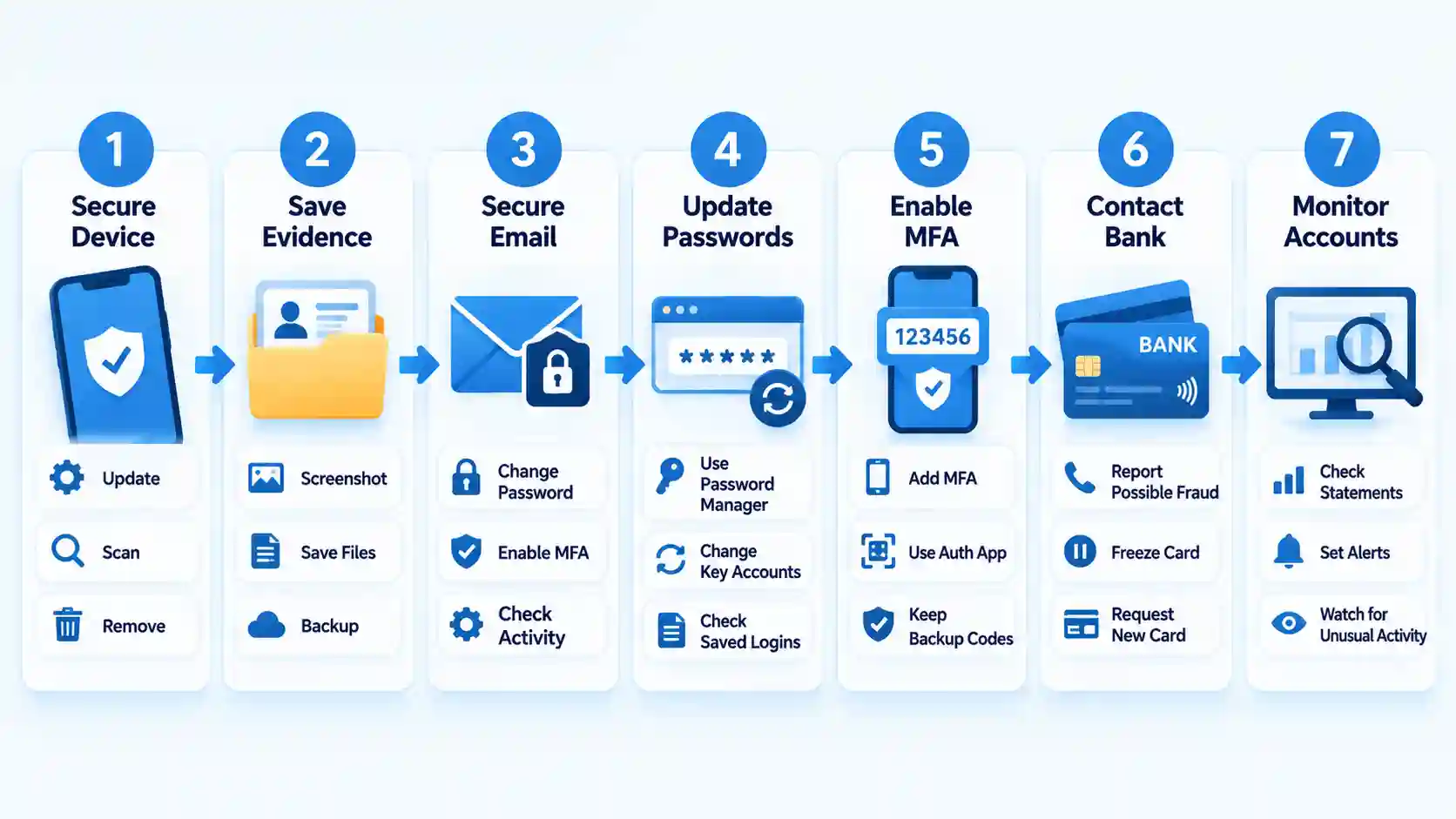
  1. Stop all communication. Do not threaten the scammer, ask for deletion, or provide a clearer image to “complete verification.” Block the contact after preserving the conversation. Deleting a message from your own chat does not establish that the recipient deleted its copy.
  2. Create an incident record. Write down the exact document and fields exposed, including name, address, date of birth, document number, signature, expiry date, selfie, password, card details, and verification codes. Save screenshots, email headers, telephone numbers, transaction references, the page address, and the approximate upload time. Do not distribute the exposed ID again when reporting unless an official process specifically requires it.
  3. Secure your email account first. Email is commonly used to reset other accounts. From the provider’s official app or a typed address, change the password, inspect recent logins, remove unknown devices, check recovery addresses and telephone numbers, and review forwarding rules. Sign out other sessions where the provider offers that control.
  4. Replace exposed and reused passwords. Create a unique password for the affected service and every account where the same or a closely related password was used. Prioritize email, banking, mobile-carrier, cloud-storage, government, and cryptocurrency accounts. The UK National Cyber Security Centre similarly advises changing passwords on every account that uses an exposed password and using a passkey where available in its post-phishing guidance.
  5. Enable stronger authentication. Add a passkey, security key, or authenticator app where supported. Save recovery codes somewhere the scammer cannot access. Do not approve unexpected login prompts. If the scammer obtained a one-time code, tell the affected provider because the code may have completed an action already.
  6. Contact financial providers. If you submitted card or account details, call the number printed on the card or use the bank’s authenticated app. Ask the fraud team whether the card or account should be restricted or replaced. Review recent transactions and turn on alerts. The payment-method comparison explains why card, bank-transfer, e-wallet, and cryptocurrency incidents require different recovery routes.
  7. Check the device. Merely uploading a file through a browser does not automatically mean the device is infected. Risk rises if you installed an app, browser extension, configuration profile, remote-access tool, or downloaded file. If that happened, disconnect the affected device from sensitive work, update its security software, and run a full scan. The FTC’s malware response steps recommend scanning before changing passwords when malware may be capturing credentials. Use another known-clean device for urgent banking or password work.

If the incident involved a cloned gambling site, preserve its domain and compare it with the checks in How to Spot a Cloned Online Casino Website. Do not return to the suspect page to collect evidence if doing so requires another login, download, or payment.

Seven-step response flow covers device security, evidence, email, passwords, MFA, bank contact, and account monitoring.

Do Not Report a Document Physically Lost Unless It Is Missing

A copied document and a missing physical document are not always handled identically. Incorrectly reporting a passport lost can invalidate it and disrupt travel.

For example, the U.S. Department of State says that a person generally does not need to file a lost-passport report when the physical passport remains in their possession. Its passport fraud guidance instead directs people concerned about compromised passport information to identity-theft resources. That is a U.S.-specific rule, not a global replacement policy.

Ask the Issuing Authority What It Can Flag or Replace

Contact the agency using the address or telephone number on its official government website. Explain that an image was submitted to a suspected fraudulent website while the physical document remains with you. Ask:

  • Can the document number be flagged for suspected misuse?
  • Does the agency accept a report when only a digital copy was exposed?
  • Would replacement issue a new document number?
  • What evidence or police report is required?
  • Would cancellation affect upcoming travel, driving, residency, or identification checks?
  • How should you report an application or account created in your name?

The answer may differ for a passport, driving licence, national identity card, residence permit, employee badge, or student card. Replacement is a decision for the issuing authority and document holder, not the scammer.

Report the Scam Through a Local Official Channel

Use the national consumer-protection, cybercrime, police, or identity-theft reporting service available where you live. U.S. users can create a tailored recovery plan through IdentityTheft.gov. UK users can report suspicious websites through the NCSC and report financial loss through the relevant fraud or police channel.

Advertisement

A report may not immediately remove the copied file, but its confirmation number and timestamp can support later disputes. Keep the report with your incident record.

Protect Credit, Banking, and Identity Records

Credit Freeze Versus Fraud Alert in the United States

These controls apply to U.S. credit files. They should not be presented as universal services.

Control What it does How to place it Important limitation
Credit freeze Restricts prospective creditors’ access to the credit file, making new-credit fraud harder Contact Equifax, Experian, and TransUnion separately It does not secure existing accounts and must be lifted when access is legitimately needed
Initial fraud alert Tells prospective lenders to verify the applicant’s identity Contact one nationwide credit bureau, which must notify the other two Creditors can still access the report, so it is not the same as a freeze

According to the FTC’s freeze and alert comparison, both controls are free. A freeze lasts until it is lifted, while an initial fraud alert lasts one year and can be renewed.

Check More Than a Conventional Credit Report

Review credit reports for unfamiliar accounts, inquiries, addresses, or collections. Also inspect existing bank, e-wallet, mobile-carrier, and cryptocurrency accounts for changed recovery details or unfamiliar verification attempts.

Advertisement

Traditional credit reports may not show every checking-account application. The U.S. Consumer Financial Protection Bureau explains that checking-account reports can contain applications, openings, closures, and check-writing information. This is an edge case worth checking when an exposed ID could be used to open a deposit account rather than obtain credit.

Use the Equivalent Controls in Your Country

Outside the United States, ask the relevant credit bureau, bank-account reporting system, document issuer, and cybercrime authority what preventive flags or reports are available. Do not submit more identity documents to a website found through an unsolicited message. Locate each institution independently.

If the scam originated from a supposed casino verification request, confirm the operator and domain through the process in How to Verify an Online Casino Licence. A licence logo or number displayed by the suspect website is not independent confirmation.

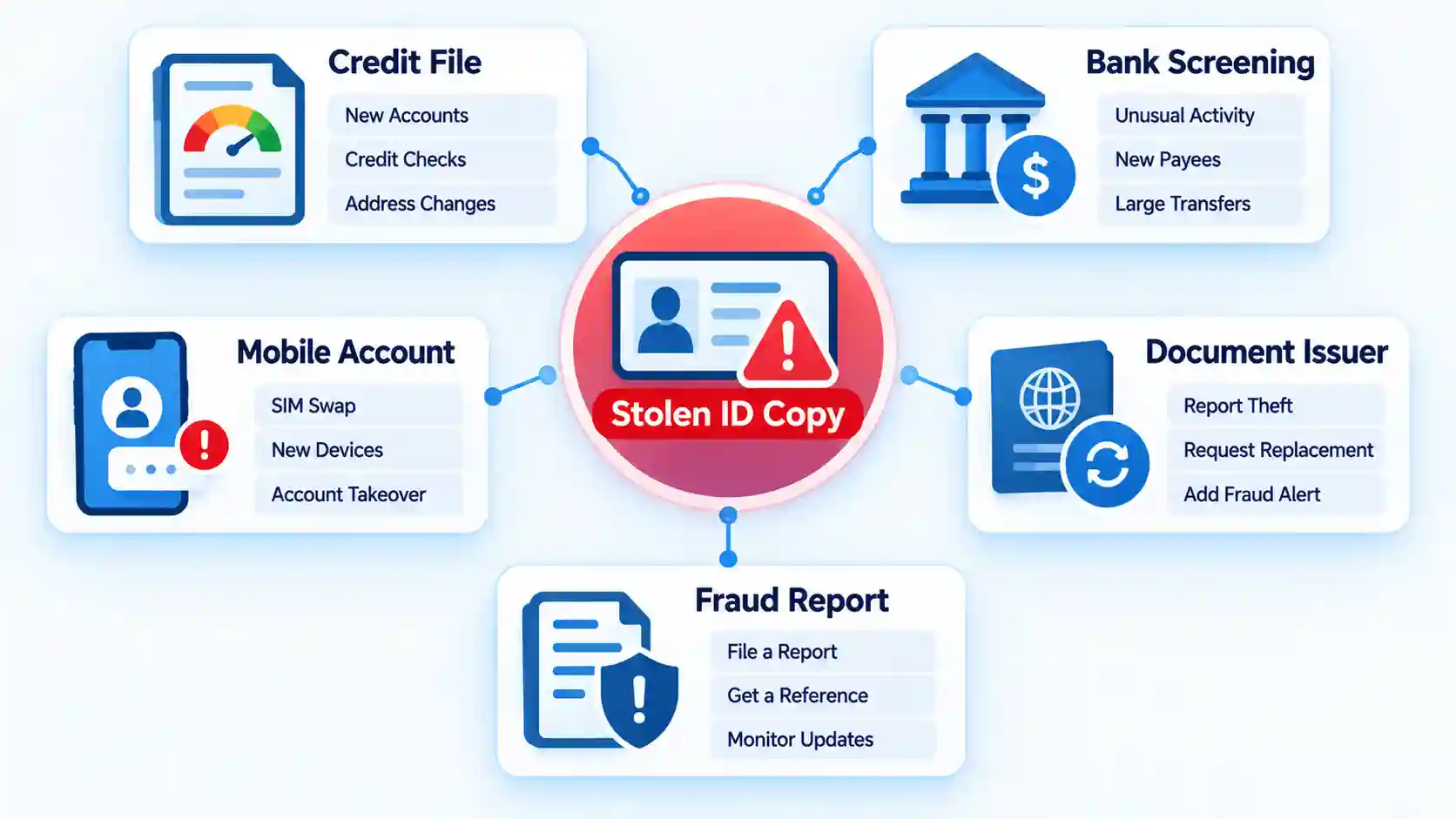
Stolen ID Copy connects to Credit File, Bank Screening, Mobile Account, Document Issuer, and Fraud Report.

Containment is complete only when you have checked the systems that can be used to regain access or impersonate you. Confirm the following:

Advertisement
  • Unknown sessions and devices have been removed from important accounts.
  • Email and mobile-account recovery details still belong to you.
  • Every exposed or reused password has been replaced.
  • MFA is active and unexpected prompts are being denied.
  • Bank and card alerts are enabled where appropriate.
  • The document issuer’s instructions and reference number are recorded.
  • Relevant fraud, credit, and banking reports have been checked.
  • Evidence and report confirmations are stored securely without unnecessary copies of the ID.

If money is missing or a withdrawal dispute led you to the fraudulent site, separate identity containment from the transaction investigation. The guide to a pending or rejected casino withdrawal explains legitimate payout checks, but a verified scam should be handled through the payment provider and authorities rather than ordinary casino support.

Failure Modes and Troubleshooting

Problem What may be happening Correct response
The scammer promises to delete the ID The promise may be intended to prolong contact or obtain money Stop communicating and proceed as though the copy remains available
The issuer will not replace the document Its policy may distinguish digital exposure from physical loss Ask for written instructions, a reference number, and the procedure for reporting actual misuse
An unknown account appears The identity information may already have been used Contact the provider’s fraud department, dispute the account, and follow your official identity-theft process
Your phone suddenly loses service A SIM-swap or mobile-account takeover may be in progress Contact the carrier from another device and secure accounts that use SMS recovery
A “recovery specialist” requests payment This may be a follow-on recovery scam Do not pay, install software, or provide another identity document
You cannot access your email The password or recovery settings may have been changed Use the provider’s official account-recovery process from a clean device

Monitor for Delayed Misuse

A clean account review today does not prove that the uploaded copy was destroyed. Criminals may retain information, combine it with later data, or use it in follow-up social engineering.

For at least the following 12 months, review important statements and reports on a regular schedule. Watch for password-reset messages, one-time codes you did not request, credit inquiries, new bank or mobile accounts, debt-collection notices, tax or benefit correspondence, and identity-verification emails from unfamiliar services.

Maintain a dated incident log. Record each alert, institution contacted, representative, case number, and outcome. If actual misuse appears, update the original report and preserve the disputed application or transaction details.

An ID-and-selfie package deserves particular attention because it may resemble a remote verification submission.

Advertisement

Key Takeaways

  • Secure email, passwords, financial accounts, and the device according to what was exposed.
  • Preserve evidence before blocking the scammer, but do not revisit an unsafe site to collect more.
  • Contact the ID issuer before cancelling or replacing a document that is still in your possession.
  • Use only independently verified government, bank, credit-bureau, and account-provider channels.
  • A credit freeze can impede new-credit fraud but cannot prevent every form of identity misuse.
  • Continue monitoring because fraudulent applications and follow-up scams may appear later.

Frequently Asked Questions

Can a Scammer Use an Expired ID Photo?

Potentially. An expired document may fail a legitimate automated verification check, but the personal data and photograph can still support impersonation, social engineering, forged documents, or attempts against services with weaker controls. Tell the issuer and monitoring services that the exposed document is expired rather than assuming it is harmless.

Should I Contact Every Company That Normally Accepts My ID?

No. Contact the issuing authority, affected financial or online accounts, relevant reporting agencies, and any company where you find evidence of an unauthorized application. Sending speculative notices to many businesses can create more copies of your personal information without providing a useful protective control.

Can Changing My Address Stop Misuse of the Uploaded Document?

No. An address update may make the old image less current, but the document number, date of birth, photograph, signature, and previous address may remain useful for identity checks or social engineering. Update legitimate records normally, but do not treat an address change as containment.

What If the Scam Website Has Already Disappeared?

Continue the response. Preserve any browser history, messages, receipts, and screenshots you still have. Report the domain and describe what was submitted. A disappearing site does not establish that its operators deleted collected data.

Should I Post the Scam URL or Messages on Social Media?

Do not publish screenshots containing your document, address, codes, account identifiers, QR codes, or case numbers. Report the site privately through official channels. If you warn others, remove personal information and avoid posting an active link that could direct more people to the scam.

Advertisement

Source link

Continue Reading

Tech

IEEE Trains African Researchers How to Publish Papers

Published

on

Many researchers and students in Kenya, Rwanda, and Uganda struggle to access and publish scientific and technical articles because of financial barriers including publishing fees and subscriptions to research libraries. To help, IEEE has made its Xplore Digital Library more accessible by offering discounts on subscriptions and lowering fees to publish articles. But the number of papers published by technologists in the three nations still lags behind those from other developing countries.

It might be that many researchers haven’t received training in methodology, been instructed on how to write academic articles, or fully understand the process for publishing in scientific journals.

Staff from the IEEE Publication and Information Products group and IEEE volunteers held educational workshops this year in the three countries. The sessions covered the publishing process, IEEE publication outlets, ways to ensure the integrity of research papers, and tips for making better use of IEEE Xplore.

“We want to make sure those in this region are on par with other research communities and ensure they have the support and knowledge they need to make informed publishing decisions,” says Kristopher Zakrzewski, the IEEE area manager for Europe, the Middle East, Africa, and parts of Central Asia. “Our goal is to give them the tools they need to increase visibility and allow them to participate in global conversations in the technology space.”

Advertisement

Workshops on the publishing process

More than 120 participants attended the workshops, which were held in February at the Novotel Nairobi Westlands hotel, the University of Rwanda, and Makerere University, in Kampala, Uganda.

IEEE volunteers who are also authors showed attendees how to prepare, submit, and publish papers. They covered the peer-review process and the benefits of working with IEEE, which publishes about 30 percent of the world’s technical literature on electrical engineering and computer science.

IEEE Senior Member Nelson Ijumba presented at the session in Rwanda. Member Kennedy Ronoh led the Nairobi workshop. Sheila N. Mugala spoke to attendees in Kampala.

“The great thing about these sessions,” Zakrzewski says, “is that each had a local author who presented tips and best practices to ensure that new and returning authors have the information they need to prepare their paper for submission, determine where best to publish their article, and find the right journal or conference that would be the best fit for their research.”

Advertisement

One of the facilitators at the Uganda session was IEEE Senior Member Mayur Kumar Chhipa, head of engineering at the International Business, Science, and Technology University in Kampala and vice chair of the IEEE Uganda Section. The university has about 200 engineering students and about 50 researchers.

More than 100 people attended Chhipa’s session, where he shared practical guidance on conducting literature reviews and identifying high-impact research.

“Researchers in Uganda typically present their paper at an IEEE conference, and that’s it,” he says. “What we’re trying to do is encourage them to take the next step and get their paper published in an IEEE journal.”

He encourages his students to submit a summary of their thesis to an IEEE conference, he says.

Advertisement

“Otherwise,” he says, “their thesis sits in the university’s library or collects dust on a bookshelf.

“When you publish your research, the world knows you are a scholar who has done good work. Having a paper published at a conference or in a journal can help you get into a master’s program globally.”

IEEE Xplore access

Attendees were given an overview of the features of their IEEE Xplore subscription. The digital library contains more than 7 million technical documents from industry-leading journals, conferences, ebooks, and eLearning courses, as well as partner content.

IEEE provides access to the library to more than 50 universities in Kenya through a subscription agreement with the country’s Library and Information Services Consortium, which includes university and public libraries and research institutions. Sixteen universities in Uganda and one institution in Rwanda receive discounted subscriptions.

Advertisement

“It was really important to establish the direct correlation between having access to the technical literature and the publishing output from their university and the region as a whole,” Zakrzewski says.

Many publishing options

The workshops covered publishing options offered by IEEE. That includes both traditional and open access journals, with more than 200 periodicals in total.

There are approximately 180 hybrid journals, which contain a mix of subscription-based and open-access articles, and 30 gold open access journals.

Open access is a publishing model that makes scholarly research and literature freely available online to everyone. Instead of institutions paying for subscriptions, authors or funders typically pay an article processing charge (APC) of between US $2,160 and $2,800 to have their piece published. IEEE offers authors in Kenya a 50 percent discount off the APC rate, and authors from Rwanda and Uganda can publish in IEEE open access journals for free.

Advertisement

The open access program provides authors with greater visibility for their research and enhances discoverability, Zakrzewski says, leading to an increased number of references and citations.

Publishing with IEEE opens additional opportunities including scholarship awards, research assistant job offers, networking opportunities, and speaking engagements.” —IEEE Senior Member Mayur Kumar Chhipa

IEEE Xplore contains more than 200,000 open access articles, he notes. More than 109,000 articles have been published in IEEE Access, a multidisciplinary open access megajournal.

“IEEE supports author choice,” Zakrzewski says. “We really want to make sure that an author has the option to publish the research that will meet any consortium, funder, university, or coauthor requirements—which is why we’re focusing on growing our open access program to complement our traditional publishing program and offer more options to authors.”

Advertisement

The sessions are having an impact

Participants at the Uganda session told Chhipa that they appreciated the IEEE Xplore Digital Library demonstrations and found the guidance on academic publishing valuable.

“Many attendees mentioned that the session helped them better understand how to search for relevant literature, evaluate the quality of research papers, and write stronger manuscripts for publication,” he says.

“I have observed increased interest among students and faculty in using IEEE Xplore as their primary research resource,” he adds. “Researchers are also more aware of ethical publishing practices and are developing stronger research proposals and manuscripts.

“The program contributes to building a stronger research culture by encouraging evidence-based research, international collaboration, and higher-quality publications, which will ultimately enhance the global visibility of research from Uganda and Africa.”

Advertisement

Publishing has its privileges

Chhipa says getting your research published has many benefits, and IEEE staff and members agree.

IEEE and several of its societies offer student grants to help cover the expense of traveling to conferences and presenting papers. The money typically covers airfare and a hotel room. Some grants also pay for conference registration fees, Chhipa says.

Chhipa assists students at his university with writing and submitting research papers to IEEE journals and conferences. Students gain confidence when their paper gets accepted, he says. One who attended the recent IEEE session was informed that his paper was accepted by an IEEE conference—which Chhipa says he was excited about.

He encouraged that student to apply for a travel grant.

Advertisement

“Maybe he’ll get it. Maybe he won’t. But at least he learned how to write a paper, apply for a visa to attend the conference, and book an airplane ticket,” Chhipa says. “It will help him grow personally and professionally.”

Presenting a paper at an IEEE conference can be life-changing, he says.

“It opens additional opportunities,” he says, “including scholarship awards, research assistant job offers, networking opportunities, and speaking engagements. This is how publishing a research paper in the IEEE Xplore Digital Library can directly, positively impact the life of students and scholars from Africa, especially Uganda, Rwanda, and Kenya.”

From Your Site Articles

Advertisement

Related Articles Around the Web

Source link

Continue Reading

Tech

Is flexible work limiting learning opportunities for young employees?

Published

on

David J Finch and Christian Cook of Mount Royal University explore the pros and cons of flexible working and the unforeseen impact for less experienced professionals.

Six years after the Covid-19 pandemic accelerated the shift to remote work, hybrid and remote arrangements have become an established part of the labour market. About one in five Canadians now works remotely some or all of the time.

For many employees, this shift has brought greater autonomy and flexibility. Time previously spent commuting can instead be spent with family or friends. Research has also found that hybrid work can improve employee retention without sacrificing performance.

These benefits, however, may not be experienced equally. Remote and hybrid work may be particularly difficult for employees who are at the beginning of their careers, when much of their professional development still depends on learning from experienced colleagues. Our new report, ‘The End of the Water Cooler: The Hidden Cost of Remote and Hybrid Work on Entry-Level Employees, examines this problem.

Advertisement

Much of how we learn is informal

Think about your first professional job. Much of what you learned probably didn’t come from an employee handbook. You likely learned by observing those around you.

You heard how they approached a problem. Someone pointed out a mistake before it became a larger one. A mentor invited you to a meeting. You asked questions over coffee. You learned who fixed what, who to trust and how things really got done.

These are forms of tacit learning: knowledge that is difficult to codify and is often acquired through observation, experience and social interaction.

The workplace has traditionally provided an environment where this learning occurs alongside formal training. Over time, these interactions help employees develop judgement, confidence, professional networks and an understanding of how their organisations operate.

Advertisement

A study of software engineers illustrates the importance of proximity. Employees who sat near their teammates received 18.3pc more feedback on their code and produced higher-quality code. The gains were concentrated among younger and less tenured employees, who were still building human capital.

There is also evidence that remote work is affecting who gets hired. Employers are hiring fewer young workers for jobs that are easiest to do remotely. An emerging global study found that by 2025, early-career workers made up a substantially smaller share of new hires in highly remote-capable occupations. When researchers tested AI as an explanation, its effect largely disappeared. The remote-work effect remained.

Canadian hiring data shows similar trends, as entry-level professional jobs remain more likely to be on-site, while flexibility grows with seniority.

Those who need mentoring most

Younger workers also appear to place considerable value on opportunities for development and mentorship. Only 23pc of remote-capable Gen Z employees in the United States say they would prefer to work fully remotely, compared with 35pc of older generations.

Advertisement

A 2025 Deloitte survey found half of Gen Z respondents said they wanted a manager who would mentor them, while only 36pc said they were receiving that mentorship.

This creates a potential mismatch between where flexibility is available and where opportunities for learning may be most needed.

But experience must be acquired somewhere. If employers primarily hire workers who already have the skills they need, rather than developing those skills internally, fewer young workers get the opportunity to build experience in the first place.

A problem that is easy to miss

The effects of reduced informal learning can be difficult for organisations to detect.

Advertisement

Employers can readily track completed projects, meetings and other outputs, but they are less likely to measure whether a junior employee has developed professional judgement, built relationships across an organisation or learned how to navigate problems independently.

Research suggests that remote work can change those relationships. A study of more than 61,000 Microsoft employees found that company-wide collaboration became more siloed when employees worked remotely, with employees communicating more within existing networks and less across organisational boundaries.

This is particularly relevant to early-career workers, who have not yet built extensive professional networks. Professional development depends partly on access to people who can provide information, feedback and opportunities.

Design hybrid work around learning

A return to five days in the office is not necessarily the solution. Research suggests that well-designed hybrid work can preserve flexibility without sacrificing performance or advancement.

Advertisement

The question is not whether employees should work remotely, but how organisations should structure remote and in-person work so employees can still develop their skills.

Employers need to design hybrid work around skill development, not attendance. Some forms of learning that once occurred informally may now need to be supported more deliberately. That means identifying which activities benefit from in-person interaction and making sure early-career employees have access to them.

This also puts responsibility on more experienced workers and managers. Mentoring, feedback and exposure to how work is actually done are essential to developing professional judgement and learning organisational norms.

Post-secondary institutions face a similar challenge with work-integrated learning. The value of a placement depends not simply on whether students gain workplace experience, but on the quality of supervision and their access to experienced professionals.

Advertisement

Governments that fund work-integrated learning programmes should therefore place greater emphasis on developmental outcomes new graduates transition to the workforce.

Hybrid work has given many experienced workers more control over their time. But preserving this flexibility cannot come at the cost of compromising the development pathways of the next generation. Whatever our role or level of experience, we all have a part to play in making sure those opportunities continue.

The Conversation

Dr David J Finch and Dr Christian Cook

Dr David J Finch is a professor for innovation and marketing at Mount Royal University. He holds a PhD in management and a doctorate of design. He is an active educator, scholar and practitioner. He has numerous academic appointments, including as a professor and senior fellow at Mount Royal University’s Institute for Community Prosperity and a visiting fellow at the Henley Business School at the University of Reading UK. He has also taught at the University of Calgary and Ohio University. He specialises in labour market dynamics, focusing on the increasing demand for adaptive and open learning systems. 

Advertisement

Dr Christian Cook is a professor of human resources and an academic director at Mount Royal University. Her teaching focus is in the field of human resources (HR) and her expertise is greatest in the areas of HR strategy, employee relations, leadership development, adult learning, employee performance, and organisational learning and development. In 2017, she was the recipient of the MRFA Teaching Excellence Award. Prior to a career transition to teaching and research, she worked for more than 20 years across several large, international organisations and has held the Chartered Professional in Human Resources designation for more than 20 years. 

Don’t miss out on the knowledge you need to succeed. Sign up for the Daily Brief, Silicon Republic’s digest of need-to-know sci-tech news.

Source link

Advertisement
Continue Reading

Trending

Copyright © 2025