



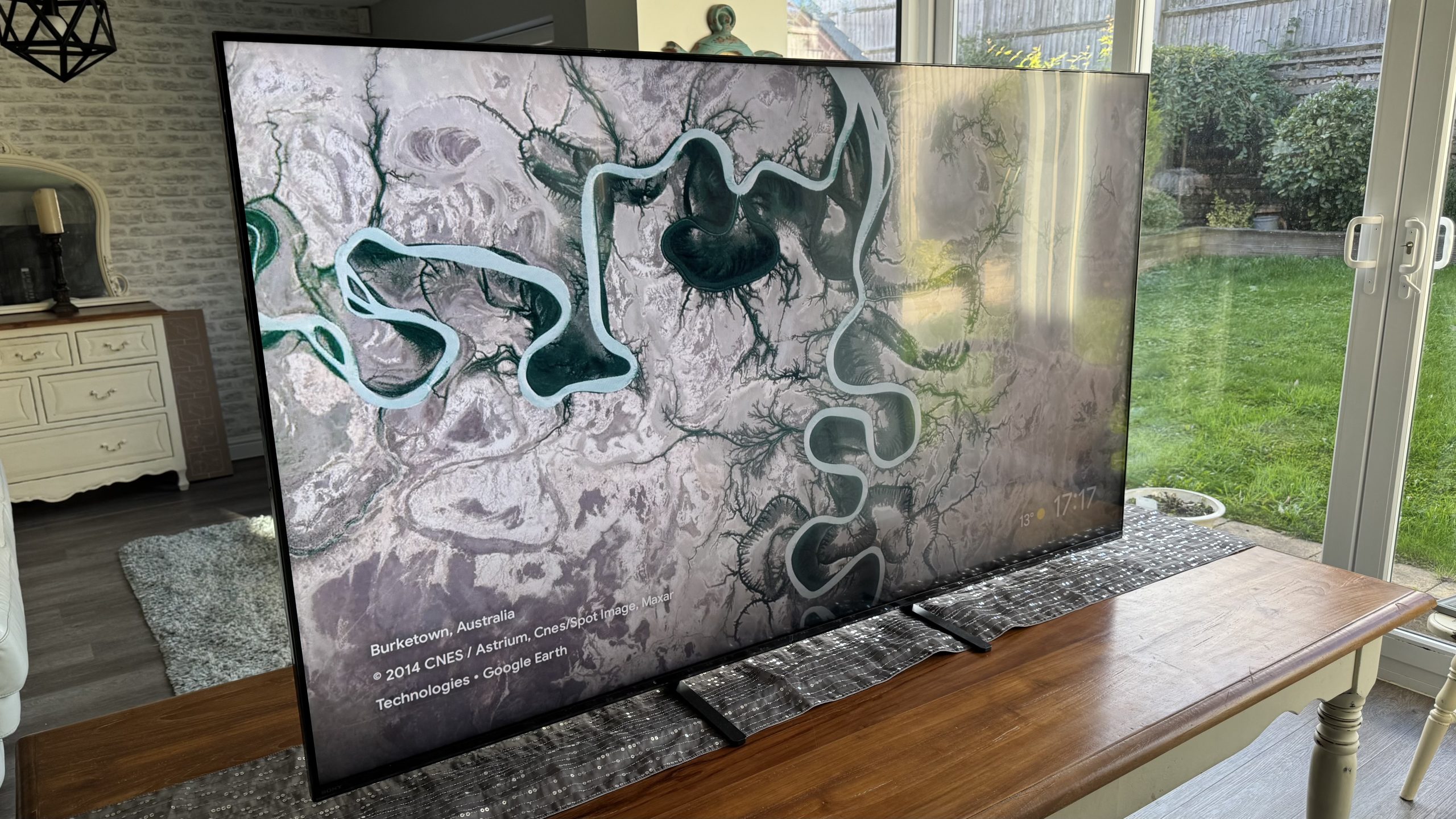
Sony Bravia 5: Two-minute review
The Sony Bravia 5 is a mini-LED TV with crisp images, strong contrast and great gaming features. It occupies that level in Sony’s TV range where the brand has historically struggled to maintain its high standards. The Bravia 5, though, bucks this trend in pretty spectacular fashion.
The Sony Bravia 5 retains both mini-LED lighting and local dimming, for starters, as well as an 120Hz panel to keep gamers happy. Sony says the Bravia 5 LCD panels are still made to the brand’s Master Backlight Drive standard too, and they’re equipped with a full up-to-date version of the Google TV smart system.
There are ‘catches’ to this promising specification, of course. In particular, the Bravia 5 won’t benefit from as many dimming zones as the step up Bravia 7, or achieve so much brightness. In reality, though, the 65-inch Bravia 5 (AKA the K65XR55) delivers much less of a step down from Sony’s mid-range models than expected based on past Sony lines. Pictures are vibrant, crisp, full of contrast and just way less compromised than previous generations of the same level of Sony TV would have been.
Latest Videos FromTechRadar
Add punchy, clean and detailed audio to its surprising picture talents, and the Bravia 5 is the Sony value TV we’ve always wanted.
Sony Bravia 5 review: Price and release date

- Release Date: July 2025
- 55-inch: $1,399.99 / £1,299 / AU$1,999
- 65-inch: $1,499.99 / £1,499 / AU$2,299
- 75-inch: $1,999.99 / £1,799 / AU$2,899
- 85-inch: $2,399.99 / £2,299 / AU$3,899
- 98-inch: $4,999.99 / £4,499 (around AU$8,570)
While the Bravia 5 is affordable by Sony TV standards, $1,499.99 / £1,499 / AU$2,299 is no longer cheap for a 65-inch TV.
The Bravia 5 retains much more of Sony’s mid-range — and even premium — TV DNA than expected based on similarly positioned models in previous Sony ranges, though. As a result, it has at least the potential to take a clear performance edge over more affordable rivals.
Sony Bravia 5 review: Specs
|
Screen type |
Backlight Master Drive VA mini-LED with local dimming |
|
Sizes available |
55, 65, 75, 85 and 98 inches |
|
Refresh rate |
120Hz |
|
Resolution |
4K |
|
HDR support |
Dolby Vision, HDR10, HLG |
|
Audio support |
40W acoustic multi-audio speaker system featuring dual full-range (bass reflex) speakers and two ‘frame’ tweeters; Dolby Atmos and DTS:X decoding |
|
Smart TV |
Google TV (plus all main UK terrestrial broadcaster catch up apps for UK buyers) |
|
HDMI ports |
4 (two full HDMI 2.1) |
Sony Bravia 5 review: Benchmark results
Sony Bravia 5 review: Features

- Mini-LED lighting
- Direct lighting with local dimming
- Bravia XR processor
As I’ve hinted more than once already, the Sony Bravia 5 is packing much more feature heat than I would have expected it to, based on Sony TV ranges of the past.
This is particularly true of the screen hardware at the Bravia 5’s heart. Designated one of Sony’s Master Backlight Drive panels, it is illuminated by mini-LEDs driven by a local dimming system that, according to my own counting efforts, operates across an impressive 240 zones. That’s 240 areas of the image that are capable of receiving their own light level, independent of their neighbors, according to the needs of the image.
The Bravia 5’s panel is a VA type, too, which should further enhance contrast (though maybe not viewing angles). Meanwhile, even this far down Sony’s range, the brand’s consistently impressive XR processor is still on hand to power all the constituent parts of the TV’s pictures. On top of this, rather than dropping down to 50/60Hz, the panel also maintains a native 120Hz refresh rate.
Meanwhile, its support for high dynamic range images extends to Dolby Vision, as well as the more basic HDR10 and HLG formats. Sony is also unusual in the TV world for automatically applying an HDR upgrade to SDR sources on some of its picture presets. There’s no interest from Sony, though, in the HDR10+ format designed as an open-source alternative to Dolby Vision.
The Bravia 5’s connections keep up with its step-up siblings. So you get four HDMIs (though only two support the TV’s full range of gaming features like VRR and ALLM), USB media playback support, and wireless support that includes Wi-Fi, Bluetooth 5.3, built-in Chromecast, Apple Airplay, and Apple HomeKit.

Sony’s TV business has long traded on its ‘from camera to TV’ product chain, and the potential for accuracy that this can bring. So as usual the Bravia 5’s Professional Mode setting, at least, will have been tuned alongside one of Sony’s professional mastering monitors, and the set is equipped with a bunch of so-called Calibrated modes designed to replicate as closely as possible the mastering standards of the Prime Video, Netflix and Sony Pictures Core video streaming services.
Buying a Bravia 5 entitles you to 10 free films and 24 months of access to Sony Pictures Core too, by the way, complete with its unique high-bandwidth streaming speeds for enhanced picture quality.
Further ‘third party’ endorsement finds the Bravia 5 earning an IMAX Enhanced badge, indicating that it has been deemed capable of doing justice to the special noise-limiting mastering processes and potential shifting aspect ratios associated with the IMAX Enhanced system. IMAX Enhanced titles are available on Sony Pictures Core and Disney+.
The Bravia 5’s audio setup is pretty potent by mid-range TV standards. It offers two full range Bass Reflex-design drivers and two separated tweeters getting 10W a piece to deliver both Dolby Atmos and DTS:X soundtracks — the latter even includes the special tweaked version of DTS:X associated with IMAX Enhanced content.
Sony Bravia 5 review: Picture quality
- Impressive brightness and light control
- Bold but also natural colour
- Genuine 4K sharpness and excellent 4K upscaling
The Sony Bravia 5’s image quality instantly changes the fortunes of this level of Sony’s TV range, leaning much more towards the Sony TVs above it than those below.
Particularly great to see is how much contrast the Bravia 5 retains for this level of Sony’s range. Black colors look deep and strikingly consistent, exhibiting minimal issues with backlight blooming around bright objects or general areas of clouding. That’s despite the fact the screen is capable of hitting nearly 900 nit brightness peaks on a 10% HDR window and sustaining an OLED-beating 595 nits with a full 100% HDR window.
Combining Sony’s backlight structure and XR Processor, the Bravia 5 can maintain more intensely bright highlights against dark backdrops than you’d expect for its price tag, despite how limited the clouding around such highlights is. This combination of bright stand-out objects and limited clouding is very difficult to achieve with locally dimmed TVs, yet the Bravia 5 makes it look easy.
Dark scenes look stable, too, in the sense that you never feel aware of the sudden brightness jumps or obvious ‘handovers’ between different dimming zones as bright objects move around a dark backdrop.

Many screens with strong contrast performances are often capable of good color reproduction too — and this trend continues with the Bravia 5. In its Standard preset, it produces strikingly vibrant, rich and bold tones (actually upgraded to HDR if you’re watching an SDR source) that still feel balanced, full of subtlety and nuance, and connected to source tones for the most part. They feel more like amplifications of source content colors rather than aggressive departures from them.
Unfortunately, the Bravia 5 pushes this amplification effect way too far in the Vivid preset, which is best avoided. But the Standard setting is an excellent bright room option, as well as actually being delicate and balanced enough to hold up as a dark room movie night option if your image tastes tend towards the bright and vibrant.
Unlike most other TV brands, Sony doesn’t offer a Filmmaker Mode preset for AV fans who favor ‘as the director intended’ viewing. Its Professional Mode, though, does pretty much the same thing, with an emphasis on trying to match the image as closely as possible to Sony’s professional video mastering monitor.
Using Portrait Display’s Calman Ultimate software, G1 signal generator and C6 HDR5000 colorimeter, the accuracy of the Bravia 5 Professional mode was easy enough to demonstate. Errors recorded in both SDR and HDR across the board came in at well under the 3.0 DeltaE 2000 average beyond which errors might become visible to the human eye.

The Bravia 5’s Professional mode doesn’t just measure well. It also looks subjectively lovely, packed with the subtle texturing, immaculate color balance, and remarkable light control for a lower mid-range LCD TV. The benefits of Sony finally being able to introduce a superior core panel in a TV at the Bravia 5’s level are arguably at their most obvious in the Professional preset, in fact, given that this mode uses relatively few processing tools to help ‘boost’ its appearance.
Inevitably, given it’s far from the most premium TV in Sony’s range, there are a few limitations to the Bravia 5’s picture performance. Dark scenes in the Professional mode look a little grayer than they do in Standard mode, and backlight blooming around bright objects can become more noticeable if you view the TV from an angle. Strangely, certain shades of red can look a bit over-ripe during dark scenes, and some dark shots also take on a slightly green undertone.
Finally, some of Sony’s preset choices don’t actually help the Bravia 5’s pictures at all. Motion processing only really helps 24p movie sources if it’s switched to its True Cinema mode, for instance, with other settings tending to generate unwanted digital side effects or leave the image looking unnaturally smooth. I’d also recommend turning off the noise reduction features, especially with native 4K sources, to ensure the screen’s impressive native sharpness isn’t unnecessarily softened away.
The Bravia 5’s issues are mild enough or easy enough to fix, though, that they don’t stop it from being an all-round excellent picture performer for its money.
- Picture quality score: 4.5 / 5
Sony Bravia 5 review: Sound quality

- Impressive clarity and detailing
- Sound doesn’t suffer with distortions
- Bass is a bit lightweight
The Bravia 5’s sound joins its pictures in being impressively expressive and clean, working within the speaker’s limitations rather than pushing things beyond their breaking point as so many integrated TV sound systems are wont to do.
Even the brightest, shrillest treble sounds are produced without sounding thin or brittle, while the mid-range is clean and pretty expansive, able to cope with the ebbs and flows of even quite dense action scenes without sounding forced, muddy or compressed.
It uses its four-speaker system well to create a fairly large soundstage, too — one that’s well populated with accurately placed, crisp but never overstated details.
My only complaint is that the Bravia 5 feels a bit light in the bass department. Dinosaur footprints, rumbling space ships, meaty explosions and the like don’t hit with quite as much heft as I’d like. At the same time, though, not even Hollywood’s most extreme bass moments cause the Bravia 5’s speakers to succumb to distracting crackles or distortions.
- Sound quality score: 4 / 5
Sony Bravia 5 review: Design

- Multi-point foot attachment
- Recycled plastic remote control
- Minimal frame
The Bravia 5’s design doesn’t feel like much of a step-down at all from Sony’s Bravia 7 series. Its screen frame is extremely narrow, distracting scarcely at all from the pictures within, and it also stays fairly trim around the back for a lower mid-range LCD TV.
Its feet look a little basic when attached to such an elegantly minimalistic screen, perhaps. But Sony has thoughtfully provided the option to attach them either quite close together or out towards the TV’s bottom corners, depending on the width of the furniture you want to stand the TV on.
Build quality is good, too, and despite its relatively affordable position in Sony’s current TV range, it ships with two remote controls. The sleeker, more modern and more feature-rich handset is made largely made from recycled plastic, as part of Sony’s wide-ranging attempts to make the TV production process greener.
Sony Bravia 5 review: Smart TV & menus

- Google TV smart system
- YouView for full UK app coverage
- Optional Bravia Cam
The Sony Bravia 5 runs the latest Google TV system very well, avoiding the sluggishness the system sometimes causes on less powerful TVs. Google TV carries pretty much all of the most popular and important video streaming services, and Sony has helpfully worked round Google TV’s blind spot when it comes to some of the UK’s most popular terrestrial broadcaster catch up services by adding the YouView app.
Google TV can still feel a little overwhelming in its presentation and doesn’t feel as intelligent as some rival smart systems when it comes to recommending content based on your viewing habits. The smarter of the two remote controls Sony provides, though, makes navigation of the menus feel straightforward. On top of this, you can access a good range of features and issue quite complex search instructions just by talking to the Bravia 5 via the Google Assistant voice recognition system.
You can even add basic gesture control features to the Bravia 5 if you cough up £200 for one of Sony’s Bravia Cam accessories. This add-on camera can also detect your location in the room and adjust the TV’s picture and sound settings accordingly, as well as issuing audio warnings if it detects anyone getting too close to the screen. I’m not personally convinced Bravia CAM does enough to justify its price, but if the features I’ve just described sound good to you, then fill your boots!
- Smart TV & menus score: 4.5 / 5
Sony Bravia 5 review: Gaming

- 4K/120Hz support
- VRR support
- Perfect For PlayStation 5 support
The Sony Bravia 5 is fairly, rather than brilliantly, well specified as a gaming display. For instance, while it does support 4K game feeds at 120Hz refresh rates, it only does so over two of its HDMIs, rather than all four. It also doesn’t stretch the refresh rate support to 144Hz or even 165Hz, like some rival TVs currently do.
Similarly, while the Bravia 5 supports variable refresh rates, that support doesn’t extend to the AMD Freesync or Nvidia G-Sync systems. There is support for auto low latency mode switching, though, so the TV can automatically switch into its fastest responding picture mode when a game source is detected. While in this mode, the Bravia 5 takes just 13.3ms to render 60Hz gaming feeds.
There’s support, too, for Sony’s unique Perfect For PlayStation 5 features, comprising a PS5-specific version of automatic game mode switching, and an excellent system where a connected PS5 is able to tell which Sony TV model it’s attached to, and automatically optimize its HDR output accordingly.
You can also call up a dedicated gaming menu when the Bravia 5 is in Game mode, containing information on the game feed and a few helpful gaming assistants. Finally, the actual gaming experience when using one of the two wide-bandwidth HDMIs is very enjoyable. The TV’s vibrant, exceptionally sharp and contrast-rich pictures provide a perfect fit for today’s usually HDR and 4K graphics, while the rapid response time and VRR support means gaming never feels sluggish or laggy.

Sony Bravia 5 review: Value
Not so long ago, spending $1,499.99 / £1,499 / AU$2,299 to get a 65-inch TV as good and feature rich as the Sony Bravia 5 would have felt like a great deal. Recently, though, TCL in particular has drastically shifted the TV value ‘window’, with its bright, vibrant and gaming-friendly 65-inch C7K currently going for just £779.
The Bravia 5 does offer more precision and balance in its pictures than the TCL C7K, but the price gap is big enough to mean you may feel like holding out for a special offer on Sony’s model, or searching beyond the most popular electronics retailers for a better deal.
Should I buy the Sony Bravia 5?
|
Attributes |
Notes |
Rating |
|---|---|---|
|
Features |
Aside from a few gaming limitations, the Bravia 5 is well featured for its money. |
4.5 / 5 |
|
Picture quality |
Vibrant, bright, sharp and contrast rich pictures reveal the presence of more excellent Sony backlighting and video processing systems. |
4.5 / 5 |
|
Sound quality |
While bass heads might wish for a bit more low frequency impact, the Bravia 5’s sound is clean, punchy, detailed and unusually well staged. |
4 / 5 |
|
Design |
With its choice of foot position, elegantly minimalist frame, slender frame and strong build quality, the Bravia 5 looks premium enough to match its price. |
4 / 5 |
|
Smart TV and menus |
Google TV runs stably and reasonably slickly on the Bravia 5, making it easy to access the huge array of content options it offers. The set up menus are well organised and graphically rich, too. |
4.5 / 5 |
|
Gaming |
Only two HDMIs support the Bravia 5’s full array of gaming features, and those features don’t include absolutely everything some rivals offer. However, the exclusive to Sony TVs Auto HDR ‘Perfect For PlayStation 5’ feature is excellent, and the screen feels responsive and immersive. |
4 / 5 |
|
Value |
While the Bravia 5 is well priced for a Sony TV that performs as well as this one, competition at this price level is brutal these days. |
3.5 / 5 |
Buy it if…
Don’t buy it if…
Sony Bravia 5 review: also consider
| Header Cell – Column 0 |
Sony Bravia 5 |
TCL C7K |
LG C5 |
Samsung QN90F |
|---|---|---|---|---|
|
Price (65-inch) |
$1,499.99 / £1,499 / AU$2,299 |
$899.99 / £779 / AU$2,295 |
$1,399.99 / £1,599 / AU$2,699.99 |
$1,599.99 / £1,399 / AU$2,899 |
|
Screen type |
Backlight Master Drive VA mini-LED with local dimming |
Mini-LED with local dimming |
WRGB OLED |
Mini-LED with local dimming |
|
Refresh rate |
120Hz 4K |
144Hz (up to 288Hz at lower resolution) |
144Hz |
120Hz (up to 165Hz with Motion Xcelerator technology) |
|
HDR support |
HDR10, HLG, Dolby Vision |
Dolby Vision, HDR10, HLG |
Dolby Vision, HDR10, HLG |
HDR10, HDR10+, HLG |
|
Smart TV |
Google TV (plus all main UK terrestrial broadcaster catch up apps for UK buyers) |
Google TV with YouView |
WebOS 25 |
Tizen OS |
|
HDMI ports |
4 (two full HDMI 2.1) |
4 (two HDMI 2.1) |
4 x HDMI 2.1 |
4 x HDMI 2.1 |
How I tested the Sony Bravia 5
- Tested over three weeks
- Tested with 4K Blu-rays, multiple streaming platforms and resolutions, Freeview HD broadcasts, and HD Blu-rays
- Reviewed in both dark and light dedicated test room conditions, on its feet in both corner and mid wall positions
I tested the Sony Bravia 5 over a three-week period in a variety of room conditions — including using it as a regular living room TV for more than a week.
I checked out streamed content at a variety of resolutions from all of the main video streaming platforms, including Sony’s exclusive Sony Pictures Core high-bandwidth services. I also watched tuner channels and fed it a selection of our regularly used test Blu-rays and 4K Blu-ray discs. Gaming was explored using a PlayStation 5, an Xbox Series X and a gaming PC.
Objective testing was performed using Portrait Displays’ Calman Ultimate analysis software, G1 signal generator, and C6 HDR5000 light meter.



























































You must be logged in to post a comment Login