
TL;DR
Trustpilot partnered with Shopify to embed reviews in merchant stores as AI search click-throughs surged 1,490 percent in FY25.



IBM spent a decade “building, testing and improving” quantum computing, reports the Wall Street Journal.
“This year, the company is laying the groundwork to turn that technology into a fully-fledged, scalable business from an expensive science project.”
IBM said last month it plans to form a new independent subsidiary called Anderon, a foundry to produce the silicon wafers needed to make quantum-computing processors. The venture is seeded by a $1 billion investment from the Trump administration and another $1 billion of IBM’s own cash.
Anderon will give the company a new line of business in selling wafers to other quantum-computing companies. It will also provide a steady stream of wafers to continue developing its own quantum technology, positioning IBM to capture part of what the Boston Consulting Group projects will be a $90 billion to $170 billion market for quantum-computing providers by 2040…
The company also plans to spend an additional $9 billion over five years to advance the final stages of its quest to build a quantum-mechanics-powered computer capable and reliable enough for widespread use, a goal known as fault tolerance. That computer, named Starling, is being targeted for 2029. With Anderon, IBM is thinking beyond Starling, or even a more powerful quantum computer planned for 2033.

Trustpilot partnered with Shopify to embed reviews in merchant stores as AI search click-throughs surged 1,490 percent in FY25.
Trustpilot has struck a partnership with Shopify that will let the platform’s merchants display and manage Trustpilot reviews directly inside their online stores. The integration goes live on June 29 and is the Danish review company’s first native tie-up with a major ecommerce platform. Financial terms were not disclosed.
The deal arrives at a moment when AI is rewriting how shoppers discover products. Trustpilot said click-throughs from AI-powered search engines rose 1,490 percent during its most recent financial year, which ended in March. A study by analytics firm Promptwatch ranked Trustpilot as the fifth most-cited domain globally on ChatGPT, behind only Wikipedia, YouTube, Reddit, and LinkedIn.
That surge is what makes the Shopify tie-up more than a distribution deal. As AI assistants start recommending products and handling purchases on a shopper’s behalf, the data those assistants rely on to form an opinion becomes critical infrastructure. Trustpilot’s argument is that verified human reviews are the trust layer AI needs to make good recommendations.

The 💜 of EU tech
The latest rumblings from the EU tech scene, a story from our wise ol’ founder Boris, and some questionable AI art. It’s free, every week, in your inbox. Sign up now!
“The rise of AI is transforming how consumers discover, evaluate and purchase products,” CEO Adrian Blair said. “Shopify merchants will now be able to build trust with customers at the point of decision.”
The partnership is not exclusive. Trustpilot said in March that it was pursuing integrations across banking, insurance, utilities, and other ecommerce platforms. The Shopify deal is the first to be announced, and the company has framed it as a template for what comes next.
Shopify merchants have long been able to display third-party reviews through apps, but native integrations carry more weight with both AI engines that scan product pages and with shoppers who are learning to distrust unverified ratings. A Recomaze study earlier this month found that AI assistants ignored 60 percent of online stores entirely, often because the product data was not structured in a way the engine could read.
The timing also reflects a broader anxiety about review integrity. AI-generated fake reviews have become a growing concern across the industry, and Trustpilot has positioned its verification systems as a defence against them. The company reported removing more than four million fake reviews in its last fiscal year, using its own machine-learning detection tools.
Trustpilot’s shares have climbed sharply this year on the back of its AI-search tailwind, with Bloomberg reporting a 46 percent gain year-to-date. The company reported $16 million in operating profit for FY25, its first full year in the black after years of losses. Revenue grew 19 percent to $211 million.
Whether the AI-search boom is durable remains an open question. The 1,490 percent click-through increase is measured from a small base, and the company has not disclosed what share of its total traffic now comes from AI engines. What is clear is that Trustpilot is betting its next phase of growth on being the source AI turns to when it needs to know whether a product or a merchant can be trusted.


Matthew Trahan has turned his workshop into a testing ground for unusual ideas. Past projects included full-size musical instruments, bedroom furniture, and even a life-size copy of himself. Each build pushed what desktop machines could handle. His newest effort went further still. He set out to create every single piece of clothing he would wear, starting from rolls of plastic filament and ending with something he could actually put on.
At first, the notion appeared to be as simple as checking off a list: make a shirt, shorts, shoes, socks, hat, belt, wallet, bow tie, glasses, watch, and bag without ever going to a store or cutting any fabric. Most of the files for the pieces were available online from public model sites, but before the printer began laying down the first layer, the owner spent 33 hours fine-tuning the drawings on his computer to meet his measurements. The actual job began with printing, which took weeks. His trusty Prusa Core 1L handled the larger portions, such as the shorts. Smaller printers took care of the rest. The overall print time came to 560 hours, which included a lot of waiting about. The project used more than 8,000 grams of filament. That’s about 8 kg, and the filament used was as different as the products themselves. Flexible TPU was employed for shoes, socks, and hats because, well, you need material that bends and cushions in a foot-related application. Stiffer PLA and PETG were utilized for the outfit’s more structural components, such as the shirt and shorts. As for the cost, it came out to a nice figure of $25 to $30, but don’t forget to factor in the cost of the printers themselves, which was not included.
Sale

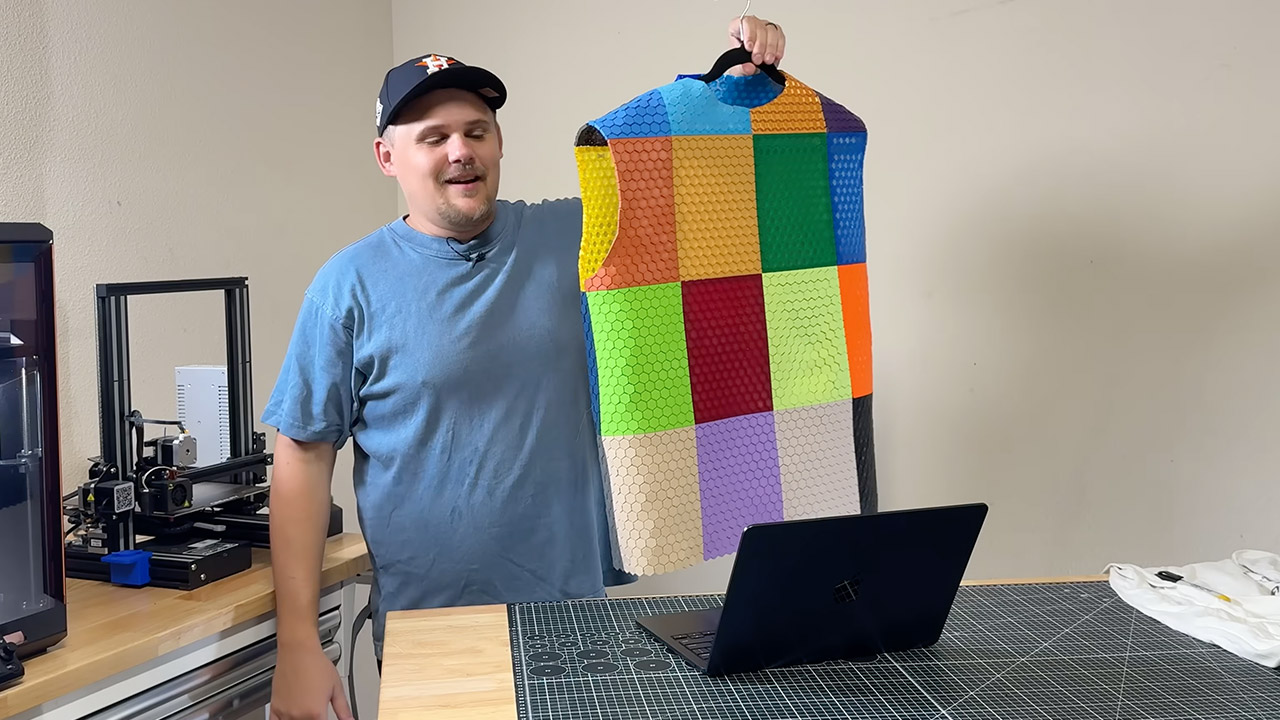
The shirt was the true highlight of the outfit, with interlocking hexagonal shapes giving it a distinct look and feel. Small gaps and flexible connectors allowed for some give, and magnets were utilized to hold the modular portions together. Finally, everything was put together! You get a stiff-looking garment that really retains its shape, giving it the appearance of costume armor rather than something you’d wear on a daily basis. The sleeves proved to be a bit of a problem, and the general fit was a little loose in some spots and tight in others.
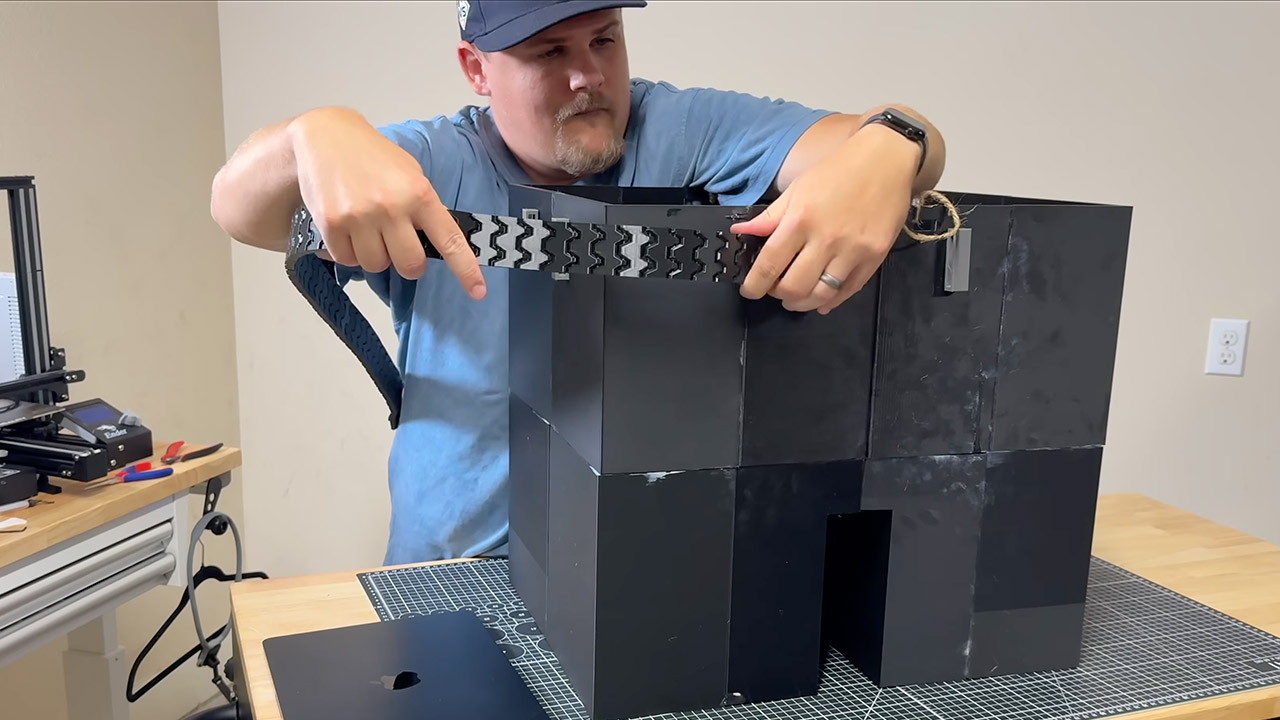
The shorts, while a little big and boxy, had a Minecraft-likeness about them that made you look twice. Belt loops and suspender holes provided several alternatives for securing them, but let’s be honest: the wide cut and firm plastic made them difficult to wear in practice. Still, the extra room inside had one redeeming feature: storage space, and while they looked cool, they did require some suspenders to keep them up.
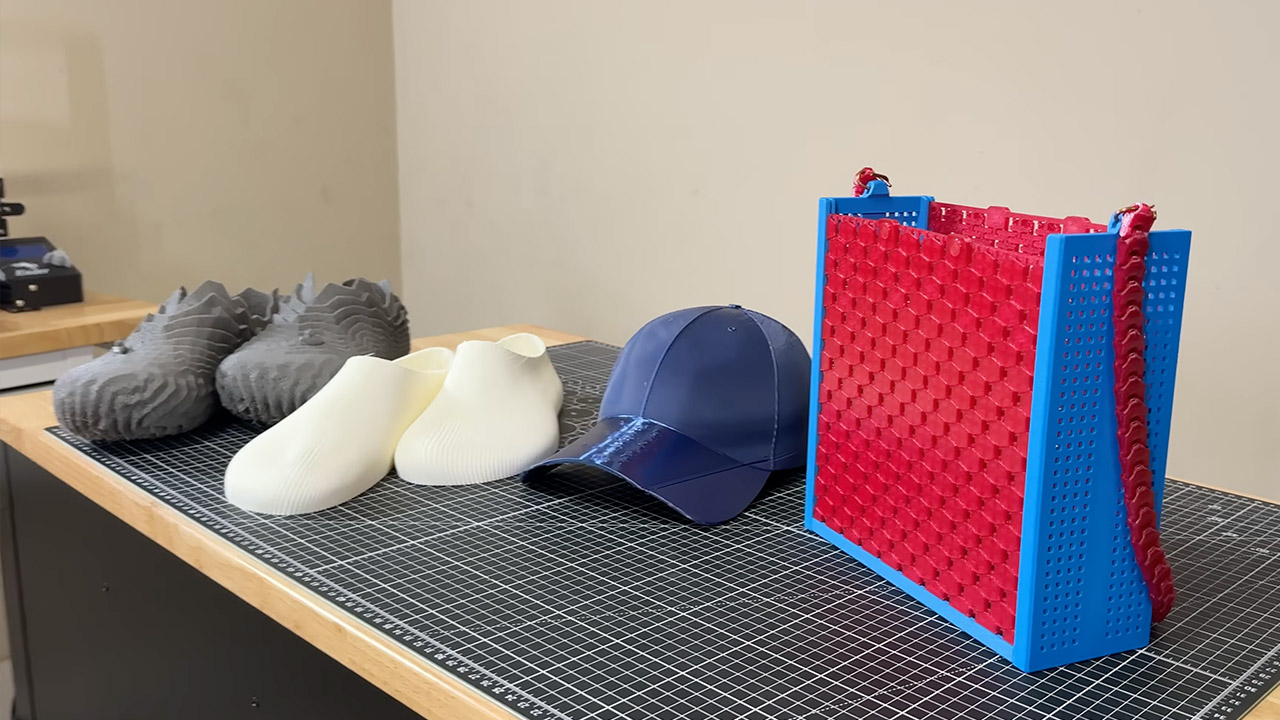
Shoes and socks, on the other hand, were completely unexpected, since the soft, spongy TPU utilized in the shoes resulted in a sort of barefoot shoe that worked out rather nicely. The socks, which were made of the same flexible material, felt bouncy to the touch instead of abrasive. Trahan tested the entire costume, laced everything up tight, and ran a mile in 8 minutes and 20 seconds. His feet did protest a little at the end, but credit to the shoes for holding up well and providing enough protection to complete the task.

Compared to the main outfit, the accessories were a breeze. The hat fit slightly larger than normal without requiring much tweaking. The belt, wallet, bow tie, and watch all performed their basic functions without difficulty. Glasses, on the other hand, looked great at first but quickly started to rub on the ears. Overall, these were the easier parts, as none of them required as much sacrifice as the major garments. When everything was put together, the overall look was unlike anything you’d find in a store, as the colors on the shirt stood out, the shorts dominated the lower half with their sheer size, the soft shoes and socks kept the feet happy for a while, and the upper body was a little restricted due to all the stiff sections.
[Source]
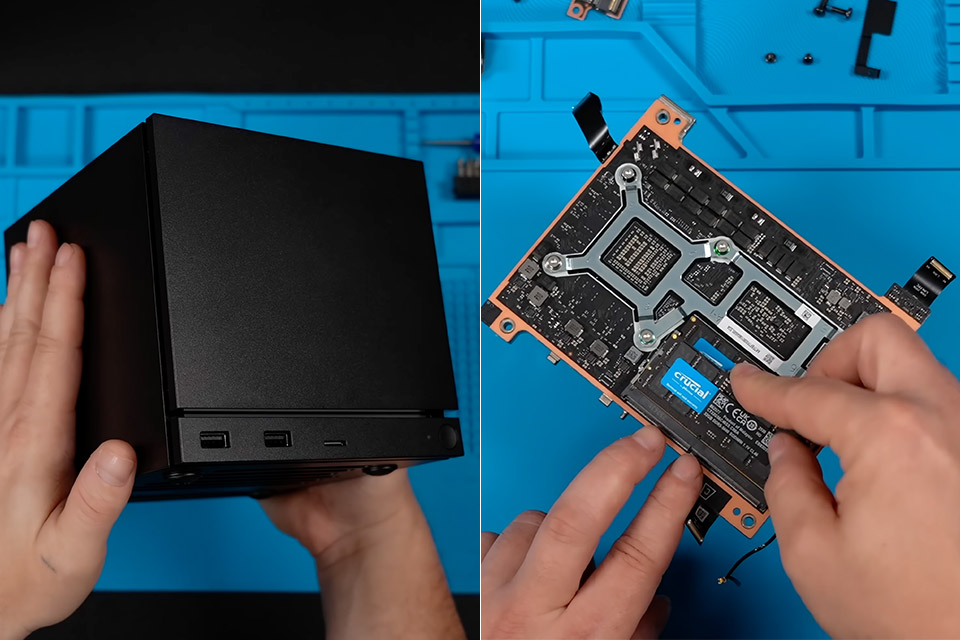
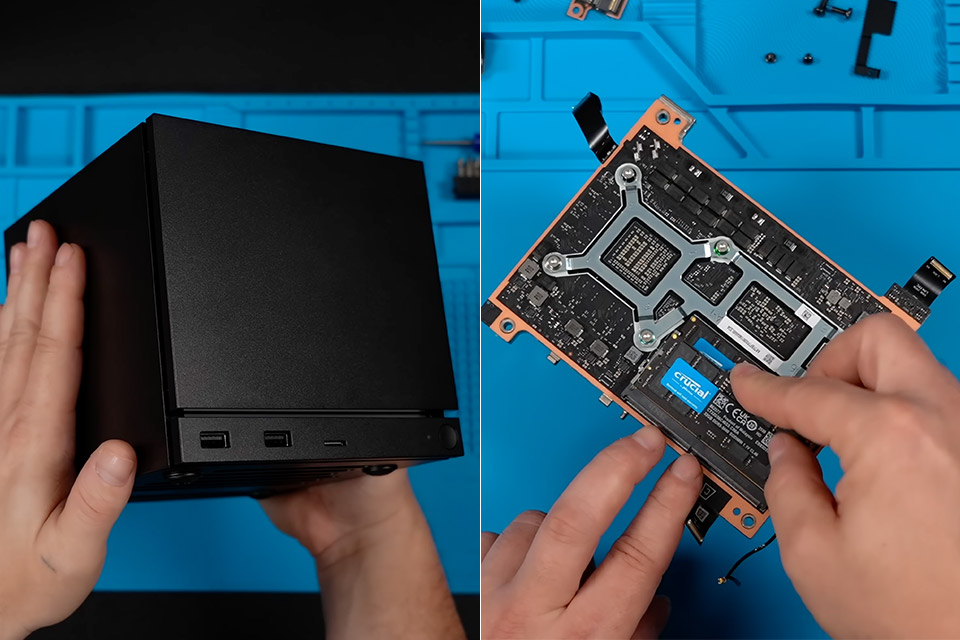
Valve just released Steam Machine, a compact computer designed to run SteamOS in living room settings. It arrives as a small black cube with ports along the base and a simple power button. The package includes a matching controller and targets people who want console convenience without giving up access to a full game library. A popular YouTuber who focuses on hardware decided to explore what sits inside one of these units. ETA Prime bought the 2TB version and set out to document every step of opening it while also pushing the specifications higher.
The outer casing is made of plastic, with a metal-reinforced rear part for added strength. A few screws hold the whole contraption together, with two in the rear and four more buried in the rubber feet. To detach the faceplate, press firmly down with a plastic spudger along the front edge, taking care not to yank it off with brutal force. Inside the case, a large cooling system takes center stage; copper pipes and thick aluminum fins do an excellent job of keeping the processor and graphics chip cool, and a custom fan is hidden in its own small shroud. The motherboard is wedged between the cooling block and the power supply, explaining why it appears tight at first glance.
Sale

Getting to the memory is a little difficult because you have to detach the antenna cables for the wireless features and remove a few screws from the small boards near the ports before sliding the whole internal assembly out. The heatsink assembly is removed using four screws, however there is no need to reapply thermal paste because the contact surfaces remain intact throughout the process. One memory stick was already installed and running in single channel mode, but ETA Prime removed it and replaced it with a matched pair of 32GB Crucial modules. They match the original speed rating exactly, and with both modules installed, the system now claims 64GB of memory, with approximately 62GB accessible for use. When the second stick is inserted, dual channel operation is instantly enabled.
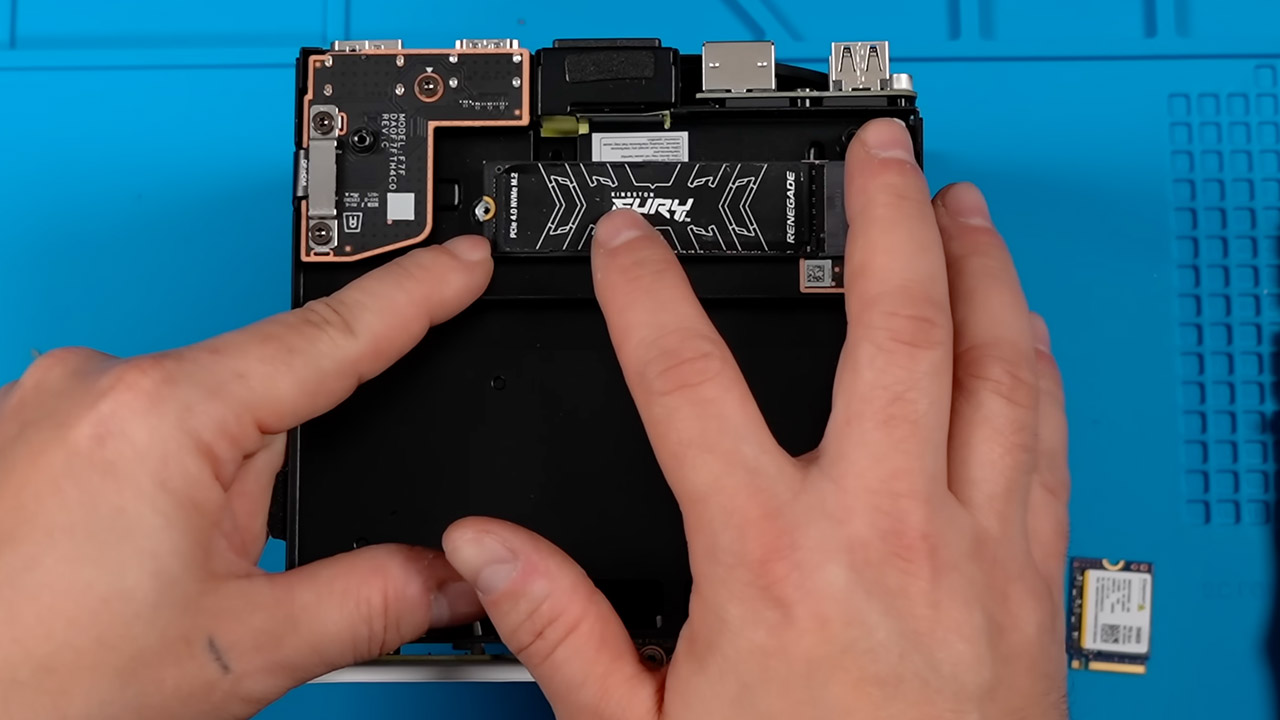
To be honest, storage access is straightforward because you only need to remove one panel on the side to see the drive region. The OEM device featured a smaller 2230 size M.2 solid state drive attached via an adapter and ribbon cable, however there was just enough room in the chassis for a full size 2280 drive, thus no modifications were necessary. A 4TB Kingston Fury Renegade drive replaced the original, and the read and write speeds are far quicker than before. To avoid having to reinstall the operating system, the previous disk was cloned onto the new one with free software on a different computer, which proceeded smoothly. After installation, the bigger drive exhibited its full capacity.
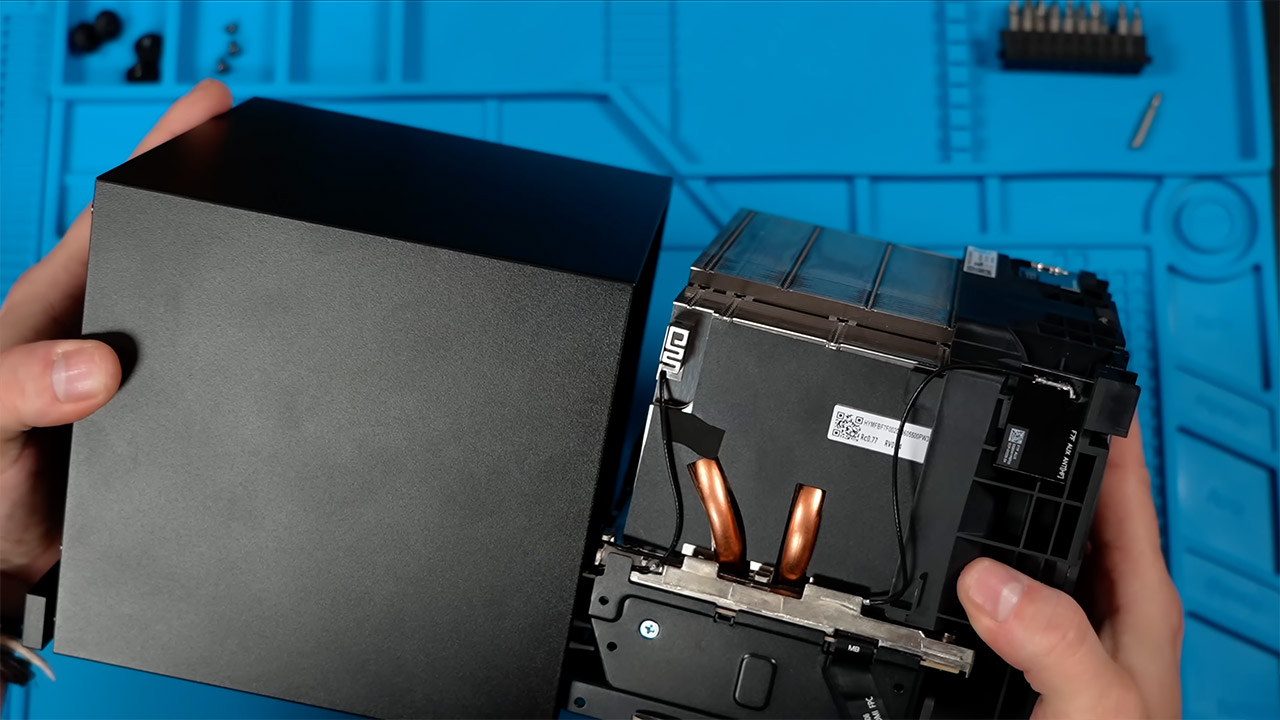
Reassembly is simple and gets everything back up and running quickly. You reattach the cables in the opposite sequence, screw everything back in place, and the outer case clicks into its groove. The computer booted into SteamOS without any warnings or missing hardware messages. The system information appears immediately, including the total memory quantity and the new storage size, with little fuss. Gameplay tests revealed that it continues to play as smoothly as possible, with occasional slight frame rate increases. For instance, the graphics chip only has 8GB of video RAM, thus adding system memory will make little impact in more demanding titles. Nonetheless, the dual channel RAM and increased storage facilitate multitasking and allow you to save a big number of games on the laptop without the use of external media.

However, the hardware required for the improvements is somewhat expensive, with the new memory kit costing around $820 and the new solid state drive costing nearly $1,000. Then you have to factor in the initial purchase price to get to around $3,247 for the full setup. Some believe that 64GB of RAM is too much for this system, but it’s comforting to know that Valve left the design open to a number of upgrades in important areas. Storage upgrades are easy and require little specialized tools.
[Source]
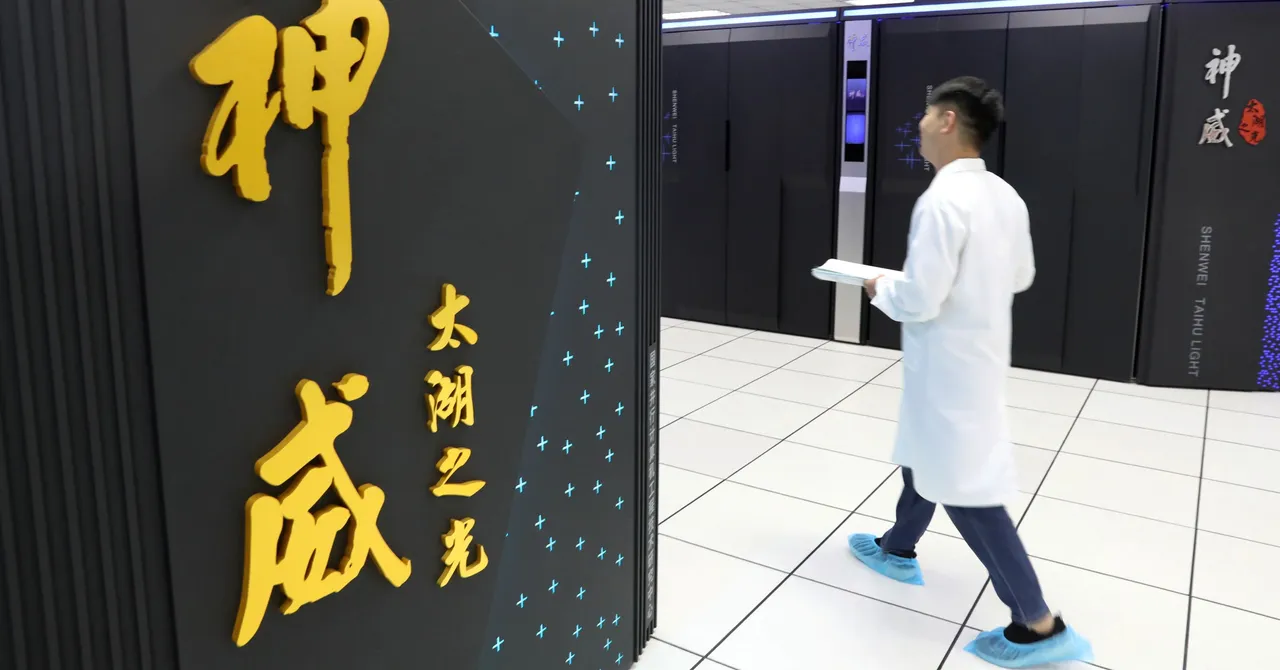
China now has the world’s fastest supercomputer, overtaking the United States. The system, known as LineShine and installed at the National Supercomputing Center in Shenzhen, displaced the US system El Capitan from the top spot in the TOP500 ranking in terms of computing power.
The breakthrough comes amid an intense competition between Beijing and Washington for technological supremacy, marked by high tariffs and restrictions on a wide range of hardware components and software.
Since 1993, the TOP500 ranking has identified the world’s most powerful supercomputers every six months through a series of standardized benchmarks that evaluate each system’s performance, taking into account both its theoretical speed and its real-world performance, as well as its energy efficiency.
Historically, the ranking has been dominated by US-developed systems. However, LineShine has returned China to the top after nearly a decade out of first place.
El Capitan, located in Livermore, California, had held the top position since 2024. Now, benchmark results have confirmed that LineShine exceeds the US system’s processing capacity by more than 20 percent.
With a power consumption of approximately 42.2 megawatts, the Chinese supercomputer delivers 2,198 exaflops, meaning it can perform more than 2 quintillion operations per second.
One of LineShine’s most striking features is that, unlike most next-generation supercomputers, it does not use graphics processing units (GPUs). Instead, it relies exclusively on central processing units (CPUs), components widely used in smartphones, desktop computers, and laptops but rarely found in large-scale scientific computing systems.
Another notable feature is that its entire infrastructure is built with hardware and software developed in China. LineShine’s architecture is based on the LingKun platform and consists of roughly 45,000 LX2 processors. Each processor has 304 cores and operates at a clock speed of 1.55 GHz.
The nodes are connected through a high-speed network called LingQi, designed to minimize latency and accelerate data exchange. The entire system runs on Kylin OS, a Linux-based operating system widely used in China’s scientific and government computing infrastructure.
China’s return to the top of the TOP500 ranking has been interpreted as an achievement that goes beyond simply possessing the world’s fastest supercomputer, as the country is eager to show the world its tech industry can thrive despite lacking access to key US technologies.
During Donald Trump’s first administration and throughout Joe Biden’s presidency, the United States imposed strict export controls on components, software, and platforms related to advanced computing in an effort to slow China’s technological progress. In response, Beijing adopted similar measures.
Those restrictions have intensified during Trump’s current administration, particularly through tariffs and limits on imports of GPUs, advanced chips, and other components related to artificial intelligence (AI), a technology that now underpins a significant share of the world’s most powerful supercomputers.
These restrictions have forced China to invest in developing new architectures and technologies capable of building supercomputers that can compete with the highest-performing US systems despite lacking access to certain state-of-the-art resources.
This story originally appeared in WIRED en Español and has been translated from Spanish.

The best Apple Watch overall has every feature you could want in a smartwatch (aside from satellite messaging, but I presume that isn’t a dealbreaker for most of you). There’s blood oxygen sensing, sleep tracking, electrocardiogram reading capabilities, and high blood pressure notifications. Best of all, the battery lasts for a full 24 hours, and it’ll get watchOS 27. And at $279, it’s the cheapest it’s been sold out for the past few months.
This is the best-value Apple Watch. It’s compatible with the latest watchOS and has several basic fitness features, though it lacks the extended battery life and some of the more high-tech tracking capabilities of the more-expensive Watch 11. But if you don’t need blood oxygen or ECG readings, and you don’t need a super-bright display, this affordable smartwatch is a smart buy. And now’s a good time to buy, as it’s $20 cheaper than it’s typically sold out, even when on sale.

Photograph: Julian Chokkattu
Not everyone needs a stylus to work with the iPad, but for artists or avid notetakers, there’s no better option than the Apple Pencil Pro. It supports all sorts of gestures and magnetically attaches, pairs and charges.

Jack Nekhala had a business selling on Amazon — and in December he received an unusual offer, reports Bloomberg. A woman said she could bribe an Amazon employee “to help him retrieve $90,000 in funds that the e-commerce giant had frozen after suspending him over an alleged violation of review policy.”
Hoping to ingratiate himself with the company and restart his business, Nekhala offered to provide evidence, including recorded conversations and screen shots, that he said proved Amazon personnel were peddling inside information and influence. The smoking gun, Nekhala told the representative: information about his seller account. Only certain Amazon employees are supposed to have access to such details, but Nekhala had received them from the woman on WeChat, the Chinese messaging app. Nekhala’s experience, which he documented and shared with Bloomberg, provides a rare glimpse into an international black market that has been a persistent scourge of Amazon’s online store. On one side are sellers looking for a variety of favors: a competitive edge over their rivals, information on how to boost sales, a way to get themselves unsuspended. On the other are middlemen who lurk on message apps like Telegram, WeChat and WhatsApp offering access to people inside Amazon who can get things done for a price…
It’s impossible to determine the scope of the illicit activity, but it’s an open secret among Amazon sellers and consultants, who are frequently approached on social-media platforms and messaging apps. “The message is always the same: ‘I’m going to show you screenshots to prove I have inside access,’” said Chris McCabe, a former Amazon employee who runs a seller consulting firm… In 2020, federal prosecutors exposed an international bribery scheme involving Amazon sellers and employees. The ring allegedly extracted about $100 million in unfair advantages by bribing Amazon employees in Asia to help them sell more products and sabotage their competitors. Five people in the US were convicted and received jail terms or probation. Last year, law enforcement officials in India began investigating more than 20 former Amazon employees suspected of accepting bribes from trucking companies in exchange for routes, according to The Times of India.
After Nekhala reported his own experience to Amazon, the representative committed to “do some digging” and to email him instructions on how his evidence could be shared, according to a recording of the conversation. But Nekhala said he never heard back. The employee who leaked his personal information had already been fired for unrelated misconduct, according to Amazon.
Amazon told Bloomberg employee involvement was “very rare,” and that “We invest heavily in this area and have dedicated teams and systems in place to prevent all types of fraud, including by our own employees.”


OpenAI hired former Uber India president Prabhjeet Singh as its first India managing director, starting September.
OpenAI has appointed Prabhjeet Singh, the outgoing president of Uber India and South Asia, as its first managing director for India. Singh will join in September and report to Kiran Mani, the company’s managing director for Asia Pacific, OpenAI told TechCrunch. He will oversee consumer growth, enterprise adoption, partnerships, regulatory engagement, and operations in what OpenAI has called its second-largest market after the United States.
Singh spent nearly 11 years at Uber, joining in August 2015 as head of strategy before becoming president in June 2020. Before Uber he was an associate partner at McKinsey, where he advised clients across financial services, telecom, and consumer technology. He is an alumnus of IIT Kharagpur and IIM Ahmedabad.
The hire is the latest in a string of investments OpenAI has made in India over the past year. The company opened its first office in New Delhi last August and said earlier this year it would establish additional offices in Mumbai and Bengaluru. In 2024 it hired former Truecaller and Meta executive Pragya Misra to lead public policy and partnerships, a role later expanded to head of strategy and global affairs.
OpenAI had also brought on former Twitter India head Rishi Jaitly as a senior adviser to help shape its engagement with the Indian government on AI policy. Mani himself, a former JioStar CEO who previously spent 13 years at Google, was appointed to lead the Asia Pacific region in March.
India’s importance to OpenAI is backed by numbers. CEO Sam Altman said in February that the country has 100 million weekly active ChatGPT users, and that users aged 18 to 24 account for nearly half of all messages sent from India. The company has since struck partnerships spanning higher education, enterprise payments with Pine Labs, web streaming with Reliance’s JioHotStar, and data centre capacity with Tata Group.
The appointment also arrives as India’s AI landscape grows more contested. Rival Anthropic opened its Bengaluru office in late 2025 and in January named former Microsoft India managing director Irina Ghose to lead the country. Google, Amazon, and domestic contenders like Sarvam, which reached unicorn status with a $234 million round last month, are all competing for developers and enterprise customers in a market with more than a billion internet users.
The competitive pressure has a geopolitical edge. The US government’s order in June to suspend Anthropic’s most powerful models for non-US users triggered a sovereignty debate in India and concrete proposals for a $5 billion annual fund to build domestic AI capabilities. For OpenAI, putting a seasoned local operator in charge signals that it takes the risk of being seen as a foreign dependency seriously.
Singh inherits a mandate that is as much political as commercial. India’s government has embraced AI as a national priority, with Prime Minister Narendra Modi hosting OpenAI, Anthropic, and Google chiefs at the AI Impact Summit in February. But the Anthropic suspension showed how quickly access can be revoked, and Indian policymakers are now weighing how much to rely on American providers.
OpenAI has simultaneously ramped up hiring in India, with open roles including AI deployment engineers, developer experience engineers, a developer marketing lead, a partner director, and solutions engineers. Uber has not yet announced a successor for Singh but is expected to outline its leadership transition plans in the coming weeks.

Algeria vs Austria is shaping up to be one of the more exciting World Cup 2026 matches – it’s a winner-takes-all contest to finish Group J runners-up. Both sides are on three points, but Austria’s superior goal difference means a draw is enough for them to finish second.
There’s narrative here, too. As Group J wraps up last, the teams will know before kick-off whether the side that finishes runners-up or third have the easier last-32 opponent. Algeria may even choose to play for a draw, and third spot, and that’s irony at its best.
In 1982, the North Africans were eliminated after West Germany beat Austria 1-0 in the only result that could send both European sides through at their expense. The match became known as the “Disgrace of Gijon”, with Algeria feeling cheated at the alleged collusion. Forty-four years later, will Algeria settle for a self-serving draw? Or do they play to win and get revenge over Austria in the teams’ first meeting since Gijon?
Vladimir Petkovic will be without star striker Mohamed Amoura, who picked up a hamstring injury against Argentina. Austria, meanwhile, are expected to reshuffle their attack, with Marko Arnautovic likely to return to the starting XI.
So, read on as we show you exactly how to watch Algeria vs Austria for free from anywhere in the FIFA World Cup 2026.
Algeria XI: Benbot; Belghali, Mandi, Bensebaini, Hadjam; Aouar, Bentaleb, Maza; Mahrez, Gouiri, Chaibi
Austria XI: Schlager; Mwene, Alaba, Lienhart, Posch; Schlager, Seiwald; Sabitzer, Laimer, Schmid; Arnautovic
Algeria vs Austria is available to watch for free in multiple countries, including the UK, Australia, Brazil, Belgium, Ireland, Netherlands, Switzerland and Turkey.
Abroad? Can’t access your free stream? Unblock your free World Cup stream with Norton VPN – more on that below.
It’s the World Cup, and if you’re traveling, you might discover your usual Algeria vs Austria stream is suddenly unavailable due to geo-restrictions.
Don’t worry, that’s exactly where a VPN can help. A virtual private network lets you connect to servers around the world so you can securely access your usual World Cup coverage as if you were back home.
We recommend Norton VPN. Here’s why:

US viewers can watch Algeria vs Austria on FS1 and Telemundo (Spanish comms).
You can watch every World Cup game on Fox, FS1 and Telemundo, which are available on cord-cutters like YouTube TV (free trial), Hulu+Live TV, Sling (select markets), Fubo or DirecTV.
Those looking for a streaming service instead can watch Algeria vs Austria on Fox One (3-day free trial). Telemundo is available via Peacock as well.
Visiting the US from the UK? You can still watch your World Cup stream for free thanks to Norton VPN (try for 60 days).

UK customers are in luck as they can stream Algeria vs Austria for free on BBC iPlayer. Live coverage is also available on the BBC One TV channel.
You require a TV Licence and a valid UK postcode for an account (e.g. SE1 7PB).
Norton VPN can unlock your stream if you’re abroad today.

Algeria vs Austria will be shown for free in Australia on SBS On Demand.
The streaming platform has every game of the tournament for free, making it the perfect place for your World Cup viewing.
Traveling for work or on holiday? A VPN like Norton VPN can help unlock your free stream.

In Canada, TSN will be broadcasting Algeria vs Austria.
You can live stream via the TSN+ streaming platform, which costs CA$8 per month or CA$80 per year.
Outside of Canada? Use Norton VPN whilst you’re traveling away from home to unlock your stream.
Algeria vs Austria kicks-off at 3am BST / 12pm AEST on Sunday, June 28. That’s 10pm ET on Saturday, June 27 in the US.
Algeria
Goalkeepers: Oussama Benbot (USM Alger), Melvin Masstil (Stade Nyonnaise), Luca Zidane (Granada)
Defenders: Achraf Abada (USM Alger), Rayan Ait-Nouri (Manchester City), Zinedine Belaid (JS Kabylie), Rafik Belghali (Verona), Ramy Bensebaini (Borussia Dortmund), Samir Chergui (Paris FC), Jaouen Hadjam (Young Boys Bern), Aissa Mandi (Lille), Mohamed Amine Tougai (Esperance)
Midfielders: Houssem Aouar (Al-Ittihad), Nabil Bentaleb (Lille), Hicham Boudaoui (Nice), Fares Chaibi (Eintracht Frankfurt), Ibrahim Maza (Bayer Leverkusen), Yassine Titraoui (Charleroi), Ramiz Zerrouki (Twente)
Forwards: Mohamed Amine Amoura (Wolfsburg), Nadir Benbouali (Gyori ETO), Adil Boulbina (Al-Duhail), Fares Ghedjemis (Frosinone), Amine Gouiri (Marseille), Riyad Mahrez (Al-Ahli), Anis Hadj Moussa (Feyenoord)
Austria
Goalkeepers: Alexander Schlager (Red Bull Salzburg), Florian Wiegele (Viktoria Plzen), Patrick Pentz (Brondby)
Defenders: David Affengruber (Elche), Kevin Danso (Tottenham Hotspur), Stefan Posch (Mainz 05), David Alaba (Real Madrid), Philipp Leinhart (SC Freiburg), Phillipp Mwene (Mainz 05), Alexander Prass (TSG Hoffenheim), Marco Friedl (Werder Bremen), Michael Svoboda (Venezia)
Midfielders: Xaver Schlager (RB Leipzig), Nicolas Seiwald (RB Leipzig), Marcel Sabitzer (Borussia Dortmund), Florian Grillitsch (Braga), Carney Chukwuemeka (Borussia Dortmund), Romano Schmid (Werder Bremen), Christoph Baumgartner (RB Leipzig), Konrad Laimer (Bayern Munich), Patrick Wimmer (VfL Wolfsburg), Paul Wanner (PSV Eindhoven), Alessandro Schopf (Wolfsberger AC)
Forwards: Marko Arnautovic (Red Star Belgrade), Michael Gregoritsch (FC Augsburg), Sasa Kalajdzic (LASK)
|
Position |
Team |
GD |
Points |
|---|---|---|---|
|
1 |
Argentina |
5 |
6 |
|
2 |
Austria |
0 |
3 |
|
3 |
Algeria |
-2 |
3 |
|
4 |
Jordan |
-3 |
0 |
Of course, most broadcasters have streaming services that you can access through mobile apps or via your phone’s browser.
You can also stay up-to-date with all of the key World Cup moments on the official social media channels on X/Twitter (@FIFAWorldCup), Instagram (@FIFAWorldCup), TikTok (@FIFAWorldCup) and YouTube (@FIFA).
We test and review VPN services in the context of legal recreational uses. For example: 1. Accessing a service from another country (subject to the terms and conditions of that service). 2. Protecting your online security and strengthening your online privacy when abroad. We do not support or condone the illegal or malicious use of VPN services. Consuming pirated content that is paid-for is neither endorsed nor approved by Future Publishing.

We’ve tested a lot of crazy workout gear over the years, from Adidas’ pressurized workout shoes to elaborate virtual coaching booths, but never anything from space.
Let me confirm that I haven’t actually worn anything from outer space: this is a workout layer from premium activewear company Walero, which also makes professional-grade motorsport gear. The Walero Active temperature-regulating baselayer incorporates Outlast technology, which is a fabric system originally developed for NASA to clothe its astronauts.
The Outlast website says “the most important part of fabrics and materials with this NASA technology is the microencapsulated wax, which is usually won from rapeseed oil.
“When the temperature rises, it causes the wax in the capsules to melt. During this phase shift, the temperature cannot increase any further. Heat peaks are reduced or even prevented and as a result, sweat production decreases by up to 48%.”
So the wax hardens and softens inside the fabric based on the wearer’s temperature, capping it. Clever.
While the Walero baselayers only consist of 20% Outlast technology, I was intrigued enough to try it when I was offered to test one. Given that I also test the best running shoes in addition to fitness gadgets, I’m always intrigued when I hear about performance-enhancing technical fabrics and materials in addition to smartwatches and other gadgets on my usual beat.
So, without further ado, I laced up my Saucony Ride 19s and hit the road, wearing it on as many runs as I could (in between washes) over a month.

I tested the Ben Nevis long sleeve half-zip Walero Active top, but I found it difficult to judge its results in an objective, numerical fashion. Walero claims its kit is scientifically proven to lower heart rates by 8%, and sweat production by 30%.
However, one person’s sweat production and heart rate can change dramatically for all sorts of reasons, ranging from what they’ve eaten that day, to the weather, to their previous night’s sleep. I normally test the best smartwatches against a Polar H10 heart rate monitor to obtain numerical data, but I found it difficult to deliver any meaningful comparison data on a regular workout vs. one in the top. An 8% decrease in heart rate isn’t a massive change for the average runner to measure, although it could mean everything for an elite athlete. How does a mediocre but enthusiastic runner quantify this sort of thing?
Nevertheless, after running 10 kilometers in a UK heatwave, during which I would have normally worn as little clothing as possible (and certainly not a long-sleeved top) I must admit I was partially convinced. I wore a sleeveless t-shirt underneath, and hadn’t needed to remove the long-sleeved top at all during the run.
Other runs in the top, some shorter, some similar distance, were done in cooler conditions, including one in the rain. At all times, the layer stayed on, apart from one exceptionally hot day. I didn’t see any historic achievements or plateau-breaking as a result of wearing it, but my runs felt strong and the top was comfortable. I didn’t need to shed the layer in most hot conditions to avoid overheating, or feel like it was insufficient in cold.

At the end of the day, it’s a very premium-priced (a hefty £195, around $250 / AU$370) baselayer with a nice feel. Will it increase performance? Perhaps. It’s definitely going to be a go-to when exercising in the cold, as the ‘layering problem’ rears its ugly head most often in transitional seasons. You start out cold, and end up baking due to over-layering. I see this piece as an answer to this issue.
One independent study testing the thermo-regulation property of Outlast fiber by means of thermal analysis found that the ‘smart fiber’ as its called, has “been certified [for] its obvious capability of temperature regulation”. So the Walero top will reduce sweat and keep your body regulated with its 20% Outlast fibers woven into its construction, in theory.
In practice, for most of us, it’s a fun novelty that seems ideal to wear in most conditions, and most suited to cooler changeable weather. You’ll get a lot of wear out of it as it’s very adaptable, but it’s certainly more expensive than most baselayers. It’s a cool gimmick to chat about as you queue up at the startline of your local parkrun, but whether it represents good value will depend on your budget. An amateur athlete looking to save money (most of us) won’t get enough mileage out of this top to justify the expense, while a high performer with deep pockets will likely live in it due to its thermo-regulating qualities.

Follow TechRadar on Google News and add us as a preferred source to get our expert news, reviews, and opinion in your feeds. Make sure to click the Follow button!
And of course, you can also follow TechRadar on YouTube and TikTok for news, reviews, unboxings in video form, and get regular updates from us on WhatsApp too

Looking for the most recent Wordle answer? Click here for today’s Wordle hints, as well as our daily answers and hints for The New York Times Mini Crossword, Connections, Connections: Sports Edition and Strands puzzles.
Today’s Wordle puzzle is tricky. If you need a new starter word, check out our list of which letters show up the most in English words. If you need hints and the answer, read on.
Read more: New Study Reveals Wordle’s Top 10 Toughest Words of 2025
Before we show you today’s Wordle answer, we’ll give you some hints. If you don’t want a spoiler, look away now.
Today’s Wordle answer has one repeated letter.
Today’s Wordle answer has one vowel, but it is the repeated letter.
Today’s Wordle answer begins with S.
Today’s Wordle answer ends with P.
Today’s Wordle answer can refer to a portion of ice cream served on a cone.
Today’s Wordle answer is SCOOP.
Yesterday’s Wordle answer, June 26, No. 1833, was ACUTE.
June 22, No. 1829: OVATE
June 23, No. 1830: CURRY
June 24, No. 1831: QUEER
June 25, No. 1832: UNITY
Don’t be afraid to use our tip sheet ranking all the letters in the alphabet by frequency of uses. In short, you want starter words that lean heavy on E, A and R, and don’t contain Z, J and Q.
Some solid starter words to try:
ADIEU
TRAIN
CLOSE
STARE
NOISE




Two goals and an assist by sheer aura: Cristiano Ronaldo just entered the World Cup chat


Microsoft accidentally kills epic Outlook email threads


Weekend Open Thread: Staud – Corporette.com


The House | Manchesterism won’t survive the painful trade-offs unless it gets citizens on board


Potential 2028er World Cup attendee leaderboard


Asia stock markets slide as tech shares slump


A Look At A Gaggle Of Transputer Boards
Bitcoin (BTC) Dips Below $62K, Ethereum (ETH) Plunges 6% Daily: Market Watch

Dell (DELL) Shares Tumble Over 5% Following Analyst Downgrade to Hold


Securitize Wraps Roubini's SEC-Registered ETF as Dubai VARA Digital Security
Entergy settles forward sale agreements, raises $672 million in cash proceeds


Kraken's xStocks Opens Bending Spoons IPO Registration to EEA Retail


FIH Pro League: India defeat Pakistan 7-1, register biggest win of campaign | Other Sports News


RTX holders must register wallets before token distribution begins

Hyperliquid Named on Singapore MAS Investor Alert Register


India vs Bangladesh LIVE Score, Women’s T20 World Cup: Bangladesh Opt To Bat; India Enter ‘Do-Or-Die’ Stage As Semi-Final Race Heats Up

Signal’s Meredith Whittaker says AI chatbots ‘are not your friends’ and calls Copilot agents a backdoor
The DATA Foundation Launches to Tackle AI’s Multi-Billion Dollar Training Data Bottleneck


Strategy (MSTR) has a 10-month cash runway for dividends, but retail investors are losing faith
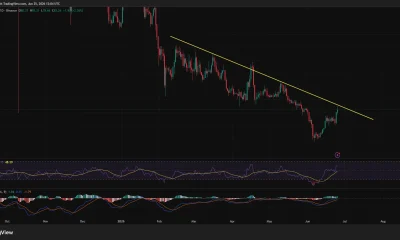

AAVE price tests 9-month trendline after 17% rebound as breakout hopes build




![Oliver Tree - Cash Machine [Official Music Video]](https://wordupnews.com/wp-content/uploads/2026/06/1782639074_maxresdefault-80x80.jpg)

You must be logged in to post a comment Login