Connect with us
DAPA Banner

Tech

In Japan, the robot isn’t coming for your job; it’s filling the one nobody wants

Published

on

Physical AI is emerging as one of the next major industrial battlegrounds, with Japan’s push driven more by necessity than anything else. With workforces shrinking and pressure mounting to sustain productivity, companies are increasingly deploying AI-powered robots across factories, warehouses, and critical infrastructure.

Japan’s Ministry of Economy, Trade and Industry said in March 2026 that it aims to build a domestic physical AI sector and capture a 30% share of the global market by 2040. The country already holds a strong position in industrial robotics, with Japanese manufacturers accounting for about 70% of the global market in 2022, according to the ministry.

Based on conversations with investors and industry executives, TechCrunch explored what’s driving that shift, how Japan’s approach differs from the U.S. and China, and where value is likely to emerge as the technology matures.

Driven by labor shortages  

Several factors are driving adoption in Japan, including cultural acceptance of robotics, labor shortages driven by demographic pressures, and deep industrial strength in mechatronics and hardware supply chains, Woven Capital managing director Ro Gupta told TechCrunch.

Advertisement

“Physical AI is being bought as a continuity tool: how do you keep factories, warehouses, infrastructure, and service operations running with fewer people?” Hogil Doh, Global Brain general partner, also said. “From what I’m seeing, labor shortages are the primary driver.”

Japan’s demographic crunch is accelerating. The population declined for a 14th straight year in 2024; those of working age make up just to 59.6% of the total, a share projected to shrink by nearly 15 million over the next 20 years, Doh pointed out. It’s already reshaping how companies operate: a 2024 Reuters/Nikkei survey found labor shortages are the main force pushing Japanese firms to adopt AI.

“The driver has shifted from simple efficiency to industrial survival,” Sho Yamanaka, a principal with Salesforce Ventures, said in an interview with TechCrunch. “Japan faces a physical supply constraint where essential services cannot be sustained due to a lack of labor. Given the shrinking working-age population, physical AI is a matter of national urgency to maintain industrial standards and social services.”

Techcrunch event

Advertisement

San Francisco, CA
|
October 13-15, 2026

Japan is stepping up efforts to advance automation across manufacturing and logistics, according to Mujin CEO and co-founder Issei Takino. The government has been promoting automation to address structural challenges such as labor shortages. Mujin, a Japanese company, has built software that lets industrial robots handle picking and logistics tasks autonomously. Mujin’s approach centers on software — specifically robotics control platforms — that allows existing hardware to perform more autonomously and efficiently, Takino said.

Advertisement

Hardware strength, system risk

Where Japan has historically excelled is in the physical building blocks of robotics. Whether that advantage translates into the AI era is a more open question. The country continues to demonstrate strength in core robotics components such as actuators, sensors and control systems, according to Japan-based venture capitalists, while the U.S. and China are moving more quickly to develop full-stack systems that integrate hardware, software and data.

“Japan’s expertise in high-precision components – the critical physical interface between AI and the real world – is a strategic moat,” Yamanaka said. “Controlling this touchpoint provides a significant competitive advantage in the global supply chain. The current priority is to accelerate system-level optimization by integrating AI models deeply with this hardware.”

Hardware capabilities are strongest in China and Japan, with Japan particularly strong in robot motion control, while the U.S. leads in the service layer and market development, Takino said. Historically, many U.S. companies have leveraged their software strengths to build integrated businesses – similar to Apple – pairing strong software platforms with high-quality hardware sourced from Asia. However, this model may not fully translate to the emerging world of physical AI, Takino said.

“In robotics, and especially in Physical AI, it is critical to have a deep understanding of the physical characteristics of hardware,” Takino said. “This requires not only software capabilities, but also highly specialized control technologies, which take significant time to develop and involve high costs of failure.”

Advertisement

WHILL, a Tokyo- and San Francisco-based startup that makes autonomous personal mobility vehicles, is drawing on Japan’s “monozukuri,” or craftsmanship heritage, as it takes a broader, full-stack approach to global expansion, CEO Satoshi Sugie told TechCrunch. The company has developed an integrated platform combining electric vehicles, onboard sensors, navigation systems and cloud-based fleet management for short-distance and autonomous transport. The company is leveraging both Japan and the U.S. for development, using Japan to refine hardware and address aging population needs, and the U.S. to accelerate software development and test large-scale commercial models, Sugie noted.

From pilots to real-world deployment

The government is putting money behind the push. Under Prime Minister Sanae Takaichi, Japan has committed about $6.3 billion to strengthen core AI capabilities, advance robotics integration and support industrial deployment.

The shift from experimentation to real deployment is already underway. Industrial automation remains the most advanced segment, with Japan installing tens of thousands of robots each year, particularly in the automotive sector. Newer applications are also beginning to gain traction, Doh said.

“The signal is simple – customer-paid deployments rather than vendor-funded trials, reliable operation across full shifts, and measurable performance metrics such as uptime, human intervention rates and productivity impact,” Doh said.

Advertisement

In logistics, companies are deploying automated forklifts and warehouse systems, while in facilities management, inspection robots are being used in data centers and industrial sites.

Companies like SoftBank are already applying physical AI in practice, combining vision-language models with real-time control systems to enable robots to interpret environments and execute complex tasks autonomously.

In defense, where autonomous systems are becoming foundational, competitiveness will depend not just on platforms but on operational intelligence powered by physical AI, Terra Drone CEO Toru Tokushige told TechCrunch. Tokushige added that by combining operational data with AI, Terra Drone is working to enable autonomous systems to function reliably in real-world environments and support the advancement of Japan’s defense infrastructure.

Investment is shifting beyond hardware, with companies allocating more capital to orchestration software, digital twins, simulation tools and integration platforms, according to investors and industry sources.

Advertisement

The rise of hybrid ecosystems

Japan’s physical AI ecosystem is also evolving in ways that differ from traditional tech disruption models. Rather than a winner-take-all dynamic, industry participants expect a hybrid model, with established companies providing scale and reliability, while startups drive innovation in software and system design.

Large incumbents, including Toyota Motor Corporation, Mitsubishi Electric, and Honda Motor, retain significant advantages in manufacturing scale, customer relationships, and deployment capabilities. But startups are carving out critical roles in emerging areas such as orchestration software, perception systems, and workflow automation.

“The relationship between startups and established corporations is a mutually complementary ecosystem,” Yamanaka said. “Robotics requires heavy hardware development, deep operational know-how, and significant capital expenditure. By fusing the vast assets and domain expertise of major corporations with the disruptive innovation of startups, the industry can strengthen its collective global competitiveness.”

Japan’s defense ecosystem is also shifting away from dominance by large corporations toward greater collaboration with startups, the Terra Drone CEO said. Large companies remain focused on platforms, scale and integration, while startups are driving development in smaller systems, software and operations, with speed and adaptability becoming key competitive factors.

Advertisement

Companies like Mujin are developing platforms that sit above hardware, enabling multi-vendor automation and faster deployment across industries. Others, including Terra Drone, are applying similar approaches to autonomous systems, combining AI and operational data to support real-world applications at scale.

“The most defensible value will sit with whoever owns deployment, integration, and continuous improvement,” Doh said.

Source link

Advertisement
Continue Reading
Click to comment

You must be logged in to post a comment Login

Leave a Reply

Tech

NASA shares breathtaking images of Artemis II astronauts taking in the view from Orion’s windows

Published

on

The Artemis II crew is almost at the moon, and the astronauts spent this weekend carrying out preparations for their lunar flyby on Monday. That included manual piloting demonstrations, reviewing their science objectives for the six-hour observation period and evaluating their space suits, which are there for life support in the event of an emergency and for their return home. But, they’ve had plenty of time to take in the views, too — and those views sure are spectacular. In the latest series of images shared by the space agency, the astronauts are seen gazing at Earth through the windows of the Orion spacecraft.

Orion will reach the moon’s vicinity shortly after midnight on Monday, April 6. Later that day, the crew is expected to reach a point farther than any humans have traveled from Earth, surpassing the record of 248,655 miles from Earth set by the Apollo 13 astronauts in 1970.

NASA astronaut and Artemis II mission specialist Christina Koch peers out of one of the Orion spacecraft's main cabin windows, looking back at Earth, as the crew travels towards the Moon.

Mission specialist Christina Koch takes in the view. (NASA)

The lunar observation period will start at 2:45PM ET, and a few hours later, they’ll be behind the moon and briefly drop out of communication. The spacecraft’s closest approach to the moon is expected to occur at 7:02PM, when it will be 4,066 miles from the surface. “From that distance, the crew will see the entire disk of the Moon at once, including regions near the north and south poles,” according to NASA. The crew will later get a chance to see a solar eclipse “as Orion, the Moon, and the Sun align in such a way that the astronauts will see our star disappear behind the Moon for about an hour.” NASA will have coverage of the flyby starting at 1PM ET.

Source link

Advertisement
Continue Reading

Tech

Tiny Moves, Big Depth: An Open-Source Macro Focus Slider

Published

on

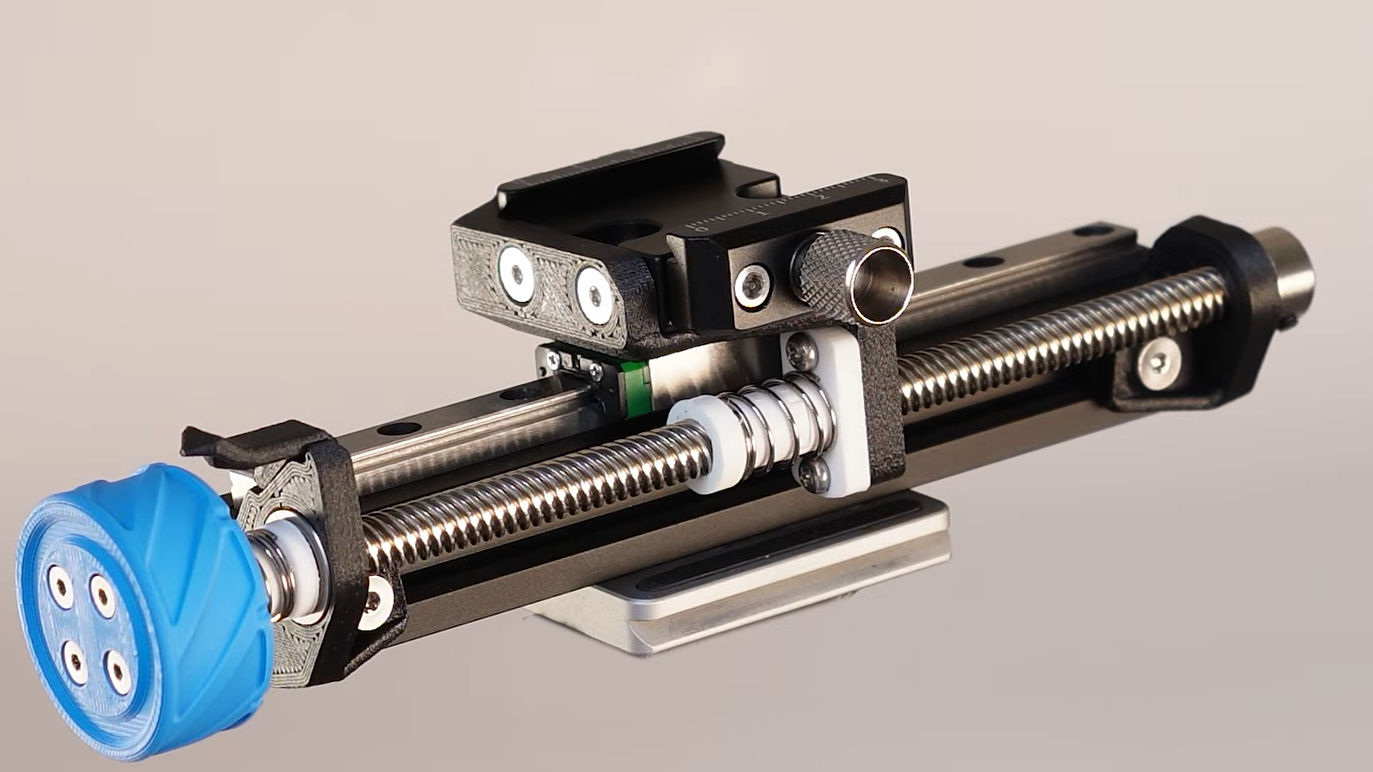
When taking macro photographs, you often need just a tiny bit of controlled motion — so little that it’s tough to pull off by hand. To address this, [Salveo] designed a small open-source macro photography slider featuring an anti-backlash handle.

Macro photography gives you an extremely shallow field of view, sometimes under 1 mm of depth, in which subjects stay in focus. To combat this, it’s common to capture multiple images while sliding the camera forward or backward, then combine them for a much larger depth of field than a single shot provides. [Salveo]’s slider gives fine control over this focus-stacking process, with the knob even marked to show every 1 mm of linear travel.

The slider is built around a 150 mm linear rail, though it could easily be lengthened or shortened to suit your needs. A T8 leadscrew, paired with anti-backlash nuts, translates the knob’s rotation into smooth linear motion. The knob itself uses a custom-designed anti-backlash mechanism to ensure the slider works cleanly in either direction.

Advertisement

You can grab all the 3D-printable files as well as the full bill of materials from the project page. Be sure to check out [Salveo]’s build video below. Thanks [Tim L.] for sending in this awesome open-source slider. Be sure to check out some of the other macro photography projects we’ve covered, too.

Advertisement

Source link

Continue Reading

Tech

Italian court orders Netflix refunds after ruling price hikes illegal

Published

on

In short: The Court of Rome has ruled that Netflix’s repeated price increases between 2017 and 2024 violated Italian consumer law and EU Directive 93/13/EEC on unfair contract terms. The ruling voids the relevant contract clauses, orders current prices rolled back to 2015 launch levels, and requires Netflix to notify millions of current and former Italian subscribers of their right to a refund, up to €500 for Premium subscribers and up to €250 for Standard subscribers. Netflix has said it will appeal.

A Roman court has given Netflix the bill for nearly a decade of price increases. In a ruling published on 1 April 2026, the Court of Rome found that Netflix had imposed repeated and unjustified price increases on its Italian subscribers in violation of the Italian Consumer Code and EU Directive 93/13/EEC, which prohibits unfair terms in standard consumer contracts. The action was brought by Movimento Consumatori, one of Italy’s largest consumer associations. The ruling, catalogued as sentence 4993/2026, affects up to 5.4 million current Italian subscribers and an unquantified number of former subscribers who cancelled during the relevant period.

Netflix launched in Italy in 2015 with a Premium plan priced at €11.99 per month. It raised prices in 2017, again in 2019, again in 2021, and most recently in November 2024, bringing the Premium plan to €19.99, an increase of €8 per month from its original price. The Standard plan reached €13.99 over the same period. The court found that none of the price changes were accompanied by justified reasons in the contract, and that offering subscribers 30 days’ notice alongside the option to cancel was not a meaningful substitute for genuine consent. Under the directive, contract terms that impose a significant imbalance between a business and a consumer, without the consumer’s substantive agreement, are void from the outset.

What the court has ordered

The ruling imposes several specific obligations on Netflix. The price-hike clauses in its standard contracts are void and unenforceable. Current subscription prices must be reduced: the Premium plan to €11.99 and the Standard plan to €9.99, the levels that applied before the first unlawful increase. Netflix must notify all current and former Italian subscribers, by email, postal mail, its own website, and notices placed in Italian national newspapers, within 90 days of the ruling, or face a daily penalty of €700 for non-compliance. Future contracts must specify the conditions under which prices may change. Eligible subscribers could receive approximately €500 in refunds if they have been on the Premium plan since 2017, and approximately €250 if they have been on the Standard plan.

Advertisement

Not an isolated ruling

The Court of Rome’s decision does not stand alone. In Germany, the federation of consumer organisations vzbv has brought a parallel action against Netflix on the same legal basis, and courts in Berlin and Cologne have already found that Netflix’s price-change clauses are void under German contract law. In Spain, the consumer association FACUA is pursuing a comparable challenge. Each case rests on EU Directive 93/13/EEC as its shared legal foundation,  a regulatory tradition that Europe has been strengthening across its digital markets for years. A defeat in Germany, where the vzbv case continues, would expose Netflix to liability across a subscriber base considerably larger than Italy’s.

The timing of the Italian ruling adds another layer of complexity. It was published on 1 April 2026, three days after Netflix had announced a global price increase on 26 March 2026, raising subscription costs across every major market. In Italy, that announcement arrived into a legal environment that had just ruled in the opposite direction. Netflix’s revised terms of service, updated in April 2025, already include conditions specifying the grounds on which prices may change, citing technical and regulatory factors as potential justifications. Whether those revised terms arrived in time to limit the company’s exposure, or were drafted in direct anticipation of mounting litigation,  is likely to feature prominently in the appeal.

Netflix’s position

Netflix has said it will contest the ruling. The company has not confirmed publicly whether it will comply with the notification and price-reduction obligations while the appeal is pending. Netflix indicated that the revised terms of service introduced in April 2025 already address the transparency concerns the court identified. The expectation that platforms disclose the basis for changes to the terms of a paid service is not limited to any single jurisdiction or sector; it has become a baseline assumption in European and increasingly global regulatory frameworks. The counterargument from Movimento Consumatori is that the obligation to provide justified reasons for price changes has existed in EU law since 1993, and that revising a contract after litigation has commenced does not retroactively cure the clauses that applied during the years of the increases.

What it means for streaming in Europe

Italy is Netflix’s fourth-largest market in Europe, with approximately 5.4 million subscribers as of October 2025 and 8 million unique users recorded during 2024. Europe’s digital market has long been the site of the most consequential tests of how much latitude technology platforms have to set their own commercial terms, and the Rome ruling is among the most direct verdicts yet on the specific question of subscription pricing. Every major streaming service operating in the EU, including Disney Plus, Amazon Prime Video, and Apple TV Plus,  uses a structurally similar mechanism: notify by email, offer a cancellation option, and proceed. If the Rome court’s interpretation of Directive 93/13/EEC is upheld on appeal or replicated by German and Spanish courts, the commercial model underlying a decade of streaming growth would require fundamental redesign across the sector.

Subscription pricing has been one of the defining revenue levers of the past decade, built on the assumption that inertia,  the gap between receiving a price-notification email and actually cancelling, functions, in practice, as consent. European courts are now testing that assumption against the text of a consumer protection directive that has been in force since 1993. Italy’s answer, issued in the first week of April 2026, is that the freedom to cancel is not the same thing as the freedom to agree. The commercial models that scaled through 2025 are increasingly arriving in front of courts equipped with three decades of consumer protection law, and the outcomes are starting to accumulate.

Advertisement

Source link

Continue Reading

Tech

Vibe coding significantly boosted App Store review submissions in 2025

Published

on

Submissions to the App Store have jumped by 84% year-over-year, with the growth of vibe coding believed to be behind the surge.

Blue rounded-square app icon with white blueprint-style lines forming an A, overlaid by a realistic black metal hammer, all on a dark background, representing software development tools
Vibe coding has led to more apps being submitted to the App Store in 2025

The continuing growth of AI services like ChatGPT and Anthropic’s Claude has helped fuel productivity in many fields, including coding. While developers have been assisted by automated tools before, AI has led to even novice coders to create bigger things beyond their capabilities.
It now seems that the increased use of AI in development has resulted in more work for the App Store.
Continue Reading on AppleInsider | Discuss on our Forums

Source link

Continue Reading

Tech

Sony’s PS5 Price Hikes Prove This Console Generation Is Far From Over. Good.

Published

on

If you’ve been holding off on picking up a PlayStation 5 in hopes of a price cut, bad news: the cost of every model of Sony’s all-conquering console has instead just gone up considerably.

It’s a move that breaks with decades of tradition (or at least consumer expectations) and is undoubtedly a blow for anyone hoping for a discount, five years into the current console generation. However, it’s also a sign that the current generation is likely to stick around for a while yet—and that may be a good thing, for the industry and players alike.

Historically, at this point in a console generation, incumbent hardware sees steep discounts. For example, the PS4, which launched for $400 in 2013, was retailing for $300 by 2018, a 25 percent decrease. Even if hardware is loss-leading, it’s a pricing trajectory that’s usually win-win for manufacturers and customers alike. Production and component costs will typically have dropped over that half-decade, allowing companies to drop the retail price, often alongside slimmed-down hardware revisions. At the same time, players who weren’t won over at a console’s launch have a cheaper entry point and years of games to catch up on. But this generation has been anything but typical.

Generational Abnormalities

The AI bubble has seen RAM and SSD storage prices skyrocket in the last few months, impacting the entire global tech sector. Sony as a whole has been hit hard by this, with the recent announcement that it was suspending its memory card business, while the PlayStation corner of the fiefdom just confirmed long-standing rumors of price increases for its console family.

Advertisement

The new MSRPs went into effect on April 2, and there’s no sugarcoating that they mark significant increases. The “entry-level” digital edition PS5 console—the one without a disc drive—is the worst hit, leaping to $600. That’s $100 higher than its previous US retail price (which was already up following an earlier hike back in August 2025, driven by Trump’s tariffs) and a staggering 50 percent higher than its $400 launch price back in 2020.

The base PS5 with a disc drive is up 30 percent on its original $500 price, now costing $650, while the PS5 Pro “only” goes up around 29 percent from its $700 launch price, setting buyers back $900—though it also doesn’t come with a disc drive, so prepare to shell out another $80 to play physical games or Blu-ray movies. Elsewhere, the PlayStation Portal, Sony’s handheld that allows users to stream games from their PS5 or the cloud, has also increased by $50, from $200 to $250.

PlayStation is far from alone in increasing its prices. Xbox increased its hardware and GamePass subscription costs multiple times in 2025, eventually bringing the MSRP of the top-end 2-TB Xbox Series X to its current $800, and is rumored to be considering another hike. The Switch 2 dodged tariff-induced price hikes at launch but is also reportedly “contemplating raising the price of that device in 2026,” per Bloomberg—and the same report suggests Sony may be delaying the inevitable PlayStation 6 to as far off as 2029, all due to the AI-induced parts crisis.

Even Valve’s handheld Steam Deck isn’t immune—while prices have so far only risen in Japan, South Korea, and Taiwan, the manufacturer has announced that the original 256 GB, LCD-screen model (the cheapest) “is no longer in production, and once sold out will no longer be available” while the newer OLED models, available with either 512 GB or 1 TB of storage “may be out-of-stock intermittently in some regions due to memory and storage shortages.”

Advertisement

Source link

Continue Reading

Tech

Will ‘AI-Assisted’ Journalists Bring Errors and Retractions?

Published

on

Meet the “journalist” who “uploads press releases or analyst notes into AI tools and prompts them to spit out articles that he can edit and publish quickly,” according to the Wall Street Journal.

“AI-assisted stories accounted for nearly 20% of Fortune‘s web traffic in the second half of 2025.” And most were written by 42-year-old Nick Lichtenberg, who has now written over 600 AI-assisted stories, producing “more stories in six months than any of his colleagues at Fortune delivered in a year.”

One Wednesday in February, he cranked out seven. “I’m a bit of a freak,” Lichtenberg said… A story by Lichtenberg sometimes starts with a prompt entered into Perplexity or Google’s NotebookLM, asking it to write something based on a headline he comes up with. He moves the AI tools’ initial drafts into a content-management system and edits the stories before publishing them for Fortune’s readers… A piece from earlier that morning about Josh D’Amaro being named Disney CEO took 10 minutes to get online, he said…

Like other journalists, Lichtenberg vets his stories. He refers back to the original documents to confirm the information he’s reporting is correct. He reaches out to companies for comment. But he admits his process isn’t as thorough as that of magazine fact-checkers.

While Lichtenberg started out saying his stories were co-authored with “Fortune Intelligence”, he now typically signs his own name, according to the article, “because he feels the work is mostly his own.” (Though his stories “sometimes” disclose generative AI was used as a research tool…) The article asks with he could be “a bellwether for where much of the media business is headed…”

Advertisement

“Much of the content people now consume online is generated by artificial intelligence, with some 9% of newly published newspaper articles either partially or fully AI-generated, according to a 2025 study led by the University of Maryland. The number of AI-generated articles on the web surpassed human-written ones in late 2024, according to research and marketing agency Graphite.”

Some executives have made full-throated declarations about the threat posed by AI. New York Times publisher A.G. Sulzberger said AI “is almost certainly going to usher in an unprecedented torrent of crap,” referencing deepfakes as an example. The NewsGuild of New York, the union representing Fortune employees and journalists at other media outlets, said the people are what makes journalism so powerful. “You simply can’t replicate lived experiences, human judgment and expertise,” said president Susan DeCarava.

For Chris Quinn, the editor of local publications Cleveland.com and the Plain Dealer, AI tools have helped tame other torrents facing the industry. AI has allowed the outlets to cover counties in Ohio that otherwise might go ignored by scraping information from local websites and sending “tips” to reporters, he said. It has also edited stories and written first drafts so the newsrooms’ journalists can focus on the calls, research and reporting needed for their stories…. Newsrooms from the New York Times to The Wall Street Journal are deploying AI in various ways to help reporters and editors work more efficiently….

Not all newsrooms disclose their use of AI, and in some cases have rolled out new tools that resulted in errors or PR gaffes. An October study from the European Broadcasting Union and the BBC, which relied on professional journalists to evaluate the news integrity of more than 3,000 AI responses, found that almost half of all AI responses had at least one significant issue.
Last week the New York Times even issued a correction when a freelance book reviewer using an AI tool unknowingly included “language and details similar to those in a review of the same book published in The Guardian.” But it was actually “the second time in a few days that the Times was called out for potential AI plagiarism,” according to the American journalist writing The Handbasket newsletter.
We must stem the idea being pushed by tech companies and their billionaire funders who’ve sunk too much into their products to admit defeat that the infiltration of AI into journalism is inevitable; because from my perch as an independent journalist, it simply is not…

Some AI-loving journalists appear to believe that if they’re clear enough with the AI program they’re using, it will truly understand what they’re seeking and not just do what it’s made to do: steal shit… If you want to work with machines, get a job that requires it. There are a whole lot more of those than there are writing jobs, so free up space for people who actually want to do the work. You’re not doing the world a favor by gifting it your human/AI hybrid. Journalism will not miss you if you leave…

But meanwhile, USA Today recently tried hiring for a new position: AI-Assisted reporter. (The lucky reporter will “support the launch and scaling of AI-assisted local journalism in a major U.S. metro,” working with tools including Copilot and Perplexity, pioneering possible future expansions and “AI-enabled newsroom operations that support and augment human-led journalism.”) And Google is already sponsoring a “publishing innovation award“…

Advertisement

Source link

Continue Reading

Tech

A new OnlyOffice fork is Europe's answer to Microsoft Office

Published

on


Developed by a consortium including Nextcloud, Ionos, and Proton, Euro-Office builds directly on the open-source OnlyOffice codebase. It offers a word processor, spreadsheet editor, presentation tool, and PDF editor, all supporting Microsoft formats (docx, pptx, xlsx) and open standards such as ODF. Its preview version is already available on GitHub,…
Read Entire Article
Source link

Continue Reading

Tech

Sunday Reboot: Gift bags, China flubs, and iPhones in space

Published

on

In this week’s “Sunday Reboot,” Apple’s gift bags and artifacts get a close look, China briefly gets Apple Intelligence ahead of schedule, and iPhones go to the Moon.

Orange smartphone with triple rear cameras appears behind a large view of Earth from space, showing swirling clouds over blue oceans against a dark starry background
The iPhone 17 Pro Max is in space.

Sunday Reboot is a weekly column covering some of the lighter stories within the Apple reality distortion field from the past seven days. All to get the next week underway with a good first step.
This week, Apple Ireland was fined by UK regulators for seemingly breaking sanctions on Russia, an AI porn startup sued Apple over its App Store rules, and the Apple Fitness+ chief prepares to retire amid claims he introduced a toxic mental health work environment.
Continue Reading on AppleInsider | Discuss on our Forums

Source link

Continue Reading

Tech

The deep-tech founder using AI to address immunology challenges

Published

on

Camille Bouget discusses how artificial intelligence is impacting innovation in the treatment of diseases affecting the immune system.

“Immuno-inflammatory diseases are often described as niche. They are not,” Camille Bouget, the CEO and co-founder of healthcare start-up Scienta Lab, explained to SiliconRepublic.com.  

With as many as one out of every 10 people in Western countries potentially impacted by an immuno-inflammatory condition, she noted, symptoms are often debilitating and the available therapeutic options frequently deeply inadequate for a significant proportion of patients. 

This is why, in 2021, Bouget co-founded Scienta Lab, a biotechnology company that aims to advance research within immunology via modern technologies such as artificial intelligence and EVA, the organisation’s multimodal AI model purpose-built for translational research in immunology and inflammation. 

Advertisement

“It was designed to answer the concrete questions that R&D teams face throughout drug development: which therapeutic targets are worth pursuing, which preclinical biological signals are robust enough to carry forward into clinical trials, and which patients are most likely to respond to a given candidate drug,” said Bouget. 

Applied across multiple stages of the pipeline, she explained, early on EVA can estimate therapeutic efficacy prior to a patient beginning treatment. As the programme advances, EVA can evaluate whether molecular signals observed in animal subjects are likely to translate to humans. And at the clinical stage, it can support the identification of patient subgroups for more precisely designed trials.

“The primary beneficiaries are biopharmaceutical and biotech companies working in immunology and inflammation,” she said.

“Ultimately, however, the downstream beneficiary is the patient: better-designed trials, fewer failed programmes and faster access to treatments that genuinely address unmet needs in diseases like rheumatoid arthritis, lupus and inflammatory bowel disease.”

Advertisement

Why AI?

A persistent challenge for Bouget and the industry she operates within has been in properly communicating the complexity of what they do in a manner that is accessible for all of the major stakeholders, be they investors, partners or the broader public.

“Immune diseases are notoriously difficult to characterise”, she noted, as often even the experts don’t always know how to measure them, what might prompt a flare-up, or why a treatment is effective for one patient but fails to work for another. 

“Convincing people that AI can meaningfully navigate that complexity without overpromising requires constant effort,” she said, especially as a young deep-tech company in an industry that is currently dominated by what she referred to as larger key players. 

She is of the opinion that the implication of AI for patients is significant, not least because the immunology drug development pipeline has historically suffered from high late-stage attrition, with programmes failing at phase II or phase III after years of investment and work. 

Advertisement

“Each of those failures represents not only a financial cost, but delayed or denied access to potentially effective therapies,” said Bouget. 

“AI that genuinely improves the translational accuracy of preclinical decision-making can meaningfully shorten that timeline and shift more resources toward candidates that are more likely to succeed.”

Sturdy foundations

But it isn’t simply a matter of having access to advanced technologies. For Bouget, multidisciplinary teams of scientists and engineers are critical to the overall success of any organisation attempting to transform immunology research and development.  

She said: “Multidisciplinary teams are the entire foundation of doing this well. The failure mode we see most often in the application of AI to drug development is a disconnect between the computational sophistication of a model and its biological relevance. 

Advertisement

“A model trained without deep immunological understanding may optimise for the wrong signal. Conversely, a team with outstanding biological expertise but limited machine learning capability will struggle to extract meaningful structure from the scale of data that modern multiomics generates.”

At Scienta Lab, the co-founding team consists of a pharmacist and former industry strategist, a biomedical engineer, and a mathematician with deep AI expertise.

“Day-to-day, our team spans immunology, bioinformatics, machine learning and clinical pharmacology,” Bouget explained.

“The ability to build bridges between those disciplines, to have a conversation where a wet-lab immunologist and a transformer architect are genuinely learning from each other, is what allows us to build models that are both technically rigorous and biologically meaningful.”

Advertisement

She added: “Organisations that try to solve this problem with either pure data science or pure biology will hit a ceiling. The translational gap in drug development is not fundamentally a data problem or a computing problem alone, but one of understanding that requires genuinely integrated teams.”

Don’t miss out on the knowledge you need to succeed. Sign up for the Daily Brief, Silicon Republic’s digest of need-to-know sci-tech news.

Source link

Advertisement
Continue Reading

Tech

Crooks Behind $27M in ‘Refund’ Scams Busted By YouTube Pranksters After Being Lured to Fake Funeral

Published

on

One crime ring scammed 2,000 elderly people of more than $27 million between 2021 and 2023 using tech support/bank impersonation/refund scams. “Victims were in their 70s and 80s,” reports the U.S. Attorney’s office for California’s southern district. Victims were first told they’d received a refund (either online or via phone), but then told they’d been “over-refunded” a massive amount, and asked to return that amount.

But 42-year-old Jiandong Chen just admitted Thursday in a U.S. federal court that he was involved in the fraud and money laundering via cryptocurrency — pleading guilty to two charges with maximum penalties of 40 years in prison and a $1 million fine, plus 20 years in prison with a maximum fine of $500,000 or twice the amount laundered. “Chen, a Chinese national, is the second defendant charged in a five-defendant indictment.” And what tripped him up seems to be that “Certain members of the conspiracy also did in-person pickups of money directly from victims…”

And so YouTube enters the story — when the scammers called pranksters with 1,790,000 subscribers to their “Trilogy Media” channel. In an elaborate three-hour video, the team of pranksters lured the scammer to a rented Airbnb where they’re staging a fake funeral with a nun. (One of the men acting in the video remembers “we start doing a prayer… I’m holding the scammer’s hand in my nun outfit…”)

They convince the scammer to collect the cash from a dead man — “Is there anything you’d like to say to him?” Then there’s demon voices. The scammer’s victim resurrects from the dead. Did the cash mule bring holy water?

Advertisement

The end result was a video titled “CONFRONTING SCAMMERS WITH A FAKE FUNERAL (EPIC REACTIONS)“. But two and a half years later, their “cash mule sting house” video has racked up over 1.3 million views, 22,000 likes, and 2,979 comments. (“This video is longer than Oppenheimer. Thanks for the laughs fellas.”)

And the scammer is facing 60 years in prison.

Source link

Advertisement
Continue Reading

Trending

Copyright © 2025