




Connect with us
DAPA Banner
DAPA Coin
DAPA
COIN PAYMENT ASSET
PRIVACY · BLOCKDAG · HOMOMORPHIC ENCRYPTION · RUST
ElGamal Encrypted MINE DAPA
🚫 GENESIS SOLD OUT
DAPAPAY COMING

Tech

iPhone part factory in India no longer in danger of shutting down

Published

on

After alleging that Apple supplier Tata contaminated farm water and threatening to close its iPhone factory, Indian regulators have now dropped the matter altogether.

As a result of Apple’s supply chain diversification plans, which aim to reduce reliance on China, a quarter of all iPhones sold worldwide are now made in India. Tata, which manufactures iPhone backplates, is a relevant factor in the process, but its production efforts have come under scrutiny.

In 2025, farmers near Tata’s facility in Tamil Nadu complained to authorities that factory wastewater was contaminating their land and open wells. After conducting five inspections from December 2025 through May 2026, the Tamil Nadu Pollution Control Board (TNPCB) threatened to shut down Tata’s factory.

On Tuesday, however, the regulator seemingly backpedaled. In a statement to Reuters, Tata explained that it had addressed all contamination concerns and that its facility in Tamil Nadu was no longer under TNPCB scrutiny.

Advertisement

As the company “satisfactorily addressed all queries” made by the Tamil Nadu regulator, it has now “dropped any further course of action on this issue.” Neither Apple nor the TNPCB commented on the matter, though.

Initially, the Tamil Nadu Pollution Control Board argued that “groundwater in the open wells located in the adjacent agricultural lands” was contaminated. It was alleged that Tata’s rainwater harvesting pond ended up overflowing because of wastewater discharged from the factory.

Tata was reportedly made aware of the contamination on December 23, 2025, but the company did not respond.

On Saturday, however, Tata revealed it had conducted an independent sample analysis, which indicated the company was in full compliance with regulations. All parameters were reportedly within the prescribed limits.

Advertisement

Now, the company says the TNPCB has reached the same conclusion, as “the reports of its own analysis of recently collected water samples from Tata Electronics’ manufacturing facility in Hosur, Tamil Nadu, do not indicate any contamination”.

Though the regulator ultimately conceded, it’s still unclear if farm water in the Tamil Nadu region was actually contaminated.

It’s unclear how and why Tata’s findings differed from the results of the initial tests conducted by the TNPCB. Either the regulator somehow made the same mistake five times in a row, or it was pressured into dropping its threat against Tata.

Tata’s role in the Apple supply chain

While Apple’s most significant supply chain partner, Foxconn, assembles the iPhone in India, parts for the devices also come from Tata.

Advertisement

In 2024, the company entered into a $1B partnership with Pegatron, another key Apple supplier, to expand iPhone manufacturing in Tamil Nadu. The year prior, Tata purchased Wistron’s Karnataka facility.

With its Tamil Nadu plant now receiving an all-clear from regulators, Tata’s iPhone component production will continue. Its manufacturing efforts may even increase, as Apple seeks to reduce its long-standing reliance on China.

Source link

Advertisement
Continue Reading
Click to comment

You must be logged in to post a comment Login

Leave a Reply

Tech

The Webb Telescope Has Captured Its First ‘Bulge Fossil Fragment’

Published

on

The funny-sounding name offers new insights into galaxy formation.

Many of the developments shared by astronomers using the James Webb Space Telescope and similar instruments center on trying to understand the history of the galaxy. The latest update from the Webb telescope researchers confirms the existence of a phenomenon known as “bulge fossil fragments” that can offer new insights on the Milky Way’s formation.

The subject of this latest investigation is known as Terzan 5, a region in the center of the galaxy often dubbed “the bulge” that has been challenging for astronomers to study due to the density of stars and presence of dust. Between their observations with the Webb telescope and archival observations taken from the Hubble Space Telescope, the team was able to confirm that Terzan 5 is not a globular star cluster, as it was previously classified. Globular star clusters usually only have one ancient star population. Instead, Terzan 5 has experienced at least four distinct phases of star formation. According to the researchers’ survey, it has two older star populations that were formed 12.5 billion and 4.7 billion years ago. The astronomers also found two more contemporary populations that formed 3.8 billion years ago and 2.5 billion years ago.

Advertisement

“For some reason, this peculiar clump of stars formed separately from the bulge and was not destroyed as the bulge itself formed,” said University of Bologna professor Francesco R. Ferraro, principal investigator of the Webb observations. “Terzan 5 is what we now call a bulge fossil fragment because it resembles the primordial clumps that contributed to the formation of the bulge.”

“Based on observations and in-depth simulations, we think that galaxies in the early Universe had huge discs of gas that fragmented into clumps and formed stars. These clumps migrated to the center of the galaxies, and many merged to form their bulges,” co-author and University of Bologna associate professor Barbara Lanzoni said.

The findings were published in the journal Astronomy & Astrophysics.

Advertisement

Source link

Continue Reading

Tech

Year of free HPE software a “step in the correct direction” in VMware rivalry

Published

on

HPE’s new promotion aims to entice customers to more deeply consider migrating off VMware. While numerous third-party surveys have pointed to a significant amount of VMware customers looking to reduce or eliminate their VMware use over the next few years, concerns around time and cost are also expected to slow or deter migration plans, especially given that migration can require paying for two virtualization products simultaneously.

“One of the big things we see is that as customers are going through this journey on transforming their operating model, you end up with double expenses,” HPE’s EVP and CTO Fidelma Russo said, according to The Register.

Dean Colpitts, CTO of Canadian managed services provider (MSP) Members IT Group (MITG), which VMware cut from its reseller program after 19 years of partnership a year ago, doesn’t expect the promotion to drive sales much.

“All our clients work on three, four, or five-year life cycles and generally roll that purchase into their initial buy,” he told Ars. “The biggest issue I’m seeing right now that is affecting VM Essentials sales and adoption is [that] the high prices and constraints of DRAM [are] affecting customers’ ability to obtain new hardware to migrate onto.”

Advertisement

Colpitts pointed to a lack of available hardware for permanent migrations and “to temporarily facilitate a brownfield reimage of the customer’s existing equipment from VMware to” VM Essentials.

On the other hand, one of HPE’s biggest channel partners, San Diego-based Nth Generation, is expecting its “VM Essentials sales pipeline to as much as quadruple and sales to grow at about that rate” because of HPE’s promotion, CRN reported.

“These additional free licensing and migration capabilities are going to drastically lower the risk of moving to VM Essentials,” Nth Generation co-president and CTO Dan Molina told the publication.

Partner promotion

HPE also announced that it would give 600 reseller partners who earn the HPE partner program’s Private Cloud with Virtualization competency by the end of the year free VM Essentials software licenses for three years. Partners still have to pay support costs, though.

Advertisement

Colpitts said that the benefit is “a step in the correct direction” but that limiting the promotion to 600 partners is “very shortsighted.” He believes that HPE should give all of its partners VM Essentials “to facilitate getting [VM Essentials] into customer sites and displacing the competitors.”

“They need to fling [VM Essentials] as far and as fast as they possibly [can] to immediately gain traction and draw ISVs to them, which will increase adoption even more,” he said.

Source link

Advertisement
Continue Reading

Tech

How to watch Austria vs Jordan: World Cup 2026 Free Streams & TV Channels

Published

on

In a World Cup 2026 group that also contains Argentina and Algeria, Austria vs Jordan will be a must-win game for both teams if they are to make a deep run in the tournament. While this is Jordan’s maiden World Cup appearance, the Burschen are returning to football’s biggest stage for the first time since 1998.

Ralf Rangnick’s men are coming on the back of an excellent qualifying campaign, winning six, drawing one, and losing just one of their eight matches. They also won all three of their warm-up matches against Ghana, South Korea and Tunisia, and are currently on a five-match unbeaten run.

Source link

Advertisement
Continue Reading

Tech

Report suggests the iPhone Fold won’t ship this year

Published

on

Apple’s long-rumoured foldable iPhone may not reach customers until 2027, despite continued speculation that the company plans to unveil the device in the coming months.

According to a new report from Taiwan’s Economic Daily News, comments from suppliers linked to Apple’s foldable plans suggest the launch timeline may have shifted.

While the iPhone Fold is still widely expected to be announced in late 2026, several supply chain sources now indicate that shipping could slip into early 2027.

The report points to remarks from Largan Precision CEO Enping Lin. He said that some upcoming products due to be announced in the third quarter have been moved to the beginning of next year. Although Lin did not mention Apple or a foldable iPhone by name, Largan is a long-time Apple supplier. This then fuels speculation that the comments relate to the company’s first foldable device.

Advertisement

Further weight comes from Xinrixing, a supplier believed to be producing bearings for the foldable handset. The company’s general manager suggested that production is largely ready and is now waiting for Apple to finalise a shipping schedule.

Advertisement

None of this confirms a delay, but it does add to a growing number of reports suggesting the iPhone Fold’s roadmap remains in flux.

Rumours surrounding Apple’s foldable ambitions have circulated for years. Predictions of an imminent launch have appeared almost annually since Samsung introduced its first Galaxy Fold in 2019. More recently, however, reports have become increasingly specific. Many point to a September 2026 unveiling.

Advertisement

Even then, some analysts believed availability would be limited at launch. This could potentially mirror Apple’s staggered rollout of products such as the original AirPods. Other reports have gone further, claiming production challenges could push the device entirely into 2027.

For now, Apple remains silent on its foldable plans. But if the latest supply chain chatter is accurate, prospective buyers may have to wait a little longer. They might not see the company’s first foldable iPhone reach store shelves soon.

Source link

Advertisement
Continue Reading

Tech

Apple Is Reportedly Planning AirPods With Cameras for 2027

Published

on

Tiny cameras in your ears may be part of Apple’s AI future. The company is preparing camera-equipped AirPods for release in late 2027, according to a report from Bloomberg’s Mark Gurman on Tuesday. 

The new earbuds are expected to arrive around the same time as a second-generation foldable iPhone and a 20th-anniversary iPhone model, Bloomberg reported, citing unnamed people familiar with Apple’s plans. Apple didn’t immediately respond to a request for comment.

The cameras reportedly wouldn’t be meant for taking photos or recording video of the inside of your ear. Instead, they would act more like AI sensors, giving Siri visual context about the world around you.

Advertisement

That could let someone ask Siri questions about what they’re looking at, like what to make for dinner based on a set of ingredients, according to Bloomberg. This would most likely use Apple’s Visual Intelligence feature, which is designed to analyze images and provide context based on what the camera on your device sees.

Apple announced new Siri and Visual Intelligence features last week at WWDC 2026 as part of iOS 27 and its other operating system updates. The new Apple Intelligence features are expected to arrive this fall, while Siri AI will be available as a beta later this year.

Bloomberg reported that the camera AirPods are code-named B798 and were originally planned for 2026 but were slightly delayed due to Apple’s struggles with AI software. The company also reportedly needed more time to develop visual AI models capable of identifying objects in its surroundings.

The earbuds are expected to look similar to current AirPods Pro models, aside from cameras embedded in the stems. Bloomberg also reported that the device would include external lights to show when data is being sent to the cloud for processing.

Advertisement

The reported AI-powered AirPods are part of Apple’s broader push into AI hardware. Bloomberg said Apple is also working on smart glasses that could arrive as early as late 2027, along with a camera-equipped pendant that could be worn on clothing or around the neck.

Apple is reportedly preparing a busy iPhone lineup. Bloomberg previously reported that Apple’s first foldable iPhone is expected to launch in 2026. Apple is also said to be working on a 20th-anniversary iPhone with a nearly edge-to-edge display and curved glass that wraps around the sides.

The timing could still change, as it has in the past. Apple hasn’t announced camera-equipped AirPods, a foldable iPhone or a 20th-anniversary iPhone.

Advertisement

Source link

Continue Reading

Tech

Smart Bulb WiFi Server Hosts “Banned” Literature

Published

on

Let’s stop for a moment and pause to consider the smart bulb. Imagine going back 20 years and telling yourself that people will be putting computers capable of acting as web servers into light bulbs just so they can control them from their telephone instead of hitting the switch. The whole thing seems crazy — but its great, because it enables hacks like this one where [RickOOOOOO] takes a commercially-available ESP32 smart bulb, and hacks it into a local file server and digital library for banned books.

The word “banned” gets bandied about a lot — but assured, there’s nothing getting served up by [RickOOOOOO]’s bulb that’s going to help somebody will ill-intent build an improvised explosive device.  No, at least as conceived here, it appears to be full of easily-available e-books that were pulled from school libraries in the USA, which may-or-may not meet your personal definition of ‘banned’. Whatever you want to call them, we appreciate the idea that a student could hypothetically replace one of the bulbs at school with a hacked version serving up that sort of content. a bulb in such a school with a bulb hacked to host that sort of content–in minecraft, naturally.

In any case, the hardest part of the hack was carving the ESP32C3 in the bulb out of the IoToreo bulb enough to access it. Unfortunately having done so, [Rick] wasn’t able to get an SDcard interface soldered on, so he’s stuck with just 4MB for books and webserver. That means only a few epubs can fit on the bulb, but it’s better than those books being unavailable.

Like the solarpunk message board we featured recently, which also ran on an ESP32, the bulb broadcasts a public network that uses a captive portal to take you to the web interface of the library. From there, users can browse books– including learning from where they were banned and why–and admins can access a password-protected control panel. One neat work-in-progress feature on the control panel is that the bulb can still be used as a smart bulb, so you can try and match the light to its surroundings. In Minecraft, because of course we would never encourage kids to change light bulbs. Perish the thought!

Advertisement

Speaking of Minecraft, you can run a server on a lightbulb, too. Or DOOM, because of course even the light bulbs run DOOM now. What a time to be alive!

Source link

Advertisement
Continue Reading

Tech

The Dell XPS 13 Laptop Is Available Starting Today

Published

on

But will it see the same success as the MacBook Neo?

Dell announced the return of the XPS 13 late last month and said broadly that it would be available in June. The low-cost laptop is now available on both virtual and brick-and-mortar store shelves. It retails starting at $599 for students and $699 for other customers.

The Dell XPS 13 announcement came hot on the heels of Apple unveiling its first true budget laptop. The MacBook Neo is designed for education, targeting both teachers and students as its likely buyers and it impressed in our review. Apple even secured a deal to bring its gear, including more than 4,500 MacBook Neos, to the Kansas City Public Schools. It should be interesting to watch whether Dell will see the same success as Apple has been enjoying for such a similar laptop.

Advertisement

Source link

Continue Reading

Tech

The foldable iPhone hasn’t launched, but Apple is already planning its successor

Published

on

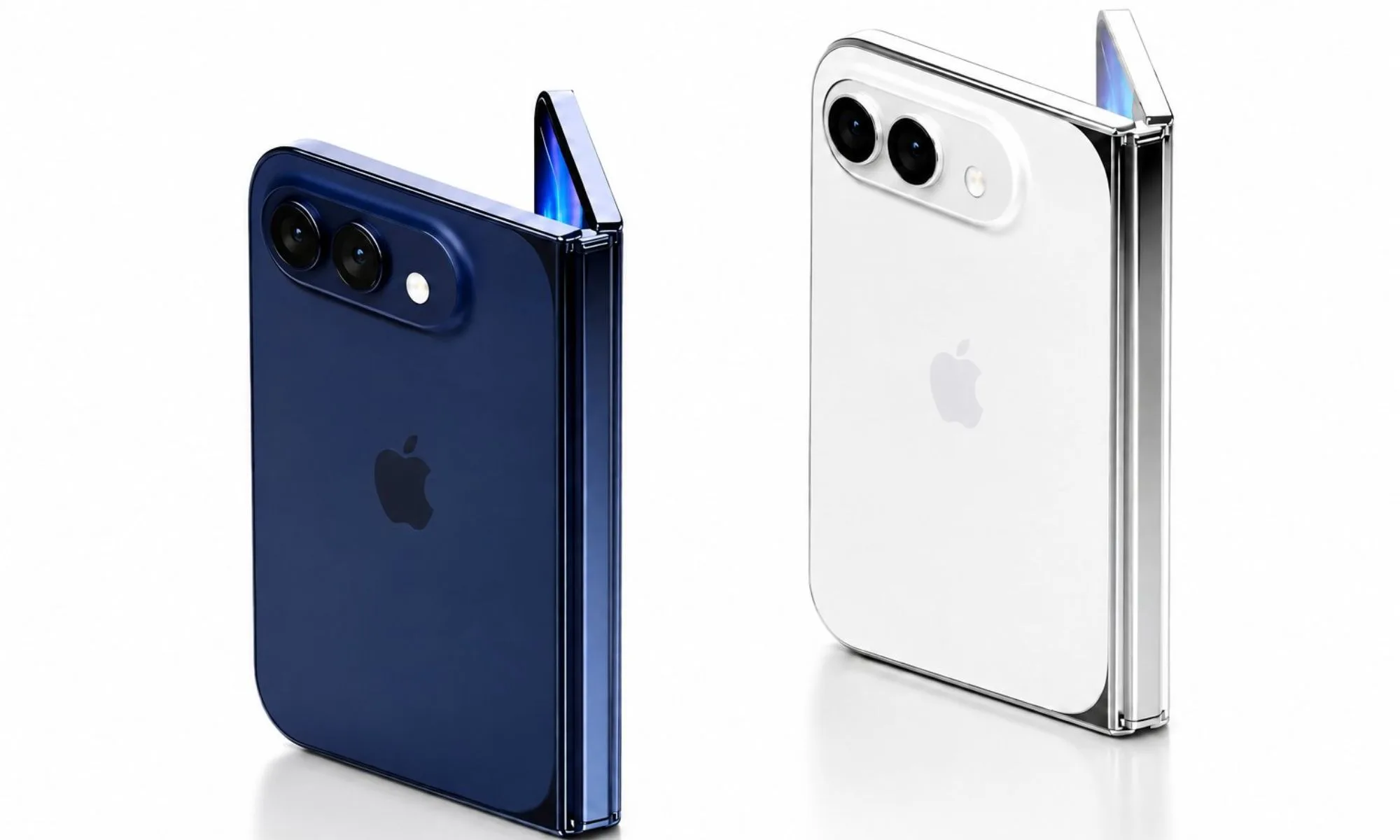
Apple‘s first foldable iPhone is still expected to debut later this year, but the company may already be looking beyond its first attempt. According to Bloomberg’s Mark Gurman, Apple is planning a second-generation foldable iPhone for release in 2027, just one year after the original model is expected to arrive. The device is reportedly codenamed V78 and will launch alongside the 20th-anniversary iPhone model. It looks like Apple might be going all in on foldables as a long-term product category rather than a one-off experiment.

The Cupertino giant has spent years watching rival smartphone makers refine foldable hardware. Samsung, Google, Honor, Oppo, and others have gone through multiple generations of designs, experimenting with everything from narrow book-style devices to wider tablet-like formats. Apple appears to have waited until the category matured before making its move.

Apple may have learned from Android’s foldable experiments

Based on leaks and replica models that have surfaced in recent months, Apple’s foldable iPhone is expected to use a relatively short and wide design rather than the tall, narrow form factor seen on earlier Samsung Galaxy Z Fold devices. The device is rumored to feature a 5.5-inch cover display and a 7.8-inch inner panel with a 4:3 screen format.

That layout mirrors much of Apple’s iPad lineup and could provide a more natural and familiar experience for multitasking, reading, and running apps side by side. At 7.8 inches, the inner display would also come close to the iPad mini‘s 8.3-inch screen, potentially giving users a tablet-like experience when the device is unfolded. Apple appears to be preparing the software side as well, encouraging developers to ensure their apps adapt smoothly to different screen sizes and display formats.

Even Samsung appears to be moving in the same direction

Interestingly, Samsung may be arriving at a similar conclusion. Rumors suggest the company is preparing a wider foldable design for next year’s lineup, with the Galaxy Z Fold 8 Wide potentially becoming the standard Galaxy Z Fold 8. A taller version could reportedly be positioned as the Galaxy Z Fold 8 Ultra instead.

Advertisement

Whether Apple’s foldable strategy pays off remains to be seen, but the company does not appear to be treating the device as a one-year experiment. A second-generation model already in development suggests Apple expects the iPhone Ultra to establish itself as a permanent tier within the iPhone lineup, with enough demand to support regular annual updates.

Source link

Continue Reading

Tech

Monitor Audio Radius Series 4G Returns With Compact Speakers Built for Modern Homes and Commercial Spaces

Published

on

Monitor Audio has launched the Radius Series 4G, a redesigned compact speaker range aimed at listeners and installers who need serious sound without large cabinets taking over the room.

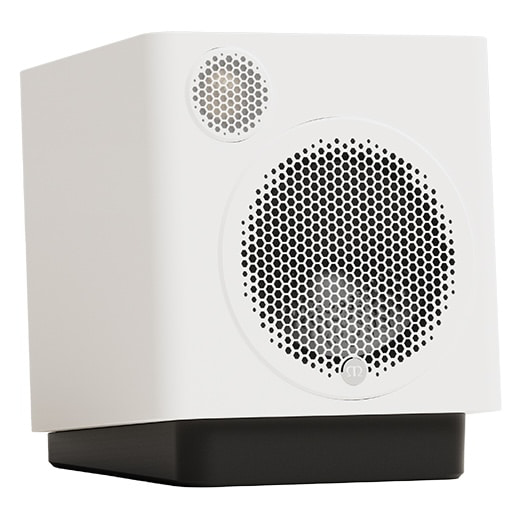
The new lineup includes the Radius 1, Radius 3, and Radius On-Wall, supported by matching floor stands, desk pads, and wall bracket options. That gives the Radius Series 4G a broader role than a typical small speaker refresh. It can be configured for two-channel listening, desktop audio, multi-room systems, home theater, and commercial installations where space, appearance, and mounting flexibility matter almost as much as sound quality.

Monitor Audio is positioning Radius Series 4G around its Transparent Design Philosophy, but the bigger story is practical: compact loudspeakers that are designed to look finished in modern residential and commercial spaces, while still being flexible enough for stereo, surround, and near-field applications. Small speakers are often treated like compromise products. Radius 4G looks more like Monitor Audio trying to make the category useful again.

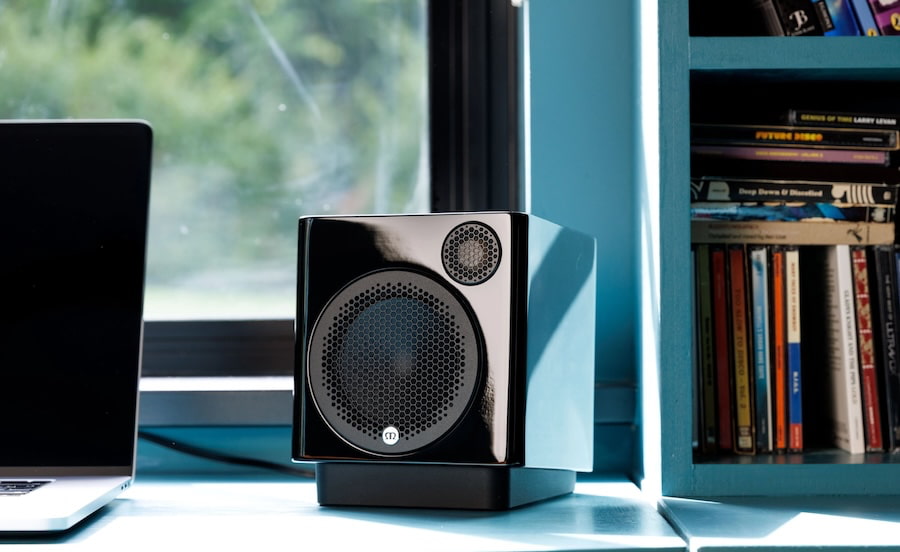
monitor-audio-radius-1-4g-white-deskpad
Monitor Audio Radius 1 4G

Compact Speakers, Smarter Engineering

The Radius Series 4G is still a compact speaker range, but Monitor Audio has put meaningful engineering into this generation rather than simply updating the cabinets and calling it a day.

Advertisement

The core driver technology remains Monitor Audio’s C-CAM cone material, which uses a ceramic-coated aluminium/magnesium structure designed to be light, rigid, and resistant to unwanted flexing. For Radius 4G, that driver platform now incorporates RST III cone geometry, a surface pattern developed to reduce breakup and resonance across the frequency range. In a small speaker, that matters. There is only so much cabinet volume to work with, so driver control becomes a much bigger part of the performance equation.

The tweeter has also been redesigned. Radius Series 4G uses a new C-CAM Gold Dome tweeter with an external magnet motor system, bringing it closer in concept to a full drive unit rather than relying on a more conventional internal puck magnet design. Monitor Audio says the goal is greater control and cleaner high-frequency performance, which should help the Radius models sound more open without becoming bright or thin.

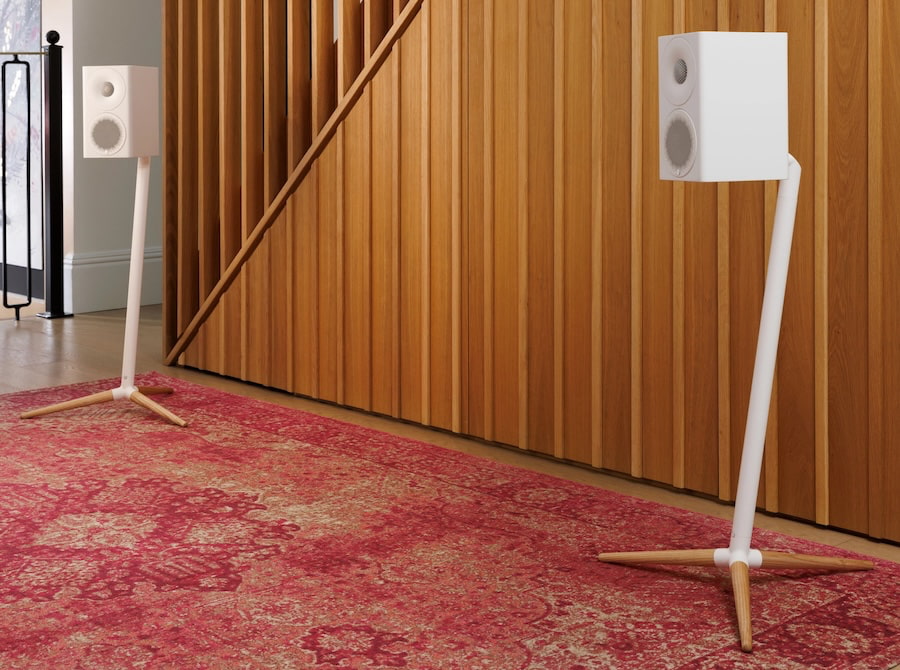
monitor-audio-radius-3-4g-black-floorstands
Monitor Audio Radius 3 4G on Floor Stands

The crossover networks have also been reworked with new measurement, listening, and component selection. That is not the flashiest part of the story, but it is often where compact speakers either come together or fall apart. Good drivers still need to be integrated properly, especially when the speaker is being used for desktop listening, wall-mounted applications, or home cinema channels.

Cabinet construction has received attention as well. Monitor Audio uses Through-Bolt Driver Bracing to lock the drive units to the rear of the cabinet at a specific torque, improving rigidity while reducing unwanted chassis resonance. Each model also includes Monitor Audio’s HiVe II port design, created to improve airflow and bass control. On the new Radius 3, the port is 50 percent larger than the previous generation, which should help it deliver more low-frequency output from a still-compact enclosure.

Advertisement

The accessory range is also part of the story. The Radius 4G Floor Stand uses wooden tripod legs with internal cable routing, giving the speaker a more furniture-friendly presence. The Desk Pad is made from vibration-isolating rubber and gives the speaker a slight upward tilt for near-field listening. Add in the wall bracket options, and Radius 4G starts to look less like a single-use compact speaker and more like a flexible system for stereo, desktop, surround, multi-room, and commercial installation use.

Monitor Audio Radius Series 4G Product Lineup


Monitor Audio Radius 1 4G

monitor-audio-radius-1-4g-black-deskpad
Monitor Audio Radius 1 4G with Desk Pad

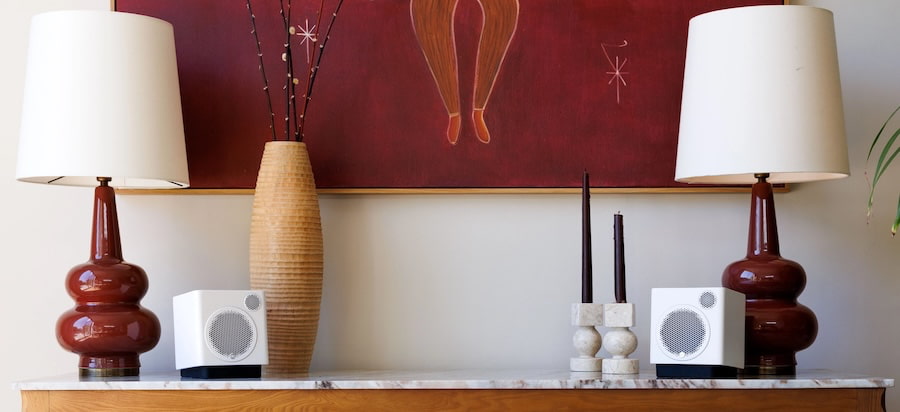
The Radius 1 4G is the smallest model in the new Radius Series 4G lineup, designed for discreet AV, surround, multi-room, desktop, and compact stereo applications. It uses a 4-inch RST III bass/mid driver with Monitor Audio’s C-CAM cone technology and a 19 mm C-CAM Gold Dome tweeter in a sealed 2-way cabinet.

Key specs and options:

Advertisement. Scroll to continue reading.
  • Price: $525 per pair
  • System: 2-way compact speaker
  • Drivers: 4-inch RST III bass/mid driver, 19 mm C-CAM Gold Dome tweeter
  • Frequency response: 100 Hz to 35 kHz, in-room, -6 dB
  • Sensitivity: 82 dB
  • Nominal impedance: 8 ohms
  • Minimum impedance: 3.8 ohms at 950 Hz
  • Power handling: 50 watts
  • Recommended amplifier power: 25 to 50 watts into 8 ohms, 50 to 100 watts into 4 ohms
  • Bass alignment: Sealed
  • Crossover frequency: 3.2 kHz
  • Dimensions: 5 5/16 x 5 5/16 x 6 1/8 inches
  • Weight: 3 lb 15 oz each
  • Finishes: High Gloss Black, Satin White
  • Sold as: Pair
  • Compatible mounts: MASM, FIX-M

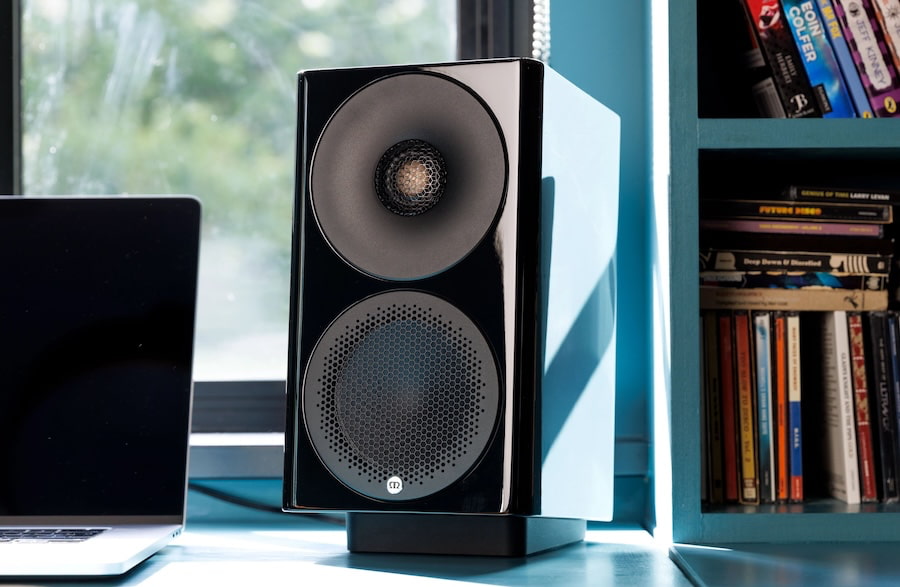
Monitor Audio Radius 3 4G

monitor-audio-radius-3-4g-black-speakers-deskpad
Monitor Audio Radius 3 4G with Desk Pad

The Radius 3 4G is the larger mini-monitor in the range and the most flexible choice for stereo, TV, gaming, desktop, multi-room, and small commercial installations. It steps up to a 4.5-inch RST III bass/mid driver, a 25 mm C-CAM Gold Dome tweeter, and a ported cabinet for deeper bass extension than the Radius 1 4G.

Key specs and options:

Advertisement
  • Price: $725 per pair
  • System: 2-way compact mini-monitor
  • Drivers: 4.5-inch RST III bass/mid driver, 25 mm C-CAM Gold Dome tweeter
  • Frequency response: 44 Hz to 35 kHz, in-room, -6 dB
  • Sensitivity: 84 dB
  • Nominal impedance: 8 ohms
  • Minimum impedance: 4 ohms at 250 Hz
  • Power handling: 75 watts
  • Recommended amplifier power: 40 to 75 watts into 8 ohms, 75 to 150 watts into 4 ohms
  • Bass alignment: Ported
  • Port tuning frequency: 53 Hz
  • Crossover frequency: 2.7 kHz
  • Dimensions: 10 1/16 x 5 7/8 x 7 15/16 inches
  • Weight: 8 lb 3 oz each
  • Finishes: High Gloss Black, Satin White
  • Sold as: Pair
  • Compatible mount: FIX-M
  • Placement options: Desktop, floor stand, or wall mount

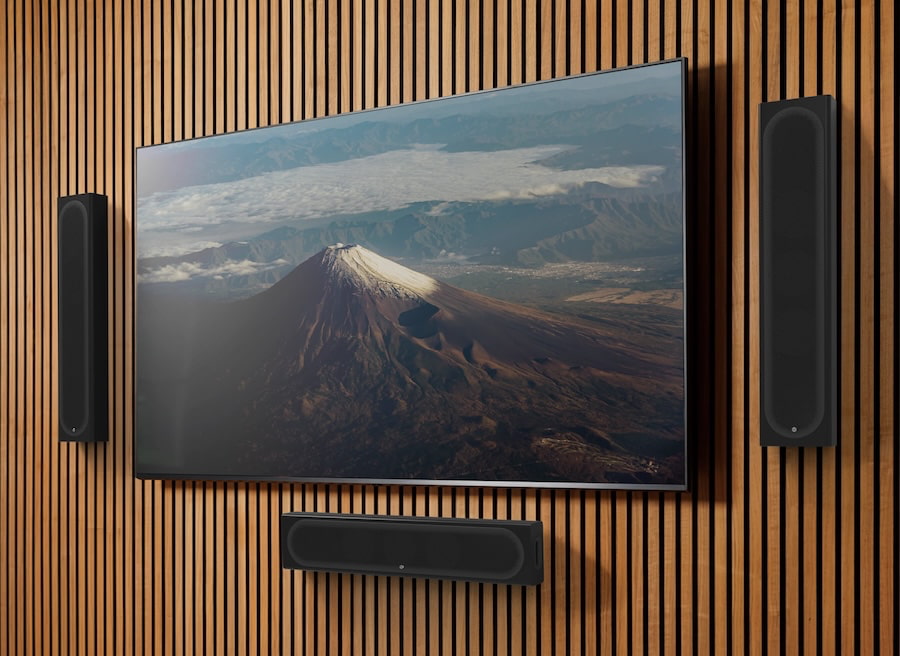
Monitor Audio Radius On-Wall 4G

monitor-audio-radius-on-wall-4g-speakers-black-lifestyle

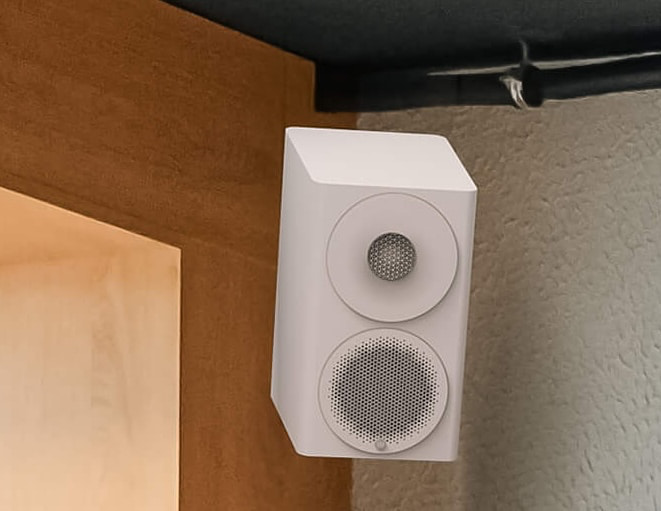
The Radius On-Wall 4G is the TV and home cinema model in the Radius 4G range. It is designed for horizontal or vertical wall placement around a screen and uses two 4.5-inch RST III bass/mid drivers with a 25 mm C-CAM Gold Dome tweeter in a slim ported cabinet. A wall bracket and fixing template are supplied.

Key specs and options:

  • Price: $575 each
  • System: 2-way on-wall speaker
  • Drivers: Two 4.5-inch RST III bass/mid drivers, 25 mm C-CAM Gold Dome tweeter
  • Frequency response: 69 Hz to 35 kHz, in-room, -6 dB
  • Sensitivity: 90 dB installed
  • Nominal impedance: 8 ohms
  • Minimum impedance: 4.4 ohms at 700 Hz
  • Power handling: 100 watts
  • Recommended amplifier power: 50 to 100 watts into 8 ohms, 100 to 200 watts into 4 ohms
  • Bass alignment: Ported
  • Port tuning frequency: 62 Hz
  • Crossover frequency: 2.3 kHz
  • Dimensions: 29 1/2 x 6 1/16 x 3 1/16 inches
  • Weight: 14 lb 2 oz each
  • Finishes: High Gloss Black, Satin White
  • Sold as: Single
  • Installation: Horizontal or vertical wall mounting, supplied bracket and fixing template

Monitor Audio Radius Floor Stand 4G

monitor-audio-radius-3-4g-white-floorstands
Monitor Audio Radius 3 4G on Floor Stand

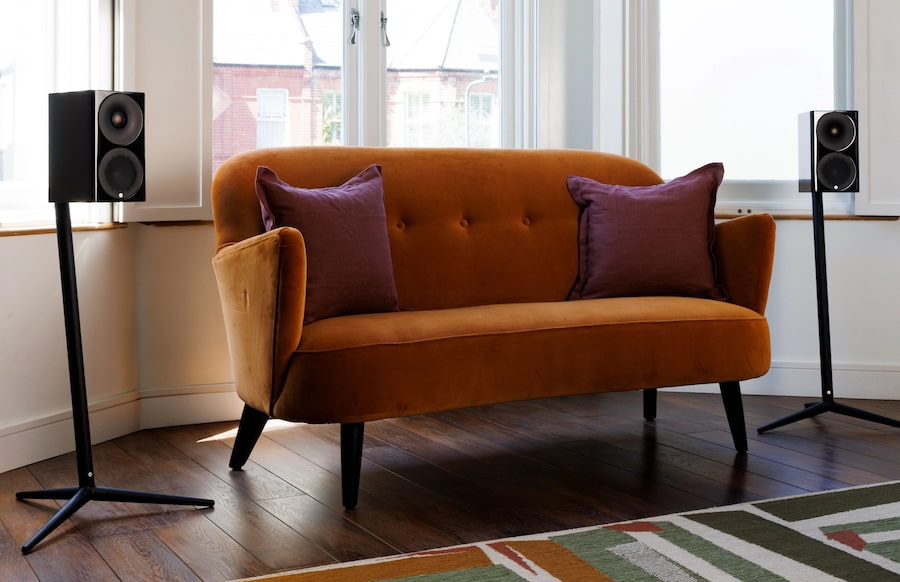
The Radius Floor Stand 4G is designed for the Radius 1 4G and Radius 3 4G. The stand uses wooden tripod legs, a single-bolt speaker attachment, and integrated cable routing that lets speaker cable exit cleanly at the base.

Key specs and options:

  • Price: $395 per pair
  • Compatibility: Radius 1 4G and Radius 3 4G
  • Design: Wooden tripod legs
  • Cable management: Internal cable routing through the stand
  • Speaker attachment: Single-bolt fixing
  • Dimensions: 30 11/16 x 20 1/16 x 17 7/16 inches
  • Weight: 3 lb 5 oz
  • Finishes: Black, White
  • Sold as: Pair

Monitor Audio Radius Desk Pad 4G

monitor-audio-radius-1-4g-white-speaker-deskpad
Radius 1 4G with Desk Pad

The Radius Desk Pad 4G is made for Radius 1 4G and Radius 3 4G desktop placement. It uses rubber with a specified hardness for vibration isolation and adds a slight upward tilt to aim the speakers more effectively in near-field setups.

Key specs and options:

  • Price: $40 per pair
  • Compatibility: Radius 1 4G and Radius 3 4G
  • Material: Rubber
  • Purpose: Desktop stability, vibration isolation, and upward speaker tilt
  • Dimensions: 15/16 x 4 1/2 x 5 7/16 inches
  • Weight: 14 oz
  • Finish: Black
  • Sold as: Pair

Monitor Audio FIX-M Speaker Mount

monitor-audio-radius-3-4g-white-fixm-wall-mount

The FIX-M is the more adjustable wall-mount option for Radius 1 4G and Radius 3 4G. It allows 0, 15, or 30-degree angle settings from center, and the rotating front section creates 14 possible positions.

Key specs and options:

Advertisement
  • Price: $55 each
  • Compatibility: Radius 1 4G, Radius 3 4G, Bronze 50 6G
  • Angle settings: 0, 15, or 30 degrees from center
  • Positioning: 14 possible positions
  • Finishes: Black, White

Monitor Audio MASM Mount

monitor-audio-radius-1-4g-black-wall-masm-mount

The MASM Mount is a smaller wall or ceiling mount for users who want to get compact speakers off the desk or furniture. It uses a ball-joint connection for positioning and is listed as compatible with Radius 1 4G.

Key specs and options:

Advertisement. Scroll to continue reading.
  • Price: $35 per piece
  • Compatibility: Radius 1 4G, Bronze 1, MASS Satellite, Radius 45 3G, Radius 90 3G
  • Installation: Wall or ceiling
  • Adjustment: Ball-joint positioning
  • Finishes: Black, White, Silver

The Bottom Line

The Monitor Audio Radius Series 4G is not trying to replace a full-size hi-fi speaker system, and that is the point. Its appeal is the combination of compact cabinets, real Monitor Audio driver technology, flexible mounting options, and a cleaner design language that works in rooms where traditional speakers are either too large or too visually intrusive.

What makes Radius 4G different is the range of applications. Radius 1 4G can handle discreet surround, desktop, and multi-room duties; Radius 3 4G is the more capable compact stereo, TV, gaming, and near-field option; and Radius On-Wall 4G gives installers and home theater users a slim horizontal or vertical speaker for screen-based systems. Add the dedicated floor stands, desk pads, and wall brackets, and this becomes less of a small speaker refresh and more of a flexible compact audio system.

Advertisement

This is for apartment dwellers, design-conscious listeners, desktop users, custom installers, and anyone building a living room, media room, retail, hospitality, or office system where sound quality matters but big boxes are a non-starter. Bass obsessives and large-room listeners will still want a subwoofer, but for modern spaces that demand compact speakers with legitimate hi-fi intent, Radius 4G makes a lot of sense.

For more information: https://www.monitoraudio.com

Source link

Advertisement
Continue Reading

Tech

The Pandemic Hindered English Learners’ Literacy. This Ohio Distr

Published

on

Elementary school is tough.

There are playground politics, multiplication tables and learning to read.

Imagine dealing with all that in a new language — or even a whole new country.

That’s the added challenge for kids who are learning English at the same time they’re learning everything else as their peers.

Advertisement

It’s an issue that Sarah Walters and her colleagues were determined to tackle in Troy City Schools, a public school district made up of nine campuses roughly an hour north of Cincinnati. The area is home to an automotive manufacturer that brings some employees — and their families — over from Japan.

Roughly 3 percent of the 4,000 students have primary languages like Spanish, Ukrainian and Japanese, a relatively small population compared to the most recent national average of 11 percent.

But that small group is making big gains. Looking to close the literacy gaps that have plagued schools since the pandemic, the district took a big swing to increase literacy among its English learners. It trained 116 staff members — including every elementary teacher, intervention specialist, paraprofessional and principal — in the Orton-Gillingham approach, which folds movement and touch into reading instruction.

They say it’s paying off.

Advertisement

Walters, a literacy instructional support specialist, says that helping multilingual students master their grasp on English is vital. Like any other student, the foundation that they lay in reading and math will affect their learning from that point on.

NEWSLETTERS

STAY AHEAD IN EDUCATION.

Sign up for EdSurge newsletters for timely news, insights and analysis.

“We want to help the students continue to thrive, and really everything that we’re thinking about with our student services is equitable learning opportunities,” Walters says.

Advertisement

Moving Toward Equity

Federal data shows that English learners’ achievement scores lag far behind their peers on average, and have made little improvement over the past two decades.

Troy City Schools was eager to close widening literacy gaps that surfaced after the onset of the pandemic, Walters says, which was particularly hard on English learners like those at Concord Elementary. A big hurdle was phonics, the letter sounds that make up words.

“We were seeing a lot of student frustration and wanting to give up,” Walters recalls. “Students being very withdrawn, those social-emotional impacts.”

Back in 2020, English-language instruction was inconsistent and fragmented across classrooms.

Advertisement

Yet, even with the desire to boost English learner scores, the program took some time.

Following the pandemic, Troy City Schools mulled over the changes for three years before it had enough funding to deliver on it, according to Danielle Romine, director of elementary teaching and learning for the district. The effort was funded through post-COVID relief grants and budget allocations made by the district’s leaders.

As a literacy specialist, Walters became certified in the Orton-Gillingham method through the Institute for Multi-Sensory Education. She’s now responsible for supporting and training staff to successfully use the techniques.

ConcordElem2-1778718672.jpg

Fourth-grade students at Concord Elementary participate in the auditory-kinesthetic drill as part of the Orton-Gillingham literacy method. The teacher dictates sounds as students use sand to write the letters represented by the sound, an activity meant to help with long-term recall of what they learn. Photo courtesy of Troy Public Schools.

Walters says teachers and staff were trained to utilize drills that connect literacy concepts through visuals, sound and movement. Students might use flash cards as a visual element or tap their fingers to each letter as they spell out a word. Students also learn the origin and history of words to strengthen their ability to decode them. For example, a “red word” is one that does not follow phonics rules.

Advertisement

“Our multilingual learners love it because no longer are they being told, ‘That’s just the way it is,’” Walters says.

After an initial summer training on the Orton-Gillingham approach, teachers spoke so highly of the method that requests for training grew among staff.

Initial Promise

“In a school district, if you want to get something out, just tell a teacher, because it [will] spread like wildfire,” Romine says.

And the data are showing promising results, Walter says. The district-wide third grade reading proficiency had plummeted to 56 percent in 2021-22 but had risen to 81 percent by 2023-24 — slightly higher than its pre-COVID achievement rate. The most recent state data shows Concord Elementary far surpassed its target goal for English proficiency among multilingual students.

Advertisement

A reading teacher demonstrates the sand tray activity as part of the Orton-Gillingham literacy approach.

Walters has heard from teachers who say that the approach has helped some English learner students make lightning-fast gains in reading. One educator told her that two students from Japan who joined the elementary school in the fall were conversing in English by December. Another student’s phonics diagnostic score shot up by 38 points in the same timeframe.

Now, the district is working to spread the method beyond its own campuses.

“Eventually, our goal is to support the entire community, or the entire county because Sarah having that training [enables her] to support teachers from other districts, as well,” Romine says.

Advertisement

But for English learners, ensuring they’re on grade level in reading goes beyond measuring their success in the classroom.

Walters says that the district is thinking about long-term learning for children who, for example, may be in the U.S. for a few years before returning to Japan.

Now, the district is working to spread the method beyond its own campuses.

“Eventually, our goal is to support the entire community, or the entire county because Sarah having that training [enables her] to support teachers from other districts, as well,” Romine says.

Advertisement

But for English learners, ensuring they’re on grade level in reading goes beyond measuring their success in the classroom.

Walters says that the district is thinking about long-term learning for children who, for example, may be in the U.S. for a few years before returning to Japan.

“We want students to have success across math, science, everything,” Walters says. “So it’s important that we get them up to speed as quickly as possible, because those long-term impacts could really be harmful for them. That early literacy is key.”

Source link

Advertisement
Continue Reading

Trending

Copyright © 2025