from the hype-without-substance dept
There is a familiar media failure in which opposing viewpoints are presented as equally valid, even when the evidence overwhelmingly supports one side. It’s called Bothsidesism. This false balance phenomenon legitimizes misinformation and undermines public understanding by giving disproportionate weight to baseless claims.
Why bring this up? Because the new AI Doc film is based on it.
The film wants credit for being “balanced” because it assembles a wide range of experts. But putting Prof. Fei-Fei Li, a pioneering computer scientist, next to someone like Eliezer Yudkowsky, an author of a Harry Potter fanfic, is not “balance.”
Once you understand that false equivalence is baked into the film’s storytelling, you understand how misleading and manipulative the documentary is. And it is compounded by a series of falsehoods that go unchallenged and uncorrected.
This review addresses both failures.
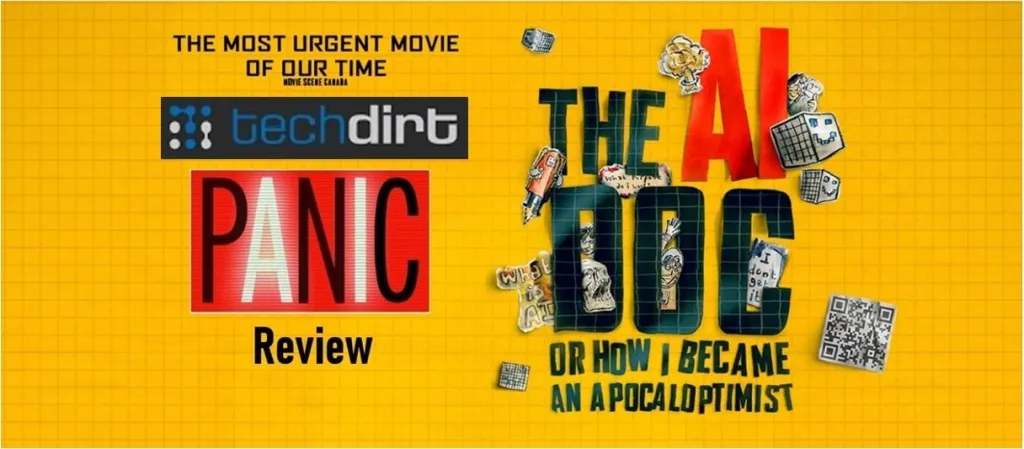
The “AI Doc” Movie
“The AI Doc: Or How I Became an Apocaloptimist,” co-directed by Daniel Roher and Charlie Tyrell, sets out to explore AI, especially its potential for good and bad, with a strong emphasis on the filmmakers’ anxieties and fears. Its basic premise is: “A father-to-be tries to figure out what is happening with all this AI insanity.” As summarized by Andrew Maynard from Future of Being Human:
“The documentary progresses through the eyes of director Daniel Roher as he faces a tsunami of existential AI angst while grappling with the responsibility of becoming a father. Motivated by a fear that artificial intelligence could spell the end of everything that matters, he sets out to interview some of the largest (and loudest) voices in AI to fathom out whether this is the best of times or worst of times for him and his wife (filmmaker Caroline Lindy) to bring a kid into the world.”
The “loudest voices” include many AI doomer figures, such as Eliezer Yudkowsky, Dan Hendrycks, Daniel Kokotajlo, Connor Leahy, Jeffrey Ladish, and two of the most populist voices on emerging tech (first social media and now AI): Tristan Harris and Yuval Noah Harari. The film also features voices on AI ethics, including David Evan Haris, Emily M. Bender, Timnit Gebru, Deborah Raji, and Karen Hao. On the more boosterish side, there are Peter Diamandis and Guillaume Verdon (AKA Beff Jezos). Three leading AI CEOs were also interviewed: OpenAI’s Sam Altman, DeepMind’s Demis Hassabis, and Anthropic’s Amodei siblings, Dario and Daniela. (Meta’s Mark Zuckerberg declined, and xAI’s Elon Musk agreed but never showed up).
The movie started playing in theaters on March 27, but there are already plenty of reviews (dating back to the Sundance Film Festival). The praise is fairly consistent: It is timely, wide-ranging, visually energetic, and unusually well-connected, with access to major AI figures.
The most common criticism is that it is too deferential to interviewees and too thin on hard interrogation or concrete answers. As several reviewers put it:
- “Roher’s willingness to blindly accept any and all of his speakers’ pronouncements leaves The AI Doc feeling toothless.”
- “By giving its doomer and accelerationist voices so much time to present AI’s most hyperbolic potential outcomes with little pushback, the documentary’s first half plays more like an overlong advertisement for the technology as opposed to a piece of measured analysis.”
- “Roher acts as a fantastic storyteller, but he treats his subjects too gently. The film desperately needs more pushback during the interviews.”
Tristan Harris, co-founder of the Center for Humane Technology, told the AP: “My hope is that this film is kind of like ‘An Inconvenient Truth’ or ‘The Social Dilemma’ for AI.”
That is not reassuring. It is more like a glaring warning sign. Harris’s “Social Dilemma” and “AI Dilemma” movies were full of misinformation and nonsensical hyperbole, and both were designed to be manipulative and dishonest. If anything, his endorsement tells you exactly what kind of movie this is.
After watching the AI Doc, I realized what the doomers had managed to accomplish here: The film absorbs the panic rather than investigates it.
The False Balance of The AI Doc
The AI Doc starts with what one reviewer called a “Doom Parade.” It aims to set the tone.
“The worst AI predictions are presented first,” another reviewer noted. “Eliezer Yudkowsky, co-founder of the Machine Intelligence Research Institute, calmly talks of the ‘abrupt extermination’ of humanity.”
And it is worth remembering who Yudkowsky is and what he has actually advocated. In his notorious TIME op-ed, “Shut it All Down,” he argued that governments should “be willing to destroy a rogue datacenter by airstrike.” In his book “If Anyone Builds It, Everyone Dies,” which many reviewers found unconvincing and “unnecessarily dramatic sci-fi,” he (and his co-author Nate Soares) proposed that governments must bomb labs suspected of developing AI. Based on what exactly? On the authors’ overconfident, binary worldview and speculative scenarios, which they mistake for inevitability.
One review of that book observed, “The plan with If Anyone Builds It seems to be to sane-wash him [Yudkowsky] for the airport books crowd, sanding off his wild opinions.”
That is more or less what the new documentary does, too. The AI Doc sane-washes the loudest doomers for mainstream viewers, sanding off their wild opinions.
In his newsletter, David William Silva addresses the documentary’s “series of doomers,” who “describe AI-driven extinction with the calm confidence of people who have said these things so many times they have stopped noticing they have no evidence for them.”
“Roher’s reaction is full terror,” Silva adds. “I hope it is unequivocally evident that this is not journalism.”
That gets to the heart of it. The film pretends to weigh competing perspectives, but in practice, it grants disproportionate authority to people most invested in flooding the zone with AI panic. And there is a well-oiled machine behind this kind of AI panic. As Silva writes:
“The people behind the AI anxiety machine. […] They know that predicting human extinction by software is an extraordinary claim requiring extraordinary evidence. They know they don’t have it. They know ‘my kids won’t live to see middle age’ is nothing but performance. […] And they do it anyway. Why do you think that is? The calculation is simple. Some people will see through it, and they will be annoyed, write rebuttals, call it what it is. Ok, fine. Just an acceptable loss. The believers, on the other hand, are a market. As long as the ratio stays favorable, the machine is profitable.”
One of the biggest beneficiaries of this film is Harris.[1] He is framed as if he is in the middle between the two main camps (doomers and accelerationists), and his narrative gradually becomes the film’s narrative (similar to the Social Dilemma). His call to action even serves as the ending (with a QR code directing viewers to a designated website).
The problem is that this framing has very little to do with reality. Harris’s Center for Humane Technology got $500,000 from the Future of Life Institute for “AI-related policy work and messaging cohesion within the AI X-risk [existential risk] community.” That is not a neutral player.
There’s a touching scene in the film where Roher mentions his father’s cancer treatment and expresses hope that AI might help. Harris appears visibly emotional. But in other contexts, Harris has argued against looking at AI for help with cancer treatment… in the belief that it would lead to extinction. Here he is on Glenn Beck’s show in 2023:
“My mother died from cancer several years ago. And if you told me that we could have AI that was going to cure her of cancer, but on the other side of that coin was that all the world would go extinct a year later, because of the, the only way to develop that was to bring something, some Demon into the world that would we would not be able to control, as much as I love my mother, and I would want her to be here with me right now, I wouldn’t take that trade.”
That sort of hyperbole seems relevant to Harris’ stance on such things, but was not mentioned in the film at all.
Connor Leahy of Conjecture and ControlAI gets a similar makeover. In the documentary, he appears as another pessimistic expert. Elsewhere, he said he does not expect humanity “to make it out of this century alive; I’m not even sure we’ll get out of this decade!” His “Narrow Path” proposal for policymakers begins with the claim that “AI poses extinction risks to human existence.” Instead of calling for a six-month AI pause, he argued for a 20-year pause, because “two decades provide the minimum time frame to construct our defenses.”
This is exactly why background checks matter. Viewers of the AI Doc deserve to know the full scope of the more extreme positions these interviewees have publicly taken elsewhere. If someone has publicly argued for destroying data centers by airstrikes or stopping AI for 20 years, the audience should know that.
Debunking the Falsehoods
The film goes way beyond just pushing a panic. It also recycles several misleading or plainly false claims, letting them pass as established facts. Three stood out in particular.
Anthropic’s Blackmail study
One of the most repeated “facts” in reviews of the movie is that Anthropic’s AI model, Clause, decided, unprompted, to blackmail a fictional employee. In the film, Daniel Roher asks, “And nobody taught it to do that?” Jeffrey Ladish, of Palisade Research and Tristan’s Center for Humane Technology, replies: “No, it learned to do that on its own.”
That is a misleading characterization of the actual experiment, it has already been debunked in “AI Blackmail: Fact-Checking a Misleading Narrative.” Anthropic researchers admitted that they strongly pressured the model and iterated through hundreds of prompts before producing that outcome. It wasn’t a spontaneous emergence of “evil” behavior; the researchers explicitly ensured it would be the default. Telling viewers that the model has gone full “HAL 9000” omits the facts about the heavily engineered experimental setup.
Although this is a classic case of big claims and thin evidence, the film offers so little pushback that viewers are left to take Ladish’s statements at face value.
It is also worth remembering that Ladish has fought against open-source AI, pushed for a crackdown on open-source models, and once said, “We can prevent the release of a LLaMA 2! We need government action on this asap.” He later updated his position (and it’s good to revise such views). But does the film mention his earlier public hysteria? No.
Is AI less regulated than sandwich shops? No.
Connor Leahy tells Daniel Roher, “There is currently more regulation on selling a sandwich to the public” than there is on AI development. This talking point has become a favorite slogan in AI doomer circles. It was repeatedly stated by The Future of Life Institute’s Max Tegmark and, more recently, by Senator Bernie Sanders. It’s catchy. It’s also false.
State attorneys general from both parties have explicitly argued that existing laws already apply to AI. Lina Khan, writing on behalf of the Federal Trade Commission, stated that “AI is covered by existing laws. Each agency here today has legal authorities to readily combat AI-driven harm.” The existing AI regulatory stack already includes antitrust & competition regulation, civil rights & anti-discrimination law, consumer protection, data privacy & security, employment & labor law, financial regulation, insurance & accident compensation, property & contract law, among others.
So no, AI is not less regulated than sandwich shops. It’s a misleading soundbite, not a serious description of legal reality.
Data center water usage
In the film, Karen Hao criticizes data centers, warning that “People are literally at risk, potentially of running out of drinking water.” That sounds alarming, which is presumably the point. But it is highly misleading.
In fact, Karen Hao had to issue corrections to her “Empire of AI” book because a key water-use figure was off by a factor of 4,500. The discrepancy was not 45x or 450x, but rather 4,500x. That is not a rounding error. For detailed rebuttals, see Andy Masley’s “The AI water issue is fake” and “Empire of AI is widely misleading about AI water use.”
There is also a basic proportionality issue here. As demonstrated by The Washington Post, “The water used by data centers caused a stir in Arizona’s drought-prone Maricopa County. But while they used about 905 million gallons there last year, that’s a small fraction of the 29 billion gallons devoted to the country’s golf courses.” To put that plainly: data centers accounted for just 0.1% of the county’s water use.
It is also worth noting that “most of the water used by data centers returns to its source unchanged.” In closed-loop cooling systems, for example, water is recirculated multiple times, which significantly reduces net consumption.
None of this is hidden information. A basic fact-check by the filmmakers could have brought it to light. But that was not the film’s goal. They chose fear-based framing over actual reporting. They could have pressed interviewees on their track records, failed predictions, and political agendas. Instead, they let them narrate the stakes, unchallenged.
So, I think we can conclude that the AI Doc may want to appear balanced and thoughtful, but, unfortunately, too often it is not.
Final Remark
While Western filmmakers are busy platforming advocates for “bombing data centers” and “Stop AI for 20 years,” the Chinese Communist Party is building the actual infrastructure. The CCP is not making doom-and-gloom documentaries; it is racing ahead. This is a real strategic threat, and it is far more concerning than anything featured in this film.
—————————
Dr. Nirit Weiss-Blatt, Ph.D. (@DrTechlash), is a communication researcher and author of “The TECHLASH and Tech Crisis Communication” book and the “AI Panic” newsletter.
Filed Under: ai, ai doomerism, daniel roher, eliezer yudkowsky, the ai doc, tristan harris
























































You must be logged in to post a comment Login