The 2026 FIFA World Cup spans three countries, drawing millions of fans across the US, Canada, and Mexico borders. As travelers hop between cities like New York, Vancouver, and Mexico City, many rely on the best VPN services for security and content access.
Yet, a key concern looms at the checkpoint: Is using a Virtual Private Network (VPN) safe during border crossings and while navigating these countries? While VPNs remain completely legal in all three host nations, federal law doesn’t guarantee a smooth experience.
From border inspections to state regulations, there’s constant room for unexpected hurdles. So, understanding how privacy tools intersect with physical borders can help you enjoy a trouble-free tournament.
Advertisement
Can border patrol search your phone for a VPN?
Border officials in the US, Canada, and Mexico can search electronic devices and inspect your phone’s contents, including installed apps. However, possessing a commercial VPN isn’t illegal, nor can you be denied entry solely for having it downloaded.
Yet a visible VPN icon may prompt further questioning. In the US, refusing to unlock a device can result in its seizure for weeks, even months. While US citizens can’t be denied entry for this refusal, non-citizens face greater risk of being turned away.
Secure your device with a strong passcode, but know that protection has limits at borders. If the VPN app causes anxiety, delete it before crossing and redownload it once cleared. Alternatively, providers like Proton VPN offer hidden icons to conceal the app from your home screen.
The impact of age verification on VPN use
VPNs are recognized as key privacy tools across the US, Canada, and Mexico. That legitimacy means federal governments won’t prosecute personal users simply for having one installed. However, new state-level restrictions are coming into play.
Take Utah’s Online Age Verification Amendments. This law doesn’t ban VPNs outright, but requires adult websites to enforce age checks on anyone physically located in Utah, holding sites legally responsible if a user bypasses the check via a VPN.
Advertisement
Because they face fines for non-compliance, websites are now forced to aggressively detect and block known VPN traffic to protect themselves. While you won’t be arrested for using a VPN, you may find your connection blocked by these filters.
It’s important to distinguish between breaking the law and violating Terms of Service. Downloading or sharing copyrighted content is illegal regardless of a VPN. Conversely, connecting to Fox Sports or TSN from overseas via a VPN isn’t a crime – but it may be a breach of contract.
Advertisement
How to keep your VPN running smoothly
If you hit ISP blocks or streaming bans when traveling, obfuscation is the solution. Standard VPN connections leave tell-tale signs that firewalls and platforms can spot. To bypass this, use features like NordVPN’s Obfuscated Servers or Norton VPN’s Mimic protocol.
These tools scramble data to look like regular HTTPS traffic, preventing ISPs from throttling your connection and making it harder for services like CTV, Sling TV, or YouTube TV to block your IP. By enabling these settings, you can expect a smoother experience throughout the tournament.
The bottom line for World Cup travelers
You’re not breaking the law by having a VPN, but how you handle it depends on your comfort level. There’s no obligation to keep your VPN visible during border inspections – some travelers prefer leaving it off or deleted at checkpoints to avoid scrutiny, then reinstalling afterward. Others keep it installed for convenience and rely on hidden icon features if available.
Advertisement
Once inside the host countries, use obfuscation to bypass blocks. By choosing the approach that balances your security needs with peace of mind, you’ll be ready for the 2026 World Cup!
As is often the case, Apple has leaked its own hardware. Here are the signs that the folding iPhone and MacBook Pro with touchscreen are coming, and where they are.
The release of the first developer betas of macOS 27 Golden Gate, iOS 27, and others was followed by the inevitable deep dive into the changes. All to find out what Apple is planning for the future.
In Sunday’s “Power On” newsletter for Bloomberg, Mark Gurman lays out multiple items that were found in the initial betas relating to inbound hardware. He refers to them as the first real evidence from Apple relating to the iPhone Fold and a MacBook with a touchscreen.
The changes, he insists, are made to support the new form factors.
Advertisement
iPhone Fold
For the iPhone Fold, Gurman first points to the iPhone Mirroring app included in macOS 27. The tool has been updated so it can be stretched wide enough for iPad-like layouts, like an opened iPhone Fold’s main display.
There were also a number of iPhone Fold code references in iOS 27, including mentions of “foldState” and “angleDegrees” and the number of hardware displays. This would directly tie into the iPhone Fold and determining how open or closed the device is.
The last bit of evidence Gurman talks about is the direction from Apple during the WWDC keynote. Developers should be taking a concept known as app adaptability into account, namely making the same app work on a variety of screen sizes.
This could be taken to mean accounting for differences between models and generations. It’s a more extreme concept when you consider the squarer display expected from the iPhone Fold.
Advertisement
Touchscreen MacBook
When it comes to the touch-enabled MacBook, Gurman starts off by pointing out how Sidecarnow supports full touch input access across macOS from the iPad. This could really just be a much-needed improvement to how Sidecar functions, but it can be interpreted as a precursor to the supposed MacBook.
He also writes about the tweaks to the macOS user interface to support pull-to-refresh. This is a design idea more common to smartphones and tablets, but it does work with trackpads and mice, with touch support a future possibility.
For both of these points, it certainly plays into the idea of a touchscreen interface. It seems unlikely that Apple would build them into macOS just for a better Sidecar experience.
Lastly, he claims that the new pill-shaped Siri Search and Ask interface on the Mac is something that would work on a Dynamic Island-style interface. He believes that this could be coming as part of a future touch MacBook.
Advertisement
Expected evidence
Normally, when we talk about leakers, we discuss their track record and how much their claims line up with the reality of the situation. When it comes to Gurman, he has a pretty good level of accuracy when it comes to leaks and rumor sourcing, making him one of the top people in the Apple rumor mill.
This time around, it’s not really a piece detailing rumors, but instead collates known facts that have surfaced in the week of availability for the betas. He’s analyzing facts, and pinning the discoveries onto some well-rumored items.
Quite frankly, he is right to do so. Both are well-rumored pieces of kit that are still ever so out of reach of consumers.
When it comes to the touchscreen MacBook, it’s something that has surfaced regularly over the years. But there are rumors about a major MacBook Pro refresh on the horizon that could use it.
Advertisement
Back in February, Gurman insisted that the touchscreen models will arrive by the end of 2026, complete with OLED and using a Dynamic Island at the top center of the screen. Other leakers have also chimed in on the rumors, making a fall launch seem more likely.
As for the iPhone Fold, the general specifications for the model have been rumored for quite some time. It’s even reached the point that dummy units are being produced, which is usually an indicator of an impending launch.
With the iPhone Fold expected in the fall as part of Apple’s split launch strategy, the timing of the physical models is apt.
Ultimately, Apple’s operating systems are due to arrive in the fall alongside a bunch of hardware launches. This is business as usual for Apple, and it has been this way for years.
Advertisement
The company has a culture of secrecy that entails hiding as much as possible from prying eyes until launches happen. But it certainly can’t hide everything, especially when it needs to get developers prepared for those fall product announcements.
They are justifiable leaks. Not only utilitarian in preparing developers, but also helping to stir the pot and excite onlookers for what’s to come.
Looking for the most recent regular Connections answers? Click here for today’s Connections hints, as well as our daily answers and hints for The New York Times Mini Crossword, Wordle and Strands puzzles.
Today’s Connections: Sports Edition is a fun one. It includes a soccer category for all of us watching the World Cup, and a category tied to the Pacific Northwest City where I live. If you’re struggling with the puzzle but still want to solve it, read on for hints and the answers.
Connections: Sports Edition is published by The Athletic, the subscription-based sports journalism site owned by The Times. It doesn’t appear in the NYT Games app, but it does in The Athletic’s own app. Or you can play it for free online.
Hints for today’s Connections: Sports Edition groups
Here are four hints for the groupings in today’s Connections: Sports Edition puzzle, ranked from the easiest yellow group to the tough (and sometimes bizarre) purple group.
Yellow group hint: Think World Cup roles.
Advertisement
Green group hint: Emerald City.
Blue group hint: Not named Tom, but close.
Purple group hint: Fore!
Answers for today’s Connections: Sports Edition groups
After Sergi Bastardas’ decade at Amazon and floriculture startup Colvin, one thing always stood out — the feeling that there wasn’t enough efficient “human infrastructure” to manage the workers behind the scenes. He took this feeling and, in 2025, alongside his co-founders Nacho Travesí and Antonio Melé, launched Orbio, an enterprise startup that helps businesses manage frontline workers — using AI agents, of course.
On Monday, the company announced a $21 million Series A in a round led by Dawn Capital. The startup says its customers already include Poke and YUM! Brands (owners of Pizza Hut, Taco Bell, and KFC), to onboard and manage their frontline employees. Bastardas said customers are progressing from using Orbio in pilot to now fully deploying the software. As an example, he said that at behavioral health provider The Stepping Stones Group, Orbio now runs the company’s full US operation, with 20% more candidates making it through to get hired
The Orbio agents (Maria, Daniel, and Claire) can interview candidates, assess fit, monitor employee output, and conduct daily check-ins throughout an employee’s work lifecycle. The goal is to help businesses run their workforces autonomously, Bastardas said, adding that businesses will be able to engage and support the frontline workforces while also delegating some workforce operations to AI agents.
“Each agent generates data that feeds back into the others: onboarding signals inform recruiting quality; exit interviews reveal why employees leave, which recalibrates hiring criteria; engagement data identifies retention risks,” he continued.
Advertisement
Orbio competes with several startups — such as Paradox, which helps automate recruiting, and WorkJam, which helps manage frontline employees.
Bastardas considers Orbio’s biggest competitor to be the legacy approach, however, to how frontline workers are managed (especially in industries like healthcare, retail, and logistics) — a fragmented process that sometimes still involves spreadsheets and phone calls. All of this is changing rapidly, however, in the age of AI. Orbio has raised $26 million in funding to date from investors, including Visionaries and 2100 Ventures. Bastardas said the fresh capital will be used to hire and develop more AI agents.
“This will be [a] transformation for businesses, but also the workforce,” Bastardas said. “The 2.7 billion people who keep healthcare, retail, logistics, and hospitality running, most of whom don’t have a corporate email address, have previously got nothing. This is their AI moment.”
When you purchase through links in our articles, we may earn a small commission. This doesn’t affect our editorial independence.
A new Quordle puzzle appears at midnight each day for your time zone – which means that some people are always playing ‘today’s game’ while others are playing ‘yesterday’s’. If you’re looking for Sunday’s puzzle instead then click here: Quordle hints and answers for Sunday, June 14 (game #1602).
Quordle was one of the original Wordle alternatives and is still going strong now more than 1,400 games later. It offers a genuine challenge, though, so read on if you need some Quordle hints today – or scroll down further for the answers.
Enjoy playing word games? You can also check out my NYT Connections today and NYT Strands today pages for hints and answers for those puzzles, while Marc’s Wordle today column covers the original viral word game.
Advertisement
SPOILER WARNING: Information about Quordle today is below, so don’t read on if you don’t want to know the answers.
Latest Videos From
Quordle today (game #1603) – hint #1 – Vowels
How many different vowels are in Quordle today?
• The number of different vowels in Quordle today is 4*.
* Note that by vowel we mean the five standard vowels (A, E, I, O, U), not Y (which is sometimes counted as a vowel too).
Advertisement
Quordle today (game #1603) – hint #2 – repeated letters
Do any of today’s Quordle answers contain repeated letters?
• The number of Quordle answers containing a repeated letter today is 0.
Quordle today (game #1603) – hint #3 – uncommon letters
Do the letters Q, Z, X or J appear in Quordle today?
• No. None of Q, Z, X or J appear among today’s Quordle answers.
Microsoft has fixed a known issue that caused Windows updates released since May 2025 to fail when installed via the Windows Update Standalone Installer (WUSA) from a network share.
WUSA is a built-in Windows command-line tool that helps admins install and uninstall Microsoft Standalone Update (.msu) files through the Windows Update Agent API to deploy or remove patches, updates, and hotfixes.
This known issue affects Windows 11 24H2/25H2 and Windows Server 2025 devices on enterprise networks, as WUSA isn’t a common method for installing updates on home devices. Microsoft also noted that the bug doesn’t occur with a single .msu file or when the files are stored locally.
“Windows updates installed using the Windows Update Standalone Installer (WUSA) might fail with error ERROR_BAD_PATHNAME, when the update is installed using WUSA or double-clicking a .msu file from a network share that contains multiple .msu files,” Microsoft said when it acknowledged the issue in August 2025.
“These issues might occur on devices that installed updates released May 28, 2025 (KB5058499) and later.”
Advertisement
Microsoft first mitigated this known issue automatically on home and non-managed business devices through a Known Issue Rollback Group Policy beginning September 2025.
Fixed in June 206 cumulative updates
As part of the June 2026 Patch Tuesday, Microsoft finally addressed this known issue for all affected systems in cumulative updates released for Windows 11 (KB5079391) and Windows Server 2025 (KB5094125).
“If you are using an update released before this date, and are experiencing this issue, you have the option to work around it by saving the .msu files locally on the device and install the update from this location,” Microsoft said in a Windows release health dashboard update.
“Also, if you’ve restarted Windows after installing an .msu file via WUSA, please wait 15 minutes or more before checking the Update History page in Settings. After this short delay, the Settings app should properly indicate if the update installed successfully.”
Supply-chain attacks are usually discussed after they become visible: a malicious package, a compromised software update, a malicious extension, or a breach involving a trusted vendor. But before an incident reaches that stage, the early warning signs may look much less obvious.
In underground forums and marketplaces, supply-chain relevance does not always appear under a clear label. A post may not say “supply-chain attack” at all. It may advertise GitHub access, private repositories, source code, API keys, OAuth tokens, cloud credentials, CI/CD data, or a vendor-related leak.
The supply-chain risk comes from where that access sits and what trust relationships it touches.
A recent investigation by Flare researchers of underground posts show that while it is very hard to recognize it, there are often early warning signs in the underground for software supply-chain attacks even before they are published in public as incident reports.
Advertisement
What is a Software Supply-Chain Attack
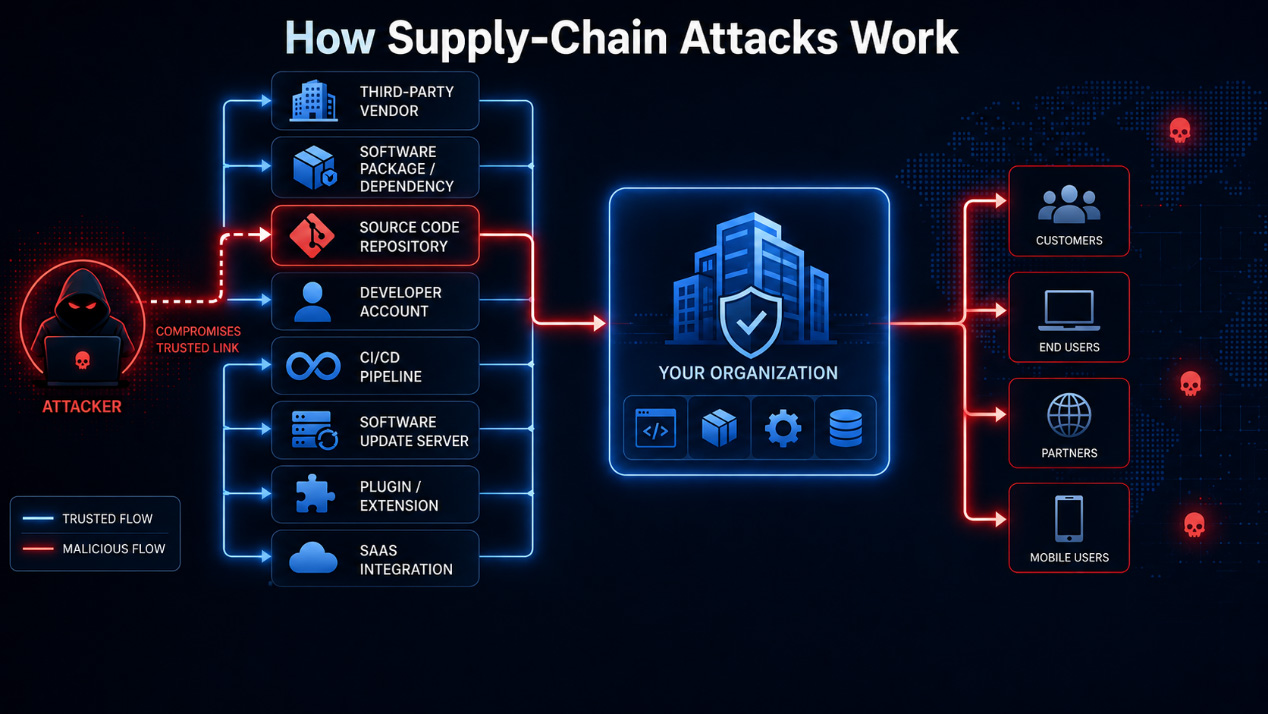
A software supply-chain attack targets the trusted tools, vendors, software components, services, or processes an organization relies on, instead of attacking the organization directly. In software, this can include compromising a third-party provider, developer account, source-code repository, package registry, CI/CD pipeline, update mechanism, plugin, or SaaS integration.
The danger is that once attackers compromise something trusted inside the delivery chain, they may be able to reach downstream customers, users, or internal systems through legitimate-looking access, updates, code, or integrations.
Software supply chain attack flow
When ordinary access becomes supply-chain relevant
One of the strongest examples observed by Flare researchers involved a post (see screenshot below) advertising GitHub-related access, including references to developer accounts, private repositories, access material, and source-code exposure.
On its own, this may look like a standard access sale. But GitHub access can be more than access to code. It may expose secrets, deployment scripts, package publishing logic, cloud credentials, internal documentation, and CI/CD workflows.
Screenshot taken from the forum
That is where the supply-chain angle begins.
If attackers gain access to a developer identity or private repository, they may be able to understand how software is built, which dependencies are used, where secrets are stored, and how updates are published. In some cases, that access can enable attacks against customers, downstream users, or other connected systems.
Advertisement
The Vercel incident in April 2026 is another useful example because it showed how a compromise involving a trusted third-party AI tool and OAuth-connected SaaS access can create a wider security concern (even when the affected company says sensitive customer data and source code were not accessed).
For analysts reviewing underground posts, the relevance is not the incident itself, which was already public, but the type of exposure it represents: trusted integrations, SaaS accounts, internal tools, environment variables, and developer platforms connected through permissions that can be abused if one link in the chain is compromised.
This is why underground posts mentioning OAuth access, SaaS tools, environment variables, or developer platforms deserve attention, even when the initial claim is limited or unverified.
From GitHub access sales to leaked vendor repositories, the warning signs exist — they’re just buried in forums and marketplaces most teams aren’t watching.
Source code is not always just intellectual property
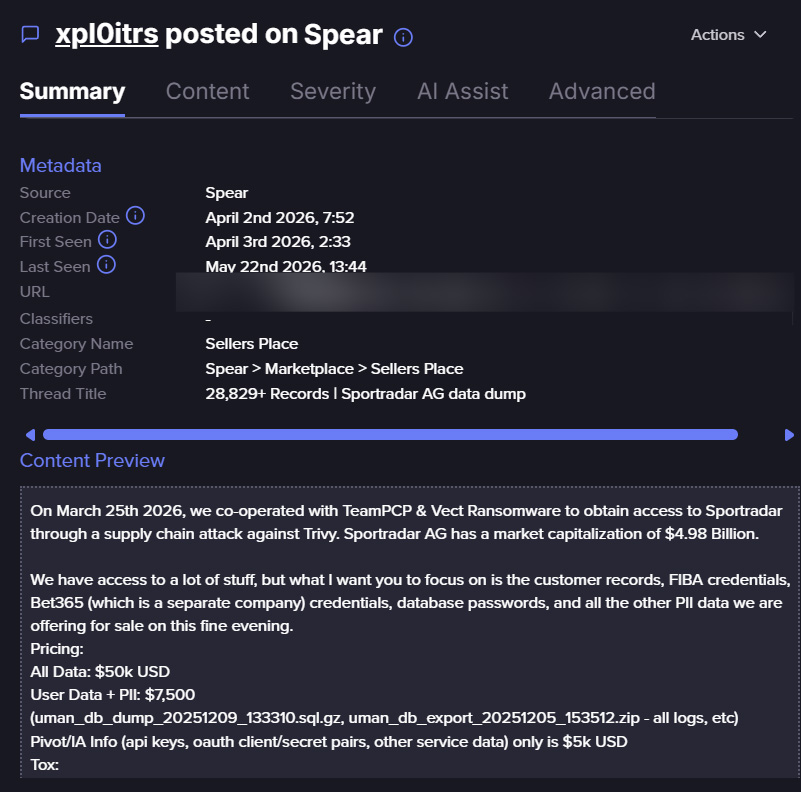
Flare researchers also reviewed posts involving alleged vendor data and source-code exposure, including claims around Sportradar AG that were later echoed in public reporting on the broader TeamPCP supply-chain campaign.
The Sportradar case was linked to a compromised Trivy scanner and included exposure of sensitive operational material such as database passwords, API key and secret pairs, Kafka credentials, and monitoring tokens.
That is what makes the case relevant beyond the immediate breach: this kind of data can reveal how a vendor’s systems are connected, which services and integrations are trusted, and which credentials may create risk for partners or customers.
Advertisement
In supply-chain investigations, those details matter because the most dangerous part of a leak is not always the stolen database itself, but the access paths and trusted relationships it exposes.
Screenshot taken from Flare’s platform. Sign up for the free trial to access if you aren’t already a customer.
A similar point appears in public reporting around TeamPCP and Mistral AI. In May 2026, reports claimed that TeamPCP was selling hundreds of alleged Mistral AI repositories. Mistral disputed parts of the claim, but the case still illustrates why source-code theft should not be viewed only as an intellectual-property issue.
Repositories may include credentials, building logic, internal service names, deployment workflows, API documentation, or references to customers and integrations.
Even when leaked source code does not provide immediate production access, it can help attackers map the environment and identify future attack paths.
Package attacks show how access can scale
The same analytical lens applies to package ecosystem incidents. Public reporting on Shai-Hulud (a self-spreading npm supply-chain attack that stole developer secrets and infected trusted packages) showed how compromised npm maintainer accounts and malicious package updates could be used to steal credentials, harvest CI/CD secrets, and propagate across repositories.
Advertisement
The significance was not only the malicious code itself, but the way trusted package publishing mechanisms were abused.
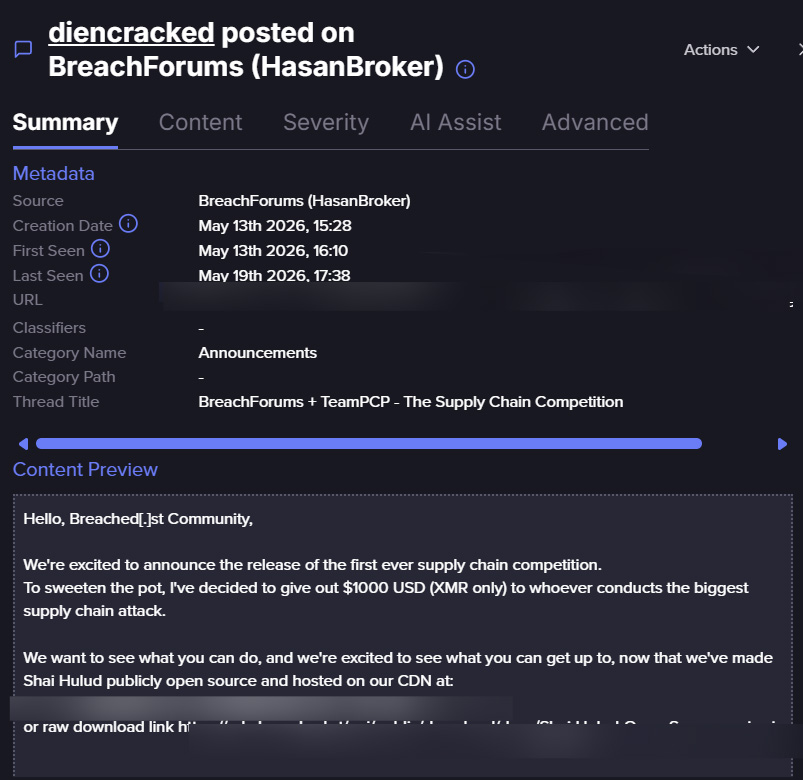
Discussions around Shai-Hulud-style activity and supply-chain attack competition were also observed. These posts were less concrete as victim leads, but they are useful as threat context. They show that actors are watching public package compromise techniques and discussing how they may be reused, modified, or extended.
Screenshot taken from Flare’s platform. Sign up for the free trial to access if you aren’t already a customer.
The LiteLLM supply-chain incident provides another recent example. Public reporting described unauthorized PyPI package publishes connected to a broader compromise path involving developer and CI/CD environments. Because LiteLLM is used as an AI gateway, the incident also shows how supply-chain risk is expanding into AI infrastructure and developer tooling.
Developer environments themselves are also becoming attractive targets. Recent reporting around malicious VS Code extensions showed how trusted development tools can become a route into repositories and credentials. Extensions, plugins, and AI coding tools often sit close to source code, terminals, tokens, and internal workflows, making them valuable even when they are not part of production infrastructure.
What defenders can take from this
The reviewed posts do not prove that every underground access sale is a supply-chain threat. They do show why security teams should ask better questions when they see posts involving source code, developer accounts, SaaS access, API keys, OAuth tokens, package ecosystems, or CI/CD material.
Advertisement
The key question is not only, “Was data leaked?” It is also, “Could this access affect how trusted software is built, deployed, updated, or integrated?”
For defenders, this means supply-chain monitoring should include more than vulnerability disclosures and package alerts. Organizations should watch for exposed developer credentials, GitHub and GitLab access, package registry tokens, leaked repositories, CI/CD secrets, cloud keys, OAuth grants, and claims involving important vendors or software providers.
The value of underground monitoring is in recognizing these early signals before they are framed as a full supply-chain incident.
Jason Fong, InvestHK’s global head of family office, said several Italian families attended the Wealth for Good in Hong Kong Summit in March 2026 and subsequently held strategic discussions with the agency. “For European families seeking new growth momentum, Hong Kong offers something that has become remarkably rare: certainty, resilience, stability, innovation and opportunity in a single jurisdiction,” Fong told the South China Morning Post.
The timing is not accidental. Hong Kong overtook Switzerland last year to become the world’s largest cross-border wealth management centre, with $2.95 trillion in offshore assets compared with Switzerland’s $2.94 trillion, according to Boston Consulting Group’s Global Wealth Report published in May. BCG projects the gap will widen to nearly $600 billion by 2030.
The city’s family office sector has expanded rapidly. A Deloitte study commissioned by InvestHK found that the number of single-family offices in Hong Kong rose 25% over the past two years to approximately 3,384 by the end of 2025, injecting an estimated $12.6 billion annually into the local economy through operating expenditures alone.
Advertisement
The tax incentives are a central draw. Hong Kong waives its 16.5% profit tax on earnings from stocks and bonds for single-family offices that hold an investment portfolio of at least HK$240 million (roughly $30.8 million), employ two staff in the city, and incur annual operating expenses of at least HK$2 million. The government is set to submit legislation this month to expand the tax exemption to cover additional investment products.
Jennifer Chan, co-founder of Orientis, a French consultancy that advises high-net-worth European clients, said geopolitical tensions have prompted some investors to reassess their global allocation. “Traditionally, European family offices tend to like to invest domestically, or they may invest in the US and the Middle East,” she said. “However, in recent years, they have started to invest in Hong Kong and other parts of Asia.”
Chan said the Middle East conflict that escalated in late February has made Hong Kong look comparatively stable. Orientis has arranged eight tours to Hong Kong for wealthy families from Germany, France, Switzerland, the Netherlands, Belgium, and Italy over the past 18 months, and some clients subsequently established family offices in the city.
The investment thesis has two prongs. The first is China’s technology sector. International investors have rushed into Chinese tech stocks since the breakthrough by AI startup DeepSeek early last year highlighted the country’s innovative potential. Chan, who is also a director of the Hong Kong Science and Technology Parks Corporation, said many family office representatives are meeting local startups at the science park, and some have already invested.
Advertisement
The second is Hong Kong property. Chan said European families believe the market has fallen significantly and shows signs of recovery, making it an attractive entry point.
Government promotion has been active. Financial Secretary Paul Chan Mo-po has led European roadshows to raise the city’s profile among wealthy families. Hong Kong’s growing role as a financial hub for Chinese technology companies adds to its appeal as a gateway for European capital seeking exposure to mainland innovation.
The institutional infrastructure is expanding to match. French insurer AXA launched AXA Global Private in Hong Kong on Monday to serve high-net-worth customers and family offices, with CEO Sally Wan saying the company was confident Hong Kong would remain the world’s largest offshore wealth centre. The platform bundles life insurance, wealth management, and succession services for wealthy families across Asia.
Cliff Ip Wang-hoi, chairman of the financial services committee for Greater China at CPA Australia, said Hong Kong serves as a gateway to mainland China and the Greater Bay Area. “The rapid development of the artificial intelligence and technology sectors in China presents substantial investment opportunities for European family offices,” Ip said.
“Asian stocks rallied Monday while oil prices tumbled,” reports CNBC, “after the U.S. and Iran agreed to a peace deal aimed at ending nearly four months of conflict…”
The strongest reaction was seen in energy markets. U.S. crude oil futures for July delivery were down 4.77% to $80.83 per barrel by 8:27 p.m. ET. Brent futures, the international benchmark, for August delivery traded about 4% lower to $83.77 per barrel. Asian equities surged. South Korea’s Kospi jumped 5.1%, Japan’s Nikkei 225 climbed 3.6%, and the broader Topix advanced 2.6%… The U.S. dollar index weakened 0.32% to 99.483, while the yield on the benchmark 10-year Treasury note fell 5 basis points to 4.423%, suggesting that investors were dialing back inflation concerns on easing energy prices. “The most immediate implication is a repricing of the inflation risk premium that markets have been carrying since the Strait closed,” said Billy Leung, investment strategist at Global X ETFs…
Besides safe-haven Treasurys, gold also rose. “Gold is the interesting outlier here,” Leung said. “In a clean risk-on trade, gold should be selling off as the geopolitical premium unwinds, but it is holding bid around $4,300, which tells you the market is not fully trusting the deal yet.” Spot gold prices were up almost 2% at $4,302.19 per ounce. That skepticism reflects lingering uncertainty around the agreement, which remains unsigned and subject to implementation risks. [Josh Gilbert, lead Asia Pacific analyst at trading platform eToro] cautioned that “the deal isn’t actually signed until June 19th, the details are still thin, and this conflict has shown more than once that headlines can turn on a dime.”
Analysts at Commonwealth Bank of Australia also stressed that the oil outlook hinges on how quickly shipping and production can normalize. Vivek Dhar, head of commodities and sustainability research at CBA, expects Brent to fall to around $80 a barrel by year-end, assuming the Strait remains open and exports recover. However, he warned that damage to refining infrastructure, the presence of sea mines and uncertainty over tanker traffic could slow the return to normal operations. Even so, he said markets are likely to take comfort from the prospect that oil flows need only recover to around 60%-70% of pre-war levels to restore expectations of a global supply surplus.
Advertisement
For investors, the biggest implication will likely be what cheaper energy means for inflation and central banks. Lower oil prices ease pressure on households and businesses while reducing the risk of a broader inflation resurgence just as major central banks enter a busy week of policy meetings. UPDATE: “A US official is rejecting Iran’s assertion that it will receive billions of dollars in frozen funds before a planned 60-day negotiating period begins following Friday’s signing of an agreement,” reports CNN:
The pushback came after Iran’s deputy foreign minister, Kazem Gharibabadi, said the next phase of talks would depend on Washington first fulfilling several obligations, including releasing Iranian funds frozen abroad.
The differing accounts underscore a significant gap between how the United States and Iran are describing what must happen before the next round of negotiations can move forward.
Apple’s WWDC went about as expected for 2026. While it’s a tiny bit disappointing, Siri AI turned out to be worth the wait, but with some painful app-based gaps.
WWDC 2026 was on Monday, and it was expected to be a bit of a slow one this time around. As predicted by the rumor mill and countless reports in the weeks ahead, it certainly wasn’t an event that shouted about many new features.
Actually, that’s not quite true. Apple did harp on about one big thing, and that was its whole artificial intelligence push.
Before the event, we knew full well that the main beats would basically be Siri and AI stuff, and a bit of periphery. I even asked for there to be something that wasn’t AI to talk about.
Admittedly, Apple did bring up other things that weren’t AI. Except they were not things I could excitedly tell my mother about when explaining the significance of Apple’s launches.
Making things more reliable and responsive? That’s nice, but that’s also what we expect from updates throughout the year anyway.
There was more talk about parental controls and Screen Time updates. This again is great for parents, as now little Timmy can be protected from blood and gore as well as unsolicited nudes.
Advertisement
But neither are things that can be enthused about to friends or people curious about what happened. “Hey, you’ll like how you’ll see confirmation codes on your iPhone screen when you phone a business number” is neat, but not sexy enough to enthuse about.
Really, the only subject worth discussing is the whole AI thing.
Shockingly more intelligent
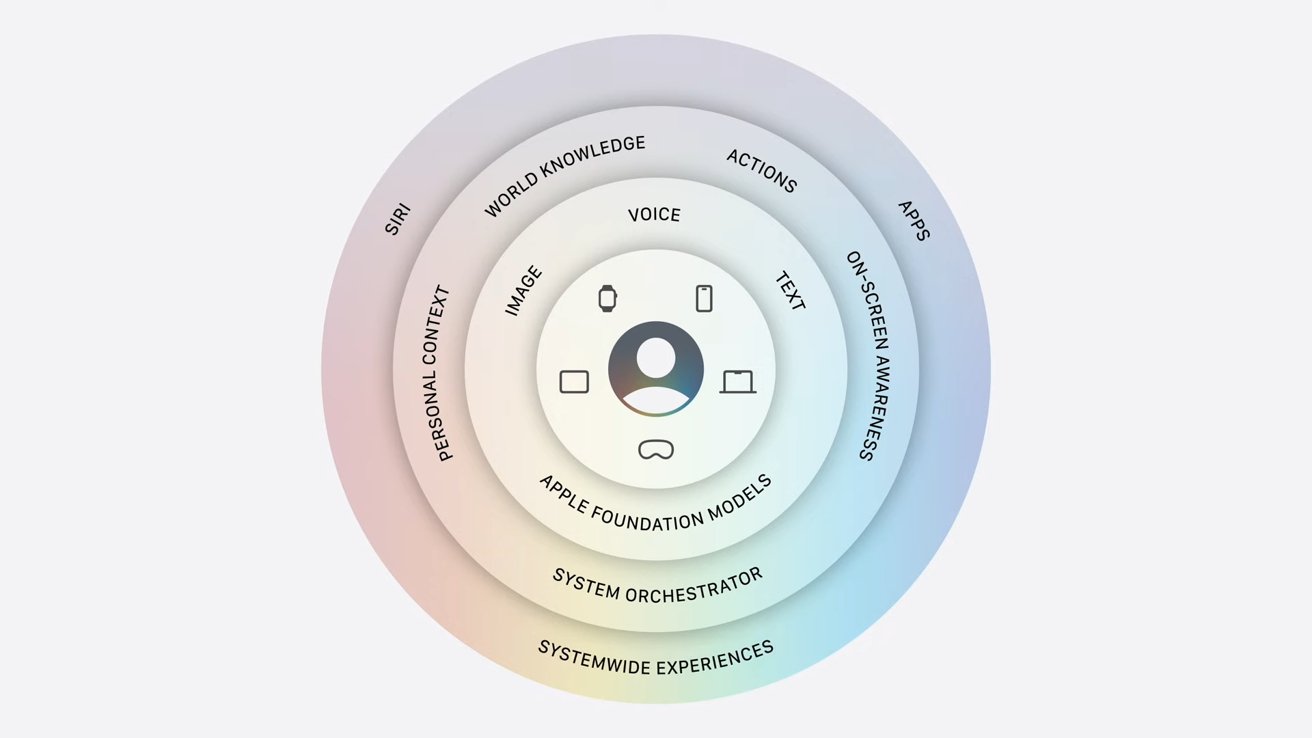
Apple went into a whole spiel about its artificial intelligence work, complete with handy circle-based graphics explaining the whole ecosystem. The whole thing of using Apple Foundation Models, a “System Orchestrator” connecting stuff together, and the “Systemwide Experiences” with Siri and Apps.
All very nice and showing in a public-friendly way how everything is interconnected and works as a giant whole, without explaining how. For Joe Public, that’s explanation enough.
Advertisement
An explanatory circle-in-circle explanation of Apple’s AI strategy. At least, it looks explanatory…
The main thing is that Apple’s two-year-late Siri upgrade has finally turned up. It’s late, but surprisingly, it wasn’t disappointing.
What Apple promoted heavily in 2024, the entire contextual-awareness thing, actually works properly. After reaching the end of the waitlist to use Siri AI, as well as the lengthy indexing process, I was able to ask some questions that could easily be troublesome for Old Siri.
The first one was simple. “Where was I born?”
Advertisement
Cue Siri coming up with the correct response of my hometown. What was unexpected was that the detail was picked up because I had a photo stored in iCloud of my passport for identity validation purposes.
Being greeted by the mugshot-like images of my passport and personal information as evidence of where it got the answer from was a bit of a shock.
A second query asking when I last went on vacation was similarly fast. This time, it used a combination of photographs and messages with my partner.
It understood we travelled to Rome in early April 2025, how long we were there for, and that we visited places like the Colosseum and the Roman Forum. Again, providing links to sources for context.
Advertisement
This is quite impressive, as is using the camera to photograph far-away slides in a presentation and asking Siri to summarize it all. The lengthy tiny print became something much easier to digest for my at-the-time tired brain and eyes.
Sure, we wanted it two years ago after Apple first demonstrated the idea. The two-year delay was made worse by seeing other AI firms developing quickly and leaving Siri in their dust.
That said, it was certainly worth the wait.
This is all something that you can enjoy in the fall if you’re not installing the developer betas. Unless you wait for the public betas, or don’t care about any risks to your data.
Advertisement
Except if you’re in the EU. That’s still a mess that Apple needs to clean up.
Massive blind spots
That said, there were some gaps in its capability. For example, it couldn’t generate a list of recent messages in Slack, nor could it work out what my mother last said in Facebook Messenger.
While my AppleInsider email is handled in the Mail app and could be accessed by Siri, my personal email in Gmail could not.
As impressive as Siri AI is, private third-party data sources are probably going to be the stumbling block. Unless apps like Gmail provide access to the data troves in some way, they will be areas that Siri won’t be able to use to help the user.
Advertisement
These data blind spots may be opened up by Google and other sources in the future. But there’s also the temptation to keep them locked off from Siri completely, if only to make their own AI services provide the same functionality.
Google Gemini already has the capability of accessing your Gmail email if you have a supported AI plan. There’s no incentive for Google to let Siri AI do the same and miss out on those consumer subscriptions.
The only bento box that mattered in WWDC 2026.
Money is always a factor in business decisions, and the massive potential of Siri could influence other big tech rivals not to play ball with Apple’s vision.
Advertisement
I may not be able to access communications from my personal email, but at least Siri can tell me what the lowest-calorie but highest-protein option available at my local KFC is for a post-gym workout.
That would be the grilled chicken salad. It was OK.
Last week’s Sunday Reboot discussed the inevitable Intel hardware and software support changes arriving this fall.
JeliLiam decided enough time had passed. The original Sonic Adventure 2 arrived on Dreamcast in 2001 and later reached GameCube players as Sonic Adventure 2 Battle. It delivered breakneck platforming, rival hedgehogs trading blows, and a story that actually mattered. Official channels never delivered a true modern version. So one dedicated creator started fresh in Unreal Engine 5 and called the result Sonic Adventure 2 Redux.
The project is accessible for free download on Game Jolt, but each new demo adds considerable content to the whole campaign. Demo 3 was only released a few days ago and appears to be the most complete yet. When people launch Demo 3, they are guided through three distinct stages that show how far the project has advanced. Pyramid Cave is a masterclass in atmosphere, with ancient stone halls and burning inscriptions lit in a dramatic way that changes as flames flicker and light bounces off the carved stone walls. Sky Rail pushes Sonic across elevated tracks high above the skies, and every boost or grind along the rails feels real. Meanwhile, Pumpkin Hill recreates the terrifying treasure hunt ambiance of the past, complete with floating platforms, concealed paths, and a sinister atmosphere that remains unsettling even in high definition.
SONIC’S COMMAND CENTER – Gaming fans ages 8 years old and up can build the LEGO Sonic the Hedgehog Team Sonic Command Truck (77006) building set for…
5 LEGO SONIC FIGURES – Sonic, Tails, and Metal Sonic minifigures plus Burrobot and Caterkiller figures speed into action as kids stage heroic…
LAUNCH & CHASE ACTION – Young gamers can deploy Tails on his ATV through the truck’s interactive launch feature while dodging attacks from the…
Plus, two new boss fights have been added to the mix. Hot Shot and Egg Golem require you to use your wits and timing in a different way than Big Foot or Shadow, but they retain the original essence while giving players more opportunities to employ speed and positioning. New animatic-style cutscenes have also been introduced to bookend certain sections and help tie the story together without requiring the full cinematic experience. The project now has enough story to tie everything together, making it feel more like a journey than a series of isolated stages.
Advertisement
Everything is built on the Azure foundation, a one-of-a-kind physics foundation that allows the main gameplay loop to shine through. This includes building speed through loops and ramps, chaining moves for a high score, and only activating the bounce bracelet or spindash when it feels right. At the same time, Azure Framework smoothes out all of the previous rough edges. Even when objects move quickly, the camera movement is smooth and steady. The controls are exactly what you’d expect from a modern game. Furthermore, the menus and on-screen text have been greatly cleaned up while maintaining their original flair.
For fans, the visuals are unquestionably the most impressive aspect of the remake. Each location has incredible detail on every surface. The stone at Pyramid Cave looks to have worn down over time. The metal in Sky Rail captures and reflects light in a very realistic way, while the character models are faithful to the original designs from 2001, but with considerably cleaner textures and smoother movements. [Source]




































































You must be logged in to post a comment Login