

Tech
James Bruton Twisted 18 Elastic Bands Into a Cart That Pushes Him Nearly 10 Meters



James Bruton has fabricated many rideable machines over the years. This one began with a simple question: could ordinary elastic bands, the thick variety offered for exercising, store enough energy to propel a full-size cart carrying a person? The solution emerged after weeks of testing, gear ratios, special plates, and meticulous winding. The final contraption rolled approximately ten meters using nothing but twisted resistance bands.
He started with a 50-millimeter resistance band suspended from a sturdy frame made of high-grade aluminum extrusion. One end was held in place, while the other was attached to a shaft that rotated on bearings from inexpensive lazy Susans. Bruton wound the band by repeatedly twisting it in his palm until it was completely knotted up. When he let go, the unwinding band turned the shaft around. Early versions, without wheels or gearing, could only travel approximately 2 meters, even with a 2-to-1 bevel gear set. Despite having excellent connection sites, the band consistently snapped or became slack in the middle.

Segway Ninebot Gokart Pro 2 – High-Speed Electric Go Kart for Ages 14+, Drift & Race with Speeds Up to…
- Extreme Speed: Race at a thrilling 26.7 mph in Race Mode, delivering an electrifying go-karting experience that leaves you exhilarated and hungry for…
- Versatile Riding Modes: Personalize your ride with ECO, Sport, Race, and Manual Modes, providing a diverse range of speed and control options to suit…
- Long-lasting Adventure: Extend your fun with a typical range of 15.5 miles, ensuring hours of non-stop excitement and enjoyment on the track without…
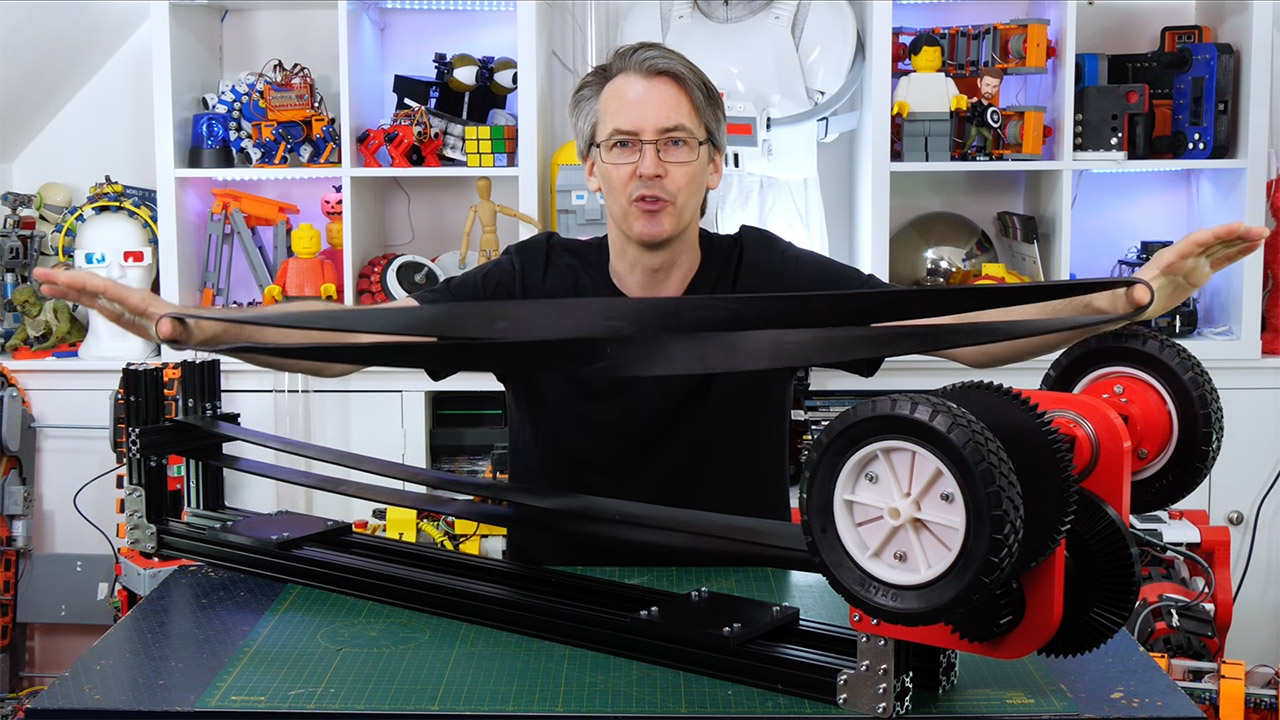
Clearly, they needed to boost torque, so he added another stage of gearing, resulting in a 6-to-1 reduction. The extra leverage allowed him to coil the band up a little further without it breaking, resulting in around 2.8 meters of travel this time. That was a nice sign, but it was clear that a single band could never carry anyone very far. Attempting to use a longer band produced its own set of problems, as the longer it became, the less efficient it became, and the twist became uneven, causing the band to bounce around rather than generate nice crisp torque.
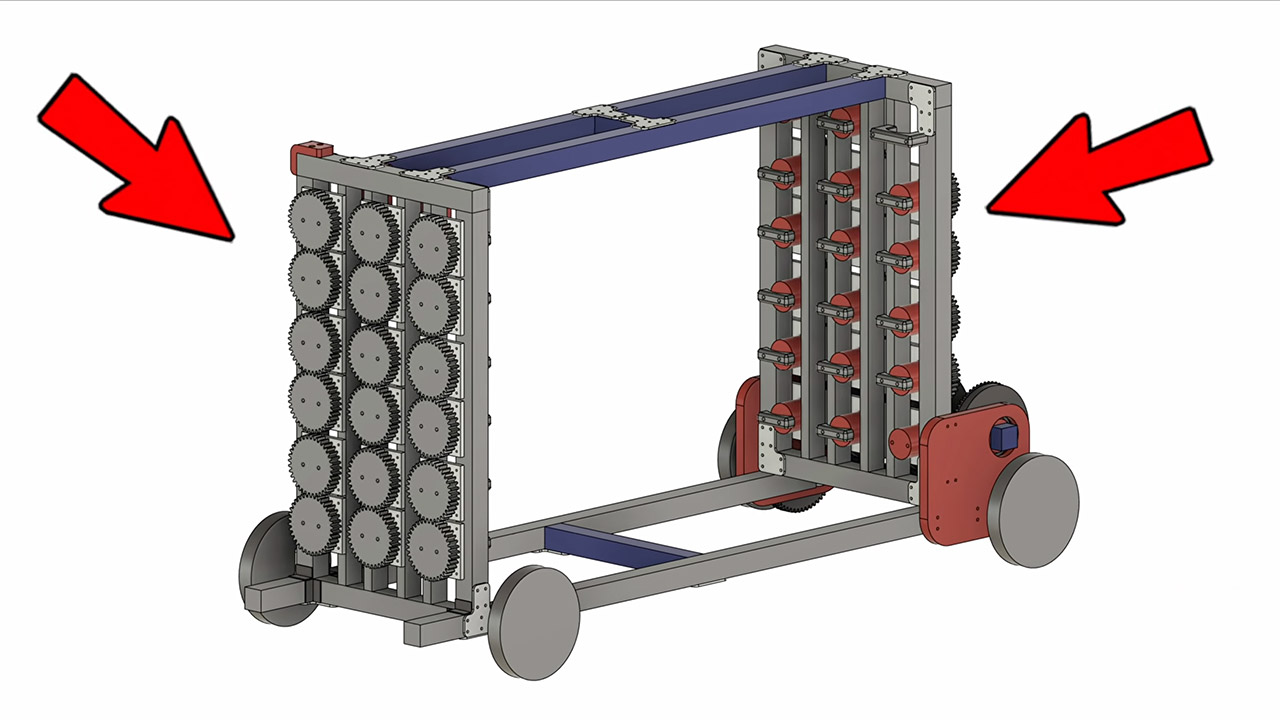
The aim was to use a series of shorter bands that worked together to increase the energy without making the whole thing overly large. Bruton devised the concept of routing the bands through additional gears, allowing them to flow back and forth inside the frame like a folded ribbon. Three columns of bands, each with six bands, totaled 18. Bevel gears at either end allow the columns to transfer their torque to a single common axle. Some unique aluminum plates were carved out using a CNC router to combine the extrusion into a beautiful solid box. A couple of vertical rails at either end ran six lazy Susan bearings each, allowing the winding shafts to spin freely.
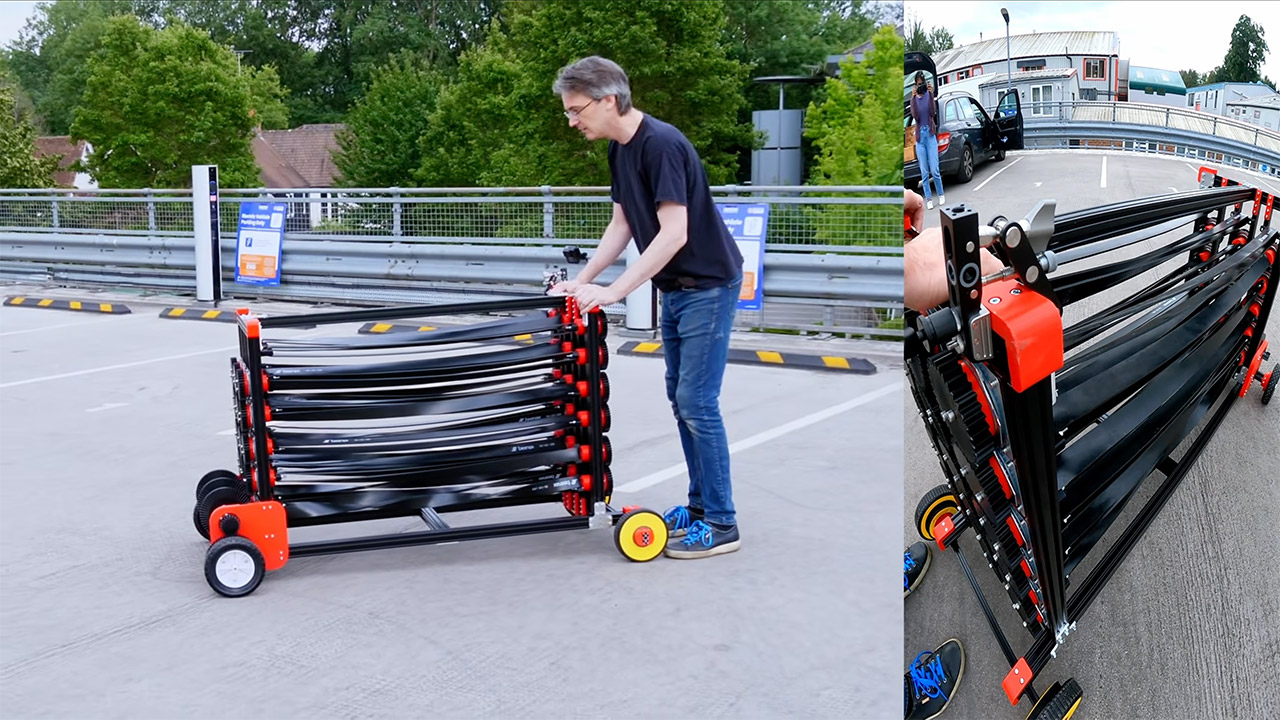
Testing is now moved outside, where Bruton winds the bands by driving the cart in reverse, allowing the wheels and gears to accomplish the hard twisting rather than raw effort. He’s taking it carefully at this point, aiming for a clean run of around 9.88 meters. That is the maximum distance the cart can travel before the front wheels lift up and prevent it from moving any farther. If he winds it up a little more, a little more “aggressive,” it adds a little more distance because of the velocity, but it also causes a problem where some of the bands are twisted a lot more than the others due to small little changes in friction in the gear box. Bands that are wound up later in the sequence frequently underperform.
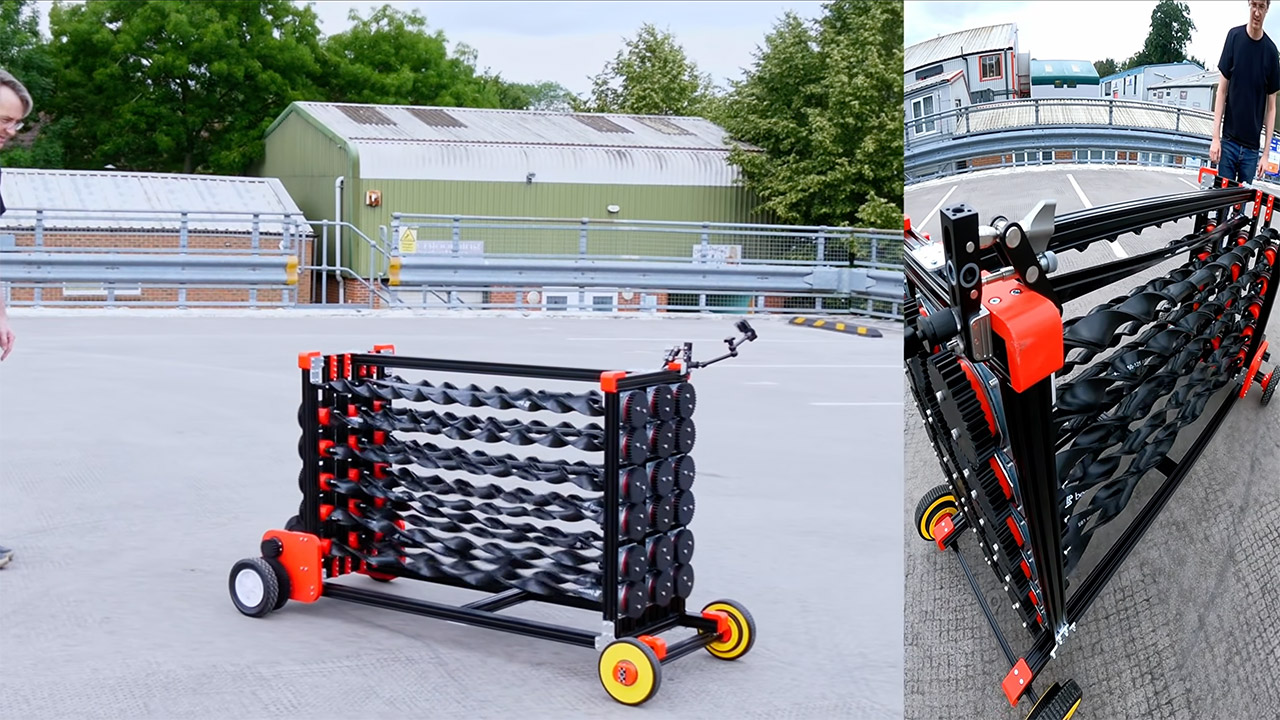
Bruton is already brainstorming about where to go next. If he winds the bands one at a time instead of all at once, he may be able to extend the power delivery and smooth out the acceleration. Alternatively, a clutch system might be an excellent option, as each stage can only begin working after the one before it has almost completely run out of gas. So far, the build has demonstrated that the main concept is viable at human scale.



SAAS
Investment bank cites messy customer data and a product that ‘just isn’t there’; Salesforce counters by saying it the fastest-growing product in its history
Salesforce’s flagship AI agent platform is struggling to convince customers of its value, according to an investment bank.
The SaaS giant has bet the farm on AI agents, hoping they will fetch and carry data from its systems into a conversational UI, according to its vision of headless CRM.
The cornerstone of the strategy is Agentforce, which the vendor promises will help customers build, test, deploy, manage, and orchestrate AI agents in the enterprise.
However, a report from KeyBanc Capital Markets cites its recent CIO survey, which found customers did not view the CRM plan favorably.
“Our checks and customer conversations have not been strong, nor has the feedback been on Agentforce. What we can piece together in the disclosed numbers does not signal building momentum and, most recently, our CIO survey delivered another blow with Salesforce being a standout for the wrong reasons,” the report says.
The report, authored by Jackson Ader, the investment bank’s managing director for software equity research, and three other analysts, says KeyBanc Capital Markets view of Salesforce was not down to the negative perception of software companies generally — the so-called SaaS-pocalypse.
“We attend more Salesforce partner and customer events than any other company in our coverage, and feedback from those customers has been consistent in two ways: 1) customers’ data is not in order to do meaningful AI work; and 2) Agentforce, as a product, just isn’t there,” it claims.
“Partners we speak with are just now beginning to convert Agentforce proof of concepts into deals in the pipeline, and more CIOs in our survey expect to deprioritize Salesforce within their IT budget than the other way around over the coming 12 months.”
A Salesforce spokesperson told The Register: “Agentforce is the fastest-growing product in Salesforce history, with customers like Engine, Falabella, and AAA going live in weeks, not months. We’re focused on helping customers move faster, including through forward-deployed engineers and out-of-the-box agents.”
The KeyBanc report says Salesforce is presiding over “aggressive price increases” while the majority of customers are “not willing to pay for AI capabilities through their CRM provider.” Salesforce, nonetheless, has retained a commanding position in the CRM market, the investment bank says.
Speaking of pricing, back in January, Gartner warned Salesforce users that a capped enterprise agreement for its AI and data platforms may not be available when they come to renew these deals, potentially meaning customers could struggle to predict costs and understand value – although Salesforce strongly disputed this contention at the time. Bill Patterson, Salesforce EVP, Corporate Strategy, told us at the time, “The claim that we are moving away from capped agreements is inaccurate.”
Meanwhile, an earlier report from global equity research firm Bernstein said Agentforce was “still in early stage of adoption” and would not drive Salesforce’s growth in the short term.
“Consumption-driven monetization at AgentForce will take longer than most expect. We also believe that AgentForce will be most successful in the company’s core CRM market and not that well-used outside the core as there are other AI platforms and many SaaS vendors and the hyperscalers are offering their own AI functionality,” the report says.
Wall Street bettors seem to share this bearishness toward the company in general, sending its stock down over 36% this year. ®

OpenAI did not agree to pay roughly $5 billion in stock for the remaining 77% of Jony Ive’s io Products because the world desperately needed another fabric-covered cylinder that can set a kitchen timer and misunderstand the name of your favorite jazz pianist.
According to a new Bloomberg report, OpenAI’s first major consumer hardware product is expected to be a portable, screenless smart speaker built around ChatGPT. The still-unannounced device reportedly includes microphones, a camera, additional environmental sensors, a rechargeable battery and mechanical components capable of moving on their own. OpenAI reportedly wants to reveal the product before the end of 2026 and begin shipping it in 2027.
OpenAI has not confirmed the design, specifications, price or release date. This is therefore not a product launch, regardless of how many tech websites have already written headlines this morning pretending that one occurred.
It is, however, the clearest indication yet of what OpenAI and Ive believe should come after the smartphone: an AI companion that lives in your home, understands its surroundings and communicates without requiring you to stare into another glowing rectangle.
That sounds more ambitious than an Amazon Echo or Google Home.
It also sounds like something Philip K. Dick would have removed from the wall with a hammer.
Related Reviews:
What Is OpenAI Reportedly Building?
The device is described as resembling a smart speaker, although that may undersell what OpenAI has in mind.
It will reportedly be able to play music and other media, answer questions, control smart home products, respond to messages and access the broader capabilities of ChatGPT. A camera and other sensors would allow it to interpret objects, people and activity in the room rather than relying entirely on spoken commands. Its rechargeable battery would let users move it around the house instead of permanently tethering it to a kitchen counter.

Bloomberg also reports that the device will use GPT-Live, OpenAI’s new voice technology. GPT-Live is designed for full-duplex communication, meaning it can listen and respond continuously, recognize interruptions and pauses, and decide whether to continue speaking or wait for the user. That should make conversations feel less like issuing instructions to a hotel-room alarm clock and more like speaking with something that understands conversational rhythm.
The strangest reported feature involves mechanical elements that move independently. Nobody outside the project appears to know whether that means a rotating camera, a speaker that physically turns toward the user, or something more disturbing that follows you into the garage during a phone call to Moscow and then into the bathroom for some deeply unauthorized OnlyFans surveillance.
A moving camera could improve visual tracking and microphone positioning. A device that nods sympathetically when you complain about the mortgage would be another matter entirely.
Previous reporting suggested a price between $200 and $300, although that figure has not been confirmed and could change before release. Reports have also pointed to a larger OpenAI hardware roadmap containing approximately five products, potentially including smart glasses and other home devices.
Why Start With a Speaker?
A speaker gives OpenAI direct access to the interface it already understands best: conversation.
Building a smartphone would require OpenAI to compete immediately with Apple, Google and Samsung across displays, processors, cellular radios, operating systems, app stores, cameras and carrier relationships. That is a wonderful way to turn billions of dollars into a warehouse filled with unsold phones.
A screenless speaker is a more manageable first step. It can rely heavily on cloud processing, use existing Wi-Fi networks and connect with services people already use. It also allows OpenAI to position ChatGPT as something that exists throughout the day rather than an app that must be opened.
OpenAI and Ive have repeatedly criticized the limitations of traditional interfaces. In announcing the io acquisition, they argued that modern AI capabilities remain trapped inside familiar products and screens. Ive and his independent design company LoveFrom now have broad creative responsibilities across OpenAI, while the former io hardware team has been absorbed into the company.
The speaker is therefore unlikely to be marketed primarily as an audio product. It will be marketed as the physical body of ChatGPT.
Whether it also sounds good remains a very different question.
Is This Really a Smart Speaker?
OpenAI will have to explain whether this is a speaker designed for music or an AI appliance that happens to contain a loudspeaker.
Amazon, Apple, Google and Sonos have spent years developing microphones, acoustic echo cancellation, multiroom synchronization, voice pickup, loudspeaker protection and room-adaptive processing. OpenAI has world-class AI researchers and an expensive collection of former Apple engineers, but it does not have an established home-audio platform.
Portable operation also creates compromises. Batteries, cameras, processors, motors and thermal management all consume internal space that could otherwise be used for drivers and acoustic volume. If the product is small enough to carry from room to room, nobody should expect it to replace a proper stereo system unless OpenAI has discovered a new branch of acoustics while the rest of the industry was attending another cable demonstration.
The product will also need broad support for Spotify, Apple Music, Amazon Music, YouTube Music, TIDAL, Qobuz and internet radio if OpenAI expects anyone to use it as a serious music source. Smart home support will require Matter, Thread and integrations with lighting, security, thermostats, cameras and appliances.
OpenAI currently controls none of those ecosystems.
That leaves partnerships, APIs and a great deal of account authorization. The AI may be clever, but it still needs permission to open your calendar, send a message, change the thermostat and play Kind of Blue from the correct service.
What Could OpenAI Offer That Amazon and Google Cannot?
The existing smart-speaker companies are hardly asleep.
Amazon’s Alexa+ already uses generative AI for conversational responses, personalization, smart home control, shopping, reservations and multi-step tasks. Amazon has also introduced Echo hardware built specifically for Alexa+, including sensor fusion intended to make the assistant more proactive and aware of what is happening in the home.
Google’s new $99.99 Google Home Speaker was designed for Gemini for Home. It supports more natural language, multiple commands within a single request, conversational corrections, smart home control and optional advanced features through Google Home Premium.
Apple has introduced Siri AI, a substantially more conversational assistant integrated across Apple devices and personal data. HomePod already offers music playback, HomeKit control, messaging and personalized voice recognition, while Apple continues to emphasize privacy and integration with the iPhone.
Sonos Voice Control is narrower, but it performs music and system commands locally without sending voice data outside the home. That is not as dazzling as asking an AI to reorganize your life, but some consumers may prefer a speaker that knows less about them and reliably plays the correct album.
OpenAI’s potential advantage is the combination of stronger conversational reasoning, visual understanding, long-term memory and agentic behavior.
The reported device may not merely wait for “turn on the lights.” It could understand a request such as, “The room is getting dark and I am starting a movie,” then lower the lights, close compatible shades, adjust the temperature and switch the television system to the correct input.
A camera could allow someone to hold up an unfamiliar cable, medication bottle, appliance component or piece of audio equipment and ask what it is. It might help troubleshoot why a television has no sound by examining the connected hardware. It could remember which family member prefers which music, when the dog was last fed or where someone left an object.
That contextual awareness is the feature most likely to separate it from a conventional smart speaker.
It is also the feature most likely to make people unplug it before Thanksgiving dinner.
AI Is Already Inside Your Headphones
The broader concept is not new. Artificial intelligence and machine learning have already become important parts of headphones, earbuds and hearing products.
Manufacturers have long used machine learning for adaptive noise cancellation, beamforming, voice isolation, personalized hearing tests and automatic transparency modes. Those systems generally analyze audio locally and adjust the hardware without attempting to become your confidant.
Generative AI has pushed headphones further.
Google’s Pixel Buds Pro 2 were designed around Gemini access, allowing users to conduct hands-free conversations with the assistant through a connected phone. Google’s Live Translate system can also provide real-time spoken translation through compatible headphones.
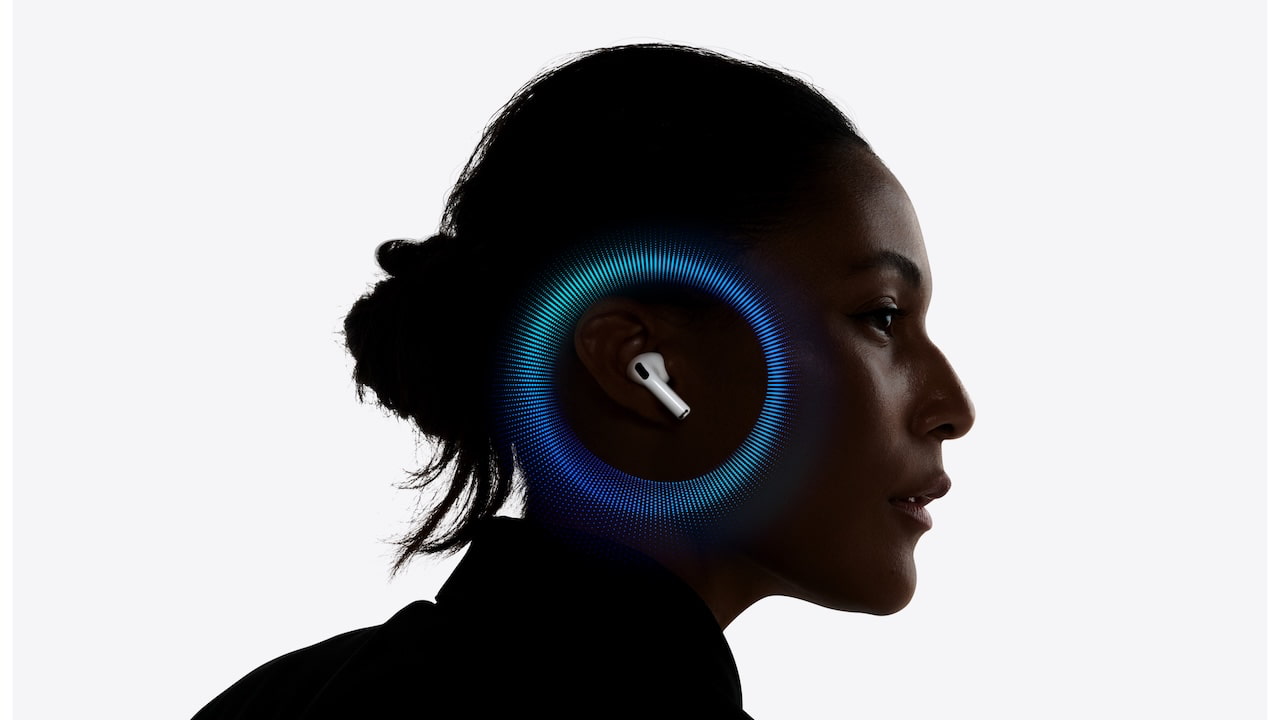
Apple Intelligence powers Live Translation through AirPods Pro 3, AirPods 4 with ANC and AirPods Max 2 when paired with a compatible iPhone. Apple also uses computational processing for Adaptive Audio, Conversation Awareness, Voice Isolation and environmental response.
Meta’s AI glasses may represent the closest current comparison to OpenAI’s reported device. They combine cameras, microphones, open-ear speakers and an AI assistant capable of answering questions about what the wearer is seeing. Unlike a home speaker, however, Meta’s glasses travel into public spaces, where everyone else gets to participate in the privacy experiment whether they volunteered or not.
The OpenAI speaker appears to take those same ingredients and place them inside the home.
Big Brother Is Listening, but Is He Recording?
Smart speakers have always created privacy concerns because their microphones must remain active enough to detect a wake word.
That does not automatically mean every conversation is uploaded or stored. Conventional smart speakers generally perform wake-word detection locally and begin transmitting audio only after activation. False activations, retention policies and human review programs have nevertheless damaged consumer trust over the years.
OpenAI has not disclosed how its hardware will handle wake words, local processing, camera data, stored memories or active listening. Until it does, nobody can honestly claim that the device will be either invasive or private.
Current ChatGPT Voice policies provide some indication of OpenAI’s approach, but they cannot be assumed to apply unchanged to future hardware. OpenAI says standard voice audio is deleted after transcription unless the user chooses to share recordings. Audio and video clips are not used for model training unless the user opts in, although transcripts may be used when the “Improve the model for everyone” setting is enabled.
A home device raises additional questions that an app does not.
Will its camera remain active between requests? Will visual analysis occur locally or in the cloud? Will it recognize individual household members? Can visitors disable it? Will parents be able to prevent children from forming persistent personal histories with the assistant? Can stored memories be inspected, corrected and permanently deleted?
There should be a physical microphone switch and a genuine mechanical camera shutter, not merely an icon that promises the software has stopped watching. Clear lights or audible signals should indicate when audio or video is being processed.
Anything less deserves suspicion.
Learning From You Could Be Useful and Uncomfortable
Personalization is central to OpenAI’s likely strategy.
A genuinely useful assistant must know which services you use, what devices you own, who lives in the house, what music you prefer and which requests require confirmation. It becomes more effective as it accumulates context.
That same context could create an extraordinarily detailed map of a household.
A camera-equipped assistant could potentially know when people arrive, which rooms they occupy, what objects they use and how they interact. Combined with calendars, messages, purchase history, music preferences and smart home activity, it might understand daily routines better than some family members do.
That information could improve accessibility, elder care, reminders and home automation. It could also become extremely valuable to hackers, litigants, insurers, advertisers or anyone who gains unauthorized account access.
The product’s commercial model matters. Powerful cloud-based AI is expensive to operate. OpenAI has not disclosed whether the speaker will require a ChatGPT subscription, include a separate monthly plan or offer reduced functionality without one.
Consumers should also ask what happens if the subscription ends or the company discontinues the service.
The Humane AI Pin provides a useful warning. Humane shut down its cloud-dependent wearable after selling parts of the company to HP, leaving the AI Pin unable to perform most of its intended functions. A sophisticated connected device can become an expensive paperweight when its servers disappear.
The Problem With an AI That Can Act
Answering a question incorrectly is irritating.
Taking an incorrect action is potentially dangerous.
A conversational AI controlling locks, appliances, purchases, messages and home security requires stricter safeguards than a chatbot generating a restaurant recommendation. Commands involving money, safety, identity or access should require confirmation and, in some cases, authentication from a phone or wearable.
The device must also understand which person is speaking. A child, visitor or television commercial should not be able to unlock a door, order $700 worth of Pokémon cards or send your employer a message explaining that you have chosen to pursue your true calling in artisanal cheese.
Hallucinations remain another concern. GPT-Live may sound natural and confident, but fluency is not the same as reliability. A voice assistant that speaks smoothly can make incorrect information feel more trustworthy because users do not see citations, uncertainty indicators or alternative answers on a screen.
A screenless interface removes visual clutter. It also removes the easiest method of reviewing what the AI thinks it heard before allowing it to act.
Why Does It Need to Move?
The mechanical movement may be functional. A rotating camera could follow the user, improve room coverage or direct microphones and speakers toward the person speaking.
It may also be intended to create personality.
Humans instinctively respond to movement, eye contact, voices and gestures. A device that turns toward someone, pauses at the right moment and remembers personal details will feel more socially present than a stationary speaker.
That could make it easier and more enjoyable to use. It could also encourage emotional attachment, particularly among children, isolated adults and elderly users.
OpenAI will need to decide whether it is building a tool or a relationship, and parents may have strong feelings about that distinction. Then again, we have already surrendered an entire generation to smartphones, social media and algorithms before breakfast. June and Ward Cleaver would probably have been removed by Child Protective Services in 2026 for allowing Wally and the Beaver to roam the neighborhood unsupervised without location tracking.
A tool should make its limitations clear. A companion is designed to make people forget them.
The Apple Lawsuit Could Complicate Everything
The report arrived only days after Apple sued OpenAI, io Products and former Apple employees Tang Tan and Chang Liu for alleged trade-secret misappropriation.
Apple claims former employees accessed confidential hardware files, engineering specifications, supplier information and unreleased product details after leaving the company. It also alleges that OpenAI recruits were encouraged to bring confidential materials and physical parts to interviews. These are Apple’s allegations and have not been proven in court. OpenAI says it has no interest in other companies’ trade secrets and is not aware of evidence supporting the complaint.
Apple is seeking damages and preliminary and permanent injunctions preventing OpenAI and the other defendants from possessing or using Apple’s trade secrets. It also wants relevant material returned and evidence preserved.
The lawsuit does not automatically block OpenAI from releasing hardware. A court would have to determine whether protected information was taken, used and connected to the products under development.
It does create risk. An injunction, discovery dispute or required redesign could delay the reported 2027 release. The case may also expose details about OpenAI’s hardware program long before Jony Ive is ready to reveal it from a perfectly lit room containing one chair and no visible cables.
The Bottom Line
OpenAI’s reported speaker could become the first smart home product to place a genuinely capable conversational AI at the center of everyday life.
Its potential advantages are substantial: natural dialogue, visual understanding, long-term context, portability and the ability to perform multi-step tasks across services. For users with disabilities, mobility limitations or complicated smart homes, a well-designed ambient assistant could be transformative.
The difficult questions are equally substantial. OpenAI must explain what the device sees, when it listens, what it remembers, where the information is processed and how much control users retain. It must create safeguards for purchases, messages, locks and other consequential actions. It also needs to prove that the product offers something a smartphone, pair of earbuds or existing smart speaker cannot already provide.
And because eCoustics readers will ask the question that most technology publications will forget, OpenAI must tell us whether the speaker can actually reproduce music without sounding like a Bluetooth-enabled soup can.
A more intelligent smart speaker could be useful.
A camera-equipped AI companion that learns the household, turns when summoned and depends on a permanent cloud connection could become the most articulate surveillance appliance ever placed on a kitchen counter. The future may not arrive wearing jackboots. It may speak softly, remember everything and ask whether we would like to renew our subscription.
Related Reading:
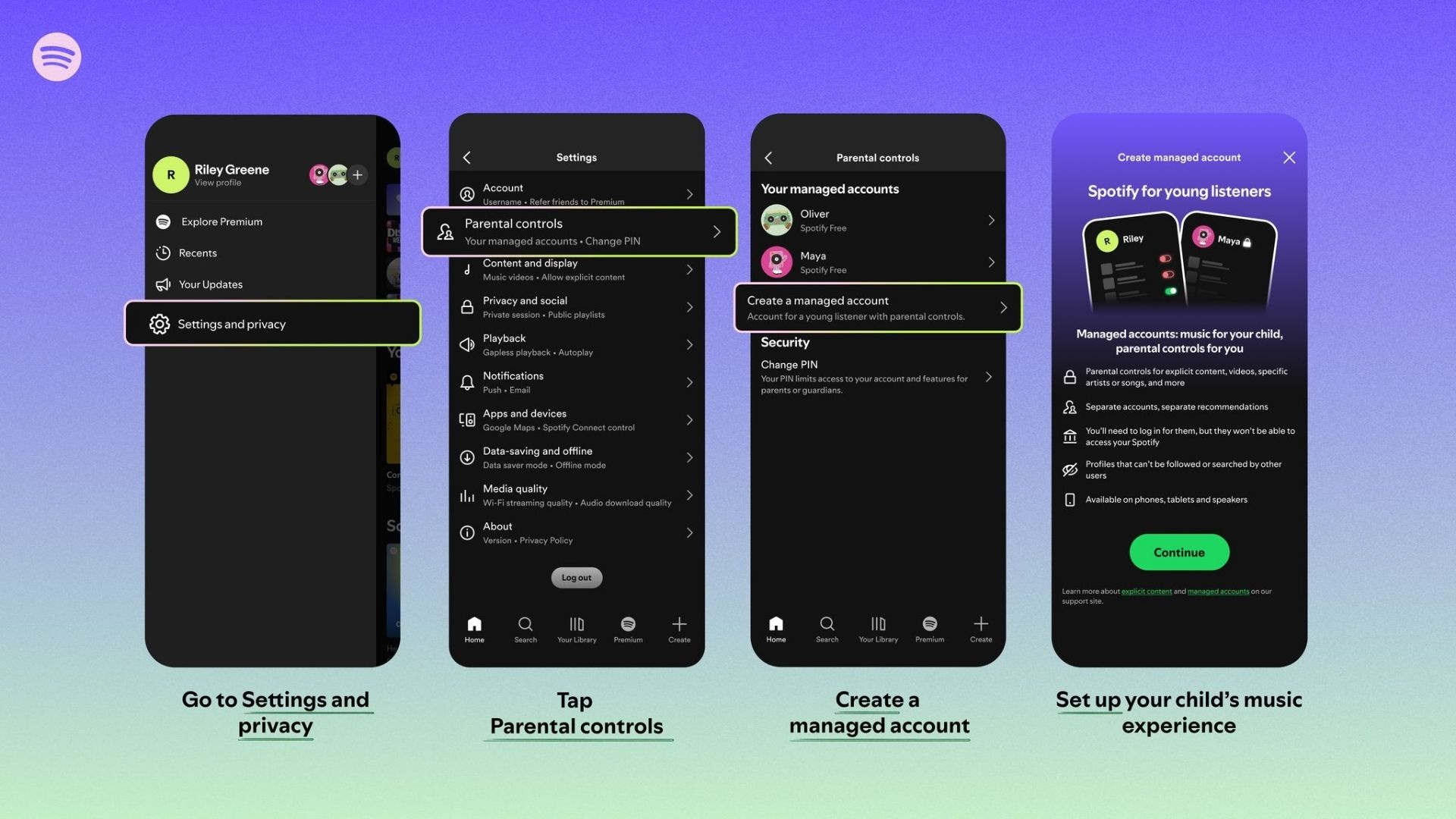
Spotify is expanding its Managed Accounts feature to users on its free, ad-supported tier, giving families a better way to separate children’s listening habits from their own alongside new parental controls and personalised recommendations for younger users.
Previously available only in certain premium family plans, Managed Accounts are designed to give children their own music-focused Spotify experience.
One of the biggest benefits is that parents will no longer have their own recommendations and annual Spotify Wrapped dominated by nursery rhymes, cartoon soundtracks or the same children’s songs played on repeat. Instead, young listeners will build their own listening history, receive personalised music recommendations, and even get their own Spotify Wrapped at the end of each year.
The child-friendly accounts are limited to music and include several safety features by default. Parents and guardians can choose to filter explicit content and block specific songs or artists if needed. Spotify has also disabled video content and Canvas looping animations by default, keeping the experience focused on music.
Young users can still personalise the service by creating their own playlists. Also, they can discover new artists through recommendations tailored to their listening habits.
Spotify has also added privacy protections. Managed Accounts are automatically set to private and unsearchable, while messaging features are disabled entirely, helping prevent unwanted contact from other users.
The move should also improve Spotify’s recommendation engine for adults. Because children’s listening activity is kept separate, parents’ Discover Weekly playlists, Daily Mixes and other personalised recommendations should once again reflect their own tastes. Family listening sessions will no longer affect these.
The expansion of the free tier means more households can use the feature without paying for Spotify Premium, making it one of the biggest updates yet to the streaming service’s family-friendly offering.
For families sharing a single Spotify account, it’s a welcome quality-of-life improvement. Children get a safer, more personalised space to listen to music, while parents finally get back recommendation algorithms that reflect what they actually want to hear.


We may receive a commission on purchases made from links.
The overwhelming majority of shoppers at Home Depot go there for tools, parts, lumber, building materials, and maybe the odd appliance or two. Even the garden center puts up pretty respectable numbers. Generally speaking, when you’re gearing up for a trip to Home Depot, it’s a targeted trip where you know what you’re looking for before you walk out the door, which is perfectly okay. Home Depot too has made quite a lot of money on that type of shopping.
However, as with most retailers these days, Home Depot has spent a considerable amount of time diversifying, either by buying up companies, or by expanding its e-commerce efforts to include other types of products. You can find some odd stuff here and there at Home Depot, like the seasonal pumpkins for carving, but you probably won’t see too many strange things just walking around the store. That particular treasure trove is almost exclusively online.
So, if you haven’t walked around the virtual Home Depot lately, you may be surprised about what you can find there. Here are some products you can buy from Home Depot right now that feel a little weird buying from a hardware store. Do note that we don’t take The Company Store or Blinds.com products into consideration here because, while Home Depot owns those brands, they maintain their own storefronts.
Paper towels and toilet paper
This one isn’t necessarily new, but it’s still a little goofy. Home Depot sells paper towels and toilet paper directly to consumers. Unlike most of the items on this list, you can actually find these in store next to the cleaning products, which we’ll include here as an honorary mention. The paper towels largely make sense. It’s nice to have a roll of those in your garage for checking oil or wiping something off. You usually want something a little more robust, like a box of white rags, which are much thicker than kitchen-use paper towels.
Home Depot leans into this as well. They own the brand HDX, which has its own line of paper towels that you can buy one roll at a time if you so choose. That one sits on the shelf right next to the Bounty paper towels that are often prominently featured in store, at least in stores near me.
The more curious product, though, is toilet paper. Home Depot sells Charmin and other brands, often in store. While I certainly appreciate the broad availability of quality of toilet paper, picking one up at the local hardware store is just flat weird, unless it’s during a product shortage. Few people have ever gone shopping for a hammer, a shovel, and toilet paper all at the same time, but apparently it happens often enough to warrant selling all in the same stores.
Cooking supplies
You can buy all manner of fun gadgets at Home Depot, but full sets of kitchen tools and cooking supplies isn’t something you’d expect to see in a hardware store. Home Depot has all sorts of kitchen stuff, way more than you would think. That includes cookware like stainless steel, non-stick, and cast-iron pots, pans, and skillets. You can also get baking sheets, bundt cake pans, cupcake pans, and basically anything else you can think of to outfit an entire kitchen with cooking surfaces. Most of the brands aren’t terribly recognizable aside from the odd Rachel Ray or Cuisinart listing, but if you look around long enough, you can find all sorts of things.
This extends into kitchen gadgets as well. Many of these are a giant waste of money, but you can find some useful stuff too, like waffle makers, countertop griddles, blenders, and things like that. The brands for these products are typically on par with what you’d find at Target, Best Buy, or other retailers where you would normally go to shop for this stuff.
Usually, Home Depot is a place where you go to buy things to fix your kitchen, not stock it with everyday cooking items. And yet, clear as day, Home Depot has so many of these products that you can outfit an entire kitchen if you wanted.
Sporting gear
Home Depot also sells sporting goods, although not quite in the same way as a dedicated sporting goods store or a variety store like Walmart would. You can’t find things like balls, bats, hockey sticks, gloves, skates, or any of that stuff at Home Depot. We checked. What you can find, though, are secondary and tertiary pieces of equipment that kind of stick out like a sore thumb in Home Depot’s lineup. These include things like full-sized basketball hoops, both portable and permanent, hockey nets with practice targets, and even pop-up batting cages.
This is a rather strange assortment of sporting goods, and it’s a little weird that Home Depot doesn’t lean into it a little more. These products seem like they’re mostly for establishments, like recreation centers or batting cages, rather than for someone at home. That’s the only explanation I can come up with for why Home Depot would sell a ball rack, but no balls to put on the rack.
Generally speaking, you can find all of this stuff at a proper sporting goods store like Dick’s Sporting Goods while also being able to get the entire assortment of things you’d need to play sports, and some other things that might come in handy. It doesn’t make any sense to go to Home Depot to buy a hoop and then to another store to buy a ball. You may as well just get everything in one spot.
Real urine
If you search for urine at Home Depot, the first thing you’ll be met with is pet cleaners. The selection is actually pretty good, and includes brands like Nature’s Miracle, which I’ve been using for years to clean up after my dogs. Those are weird enough to get from a hardware store since pet stores exist, but we already talked about cleaning products earlier. If you keep scrolling and keep your eyes peeled, however, you’ll run into something even weirder. You can buy actual urine from Home Depot.
There are two main use cases for owning a jug of urine. The first is hunting. Hunters use it to mask the scent of humans and to attract deer, making them easier to hunt. However, wildlife authorities have been banning the use of urine over the last two decades to help contain the spread of chronic wasting disease in deer and elk. That’s why the urine you can find at Home Depot is not for hunting.
The urine sold at Home Depot is actually for home use and comes from the many predators native to North America, like foxes, coyotes, and wolves. You spray this along the outskirts of your property to keep those predators from getting inside and damaging your house, lawn, pets, or livestock, if you have any. There’s nothing unusual about this, but no matter how you swing it, logging onto a hardware store to buy a gallon of urine is a little strange.
Brewing supplies
Arguably the weirdest thing that you really don’t expect to find at a hardware store is an alcohol still. These are designed for brewing your own adult beverage, however in the U.S. the distillation of alcohol at home is still generally illegal on a federal level. You may need a permit to use one of these machines for distilling alcohol. The distillers available at Home Depot all aren’t name brands, but they seem to work just fine for most users.
You can also buy the airtight bottles used to seal in the carbon dioxide when brewing beer, making Home Depot a one-stop-shop for this kind of equipment. You can also get fermentation bottles. These have airlocks at the top to let gasses escape and are normally used for things like sourdough starters and pickling, but can be used to make mead as well. Home Depot also sells mason jars if you need something to store your mead. Just make sure to sanitize them first.
Home Depot never really comes across as a place to go for making your own alcohol, but it does have a surprising amount of equipment for the endeavor. The only downside is that it doesn’t have yeast or any of the other ingredients you need to actually make these things, so you’ll have to get those elsewhere.

The EPA-rated range on your electric vehicle will likely differ from the real-world range you get — and by that, it means real-world range is usually a lot lower, but that’s because people are using their vehicles a lot differently in the real world than the automaker usually expects. For example, a Cybertruck owner recently owed a 6,500 lb boat for 350 miles, giving car enthusiasts a closer look at how heavy towing impacts an EV’s range.
Ahead of the Cybertruck’s launch, Tesla claimed it would have a 500-mile range. Once it was released and tested, the controversial EV was confirmed to have 325 miles of range. In Inside EVs‘ real-world testing, it only made it to 252 miles. While towing a 6,500-pound boat, the owner reported the Cybertruck made it 170 miles — driving 145 miles and leaving 25 miles of reserve in case of wind, traffic, or simply going the wrong way. Why did towing a boat make the Cybertruck lose so much range?
Why did the Cybertruck lose range while towing a heavy boat?

Contrary to what some may believe, the lost range wasn’t due solely to the boat being heavy. At 6,500 pounds, the boat is below the Cybertruck’s 11,000-pound tow rating (also much lower than the claim before its launch). There are a few other factors at play. “Overall this trip went way better than planned,” the Cybertruck owner wrote on Facebook. “Going faster killed range and meant more charging stops. So paradoxically, driving slower (55mph) made us reach our destination quicker.”
Going faster will use up more battery in all EVs, and that’s especially true with a boat behind you, since you’ll need to accelerate faster to reach higher speeds and brake harder to stop in time at those speeds — not to mention the added drag. Towing will lead to more charging stops, and some of those charging stops may not have room for a 6,500 lb boat. You’ll definitely want to plan your trip with these charging stops in mind, since the trip will be a lot slower with the boat in tow – each charging stop may take 45 minutes to get back up to 80%, depending on the charger you have stopped at.
If you want to make less frequent stops in an EV while towing a boat, you’d maybe want to consider the Chevrolet Silverado EV, which has an EPA-rated 492 miles of range and a 12,500 lb towing capacity. However, the Cybertruck really isn’t that far behind the competition, and while the strange-looking vehicle has other shortcomings, leading to frequent Cybertruck sales drops, this experiment actually proved the Cybertruck quite capable when it comes to heavy towing in an EV.

OpenAI’s first hardware device is a limited-edition desktop keypad called the Codex Micro that lets users monitor and control AI coding agents. Axios reports: Codex Micro is a collaboration with Work Louder, a boutique hardware company known for customizable mechanical keyboards and shortcut controllers for developers and designers. The small, square macro pad — with backlit keys, a rotary knob and a tiny joystick — sits beside your regular keyboard as a physical shortcut box for common Codex actions and shows the status of your agents. The keys are customizable and include a push-to-talk option as well as a dial to adjust your reasoning setting. Codex Micro is a niche device for Codex power users and will only be available until it sells out. It’s priced at $230.

FreeBSD 16 has removed the last GPL-licensed code from its base system, retiring the old GNU ‘dialog’ implementation after the installer moved to ‘bsddialog’ and the final dependency was disabled. Phoronix reports: This ticket to retire dialog was opened back in February while is now merged to the FreeBSD source tree for what will become FreeBSD 16.0. With dialog removed, the latest FreeBSD code now retires the GNU sub-tree of the FreeBSD base system now that no more GNU code remains. FreeBSD 16.0 is working its way toward release that is expected to happen in December 2027.


Emergent’s vibe coding platform hit a $1.5bn valuation a year after launch. Its founder says most businesses do not need software, they need a way to turn how they work into it.
“Most businesses don’t need any software. They need a way to turn how they actually work into software.” That is how Mukund Jha pitched his startup as he announced it had become a $1.5bn unicorn.
Emergent, the vibe coding platform Jha runs with his twin brother Madhav, has raised a $130m Series C. The round values it at $1.5bn, about five times its valuation in January. That makes Emergent a unicorn roughly a year after its 2025 launch.
Creaegis, a private equity firm, led the round. Claypond Capital and Sentinel Global co-led. Earlier backers Khosla Ventures, SoftBank’s Vision Fund 2, Lightspeed, and Y Combinator returned. Total funding now reaches $230m.
An engineering team in a box
Emergent lets people build full software by typing plain-language prompts. Autonomous AI agents write the code, then handle hosting, testing, and deployment. Jha says 70% of its users have never coded.
“You’re basically getting an engineering team in a box,” he told TechCrunch. The company says more than 12 million apps have been built on the platform in a year. Jha puts annual revenue at a $120m run-rate, with 200,000 paying customers.
These are not just websites. Users build CRMs, inventory systems, and marketplaces. Jha points to an Ohio roofer who replaced five tools with one system, and a Florida car detailer who rebuilt his site in four days. Software that once cost six figures, he says, now costs a few thousand dollars.
A crowded, expensive race
Emergent is chasing the same wave as some of the most richly valued startups in tech. Lovable is reportedly seeking a $13.2bn valuation. Anysphere’s Cursor was bought by SpaceX for $60bn in June. That boom has also flooded app stores with a surge of AI-built apps.
Against those numbers, $1.5bn looks modest. Emergent’s bet is a different customer. It targets small businesses and solo founders, not the professional developers who lean on Replit and Cursor. Jha calls Replit his closest rival.
He is candid about the limits. He admits design is a weakness, noting that many AI-built sites look alike. Success rates, he says, are still lower than he wants them to be.
What Emergent does with the money
Most of the cash will go to hiring and research. Emergent wants to lift its success rates and support more complex apps, including ones that run on open-source models. It is weighing a European office and expanding in San Francisco.
Jha’s ambition is bigger than an app builder. He wants Emergent to become “the operating system for businesses,” and is putting $200,000 into two builder contests to draw more people in. If software itself gets solved, he told Business Insider, builders will simply move on to harder problems, from quantum computing to drug discovery.

Microsoft just released the third edition of its AI in Education Report, surveying more than 3,000 students, educators and leaders across six countries. Ira Apfel sat down with Pat Yongpradit, general manager of global education and workforce policy at Microsoft, which sells AI tools including Copilot to schools, at ISTELive 26 in Orlando, to talk through what the data reveals about daily use, trust, training gaps, and where the policy backlash against AI in schools may be headed next.
Pat Yongpradit on Adoption, Trust and Cheating
Yongpradit walks through why daily AI use in schools still lags far behind overall adoption, even though nine in 10 educators, students and leaders report having tried the tools at least once. He addresses the recent drop in student optimism, framing it as a predictable dip on a familiar technology adoption curve rather than a warning sign.
The conversation also covers the wide gap between how much training school leaders believe their staff have received and what teachers and students say they have actually experienced. Yongpradit also shares his candid take on academic integrity, arguing that the panic around cheating has more to do with long-standing temptation than with any single tool.
Listen to the episode:
Stories Mentioned in This Episode
2026 AI in Education Report by Microsoft
This Week with EdSurge is a weekly podcast from EdSurge. Subscribe to EdSurge newsletters for more news and analysis on education and technology.

Verdict
The Nothing Phone 4(b) is a capable budget Android handset with a clean OS, avant-garde looks and excellent battery life. Its internal power is fine for the price, although lacking against some of the competition, and the dual camera array is mostly fine for the price.
-
Classic Nothing design
-
Solid internal grunt
-
Excellent battery life
-
Screen is dimmer than some rivals
-
A fair bit dearer than the last CMF phone
-
Performance isn’t as strong as rival devices
Key Features
-

Review Price:
£299
-
Snapdragon 6 Gen 4 SoC
The Phone 4(b) has a decent mid-range Qualcomm chip inside to offer solid day-to-day performance.
-
50MP + 8MP camera system
It features a dual camera setup with a 50MP main sensor and 8MP ultrawide, meaning no dedicated telephoto lens is present.
-
Signature Nothing design
In spite of being a more affordable option, this handset retains Nothing’s signature industrial design and unique elements.
Introduction
The Nothing Phone 4(b) is the first of a new kind of phone for the London-based brand.
The budget phones sector was rocked by the decision from Nothing that it wasn’t going to release a sequel to the excellent CMF Phone 2 Pro this year, and instead chose to launch a spiritual successor under its own Nothing branding.
To this end, the Phone 4(b) is in essence a cut-down and more affordable version of the Nothing Phone 4(a), featuring a Qualcomm Snapdragon 6 Gen 4 SoC with 8GB of RAM and 128GB of storage, plus a 6.77-inch Super AMOLED screen and a 5200mAh battery inside.
Priced at £299/$399, it’s more expensive than the older CMF Phone 2 Pro, although it makes a few key upgrades and positions this new Nothing handset against the likes of the Motorola Moto G86 5G and the Poco X8 Pro.
To see if the Phone 4(b) can come out on top as one of the best cheap phones we’ve tested, I’ve been putting it through its paces for the last week or so.
Design
- Solid polycarbonate chassis
- Typically Nothing design
- IP64 water and dust resistance
Nothing’s phones have always had a certain look to them, and the Phone 4(b) sticks with its tried-and-tested formula of being funkier and more interesting than a lot of its contemporaries. You either like it, or you don’t, and admittedly, I’m quite a fan of it.
It is made of polycarbonate (plastic), as you’d perhaps expect for a more affordable handset, but I won’t hold that against Nothing with this phone. It’s comfortable to hold and feels quite durable compared to other cheaper phones out there. There isn’t any creaking or twisting at the corners, either.

As for colour options, the Phone 4(b) is available in black, white, or blue. My sample is the latter, adding a pleasant pop of colour against the other options, and certainly helping it to stand out.
The rear portion features a rectangular camera bump that doesn’t protrude too far from the main chassis, keeping the phone stable when you set it down. It comes with Nothing’s typical retro-futuristic touches, alongside a downsized Glyph Bar borrowed from the Phone 4(a).

The Glyph Bar has long been Nothing’s calling card when it comes to its phone design, and it achieves much of the same use cases as with the brand’s other phones. It can do everything from lighting up for notifications from specific people to letting you check charging progress, counting down shutter timers for the camera, or even pulsing red for severe weather alerts.
Ports are standard fare for a modern phone, with a USB-C port for charging and a SIM slot off to the left. There aren’t any other frills, either, such as a headphone jack or a microSD card slot for expandable storage.

We’ve got IP64 water and dust resistance for the Phone 4(b), which should protect it well against water and dust. This is ahead of the IP54 rating on Nothing’s own CMF Phone 2 Pro, although behind the IP68/IP69 rating of the Motorola Moto G86 5G.
This handset doesn’t ship with a charger in the box, although you at least get a USB-C to USB-C cable and a clear silicone case to help protect the phone.
Screen
- 6.77-inch 120Hz 1080×2344 AMOLED
- 2000 nits peak HDR brightness
- Optical fingerprint sensor
Nothing has kitted the Phone 4(b) out with a large 6.77-inch Super AMOLED screen with a 1080×2344 resolution. This makes it one of the larger screens kitted out to a phone at this price.
The resolution is more akin to HD, which provides reasonable detail at the price, plus as an AMOLED choice, there are deep blacks and good contrast to my eye.

If there’s one area where the Phone 4(b)’s screen isn’t quite as strong as its rivals, it’s brightness. A typical peak brightness of 1200 nits gives images some pop and means this phone is fine for brighter conditions, although the 2000-nit peak for HDR content isn’t as vivid as on other budget phones.
It’s up to 120Hz of refresh rate here, which gives an added slickness against the 60Hz we were stuck at for a long time, although the screen here lacks the more advanced LTPO tech we see in costlier phones, meaning the variable refresh rate works in a blockier manner. For the most part, the Phone 4(b)’s panel sticks at 120Hz in my experience, which isn’t much of a hardship.

Nothing has also included an optical under-display fingerprint sensor for this phone, mounted quite low down on the panel. It’s fine to use, although not quite as good as the ultrasonic ones seen on higher-end devices.
Cameras
- Main rear camera is reasonable
- Lack of a telephoto leaves long-range photography fuzzy
- Decent selfie camera and okay video options
In terms of cameras, the Phone 4(b) slices off the telephoto shooter found on the Phone 4(a) and opts for a dual-camera arrangement. The main camera is a 50MP 1/2.76-inch sensor optically stabilised snapper with an f/1.8 aperture, which is joined by an 8MP 1/4-inch ultrawide sensor with an f/2.2 aperture.
By default, the main sensor chucks out 12MP images, although you can switch to the camera’s 50MP mode to make full use of the resolution on offer for more detail, dynamic range and inherently larger file size.

Out-of-the-box images with the main snapper are perfectly pleasant, with natural colours and solid detail resolution. In general, the 12MP mode offers richer colours, while using the full 50MP resolution will give you stronger detail.
By comparison, the 8MP ultrawide is lacking in overall detail and only provides images I’d describe as serviceable at best. Finer portions are fuzzier if you pixel-peep.

The lack of a telephoto lens is the downfall of the Phone 4(b)’s camera setup, as it means anything beyond a simple 2x or 3x zoom can cause detail to fall off dramatically. For instance, the images taken of Spinnaker Tower beyond the advised 2x on the phone’s camera leave a lot to be desired, with a digital crop nowhere near as effective as proper optical zoom. A dedicated telephoto would have resolved the fuzziness and given a lot more to work with.

For selfies, the 16MP snapper on the front is okay, with good richness of colour and a pleasant, vibrant tone. Video capabilities in any guise are locked to a max of 1080p/60fps or 4K/30fps, which is fine, if unremarkable.
Performance
- Reasonable mid-tier Qualcomm SoC inside
- Solid speed for more basic tasks
- More advanced 3D loads can lead to stutters
Inside, the Phone 4(b) is brought down a peg or two against its dearer brother by coming with a Qualcomm Snapdragon 6 Gen 4 SoC, paired with 8GB of RAM and 128GB of storage as its only configuration.
With this in mind, performance is stronger against the likes of the Xiaomi Redmi Note 15 4G model, with a much stronger CPU and GPU in the customary Geekbench 6 test. From Nothing’s own canon, the cheaper CMF Phone 2 Pro is rather similar in its performance, while last year’s Phone 3(a) is also faster than the 4(b) in this regard.

For general use, things are better than the benchmark numbers would suggest, with zippy performance navigating the operating system, streaming music or video or dealing with social media in my usual workflow.
In terms of 3D performance, more casual titles such as COD Mobile or PUBG fare absolutely fine, just as long as you’re happy to turn down some graphics settings for a smoother feel. With this in mind, don’t expect to be playing heavier and more intensive titles, as the 3DMark Wild Life Extreme test posted single-digit frame rates for one of the lower scores I’ve seen.

For more prolonged intensive loads, expect this Nothing phone to get a little on the warm side, although it wasn’t uncomfortable to the point I had to put it down. The Phone 4(b)’s vapour chamber cooling apparatus seems to do its job decently well.
Test Data
Nothing Phone 4(b)
Xiaomi Redmi Note 15 4G
CMF Phone 2 Pro
Nothing Phone 3a
Geekbench 6 single core
1090
738
1003
1164
Geekbench 6 multi core
3177
1990
2910
3273
Geekbench 6 GPU
2912
1307
–
–
3D Mark – Wild Life
965
350
852
1057
3D Mark – Wild Life Stress Test
99.2 %
99.1 %
–
–
Software & AI
- Monochromatic Nothing OS or stock Android looks available
- Very basic AI features against rivals
- Reasonable OS and security update commitments
The Phone 4(b) comes with Nothing’s own Nothing OS 4.1 Android skin out of the box that’s based on Android 16. When you first set the phone up, you get a choice between a stock Android lock or the monochromatic, retro-future aesthetic Nothing offers.
I went full Nothing, and opted for its own skin, which is an interesting look against other budget Android phones out there. App icons appear in white on black circles, and it can be a little difficult to distinguish one app icon from another at first. If you’d prefer, going back to the more colourful traditional Android aesthetic is a few taps away in the settings menu.

With this in mind, I didn’t find any bloat or unwanted crud here, and the OS is remarkably clean for such an affordable phone. The OS itself has some useful features, such as a hidden vault called Private Space to store sensitive documents and photos, as well as its clever freeform window sizing where you can make any app any size, which is neat.
Pressing the Essential key on the phone’s left side opens up the Essential Space, where the Phone 4(b) uses AI to organise screenshots, recordings and notes, auto-generating summaries, reminders and any to-do lists from the information you saved.

That’s as far as AI seemingly goes on this Nothing phone, though. There doesn’t seem to be any more AI gubbins here, such as for photo editing as we see on lots of other phones up and down the price ladder.
For the Phone 4(b), Nothing is committing to six years of security updates and three years of Android updates, giving some peace of mind for long-term use.
Battery Life
- 5200 mAh battery
- 33W wired charging
- No wireless charging support
The Phone 4(b) features a 5200mAh battery inside, which is ironically the largest battery Nothing has ever fitted to one of its phones, in spite of it being the most affordable Nothing-branded handset. For reference, the Phone 4(a) comes with a 5080mAh cell.
The brand says that works out to enough for 22 hours of video streaming. In my experience, I managed around eight hours of screen-on time of use when it came to an intensive day of multitasking and using my phone as normal at more middling brightness levels.

For reference, that’s scrolling my social media, streaming music through Tidal or Plexamp, taking the odd photo when out and about, and dealing with a small amount of work in a pinch in Google Docs.
For a more scientific test, a cursory run of the PCMark Work V3.0 battery test at 50% brightness worked out to nearly 17 and a half hours of use – a fantastic result.

The Phone 4(b) supports up to 33W wired charging with no wireless charging support, which lags behind a lot of its key rivals. In using my 66W 6A charger to put some go-juice back into the handset, it also proves to be quite slow, taking 57 minutes to get back to 50%, while a full charge took 100 minutes.
Should you buy it?
You want an affordable Nothing phone
The Phone 4(b) is the cheapest Nothing-branded phone out there, and if you want the brand’s unique features and design, it’s the most affordable way to do it.
You want a brighter screen
Against some rivals, this Nothing handset lacks some vividness with its screen and has less in the way of overall detail, too.
Final Thoughts
The Nothing Phone 4(b) is a capable budget Android handset with a clean OS, avant-garde looks and excellent battery life. Its internal power is fine for the price, although lacking against some of the competition, and the dual camera array is mostly fine for the price.
It makes several key upgrades to the CMF Phone 2 Pro, such as with battery life, dust and water resistance, and by sticking with Nothing’s own design philosophy, although it feels a little baffling considering the Phone 4(b)’s screen is dimmer, and it isn’t much more powerful. Bear in mind the CMF option is also nearly £100 cheaper, too.
Elsewhere, the Motorola Moto G86 5G has a slightly higher-res screen, similar performance from its MediaTek Dimensity 7300 SoC and a similar camera array to the Phone 4(b) while costing £20 less. Its OS is much more chock-full of bloatware than Nothing’s, though, so it’s swings and roundabouts.
With this in mind, the Phone 4(b) is an interesting choice if you want an affordable handset with Nothing’s typical flair and interesting design, and seems like it’s going to be the way the brand does things going forward. For more choices, check out our list of the best cheap phones we’ve tested.
How We Test
We test every mobile phone we review thoroughly. We use industry-standard tests to compare features properly and we use the phone as our main device over the review period. We’ll always tell you what we find and we never, ever, accept money to review a product.
- Used as a main phone for a week
- Thorough camera testing in a variety of conditions
- Tested and benchmarked using respected industry tests and real-world data
FAQs
The Nothing Phone 4(b) has a 5200mAh battery inside, which is the biggest Nothing has ever fitted to one of its devices.
Test Data
| Nothing Phone 4(b) | |
|---|---|
| Geekbench 6 single core | 1090 |
| Geekbench 6 multi core | 3177 |
| Geekbench 6 GPU | 2912 |
| Max brightness | 2000 nits |
| 1 hour video playback (Netflix, HDR) | 4 % |
| Time from 0-100% charge | 100 min |
| 3D Mark – Wild Life | 965 |
| 3D Mark – Wild Life Stress Test | 99.2 % |
Full Specs
| Nothing Phone 4(b) Review | |
|---|---|
| Manufacturer | Nothing |
| Screen Size | 6.77 inches |
| Storage Capacity | 128GB |
| Rear Camera | 50 MP, f/1.8, (wide), 1/2.76″, PDAF, OIS, 8 MP, f/2.2, 15mm, 120˚ (ultrawide), 1/4.0″, 1.12µm |
| Front Camera | 16 MP, f/2.4, (wide), 1/3.0″ |
| Video Recording | Yes |
| IP rating | IP65 |
| Battery | 5200 mAh |
| Fast Charging | Yes |
| Size (Dimensions) | 78.2 x 159.4 x 8.6 MM |
| Weight | 210 G |
| Operating System | Nothing OS 4.1 (Android 16) |
| Release Date | 2026 |
| First Reviewed Date | 15/07/2026 |
| Resolution | 1078 x 2344 |
| HDR | Yes |
| Refresh Rate | 120 Hz |
| Ports | USB-C |
| Chipset | Qualcomm Snapdragon 6 Gen 4 |
| RAM | 8GB |
| Colours | Black, White, Blue |
| Stated Power | 33 W |
| UK RRP | £299 |
| USA RRP | $399 |

CI BECCANO MANGIARE AL SUPERMERCATO #streamhouse #money #teknoyd #memes #troll #ussa

PSNI concerned for welfare of missing man last seen over a week ago
United Airlines Holdings earnings beat by $0.14, revenue topped estimates

No Jackpot Winner as $257 Million Prize Rolls Over to $269 Million Monday Draw

Renter of Home in Anne Heche Crash Denies Settlement With Son

Weekend Open Thread: Staud – Corporette.com
CI BECCANO MANGIARE AL SUPERMERCATO #streamhouse #money #teknoyd #memes #troll #ussa

What is Cryptocurrency? Difference in Digital Currency and Cryptocurrency explained | Economy UPSC

Low Salary Build Wealth with These 3 Smart Money Habits | Financial Tips #shorts#youtubeshorts
-

 Fashion6 days ago
Loro Piana Fall 2026 Enters Houston’s Art Scene
-

 Fashion5 days ago
Weekend Open Thread: Nutriplenish Leave-In Conditioner
-
 Sports6 days ago
2026 Genesis Scottish Open Thursday TV coverage: Round 1
-

 Sports6 days ago
Super Eagles star Moses Simon opens up on Liverpool transfer regret
-

 Tech6 days ago
Character.AI enters the microdrama arena with its own productions, but there’s a twist
-

 Politics8 hours ago
Young campaigners urge incoming PM to act on outdoor junk food ads
-

 News Videos1 day ago
XRP BOMBSHELL… XRP OMBOARDED FOR TRANSACTIONS!!!
-

 Tech2 days ago
Get Your ESP32 Sunny Side Up With This Solar Dev Board
-

 Tech24 hours ago
Dark Secrets Emerge When Jailbreaking LLMs
-

 News Videos7 days ago
Crypto Just Entered Its Most Important 6-Month Candle (Could Decide Everything!)
-

 Tech6 days ago
Level Infinite Launches Gangstar Mirage City in India with Pre-Registrations
-
 NewsBeat6 days ago
Major update after Huntingdon train attack as man enters plea
-

 News Videos2 days ago
how to make coin bank box with cardboard #scienceproject #money #diy #shorts
-
 Entertainment3 hours ago
Disney’s Most Ambitious Failed Star Wars Attraction Is Coming to SDCC
-
 Tech2 days ago
Cloudflare Precursor Watches Your Mouse and Keyboard To Decide If You Are Human
-

 Tech7 days ago
Entra passkey enrollment vishing targets Microsoft 365 users
-
 Crypto World7 days ago
DeFi Dashboard Zapper to Shut Down After 7 Years
-
Crypto World1 day ago
Ripple, Coinbase, Circle Join Linux x402 Foundation to Help Shape AI Payments
-
 Entertainment2 hours ago
Vicki Gunvalson Defends Discussing Heather Dubrow’s Money
-

 Crypto World7 days ago
Mark Cuban-Backed DeFi Dashboard Zapper Shuts Down After 7 Years
You must be logged in to post a comment Login