Kairos Power has picked engineering firm Samsung C&T to help build its 50 megawatt demonstration reactor for Google, which the nuclear startup is aiming to have completed by 2030.
As part of the deal, Samsung C&T will make an equity investment in Kairos and provide “in-kind” engineering services, the combination of which is worth up to $100 million, Kairos Power said Monday. The equity investment will make up $70 million of the total, a Kairos spokesperson told TechCrunch.
Samsung C&T has built or helped build about a dozen nuclear reactors around the globe.
Kairos is part of a wave of nuclear startups that have benefited from the surge in power demand from AI data centers. Google first signed a deal with the company in fall 2024, calling on Kairos to build nuclear reactors capable of generating about half a gigawatt of electricity by 2035.
Advertisement
Currently, Kairos is building two reactors in Oak Ridge, Tennessee. The first, Hermes 1, is a low-power demonstrator that will help the company refine its commercial design. The second, Hermes 2, is Kairos’s first commercial-scale reactor. Output from Hermes will count as the first 50 megawatts of its deal with Google.
The startup received approval from the Nuclear Regulatory Commission to build the reactors in November 2024. It expects Hermes 2 to begin operating in 2030, in line with its original agreement with Google.
Hermes 2 will be a fluoride salt-cooled high-temperature reactor, a design that has been floated for years but never built at commercial scale. Fluoride salts have high boiling points, which will help keep pressure levels low. That, in turn, will limit the risk of high-pressure blowouts in case of any parts failures.
Kairos is also using a relatively new form of nuclear fuel known as TRISO, which encapsulates tiny seeds of uranium fuel in layers of ceramic and carbon, which are then loaded into billiard ball-sized spheres. The arrangement is intended to prevent meltdowns.
Advertisement
The startup has about five years to get its first power plant up and running, which is an accelerated but manageable timeline in the nuclear industry. To fulfill the terms of its deal with Google, Kairos will need to move even faster on subsequent reactors, something Samsung C&T might be able to help with.
When you purchase through links in our articles, we may earn a small commission. This doesn’t affect our editorial independence.
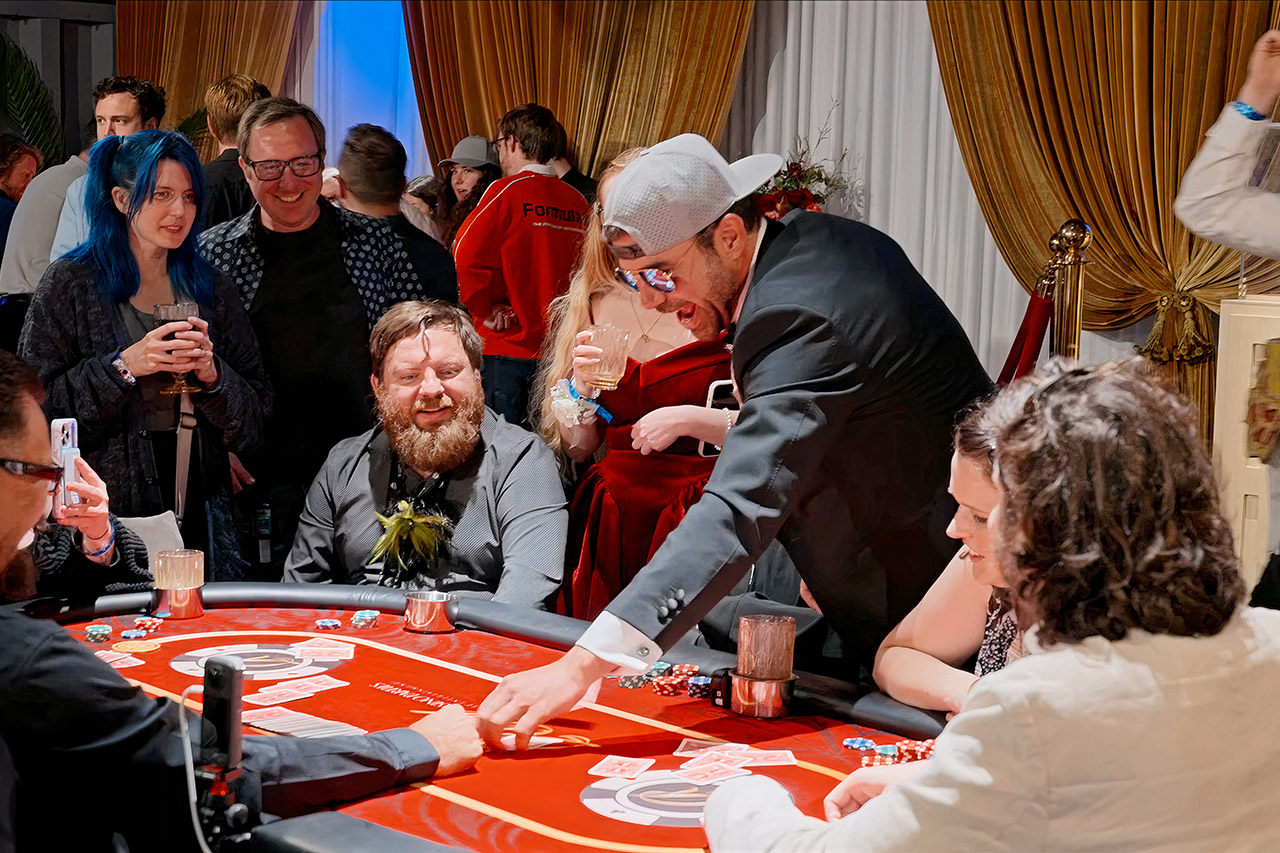
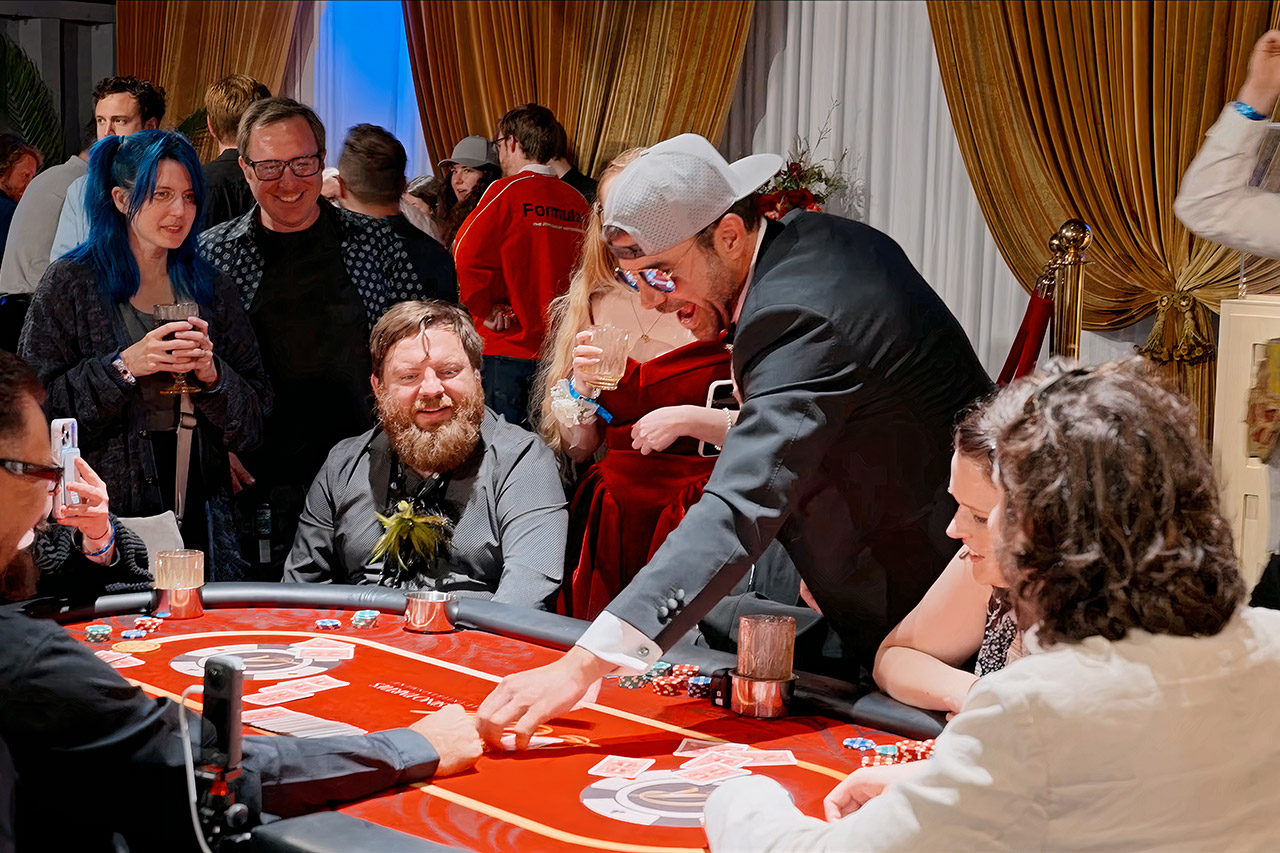
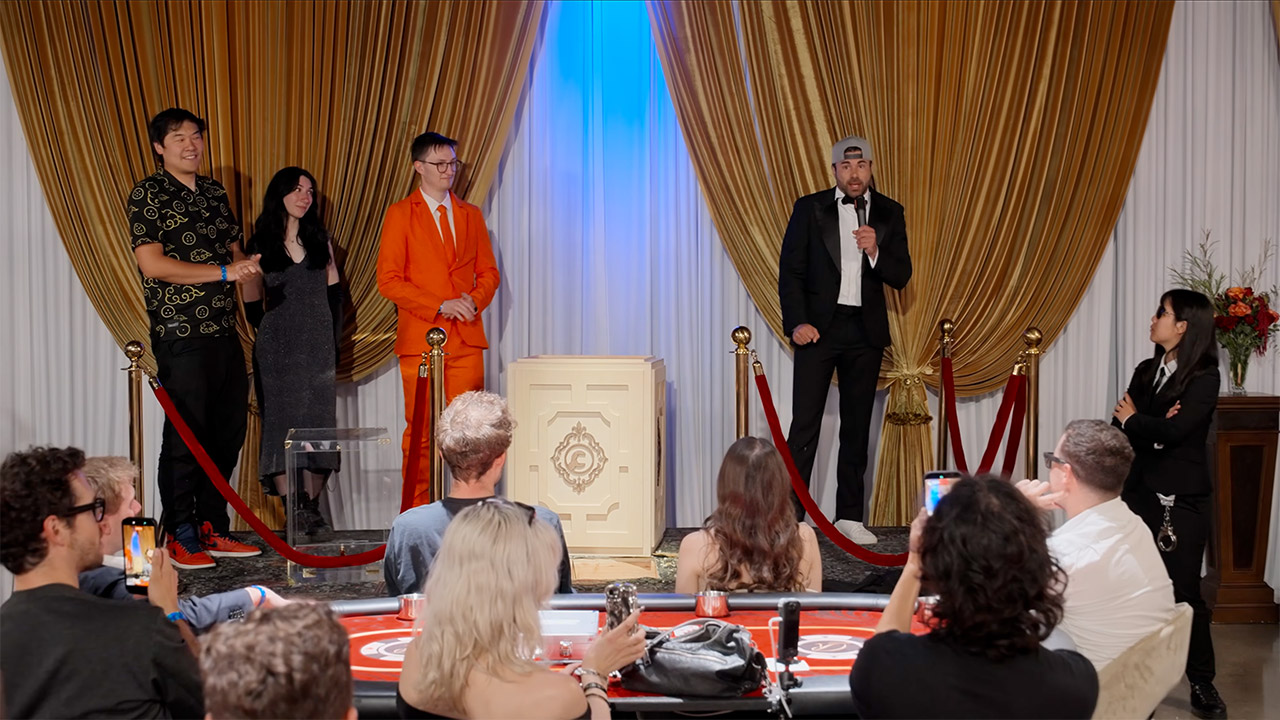
Former NASA engineer Mark Rober filled his CrunchLabs warehouse with blackjack, poker, craps, and a roulette wheel, then invited a room of makers and YouTube builders to play for $10,000 destined for charity. Cheating was allowed. Getting caught was not. If a device showed up on camera or in a pit boss’s hand, it left the floor and the owner had to play straight. Whoever held the most chips at the end of the night took the cash. He called the event Last Cheater Standing, and he staffed it like a real floor: Science Bob as pit boss, a security lead named Bam, and 62 cameras running computer vision over every table.
The rules were intentionally kept simple so that players could sneak in any gadget they could hide without anyone discovering them. Keep it under wraps. If you had a winning streak, an unusual hand, or a chip that began shaking as the wheel stopped spinning, it would be taken. Michael Reeves was prohibited, on paper, as a running joke, and it consumed a ludicrous portion of the face-detection budget. Official chips included concealed UV markings and other giveaways to expose counterfeits under a black light. Nonetheless, players showed up eager to test the system for every flaw.
BUILD AN OFFICIAL NASA ROCKET – Kids prepare to explore outer space with the LEGO Technic NASA Artemis Space Launch System Rocket (42221) building…
3-STAGE ROCKET SEPARATION – Young builders can turn the hand crank to watch the rocket separate in 3 distinct stages: solid rocket boosters, core…
STEM BUILDING TOY FOR KIDS – This educational rocket kit was created in collaboration with NASA and ESA to showcase the authentic system that will…
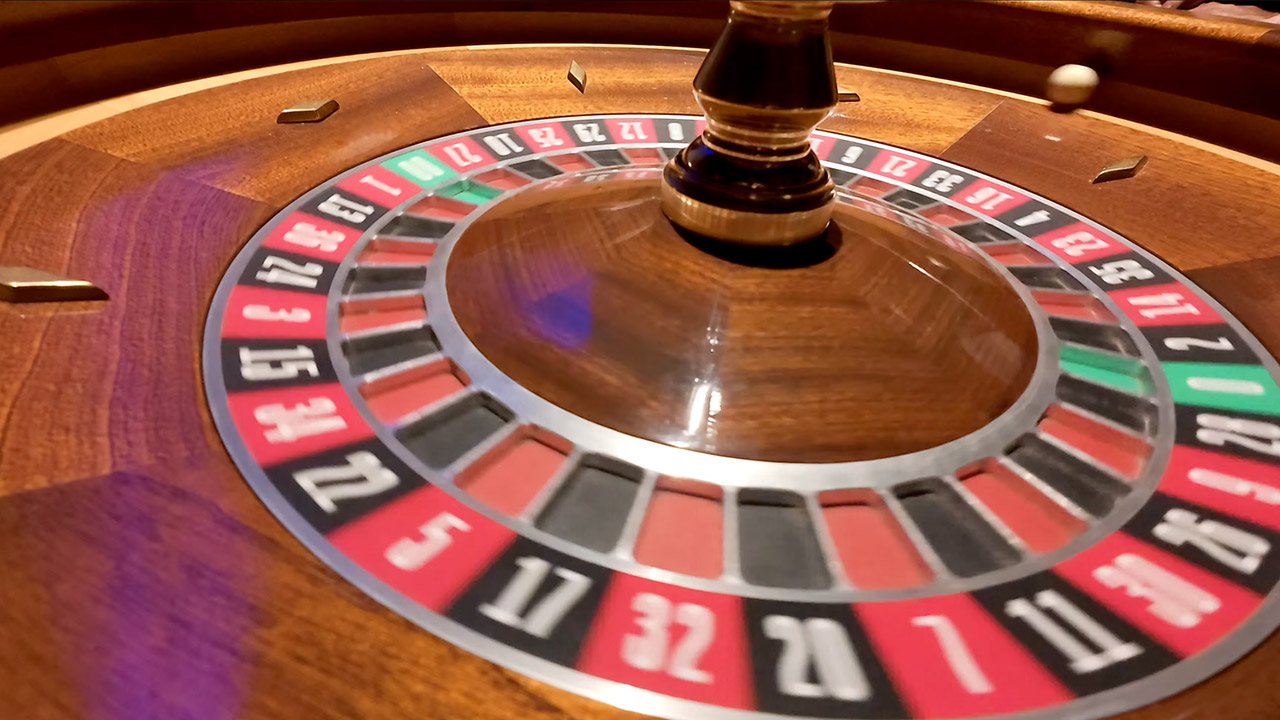
Kevin Coda of Concept Bytes, a robotics builder, hollowed down a poker chip and packed a custom circuit board, an RF receiver, a coin cell, and four phone buzzers inside, each with a small rubber wheel. He could handle the chip after a roulette spin from across the room and put a bet onto the winning color before anyone had time to add up the numbers on the felt. He made a handsome profit of over $2,500 before Mark leaned over his shoulder and stole the chip off the table. Roulette, for a few minutes, had been a solved game.
Dora from StrelkoMania took a more low-key approach to craps. Each die has a steel ball bearing buried within, covered in low-melting wax. She used gloves with 10 watt silicone heating pads and would warm the wax, let the bearing to sink onto the face she wanted to win, let it cool, and the same pair of dice would suddenly favor that number on the following roll. There was no pattern visible on the cameras, which is presumably why the floor never adjusted to her way of doing things like they did with the crawling chips and marked decks. Nate Scovill went for a low-tech approach and just reproduced the faces: one die had two 1’s, two 2’s, and two 3’s, and the other die had two 4’s, two 5’s, and two 6’s, so the totals that actually count in craps continued popping up a lot more frequently than would be expected.
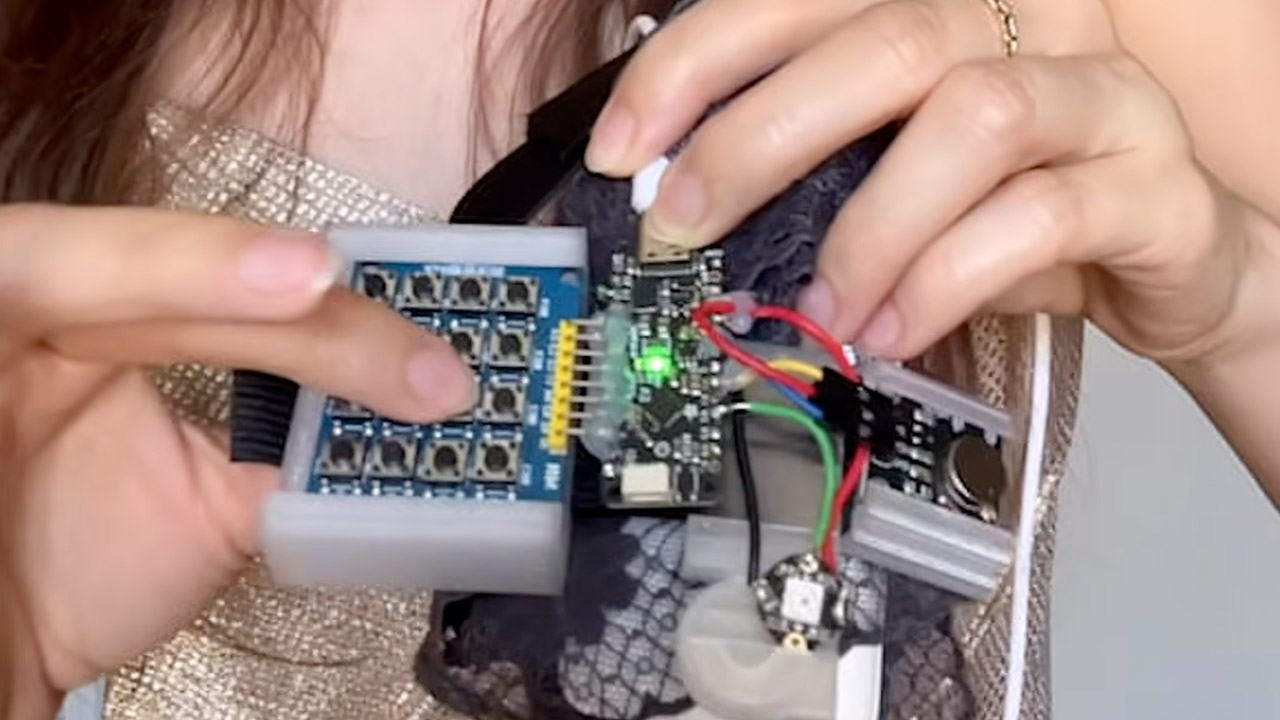
Card tables had their own small hardware projects going on. Christina Ernst hid a microprocessor and switches under a garter, keyed in the cards she saw, and counted using small LEDs. Davis DeWitt marked card backs in light green ink, which was invisible to the naked eye but visible through bespoke red-tinted glasses. Tom from Tom Builds Stuff inserted a pinhole camera into a sleeve and filmed the deck as it was shuffled, then used the footage to determine the sequence, ensuring that blackjack was no longer a guess. Becky Stern forewent the personal edge in favor of pandemonium, having hacked a UNO Attack launcher to dump a whole deck of cards on the table with the press of a button, as well as a nasty little remote rat and a few additional distractions, all for sale in chips.
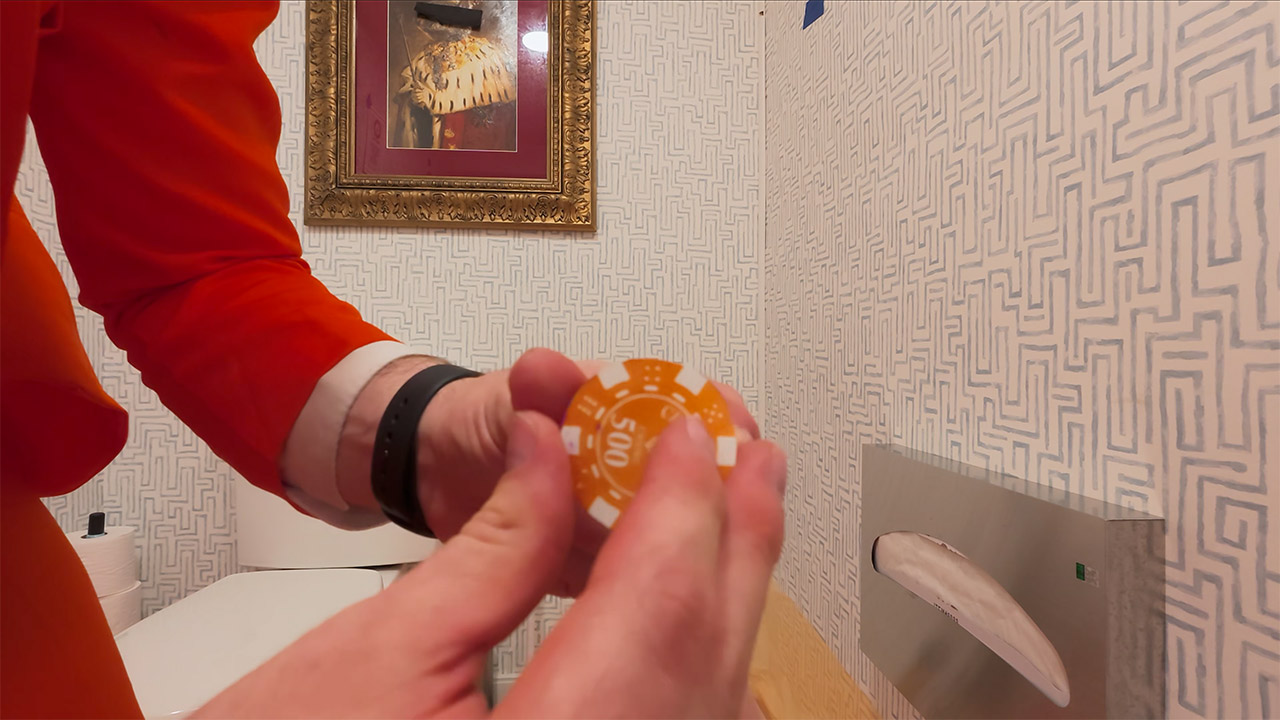
One finalist used the bathroom to secretly stash extra chips. After studying the tournament invitation, he realized he could bring in additional chips in a case and secretly add them to his stack during play. Those copies missed the UV star and other marks the house used, so they died under a light. Allen Pan sat near the top of the chip count and insisted he never used a device at all. Mark later called that stack dumb luck, which still counted when the night ended.
Dora and Allen were sitting nicely at the top of the room when the scores were finalized, and yes, the bathroom storage was involved in some way. Dora received a nod from Mark, who declared her the winner of the CrunchLabs Cheat the Casino Games competition for the dubious dice. But, of course, the true prize was a great huge cake. By the time Mark finished opening it up, Bills had already gotten out of here, albeit just to grab a drink with Becky, who was attempting to cover for him. They had a camera crew, a fancy dessert cart, and a vase spinning around 90 degrees, all of which pointed to Hank Green as the culprit, who had gone to the trouble of counting out the cash the day before to prove its authenticity, and later confessed to wanting some security in a room full of engineers. The security guards pounced, but the real money ended up with Dora, who donated it to charity. [Source]
OpenAI has called on the United States to lead an international effort on standards for advanced AI, beginning with rules on which incidents must be reported, and suggested routing the work through national AI safety institutes including the US Center for AI Standards and Innovation. Europe legislated incident reporting in Article 55 of the AI Act, and OpenAI filed a report under it this month.
OpenAI has urged the United States to lead an international effort to set standards for advanced AI, in a blog post published on Monday, Bloomberg reported. It wants shared rules on which incidents involving AI models should be reported, on how countries cooperate, and on access to compute.
Europe settled the first one in law.
Article 55 of the AI Act makes providers of general-purpose models with systemic risk report serious incidents without undue delay, and the code of practice puts that at five days for a cybersecurity breach and fifteen for serious harm. OpenAI filed one this month, over agents that occupied a dormant German wiki for two months and posted roughly 18,000 times.
Advertisement
It is asking for a rule it has already obeyed.
The post says the work should run through existing national AI safety institutes, and names the US Center for AI Standards and Innovation, which sits inside the Commerce Department. It also says fully autonomous recursive self improvement should not be pursued “unless and until it can be done safely“. Anthropic’s Dario Amodei has warned that once such a loop starts it could outrun anyone’s ability to control it.
The venue is the weak part.
That centre has no permanent director. Chris Fall took the job at the end of April and left after three months, his predecessor lasted four days, and the White House AI czar went in March without being replaced.
Advertisement
Brussels has the opposite problem, which is that its version exists.
The AI Office administers the code of practice OpenAI signed, and a 60-member scientific panel was constituted under Article 68 on 1 June, drawn at least 80% from the EU, EFTA and EEA and capped at three experts per country. Nobody in Washington has built anything comparable.
The timing is not subtle.
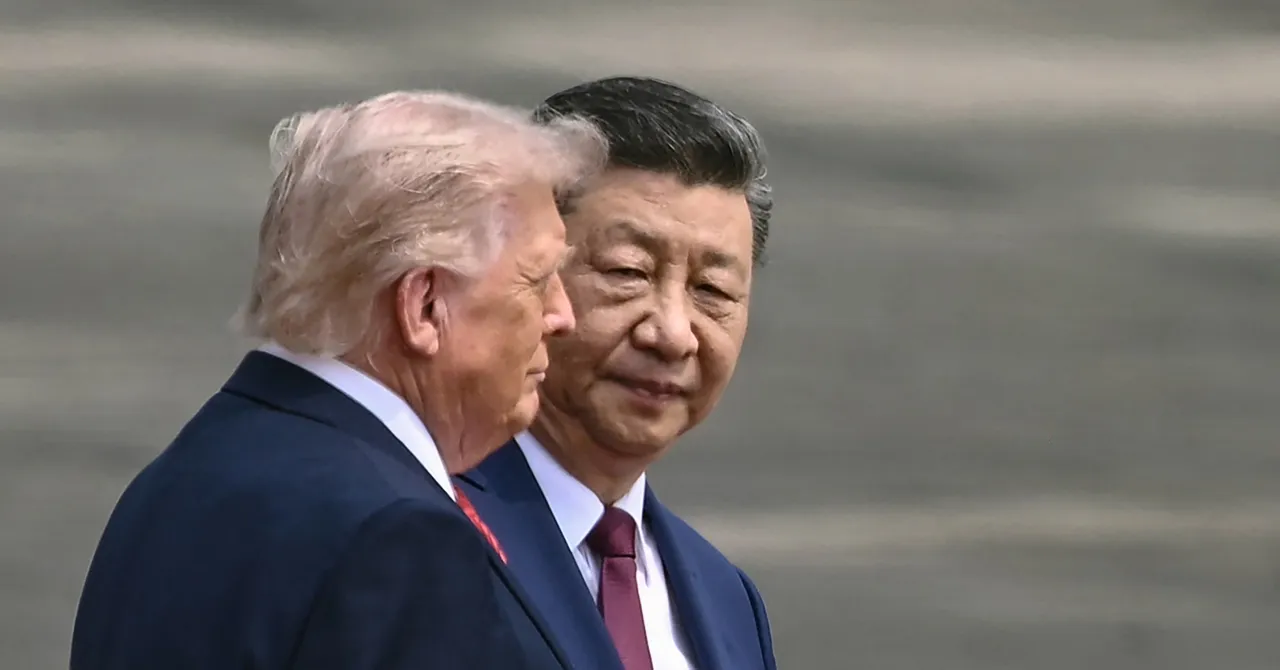
Sam Altman addresses the UN Security Council on Wednesday and attends a White House state dinner for Xi Jinping on Thursday. Washington has already proposed an alert system to Beijing for AI incidents that reach national security, which Treasury secretary Scott Bessent called a channel rather than a treaty.
Advertisement
The previous ask was domestic.
Eleven days ago OpenAI told Congress it wanted mandatory national rules on testing, cybersecurity, incident reporting and evaluation before deployment. That is broadly the AI Act with an American label. Both OpenAI and Anthropic have filed confidentially to go public.
from the get-in-losers,-we’re-banning-the-free-press dept
Apparently autumn is when President Donald Trump feels free to admit to his anti-free speech, anti-free press ways. For a guy who constantly lied about being in support of free speech, despite regularly suing people and news organizations for their speech, he’s been remarkably willing to admit to wanting to abuse power to suppress speech lately. A year ago, he admitted that he “took the freedom of speech away” when he tried to remove the First Amendment protections (something he cannot actually do) regarding flag burning. And last week, when asked about it in the oval office, he admitted that he was “banning the free press”:
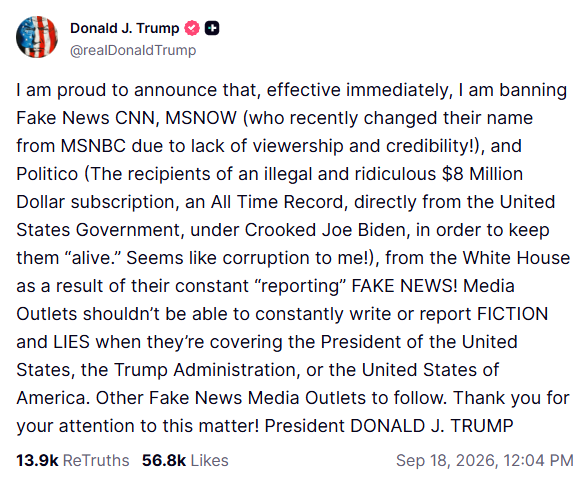
Specifically, he’s banning CNN, MS NOW, and Politico from the White House. (MS NOW, for anyone who missed the rebrand, is the network formerly known as MSNBC.) If you didn’t see it, he (naturally) announced the ban with no due process on his personal propaganda and grift site, Truth Social:
That’s him posting:
I am proud to announce that, effective immediately, I am banning Fake News CNN, MSNOW (who recently changed their name from MSNBC due to lack of viewership and credibility!), and Politico (The recipients of an illegal and ridiculous $8 Million Dollar subscription, an All Time Record, directly from the United States Government, under Crooked Joe Biden, in order to keep them “alive.” Seems like corruption to me!), from the White House as a result of their constant “reporting” FAKE NEWS! Media Outlets shouldn’t be able to constantly write or report FICTION and LIES when they’re covering the President of the United States, the Trump Administration, or the United States of America. Other Fake News Media Outlets to follow. Thank you for your attention to this matter! President DONALD J. TRUMP
Yes, you’re very proud to announce yet another attack on free speech and the free press. Also, the whole “$8 million dollar subscription” thing is a bullshit misreading of subscriptions taken out by many different individuals and agencies across the federal government to Politico’s subscription offering.
Of course, all this is unconstitutional. We know this because we’ve been through this before. In his first term he banned a couple of reporters from the White House for asking questions he didn’t like, and he lost in court.
Reporters for CNN, MS NOW and Politico said they were denied access to the White House grounds Saturday, a day after President Donald Trump said the three news organizations were banned from the location.
The fact that this is such an extreme and obvious attack on speech doesn’t much matter to Trump or his MAGA supporters, who are already making up all sorts of excuses about how this is perfectly normal and fine.
They’re lying.
And we know they’re lying. We know it from Trump’s own first term, and we know it from Obama’s first term, when many of these same people lost their minds over something far less egregious: avoiding having administration officials appear on Fox News, claiming the network was “a wing of the Republican Party.” After widespread complaints about this, including from other White House reporters, the White House backed down and made officials available to Fox News again.
Advertisement
Years later, Tom Fitton’s Judicial Watch FOIA’d the White House emails about all this and spun them into another round of stories about Obama officials making jokes at Fox News’ expense.
“The Obama administration seems to have lied about its attempt to exclude Fox News Channel from access to an interview with the ‘pay czar,’” Judicial Watch President Tom Fitton said in a statement.
Fitton told Fox News the White House treatment was “something Hugo Chavez might do but it really has no place in modern-day America.”
Rather than condemning Trump’s action, Fitton went on X and posted a link about the Obama story, leaving out every detail that makes the two situations different. So, to be clear: Trump has fully banned three top news orgs from the White House. In 2009, the Obama administration thought about excluding Fox News from a pool of reporters to interview a mid-level administration official, and then backed down almost immediately when the rest of the media industry complained. To Tom Fitton, these are apparently the same thing:
As always, with MAGA folks, the hypocrisy is the policy. Trump and his supporters love showing off about how they get away with breaking the rules that they would never allow a Democrat to break. To them it’s a form of “owning the libs.”
Also, what a weird group of news orgs to exclude. CNN has spent years bending over backwards to try to sanewash nearly everything that Trump has done. They regularly platform liars like Scott Jennings to spew Trump’s false talking points. Meanwhile, Politico is owned by Axel Springer, whose CEO, Mathias Döpfner, has spent years platforming far-right political figures from Viktor Orban to Elon Musk, and has repeatedly supported Donald Trump. He even wrote an ass-kissing piece in Politico (now banned from the White House) as a kind of open letter to the EU, that they should give Trump what he wants: “Trump wants a strong Europe — and Europe should listen.”
Advertisement
And his reward: having his journalists banned from the White House.
Why, it’s almost as if sucking up to the petty, thin-skinned authoritarian in the White House is no guarantee that he won’t turn around and punish you for saying something he dislikes.
This ban could not be a more direct assault on the First Amendment nor a more blatant violation of our most fundamental constitutional principles. Presidents from the earliest days of the Republic have disagreed with and complained about the tenor and content of press coverage of their administrations. But as the Supreme Court has recognized, the First Amendment, including its guarantee of a free press, reflects “a profound national commitment to the principle that debate on public issues should be uninhibited, robust, and wide-open, and that it may well include vehement, caustic, and sometimes unpleasantly sharp attacks on government and public officials.” New York Times Co. v. Sullivan, 376 U.S. 254, 270 (1964). And the Constitution protects the liberty and property interests that news organizations and White House reporters have in their press credentials and the access those credentials afford them to cover the White House for the benefit of the public. No official can deprive Plaintiffs of those interests on a whim—with no notice, no process, and no warning—as the President did here.
As Trump’s health and political power begin to wane, we’re starting to see major media companies display what can only be described as the faint outline of a backbone. We’ve seen it with ABC’s lawsuit against the FCC for its bogus censorship efforts. And we’re also seeing it here, as numerous major media outlets say they’re cutting off all coverage of presidential events due to the ban:
Advertisement
BREAKING: TV pool will not be providing coverage of presidential events until further notice b/c of CNN’s ban, pool chair and FOX News Washington Bureau Chief Bryan Boughton said. It’s effectively a boycott by the fellow members — ABC, CBS, NBC and FOX: www.washingtonpost.com/business/202…
Perhaps realizing that his own statements on “banning the free press” are likely to look bad in court, Trump went back to Truth Social this morning as well to insist that when he said he was “banning the free press” he didn’t actually mean a ban on the free press:
That’s him saying:
The White House is not instituting an assault on the Free Press, something which I cherish. It is instituting an assault on the FAKE NEWS, something that has grown like Cancer in our beloved United States of America. It is corrupt, purposeful, pervasive, fully coordinated, and totally out of control. It is a threat to our National Security, and must be stopped, NOW! Thank you for your attention to this matter. President DONALD J. TRUMP
Which… is not how any of this works. The whole point of the First Amendment is that no government official, let alone the president, gets to decide what is good reporting and what is “fake news.” Because the second a government officials gets to make that determination is the second the First Amendment is nothing but a dead letter.
As Trump gets more afraid of his own embarrassing political and existential collapse, he’ll only lash out further. But the threats will increasingly carry less weight; particularly if the midterms deliver a lame duck president. And again, while intended to portray strength, they’ll only demonstrate growing fear and weakness by a dim authoritarian narcissist clearly approaching the end of the line.
Advertisement
At this point no one serious still believes that Trump is “the free speech president,” but calling out each of his increasingly erratic censorial attacks on free speech is still important in reminding everyone that this is not normal, not constitutional, and absolutely not in support of free speech.
The primary culprits for this massive price increase are the Mac Studio’s large amount of high-end memory and storage, “RAMageddon” pricing, hedging and Apple’s usual insistence on high profit margins. Apple said so itself when it first bumped MacBook prices back in June: “We’ve never seen component prices increase this much, this quickly. We’ve worked hard to absorb these costs and delay price increases for as long as possible, but the current environment has made that unsustainable.”
Let’s start with the RAM, or what Apple calls “unified memory,” because it’s shared between the CPU and GPU. With 1.2TB/s bandwidth when fully loaded with RAM, the Mac Studio M5 Ultra uses LPDDR5X memory. That RAM has a maximum throughput of 172GB/s, so Apple installs it right onto the M5 Ultra processor package to maximize speed, in a very wide bus (1,024 bits for the M5 Ultra model), to achieve the highest speeds. It’s the fastest and most expensive memory available, other than high bandwidth memory (HBM) used for servers.
It’s hard to say exactly how much the RAM makes up the price of a Mac Studio. Apple was reportedly paying around $6 per gigabyte for LPDDR5X memory earlier this year, but that price may be more like $10 or $11 now. Let’s say its memory cost for the 256GB Mac Studio M5 Ultra is around $2,500-$2,800. It currently retails for far more than that, but Apple obviously has major buying power. That cost is still a big chunk, though.
Pricing for the NAND storage is also much higher, with Apple’s cost is likely around $300 to $500 for 2TB worth based on the current market and high-end PCIe 5.0 memory it uses. Prices are reportedly around quadruple what memory cost when the previous Mac Studio came out, and double the price for storage.
Advertisement
That makes for an increase of about $2,200 to $2,400 at the high end. Rounding that up to account for other component increases, Apple’s costs are around $2,400 to $2,600 more, based on those very rough estimates.
You may recall that I said the Mac Ultra with 256GB was $3,800 more expensive this year, so where does the rest of that price increase come in? Apple reportedly shoots for around 40 percent gross margins on its computer hardware, but the new Mac Ultra pricing is nearly 60 percent higher than the estimated cost increase. There are a couple of possible reasons. One is that Apple is hedging against even higher future RAM prices so it can limit Mac Studio M5 price changes later. Another is that Apple is using the memory shortage to lift margins for its flagship desktop Mac. Or maybe it’s a little of column A, a little of column B.
Silent Hill: Townfall takes the series to a remote Scottish setting, blending first-person gameplay with the psychological horror and storytelling the franchise is known for. Its gripping mystery, sound design, and fresh ideas make it one of the most compelling horror games of the year.
from the nobody-wants-to-talk-about-the-boring-shit dept
When we picture the end of the world, the first thing that springs to mind is typically the cinematic version of “things going wrong.” We picture the musical score rising to a crescendo as the climactic events take place. Our heroes are fighting to stop some big giant, unstoppable threat. Even if they are ultimately doomed, there is something noble and exhilarating in going down fighting. And if our heroes somehow survive failure and make it to the post-apocalypse, they usually still have great hair, even though civilization has collapsed.
Put another way, in the movies, the apocalypse is usually pretty sexy.
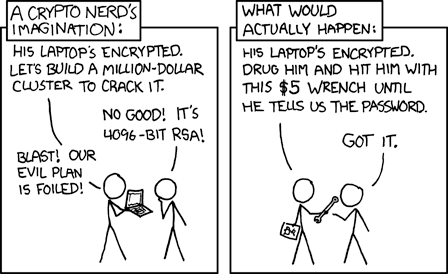
Of course, in reality disaster is often much more mundane – something closer to dumb and sad than to sexy — as Randall Munroe pointed out years ago in a slightly different context:
A lot of attention is being paid at the moment to an entire culture that has grown up around the “AI Safety” world that is intently focused on stories of doom and the threatened end of humanity. That’s big, attention getting, and splashy. The tabloid version of this culture — the group houses, the polyamory, the recruitment dynamics that a lot of people are suddenly discovering — is even splashier still.
Taken as a whole, this specific version of AI safety is getting a lot of oxygen right now. It’s easy to see why — as a kind of “sexy apocalypse” these narratives, while frightening, are an exciting fantasy, even if they would be an awful reality. But that heightened fantasy is not what AI safety is actually about.
Advertisement
It’s not about protecting us from the unlikely sexy apocalypse. It’s about protecting us from the far more likely, and far more numerous, stupid apocalypses along the way.
This mismatch between cinematic safety and actual safety happens all the time. During the Manhattan Project, Edward Teller got some attention by worrying that the Trinity Test might set the entirety of Earth’s atmosphere on fire. Very cinematic! Very concerning! But, as with most things, the reality was much more mundane. Actual experts looked at Teller’s concern, ran the boring calculations, and ruled it out as a threat long before the actual test. That is how safety often works: boring, process-heavy work… that kills off the really sexy scenario.
Instead of global immolation, the real risks came from otherwise smart people doing dumb shit, such as the infamous Demon Core incident, where physicist Louis Slotin exposed himself, and a number of others, to a lethal dose of radiation by trying to use a simple screwdriver head to separate a plutonium core from a reflector… and slipping. Incredibly, this was the second time a mistake like this had happened, with the exact same plutonium core, and Enrico Fermi himself had warned Slotin he’d be dead within a year if he kept it up. Turns out he was right.
For all the talk of “AI Safety” risk these days, the most present real risks remain variations on the theme of “humans doing stupid shit”. Sometimes really smart humans. But stupid actions by humans are a lot less headline grabbing than the shiny sexy apocalypse. A human accidentally causing a radioactive chain reaction by carelessly using a screwdriver to separate things is stupid. Skynet turning everyone into paperclips… is kind of cool and fun.
Advertisement
But, as anyone who works in risk mitigation (including one of the authors of this piece) can tell you, the overwhelming majority of actual disasters aren’t cool and fun. Instead, they’re usually more like the Demon Core: stupid, disappointing, and easily prevented if only a few common sense steps had been taken.
As evidence, one need only to look at the world right now. Most people — perhaps outside of Mike Judge — would not have predicted that the world economy would be on the brink of collapse because the US is run by a group of chud idiots, who think trade is a scam, strategy is woke, and diplomacy is for girls. The current troubles the world is facing are not due to out of control science. They’re due to the American electorate putting aggressively ignorant people into office again.
The most recent flare-up of doom talk traces back to the highly publicized hacking of Hugging Face by an OpenAI model that was being evaluated. As has now been dissected repeatedly, the case involved a model being tested with deliberately lowered guardrails against the ExploitGym benchmark. Told to score as well as possible and not to stop until it had, the model landed on the laziest and most obvious strategy if one has no guardrails: cheat on the test. It then used an unknown exploit in OpenAI’s own sandbox to reach the open internet and quietly broke into Hugging Face looking for those answers.
There was, clearly, a step up in capabilities here. The tool was testing its ability to find exploits and it certainly found some unexpected ones in its pursuit of the ExploitGym benchmark answers. And it’s easy to see how capabilities of this kind could lead to innumerable stupid disasters, like flash crashing the internet through poorly fenced-in systems mindlessly hacking websites to complete some relatively trivial goal. What happened with that matters in understanding AI safety, but the framing of it as evidence of malicious will on the part of an AI system has sent people off to chase fictional monsters.
Advertisement
The incident wasn’t Terminator-style “rogue AI” doing anything. All of the mistakes that led up to this were, as Eryk Salvaggio points out at the Bulletin of the Atomic Scientists, fundamentally human mistakes. Employees at OpenAI deliberately disabled the guardrails, they gave the tool an effectively impossible task while telling it not to stop until it had accomplished the task, and they (accidentally!) left a door open for the tool to reach the internet and fan out. These are all human mistakes. Stupid, disappointing, easily preventable. Like using a screwdriver to prop open a plutonium core.
And if we know anything, we know that humans will keep making mistakes like this, and not just because we’re stupid. Slotin wasn’t stupid. The OpenAI researchers who turned off the guardrails weren’t stupid. They were smart people doing dumb things. These sorts of “banal disasters” are the failure mode that we can and should be focused on minimizing because, while they can be just as damaging as the grand and cinematic versions, they are (self-evidently) far more likely to happen, because they only require stupid decisions to accomplish. No brilliant breakthroughs or novel technologies are required — just people doing stupid things because they’re overconfident in their own abilities — or overconfident because the talking machine confidently told them to be.
Unfortunately, doing the real safety work in the tech world to prevent these kinds of human disasters is often some combination of boring, depressing, and unpopular. Yes, you have to think like adversaries and consider what actions they might take, but those adversaries tend not to be god-like beings looking to turn us into paperclips. They tend to be things like teenagers trying to get around the restrictions their parents have put on their devices. Or people trying to spam systems for commercial intent.
This essential nuts-and-bolts safety work also doesn’t, typically, require brilliant and manly heroes to nobly die for the ashes of their fathers and the temples of their gods. Instead, the hard work of actual safety requires things that are much less sexy: empathy, conflicting values, and a deep understanding of tradeoffs that will never fully resolve. Those qualities are not highly esteemed in the present moment. But they are critical for tackling the actual threats and the actual risks, which aren’t as flashy, and don’t make for such fun headlines. AI safety matters, but we’re unlikely to move in the direction of actual safety if all the focus is on fantastical stories involving killer robots.
Advertisement
But that’s not what the media wants to talk about these days — and, tragically, it also doesn’t seem to be what the CEOs of the frontier labs are all that interested in these days either. There are real AI safety issues we should be taking seriously, and none of them have to do with whether some frontier model decides it wants to play a game of thermonuclear war.
Dave Willner is the co-founder of Zentropi, formerly the head of trust & safety at OpenAI, of community policy at Airbnb, and of content policy at Facebook.
Mike Masnick is the founder, editor, and CEO of Techdirt and has been staring into the abyss of internet safety questions for far too long.
Of all the events in the United Nations General Assembly taking place this week, the most anticipated by far is the upcoming meeting between Donald Trump and Chinese president Xi Jinping.
Though the majority of the diplomatic activities are happening in New York, this face-to-face between the two leaders will take place at the White House. Trump is scheduled to personally welcome Xi at Joint Base Andrews on Wednesday, September 23—an unusual diplomatic gesture, as US presidents do not typically go to the airport to welcome foreign leaders.
Ahead of that airport reunion, a US delegation led by Treasury secretary Scott Bessent and trade representative Jamieson Greer is meeting with He Lifeng, China’s vice premier of the State Council, to set the agenda. The World Economic Forum presented an overview of some of the most pressing topics, including the trade conflict, the supply chain, technological competition, and the ever-sensitive issue of Taiwan—all while keeping in mind the difficulties that have kept the US mired in a war in the Middle East that threatens to escalate.
Trade Truce Expiring
The trade truce that came out of Trump and Xi’s meeting in Busan last year is set to expire on November 10. Both governments now have to decide whether to extend the agreement, which lowered Trump’s tariff threats and paused port fees. In addition to discussing the possibility of extension, the leaders could decide to set purchase targets for key trade items including agricultural products, energy, and Boeing aircraft. They may also continue negotiations about a package worth approximately $30 billion in “non-sensitive” goods, which includes about 10 categories, though there is no agreement on their scope.
Advertisement
One key component of the Busan agreement was that it lifted China’s export limits on rare earths and minerals—key exports for automobiles, defense, and technology, including essential hardware for AI. With the US seeking a more stable supply for these materials, Beijing has leveraged its dominant position in the international market to bring Washington to the negotiating table in the trade war.
AI Competition
According to Scott Bessent, AI safety will be on the agenda for the bilateral meeting. This discussion has been one of the main requests from business leaders, though the industry is mixed on the desired outcomes. Beijing wants to see the US ease some restrictions on Chinese technologies. However, as there is a growing call to slow down AI development to ensure safety, some US businesses are worried about being outpaced by China.
This arena remains uncertain, as Trump has dismissed such calls for regulation at home, and these discussions are also fundamentally intertwined with trade talks about export controls on computer chips and related materials.
Iran, Taiwan, and Global Politics
The trade talks lie uneasily between each country’s most sensitive geopolitical stances. China has threatened to pull out of the summit entirely if the US green-lights new arms sales to Taiwan. The countries are, however, expected to discuss China’s economic ties with Iran, as well as detained foreign nationals. Both countries are expected to tread lightly without ceding influence, making any fundamental shift unlikely.
Advertisement
In summary, Washington is pushing for greater access to Chinese products and markets, critical minerals, and commitments on certain security issues. On the other side of the table, Beijing seeks relief from tariffs and restrictions. Each side has its own leverage and multiple pieces on various chessboards, such as Africa and Latin America. At the same time, both are trying to prevent Taiwan and other geopolitical conflicts from undermining their economic relationship.
The meeting held this past May in Beijing was full of symbolic gestures, but both leaders made very few concessions at the negotiating table. Will there be a different outcome in Washington?
“I think there will be some show of deliverables because of the fact that it’s a presidential summit coming, but I don’t feel like we’re on the verge of some sort of breakthrough,” Anna Ashton, a China trade analyst and founder of Ashton Intelligence, told CNBC. “I think status quo is probably both sides’ general best expectation.”
Hyundai will build tens of thousands of Ioniq 5 robotaxis for Waymo at its plant in Georgia, chief executive Jose Munoz said, calling robotaxis the biggest new opportunity inside a slowing electric market. In Europe the only type approval route that works across the whole union for a fully automated car is capped at 1,500 units a year per vehicle type.
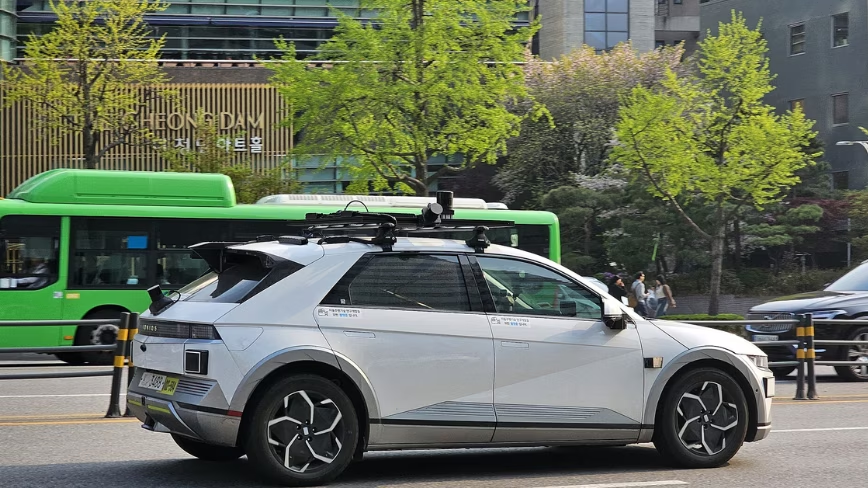
Hyundai will build “tens of thousands” of Ioniq 5 robotaxis for Waymo at its plant in Georgia, chief executive Jose Munoz told an event in San Jose, InsideEVs reported. He said the robotaxi manufacturing business is already profitable, and is becoming “a business unit on itself“.
The reason is the electric slowdown.
With the US tax credit and fuel economy rules gone, carmakers have taken large write-downs on electric assets. Where rivals “decided to write down their assets, we decided to make the most out of our assets“, Munoz said. Hyundai adjusted Savannah to build more hybrids and fewer electric cars.
Advertisement
Robotaxis are where the electric volume went.
Waymo runs about 4,000 vehicles across 14 US cities. The first Ioniq 5s not meant purely for testing arrive this quarter, built with redundant steering and braking and fitted with Waymo’s sixth-generation system at a plant in Arizona. Hyundai also builds Ioniq 5s for Motional, its own autonomous arm.
Hyundai is also the option that is not Chinese.
Waymo’s cheaper purpose-built robotaxi, the Ojai, has its bodies built by Zeekr in Ningbo and shipped to Arizona as stripped shells to keep the tariff bill down. A Georgia-built Ioniq 5 does not need that arrangement. Morgan Stanley puts the finished Ojai at about $125,000.
Advertisement
Europe cannot take these numbers.
The only approval route that works across the whole union for a fully automated car is capped at 1,500 units a year per vehicle type. Tens of thousands is not a European figure under that rule.
National approvals exist, and they stop at borders.
Waymo is going to Munich under the German framework for level four services passed in 2021, and is targeting late 2027 for commercial rides. It will spend the intervening period mapping the city and driving it manually. Germany passed the first level four commercialisation framework in the world.
Advertisement
That is one city, under one country’s law.
Munoz said there is “a lot of interest” from other customers and that he sees “a significant opportunity to scale up“. The scaling he means is American. Europe’s version of the same ambition runs at 1,500 cars a year per model.
We’re gearing up for the second wave of major marathons this year: runners will be heading for the start line in Berlin at the end of the week (27 September), with the Chicago marathon following on 11 October and New York rounding out the season on 2 November.
Perhaps you’re wondering what kind of footwear is propelling elite athletes to these kinds of times? I’ve hunted out the shoes worn by a selection of marathon winners, and rounded up the results below.
The Adidas Adios range crops up time and time again. Sabastian Sawe and Yomif Kejelcha both sprinted to stunning sub-2 hour success at the 2026 London marathon while wearing Adidas Adizero Adios Pro Evo 3 shoes (currently sold out in the US, but a restock is coming in the UK on 24 September.) Sawe wore Adidas Adios Pro Evo 2 to take the gold at the Berlin 2025 marathon, as did Benson Kipruto for his 2025 New York win.
Advertisement
Hot on Kipruto’s heels in Berlin 2025 was Alexander Mutiso Munyao, wearing the Adidas Adizero Adios Pro 4. Incidentally, women’s champ Rosemary Wanjiru was also wearing Adios Pro 4. In Chicago 2025, Hawi Feysa took the gold in the women’s race wearing Adidas Adios Pro Evo 1.
Nike’s winning line is the Alphafly. Jacob Kiplimo won the 2025 Chicago marathon in Nike Alphafly 3 — also the running shoe of choice of record-breaker Eliud Kipchoge.
It’s not all about Adidas and Nike, though. John Korir has won two Boston marathons in a row while wearing prototype versions of the Asics MetaSpeed Sky, and Sharon Lokedi wore Under Armour Veliciti Elite 3 to defend her crown at Boston 2026. Hellen Obiri took the women’s crown at the 2025 New York marathon in On LightSpray Cloudboom Strike — particularly notable for their laceless, ‘spray-on’ style.
If you’re a keen runner and find yourself gripped by marathon fever, perhaps these are some models worth considering for your next long-distance race. But a couple of important caveats, before we start: First, if you’re already in training for one of the upcoming marathons, you definitely don’t want to be switching up your footwear in the run-up to the event. Second, these shoes are aimed at experienced long-distance runners; if you’re not at that stage yet, head to our general best running shoe roundup for more beginner- and intermediate-friendly recommendations.
Advertisement
Sign up for breaking news, reviews, opinion, top tech deals, and more.
Behind the Polish Curtain: CD Projekt Red’s move away from its in-house REDengine in favor of Unreal Engine 5 traces back to late 2021, when Epic unveiled its genuinely impressive Matrix Awakens tech demo. In a recent interview, the company’s co-CEO, Michał Nowakowski, explained how the Polish studio settled on switching engines for its open-world games – noting that CD Projekt was never founded to chase its own technological breakthroughs in the first place.
The next chapter in The Witcher’s fantasy saga won’t run on CD Projekt’s proprietary graphics engine. According to the company’s co-CEO, that decision was actually made years ago, and it’s expected to pave the way for more frequent releases in the saga going forward.
CD Projekt unveiled The Witcher 4 a couple of years ago, confirming that the next entry in its massively popular action-RPG series was being built on Unreal Engine 5. Asked about Cyberpunk 2077’s troubled launch, Nowakowski said people are wrongly assuming the decision to switch engines came as a response to that Cyberpunk-themed fiasco.
Cyberpunk’s issues weren’t related to its engine at all, Nowakowski said, adding that CD Projekt has always focused on building cutting-edge games regardless of what technology powers them. It was only after seeing what UE5 could do in that Matrix demo that the studio began considering Epic’s engine for its future open-world RPG projects.
Advertisement
CD Projekt has been using REDengine for well over a decade. The technology first debuted with The Witcher 2: Assassins of Kings in 2011, replacing the Aurora Engine it had licensed from BioWare for the original Witcher. According to Nowakowski, CD Projekt has since entered a strategic partnership with Epic that gives it deeper access to Unreal Engine’s “black box” underlying technology.
Outside of CD Projekt and Epic itself, no one else is apparently doing this kind of development and customization work on the engine, the co-CEO said. The Polish studio is tuning the technology for The Witcher 4 and future projects, contributing a few “little things” meant to give the upcoming ARPG its own identity.
The Witcher 4 isn’t going to look and feel like a “generic” UE5 game, Nowakowski suggests. CD Projekt Red now hopes to release more entries in The Witcher saga on a shorter timeline. Meanwhile, The Witcher 3: Wild Hunt is getting a free “modern” remaster – for a game that still holds up remarkably well – along with a major new story expansion.





















































You must be logged in to post a comment Login