Connect with us
DAPA Banner

Tech

Kash Patel Filed a Defamation Case Monday. His Other Defamation Case Got Dismissed Tuesday.

Published

on

from the that’s-a-lot-of-defamation-cases-kash dept

To have one defamation case about public allegations of your drinking as FBI Director would be unfortunate. To have a second dismissed the very next day would be, well, perhaps a sign that something has gone wrong. Earlier this week we wrote about Kash Patel’s ridiculously weak defamation case against The Atlantic over its big, deeply sourced article with multiple sources claiming that there have been problems associated with Patel’s drinking.

His complaint was filed on Monday. In it, his lawyers mention that they already have an existing defamation lawsuit against MSNBC’s Frank Figliuzzi (a former FBI assistant director for counterintelligence). This is part of Patel’s argument for why the Atlantic should have known the reporting was false. From the Monday complaint:

The FBI further warned Defendants that these allegations echoed a similar fabrication previously aired by MSNBC’s Frank Figliuzzi on Morning Joe—anonymously sourced reporting that was later retracted by MSNBC and that is the subject of pending defamation litigation—yet Defendants published it anyway.

That was Monday. On Tuesday, that defamation lawsuit was dismissed. Judge George C. Hanks Jr. made quick work of it, noting that Figliuzzi’s statement was clearly rhetorical hyperbole — a form of opinion that cannot be defamatory.

The case was entirely about this exchange on MSNBC:

Advertisement

Host: “So, Frank, let’s turn to FBI Director Kash Patel, who has sort of taken a surprisingly backseat role—at least to this point, in the first 102 or 103 days, wherever we are right now. What do you make of that, that he’s just been a little less visible than I think a lot of people and Trump observers expected him to be?”

Figliuzzi: “Yeah, well, reportedly, he’s been visible at nightclubs far more than he has been on the seventh floor of the Hoover building. And there are reports that daily briefings to him have been changed from every day to maybe twice weekly. So this is both a blessing and a curse, because if he’s really trying to run things without any experience level, things could be bad. If he’s not plugged in, things could be bad, but he’s allowing agents to run things. So we don’t know where this is going.”

The court is not at all impressed by this lawsuit.

The Court finds that Figliuzzi’s statement, when taken in context, cannot have been perceived by a person of ordinary intelligence as stating actual facts about Patel. As alleged, Figliuzzi’s statement about Patel—again, made in response to a question about Patel’s decreased visibility as Director of the FBI—was that “he’s been visible at nightclubs far more than he has been on the seventh floor of the Hoover building.”…. A person of reasonable intelligence and learning would not have taken his statement literally: that Dir. Patel has actually spent more hours physically in a nightclub than he has spent physically in his office building. By saying that Patel spent “far more” time at nightclubs than his office, Figliuzzi delivered his answer “in an exaggerated, provocative and amusing way,” employing rhetorical hyperbole. …

The Court finds that Figliuzzi’s statement is rhetorical hyperbole that cannot constitute defamation. Accordingly, Dir. Patel has failed to state a claim against Figliuzzi, and his lawsuit must be dismissed.

If a person of reasonable intelligence and learning would not have taken this statement literally, what does that say about Patel and his lawyers?

Either way, that’s a point for The Atlantic’s legal team, which can now respond to Patel’s claim that the Figliuzzi suit was evidence of falsity with: “nope, not anymore.”

Separately, part of the case involved whether or not Figliuzzi could get attorney’s fees from Patel for filing a vexatious SLAPP suit. There was a dispute over which state’s anti-SLAPP law should apply — Texas, Nevada, or New York each had some claim — and the court (correctly, in my opinion) landed on Texas, since that’s where Figliuzzi resides. Speakers have a reasonable expectation that their home state’s anti-SLAPP law will shield them.

Advertisement

Unfortunately, though, because the Fifth Circuit a while back decided that you can’t use Texas’ anti-SLAPP law in federal court, it’s all for nothing, and he can’t get Patel to pay for his legal fees. This is yet another reminder of why we need a federal anti-SLAPP law — not just to protect free speech more broadly, but to protect SLAPP victims in federal courts in circuits where state anti-SLAPP statutes can’t reach.

The Court finds that Texas has the most significant relationship. Further, applying either Nevada’s or New York’s anti-SLAPP statute to a Texas Defendant would “impede on Texas’s interest in protecting its citizens and fulfilling the statute’s purpose.”…

The Fifth Circuit has found that, because Texas’s anti-SLAPP statute’s “burdenshifting framework imposes additional requirements beyond those found in Rules 12 and 56 and answers the same question as those rules, the state law cannot apply in federal court.” … Thus, while Figliuzzi prevails on the present motion to dismiss, the Court may not award him court costs and attorney’s fees under Texas’s anti-SLAPP law.

Still, even without the fee shifting, this is a good result, and underscores how these exceptionally weak defamation suits are little more than attacks on the press for reporting what multiple sources describe as problematic behavior from the FBI director.

Filed Under: 1st amendment, defamation, frank figliuzzi, free speech, jesse binnall, kash patel, rhetorical hyperbole

Companies: msnbc

Advertisement

Source link

Continue Reading
Click to comment

You must be logged in to post a comment Login

Leave a Reply

Tech

Give Mom Warm Coffee All Year Long With This Ember Smart Mug Deal

Published

on

The Ember Smart Mug 2 is niche, but it has a loyal following. Even though we think there are better mug warmers on the market, Ember is like Apple AirPods or Kleenex. People want what they want. Right now, for Mother’s Day, the Ember Smart Mug 2 is on sale for just under $100, a 30 percent discount and a match of the very best price we’ve tracked. You can save at Amazon, Best Buy, and the manufacturer’s website.

ember mug in white

This smart mug is probably overkill. It has a smartphone app that notifies you when your coffee reaches the ideal temperature, and its onboard light also provides a visual indicator that your brew is ready. It intelligently adjusts power usage to keep your drink warm when you’re nearby, and turns off when you’re not around. The self-heating mug is on sale in a few variations—10 or 14 ounces, in blue, white, black, and purple.

The mug offers up to 80 minutes of powered heating time, or you can pop it on the included charging coaster to keep the battery going all day. And you don’t need the smartphone app unless you want to precisely dictate your coffee temperature—the mug defaults to 135 degrees Fahrenheit without your specific input.

Our main gripe is that this proprietary warming system is not dishwasher safe. You need to hand-wash each component, and ensure you do so carefully, because the items are not cheap to replace. But if Mom has been putzing around the house drinking perpetually microwaved coffee, perhaps an upgrade is in order. We have additional recommendations in our guide to the Best Coffee Warmers. You may also want to check our related stories on the Best Espresso Machines, Best Coffee Machines, and Best Pod Coffee Makers.

Source link

Advertisement
Continue Reading

Tech

Govee’s New Outdoor Solar String Lights Bring Smart Choices to Backyard Evenings

Published

on

Govee Outdoor Solar String Lights
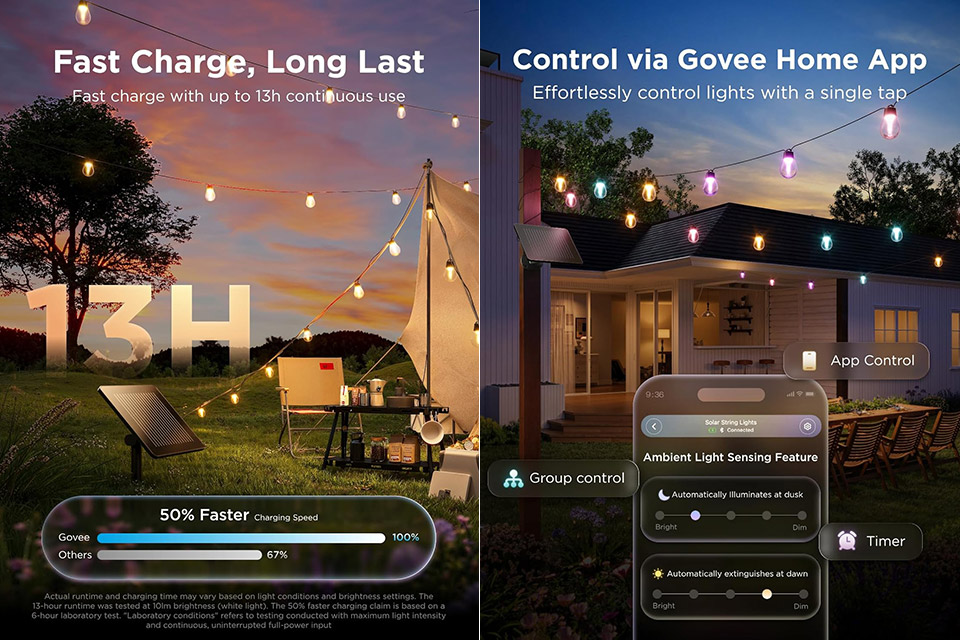
Govee’s Outdoor Solar String Lights have just launched, and they’re already making waves across social media. The string itself is 34 feet long and has eight extremely flexible bulbs that may be hung over a fence, a tree branch, or the border of your patio. A secondary 6 watt solar panel clamps on and may be tilted to maximize sun exposure while the lights are in place.

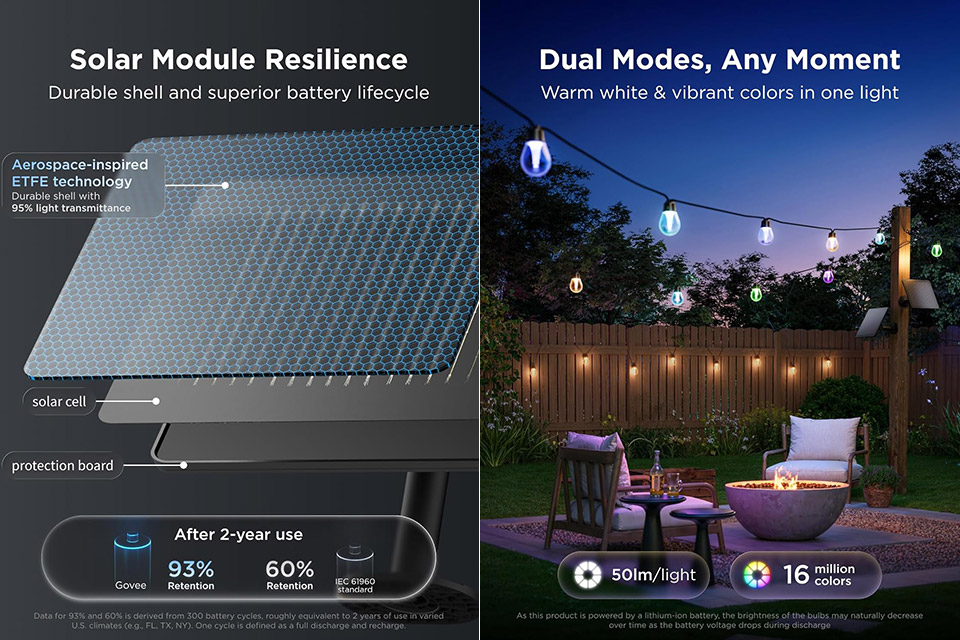
A full day in the sun will charge the built-in 4800 milliamp-hour battery, providing up to 13 hours of consistent, warm warmth when nightfall arrives. At 50 lumens apiece, they are not very bright and will not blind anyone around, but they do emit a warm and pleasant light. You can operate them using the free Govee Home app and a simple Bluetooth connection.


Govee Outdoor Solar String Lights 33ft, RGBICW Outdoor Lights with 8 Dimmable LED Shatterproof Bulbs…
  • Unrivaled Radiance with LuminBlend: Govee solar string lights offer 16 million colors with LuminBlend technology for a premium ambiance – all fueled…
  • Outdoor Reliability: Built for all-weather durability, these string lights and solar panel are IP67 waterproof. Solar panel with aerospace-inspired…
  • High-Capacity Solar Panel for All-Night Lighting: With a 4800mAh high-capacity battery and a 6W high-power solar panel, a full charge offers up to…

Within that app, you can select from over 100 pre-programmed scenes that load instantaneously, or you can customize your own colors and have the lights match with music on your phone or a speaker. The RGBICW technology allows each bulb to function as an own unit, providing you with an extremely wide spectrum of hues and tones, as well as some stunning smooth white tones for everyday use.

Govee Outdoor Solar String Lights
The LuminBlend software ensures that every transition from one colour to another seems natural and even, avoiding washed-out pastel tones and keeping deeper colors polished. Don’t worry about poor weather; this item has an IP67 water proof classification, so rain and wind will not stop it from working. The bulbs are durable enough to take a few knocks, and the panel itself is coated with ETFE, which is basically aerospace grade material that can withstand high heat, cold, filth, and the like.

Govee Outdoor Solar String Lights
Setup is simple, requiring no wiring or tampering with an electrical outlet. Simply hang the string and set the panel, and you’re good to go. You can also check the battery state within the app and add a rapid charge with a USB-C charger if the clouds come in the way. Govee claims the whole device will endure for 30,000 hours and offers a two-year warranty.

Govee Outdoor Solar String Lights
You can acquire the entire setup for $99.99 right now from the Govee website or Amazon. Finally, anyone who has put up with basic solar lights for years but still wants some actual color and the option to control them from their phone can finally get it all in one convenient package that is self-charging and reliable season after season.
[Source]

Advertisement

Source link

Continue Reading

Tech

Fitbit’s latest update turns your app into a conversational personal trainer

Published

on

Fitbit isn’t just tracking your steps anymore; it’s starting to talk back. 

The Fitbi 4.68 update, currently rolling out for Android and iOS users, is one of the more feature-packed app releases in a while (via 9To5Google). It brings a more conversational, personalized coaching experience for users. 

What’s new in this update?

The main addition is the return of the sleep log editing feature on Android. The feature was missing from the previous app build. For those catching up, it allowed users to edit the previous night’s summary and manually override it from the overflow menu. It’s also coming to iOS. 

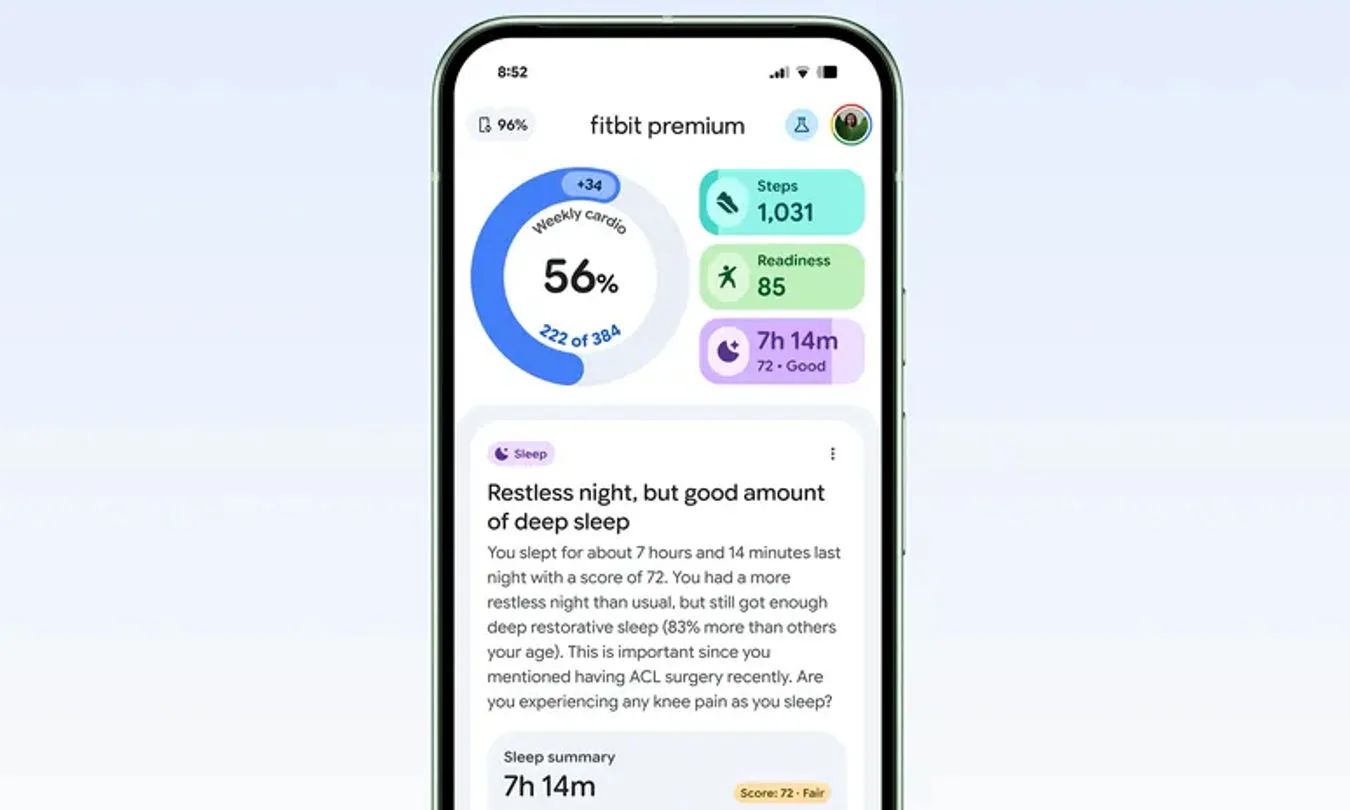
Beyond that, the update overhauls the Coach experience. Personalized motivational messages now appear throughout the day in the Today tab, and they cover Morning Moments, Post-Workout Summaries, and End-of-Day or End-of-Week updates. 

There’s a new Conversational Check-In Feature that lets Fitbit users interact with their fitness coach more naturally, via a new text interface. The addition removes the friction of entering data into the app and then waiting for a response, allowing you to talk to it and get responses as part of a back-and-forth conversation. 

Advertisement

How does the coach experience actually change for users?

Whenever a coach-assigned workout appears, users will now see step-by-step guidance on the screen, helping those with less experience. Weekly fitness targets are now more flexible, with recommendations tailored specifically to individual health goals rather than generic plans. 

A future Fitbit update will also add the ability to adapt workout plans through conversation. While Fitbit 4.68 might sound like a small update, it conveys a bigger message. Google is quietly repositioning Fitbit as an AI-powered health coaching platform, rather than a simple software companion for smartwatches. 

The Conversational Check-In feature, along with the leaked Google Health rebrand logo, indicates that the Fitbit app might get folded into something much bigger and more important at the Google I/O 2026. 

Source link

Advertisement
Continue Reading

Tech

Audio-Forward Case Mod Of Classic 90s Portable TV

Published

on

The humble cathode ray tube (CRT) was once the technology behind almost all of our televisions and computer displays. Its replacements, from LCD screens to OLED and others, are generally cheaper to make and better to look at. Old televisions were comparatively large as well, but their size can be an advantage for people like [ManicMods] aka [Jeff]. His latest build ditches the CRT from an old Bently portable TV and uses the huge space available in the case for a hi-fi audio system and some other parts that turn it into an impressive portable home theater system.

After removing most of the internals of the TV, the first part to go in is the stereo and subwoofer combo as it takes up the most amount of space. The subwoofer section points downward and the two stereo speakers are mounted to the sides. To free up the most space inside, the new display is mounted forward of the original bezel, with a new 3D printed one helping to hold it in place. Behind it goes a Raspberry Pi, loaded with the moOde audio player, a high quality DAC for audio output, and a 1 TB SSD with [Jeff]’s uncompressed audio library. Most of the ports are extended out to the case including the SD card slot so other operating systems can be loaded on the Pi, and there are a ton of options for hooking up external speakers and displays as well, making it an extremely modular and expandable portable media center.

Also added to the finished product are a few small game controllers, since the Pi is perfectly capable of playing retro games, as well as a small wireless keyboard and trackpad combo. Although the CRT’s demise will be felt harder by some than by others, the original look of the case is preserved somewhat by keeping the original tuning display and locations of the original control buttons and knobs. If preserving the CRTs are of upmost importance, though, this build used a pair of them in a VR headset.

Advertisement

Source link

Continue Reading

Tech

Good News If You Have A Sony TV And Were Hoping It Would Become Less Useful For No Reason

Published

on

from the you-don’t-own-what-you-buy dept

If you own one of the Sony Bravia lines of televisions (like I do) and were hoping that the expensive television would suddenly become slightly less functional for no good reason, I have some good news for you.

Sony just announced that the company is making adjustments that will reduce the usefulness and efficiency of watching over-the-air (OTA) broadcasts with an antenna (something many still do in order to “cut the cord,” but still watch local sports broadcasts). According to the Sony announcement, the TV’s internal guide for watching live OTA simply won’t work as well anymore:

“The changes primarily target the program guide functionality for over-the-air antenna TV channels received via the ATSC tuner. After the cutoff date, program information may fail to display on certain channels, limiting the guide’s usefulness for planning viewing schedules. Users will often see listings only for channels they have recently watched, rather than a comprehensive overview of available broadcasts. Additionally, channel logos that previously appeared in the guide will disappear, and any thumbnail images accompanying program descriptions will no longer load or show.”

Many of the TVs being impacted are several thousand-dollar televisions, including the 2025 BRAVIA 8 II (XR80M2) and BRAVIA 5 (XR50), and the 2024 BRAVIA 9 (XR90), BRAVIA 8 (XR80), and BRAVIA 7 (XR70).

Sony didn’t specify why it’s making several-thousand-dollar televisions slightly less useful, but as always it’s about money. Many companies are keen to direct consumers to their (or their own) ad-based streaming alternatives to live OTA broadcasts, which are easier to monitor and monetize through surveillance. As Ars Technica posits Sony is also just likely cutting costs:

Advertisement

“Sony’s plan to remove some TV guide and menu features may be aimed at reducing costs and burden associated with features that typically depend on backend data services. Things like channel logos and enhanced metadata often require licensing agreements and the use of third-party electronic program guide data providers and metadata aggregators.”

Again, some of these sets (especially of the larger screen sizes) can run upwards of $3000 to $4000. You don’t typically expect products that expensive to suddenly become less useful. Or perhaps you do, if you’ve watched repeatedly how you no longer actually own the products you buy, which can be routinely downgraded (or bricked entirely) with a firmware update out of the blue.

Filed Under: bravia, broadcasts, channel guide, enshittification, hardware, smart tv, software, streaming, televisions, tv, tv guide, update

Companies: sony

Source link

Advertisement
Continue Reading

Tech

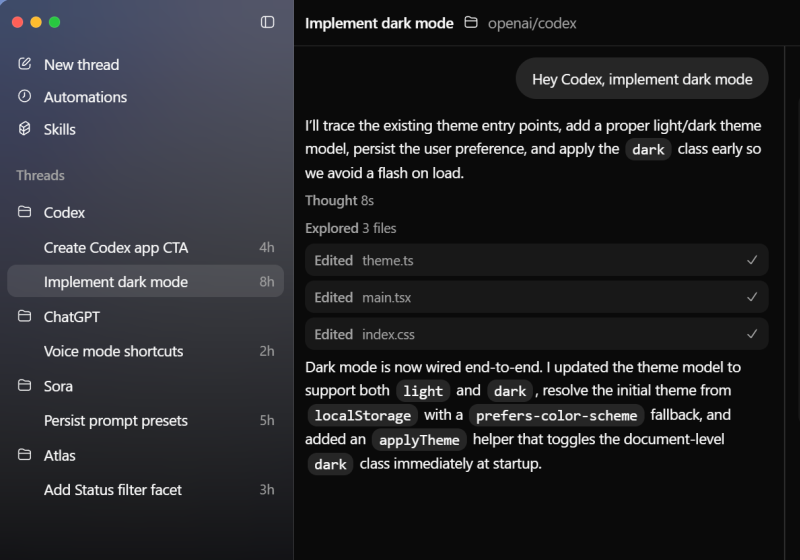
OpenAI Codex brings agent AI workflows to coding tasks

Published

on

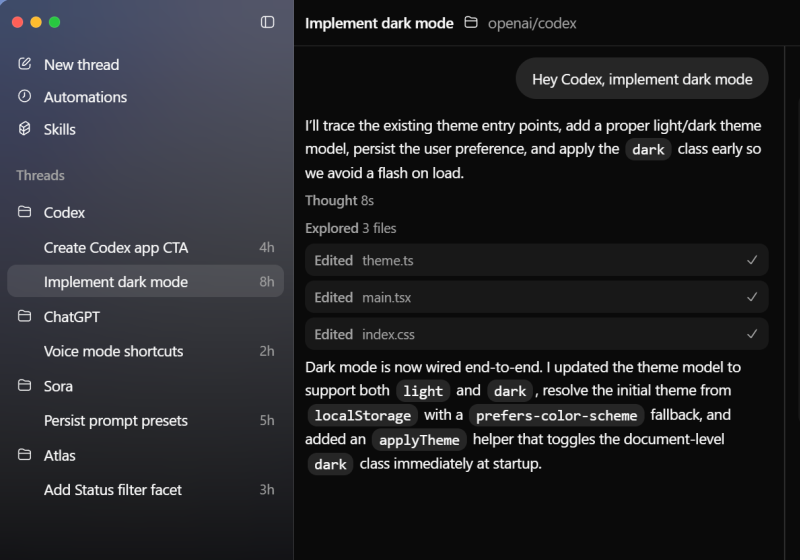
OpenAI Codex is a coding agent powered by ChatGPT that helps developers build, test, and ship software. It can run tasks in parallel, generate and review code changes, and automate repeatable workflows, while working with existing tools and secure sandboxed environments.

Read Entire Article
Source link

Continue Reading

Tech

Yong Wang Turns Visualization Into Insights

Published

on

When Yong Wang recently received one of the highest honors for early-career data visualization researchers, it marked a milestone in an extraordinary journey that began far from the world’s technology hubs.

Wang was born in a small farming village in southwestern China to parents with little formal education and few electronic devices. Today the IEEE member and associate editor of IEEE Transactions on Visualization and Computer Graphics is an assistant professor of computing and data science at Nanyang Technological University, in Singapore. He studies how people can employ data visualization techniques to get more out of artificial intelligence tools.

YONG WANG

EMPLOYER

Advertisement

Nanyang Technological University, in Singapore

POSITION

Assistant professor of computing and data science

IEEE MEMBER GRADE

Advertisement

Member

ALMA MATERS

Harbin Institute of Technology in China; Huazhong University of Science and Technology in Wuhan, China; Hong Kong University of Science and Technology

“Visualization helps people understand complex ideas,” Wang says. “If we design these tools well, they can make advanced technologies accessible to everyone.”

Advertisement

For his work in the field, the IEEE Computer Society visualization and graphics technical committee presented him with its 2025 Significant New Researcher Award. The recognition highlights his growing influence in fields including human-computer interaction and human-AI collaboration—areas becoming more important as the world generates more data than humans can easily interpret.

Growing up in rural Hunan

Wang was born in southwestern Hunan Province. China’s economy was still developing, and life in his village was modest. Most families in Hunan grew rice, vegetables, and fruit to support themselves.

Wang’s parents worked in agriculture too, and his father often traveled to cities to earn money working in a factory or on construction jobs. The extra income helped support the family and made it possible for Wang to attend college.

“I’m very grateful to my parents,” Wang says. “They never attended university, but they strongly supported my education.”

Advertisement

“If we build tools that help people understand information, then more people can participate in science and innovation. That’s the real power of visualization.”

Technology was scarce in the village, he says. Computers were almost nonexistent, and televisions were considered precious, expensive household possessions.

One childhood memory still makes him laugh: During a summer vacation, he and his brother spent so many hours playing video games on a simple console connected to the family’s television that the TV screen eventually burned out.

“My mother was very angry,” he recalls. “At that time, a TV was a very valuable thing.”

Advertisement

He says that despite never having used a laptop or experimenting with electronic equipment, he was fascinated by the technologies he saw on TV shows.

Discovering robotics and engineering

His parents encouraged a practical career such as medicine or civil engineering, but he felt drawn to robotics and computing, he says.

“I didn’t really understand what computer science involved,” he says. “But from what I saw on TV, it looked exciting and advanced.”

He enrolled at Harbin Institute of Technology, in northeastern China. The esteemed university is known for its engineering programs. His major—automation— combined elements of electrical engineering, robotics, and control systems.

Advertisement

One of the defining experiences of his undergraduate years, he says, was a university robotics competition. Wang and his teammates designed a robot capable of autonomously navigating around obstacles.

The design was simple compared with professional systems, he acknowledges. But, he says, the experience was exhilarating. His team placed second, and Wang began to see engineering as both creative and collaborative.

He graduated with a bachelor’s degree in 2011 and briefly worked as an assistant at the Research Institute of Intelligent Control and Systems at Harbin.

In 2014 he took a position as a research intern working at Da Jiang Innovation in Shenzhen, China.

Advertisement

That experience helped him clarify his future, he says: “I realized I didn’t enjoy doing repetitive work or simply following instructions. I wanted to explore ideas that interested me, and I wanted to conduct research.” The realization pushed him toward graduate school, he says.

Building tools that help humans work with AI

Wang received a master’s degree in pattern recognition and image processing from the Huazhong University of Science and Technology, in Wuhan, China, in 2016.

He then enrolled in the computer science Ph.D. program at the Hong Kong University of Science and Technology and earned the degree in 2018. He remained there as a postdoctoral researcher until 2020, when he moved to Singapore to join Singapore Management University as an assistant professor of computing and information systems. He moved over to Nanyang Technological University as an assistant professor in 2024.

His research focuses on a challenge facing nearly every business: how to make sense of the enormous amounts of data being generated.

Advertisement

“We live in an era of information explosions,” Wang says. “Huge amounts of data are generated, and it’s difficult for people to interpret all of it to make better business decisions.”

Data visualization offers a solution by turning complex information into images, patterns, and diagrams that people can more readily understand.

But many visualizations still must be designed manually by experts, Wang notes. It’s a time-consuming process that creates a bottleneck, he says.

His solution is to use large language models and multimodal systems that can generate text, images, video, and sensor data simultaneously and automate parts of the process.

Advertisement

One system developed by his research group lets users design complex infographics through natural-language instructions combined with simple interactions such as drawing on a touchscreen with a finger. It allows nontechnical people to generate visualizations instead of hiring professional designers.

Another focus of Wang’s research is human-AI collaboration. AI systems can analyze data at enormous scale, but people still need to be the final decision-makers, he says.

Visualization helps bridge the gap between human intention and AI’s complex calculations by making the process an AI system uses to reach a result more transparent and understandable.

“If people understand how the AI system works,” Wang says, “they can collaborate with it more effectively.”

Advertisement

He recently explored how visualization techniques could help researchers understand quantum computing, a field where core concepts—such as superposition, where a bit can be in more than one state at a time—are abstract. In classical computing, the bit state is binary: It’s either 1 or 0. A quantum bit, or qubit, can be 1, 0, or both. The differences get more dizzying from there.

Visualization tools could help scientists monitor quantum systems and interpret quantum machine-learning models, he says.

The importance of IEEE communities

Teaching and mentoring students remain among the most meaningful parts of Wang’s career, he says.

Professional communities such as the IEEE Computer Society, he says, play a major role in helping him transform early-stage graduate students unsure of which lines of inquiry they will pursue into independent researchers with a solid technical focus. Through conferences, publications, and technical committees, IEEE connects Wang with other researchers working in visualization, AI, and human-computer interactions, he says.

Advertisement

Those connections have helped him share ideas, collaborate, and stay up to date on innovations in the research community.

Receiving the Significant New Researcher award motivates him to continue pushing the field forward, he says.

Looking back, he says, the distance between his rural village in Hunan and an international research career still feels remarkable. But, he says, the journey reflects something larger about his chosen field: “If we build tools that help people understand information, then more people can participate in science and innovation.

“That’s the real power of visualization.”

Advertisement

From Your Site Articles

Related Articles Around the Web

Source link

Advertisement
Continue Reading

Tech

Today’s NYT Connections: Sports Edition Hints, Answers for April 25 #579

Published

on

Looking for the most recent regular Connections answers? Click here for today’s Connections hints, as well as our daily answers and hints for The New York Times Mini Crossword, Wordle and Strands puzzles.


Today’s Connections: Sports Edition could trip you up, unless you know your video games. If you’re struggling with today’s puzzle but still want to solve it, read on for hints and the answers.

Connections: Sports Edition is published by The Athletic, the subscription-based sports journalism site owned by The Times. It doesn’t appear in the NYT Games app, but it does in The Athletic’s own app. Or you can play it for free online.

Advertisement

Read more: NYT Connections: Sports Edition Puzzle Comes Out of Beta

Hints for today’s Connections: Sports Edition groups

Here are four hints for the groupings in today’s Connections: Sports Edition puzzle, ranked from the easiest yellow group to the tough (and sometimes bizarre) purple group.

Yellow group hint: Not on top.

Advertisement

Green group hint: Hoops teams.

Blue group hint: Great netminders.

Purple group hint: Good group for gamers.

Answers for today’s Connections: Sports Edition groups

Yellow group: In the lowest position.

Advertisement

Green group: NBA teams, on scoreboards.

Blue group: Hall of Fame hockey goaltenders.

Purple group: Baseball video games.

Read more: Wordle Cheat Sheet: Here Are the Most Popular Letters Used in English Words

Advertisement

What are today’s Connections: Sports Edition answers?

completed NYT Connections: Sports Edition puzzle for April 25, 2026

The completed NYT Connections: Sports Edition puzzle for April 25, 2026.

NYT/Screenshot by CNET

The yellow words in today’s Connections

The theme is in the lowest position. The four answers are bottom, cellar, last and worst.

The green words in today’s Connections

The theme is NBA teams, on scoreboards. The four answers are DEN, OKC, SAC and WAS.

Advertisement

The blue words in today’s Connections

The theme is  Hall of Fame hockey goaltenders. The four answers are Brodeur, Fuhr, Parent and Roy.

The purple words in today’s Connections

The theme is baseball video games. The four answers are Backyard, High Heat, Slugfest and The Show.

Source link

Advertisement
Continue Reading

Tech

Why are top university websites serving porn? It comes down to shoddy housekeeping.

Published

on

With that, they have now hijacked that university’s subdomain. Given the reputations universities have, search queries then flow to the top of Google’s results.

Shakhov wrote:

The root cause is simple: organizations create DNS records and never clean them up. There is no expiry date on a CNAME record. Nobody gets an alert when the target stops responding. And most university IT departments don’t maintain a comprehensive inventory of their subdomains and where they point.

This is compounded by how universities operate—they are highly decentralized. Individual departments, labs, research groups, and student organizations can often request subdomains independently. When people leave, there is no decommissioning process for the DNS records they created.

Finding hijacked subdomains is straightforward. People need only enter site:[university].edu “xxx” or site:[university].edu “porn” for an affected institution, and scores of results will appear. In some cases, the subdomains returned no longer lead to porn sites, but as of Friday morning, many still did.

Advertisement

The lesson here is clear: Any organization with a website should compile a running inventory of all subdomains along with the purpose of each one and its corresponding CNAME record. Then staff should regularly audit the list in search of “dangling” records, meaning those that remain even after the official subdomain has gone dark. Any subdomain found to be inactive should have its CNAME removed.

Clearly, many universities and other organizations are flouting this common-sense practice. Shakhov said only a handful of the affected universities have expunged dangling CNAME records since he went public with his findings earlier this month. Even then, several of them have failed to get the URLs delisted by Google. That results in the indexed remaining visible in search results. Inquiries sent to UC Berkeley, Columbia, and Washington University didn’t receive responses before publication.

Source link

Advertisement
Continue Reading

Tech

Android wants to replace email verification codes with one-tap credentials

Published

on


Google is working on a more streamlined way for app developers to authenticate users. The company has introduced a new verified email credential issued directly through Android’s Credential Manager API, with the goal of modernizing the authentication process. Users will no longer need to check their inbox for temporary authentication…
Read Entire Article
Source link

Continue Reading

Trending

Copyright © 2025