We spend hours testing every product or service we review, so you can be sure you’re buying the best. Find out more about how we test.
Kodak Snapic A1: one-minute review
The Kodak Snapic A1 is a 35mm analog film camera designed and manufactured by Hong Kong-based Reto Production – the same company behind other licensed Kodak analog models like the Ektar H35N and Charmera. Priced from just $99, it’s one of the more affordable ways to dip your toes into the world of film photography, and it comes loaded with enough retro charm to justify that novelty appeal.
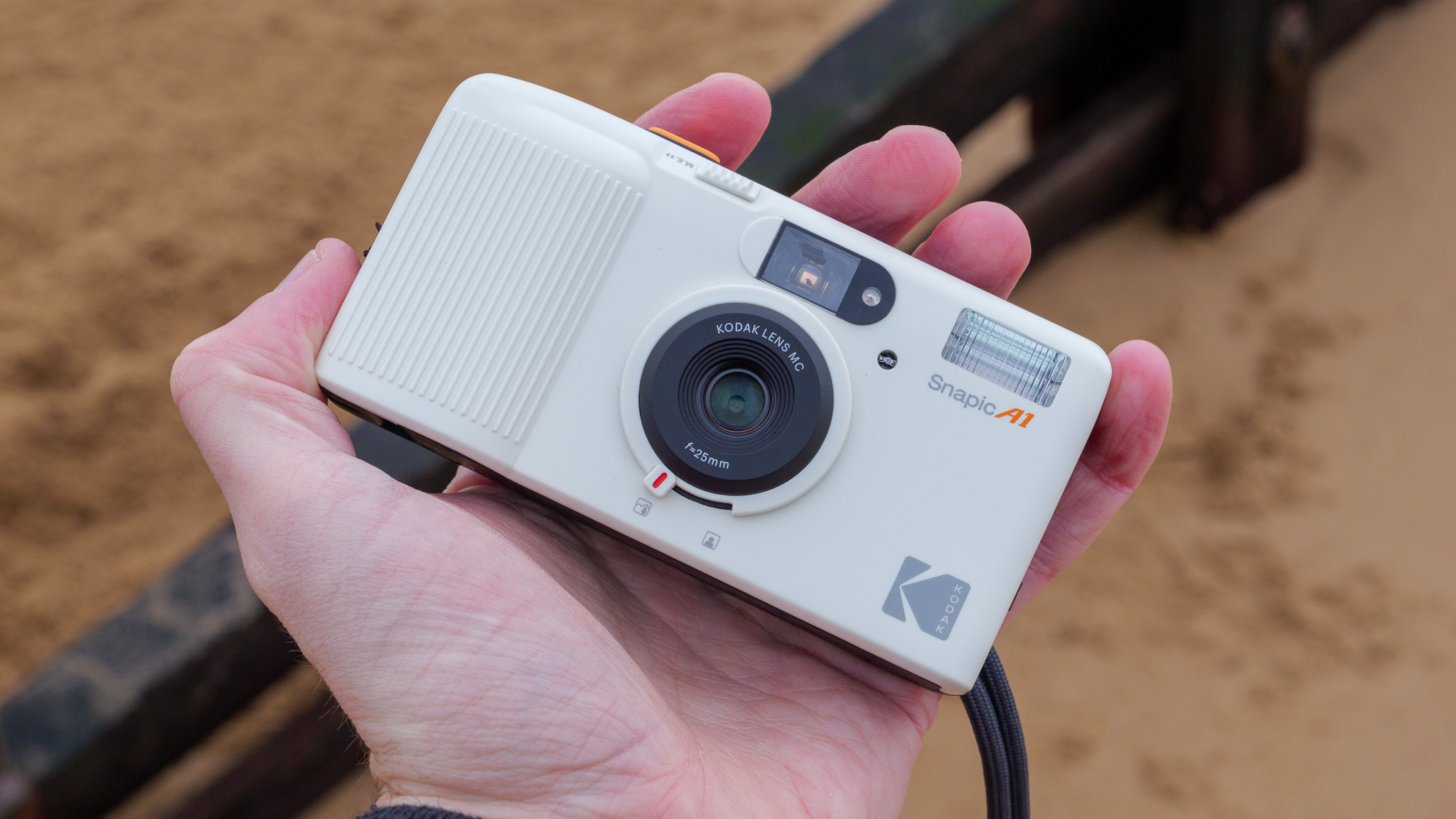
The design is immediately striking. Available in off-white or dark gray, the clean-lined plastic body has just enough Kodak orange on the shutter button and logo to feel authentically branded without going overboard. It’s a look that calls to mind the retro-futuristic aesthetic of classic science fiction movies rather than a straightforward throwback, and in my book that’s a good thing. It slipped into my jacket pockets with ease, and the included neck strap and protective pouch are welcome additions that more budget-focussed cameras often skip.
Advertisement
Feature-wise, you get a three-element glass lens at 25mm with a fixed f/9.5 aperture and 1/100s shutter speed. There are two manual focus settings, plus an auto flash with red-eye reduction, automatic film advance and rewind, and a double-exposure shooting mode. A small but practical OLED panel on top displays battery life, remaining exposures, and current settings. It’s basic by design, but thoughtfully put together.
(Image credit: Future | Sam Kieldsen)
In good outdoor light, I found that the Snapic A1 delivers characterful, grainy 35mm shots with that all-important analog look. Vignetting and some chromatic aberration are present, but these feel like features rather than flaws. Indoors, however, the flash struggles; it lacks the reach and power to properly illuminate subjects beyond a few feet, making indoor shots a more hit-or-miss experience, particularly with slower film.
The main practical gripes are minor but worth flagging. The Mode button sits awkwardly on the left edge of the top plate, and it’s easy to accidentally trigger it depending on how you hold the camera. There’s also no lens cap, which makes the pouch essential rather than optional. And while the price is genuinely affordable for the hardware, film and processing costs ramp up fast. A single 36-exposure roll and a set of digital prints can run close to $40 / £30, meaning the ongoing cost of ownership is considerably higher than buying the camera itself.
Advertisement
Taken as a whole, I think the Kodak Snapic A1 is a fun, well-designed entry point into analog photography – and one of the best new film cameras for the money. It won’t satisfy anyone looking for creative control or technical precision, but for casual shooters who want a stylish, pocketable film camera that just works, it hits the mark at a price that’s hard to argue with.
Kodak Snapic A1: price and availability
$99 / £99 / AU$179
Ongoing costs of 35mm film and processing
The Kodak Snapic A1 is available to buy now, and refreshingly cheap at just $99 / £99 / AU$179.
Sign up for breaking news, reviews, opinion, top tech deals, and more.
Advertisement
Also supplied in the box are two handy accessories: a soft microfiber drawstring pouch for keeping the camera protected when not in use, and a corded strap that’s long enough to fit around the user’s neck or shoulder. Kodak could have shipped this with just a tiny wrist strap, so I was impressed with the extras.
You will, however, need to supply your own batteries (2 x AAA), and there are the added costs of 35mm film, its development and potential printing to consider as well. This can quickly add up: buying a roll of 36-exposure Kodak ColorPlus film and getting some medium-quality digital prints costs me almost £30 in the UK (around $40 / AU$ 57). So, despite the affordability of the hardware, the Snapic A1 isn’t a particularly cheap camera to own.
(Image credit: Future | Sam Kieldsen)
Kodak Snapic A1: specs
Swipe to scroll horizontally
Format:
Advertisement
35mm
Lens:
25mm f/9.5
Focus:
Advertisement
0.5m to infinity (two-stage)
Flash:
Built in
Exposure:
Advertisement
Auto
Battery:
2x AAA
Viewfinder:
Advertisement
Optical, direct vision
Size:
118 x 62 x 35mm, 120g
Advertisement
Kodak Snapic A1: design
Small, stylish and built from sturdy plastic
Just 120g in weight and 118 x 62 x 35mm in size
Film is easy to load thanks to large rear door and auto wind
The top plate’s OLED panel is a clever and very useful touch. (Image credit: Future | Sam Kieldsen)
Kodak (or Reto, to be precise) has kept things pleasingly nostalgic with the styling. The camera body is ABS plastic but built to nice sturdy standards, and its clean lines and ivory white front (it’s also available in a dark gray color finish), with a couple of flashes of classic Kodak orange on the shutter button and logo, bring to mind the retro-futuristic production design of something like 2001: A Space Odyssey. It’s not just another 1950s or 60s-esque camera, and I really like that.
At under 120g and just 118 x 62 x 35mm in size, the camera is genuinely pocket-sized and I found it very easy to bring along to social events and out on hikes. There’s no lens cap to protect the glass front element, which makes the included protective pouch all the more valuable.
While the Snapic A1 is fairly bare-bones in terms of features and functions, it does have some interesting design touches. By flicking a switch underneath the lens, for instance, I could toggle between close-up (0.5 to 1.5m) and far-off (1.5m to infinity) focus. And, up on top, there’s an OLED panel that provides at-a-glance info on remaining exposures, battery life and the current flash and focus settings. It’s monochrome and tiny, but easy to read and perfectly equipped for its job.
(Image credit: Future | Sam Kieldsen)
My main gripe with the design is the placement of the Mode / M.E. button, which sits right on the left edge of the top plate, curving around to the left side of the camera. Often, when I was gripping the camera and about to take a shot, my left forefinger would hit this button and change the shooting mode. Depending on how you hold the camera, this may never become an issue for you, but it forced me to adjust the way I took photos, which I found a little annoying.
Advertisement
Getting film in and out of the camera is easy thanks to a large, easy to open rear door that provides plenty of room to work. There’s a tiny plastic window on the door so that you can instantly see whether or not any film is inside. And, in a nice user-friendly touch, film winds on automatically between shots and will fully rewind once a roll is complete.
Kodak Snapic A1: performance
Strong, characterful 35mm photos
Flash isn’t particularly powerful
Solid battery life
Most cheap 35mm cameras use plastic lens elements, but the Kodak Snapic A1 has a three-element glass lens. It has a wide-angle 25mm focal length and a rather narrow fixed aperture of f/9.5, along with a fixed shutter speed of 1/100s.
There’s the two-stage manual focus I mentioned above, as well as a flash (which can be set to automatic, on or off, and has a red-eye reduction mode), but other than that there’s no way to control your exposures. This is very much a point-and-shoot camera, and while that’s not necessarily a bad thing – simplicity is welcome – it does mean you need to know its limits if you want to get the best out of it.
Image 1 of 1
Advertisement
(Image credit: Future | Sam Kieldsen)
I shot using Kodak ColorPlus 200 speed film, with which the camera performs well outdoors in the daytime. I managed to capture some striking snaps that I’m very happy with, and I love the grainy look of those images. Indoors, however, I found that the flash doesn’t have the reach or power to illuminate subjects more than a few feet away. It may fare better with 800 or 1600 speed film, of course, but in my experience my most successful indoor shots were all close-up portraits, where the flash could do its job properly.
Are the Snapic A1’s photos “high quality” by today’s standards? Not really – if you pull out a 10-year-old smartphone it’ll take sharper, cleaner images than these; there’s noticeable vignetting around the edges, particularly in the corners, and some chromatic aberration too.
Image 1 of 8
(Image credit: Future | Sam Kieldsen)
But I don’t think quality is ever really the point with a cheap 35mm camera – the look and feel of analog photos can’t easily be replicated by digital filters and algorithmic tweaking, and you buy an old-fashioned camera like this for, ironically, the novelty of shooting on film. Yes, its photos aren’t noise-free or razor-sharp edge-to-edge, but they have real texture and character.
If you do want to get a little more creative, the Snapic A1 can capture double exposures – just hold down the Mode button to select it, and the OLED panel will make it clear whether you’re shooting the first or second exposure.
(Image credit: Future | Sam Kieldsen)
Battery life feels pretty solid to me. After shooting a 36-exposure roll of film on the camera, the battery indicator still showed as full, and according to Kodak users should be able to shoot around 10 rolls of 24-exposure film on a single pair of AAA alkaline batteries. Your mileage, of course, may vary depending on which batteries you’re using and how frugal you are with the flash.
Advertisement
Should you buy the Kodak Snapic A1?
(Image credit: Future | Sam Kieldsen)
Buy it if…
Don’t buy it if…
Advertisement
Also consider
How I tested the Kodak Snapic A1
Used over a few weeks in different lighting conditions, indoors and outside
Tested with Kodak ColorPlus 200 film
Film sent to Analogue Wonderland for processing and development
Testing a film camera is a much slower process than reviewing a digital camera, because you can’t look at the photos right away. In fact, I reviewed the Kodak Snapic A1 (a sample of which was sent to me by a PR rep) over a period of well over a month, taking it with me to various parties, hikes and events and snapping a photo or two until my 36-exposure roll of Kodak ColorPlus 200 film was spent.
I made sure to use the camera in all kinds of conditions – indoors and outdoors, day and night, bright and overcast – testing out the flash and focus controls.
I then sent the film to UK-based online film retailer and developer Analogue Wonderland for processing. They created digital scans for me to download – I opted not to pay extra for physical prints.

Xiaomi has been out of the laptop game for a few years, but the Book Pro 14 (2026) completely outperforms their previous offerings with cutting-edge technology that manages to deliver everyday comfort and a serious punch in an impressively small chassis, rivaling Apple’s MacBook Air.
The Book Pro 14 weighs a sleek 1.08kg and is only slightly thicker than 15mm, making it easy to sneak into your luggage without drawing notice. The entire design revolves around a single huge piece of die-cast magnesium alloy that acts as the main frame, which is then encased in a carbon fiber bottom panel and a titanium support beneath the keyboard. The idea behind all of this was to minimize weight while yet having a structure robust enough to withstand being bunged in a travel bag, and there are a variety of color possibilities, including blue, grey, pink, and white, which is a nice change from the usual bland neutrals.
SPEED OF LIGHTNESS — MacBook Air with the M4 chip lets you blaze through work and play. With Apple Intelligence,* up to 18 hours of battery life…
SUPERCHARGED BY M4 — The Apple M4 chip brings even more speed and fluidity to everything you do, like working between multiple apps, editing videos…
BUILT FOR APPLE INTELLIGENCE — Apple Intelligence is the personal intelligence system that helps you write, express yourself, and get things done…
The screen is 14.6 inches and features an OLED panel with a resolution of 3,120 x 2,080, which is refreshed 120 times per second. Oh, and it’s touch-sensitive and bright enough to see in almost any setting. Overall, it provides a really fluid experience whether you’re seeing documents or watching videos, and the colors appear accurate for creators.
Advertisement
Intel basically provides the CPUs, and there are a few solid options to select from, ranging from the Core Ultra 5 325 to the Core Ultra X7 358H, which has an incredible 16 cores. Meanwhile, the top models have 32GB of RAM and 1TB of storage, with an internal slot for adding another drive for a total of 4TB.
Power management is handled by a huge 10,000 square millimetre vapor chamber, which works in tandem with dual fans and three independent airflow channels to keep the whole thing nice and cool even when running solely on battery power. The battery has an amazing 72WH capacity, and estimations range from 19.8 hours of mixed use to 12 hours of uninterrupted video playback or over 16 hours of online meetings. It’s also easy to recharge; simply plug in a 100w charger and you’re ready to go.
When it comes to connectivity, we’ve got the essentials without the extras: a single standard USB-A connector adjacent to an HDMI port, two USB-C ports (one of which supports Thunderbolt), and a 3.5mm socket to meet all of your audio demands. The keyboard boasts 1.3mm of key travel and LEDs to help you work late at night or in low-light conditions. The touchpad is a reasonable size at 129 square cm and responds to pressure in a way that allows you to employ a few extra gestures for shortcuts and other purposes. To sweeten the deal, Xiaomi has included a few features that should make life easier, such as seamless file copying between devices and the ability to read documents on whatever tablet or phone you own without having to worry about it.
Prices in China start around 8,500 yuan, which equates to approximately $1,234 for the entry-level model with 24GB of memory and 1TB of storage. The higher-spec models with faster processors and more memory cost around 10,500 yuan. Sales began in China on March 21st, and if you were lucky, you might have gotten one of the early deals that were available.
Salesforce acquired Clockwise’s workers, but not the company itself
Clockwise customers advised to migrate to Reclaim
Agentforce annual recurring revenue up 169%
Clockwise CEO Matt Martin has announced via a LinkedIn post that Salesforce will be hiring the startup’s team as part of its broader Agentforce push.
Because Salesforce is acquiring the workers and not the company, Clockwise has confirmed it will be shutting down from March 27, 2026, leaving customers having to find an alternative.
Martin confirmed that all customer data would be deleted, meaning that Salesforce won’t have access to Clockwise’s database, and that unused subscriptions will be refunded.
Article continues below
Advertisement
Clockwise closes down as Salesforce acquires workers, not company
“We believe this move will allow us to have even greater impact,” Martin wrote, explaining the founding team’s success and experience. “We will be bringing our deep expertise building reliable, agentic software to the Agentic Enterprise.”
The 10-year-old company has served major customers, like Uber, Netflix and Atlassian, during its time in market, but now users are being directed to rival app Reclaim in light of the near-immediate shutdown. Reclaim will be matching Clockwise’s prices to make the transition less painful.
Advertisement
“They’re joining my charter to build Agent Interoperability and Orchestration within Agentforce,” Clockwise co-founder Gary Lerhaupt wrote in a separate LinkedIn post. Lerhaupt joined the Agentforce team as Product Architecture VP a little over a year ago after around eight years at Clockwise. Martin also spent over two years at Saleforce between 2014 and 2016 before departing to create Clockwise.
Although Salesforce has not commented on how the new recruits might drive Agentforce forward, we can at least expect immense growth. The Agentforce business grew 169% in terms of annual recurring revenue, now accounting for $800 million. Total company revenue for the most recent full year stood at $41.5 billion, up 10% year-over-year.
Sign up to the TechRadar Pro newsletter to get all the top news, opinion, features and guidance your business needs to succeed!
The team from Auger accepts the Startup of the Year trophy at the 2025 GeekWire Awards. (GeekWire File Photo / Dan DeLong)
Boot up the robot trophies, it’s time to vote for the finalists for the 2026 GeekWire Awards!
This is your chance to help us honor the top innovators and entrepreneurs in Pacific Northwest tech — from Startup of the Year to Next Tech Titan, from Young Entrepreneur of the Year to CEO of the Year, and much more.
With 50 finalists across 10 categories, the annual GeekWire Awards are a much-anticipated and hotly-contested affair, hosted live from the Showbox SoDo in Seattle on May 7.
Cast your ballot here or in the embedded form at the bottom. Voting runs through April 10.
The event will feature a VIP reception, sit-down dinner and fun entertainment mixed in. Tickets go fast, and a limited number of half-table and full-table sponsorships are available, so contact events@geekwire.com to reserve a spot for your team today.
Over the next few weeks, we’ll feature the finalists in special GeekWire editorial posts on each category.
Advertisement
Now in its 18th year, the GeekWire Awards is a premier event for the Seattle tech community, bringing together hundreds of geeks to celebrate innovation and the entrepreneurial spirit. Past winners have included Auth0, Tableau, Smartsheet, Rover, Remitly, Swype, Redfin, Zulily, The Black Boardroom Initiative, University of Washington computer scientist Ed Lazowska, Technology Access Foundation and many others.
(function(t,e,s,n){var o,a,c;t.SMCX=t.SMCX||[],e.getElementById(n)||(o=e.getElementsByTagName(s),a=o[o.length-1],c=e.createElement(s),c.type=”text/javascript”,c.async=!0,c.id=n,c.src=”https://widget.surveymonkey.com/collect/website/js/tRaiETqnLgj758hTBazgd5M58tggxeII7bOlSeQcq8A_2FgMSV6oauwlPEL4WBj_2Fnb.js”,a.parentNode.insertBefore(c,a))})(window,document,”script”,”smcx-sdk”); Create your own user feedback survey
GrapheneOS is doubling down on privacy at a time when most platforms are moving the other way. The security-focused Android alternative says it won’t require personal information from users, even as governments tighten identity and data collection rules.
In a recent public post, the team said the OS will remain usable without accounts or ID checks worldwide. That decision comes with a clear tradeoff. If local laws demand verification, access in those regions could disappear instead of the platform changing its approach
That puts GrapheneOS on a direct collision path with a broader push toward verified online services. While most companies adapt quietly to stay compliant, this project is choosing to stay outside that system entirely.
No ID means no compromise
The position itself isn’t new, but the clarity is. Access to GrapheneOS and its services won’t depend on signing up or proving your identity, regardless of where you are
Advertisement
GrapheneOS will remain usable by anyone around the world without requiring personal information, identification or an account. GrapheneOS and our services will remain available internationally. If GrapheneOS devices can’t be sold in a region due to their regulations, so be it.
Instead of tailoring rules for each market, the platform keeps a single global standard. If a government requires identity checks to distribute or use it, support in that region stops there.
That approach is rooted in how the OS is built. GrapheneOS strips out unnecessary data exposure wherever possible, including avoiding centralized accounts that can tie activity to a person. Adding identity requirements would break that model at a fundamental level.
Why this stance stands out
There’s a practical downside to that consistency. In regions where stricter rules take effect, users could lose access to GrapheneOS devices or updates tied to the platform
Advertisement
The limitations go further than availability. Hardware support is deliberately narrow, limited to devices that meet strict security requirements. Broader compatibility options are avoided because they weaken protections. Even setup reflects that thinking, with preloaded devices offered to reduce exposure to standard Android installs

YouTube
That tradeoff is hard to ignore. You get stronger privacy guarantees, but you give up flexibility in devices and access.
What happens next
GrapheneOS is still trying to grow without loosening its rules. A long-term partnership with Motorola aims to bring official support to more devices starting in 2027, which could improve availability without lowering its standards
Expansion will stay selective. Devices that don’t meet its requirements won’t be supported, even if that slows adoption.
The project’s funding model also plays a role. It runs entirely on donations, now enough to support a full-time team. That independence gives it room to hold this line while others bend under regulatory or commercial pressure.
Advertisement
If you’re thinking about switching, the value is straightforward. You get a mobile OS that avoids identity checks entirely, but depending on where you live, access could become harder to maintain over time.
Looking for the most recent regular Connections answers? Click here for today’s Connections hints, as well as our daily answers and hints for The New York Times Mini Crossword, Wordle and Strands puzzles.
Today’s Connections: Sports Edition is a tough one. Let’s hope you know a lot about a certain NBA player. If you’re struggling with today’s puzzle but still want to solve it, read on for hints and the answers.
Connections: Sports Edition is published by The Athletic, the subscription-based sports journalism site owned by The Times. It doesn’t appear in the NYT Games app, but it does in The Athletic’s own app. Or you can play it for free online.
Hints for today’s Connections: Sports Edition groups
Here are four hints for the groupings in today’s Connections: Sports Edition puzzle, ranked from the easiest yellow group to the tough (and sometimes bizarre) purple group.
Yellow group hint: Somebody has to win!
Advertisement
Green group hint: Gridiron strategy.
Blue group hint: Certain bird.
Purple group hint: A hoops star.
Answers for today’s Connections: Sports Edition groups
Yellow group: Used to break a tie.
Advertisement
Green group: Offensive formations in football.
Blue group: Cardinals.
Purple group: Associated with Shai Gilgeous-Alexander.
One of the coolest things about old hi-fi hardware is that it often came with flickety needles that danced with the audio level. You can still buy these if you want, or you can simulate the same look on a screen, as [mircemk] demonstrates.
It isn’t [mircemk]’s first rodeo in this regard. An earlier project involved creating simulated VU meters on round displays, but they were somewhat limited. Using the Adafruit GFX library on an ESP32 netted a working setup, but it was jerky and very jagged and digital-looking. It was more akin to a fake needle display running on an 8-bit computer than something that looked like a real vintage VU meter.
[mircemk] didn’t give up and figured the ESP32 microcontroller and GC9A01 round display could surely deliver better results. The trick was to leverage the LVGL graphics library instead, along with the Squarelinestudio UI editor. The library was able to display far richer graphics that look like an actual vintage VU meter, even appearing glowing and backlit like the real thing. The moving needle animates far more smoothly as well, pulsing with the music in a way that feels far more realistic compared to the earlier attempt.
Advertisement
It’s nice to see this simple project revisited and so boldly improved just a year later. If you’re looking to implement real-looking gauges while retaining the flexibility of a small LCD screen, you might like to try the LVGL library for yourself. With that said, sometimes you just can’t beat the real analog gauges themselves. Video after the break.

AI agents are quickly becoming the cybersecurity industry’s favorite promise.
In theory, they can triage alerts, investigate incidents, and respond to threats – acting as force multipliers for overstretched SOC teams.
In practice, many security leaders are discovering that agents are failing.
Advertisement
Article continues below
Jamie Moles
Senior Technical Manager at ExtraHop.
Not because these agents are incapable, but because they lack the data and context to understand activity across the network and respond appropriately.
Autonomy is compelling, but without the right data, it’s less useful automation and more hopeful guesswork that is quietly creating a visibility gap at the heart of the agentic SOC.
Advertisement
The context problem
Most AI agents rely on the same fragmented telemetry stacks that analysts have struggled with for years. Endpoint logs in one tool, cloud signals in another, identity data elsewhere, and network traffic often underused or ignored. Each source tells part of the story, but none provide the full picture no matter what dashboard you favor.
When context is missing, agents struggle to reason about what’s normal and what’s malicious. False positives can multiply, investigations can stall, and automated responses can disrupt legitimate business activity.
Sign up to the TechRadar Pro newsletter to get all the top news, opinion, features and guidance your business needs to succeed!
Practical AI use cases illustrate both the promise and the challenge: agents can automatically isolate compromised endpoints after detecting unusual login patterns, or flag anomalous lateral movement that would take analysts hours to investigate manually.
Advertisement
Yet these same agents can misfire if the underlying telemetry is incomplete, triggering unnecessary quarantines or failing to detect stealthy sophisticated threats.
At its core, this isn’t a problem with the AI, but with the information available to it. AI can only act on what it knows. And in many SOCs, it simply doesn’t know enough.
Advertisement
Building a foundation for autonomy
Before organizations push further into automation, they need to address a more fundamental issue: the quality and completeness of their telemetry. Autonomous decision-making requires a constant stream of high-fidelity, trustworthy data – the kind that can be correlated across users, devices, applications, and workloads.
Many practitioners are returning to the foundational principle that the network remains one of the most reliable sources of truth in modern environments. While endpoints can be tampered with and logs siloed, network activity is unavoidable to attackers. It captures what actually happened – who talked to what, when, and how.
Modern environments demand even more context. Security teams also need visibility into identities behind actions and the behavior of cloud-native and Kubernetes workloads that now power critical business applications.
Advertisement
How context enables effective AI
When these layers – network, identity, and cloud – are unified, agents can operate with clarity. Instead of guessing, they can query rich telemetry directly, enrich alerts automatically, and make deterministic decisions about whether something truly represents risk.
In an effective agentic SOC, AI doesn’t replace analysts or blindly trigger responses. It does, though, handle the heavy lifting, correlating signals, surfacing the most relevant evidence, and resolving straightforward incidents so humans can focus on complex threats.
But this only works if the underlying data is complete, structured, and accessible. Put simply, better algorithms can’t compensate for poor visibility.
Advertisement
The path forward
As enterprises race to adopt AI-driven defenses, it’s tempting to treat agents as a shortcut to cybersecurity maturity. In reality, they amplify whatever foundation already exists – good or bad.
Organizations with strong telemetry and contextual insights see meaningful gains. Those without it simply automate their blind spots.
The future SOC will absolutely include AI agents. But autonomy needs to start with making sure the system has something trustworthy to see.
AI or not, in cybersecurity, your intelligence is only as powerful as the context behind it.
The AI company is facing strong competition from rivals such as Anthropic.
OpenAI is aiming to nearly double its headcount by the end of 2026, according to a Financial Times report.
The publication estimated that current staff numbers of 4,500 would reach around 8,000 by the end of the year, citing two people with direct knowledge of the matter, and added that the new roles would largely be across product development, engineering, research and sales.
Last month, Irish media reports suggested OpenAI was looking for a new, larger Dublin premises for its European headquarters, having established its Irish presence in 2023. Then, CEO Sam Altman said that the company chose Ireland because it “blends a talented workforce with support for innovation and responsible business growth”.
Advertisement
The company is currently hiring in cities in the US, Europe, Australia and Asia.
OpenAI is facing stiff competition in its field from rivals such as Anthropic, which recently announced the planned expansion of its Dublin operation and the creation of 200 new jobs by 2027 in engineering, sales, finance, legal and compliance, and operations.
As of November 2025, Anthropic had around 300,000 enterprise customers, while OpenAI had more than 1m, but recent data shows that Anthropic is now capturing more than 73pc of all spending among companies buying AI tools for the first time, while OpenAI is down to around 27pc.
In late February, a $110bn funding round brought OpenAI’s valuation to $730bn. The round featured major contributions from Amazon, Nvidia and SoftBank – the latter of which had its outlook lowered by S&P earlier this month due to a perceived over-reliance on heavy investment in OpenAI.
Most of us now get our information using AI chatbots and search engines. Even Google shows us an AI summary first before guiding us towards the sources it compiled the answers from.
A new study from Yale suggests that while AI-generated answers are fast, convenient, and easy to read, they can also influence our opinions. Daniel Karell, an assistant professor of sociology at Yale, and his team wanted to find out whether reading AI-written summaries of historical events helped people learn better than reading human-written ones.
To test this, participants were shown short summaries of historical events, some written by humans and others by AI tools like ChatGPT, and then quizzed on what they remembered.
The result? People who read AI-written summaries consistently answered more questions correctly.
Advertisement
Is AI just better at disseminating information than humans?
Karell attributes this to how AI presents information. “It’s like the model took Wikipedia and made it more readable,” he said. The AI summaries were smoother, clearer, and easier to retain, regardless of whether participants knew they were reading AI-generated content.
Growtika / Unsplash
That means, even when people were told the summary was written by AI, they still learned more from it than from the human-written version.
Should this worry you?
Here is where it gets interesting. In a follow-up paper published in PNAS Nexus, the same researchers found that AI summaries not only teach better, but also influence political opinions.
If the AI summary had a liberal slant, readers came away with more liberal opinions. A conservative slant had the opposite effect. The researchers believe this happens because AI doesn’t just present facts, but it frames them in a way that feels more logical and convincing.
Daniel Karell / PNAS Nexus
AI tools are becoming the default way people learn about history and current events. That is not necessarily bad. But knowing that the tool shaping what you learn can also quietly shape what you think is something worth keeping in mind.
At the same time, AI hallucinations remain a significant issue, and AI-generated summaries can be even more misleading for humans. A study conducted by researchers at USC’s Information Sciences Institute found that AI systems can execute propaganda campaigns with minimal human input.
Advertisement
If we add to this the idea that AI can be more convincing than humans, it’s scary to think how these tools can be used to manipulate human thinking and reasoning, guiding us toward a more fractured world.
Meze Audio, founded in 2011 in Romania, has built a strong reputation in high-end personal audio with standout over ear models like the award winning Empyrean II, 109 Pro, and the recently updated 99 Classics 2nd Gen. But while the brand has become one of the more recognizable names in premium headphones, its track record with in-ear monitors has been far less consistent.
We had an early preview of the new Astru at CanJam NYC 2026, where one thing was impossible to ignore: wired IEMs are having a moment and were at the center of the conversation. If you think the category is fading in a world dominated by wireless earbuds, think again. Enthusiasts are doubling down on sound quality, and brands are responding.
The Astru is Meze’s latest attempt to finally lock in a true flagship IEM. Featuring a titanium shell and a single dynamic driver design, it builds on earlier efforts like Advar and Rai Penta, both of which showed promise but struggled to fully land with critics and buyers. The question now is simple. Can Meze translate its headphone success into the IEM space, or is this another near miss?
Key Specifications and What They Actually Mean
The Astru uses a single 10mm dynamic driver with a titanium and PEEK diaphragm, a combo designed to balance rigidity and flexibility for a more natural, controlled sound. With a 32 ohm impedance and 111dB sensitivity, it is easy to drive from a phone or dongle, but still benefits from better sources.
Advertisement
Meze includes a 0.78mm 2-pin cable with a 4.4mm balanced termination, which signals this is meant for serious portable gear, not just casual listening. At 13.4 grams with a titanium shell, it should feel solid without being fatiguing, and at $899, it lands in a very competitive tier where sound quality matters more than design alone.
Who Astru Is For and Who It Is Not
The Astru is aimed squarely at dynamic driver enthusiasts and anyone chasing a flagship IEM experience built around Meze’s house sound. It will appeal to listeners who prioritize cohesion over complexity, delivering a unified presentation that does not sacrifice treble performance, along with a warm, balanced tuning that favors musicality over analysis.
It is not for bassheads, listeners who demand true reference sound, or those chasing maximum top of the line vocal resolution. If your priorities lean toward impact, absolute neutrality, or extracting every last micro detail from a vocal track, this may not be your endgame.
Build
Meze went with titanium for the Astru’s shells. It is an expensive, finicky material, so it makes sense that they also reduced the visual and structural complexity to match. That said, the two-tone character of models like Advar and Alba is missed. This more minimalist approach makes the Astru feel less like a statement piece and more like an unfinished Blender render than a flagship Meze IEM.
Advertisement
Style aside, Meze clearly put real effort into the Astru’s geometric shell design. The titanium nozzles feature precisely cut, integrated debris filters with a clean chamfer leading into a tight lip, giving the whole assembly a more refined, engineered feel.
Like the Alba and unlike the Advar, the Astru uses 0.78mm 2-pin detachable cables, with the sockets housed in smoky black plastic blocks. It works, but it is a step back visually. The Alba at least added a red accent on the right side for quick channel identification, a small but thoughtful detail that is missing here on the more expensive Astru.
The effort Meze put into the Astru’s cable is obvious, from the soft, premium feeling twisted braid to the custom cut hardware on the Y splitter, giving it a true flagship feel in hand rather than something thrown in to check a box. It uses a fixed 4.4mm termination, with a 4.4mm to 3.5mm adapter included in the box for broader compatibility.
Advertisement. Scroll to continue reading.
Comfort
Comfort is always subjective and heavily dependent on your ear anatomy, so mileage will vary. The Astru is one of the most-comfortable IEMs I’ve used. I was able to listen to it without any discomfort. Its lightweight titanium shells work wonders for long transit rides and intense work sessions, though I did not get the best passive isolation with the stock eartips.
Accessories
Inside the box you’ll find:
1x Semi-hard carrying case
1x 4.4mm-to-3.5mm adapter
5x Pairs silicone eartips
1x Synthetic leather baggie
1x Metal Astru plate
Meze did well with the Astru’s cable. It feels great in hand and is comfortable to use, but the rest of the accessory package does not keep up. The carrying case uses the same overall design as previous Meze flagships, but swaps the glossy black finish for a cheaper feeling satin coating that is more prone to scratches and long term wear like drying or flaking. By comparison, my well used Advar case still looks close to new. At $100 more, this feels like a step backward in overall quality.
Thankfully, Meze has improved on their ear tip offerings since 2022. The Astru’s stock eartips are comfortable and sized-well, but don’t offer the variety and passive isolation found on the sets offered by other brands. Campfire Audio, for example, includes a wider variety on even their entry-level IEMs, including liquid-silicone and foam sets. For $900, it’s fair to expect a more-comprehensive out-of-the-box experience.
Advertisement
Listening
About My Preferences: This review is a subjective assessment and is therefore tinged by my personal preferences. While I try to mitigate this as much as possible during my review process, I’d be lying if I said my biases are completely erased. So for you, my readers, keep this in mind:
My ideal sound signature leans toward competent sub bass, textured mid bass, a slightly warm midrange, and extended treble, though I do have mild treble sensitivity.
Testing equipment and standards can be found here.
The Astru features a gently V-shaped sound signature. It has a warm, healthy lower register, clean upper-midrange lift, and far-extending treble. The Astru exhibits a distinct “balance-first” approach to tuning, deviating from a tonal neutral purely in pursuit of a more-organic presentation. The Astru’s warm and inviting timbre and top-notch performance, blend together to deliver a distinctly “Meze” take on a harmonically-complete version of a modern meta IEM.
The Sweet Meze Sparkle
The Astru, with its single dynamic driver configuration, faces an uphill battle against the maelstrom of audiophile preconception. Single dynamic driver IEMs have long since been maligned as somehow inferior to alternative configurations, even if the objective measurements demonstrated otherwise. The bulk of the general enthusiast population’s disillusionment with dynamic drivers is concentrated around their treble characteristics, often described as grainy, or lacking in upper-end resolution.
Advertisement
For many poorly-implemented IEMs, that’s actually true — but that’s not the case on the entry-level Meze Alba, let alone the new Astru. The Astru exhibits the best treble performance of any single dynamic driver IEM I’ve heard, bar none. Even some multi-driver, planar-based, tribrids don’t resolve subtle textures as cleanly as the Astru does.
I was particularly taken by the Astru’s ability to resolve the tactile decay of the hi hats in “Careless” by Royal Blood (around 1:20 and 1:23). It also does an excellent job with background textures in “WANTED U” by Joji (around 3:00), integrating treble based effects naturally against the track’s dark, empty soundstage.
Meze’s focus on the Astru’s treble pays off, delivering a more elevated take on the brand’s upper register tuning. The result is a sweet, resolving timbre that avoids sharpness and sibilance, making it an easy listen even on rougher masters, including for those with mild treble sensitivity like myself.
Advertisement. Scroll to continue reading.
Advertisement
Vivid and Lush Mids
The core trait shared between Meze’s IEMs is a lush, warm, and inviting midrange. That Meze house sound is certainly present on the Astru, as its lower-mids have a healthy dose of emphasis. They blend organically from the lower mids into the mid bass, allowing the Astru to create a strong sense of atmosphere on tracks like “Lisztomania” by Phoenix. The layering of gentle guitar strumming against punchy drums and fluttering vocals feels dynamic and engaging, exactly what you want from a flagship IEM.
The Astru’s vocal timbre benefits from its rich midrange, with male vocals sounding deep and harmonically complete. Singers with complex tones, like Chris Cornell in “You Never Really Knew My Mind,” come through with a haunting sense of weight and texture. That said, vocal intelligibility in busy tracks does not rise above what similarly priced competitors deliver.
Challenging tracks like “Letter from a Thief” by Chevelle push the Astru close to its limit in terms of vocal presence, and as a result, some of the finer edges of the performance get smoothed over. In the pursuit of maintaining a sense of vocal cohesion, Meze limited the forwardness of the Astru’s upper-mids, and this aspect of its performance is what happens as a result.
Polite, But Firm
As divisive as bass can be, it is hard to imagine anyone putting on the Astru and not thinking this is well tuned low end. It does not lean into basshead levels of emphasis, but there is enough presence to satisfy across a wide range of genres, backed by strong control and texture rather than just quantity.
Advertisement
The Astru held its own in EDM, delivering deep, impactful bass hits in “Fat Cat Adventures” by Tut Tut Child (around 1:20). “Turbulence” by Neddie also comes through with tight, full bodied bass lines, supported by the Astru’s solid and well extended sub bass.
The Astru is just as capable with rock and alternative. It picks up even the faint mid bass drum hits in “Lydia” by Highly Suspect with ease, showing impressive control across the lower register. That control translates into strong contrast and rhythmic drive, and the Astru clearly understands that musical engagement starts with the low end.
That said, some tracks could use a bit more weight. “I Hope You Hate Me” by Dead Poet Society sounds warm enough, but the electric guitar chugs do not hit as hard as they could. The drums in “Bulletproof Heart” by My Chemical Romance are clear and distinct, but they lack the kind of physical impact you get from bassier IEMs.
Comparisons
Comparisons are chosen based on what I find most interesting. If there is something you would like to see added, feel free to drop a request in the comments.
Advertisement
Meze Alba
Left to right: Meze Astru, Advar, Alba
The Alba is Meze’s entry-level IEM. It features slender metal shells and a single dynamic driver per-side. It sells for a fairly-affordable $159, making it significantly cheaper than the Astru’s $899 price-tag.The goal of this comparison is not to decide which one is “better,” especially given the price gap, but to highlight the differences in sound and physical design between Meze’s two newest IEMs.
For $899, Meze includes a five size set of basic silicone eartips with the Astru, while the Alba ships with a lower quality four size set. Both use detachable 2-pin cables, but the Astru’s is clearly the better execution, with a thicker build and a proper 4.4mm termination.
That said, the Alba includes a well designed USB-C DAC, which is notably absent from the Astru. Most flagship buyers will already have a capable 4.4mm source, but it still represents a meaningful loss in out of the box flexibility. The Alba also leans more into design, with a more distinctive two tone look and clearer left and right channel indicators.
Sound wise, the Alba presents hi hats and cymbals more forward, but without pushing the lower treble as prominently as the Astru. The Astru comes across warmer overall, with a fuller lower midrange and a more grounded presentation.
Advertisement. Scroll to continue reading.
Advertisement
Bass is where the gap becomes more obvious. The Alba is lighter and less controlled, while the Astru delivers greater impact and definition. Resolution is also improved on the Astru from top to bottom, especially in how it handles hi hat decay in busy passages. That makes it the better pick for bass heavy music, though the Alba still holds its own, with a tuning that stays close enough to make switching between them feel natural rather than jarring.
All things being equal, I’d say that the Astru, on tonal merits alone, is my choice. The Alba is an excellent “baby Astru,” but doesn’t deliver the depth and lower-register technicality that I’m looking for in electronic music. Even if both IEMs shared identical physical design and price tags, I’d lean the same way.
Meze Advar
Left to right: Meze Astru, Advar, Alba
The Advar is the direct ancestor of the Astru, acting as the Meze IEM flagship back from 2022 until the end of 2024. Meze came back with the Astru, swapping to monochrome titanium shells and dropping much of the Advar’s visual flare. The Advar is a little weightier than the Astru, and looks quite a bit more stately thanks to its high-contrast design. The Astru uses the more-widespread 2-pin standard for its cables, rather than MMCX, which should allow users to more-easily swap to aftermarket cables.
The Astru’s cable is thicker, softer, and less tangle-prone that the Advar’s cable, which is a major quality-of-life improvement. Beyond the improved ergonomic utility, the Astru’s cable is outright nicer to look at and better-feeling in the hand. While some users may find that the decision to move to a fixed 4.4mm termination is kind of annoying, you can always swap the cable or make use of the included 4.4mm-to-3.5mm adapter to compensate.
The Astru includes a better selection of eartips and a nicer cable, but it loses ground with the case. Instead of the more premium finish used on the Advar, you get a matte slate colored version with the same shape but a less refined look and feel.
Advertisement
Sonically, the Advar is fairly similar to the Astru, offering a broadly V-shaped sound signature with a warm lower midrange and enhanced upper-treble. The Advar, however, has less bass emphasis. The Astru, while bassier on the whole, also exhibits a tangibly-improved level of control over its mid and sub-bass, leading to an obviously-better experience with bass-centric tracks.
The intro of “Reminder” by Uppermost sounds noticeably more dynamic on the Astru, with tighter sub bass hits and improved texture throughout.
The Astru also features a retuned treble with reduced peakiness and greater overall resolution. There are plenty of treble-heavy elements on the Advar that can come across as too aggressive. The Astru is not exactly laid back up top, but it avoids that sharp edge and sounds more controlled by comparison. The Astru also demonstrates a greater degree of control over percussion decay. Hi hats and cymbals decay for longer and with a greater sense of identity on the Astru versus the Advar.
For me, the choice between the Advar and Astru is straightforward: the Astru simply sounds better. It costs more and comes with a less appealing case, but where it matters most, its musical performance is clearly superior.
Advertisement
Campfire Audio Alien Brain
The Alien Brain is a $1,000 IEM from Campfire Audio. It features a selection of balanced-armature and dynamic drivers per side and uses a combination of aluminum and plastic for its shells. Coming in at $100 more than the Astru, the Alien Brain features a simple carrying case with a magnetic flap and a pair of flat-braid MMCX cables. The Alien Brain includes a USB-C DAC, which is a utility absent from the Astru’s accessory package. The Astru has a less-robust selection of eartips in the box, notably missing the liquid-silicone and foam varieties found in the Alien Brain’s eartip suite. Campfire Audio also includes a number of tertiary goodies that Meze does not, including a microfiber cleaning cloth, cleaning tool, protective IEM baggie, and lapel pin. And while these are not essential to the core task of listening to music, the level of detail and finish from Campfire Audio feels more in line with a $900 to $1000 experience than what Meze delivers with the Astru.
Sound wise, the Alien Brain leans more into upper treble, with a more forward vocal presentation and punchier mid-bass. The Astru shifts focus slightly lower, with more forward sub bass that lets it dig deeper on drier tracks. The Astru has a warmer, more relaxed lower-midrange, giving it a comforting disposition that contrasts the Alien Brain’s more-analytical timbre. The Alien Brain, though a bit thinner-sounding, has a smoother upper-treble timbre. The Alien Brain’s cooler, more-technical presentation is a lot closer to the tonality you’d get from a classically V-shaped IEM. Its punchier mid-bass, but less-rumble-prone sub-bass, is more immediately-engaging in rock and alternative, though by a slim margin.
Fundamentally, I believe these two IEMs target different audiences. The Meze house sound, imbued into the Astru’s drivers, delivers a warm, moderately V-shaped sound signature with an emphasis on being welcoming and sweet. While I do enjoy the Alien Brain’s stronger vocal intelligibility on select tracks, that’s not enough of a benefit to entirely pull me away from the Astru’s excellent overall timbre. Given the Astru’s lower price tag, I’m gonna have to call a subjective draw between these two well-made IEMs.
Advertisement. Scroll to continue reading.
The Bottom Line
The Meze Astru gets the important things right. It delivers a cohesive, natural sound with excellent treble control, strong bass texture, and a presentation that feels more refined than past Meze IEM efforts. It is easily the brand’s most convincing in ear to date and a clear step up from models like Advar, especially in resolution and overall balance.
It is not perfect. The accessory package feels uneven for the price, with a noticeable drop in case quality and a lack of extras like a bundled DAC that some competitors include. And while the tuning is engaging and musical, it is not built for bassheads or listeners chasing strict reference neutrality or maximum vocal detail.
Advertisement
Against competitors in the $900 to $1000 range, the Astru holds its ground on sound quality but gives up some points on perceived value and finishing touches. This is for listeners who want a flagship-leaning dynamic driver IEM with a warm, cohesive tuning and fatigue free treble, not those looking for the most analytical or feature packed option in the category.
You must be logged in to post a comment Login