





Connect with us
DAPA Banner
DAPA Coin
DAPA
COIN PAYMENT ASSET
PRIVACY · BLOCKDAG · HOMOMORPHIC ENCRYPTION · RUST
ElGamal Encrypted MINE DAPA
🚫 GENESIS SOLD OUT
DAPAPAY COMING

Tech

Leica Cine Compact 1 Projector Debuts: 4K RGB Laser Performance in a Smaller Package for $2,000

Published

on

Compact 4K laser projectors are having a moment, and not because everyone suddenly wants to bolt a giant chassis to the ceiling again. More buyers are looking for serious big-screen performance in smaller, more living-room-friendly designs that can fit into real homes without turning the space into a demo room at an AV trade show. Leica clearly sees the same shift.

In 2023, Leica entered the ultra-short-throw projector category with the Hisense-built Cine 1, a $9,000 UST model bundled with either a 100-inch or 120-inch ALR screen. In 2024, it followed with the Cine Play 1, a lifestyle-focused standard-throw projector priced at $3,795. For 2026, Leica is expanding the lineup again with the Cine Compact 1.

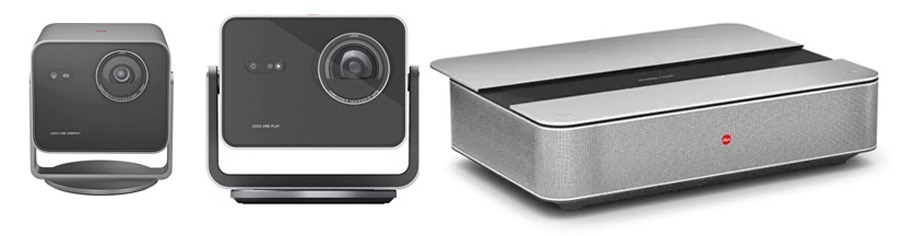
Priced at $2,000, the Leica Cine Compact 1 is now the smallest projector in the company’s range, borrowing much of its concept and feature set from the Cine Play 1 but placing it in a smaller, more compact chassis.

That makes it less of a “take it anywhere” projector and more of a smaller premium 4K laser option for buyers who want the Leica badge without handing over Cine 1 money.

Advertisement
leica-cine-play-compact-1-projectors-front
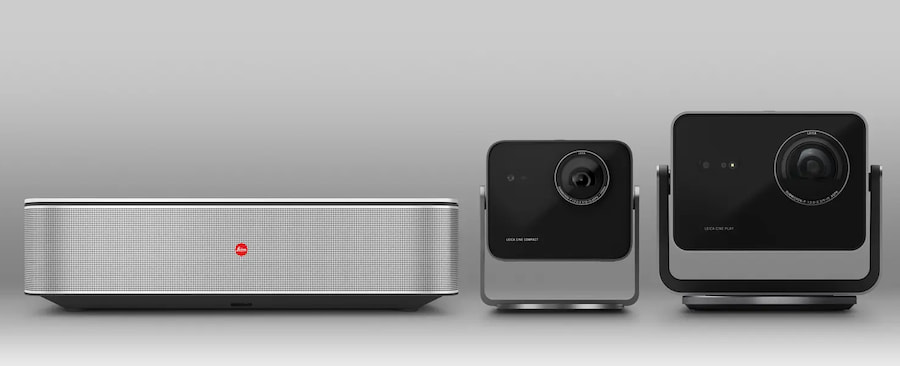
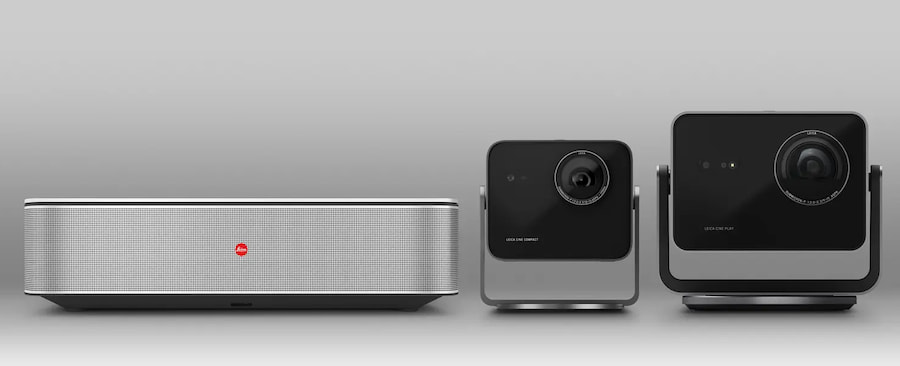
Left to right: Leica Cine 1, Cine Compact 1, and Cine Play 1

Smaller Leica, Still Big-Screen Ambitions

Like the Cine Play 1, the Leica Cine Compact 1 combines RGB laser light source technology with Leica’s premium imaging approach and support for 4K resolution via pixel shifting. The key difference is scale. While the Cine Play 1 can project images up to 300 inches, the Cine Compact 1 tops out at 220 inches, which is still absurdly large for most living rooms unless your sofa came with its own ZIP code.

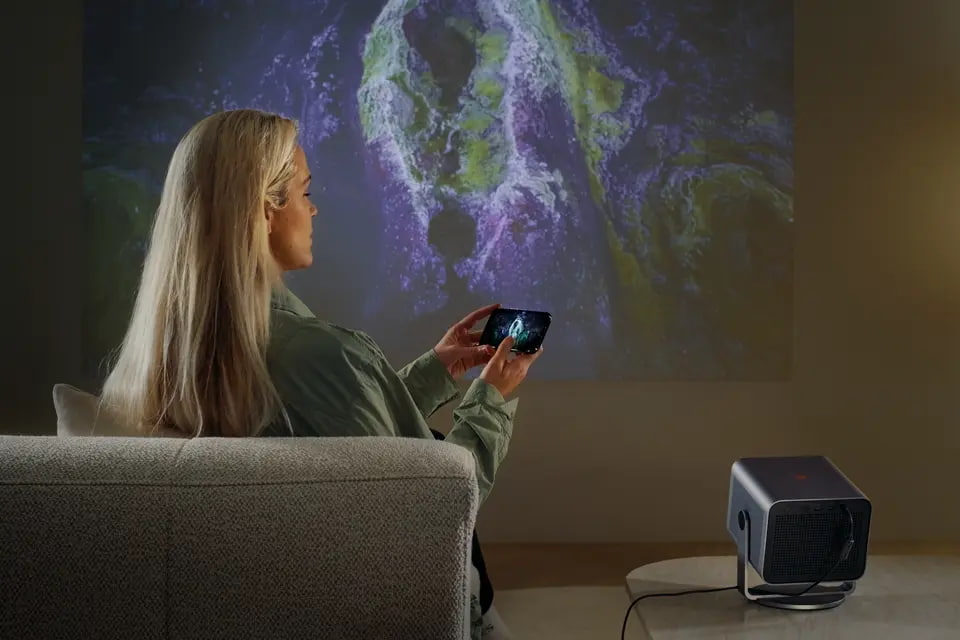
Leica is positioning the Cine Compact 1 as a more convenient home cinema option for both indoor and outdoor use, helped by built-in smart features and user-friendly setup tools. That outdoor angle comes with the usual projector reality check: it will work best after dark and away from ambient light. Daytime backyard cinema still belongs in the same fantasy file as affordable Leica lenses.

RGB Laser, Leica Optics, and the Usual Brightness Reality Check

leica-cine-compact-1-projector-on
Leica Cine Compact 1

The Leica Cine Compact 1 uses a triple RGB laser light source rated for up to 25,000 hours of operation, which should cover a lot of movies, streaming binges, and questionable franchise reboots before anyone starts worrying about the light engine.

Leica rates the Cine Compact 1 at up to 1,700 ANSI lumens, which means it should be capable of producing a clear, high-contrast image in darker rooms or outdoor spaces with minimal ambient light. That last part matters. This is still projection, not witchcraft. If you aim it at a wall during a bright afternoon barbecue, the sun is going to win.

HDR support is also broad, with compatibility for Dolby Vision, HDR10, HDR10+, and HLG. The Cine Compact 1 also includes Leica Image Optimization, or LIO, which uses image-processing algorithms designed to improve color rendition, color gradation, and contrast.

Advertisement

And because Leica is not going to put its name on a projector without making the lens part of the story, the Cine Compact 1 incorporates a genuine Leica Summicron zoom lens. That gives the projector a real optical talking point beyond the badge, which matters at $2,000.

Audio

For the best listening experience with the Leica Cine Compact 1, an AVR and surround sound speaker system would still be the preferred option. At minimum, a good soundbar makes sense, especially since HDMI eARC connectivity is supported. That said, a full external audio setup is not always practical with a compact projector designed to move more easily between rooms or support occasional outdoor use.

Advertisement. Scroll to continue reading.

To make the Cine Compact 1 more self-contained, Leica includes a 2 x 10-watt onboard audio system with DTS Virtual:Xprocessing. That will not replace a proper surround system or a serious soundbar, but it should provide a more spacious and usable listening experience than the tiny speaker systems found in many lifestyle projectors.

Advertisement
leica-cine-compact-1-projector-from-back

Streaming, AirPlay, and Just Enough Physical Connectivity

The Leica Cine Compact 1 is not just about image quality and onboard sound. It also includes both wireless and physical connectivity, which matters if the goal is to make the projector easy to use without adding a stack of external boxes.

With built-in smart TV features, users can access streaming services directly from the projector, provided it is connected to the internet via Wi-Fi or Ethernet. Leica uses Hisense’s VIDAA streaming platform, which provides access to major apps, including Netflix. The remote control also includes direct-access buttons for Netflix, Prime Video, Disney+, and YouTube.

Wireless support includes Apple AirPlay and Bluetooth. AirPlay allows users to stream compatible content from Apple devices, while Bluetooth can be used for wireless audio streaming from smartphones, tablets, and laptops.

Physical connectivity is more limited. The Cine Compact 1 includes one HDMI port and one USB port. The HDMI connection supports eARC, making it easier to connect the projector to a compatible AVR or soundbar. The USB port can be used to play compatible media files stored on a USB flash drive. 

Flexibility

The Leica Cine Compact 1’s biggest advantage is flexibility. Weighing under 10 pounds, it can be moved from room to room and set up without a permanent installation.

Advertisement

Its integrated 360-degree rotation system allows projection from multiple angles onto walls, ceilings, or other suitable surfaces, while automatic zoom, autofocus, keystone correction, and intelligent screen framing help align the image with minimal manual adjustment. Because spending 20 minutes fixing geometry before the movie starts is nobody’s idea of premium.

For added placement options, the Cine Compact 1 can also be used with the same optional stand as the Cine Play 1, with a stand adapter included.

Comparison

leica-compact-play-cine-1
Leica Model Cine Compact 1 Cine Play 1 Cine 1
Price  $1,995 $2,995 $8,995 (w 100-inch screen)
$9,495 (w 120-inch screen)
Projection Screen Size 60 – 220”  65 – 300” 100″ or 120″
Imaging Chip DLP 0.47” Pico DMD  DLP/0.47” 4k XPR DLP/0.47” 4k XPR
Image Resolution 3840x2160px (4K) via pixel shifting 3840x2160px (4K) via pixel shifting 3840x2160px (4K) via pixel shifting
TV Tuner No No ATSC 3.0 / Next-Gen TV / QAM on cable
Gaming Mode Yes – Latency ≤ 20ms in gamer mode ≤ 60ms in all other modes 

Refresh Rate 4K @ 60Hz 2K @ 240Hz 2K @ 120Hz 

Yes, Latency < 12 ms 1080px@120Hz Yes, Latency < 60ms 4K@60Hz
Lumen Output Up to 1700 lm (Ultra Mode)  Up to 3000 lm (Ultra Mode) > 2500 lm
Dynamic Contrast Not Indicated Approx. 2 Mio. :1 Approx. 2 Mio. :1
Contrast Ratio Up to 1500:1 Up to 1500:1 Approx. 1000:1 
BT 2020 Support > 100 %  > 100% > 100%
HDR Support Dolby Vision® / HDR10 / HDR10+ / HLG   Dolby Vision® / HDR10+ / HLG Dolby Vision® / HDR10+ / HLG
3D Support Yes, DLP Link Active Shutter  Yes, DLP link active shutter Not Indicated
Throw Ratio Optical: 1.0 – 1.3 
Digital: 1.3 – 3.2 
0.9 – 1.5 0.25
Leica Image Optimization (LIO) Yes  Yes Yes
Light Source Direct Triple RGB-Laser Direct Triple RGB-Laser Direct Triple RBG-Laser
Light Source Use Hours 25,000 25,000 25,000
MEMC Yes  Yes
HDMI 1x HDMI 2.1 with eARC Support  2x HDMI 2.1 (1x eARC Support) 2x HDMI 2.1 (1x eARC Support)
1x HDMI 2.0 Type  
USB 1x USB A 3.0  2x USB 3.0 2x USB (1x USB 2.0 & 1x USB 3.0)
USB Recording Not Indicated Yes Not Indicated
Ethernet RJ45 –  Yes Yes
Digital Connections –  1 x S/PDIF
1 x Optical (Toslink)
Physical On/Off Button Yes Yes Yes
Earphone/Audio Output  No  1x 1x
Audio Output Power 2 x 10 Watt 2 x 10 Watt 2 x 25 Watt
Number of Channels  2.0  2 4
DTS Virtual:X Yes  Yes No
Dolby Audio Yes Yes No
Dolby Atmos Yes
Dolby Digital Plus Dolby Digital Plus, Dolby Digital  Not Specified Yes
WiFi (Plus) 6 (IEEE 802.11a/b/g/n/ac/ax) (2.4G, 5G)  6 (IEEE 802.11 a/b/g/n/ac/ax) 6 (IEEE 802.11 a/b/g/n/ac/ax)
Bluetooth  Version 5.4  Yes Yes
Screen Mirroring Yes  Yes Yes
Works with AirPlay Yes Yes Yes
Operating System VIDAA  VIDAA U7.6 Google TV 
Streaming Direct Buttons on Remote Yes, for Netflix, Prime, Disney, YouTube  Yes, for Netflix, Prime, Disney, YouTube
Voice Assistant Yes (VIDAA Voice)  Yes Yes
Web Browser Yes (Odin)  Yes Yes
Child Protection Yes  Yes
OTA Software Updates Yes  Yes Yes
Remote Control Bluetooth / IR in Aluminum Housing with Microphone  Bluetooth / IR in Aluminum Housing with Microphone Bluetooth / IR in Aluminum Housing with Microphone
Voice Command Yes  Yes Yes
File Formats AV-Container AVI / MP4 / MKV / TS / FLV 
Advertisement

Video AVI / WMV / MP4 / MOV / MKV / MPG / MPEG / FLV / WebM 

Audio WMA / WAV / FLAC / MP3 

Image JPEG / BMP / PNG / GIF 

AV-Container: AVI / MP4 / MKV/ TS / FLV
Advertisement

Video: AVI / WMV / MP4 / MOV / MKV / MPG / MPEG / FLV / WebM

Audio: WMA / WAV / FLAC / MP3

Image: JPEG / BMP / PNG / GIF

AV Container: AVI / MP4 / MKV / TS / FLV / OGG 
Advertisement

Video: AVI / WMV / MP4 / MOV / 3GP / MKV / MPG / MPEG / VOB / FLV / WebM / OGM

Audio: WMA / WMV / MP4 / FLAC / MP2 / MP3 / AAC / WMA / WAV 

Image: JPEG / BMP / PNG / GIF / WEBP 

Voltage 100V – 240V  100V – 240V 120V -240V 
Power Consumption Standard Mode / Standby / Network Standby 
120W / 0.5W / 2W 
On 180W / Standby 0.5W Max. 300W / 0.5W
Dimension 209 x 226 x 193 mm (8,2 x 8,9 x 7,6 inch)  242 x 261 x 229 mm (10,3 x 9,5 x 9,0 inch) 600 x 378 x 149 mm Approx.
Weight Approx. 4.4 kg (9,70 lbs)  Approx. 6.7 kg (14,7 lbs) 14.5 kg (32 lbs)
In The Box Leica Cine Compact 1
Advertisement

Remote control

2 AAA batteries

Power cable

Power supply

Advertisement

Case 

Adapter for Leica Floor Stand

Operating instructions/warranty 

Leica Cine Play 1
Advertisement

Remote control

2 AAA batteries

Power cable

Power supply unit

Advertisement

Accessory bag

Operating Instructions & Warranty

Leica Cine 1

Remote Control

Advertisement

2 x AAA Batteries

Power cable

Quick Start Guide

100-inch or 120-inch Screen

Advertisement

3 Year Warranty

The Bottom Line 

The Leica Cine Compact 1 is the company’s most accessible projector so far, but “entry-level” is doing some heavy lifting at $2,000. What makes it unique is the combination of RGB laser projection, broad HDR support, automatic setup tools, built-in streaming, DTS Virtual:X audio, and a genuine Leica Summicron zoom lens in a smaller sub-10-pound chassis.

What is missing? More HDMI inputs, higher light output, and a price that does not immediately invite comparisons with Hisense’s own M2 Pro, which costs $1,299.99 and offers a very credible alternative, albeit with slightly lower brightness. Leica’s advantage remains optics and image refinement, but buyers are still paying a premium for the red dot. Funny how that works.

Advertisement

Price & Availability

The Leica Cine Compact 1 will be available for $1,995 beginning June 18, 2026 with optional floor stand priced at $495 through Leica Authorized Dealers.

For more information: leicacamerausa.com

Advertisement. Scroll to continue reading.

Source link

Advertisement
Continue Reading
Click to comment

You must be logged in to post a comment Login

Leave a Reply

Tech

More than 20,000 Instagram accounts hacked using Meta AI bug

Published

on

Contact information, direct messages and connected accounts were all potentially compromised, Meta said.

Hackers used Meta AI to hack into 20,225 Instagram accounts, Meta reported in a US local government data breach notice on 5 June.

According to the notice to the attorney general for Maine, the breach occurred on 17 April, but wasn’t discovered by the company until more than a month later, on 31 May.

The company explained that hackers exploited a now-resolved bug in its AI-assisted support tool designed to help Instagram users access their account after being locked out.

Advertisement

“HTS (high touch support) is an AI-assisted support tool designed to help users who are locked out of their Instagram accounts regain access,” said Amber Hannah, Meta’s associate general counsel for incident response.

“Users can request support from HTS and, as part of that process, can ask that a password reset link be sent to their email address.

“The tool itself worked properly and functioned as intended; however, due to a bug in a separate code path, the system did not properly verify that the email address provided by the individual requesting a password reset matched the email address associated with that user’s Instagram account.”

The bug allowed hackers to avoid triggering Instagram’s automated account protections, enabling password reset links to be sent to an email not connected to the account. Bad actors were then able to reset passwords to gain access to victims’ accounts if they did not have two-factor authentication enabled.

Advertisement

The hack affected prominent figures’ accounts, including the inactive Instagram handle for the Obama-era White House, beauty retailer Sephora and a senior US Space Force official.

Meta said that hackers could have potentially accessed sensitive data, including contact information, direct messages and communications, and connected accounts and linked services, such as email IDs. The company said that it would fix the bug before relaunching the AI tool.

In 2024, the Irish Data Protection Commission (DPC) fined Meta €251m for a 2018 data breach affecting approximately 29m Facebook accounts. The same year, the watchdog fined Meta €91m for improperly storing passwords.

In 2023, the company was fined €1.2bn by the DPC for violating GDPR guidelines by transferring users’ personal data outside of the EU.

Advertisement

AI-enabled cybercrime is fast becoming a sore point for companies, as attacks become more frequent and sophisticated. Just last month, hackers stole 8TB of data from the Taiwanese electronics manufacturer Foxconn, while medical equipment manufacturing giant Stryker was hit by a global cyberattack in March.

Don’t miss out on the knowledge you need to succeed. Sign up for the Daily Brief, Silicon Republic’s digest of need-to-know sci-tech news.

Source link

Advertisement
Continue Reading

Tech

Researchers trained an open source AI search agent, Harness-1, that outperforms GPT-5.4 on recalling relevant information

Published

on

A joint research collaboration between researchers at the University of Illinois at Urbana-Champaign (UIUC), UC Berkeley, and the open source AI-native vector database platform Chroma unveiled Harness-1, a 20-billion parameter open-source search agent built atop OpenAI’s gpt-oss-20B open source model that fundamentally redesigns how AI executes complex retrieval tasks.

Harness-1 achieves a massive leap in performance, scoring 73% average on its ability to recall relevant information correctly from a curated dataset, outperforming even GPT-5.4 (70.9%) and the next, most accurate open source search agent, Tongyi DeepResearch 30B, by 11.4 percentage points. (While GPT-5.5 has also been out for more than a month, the researchers didn’t test against this model as it wasn’t available when they were building theirs.)

Harness-1 accuracy benchmark performance compared to other leading AI search agents and models

Harness-1 accuracy benchmark performance compared to other leading AI search agents and models. Credit: University of Illinois at Urbana-Champaign, UC Berkeley, Chroma

Crucially for developers, the model and its environment are available immediately under the highly permissive Apache 2.0 license and model code/weights on Hugging Face.

Advertisement

Harness-1 also serves as proof-of-efficacy of another effort, Tinker, the distributed, web-based AI model training and fine-tuning API developed by Thinking Machines. Tinker was used specifically to train and run inference for Harness-1, highlighting how interactive infrastructure is actively enabling the next generation of autonomous models.

So how did the researchers do it?

Benchmarks Decoded (and Why Harness-1 Could Help Enterprises Tremendously)

To actually put these models to the test, the researchers evaluated Harness-1 and its competitors across eight highly complex search benchmarks. Rather than asking simple trivia questions, these tests required the AI to act like a real researcher sifting through diverse, dense data sources.

The benchmarks spanned several different domains, including open web searches, complex financial filings from the SEC, technical patent databases from the USPTO, and “multi-hop” question-answering tasks where the AI had to logically piece together scattered clues from multiple different documents to arrive at the correct answer.

Advertisement

When the results came in, Harness-1 dominated the open-source competition in its ability to successfully find and curate the right facts. Even more impressively, this relatively small 20-billion parameter model went toe-to-toe with massive, expensive proprietary AI systems. It actually outperformed heavyweights like GPT-5.4, Sonnet-4.6, and Kimi-K2.5 — thought to be the hundreds of billions or trillions of parameters. Only one giant frontier model—Opus-4.6 — managed to narrowly edge it out in overall average performance.

Harness-1 achieves its performance gains by offloading the exhaustive “bookkeeping” of a search session out of the model’s working memory and into a structured software environment.

As enterprise use cases grow more sophisticated, demanding that models autonomously sift through thousands of corporate documents or financial filings, these systems frequently succumb to “search amnesia”—forgetting their original queries, looping over rejected documents, or losing track of the specific claims they are trying to verify.

Until now, the prevailing solution to this amnesia has been brute force. Engineers typically force models to constantly reread an ever-expanding, append-only transcript of their own actions, piling every search, read, and thought back into a massive context window.

Advertisement

Harness-1 introduces a paradigm shift away from this method, proving that the bottleneck for true artificial autonomy isn’t necessarily the size of the model, but how efficiently its working environment manages state. It highlights once more, as Anthropic’s Claude Code has also done, that the raw model is arguably less important than the harness — or set of conditions — through which it runs.

Technology: Doing the Paperwork in the Environment

To understand the technical leap of Harness-1, consider a real-world analogy.

Imagine hiring a brilliant research assistant and placing them in an empty room without a desk, notepads, or filing cabinets. You ask them to write a comprehensive report on a highly complex topic, which requires them to read dozens of books while keeping every single quote, citation, and dead-end search perfectly memorized in their own head. Eventually, no matter how intelligent the assistant is, their cognitive load will max out, and they will start dropping facts or losing the thread of the assignment.

This is exactly how traditional search agents operate today. They are trained as policies over growing transcripts, meaning the model searches, reads, searches again, and appends everything into its own context window.

Advertisement

As lead researcher Patrick (Pengcheng) Jiang of the University of Illinois noted on X: “At some point the model is not just ‘searching’ anymore. It is also being asked to be a memory system, a note taker, a verifier, and a librarian.”

Harness-1 solves this by giving the AI a desk and a filing cabinet—what the research team calls a “state-externalizing harness.”

This harness is an active, surrounding environment that takes over the routine bookkeeping, maintaining a recoverable working memory that includes a candidate pool of documents, an importance-tagged curated evidence set, compact evidence links, and verification records.

By separating semantic choices from structural state management, the AI is freed up to do what it does best.

Advertisement

The policy still decides what to search, determines which documents to keep, and knows when to stop, while the environment simply holds the state.

Here is a subsection breaking down the training methodology and how it differs from prior agentic search models:

Training Harness-1: A Masterclass in Data Efficiency

The training pipeline for Harness-1 represents a fundamental shift in how the AI industry approaches agentic learning.

Historically, developers have treated search agents as policies operating over massive, ever-growing transcripts, forcing reinforcement learning (RL) algorithms to simultaneously optimize both semantic reasoning and the raw memorization of a search state.

Advertisement

Harness-1’s creators took a radically different approach: because their custom “harness” handles all the routine bookkeeping—like maintaining evidence links, candidate pools, and verification records—the training process only needed to teach the model how to operate this structured interface.

This division of labor drastically simplified what the underlying 20-billion parameter model actually needed to learn.

The process began with a remarkably narrow Supervised Fine-Tuning (SFT) stage. Rather than scraping petabytes of new behavioral data, the team generated just 899 filtered trajectories using a GPT-5.4 teacher agent that was plugged into the exact same harness environment the student model would eventually use.

The goal of this SFT phase was not to inject vast amounts of domain knowledge into the model, but simply to teach it the mechanical rhythms of a good researcher: how to format tool calls, how to tag documents by importance, and the discipline of verifying a claim before promoting it to the final curated set.

Advertisement

Following SFT, the model underwent Reinforcement Learning (RL) using an algorithm called CISPO, applied over full search episodes capping at 40 turns.

The team designed a highly specific terminal reward function that explicitly separated discovery from selection. The model was rewarded not just for finding a relevant document, but for successfully promoting it into the final answer set, while being penalized if it found the answer but failed to curate it.

The researchers also instituted a “tool diversity” bonus; without this specific incentive, they found the policy would quickly collapse into a lazy, search-heavy strategy where it spammed queries but bypassed the harder work of reading and verifying the text.

What makes Harness-1 truly innovative compared to prior work is its unprecedented data efficiency. The entire model was trained on roughly 4,400 unique items—899 SFT trajectories and 3,453 RL queries.

Advertisement

In stark contrast, competing open-source models required vastly larger datasets to achieve worse results: Context-1 utilized over 17,200 training items, while Search-R1 relied on a staggering 221,300 items to learn search behaviors.

By proving that a smarter external cognitive architecture can replace brute-force data scaling, Harness-1 suggests that the future of agentic AI lies in building better environments for models to work within, rather than just training larger models on more data.

Product: Enterprise Applicability and Generalization

From a product perspective, Harness-1 is delivered as a highly capable 20B agent merged into the openai/gpt-oss-20b base architecture.

For enterprise tech stacks, the applicability is massive because businesses need AI to execute multi-step research across proprietary databases without hallucinating or running up exorbitant compute bills.

Advertisement

Harness-1 manages its frontier-level performance at what the creators describe as “Context-1-level cost and latency.” Because the context window is strictly managed by the budget-aware harness rather than continuously expanding, enterprises can deploy this agent autonomously without incurring the exponential token costs typically associated with long-horizon AI tasks.

Even more impressively, Harness-1 proves it can generalize well beyond its training data. According to the research team, it was incredibly cheap to train, utilizing just 899 filtered supervised fine-tuning (SFT) trajectories and a mere 3,453 reinforcement learning (RL) queries.

“Instead of training the model to survive a giant append-only transcript, we train it to use a structured search interface: search, curate, revisit, verify, and submit,” Jiang explained.

This leanness proves a critical point for the AI industry: developers do not necessarily need petabytes of new behavioral data if they build a better cognitive framework for the model to operate within.

Advertisement

Licensing: The Power of Apache 2.0

One of the most significant aspects of the Harness-1 release is its licensing. In plain language, Apache 2.0 is a highly permissive, enterprise-friendly software license that fundamentally enables commercialization.

Unlike “copyleft” licenses (such as the GPL) that can force companies to open-source their own proprietary software if they integrate the code, or “research-only” licenses that ban commercial use entirely, Apache 2.0 gives businesses the green light to freely build, modify, and monetize the technology.

For developers and startups, this means Harness-1 can be seamlessly integrated into commercial enterprise search products, internal data retrieval tools, or customer-facing AI applications without fear of legal reprisal.

The only major requirement is that users must include the original copyright notice and explicitly state any significant modifications they make to the source code, positioning Harness-1 as a highly viable foundational building block for the enterprise.

Advertisement

Community Reactions: A Resounding Validation

The announcement has clearly struck a nerve within the developer community, validating the very real pain points engineers face when building agentic systems. Jiang’s multi-part announcement thread on X quickly garnered massive traction, pulling in over 256.1K views, 3.7K likes, 2.9K bookmarks, and nearly 300 reposts within a matter of days.

This high engagement underscores a growing consensus in the AI space that brute-forcing context windows is a losing battle.

When Jiang posted on X, “I’ve been wondering: maybe search agents are bad at search partly because we make them do all the paperwork in their head,” the resonance was immediate.

For developers who have spent the last year wrestling with AI agents that confidently forget their primary instructions halfway through a database search, the Harness-1 approach feels like a desperately needed course correction.

Advertisement

Ultimately, the community sentiment highlights a shift in industry priorities. Developers are moving away from asking how large an AI model’s context window can get, and instead asking how efficiently an AI model’s environment can manage that context for it. By offloading the paperwork, Harness-1 is proving that smaller, smarter systems can outmaneuver the giants—provided they have the right desk to work at.

Source link

Continue Reading

Tech

Meta Quietly Removes Face-Recognition Code From Its Smart Glasses App

Published

on

The ‘disappearing into the bushes like Homer Simpson’ strategy is a bold choice.

Only a day after a dormant bit of code that seemed to be a facial recognition algorithm was discovered in a companion app for its smart glasses, Meta released an update which removed that code, Wired reported. The publication had first uncovered the suspicious code, internally dubbed Name Tag within Meta, while reviewing code for a Meta AI app which handles some core features of the glasses. In other words, the same app necessary for pairing Meta smart glasses to a user’s phone over Bluetooth was also ready to start harvesting every face a user passed by while wearing them.

Wired uncovered the dormant tool on June 4. It contained algorithms which would have converted photos of faces into biometric identifiers stored on-device and cross referenced with each new facial scan. On June 5, an update was released which removed it entirely. In February, The New York Times had reported that Meta was working to bring facial recognition to its glasses. Given that the Times heard the internal moniker Name Tag bandied about at that time, the code discovered by Wired was likely the fruit of those efforts.

The workings of the tool suggest that it might have been intended as a way for users to more easily identify people they had previously met. A handy feature for forgetful folks, no doubt, but also an extremely creepy and invasive solution to a very common interpersonal dilemma. Most people would probably rather someone simply admit to having forgotten their name than to have their likeness ingested by a face-mounted camera.

Advertisement

Meta smart glasses are made in partnership with popular Luxottica brands including Ray-Ban and Oakley. They are already raising hackles, with manosphere-adjacent social media influencers using them to harass and record women. In December, a woman was accused of breaking a man’s Meta glasses on the New York City subway. Meta was also hit with a class action in March after a Swedish newspaper investigation revealed that Kenyan workers were reviewing footage from the company’s smart glasses  — including sexual intimacy and bathroom use  — which seemed to have been taken without the owners’ knowledge.

In a statement given to Wired on Monday, Meta vice president of communications Andy Stone was quoted saying that the feature was only a pilot effort and that the company had not made a “final decision on what to do here, if anything.” That may be true, but real Meta employees were paid real money to spend their time writing, reviewing, and shipping that code in a live product. That it was never activated is likely to be cold comfort not only for owners who may not want to turn themselves into mobile data harvesting tools, but also for the people in those users’ lives who may not want their faces unknowingly analyzed. The very fact that the code was so swiftly removed and PR statements issued suggests Meta knows it’s walking a tightrope with these types of invasive features.

Advertisement

Source link

Continue Reading

Tech

NCOSE CEO Calls Porn A National Security Threat; Urges Federal Obscenity Prosecutions

Published

on

from the ncose-is-a-threat-to-free-speech dept

In totally sane and not-crazy anti-pornography activism news, the National Center on Sexual Exploitation (NCOSE) considers online pornography a national security threat. This may be the stupidest thing NCOSE has ever claimed in its decades’ long fascistic fight against sexuality. 

The group’s president and chief executive officer, Marcel van der Watt, wrote for the Washington Times about cases of sexual exploitation that could potentially harm individuals who are a part of the military-industrial complex. However, he offers no clear example of such cases and simply relies on the organization’s standard talking points that all sexual expression is bad. 

He writes:

Adults are often an underreported victim group because of shame and fear of social repercussions, yet they are deemed high-value targets by exploiters because of their financial resources.

This claim is meant to apply to military and government employees with security clearances who could be subject to coercion, extortion, and other legitimate forms of exploitation if they post nudes consensually or if they were legitimately victimized by criminals. All of these are real issues, but, in true NCOSE form, van der Watt falsely conflates activities that are illegal with those that are lawful. Van der Watt likens this exploitation as a “symptom” of pornography’s ubiquity in national culture, despite the resurgence of white Christian nationalism.

Advertisement

The argument can be summed up that military personnel have private lives, and sometimes those private lives involve pornography, and because of that, they may be coerced into sharing nudes, which means that the government must outlaw porn as a national security threat.

There are a few logical leaps in there.

He calls for the U.S. Justice Department to stand up its long-dormant obscenity task force that once went after legal pornography producers who released hardcore content. Van der Watt’s calls echo a recent attempt by Sen. Jim Banks of Indiana urging acting Attorney General Todd Blanche to reinstate the task force while singling out the $3.15 billion-valued OnlyFans.com

And it’s clear that the real threat here is just… van der Watt doesn’t like the idea that some people enjoy pornography:

Advertisement

Yet the national security threat posed by pornography is incubated on a far more granular level.

Pornography corrodes the exact social foundation that supports national strength. It normalizes sexual objectification and fosters impersonal, consumeristic attitudes toward sex. Over time, its use may lead to habituation, where users require increasingly extreme content to achieve the same level of sexual arousal.

Such rhetoric is part of the far-right’s project to eliminate legal and consensual pornography. This has long been a core tenant of NCOSE’s mission. This is the organization that used to be called “Morality in Media.” Remember, this is the same organization that called for the magazine Cosmopolitan to be removed from Walmart checkout lines because the publication was “pornographic.” NCOSE once went after academic database provider EBSCO for not blocking students from accessing anatomically correct sexual education materials. NCOSE is also one of the central groups to argue the pseudo-scientific claim that pornography is addictive like a drug and serves as a public health crisis. NCOSE persists in these claims, despite no evidence of such. And now it wants you to believe its a “national security” threat?

Michael McGrady covers the tech and legal sides of the online porn business.

Filed Under: marcel van der watt, national security, pornography

Companies: ncose

Advertisement

Source link

Continue Reading

Tech

News Sites Are Blocking Internet Archive Over AI Scraping Fears

Published

on

Especially in this era of the Internet, the role of the Internet Archive’s Wayback Machine has become increasingly essential as more and more web content vanishes into the ether or is surreptitiously altered to hide salient details. More recently a new worry has seemingly cropped up in the form of scraping of data for so-called AI systems, or at least that’s part of the excuses being offered for blocking the Wayback Machine’s web crawlers, with [Andrew Deck] and [Hanaa’ Tameez] of [Nieman Lab] detailing the impact and reasons provided.

Some news outlets like The Baltimore Banner insist that they’re only blocking the Wayback Machine crawlers because they are worried that LLM chatbots would otherwise ‘improperly cite’ the source of content, while outlets like The Atlantic have put a blanket anti-scraping policy in place. Meanwhile news outlets are generally happy to let paid commercial news archiving outlets like ProQuest and LexisNexis index their content, showing a potential financial incentive.

Whatever the reasons, the direct effect is that as content is modified or vanishes during for example a system migration, buy-out or bankruptcy, researchers who rely on the Wayback Machine are pretty much forced to rely on paid offerings by ProQuest and kin, without the pure archiving focus and free access to information. It will also leave big holes in what the Wayback Machine can cover in its archives, with news especially becoming very spotty.

Advertisement

Incidentally there’s an ongoing petition over at SaveTheArchive.com which people can sign.

Source link

Advertisement
Continue Reading

Tech

Meta Deletes Face-Recognition System From Its Smart Glasses App

Published

on

Last Thursday, Wired reported that Meta had quietly embedded an unreleased facial recognition system called NameTag into software installed on millions of phones. In a follow-up report, Wired says the tech giant has now removed the face-recognition-related code, while saying “no final decision” has been made about whether the feature will launch. From the report: On Thursday, WIRED reported that Meta had quietly integrated substantial portions of the NameTag system into the Meta AI app. Though never publicly enabled, the feature was designed to convert faces captured by the glasses into unique biometric signatures, commonly known as faceprints, and compare them against a database of faceprints stored on the user’s device. WIRED also found that faces the system failed to recognize were cropped, indexed, and stored locally for future processing.

NameTag first surfaced in February, when The New York Times, citing internal Meta documents, reported that the company was developing face recognition for its smart glasses and weighing a launch as soon as this year. One memo reportedly described releasing it during a “dynamic political environment,” when privacy and civil liberties advocates would be distracted. Last week, WIRED reported that much of NameTag’s machinery was already built into the Meta AI app, downloaded by millions of users, as early as January, even as Meta publicly said it had made no final decision about face recognition. After WIRED’s report, Stone dismissed the findings, writing that the company couldn’t answer questions about how the system would work because “the feature does not exist.” Andrew Bosworth, Meta’s chief technology officer, called the reporting “incredibly misleading” and “absolutely dishonest.”

[…] The newly released version of Meta AI removes nearly all traces of the feature Meta said did not yet exist. Gone is the face-recognition software itself, along with the code that ran the NameTag recognition process and the “Person recognized” alert the app would have shown if someone were identified. The update also strips out a folder where the app would have stored the cropped images and biometric signatures of faces it captured but could not identify. […] A few fragments of the NameTag system remain in the version of latest Meta AI, including an internal debug menu label and a dormant link meant to open a recognized person’s profile. The leftover code points to parts of the system that are no longer there.

Source link

Advertisement
Continue Reading

Tech

Google Cuts The Price Of Its AI Plus Plan And Doubles The Storage

Published

on

The subscription now starts at $5 per month.

Google is lowering the cost of its cheapest AI subscription to make Gemini models even easier to access. The Google AI Plus plan will now cost $5 per month, according to a post from Vikas Kansal, the company’s Product Lead focused on Gemini AI subscriptions, down from its original $8 per month price. It now also comes with double the storage, 400GB instead of 200GB.

The subscription plan became available in January 2026 as a cheaper way to access Google’s Gemini 3 Pro model, Nano Banana Pro and Deep Research. Google previously offered those features as part of its more expensive AI Pro plan, but Plus lowered the price in exchange for more severe usage limits. Sweetening the deal further now that Google I/O 2026 has come and gone, the AI Plus plan also includes new benefits, like AI-powered email tools, a new Daily Brief agent that can summarize your upcoming day in the Gemini app and access to Gemini Omni, Google’s newest AI model for generating video “from any input.”

Your mileage may vary with Google’s AI features, but getting double the storage for half the price is obviously meant to be a deal that’s hard to say no to. You can sign up for the AI Plus plan now on Google’s website. According to Kansal, existing subscribers should see their extra storage space in the next few days, and the updated subscription price on their next bill.

Source link

Advertisement
Continue Reading

Tech

Happy Birthday, Intel 8086: World's first x86 processor debuted exactly 48 years ago today

Published

on


Curiously, the Intel 8086 was conceived as a stopgap while the more technologically ambitious 32-bit iAPX 432 struggled with repeated delays. Developed in just 18 months, it was still capable of supporting far more demanding applications than its predecessors, and was notably the first Intel chip to contain microcode.
Read Entire Article
Source link

Continue Reading

Tech

Global Math Gains for Girls Are Slipping, Report Finds

Published

on

Global data on math achievement is revealing a dismaying trend: Girls are doing worse than boys — and the margins are huge.

Parsing education data into snack-sized servings.

Parsing education data into snack-sized servings.

In 2023, fourth-grade boys outperformed their female peers in a vast majority of schools, growing the gender gap that existed prior to the pandemic, according to an international study released last week.

Among eighth-graders, the rate of boys scoring higher than girls increased exponentially since 2019, rolling back gains in math equity that had been shaping up for more than a decade. Matthias Eck, a program specialist for UNESCO’s Section of Education for Inclusion and Gender Equality, tells EdSurge that prior data showed girls were catching up with boys in math achievement.

“But in the latest data, we see that the gap is widening again between girls and boys, and that’s at the detriment of girls, which is quite concerning,” he says.

Advertisement

This international trend echoes what U.S. analysts saw when data from the Nation’s Report Card was released last year.

The latest analysis is based on data from the Trends in International Mathematics and Science Study (TIMSS), a global study published every four years that measures math and science achievement among fourth- and eighth-grade students. The International Association for the Evaluation of Educational Achievement performed the analysis in partnership with UNESCO.

Advertisement

Widening Achievement Gaps

The new data is part of the first set of TIMSS results that measure student performance following the onset of the pandemic. The analysis shows that among top performers in fourth grade, 85 percent of counties’ results skewed toward boys. Slightly over half of the countries and territories from which data was collected have an advanced math achievement gap that favors eighth-grade boys, while none are lopsided toward girls in either grade.

Eck, one of the report’s authors, argues the data shows a correlation between longer school closures and higher rates of learning loss in math, with some variation among countries and territories. “One of the hypotheses is really that those disruptions during the pandemic may have exacerbated existing disparities and have reduced learning opportunities for girls, and potentially those that were at risk of low achievement have been more affected,” Eck says. “The fact that girls were out of school and were not in the learning environment, it could have impacted their confidence, but that’s just the hypothesis.”

But the numbers contain other alarming signals.

NEWSLETTERS

Advertisement

STAY AHEAD IN EDUCATION.

Sign up for EdSurge newsletters for timely news, insights and analysis.

For example, the share of regions with a gender gap among fourth-grade students who are failing to reach basic math proficiency is on the rise, and most of them have a higher proportion of struggling girls, according to the report. And while the gender gap in underperformance among eighth-graders is shrinking, the proportion of countries and territories where girls have a higher failure rate spiked.

Researchers are being cautious when it comes to drawing conclusions about the causes behind the results, but girls’ experience of gender stereotypes and confidence in their math abilities can play a role.

“Boys and girls are equally able in mathematics, but these learning outcomes can be shaped by a range of factors,” Eck explains, “and that can be persistent gender stereotypes, but also teacher expectations — and they’re based, of course, on those gender stereotypes.”

Advertisement

Targeted Solutions

UNESCO is pushing education systems across the globe to take a hard look at whether their gender equity strategies are working, especially efforts aimed at younger students.

Eck notes that the consequences of girls’ achievement in math can have far-reaching effects in their lives — and very real consequences in societies writ large. “We know that mathematics is quite foundational to learning across the school subjects, it’s also critical for pathways into science, technology, engineering, mathematics careers,” he says. “These sectors are at the center of innovation, technology advancement, inclusive growth and sustainable development, so that’s quite concerning in terms of those sectors.”

Advertisement

But there’s no widely accepted solution to this problem.

Increasing girls’ math performance will take work at the national policy level, local communities, within families and the culture of classrooms, Eck says. And changes have to include challenging gender stereotypes that limit how far girls think they can go in mathematics, he adds.

“I think what is really critical is that we see those large gaps emerging early, at the fourth grade level when students usually are around 9 or 10 years old,” he says. “That means that whatever we do, the action we take to address the issue must start quite early and must be very targeted.”

Advertisement

Nadia Tamez-Robledo (@nadiatamezr) is a reporter covering K-12 education for EdSurge with focuses on student and teacher mental health and changing demographics. You can reach her at ntamez-robledo [at] iste [dot] org.

Source link

Advertisement
Continue Reading

Tech

4 Goodyear Tire Warranty Conditions You Should Know Before You Buy

Published

on


Let’s say you’ve done some diligent research on the different types of tires for your vehicle and have selected your brand and model. Before you roll away on your new tires, don’t neglect the small print. Tire warranty coverage depends on so many different things, from the number of miles driven to specific types of damage that may or may not be covered. An unexpected bill from time to time is just a part of driving, but you can mitigate this if you know exactly what you’re covered for beforehand. 

A Goodyear tire can be a solid pick, with the brand offering a huge range of performance tires for many types of vehicles. There are some budget-friendly options that rival Goodyear, but if you’re committed to the U.S. tire giant, there are some important things you need to know about Goodyear’s tire warranties. From the length of tread coverage on different varieties of Goodyear tires to the complicated calculations involved in prorated costs, some of these details are more broadly applicable to tire manufacturers, and others are exclusive to Goodyear and its subsidiaries. 

Advertisement

Accidental damage coverage is a complicated business

Tire damage from an inadvertent curb bump, a nail, or other obstacle you didn’t see can ruin your day immediately. It’s all the more devastating, of course, if you’ve recently bought a new set of Goodyear tires. With Cooper Tires (a subsidiary of Goodyear), the Cooper Standard Limited Warranty is very specific about this. As Goodyear notes, damage caused by the user (such as a lack of maintenance or other improper treatment of tires) is not covered. Neither are tires that are damaged by “road hazards, such as (A) impact damage, (B) cuts, (C) snags, or (D) punctures or (E) vandalism.” 

By default, this warranty does not offer coverage against road hazards, as manufacturers typically don’t. If that’s a priority for you, be sure to consider optional additions or the warranties of other manufacturers. The Total Confidence Plan from Continental is one such possibility, with eligible tires that have been registered by the owner covered for things like roadside assistance for a flat, as well as road hazard coverage for one year or up to a certain level of tread wear.

Interestingly, Goodyear does offer a similar deal of its own in some international markets. For example, Goodyear Malaysia allows customers access to the Worry Free Assurance policy for registering their tires. The perks include a five-year overall warranty, as well as two tire safety checks at no cost and road hazard protection for a full year. U.S. drivers can check with the retailer or dealer to see whether they can add similar optional coverage for the specific tires they’re considering. 

Advertisement

How the length of coverage and the type of tire relate

Goodyear groups its replacement tire treadwear coverage by tire family, including Assurance, Eagle, EV, and Wrangler. The mileage is largely the same between all models in a family, but not always. In the case of the Assurance product line, the All-Season, ComfortDrive, Fuel Max, and CS Fuel Max are all covered up to 65,000 miles, but two, the WeatherReady and WeatherReady2, are a little shorter than that at 60,000. Unsurprisingly, the ones with the longest coverage are the MaxLife tires, which are covered for as much as 85,000 miles, one of the best warranties offered by a tire brand.

Advertisement

The difference is enormous between the families: For EV models, this mileage is 60,000 for the ElectricDrive model, 45,000 for the ElectricDrive 2, and just 40,000 for the ElectricDrive GT. The lowest for all models listed is 30,000 miles, with the Eagle F1 Asymmetric 6. This gap reflects the familiar idea that performance tires don’t last as long as their standard counterparts. 

It’s vital to consider your vehicle and driving habits when choosing a variety of tires and their warranty (along with any optional extras that may be appropriate). Doing so helps ensure that you get the expected performance from the tire type you choose. Standard coverage lasts for up to six years or until these replacement tires hit the listed mileage covered. This is a policy typical of manufacturer warranties, but there may be a wrinkle or two that drivers new to Goodyear weren’t aware of. 

Advertisement

The length of the initial Satisfaction Guarantee may differ

Goodyear tires have a 60-Day Satisfaction Guarantee. During this period, you can change your mind and return them for a different set of tires from Goodyear (or exchange your Goodyears for certain tires from one of its subsidiaries, Cooper, Mastercraft, and Kelly). However, the 60-Day Guarantee is amended in the case of the other brands and lasts for only 45 days instead.

Of course, there are several caveats that have to be applied here. Firstly, only certain Goodyear tires are covered under the brand’s warranty details. Should you replace your tires, the new ones do not have the 60-Day Satisfaction Guarantee coverage. 

These are significant differences from Michelin’s 60-Day Satisfaction Guarantee, with which you should also be familiar before you buy Michelin tires.  The two programs also share similarities, though, in that receipts are vital and only the original retailer can do the deal for you.  “Tires that are damaged due to misuse, road hazards, mechanical problems related to the vehicle, use in any racing-related activities or competitive events, or tires that are removed from the original vehicle are excluded,” Goodyear underscores.

Replacement tires aren’t necessarily free tires. If valve stems are required, that cost will also be passed along to the driver, though balancing and mounting of the replacements (which can be considerably costly in itself) is free.

Advertisement

Exactly how prorated coverage works for Goodyear models

As we’ve seen, you can’t really expect a freebie whenever a tire gets damaged. It’s the manufacturer’s responsibility to protect buyers against defects, first and foremost, which are not at all the driver’s fault. Accidental damage can potentially be covered with an optional add-on, but this may not always be available and will differ depending on the type of tire and where you live. 

Even if you do meet all the requirements for compensation or a replacement, there’s much more to consider. As is typically the case with tire warranties, the value you receive will be prorated. In the specific case of Goodyear, this means that you would only get the value of the tire tread that you hadn’t already used. “If your tire had a tread life limited warranty of 80,000 mi. (130,000 km) and delivered 56,000 mi. (91,000 km) prior to wear-out (down the 2/32″), the tire will be replaced for 70% of the advertised selling price of the comparable tire at the time of adjustment,” the brand explains. 

Advertisement

On top of that, services such as balancing and mounting of those tires aren’t included, unlike in the case of the purchase satisfaction guarantee, as we’ve seen. Tires that were originally supplied with the vehicle are not eligible, and neither are those that have been used for commercial purposes, including the likes of taxi services. 


Advertisement

Source link

Continue Reading

Trending

Copyright © 2025