Apple Silicon was a gamble, and in spite of repeated reports of brain drains and executive exodus, the M5 Ultra is Apple’s most powerful chipset by a long shot.
Earlier Tuesday, the M6 benchmarks showed up on Geekbench with impressive results. It is expected to be the only chipset in that generation, so the M5 Ultra is the high-end pros will have to work with for the time being.
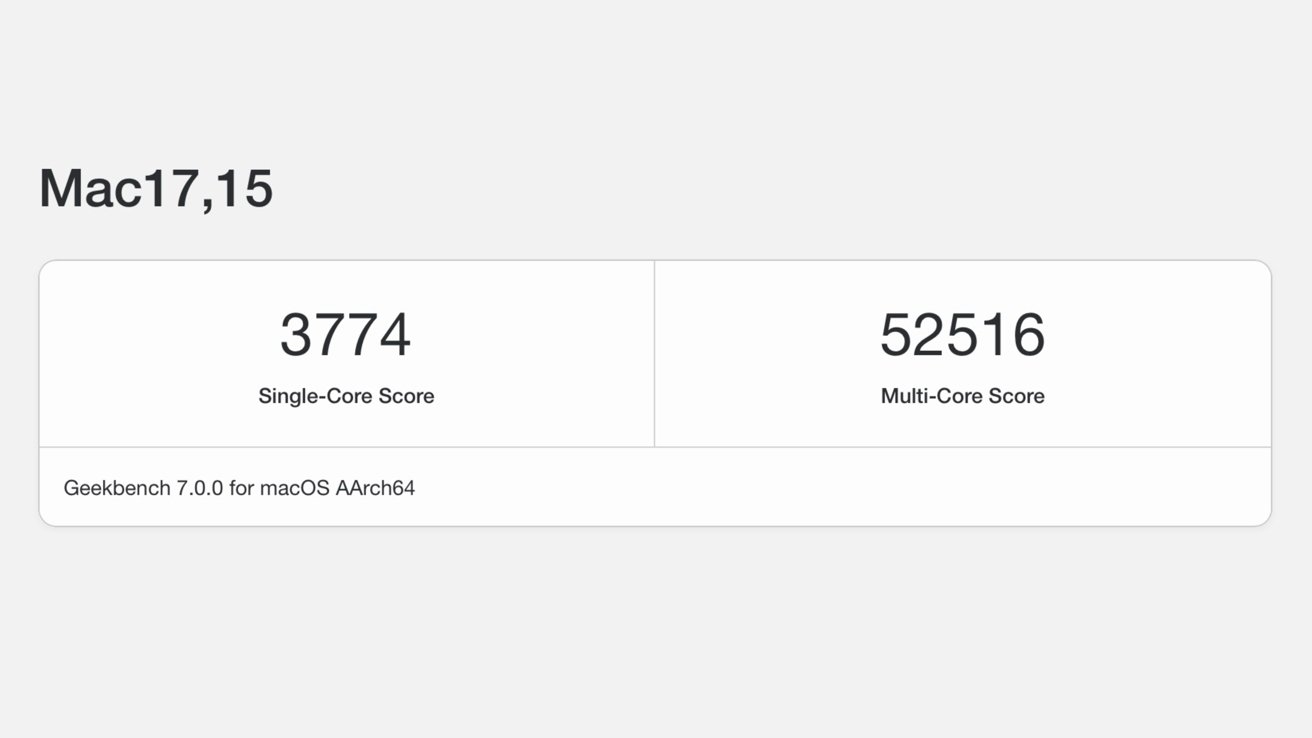
Another Geekbench result showed up, this time for the M5 Ultra. The 36-core CPU Mac Studio with 256GB of RAM scored 3,774 in single-core and 52,516 in multi-core.
Geekbench is a useful reference tool for generalized performance gains, not one that determines real-world use. However, the numbers don’t lie, and Apple’s M5 Ultra is an incredible chipset.
Advertisement
For comparison, the M6 scored 4,071 in single-core and 22,783 in multi-core. That single-core score makes since given it is the new 2nm package with more powerful cores.
The multi-core results show the 36-core M5 Ultra scores more than double the 12-core M6.
M5 Ultra 3,774 single-core and 52,516 multi-core in Geekbench
Compare the M5 Ultra to the original M1 chip and you can see just how far Apple Silicon has come in six years. The M1 in a MacBook Air got a single-core score of 2,150 and a multi-core score of 8,434.
Advertisement
That means M5 Ultra is about 6x more performant in multi-core processes versus M1.
Moore’s Law is well and completely dead, but that hasn’t stopped Apple from finding notable performance gains with each chip generation. The move to Apple Silicon was met with some concern, but it has proven to be an incredible success for the company.
Meanwhile, in spite of the advances over time, concerns continue to creep up over Apple’s ability to maintain that success. Reports keep coming out about so-called “brain drain” and the attempted exit of chip mastermind Johny Srouji.
Instead, Apple continues to develop industry-leading processors that sip on power. The M5 Ultra Mac Studio starts at $5,499, while the configuration in this benchmark is $10,799.
Advertisement
Shipments are highly constrained, especially for the higher-end models. Customers can expect to get an M5 Ultra Mac Studio between November 9 and sometime in January, depending on configuration options.
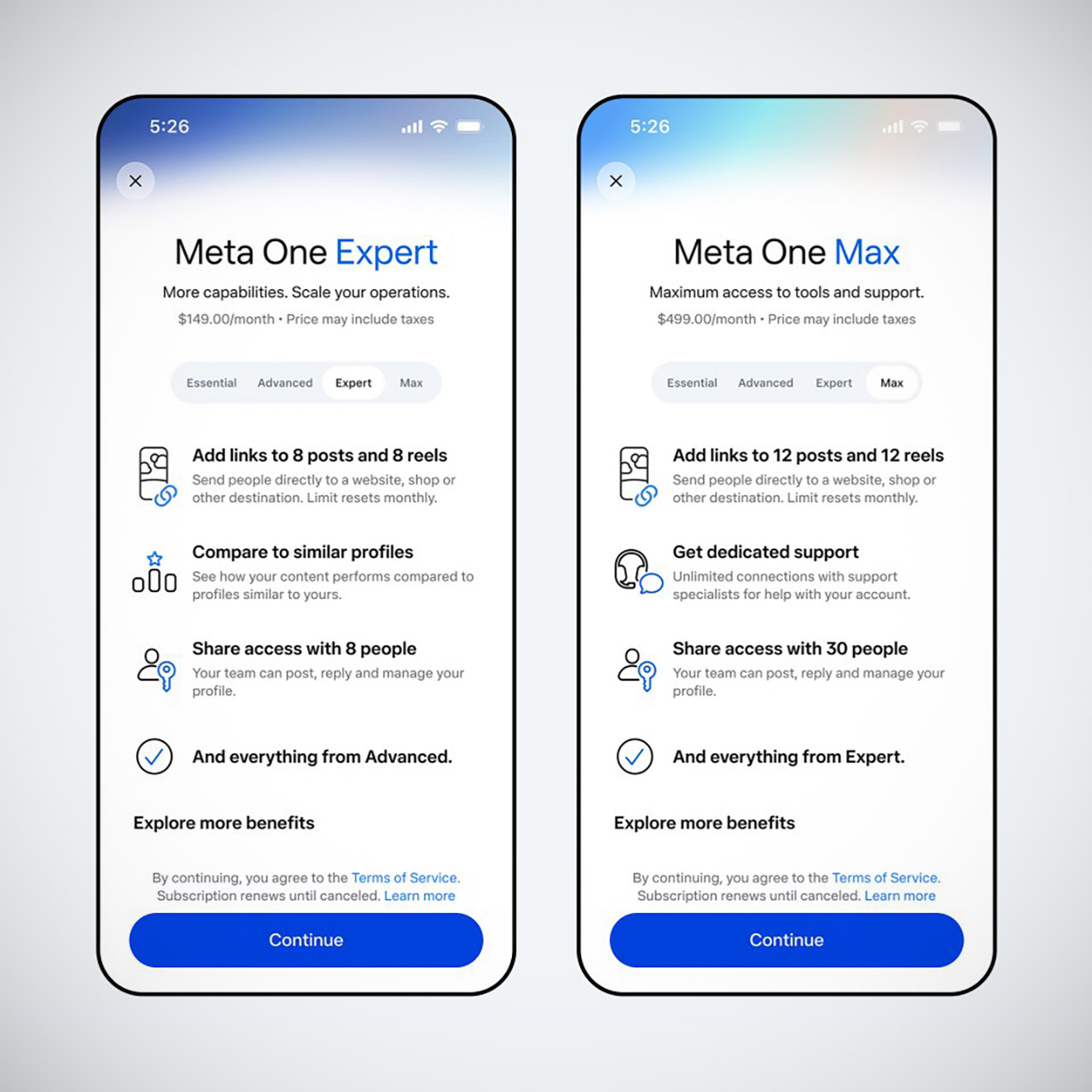
Meta One went live today as a paid layer across Instagram, Facebook, WhatsApp, and Meta AI, grouping more than 50 extras that sit on top of the free apps. Plans already collected 15 million subscriptions and trials during earlier tests, and Meta says later waves will reach Edits and AI glasses. Everyday feeds, chats, and basic Meta AI stay free.
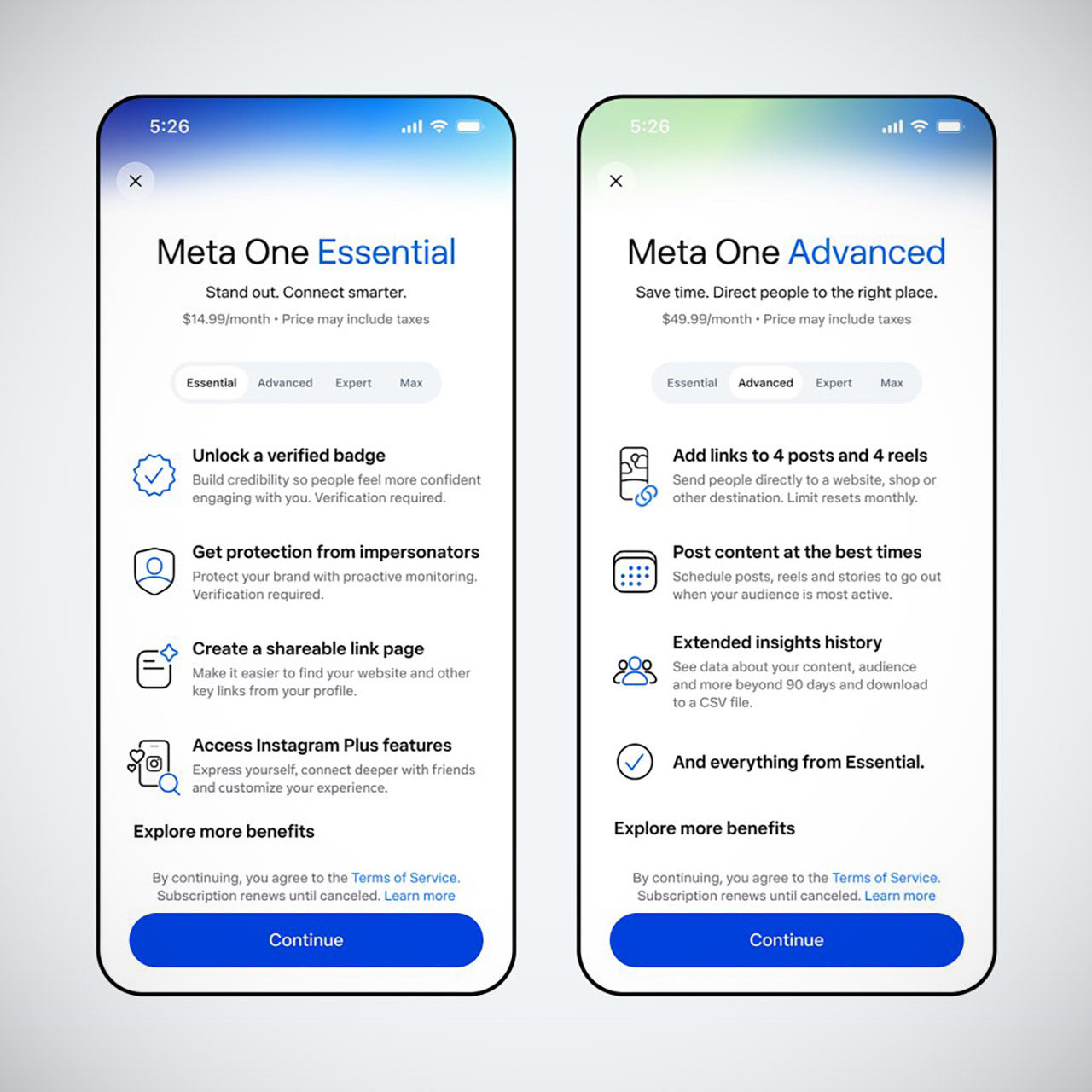
WhatsApp Plus costs $2.99 per month, while Instagram and Facebook Plus cost $3.99 each. Core packages those three Plus subscriptions with additional AI capabilities for $7.99. Premium grants you access to the most AI allowance for $19.99. On top of that, you have your Creator and business tiers, which begin at $14.99 for Essential, $49.99 for Advanced, $149 for Expert, and a staggering $499 for Max. Keep in mind that these charges vary by location and account, and if you run a business on Instagram or Facebook, you may receive separate bills for each unique profile.
Answers, tips and inspiration are a question away. Forgot an ingredient for dinner? Ask Meta AI for a substitute to save a trip back to the store…
Meta Glasses are meticulously designed to deliver a fit that feels custom to you. Choose from a variety of bold colors and experience a comfortable…
Travel like a local whether you’re navigating a bustling market in Spain or having a conversation in Japanese. Just say “Hey Meta” to start a live…
Instagram Plus offers a really great deal: you can stretch your Stories to 48 hours (before they disappear), use custom fonts in your DMs and Stories, receive notifications everytime someone views your Story, and even look at someone else’s Story without being added to their viewer list. Facebook Plus, on the other hand, provides personalized app icons, super hearts, additional Reels stats, and larger reactions in both the Feed and Reels. WhatsApp Plus offers exclusive themes and icons, some fancy effect stickers, and the ability to pin up to 20 chats. Backup storage and scheduled Focus Schedules are also on the way.
Core and Premium upgrade the Meta AI with additional functionality and greater limits. You can generate more photographs and videos with the Muse models, experiment with Restyle on more Instagram Stories, and utilize in-app creative tools like voice effects more frequently. People that joined up for testing used both the AI tools and the style extras rather regularly, and it turns out that Restyle and voice effects were the two most common causes.
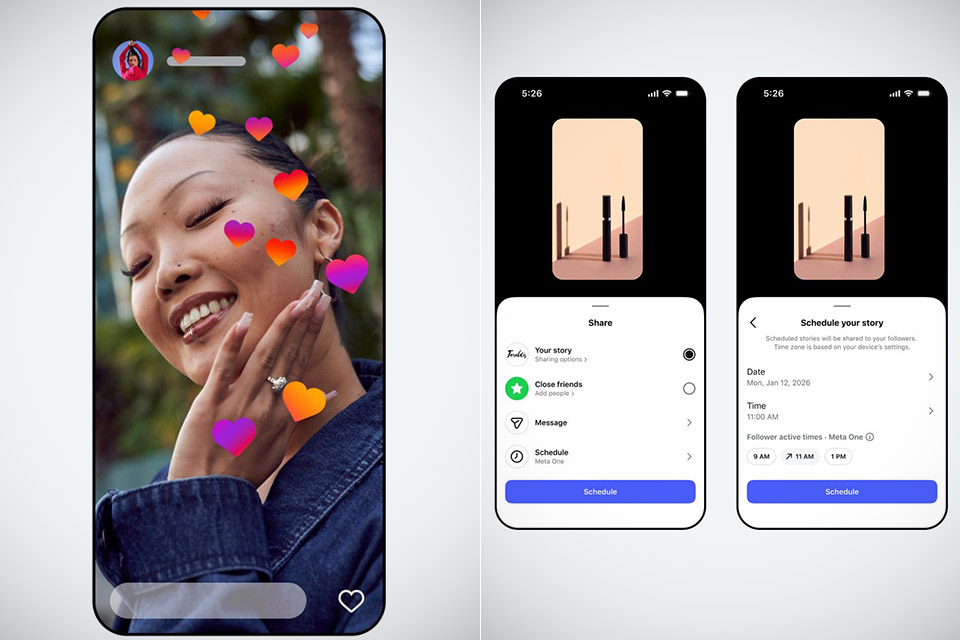
Advanced is where all of the scheduling and operations magic occurs. You can queue up Stories up to 30 days in advance, schedule posts and Reels even further ahead of time, include clickable links in your organic posts and Reels, access exportable analytics, deeper audience insights, team seats without revealing your password, additional linked WhatsApp devices, and a slew of broadcast credits. Expert and Max push those boundaries even farther for larger teams and more corporate traffic. One thing to look out for is edits. Plus, it will include cloud project storage and an assistant that will read your Instagram analytics and make suggestions.
It’s worth noting that subscription does not remove ads completely, as Meta continues to run the same ad-supported core for its 3.6 billion daily visitors. Instead, they’re positioning these subscription tiers as a method to assist big hitters that use a lot of AI, while also providing power users and organizations with a single location to manage everything rather than having to fragment among a variety of third-party schedulers, link pages, and analytics tabs. To keep track of the rollout, the feature list will vary depending on your location, app, and account, so you’ll need to look inside the applications to see what’s available to you.
Helen Ma, Meta’s VP of subscriptions, told reporters that people who want specialized work out of apps built for billions now have a paid lane, and that free creator tools will not be cut to force a sale. Essential adds an enhanced profile with website and location slots, a bolder follow button on Reels, automatic follow invites to people who already engage, more Meta Business Agent replies on WhatsApp around the clock, a verified badge and WhatsApp Business channel after checks pass, plus impersonation monitoring.
Looking for the most recent NYT Strands puzzle answers? CNET publishes daily answers and hints for The New York Times Mini Crossword, Connections, Connections: Sports Edition and Strands puzzles.
Strands is like a word find game, but without the list of words to find. Sometimes I see the theme and begin recognizing the answers right away. But for those times when I can’t seem to manage this, there’s a loophole: Strands lets you make as many words of four or more letters as you want. For every three of those words you find, the puzzle will highlight one of the answers. You’re still going to have to unscramble that answer, though, which can be very tough.
Today’s puzzle has a fun category, with some lively words. They’re pretty easy to unscramble once you pick up on the theme. Read on for hints and all the answers.
Hint for today’s Strands puzzle
Today’s Strands theme is: Hard not to notice.
Advertisement
If that doesn’t help you, here’s a clue: Showy or glitzy.
Clue words to unlock in-game hints
Your goal is to find hidden words that fit the puzzle’s theme. If you’re stuck, find any words you can. Every time you find three words of four letters or more, Strands will reveal one of the theme words. These are the words I used to get those hints, but any words of four or more letters that you find will work:
These are the answers that tie into the theme. The goal of the puzzle is to find them all, including the “spangram,” a theme word that reaches from one side of the puzzle to the other. When you have all of them (I originally thought there were always eight, but learned that the number can vary), every letter on the board will be used. Here are the nonspangram answers:
JAZZY, VIVID, BRIGHT, FLASHY, VIBRANT, STRIKING
Today’s Strands spangram
The completed NYT Strands puzzle for Sept. 16, 2026.NYT/Screenshot by CNET
Today’s Strands spangram is EYECATCHING. To find it, start with the E that’s the first letter on the top row, and wind down, over, and then down again.
CNET editor Gael Fashingbauer Cooper, a journalist and pop-culture junkie, is co-author of “Whatever Happened to Pudding Pops? The Lost Toys, Tastes and Trends of the ’70s and ’80s,” as well as “The Totally Sweet ’90s.” She’s been a journalist since 1989, working at Mpls.St.Paul Magazine, Twin Cities Sidewalk, the Minneapolis Star Tribune, and NBC News Digital. She’s Gen X in birthdate, word and deed. If Marathon candy bars ever come back, she’ll be first in line.
See full bio
There is a particular kind of question that families postpone for years. It is difficult not because the answer is secret, but because the question is too large: Tell me about your life.
Faced with it, even a willing storyteller may retreat into generalities. A childhood becomes “happy”. A marriage was “good”. A migration, a war, a career, a grief, all reduced to a few durable adjectives. The trouble is not necessarily memory. Often, it is form.
From weekly prompts to voice
Storyworth began as a family project. Nick Baum recorded his 82-year-old father’s answers; in 2013, he and Krista Baum founded the family-owned company. Its established format is deliberately incremental: a storyteller receives regular questions, responds over time, and eventually turns those responses and photographs into a hardcover book. Rather than demanding an autobiography all at once, the service divides a life into scenes small enough to enter.
The original Storyworth model centered on written responses. A storyteller could answer a weekly prompt by replying to an email or using a Storyworth account. That route remains available.
Advertisement
With its newer voice features, however, Storyworth is adding a technological layer between memory and the finished memoir: software can now record, transcribe, prompt and help structure the recollection before it reaches the page.
Story Calls, Magic Interviews and Family Calls
The first step in that shift came in 2024 with Story Calls. Storyworth first enabled phone recording in 2013, initially relying on human transcription. In 2024, the company added automated transcription. Today, Story Calls lets a storyteller answer by phone, including on a landline, with the call transcribed word for word.
The distinction matters. A verbatim transcript preserves the loops, digressions and idiosyncratic phrasing of speech, even when the result is less orderly than conventional prose. The storyteller can later revise the text or add photographs, but the initial record begins with the spoken answer rather than a rewritten version of it.
In early 2026, Storyworth added two more conversational formats. Magic Interviews guides a storyteller through a phone conversation and asks follow-up questions. When the call ends, the exchange is shaped into a written narrative and added to the memoir.
Advertisement
Family Calls brings another person (a relative or friend) into the conversation, allowing that person to ask questions, contribute memories and help direct the story. The recording preserves both voices, while Storyworth adds a cleaned-up transcript of the conversation to the memoir.
These are small product distinctions, but they produce different kinds of documents. Story Calls privileges fidelity to speech. Magic Interviews privileges structure. Family Calls introduces relationship itself as a source.
A daughter may remember the name of a neighbour her father has omitted. A grandchild may ask why a detail mattered, rather than merely what happened. One person’s recollection can become more specific when another person is present to recognise the gaps.
Every question is a frame
That does not mean guided conversation produces a deeper or truer memory. Interviews are never neutral containers. Every question places a frame around the past, and every follow-up makes one path more visible while leaving others unexplored.
Advertisement
A polished narrative is also not the same object as a verbatim transcript. The first may be clearer and more readable; the second may preserve more of the speaker’s manner.
Storyworth’s expanded system is interesting partly because it makes those choices visible. Families are not simply deciding what to preserve. They are deciding how much shaping should occur between speech and page.
The more consequential shift is that Storyworth is no longer only giving families a place to store finished recollections. In Story Calls, software transcribes; in Magic Interviews, it asks follow-up questions and helps shape the conversation into a polished narrative; in Family Calls, it preserves a two-person conversation as a cleaned-up transcript. The product is beginning to mediate the act of remembering, not merely preserve its result.
Remembering is uneven. People contradict themselves, circle back, pause, misplace dates and discover the meaning of an event halfway through describing it. A useful family archive cannot eliminate that instability; it can only decide what to do with it.
Advertisement
A book with a second record behind it
Storyworth’s answer is layered preservation. Stories can be edited and supplemented with photographs after a call. Friends and family with access to the project can listen through a private podcast feed.
In the finished hardcover, a QR code takes authorised readers to the Memoir project page, with stories and available recordings; a downloadable audiobook is included. The result is neither simply a book nor simply an audio archive. It is a printed narrative with a second record behind it: the actual sound of the person speaking.
That hybrid model also creates a distinctly digital dependency: the book is physical, but access to the linked recordings is mediated through Storyworth’s platform.
Voice carries information that transcription cannot fully absorb. It contains pace, accent, hesitation and emphasis. It reveals where someone laughs before reaching the end of a sentence, where certainty weakens, where a familiar story still catches in the throat.
Advertisement
None of this guarantees intimacy. A recording can be formal, guarded or repetitive. Yet it preserves the physical event of telling: breath passing through a particular body at a particular moment.
Why the telephone works
That quality makes the telephone an unexpectedly apt instrument for family history. It is ordinary enough not to feel ceremonial. It does not require a studio, specialised equipment or, in Storyworth’s system, even a smartphone.
The same device used for routine check-ins can become the site where a memory is prompted, questioned, recorded and transferred into a more durable form.
The limits of a designed archive
There is a tension here that Storyworth cannot entirely resolve. The service turns private recollection into a designed process, and design always influences outcome.
Advertisement
Weekly prompts encourage continuity, but they also divide a life according to the questions selected. Guided interviews can draw out detail, but they may also smooth the disorder from which a person’s way of remembering becomes visible.
A family memoir is not the whole life. It is a sequence of chosen entrances.
Still, that limitation belongs to every archive. Photographs exclude what stood outside the frame. Letters preserve what someone was willing to write. Home videos favour occasions when a camera was present. Storyworth’s voice tools add another kind of partial evidence: not merely what a person remembered, but how the memory emerged in conversation.
The phrase “family legacy” is often used as though inheritance were a finished object passed intact from one generation to the next. In practice, it is usually assembled from fragments: a name written on the back of a photograph, an anecdote repeated at dinner, a voicemail no one meant to save.
Advertisement
When software joins the act of remembering
Storyworth’s newer features show how consumer software can move from storing memory to participating in how it is elicited and organised. A question is asked, a voice is recorded, a transcript is generated, and a conversation can be reshaped into narrative. Each step adds convenience, but each also adds another layer of design between the remembered event and the archive that survives it.
That makes Storyworth interesting beyond the family-memoir market. It points to a larger question for consumer technology: what happens when software becomes an active intermediary in human acts that once seemed too personal to automate? In this case, the act is remembering.
The inheritance is still human. The system helping to produce it increasingly is not.
Chen Yilong has racked up plenty of film and TV credits in his two decades as an actor, but with work getting scarcer he signed a contract in August to license the image of his face to a Chinese production studio. Chen’s role will be to sit in front of a video camera and make facial expressions at the prompt of a director. A neutral stare. An angry glare. A look of surprise. Using artificial intelligence, the studio will use images of Chen’s face to generate an avatar, also known as a “digital human,” to star in an AI-generated movie. “If you can’t beat it, join it,” said Chen, 38, who works in Beijing.
The Chinese film and video industry is being transformed by AI-driven storytelling, fueled by rapid advances in video generation software, and at ground zero are the so-called micro dramas that play out on millions of smartphones. Typically just a minute or two in length, the videos are devoured by Chinese audiences… And the cost of producing them has been cut drastically through the use of AI software developed by Chinese technology juggernauts including Kuaishou Technology and TikTok’s global owner, ByteDance. The number of Chinese-made micro dramas surged in the first three months of this year to 128,000, according to the China Netcasting Services Assn. More than 95% of them were made with AI, the association said….
Sun Wei founded Feixiang Universe, the Shenzhen-based studio that cast Chen. The fear of accidentally “stealing someone’s face” was a big reason she said she decided to license real people’s likenesses for an AI production set during China’s Tang Dynasty more than 1,000 years ago. Thanks to AI’s training data bias, AI-generated performers tend to have similar features and share a homogenous look, Sun said. Many have flawless skin and extremely symmetrical faces, requiring her and other Chinese AI filmmakers to cast a wide net to “buy” new faces and digitize actor’s expressions.
Advertisement
Lu Beike, who directed the big-budget Chinese series “Three-Body,” felt theAI-generated scenes he’d tried came out sub-standard. “Lu added that if 90% of a film was generated by AI, a real human performance could appear jarring. A real actor’s expressions carried more nuance and emotion. The skin textures did not match. Sometimes the only solution was to process the live-action material until the person looked a little less real — until they fit back into the ‘AI world,’ Lu said.”
But at Sun Wei’s studio, they’re thrilled they can produce a 90-minute AI film for $500,000 where professional productions used to cost millions of dollars. According to the article, Sun’s team works with ChatGPT, Kimi or DeepSeek to flesh out entire screenplays from a short paragraph. The screenwriter takes over, but “to produce the finished product, Sun’s team uses Chinese video-generation models to input the type of scenes, backgrounds and performers they want, with the AI generating 15 seconds of footage each time.”
Still, the article points out that “Similar tools are being tested in the U.S., and the AI trends upending China’s entertainment industry may be a harbinger for what’s to come in Hollywood, said Michael Berry, a professor specializing in contemporary Chinese culture at UCLA. Already, Chinese companies that sell AI-powered video-generation software are seeking inroads in Hollywood…”
The cybersecurity start-up aims to fight AI hackers using AI-powered innovations.
Exein, an Italy-headquartered cybersecurity start-up that protects smart, connected devices from hackers, has joined the global collection of unicorns post a $270m funding round that brought the company to a $1.7bn valuation. The round was led by Headline, with participation from Sofina, Goldman Sachs and others.
Established in Rome in 2018 by CEO Gianni Cuozzo, Exein has additional offices in Germany, Taiwan and the US. The company builds technology to secure hardware at the processor level and that is embedded in 2bn chips globally. Consumers include Nvidia, AWS and Mediatek, among others.
Cuozzo told the Financial Times that the new investment is necessary, in part, to enable the organisation to compete on a global scale for limited cybersecurity and computing professionals.
Advertisement
The cybersecurity start-up aims to fight AI hackers using AI-powered innovations. Additionally, Exein intends to release its own foundational model for physical AI security in 2027.
Cuozzo explained: “We are moving from having security software to having a secure model that is running constantly on the device and will automatically react to attacks.”
He added: “Right now, I think the hackers have the edge.” Exein’s plan is to use embedded AI technology to combat threats and provide “machine-based protection in a world of machine-based attacks”.
As the world becomes more digitally connected and advanced, the risk of cybersecurity breaches is increasing. 12 Irish account holders are among the 680 global consumers with Revolut who recently had their sensitive data exposed.
Advertisement
Late last week, OpenAI’s Sam Altmanannounced that the company will not be launching its initial public offering this year. “Right now would be an ill-advised moment to go public,” he said.
He added that there is much to be done in the way of safety, alignment and showing how the industry and governments can work together on AI regulation before OpenAI is ready to go public.
Don’t miss out on the knowledge you need to succeed. Sign up for the Daily Brief, Silicon Republic’s digest of need-to-know sci-tech news.
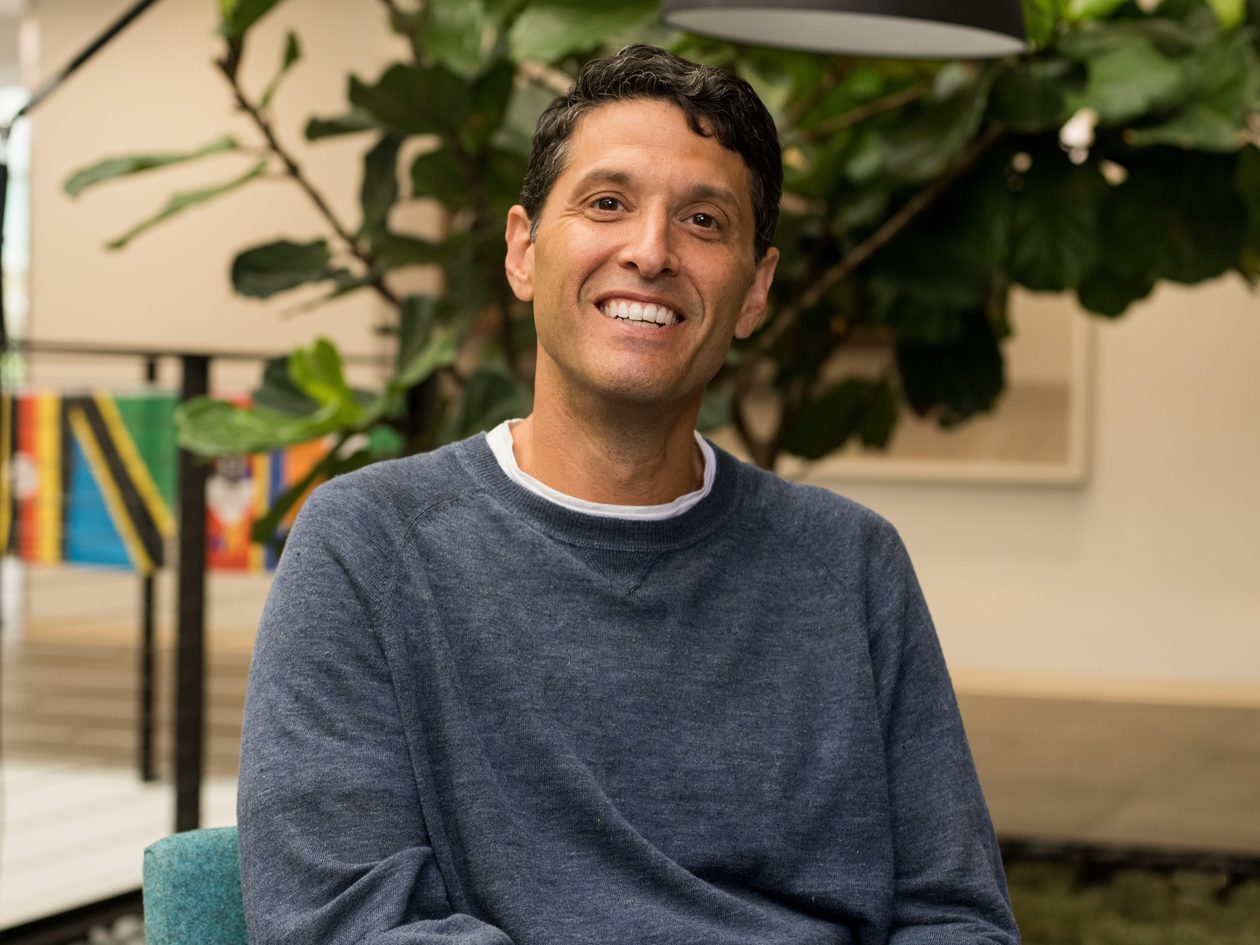
Terry Myerson, Truveta’s co-founder and CEO, will retire at the end of September. (Truveta Photo)
Terry Myerson, the former Microsoft executive who co-founded Truveta during the pandemic, growing it to 500 employees and a valuation of more than $1 billion, is retiring as CEO of the Bellevue, Wash.-based health data company at the end of September.
Truveta co-founders Jay Nanduri, CTO, and Ryan Ahern, the chief medical officer, will take over as interim co-CEOs while the board conducts a search for a permanent CEO. Myerson said in an interview that the board has a responsibility to look for “the absolute best CEO,” but he expressed hope that the search will confirm Nanduri and Ahern as the right leaders for Truveta’s next chapter.
Myerson, 54, will become an advisor to the company and step down from its board. He said he’s leaving because the business is doing well and his co-founders are ready. He also cited changes in his personal life. He and his wife, Katie, are empty nesters, and they want to travel.
“If things were not going well, I would not do this,” he said. “I’d be grinding it out. But things are going really well.”
Truveta pools de-identified patient records from 30 large U.S. health systems into a database that’s updated daily. It sells access to that data, along with analysis and AI tools, to drug makers, medical device companies, researchers and government agencies studying how treatments work in the real world.
Advertisement
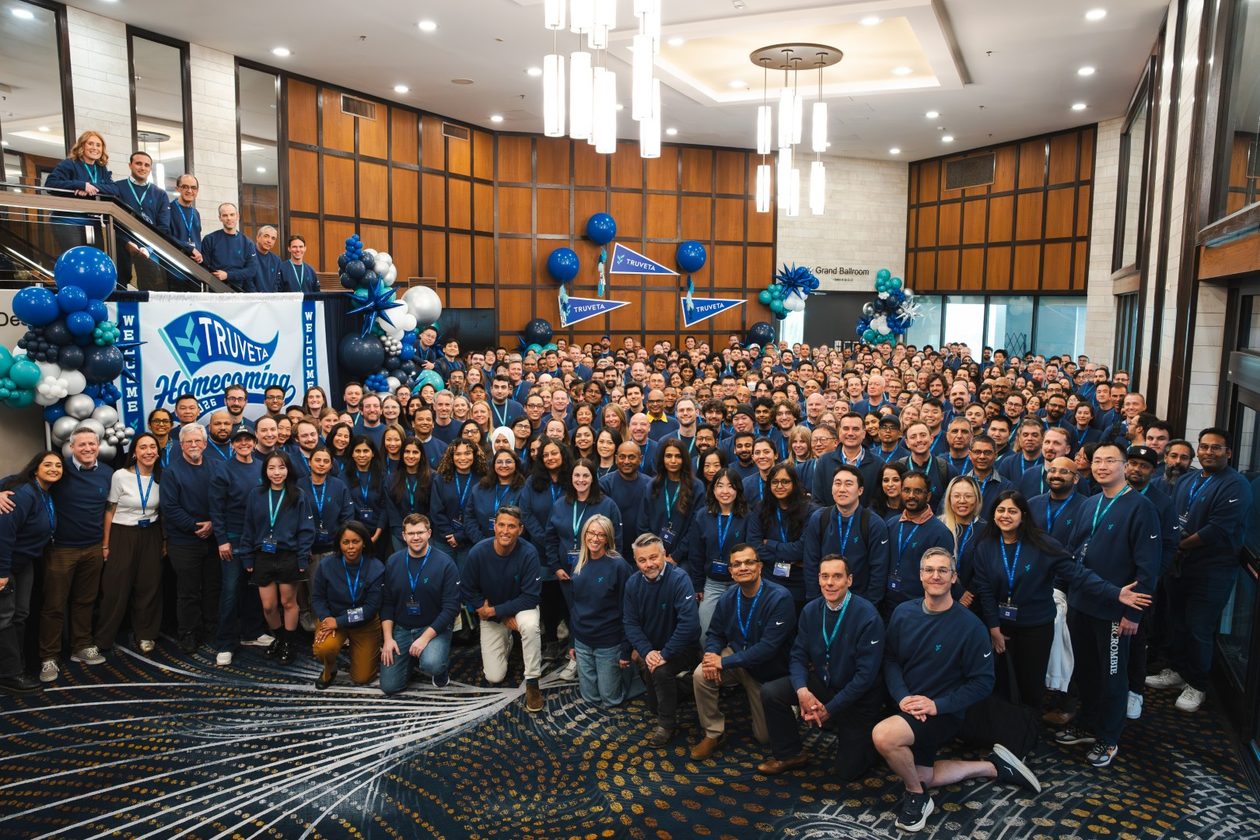
Truveta employees gather at the company’s all-company “Homecoming” meeting in April 2026. (Truveta Photo)
In a LinkedIn post announcing his retirement, Myerson noted that Truveta started “with an idea and no employees, no technology, no customers, and no data.” He wrote that what he’ll remember most are “the hundreds of Truvetans who took a chance on an ambitious idea and turned it into something real.”
Origins in the pandemic: Truveta grew out of a proposal from Providence, the Seattle-area nonprofit health system, for health systems to pool their data for research. Early in the pandemic, then-Providence CEO Rod Hochman called Myerson, who had left Microsoft in 2018 after leading its Windows and Devices Group, and asked him to build it.
GeekWire first reported on the startup in October 2020, and it launched publicly in February 2021 with 14 health systems.
Ahern was treating patients at NewYork-Presbyterian/Weill Cornell Medical Center in New York at the time. “We were giving out hydroxychloroquine, not knowing that it was actually harming patients,” he said. “It was the first time in my career that we were learning a new disease from scratch.”
Ahern was connected to Myerson through Madrona co-founder Jerry Grinstein, a former Delta Air Lines CEO and Ahern’s uncle by marriage. Myerson had joined the Seattle venture firm as a venture partner after leaving Microsoft.
Advertisement
Truveta says its data now covers more than 140 million patients. It published the first peer-reviewed real-world comparison of Ozempic and Mounjaro for weight loss, research that landed the company on the Today Show.
In 2025, Truveta raised $320 million in a round that included Regeneron and Illumina, bringing its total funding to $515 million. The round helped fund the Truveta Genome Project, which is sequencing leftover blood samples from consenting patients and linking the genetic data to de-identified medical records.
State of the business: Myerson declined to share revenue figures. He acknowledged that Truveta isn’t yet profitable but said it doesn’t need to raise more money. An IPO isn’t on the near-term horizon, he said, because Truveta’s revenue isn’t yet large enough for the public markets.
That leaves Nanduri, Ahern and the board with strategic decisions about which path to take over the long term. Myerson said the company has turned down offers, without elaborating.
Advertisement
“One of the problems with a business that’s doing well is you’ve got all those options,” he said.
“We’re blessed with a lot of options,” Ahern added.
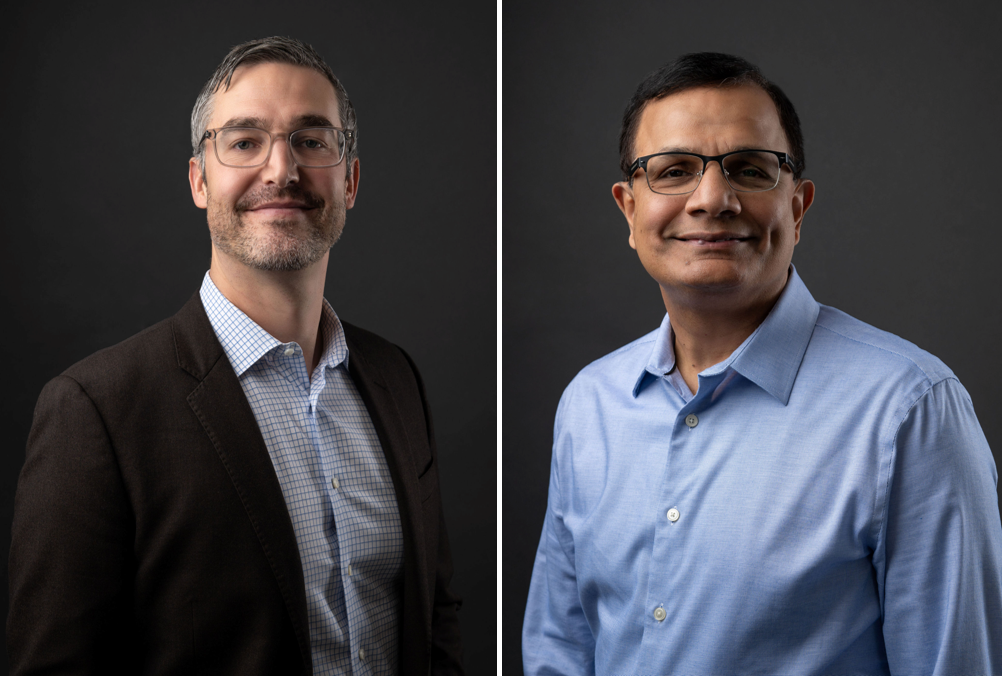
Truveta co-founders Ryan Ahern, left, the company’s chief medical officer, and Jay Nanduri, CTO, will be interim co-CEOs. (Truveta Photos)
Dividing the job: Nanduri, a former Microsoft technical fellow, will continue to lead engineering, product and the data systems behind them. Ahern, a physician who remains on the University of Washington faculty part time, will run sales, marketing, customer delivery and the evidence services team that handles regulatory work for customers.
Nanduri described it as supply and demand. “Ryan takes care of demand,” he said. “I make sure that the supply and the ecosystem and everything thrives.”
The company is expanding beyond data into AI tools for research, including Truveta Intelligence, which launched in April and lets researchers ask questions of its clinical data in plain English. Ahern said a key challenge is showing that AI-generated answers can be trusted for high-stakes decisions such as drug safety and label expansion.
Advertisement
Nanduri said each of the companies behind the leading AI models is doing some health-related work, and “they have approached us too.” The board has discussed how Truveta can coexist with them, he said. The company also opened a development center in Hyderabad, India, in July, expanding its engineering organization.
Truveta’s next chapter: The leadership change follows a shift at the board level. In March, Henry Ford Health executive Robin Damschrodersucceeded Hochman as Truveta’s board chair after he retired from Providence and affiliated entities.
The company also added a new senior executive this year, hiring Johnathan Lancaster, an oncologist and former Regeneron executive, as president and chief scientific officer in January.
Asked whether the board changes played a role in his decision, Myerson praised both Hochman and Damschroder, describing her as a disciplined board chair, and said the transitions are all part of the company moving into its second chapter. When it comes to CEO succession, he said, the question is who will commit for the next five to seven years.
Advertisement
“It’s easier for me to say, gosh, Jay and Ryan have earned this,” he said. “Bet on them for the next five to seven years versus betting on me.”
Advertisement
Myerson’s competitive streak, well known from his Microsoft days, hasn’t faded.
Truveta is currently No. 3 on the GeekWire 200, our list of the top Pacific Northwest startups. Myerson once responded to a congratulatory note from GeekWire about the company’s status on the list with a link to a YouTube clip of the famous line from Talladega Nights: “If you ain’t first, you’re last.”
Even as he discussed his departure, Myerson made his case for the top spot, calling Truveta “an amazing Pacific Northwest success story” and noting that more than 200 of its 500 employees are in the Seattle area.
“It’s a Pacific Northwest story that’s having global influence,” he said, “and so I think it should be number one on the list.”
Advertisement
At this stage of his life, he didn’t rule out the possibility of a next professional chapter for himself. But asked about his immediate plans, he said he’s hoping for “a great ski year.”
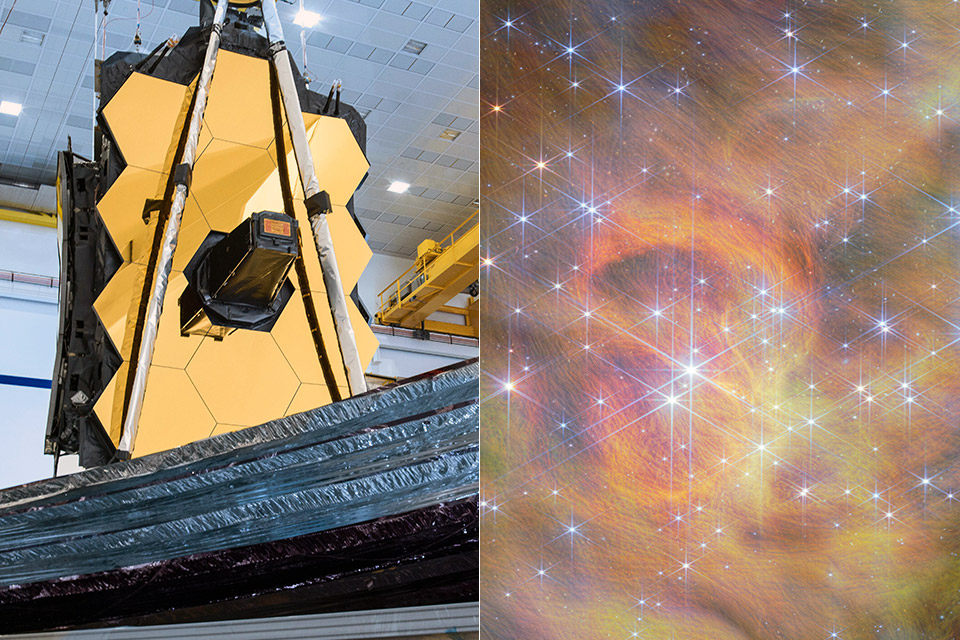
Photo credit: NASA/Chris Gunn NASA’s James Webb Space Telescope has released one of its largest public views yet, a near-infrared mosaic of IC 348, a star-forming region 1,000 light-years away in Perseus. Cold molecular hydrogen in that cloud is still collapsing into new stars, and Webb’s NIRCam turned the scene into a wide, crowded field of young suns, leftover dust, and objects so small they sit uncomfortably close to the planet side of the ledger.
A thousand light-years apart, you can see the difference, since Webb has the resolution to detect not just the luminous cluster but also the faint stragglers lurking in the filaments. The smallest proper stars will have a mass of about 8% that of the Sun. If you have anything smaller than that growing in the same manner that our sun does, by gravity dragging a cloud in on itself, you have a brown dwarf: it can’t get hot enough internally to fuse hydrogen properly, though many of them do burn deuterium for a short time in the beginning. A 2022 hunt in this same region with Webb found brown dwarfs with masses 3 to 4 times that of Jupiter, followed by some deeper NIRCam imagery in 2024 and NIRSpec spectra in 2025 under General Observer program 4866, which lowered the floor even further. Several of the objects were discovered to weigh around twice Jupiter’s mass, or 0.19% of the Sun’s mass, making them the least massive brown dwarfs on record. That effectively negates what many of the formation models have to say on the subject.
EXPLORE THE HUBBLE SPACE TELESCOPE – Celebrate one of humanity’s greatest scientific feats while enjoying a relaxing building experience with the…
REPLICA SPACE MODEL – Recreate the legendary space-based telescope with posable solar arrays and antennas, an opening aperture door and a detailed…
AUTHENTIC DETAILS – Remove the exterior panels to reveal a detailed instrument bay, which features gyroscopes alongside primary and secondary…
The researchers behind this hunt, Kevin Luhman of Penn State and Catarina Alves de Oliveira of the ESA, undertook the legwork. They selected the candidates based on color and brightness in the NIRCam frame, then weighed them using spectroscopy. One of the lightest new objects also appears to have a disk surrounding it. That leads to a simple but scary thought: planets may be developing around an object with the same mass as a planet. The spectra of the lightest brown dwarfs also revealed another surprise, which the team believes is an unnamed hydrocarbon composed only of hydrogen and carbon. This signal is only found in the most extreme objects, prompting the scientists to consider assigning these brown dwarfs their own spectral class.
NIRCam pieced together this mosaic using filters F162M, F182M, F360M, and F444W during observations on August 30th, 2024. The resulting product is a pretty enormous image, 16 by 20 arcminutes, which ranks as one of Webb’s largest releases to date. With tens of thousands of pixels to work with on each side, it’s no surprise this image is so detailed. Because we’re gazing in near-infrared light, the dust clouds become transparent rather than obscuring the view. As a result, young stars appear all over the place, faint outflows can be seen speeding through gas, and embedded sources glow brightly from within thicker knots of gas and dust. Even more intriguing, the mosaic’s background includes spiral galaxies and a gravitational lens, indicating that Webb is seeing not only into the clouds, but also back at the nursery.
The heavy lifting is taking place in the upper right corner of the building site. A dense cluster of protostars is hard at work right there, with many of them spewing out jets that collide with remaining gas and dust, illuminating the vicinity as Herbig-Haro objects. One such object, HH 797, extends out in a long, thin horizontal line before separating into two protostars with parallel outflows. Right next to it, HH 211 has a rather unusual propeller form, with a narrow jet paired with a larger wind. Both of those objects appeared in previous Webb releases, but this new mosaic places them in context: two bright patches in a much larger factory that is still producing stars, dead stars, and possibly the building blocks of planets orbiting objects only slightly larger than Jupiter.
Salesforce has revealed Ace, a new AI agent for the TSA
Ace should take the pressure of answering basic questions off human agents
Ace has already resolved 96% of basic inquiries so far
Salesforce has built the Transportation Security Administration (TSA) a new AI agent to try and help streamline travel for passengers everywhere.
Ace, a new AI agent built with Salesforce’s Public Sector Solutions platform, has been live for several months now, helping the TSA deal with traveller requests and inquiries.
So far, Salesforce says Ace has already handled approximately 100,000 routine traveler conversations per month and resolved 96% of routine inquiries, such as how to pack liquids or enter a checkpoint with a medical device — without the need for human escalation.
Latest Videos FromTechRadar
Advertisement
TSA and AI
“Nearly three million people travel through US airports every day, and a simple question shouldn’t stand between them and a smooth trip,” said Kendall Collins, CEO of Missionforce and Government Cloud.
“TSA’s new Ace AI agent gives travelers fast, accurate answers before they reach the checkpoint—from what they can pack to how they can prepare—while helping TSA officers stay focused on their essential security mission.”
The launch of Ace forms part of a broader modernization initiative, led by the TSA’s Customer Experience Branch to improve traveler service using Salesforce.
The amount of questions from travellers can ramp up hugely during peak travel periods and disruptions, so the TSA needed a flexible way to scale support, deliver consistent guidance, and reduce pressure on its contact center teams.
Sign up to the TechRadar Pro newsletter to get all the top news, opinion, features and guidance your business needs to succeed!
Deploying a secure, autonomous AI agent like Ace, which can answer routine questions and direct more complex needs to staff, means the TSA can improve services, control costs, and support its missions at scale, even at the busiest times of the year.
Advertisement
“The TSA is leading with trusted AI to meet the mission,” said Paul Tatum, EVP of Global Public Sector Solutions at Salesforce. “They are delivering a secure, data-driven, and AI-first foundation that scales operations, lowers costs, and protects public trust, even during the most stressful travel times.”
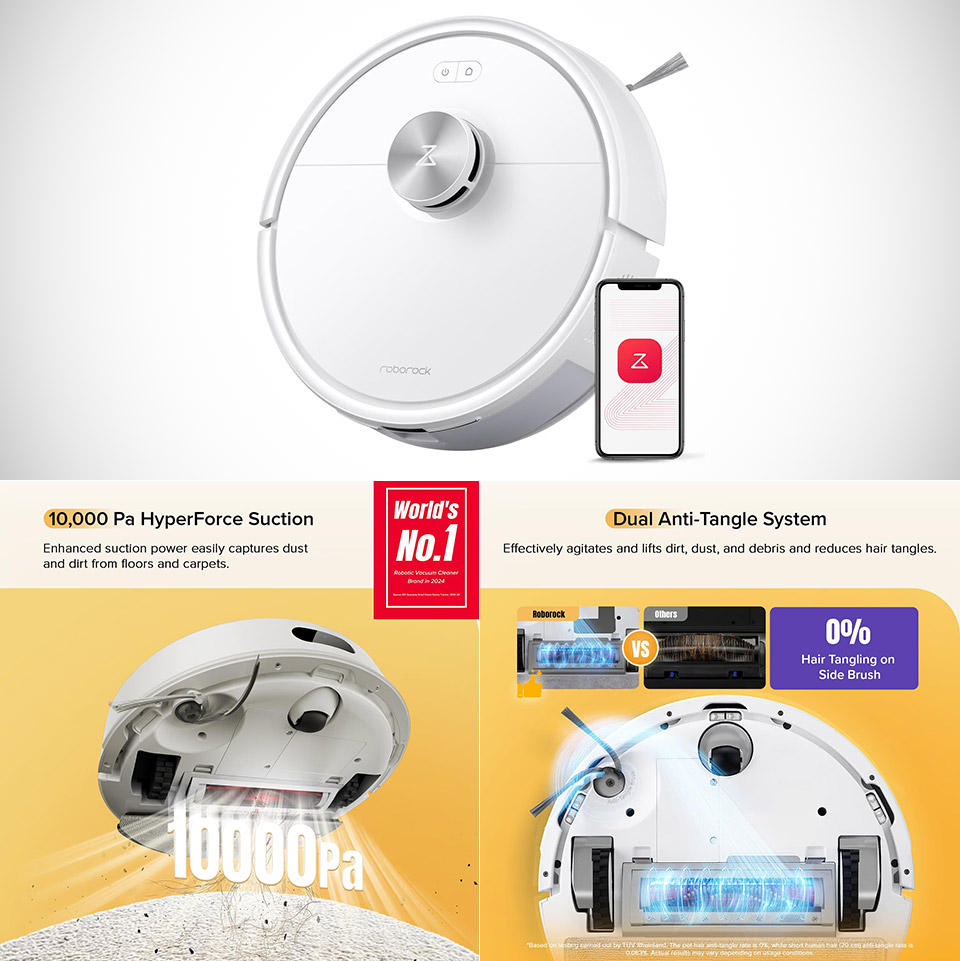
Most homes collect dust, crumbs, and pet hair faster than anyone wants to admit. Roborock’s Q7 M5, priced at $149.98 (was $230), is all around vacuum-and-mop combo aimed at that daily drift, pairing 10,000 Pa of HyperForce suction with a detachable mop pad so floors get a pass without you dragging out a stick vac after dinner.
This vacuum performs best under suction. Independent tests have placed this model at the top of the market when it comes to sucking up fine debris and carpet, particularly minute particles. The inclusion of a comb on the main roller and a tangle-resistant side brush has greatly reduced hair tangles, which tend to coil around this device and force you to flip it over every time it runs. Pet hair still likes to wrap around the roller every now and again, but the dual system is intended to remove as much of it as possible before it becomes a major maintenance headache. When it detects a rug, Carpet Boost activates more power, and then reduces the volume on hard floors to avoid blasting through the entire home.
𝗗𝘂𝗮𝗹 𝗔𝗻𝘁𝗶-𝗧𝗮𝗻𝗴𝗹𝗲 𝗗𝗲𝘀𝗶𝗴𝗻: Equipped with a JawScrapers Comb main brush and a tangle-free…
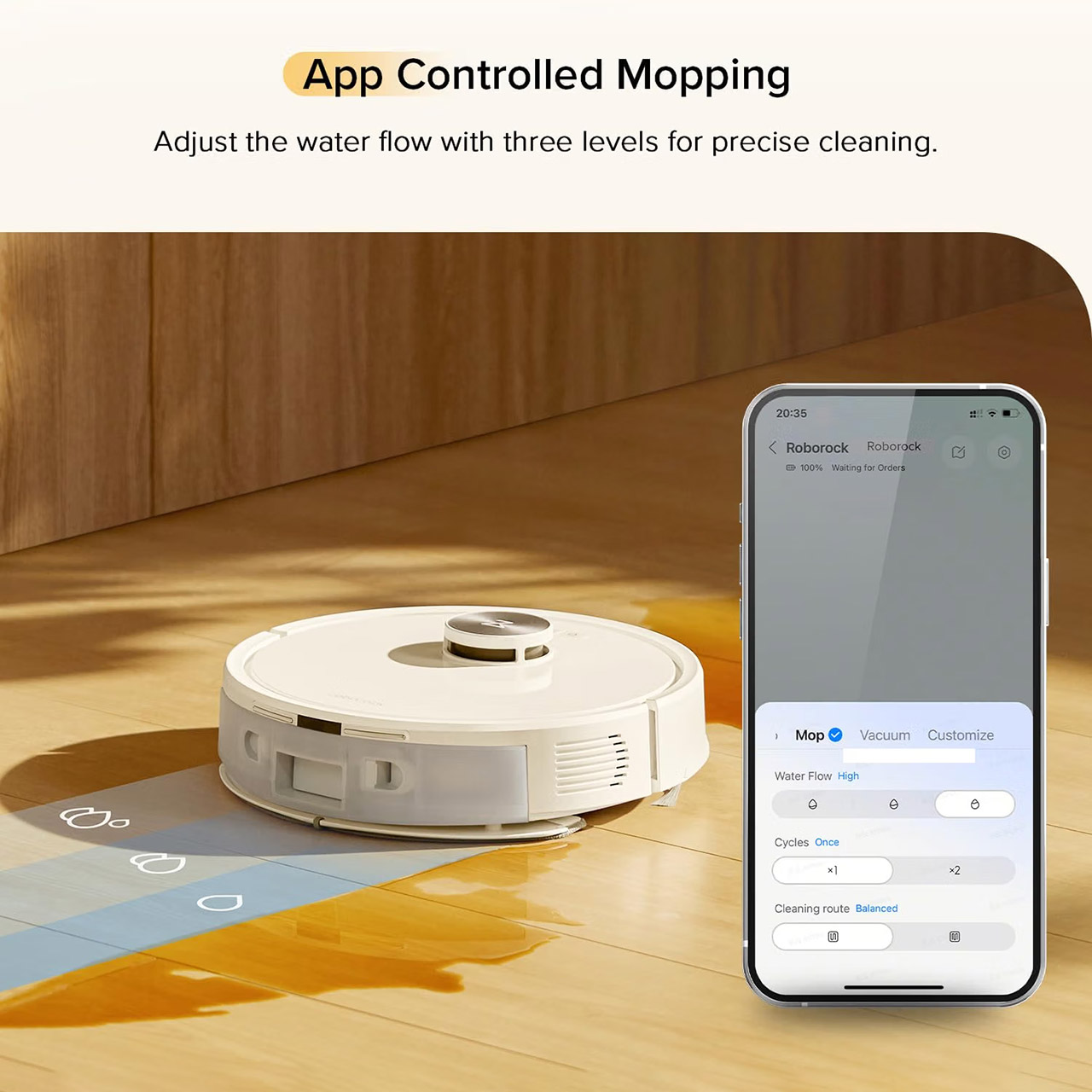
𝗔𝗽𝗽 𝗖𝗼𝗻𝘁𝗿𝗼𝗹𝗹𝗲𝗱 𝗠𝗼𝗽𝗽𝗶𝗻𝗴: The electronically controlled water tank provides three adjustable…
LiDAR sits on top, mapping the room all at once before beginning to clean. It doesn’t merely bounce off furniture until the battery runs out; instead, it follows a grid, and when you move to a new floor, it remembers the previous configuration, so you can simply carry it upstairs and let it go to work. The Roborock app allows you to configure a variety of custom jobs, including no-go zones, one-room jobs, scheduled runs, and even suction and water flow settings. If you don’t want to use your phone, simply tell Alexa or Google Assistant to start it. The only catch is that object avoidance is just infrared, so you’ll still have to pick up the occasional sock or charging wire before letting it go.
The mopping side of this combo is fairly quiet, and it’s very clear about what it can and cannot accomplish. The stationary microfibre pad simply drags behind the body, while the water tank, similar to a luxury coffee maker, calculates out the appropriate amount of water at low, medium, or high settings. Kitchen tile and sealed wood receive a pleasant wet treatment that removes any debris left by the vacuum. The tank carries around 270ml of water and a 400ml dustbin in one of those convenient side-mounted modules. That’s enough for a typical single-story clean, but don’t expect a week of hands-off service.
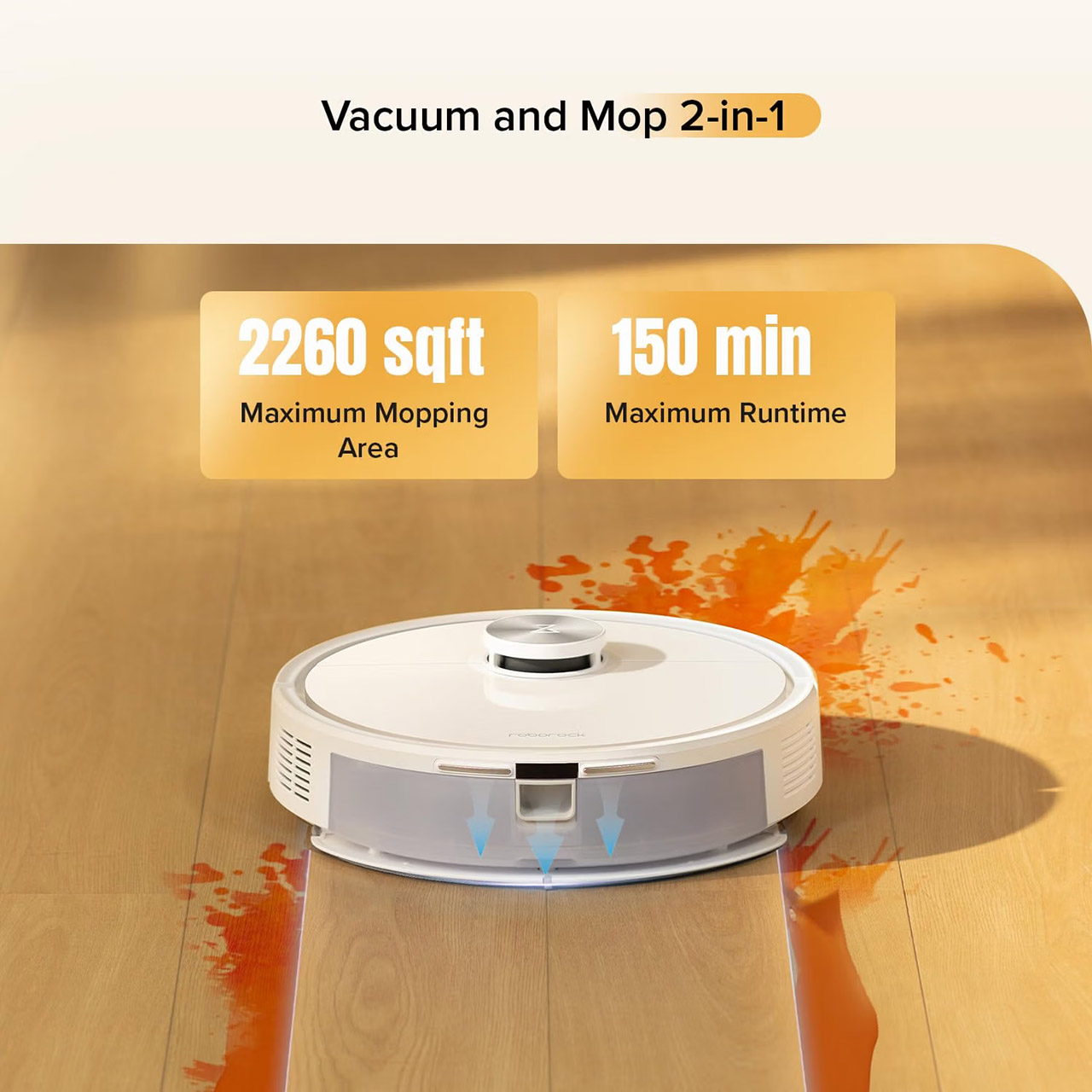
The 3,200 mAh battery pack’s runtime ranges from 150 to 180 minutes, depending on how you use it. In actual life, a typical mixed vacuum-and-mop run will cover around 1,000 square feet before returning to its small port to recharge. The body measures 12.8 inches across and 3.9 inches tall, and weighs only 7.28 pounds, making it easy to transport between floors or tuck under a sofa or two. Noise levels are fair, ranging from the mid-60s to low-80s dB; the mopping setting is your best bet if someone is still working in the adjacent room.




























































You must be logged in to post a comment Login