Sometimes, a threat lands as a threat. Other times, it comes off like, well, an advertisement for the New Mexico tourist bureau. In court filings (viaSourceNM), Meta warned that if a judge sides with the NM Department of Justice in an upcoming bench trial, the company may be forced to shut down its apps for users in the state. NM Attorney General Raúl Torrez described Meta’s threat to pull the plug on its apps as a “PR stunt.”
Last month, a Santa Fe jury held Meta liable for $375 million in damages to NM over the company’s failure to protect child users from online predators. The company’s warning was made ahead of the trial’s second phase, scheduled to begin next week.
In the May 4 bench trial, NM District Judge Bryan Biedscheid will determine whether Meta caused a “public nuisance” and should therefore fund related state programs. NM DOJ lawyers will also argue that Meta needs to make several changes to its platform. These include adding age verification, removing predators, and “protecting minors from encrypted communications that shield bad actors.”
Advertisement
Meta’s response, unsealed on Thursday, reportedly described the state’s demands as “so broad and burdensome that if implemented, it might force Meta to withdraw its apps entirely.” “It does not make economic or engineering sense for Meta to build separate apps just for New Mexico residents,” it continued. The company also claimed that the state lacks the authority to implement its desired changes and that doing so would violate free speech.
In a statement sent to Engadget, NM AG Torrez dismissed Meta’s claims that the proposed remedies weren’t feasible. “We know Meta has the ability to make these changes. For years, the company has rewritten its own rules, redesigned its products, and even bent to the demands of dictators to preserve market access. This is not about technological capability. Meta simply refuses to place the safety of children ahead of engagement, advertising revenue, and profit.”
If there’s something that stands between foldables and the mainstream smartphone market, it’s their battery life, and Motorola has taken it upon itself to fix that. Almost all smartphone giants have their own book-style foldable available in the U.S., and all of them justify the premium with intricate hinges, flexible displays, and other engineering marvels, but somehow, that doesn’t extend to their batteries.
You can unfold a foldable to double its screen size; that’s its entire pitch. But does the battery life also double? Unfortunately, it doesn’t. Among the two widely available book-style foldables in the U.S. — Samsung’s Galaxy Z Fold 7 and Google’s Pixel 10 Pro Fold — the average battery life remains less than that of regular handsets.
Motorola
But haven’t smartphones already unlocked over 10 hours of screen-on time using silicon-carbon battery technology? This is exactly the gap Motorola is walking into with its first book-style foldable: the Razr Fold. For the first time, a foldable is entering the U.S. market with a 6,000 mAh battery that supports 80W wired charging, no less.
Should it deliver, the Razr Fold could bridge that gap before Samsung or Google even comes close.
The battery problem foldables have always had
Think about what the battery on the Fold 7 or a Pixel 10 Pro Fold is actually running: two displays (the cover screen and the foldable screen), a flagship-tier chipset borrowed straight from the slab phones, and at least two to three rear-facing cameras, along with constant Wi-Fi or cellular connection.
Advertisement
It is because of this compounded power draw that foldables require larger batteries to provide similar endurance to regular phones. A couple of years ago, when the technology wasn’t as mature as today, using a 4,000 or 4,400 mAh battery on a foldable was par for the course.
Motorola
To me, it feels like OEMs, especially in the U.S., are deliberately holding back on battery capacity in foldables, while Chinese brands like Honor and Oppo continue to push the limits.
This is the core problem that the Motorola Razr Fold could solve.
Phone
Battery
Wired Charging
Wireless Charging
Status
Samsung Galaxy Z Fold 7
4,400 mAh
25W
15W (Qi2 Ready*)
Available
Google Pixel 10 Pro Fold
5,015 mAh
39W
15W (Qi2)
Available
Samsung Galaxy Z TriFold
5,600 mAh
45W
15W (Qi)
Discontinued
Motorola Razr Fold
6,000 mAh
80W
50W
Launching May 21
Who does the Razr Fold compete with?
I’ve used the Fold 7 briefly, and by many measures, it’s an impressive piece of technology. The thinnest book-style foldable in the U.S. is just 4.2 mm when unfolded. However, with a 4,400 mAh battery that offers around six hours of screen-on time on average, that didn’t make the phone last an entire day, at least for me.
The phone also takes around 90 minutes for a complete charge, thanks to support for only 25W wired charging. You can’t just plug it 20 minutes before leaving your home; you’d have to plan around it.
Advertisement
Nirave Gondhia / Digital TrendsNirave Gondhia / Digital Trends
Google’s Pixel 10 Pro Fold took a meaningful leap with a 5,015 mAh cell and up to 39W charging, offering between seven and eight hours of screen-on time, genuinely lasting an entire day of usage.
But that’s enough, right? Not quite. Now that we’re in the era of over-7,000-mAh battery phones (I’m talking about the OnePlus 15 and the OnePlus 15R) that deliver nearly two days of battery life between charges, plugging in a foldable at around 8 or 9 PM feels like getting shortchanged on a $2,000 purchase
If foldable phones stand a chance against mainstream handsets, manufacturers have to step up to the plate on battery life, and that’s exactly why the Razr Fold has my attention.
What should you expect from the Razr Fold?
The Razr Fold’s 6,000 mAh battery is roughly 36% larger than the Galaxy Z Fold 7’s and about 20% larger than the Pixel 10 Pro Fold’s. The company has achieved this using the same tech on modern Chinese flagships: silicon-carbon battery chemistry, which packs more energy into less physical space without adding bulk. The result is a book-style foldable that unfolds to just 4.7 mm, slightly thicker than the Fold 7, but not by a margin that should trouble anyone.
Now, this is the part where I’m using years of experience to speculate something without trying to sound too optimistic. The Razr Fold, with its 6,000 mAh battery and the Snapdragon 8 Gen 5 chip that’s actually less powerful than the Snapdragon 8 Elite on the Fold 7, should provide a screen-on time of around eight to nine hours under mixed usage.
Advertisement
Motorola
If Motorola has optimized the software well for a big-screen foldable, and that’s a big if, given that this is the company’s first foldable, the screen-on time might nudge past nine hours as well.
This way, the foldable could actually match the battery life of modern flagships. If that doesn’t happen, however, I’d be disappointed, and seven to eight hours is where the phone would sit, with the Pixel 10 Pro Fold, despite featuring a significantly bigger battery.
Please don’t drop the ball, Motorola
The charging speed is equally important here. Razr Fold’s 80W wired charging speed is more than three times what Samsung offers on the Fold 7 and double what Google offers on the Pixel 10 Pro Fold. The caveat, here, is that none of this has been proven yet, and we’ll have to wait a couple of weeks to find out the truth.
Motorola
It’s worth knowing that the company also promises over 12 hours of use from under 10 minutes of being plugged in. For added convenience, and to leave the competition baffled, the Razr Fold also supports 50W wireless charging. While achieving those speeds requires Motorola’s proprietary hardware, I’d definitely pay for that kind of speedy convenience.
Moreover, the Razr Fold’s 6,000 mAh battery, paired with 80W wired and 50W wireless charging, is the spec combination that the U.S. buyers deserve. If it delivers, it will bridge the gap between the battery life we get from regular smartphones and foldables, making the Razr a compelling buy and forcing Samsung and Google to go back to the drawing board.
Iron flow battery runs 6,000 cycles without measurable capacity loss
New electrolyte chemistry reduces degradation and membrane crossover problems
Iron materials offer low-cost alternative for large-scale renewable energy storage
Researchers in China say they have made new progress on iron-based flow batteries that could reduce the cost of storing renewable energy while extending usable lifespan.
The team from the Institute of Metal Research under the Chinese Academy of Sciences developed a redesigned electrolyte that allowed an alkaline all-iron flow battery to run through more than 6,000 cycles without measurable capacity decay, according to results published in Advanced Energy Materials.
Iron flow batteries have been studied for years but have struggled with stability problems that limit long-term use. Active materials inside the battery tend to degrade or leak through membranes, reducing efficiency and shortening lifespan.
Article continues below
Advertisement
Iron is 80x cheaper than lithium
The researchers addressed those limits by redesigning the molecular structure of the negative electrolyte used inside the system.
The team synthesized 11 iron complexes built from 12 organic ligands before identifying a compound known as [Fe(HPF)BHS]⁴⁻ as the most stable candidate.
Advertisement
Its bulky structure creates physical protection around the iron center, while negatively charged groups help prevent unwanted reactions and reduce material crossover across the membrane.
Testing showed the battery running at 80 mA·cm⁻² for more than 6,000 cycles with no capacity decay and an average coulombic efficiency of 99.4%, based on performance data released by the research team.
Sign up to the TechRadar Pro newsletter to get all the top news, opinion, features and guidance your business needs to succeed!
Under higher current conditions, the system reached a peak power density of 392.1mW·cm⁻² while maintaining energy efficiency of 78.5%, indicating stable performance under heavier electrical demand.
Advertisement
Researchers linked the cycle count to long-term use, estimating the performance equals more than 16 years of daily use without measurable degradation.
Iron is more than 80 times cheaper than lithium as a raw material, which could make large-scale energy storage far less expensive, provided the technology scales successfully.
Iron is also widely available, ranking among the most abundant metals on Earth, which reduces concerns about supply shortages compared with lithium.
Advertisement
All-iron flow batteries use water-based electrolytes instead of flammable liquids found in lithium-ion systems. That chemistry removes the conditions needed for thermal runaway, which is the chain reaction that can lead to battery fires or explosions.
Large-scale energy storage remains one of the major technical challenges tied to renewable energy expansion, since electricity generation from solar and wind fluctuates depending on weather conditions.
The research improves stability in iron-based electrolytes, but long-term testing outside controlled environments will determine just how well the chemistry performs in real grid installations.
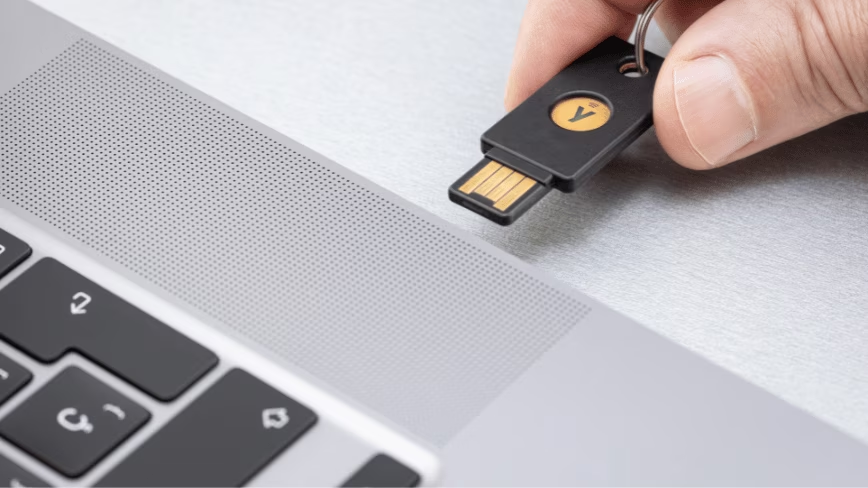
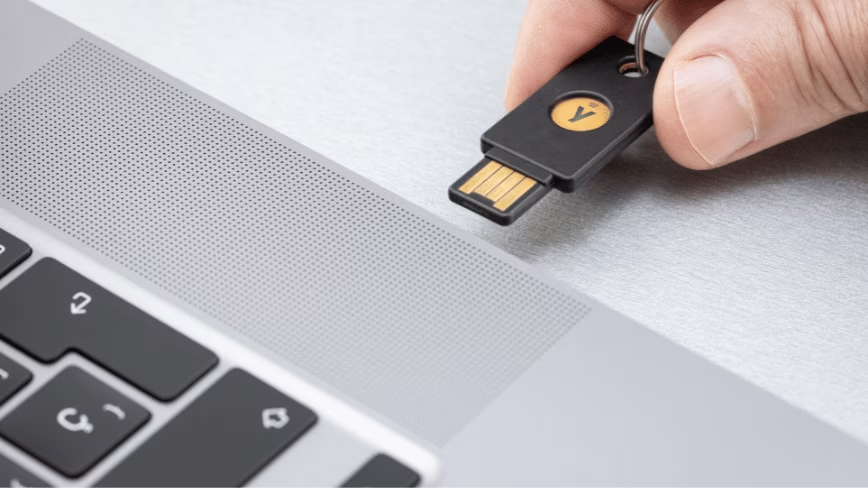
OpenAI launched Advanced Account Security for ChatGPT and Codex, an opt-in feature that replaces passwords with passkeys or hardware security keys, disables email and SMS recovery, and automatically opts users out of model training. The company partnered with Yubico to sell co-branded YubiKeys for $68 (two-pack), less than half retail price. The feature targets journalists, dissidents, and officials, and will be mandatory for Trusted Access for Cyber members by June 1.
OpenAI has released a security feature for ChatGPT accounts that treats them the way banks treat online banking: hardware keys, no passwords, no email recovery, and no help from customer support if you lose access. The feature, called Advanced Account Security, is an opt-in setting that requires users to authenticate with two passkeys, two hardware security keys, or one of each before they can log in to ChatGPT or Codex. Once enabled, password-based login is permanently disabled, and recovering an account through email or text message is no longer possible. OpenAI has partnered with Yubico, the Swedish-American hardware authentication company, to sell co-branded YubiKeys bundled for $68, less than half the $126 retail price. The feature is available to everyone, including users on the free tier. The company says it is designed for journalists, political dissidents, researchers, and elected officials. But the fact that OpenAI built it at all is an acknowledgment that a ChatGPT account, for a growing number of people, now holds more sensitive information than their email.
Advertisement
What it does
Advanced Account Security replaces every conventional login and recovery mechanism with cryptographic authentication. Users who enable it must register two separate credentials, choosing from passkeys stored on their device, YubiKeys or other FIDO2-compliant hardware tokens, or a combination. Each credential generates a unique cryptographic key pair that never leaves the device, which means there is no password to steal, no one-time code to intercept, and no recovery email that an attacker can compromise through social engineering. OpenAI has made the design trade-off explicit: its own support team cannot restore access to an account protected by Advanced Account Security if the user loses both credentials. The company issues a recovery key during setup, and if that key is also lost, the account is unrecoverable. The architecture is borrowed from the same zero-trust principles that protect classified government systems and cryptocurrency wallets, applied to a consumer chatbot.
The feature includes several secondary protections. Sign-in sessions are shortened, reducing the window during which a stolen session token could be exploited. Users receive alerts for every new login and can view and terminate active sessions from their account settings. And enabling Advanced Account Security automatically opts the user out of model training, meaning their conversations will not be used to improve future versions of ChatGPT. That last detail is significant: it links the highest level of account protection to the highest level of data privacy, creating a tier of user whose interactions with the system are both cryptographically secured and contractually excluded from OpenAI’s training pipeline. For users handling sensitive material, the combination addresses two concerns simultaneously.
The security upgrade arrives in a context that makes its purpose clear. In 2024, Group-IB, the Singapore-based cybersecurity firm, identified more than 100,000 stolen ChatGPT credentials circulating on dark web marketplaces, harvested from devices compromised by information-stealing malware. Those credentials gave anyone who purchased them full access to the victim’s chat history, which for many users included confidential work conversations, personal queries, and information that would be damaging if exposed. A separate breach involving Mixpanel, a third-party analytics provider, exposed ChatGPT user names, email addresses, and technical metadata that could be used for targeted phishing campaigns. The industry’s broader push toward passwordless authentication has been driven by the recognition that passwords are the single largest attack surface in consumer technology: an estimated 46 per cent of all successful cyberattacks on small and medium businesses in 2026 will originate from credential reuse, according to industry research.
ChatGPT’s vulnerability is distinctive because of what the accounts contain. An email account holds messages. A banking account holds transaction records. A ChatGPT account holds the unfiltered questions a person asks when they believe no one is watching: medical symptoms, legal exposure, relationship problems, business strategies, code with proprietary logic, and conversations with an AI system that remembers context across sessions. OpenAI’s Codex Chronicle feature, which periodically captures screenshots of a user’s desktop and sends them to OpenAI’s servers for processing, has made the data stakes even higher for users who opt in. The company is simultaneously expanding the volume of sensitive information its products collect and building the security infrastructure to protect it. Advanced Account Security is the protection side of that equation.
The Yubico deal
The partnership with Yubico is commercial and strategic. The two co-branded products, the YubiKey C NFC and the YubiKey C Nano, are physically identical to Yubico’s existing product line but carry OpenAI branding and are sold through OpenAI’s channels at a subsidised price. The C NFC model supports both USB-C and near-field communication, allowing it to work with laptops, phones, and tablets. The C Nano model is small enough to remain permanently inserted in a USB-C port. Both support FIDO2, the authentication standard developed by the FIDO Alliance that underpins passkeys and is backed by Apple, Google, and Microsoft. The $68 bundle for two keys represents a meaningful discount: a single YubiKey C NFC retails for approximately $55, making the bundle effectively a buy-one-get-one offer.
Advertisement
OpenAI’s decision to subsidise hardware authentication for its users reflects a calculation about the cost of account compromises. A high-profile breach of a ChatGPT account belonging to a journalist, government official, or corporate executive would generate reputational damage that far exceeds the cost of discounted security keys. By making hardware authentication cheap and accessible, OpenAI is shifting the security burden from a password that can be phished to a physical object that must be stolen. The strategy mirrors what Google implemented internally in 2017, when the company distributed YubiKeys to all 85,000 employees and subsequently reported zero successful phishing attacks against employee accounts. OpenAI is applying the same logic to its user base, though on an opt-in rather than mandatory basis, with one exception: members of the Trusted Access for Cyber programme, which grants verified security researchers and defenders access to OpenAI’s most capable cybersecurity models, will be required to enable Advanced Account Security by 1 June 2026.
The signal
The deeper significance of Advanced Account Security is not the feature itself but what it implies about the category. When a company builds bank-grade security for a chatbot, it is telling you that the chatbot is no longer a toy. OpenAI now operates a six-tier subscription structure that ranges from a free ad-supported account to custom enterprise contracts, with 50 million paying subscribers and 900 million weekly active users. A meaningful fraction of those users treat ChatGPT as a primary work tool, a confidential advisor, or both. The conversations stored in those accounts are, in aggregate, one of the most valuable datasets of human intent ever assembled: what people want to know, what they are worried about, what they are building, and what they are hiding. Protecting that dataset is not a feature. It is a business requirement.
The opt-in model is both a strength and a limitation. Users who need Advanced Account Security the most, dissidents in authoritarian countries, journalists investigating powerful institutions, executives discussing unreleased products, are also the users most likely to enable it. But the vast majority of ChatGPT’s 900 million weekly users will never toggle the setting, which means their accounts will remain protected by whatever password they chose when they signed up, reused from another service, and have not changed since. AI-powered phishing campaigns can now generate hundreds of targeted messages per minute, each tailored to a specific victim, and the most common entry point remains a stolen or guessed password. OpenAI has built the infrastructure to protect accounts that matter. Whether the accounts that do not opt in will become the easier targets is a question the feature does not answer. What it does answer, clearly, is that OpenAI considers a ChatGPT account to be a high-value asset worth defending with the same tools used to protect state secrets and financial systems. The company that made it easy for anyone to talk to an AI has now made it possible for anyone to lock that conversation behind hardware that cannot be phished. The gap between those two populations will determine how the next wave of AI-related breaches unfolds.
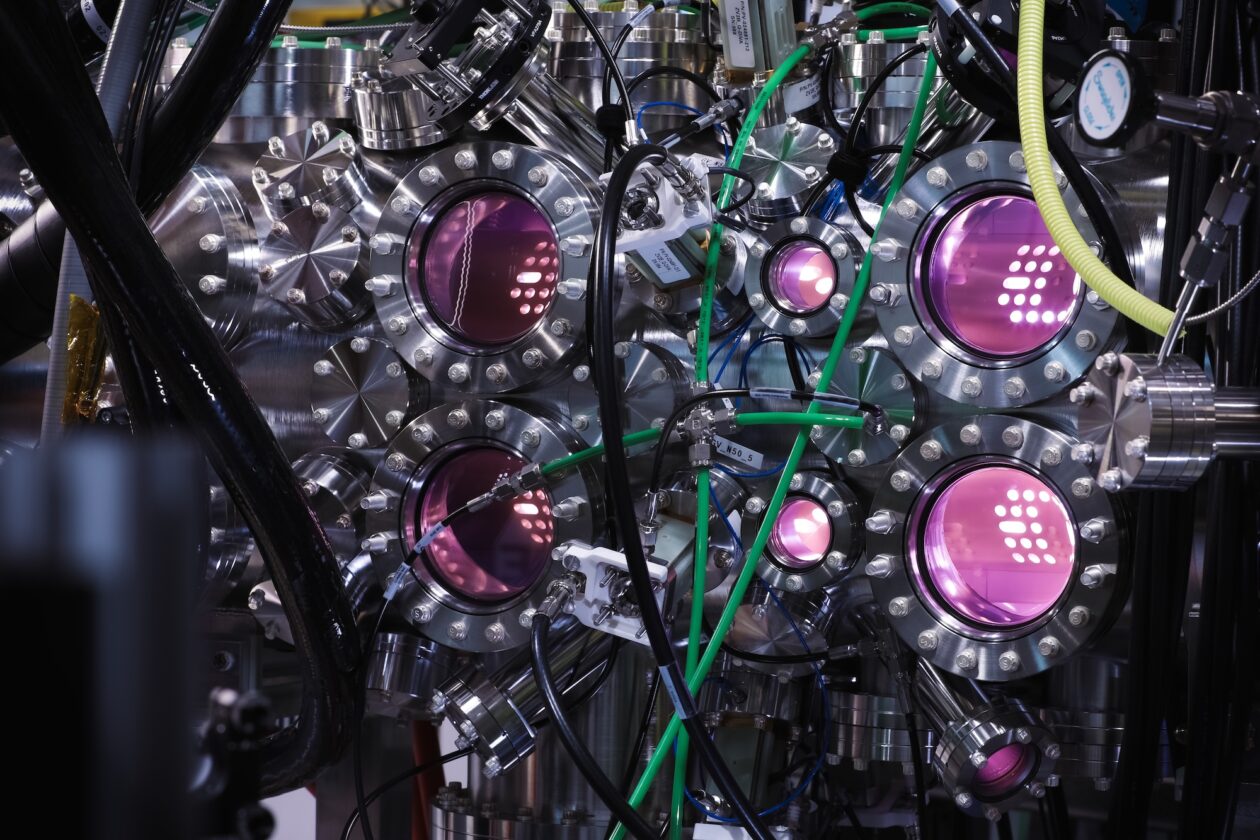
Zap Energy’s fusion device creates a purplish glow from its hydrogen plasma. (Zap Photo)
Zap Energy announced plans Wednesday to become the first company to simultaneously pursue two tracks for nuclear power: fusion, an unproven but promising technology that smashes light atoms together to produce energy, and fission, the better-known nuclear pathway that already powers reactors around the globe by splitting heavy atoms.
To support these dual objectives, Zap has named Zabrina Johal as CEO, succeeding company co-founder Benj Conway, who is transitioning to president.
Zabrina Johal, CEO of Zap Energy. (LinkedIn Photo)
Fusion innovators have typically drawn a bright line between their nuclear solution and conventional fission, given public concerns about past reactor meltdowns and radioactive waste.
But Zap’s leaders say that distinction creates a “false wall” the Everett, Wash., company is ready to knock down.
“Fission and fusion are two expressions of the same underlying physics,” Conway said in a statement. “This isn’t a pivot — by integrating them into a single platform, we can move faster, reduce risk, and build a more enduring company.”
The planet is desperate for new energy sources and many customers and governments are eager for solutions that don’t release carbon and further stoke climate change. Demand is spiking as tech companies rush to erect data centers that support AI even as transportation, housing and industrial sectors electrify their operations.
Advertisement
Zap has been developing its commercial fusion technology since launching nine years ago, building fusion machines and the systems needed to deliver that power to the grid. It has raised more than $330 million from investors and was selected to participate in the Department of Energy’s fusion development program.
But mastering fusion’s physics — essentially recreating the reactions that fuel the sun in an earthbound device — is uncertain and costly. While dozens of companies worldwide are chasing commercially viable fusion energy, none have succeeded so far.
Building next-generation fission technology is more predictable and would provide revenue sooner, the startup said, while simultaneously supporting research that advances its fusion work. The company’s goal is to have a fission solution for sale by the early 2030s, according to the New York Times, which first reported the news.
A Zap Energy employee working on its demo fusion reactor at the company’s Everett, Wash., research and development facility. (Zap Photo)
Johal began her career as an officer and engineer in nuclear propulsion in the U.S. Navy and previously spent 18 years with General Atomics leading strategic development for its nuclear and defense portfolios. Most recently, she was with AtkinsRéalis, a Montreal engineering firm with a nuclear power focus.
The company also named Daniel Walter, a former director at TerraPower — the nearby nuclear company backed by Bill Gates — as director of nuclear engineering. Zap vice president Matthew Thompson is now SVP of fission technology and will work on both tech platforms.
Advertisement
Other fusion companies have similarly pursued additional revenue streams. Seattle’s Avalanche Energy, for example, has multiple initiatives, including work on compact nuclear batteries, fusion propulsion in space applications, and advanced materials for extreme environments.
Zap is the first, however, to add the development of fission reactors to the mix. Traditional nuclear has seen a renaissance driven by the spiking power demand. The U.S. government is investing in fission innovation and expedited permitting for the sector, and tech companies are paying to keep existing reactors online while backing startups pursuing smaller, cheaper and faster-to-deploy designs that use factory fabricated parts.
Zap has been developing its nuclear plan over the past year and is looking to develop microreactors that roughly share the physical dimensions of its planned fusion device.
The company’s approach builds on technology from the Experimental Breeder Reactor-II (EBR-II), developed and tested over decades at U.S. national laboratories. The strategy was later adopted by Toshiba for its 4S (Super-Safe, Small and Simple) reactor, though that project fizzled in the post-Fukushima climate that turned hostile to nuclear power — despite the fact the 4S design itself was unrelated to the Fukushima reactor technology.
Advertisement
Zap said it is now revitalizing the Toshiba design, which includes a 10 megawatt microreactor cooled by liquid sodium that can run for decades without refueling. The approach is attractive in part because Zap’s fusion device uses liquid lithium, which behaves similarly to sodium.
Advertisement
“Zap’s approach is to build common technical foundations — materials, liquid metal systems, high power density design, and neutron environments — once and apply them across both fission and fusion,” the company said.
The startup is confident that customers are hungry for both varieties of nuclear energy.
“Meeting that demand requires simpler, more adaptable systems and a faster path to deployment,” Johal said. “Fission gives us a path to deploy. Fusion gives us a path to transform. Bringing them together is how we do both.”
A Romanian national who led an online swatting ring that targeted more than 75 public officials, multiple journalists, and four religious institutions was sentenced to 4 years in federal prison.
Swatting is a dangerous criminal harassment tactic involving making false reports to emergency responders of an ongoing violent threat at a target’s address to provoke an armed police response.
27-year-old Thomasz Szabo, who was extradited from Romania in November 2024, was also ordered three years of supervised release after he pleaded guilty to one count of conspiracy and one count of threats involving explosives in June 2025.
Szabo, who operated online under multiple aliases (including “Jonah,” “Jonah Goldberg,” “Plank,” “Rambler,” “War Lord,” “Shovel,” “Cypher,” “Kollectivist,” “Mortenberg Shekelstorms,” and “NotThuggin2”) founded and led an online community that began a pattern of bomb threats and swatting attacks in late 2020.
Advertisement
According to court documents, Szabo personally made false reports to U.S. law enforcement, including a December 2020 threat to carry out a mass shooting at New York City synagogues and a threat to detonate explosives at the U.S. Capitol and kill President-elect Joe Biden in January 2021.
“Members of Congress, cabinet officials, the heads of federal law enforcement agencies, churches, journalists — Thomasz Szabo and his followers targeted them all with swatting calls and fake bomb threats designed to send armed police to their doors,” said U.S. Attorney Pirro on Wednesday. “Szabo was extradited from Romania to face justice in an American courtroom, and today he has reaped the consequences of his actions.”
Szabo also advertised his activities to followers and encouraged them to carry out similar attacks, which prompted a concentrated spree of swatting attacks targeting at least 25 members of Congress or their family members, and at least six senior executive branch officials, including multiple cabinet-level figures, between December 2023 and early January 2024.
Within the same timeframe, Szabo’s followers also targeted at least 13 senior federal law enforcement officials, members of the federal judiciary, at least 27 state officials, and four religious institutions.
Advertisement
One of the group’s members even boasted to Szabo about conducting more than 25 swatting calls in a single day, claiming to have wasted more than $500,000 in taxpayer funds over two days.
23-year-old Serbian national Nemanja Radovanovic, another one of Szabo’s accomplices, was also charged in August 2024 in connection with the same scheme and faces separate proceedings.
“Mr. Szabo’s and his co-conspirators’ incessant swatting attacks created a tremendous drain on law enforcement resources and taxpayer dollars and put innocent civilians in harm’s way,” added FBI Special Agent Michael Burgwald. “Today’s sentencing is an important step toward ensuring that those who believe swatting is just a prank will be disabused of that notion and making it clear that those who engage in it will face justice.”
AI chained four zero-days into one exploit that bypassed both renderer and OS sandboxes. A wave of new exploits is coming.
At the Autonomous Validation Summit (May 12 & 14), see how autonomous, context-rich validation finds what’s exploitable, proves controls hold, and closes the remediation loop.
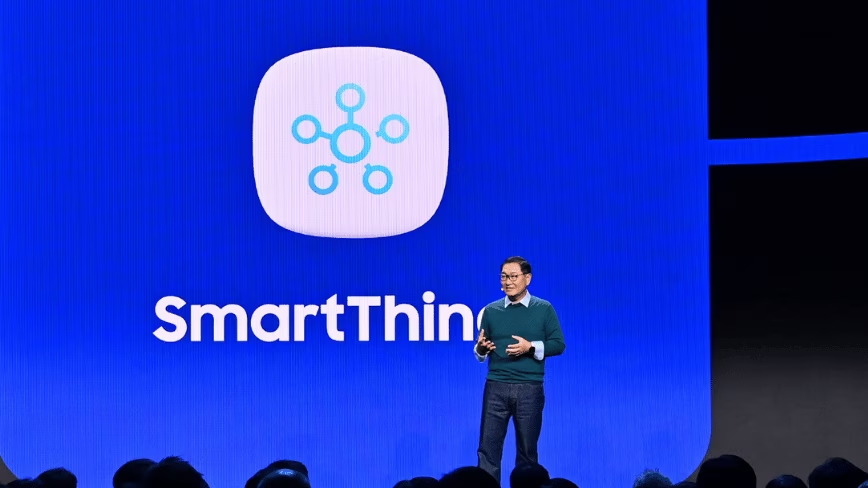
The Lee family that controls Samsung has seen its wealth double from $22.7 billion to $45.5 billion in twelve months, jumping from tenth to third among Asia’s richest families. The surge is driven by Samsung Electronics’ 186% stock rally on AI chip demand, with Q1 operating profit reaching 57.2 trillion won (8x YoY) on HBM4 memory production for Nvidia. Meanwhile, 30,000 Samsung workers have rallied demanding a 15% profit share and are threatening an 18-day strike.
The Lee family of South Korea, which controls Samsung, has doubled its wealth in twelve months. Bloomberg’s Billionaires Index now values the dynasty’s holdings at $45.5 billion, up from $22.7 billion a year ago, propelling the Lees from tenth to third among Asia’s richest families. The catalyst is not a new product or a management breakthrough. It is a 186 per cent surge in Samsung Electronics’ share price, driven almost entirely by global demand for the high-bandwidth memory chips that power artificial intelligence data centres. Samsung’s first-quarter operating profit reached 57.2 trillion won, roughly eight times what it earned in the same period last year. The Lee family did not build the AI industry. But the AI industry cannot function without what Samsung builds, and for the moment, that dependency is worth $22.8 billion in new wealth for a single family in a single year.
Advertisement
The chip
Samsung’s financial turnaround rests on one product category: high-bandwidth memory, or HBM, the specialised DRAM chips that sit inside the GPU modules used to train and run large AI models. Nvidia’s next-generation B300 server systems require HBM4 chips, and Samsung has entered mass production of HBM4 ahead of SK Hynix, its primary rival, after years of trailing in the technology. The shift matters because HBM commands margins that conventional memory chips cannot match. When Samsung reported first-quarter results, the semiconductor division accounted for the overwhelming majority of the profit swing, converting what had been a cyclical downturn into the most profitable quarter in the company’s recent history. Nvidia’s B300 servers, which can cost more than $1 million each, are shipping to hyperscalers and sovereign AI programmes worldwide, and Samsung is now one of the primary suppliers of the memory those systems require.
The concentration of value in a single product line is both Samsung’s opportunity and its vulnerability. HBM4 is a generational leap in memory architecture, moving the chip from a stacked DRAM design to a logic-integrated base die that allows higher bandwidth and lower power consumption. Samsung’s ability to reach volume production on HBM4 before its competitors gave it a pricing advantage that flowed directly into the first-quarter numbers. But the AI chip supply chain is notoriously volatile. Nvidia’s own product cycles, the pace of data centre buildouts by Amazon, Google, Meta, and Microsoft, and the geopolitical restrictions on chip exports to China all determine how much HBM Samsung can sell and at what price. The stock’s 186 per cent gain in twelve months prices in a sustained AI infrastructure boom. If that boom slows, the same leverage that doubled the Lee family’s wealth can reverse it.
The inheritance
The wealth surge arrives at a consequential moment for the Lee family’s finances. The heirs of the late Samsung chairman Lee Kun-hee, who died in October 2020, have been paying the largest inheritance tax bill in South Korean history. The total obligation is approximately 12 trillion won, roughly $9 billion at current exchange rates, which the family agreed to pay in six annual instalments. The final instalment came due in April 2026. The tax was assessed on the estate’s value at the time of Lee Kun-hee’s death, when Samsung’s share price was substantially lower than it is today. The family has funded the payments through a combination of dividends, share sales, and loans against their Samsung holdings. The timing of the stock rally means the inheritance tax, once seen as a potential threat to the family’s controlling stake, has been absorbed without forcing a dilutive restructuring of the group’s cross-shareholding structure. The dynasty’s grip on the Samsung conglomerate remains intact.
That grip is unusual by the standards of global technology companies. Samsung is not a founder-led startup or a publicly traded corporation with dispersed ownership. It is a chaebol, a family-controlled industrial conglomerate in which the founding family maintains control through a web of cross-shareholdings across dozens of subsidiaries. The Lee family’s direct equity stakes in Samsung Electronics are relatively modest, around 5 per cent of outstanding shares, but their control is exercised through Samsung C&T, Samsung Life Insurance, and other group entities that collectively hold enough voting power to determine the company’s direction. The AI-driven rally in technology stocks has inflated the value of every entity in this chain, amplifying the family’s paper wealth far beyond what their direct Samsung Electronics holdings alone would suggest.
Advertisement
The workers
The wealth transfer to the Lee family has not gone unnoticed inside Samsung. In March, approximately 30,000 members of the National Samsung Electronics Union rallied outside the company’s Hwaseong semiconductor campus, the largest labour demonstration in the company’s history. The union is demanding that workers receive a share of the profits their labour produces, specifically a bonus tied to 15 per cent of the semiconductor division’s operating profit. Samsung has historically resisted union demands, and the company’s labour relations remain more adversarial than those of most large technology employers. The union has threatened an 18-day strike beginning 21 May if its demands are not met. Technology companies cutting thousands of workers while reporting record profits is a pattern that extends well beyond Samsung, but the dynamic is sharper in a chaebol structure where the controlling family’s wealth is publicly tracked and the connection between labour and capital is unusually direct.
The workers’ grievance has a specific arithmetic. Samsung’s semiconductor division generated 57.2 trillion won in operating profit in the first quarter alone. Fifteen per cent of that figure is approximately 8.6 trillion won, or $6.3 billion, for a single quarter. The union argues that the HBM4 chips driving Samsung’s profits are manufactured by workers operating in cleanrooms under demanding conditions, and that the value those chips create should be distributed more broadly than the current compensation structure allows. Samsung’s management has not publicly responded to the specific profit-sharing demand, but the company’s annual wage negotiations have historically ended with increases well below what the union requests. The tension is a microcosm of a broader question that the AI boom is raising across the technology industry: when a single product category generates windfall profits because of macroeconomic conditions beyond any individual worker’s control, who is entitled to the upside?
The dependency
The Lee family’s wealth is a proxy for a structural shift in the global economy. The $22.8 billion they gained in twelve months did not come from Samsung selling more phones, televisions, or appliances. It came from the world’s largest technology companies spending hundreds of billions of dollars on AI infrastructure that requires the specific type of memory chip Samsung manufactures. Alphabet, Amazon, and Meta alone guided for more than $650 billion in combined AI capital expenditure in their most recent earnings, and a significant share of that spending flows through the semiconductor supply chain to companies like Samsung, SK Hynix, and Micron. The concentration is extreme: three memory manufacturers supply virtually all the HBM chips the AI industry needs, and Samsung’s ability to reach HBM4 production at scale has shifted its market share in the highest-margin segment at exactly the moment demand is peaking.
That dependency runs in both directions. Samsung needs the AI boom to sustain the share price that doubled the Lee family’s wealth. The AI industry needs Samsung to produce enough HBM4 chips to keep Nvidia’s server shipments on schedule. If Samsung’s HBM4 yields falter, data centre buildouts slow. If data centre buildouts slow, Samsung’s margins compress. The venture capital ecosystem that has emerged around AI infrastructure is built on the assumption that compute will keep scaling, which requires memory to keep scaling, which requires Samsung and its competitors to keep investing in fabrication capacity at a pace that matches demand. The Lee family’s $45.5 billion fortune is not a static asset. It is a real-time readout of the market’s confidence that the AI infrastructure cycle has years to run. The family’s position, third-richest in Asia, is held at the pleasure of a supply chain that did not exist in its current form eighteen months ago. Dynasties are supposed to be durable. This one’s value is a function of how many GPUs Nvidia can ship next quarter.
Hear me out: There’s no better feeling than successfully pulling out a perfectly baked pizza from an 800-plus-degree oven at home.
After spending anywhere from a few hours to several days preparing for family pizza night, carefully making the dough, selecting the toppings, and taking everyone’s orders, you can’t help but feel a strong sense of accomplishment when everything goes right.
Anyone who’s ever tried making pizza at home knows the pain of a pizza sticking to the launch peel, instantly converting into a calzone. Or, even worse, when the pizza rips as you try to slide it off the peel into the oven, making a giant mess you can’t easily recover from.
Advertisement
Article continues below
I’ve messed up countless times myself. My wife and I opened a mobile wood-fired pizzeria in April of 2025. Opening day was the culmination of years of research, testing, and planning. During that time, we experimented with countless dough recipes, toppings, pizza styles, and ovens.
Most of our product development was conducted in gas-powered pizza ovens from Gozney and Ooni. Our back patio is still littered with countless ovens of all shapes, sizes, and capabilities. All told, we’ve made thousands of pizzas over the last five years.
Advertisement
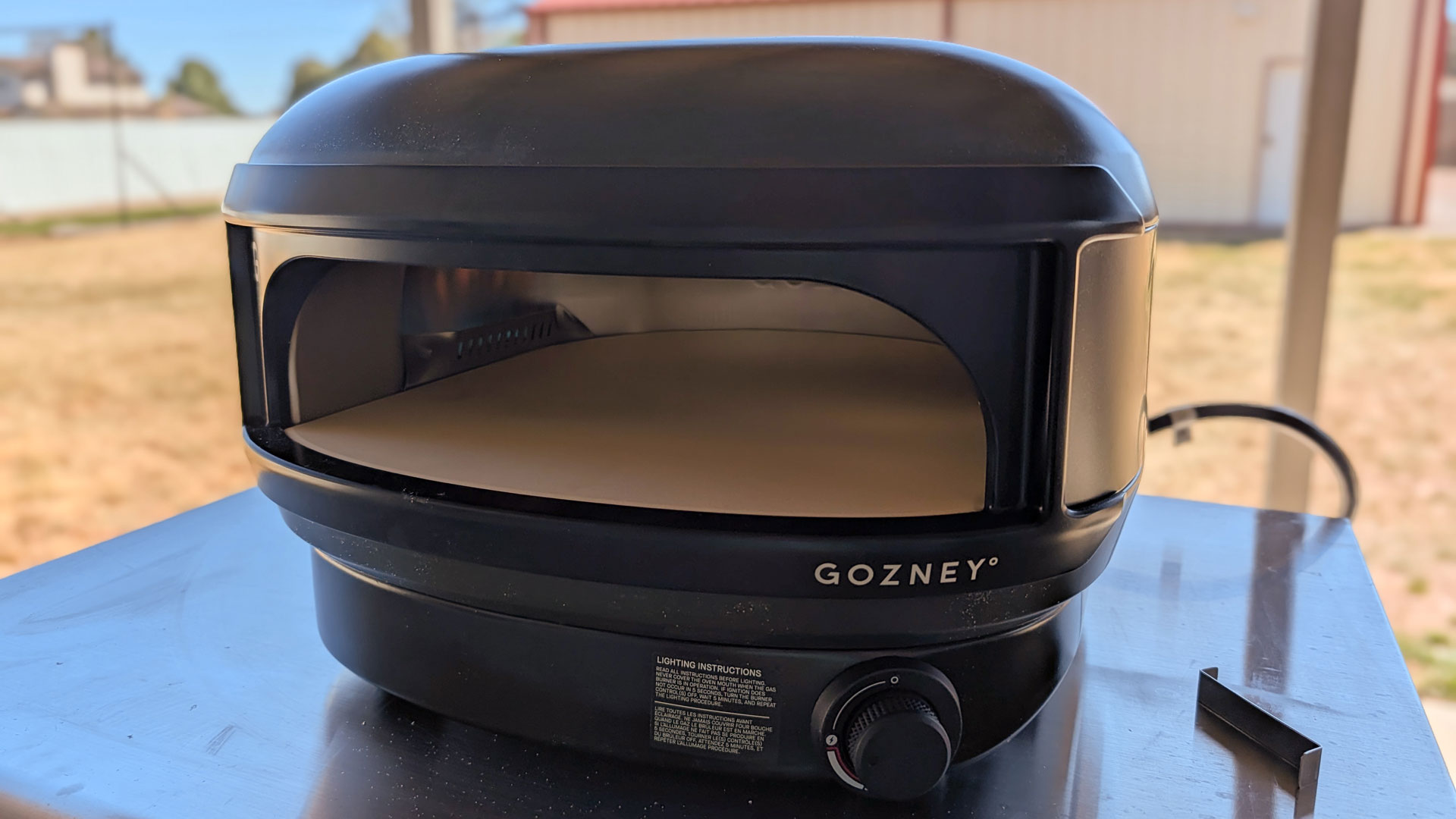
As with everything else worth doing in life, it takes practice to get to the point where you have the confidence and skill that nothing will go terribly wrong. But it also helps to have the right equipment, and after using Gozney’s latest pizza oven, the $399 Arc Lite, I can confidently say it’s the best pizza oven for beginners.
Over the last few weeks, I’ve used the Arc Lite to make over a dozen pizzas at home, and even baked a loaf of focaccia bread.
Sign up for breaking news, reviews, opinion, top tech deals, and more.
Advertisement
From unboxing to pizza in 30 minutes
(Image credit: Jason Cipriani)
The initial unboxing and setup experience for the Arc Lite is as straightforward as it gets. There’s no fancy electronics or gadgets you need to worry about. After removing everything from the box, you slide the 12mm thick cordierite stone into the Arc Lite, put the flame guard in its place, connect a propane tank, and you’re ready to go.
Oh, I almost forgot there’s a weirdly shaped piece of metal that you use to ensure the stone is pulled all the way to the front of the oven. But it’s not a stretch to say it takes all of five minutes to go from a pizza oven in a box to a pizza oven on a table, ready to light.
(Image credit: Jason Cipriani)
Ignition is handled by a single knob, which triggers the igniter as you rotate it. You’ll feel and hear a click as you turn the knob, followed by a gentle rolling flame that — as its name implies — arcs over the roof of the oven. You don’t have to fuss with batteries for electric igniters like higher-end ovens have. Just turn, and it’s lit.
There are blue and red markings next to the knob, which are crude indicators of a temperature range. Truly, the best way to monitor the oven’s temperature is to get an infrared thermometer.
Fully assembled, the oven weighs just over 26 pounds and measures 16.9 x 28.9 x 11.7 inches, with an internal size of 12.8 x 14 x 5.9 inches. Its overall size makes it extremely portable and easy to pack up to take to the park for a picnic, or to put into storage after you’re done cooking dinner (and it’s properly cooled down). It’ll handle pizzas up to 12 inches in size.
(Image credit: Jason Cipriani)
After assembly, all you have to do is turn it on and let it get to temperature, saturating the stone with heat at a full flame. It takes right at 20 minutes in my testing to go from cold to ready for pizza.
Giving yourself a 5-minute buffer, all told, you’ll be ready to start making pizza within 30 minutes of cracking open the Arc Lite’s box.
Advertisement
Bigger pizza ovens like the Gozney Dome S1 or Ooni Koda 2 Max take anywhere from 40 minutes to an hour to preheat.
Taking the Arc Lite for a spin
(Image credit: Jason Cipriani)
I didn’t have dough ready on the same day the Arc Lite arrived, so I had to wait a couple of days before I was able to put it through its paces.
On the day of, I lit the oven before I started getting all of the toppings out for pizza night. I checked the stone’s temp after 15 minutes, and it was hovering right around 750 degrees — I gave it another five minutes to get closer to 800 degrees (my personal sweet spot), and it was ready to go.
Advertisement
Image 1 of 4
(Image credit: Jason Cipriani)
(Image credit: Jason Cipriani)
(Image credit: Jason Cipriani)
(Image credit: Jason Cipriani)
I launched the first pie, spun it around 180 degrees at the 30-second mark, with another spin every 15 seconds or so after that until the bottom had just the right amount of char, the crust was brown, and the cheese was bubbling. All told, it took 1 minute and 48 seconds to bake.
In about 30 minutes, I made a total of 6 pizzas. As I went on, I had to give the stone more time to reheat between each pizza. The bottoms of a few of the pizzas weren’t nearly as charred as I’d like.
At 12mm thick, the stone won’t retain heat like the thicker stones used in ovens like Gozney’s Dome S1 (which is also why they take so long to preheat).
Even though I can see why some will view that as a shortcoming of the Arc Lite, I see no issue with it. As an oven designed for beginners, odds are you’re going to take several minutes to shape and top the next pizza, which gives the stone plenty of time to get back to temp. Whereas someone who is hosting a big party or using it in a commercial setting is sure to get frustrated by its lack of heat retention.
Advertisement
Here’s how I really know it’s for beginners
(Image credit: Jason Cipriani)
Near the end of that same night, I didn’t feel up to making the last pizza. I was hungry and just wanted to eat. My 14-year-old son noticed there was one last dough ball and asked if he could make it. I somewhat reluctantly let him after I accepted the fact that the worst outcome would be a burnt pizza.
I watched him stretch, top, and launch the pizza into the oven. He started turning it, with a touch of reassurance, and eventually pulled the pizza out. He over-baked the top just a bit, but overall it was a success.
I attribute this to the fact that he’d watched me do it many times before, but also to the fact that the Arc Lite isn’t a large, intimidating oven. Its small stature and limited heat output didn’t scare him away, as other ovens had in the past.
Advertisement
For someone who’s currently debating whether or not they’ll use a pizza oven at home enough to justify their high price tag, the $399 Arc Lite offers an entry-level experience that doesn’t skimp on the overall experience. I hope, one day, you get to feel the rush that comes with making the perfect pizza at home. But be warned — it’s addicting!
And of course, you can also follow TechRadar on YouTube and TikTok for news, reviews, unboxings in video form, and get regular updates from us on WhatsApp too.
Skio, a 2020 Y Combinator alum that was founded by self-described college dropout Kennan Frost, has been acquired by competitor Recharge, the companies announced on Thursday.
Both Skio and Recharge make products that handle subscription payments for brands.
While the official press release did not disclose the terms of the deal, Frost (who had previously left the company), posted on X, LinkedIn, and Instagram that his startup walked with $105 million cash and had only raised $8 million from investors. That’s a healthy return by any measure.
Frost had not been running the company for about two years, according to a LinkedIn post by Skio’s current CEO, Aidan Thibodeaux, who began as the startup’s first COO. When he took over, he described a grind that involved no spend on marketing, ads, or a sales team. Instead, they focused spending exclusively on building the product. He and the founding CTO, Andrew Chen, made every sales call themselves, he wrote.
Frost’s story is even more stirring. In his Instagram post, he wrote that he solo-founded the startup after having a panic attack that caused him to leave his job as an engineer at Pinterest. COVID shut the world down two weeks later.
Frost got into YC and says in another post that he “completely failed during the batch,” until he pivoted to this subscription idea. In three years, he got the company to $10 million in ARR and, he says, profitable. Then another “team came together and turned this early traction into a real company,” he credits.
Techcrunch event
Advertisement
San Francisco, CA | October 13-15, 2026
His YC advisor, Gustaf Alströmer, confirmed the terms of the sale on X. Alströmer described how the founder struggled during his time at the accelerator but never gave up.
Advertisement
Being a founder is hard. Being a solo founder is much harder. Kennan did YC in S20 with Skio. Applied with one idea, pivoted during the batch, then pivoted again. Never gave up. The last pivot worked. Today Skio sold for $105M in cash. There are very few straight lines to… https://t.co/oFm5nYF10F
Frost says at the time of the sale the company was at $32 million ARR and had processed $4 billion in payments. He is now working on another startup he founded, Icon, which offers a product called AdMaker for generating ads and tracking ad campaigns.
Frost, Recharge, and Wittenborn could not be immediately reached for comment.
When you purchase through links in our articles, we may earn a small commission. This doesn’t affect our editorial independence.
If you haven’t seen the 1972 movie The Poseidon Adventure (it’s a classic, starring Gene Hackman, Shelley Winters, and Leslie Nielsen, among others!), perhaps you’ve seen the 2006 remake simply dubbed Poseidon, with Richard Dreyfuss and Kurt Russell. These movies tell the story of a cruise ship named after the Greek god of the sea, Poseidon, that is struck by a massive rogue wave and capsizes, turning completely upside down. Like most disaster movies, the premise is a bit unbelievable, but rogue waves exist, and scientists are finally gaining an understanding of how and why they form.
The legend of rogue waves has existed for centuries. Sailors would report monstrous waves that seemingly appeared out of nowhere. Despite the persistent stories, rogue waves weren’t scientifically measured until 1995, when an 80-foot wave in the North Sea hit the Draupner oil platform, wreaking havoc but ultimately becoming the first rogue wave ever measured in the open ocean. Myth became reality, but scientists still didn’t understand how these waves formed.
Satellite data was first used to study rogue waves in 2001 using the European Space Agency’s ERS-2 satellite. Since then, there have been several studies internationally using satellites to better understand rogue waves and in late 2024, the Surface Water and Ocean Topography (SWOT) satellite captured waves measuring 65 feet to 115 feet. The data not only confirmed the existence of such massive waves but found that they can occur hundreds or even thousands of miles away from powerful storms. This data, along with other studies, has given scientists a better understanding of rogue waves than ever before.
Advertisement
Additional studies and the chances of a rogue wave
Nancy Pauwels/Shutterstock
Satellite data proved the existence of rogue waves, but we actually know much more. After the rogue wave hit the Draupner oil platform, Francesco Fedele, an associate professor at Georgia Tech’s School of Civil and Environmental Engineering, led an international team on an 18-year study of wave records in the North Sea. The team analyzed 27,500 wave records, and each record contained 30 minutes of wave activity, including how high the waves were, the frequency of waves, and their direction.
This research found that large waves typically occur in one of two ways: waves traveling at different speeds and different directions align and combine to form a much taller wave. This is called linear focusing. There’s also a second, natural process that stretches the shape of the wave to make it steep and tall but flattening the trough (the lowest point of the wave) which increases its height by up to 20%. Ultimately, Fedele hopes this research will help scientists predict when a rogue wave will happen.
Advertisement
The data has proven this old sailor’s myth, but you shouldn’t be worried about a rogue wave hitting your cruise ship — though it happens from time to time. In 1995, Cunard’s Queen Elizabeth 2 encountered an estimated 92-foot wave, but was able to steer into it, and no one was injured. Data has found they are much more common than previously thought, though the National Oceanic and Atmospheric Administration still calls them “uncommon.” Still, the likelihood that one would hit your cruise ship is low, and modern sailors know there are some parts of the ocean they should simply avoid.
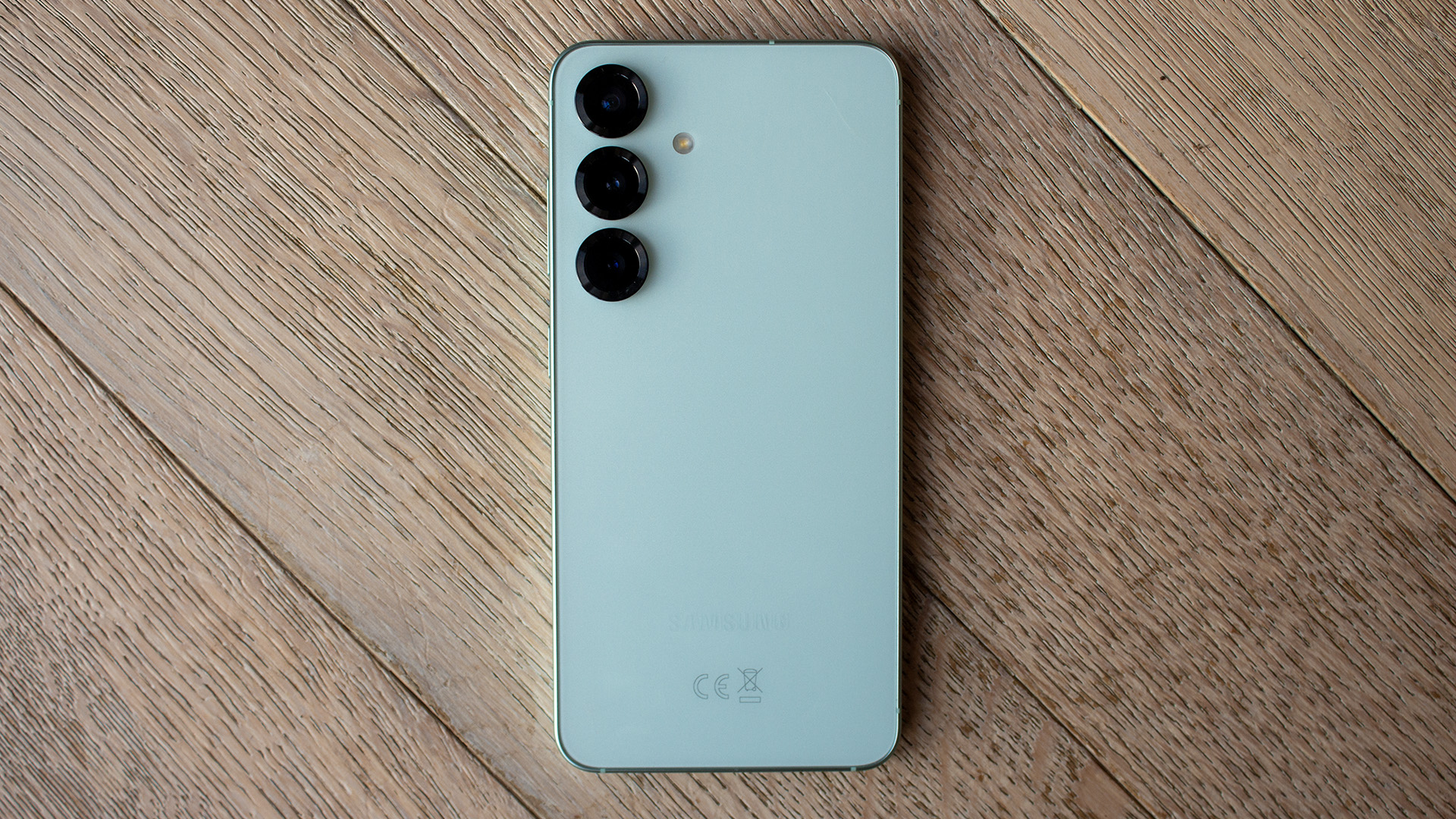
Samsung’s latest software update might be doing more harm than good for some Galaxy users.
Following the April 2026 security update, owners of the Galaxy S25 and Galaxy S24 are reporting serious battery drain and overheating issues. Complaints are quickly piling up across forums and Reddit.
The issue appears to have started shortly after the update began rolling out earlier this month. Since then, users say battery life has dropped off a cliff. In some cases, it has dropped dramatically. One Galaxy S25 owner claims their phone is dying in just a couple of hours, while another Galaxy S24 user says their device now lasts under three hours and takes significantly longer to recharge.
It’s not just isolated cases either. Threads across Samsung’s community forums, and echoed on Reddit, paint a consistent picture. Users have described their battery performance as “trash” over the past few weeks. One says they’re now regularly hitting 20% by the time they get home, something that “never used to happen.” Others have simply said: “So it’s not just me.”
Advertisement
Digging into battery stats, some users believe they’ve found the culprit: Knox Matrix. The built-in security system detects threats and protects connected devices. However, it appears to be running constantly in the background and putting heavy strain on the CPU. Screenshots shared online show it consuming an unusually high amount of power compared to other system processes.
Advertisement
That could explain both the battery drain and the overheating reports. Knox Matrix is deeply integrated into Samsung’s ecosystem, so users cannot simply remove or disable it like a regular app. This makes this a trickier issue to work around.
So far, Samsung hasn’t officially acknowledged the problem. However, moderators on the company’s forums are advising affected users to visit service centres so technicians can investigate further. It’s also worth noting that the issue does not appear to affect every device, suggesting this could be a bug affecting certain configurations rather than a universal issue.
Advertisement
For now, if your Galaxy S25 or S24 has suddenly started burning through battery after the latest update, you’re definitely not alone. Also, it might not be something you can fix on your own just yet.






























































You must be logged in to post a comment Login