
Join Mikko Hyppönen and security leaders from the NFL, CHANEL, and Atlassian for a two-hour digital summit on what AI-speed attacks change, what defenders should stop doing, and how to validate, decide, fix, and re-validate at machine speed.
Tech
Microsoft releases emergency Windows updates to fix RDS failures



Microsoft has released emergency out-of-band Windows updates to fix Remote Desktop Services failures caused by this month’s security updates, along with Hyper-V and USB audio problems on some Windows versions.
The September 2026 security updates caused Remote Desktop Services (RDS) to become unstable on affected systems, leading to RDP connection and sign-in failures and, in some cases, unresponsive servers.
Microsoft previously acknowledged the issue after Windows administrators reported widespread RDS problems following the September updates.
Affected systems could also experience problems with related components and tools, including Microsoft Management Console (MMC), RDS Licensing Diagnoser, File Explorer, and the Windows Update page, which could stop responding.
Microsoft has now released multiple out-of-band updates on September 14 to fix the bug, including:
The Windows Server updates address RDS failures introduced by September’s KB5122871 update on Windows Server 2025 and KB5122882 on Windows Server 2022.
The company had previously provided Group Policy mitigations for affected Windows and Windows Server systems while it worked on a permanent fix.
Administrators also reported that uninstalling the September security updates restored Remote Desktop functionality, but it also removed the security fixes included with those updates.
The Windows 11 26H1 update, KB5129194, is available through Windows Update, Windows Update for Business, the Microsoft Update Catalog, and Windows Server Update Services (WSUS).
For Windows Server 2022 and Windows Server 2025, the out-of-band updates are available through the Microsoft Update Catalog.
Microsoft also released KB5129195 for Windows 11 24H2 and 25H2 and KB5129236 for Windows 10 21H2 and 22H2 to address the RDS failures affecting those systems.
Hyper-V and multichannel audio fixes
The out-of-band Windows 11 updates also resolve a Hyper-V issue affecting applications that use Host Compute Service (HCS)-managed virtual machines.
Microsoft says some applications experienced problems when sharing Windows host folders with Linux virtual machines using Plan9, causing shared folders to either not appear inside the guest environment or become inaccessible.
The updates also fix an audio issue affecting some USB Audio Class 1.0 devices when used with multichannel audio, including 8-channel and 3D audio modes.
Microsoft says affected devices continued to work as expected in standard stereo mode but could fail when switching to these multichannel configurations.
However, the emergency updates do not resolve all of the USB audio problems introduced by the September updates.
“After installing the September 8, 2026, Windows security update, some USB Audio Class 1.0 devices might fail to start or produce audio,” Microsoft says in the release notes.
“Affected devices might experience one or more of the following symptoms: The device displays an error in Device Manager: “This device cannot start (Code 10).” No audio output. Volume controls are unresponsive or remain at zero. Sound settings are unresponsive or unavailable. This issue is limited to USB Audio Class 1.0 devices.”
The company says it is working on a fix for the remaining audio problems.


Continue Reading
Tech
A costly mistake? Report claims a third of employees fired due to AI will need to be rehired in the next few years

- Gartner predicts that around 33% of people laid off due to AI could be rehired by 2029
- Those rehired employees, presumably filling similar roles, will command higher salaries
- Further predictions point to 75% of organizations making cost savings from AI productivity being overtaken by competing companies with a stronger modernizing philosophy
People laid off from their roles due to a corporate refocusing on AI could soon find themselves rehired – or at least, their former roles being advertised, new Gartner research has claimed.
It predicts that by 2027, 75% of organizations who expected to make cost savings by focusing on AI productivity over human endeavor will be overtaken by companies who reinvested those savings in modernization and training.
Organizations which have made large cuts to their workforce in order to take advantage of perceived productivity boosts from automation could be forced to change to a new human-centric philosophy, where skills and abilities can be amplified while AI does the grunt work.
Latest Videos FromTechRadar
AI vs. management
Choices made by companies across all industries could be cause for regret in future, as the truth about how AI is used comes to light. Rather than being a disruptor of employment, the notion of intelligent automation may be considered as a missed opportunity by some organizations.
“When business and IT executives look back on the early AI era, they will realize their greatest mistake was believing that work automation was the point, when workforce amplification was the opportunity,” noted Tori Paulman, VP analyst at Gartner.
That mistake – which could not only have severe consequences for the business – could have had striking impacts on individuals, all due to a misunderstanding of what AI can deliver.
“The competitive advantage will go to the CIOs and business executives,” continues Paulman, “who build an AI-shaped organization where AI value compounds by reshaping roles and allowing workflows to cross traditional boundaries, increasing velocity and reducing friction.”
AI productivity… gains?
Gartner’s prediction appears to paint a bleak picture for any organization that has failed to amplify the talents and abilities of its employees after going all-in on AI. But there is still time to fix the damage. Its prediction of 2027 might only be a year away, but 2029 – when just short of 33% of employees are expected to need rehiring – is far enough down the line that there is time to start reorganizing now.
“Business and IT executives […] should develop a ‘talent remix’ strategy that uses AI to reshape roles and redirect workers from less productive work to new opportunities,” said Paulman.
The conclusion is that AI is better used to strengthen decision making, creativity, and leadership, rather than replacing people for misjudged producivity boosts.

Follow TechRadar on Google News and add us as a preferred source to get our expert news, reviews, and opinion in your feeds.


Social media plays a significant, multifaceted role in adolescents’ development, influencing how they communicate, learn, socialize, and express themselves.
The benefits, however, are accompanied by risks that can undermine youngsters’ character as well as their cognitive and social development.
The potential problems include excessive screen time, social media addiction, cyberbullying, misinformation, radicalization, privacy violations, exposure to inappropriate content, sextortion, and doomscrolling.
A recent study published in Nature: Human Behaviour found that adolescents who begin using social media at an early age tend to have significantly lower academic performance. A Mashable article highlights additional issues including effects on mental health, self-harm, addiction to social media, compulsive, repetitive checking, and exposure to pornography and violent material.
Protecting minors has largely fallen to parents, schools, and self-regulation by some social media providers.
But that approach has proven ineffective and inadequate, so some governments and policymakers have stepped in and placed responsibility on social media providers.
Australia’s nationwide ban
Australia was the first country to legislate a nationwide social media ban on children younger than 16—which I wrote about in January for Communications of the ACM.
Enacted in December, the ban initially applied to 10 platforms: Facebook, Instagram, Kick, Reddit, Snapchat, Threads, TikTok, Twitch, X, and YouTube. It excluded messaging, gaming, and nonsocial platforms including Discord, GitHub, Roblox, WhatsApp, YouTube Kids, and educational tools.
The law places the responsibility for enforcement on the platform providers through age-assurance mechanisms, requiring the platforms to take “reasonable steps” to prevent those 15 or younger from creating or holding accounts.
It does not, however, apply to content consumption. Children can view publicly available posts and videos without logging in; they cannot comment or post, according to the law.
The legislation mandates that the user’s age be verified with tools such as government-issued identification, biometric or facial age-estimation tools, behavioral or inference algorithms, and self-declaration with optional checks.
Penalties for noncompliance can reach US $35.6 million.
The 10 platforms subsequently removed nearly 5 million accounts of young users.
Although the ban received widespread support, human rights organizations and digital freedom advisory groups have argued that it limits young people’s freedom of expression and access to useful information. They say the ban might contribute to social isolation and the loss of support networks, particularly among marginalized youth.
Promising early outcomes
The Australian ban is producing positive outcomes, according to a recent Time magazine article, “What the World Should Learn From Australia’s Social Media Law.”
Early findings indicate it has reduced account ownership and social media use among young children. A YouGov survey of Australians found that 61 percent of parents of children age 16 and younger reported positive changes including more face-to-face interaction, greater presence and engagement, and improved parent-child relationships. Three in five Australians surveyed called the ban effective.
The ban has encouraged social media platforms to reconsider their features. Snapchat is moving toward a friends-only experience for 13- to 15-year-olds, for example.
The law is stimulating the development of purpose-built online spaces for children younger than 16 that can support their developmental needs, offering alternatives to mainstream social media.
The longer-term impact could be more significant if “no social media account before age 16” becomes an accepted norm, making it easier for parents and schools to support delayed social media use.
Implementation struggles
Despite the early encouraging outcomes, one study found that online platforms struggle to implement age checks. Many under-16 users in Australia have continued to access platforms with little difficulty, the study said. They children have found workarounds to subvert restrictions, such as using a free VPN to bypass age checks—some of which have questionable data-collection practices.
Seven in 10 children retained their existing accounts on restricted platforms, the study found. Other teens created new accounts using incorrect age information. Some were incentivized to seek unregulated offshore platforms not subject to Australia’s law.
The workarounds prompted Australia to double the maximum fine and warn of court action against tech giants for noncompliance.
Emphasis on age verification
A number of other countries are implementing or considering social media restrictions. They include Brazil, Canada, France, Greece, Indonesia, Norway, Poland, Thailand, Türkiye, and the United Kingdom. The European Union is contemplating its own restrictions.
The countries’ mandates for age verification or age assurance shift the policy focus from whether to verify age to how to do so effectively while protecting user privacy.
An article on think tank New America’s website, “Age Assurance and Verification,” describes some methods:
- Age gating and screening. Users self-attest their age by checking a box or inputting a birth date.
- Age estimation. Several techniques are available, including profiling the user’s online activity and scanning the user’s face.
- Age verification. One way is providing a government-issued identification document. Other approaches include digital identity systems, digital wallets, and third-party verification.
Reliable age verification is technically challenging and raises privacy concerns, as outlined in “The Age-Verification Trap,” written by Cinderpoint consultant Waydell D. Carvalho and published in February in IEEE Spectrum. Carvallo says platforms need to balance age verification with protecting users’ personal information.
IEEE’s contributions
IEEE is working on initiatives to provide a safer online environment for children. To help developers build age-appropriate social media platforms and websites, the IEEE Standards Association (IEEE SA) has published two guidelines.
The IEEE Standard for Online Age Verification (IEEE 2089.1-2024) provides a framework for designing, specifying, evaluating, and deploying verification systems. The standard includes requirements for privacy protection, data security, and information management specific to the age-assurance process. It also provides procedures for verifying a user’s age or age range with a high degree of accuracy.
Based on the 5Rights Foundation’s Principles for Children, the other standard (IEEE 2089-2021) provides practical steps to qualify online products and services for children. It requires systems to present information in an age-appropriate way and to uphold the rights established for youngsters in the U.N. Convention on the Rights of the Child.
IEEE SA also offers an online age-verification-certification program, which assesses systems for compliance with the IEEE 2089.1 standard. The program certifies that organizations implement robust processes before granting access to age-restricted products and services, prioritizing children’s safety, privacy, autonomy, and rights.
As outlined in The Institute article “IEEE Makes Strides to Improve Online Safety for Kids,” certification is based on six key indicators: accuracy, frequency of assurance, counter-fraud measures, authenticity, frequency of authenticity checks, and birth date confidence.
Indonesia used key provisions from the two IEEE guidelines to inform its child-protection regulation, which was signed into law last year.
IEEE’s ethically aligned design framework prioritizes human well-being, transparency, accountability, privacy, and protecting vulnerable populations including children.
Calls for platform reforms
Although social media bans would be globally significant policy responses, deeper structural issues remain largely unaddressed. Platform architecture and features contribute to social media harm.
The focus needs to shift from constraints on account provisioning and content moderation to safer platform design.
Meta in August agreed to pay $17.1 billion to settle a lawsuit brought by U.S. states. The suit said Meta designed its social media to be addictive to children, and the company concealed internal research showing Instagram’s addictive effects on teenagers. As part of the settlement, Meta agreed to implement child-safety measures such as setting daily time limits and disabling Facebook and Instagram push notifications during school hours.
The company still faces other lawsuits that could have far-reaching implications, pressuring other tech companies to design safer social media platforms.
Architecture-driven features such as infinite scrolling, algorithmic recommendations, addictive platform design, data-driven engagement, and personalized advertising to minors are other contributing factors to social media addiction.
IEEE Senior Member Katina Michael, professor at the University of Sydney business school and founding editor in chief of IEEE Transactions on Technology and Society, shared her perspective: “Social media bans may offer a short-term response to growing concerns, but they are not a long-term solution,” she says. “IEEE 2089.1-2024 advocates for socio-technical systems that are designed to promote human well-being, safety, and flourishing. Rather than relying on prohibition alone, we should focus on better design, building digital platforms that embed ethics, accountability, transparency, and human values from the outset.”
Collective responsibility
Protecting children online would require a combination of policy measures, improved platform design, digital literacy, parental involvement, and cultural change.
Building a safe, secure, and inclusive digital ecosystem that supports adolescents’ cognitive, social, and emotional development would require collaboration among technology companies, platform providers, content creators, parents, educators, policymakers, and young people themselves.
Professional organizations such as IEEE can continue contributing through standards development, education, certification while promoting trustworthy and responsible digital technologies.
From Your Site Articles
Related Articles Around the Web
Grand View Research puts the enterprise agentic AI market at $24.5 billion by 2030.
On the other hand, MarketsandMarkets estimates the AI agents’ market size at $52.62 billion over the same horizon.
Both start from a mid-single-digit-billion base and both land on a compound growth rate near 46%. When two credible forecasters agree that closely on the slope and differ by more than a factor of two on the destination, the interesting information is in what each of them is counting.
The Forecasts Agree on the Slope and Not on the Size
A forecast range is a decent proxy for how well a category has been defined, and agentic AI is currently defined differently by everyone measuring it.
Grand View Research tracks enterprise deployment specifically. The firm projects this enterprise deployment’s growth from $2.6 billion in 2024 to $24.5 billion by 2030 at a 46.2% compound rate. MarketsandMarkets draws a wider boundary around agent software generally that runs from $5.26 billion in 2024 to $52.62 billion in four years at 46.3%. Same six years, near-identical growth rate, two different universes.
Convergence on the rate is the stronger signal. Absolute market sizes are hostage to definitions, while growth rates tend to survive them.
Whether shared infrastructure genuinely removes rebuild cost is testable, and the test is uncomfortable for the category. If the claim holds, the share of agent budgets going into integration work should be falling. Most evidence on enterprise deployment points the other way.
Where the Spend Actually Lands
Follow agent budgets and they break into four layers: data, execution, identity and payments. Only one of them has a settled standard.
Gartner produces the largest figures in circulation on the demand side. It projects that machine customers will control roughly $30 trillion of purchases by 2030, with AI agents commanding $15 trillion in business-to-business purchases as soon as 2028. McKinsey’s narrower estimate, covering consumer commerce mediated by agents, lands between $3 trillion and $5 trillion by 2030.
The supply side looks less like new money than money changing hands. Gartner puts $234 billion of enterprise application software spend at risk from agentic AI, which describes displacement rather than creation.
Payments is where finance enters. Stripe and Tempo launched the Machine Payments Protocol in March 2026 with more than 100 integrated services, Mastercard shipped Agent Pay for Machines in June, and Coinbase contributed x402 to the Linux Foundation in April. Four standards, four sets of incumbents, no consolidation.
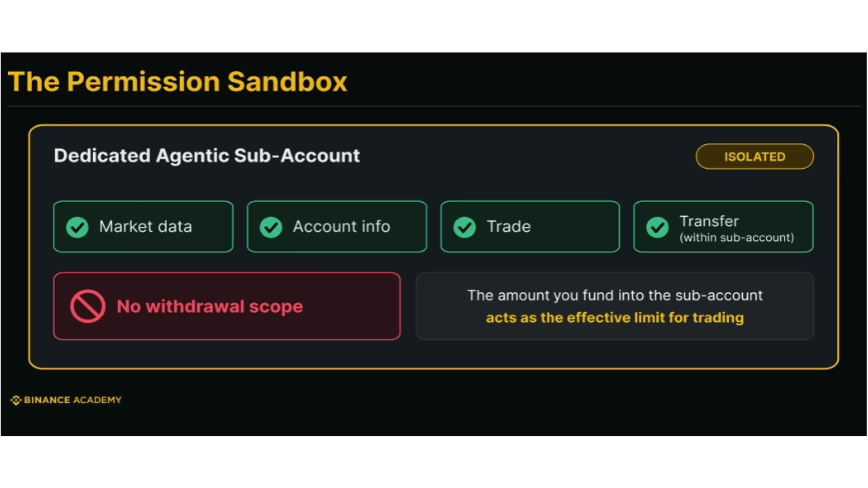
Market venues took the opposite route. Binance exposed market data and trading to compliant agents through an MCP endpoint on August 20, 2026 rather than building a proprietary connector, a bet that the connection layer is now commodity infrastructure and the competition happens elsewhere.
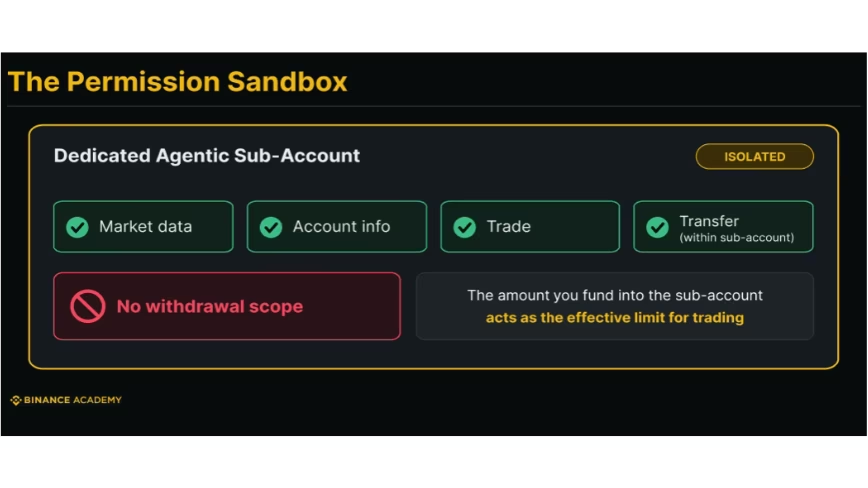
“AI agents are becoming another way people interact with financial markets, but they need the same reliable data, infrastructure and controls that users and developers expect today,” says Jeff Li, VP of Product at Binance. “That makes it easier to create AI-driven financial applications without having to recreate the underlying infrastructure each time.”
Whether shared infrastructure genuinely removes rebuild cost is testable, and the test is uncomfortable for the category. If the claim holds, the share of agent budgets going into integration work should be falling. Most evidence on enterprise deployment points the other way.
The Adoption Curve Measures Intent, Not Deployment
The protocol numbers are the most current data the category has and they are easy to misread.
Anthropic counted more than 10,000 active public MCP servers in December 2025 and roughly 97 million monthly software development kit downloads by March 2026 against about 100,000 in the month of launch. A May census found 15,926 repositories carrying the mcp-server topic on GitHub. In contrast, 9,652 latest-version records sat in the official registry.
Then the correction. Stacklok’s 2026 survey of senior technical leaders found 29% of software organizations running MCP in limited production and 12% in broad production, so roughly 41% in production of any kind, with security ranked as the leading barrier ahead of cost and legacy integration complexity.
That security concern is documented rather than speculative. Only 8.5% of MCP servers implement the OAuth 2.1 standard the specification makes mandatory for remote deployments, and 53% expose credentials through hard-coded configuration values.
Downloads and repository counts measure how many engineers tried something. Production deployments measure how many finished, and the distance between those two numbers is the category’s actual maturity. A widely circulated claim of 78% enterprise production adoption was later withdrawn by the team that published estimates in that range.
The Same Analysts Are Forecasting the Failures
The firms producing the growth curves are also producing the attrition numbers, which is the most useful thing about them.
Gartner predicts that more than 40% of agentic AI projects will be canceled by the end of 2027 on escalating costs, unclear business value or inadequate risk controls. It also estimates that of the thousands of vendors describing themselves as agentic, only around 130 are real, with the rest rebranding assistants, robotic process automation and chatbots.
The payments layer carries a matching caution. Chainalysis recorded more than 100 million cumulative x402 transactions on Base across three quarters as of the first quarter of 2026, while noting that much of that growth came from memecoin farming and that mass adoption remains distant. CoinDesk reported in March 2026, citing Artemis, that daily volume on the protocol was running near $28,000 across roughly 131,000 transactions, an average payment of about $0.20, and that roughly half of observed transactions appeared to be self-dealing or wash trading.
Both readings can be true at once. A standard can be settled, well engineered and adopted by the largest platforms in software, and still be waiting for the demand that justifies the build.
The Number Worth Watching
The forecasts describe a destination and the field data describes a starting line, and the two sit further apart than the headline figures suggest.
What settles the argument is not download growth or registry entries. It is the share of deployments that survive their first budget review, and that number will not be published for another year.

Nearly 1900 Blizzard Entertainment workers “voted to ratify their first union contract with parent company Microsoft after over two years of bargaining,” reports Kotaku, “consolidating Blizzard’s many smaller unions into three larger bargaining units.”
The workers now gain new protections “on issues such as generative AI, crediting, remote work, and layoffs.”
[The contract] acknowledges that AI tools “may be useful in the game development process to support human judgment and creativity and that AI-assisted workflows remain subject to appropriate human control and review for accuracy and quality.” But it also stipulates that any implementation of AI technology that would materially impact work performed by union employees must have its impacts bargained over before it can be implemented.
Other sections cover issues such as crediting (guaranteeing that current and former employees are credited by name in all games they work on) and remote work (designating certain roles as hybrid in-office and providing procedures for individuals to apply for their roles to be fully remote). It also contains a lengthy section on how layoffs may be conducted, including a required 60-day notice period (or pay in lieu of notice), a guarantee of one week of severance for every six months of employment, and 14 months of recall rights. The contract also guarantees successorship, meaning if Blizzard is ever acquired by another company, the contract would remain intact.
“Workers also contractually locked in their current hybrid work schedule,” reports the gaming news site Aftermath, “meaning that Blizzard can’t suddenly change it, as has been a labor-unfriendly trend in the games industry over the past couple years.”
Fully remote workers scored a big win as well. “I’m remote, and we grandfathered everyone who is remote to stay remote, so we can’t be magically called to an office that we’ve never worked at before,” [said Diablo senior environment artist Mahreen Fatima].
And “The contract also elevated pay floor,” reports the Yakima Herald-Republic. “Across the board, workers secured a 1.25% pay increase, but some workers who were paid below $50,000 per year will walk away with pay increases that are as much as 34%.”


Read more of this story at Slashdot.
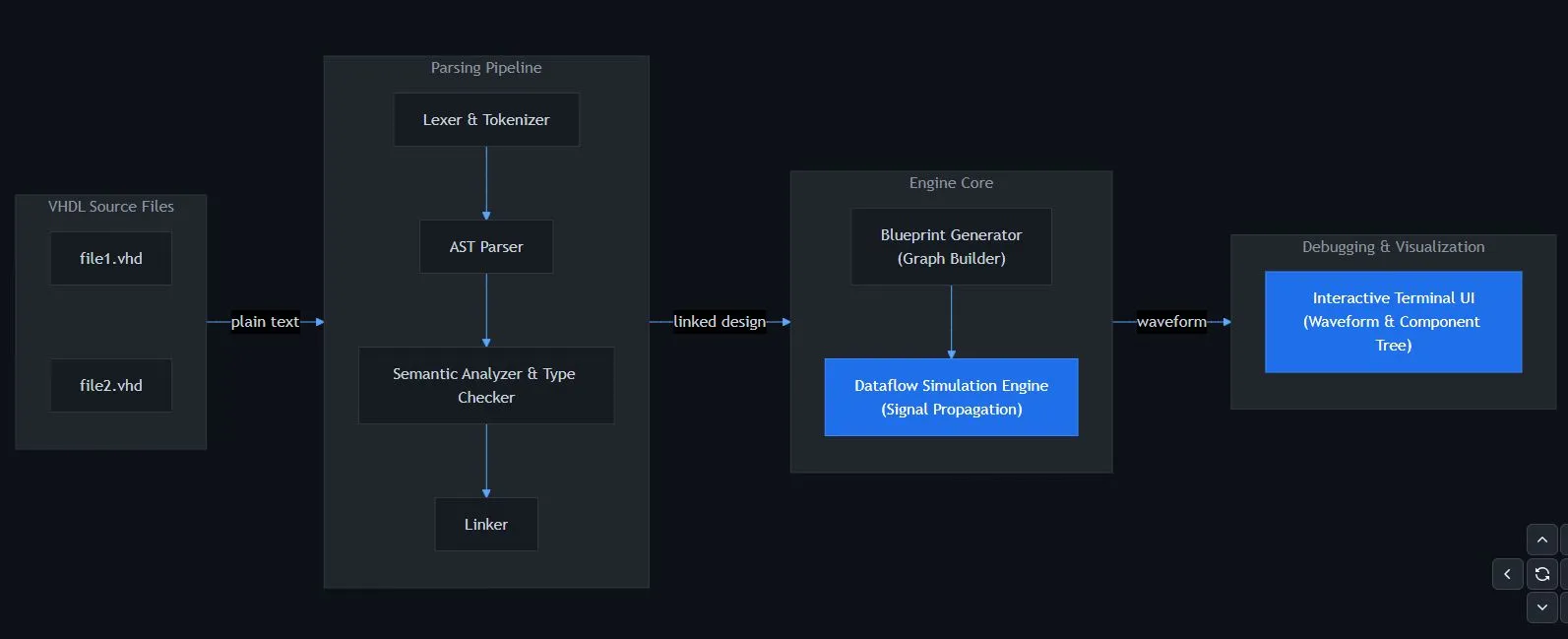
With VHDL being arguably more deterministic and bullet-proof than Verilog, it’s good to see another open source VHDL simulator joining the fray that is not a variation of ghdl. Written by [Óscar Grimal] in C++ with an MIT license, the Pulse project is a still in progress package that provides the entire toolchain, from the compiler to the requisite waveform output.
This waveform output is provided in the form of a text-based user interface (TUI), which at the very least helps a lot with making it cross-platform compatible. As dependencies only a C++20 capable compiler and CMake are indicated.
Of course, with VHDL being a rather hefty language especially once you start piling up the associated standard library, the currently supported language and library features are somewhat limited still so that you’re limited to basic IEEE packages and types, with default values are not supported yet.
Per the roadmap on the GitHub project’s Readme more VHDL language features including generics and additional types will be added, along with an enhanced simulation engine. It’s also said that mixed-language support with Verilog will be added, though SystemVerilog looks to be getting the short end of the stick as usual.
It will definitely be interesting to compare this package to ghdl.
Tech
No Rolling Power Outages for California Since 2020 – Thanks to 17,000 MW of New Battery Storage
“Californians just made it through the hottest August on record without having to endure any rolling power outages,” reports the Los Angeles Times. In fact, the state hasn’t implemented rotating power outages since 2020.
Because “Over the last few years, California has quietly but dramatically increased the resiliency of its electrical grid through a significant expansion in battery energy storage.”
These batteries hold onto solar energy captured during the day, so it can be sent to the grid as demand peaks in the evening and morning, when most people are at home running air conditioners and other appliances.
During the August heat wave of 2020, the California Independent System Operator, which manages the flow of electricity for most of the state, declared a Stage 3 Emergency and hundreds of thousands of households lost power in rolling outages. At the time, the system had less than 100 megawatts of battery storage available, according to system spokesperson Jayme Ackemann. Today, it has more than 17,000 megawatts available….
According to Ackemann, the system seeks to add 20,000 to 25,000 megawatts of battery storage capacity by 2045 — the same year it has set a goal of achieving carbon neutrality. That means the state would remove as many carbon emissions from the atmosphere as it emits.
In recent years, California has steadily grown the share of electrical power generated by renewable sources — such as solar, wind, geothermal and hydropower — which bolstered the resiliency of the grid by increasing the overall amount of energy available. An uptick in people installing rooftop solar panels has provided an additional power boost, Ackemann said. In May, California became the first known large-scale power system in the world to have relied on more than 50% solar power for an entire month…. California’s grid is also now integrated with electrical systems across much of the Western United States. This means that if there is an extreme heat event in Southern California, energy from a cooler area such as the Pacific Northwest can be imported to help meet regional demand. All of this has collectively helped the state’s electrical system weather this year’s long-lasting heat.
“Southern California continued to break temperature records this week when Long Beach and Anaheim reached a blistering 107 degrees and Escondido hit 112 degrees…”
Read more of this story at Slashdot.
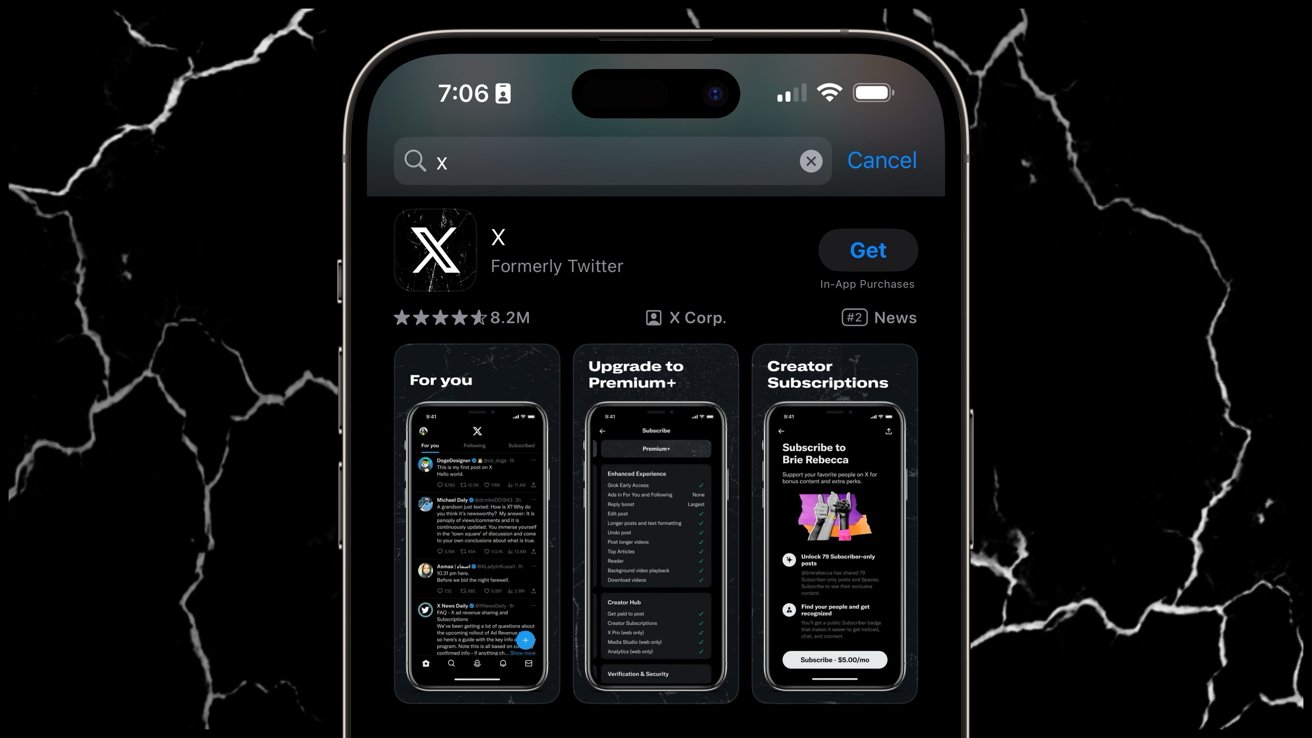
Elon Musk has moved to dismiss its lawsuit against Apple regarding the App Store given preferential treatment to OpenAI over xAI’s apps. There are unanswered questions.
The court filing on Monday, September 14 is pretty sparse, other than the request to dismiss. It’s not yet clear if there’s some kind of settlement, or if Musk has decided his case is baseless.
OpenAI was named in the suit as well. Notably, it’s just Apple that Musk is asking the court to remove from the case, and OpenAI will need to fight two major legal battles with industry titans at the same time.
Apple and OpenAI were sued by Elon Musk’s xAI, now owned by SpaceX, due to alleged anticompetitive practices. The trial hasn’t been going well for Musk so far, as it was accused of destroying and withholding evidence previously.
The suit alleging preferential treatment has been sketchy from the beginning. As Musk’s own Grok noted when asked by a social media user, other companies other than OpenAI have been on the top of the App Store.
DeepSeek was in the App Store top spot in January 2025. Perplexity followed on July 18, 2025. Both happened after the June 2024 OpenAI and Apple partnership.
Further complicating the suit, app data aggregator SensorTower has also noted that Grok was on the peak App Store spot on February 18, 2025 and February 19, 2025 after Grok-3 was made free.
The case has been moving at a snail’s pace since it was brought on August 2025. In May 2026, SVP of Software Engineering Craig Federighi was brought in as a document custodian.
Current Apple CEO Tim Cook was also requested as a custodian, but that was denied.
And, more recently, a judge has ruled that Elon Musk’s emails must be entered into the record. It’s still not clear what has triggered Musk’s request.
We have reached out to Apple and X corp for more details. We are not expecting a response from either, but a return call from Apple is more likely.

Gemini Intelligence is at the heart of the operating system.

We’ll soon learn a lot more about Googlebooks — a new line of higher-end laptops from Google — as pre-orders are about to open. As noted by 9to5Google, the company told folks who signed up for updates on the devices that they (and you) can lock in an order starting on September 21 at 9AM ET. The same date appears on the Googlebook website.
Since Google announced its latest laptop brand back in May, the company hasn’t said too much officially about what to expect from them. They’ll run on a version of ChromeOS that’s based on Android. Models from Acer, ASUS, Dell, HP and Lenovo (all of which have made Chromebooks) are on the way. Of course, Gemini Intelligence is at the heart of these laptops.
One of the AI-powered features Googlebooks have is called the Magic Pointer. Wiggling the cursor turns it into the Magic Pointer, which makes it sound a bit like a Power Ranger or something. When you aim this at something on your screen, your Googlebook will offer contextual suggestions on actions you can take.
In addition, you’ll be able to generate custom widgets. Googlebooks (which feature a “glowbar” on the lid) will have deep integration with Android phones as well.

Apple has announced the AirPods 5 – that, you obviously know – and they’re coming with Active Noise Cancellation as standard.
Now, while I’d say there’s still some debate to be had over the designation of ANC in an open-ear design, this type of feature in an open-ear design has gone from a rarity to becoming more widespread.
And with the cheapest version of the AirPods 5 at £119 / $129, that’s made ANC open-ear a fairly affordable proposition for iOS owners. And given the AirPods sell like hotcakes, it’ll likely give Apple even more dominance in the headphone market. Impressive, considering they’re a device brand first and less a ‘traditional’ headphone brand.
But I’m beginning to monologue. The inclusion of ANC in an AirPods model at such an affordable price is a good thing, and I reckon it’s all to do with your hearing health.
SQUIRREL_PLAYLIST_10208756
Is it actually ANC?

I think it’s odd that Apple has designated this feature as Active Noise Cancellation (ANC). While I risk making myself look like a fool against the mighty Apple, the way ANC works is by using a feedforward mic – an external microphone that detects noise before it reaches your ear, and a feedback mic – one that sits close, if not in your ear, that analyses the noise in that region.
The open-design, where it nestles in your earlobe rather than in your ear proper, doesn’t seem close enough for that ANC system to work. Noise Reduction seems like a better way to describe it, but it’s certainly not as attractive to people who think it will cancel noise completely.
Apple says it’ll cancel up to 50% more noise than the AirPods 4 with ANC did, which sounds impressive; and Apple says the Transparency mode will sound more natural, but that’s a laughable claim to me. If you want to hear what’s around you, just turn the ANC off. A Transparency mode seems a needless feature for a headphone that’s primarily designed to let you hear what’s around you.
That’s my scepticism detailed for you, but truly, I think the inclusion of (cough) Noise Reduction is a good thing. It’s featured on several products before, and I alluded to it towards the end of 2025 when I wrote about the continuing progress of open-earbuds.
Shokz is the name most widely associated with the open-ear design, and its OpenFit Pro added Noise Reduction earlier this year, but I think even they have been caught off guard – gazumped, you might say – by Apple pricing the AirPods 5 so low; a low price will bring this technology to more people.
Noise Reduction takes open-ears to another level

Whenever I test open-ear designs, my ears take a battering in noisy environments. I’ve recently tested a new pair in terms of call quality, and while the person on the other end heard me fine, I could not hear a thing they were saying when I was walking on a street or in a restaurant waiting for an order. All I could hear was a cacophony of sound.
And that isn’t good for your ears. We’re always subjected to loud noises wherever we go, and life at times can seem louder than ever, but wearing headphones can shield you from that noise, and open-ear designs have never been particularly good at that.
With noise reduction, you can take the edge off the noise. On a plane, on the Underground (or subway), in a loud indoor environment (pubs make my ears want to explode), headphones can subdue and save your ears from being pelted by the racket around you. I wear headphones on public transport and whenever I fly – I feel like my ears are better for it.
Apple makes no mention of hearing health in its press release, which surprises me a little given they’re so focused on health in other areas, but regardless, the addition of noise reduction at this price means more people will be able to get this type of experience – and it could help your hearing health in the long term.
It’ll suggest changes and all you need to do is approve them.
If you do a lot of work online, there’s a good chance your Google Drive has accumulated way too many documents, photos and other files. Unfortunately, Google has typically made organizing your digital life through Drive difficult, with a web client that doesn’t have a particularly useful search function to find and move things around. With this in mind, Google recently introduced a tool to help people get their digital lives in order. And before you ask: yes, it uses AI.
Last fall, Google began testing a feature called Organize My Files in Drive, and began rolling it out to Workspace users in June. Like a lot of the features the company has introduced recently, it relies on Gemini. In this case, “Gemini can help you organize your Drive by providing suggestions of where to move loose files based on your organizing structure and strategies,” says Google.
How to get Gemini set up
Before you can task Gemini with cleaning up your Google Drive, there are a few requirements worth noting. First, you’ll need a Google AI Pro or AI Ultra subscription. The feature isn’t available to free accounts, which means it will not appear in Google Drive’s interface if you aren’t already a paid user.
If Google Drive is your primary cloud storage, this requirement is not the worst thing to spend your money on since the AI Pro subscription, priced at $20 per month, comes with 5TB of additional space and a YouTube Premium Lite subscription (amongst other things).
Organize My Files in Drive is also available to Business, Enterprise and Education customers, but keep in mind you won’t be able to use your workplace account to organize your personal files. Additionally, you can’t use Gemini to organize files and folders you share with your colleagues. The feature only works with private folders.
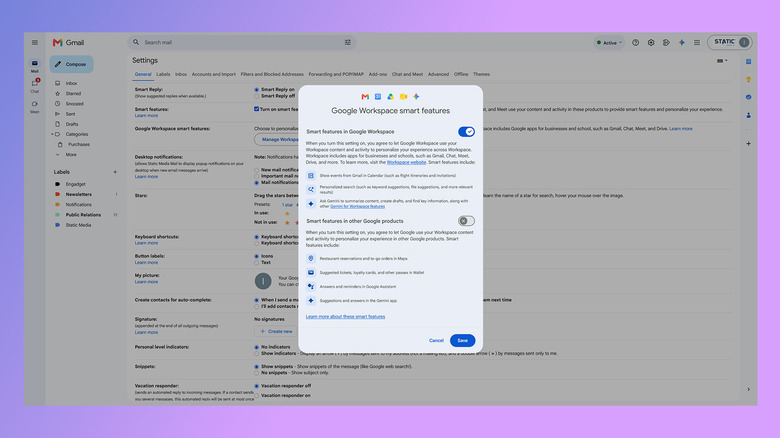
Next, you need to enable Smart features in Google Workspace. This setting is enabled by default in most markets where Google offers Workspace. If you’re unsure if smart features are active on your account, here’s how to check:
- In Gmail, tap the cog icon.
- Select See all settings.
- Under the General tab, scroll down and click Manage Workspace smart feature settings.
- If turned off, enable smart features in Google Workspace.
How to use Gemini to organize your files
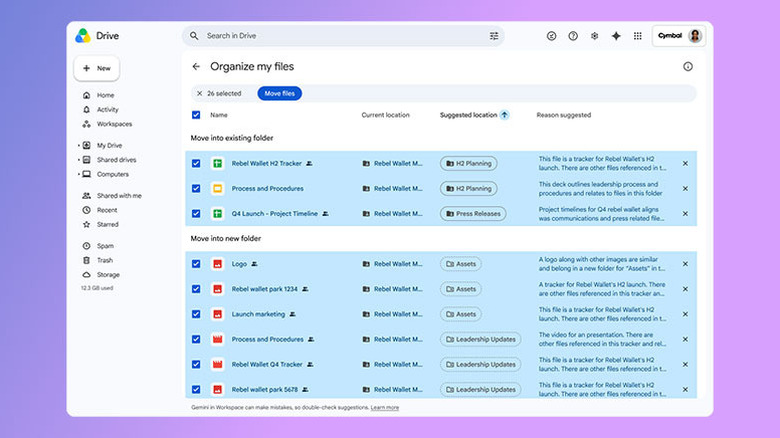
Once you’ve met the above requirements, using Gemini to organize your files is straightforward.
- Open Google Drive on the web and select My Drive.
- Click Suggest file moves toward the top of the interface.
- Review Gemini’s suggestions, which you’ll see in a new window.
- Approve any changes you want Gemini to carry out by using the checkboxes next to each action.
While reorganizing your Google Drive, Gemini may recommend you create new folders to store your files. You can preview every file or document it suggests moving through the cards that appear when you hover your mouse over them. One thing Gemini won’t do for you is rename your files. For that reason, how much utility you get out of the tool will vary.
Gemini doesn’t appear to read the contents of your documents to generate its suggestions. So you’ll get the most out of its organizational efforts if all your files are already named and follow some sort of naming convention and hierarchy. If you have a lot of untitled documents, Gemini may not be able to help you.
If you need to go through all your files to name them, you might as well organize them into folders while you’re at it. You’ll then be able to use Gemini in the future to sort any files you forget to properly file after creating them.

Entertainment1 minute ago
Sukihana Reveals She’s “Single” Following Split From BF Snoop

NewsBeat4 minutes ago
Macklemore dropped from Ed Sheeran tour after ‘free Palestine’ speech

Business5 minutes ago
BofA turns bullish on Nifty after 2 years, cautious on small, midcaps. Here’s what it expects now
![Savage Plug X Didine Canon 16 - MONEY CASH (Official Music Video) [Prod. Blackrock Chonique]](https://wordupnews.com/wp-content/uploads/2026/08/1788053076_maxresdefault-80x80.jpg)


-
 Tech6 days ago
Memory prices are slowing because buyers ran out of money
-

 Tech1 day ago
The Latest Weird Thing to Play Doom Is the Mapped-Out Brain of a Fruit Fly
-

 Business5 days ago
Micron Stock Climbs Above $1,031 as AI Memory Crunch and a $50 Billion Outlook Fuel the Rally
-

 Business5 days ago
AMD Stock Climbs After Management Lifts 2027 Data Center Outlook Toward $70 Billion in AI Sales
-

 Fashion3 days ago
Weekend Open Thread – Corporette.com
-

 Crypto World6 days ago
Bitcoin price risks $76K drop as $78K support weakens
-

 Crypto World6 days ago
Robinhood Stock: How To Take Advantage With Reduced Risk
-

 Crypto World3 days ago
XAG/USD: Silver’s Short-Term Rally Meets Its Moment of Truth
-

 Crypto World4 days ago
2 Chip Stocks Broke Out This Week. Neither Was Nvidia
-

 Crypto World6 days ago
Ethereum price stalls below $2,500 as ADX drops to 11
-

 Business4 days ago
10 Most-Streamed Songs On Spotify In 2026 So Far, Led By Ella Langley’s Dominant Run On The Charts This Year
-

 NewsBeat6 days ago
England up in reading, maths and science rankings as Scotland and Wales dip
-

 Tech4 days ago
Battery life is the only iPhone 18 Pro and iPhone Duo upgrade I care about. Apple didn’t disappoint
-

 Crypto World4 days ago
OKX launches 10x OpenAI, Anthropic X-Perps in Europe
-

 Crypto World3 days ago
Diesel Tops $6 a Gallon for the First Time as 28 States Set Records
-

 Crypto World6 days ago
Intel Stock Jumps 9% on Chip Price Hike Report, US Stake Gains $36 Billion
-

 Crypto World5 days ago
Bitcoin price risks $70K if $78K neckline breaks
-

 News Videos3 days ago
Facing Financial Fears
-

 NewsBeat6 days ago
What went right this week: an ‘historic’ fall in violent crime, plus more
-

 Tech5 days ago
Apple Watch Ultra 4 vs Watch Ultra 3: Should you really spend another $799?
You must be logged in to post a comment Login