In a viral essay on X, “Something Big Is Happening,” Matt Shumer writes that the world is living through a moment similar to early Covid for artificial intelligence. The founder and CEO of OthersideAI argues that AI has crossed from useful assistant to general cognitive substitute. What’s more, AI is now helping build better versions of itself. Systems rivaling most human expertise could arrive soon.
Tech
MiniMax’s new open M2.5 and M2.5 Lightning near state-of-the-art while costing 1/20th of Claude Opus 4.6
Chinese AI startup MiniMax, headquartered in Shanghai, has sent shockwaves through the AI industry today with the release of its new M2.5 language model in two variants, which promise to make high-end artificial intelligence so cheap you might stop worrying about the bill entirely.
It’s also said to be “open source,” though the weights (settings) and code haven’t been posted yet, nor has the exact license type or terms. But that’s almost beside the point given how cheap MiniMax is serving it through its API and those of partners.
For the last few years, using the world’s most powerful AI was like hiring an expensive consultant—it was brilliant, but you watched the clock (and the token count) constantly. M2.5 changes that math, dropping the cost of the frontier by as much as 95%.
By delivering performance that rivals the top-tier models from Google and Anthropic at a fraction of the cost, particularly in agentic tool use for enterprise tasks, including creating Microsoft Word, Excel and PowerPoint files, MiniMax is betting that the future isn’t just about how smart a model is, but how often you can afford to use it.
Indeed, to this end, MiniMax says it worked “with senior professionals in fields such as finance, law, and social sciences” to ensure the model could perform real work up to their specifications and standards.
This release matters because it signals a shift from AI as a “chatbot” to AI as a “worker”. When intelligence becomes “too cheap to meter,” developers stop building simple Q&A tools and start building “agents”—software that can spend hours autonomously coding, researching, and organizing complex projects without breaking the bank.
In fact, MiniMax has already deployed this model into its own operations. Currently, 30% of all tasks at MiniMax HQ are completed by M2.5, and a staggering 80% of their newly committed code is generated by M2.5!
As the MiniMax team writes in their release blog post, “we believe that M2.5 provides virtually limitless possibilities for the development and operation of agents in the economy.”
Technology: sparse power and the CISPO breakthrough
The secret to M2.5’s efficiency lies in its Mixture of Experts (MoE) architecture. Rather than running all of its 230 billion parameters for every single word it generates, the model only “activates” 10 billion. This allows it to maintain the reasoning depth of a massive model while moving with the agility of a much smaller one.
To train this complex system, MiniMax developed a proprietary Reinforcement Learning (RL) framework called Forge. MiniMax engineer Olive Song stated on the ThursdAI podcast on YouTube that this technique was instrumental to scaling the performance even while using the relatively small number of parameters, and that the model was trained over a period of two months.
Forge is designed to help the model learn from “real-world environments” — essentially letting the AI practice coding and using tools in thousands of simulated workspaces.
“What we realized is that there’s a lot of potential with a small model like this if we train reinforcement learning on it with a large amount of environments and agents,” Song said. “But it’s not a very easy thing to do,” adding that was what they spent “a lot of time” on.
To keep the model stable during this intense training, they used a mathematical approach called CISPO (Clipping Importance Sampling Policy Optimization) and shared the formula on their blog.
This formula ensures the model doesn’t over-correct during training, allowing it to develop what MiniMax calls an “Architect Mindset”. Instead of jumping straight into writing code, M2.5 has learned to proactively plan the structure, features, and interface of a project first.
State-of-the-art (and near) benchmarks
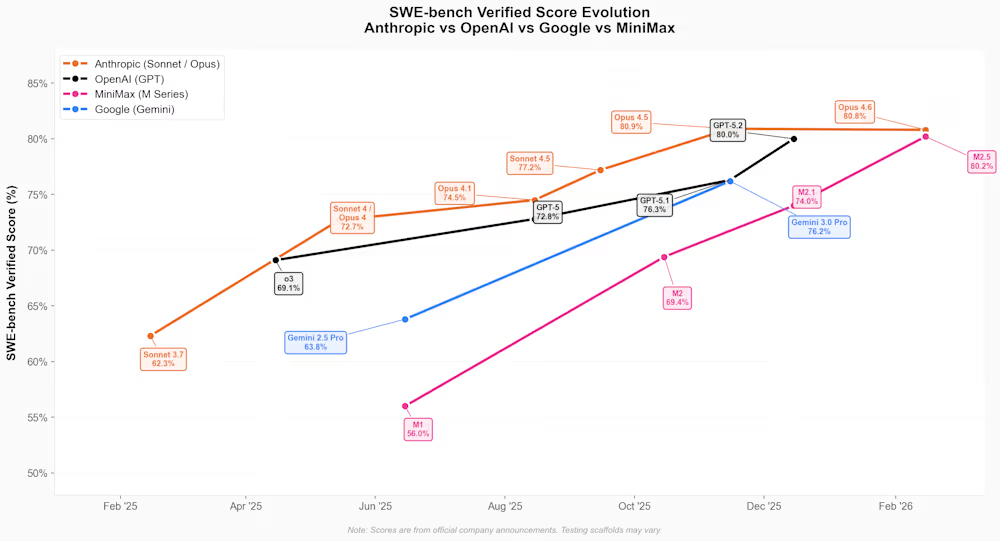
The results of this architecture are reflected in the latest industry leaderboards. M2.5 hasn’t just improved; it has vaulted into the top tier of coding models, approaching Anthropic’s latest model, Claude Opus 4.6, released just a week ago, and showing that Chinese companies are now just days away from catching up to far better resourced (in terms of GPUs) U.S. labs.
Here are some of the new MiniMax M2.5 benchmark highlights:
-
SWE-Bench Verified: 80.2% — Matches Claude Opus 4.6 speeds
-
BrowseComp: 76.3% — Industry-leading search & tool use.
-
Multi-SWE-Bench: 51.3% — SOTA in multi-language coding
-
BFCL (Tool Calling): 76.8% — High-precision agentic workflows.
On the ThursdAI podcast, host Alex Volkov pointed out that MiniMax M2.5 operates extremely quickly and therefore uses less tokens to complete tasks, on the order $0.15 per task compared to $3.00 for Claude Opus 4.6.
Breaking the cost barrier
MiniMax is offering two versions of the model through its API, both focused on high-volume production use:
-
M2.5-Lightning: Optimized for speed, delivering 100 tokens per second. It costs $0.30 per 1M input tokens and $2.40 per 1M output tokens.
-
Standard M2.5: Optimized for cost, running at 50 tokens per second. It costs half as much as the Lightning version ($0.15 per 1M input tokens / $1.20 per 1M output tokens).
In plain language: MiniMax claims you can run four “agents” (AI workers) continuously for an entire year for roughly $10,000.
For enterprise users, this pricing is roughly 1/10th to 1/20th the cost of competing proprietary models like GPT-5 or Claude 4.6 Opus.
|
Model |
Input |
Output |
Total Cost |
Source |
|
Qwen 3 Turbo |
$0.05 |
$0.20 |
$0.25 |
|
|
deepseek-chat (V3.2-Exp) |
$0.28 |
$0.42 |
$0.70 |
|
|
deepseek-reasoner (V3.2-Exp) |
$0.28 |
$0.42 |
$0.70 |
|
|
Grok 4.1 Fast (reasoning) |
$0.20 |
$0.50 |
$0.70 |
|
|
Grok 4.1 Fast (non-reasoning) |
$0.20 |
$0.50 |
$0.70 |
|
|
MiniMax M2.5 |
$0.15 |
$1.20 |
$1.35 |
|
|
MiniMax M2.5-Lightning |
$0.30 |
$2.40 |
$2.70 |
|
|
Gemini 3 Flash Preview |
$0.50 |
$3.00 |
$3.50 |
|
|
Kimi-k2.5 |
$0.60 |
$3.00 |
$3.60 |
|
|
GLM-5 |
$1.00 |
$3.20 |
$4.20 |
|
|
ERNIE 5.0 |
$0.85 |
$3.40 |
$4.25 |
|
|
Claude Haiku 4.5 |
$1.00 |
$5.00 |
$6.00 |
|
|
Qwen3-Max (2026-01-23) |
$1.20 |
$6.00 |
$7.20 |
|
|
Gemini 3 Pro (≤200K) |
$2.00 |
$12.00 |
$14.00 |
|
|
GPT-5.2 |
$1.75 |
$14.00 |
$15.75 |
|
|
Claude Sonnet 4.5 |
$3.00 |
$15.00 |
$18.00 |
|
|
Gemini 3 Pro (>200K) |
$4.00 |
$18.00 |
$22.00 |
|
|
Claude Opus 4.6 |
$5.00 |
$25.00 |
$30.00 |
|
|
GPT-5.2 Pro |
$21.00 |
$168.00 |
$189.00 |
Strategic implications for enterprises and leaders
For technical leaders, M2.5 represents more than just a cheaper API. It changes the operational playbook for enterprises right now.
The pressure to “optimize” prompts to save money is gone. You can now deploy high-context, high-reasoning models for routine tasks that were previously cost-prohibitive.
The 37% speed improvement in end-to-end task completion means the “agentic” pipelines valued by AI orchestrators — where models talk to other models — finally move fast enough for real-time user applications.
In addition, M2.5’s high scores in financial modeling (74.4% on MEWC) suggest it can handle the “tacit knowledge” of specialized industries like law and finance with minimal oversight.
Because M2.5 is positioned as an open-source model, organizations can potentially run intensive, automated code audits at a scale that was previously impossible without massive human intervention, all while maintaining better control over data privacy, but until the licensing terms and weights are posted, this remains just a moniker.
MiniMax M2.5 is a signal that the frontier of AI is no longer just about who can build the biggest brain, but who can make that brain the most useful—and affordable—worker in the room.
Tech
Microsoft’s AI-Powered Copyright Bots Fucked Up And Got An Innocent Game Delisted From Steam
from the ready-fire-aim dept
At some point, we, as a society, are going to realize that farming copyright enforcement out to bots and AI-driven robocops is not the way to go, but today is not that day. Long before AI became the buzzword it is today, large companies have employed their own copyright crawler bots, or employed those of a third party, to police their copyrights on these here internets. And for just as long, those bots have absolutely sucked out loud at their jobs. We have seen example after example after example of those bots making mistakes, resulting in takedowns or threats of takedowns of all kinds of perfectly legit content. Upon discovery, the content is usually reinstated while those employing the copyright decepticons shrug their shoulders and say “Thems the breaks.” And then it happens again.
It has to change, but isn’t. We have yet another recent example of this in action, with Microsoft’s copyright enforcement partner using an AI-driven enforcement bot to get a video game delisted from Steam over a single screenshot on the game’s page that looks like, but isn’t, from Minecraft. The game in question, Allumeria, clearly is partially inspired by Minecraft, but doesn’t use any of its assets and is in fact its own full-fledged creative work.
On Tuesday, the developer behind the Minecraft-looking, dungeon-raiding sandbox announced that their game had been taken down from Valve’s storefront due to a DMCA copyright notice issued by Microsoft. The notice, shared by developer Unomelon in the game’s Discord server, accused Allumeria of using “Minecraft content, including but not limited to gameplay and assets.”
The takedown was apparently issued over one specific screenshot from the game’s Steam page. It shows a vaguely Minecraft-esque world with birch trees, tall grass, a blue sky, and pumpkins: all things that are in Minecraft but also in real life and lots of other games. The game does look pretty similar to Minecraft, but it doesn’t appear to be reusing any of its actual assets or crossing some arbitrary line between homage and copycat that dozens of other Minecraft-inspired games haven’t crossed before.
It turns out the takedown request didn’t come from Microsoft directly, but via Tracer.AI. Tracer.AI claims to have a bot driven by artificial intelligence for automatic flagging and removal of copyright infringing content.
It seems the system failed to understand in this case that the image in question, while being similar to those including Minecraft assets, didn’t actually infringe upon anything. Folks at Mojang caught wind of this on BlueSky and had to take action.
While it’s unclear if the claim was issued automatically or intentionally, Mojang Chief Creative Officer Jens Bergensten (known to most Minecraft players as Jeb) responded to a comment about the takedown on Bluesky, stating that he was not aware and is now “investigating.” Roughly 12 hours later, Allumeria‘s Steam page has been reinstated.
“Microsoft has withdrawn their DMCA claim!” Unomelon posted earlier today. “The game is back up on Steam! Allumeria is back! Thank you EVERYONE for your support. It’s hard to comprehend that a single post in my discord would lead to so many people expressing support.”
And this is the point in the story where we all go back to our lives and pretend like none of this ever happened. But that sucks. For starters, there is no reason we should accept that this kind of collateral damage, temporary or not. Add to that there are surely stories out there in which a similar resolution was not reached. How many games, how much other non-infringing content out there, were taken down for longer from an erroneous claim like this? How many never came back?
And at the base level, the fact is that if companies are going to claim that copyright is of paramount importance to their business, that can’t be farmed out to automated systems that aren’t good at their job.
Filed Under: ai, allumeria, copyright, copyright detection, dmca, minecraft, steam
Companies: microsoft, tracer.ai, unomelon, valve
Tech
Modder Crams Powerful 1000W Gaming PC Into a Tiny Desk Drawer

A high-end gaming PC often requires a lot of room, with full-size tower cases, large fans blowing air all over the place, and wires coming out of everywhere. Zac Builds, on the other hand, takes the other approach: he stuffs around 1000 watts of performance into a typical desk drawer, keeping your workstation neat and hiding all hardware until you need it.
This is his third attempt at the notion; each has been a refinement of the prior one, but the first two times around he encountered some serious barriers. Airflow concerns, heavy components drooping, and tangles galore have forced him to go outside the box to solve these challenges while keeping future updates under wraps.
Sale
ASUS ROG Strix G16 (2025) Gaming Laptop, 16” FHD+ 16:10 165Hz/3ms Display, NVIDIA® GeForce RTX…
- HIGH-LEVEL PERFORMANCE – Unleash power with Windows 11 Home, an Intel Core i7 Processor 14650HX, and an NVIDIA GeForce RTX 5060 Laptop GPU powered…
- FAST MEMORY AND STORAGE – Multitask seamlessly with 16GB of DDR5-5600MHz memory and store all your game library on 1TB of PCIe Gen 4 SSD.
- DYNAMIC DISPLAY AND SMOOTH VISUALS – Immerse yourself in stunning visuals with the smooth 165Hz FHD+ display for gaming, creation, and…
The essential components of this system are a powerful Ryzen 9 9950X3D CPU and a Gigabyte X870E motherboard. An RTX 5090 graphics card takes care of all the hard lifting, even demanding games. Its size and power requirements (almost 600 watts) were difficult to manage, so he installed a special water block to deal with the heat. It has a whopping 128GB of DDR5 memory, a 4TB NVMe disk for storage, and a 10GB network card for further performance. The power comes from an MSI 1250W supply, which gives him some wiggle room while the system is cranking.

To keep everything from overheating, a homemade water loop is used, which includes a big radiator salvaged from a previous build and several high-performance fans. The pump and reservoir are freestanding, making them easily accessible. The rigid tubing is routed through several carefully bent sections and connected with some quick-release connectors for easy future maintenance. He also has a unique thermal interface material on the CPU to keep temperatures low; no more paste issues.

For increased airflow, he enlarged the front of the drawer (almost 50% additional intake, for you numbers geeks) and chopped out several areas to improve port reach. The drawer itself has undergone a few changes, including narrow slides instead of the originals to accommodate the GPU width, a custom printed tray to support the motherboard and other components, and some printed mounts to prevent the GPU from placing too much strain on the slot. The power supply has a new home up top to clean up the cabling and provide greater access to the back.

The wiring is all channeled up into nice tiny modular bits, and there’s a front shroud to direct air over crucial regions like the RAM and VRMs. To be honest, putting it all together was difficult; the tubing bends took a long time to perfect, and he had to do a few runs to get the loop right.

Assembly required a high level of precision, as fitting the tubing into the tight spaces was a real challenge. He even had to flush the loop with chemicals to remove the old residue before refilling it with new coolant. The fans received printed dust filters to keep them clean, and he threw in some walnut panels with laser-cut and engraved features to add some beauty to the inside of the drawer.

A Thunderbolt 5 dock allows you to bring all of the ports up to the desktop surface, and a printed webcam stand provides a comfortable login seat, eliminating the need for cords or awkward posture. He’s even got a UGREEN NAS to handle backups and perform various services in the background, freeing up resources on the main machine. Zac believes this is the most difficult construction he’s ever completed, combining tremendous power with dependability and ease of maintenance. What was the result? A beast of a gaming PC that from the outside appears to be no more than a standard desk drawer.
Tech
You Can Binge All the Hallmark Romance Your Heart Desires for Free. Here’s How
Valentine’s Day is the perfect time to unwind with a cozy Hallmark romance. If you’re a Peacock subscriber, you know full well that the NBCUniversal-owned streamer used to house a whole slew of Hallmark TV shows and movies. The three-year-long contract between the two ended in May 2025, but that doesn’t mean you can’t get your fill of small-town love stories, Christmas romances and light-hearted mysteries.
If you’re pining for that classic Hallmark goodness, I’ve got a tip for you. You can watch everything you’ve been missing to ring in Valentine’s Day right. And you won’t have to pay a dime. Yes, free, gratis, at no cost to you whatsoever.
What’s all the hoopla, you must be wondering. Well, not to be cheeky or anything, but it’s Hoopla, actually.
Fun wordplay aside, Hoopla is the streaming spot where you can find that Hallmark goodness you’ve been missing out on. It’s a digital entertainment platform with all sorts of audiobooks, podcasts, movies, TV shows, music and educational material to keep you engaged. Your local public library provides this cost-free app.
The Hallmark Channel’s entire collection is available here through the platform’s Hallmark Plus BingePass. With this feature, you can borrow premium content for seven days. Get ready to binge all the charming love stories you want. This is the perfect way to catch up if you’re behind on hit shows like Ride and When Calls the Heart. It’s all ad-free with just a single click.
Read more: I Love Hallmark Movies, but This New Netflix Flick Shakes Up the Rom-Com Formula
First, you will need a valid library card and email address to sign up for the Hallmark Plus BingePass on Hoopla. Visit the Hoopla website (or download the mobile app) and follow the steps to create an account. Keep your library card on hand, as you may be asked to provide your card number and PIN. You can sign up for one if you don’t have a library card.
Once you complete the setup process for your Hoopla account, you can start streaming. From there, simply pick the Hallmark Plus BingePass option from the BingePass prompt to watch. Not all libraries support Hoopla, so I recommend checking with your local branch to see if the service is available. If you would rather not rely on the library to scratch that feel-good movie itch, you can try Pluto TV and watch its curated channel, devoted to all things Hallmark.
Want the entire library and don’t mind paying? You can always sign up for Hallmark Plus — the channel’s exclusive streaming platform — for $8 a month or $80 a year. A paid subscription gets you access to Hallmark’s content library along with all-new exclusive original series and movies. Extra perks, as listed on the Hallmark Plus website, include a Hallmark Gold Crown Store coupon, Crown Rewards points, unlimited eCards and exclusive surprises.
Tech
The iPhone 18 Pro could avoid a RAM-related price hike altogether
GF Securities analyst Jeff Pu reports that Apple may keep iPhone 18 Pro and iPhone 18 Pro Max pricing unchanged despite rising memory costs, easing concerns that higher RAM prices would automatically push flagship iPhone prices upward.
Pu, in an investment note first reported by MacRumors, states that Apple does not plan to increase prices relative to the iPhone 17 Pro lineup, which currently starts at $1,099 for the Pro and $1,199 for the Pro Max.
Rising memory costs have created pressure across the smartphone industry, as demand for high-bandwidth memory used in AI data centres has driven up prices for RAM and flash storage components.
Pu attributes Apple’s ability to hold pricing steady to aggressive cost-management strategies, including negotiations with key suppliers such as Samsung and SK Hynix, which manufacture memory chips used in iPhones.
He adds that Apple is also seeking more favourable terms for display panels and camera modules, suggesting that broader supply chain optimisation could offset higher semiconductor costs.
Memory pricing pressure and Apple’s margin strategy
The current surge in memory pricing has affected laptops, smartphones and other personal computing devices, raising expectations that 2026 flagship models across multiple brands would reflect those increases in retail pricing.
Apple has historically maintained premium margins on its Pro models, but analysts increasingly suggest that the company may accept slightly reduced margins to protect volume and maintain its competitive position.
TF International Securities analyst Ming-Chi Kuo previously indicated that Apple could absorb higher component costs rather than pass them directly to consumers, particularly if stable pricing supports stronger device sales.
Kuo argues that Apple can offset thinner hardware margins through continued growth in subscription services such as iCloud, Apple Music, Apple TV+ and Apple Arcade, which generate recurring revenue beyond the initial device purchase.
If Apple maintains starting prices at $1,099 and $1,199, the iPhone 18 Pro lineup would avoid a price increase during a period when component inflation has already affected other segments of the consumer electronics market.
Separate rumours suggest Apple could introduce a foldable iPhone later in the same release window with pricing potentially reaching $2,500, which would position that device as a distinct ultra-premium tier rather than a direct Pro replacement.
Apple has not confirmed pricing or specifications for the iPhone 18 Pro range, and final retail details are expected closer to the typical autumn launch window.
Tech
Fusion startup Helion hits blistering temps as it races toward 2028 deadline
The Everett, Washington-based fusion energy startup Helion announced Friday that it has hit a key milestone in its quest for fusion power. Plasmas inside the company’s Polaris prototype reactor have reached 150 million degrees Celsius, three-quarters of the way toward what the company thinks it will need to operate a commercial fusion power plant.
“We’re obviously really excited to be able to get to this place,” David Kirtley, Helion’s co-founder and CEO, told TechCrunch.
Polaris is also operating using deuterium-tritium fuel — a mixture of two hydrogen isotopes — which Kirtley said makes Helion the first fusion company to do so. “We were able to see the fusion power output increase dramatically as expected in the form of heat,” he said.
The startup is locked in a race with several other companies that are seeking to commercialize fusion power, potentially unlimited source of clean energy.
That potential has investors rushing to bet on the technology. This week, Inertia Enterprises announced a $450 million Series A round that included Bessemer and GV. In January, Type One Energy told TechCrunch it was in the midst of raising $250 million, while last summer Commonwealth Fusion Systems raised $863 million from investors including Google and Nvidia. Helion itself raised $425 million last year from a group that included Sam Altman, Mithril, Lightspeed, and SoftBank.
While most other fusion startups are targeting the early 2030s to put electricity on the grid, Helion has a contract with Microsoft to sell it electricity starting in 2028, though that power would come from a larger commercial reactor called Orion that the company is currently building, not Polaris.
Every fusion startup has its own milestones based on the design of its reactor. Commonwealth Fusion Systems, for example, needs to heat its plasmas to more than 100 million degrees C inside of its tokamak, a doughnut-shaped device that uses powerful magnets to contain the plasma.
Techcrunch event
Boston, MA
|
June 23, 2026
Helion’s reactor is different, needing plasmas that are about twice as hot to function as intended.
The company’s reactor design is what’s called a field-reversed configuration. The inside chamber looks like an hourglass, and at the wide ends, fuel gets injected and turned into plasmas. Magnets then accelerate the plasmas toward each other. When they first merge, they’re around 10 million to 20 million degrees C. Powerful magnets then compress the merged ball further, raising the temperature to 150 million degrees C. It all happens in less than a millisecond.
Instead of extracting energy from the fusion reactions in the form of heat, Helion uses the fusion reaction’s own magnetic field to generate electricity. Each pulse will push back against the reactor’s own magnets, inducing electrical current that can be harvested. By harvesting electricity directly from the fusion reactions, the company hopes to be more efficient than its competitors.
Over the last year, Kirtley said that Helion had refined some of the circuits in the reactor to boost how much electricity they recover.
While the company uses deuterium-tritium fuel today, down the road it plans to use deuterium-helium-3. Most fusion companies plan to use deuterium-tritium and extract energy as heat. Helion’s fuel choice, deuterium-helium-3, produces more charged particles, which push forcefully against the magnetic fields that confine the plasma, making it better suited for Helion’s approach of generating electricity directly.
Helion’s ultimate goal is to produce plasmas that hit 200 million degrees C, far higher than other companies’ targets, a function of its reactor design and fuel choice. “We believe that at 200 million degrees, that’s where you get into that optimal sweet spot of where you want to operate a power plant,” Kirtley said.
When asked whether Helion had reached scientific breakeven — the point where a fusion reaction generates more energy than it requires to start it — Kirtley demurred. “We focus on the electricity piece, making electricity, rather than the pure scientific milestones.”
Helium-3 is common on the Moon, but not here on Earth, so Helion must make its own fuel. To start, it’ll fuse deuterium nuclei to produce the first batches. In regular operation, while the main source of power will be deuterium-helium-3 fusion, some of the reactions will still be deuterium-on-deuterium, which will produce helium-3 that the company will purify and reuse.
Work is already underway to refine the fuel cycle. “It’s been a pleasant surprise in that a lot of that technology has been easier to do than maybe we expected,” Kirtley said. Helion has been able to produce helium-3 “at very high efficiencies in terms of both throughput and purity,” he added.
While Helion is currently the only fusion startup using helium-3 in its fuel, Kirtley said he thinks other companies will in the future, hinting that he’d be open to selling it to them. “Other folks — as they come along and recognize that they want to do this approach of direct electricity recovery and see the efficiency gains from it — will want to be using helium-3 fuel as well,” he said.
Alongside its experiments with Polaris, Helion is also building Orion, a 50-megawatt fusion reactor it needs to fulfill its Microsoft contract “Our ultimate goal is not to build and deliver Polaris,” Kirtley said. “That’s a step along the way towards scaled power plants.”
Tech
No, Apple Music didn't fire Jay-Z over Bad Bunny Super Bowl Halftime Show
Rumors that Jay-Z lost his Apple Music leadership position in connection with the Super Bowl halftime show are lies, and trace back to a satirical post falsely presented as news.

Hip hop star Jay-Z
The rumor traces back to a post from “America’s Last Line of Defense,” a network known for publishing fabricated stories presented as satire. Screenshots of the post circulated on Facebook and other platforms without the page’s disclaimer, giving the false impression it was a legitimate report.
The original post claims Apple Music “fired” Jay-Z after years of producing the halftime show. There is no supporting evidence from Apple, the NFL, Roc Nation, or any credible news outlet.
Continue Reading on AppleInsider | Discuss on our Forums
Tech
Microsoft fixes bug that blocked Google Chrome from launching
Microsoft has fixed a known issue causing its Family Safety parental control service to block Windows users from launching Google Chrome and other web browsers.
Family Safety helps parents monitor their children’s activity and provides screen time management, app controls, communication monitoring, content filtering, location tracking, and activity reports.
Microsoft acknowledged the bug in late June 2025 after widespread reports that users were unable to launch Google Chrome on their PCs or experienced the web browser randomly crashing on devices running Windows 10 22H2 and Windows 11 22H2 or later.
As explained at the time, the issue is caused by Family Safety’s web filtering tool, which prompts children to ask their parents for approval to use other browsers. However, the bug also causes Family Safety to block new versions of previously approved web browsers, inadvertently preventing them from launching or causing them to shut down unexpectedly.
“The blocking behavior continues to work, however, when a browser updates to a new version, the latest version of the browser cannot be blocked until we add it to the block list. Microsoft is currently adding the latest versions of Chrome and other browsers to the block list,” the company notes on the Windows release health dashboard.
“As Microsoft continues to update the block list, we’ve received reports of a new issue affecting Google Chrome and some browsers. When children try to open these browsers, they shut down unexpectedly.”
Service‑side fix pushed in early February
This week, Microsoft confirmed that it addressed the issue with a service‑side fix earlier this month, nearly eight months after first receiving reports of web browsers shutting down unexpectedly.
Affected users are advised to connect their devices to the Internet to receive the fix, which should address the bug and prevent similar problems in the future.
“This issue has been resolved through a service‑side fix. The rollout began early February 2026 and should reach all affected devices over the coming weeks,” Microsoft said. “If your device presented this symptom, please let it connect to the internet to receive the resolution. No other action is required.”
Those who can’t get online to receive the fix are advised to turn on the ‘Activity reporting’ feature under Windows settings in Microsoft Family Safety, which will allow parents to receive approval requests as expected and allowlist newer browser versions.
Tech
What that viral “Something big is happening” AI post gets wrong
While experts know transformative change is coming fast, normies are about to be blindsided. To stick with the pandemic-era metaphor, Tom Hanks is about to get sick.
Between Shumer’s essay and the resignation of Mrinank Sharma — he led Anthropic’s safety team and vague-posted quite the farewell letter warning that “the world is in peril” from “interconnected crises,” while hinting that the company “constantly face[s] pressures to set aside what matters most” even as it chases a $350 billion valuation — well…some people are starting to wig out. Or, more precisely, the folks already super-worried about AI are now super-worrying even harder.
Look, is it possible that AI models will soon indisputably meet various so-called weak AGI definitions, at minimum? Plenty of technologists, not to mention prediction markets, suggest it is. (As a reality check, though, I keep front of mind Google DeepMind CEO Demis Hassabis’s statement that we still need one or two AlphaGo-level technological breakthroughs to reach AGI.)
But rather than technological advances — and I have high confidence generative AI is a powerful general-purpose technology — let’s instead talk about some basic bottlenecks and constraints from the world of economics rather than computer science.
The long road from demo to deployment. The leap from “AI models are impressive, even more than you realize” to “everything changes imminently” requires ignoring how economies actually absorb new technologies. Electrification took decades to redesign factories around. The internet didn’t change retail overnight. AI adoption currently covers fewer than one in five US business establishments. Deploying it across large, regulated, risk-averse institutions demands heavy complementary investment in data infrastructure, process redesign, compliance frameworks, and worker retraining. (Economists term this the productivity J-curve.) Indeed, early-stage spending can actually depress measured output before visible gains arrive.
Richer doesn’t always mean busier. Let’s grant the optimists — and I certainly consider myself pretty darn optimistic — their assumption about fast-advancing AI capability. Output still doesn’t explode on a dime. Richer societies historically choose more leisure — earlier retirements, short workweeks — not more time at the office or factory floor. Economist Dietrich Vollrath has pointed out that higher productivity doesn’t mechanically translate into faster growth if households respond by supplying less labor. Welfare might rise substantially while headline GDP growth stays relatively modest.
The slowest sector sets the speed limit. Even if AI makes some services far cheaper, demand does not expand without limit. Spending shifts toward sectors that resist automation — health care, education, in-person experiences — where output is tied more tightly to human time. (This is the famous “Baumol effect” or “cost disease.”) As wages rise economy-wide, labor-intensive sectors with weak productivity growth claim a larger share of income. The result: Even spectacular AI gains may yield only moderate growth in overall productivity.
The economy’s narrowest pipe. In a system built from many complementary pieces, explains economist Charles Jones, the narrowest pipe determines the flow. AI can accelerate coding, drafting, and research all it wants. But if energy infrastructure, physical capital, regulatory approval, or human decision-making move at ordinary speeds, those become the binding constraints that limit how fast the whole economy can grow.
Economies are adaptive, complex, wonderful systems. They create the physical objects that embody and accumulate complex information — what economist Cesar Hidalgo elegantly calls “crystals of imagination.” And when they change, they adjust through gradual reorganization and reallocation, not through sudden collapse or instant takeoff. I mean, that should be your baseline scenario.
Now, a degree of urgency may be warranted. (Shumer’s advice to embrace the most capable AI tools now and weave them into your daily work seems prudent.) Panic-inducing analogies to early 2020 probably are not.
This piece originally appeared in Pethokoukis’s newsletter “Faster, Please!”
Tech
God of War Original Trilogy Remakes Are Coming, and a New 2D Platformer Is Out Today
Sony’s State of Play on Thursday had some surprises, including the remaster of Metal Gear Solid 4. Finishing up the show were two announcements for the God of War franchise that no one saw coming.
The first reveal was done by TC Carson, the voice actor for Kratos in the original God of War games released on the PS2 and PS3. Carson announced that the first three God of War games will be remade. The God of War Greek trilogy remakes are still in early development by Santa Monica Studio, and more details about the games will come in the future, so it’s safe to say fans still have plenty of time to wait before they’re released.
Following the news of the trilogy remake, the final surprise was the release of a new God of War game, albeit in a game format that’s new to the series. God of War: Sons of Sparta is a 2D action platformer that tells the story of Kratos’ youth as he trains to be a Spartan warrior with his brother Deimos. Developed by Mega Cat Studios (makers of the side-scrolling Five Nights at Freddy’s: Into The Pit) with a story written by Santa Monica Studio, young Kratos will have to learn to use his spear, shield and divine artifacts to defeat his enemies.
Since Kratos doesn’t have his traditional Blades of Chaos or Leviathan Axe in this new game, he’ll rely on a classic Spartan spear that can still do plenty of damage and be customized. Changing out the spear tip will add extra offensive stats or status effects to the weapon, such as poison or burn, while spear grips add a finishing move to his combos. The spear tails add a new special attack that Kratos can unleash.
With his shield, Kratos can deflect or parry attacks from enemies. His shield can also be upgraded to make parrying easier to reduce the damage Kratos receives when evading. The Gifts of Olympus are divine artifacts Kratos can equip that can unleash punishing projectiles or their own melee combo. Kratos can also equip accessories called Gouri to improve his offense, defense or even help find secret treasure.
God of War: Sons of Sparta was made available in the PlayStation Store following the reveal on Thursday. The standard edition costs $30 while the deluxe edition costs $40 and includes multiple in-game items, a PlayStation Network avatar, a digital artbook and soundtrack.
These announcements, along with the news of a God of War TV series coming to Amazon, are all part of the celebration for the God of War 20th anniversary.
Tech
Ring Cancels Its Partnership With Flock Safety After Surveillance Backlash
Following intense backlash to its partnership with Flock Safety, a surveillance technology company that works with law enforcement agencies, Ring has announced it is canceling the integration. From a report: In a statement published on Ring’s blog and provided to The Verge ahead of publication, the company said: “Following a comprehensive review, we determined the planned Flock Safety integration would require significantly more time and resources than anticipated. We therefore made the joint decision to cancel the integration and continue with our current partners … The integration never launched, so no Ring customer videos were ever sent to Flock Safety.”
[…] Over the last few weeks, the company has faced significant public anger over its connection to Flock, with Ring users being encouraged to smash their cameras, and some announcing on social media that they are throwing away their Ring devices. The Flock partnership was announced last October, but following recent unrest across the country related to ICE activities, public pressure against the Amazon-owned Ring’s involvement with the company started to mount. Flock has reportedly allowed ICE and other federal agencies to access its network of surveillance cameras, and influencers across social media have been claiming that Ring is providing a direct link to ICE.
-
Politics5 days agoWhy Israel is blocking foreign journalists from entering
-
Sports6 days agoJD Vance booed as Team USA enters Winter Olympics opening ceremony

-
Business5 days agoLLP registrations cross 10,000 mark for first time in Jan
-
NewsBeat4 days agoMia Brookes misses out on Winter Olympics medal in snowboard big air
-
Tech7 days agoFirst multi-coronavirus vaccine enters human testing, built on UW Medicine technology
-
Sports1 day agoBig Tech enters cricket ecosystem as ICC partners Google ahead of T20 WC | T20 World Cup 2026
-
Business4 days agoCostco introduces fresh batch of new bakery and frozen foods: report
-
Tech2 days agoSpaceX’s mighty Starship rocket enters final testing for 12th flight
-
NewsBeat5 days agoWinter Olympics 2026: Team GB’s Mia Brookes through to snowboard big air final, and curling pair beat Italy
-
Sports4 days agoBenjamin Karl strips clothes celebrating snowboard gold medal at Olympics
-
Sports6 days ago
Former Viking Enters Hall of Fame
-
Politics5 days agoThe Health Dangers Of Browning Your Food
-
Business5 days agoJulius Baer CEO calls for Swiss public register of rogue bankers to protect reputation
-
NewsBeat7 days agoSavannah Guthrie’s mother’s blood was found on porch of home, police confirm as search enters sixth day: Live

-
Crypto World2 days agoPippin (PIPPIN) Enters Crypto’s Top 100 Club After Soaring 30% in a Day: More Room for Growth?
-
Crypto World3 days agoBlockchain.com wins UK registration nearly four years after abandoning FCA process
-
NewsBeat4 days agoResidents say city high street with ‘boarded up’ shops ‘could be better’
-
Crypto World3 days agoU.S. BTC ETFs register back-to-back inflows for first time in a month
-
Video1 day agoPrepare: We Are Entering Phase 3 Of The Investing Cycle
-
Sports4 days ago
Kirk Cousins Officially Enters the Vikings’ Offseason Puzzle