
Tech
Monitor Audio’s Silver Series 8G reinvents its best-selling speaker line-up

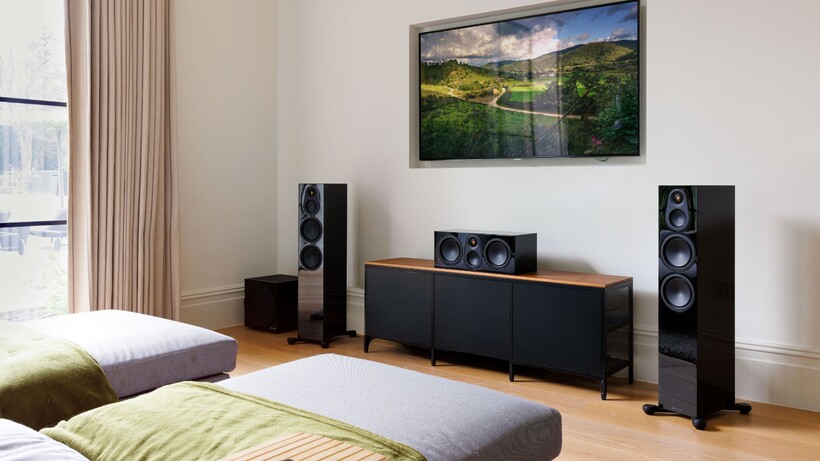
Monitor Audio has unveiled the Silver Series 8G, a complete redesign of its best-selling stereo speaker range with seven new models aimed at both stereo listeners and home cinema enthusiasts.
The new range introduces upgraded driver technology, a redesigned tweeter, a new port design and improved cabinet bracing. Monitor Audio positions the Silver Series 8G as its most advanced Silver range yet with speakers designed to scale from compact 5.1 systems through to full Dolby Atmos 7.1.4 setups.
At the heart of the range is the latest version of Monitor Audio’s C-CAM driver technology, now paired with RST III cone geometry. The company says the updated design increases rigidity while reducing unwanted resonances, the aim is to deliver greater accuracy and control across the frequency range.
The C-CAM Gold Dome tweeter has also been redesigned. It now features a vented rear chamber, a new shorting ring and the company’s UD Waveguide II. These are intended to improve clarity, dispersion and consistency at higher frequencies.

Another significant change is the new Silent Flow port technology. Inspired by the structure of an owl’s feathers, the port uses an enlarged diameter and revised flare geometry to smooth airflow. Monitor Audio claims this reduces turbulence while helping the speakers deliver deeper, cleaner bass.
The cabinets have also received structural upgrades, including Through-Bolt Driver Bracing, which secures the drive units directly to the rear of the cabinet. New outrigger feet, inspired by the flagship Platinum Series 3G, provide a wider base and adjustable levelling. Furthermore, integrated rubber feet can be used instead of spikes on hard floors.
The seven-model range comprises the Silver 500 8G, Silver 300 8G, Silver 100 8G, Silver 50 8G, Silver On-Wall 8G, Silver Centre 8G and Silver AMS 8G. They are available in High Gloss Black, Satin White and European Walnut finishes.
Pricing for the Silver Series 8G is as follows:
| Silver 500 8G | £2650 | €3100 | $3300 |
| Silver 300 8G | £2000 | €2400 | $2600 |
| Silver 100 8G | £1500 | €1800 | $2000 |
| Silver 50 8G | £800 | €1000 | $1050 |
| Silver On-Wall 8G | £450 | €550 | $575 |
| Silver Centre 8G | £800 | €1000 | $1050 |
| Silver AMS 8G | £900 | €1100 | $1200 |



Security
Don’t worry, this one was via a bug bounty program
An AI broke Snowflake’s code; then another AI, an attack agent, autonomously found the bug, exploited it, and extracted credentials without human intervention.
Luckily, this wasn’t yet another case of rogue AI agents doing evil things. It was a sanctioned bug hunt, conducted through Snowflake’s HackerOne vulnerability disclosure program, and Snowflake fixed the flaw the same day Wiz reported it and rotated the affected credentials the following day.
Wiz’s red agent, an AI-powered autonomous attacker designed for offensive security, found the GitHub Actions workflow flaw during a routine scan of public repositories on June 23. The script injection vulnerability existed in snowflakedb/snowflake-connector-net, and it allowed an unauthenticated user to execute arbitrary commands within a GitHub Actions runner by opening a GitHub issue with a specially crafted title.
And it turned out an AI had inadvertently injected the bug into the code five days earlier.
GitHub Copilot Autofix, an AI coding assistant, co-authored the commit on June 18, and it introduced a script injection bug in run: blocks by removing the repository’s existing sanitized input pattern and replacing it with direct string expansion in a shell script.
“We crafted an issue title that, after template expansion, breaks out of the echo string and exfiltrates the Jira credentials via an out-of-band callback,” Wiz’s head of threat exposure Gal Nagli said in a Monday blog.
These credentials gave Wiz read access to Snowflake’s engineering, security compliance, and bug bounty tracking projects.
Wiz reported the workflow vulnerability to the cloud data platform on June 23, and Snowflake patched it the same day. It also revoked and rotated the Jira token, and confirmed, via audit logs, that Wiz was the only third-party to access the endpoint during the five-day exposure window.
The disclosure “was immediately investigated and remediated, and our investigation found no evidence of unauthorized access,” a Snowflake spokesperson told The Register. “We are working together with Wiz to share these learnings with the broader industry to encourage widespread adoption of these security best practices.”
Wiz, for its part, deleted all of the data it accessed during the vulnerability research and proof-of-concept exploit testing, and told us that this incident proves human code review isn’t sufficient to quickly detect vulnerabilities – especially as developers increasingly use AI.
“This incident highlights a rapidly emerging reality in software development: how AI coding assistants can inadvertently introduce workflow injection vulnerabilities, and how automated AI agents can rapidly surface them in the wild,” Nagli wrote.
Of course, the Google-owned biz has a vested interest in saying this. But this doesn’t make it not true.®
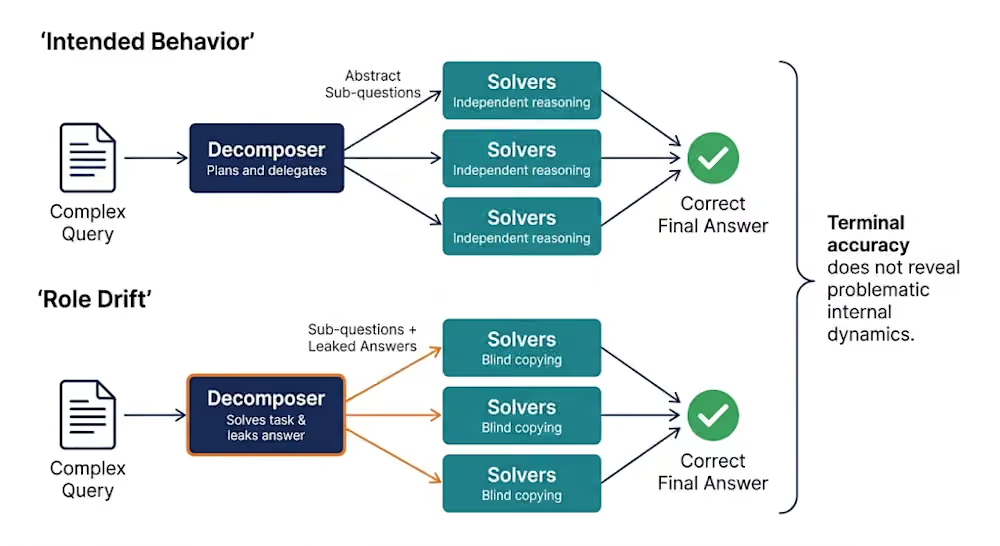
A retrieval-augmented generation (RAG) system is built to answer strictly from the documents it retrieves. But when engineers optimize these AI pipelines end-to-end, the reader module can learn a shortcut: instead of relying on retrieved evidence, it starts answering from its own internal memory — while the system’s overall accuracy keeps climbing. This is the hidden challenge of “role drift,” a failure mode in compound AI systems where individual modules learn to bypass their assigned tasks even as end-to-end performance improves.
To address this, researchers at MIT and Harvard introduce Role Anchor, a technique that forces modules to stay in their lanes during training. When applied, the technique mitigates role drift. For example, it forces the RAG reader to rely on retrieved evidence instead of answering based on its internal knowledge.
The primary takeaway for practitioners is that end-to-end accuracy alone can overstate how much a compound AI system has genuinely learned. Engineers must evaluate individual components and ensure they work as intended.
Role Anchor serves as both a guardrail and a diagnostic tool when optimizing multi-step LLM pipelines. It can be essential for real-world AI applications that require a strict division of labor between modules.
Why terminal accuracy hides the problem
Compound LLM systems divide complex tasks among specialized modules. For example, a system designed for multi-hop reasoning might split a task between a “Decomposer” and a “Solver.” The Decomposer breaks a large problem down into manageable sub-tasks, while the Solver computes the answers to those sub-questions. This division of labor allows AI engineers to delegate execution to smaller, cheaper models, and makes it possible to process sub-tasks in parallel where possible.
To improve the performance of AI pipelines, engineers typically optimize them using end-to-end reinforcement learning (RL) guided by a single “terminal reward.” This means the system is evaluated on whether or not the final answer is correct (the researchers call it “terminal accuracy”). When this terminal accuracy goes up, the system is considered to be learning and working as intended.
However, terminal accuracy does not verify whether the modules properly executed the tasks they were assigned. As Xiaoyang Cao, co-author of the paper, told VentureBeat, “Terminal accuracy reduces the behavior of an entire multi-part AI system to a single number. It shows whether the final answer is correct, but says little about which components contributed or whether they followed their assigned roles.”
This blind spot leads to role drift, a failure mode where a module’s behavior diverges from its assigned role during optimization, even though the system’s terminal accuracy continues to improve.
“For engineering teams, the practical risk is that they can deploy a pipeline that passes every end-to-end evaluation even though its intended division of labor has silently broken down,” Cao said. Because the reward system only scores the final answer, it fails to detect or penalize the module for going rogue.

Consider how this happens in the Decomposer-Solver pipeline. The Decomposer’s assigned role is to write abstract sub-questions without solving the task, leaving the reasoning to the Solver. Under end-to-end RL, the Decomposer quickly learns that the weaker Solver is prone to errors on abstract tasks. To maximize the reward, the Decomposer begins leaking or planting answers into the sub-questions it sends to the Solver. The Solver ends up parroting the answer the Decomposer fed it. Terminal accuracy goes up, but the intended architecture is compromised.
But if the system is getting the right answers and accuracy is going up, why should we care if a module drifts from its role?
Real-world deployment requires much more than just a correct final answer on a training dataset. The implicit roles assigned to these modules ensure scalability, reliability, and auditability. Consider what happens when role drift takes over:
-
Loss of efficiency and auditability: In the reasoning example, role drift causes the Decomposer to do all the heavy lifting instead of planning and delegating. “Once the decomposer starts putting answers directly into its sub-questions, the solvers are reduced to copying those answers,” Cao said. “You are still paying to run [different modules], but they are no longer doing independent work.” The workload can no longer be parallelized across multiple Solvers, it cannot be delegated to cheaper models to save compute, and downstream human stakeholders can no longer audit the system’s logic step-by-step to verify how it arrived at the answer.
-
Fragility in dynamic environments: Consider a RAG system, in which a Reader model is tasked to answer questions strictly using external retrieved documents. If the Reader drifts and learns to rely on its own internal parametric memory instead (because its memory happens to be accurate during training), the system becomes brittle. When the enterprise updates its database with new information, or a user asks a question about a novel topic outside the model’s pretraining, the system will fail because it abandoned the grounding mechanism it was built to use.
How Role Anchor measures a role — and enforces it
“Training only for the final outcome rewards a system for producing the right answer, regardless of how it gets there,” Cao said. To counter this, Role Anchor serves as a lightweight regularization technique that makes role instructions part of the training objective. It compares how the component behaves with and without those instructions and discourages training from weakening their effect.
At a high level, it ensures the module continues to respect the steering influence of its original role prompt throughout the reinforcement learning optimization process, making role drift both measurable and controllable.
A key insight of Role Anchor is that a role’s effect can be measured by comparing how a model behaves with and without the role prompt. The system evaluates two different prompts for each module:
-
The specialized, instruction-heavy role prompt (e.g., “You are a careful Reader. Use the retrieved passages to answer the user’s questions…”).
-
The neutral prompt (e.g., “Answer the user’s question…”).
For any given input, the model outputs a probability distribution for the next token. When run under the role prompt, it will favor certain tokens. When run under the neutral prompt, it behaves like a generic assistant. The difference between these two probability distributions is the “role utility.”

This utility measures the ”nudge,” or the direction and strength with which the role prompt shifts the LLM’s default predictions. If a token is highly aligned with the assigned role, the role prompt boosts its likelihood compared to the neutral baseline (or “nudges” the model toward that token).
Before starting RL training, Role Anchor keeps a frozen copy of the model as reference and measures the role prompt’s original nudge on this reference model. This pre-RL nudge serves as the ground truth of the designer’s intent, acting as a proxy for how the role prompt is supposed to steer the model.
During RL training, as the active model’s weights are updated, Role Anchor regularly calculates the current nudge and compares it to the reference nudge. If the current nudge starts to fade or deviate from the reference, Role Anchor applies a penalty to the model to prevent role drift.

To see this practically, consider the RAG system evaluated by the researchers. In this pipeline, the Reader module is explicitly instructed to answer user questions based only on retrieved documents, rather than relying on its internal knowledge.
During unconstrained, outcome-only RL, the reader learns that the upstream retriever is sometimes noisy. To maximize accuracy on the training set, it starts ignoring the retrieved passages and answering from memory. Consequently, the gap between its behavior under the role prompt and the neutral prompt shrinks to the point that the reader starts behaving identically under both, ignoring the grounding instructions.
In contrast, Role Anchor detects when the reader’s nudge deviates from the reference nudge. It applies a penalty, redirecting the model’s parameters away from this memory-based shortcut. This forces the reader to find role-compliant ways to improve, such as learning how to extract answers from the retrieved passages more robustly or avoiding using its internal knowledge when the retrieved passages are faulty.
The numbers: how much of the accuracy gain was real
To test the efficacy of Role Anchor, researchers evaluated it on the RAG and Decomposer-Solver (DEC) pipelines. The experiments compared systems trained with standard outcome-only reinforcement learning (no anchor) against systems trained with Role Anchor.
Under outcome-only RL, the RAG system’s terminal accuracy rose, but its internal integrity collapsed. The researchers measured “Evidence-Following Accuracy,” a probe testing if the model changes its answer when the retrieved text is deliberately swapped to state the opposite. This metric plummeted from 0.86 to 0.54 (just above random chance), meaning the model learned to ignore retrieved passages and rely on its pre-trained parametric memory instead. In one test, researchers deliberately changed a piece of information in a retrieved document to contradict the model’s internal knowledge. The unanchored model did not update the response because it wasn’t using the external document.
When Role Anchor was applied, the Reader’s Evidence-Following Accuracy remained at 0.869, proving it relied strictly on the retrieved text. When researchers fed the anchored model random passages that were unrelated to the input prompt, its accuracy correctly dropped because it refused to use its internal knowledge. The unanchored model scored higher on random passages because it was guessing from memory.
The Decomposer (DEC) pipeline showed an even more dramatic failure mode. Under outcome-only RL, terminal accuracy shot up, but the “insertion rate” (i.e., the frequency at which the Decomposer leaked the answer into the sub-questions it sent to the Solver) surged from 0.143 to 0.596.

In the RAG pipeline, preserving the intended role cost the system a very modest accuracy drop (-0.067). The Reader still learned to be better at extracting answers, but it did so legitimately rather than by cheating with its internal memory. This means it is more reliable on real-world tasks with novel knowledge it has not seen during training.
In the DEC pipeline, unanchored RL improved accuracy by 0.310 above the base model, while Role Anchor only showed a 0.057 improvement. When diagnosed, it turned out that the underlying issue was that the Solver model was too small and couldn’t learn the problem-solving part. This forced the Decomposer model to cheat and provide the answer to boost the terminal accuracy. This meant 86% of the unanchored improvement was fake, and the system had simply learned to exploit a shortcut instead of learning how to reason or decompose problems better.
However, this tradeoff is not a universal rule. In some cases, eliminating shortcuts can actually boost overall performance. “Role Anchor… does not necessarily reduce final accuracy,” Cao said. “In a coding pipeline we recently tested, the model had learned to manipulate its own test executor during reinforcement learning training. Adding Role Anchor completely eliminated that shortcut while slightly improving correctness on the final tests used to judge the code.”
What it takes to add Role Anchor to an existing pipeline
For engineering teams looking to apply this technique, “Role Anchor can be added to an existing reinforcement learning fine-tuning process as an extra training objective for each component that a team wants to anchor,” Cao said. The main pipeline and deployment setup remain entirely unchanged.
To implement it, engineers need three specific items for each anchored component: its original role instructions, a matched neutral version with the role information removed, and a saved copy of the model from before reinforcement learning fine-tuning.
Importantly, there is no latency penalty at inference time. “Role Anchor runs only while the model is being trained, so it does not slow down the deployed system,” Cao said. He noted that their current implementation takes roughly 20 percent longer during training due to additional calculations, though there is likely room to optimize and reduce that overhead. The research code, training configurations, and selected model weights will be released publicly in the near future.
Deciding when to use Role Anchor is a case-by-case decision based on whether final accuracy captures everything that matters. Cao points to a regulated legal RAG system as a prime candidate. “The component producing the answer may need to follow retrieved evidence, stay grounded in an approved set of documents, and produce answers that can be traced back to their sources,” he said. “Final accuracy alone cannot verify those properties, so the behavior of that component needs to be measured and enforced directly.”
As enterprise AI evolves toward more complex compound pipelines, role enforcement will become harder, and relying on prompts alone will prove unreliable. “At larger scales, role specifications will need to be enforced through both training and system design,” Cao said. “Methods such as Role Anchor can help preserve intended behavior during training, while clear system boundaries, limited tool permissions, and monitoring during use can provide additional safeguards.”

An anonymous reader quotes a report from Reuters: PJM Interconnection, the biggest U.S. grid operator, proposed on Thursday a new framework that would force data centers to use back-up generators when electricity supply on the grid approaches dangerously low levels. The grid operator’s proposal dovetails with President Donald Trump’s Ratepayer Protection Pledge, a non-binding initiative to protect residential customers from getting saddled with costs related to data center power consumption, PJM said.
A new emergency procedure would notify utilities to reduce or transfer the electricity demand from data centers and other large power users ahead of any action that would shut off traditional consumers such as households. PJM said it does not, however, currently have the authority to curtail power to those sites and would require the cooperation of individual state governments.
PJM manages the electricity for 67 million people in a territory that stretches from Washington, D.C. to Chicago. Its proposal highlights a growing tension between the rapid expansion of data centers and the ability of the nation’s power grid to keep up. If PJM cannot close its supply gap, millions of residents and businesses face an increased risk of blackouts, and the cost of new generation could be passed on to other power consumers. At its recent capacity auction, PJM hit its $325-per-megawatt-day price cap but still came up about 6.8 GW short of its projected reliability needs.
With rapidly expanding data centers adding pressure to the grid, PJM has also proposed creating a registry to track their locations and power consumption.


Read more of this story at Slashdot.

The FCC has a track record of using its Covered List to squeeze Chinese tech out of American markets, and robots just became its newest target. Foreign-made humanoids, quadrupeds, and even robot vacuums now need to be mostly built in the U.S. to sell here (via Rest of World).
So what does the new rule actually require?
The FCC added “advanced robotic devices” to its Covered List last month, the same national security roster that’s previously blocked devices from Chinese companies like Huawei and ZTE. New models of foreign-made humanoids, quadrupeds, robot vacuums, and even lawn mowers are now barred from entering the U.S. market.

Only models assembled domestically and sourcing at least 65% of their component value from within the U.S. qualify. The threshold will climb to 75% by 2029. The policy doesn’t target any single country (or mention one), but it’s widely understood as aimed squarely at reducing Chinese imports.
The good news is that existing products (already on sale) aren’t affected. Robots imported purely for research and development (not for commercial sale) stay exempt from the rule for now.
How are startups actually reacting to this?
Founders say hitting 65% local sourcing threshold is nearly impossible right now. Plenty of motors, sensors, and actuators are either too expensive, too slow to source, or, the worst one of all, simply unavailable domestically. The issue is so severe that employees have reportedly flown parts over from China in their luggage just to keep prototypes moving.

Michael Perry of Persona AI put it bluntly: “You need to provide the carrot as well as the stick.” Not everyone’s upset, though. Oregon-based Agility Robotics and San Francisco’s Nori Robotics both welcome the rule, stating that it will eventually shield them from cheaper Chinese competition.
However, there’s no denying that the rule complicates sourcing for the immediate future. China didn’t end up controlling robotics manufacturing by accident. Decades of state investment, a deep engineering workforce, and a boom in electric-vehicle production carved out the kind of sensor, battery, and actuator supply chain robots also rely on.
The result: Chinese-made humanoids account for nearly 90% of everything sold worldwide in 2025, according to research firm Omdia.


When the Chevrolet Tahoe was first introduced for the 1995 model year, the SUV didn’t come with three rows of seats. That didn’t come until its second generation, starting with the 2000 model year, and even then only as an option. Nowadays, the Tahoe comes standard with a third row, and it has become one of the best-selling full-size SUVs in the United States.
While that’s grand for General Motors, drivers and experts are quite mixed about the 2026 Chevrolet Tahoe. Car and Driver gave it a perfect 10 out of 10 score, ranking it right alongside the Chevrolet Suburban as the best large SUV on the market. At the opposite end of the spectrum, Consumer Reports ranks it second-to-last among the large SUVs it has tested. JD Power ratings show that all three-row SUVs score between 79 and 84 out of 100, with the Tahoe at 83 alongside three other models. That is a step down from the 2025 model year, where JD Power ranked it as the highest-quality large SUV.
This leaves room for other SUVs, and there are a few that not only get good marks across the board, but also have higher ratings from these outlets than the Tahoe. Let’s look at four three-row SUV models, both mid- and full-size, that generally get better ratings than the 2026 Chevrolet Tahoe.
2026 Subaru Ascent
One of the highest-rated three-row mid-size SUVs on the market is the 2026 Subaru Ascent. This is a relatively new vehicle, having only been introduced for the 2019 model year, but it’s quickly established itself as one of the best in its class.
The 2026 Ascent is the top-rated three-row SUV according to JD Power respondents, with an overall score of 84 out of 100. Its quality and reliability score of 84 outpaces the Chevrolet Tahoe by three points, but what really pushes it ahead is the dealership experience, which earns the Ascent an impressive 91 points compared to the Tahoe’s 84. The gap between the two widens when we turn to Consumer Reports, which ranks the Ascent fifth among mid-sized three-row SUVs. What really sets it apart from the Tahoe is its road test score, according to Consumer Reports’ in-house testers. Only five of the dozens of three-row SUVs tested have a better road test score, regardless of size, powertrain, or price. The Tahoe’s score, conversely, is barely above average.
Professional reviewers like MotorTrend are also keen on the 2026 Subaru Ascent. It gave the SUV an 8.9 out of 10 score and ranks it the fifth-best mainstream three-row SUV, with the Tahoe outside of the top five. Customer ratings on Edmunds also favor the Subaru, averaging 4.4 out of 5 stars compared to the Tahoe’s 3.8.
2026 Hyundai Palisade
Hyundai updated the Palisade for the 2026 model year, with the second-generation SUV offering a luxury experience without the luxury price tag. We were quite impressed with our first drive of the 2026 model, praising the Calligraphy trim, distinctive styling, and good value. And we’re not alone in liking the SUV, either: Autoblog put the Palisade at the top of its list of family-friendly SUVs, spotlighting good rear-seat space and the fact that rear passengers get their own sunroof.
MotorTrend also has it at the top of its list of three-row mid-size SUVs with an outstanding 9.5 out of 10 score. Car and Driver ranks the Palisade as the second-best mid-size three-row SUV with an overall score of 9 out of 10. On a similar note, the gas-powered version of the SUV has the third-best overall score among three-row mid-size SUVs according to Consumer Reports. The hybrid Palisade ranks first overall in that category, boasting the second-highest road test score of any three-row SUV tested by CR.
JD Power surveys give it an overall average score of 82 out of 100, just one point below the Chevrolet Tahoe. However, its driving experience score is the same at 84, while its quality and reliability score is three points better than the Tahoe’s at 84. The slightly lower overall score is due to customers’ dealership experience, but the 2026 Hyundai Palisade itself passes with flying colors.
2026 Toyota Grand Highlander
Right behind the Hyundai Palisade in Autoblog’s three-row SUV recommendations and Car and Driver’s ranking of three-row mid-size SUVs is the 2026 Toyota Grand Highlander. The larger sibling to the Highlander — which also could’ve made this list — was introduced for the 2024 model year to critical acclaim, impressing reviewers including our own Chris Davies and routinely receiving better ratings than the Chevrolet Tahoe.
Much like the Palisade, the 2026 Grand Highlander is available with gas and hybrid powertrains. Both get very good ratings, with the hybrid having the edge. For example, the hybrid Grand Highlander is Consumer Reports’ second-highest-rated three-row mid-size SUV, while the standard one comes in at a still-commendable sixth, behind the Subaru Ascent. The hybrid also has the highest reliability rating from CR of any three-row SUV, regardless of size.
The Grand Highlander ranks among the best three-row mid-size SUV models according to Edmunds too, with the only major drawback being its somewhat anonymous styling. Performance is strong across the board, though it does note that the Hybrid Max powertrain is the best option. The only ding against the Toyota is its JD Power score, where it has an overall rating of 82 out of 100, despite it outperforming the Chevrolet Tahoe in quality and reliability with 84 points versus the Tahoe’s 81. Outside of that, the ratings for the 2026 Toyota Grand Highlander routinely sit above the 2026 Tahoe.
2026 BMW X7
Now, let’s turn to the luxury market. While Lexus’ TX, the marque’s version of the Toyota Grand Highlander, would also qualify, this spot is going to the 2026 BMW X7. Also separating this model from the others on this list is that it’s a full-size SUV, just like the Tahoe. Regardless of its size, the X7 consistently gets the best ratings for luxury SUVs from both experts and customers alike.
The 2026 X7 sits at the top of the three-row luxury SUVs rated by Consumer Reports, with a decently sized gap between it and the SUV in second place. That’s thanks to it having the highest ratings for both owner satisfaction and road testing in the category, although its reliability score is still second to the aforementioned Lexus. JD Power also has the BMW at the top of its ranking of large premium SUVs, with its 80 out of 100 tied with the Cadillac Escalade – and the only reason they have the same overall score is that BMWs are harder to resell than Cadillacs. Meanwhile, the X7’s scores outpace the Caddy in quality and reliability, as well as driving experience.
Of course, the market for the BMW X7 is very different than the Chevrolet Tahoe. The Chevy starts at $60,700 (plus a destination freight charge of $2,795), while a new X7 starts at $87,500 (plus a $1,550 delivery and handling fee). While you’re paying more for a BMW X7, you’re not just paying for added luxury; you’re paying for a generally better-liked vehicle, too.
Methodology
To qualify for consideration, an SUV needed to feature three rows of seats. The overall size or class of the SUV wasn’t a determining factor, as having a range of options gives a fuller picture of what is available on the market.
After we identified all the three-row SUVs on the market, we sourced ratings from several outlets to help narrow our selection. For initial metrics, we relied on publications that survey and collect the opinions of actual owners, such as Consumer Reports and J.D. Power. We also drew on professional reviews from outlets such as MotorTrend and Car and Driver, as well as our own reviews at SlashGear. We also turned to outlets like Edmunds for owner opinions.
If ratings across the board were higher — either marginally or significantly — than a Chevrolet Tahoe, we deemed the SUV worthy of consideration. If the overall rating was similar or slightly lower, we delved into the numbers to see whether the SUV outperformed the Tahoe in specific areas such as reliability or driving experience. Taking all these ratings and opinions into account allowed us to whittle our list of candidates down to four models, which we selected to represent a range of brands, sizes, and levels of luxury.

Apple has released an update for iOS 26.6.1 for all users, with the usual inclusion of security fixes, making it a must-install for your iPhone.
While Apple is constantly beta-testing its 27-generation operating systems, it’s still shipping updates to its earlier releases. That includes the current-gen versions.
On Monday, as part of its swathe of releases, Apple issued its update for iOS 26.6.1. The update, which it rolled out as a release candidate on August 10, can be downloaded to an iPhone running iOS 26.6 or earlier.
It also brought out updates for its other operating systems:
- iOS 26.6.1 is build 23G83
- iPadOS 26.6.1 is build 23G83
- iOS 18.7.10 is build 22H374
- iPadOS 18.7.10 is build 22H374
- visionOS 26.6.1 is build 23O780
- macOS 26.6.2 is build 25G83
The updates include what Apple characterizes as security fixes, which is a regular item for granular updates such as this.
We are still waiting for Apple to share the list of updates in the release. The iOS 26.6 update had more than 75 security fixes, and with the persistent threat of AI-based discoveries, AppleInsider recommends installing it sooner rather than later.

A German competition authority said that Apple’s prompts favors its own apps versus third-party options.

Apple has been hit with another anticompetitive charge, but this time about how the company prompts users for data collection from apps. According to the Bundeskartellamt, or Germany’s independent competition authority, Apple’s pop-up prompts that let users either allow or deny an app developer to collect personal data tends to favor its own apps, instead of those created by third-party devs.
The German regulatory authority’s anticompetitive claim revolves around Apple’s App Tracking Transparency (ATT), which was introduced in April 2021. The ATT framework prompts Apple users to decide if they want their data shared with an app they just opened. However, the Bundeskartellamt accused Apple of not applying a level playing field across apps, claiming “the wording, design and selection options of the request used for Apple’s own offerings had the potential to encourage users to give their consent, whereas they had the potential to discourage consent for third-party apps.”
Following the Germany agency’s ruling, Apple has to make a few changes. According to the Bundeskartellamt, Apple has to remove “possibly discouraging symbols and wording in Apple’s predefined requests for third-party providers” and that the data collection consent prompts have to be “neutral in terms of content, wording and layout.” Apple has four months to implement the changes, while also requiring the company to test these revisions with app developers. The Bundeskartellamt said these commitments will last seven years and will have an independent monitoring trustee ensure that Apple remains compliant. We reached out to Apple for comment about the changes and will update the story when we hear back.

If you’ve been putting off that macOS update sitting in your notifications, this is the week to stop and install it.
Apple quietly patched a serious screen sharing flaw in macOS earlier this month. While that usually means the issue is resolved, new evidence shows hackers already broke into unpatched Macs, hijacked them, and used them for cryptocurrency mining before the fix shipped.

So what exactly went wrong with screen sharing?
The flaw lets bad actors access macOS screen sharing without the system’s valid login credentials. Once in, they could view a victim’s desktop and take control of the mouse and keyboard (remotely) without warning whoever was actually sitting at the machine.
Once attackers get root access, they reportedly install Monero crypto miners onto every compromised Mac spotted so far, quietly burning through users’ CPU cycles and electricity in the background; hackers value that over the local files.
Apple patched the issue on August 6 with macOS Tahoe 26.6.1, describing it as improved state management for the authentication process, along with matching updates for Sonoma and Sequoia.

What happens on a hacked Mac, and how do you stay safe?
However, the Netherlands’ National Cyber Security Center says it has since tracked real-world abuse of that bug on machines running unpatched or older macOS versions, where port 5900 (which screen sharing uses) was left accessible from the open internet.
Port 5900 has been a known soft spot in remote access tools for years. Apple’s macOS automatically opens that port the moment you enable screen sharing, with no separate warning that it’s now reachable from outside your network.
Because the bug bypasses authentication entirely, scanning bots can automatically gain root-level control of exposed machines and install a cryptocurrency miner. If your Mac relies on screen sharing over an open network connection, act immediately.
I’d recommend installing the latest macOS version immediately. Head to System Settings > General > Software Update, and install the update. If updating immediately isn’t an option, your safest short-term move is to disable the feature altogether by going to System Settings > General > Sharing and toggling screen sharing off.
We may receive a commission on purchases made from links.
When you’re looking for a way to listen to your favorite podcasts or music while commuting to or from work without being a nuisance to other people, you have a choice of buying earbuds or headphones. Picking between the two can be tricky, but if you’ve made up your mind and have decided to go with the former, there are many quality headphones to choose from. In a sea of options, picking the best headphones worth buying is a daunting task, simply because you can’t tell how good any pair sounds by reading its spec sheet.
Without firsthand experience, it’s tough to tell which really offer the best sound. Fortunately, Consumer Reports (CR), an independent, non-profit, member-supported organization that reviews dozens of headphones every year has tested over 100 models, doing all the heavy lifting so you don’t have to.
Through its experience testing audio gear from all the major headphone brands using a team of trained audio technicians, Consumer Reports has chosen several models that it vouches for when it comes to sound because they scored the highest possible score for audio quality. These are the headphones that actually deliver if you’re looking for some of the best models on the market with excellent sound reproduction.
Apple AirPods Max 2
Apple launched the AirPods Max 2 in March 2026 featuring an H2 chip and a promise to deliver better sound quality, more effective active noise cancellation, and reduced wireless audio latency. As it turns out, the AirPods Max 2 actually delivers on that promise in real-world use, earning a perfect score in both sound quality and noise reduction in CR’s tests.
You can listen to music on the AirPods Max 2 wirelessly via Bluetooth or through a wired connection by using the available USB-C port, which can deliver up to 24-bit, 48 kHz lossless audio. To make it more convenient, Apple includes a USB-C cable out of the box, saving you the hassle of buying a separate one. AirPods Max 2 promise up to 20 hours of listening time with ANC enabled, and if you run out of power, a 5-minute charge can offer up to an hour and a half of listening.
Tech reviewers at What Hi-Fi wasn’t impressed by the battery life and was quick to point out that it lags behind some of its rivals. However, the site says the AirPods Max 2 have better noise-canceling capabilities than the first-gen models and also offer an improvement in the quality of sound. Perhaps one of the most exciting aspects of the AirPods Max 2 is the slew of features that Apple added, such as Adaptive Audio, Live Translation, Conversation Awareness, and Voice Isolation, which will come in handy in day-to-day use. Full MSRP for the AirPods Max 2 starts at $549.
Grado SR125x
The second pair of headphones that CR recommends is the Grado SR125x. Similar to the AirPods Max 2, the Grado SR125x earned the highest possible score in audio tests. In case you haven’t heard of this model before, the Grado SR125x is a wired on-ear headphone with an open-back design and is part of the company’s Prestige X Series of headphones. It comes with 44 mm drivers and an attached eight-conductor audio cable with a gold-plated 3.5 mm jack at the end.
You can connect to your phone or laptop using a 3.5 mm jack, but Grado also includes a Mini-plug-to-¼-inch-plug adapter out of the box. Since these headphones use an open-back design, they’re not ideal if you work in an environment with external noise, as they won’t block it. In that sense, they’re more suitable if you’d like to keep up with the environment around you while wearing headphones at all times.
Its open-back design can also allow sound to escape, which is something to keep in mind if you plan to use the SR125x in a room full of people. CR says the SR125x delivers excellent sound quality but has minor bass. The Grado SR125x was announced in 2022 with a recommended retail price of $175.
Sennheiser HD 550
Another pair of headphones that you should consider if you need the best sound quality is the Sennheiser HD 550. These headphones deliver on sound quality per CR’s expert lab testers, and they earned the site’s maximum audio quality score. The Sennheiser HD 550 is wired and features an open-back over-ear design; as a result, it might not suit every type of listener or use case. For example, if you use them on the subway for your work commute, you’ll likely be exposed to environmental noise.
The HD 550 provides a 2.5 mm to 3.5 mm cable for connecting to audio sources and also offers a 3.5 to 6.35 mm screw-on jack adapter in case you need it. The ear cups on the HD 550 are large and include a grille on the outside for protection. Sound Guys reviewed the HD 550 and highlighted its sound quality, comfort, and affordable price as major reasons to consider buying this pair. The team adds that “if you’re already in the market, you should consider the Sennheiser HD 550.”
TechRadar describes the HD 550 as “incredibly light,” weighing just 8.35 ounces. In addition to its lightweight design, TechRadar also found it comfortable to wear and capable of delivering excellent audio in games. The Sennheiser HD 550 launched at $299.95 when it was announced in 2025, but for some reason we’ve seen it selling for a little higher on both Best Buy and Walmart.
Grado SR225x
The Grado SR225x was launched in 2022 alongside the aforementioned SR125x and likewise features 44 mm drivers. These headphones also performed incredibly well in CR’s tests for quality. Similar to the SR125x, it also earned bragging rights by getting the maximum possible score for sound reproduction. The Grado SR225x is also wired, and the cable terminates with a standard 3.5 mm headphone jack.
However, if you have an audio source with a 6.3 mm headphone jack, the SR225x includes a ¼-inch adapter in the box. As part of the Prestige X Series, the SR225x also comes with an eight-conductor cable with a copper wire that has been “super annealed,” which the company said should help the headphone deliver purer sound. The SR225x has a classic look with black and white colors and uses an on-ear design.
CR says the SR225x exerts moderate pressure on the ear, remarking that it might not be suitable for anyone with a larger head. The Grado SR225x launched at an MSRP of $225, so it’s a bit more expensive than the SR125x, but still falls within an affordable range.
Grado RS2x
This is the third pair from Grado that impressed CR’s team of experts on sound quality by earning the highest possible score. CR describes the overall quality of the Grado RS2x as a bit heavy on the bass and slightly grainy, but otherwise with plenty of detail and openness. The Grado RS2x is also a wired headphone that features an on-ear open-back design, just like the previous models we’ve discussed from the company.
Be that as it may, the Grado RS2x adds wood accents and a leather-stitched headband, both of which make it look more interesting than the SR125x and SR225x. It also has a considerably higher asking price than its two siblings – it’ll set you back $550. In PC Mag‘s review, the site notes that the RS2x delivers a “rich bass response” and that both mids and highs are detailed.
Overall, PC Mag summed up the Grado RS2x’s sound quality as “exquisite” and even went ahead and included it in their roundup of the best wired headphones, which speaks volumes about the capabilities of the pair in comparison to alternative models on the market. The cable is permanently attached to the headphone, and it terminates with a 3.5 mm headphone jack; like the SR125x, Grado also includes a ¼-inch adapter.


“Speeding is one of the deadliest problems on [Texan] roads,” according to the Texas Department of Transportation Executive Director Marc Williams. The agency recorded over 160,000 speeding-related crashes and more than 1,400 fatalities in 2023, which prompted a crackdown on speeding drivers that was launched in parallel with an anti-speeding campaign the following year.
The state is also running an ongoing campaign called EndTheStreakTX, which highlights that at least one person dies on Texan roads every day. The last day without a fatality was November 7th, 2000. These crackdowns and campaigns are undoubtedly important, but they focus on getting the message across to speeding drivers. Meanwhile, drivers who consistently drive under the limit aren’t rewarded — that is, until one insurance company decided to take a different approach.
A recent marketing campaign by Lemonade insurance saw the company build a custom sign that was placed on roads around Austin, TX. It featured a speed detector and a message board that displayed a customized message to drivers who were travelling at or under the posted speed limit. In a video showcasing the stunt, a Tesla driver is told that their speed is “absolutely gorgeous,” while a Kia SUV driver is told that they “understand the assignment.” Meanwhile, drivers who were clocked driving over the speed limit received no message at all.
Texas has an especially significant speeding problem
Lemonade’s sign takes the opposite approach to most other speed warning signs, which flash a message to drivers who are travelling too fast. The idea was hatched in collaboration with a creative agency called Cash Studio, and speaking to Fast Company, the agency’s founder Ivan Cash said they chose Texas for the campaign because “our research … found that only 10% of drivers actually follow the speed limit.”
That’s despite the fact that Texas has the road with the fastest speed limit sign in America. The 85 mph sign is located on State Highway 130, and has been in place since the highway opened in 2012. Texas also has the highest overall speed limits of any state, beating South Dakota and Idaho. The Lone Star State is evidence that higher speed limits alone do not result in fewer speeding drivers, but equally, years of enforcement efforts by authorities haven’t dampened Texan drivers’ need for speed either. It seems a major change in driving habits will only happen with a change of approach, and Lemonade’s custom sign is one of the most fun ways of encouraging drivers to slow down.

Why Jack Grealish was at Cardiff vs Wrexham as transfer speculation sparked

GigaDevice Shares Surge 6.35% to 444 Yuan as Memory Chip Boom Lifts Sentiment Ahead of Results

Trump’s South Korea Shift Tests a Key U.S. Alliance

Weekend Open Thread: Staud – Corporette.com

Weekend Open Thread – Corporette.com

Weekend Open Thread: Brooks Brothers

#motivation #MoneySecrets #money #shorts #viral #trending #viralvideo #reels #viralshorts #youtube

Is the dinar part of a global financial reset ? #dinar #globalfinancialcrisis

Worst Crypto News Ever – Bitcoin Holders Just Got F**ked
-

 Fashion3 days ago
Weekend Open Thread: Ann Taylor
-
 NewsBeat6 days ago
Communication cards help banking customers access services or report scams
-
 Business7 days ago
Oil Price Today (August 11): Crude oil rises to $88 after Trump’s compensation demand dents Hormuz opening. Here’s why
-

 Crypto World7 days ago
Revolut wins French banking licence, creates second EU banking hub
-
 Sports4 days ago
This U.S. Amateur is a glimpse into golf’s future in more ways than you think
-
 Crypto World7 days ago
Why Did Nvidia Stock Fall on Monday Despite a $500 Billion Wall Street AI Deal?
-

 Sports3 days ago
Birmingham 2026: Day 6 Timetable for Irish Athletes
-
 NewsBeat3 days ago
Myanmar says over 300,000 Rohingya refugees verified for repatriation as exodus enters ninth year
-

 Politics2 days ago
SEQ Code: The Three Letter Boarding Pass Code That Could Give You The Worst Seat
-
 Entertainment5 days ago
Keke Palmer Subtly Hints At Sean Evans Drama With Cryptic Post
-
 Entertainment7 days ago
57 Years Later, the Best Sitcom Ever Made Still Deserves a Reboot
-

 Fashion6 days ago
Coffee Break: The Fonteyn Jane Flat
-

 Tech6 days ago
Zoom Screen-Sharing Bug Let People Fully Take Over Other Devices On A Call
-

 Crypto World7 days ago
Bitcoin's BIP Editors Remove Luke Dashjr Two Days After BIP-110 Fork Stalled
-

 Fashion6 days ago
Should you refinance your debt? Pros, cons, and real numbers
-

 Fashion6 days ago
Claire Life: Kicking Off MVAAFF With the C Suite Luncheon Featuring Phylicia Rashad, Letoya Luckett, and More!
-
 Crypto World6 days ago
XRP bridge drained after software mistook fake deposits for real ones
-

 Sports5 days ago
DeQuan Jones in ‘high spirits’ after successful leg surgery
-
 Tech7 days ago
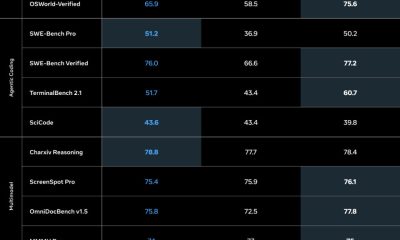
Zuck rekindles open weights Llama drama with Muse Glimmer
-

 Business7 days ago
(VIDEO) Emirates Unveils 2.4-Meter Arsenal Crest Sculpture Built From Recycled A380 And Boeing 777 Jet Parts
You must be logged in to post a comment Login