MOON by Simaudio has expanded its Compass Collection with the new MOON 491 Network Player/Preamplifier and MOON 461 Power Amplifier, a Canadian-made streaming and amplification pairing built for listeners who want one serious high-end system without turning the rack into a wiring nightmare.
Designed and handcrafted just outside Montréal, the 491 combines a network player, preamplifier, DAC, MM/MC phono stage, and headphone amplifier in one chassis, while the 461 delivers 150 watts per channel and borrows MOON’s distortion-cancelling amplifier architecture from the flagship North Collection.
The timing feels right. MOON has built a reputation for delivering strong performance for the money in the high-end category, and this new pairing arrives with the same kind of momentum currently rattling Bell Centre glass during the Canadiens’ unexpected 2026 Stanley Cup Playoffs run.
“As a pairing, the 491 and 461 represent a complete expression of the Compass Collection,” said Etienne Gautier, CCO of Simaudio. “Together they deliver outstanding musical performance and system flexibility, while also forming a visually striking statement that will look exceptional in any environment, from contemporary interiors to traditional spaces. The MOON 491 and MOON 461 are the True Direction.”
Advertisement
That “complete expression” part matters. The 491 is not just another streamer with a nice faceplate. With MiND 2 streaming, Roon Ready support, AirPlay, Bluetooth, Qobuz Connect, TIDAL Connect, Spotify Connect, analog and digital inputs, adjustable MM/MC phono support, headphone output, and MOON’s Hybrid Power supply, it is clearly designed to be the hub for $6,500 USD.
Add the 461 power amplifier, with MOON Hybrid Power and MDCA technology, and the Compass Collection starts to look less like a lifestyle stack and more like a proper no-nonsense two-box high-end system with Canadian muscle. No poutine theatrics required. This is more like a smoked meat sandwich from Lester’s with fries and a hearty karnatzel on the side: straightforward, satisfying, and built to do the job without asking for applause.
MOON 491 Network Player/Preamplifier: One Box to Run Streaming, Vinyl, Digital and Headphones
MOON 491
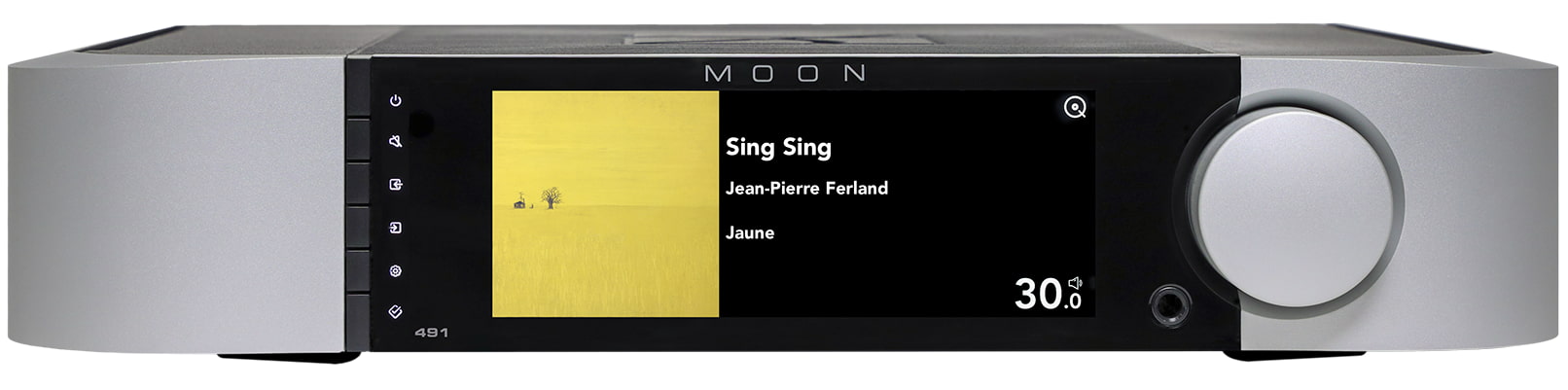
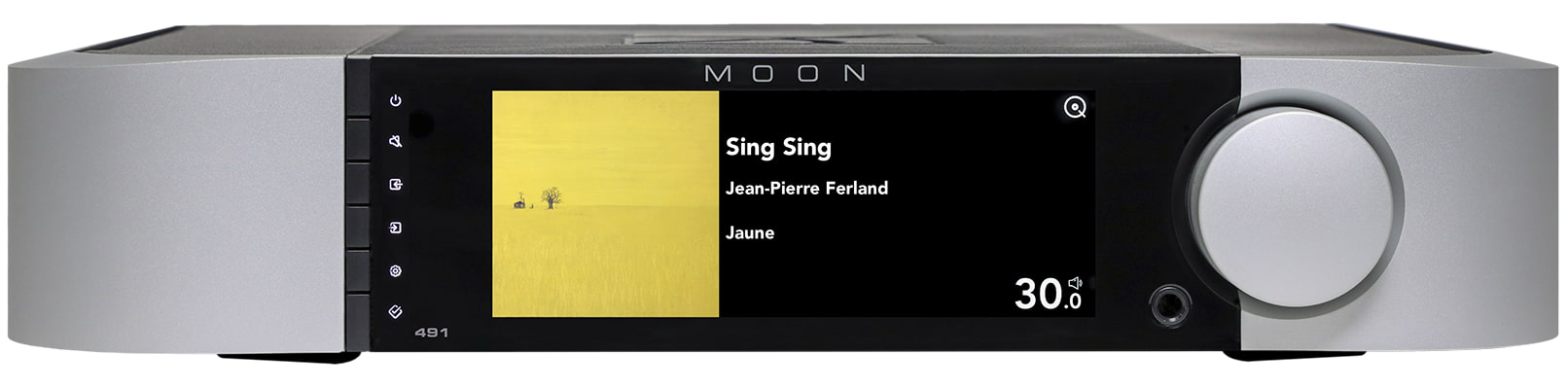
The MOON 491 Network Player/Preamplifier is designed to be the control center of a serious two-channel system. It combines a network player, preamplifier, DAC, MM/MC phono stage, and headphone amplifier in one chassis, which means it can manage streaming, digital sources, analog components, turntables, headphones, and system volume without requiring five separate boxes and a weekend with cable labels.
At the center of the 491 is MOON’s proprietary MiND 2 streaming platform. It works as a UPnP renderer, a Roon Ready endpoint, and supports AirPlay and Bluetooth. The MOON MiND Controller app for iOS and Android provides access to Qobuz, TIDAL, Deezer, and Spotify, while direct platform support includes Qobuz Connect, TIDAL Connect, and Spotify Connect. That gives users multiple ways to stream without being forced into one control path. Having used MiND 2 at AXPONA 2026, I can attest to its relatively easy learning curve.
The 491 also takes vinyl seriously. Its built-in phono stage supports both MM and MC cartridges, with adjustments for loading, capacitance, gain, and equalization through the on-screen menu.
Advertisement
Analog connectivity includes one RCA line-level input, one balanced XLR input, and one phono input. Outputs include fixed and variable RCA, variable balanced XLR, and a 1/4 inch headphone jack. The large color display shows volume, album art, and track information, while control is handled through the app, front-panel buttons, and the aluminum CRM-4 remote.
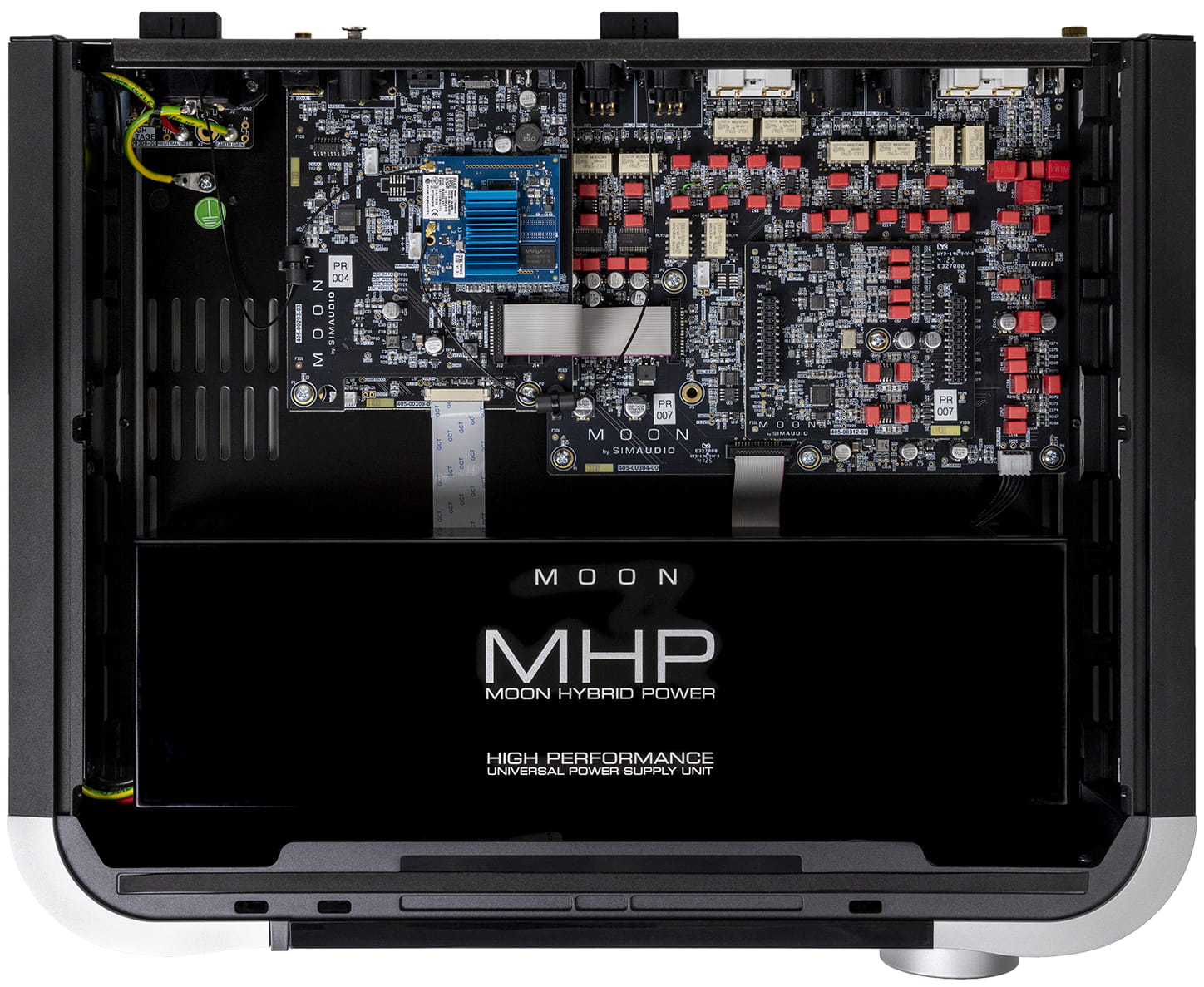
MOON’s Hybrid Power supply is also part of the package, blending linear and switch-mode power supply technologies to provide stable, low-noise DC power. According to MOON, the design operates beyond the audio band to avoid contaminating sensitive audio circuits, helping lower the noise floor and improve dynamic range.
Digital inputs: HDMI ARC, S/PDIF, Toslink, AES-EBU
Ethernet: 2 inputs
Input sensitivity: 0.3 V to 5 V
Input impedance: 22 kΩ
Gain: 10 dB
Frequency response: 10 Hz to 200 kHz, +0.5/-3.0 dB
Total harmonic distortion + noise: 0.0004%
Intermodulation distortion: 0.0004%
Dimensions: 16.9 x 3.5 x 14.1 inches / 42.9 x 8.7 x 35.7 cm
Shipping weight: 20 lbs / 9 kg
Finish: Black chassis with bead-blasted aluminum cheeks in black or silver
Remote: CRM-4 aluminum remote control
Display: Large color display with volume, album art, and playback information
MOON 461 Power Amplifier: Serious Power for the Compass Collection
The MOON 461 Power Amplifier is the dedicated power amplifier in Simaudio’s Compass Collection. It is designed to take the signal from a preamplifier and drive loudspeakers with high output, low distortion, and stable performance across different speaker loads. It is the most powerful model in the Compass Collection, rated at 150 watts per channel into 8 ohms, 300 watts per channel into 4 ohms, and 450 watts in mono into 8 ohms.
At the center of the 461 is MOON’s proprietary MDCA, or MOON Distortion-Cancelling Amplifier architecture, which was first developed for the flagship North Collection. The design is intended to reduce distortion and improve linearity, helping the amplifier preserve clarity, accuracy, and control as output demands increase.
Advertisement
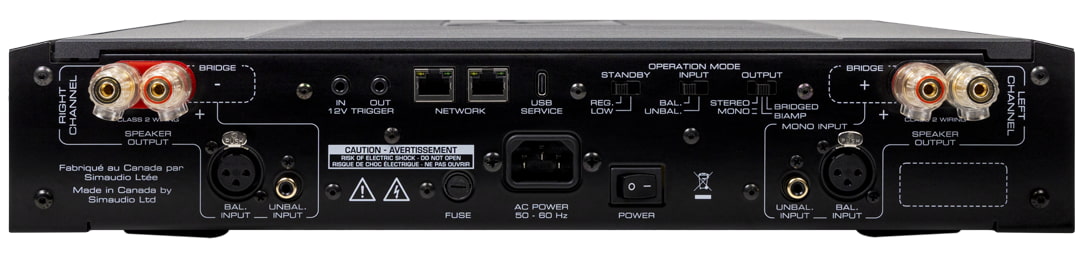
The 461 also uses two MOON Hybrid Power supply modules, with one dedicated to each channel. That dual-mono layout is designed to improve channel separation, reduce crosstalk, and deliver stronger current into lower-impedance loudspeakers. A Stereo / Bridged Mono / Bi-Amping Mono mode switch adds useful system flexibility for listeners who may want to run a single amplifier now and expand later.
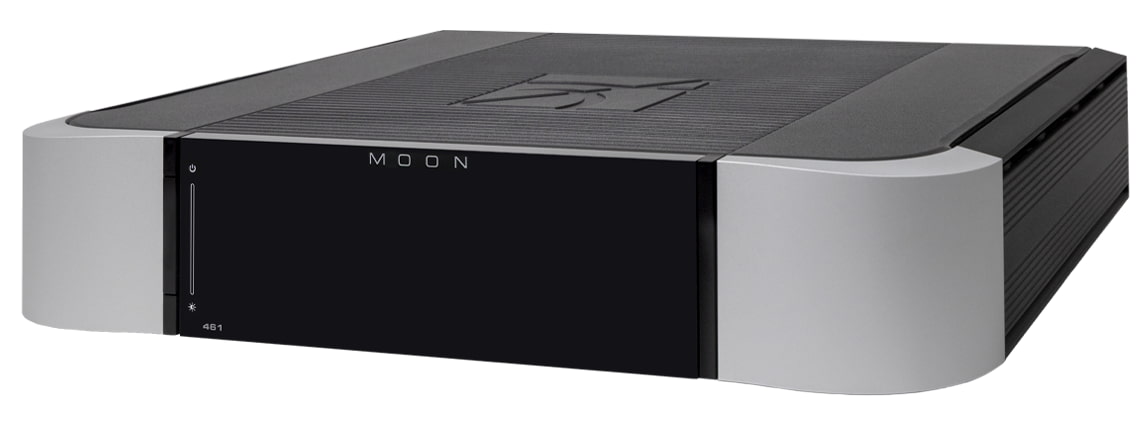
Visually, the 461 follows the Compass Collection design with a black chassis, bead-blasted aluminum cheeks in black or silver, and a clean front panel. It is not flashy, which is probably the point. This is a power amplifier, not a Cirque du Soleil audition. Think more Montreal Metro in February: not glamorous, but it moves a lot of current and usually gets you where you need to go.
MOON 461 Power Amplifier Specifications:
Product type: Analog stereo power amplifier
Collection: MOON Compass Collection
Amplifier architecture: MOON Distortion-Cancelling Amplifier architecture, or MDCA
Power supply: Two proprietary MOON Hybrid Power supply modules
Power supply layout: Dual-mono implementation, with one MHP module dedicated to each channel
Total harmonic distortion + noise at 150 W: 0.003%
Damping factor: 425
Power consumption, idle: 35 W
Power consumption, full power standby: 34 W
Power consumption, low power standby: 1 W
Dimensions: 16.9 x 3.5 x 14.5 inches / 42.9 x 8.7 x 36.8 cm
Shipping weight: 24 lbs / 11 kg
Finish: Black chassis with bead-blasted aluminum cheeks in black or silver
The Bottom Line
The MOON 491 Network Player/Preamplifier and MOON 461 Power Amplifier make the most sense as a clean, high-performance two-box system for listeners who want modern streaming, vinyl playback, DAC functionality, headphone listening, and serious loudspeaker control without building a rack that looks like Bell Centre after triple overtime.
The 461 is the matching muscle. With 150 watts per channel into 8 ohms, 300 watts into 4 ohms, and 450 watts in mono, it gives the Compass Collection real amplifier authority. MOON’s MDCA amplifier architecture, borrowed from the flagship North Collection, and dual MOON Hybrid Power modules add some meaningful trickle-down engineering. The stereo, bridged mono, and bi-amping modes also make it more flexible as a long-term system anchor.
What is missing? The 491 is not a full integrated amplifier, so passive loudspeakers still require a power amplifier like the 461. Otherwise, the feature set is quite complete: HDMI ARC, four digital inputs, two Ethernet jacks, MiND 2 streaming, Roon Ready support, Qobuz Connect, TIDAL Connect, Spotify Connect, MM/MC phono, DAC, headphone output, and preamplifier functionality.
Advertisement
The only obvious omission from the supplied information is any confirmation of higher-resolution Bluetooth codec support such as LDAC, aptX HD, or aptX Lossless.
Pricing & Availability
This pairing is not entry-level, but it is very MOON: designed and handcrafted in Canada, backed by a 10-year warranty, and built for listeners who want long-term performance rather than feature churn.
Aside from Apple, everybody seems to be doing clip-on earbuds these days, including Sennheiser. The company just announced its Accentum Clip buds, set to ship on July 23 in black or white. But the only rub is they won’t be coming to the US on that date, and it’s unclear when they’ll hit US retailers. However, Sennheiser says Canadians will be able to pick them up for $270 Canadian (roughly $190).
I am curious to hear how they sound compared to other leading clip-on buds, which are not only becoming more comfortable and better designed, but are delivering better performance compared to early clip-on models. The Sennheiser Clip are equipped with 12-millimeter drivers, Bluetooth 6.0, have support for the LDAC audio codec for Android users (along with AAC for Apple users) and are rated for 9 hours of battery life on a single charge with an additional 27 hours in the charging case. They’re splashproof and dust-resistant with an IP54 rating and weigh 6.8 grams per bud.
Advertisement
The Sennheiser buds in black.
Sennheiser/CNET
Sennheiser says the Accentum Clip are “tuned for clarity and punchy bass with smooth treble” and the earbuds use dynamic EQ for “seamless compensation of tonal shifts” when playback volume is raised and lowered “to maintain balance while preventing unpleasant distortion.”
If the Canadian price is any indication, I suspect the Accentum Clip will cost around $200 when they final make it stateside. That’s toward the premium end of the clip-on earbuds spectrum, with Sony’s LinkBuds Clip and Shokz OpenDots One in a similar price range. Bose’s Ultra Open Buds, which list for $300, are currently being discounted to $200.
Advertisement
They fit like other clip-on buds.
Sennheiser
If you’re looking for value clip-on options, Baseus sells its new Bowie MC2 buds for around $60 on Amazon. I like them a lot for what they cost. The Baseus Inspire XC1 buds, which feature Sound by Bose, are also a decent value at $110.
Check out my list of the best clip-on earbuds for other options in this nascent earbuds subcategory. Maybe these new Sennheiser Accentum Clip buds make the list once I get a chance to test them. Hopefully, that’ll happen in the not-so-distant future and not require a trip abroad.
As TVs and projectors have evolved over the years, detail or “native resolution” was one spec that drove the market forward. 480i analog CRT TVs were replaced by 720P and 1080i digital HDTVs, which soon were replaced by 1080p HDTVs as the standard in around 2005. Just under 10 years later, 4K TVs were introduced to the consumer market, leading to a new wave of upgrades. More pixels meant more detail, and more detail meant a sharper picture, particularly as screen sizes grew from 27 inches to 55 inches to 85 inches to over 100 inches. FOMO on the highest resolution TVs drove a lot of TV owners to upgrade to the latest, greatest, biggest, most pixel-packed new models.
Just How Many Ks Do You Need?
But a funny thing happened on the road to “more Ks.” As 4K TVs became more common, and increased competition lowered the profit margins, TV makers tried their hands at the resolution upgrade game again with the introduction of 8K TVs. To put things in perspective, 4K TVs (3840×2160 pixels) have four times the detail of 1080p TVs (1920×1080 pixels). And 8K TVs (7680×4320 pixels) have four times the detail of 4K TVs. But it turns out that consumers were quite happy with 4K resolution and most were not willing to pay the premium for an 8K TV, particularly with no native 8K content to play on them.
Consumers started to notice that other picture quality elements – like contrast, black levels, color saturation and color gamut – mattered more than resolution for overall picture quality, even on massive 100+ inch screens. So most TV and projector makers, pulled back on 8K support, focusing instead on other differentiating factors like Quantum Dots, Local Dimming, Micro LED backlighting and RGB backlighting for LCD TVs and, of course, OLED and QD-OLED technology for pixel perfect black levels. Projector makers mostly switched from lamp-based illumination to laser lighting engines, which not only improves peak brightness and contrast, but also lasts much longer than traditional bulbs.
Putting the HIGH in High Dynamic Range
With the introduction of 4K/UHD standards, another important element of picture quality was improved, called “Dynamic Range.” This is the difference between the darkest black and the brightest white or color that can be encoded into the movie or TV show. Standard Definition movies and High Definition movies, even those on physical media such as Blu-ray Disc, are significantly limited in their dynamic range, with most movies encoded and mastered for a a peak brightness of only 100 nits. This means the picture can only get so bright, limited by the content itself.
Advertisement
Meanwhile 4K/UHD content supports a much higher range of values between deepest black and peak brightness. This is known as HDR (High Dynamic Range) and it allows 4K movies and TV shows to be much more dynamic, with fine details visible on screen in both the dark shadows and in the brightest areas of the screen. 4K/HDR titles are frequently mastered for a peak brightness of 1,000 nits or 4,000 nits. There are even some HDR titles mastered for 10,000 nits of peak brightness.
Today, TV manufacturers’ support for 8K resolution has virtually disappeared, at least in North America. There are still some displays that support native 8K resolution but they’re few and far between. On the flat panel side, Samsung still has a few TVs that offer native 8K resolution. On the projector side, select home theater projectors from JVC also support native 8K video, displaying it in 8K resolution via pixel shifting technology on their native 4K projectors with 8K eShift.
But there is still apparently some support for 8K from within the industry itself, manifesting itself in the shape of an industry trade group, formed in 2019, known as the “8K Association.” The “8KA” is dedicated to establishing standards and increasing adoption of 8K resolution in all aspects of the video reproduction chain, from the software itself to media players to display devices including TVs and projectors.
Not Just 8K, But Better 4K
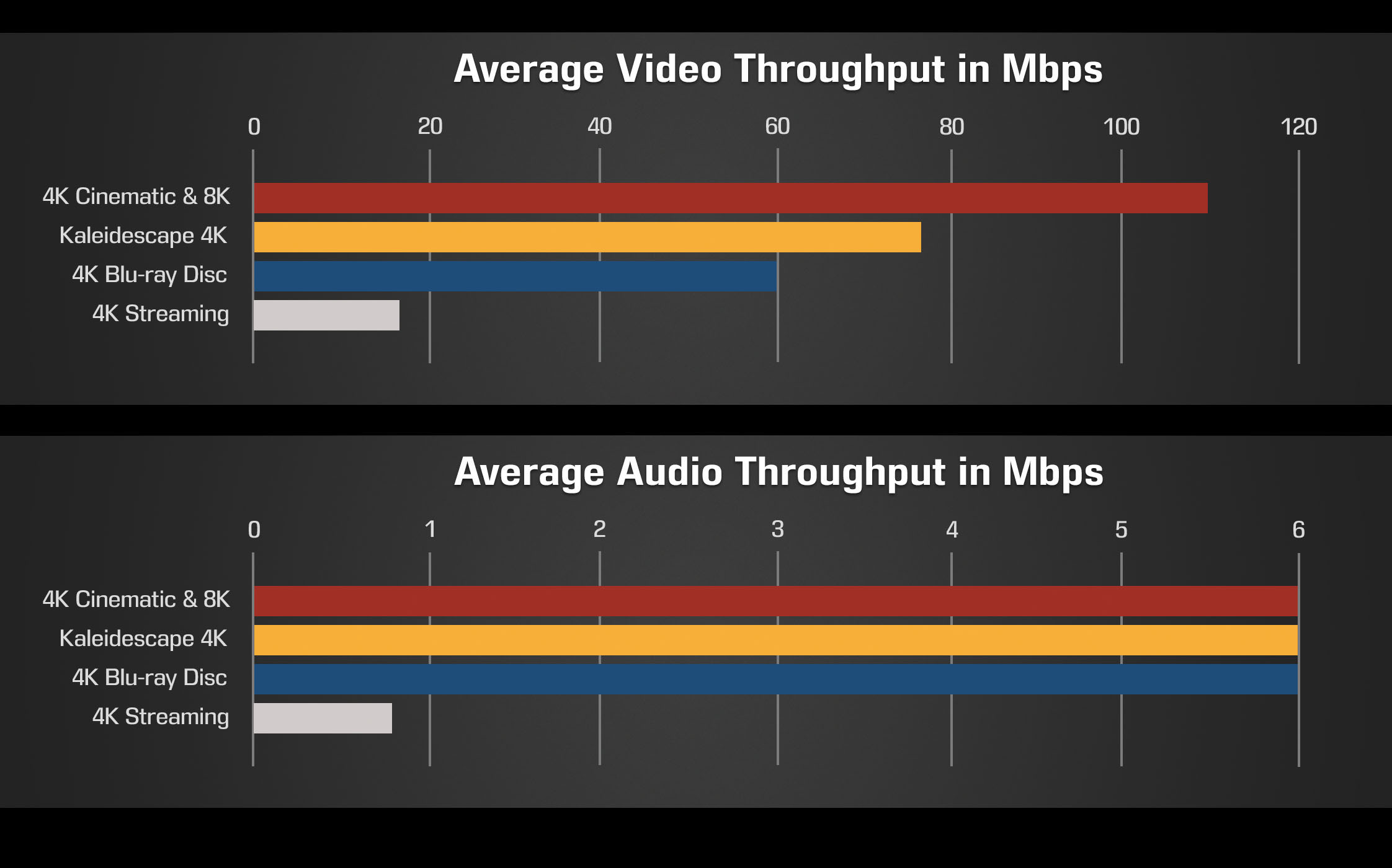
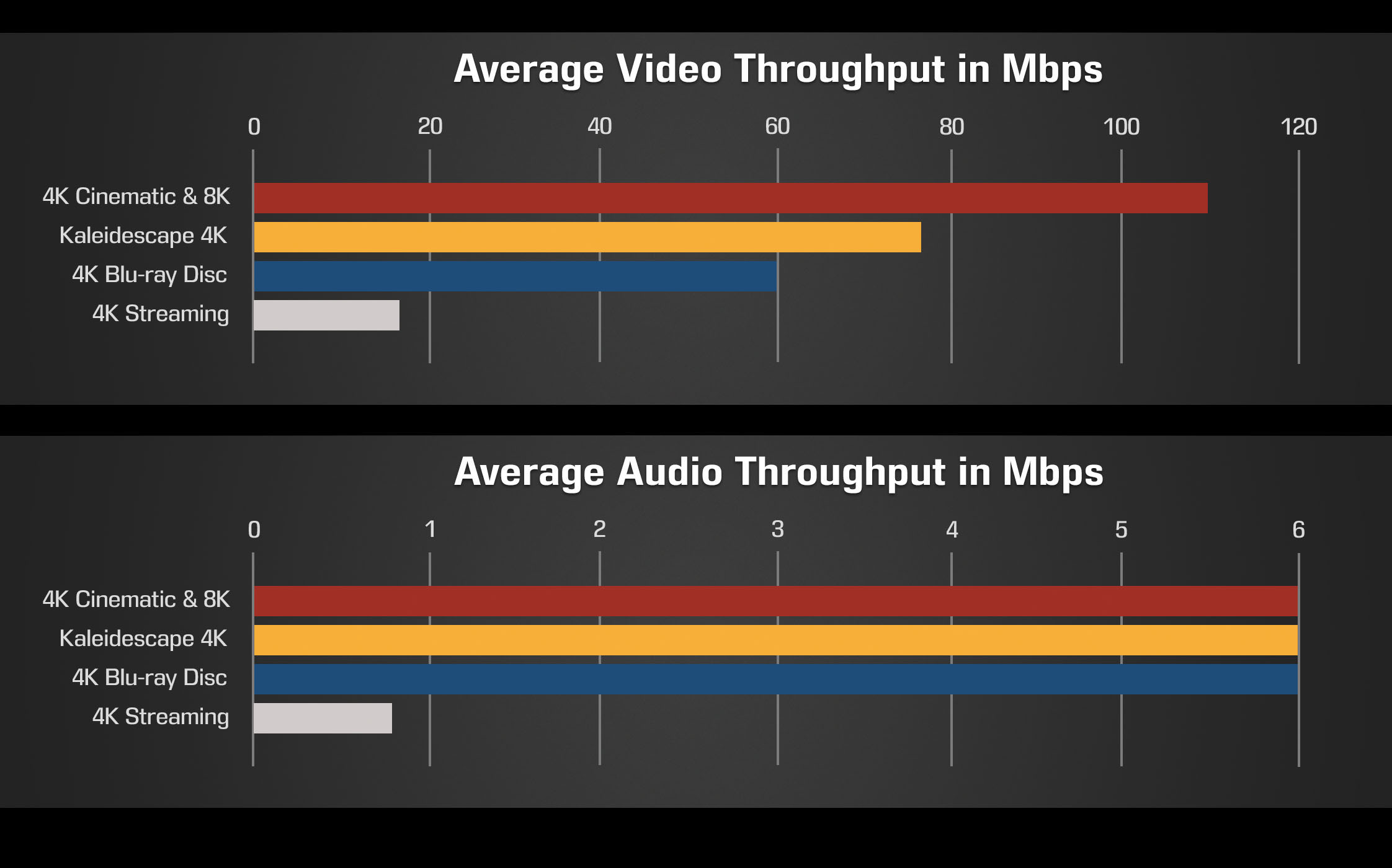
Today, Kaleidescape, provider of premium media players and its own digital movie ecosystem, has just announced its first 8K-capable media player, the Strato K ($4,995). The Strato K is not only the first Kaleidescape player to support native 8K movies and TV shows, but it also supports a new higher fidelity 4K media format, called “4K Cinematic.” 4K Cinematic mode offers full 4:4:4 chroma encoding, and much higher bitrates, even compared to Kaleidescape’s current 4K UHD offerings. 4:4:4 chroma encoding and higher bitrates lead to better color detail, crisper images and fewer of the egregious video artifacts that plague low quality streaming sources.
Advertisement
8K and 4K Cinematic titles on Kaleidescape support bit rates up to about 110 Mbps, over 5 times what we normally see on 4K streaming services.
The new Kaleidescape Strato K is the first movie player certified by the 8K Association that meets the performance and interoperability requirements developed by the Association’s Technical Working Group. In addition to Kaleidescape, 8KA members include leading companies such as Panasonic, Samsung and Xperi, along with other contributors to the 8K ecosystem.
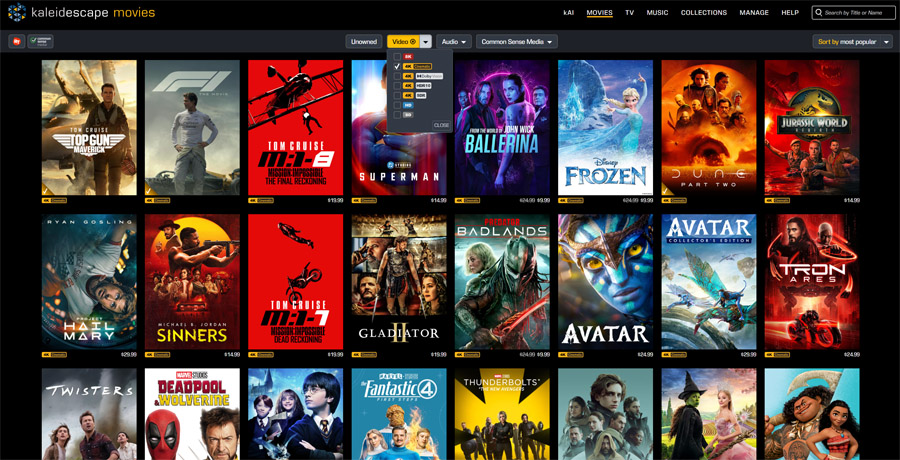
According to Kaleidescape, there are already over 150 titles available in the Kaleidescape movie store in 4K Cinematic format. 8K content licensing is also in the works, but 8K title selection is very limited at this time.
If you visit the Kaleidescape store and filter video for “4K Cinematic” you’ll see a list of titles currently available in the format.
In Kaleidescape CEO Tayloe Stansbury’s words, “Kaleidescape’s Strato K is the world’s highest-fidelity movie player. It brings movie lovers closer to the filmmaker’s intent, with cleaner detail, true-to-life color, and a more natural presentation that dramatically improves the viewing experience of any display.”
Advertisement. Scroll to continue reading.
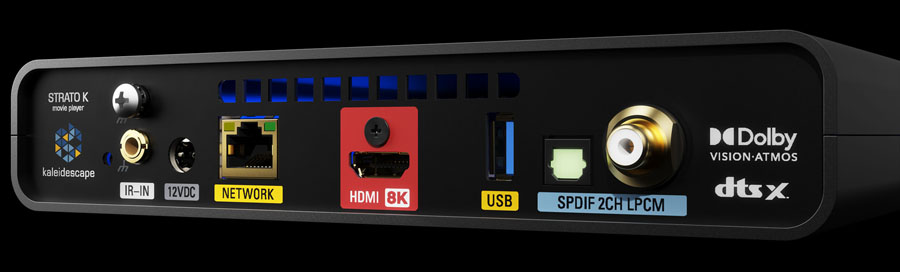
Similar to the Strato V in design, the new Strato K player supports dedicated fiberoptic and coax digital audio outputs, plus the new 8K-capable HDMI output.
Strato K is available now for pre-order, at $4,995 US MSRP. In addition, with Strato K’s release, the current flagship Strato V player’s price has been lowered from $4.495 to $3,995 (US MSRP).
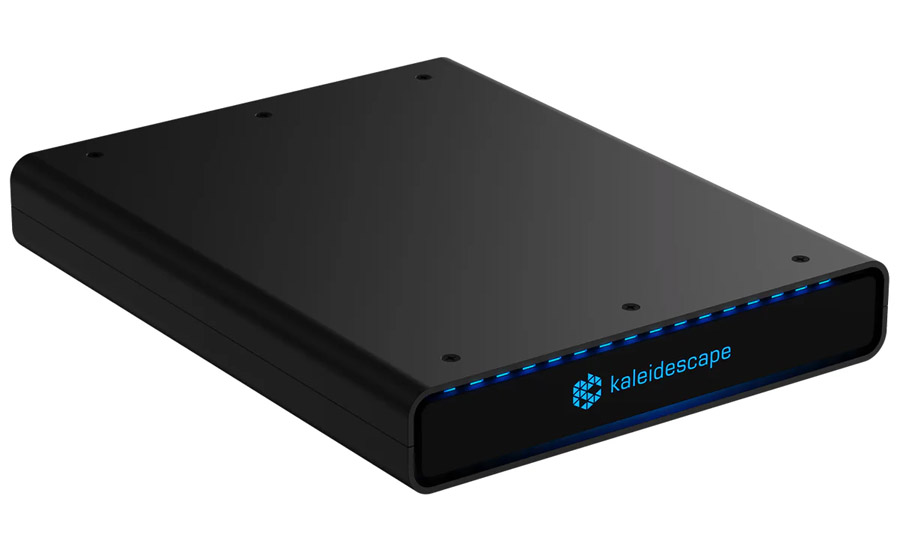
The Strato K features a compact form factor, similar in size and general design to the Strato V, but not quite as compact as the Strato E and Strato M. Like the other recently introduced players, the Strato K can operate as a standalone player. Its internal one terabyte (1 TB) solid state drive can store a handful of movies in 4K, 4K Cinematic or 8K formats. For more dedicated movie lovers and collectors, Strato K can be grouped with one or more Kaleidescape Terra movie servers to add movie storage and provide whole-home entertainment.
Like the Strato V, the Strato K supports Dolby Vision dynamic HDR as well as HDR10. Movies and TV shows are available in the Kaleidescape movie store in 8K, 4K Cinematic, 4K, and 2K with lossless multichannel and object-based audio, including Dolby Atmos and DTS:X.
The Kaleidescape Strato K player will make its public debut later today (June 18, 2026) at a special event hosted by the SMPTE Hollywood Section and the 8K Association in the Amazon Culver Theater’s 8K screening room.
PCM (up to 7.1ch, 96kHz/24-bit)PCM (up to 7.1ch, 96kHz/24-bit
Dolby Atmos
Dolby TrueHD
Dolby Digital Plus
Advertisement
Dolby Digital
Dolby MAT PCM
DTS:X
DTS-HD Master Audio
DTS-HD High Resolution Audio
Advertisement
DTS Digital Surround
PCM (up to 7.1ch, 96kHz/24-bit)PCM (up to 7.1ch, 96kHz/24-bit
Dolby Atmos
Dolby TrueHD
Advertisement
Dolby Digital Plus
Dolby Digital
Dolby MAT PCM
DTS:X
Advertisement
DTS-HD Master Audio
DTS-HD High-Resolution Audio
DTS Digital Surround
PCM (up to 7.1ch, 96kHz/24-bit)
Advertisement
Dolby Atmos
Dolby TrueHD
Dolby Digital Plus
Dolby Digital
Advertisement
Dolby MAT PCM
DTS:X
DTS-HD Master Audio
DTS-HD High-Resolution Audio
Advertisement
DTS Digital Surround
PCM (up to 7.1ch, 96kHz/24-bit)
Audio Format Support via Digital Coaxial/Digital Optical
–
–
Dolby Digital DTS Digital Surround
PCM (2ch, up to 96kHz/24-bit)
Advertisement
Dolby Digital DTS Digital Surround
PCM (2ch, up to 96kHz/24-bit)
Control Support
Kaleidescape remote (not included)
Front-panel IR receiver window
Advertisement
IR input (1/8in mini plug)
Kaleidescape control protocol over Ethernet (supported by Josh.ai, Crestron, AMX, Control4, Savant, the Kaleidescape apps, and other apps & control systems) Lutron RA3 and HomeWorks control over Ethernet
Kaleidescape remote (not included)
Front-panel IR receiver window
Advertisement
IR input (1/8in mini plug)
Kaleidescape control protocol over Ethernet (supported by Josh.ai, Crestron, AMX, Control4, Savant, the Kaleidescape apps, and other apps & control systems) Lutron RA3 and HomeWorks control over Ethernet
Kaleidescape remote (not included)
Front-panel IR receiver window
Advertisement
IR input (1/8in mini plug)
Kaleidescape control protocol over Ethernet (supported by Josh.ai, Crestron, AMX, Control4, Savant, the Kaleidescape apps, and other apps & control systems) Lutron RA3 and HomeWorks control over Ethernet
Kaleidescape remote (not included)
Front-panel IR receiver window
Advertisement
IR input (1/8in mini plug)
Kaleidescape control protocol over Ethernet (supported by Josh.ai, Crestron, AMX, Control4, Savant, the Kaleidescape apps, and other apps & control systems) Lutron RA3 and HomeWorks control over Ethernet
Dimensions (WHD)
6.4 x 1.1 x 6.4 inches
6.4 x 1.1 x 6.4 inches
7.87 x 1.52 x 10 inches
7.87 x 1.52 x 10 inches
Weight
1.6 lbs
1.6 lbs
4.2 lbs
4.2 lbs
Kaleidescape’s user interface makes finding related movies easy with a few clicks on your remote.
The Bottom Line
While interest and excitement around 8K resolution has waned (perhaps for good reasons), we’re happy to see Kaleidescape pushing the quality of media toward to its current limits. With support for both 8K resolution and for higher quality “4K Cinematic” content, and with bit rates and color reproduction that exceed even the highest quality physical media, the Strato K looks like an impressive addition to the line. If you’re looking for a high quality movie player with an eye toward the future, the Strato K is worth checking out.
The new updates will give developers additional options to distribute iOS apps to Brazilian users via alternative app marketplaces, Apple said. Third-party app stores will need to be approved by Apple first, and will need to meet “ongoing requirements to serve developers and users”.
Advertisement
Additionally, Apple will also allow developers to include alternative payment processing methods in their apps or guide consumers to external sites to complete transactions.
These new payment options will appear alongside Apple’s own in-app purchasing. However, purchase history and subscription management will not reflect payments made using third-party methods, the company clarified.
Apple said it will also not provide refunds for transactions conducted outside its ecosystem, and will have less ability to support customers encountering issues, scams or fraud.
In 2025, Brazil’s regulator, Conselho Administrativo de Defesa Econômica (CADE), found Apple to be guilty of anticompetitive conduct within its iOS ecosystem.
Its investigation revealed that Apple prohibited the sale of services from third parties, and required developers to exclusively use the iOS payment system for transactions with customers.
The watchdog found that these practices created “artificial entry barriers” for competitors selling apps and other tools to iOS users.
Later that year, Apple and CADE entered into an agreement to implement anticompetitive measures. The agreement’s requirements are set to last for three years from when Apple announces changes to iOS in Brazil.
Advertisement
The agreement also reduces the commission Apple charges to sell apps on the App Store from 30pc to 10pc for members of the Small Business programme, Video Partner programme, Mini Apps Partner programme, and for subscriptions following their first year – and 21pc for the rest. Apple says a “vast majority” of developers will pay the lower fee.
Some of the developers steering transactions to websites outside iOS will pay a commission of 15pc, while iOS apps being distributed outside the App Store in Brazil will be charged a 5pc commission.
Apple also highlighted a number of cybersecurity issues emerging from opening up iOS to third-party markets and payment platforms.
The company said that it has worked with CADE to introduce new protections against potential malware, fraud or scam threats from third-party services, including an authorisation process for app marketplaces and baseline reviews for all iOS apps.
Advertisement
Don’t miss out on the knowledge you need to succeed. Sign up for the Daily Brief, Silicon Republic’s digest of need-to-know sci-tech news.
Apple TV has a treat for Formula 1 fans. The platform is streaming the Austrian Grand Prix, with all sessions available to watch. This includes practice rounds, qualifiers and the race itself. Even better? It’s free and I don’t mean “free for subscribers.” Anyone can pop open the app and watch, subscription or not.
Events start on June 26 at 7:30AM ET with the first practice round. There’s another practice round later that day at 11AM ET. The qualifying round begins on June 27 at 10AM ET and the race starts at 9AM ET on June 28.
REMINDER ‼️
Apple TV will make the entire Formula 1 Austrian Grand Prix race weekend available FREE to viewers in the U.S., with live coverage from June 26–28. pic.twitter.com/uJ4b1Xp4wP
The company is also dipping its toes into other sports. It streamed a Major League Soccer game captured entirely with iPhones and now airs Major League Baseball doubleheaders on Friday evenings.
Apple is bringing alternative app marketplaces and payment options to iPhone users in Brazil under an agreement with the country’s antitrust regulator, extending App Store changes that were previously limited to the European Union.
The changes reflect an agreement with Brazil’s competition regulator, the Conselho Administrativo de Defesa Economica, known as CADE, and will arrive as part of iOS 26.5. Developers can begin integrating the new capabilities immediately.
Developers in Brazil will be able to distribute iPhone apps through marketplaces outside the App Store. Marketplace operators must receive authorization from Apple and comply with ongoing requirements.
Apple will also require apps distributed through alternative marketplaces to pass a notarization process. The company said the review combines automated checks and human oversight designed to identify malware and other known security threats.
Advertisement
Apple is also introducing a revised business model for developers in Brazil. The new structure applies to App Store distribution, alternative payments, and app distribution outside the App Store.
Developers with iOS apps on the App Store in Brazil will pay a reduced commission of either 10% or 21% on sales of digital goods and services, depending on eligibility. Those who continue using Apple In-App Purchase will also pay an additional 5% payment processing fee.
Apple will charge a 15% Store Services Commission on purchases completed through developer websites linked from apps, with some developers qualifying for a reduced 10% rate. Apps distributed outside the App Store will face a 5% Core Technology Commission on sales of digital goods and services.
Developers who sell digital goods and services in Brazil will pay the same amount or less than they do today under the new business terms. Apple will require alternative payment options to appear alongside its own payment system.
Advertisement
The company said the requirement will help users distinguish between purchases processed by Apple and those handled by third parties.
Users who continue using Apple In-App Purchase will retain access to subscription management, refund requests, payment history, and fraud reporting tools. Purchases completed through alternative payment systems or external websites won’t receive the same support features.
Apple will have less ability to assist customers who encounter scams, fraud, or payment disputes involving third-party payment systems. Users may also need to share payment information with additional companies.
Brazil adopts changes similar to Apple’s European framework
Many of the changes mirror Apple’s response to the European Union’s Digital Markets Act. Alternative app marketplaces, app notarization, and external payment options already exist under the company’s EU rules.
Advertisement
Many of the changes mirror Apple’s response to the European Union’s Digital Markets Act
Apple first built much of the underlying framework to comply with European regulations. Brazil is the first major market outside Europe to receive a similar set of marketplace and payment changes.
The company also drew a sharp distinction between Brazil’s agreement and the European Union’s Digital Markets Act. CADE and Japan’s Mobile Software Competition Act allowed safeguards around parental controls, payment choices, and marketplace authorization to remain in place.
Those protections, Apple argued, weren’t possible under the EU framework. One example is Brazil’s requirement that app distribution flow through authorized marketplace operators.
Another is the decision to keep Apple In-App Purchase available alongside alternative payment systems. Together, those measures help address some of the security and fraud risks associated with alternative app distribution and payments, according to Apple.
The U.S. has taken a different approach. Litigation involving Epic Games focused largely on payment steering and restrictions on directing users to outside purchasing options.
Advertisement
The Justice Department’s antitrust case challenges broader questions about competition within the iPhone ecosystem. Neither effort has produced nationwide requirements for alternative app marketplaces.
Apple emphasizes security, child safety, and fees
Apple devoted much of its announcement to security, fraud, and child safety concerns tied to alternative app distribution and payment systems. Apps distributed outside the App Store don’t go through the same review process as App Store apps.
Alternative distribution and payment systems can increase exposure to scams, fraud, malware, and objectionable content. Apple also pointed to pornography apps that became available after similar regulatory changes in Europe and Japan.
Apple preserved several safeguards for younger users in Brazil. Apps in the Kids category can’t use external payment links, and alternative payment systems must include parental gates for users under 18.
Advertisement
Users under 18 also won’t be able to access web-based payment flows from App Store apps. Apple is developing APIs that would allow parents to monitor and approve purchases completed outside Apple In-App Purchase.
Apple is pairing the new marketplace and payment options with alternative fees and commissions. The company used a similar approach in Europe when it introduced marketplace distribution and external payment options.
Security researcher Justin O’Leary says Google initially accepted his Config Connector privilege-escalation report as a high-priority, high-severity bug, then denied a bounty by declaring the behavior “working as intended.” “Google initially rated the bug high priority and high severity, with a rep telling O’Leary ‘Nice Catch!’ Then, the cloud giant changed course and told O’Leary […] that there’s no vulnerability, so no fix and no reward payout,” reports The Register. “The bug report, however, is still marked high-priority and accepted.” The alleged flaw, dubbed ConfigConfusion, could let a Kubernetes namespace user exploit an overprivileged service account to become a GCP organization owner with only a few lines of YAML and little apparent audit visibility. O’Leary details the incident in a blog post. The Register reports: According to O’Leary, Config Connector doesn’t perform an authorization check, and this allows any Config Connector service account with org-level permissions to bypass Identity and Access Management (IAM) authorization and gain the highest level of control (roles/owner) to an entire GCP Organization — the root node of all of a company’s resources within Google Cloud. On March 27, a Google security engineer accepted O’Leary’s report and told him: “Nice catch!” The employee said that they filed a bug based on O’Leary’s report with the relevant product team and assured him the Chocolate Factory’s security squad would work with relevant Google Cloud people to fix the flaw. “We’ll work with the product team to ensure this issue is address. We’ll let you know when the issue was fixed,” the engineer said. “In the meantime, review the payment option selected in your bughunters.google.com profile.”
Google assigned the bug P1 priority and S1 severity, signifying a flaw worthy of urgent repair because it affects a large percentage of users and can disrupt core organizational functions. “I figured that was the end of that,” O’Leary said in a phone interview with The Register. Eleven days later, on April 7, he received a new message from a Google Security Bot reversing the earlier decision. The Reg viewed the email, and O’Leary included a screenshot in his Thursday writeup. The message said that the Cloud Vulnerability Reward Program panel decided that the “security impact of this issue does not meet the criteria to qualify for a reward.”
After reviewing the bug report, Google determined the software “is working as intended,” the message continued. It also noted that the program’s decision not to pay a bounty “does not mean that the product team won’t fix the issue.” Nearly three months later, the case remains P1/S1 with the status “in progress (accepted).” Google hasn’t assigned a CVE or issued a fix. O’Leary didn’t receive any reward for his research. […] “This is a pattern,” O’Leary told [The Register]. “This is just how these trillion-dollar companies deal with people like me. In my day job, we use GKE, and it’s incredibly frustrating on my end, when I find a critical vulnerability in the system that’s being widely used, and I can’t even get the vendor to patch their own stuff.” A Google spokesperson told The Register: “The issue reported does not qualify for a reward because the GCP IAM authorization bypass is only exploitable if an attacker has access to a Config Connector Service Account that’s been granted the Organization Admin role by the organization (i.e., it is privileged). Additionally, an attacker would first need to gain entry to an organization’s environment (e.g., an exposed container) in order to leverage the privileged Config Connector instance and execute commands with administrative authority, such as the IAM bypass. Granting this level of access to the Config Connector Service Account goes against Google Cloud’s publicly shared best practices and the principle of least privilege.”
Rockstar Games released the official cover artwork for Grand Theft Auto VI on June 18. The image puts the two central characters, Lucia and Jason, in the foreground while surrounding them with scenes and figures that hint at the world ahead.
Lucia and Jason are standing side by side in a pose that captures their partnership. Jason has his gun pointing forward, and Lucia is ready to go with her own firearm and briefcase in hand. A helicopter whizzes by in the top of the frame, as Rockstar has done on almost every mainstream cover since Grand Theft Auto III, which came out 25 years ago. The rest of the scene is wonderfully detailed without being overly busy. A police boat moves across the water below, with palm trees and the Vice City cityscape rising in the distance under a huge sky. The whole thing combines the main characters with some environmental storytelling in the style of the well-known series.
PlayStation 5 Console – 1TB, includes wireless controller, 1TBSSD, Disc Drive, 2 Horizontal Stand Feet, HDMI cable, AC power cord, USB cable, printed…
1TB of Storage, keep your favorite games ready and waiting for you to jump in and play
Ultra-High Speed SSD, maximize you play sessions with near instant load times for installed PS5 games
Other small details appear all over the place in this artwork. A motorcycle is performing a trick here, while a police car is hanging out over there. You also have an alligator and a speedboat carrying a flamingo in one corner, and it’s not even on land, and there’s a woman wearing a necklace that says “siempre”. Then there’s the cameos, which include Boobie Ike, a well-known real estate billionaire and club owner, and Raul Bautista, a Vice City veteran with extensive experience in heists.
Advertisement
Grand Theft Auto VI will be available for pre-order on June 25th via the PlayStation Store, Xbox digital marketplaces, and a few select merchants. That is where they will disclose pricing information for the PS5 and Xbox Series and S models. Then, on November 19th, the game is released, and Vice City returns, but this time it is set in the fictional state of Leonida. The official description describes this site “the darkest side of the sunniest place in America” and adds the tagline “Only in Leonida.” Lucia and Jason begin with a simple heist, but things rapidly become difficult as they find themselves in the midst of a much larger conspiracy with far more at risk. [Source]
Adobe has announced a major expansion of its “creative agent” across its flagship Creative Cloud suite and upgraded Firefly AI studio.
Available in public beta starting today across Premiere Pro, Photoshop, Illustrator, InDesign, and Frame.io, the agent is designed to serve everyone from individual creators to enterprise marketing teams.
Unlike first-generation generative AI tools that simply output flat media from a chat interface, Adobe’s embedded assistant acts as an orchestration layer.
It interprets natural language prompts and directly accesses the underlying software’s APIs to execute complex, multi-step production workflows—from batch-renaming video sequences to dynamically updating brand assets across print layouts—while leaving the final aesthetic decisions entirely in the hands of the human designer.
Advertisement
Technology: Contextual Memory and DOM Manipulation
At the core of this release is a significant technical upgrade to how Adobe’s AI handles persistent memory and context window management. In its upgraded Firefly creative AI studio—currently in private beta—Adobe has introduced two foundational architectural components: “Elements” and “Projects”.
Elements functions as a visual variables library, allowing users to save and reuse specific characters, locations, and objects across multiple generations to ensure strict visual consistency as campaigns scale.
Projects acts as the contextual memory layer, storing assets, generations, and session history in a unified space so users can pick up where they left off without rebuilding their prompt context.
Beyond pixel generation, the system’s most critical technological leap is its ability to operate seamlessly within the complex document structures of desktop applications. “Our Adobe Creative Agent can leverage the decades of powerful features, workflows, APIs that we’ve brought into our application and exposed through tooling that can now be invoked through a creative agent,” an Adobe representative explained.
Product: Automating the Tedious, Expanding the Canvas
The practical application of this technology fundamentally alters standard production workflows. Adobe is positioning the human user as a “creative director” capable of delegating repetitive, labor-intensive tasks to the AI. The rollout introduces highly specific specialist agents tailored to the logic of each application:
Premiere Pro: The agent handles tedious project setup, analyzing and sorting source media into bins, batch renaming clips, identifying interview questions, and assembling a rough working starting point.
Illustrator: The assistant automates mathematical and multi-step design tasks, such as generating 50 versioned files from a spreadsheet or running pre-flight checks to flag color mode errors before printing. It can even programmatically duplicate a vector shape 100 times, randomize its position, and change its size based on its z-depth and transparency.
Photoshop & InDesign: The agent executes batch background removals, dynamic layer organization, and applies brand updates across multi-page layouts.
Furthermore, Adobe is actively integrating its creative agent into major third-party enterprise platforms, including OpenAI’s ChatGPT, Anthropic’s Claude, Microsoft 365 Copilot, and soon, Google Gemini and Slack.
Advertisement
Licensing: Commercial SaaS and Enterprise Implications
Unlike open-source orchestration frameworks or models released under MIT or Apache licenses, Adobe’s creative agent operates strictly within a proprietary, commercial SaaS ecosystem. For enterprise decision-makers, this carries specific implications. Because the agent relies on Adobe’s proprietary APIs to manipulate project files, it requires an active Creative Cloud commercial license. Additionally, by bringing the “Adobe for creativity connector” to platforms like Slack and Microsoft Copilot , enterprise IT and systems architects must consider how internal chat tools will interface with Adobe’s cloud processing environments to support enterprise creative and marketing teams securely.
The Enterprise Unknowns: APIs, Governance, and Architecture
While Adobe’s announcements highlight a powerful user interface and deep integration within its own flagship applications, several critical questions remain for enterprise technical decision-makers tasked with building bespoke AI systems. VentureBeat has reached out to Adobe for clarification on these infrastructure-level details and will update this coverage as we learn more.
For AI system architects, the value of a creative agent lies not just in a native application UI, but in its extensibility. It remains unclear if Adobe plans to expose these new agentic capabilities via API, or if the company will support the Model Context Protocol (MCP). Without MCP support or direct API access, enterprise teams will face friction integrating Adobe’s tools into their own custom task-routing frameworks and internal LLM pipelines.
Adobe’s new “Elements” feature promises to solve the generative AI consistency problem by anchoring characters and objects across generations.
Advertisement
However, the backend architecture driving this persistent memory is not yet detailed. Whether Adobe is leveraging on-the-fly Low-Rank Adaptation (LoRA) based on user uploads or utilizing a form of visual Retrieval-Augmented Generation (RAG) is a critical distinction for technology leaders managing compute costs, model evaluations, and enterprise-grade inference pipelines.
As organizations build out “Projects” and define brand-specific “Elements”, security and data decision-makers require strict guarantees regarding data provenance and storage. It is currently unknown exactly where this contextual workflow and vector data lives—specifically, whether it remains strictly sandboxed within the customer’s enterprise Creative Cloud instance on Adobe servers, and how role-based permissions apply to these new agentic workflows.
Finally, as lightning-fast, developer-first, multi-model AI creative platforms like fal.ai gain significant traction among enterprises and developers, Adobe’s position in the broader developer ecosystem remains a point of interest.
Whether Adobe views these infrastructure-level API providers as direct competitors to its Firefly AI studio or as potential integration points for bespoke enterprise environments has yet to be seen.
Advertisement
Community Reactions: The Tension Between Automation and Craft
The integration of agentic AI touches on the tension between eliminating drudgery and surrendering creative control. According to Adobe’s recent Creators’ Toolkit Report, which surveyed over 16,000 creators globally, the market is highly receptive to AI as an operational assistant rather than an autonomous creator.
75 percent of surveyed creators describe creative AI as integrated or essential to their current workflows.
85 percent emphasized that the final creative decision must always remain in human hands.
This sentiment is central to Adobe’s messaging. By focusing the agent’s capabilities on file organization, layer management, and brand compliance, Adobe aims to automate what a spokesperson called the “tedious parts of their workflow”. The goal, according to Adobe executive David Wadhwani, is to let creatives focus on the craft so they can “apply their taste and make the calls that only they can”.
‘Most organizations do not have an AI investment problem, they have a data problem’: New study warns infrastructure demands could be what’s really holding AI back
Confluent research reveals firms aren’t worried about the scale of AI investments – the ambitions are there
Instead, companies are struggling with legacy data systems
We just didn’t know that we needed support for continuous intelligence back then
Businesses are still investing heavily in AI while they figure out where it can be used best, but Confluent believes the volume of investment isn’t a blocker anymore. Instead, it’s the quality of the data AI systems rely on that’s letting them down.
Three in four (72%) IT leaders say poor real-time data infrastructure is preventing them from being able to scale properly.
Real-time data processing (72%), data lineage uncertainty (66%) and fragmented data ownership (65%) are among the biggest challenges that companies face when trying to implement AI.
Latest Videos From
AI’s biggest blocker is data
These challenges have ultimately led to lower-than-expected AI deployments and poor ROI – only 32% say they have agentic AI in production, and the majority instead experience delays.
Advertisement
To fix it, 80% say they’re now prioritizing using enterprise data to drive AI-based systems, with data streaming platforms cited as one of the biggest supports by 88% of IT leaders. In fact, it’s more of a priority than AI and ML (82%), indicating that leaders are increasingly aware of how they could fix the problem.
“Models need to be connected to the systems, events and signals that reflect what is happening across the business,” Chief Product Officer Shaun Clowes wrote, referencing the currently fragmented data systems. But Clowes acknowledged that it’s not necessarily organizations’ faults that AI systems are failing.
Clowes explained that current infrastructures weren’t designed for continuous intelligence, which is why all companies regardless of sector or size are facing the same issues.
Advertisement
Sign up to the TechRadar Pro newsletter to get all the top news, opinion, features and guidance your business needs to succeed!
“The companies making the most progress are investing not only in AI itself, but in the data foundations needed to support it,” he concluded.
For a long time organizations like the Southern Environmental Law Center (SELC) have noted how Elon Musk’s xAI data center in Memphis disproportionately pollutes the air in minority neighborhoods. A joint lawsuit by SELC, Earthjustice, and the NAACP filed last April argued that Musk and friends didn’t even bother to get the necessary permits to run the turbines at its xAI’s Colossus 2 data center.
The lawsuit also notes how these 27 turbines (which has ballooned to 57 turbines since the lawsuit was filed) belch all manner of contaminants, including formaldehyde, into minority neighborhoods already seeing some of the highest asthma rates in the country, violating the Clean Air Act.
But this being Elon Musk, he apparently has been able to leverage the presidency he helped purchase to get those pesky Memphis minorities off of his back. In a filing this week obtained by Wired, the DOJ is trying to claim the lawsuit can’t proceed because xAI and Grok are highly tethered to the country’s national security efforts:
“In a filing, the agency sided with Elon Musk’s company, saying attempts to stop xAI from running the natural gas turbines “threatens American national, economic, and energy security by seeking to shut off the power supply for artificial-intelligence innovation that supports the Department of War’s military operations.”
Musk and his friends at the DOJ are asking the courts to dismiss the lawsuit. In May, the NAACP filed a request for a preliminary injunction, stating that the climbing rates of environmental pollution “increases risks of asthma attacks and heart disease” in communities that already face significant pollution thanks to regulatory capture and systemic racism.
Advertisement
Over on Elon Musk’s right wing propaganda website, Marc Andreessen pretended to not understand why a civil rights group might be upset that unregulated data centers are pumping pollution into minority Memphis neighborhoods:
It’s worth noting that when Musk built the Colossus 2 data center near Memphis, he promised that the facility would largely re-use water via a next-generation water-recycling plant as to not strain the area water supply. But curiously, construction of that part of the project has stalled out completely. Musk says the company needs to focus on finishing their other data center in the region, then will finish construction. But, well, it’s Musk. The guy always saying we’re *this close* to settling Mars.
The youth movement has tethered AI to the country’s growing fascist, racist corruption and income inequality (and the tech sector that openly embraced it at almost every turn), and it’s going to take a lot more than sloppy CBS propaganda and new software updates to shift the perception. I’m not sure the tech sector truly groks what their enthusiastic support of Trumpism will ultimately reap them.
This is the future we’ve built in a country too corrupt to have functional regulatory oversight of obscenely rich men and corporate power. Without a meaningful ethical renaissance and profound political sea change, it only gets uglier and more violent from here.






















































You must be logged in to post a comment Login