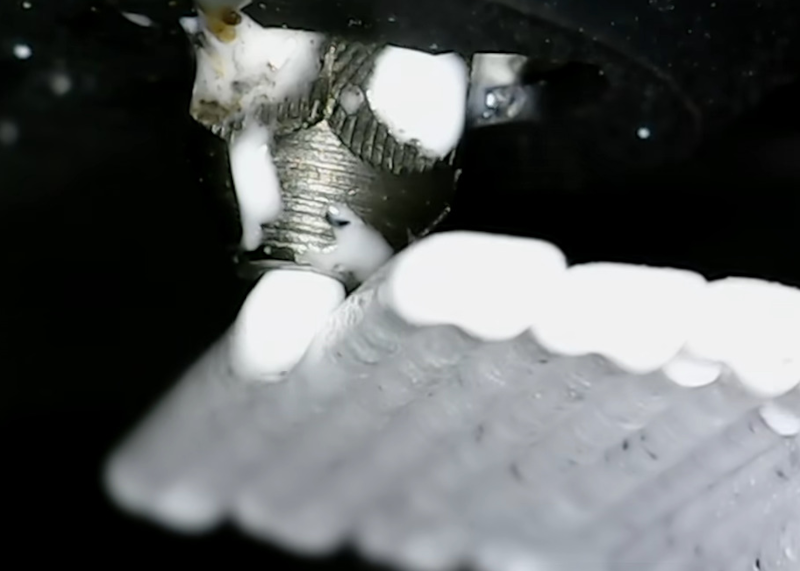
We’ve heard of wave overhangs before. It is a new technique for printing horizontal overhangs with no supports. Building on some other techniques like arc overhangs. The idea is to teach the slicer not to try to draw overhangs in the middle of free space. Instead, when the slicer realizes there is a horizontal overhang, it tries to “grow” the overhang from the main part. You can see an overview in the video below.
For example, imagine printing a letter ‘T’ vertically. The stem of the T is no problem, but when you try to print the arms it will normally need support. But if you could just print the arms starting at the stem with slight overlapping, the arms could grow as they hang onto either the stem or the last overhang line.
That makes sense, but it only works for very simple cases. Arc overhangs can fill more complex cases, but suffer from little dimples at the center of each arc. The realization for wave overhangs is to replace the arcs with waves as you would see in a pond. The waves diffract around holes and corners.
Advertisement
Perfect? Not quite. They are still experimenting with settings, but there seems to be some increase in warping. If you want to experiment, you can download a fork of Orca and contribute your results to the community.
We looked at this technique earlier, but we haven’t seen much about it in practice yet. Let us know in the comments if you’ve tried it and how it worked for you. There are more details in the paper on the subject, or you can jump right to the software.
Samsung has had a busy few weeks with the launch of its 2026 foldable and wearable ranges, with pre-orders just wrapping up last week. If you missed out on the pre-order deals or you have your eyes set on something else from the brand, then fret not — Samsung has just unveiled a slew of deals across its product portfolio.
The latest Samsung Secret Sale event features lots of top-rated tech that we’ve reviewed here at TechRadar, with savings of up AU$1,200 or 50% with the code SECRETAUG — but it’s only running for 48 hours, with deals ending at 10am AEST on Wednesday, August 19.
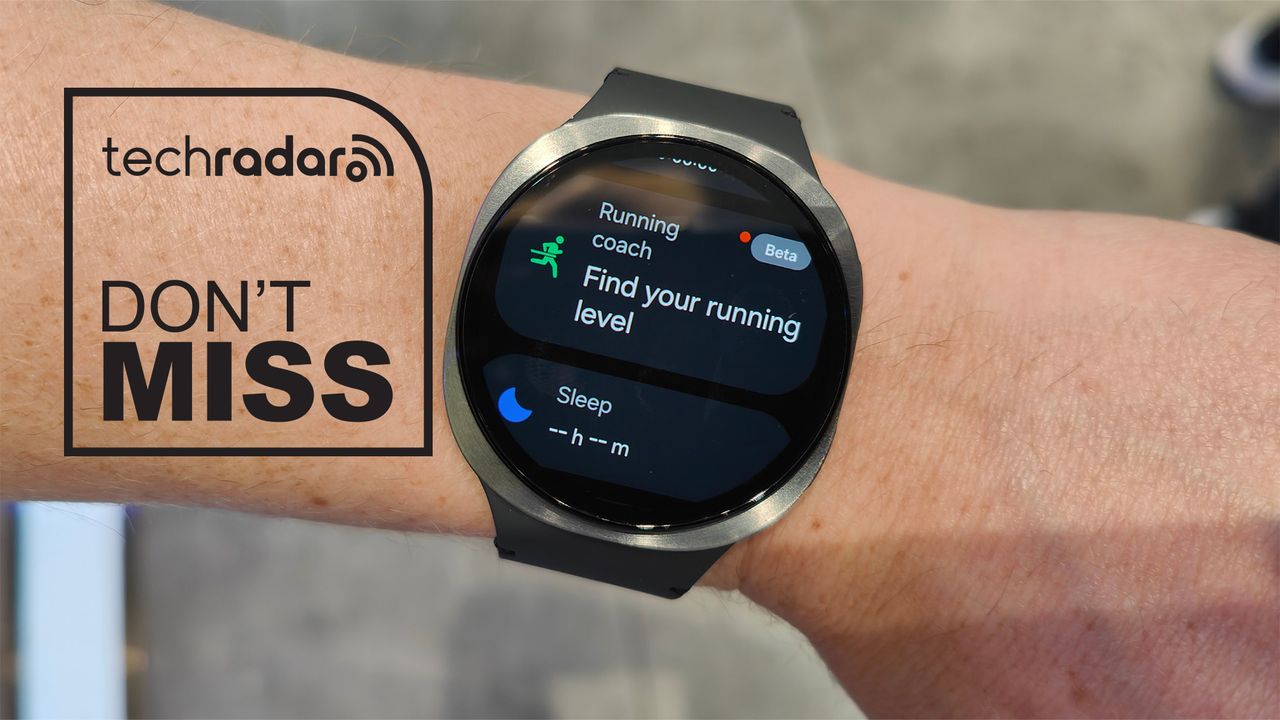
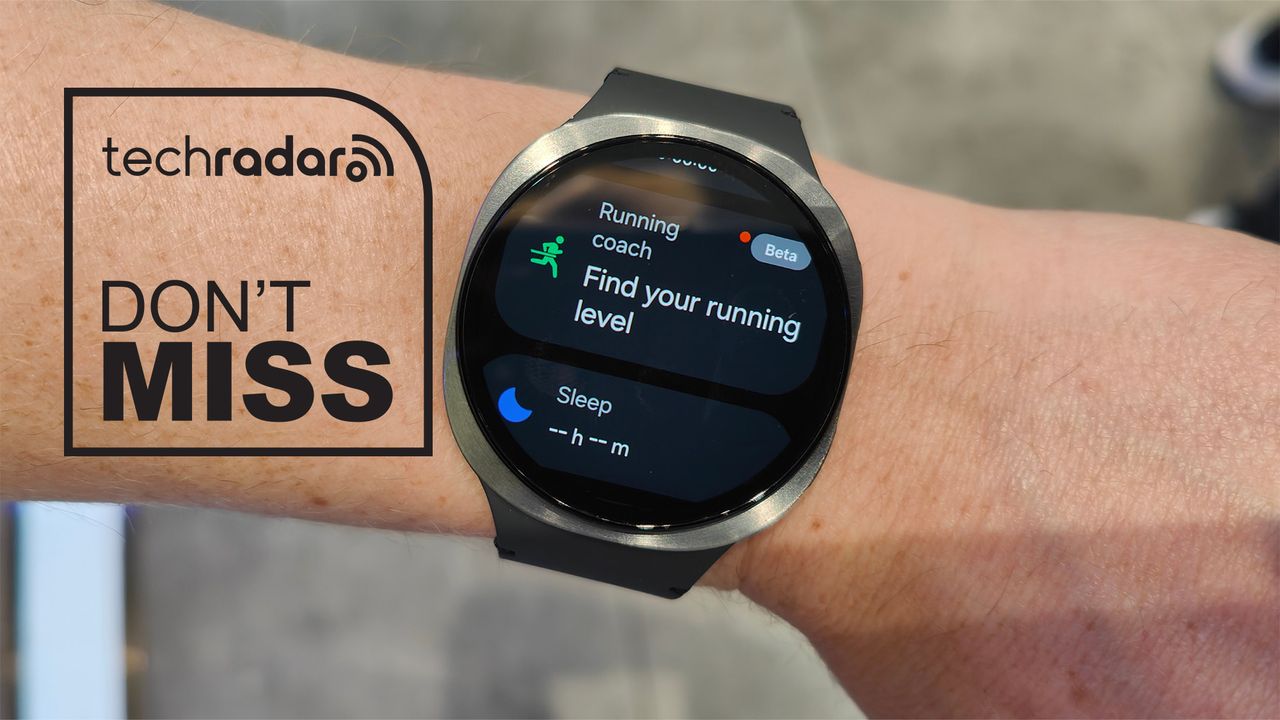
One standout deal is the excellent Samsung Galaxy Watch 8 with a 50% discount, bringing it down to just AU$374.50 for the 40mm LTE model. Given that the new Watch 9 has relatively modest upgrades for AU$699 (with a current deal), this offer is hard to pass up.
Dealing with machine-made bug backlog makes it hard to find a moment to deliver promised subscription service
Microsoft has blamed extra work created by AI bug-finders for the delayed release of a major Cumulative Update to Exchange Server Subscription Edition (SE).
Redmond’s Exchange team made that admission last Thursday in a post titled “Where is Exchange SE CU1 anyway?” that reveals the software giant is “getting questions from our customers on when they can expect us to release Exchange SE Cumulative Update 1 (CU1).”
Advertisement
“After all, in the past we mentioned that it would be released by the end of the first half of calendar year 2026, later updated to ‘second half of 2026’. What is the deal? Where is CU1?”
For those of you who came in late, Exchange SE is the subscription version of Microsoft’s email server, and a Cumulative Update (CU) is a new version of the package that includes all recent bug fixes, plus other changes such as new features or removing deprecated code. Microsoft publishes CUs once or twice a year. Some users prefer applying CUs to applying every patch.
As Exchange SE is a subscription product, not getting CU in a timely fashion isn’t a great example of why pay-as-you-go software is a great idea.
Microsoft explained delays to the arrival of CU1 by referring to the fact that “Over the last few months, various Microsoft execs made statements explaining how Microsoft is leveraging a variety of AI tools to help find vulnerabilities in our products.”
Advertisement
The post says the Exchange development team is “working through reported issues – which includes validation that they are real security issues, reproducing, fixing, testing for regressions / issues after fixes are deployed and releasing updates monthly.”
The Exchange team says that while trying to stay on top of bugs, it is also working on CU1.
“We are regularly rolling our monthly security payload into our internal CU1 build and plan to release Exchange SE CU1 as soon as we get a reasonable stable point and have a month without pressing security payload.”
Advertisement
The Exchange team has adopted that stance because it doesn’t want to publish CU1 and then find it needs to replace it with another that includes new security updates.
“That would create double the update work for many organization administrators,” the post explains. “Even internally, trying to ensure that two major releases (Security Update and a CU) get appropriately tested so we can ensure high quality and nothing falls through the cracks would be very challenging as CU1 must be all inclusive of everything that we released since the RTM.”
Exchange admins will likely appreciate the fact that Microsoft doesn’t want to burden them with two major updates to implement. They may also wonder when Microsoft will find a month in which there is no “pressing security payload” that takes priority over CU1.
Microsoft’s post offers little certainty because it concludes: “In short: Exchange SE CU1 is coming; we do not have a date to give you. But we did not forget about it.”
Advertisement
Nor, it seems, did Microsoft plan for how AI-powered bug-finding would impact product development teams. ®
Have you ever had four religious experiences in a weekend? OK, that might be hyperbole, but if you had the weekend I just had at Audio Advice Live in Raleigh, then you can relate. Disregarding audiophiles’ apparent love of Steely Dan, I was enthralled and impressed time after time at what I was hearing.
Just about every audiophile adjacent brand (and some more budget friendly enthusiast ones) was there showing off its best stereo speakers. Bowers & Wilkins showcased its flagship 801 D5 , Focal had its all-in-one active Diva Alta Utopia, Klipsch went back to one of its original speaker designs with the Klipschorn, and JBL had its new Summit Series on display including the almost flagship K-2 (the flagship Everest model didn’t make it to the show).
All in all, it was an exciting time to get acquainted with these speakers. Of course, some of them cost the equivalent of a small house in the Midwest, but that’s the deal when a team of audio engineers put their best ear forward.
Latest Videos FromTechRadar
Advertisement
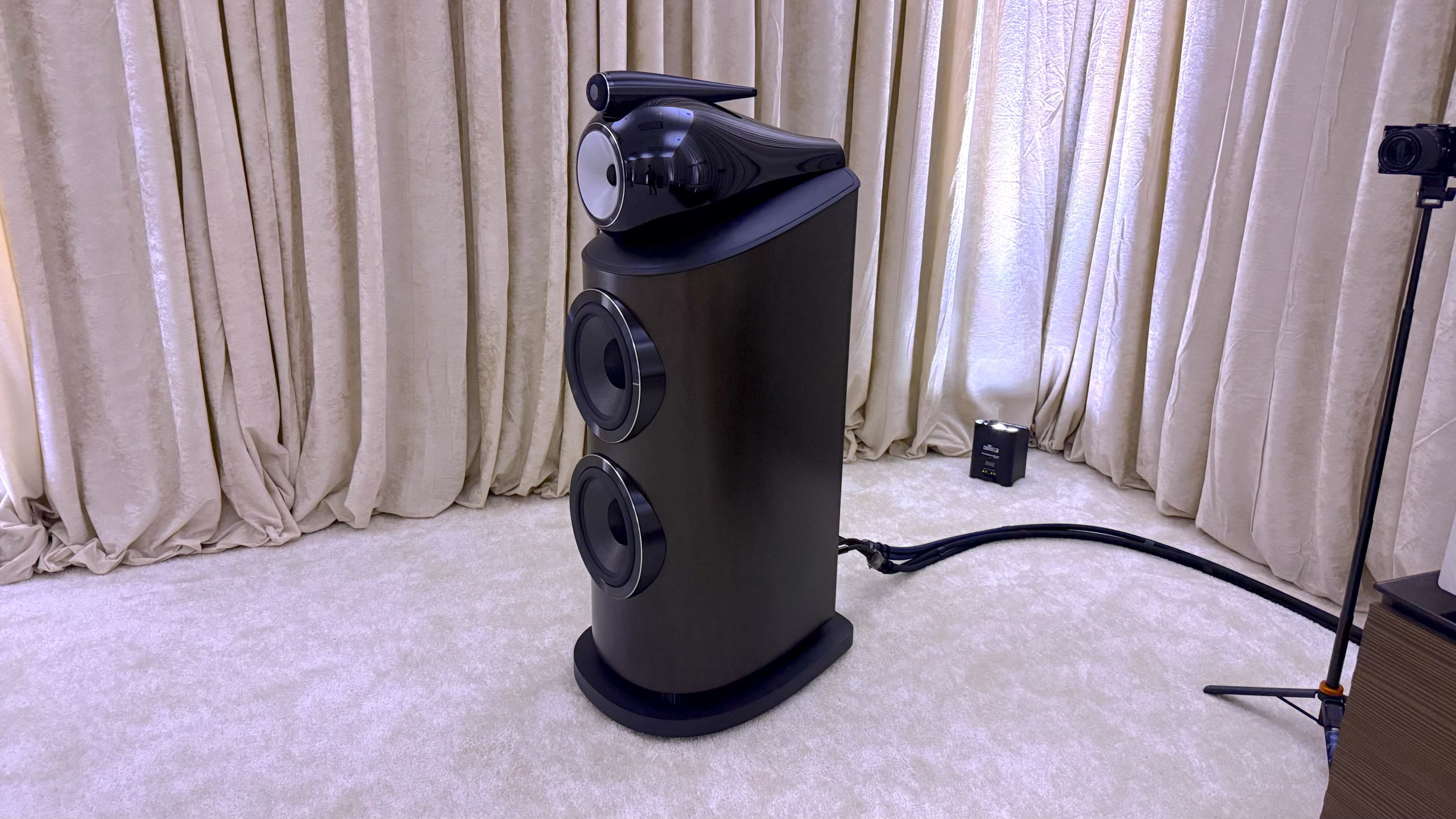
The Bowers & Wilkins 801 D5 was demoed using a Marantz streamer and amps. (Image credit: Future / James Holland)
1. Bowers & Wilkins 801 D5
Though the company’s original version of the Diamond Series (what the D stands for) came out in 1979, a lot has changed since then. Specifically, 2026 brings with it the Bowers & Wilkins 801 D5, an update that doesn’t look much different to the D4 but sure sounds it.
The model keeps the same design principles in that every driver has its own casing, but comes with a number of improvements. Externally, there are three noticeable changes from the 801 D4: the more open tweeter grille design introduced on the 801 D4 Signature, the stronger and stiffer aluminum spine that’s fully incorporated into the cabinet, and an upgraded plinth that reduces vibrations via tuned mass and constrained layer damping.
Advertisement
More importantly, the internal matrix bracing has been completely redesigned so that the 801 D5’s cabinet is as stiff as can be. This means that the signal is less affected by internal vibrations and reflections.
All of these changes result in a speaker that sounds incredibly detailed yet warm, with a resolution worthy of a studio. They basically disappear so that you’re just focused on the music and reveal things you’ve never heard in your favorite tracks. The Bowers & Wilkins 801 D5 might possibly be the best pair of speakers I’ve heard. Just be ready to drop $65,000 (£43,000, oraround AU$81,900) on a pair…
Sign up for breaking news, reviews, opinion, top tech deals, and more.
Advertisement
The Focal Alta Diva Utopia, being active speakers, only need an outlet to use. (Image credit: Future / James Holland)
2. Focal Diva Alta Utopia
Going into this event, I was excited to hear the Focal Diva Alta Utopia, the newest iteration in Focal’s first active speaker series. I almost didn’t get to hear them. Held hostage in customs during the first half of Audio Advice Live, their fashionably late entrance only made me want to hear them more. And oh, were they worth the wait.
There’s a lot going on here. The Focal Diva Alta Utopia speakers use Adapt, a DSP technology that can adjust listening position for imperfect rooms or placement. It also adds an additional driver per cabinet over the Focal Diva Mezza Utopia (the previous generation of this speaker line), making it a four-way speaker. And Focal added an additional Class A/B amp per cabinet for a total five per 600 watts per cabinet or 1200 watts total.
The Focal Diva Alta Utopia also features the company’s new PRISM tweeter that’s only available on this model and the company’s Scala Utopia Evo M. This tweeter is essentially a carbon-coated composite material that offers more detail and more aural flexibility over the beryllium drivers that the company has leaned on previously.
Advertisement
Looks are important too, so Focal has made the accessory panels removable, so you can change out the color of the speakers if you get tired of a colorway by ordering additional ones in a different finish.
When I got to listen to these, the first thing I wrote down was “energetic.” These speakers, which retail for a cool $210,000 (£165,000, or around AU$296,800 and FYI, I don’t think you can take a mortgage out to finance these) are in your face in the best way. Room-filling with plenty of mid-bass, they offer that flagship audiophile experience without needing any additional amps or streamers. This is as good as it gets when it comes to active speakers.
The Klipsch Klipschorn looks as good as it sounds. (Image credit: Future / James Holland)
People love vinyl for that analog sound. And if there’s anything that most resembles the feel of vinyl in speaker form, it’s the Klipsch Klipschorn, specifically the 80th Anniversary Limited Edition. Based on Paul Wilbur Klipsch’s original design from 1946, it comes with a few updates to bring it into the modern era.
Since only 280 of the 80th Anniversary Limited Editions will be built, Klipsch has pulled out all the stops visually. From its tigerwood veneer to the brass inlay adorning the front of the cabinet meant to emulate the folding that’s happening inside the cabinet, it’s stunning in a very mid-century modern kind-of way.
As far as its actual design, it has an active crossover and a two-way speaker design, composed of the K-5-K high-frequency horn with a 2-inch throat and four-way compression driver that takes care of everything above 350Hz and a 15-inch woofer hidden behind those brass inlays responsible everything under.
The resulting sound is one that’s a little softer around the edges than the other speakers I’ve mentioned here (hence the vinyl comparison). This makes them less ideal for reference-level use, yet they still work wonderfully with all sorts of music.
Advertisement
In terms of flagship speakers, the Klipsch Klipschorn 80th Anniversary Limited Edition are downright reasonable, a word I never would have expected to use for a pair of speakers costing $24,998 (so around £18,485 or AU$35,329).
The JBL Summit Series K-2 stands beside the other speakers in the Summit Series (excluding the Everest). (Image credit: Future / James Holland)
4. JBL Summit Series K-2
If you’re not familiar with JBL’s project series, let me give you a brief definition. A project series for JBL is one in which the lead engineers have been given a no-expense-spared, carte-blanche approach to making the best speaker they possibly can.
There have been five of these series since the company’s inception, and the Summit Series is the newest. Not only are they named after a series of mountains that have struck fear in many an expeditioner’s heart, but they have 12 US patents that have come about just from the creation of this series.
Advertisement
The penultimate of this series is the JBL Summit Series K-2 ($99,990 per pair, or £71,998, which is roughly AU$141,300), featuring a single 15-inch woofer, a 10-inch woofer, and three 1-½-inch dual-diaphragm, dual-motor compression drivers going into a 3-into-1 expansion manifold. That manifold has been designed in a way that requires it to be 3D printed instead of a more traditional construction method. The woofers themselves also use a rigid carbon fiber (HC4) material.
Also worthy of mention is the fact that they have decoupled isoacoustic isolation feet and come with the ability to tri-wire /tri-amp – a feature that only the more expensive Everest can do. The rest of the line can bi-amp.
When I had the opportunity to listen to the K-2s, it was in a large hall, bigger than any of the other spaces, yet these speakers filled out the space with seemingly plenty of headroom to spare. Despite the large room, these speakers had one of the cleanest sounds I heard over the weekend. And that 15-inch woofer kicked like a mule.
The Sonus Faber Olympica V were demoed using an all McIntosh signal chain. (Image credit: Future / James Holland)
Did you know TechRadar now has membership?
Advertisement
(Image credit: Future)
Become a TechRadar Insider by simply clicking ‘Join Now’ at the top of this page. Have a question? Please email membership@techradar.com
Honorable Mentions
While I was most impressed with this set of speakers, there were quite a few other towers of power that impressed me more than enough to be worth a quick mention. The three-way ported Sonus Faber Olympica V, powered by McIntosh amps, sounded almost as good as the speakers listed above, as they should since they’re about $30k a pair.
Wharfedale impressed with its Elysian R and is probably one of the best representations of a speaker using an AMT speaker. And the new old kid on the block, French brand Cabasse (the company is actually 77 years old), just starting to make inroads into the US is one to watch out for. Cabasse makes some really unique looking and functioning active speakers, but also some great-sounding floorstanders. This time next year, you might be looking at a set of Cabasse speakers with the same amount of interest and deliberation as any of the other brands mentioned here.
In this week’s Sunday Reboot, Apple employs weird delay tactics for its Epic lawsuit filing. Meanwhile, Epic still doesn’t think Apple’s proposals go far enough.
Sunday Reboot is a weekly column covering some of the lighter stories within the Apple reality distortion field from the past seven days. All to get the next week underway with a good first step.
Playing courts for time
I have been covering the Apple-Epic lawsuit saga for about half of my tenure here at AppleInsider. It’s a source of news that, despite its regularity, doesn’t seem to be scraping the bottom of the barrel quite yet.
In the last week, there were a series of updates that are interesting, if not entirely groundbreaking. Specifically, delays, availability, and fees.
Advertisement
Let’s start with delays, because they can make a big impact in a legal case.
Back in May, Apple and Epic agreed on a pre-court schedule for the U.S. District Court for the Northern District of California. It was a schedule set so that Apple and Epic could negotiate new commission rates for app transactions handled outside of the App Store, referred to as “linked-out purchases.”
At the time, it was outlined that Apple would have 45 days to file a “proffer,” namely a good-faith offer of evidence, testimony, and other elements to the court. This would propose commission rates for purchases, including why they were set at specific levels, in a neat 30-page document.
After that, Apple would hand Epic all non-privileged documents about the decision-making process and a privilege log, within ten days. Within five days of that, Apple and Epic would then meet up to discuss the privilege log, and to determine what documents would go under third-party review.
Advertisement
Epic Games CEO Tim Sweeney
The schedule then continues with Epic filing its own response to Apple’s proffer, again in a 30-page document. That has a timeline of within 60 days of Apple’s proffer filing or Apple’s completion of document production, whichever happens last.
It’s still not over, as the schedule then has another 30-day period for Apple to respond to Epic’s response, with a 15-page limit. At that point, the court holds a status conference to determine what happens next.
The continuing game of litigious table tennis was supposed to hit that first 45-day proffer deadline this week, and it did. Except Apple asked for a stay on it on Tuesday, to delay things further.
Advertisement
The court decided Apple had more than enough time, so it gave the legal team just 24 hours to come up with something. On Wednesday, Apple then got another 24 hours approved.
Tim Sweeney, the CEO and founder of Epic Games, took the news in his stride. And by that, I mean gleefully taking to X.
He mused if Apple would honestly document the costs for human reviewer time in the proposal. Or if not, if Apple will “fabricate outlandish new notions of cost previously unknown to mankind.”
Will Apple honestly document their costs for human reviewer time and seek to recoup them? Or fabricate outlandish new notions of cost previously unknown to mankind? Tune in 24 hours from now to find out.
It seems that a second 24-hour period was enough for Apple to finally submit something on Thursday.
It is truly astounding that a major company like Apple and its well-paid legal team would ask for a long stay after a 45-day deadline for a 30 page document’s creation.
But at the same time, it seems weird that it would get what amounts to 48 hours of extra time to work on the project, and it managed to hand something in.
We don’t know why the delay was requested, nor what was stopping Apple from actually filing the proffer on time. But it has the feel of an attempt to deliberately push back as some sort of high-level legal strategy.
Advertisement
Courtroom-based foot-dragging, if you will.
At least, that would be the better way of viewing it. At worst, it could’ve been someone procrastinating on the 30-page book report about the most niche topic imaginable, and then rushed to put it together at the last minute.
Has anyone told a court “the dog ate their filing” before?
Fee cuts, but they’re never enough
The actual point of the filing is for Apple to detail its proposed external commission rates. The original proposal of 27% versus the 30% App Store commission was no bueno, and Apple had to do more.
Advertisement
The new proposal is much better for developers, in that the percentages are far lower:
15% for standard apps that would face the usual 30% App Store fee
10% for subscription renewals as well as the Video Partner Program, the News Partner Program, and the Mini Apps Partner Program
5% for Small Business Program apps
So, on the good side, those fees are lower so developers should earn a tiny bit more revenue. On the bad side, at least to Epic, those fees are still too high.
In an X post, Epic’s Newsroom feed said that even these concessions are “far outside the bounds of the Ninth Circuit’s guidance on permissible fees.”
An image from an Epic Games video mocking Apple’s 1984 ad – Image Credit: Epic Games
It’s good that Epic still has an opinion, but it doesn’t say how much those fees should be just yet. I get the feeling that the closer to 0%, the better, when it comes to Epic’s preferred fee level.
Advertisement
Alas, we won’t know exactly how much until Epic files its reply. That’s going to take another 60 days at most.
Unless there are more attempts to delay filings in the court.
There’s no chance of that happening. Surely
Last week’s Sunday Reboot talked about OpenAI’s hardware leak and an astoundingly cheap “Ted Lasso” promotion.
The short answer is probably not, but it depends on how you use your device.
Eza_Nanda/Shutterstock
The heyday of third-party antivirus software has been and gone as the dominance of the PC era has ended. Names like Norton, McAfee and Avast were once familiar to PC users across the world, but unlike those Windows PCs of old, we aren’t rushing en masse to install antivirus software on our phones. The reason is simple: modern Android smartphones don’t really need it.
That’s not to say that your device is impenetrable to malware, but protecting it isn’t left entirely up to you these days. All modern operating systems, including those on mobile like Android, ship with some level of security out-of-the-box. That security might just be good enough, but it’ll depend on the type of user you are, as there are some situations where extra protection for your Android smartphone might make sense.
Advertisement
Modern Android protects your device from threats automatically
Eza_Nanda/Shutterstock
Android isn’t immune to infection. It can suffer from viruses and malware and security breaches, just like all software. It also faces attacks that are (mostly) unique to mobile, like malicious push notifications, which a 2025 Gen threat report found had tripled in the space of just three months. Spyware, too, continues to be an invasive and growing problem on mobile devices, according to this later Gen Threat report.
Luckily for the average user, Android has features and settings that are designed to try and automatically protect your phone from these threats. Google Play Protect is one of the biggest, acting as the first line of defense to keep harmful apps away from your phone. Google says it blocked 27 million new malicious apps from the Play Store in 2025 alone. It regularly scans your apps, both at the point of installation and afterwards, for threats. If they’re detected, it may disable the app, or remote it automatically, depending on the level of risk.
Android also uses built-in sandboxing to isolate each app. It gives each app a secure user ID, running them in a way that prevents them from interacting with any of the other apps on your phone. Meanwhile, modern Android smartphones receive regular security updates to patch vulnerabilities, while the permissions system is designed to be proactive and opt-in so that your files, contacts and surroundings are protected. Google Play Protect helps with this, too, by alerting you to apps requesting access to sensitive data, as well as automatically resetting permissions for apps that you haven’t used for a while.
Android’s protection continues to evolve, too, and AI is playing its part. It’s looking to introduce phone call spoofing protection to block scammers impersonating high risk calls, like those from a bank, for instance. It’s also expanding its live threat detection functionality to detect suspicious actions made by apps, like SMS forwarding, which forwards messages to another number. Google has also changed its policy for Android app sideloading, and will soon only allow apps that bypass the protection of the Play Store to be installed only by “experienced users,” with an initial 24-hour cooldown and mandatory ID checks for developers.
Advertisement
The biggest mobile risks are ones that an antivirus can’t protect you from
Peace-loving/Shutterstock
We’ve not moved to a virus-free world, but to a world with a number of other attack vectors that pose just as great a risk to your security. Some of the more common dangers to Android aren’t a virus you’ll install, but are threats designed to manipulate you into exposing your data yourself.
Social engineering is front and center of the danger. Fake text messages and phone calls are big winners for scammers, and while Android is adding AI-powered live threat protection to try and stop it, it isn’t available yet. We’ve all seen fake texts with phishing links that are designed to encourage you to expose your details, whether it’s passwords or personal information it can use later. Fake tech support, a child or relative in trouble and financial romance scams are all psychological threats that no antivirus is going to be able to help you with.
You’re also at risk when you’re out, about and connected. Connecting to an open Wi-Fi network could put your device in danger, especially if you’re not using a VPN. Attacks monitoring your connection on the same network could intercept any unencrypted data or hijack your web sessions to push you to fake websites to steal your data.
Advertisement
Malicious push notifications, too, are a win for scammers. By accidentally clicking “allow” on one of these fake websites, you might give it permission to spam you with messages that look like real warning alerts. Some even warn you that you’ve been infected with a virus, ironically enough.
Where a third-party Android antivirus might occasionally make sense
Maor_Winetrob/Shutterstock
Risk isn’t binary. The risk you’ll face when you’re using your Android smartphone will vary from day to day, from person to person. The most obvious attack vectors are the areas that place you at most risk. Public Wi-Fi networks, for instance, are dangerous for any device, especially in big locations like airports or hotel lounges, with even the TSA warning of the dangers of open Wi-Fi. While a VPN that encrypts your connection is still likely to be a better form of defense, Android antivirus software could help you in the aftermath by double-checking your files for any malware you’ve downloaded since.
If you’re somebody who likes to sideload Android apps, an Android antivirus app might make sense, too. Google Play Protect will still scan apps, even those that aren’t from the Play Store, but this won’t work if you’ve switched it off, or if you’re using a device that lacks Google Play services entirely. Google’s enhanced protection against app sideloading is coming, but only for certified Android devices.
Advertisement
It’s a good idea, too, if there are obvious signs that your Android phone has been infected with a virus and you want a definitive answer. Signs could include pop-ups, slow performance, unusual permissions requests or even unusual battery drain, to name but a few. All of those things aren’t necessarily due to an infection, but should be investigated nevertheless.
Running an older Android smartphone, one that doesn’t receive OS or security updates, puts you at greater risk, too. An Android AV can’t fully replace those updates, but it could protect you from scenarios where a high-risk vulnerability is being exploited in the wild.
Advertisement
Is an Android antivirus really necessary?
Karlis Dambrans/Shutterstock
Antivirus apps for your Android smartphone aren’t really necessarily for most users. Google’s Play Store Protect will shield you from rogue apps, while a VPN can help you stay secure while you’re online. By design, Android apps aren’t allowed to interact with each other while they’re running, and permissions are mostly opt-in, so you can control what they can and can’t see on your phone.
Where it might make a difference is if you’re a particularly high-risk user. Accessing risky websites or sideloading apps, especially with Google’s Play Store Protect functionality disabled, is going to make you a much bigger target for malware. An antivirus in this situation could make sense as additional peace of mind, as long as it’s from a reputable developer in the Play Store. Big names like Norton are still around to help with this, too, and often come with a full suite of protection, including VPN connectivity, malicious ad blocking, and SMS filtering.
Education is still one of the best forms of defense in each of these situations, however. If you can avoid the scenarios that put you in greater risk, you’re going to see better security in the long run. That might mean screening those unknown calls, or taking greater care when you see an unusual message from a loved one that doesn’t smell right.
There’s nothing wrong with not having an Android antivirus installed. Some will argue that you don’t need them at all. The real answer isn’t as clear cut, and it’ll depend on you. Luckily, Google’s built-in security measures ensure that most Android users receive protection without even realizing it, and these measures will continue to evolve and adapt to new and more serious threats.
Today’s NYT Connections: Sports Edition puzzle has a real mix of topics, and might be a tough one. If you’re struggling with the puzzle but still want to solve it, read on for hints and the answers.
Hints for today’s Connections: Sports Edition groups
Yellow group hint: Flip it!
Green group hint: Git ‘er done.
Blue group hint: Gimme the ball!
Advertisement
Purple group hint: The Silver and Black.
Answers for today’s Connections: Sports Edition groups
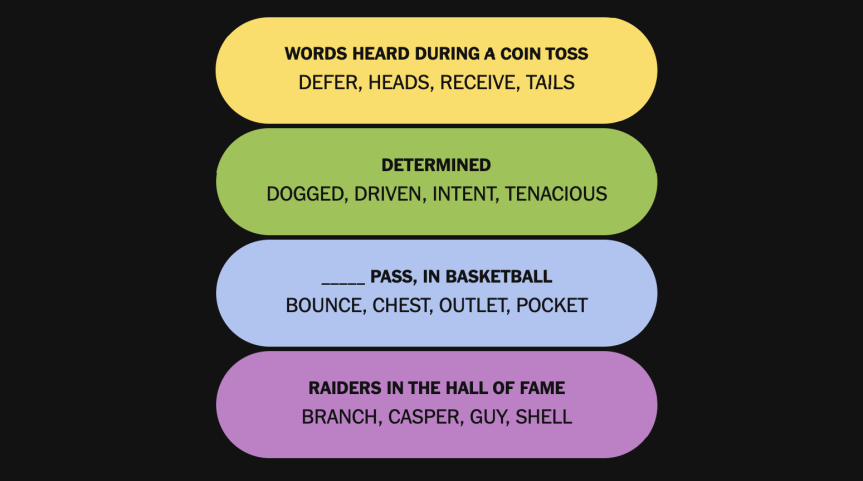
Yellow group: Words heard during a coin toss.
Green group: Determined.
Blue group: ____ pass, in basketball.
Advertisement
Purple group: Raiders in the Hall of Fame.
What are today’s Connections: Sports Edition answers?
The completed NYT Connections: Sports Edition puzzle for Aug.17, 2026.NYT/Screenshot by CNET
The yellow words in today’s Connections
The theme is words heard during a coin toss.
The four answers are defer, heads, receive and tails.
The green words in today’s Connections
The theme is determined.
The four answers are dogged, driven, intent and tenacious.
Advertisement
The blue words in today’s Connections
The theme is ____ pass, in basketball.
The four answers are bounce, chest, outlet and pocket.
The purple words in today’s Connections
The theme is Raiders in the Hall of Fame.
The four answers are Branch, Casper, Guy and Shell.
Advertisement
CNET editor Gael Fashingbauer Cooper, a journalist and pop-culture junkie, is co-author of “Whatever Happened to Pudding Pops? The Lost Toys, Tastes and Trends of the ’70s and ’80s,” as well as “The Totally Sweet ’90s.” She’s been a journalist since 1989, working at Mpls.St.Paul Magazine, Twin Cities Sidewalk, the Minneapolis Star Tribune, and NBC News Digital. She’s Gen X in birthdate, word and deed. If Marathon candy bars ever come back, she’ll be first in line.
See full bio
DARPA wants hypersonic missiles capable of surviving increasingly sophisticated enemy air defenses
The new program seeks major gains in range, speed, and survivability
Russia’s Zircon gives Washington an existing hypersonic cruise missile benchmark
The Pentagon is pursuing a new hypersonic cruise missile concept designed to survive increasingly capable enemy air defense networks.
The Defense Advanced Research Projects Agency (DARPA) Next Generation Hypersonic Cruise Missile (NGHCM) program wants contractors to design a hypersonic scramjet cruise missile capable of evading enemy interceptors.
The effort comes as U.S. forces intercept Iranian retaliations from its attack, increasing concerns about existing stand-off weapons facing sophisticated defenses.
Latest Videos FromTechRadar
Advertisement
DARPA seeks a survivable hypersonic cruise missile
DARPA says advanced integrated air defense systems could increasingly restrict American forces and weaken existing stand-off strike capabilities.
Its request for information seeks concepts capable of achieving significant improvements in range, cruise speed, altitude, or other operational characteristics.
The agency specifically wants a demonstrator that could establish the basis for producing future missiles in substantially larger quantities.
The proposed system would use scramjet propulsion, allowing atmospheric air to support combustion during sustained high-speed flight.
Sign up to the TechRadar Pro newsletter to get all the top news, opinion, features and guidance your business needs to succeed!
DARPA has not specified a precise velocity requirement, although hypersonic flight generally refers to speeds exceeding Mach 5.
Advertisement
The request instead emphasizes broader performance, survivability, affordability, and development speed rather than prescribing one fixed technical configuration.
“Future U.S. military operations face increasingly significant challenges from the rapid proliferation and advancement of highly capable Integrated Air Defense Systems,” DARPA said.
The agency also asks companies to consider how payload, range, speed, altitude, maneuverability, signatures, and launch-platform capacity could influence overall effectiveness.
Advertisement
Potential launch arrangements include tactical fighters, heavy bombers, surface-based vertical launch systems, and larger ground-based platforms.
DARPA also encourages participation from emerging tech companies and contractors outside the traditional defense industry.
Testing and rapid development are major priorities
DARPA is seeking a development schedule capable of moving important technical milestones toward flight testing faster than conventional acquisition programs.
Advertisement
Companies responding to the request must identify ways to accelerate development while maintaining the technical reviews required for major program decisions.
The agency also wants advances in air-breathing propulsion, high-energy-density fuels, advanced boosters, high-temperature materials, thermal management, and power systems.
Testing is another major concern because DARPA wants flight evaluations capable of generating useful data without creating excessive indicators before testing occurs.
The agency says proposed concepts should support rapid collection of critical flight data while reducing observable signs associated with imminent tests.
Advertisement
The requested mission scope covers distances from 250 nautical miles to 2,000 nautical miles, although DARPA has not specified detailed missile performance requirements.
That range would allow the agency to examine whether a common technological foundation could support substantially different mission requirements.
Russia has already deployed the 3M22 Zircon, a hypersonic cruise missile using air-breathing propulsion, creating an existing example for comparison.
DARPA’s proposed NGHCM is an effort to develop a future missile capable of operating against increasingly sophisticated defenses.
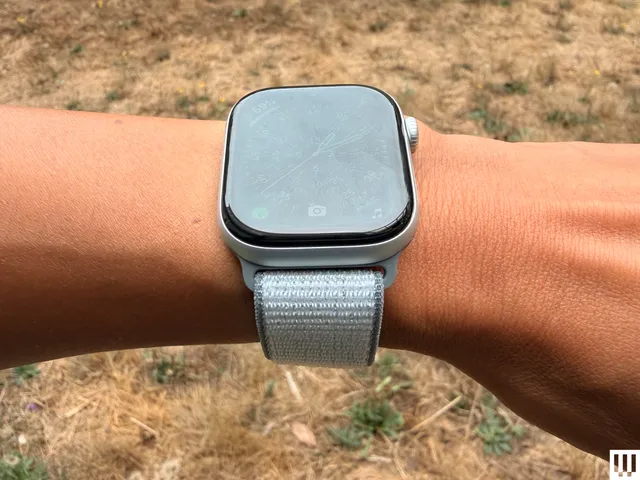
When you buy your Apple Watch, you get to choose a band at checkout. I find textile and metal (stainless steel or titanium) bands to be more comfortable and fashionable than fluoroelastomer bands, which tend to be rigid and can irritate your skin. I love the Nike Sport Loop so much that it’s been my everyday band for six years, and I ended up buying it in two colors: navy blue and black. Made from recycled polyester, Spandex, and nylon, it’s soft, breathable, and easy to hand-wash. The Velcro pull tab makes it as adjustable as a band can get, and it’s easy to fasten with one hand. Apple doesn’t advertise any water resistance, but I’ve swum with it multiple times; after rinsing it off and letting it air dry, it looked brand new. The yarn is reflective if you’re running at night, though it is subtle.
The band comes in five colors and three case sizes, which makes it compatible with most versions of the Apple Watch. If you’re shopping for a leather band, Konsu NYC makes a gorgeous strap, too. For more recommendations, check out our Best Apple Watch Bands guide.
Best Charging Stand
Advertisement
The Nomad Stand One Max is a splurge, costing even more than reviewer Simon Hill’s top pick (the Belkin 3-in-1 Qi2 Charging Stand), but its minimalist design is arguably worth the extra spend. It’s compact enough that it doesn’t overcrowd a nightstand, and with the cable tucked away, it looks sleek. It’s also one of our favorites for fast Apple Watch charging, along with Qi2 25-watt charging for iPhones and MagSafe devices. The angled charging pad supports your phone in either portrait or landscape orientation, and the Apple Watch puck allows for Nightstand mode. It comes in three colors and includes a durable, braided 6.6-foot USB-C cable. The only downside is that there’s no included power adapter. Nomad’s 40W Slim Power Adapter ($25) is an easy add-on, but it does increase the cost of an already pricey charger.
Best Portable Charger
Anker
MagGo Power Bank for Apple Watch
A fully charged Apple Watch should last all day, but since I don’t always remember to top it up, I always carry a power bank for backup when I’m out. WIRED reviewer Simon Hill—who specializes in smartphone accessories—says the compact Anker MagGo Power Bank is the best portable Apple Watch charger. It can deliver 5 watts and supports Nightstand mode. It has a 10,000-mAh battery capacity, and its built-in USB-C cable and USB-C port offer up to 30 watts to your phone or small device. Plus, it comes in white, black, teal, and pink for whimsy.
Advertisement
Best Apple Watch Case
Unlike a phone, a watch is worn on your wrist, so every millimeter of real estate counts. If all you want is a thin, affordable, and attractive bumper that will protect your watch from bangs and scratches throughout the day, this is my favorite. It’s made from a matte thermoplastic urethane (TPU) that is extremely thin and fits a 41-mm watch well. I have and like the dark green color, but reviewers say the lighter colors show dirt very easily, so I would stick with darker shades.
Connecting a single power cord turned into a lucrative all-nighter
ON CALL “I can’t stand it, I know you planned it, I’m gonna set it straight, this Watergate” is the opening of the Beastie Boys classic Sabotage, a fact we mention as it will soon become pertinent to today’s edition of On Call, The Register’s weekly reader-contributed column that shares your tech support stories.
This week, meet a reader we’ll Regomize as “Wade” who in the mid-1980s made a crust by programming in Pick – the minicomputer OS entangled with a database that On Call wrote about last year.
Advertisement
Wade told us that he used Pick to write the software that powered a mail order business, before moving on to greener pastures.
Several years later, in early 1990, Wade’s mail order boss called him at home in the evening.
“He had fired the clerk who did all the work in application I wrote,” Wade explained to On Call. “They entered orders, sent purchase orders out and arranged customer dispatches.”
It sounds like the clerk and the mail order company parted ways on bad terms, as this was a “You have an hour to pack up your stuff and leave” affair.
Advertisement
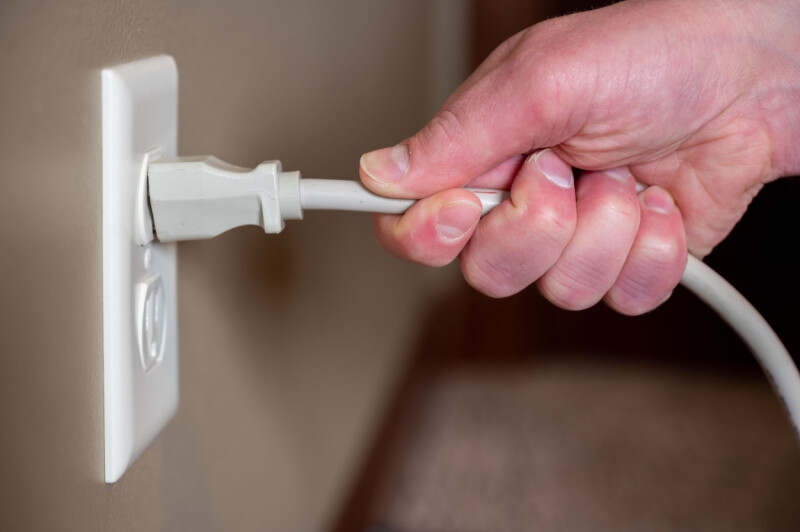
“That was unwise,” Wade wrote. “The clerk used that time to sabotage the system … or so she thought, by unplugging it while it was printing the day’s orders.”
When the mail order magnate realized the machine was down, he panicked and called Wade – who despite being rather surprised by the summons showed up and realized the first thing to do was plug the Pick machine into a power socket.
“I spent a couple of hours booting it up, checking all the data and restarting the print run.”
Wade told On Call his old boss was more than happy.
Advertisement
“The loss of a night’s sleep was recompensed by the fee I charged,” he wrote.
Has someone you’ve forgotten asked you to rescue their tech? If so, click here to send your story to On Call. We promise not to sabotage it if we give it a run on a future Friday. Or as the Beasties put it: “But you, I’m out and I’m gone. I’ll tell you now, I keep it on and on.” ®
Usually, the name ‘Famicom’ and the associated Nintendo Entertainment System (NES) don’t exactly bring to mind downloadable content and online services. However, at least in Japan, a modem add-on for the Famicom offered those features. Released in 1988, the Family Computer Network System (FCNS) offered all that using its modem to dial into Nintendo’s servers. Recently, [Throaty Mumbo] got his mitts on one of these units to try and see what you can still do with it in 2026.
Voiding that Nintendo warranty. (Credit: Throaty Mumbo, YouTube)
Although only mildly successful in the Japanese market, Nintendo still sold 130,000 of these modem add-ons, with tens of thousands of users for the stock brokering, banking, and Super Mario Club services offered. The experiences with the FCNS would form the foundation for Nintendo’s Satellaview for the Super Famicom and from there into today’s Nintendo Online offerings.
Of course, the main challenge with reviving the FCNS in 2026 is that the remote servers were turned off decades ago, along with the minor detail that to do anything with it you need to insert a special card. This was missing in the used version that [Throaty Mumbo] bought, but fortunately he got a workable Super Mario Club card. The next struggle? He doesn’t speak Japanese, so it took a while to eke out the details.
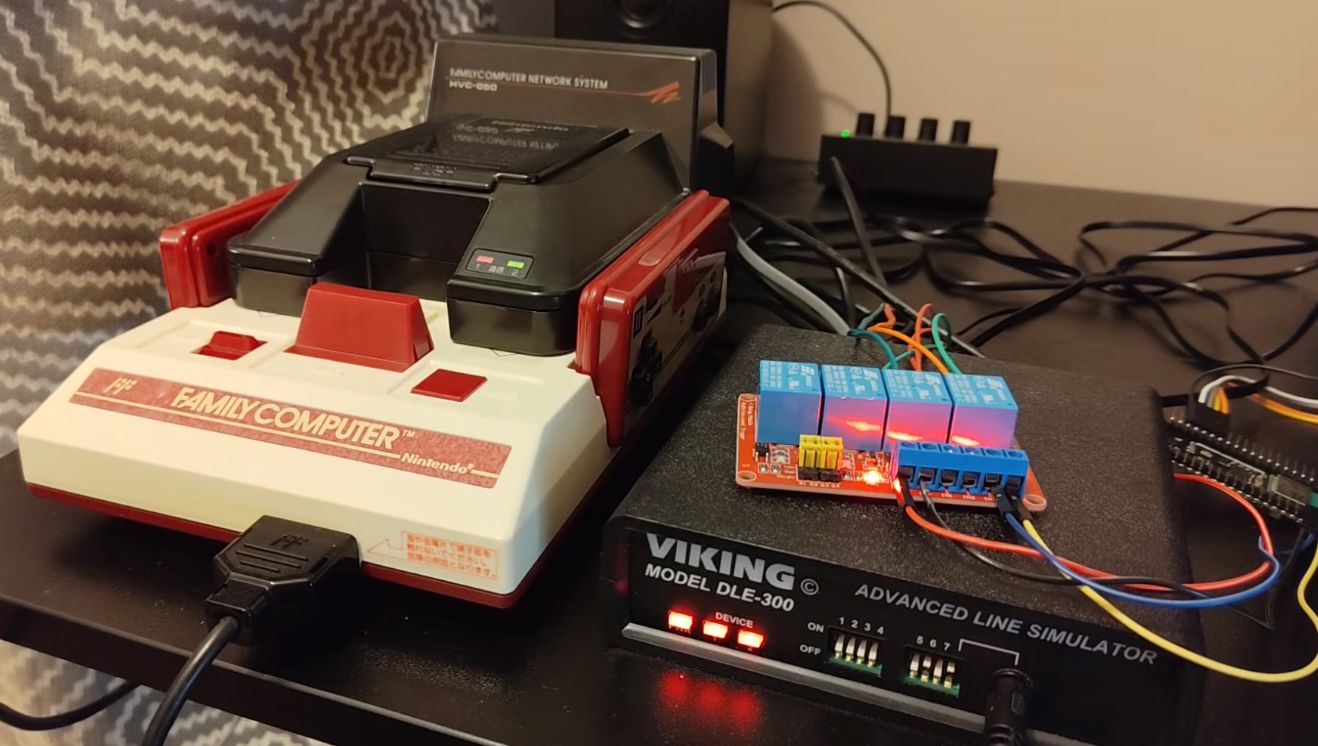
With a phone line simulator, it’s at least possible to try to have the FCNS try to dial, but that only throws another error. Ultimately it turned out that the FCNS uses NTT’s proprietary DDX-TP (in Japanese) protocol, which isn’t really documented outside of some Japanese sources. This is where the NES Dev site and its forum thread full of FCNS enthusiasts proved essential, as they had already done all the reverse-engineering.
All it took to make the Famicom go online again. (Credit: Throaty Mumbo, YouTube)
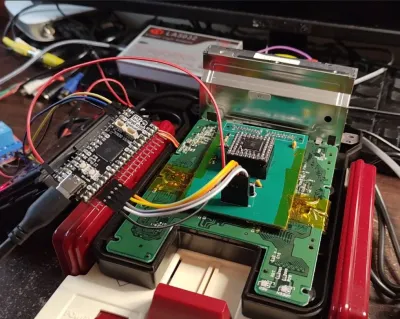
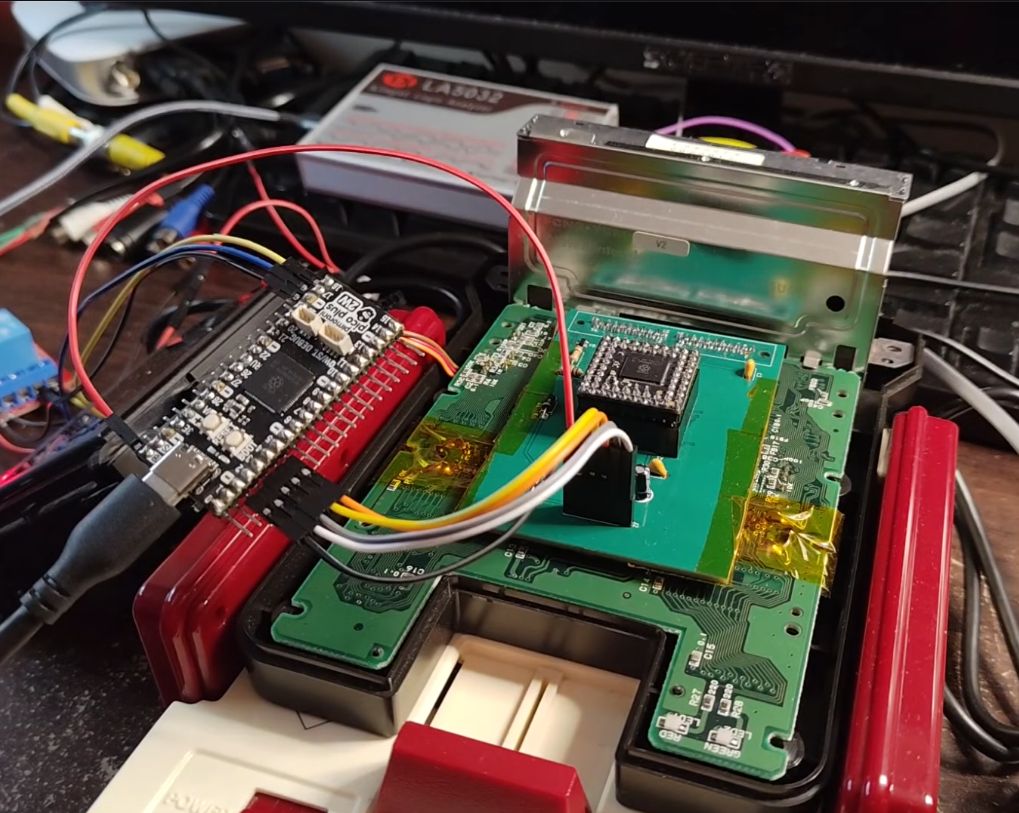
NES Dev user [Ben Boldt], for example, made a DIY version of the FCNS access (tsuushin) card that lets you configure its details. For development, the PLCC-based CPLD was a bit of an annoyance, so the FCNS got somewhat modified along the way for more direct access.
After five months of work, he was finally able to connect the Famicom via the FCNS and a telephone line simulator for some Super Mario Club action. This connects to the SMC Server simulator on the PC, with the detailed manual that comes with the access card helping a lot.
Advertisement
After all this, the Super Mario Brothers game was graced with a game patch that allows for network-based SMB two-player action. This adds a ‘dial’ and ‘answer’ option so that the two Famicoms can connect and commence the two-player session. Although one can question the latency this would entail without a direct POTS connection as here, it is definitely a nifty demonstration of what ultimately would become the multiplayer gaming on Nintendo consoles today.

















-Reviewer-Photo-(no-border)-SOURCE-Simon-Hill.jpg)


































You must be logged in to post a comment Login