If the name Motorola isn’t already in your smartphone lexicon, then you’ve been missing out on terrific Android devices from one of the most legendary tech brands. In fact, it practically invented the industry, having unveiled the world’s first cell phone in the 1970s (respect!). From ethe DynaTAC in the 1980s, to the StarTAC of the nineties, and the Razr in the early aughts, Motorola’s phones have been the epitome of what’s cutting-edge and fashionable. And let’s not forget that iconic “Hello, Moto” jingle. More than 50 years later, Motorola (now part of Lenovo) is still producing some of the best phones you can buy, including top-quality budget models to sleek, premium foldables. Heck, we even have a whole buying guide dedicated to Motorola phones.
No smartphone is one-size-fits-all, which is why Motorola offers a wide range of options to suit whatever you’re seeking. Even better, you can save big on a new Motorola device by snagging a Motorola discount code or using a Motorola coupon code, including our pick for the best flip phone (Razr Ultra 2025 and 2026) and best budget phone (Moto G 2026). With phone costs rising due to a global memory shortage, these savings can make a big impact on your purchase. Here’s where to find a Motorola coupon code to save on a new smartphone.
Unlock Motorola Coupon Code Savings on Razr, Edge, and Moto G Devices This August
Whether it’s the sexy and compact Razr Ultra foldable or the budget-friendly Moto G Power, be sure to take advantage of these offers (no code required; discounts are automatically applied at checkout). And Motorola will even throw in free shipping.
You can save $700 on the flagship Razr Ultra (2025) with a whopping 1 TB of storage, one of the best folding flip phones. Our current pick for the best small Android phone (and the best Motorola phone overall last year, the Razr Ultra has a gorgeous finish that harks back to the original (and highly coveted) Razr. The 4-inch exterior OLED display is more useful than it looks for at-a-glance info, but when opened, the 7-inch internal AMOLED screen rivals the XL variants of non-folding smartphones in size and picture quality. The Razr Ultra is very durable yet fits easily inside a pocket—a must on any fashionista’s shortlist. While it isn’t Motorola’s latest flagship flip phone, our testing found no major differences between the 2026 and 2025 models in performance or specs. So you’re getting a premium device for half the price. This deal ends December 31, 2026.
Advertisement
Motorola
Razr Ultra (2026)
Motorola
Moto G Stylus 5G (2024)
Advertisement
Save $100 on the Moto G Power With a Discount This Month
Sure, cheap Android phones are aplenty, but you get what you pay for. Not with Motorola: The company has perfected budget phones that don’t suck, like the Moto G Power. While the 2026 model is our current pick for the best budget Android phone, you should also look at its predecessor, which is currently $100 off. There’s much to love about this phone: It has the same processor as the 2026 model, with performance suitable for everyday use and lightweight games. The large 6.8-inch display is bright and easy to read, the battery is long-lasting, and it has an IP68/69 rating to survive storms and even accidental submersions. But it one-ups its newer sibling by offering wireless charging. Other things we appreciate include a microSD slot to expand storage (a godsend since the onboard memory is a bit small), a capable camera system, and a headphone jack—a rarity in phones these days. If you act fast, Motorola is sweetening the deal with an extra $20 off if you trade in a qualified old phone and a Moto Tag Bluetooth tracker.
Save on the Motorola Razr and Razr+ Without a Coupon Code
Although Motorola isn’t discounting its newest devices, it’s offering incentives to add more value. In addition to free shipping, the company is including gifts with the purchase of a Razr, Razr+, and Razr Fold—no Motorola coupon code required.
The Razr is WIRED’s recommendation for the best budget folding phone. Our reviewer enjoyed their time with the flip-style device, finding performance to be very good and was able to last through a day of use. It’s amazing you can get a quality foldable for under $1K. If your wallet allows, the Razr+ offers a larger outer screen and faster processor. Motorola is gifting a free Moto Watch and Moto Tag tracker with purchase of the Razr+, while Razr buyers will get a pair of Moto Buds 2 Plus headphones and a Moto Tag. And, a qualified trade-in could knock as much as $300 off the Razr+ MSRP or $150 off the Razr.
If very large screens excite you, the new Razr Fold is your kind of phone. This book-like foldable opens to reveal an 8.1-inch screen—perfect for multitaskers—and thanks to a 6,000-mAh battery, it can last you almost three days before it needs to be recharged. The camera system is strong, and Motorola is including seven years of software updates. The Fold is one of Motorola’s pricier premium models, but you’ll get a Moto Watch, Moto Buds Loop headphones, and a Moto Tag, plus up to $300 off with a qualified trade-in.
Advertisement
Save More on the Motorola Edge Without a Coupon Code
While the folding phones are about going big, the Motorola Edge is about being small. The 6.3-inch screen is standard, but at 0.28-inches thin and weighing 5.66 ounces, the Edge is incredibly lightweight and compact, as our reviewer discovered. This phone is made for people who don’t want anything intrusive, but still capable of doing all the things a good smartphone should. Act now and you can score a free Moto Watch and Moto Buds Loop.
Motorola
Razr Ultra (2025)
Motorola
Advertisement
Moto G Stylus 2025
Service Members & Veterans Get Extra Motorola Savings With a Military Discount Code
Military members are entitled to a 10% discount on any non-discounted Motorola phones and accessories. The offer applies to active, veteran, retired, and reservist members, and it can be used across Motorola’s online store. To receive a Motorola promo code, log in to ID.me to verify your eligibility. This offer expired on December 31, 2026.
Motorola
Moto G Stylus 2026
Advertisement
How to Fix Motorola Coupon Code That’s Not Working
Many of these Motorola deals are automatically discounted at checkout (just double-check the total and make sure you can’t find better competing deals at Amazon, et al.). For those that require a coupon or Motorola promo code, enter it on the checkout page where it says “apply coupon.” But what if the coupon doesn’t work? First, make sure you review the product exclusions, expiration dates, and minimum order values. Some offers, like the military discount code, only apply to non-discounted phones.
Next, check that you aren’t stacking multiple Motorola promo codes. If you’re still encountering an error, make sure the code is typed in correctly. Lastly, try clearing your browser’s cache or visit the site through an incognito window if the cart refuses to budge. Ultimately, it could mean the Motorola discount code has ended.
Autonomous systems that can reason, make their own decisions, and execute actions across an environment introduce a category of risk that application-level controls were never built to contain. Treating that risk as a single problem produces incomplete architectures, says Oscar Wahlberg, senior director of product management at Nutanix.
“The guardrails to catch a malicious prompt won’t stop an agent from hallucinating and doing something it never should have done, like accidentally deleting databases or leaking sensitive data with a credential it was granted but then uses for something entirely different,” Wahlberg says. “That’s the central problem as enterprises move autonomous agents out of experimentation and into production.”
Once an agentic system is granted execution privileges across the data center, the security posture has to scale into a defense-in-depth architecture spanning infrastructure, storage, compute, networking, and a governing control plane. Each layer addresses a distinct category of risk, rather than duplicating the same controls across the stack. No single security control or vendor can provide that protection on its own. Defense-in-depth depends on those layers working together.
Advertisement
By dividing the responsibilities across the stack and adhering to zero trust segmentation, organizations can create a secure framework that improves their overall posture. Understanding which risks belong in each layer is what turns the principle of defense-in-depth into a practical security framework, with three layers that each have a distinct responsibility.
Infrastructure layer: Establishing trust where AI agents run
The infrastructure layer’s foundational responsibility is establishing a root of trust that answers a simple question: who is operating in the environment? That trusted identity becomes the prerequisite for every security control above it. Before an organization can trust what an agent does, it first has to trust the integrity of the environment where the agent runs. When an agent requests permission to execute an operation, the system must be able to verify that the request came from the legitimate agent — not something impersonating it.
Delivering that kind of assurance depends on technologies that root trust in the hardware itself, including platform attestation, confidential computing, and secure boot, alongside controls that prevent unauthorized access both within a server and beyond it. For regulated industries such as financial services, this layer provides the ability to isolate AI production workloads so that neither the agent nor the environment can operate outside its assigned scope. That mitigates risks including model and runtime tampering, supply chain compromise, and unauthorized access to sensitive AI workloads.
Network layer: Governing how AI agents communicate
Once agents begin communicating with other agents, APIs, applications, and enterprise systems, they generate a level of concurrency and dynamic communication that traditional static network configurations were never designed to handle. An agent configured to call APIs, query data sources, and spin up additional agents without constraint creates a sprawling web of east-west traffic that becomes very difficult to reason about, and that complexity can easily mask lateral movement or data exfiltration when the right network security layers are not in place.
Advertisement
“We should treat AI agents as a new class of network identity, and make sure that an agent can only talk to other agents or data sources where it’s explicitly allowed to do so,” Wahlberg says. “That means moving away from rigid static rules toward dynamic policy enforcement.”
Nutanix’s solution is Agent Gateway, part of the Nutanix Agentic AI solution. It’s a unified, governed layer that is designed to provide cost control and governance capabilities to help manage autonomous agent users. Coupled with agents grounded in zero trust segmentation and using capabilities like Nutanix Flow for micro segmentation and integrating with networking vendors, including its integration into the Cisco Secure AI Factory, Agent Gateway helps enterprises govern interactions across agents, models, data sources, and enterprise applications.
The network layer governs lateral movement, data exfiltration, and gates the agent’s network interactions. A zero trust framework with access blocked by default and scalable interaction monitoring is important for agents since they can exhibit unreliable behavior. The Nutanix software integration with Cisco UCS servers and Cisco AI PODs delivers the turnkey physical infrastructure (compute, storage, and networking) that the AI factory runs on.
Control plane layer: Governing what AI agents are permitted to do
The control plane is the brains of the operation, providing a central point for managing agent permissions, tool access, resource consumption, and runtime visibility. What matters most is having a single place where policies can be enforced consistently rather than reinvented for every agent, Wahlberg says.
Advertisement
“Agent Gateway acts as a universal endpoint for different models and tools, so an IT team can configure their agents to talk to this single control point,” he explains.
The centralized AI gateway enables the admin to observe, audit, and control access to models as well as MCP tools protecting data and gating privileged access. This layer is designed to help mitigate risks such as privilege misuse, runaway agents, unauthorized tool usage, data leakage, and the excessive model consumption that can lead to increased token consumption when agents get stuck in runtime loops. And it depends on treating governance as a runtime control system rather than a compliance afterthought.
Why one-size-fits-all security fails agentic AI environments
The biggest architectural mistake enterprises make is assuming a single security model can be stretched across every layer of an AI stack. When an organization tries to solve for hardware-level trust with application-level software, or leans on static legacy network rules to manage dynamic agents, it builds an architecture that either blocks the agentic system from doing its job or leaves critical doors wide open. One-size-fits-all thinking tends to produce significant performance penalties and operational friction.
“By failing to assign specific responsibilities to the appropriate layers, enterprises end up with blind spots in governance,” Wahlberg says. “They might secure the model output but miss that there’s data leakage between agents, or they might secure the network but lack the control plane visibility to understand that they’re wildly burning tokens because the agents are stuck in some kind of runtime loop.”
Advertisement
Focusing exclusively on the model leaves the largest gaps of all, because a guardrail that catches a malicious prompt does nothing to stop a hallucinating agent from misusing a legitimate credential. Embedding security across the full stack helps ensure that even when a model level threat slips past the initial filters, the agent remains constrained by hardware rooted trust, network isolation, and access controls at the agent layer.
How Intel, Cisco, and Nutanix build defense-in-depth together
The three-way partnership from the three companies demonstrates how the layered architecture comes together in practice as a well-governed, enterprise-grade AI Cloud. Intel supplies the computer to run agentic workloads and secures the execution environment through hardware-rooted trust and confidential computing, while also driving costs down through their accelerators. Intel Xeon 6 processors with built-in AMX accelerate AI inference efficiently without relying exclusively on expensive GPUs.
Cisco wraps the environment in a secure fabric that governs communication between agents and enterprise tools, while Nutanix provides the software platform, minimizing architectural silos, and the central control plane that enforces permissions, delivers visibility and cost governance, and ties the architecture together into a defense-in-depth solution that lets enterprises scale agentic AI.
Of the three layers, enterprises currently underestimate the control plane the most, Wahlberg says. A true control plane extends far beyond initial deployment to simplify Day 2 operations, he explains, giving IT teams the continuous observability, and strict token governance required to keep autonomous agents secure and cost-effective in production.
Advertisement
“Apart from model and tool selection, governing the agent deployments and their access to models and business tools in a tightly integrated full stack platform will be important for the success of AI projects,” he says, pointing to a near future in which organizations move from a handful of AI use cases to thousands of agents working autonomously to drive the business.
Technology leaders should prioritize building a centralized governance layer today that can manage agent identities, tool permissions, and token budgets in real time, because that control point is what builds the operational muscle to scale safely.
“You can’t build an AI system without getting into a lot of complex decisions,” he explains. “And you need a control plane that talks across multiple vendors and infrastructures to help you solve for those defense-in-depth strategies.”
Learn more about the Nutanix Agentic AI solution here.
Advertisement
Sponsored articles are content produced by a company that is either paying for the post or has a business relationship with VentureBeat, and they’re always clearly marked. For more information, contact sales@venturebeat.com.
A Kentucky-based glass plant is poised to become a much bigger piece of the iPhone supply chain, with hundreds of both long-term and temporary jobs expected as production ramps up.
Apple has been getting glass for iPhone for 20 years from Kentucky. Specifically, in Harrodsburg, Kentucky, where the tech giant plans to expand manufacture the glass for every iPhone and Apple Watch.
Apple COO Sabih Khan and U.S. Secretary of Commerce Howard Lutnick toured Corning Inc. on Friday. The tour comes one year after Apple had invested $2.5 billion more in Kentucky, hoping to double plant jobs and triple its current output.
“Made in Kentucky. Made in America. Sold around the world,” U.S. Rep Andy Barr said during the tour, according toThe Lexington Herald-Leader. “We invent it here. We have the talent, and we have the manufacturing heritage. We will build it here, and we will sell it to the world.”
Advertisement
“I want Kentucky to be the first place companies think about when deciding to make their next major American investment.”
The plant currently has 350 employees, but hopes to employ 200 new hourly production jobs, alongside a handful of salaried employees in glass development. That’s not quite double the existing 350, but that’s because Corning was including construction jobs in that total.
However, Apple and Corning are planning to build a new Apple-Corning Innovation Center at the site. It is believed that construction will create 100 jobs, but those won’t last.
“At Apple, we share the administration’s commitment to producing more of the most innovative technology right here in the United States,” said Khan.
Advertisement
“We’re expanding our U.S. supply chain, and we will continue to build on these efforts because at Apple, we believe in the power of American innovation. We believe in the ingenuity of American workers, and we believe deeply in the promise of America.”
The Apple-Corning Innovation Center may be similar to Apple’s Advanced Manufacturing Center in Houston, though likely at a smaller scale.
If you are stuck with the same five prestige dramas everyone’s already talking about, here are three that got criminally overlooked. For this weekend, we have a yakuza thriller, a finance drama, and a televangelist saga that still delivers after four seasons. All three underrated shows are streaming right now on HBO Max, and deserve a spot on your watchlist. If you don’t have the time or the appetite to commit to multiple seasons, I have created a list of the best limited series on Netflix that’s worth checking out.
Jake Adelstein (Ansel Elgort) talks his way onto a Japanese newspaper’s crime desk in the late ’90s, then keeps pulling threads until he’s tangled up with actual yakuza. Detective Hiroto Katagiri (Ken Watanabe) half mentors him, half tolerates him, and their partnership carries the whole show. Underneath the neon and the subtitles, this is really a story about how far someone can go for a byline.
Michael Mann directed the pilot, setting a gorgeous, moody, authentic tone that you can feel in every frame. The secret weapon here is Show Kasamatsu, who plays a rising mobster with incredible charisma. This show on HBO Max has two tight seasons, zero filler, and an ending that actually reaches a resolution.
Harper Stern (Myha’la Herrold) and Yasmin Kara-Hanani (Marisa Abela) fight for a handful of permanent jobs at a London investment bank, and every day on the trading floor is an absolute knife fight for survival. They drown their grueling late-night hours in substance abuse, complex office politics, and deeply terrible relationship choices. The show is also about what ambition does to people who never learn to stop.
What got me hooked wasn’t the finance jargon; it was watching characters make self-destructive choices and finding myself still rooting for them. I’ve recommended this to friends who work in soul crushing jobs, and they texted me mid-season one saying, “this is too real.” Four seasons in and a fifth already confirmed, this thing keeps getting sharper instead of running out of ideas.
Genre: Comedy, Drama IMDb: 8.0/10 Rotten Tomatoes: 91%
Eli Gemstone (John Goodman) tries to keep his three deeply flawed adult children from tearing apart the megachurch empire he built. Jesse (Danny McBride), Judy (Edi Patterson), and Kelvin (Adam DeVine) spend four seasons scheming against each other and occasionally the whole family at once. It’s a dark comedy about how faith and greed end up looking identical once enough money gets involved.
Advertisement
I put off watching this for years, assuming it was just Danny McBride yelling for four seasons, but the show proved me wrong. He channels pure satirical genius here, delivering funny moments without dropping the narrative. There is also a real tenderness buried under all the chaos, which I liked. And this hidden gem on HBO Max wrapped up with a perfect critic score on the finale.
President Trump awarded the four-member Artemis II crew the Congressional Space Medal of Honor and signed an executive order directing the creation of a new U.S. Space Academy. The proposed academy would train engineers, scientists, technicians, operators, and astronauts for NASA, the Space Force, and the commercial space industry. Houston Public Media reports: The Artemis II crew — NASA’s Reid Wiseman, Victor Glover, Christina Koch, and the Canadian Space Agency’s Jeremy Hansen — retraced history as they flew around the moon and back in April, the first time humans have been in lunar territory since the 1970s. He had previously hosted the crew members at the White House following their mission and called them during the mission while the crew was tens of thousands of miles away. “The one thing that really sticks out to us [from that call] is you said how proud you are and how proud our nation is for the job that we’ve just accomplished,” Wiseman said during Friday’s ceremony. “And for us, that is what we set out to do. We wanted to inspire this nation to learn.”
During the ceremony, Trump also signed an executive order to create the “United States Space Academy.” Under the order, a Presidential Commission on the U.S. Space Academy has 120 days to create a report with guidelines for the U.S. Space Academy. The Commission will include NASA Administrator Jared Isaacman as its Chair, as well as other NASA and space officials. Secretary of Defense Pete Hegseth, Trump’s Chief of Staff Susie Wiles, and Michael Kratsios, assistant to the president for science and technology. In effect, it allows the Trump Administration to build the U.S. Space Academy to its liking. “It will serve both the United States Space Force as well as NASA and the civilian spaceflight industry,” Trump said. “And it will attract, train, graduate the very best that our nation and our nation really has to offer.” As for where the academy will be located, Trump said he was “going to be choosing a location very shortly.”
Your email address is one of the easiest ways for websites and advertising companies to identify you online. If you provide the same address to multiple websites, it can potentially be used to connect your activity across different services.
Brave is now trying to limit this type of tracking. Starting with desktop version 1.94, the browser has added Email Aliases, which let users provide websites with a different email address instead of revealing their primary one.
How do Brave Email Aliases work?
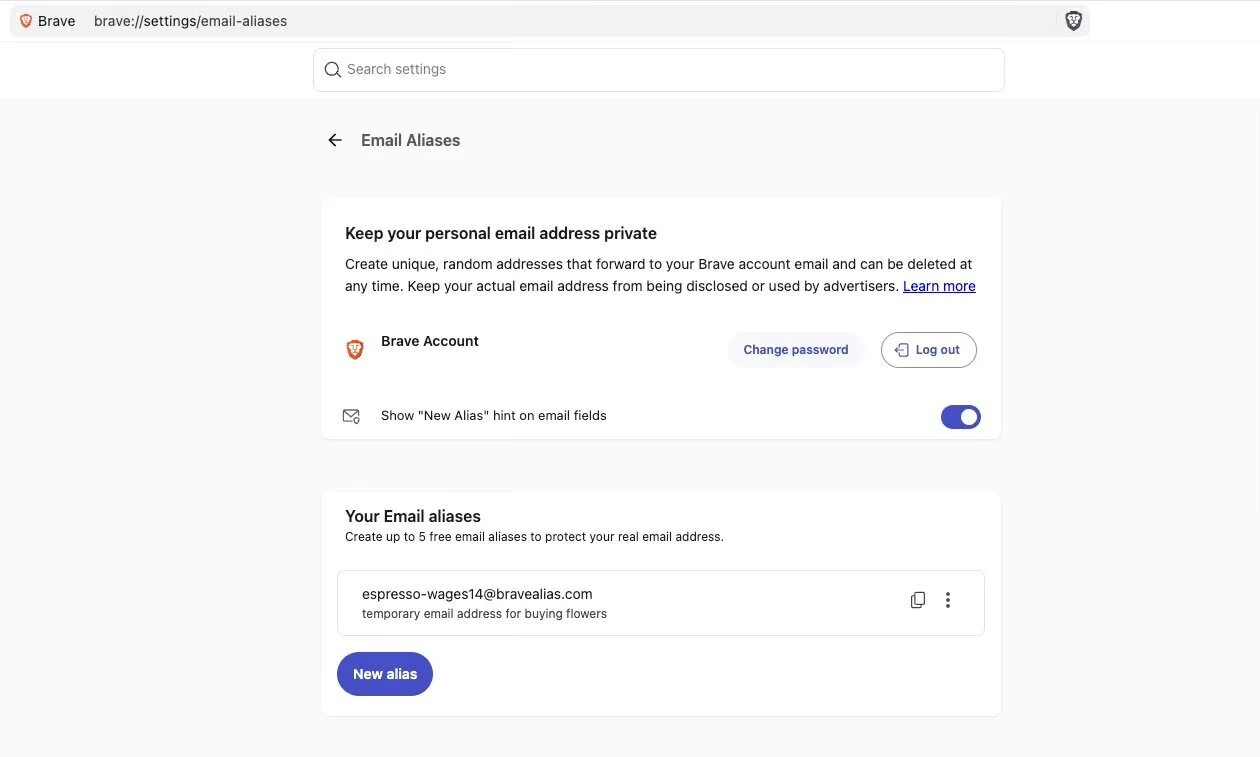
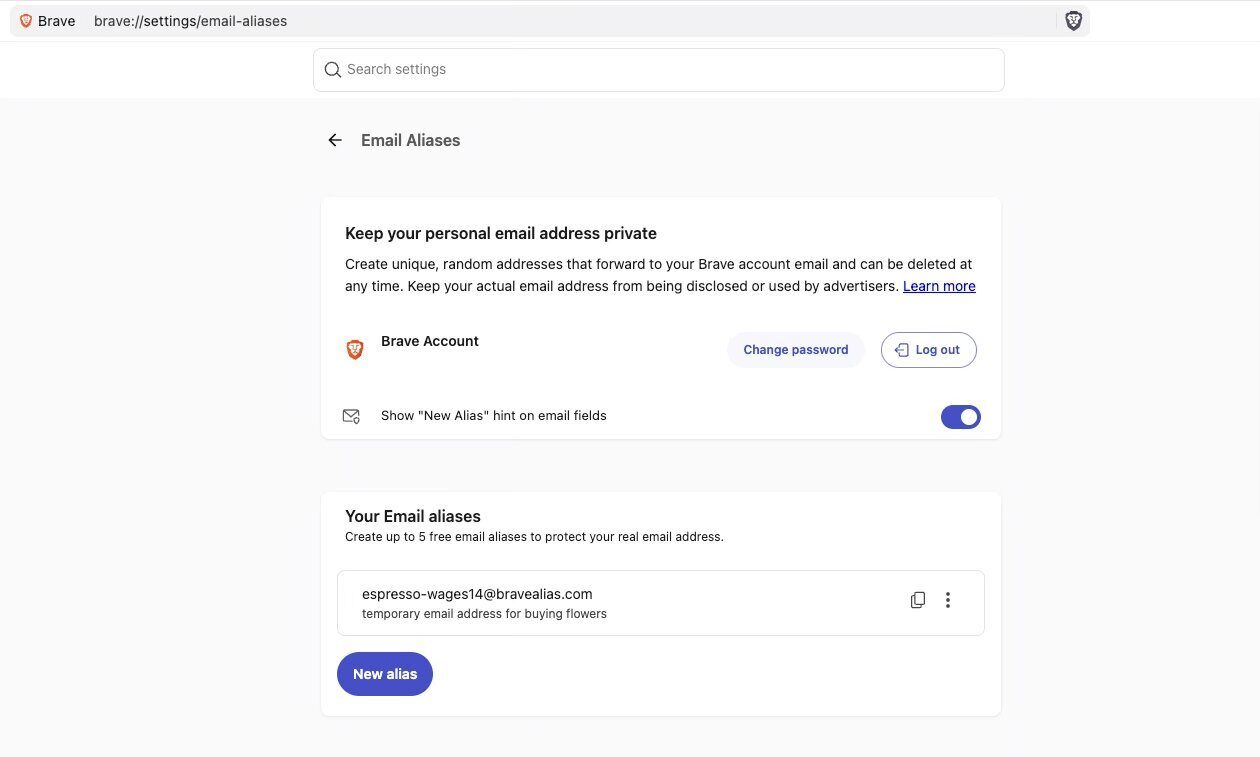
Once users create a Brave Account, they can generate an alias directly from an email field on a website. Any messages sent to this address are then forwarded to the primary email address connected to the Brave Account.
The website never receives the primary address. Companies can upload customer email addresses to advertising platforms such as Google, Meta, and LinkedIn to match them against existing user profiles. Since this matching can happen on company servers, browser-based tracker blocking cannot always prevent it. Aliases can also limit how widely a primary email address spreads if a website suffers a data breach.
Advertisement
Email Aliases setupBrave
However, Brave Email Aliases does not automatically block newsletters or promotional messages. Anything sent to the alias can still be forwarded to the primary inbox. If an alias starts receiving unwanted emails, users can deactivate it, preventing future messages sent to that address from reaching them. Brave is initially offering five aliases for free, while a Premium version and mobile support are planned for the future.
Brave is not the first browser to do this
Email aliases themselves are nothing new. DuckDuckGo Email Protection already provides private @duck.com addresses that forward messages to an existing inbox. It can also remove supported email trackers before forwarding them. Firefox Relay provides a similar service and can generate email masks through Firefox. Its free tier currently supports up to 50 masks.
Brave’s advantage here is having another privacy feature built directly into its browser. The company recently added Containers to separate accounts, cookies, and browsing sessions. Email Aliases now give users another way to keep information shared with different websites separated.
Tim Draper is selling his island in Lake Tanganyika for $7.9M or best offer, announcing it himself on X and inviting offers directly by email. The ECB reported this month that EU venture capital funds hold around 150B euros against roughly 930B euros in the United States.
Tim Draper is selling his island in Lake Tanganyika, Tanzania, for $7.9M or best offer. “Gorgeous place, but we don’t use it enough,” the venture capitalist wrote on X on Friday.
There is no broker and no listing. He is taking offers at his own work address.
The location is not the usual trophy. Lake Tanganyika is the longest freshwater lake in the world and the second deepest after Baikal, and it is shared by Tanzania, the Democratic Republic of Congo, Burundi and Zambia.
Advertisement
Draper is commonly described as a SpaceX and Tesla investor. Both were positions at Draper Fisher Jurvetson, which he co-founded and where his partner Steve Jurvetson led the deals.
The cheques most often called his are elsewhere. Skype, Hotmail, Baidu and Coinbase all sit on his own list.
His best known purchase was not a company at all. He won nearly 30,000 bitcoin at a US Marshals auction in 2014, worth roughly $19M at the market price that week, and has said he did not sell.
Which makes the asking price modest by his standards. It is a reminder of what one early cheque is worth twelve years later, and of who gets to write them.
Advertisement
Europe published its own number this month. EU venture capital funds hold about 150B euros against roughly 930B in the United States, the ECB found, around six times as much.
The shortfall is not even. It widens in later rounds, where companies need the largest cheques.
European scale-ups lean on money from outside the bloc. The ECB flags the risk that successful startups move to where the capital is.
The most uncomfortable finding is about companies nobody funds. Among firms without venture backing, the median EU firm is nearly twice the size of its American equivalent by employment and grows about 15 percentage points faster. Brussels published a Startup and Scaleup Strategy last year promising to widen the pipe.
Advertisement
The composition has not shifted either. The share of European venture going into software and IT services has stalled since 2020.
The people inside those companies own less of them. Employees at late-stage European startups hold roughly half the equity their American counterparts do.
None of which is Tim Draper’s problem. He is selling an island for less than half what one lot of bitcoin cost him in 2014, and Europe’s founders are short 780B euros.
L-R: OnTrade co-founders Zachary Harl, chief investment officer; Raji Subramanian, CEO; and Matt Williams, president. (OnTrade Photos)
The co-founders of Pro.com, the Seattle-based home-improvement marketplace acquired by Opendoor in 2021, are back with a new company targeting what seems on the surface a very different kind of market: AI-powered software for the wealth management industry.
But Rajalakshmi “Raji” Subramanian and Matt Williams say the new challenge matches the same pattern: a huge industry held back not by a lack of customers, but by a shortage of professionals and tools.
Their Seattle startup, OnTrade, co-founded with former Bank of America chief investment officer Zachary Harl, has been operating under the radar since 2024, raising an undisclosed amount of funding from General Catalyst, Madrona and angel investors.
OnTrade’s chief technology officer is Jean Bredeche, who co-founded Quantopian, the algorithmic trading platform, and later served as a director of engineering at Robinhood.
How it works: OnTrade connects software that financial advisors already use — including CRM, portfolio accounting, trading, and compliance programs — into a single interface.
Advertisement
It then deploys AI agents to handle the type of work that advisors have traditionally done manually, such as scanning portfolios for tax-loss harvesting opportunities, flagging accounts that have drifted from their targets, or drafting proposals and reports for clients.
The humans approve everything before it reaches a client. The idea is to help them serve more clients without sacrificing the quality of their work, expanding access to wealth-management services that tend to be concentrated among more affluent households.
“Wealth management, if you look at the industry, does not have a demand problem; it has an access problem,” said Subramanian, the company’s CEO, in an interview. “Many people who’d like access to wealth management don’t have access to wealth management, and that’s what we’re here to solve.”
Harl, OnTrade’s chief investment officer, called raw foundation models the “brilliant PhDs” of the AI world — impressive on paper, but not as valuable to a specific industry such as wealth management until they understand its portfolios, policies, compliance rules, and client relationships. Vertical AI solutions like OnTrade, he said, are better positioned to connect that general-purpose intelligence to a specific firm’s data and workflows so the technology can do trusted work.
Advertisement
Industry shakeup: OnTrade is emerging at a pivotal moment, two days after investment giant Vanguard agreed to acquire wealth-management platform Altruist reportedly valued at $4 billion. OnTrade’s founders cite the deal as validation of the vertical AI opportunity they’re pursuing.
In a LinkedIn post Thursday, Subramanian wrote that the Vanguard-Altruist deal signals something bigger than a battle over where advisors park their clients’ assets: that capturing the opportunity “requires a new operating model rather than AI-enhanced versions of today’s applications.”
The wealth management industry’s unit of scale, she wrote, is shifting “from the number of people a firm employs to the intelligence and agency it can deploy.”
The founders: Subramanian joined Amazon in the late 1990s as an early engineer who helped build Amazon Marketplace and AWS, and later led the digitization of books for Kindle.
Advertisement
Amazon was where she met Williams, who had founded a startup called LiveBid that Amazon acquired in 1999. He spent 11 years there, including a stint as a technical advisor to Jeff Bezos, then left to run Digg as CEO and served as an entrepreneur in residence at Andreessen Horowitz.
Subramanian went on to run engineering at Yahoo Finance, where she helped open up market data that had previously been the province of institutional investors, giving her an early look at the problem that OnTrade is now aiming to solve.
In 2013, the two co-founded Pro.com, a tech-driven home improvement marketplace that raised early funding from investors including Madrona, Maveron, Bezos and Andreessen Horowitz.
Real estate tech company Opendoor acquired Pro.com in 2021, and brought both founders on as executives — Subramanian as chief technology officer, Williams as head of the Pro.com unit and senior vice president of retail.
Advertisement
Harl spent many years at Bank of America, rising to chief investment officer, where he managed the bank’s asset portfolios and large balance sheet risks across multiple market cycles. He is a chartered financial analyst (CFA), with a math and computer science degree from Indiana University, and a statistics degree from the London School of Economics.
He served on the U.S. Treasury Borrowing Advisory Committee under Secretaries Steven Mnuchin and Janet Yellen, advising on debt management, before joining Opendoor in 2023 as chief risk officer. That’s where he met Subramanian and Williams, before making the startup leap with them.
Traction and competition: The company’s technology is already in use at firms ranging in size from boutique advisories to large national practices, said Williams, the company’s president.
He said one client used the platform to win a billion-dollar family office account, and that another recouped the full annual cost of the platform in less than 30 days. He called that “a small window into what’s going to happen on a larger scale.”
Advertisement
The wealth management software market has many established players — such as Orion Advisor Solutions, Envestnet, and Addepar — but the OnTrade founders say they see them as partners, not rivals. OnTrade integrates with those systems rather than replacing them.
That distinguishes the company from Altruist, the Vanguard acquisition target, which built its own full stack, including its own custodian, the financial institution where client assets are held. That approach requires firms to move client assets onto its platform.
OnTrade doesn’t ask firms to replace their existing tools or move their clients’ money. Instead, it plugs into what’s already there.
The broader timing may work in their favor. As baby boomers age, an estimated $50 trillion or more in assets is expected to pass to younger generations in the coming decades — creating a wave of new clients who will need financial advisors, and new pressure on firms to serve them.
Advertisement
That’s where home improvement and wealth management have something in common.
“There aren’t many bigger places, other than health, wealth and real estate, where you can impact a population, especially an underserved population,” Williams said. “That was at the heart of the motivation.”
[soiboi soft]’s vacuum-driven dot matrix display is part suction gripper, part touchscreen, and altogether impressive. Its display capabilities are entirely shadow-based, with each pixel being made of a cavity behind a flexible silicone sheet; when the display’s microfluidic logic circuitry activates a pixel, a vacuum pump pulls the sheet inwards, creating a visible hollow.
As in previous iterations, the display’s control circuitry is built around a pneumatic “transistor”, which allows an air channel to be opened or closed by applying vacuum to a control channel. As a first test, [soiboi soft] built a 16-pixel dot matrix display. Eight control channels – four row and four column channels – are multiplexed to individually control each pixel. The transistors act like one-way valves, so the pixels hold their state, even when pressed in by hand; simply add some circuitry to read a pixel’s state, and it would be a fully-functioning touchscreen. The supporting pneumatics also got an upgrade; the solenoid valves now cleanly mount to the back of the board, and the vacuum pump connects via a Luer lock adapter.
The 3D printing used to make certain parts and silicone molds caused issues when scaling up to a 64-pixel display, however. The parts were warping, destroying the seal necessary to keep pixels “on”. To straighten them out, [soiboi soft] pressed the printed part against a flat glass build plate in a vacuum bag and annealed it at 60 Celsius for several hours. This worked quite well, particularly when slightly raised rings were printed around the area to be sealed. Once all these bugs were worked out, the display was clear and decently responsive. [soiboi soft] was able to display letters, numerals, and animations, and even able to play Pong and Snake. It won’t be setting any refresh rate records, but it was nevertheless fully usable.
Advertisement
For another approach to playing Snake with microfluidics, check out this project. If printing molds and casting silicone seems too fiddly, there are always other ways to make microfluidic circuits.
An IBM survey of 2,000 C-level executives found only 11% feel fully prepared for AI agent deployment. PromptHalo founder Madhuri Chandoor argues the core issue is distinguishing capability from authority. Her refund-splitting example shows how agents can circumvent per-action limits through sequential requests. She advocates behavioral profiling for AI agents (modeled on financial fraud monitoring) and documenting what agents can access, under what conditions, and what downstream effects are possible.
A 2026 IBM study points to questions about AI readiness, visibility, and control. The survey of 2,000 C-level technology executives found 11% felt fully prepared for the AI-agent deployment expected over the following year. Two-thirds of CIOs and CTOs said they were accountable for AI systems they did not fully control, while 70% said teams were deploying technology faster than IT could track. IBM presented the findings as an indication of a growing control gap as AI use expands across businesses.
The distinction between capability and authority is central to how Madhuri Chandoor, founder of PromptHalo, approaches that control gap. She describes PromptHalo as an AI security and trust infrastructure company that inspects why a certain action is being performed, rather than just inspecting what is being performed. According to Chandoor, the approach is intended to give organizations more contextual information about whether an action reflects user intent, assigned permissions, and the surrounding circumstances before a system proceeds.
One hypothetical enterprise database task illustrates the concern Chandoor raises about context. She says that an infrastructure-managing AI agent asked to improve application performance might add or remove an index or change the table structures autonomously in a production environment. In her example, that action could affect live transactions, customer data, or dependent processes that were outside the agent’s immediate analysis. “A technical conclusion can appear reasonable within a narrow focus,” Chandoor says. “The context, the situation, and the downstream impact still need to be considered before an action proceeds.”
Advertisement
Earlier chatbots, in Chandoor’s account, generally operated within predetermined questions and answers. She says with large language models we are now using broader company information and tools that increase the exposed risk surface, leading businesses to consider how incoming requests could influence a system. She recommends that security teams examine how a request is interpreted and what level of authority connected systems provide before an agent proceeds.
Chandoor uses a refund scenario to explain why context may span several actions. In her example, an agent may issue refunds up to $50 without human review. A user then requests ten $50 refunds rather than one $500 refund requiring review. Chandoor says each transaction could appear permissible when examined individually, while the sequence may suggest an effort to avoid the threshold. From her perspective, reviewing broader session context and behavior could help identify when escalation for human review may be appropriate.
Drawing on two decades in financial services, Chandoor compares her approach with fraud monitoring across transactions and accounts. She suggests organizations develop behavioral profiles for autonomous agents alongside the identity and access permissions. Under her proposed model, teams would review the resources an agent accesses, its use of tools, changes in its activity over time, and actions that appear inconsistent with its assigned role or the circumstances of a session.
Questions about authorization should be considered during both design and operation, Chandoor says. In her view, teams benefit from documenting the resources an agent may access, the conditions that apply to that access, and the possible downstream effects of particular actions. She also recommends observability gates to review activity, particularly to inspect and address when requests become repeated, unusually broad, or inconsistent with the purpose originally assigned to the agent. Those checkpoints, Chandoor explains, can help contain the impact and determine what additional controls are required to secure underlying systems.
Advertisement
Chandoor emphasises her position as support for responsible AI adoption. She favors using agentic automation for analysis and workflows but applying additional verification when the impact involves critical decisions and actions. “Trust, but verify,” she says.
“Businesses should adopt AI responsibly and verify its behavior throughout the process,” she says. “Establishing clear accountability ownership across the organizations for AI applications security is essential to operationalise these guardrails.” In her view, that approach may help businesses pursue AI innovation while giving security and accountability the necessary attention.
More than 50 jobs are expected to be cut in Dublin.
Roughly 160 jobs are potentially at risk at the Softbank-backed, Dublin-based automotive software provider Cubic3, as first reported by TheJournal.ie today (28 August).
According to the publication, around 70 jobs are set to go globally, with 52 of them based in Dublin. Meanwhile, the Business Post reported that 53 jobs in Dublin are expected to be cut. The company employs around 450 across 19 countries.
Redundancies are compulsory, and staff are expected to receive notice on 21 September, TheJournal.ie further reported. Cubic3 declined to provide any further comments to SiliconRepublic.com.
Advertisement
Rebranded from Cubic Telecom last year, Cubic3 provides connectivity technology to software-defined vehicles – vehicles whose core functions are software-based, not physical.
The company’s technology has been used in more than 30m vehicles to date. According to a 2024 interview, its software connects more than 480,000 cars every month.
Japanese conglomerate Softbank took a majority stake in the business in 2023 with a €473m investment that took Cubic3 to a valuation of more than €900m, pushing it past the $1bn threshold for unicorn status.
Act was an early-stage investor in the Irish business, alongside Qualcomm Ventures, Audi and Sierra Wireless. Cubic3 has also received backing from Enterprise Ireland and the European Investment Bank.
Advertisement
According to TheJournal.ie’s report, staff were told Cubic3 is facing financial struggles, including being outpriced by its competitors.
The company’s clientele, which includes global names such as Volkswagen, General Motors and Audi, are expecting more work at a cheaper price, employees told the publication.
Cubic3 was founded by serial entrepreneur Pat Phelan in 2005. In January of this year, long-term chief operating officer Shane Sorohan was tapped for the role of CEO, taking over from Barry Napier, who held the position for 17 years.
Napier earned nearly €119m from the Softbank deal, while Sorohan earned an estimated €3m and around 190 employees shared €75m.
Advertisement
Don’t miss out on the knowledge you need to succeed. Sign up for the Daily Brief, Silicon Republic’s digest of need-to-know sci-tech news.































































You must be logged in to post a comment Login