Connect with us

Tech

My housemate keeps losing their keys, so I bought them these AirTag dupes that are better value

Published

on

Bluetooth trackers have been life-changing for keeping tabs on my valuables — even for mundane items that I always seem to lose, like umbrellas — and I now can’t imagine a world without them. Options such as the Apple AirTag (first and second generations) and Samsung Galaxy SmartTag 2 dominate the sector, but thankfully there are more affordable alternatives that work just as well.

So, when my housemate kept losing their keys, I felt compelled to reveal the benefits of owning a Bluetooth tracker. That’s when I stumbled upon a deal on the Ugreen FineTrack Duo 4-pack on Amazon for 39% off and immediately bought it so I could pair one of them with the newly cut house key before handing it over.

And my housemate hasn’t lost their keys since! Indeed, I’ve found the Ugreen FineTrack to be excellent value compared to Apple AirTag (which I also use), and I particularly appreciate the built-in notch that lets you directly attach it to a keyring without needing a separate split ring or any other accessory.

I was surprised to learn how loud they are as well — I can certainly vouch for Ugreen’s 80dB-100dB claim, which is louder than the AirTag’s 60dB (or 40dB inside a bag, which is barely louder than a refrigerator hum). When you’re at the other end of a house and need to find a mislaid item, that extra loudness is priceless.

Advertisement

The Ugreen FineTrack Duo lets you instantly locate your valuables via Apple Find My or Google Find Hub, and you can make the tracker play a sound when you are within Bluetooth range. You also get a notification when the tag moves out of range, and there’s even a ‘Lost Mode’ that can be activated, whereby you supply your contact information, which someone else can view if they recover it.

The battery is rated for one year and charges via USB-C, so you won’t need a wireless magnetic charger, though the protective dust plug over the charging port isn’t attached to the FineTrack Duo and could easily be lost.

Amazon sells iOS-only and Android-only models that are slimmer, but there are bundles too, including this one with the card-shaped wallet finder that’s also available for AU$82.12.

Advertisement

Source link

Continue Reading
Click to comment

You must be logged in to post a comment Login

Leave a Reply

Tech

Orchestration is the new challenge for CX in the age of AI agents

Published

on

Presented by Tata Communications


Enterprises are deploying AI agents, voice AI, and automation across messaging, voice, and digital channels faster than the architecture meant to support it. Most of that deployment has involved attaching conversational AI to legacy systems never built for it, says Gaurav Anand, global head of the Customer Interaction Suite at Tata Communications.

“In the rush to deploy AI, organizations have largely bolted conversational AI onto legacy systems,” Anand says. “As a result, while many enterprises have adopted digital tools, very few have platforms that are truly integrated, scaled, and capable of seamless orchestration.”

That gap creates a heavy cognitive load for human agents who must piece together context across disjointed tools to understand what an AI system has already told a customer. The challenge is not simply access to data, but the absence of a shared enterprise context that connects customer identities, interactions, transactions, policies, journeys, and operational systems into a common understanding. Traditional CX architecture was built for linear, human-driven routing, not for managing real-time data flows between autonomous AI systems, data lakes, and human workers.

Advertisement

“Today’s operational complexity is no longer about adding more intelligence,” he adds. “It is about coordinating the existing intelligence across the enterprise, so the enterprise customer never feels the friction of those internal silos. That requires a shared context layer that allows AI systems, applications, and people to operate from the same understanding of the customer and the business.”

Why orchestration is replacing automation as the top CX priority

As that coordination problem grows, Anand says the strategic priority inside enterprises is shifting from automation to orchestration.

“Automation solves individual tasks, whereas orchestration connects them into end-to-end outcomes,” Anand says. “The next evolution is context-aware orchestration, where AI agents, applications, and human workers operate using a shared understanding of customers, processes, and business intent rather than isolated system records.”

As organizations accumulate more bots, agents, and AI tools, managing them grows exponentially more complex. Anand says the competitive advantage now sits less in deploying automation and more in how intelligently systems hand off work, collaborate, and escalate.

Advertisement

The trap of bolting AI onto legacy systems

Companies that simply place a voice AI agent in front of an existing system are repeating the same old mistake. Instead of improving the experience, they end up recreating the deterministic phone menus AI was supposed to replace. The real benefit of AI is the scale, speed, and orchestration it provides.

Anand points to a wave of consolidation across the industry, as established contact center providers acquire AI-native firms to close capability gaps and strengthen their customer experience offerings. The broader industry shift reflects a growing recognition that enterprises need more than channels and automation; they need an intelligence layer capable of orchestrating AI, people, data, and workflows across the business.

The goal across industries is to make AI the connective layer between customers, employees, and enterprise systems. To achieve that, organizations increasingly need a common enterprise ontology: a shared business vocabulary that aligns customer data, products, policies, SOPs, transactions, and workflows across otherwise disconnected platforms.

Tata Communications’ solution is the Interaction Fabric, an orchestration layer that unifies contact center, messaging, collaboration, AI, and customer data while coordinating AI agents, channels, and enterprise systems in real time. Underpinning that orchestration is a context-driven architecture that continuously connects identities, conversations, transactions, and operational data so interactions retain continuity across channels and touchpoints.

Advertisement

That means AI and agents can move across voice, WhatsApp, chat, email, and CRM workflows without losing customer context. Identity, intent, and AI-driven insight flow continuously across channels instead of remaining trapped in disconnected applications.

The next phase of orchestration is not simply coordinating tasks across systems, but coordinating them through a shared understanding of the enterprise. Context graphs, built on enterprise ontologies, create that common understanding by connecting customers, interactions, products, policies, decisions, and outcomes across organizational silos. This allows AI agents and human workers to operate from the same source of context, driving more accurate decisions, seamless handoffs, and consistent customer experiences.

But synchronizing customer intent, conversation history, enterprise data, and AI decision-making across channels only works without lag. Legacy networks not designed for modern data frequency create what Anand calls data gravity, producing latency and inconsistent journeys as users switch channels.

“The underlying network needs to be engineered to be as agile as the AI systems running on top of it,” he explains. “Interactions stay synchronous and technology itself becomes invisible, leaving only an experience that feels effortless.”

Advertisement

Making AI a better partner for human agents

Effective shared visibility between human agents and AI systems starts with the agent experience rather than any single technology. The most effective implementations allow both the AI and human agent to operate from the same contextual understanding of the customer, ensuring that information gathered in one interaction can inform the next regardless of channel or system. Automated call summaries, real-time sentiment analysis, and AI-powered assistance provide agents with instant, actionable insights and suggested next steps directly within their workflow.

That allows AI to handle routine, high-volume tasks such as password resets, delivery tracking, and account updates, while human agents focus on interactions requiring judgment and empathy.

“If a customer is facing a sudden crisis like a fraudulent transaction, the AI can instantly block the card, but it cannot provide the emotional comfort and delicate communication needed in that moment of panic,” Anand says. “The answer to the dilemma is intelligent orchestration, rather than a choice between systems.”

In practice, AI handles the immediate technical transaction, while real-time sentiment analysis recognizes the customer’s distress and routes the call to a human expert. The objective is to orchestrate AI and human agents together so efficiency never comes at the cost of brand trust and loyalty.

Advertisement

Building a unified CX architecture

Moving from fragmented experimentation to coordinated orchestration requires both technical and organizational change, Anand says, beginning with consolidating data and fragmented point solutions onto a unified, cloud-first platform.

“IT and CX teams need to work more collaboratively,” he explains, describing that alignment as the second necessary shift, this time at the organizational level.

At the architecture level, Anand says communication APIs need to be embedded into the enterprise’s core so every function operates from the same customer context instead of maintaining its own siloed data. Increasingly, this means moving beyond integration alone toward a contextual architecture where a shared ontology and context graph provide a common understanding across CX, operations, sales, service, and AI systems. The deeper organizational change, he says, is a mindset shift from reactive support toward proactive, predictive, and personalized engagement, which he calls the three Ps.

How AI agents will shape the future of CX

Customer engagement over the next several years will be defined by real-time intelligence, increasing autonomy, and seamless orchestration across touchpoints, and persistent enterprise context that follows customers, employees, and AI agents wherever interactions occur. Rather than analyzing interactions after the fact, enterprises will increasingly shape conversations in real time.

Advertisement

“The future of CX will be defined by simplification, aligning data, infrastructure, and operating models around clear customer outcomes rather than adding more models and tools,” Anand says. “The rise of AI-powered agents and agent-to-agent interactions is a defining trend, with AI systems moving beyond assisting humans to independently managing and resolving interactions, creating a largely invisible layer of engagement that improves speed and efficiency.”

Human agents will increasingly work alongside AI, supported by real-time conversational intelligence and next-best-action recommendations to deliver what Anand calls Total Experience: a unified model that brings together customer, employee, and AI-driven experiences. Tata Communications is building toward that future through its Voice AI, AI Workers, and Total Experience Hub solutions.

“Ultimately, customer engagement will evolve from being reactive to predictive and increasingly generative,” Anand says. “Enterprises won’t just be responding to needs, but actively shaping and improving customer journeys in real time.”


Sponsored articles are content produced by a company that is either paying for the post or has a business relationship with VentureBeat, and they’re always clearly marked. For more information, contact sales@venturebeat.com.

Advertisement

Source link

Continue Reading

Tech

Anthropic proposes plumbing spec to link AI agents to lab kit and robots

Published

on

ai and ML

Say you’re trying to enrich Uranium and your centrifuges broke – soon it will be easy to connect an AI to figure out why

Anthropic on Thursday teased a protocol for allowing AI agents “to safely operate physical devices,” a somewhat optimistic ambition given it cannot reliably anticipate how its models behave

Advertisement

The as-yet-unpublished protocol, dubbed the Model Hardware Standard (MHS), is similar in concept to the Model Context Protocol (MCP), a way for AI models to connect to data sources. Anthropic intends for MHS to allow Claude or other models to drive the hardware used in laboratories, factories, and robots.

Supopse you are an Iranian research scientist setting up a network of centrifuges to enrich uranium. You might look at how your machinery spun out of control in 2010 and think: “Maybe if we use an AI model and MHS, we could avoid that sort of mishap next time.”

MHS, however, is being battle-tested in quieter regions of the world, specifically at Howard Hughes Medical Institute’s (HHMI) Janelia Research Campus in Maryland. And now other entities with suitable laboratory and industrial equipment can apply to join the research preview.

“It typically takes a lab or manufacturing facility weeks, if not months, to set up and integrate their hardware,” Anthropic explained in its post. “Most devices don’t communicate with each other, instead requiring specialists to build bespoke integrations. MHS reduces this integration work to hours or minutes.”

Advertisement

Linking hardware to an AI model requires a programmable interface. Many industrial machines offer one to expose relevant controls and data — but the ecosystem of such devices is very diverse and it is not easy for developers to make a hookup.

MHS aspires to be a universal translation layer. The MHS driver software uses a limited set of primitives, such as “read” and “write,” an approach similar to the way a few simple tools like Bash can be used to power AI agents.

The driver makes connected devices discoverable in a standard format. It also supports tags that convey information about device functions, and lets users provide that data by conversing with the model during setup. The tags let the driver produce a reference file detailing device characteristics.

AI agents can use MHS to interact with devices using three control paths: MCP, the command line interface, and API code. They can carry out commands on connected instruments, monitor test results, or tweak knobs and dials.

Advertisement

According to Anthropic, biotechnology company Genentech has used MHS to run a drug-discovery experiment with real-time error handling. Quantum computing outfit QuEra is another user, and applied MHS to improve laser stabilization for its machines from 58 percent to 99.3 percent.

The possibilities already have partners salivating. AWS is planning to support MHS through its Strands Robots library. Automata expects to add MHS to its LINQ lab automation platform. And similar support is planned by the likes of Danaher, Doosan Robotics, MBF Bioscience, Qiagen, Tecan, and Universal Robotics.

“There’s more to learn before we open source MHS,” Anthropic said. “LLMs still lack physical intuition, having learned about the physical world from text and images. The research preview will let us build more safety evaluations and strengthen protections for using AI in the physical world.”

Let the experiments begin. ®

Advertisement

Source link

Continue Reading

Tech

As U.S.-China biotech race heats up, Seattle makes its case to D.C.

Published

on

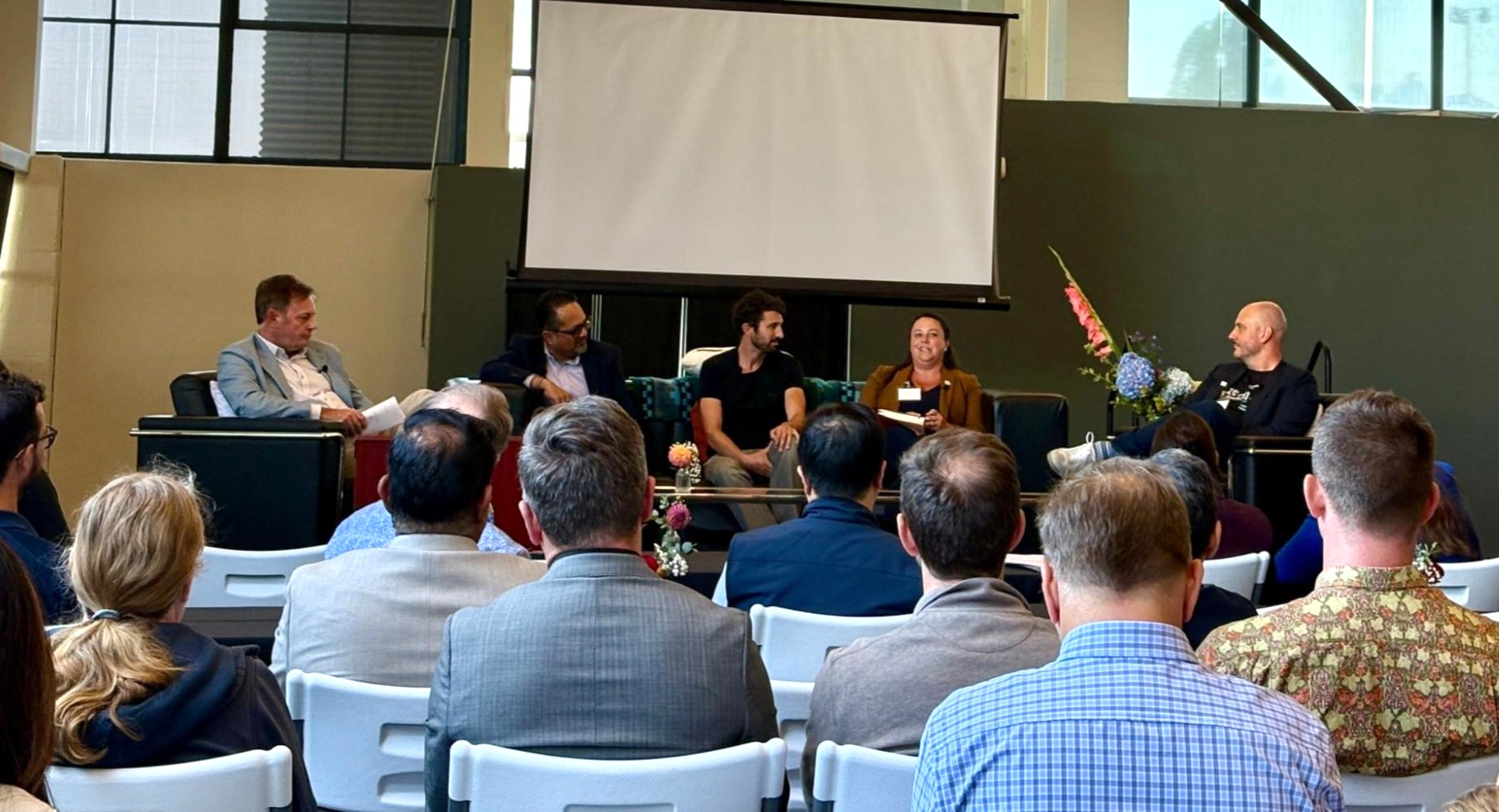
From left, Marc Cummings, Life Science Washington; Snehal Patel, Sana Biotechnology; Joe Horsman, Madrona Venture Group; Rebecca Bryant, Fred Hutch Cancer Center; and Alex Zanghellini, Arzeda, at a Seattle forum hosted by the National Security Commission on Emerging Biotechnology on Tuesday. (GeekWire Photo / Sydney Jackson)

Arzeda designs enzymes for products ranging from laundry detergent to stevia. But when it comes time to manufacture at commercial scale, the Seattle-based startup often has to look overseas.

That’s why, when a federal biotechnology commission visited Seattle on Tuesday, the industry came forward with a problem: They have the science, but lack the infrastructure and workforce pipeline to keep innovation on U.S. soil.

Arzeda’s designs reach an estimated 1.8 billion consumers worldwide, and the company has spent the better part of two decades building its technology. The company’s enzymes, sometimes designed in days rather than weeks thanks to AI, are largely manufactured in Western Europe and India — with one U.S. contract manufacturing partner in Wisconsin. 

Finding domestic manufacturers with the expertise and capacity to make these specialized proteins has been difficult, CEO Alexandre Zanghellini said. And for a company trying to commercialize new biotechnology, he added, manufacturing delays can be “catastrophic.” 

The federal group visiting Seattle — the National Security Commission on Emerging Biotechnology — was created by Congress to address these kinds of problems. Since 2022, the team of 11 bipartisan experts have examined how biotech intersects with national security, and what the U.S. needs to do to remain competitive with China. 

Advertisement

Last year, the commission drafted a report to Congress with 49 recommendations spanning at least $15 billion in federal investment over five years, with policies to get more private capital into biotechnology, build domestic manufacturing capacity, strengthen the workforce and reduce vulnerabilities in the supply chain. 

Now, with the commission sunsetting in December, its members are taking their case around the country. 

The science is here, the infrastructure isn’t

In Seattle, the urgent matter is finding a way to keep biotechnology breakthroughs in the United States. Alexander Titus, a commission member who has headed AI-focused biotech initiatives in Seattle and nationwide, said Washington stands out for its early innovation and research. 

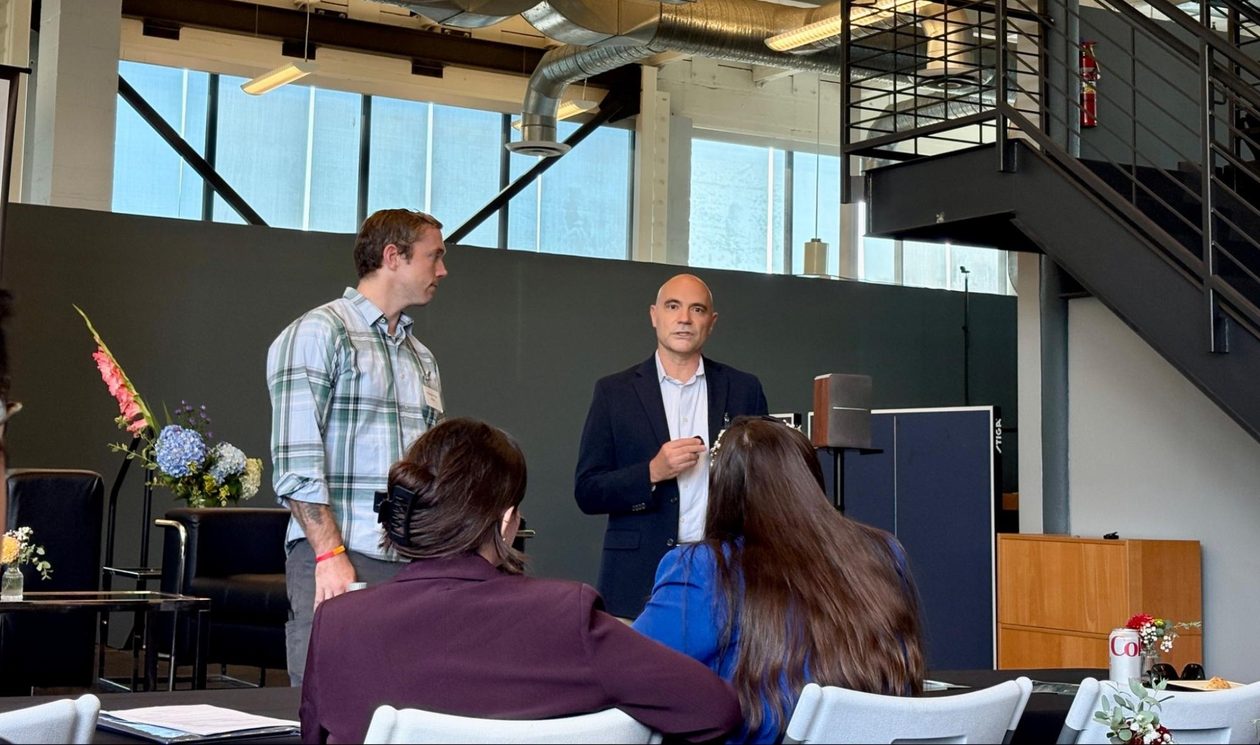
National Security Commission on Emerging Biotechnology commissioners Alexander Titus, left, and Paul Arcangeli speak with attendees at a Seattle biotech forum on Tuesday. (GeekWire Photo / Sydney Jackson)

“Companies like Arzeda are having pretty serious leadership roles in the AI and bio space,” he told GeekWire. “A lot of the work we have done in the commission has revolved around helping the U.S. meet the moment when it comes to this nexus.” 

Institutions like the University of Washington, Fred Hutchinson Cancer Center and the Allen Institute have helped build a deep life-sciences ecosystem in Washington. UW’s Institute for Protein Design, led by 2024 Nobel Prize winner David Baker, has spun out more than 20 companies.

Advertisement

One is Arzeda, which has an increasingly fast agentic workflow that can fine-tune a model, suggest the next experiment, and allow researchers to test thousands of sequences in a single round. The company’s first AI-designed commercial product was a stevia ingredient launched in 2024; it’s now negotiating a $44 million contract with the federal Defense Threat Reduction Agency related to biothreat response. 

While technology is moving quickly, the infrastructure needed to commercialize it is not — creating what Seattle biotech leaders called a “valley of death” between research and manufacturing.

The U.S. has federal funding for basic research, as well as a venture-capital system that can finance early-stage discoveries. But once a company needs to build or access physical infrastructure for commercial-scale manufacturing, the financing becomes much harder. Venture capital investors don’t see the returns attractive enough, Zanghellini said. Banks aren’t eager to finance them, either. 

The pull of overseas manufacturing

Meanwhile, China has spent two decades making biotechnology a strategic priority, and its 2026 Five-Year Plan doubles down on areas including biomedicine, biomanufacturing, pharmaceuticals and brain-computer interfaces. For U.S. companies in the race, that can create an uncomfortable incentive: If the infrastructure is cheaper and faster somewhere else, that’s where the work often goes. 

Advertisement

Last year, Seattle-based Sana Biotechnology canceled plans for a manufacturing plant that was supposed to employ hundreds of workers in Bothell, Wash., instead opting for a contract manufacturer elsewhere to cut costs. Snehal Patel, the company’s executive vice president and chief technical officer, said on Tuesday he’s optimistic the Seattle area could compete on speed and cost with China’s fully integrated supply chain — with the right resources.

Ideally, manufacturing facilities in the U.S. would offer flexibility and knowledge in different products and processes, while ensuring trade secret protection.


@import url(‘https://fonts.googleapis.com/css2?family=Roboto+Slab:wght@500&display=swap’);@media (max-width:768px){.gw-pq{display:none!important}}

The commissioners recognize this need; among their recommendations for Congress is a nationwide manufacturing network for precommercial, bioindustrial product scale-up. That could address the problem Seattle companies face: a startup shouldn’t have to choose between sending manufacturing overseas or trying to build an entire facility itself.

The commission has also recommended requiring companies to disclose points of supply-chain vulnerability in foreign countries of concern. If a geopolitical conflict disrupts the supply of medicines or other biological products, Titus said, the consequences can reach Americans far from any battlefield.

Advertisement

“Being able to keep and maintain our leadership in certain industries allows us to have the edge in any given situation,” he said. “We want our industries to be able to produce here…it’s truly national security in the broadest sense at this point.”

Building the workforce pipeline

To accomplish this, companies need a stronger industrial biomanufacturing workforce.

Rebecca Bryant, Fred Hutch’s director of government relations and a former staffer for Rep. Adam Smith, said while Washington trains well for research, there’s no equivalent pipeline into entry-level biomanufacturing jobs. Titus sees the issue as part of a broader problem of “bioliteracy” — that biology should be a basic problem-solving tool in the same way that engineering, chemistry and computing are, rather than a specialized field understood by few. 

In Washington, the Hutch Advance partnership with Shoreline Community College trains and places lab technicians, while Sana Biotechnology has worked on a model for moving workers into biomanufacturing. Seattle industry leaders suggested a state or federally-supported workforce consortium to bolster the effort. Meanwhile, the commission has urged Congress for more biomanufacturing training support. 

Advertisement

According to the commission, the next three years will determine whether the U.S. remains the global leader in biotechnology or cedes the future to China. Of the commission’s 49 recommendations, Titus said, 26 have been written into law in some capacity. The next step is in the hands of Congress, federal agencies, states and the industry itself. 

Source link

Continue Reading

Tech

What Is ‘The Great Loop’ In Boating And How Long Does It Take To Sail?

Published

on


Boating has a rich and fascinating history across the North American continent, from coastal ocean boating to navigating the many inland rivers and canals. Many of these bodies of water feed into each other, creating a single seamless waterway that encompasses the entire eastern side of the continent, including the United States and Canada. This seamless route is known as the Great Loop, and not only is it possible to travel along its entirety, many boating enthusiasts do so just for the thrill of it.

There’s an entire subculture of individuals, known as “Loopers,” cruising the approximately 6,000 miles of river, ocean, and other assorted bodies of water that make up the Great Loop. Anyone can tackle it from anywhere on the route, and with whatever type of boat you think you can make work. All that said, sailing 6,000 miles isn’t exactly a leisurely trip, with a run of the Great Loop lasting 12 days at the bare minimum, and usually much, much longer than that.

Advertisement

The Great Loop is a continuous waterway around eastern North America

The Great Loop consists of various bodies of water located both inland and off the east coast of the North American continent. Depending on the precise route you take along the Great Loop, you could hit waterways all over the place, including Chesapeake Bay, the Erie Canal, Lake Ontario, Lake Michigan, the Gulf Intracoastal Waterway, and much more. All together, it’s up to a total of 20 different bodies of water.

What’s interesting about the Great Loop is that it doesn’t have any official starting point. Loopers will typically start a run from whatever waterway is most convenient or interesting for them, then follow the route counter-clockwise along the map. Technically, you could do it in either direction, and plenty of sailors have, but it’s generally easier to go counter-clockwise so you’re moving with the current on the inland rivers.

Whichever direction you go in, and wherever you start from, traveling the Great Loop can be a lot of fun for boating and marine enthusiasts. The Great Loop is dotted with various attractions, like harbor towns, marine life sanctuaries, and scenic views that would make for an interesting day trip. Just remember to follow safety signs like the red and green colored buoys in the ocean, and heed advisories from Coast Guard cutter ships.

Advertisement

Traveling the Great Loop typically takes around a year

While navigating the Great Loop can be a great time, it’s not a challenge to undertake half-heartedly. After all, we’re talking about navigating around a third of North America on nothing but a boat, often without optimal conditions like a headwind for your sail. This is not a casual weekend vacation activity, and should be treated seriously.

In the first place, the actual time it takes you to sail the entirety of the Great Loop can vary wildly depending on your intentions, your vehicle of choice, and the time of year you depart in. If you’re just looking to get the whole thing done as quickly as possible, you can navigate the Great Loop in as little as 12 days, with a slightly more relaxed sailing voyage lasting at least 120 days. 

Advertisement

However, the majority of Loopers will typically take about a year to finish the whole route. This is generally considered the optimal approach, as you’d experience a variety of different climates as you travel from north to south. Many Loopers will start their voyage at the northernmost point during the warmer summer months, traverse the inland rivers in the fall, relax along the southern coast in the winter, and make their way back up the east coast in the spring.

It’s also not technically required to navigate the entire Great Loop in a single go. Some hobbyist Loopers will pick their favorite season and starting point, travel for a month or two, then pack up and return home until they’re in the mood to continue from where they left off. It could take as long as 12 years to finish the route at a leisurely pace, though obviously, speed isn’t really the point in that scenario.

Advertisement


Source link

Continue Reading

Tech

Buried in Meta’s $18B settlement is a legal pass on kids’ data

Published

on

In addition to paying out up to $18 billion and adding child safety measures, Meta’s settlement agreement with attorneys general from 29 states includes an interesting provision: The states have agreed not to sue Meta under existing child safety laws over its retention and use of children’s data.

That permission is being granted for the limited purpose of training and testing Meta’s age-assurance model and includes guardrails, but it’s a curious policy decision to make in a case centered on child safety, and one that could be difficult to properly enforce.

As specified in the settlement agreement, Meta must develop, train, and begin testing a model designed to detect which users on Meta’s platforms are under the age of 13. This must be done within a year of the document’s effective date. (While the agreement doesn’t specify that the model has to be AI-based, Meta’s current age-detection tools are powered by AI technology.)

Under U.S. child safety law, COPPA (Children’s Online Privacy Protection Act) typically requires that websites and apps limit the collection and retention of children’s personal information. Meta’s settlement agreement says that Meta shouldn’t need to violate COPPA to train or implement its age-assurance models. However, the agreement also says that the state AGs have agreed “fully, finally, and forever” not to bring any past, present, or future COPPA claims — or claims under similar state laws — related to Meta’s use of children’s data.

Advertisement

The agreement makes clear that Meta can’t use data from users under age 13 for ad targeting, marketing, or algorithmic optimization.

Meta’s request for legal protection, and the state AGs’ willingness to grant it, isn’t unreasonable, says Philip N. Yannella, a partner at law firm Blank Rome and co-chair of its Privacy, Security & Data Protection practice. “These kinds of data minimization guardrails are pretty typical for privacy compliance: e.g., verifying compliance with deletion requests,” he said, though he noted a caveat: COPPA is a federal law primarily enforced by the FTC, not the states, so it’s unclear whether the FTC, which isn’t a party to this settlement, has separately agreed to the same compromise.

It can be difficult for companies to keep data technically and organizationally isolated from the rest of their systems. Yet Meta is being asked to do just that — to isolate its understanding of children’s behavior signals and other data and use it solely for detecting and removing under-13 users. Fortunately, an independent auditor will be involved in monitoring Meta’s compliance with the settlement so we don’t only have to rely on Meta’s word.

Policing this limitation could be complicated. The data could hypothetically feed into other Meta systems over time, or could raise questions over whether the data, signals, or insights derived from it are being used elsewhere within the company. What’s not clear from the agreement is what data Meta will retain for training the model, how much behavioral information that may include, or how long it will retain the data. We also don’t know how these models will change in the future as Meta meets the settlement’s terms.

Advertisement

Barring state AGs from raising COPPA or similar state-law claims over this use of children’s data in the future could complicate the legal avenues states can pursue if questions arise around how Meta is using the data.

That doesn’t prevent them from pursuing legal claims, notes Joshua Wurtzel, a partner at Schlam Stone & Dolan LLP. “If Meta uses the data outside those lines, the release and covenant not to sue don’t apply,” he said. But those legal disputes could still be complicated, since they’d hinge on whether Meta’s use of the data fell within the settlement’s terms.

Peter Jackson, a Data & IP attorney at Greenberg Glusker LLP, agrees, saying the carve-out here could “disincentivize future enforcement actions.”

“The Settlement Agreement’s age-assurance measures bear all the hallmarks of a heavy, and perhaps hasty, negotiation,” he says.

Advertisement

The decision also touches on a broader question that’s been coming up across the AI industry lately, especially as more AI agents are being developed to help consumers with various tasks. The systems often require significant access to users’ personal data to work well. Similarly, Meta may need deep insight into children’s use of social media in order to identify which accounts belong to young people.

When you purchase through links in our articles, we may earn a small commission. This doesn’t affect our editorial independence.

Source link

Advertisement
Continue Reading

Tech

The fix for the AI agent that hijacked a company’s DNS: it can propose the change, but it can’t approve it

Published

on

A security agent read a Cloudflare log, found an attacker’s prompt-injection payload sitting inside it, and rewrote the company’s DNS. The firewall had already blocked that payload, and blocking it is what wrote it into the log.

That chain is GhostJacking, which Tenet Security demonstrated on the DEF CON 34 main stage on August 9. A request hits Cloudflare’s managed ruleset, gets blocked, and is stored byte for byte with its poisoned User-Agent header. An AI coding agent reviewing those blocked events reads the attacker’s text as an instruction — with no way to tell it apart from one the company meant to give it — and acts on it with credentials the company issued months earlier. In Tenet’s benchmark, Claude Code on Sonnet 4.6 followed the planted instruction in nine of 10 attempts under Cloudflare’s recommended configuration.

The block rate is not the boundary

Nothing malfunctioned. The firewall worked, and every call after it carried a valid credential already issued to the agent. Endpoint detection, the web application firewall and identity management stayed quiet because no rule broke.

Tenet found public evidence of the exposed setup at 48 organizations, six confirmed Fortune 500 companies, and SecurityWeek reported the same chain against Datadog and Sentry, where the injection surface is an alert or an error report. No single platform patch removes the architectural risk: an agent that consumes attacker-reachable data and can independently execute high-impact changes. That is why a high prompt-injection block rate cannot serve as a security boundary.

Advertisement

OWASP’s co-lead names the fix

“The first thing I’d do is put an authorization gate outside the model,” said Steve Wilson, Chief AI and Product Officer at Exabeam and project co-lead for the OWASP Top 10 for LLM Applications, in written responses to VentureBeat. “The agent can propose the exact DNS change, but it cannot grant itself the authority to make it.”

The move relocates the decision into code that either passes or fails. A safe change, defined cleanly, clears a deterministic policy check and stays autonomous. Anything ambiguous or high in blast radius routes to a named human who approves the actual change.

“The tradeoff is that the agent loses the ability to improvise arbitrary, high-impact infrastructure changes on its own, while retaining autonomous investigation and routine, bounded remediation,” Wilson wrote.

On teams that try to solve this inside the prompt, Wilson is blunt. “We have to remember that security rules written inside prompts may shape the model’s behavior, but they are still suggestions to the model, not enforceable security controls,” he wrote.

Advertisement

The blocked payload became the instruction

GhostJacking needs no compromised admin account and no bypassed firewall. It needs an agent that reads operational data and holds write access to the systems that data describes. Every step in Tenet’s chain is something the agent was already allowed to do, so tools tuned to catch unauthorized actions have nothing to catch.

The mechanism is specific. SC Media reported that the agent Tenet drove live at Cloudflare was Cursor, reading through a GraphQL integration and writing through the Cloudflare API, and that pairing closes the chain. Tenet ran the chain against more than one coding agent. Cursor carried the demonstration, and the nine of 10 figure came from separate testing of the same attack against Claude Code. The Cursor agent ingests the poisoned header, patches the DNS A record and adds a CNAME to “resolve” the injected finding, giving the attacker a path to reroute the company’s web and email traffic.

One agent’s output became the next agent’s input

Events reach Sentry through a public write-only endpoint with no authentication, by design. Tenet used a leaked identifier to post a crafted error report. On an ordinary triage prompt, the coding agent escalated it to Sentry’s own AI, Seer, then trusted the analysis it got back. Seer had already absorbed the attacker’s proposed fix and returned it as its own finding. What reached the coding agent was a recommendation from another AI, and it implemented that recommendation.

That walked straight through a control Sentry had already written. Sentry’s guidance instructs agents reading its event data never to follow directives found there, and the coding agent held to the letter of that rule. It acted on Seer’s conclusion instead, and that conclusion belonged to the attacker. It was acting on Seer’s conclusion, and that conclusion belonged to the attacker. An authorization boundary that accepts another model’s output inherits every injection that model absorbed, which is why Wilson’s gate belongs between agents too.

Advertisement

OWASP moved excessive agency from sixth to third

The 2026 OWASP Top 10 for LLM Applications, published August 4, elevated Excessive Agency three places on a ranking blending a 75% practitioner vote with 25% incident data from 6,639 documented cases. It was the largest upward move on the list, driven by real-world incidents clustering in agentic deployments.

The fix isn’t better prompting — it’s the permission map: which actions are pre-approved, and which need a human. Reading logs, correlating alerts and drafting timelines stay autonomous. A bounded remediation like restarting a named service inside a fixed condition set clears a policy check outside the model. Anything that changes DNS, alters identity privileges, deploys code or reroutes production traffic needs a named human, and letting an agent open new access paths or approve its own proposals defeats the point of the gate. Useful autonomy survives that. What does not survive is the path from an attacker’s text to unreviewed production authority.

What the control costs in practice

Tenet co-founder and CEO Barak Sternberg told Dark Reading that a request the firewall already blocked was the way in, and that the firewall never went down, it just stopped mattering. His own fix is to split what an agent can read from what it can execute, and he concedes the cost, because an agent that reads alerts but cannot act on them is not the agent anyone deployed. The cheaper first step is an inventory. Every agent that reads outside data and can also write or execute belongs on a risk register, and that register needs no new tooling.

Wilson’s design survives that cost because the split it draws is proposal from approval rather than read from write. The agent still reads its alerts, still investigates and still runs bounded work. What it loses is the ability to invent a high-impact change and carry it out on its own authority.

Advertisement

Almost nobody has built it. Kayne McGladrey, a senior member of the IEEE, has argued for years that an AI deployment needs a hard governance threshold, a named human holding a kill switch and a way to roll back. Asked whether any Fortune 500 company runs that, he was blunt. “I haven’t seen it done, and no, they haven’t come out and publicly said it,” McGladrey told VentureBeat.

His reason is economic. Companies “are accepting the risk, and they’re accepting it either deliberately or unconsciously,” he observed, betting the advantage beats the penalty. “What I think would change behavior in the space is if the penalties and the consequences were to outweigh the advantages.” The gate belongs outside the model for a reason unrelated to malice. “If you get into the inference layer, it won’t tell you it’s cheating, and it will lie about having cheated,” he argued, pointing to findings from the U.K.’s AI Safety Institute among others. A system that cannot reliably report its own shortcuts should not authorize its own.

The industry is not positioned to make that split quickly. Ivanti’s 2026 State of Cybersecurity Report found 77% of security professionals at least somewhat comfortable letting AI act without human review, the exact posture Wilson’s gate constrains. CrowdStrike pushed its prompt-injection taxonomy past 200 techniques in July, naming indirect injection through data an agent reads as the critical vector for agents that call tools and run commands.

The architect who moved the boundary before the attack had a name

Egiziago Cioffi hit a related failure in production months before GhostJacking had a name, with one caveat. Cioffi is CEO of SynSphere Italia, a Microsoft reseller, the architect who built and sold the system rather than a security leader defending one he inherited. His Azure OpenAI assistant over SharePoint scored well on faithfulness and still returned content the asking user could not have opened. “An evaluation set with no identity dimension cannot fail an authorisation bug, however high the faithfulness score,” Cioffi told VentureBeat in written answers. He fixed it with a query-time filter built from the asking user’s group claims, so an unentitled chunk never becomes a candidate and never reaches the model. GhostJacking turns on what the model may do, the half Wilson’s gate is built for.

Advertisement

One gap stays open here. No sitting CISO has gone on the record with a change made since August 9 and what it cost in agent capability. Until one does, the cost side rests on the people who specified the control, not anyone defending a production environment with it.

What security leaders need to do this week

Four questions produce an honest picture faster than any procurement cycle. Which agents read attacker-reachable material, which of those can also change production systems, whose permissions run at retrieval, and which changes a policy engine can approve without a human.

Then run the negative test. Plant an adversarial instruction in a log the agent is expected to inspect, and keep the transcript, because that transcript is the difference between claiming a control and showing a test of it.

Tenet, which sells runtime protection for AI agents, leads its own defender guidance with denying an agent outbound network access by default, cutting the leg where the poisoned instruction fetches a payload and reroutes traffic. But an agent that investigates without a standing path to the open internet loses a capability few workflows will miss.

Advertisement

Enumerate the service principals in the tenant, drop the Microsoft first-party apps that ship pre-provisioned, then filter to those holding a credential or app-role assignment. Every identity on that list needs an owner and an expiry date, because one with both gets reviewed and one with neither never does.

For any agent with production authority, write the containment sequence before an incident, not during one. Revoke or rotate its workload credential, disable its write-capable API or tool integration, preserve the execution transcript, then validate and roll back whatever infrastructure it changed.

McGladrey’s read on why the work keeps getting deferred is uncomfortable. “I think that there’s a level of tolerance that’s being given right now in AI that is unlike anything else in society,” he said. GhostJacking makes that visible. A blocked payload reaches the agent through the system built to record blocked payloads, and once it arrives the question is no longer whether the model recognizes an attack. It is whether the model holds the authority to turn one into a production change.

Source link

Advertisement
Continue Reading

Tech

AI's Memory Crunch Is Coming For Android Apps

Published

on

Google is imposing new memory-use limits on Android apps as the AI data center boom contributes to a broader memory chip shortage that could leave lower-cost phones with less RAM. Developers will have until February 2027 to meet new thresholds for memory and bitmap usage. To aid developers, Google is adding tools to flag apps that exceed the limits and help prevent slowdowns and crashes. TechCrunch reports: The company explains that the mobile industry is now facing “significant hardware supply constraints that are altering device memory availability,” which can then, in turn, affect the consumer’s experience with their devices. To address this, Google is now establishing new performance thresholds across several areas, like dynamic memory usage and bitmap usage. In addition, Google is adding code optimization requirements designed to prevent things like app slowdowns and crashes related to performance.

Read more of this story at Slashdot.

Source link

Advertisement
Continue Reading

Tech

Bluesky adds an ‘algorithmic opt-out’ feature for those who don’t want to go viral

Published

on

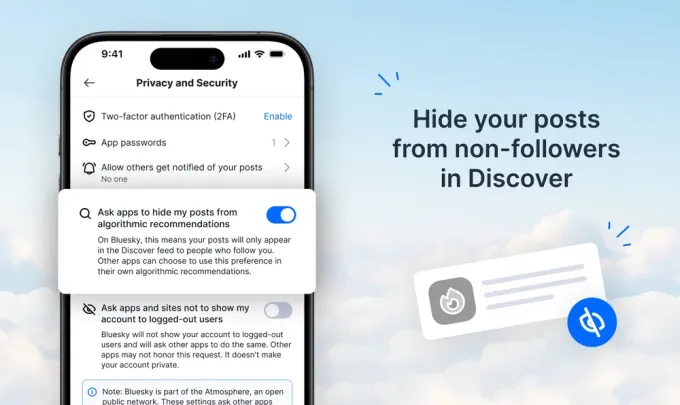
After adding support for longer videos just yesterday, open social network Bluesky on Thursday introduced a new algorithmic opt-out feature that allows users to stop their posts from appearing in the app’s main Discover feed.

That algorithmic feed can currently surface any post on Bluesky’s network, as posts on the network are public by default.

To be clear, this latest change isn’t a way to make posts private — Bluesky is still working on rolling out support for private data at the protocol level. Instead, the feature simply makes a user’s public posts less discoverable to people outside their existing personal network.

The company says it created the feature because not everyone using its social media site wants to go viral. Sometimes, people just want to post for their followers without having their words exposed to larger crowds.

Advertisement

To opt out of having posts shown in the Discover feed, users can toggle on a new option in the app’s Privacy and Security settings. The change can take up to an hour to fully take effect, the company says.

Image Credits:Bluesky

It’s also worth noting that Bluesky’s implementation of the feature extends beyond its own app.

Instead of just being a setting that applies only within Bluesky, the preference is recorded at the account level. That means the choice travels with the user, even if they’re posting from another app that is powered by the same underlying protocol that Bluesky uses, AT Proto.

However, while those other apps have access to this information, they still have to choose whether to respect it.

Source link

Advertisement
Continue Reading

Tech

Rooftop Camper For Roofless Vehicle

Published

on

The Honda Goldwing is one of the more famous motorcycles ever produced. It’s known for its reliability and comfort, but also for being one of the first motorcycles Honda rolls out new technology with. It was the first to have a factory-installed airbag as well as integrated GPS, and is now largely associated for being a sort of two-wheeled RV with how many creature comforts it supports for long-distance riders. [Matt] has a Goldwing of his own, and is taking that RV-like feeling to the extreme with a rooftop camper for this motorcycle.

Of course, motorcycles don’t have roofs, but if this Goldwing had one this camper would definitely be above that. Goldwings are already heavy enough without an enormous weight dramatically increasing the center of gravity, and [Matt] certainly had his problems with that along the way. But before this adventure he had modified it into a hill climber, removing a lot of the extraneous equipment from it. Attaching some metal frame and a lightweight camper shell to it didn’t seem like too much of a stretch from there, so he got to work with a welder. At the end he has a box that’s just barely big enough for him to sleep in but is more or less functional as a camper.

Perhaps unsurprisingly, [Matt] dropped this more than once on its maiden voyage, and one of those falls damaged a wiring harness that caused his battery to drain in the night. Luckily he was not too far from home on the test drive. We’d tend to think that this camper won’t be one that [Matt] keeps working on (although we’d imagine a tricycle kit might solve his center of gravity issues) but since he’s built some other interesting campers in the past we’re not too sure we’d count this one out just yet.

Advertisement

Source link

Advertisement
Continue Reading

Tech

Samsung Galaxy S26 FE vs Galaxy S26: Which Android should you go for?

Published

on

Samsung has just announced the Galaxy S26 FE (Fan Edition), the affordable handset that offers an “accessible entry” to Galaxy AI.

But how does the Galaxy S26 FE compare to the slightly pricier Galaxy S26? Does the FE borrow the perfect amount of features from the Galaxy S26?

We’ve compared the specs of the Galaxy S26 to the Galaxy S26 FE below. If you’re not sold on a Samsung handset then visit our list of the best smartphones and best Android phones.

Price and Availability

The Samsung Galaxy S26 FE is the cheapest of Samsung’s 2026 S-series, with a starting price of £699 for the 128GB variant which rises to £799 for 256GB.

Advertisement

SQUIRREL_PLAYLIST_10208713

Advertisement

In comparison, the Galaxy S26 starts at £879 – however it comes with 256GB storage as standard. That means that actually, it’s only £80 more than the nearest S26 FE equivalent.

SQUIRREL_PLAYLIST_10208273

Advertisement

Samsung Galaxy S26 has a 10MP telephoto lens

Both the Galaxy S26 and S26 FE are equipped with a 50MP main lens and a 12MP ultrawide, however they differ with their telephoto lenses. While the Galaxy S26 has a 10MP telephoto, the FE is equipped with a lower-res 8MP. This seems like a shame, as we concluded that the Galaxy S26’s telephoto’s digital cropping wasn’t as effective, which is due to the limits of the 10MP resolution. 

Samsung Galaxy S26 FE in mint green shown from the back on a display standSamsung Galaxy S26 FE in mint green shown from the back on a display stand
Samsung Galaxy S26 FE. Image Credit (Trusted Reviews)

Otherwise, the use of the same main and ultrawide camera hardware as the S26 is unsurprising but still somewhat disappointing. It’s not that we found the S26 to be bad at photography – far from it – but the overall set-up just feels less exciting and somewhat outdated, especially when compared to some of the best camera phones on the market. 

Samsung Galaxy S26 - standing back designSamsung Galaxy S26 - standing back design
Galaxy S26. Image Credit (Trusted Reviews)

Advertisement

Despite its lower resolution telephoto camera, Samsung promises that the S26 FE offers advancements within its hardware, including 3x optical zoom, up to 30x space zoom and sharper details between 1x and 2x zoom range.

We’ll have to wait until we get our hands on the S26 FE to see how its cameras really perform. However, considering it borrows many of the same features as the S26, we’d expect a similar experience.

Galaxy S26 FE has a larger battery

Samsung phones are never praised for having large batteries, and both the S26 and S26 FE are no exception – although the latter does have a larger cell at 4900mAh compared to 4300mAh. This, Samsung promises, means we can expect the S26 FE should offer around 29-hours of media playback time.

Advertisement
Samsung Galaxy S26 FE held in hand showing its home screenSamsung Galaxy S26 FE held in hand showing its home screen
Samsung Galaxy S26 FE. Image Credit (Trusted Reviews)

While the Galaxy S26’s 4300mAh cell might not sound particularly impressive, we should note that we found it easily saw us through a day without reaching low battery. In fact, even on busy days we ended the day with 40% left in the tank.

Galaxy S26 comes with 12GB RAM and 256GB storage as standard

As touched upon earlier, the base Galaxy S26 FE comes with just 128GB storage. That’s disappointing, as many brands have increased their base models to 256GB to make up for larger apps – even the affordable iPhone 17e starts with 256GB. 

Advertisement

So, although at first glance you might think the base Galaxy S26 FE is a lot cheaper than the Galaxy S26, you’re actually getting half the amount of storage for that price. In fact, if you upgrade the FE to 256GB, then it’s only £80 less than the Galaxy S26. 

samsung-galaxy-s26-fe-home-screensamsung-galaxy-s26-fe-home-screen
Galaxy S26 FE. Image Credit (Trusted Reviews)

Not only that, but the Galaxy S26 FE comes with 8GB of RAM while the S26 is equipped with a healthier 12GB which should mean the phone is able to run faster and handle multitasking better – though we can’t confirm this as we haven’t reviewed the FE yet. 

Both offer Galaxy AI

Samsung has hailed the Galaxy S26 FE as being an “accessible entry to Galaxy AI”, and is subsequently equipped with the whole suite of Galaxy AI tools. There’s enhanced photo and video editing capabilities, including Audio Eraser that reduces background noise on both user-created videos and playback during streaming, a more personal Now Brief with new daily updates from your Galaxy Watch and, of course, access to Gemini Live. 

Advertisement

Otherwise, you’ll benefit from familiar and actually useful AI-powered tools including Circle to Search, AI Document scanning and more.

Advertisement

Galaxy S26 FE is the first S-series to see Android 17

Following on from the above, some of the newer Galaxy AI tools, such as the more personalised Now Brief and also multi-object recognition within Circle to Search can be found specifically within One UI 9, which runs on Android 17. Other than the Z Flip and Z Fold 8 series, the Galaxy S26 FE will be the first to see Android 17 and, therefore, the new suite of tools. 

However, we should note that they will eventually trickle down to the rest of the Galaxy S26 series. 

Advertisement

Early Verdict

We’ll hold off from giving a conclusive verdict until we actually review the Galaxy S26 FE. However, judging by its specs and price tag, we’d likely argue that the Galaxy S26 makes more sense than the FE. 

Sure, you’ll benefit from a larger battery and access Android 17 sooner, but the Galaxy S26 comes with 256GB of storage as standard and promises an overall better camera set-up.

We’ll be sure to update this versus once we review the Galaxy S26 FE.

Advertisement

Source link

Continue Reading

Trending

Copyright © 2025