Perseids is one of the biggest meteor showers of the year and one of the most popular since it takes place in summer, and it’s been reliably active for centuries. Many people make it out to a viewing site and spend hours enjoying a live view of the meteors. But if you can’t, NASA is hosting a livestream of the Perseids meteor shower this year.
The livestream starts at 9 p.m. PT on Wednesday on YouTube. NASA is showing real-time sky imagery from its Automated Lunar and Meteor Observatory at the Marshall Space Flight Center in Huntsville, Alabama. The livestream will be hosted by meteoroid experts from Marshall, as well as several guest speakers who will talk about the meteor shower, its history and other fun facts.
Perseids began its 2026 show on July 17, and it continues until Aug. 24, so if you’ve seen a meteor in the night sky here recently, there’s a good chance it was Perseids. The meteor shower peaks on the evening of Wednesday and into Thursday, which is the best part. NASA says that Perseids can output anywhere from 50 to 100 meteors per hour during the peak, which averages out to more than one per minute.
NASA hasn’t announced how long the stream will last, but the stream’s name, Up All Night, suggests it’ll last for quite a while. It may be the best way for early birds to experience Perseids after waking up.
Advertisement
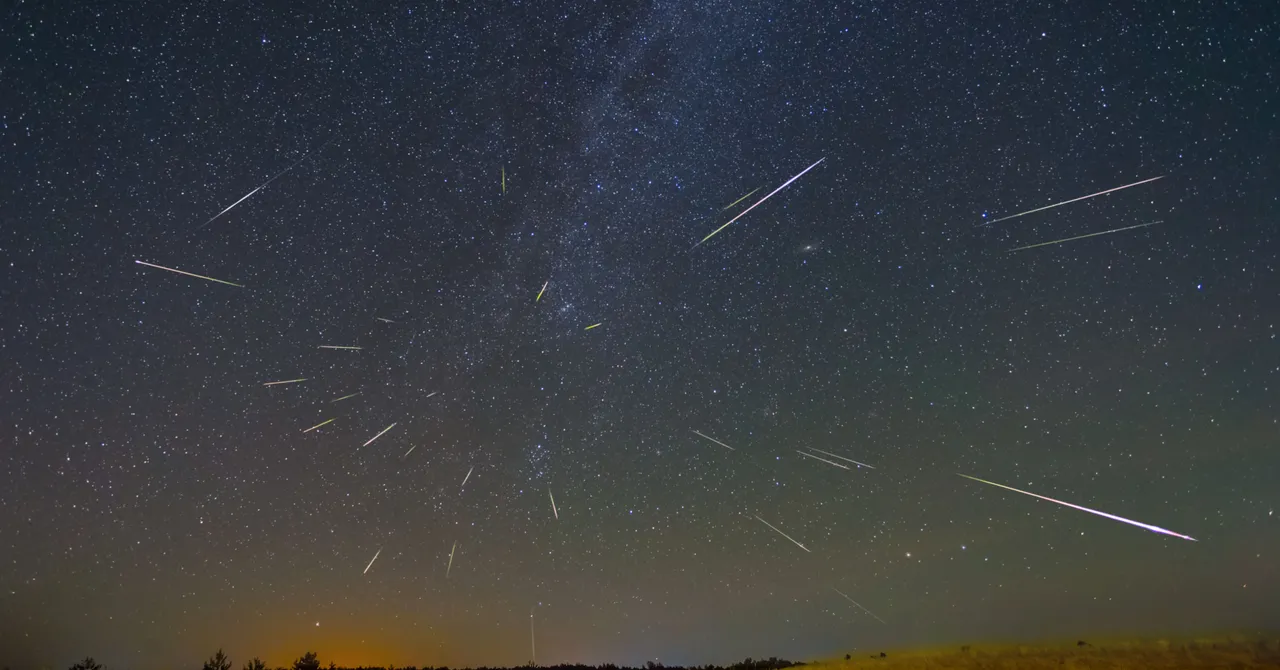
This Perseid fireball was seen over a lake in Ontario around dusk. “It was hot and muggy even after the sun went down, with lots of haze on the horizon but this Perseid was so bright it didn’t matter,” photographer Malcolm Park said.
Spaceweather.com/Malcolm Park
A full schedule of live streams for NASA
NASA typically simulcasts its streams across its YouTube channel, Twitch channel and NASA Plus, which is often also streamed on Netflix. However, Wednesday is chock-full of interesting things to look at, including a solar eclipse and even a planet parade. It seems NASA’s strategy is to divide and conquer, so the Perseids stream is only appearing on YouTube.
The agency is also hosting a livestream for the solar eclipse on NASA Plus, Netflix, X, Amazon Prime and YouTube on Wednesday. The solar eclipse lasts all day and is visible to the northern third of the US. Those outside the path can watch the eclipse online, at least.
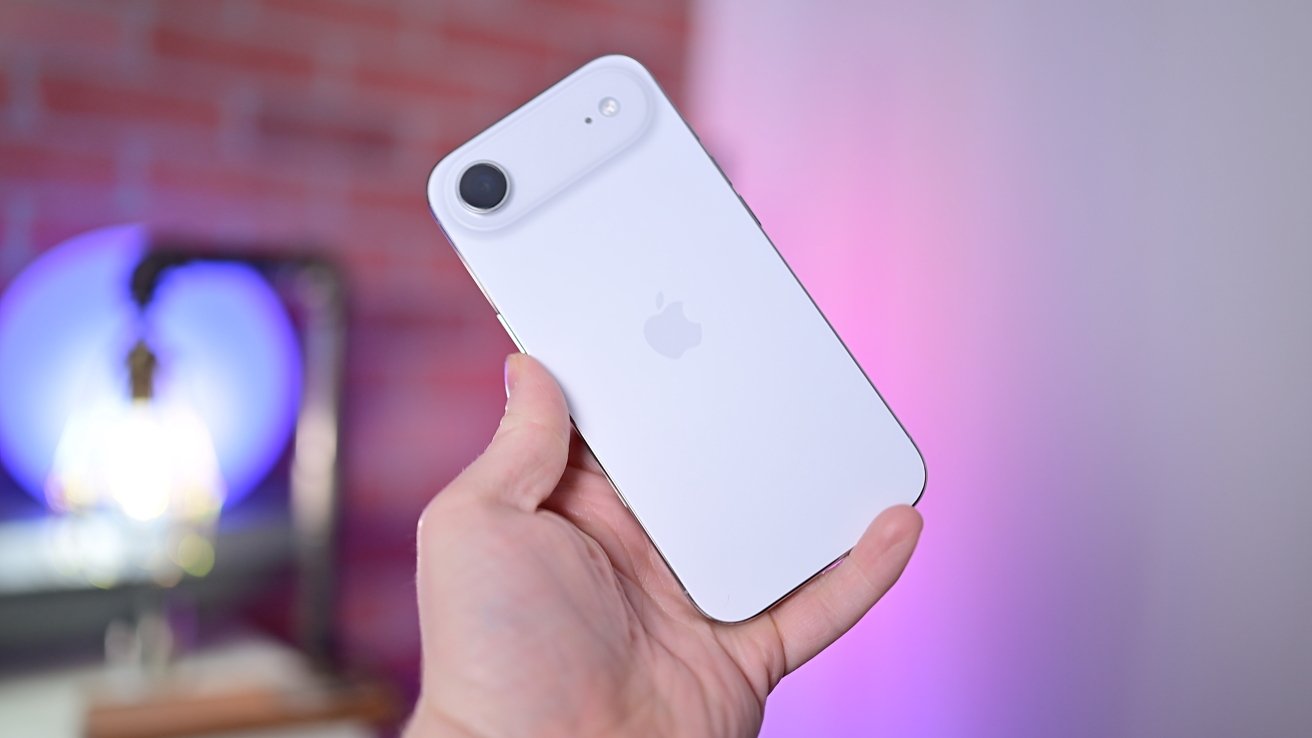
A new rumor suggests that “everyone” at Apple calls the upcoming foldable iPhone the “iPhone Ultra,” though that doesn’t mean Apple will actually go with that name.
Apple keeps things like marketing names under a tight lock and key. It is rare, if ever, that the public learns about what something might be called before it is released.
However, you have to call the device something, and it seems a colloquial name has caught on internally at Apple. A social media post from Mark Gurman suggests that “everyone calls it the Ultra internally.”
Everyone calls it the Ultra internally. We’ll see what happens.
The device has been referred to as the iPhone Fold here at AppleInsider, with an occasional dip into Ultra. The name is anyone’s best guess at this point, and it seems highly unlikely that the true name is known by “everyone” at Apple.
Whether they are accidentally correct or talking openly about secret product names won’t ever be known. But it won’t be long before Apple finally reveals the product and we all get to learn the name first-hand.
Naming conventions aren’t always predictable
Previous naming debates lasted right up until the product was revealed on stage. The iPhone Air was previously called “iPhone Slim” and the iPhone 16e was long believed to be an iPhone SE 4.
The iPhone Air name was also anyone’s guess before it launched
Advertisement
The “Ultra” moniker has been used by Apple for its Apple Silicon chips most recently. However, that term is used to refer to the highest-end of a possible product, and that won’t be the foldable iPhone in some respects.
Sure, Apple will put the best A-series chip it has in the foldable, and its display technology will be unmatched, but it may not be the “best” iPhone. The iPhone 18 Pro Max will still have a superior camera system, more rugged case, better battery life, and better cooling.
Until recently the iPhone lineup was a ladder you could climb up and down, but the iPhone Air added a branch so there are two pathways. The entry “e” model then the base model make up the bottom, then consumers choose between an iPhone Air and iPhone Pro.
The foldable iPhone will be above the Air in the lineup, not above the Pro. So, it is difficult to suggest that it would get the “Ultra” name.
Advertisement
Regardless, the folding iPhone will be the most expensive by far. Perhaps that will be enough to earn it the top-level moniker.
The iPhone 18 Pro and iPhone Fold are expected to be revealed during an event in September. Whether or not the iPhone Fold will actually ship that month is another question entirely.
Published last week in the journal npj Climate Action, the research finds that AI use could significantly increase global energy emissions simply by enabling the fossil fuel industry to produce more oil and gas. At the low end, the research finds that the additional yearly emissions could be equal to Mexico’s; at the high end, AI boosting the fossil fuel industry could add as much greenhouse gas emissions as Russia, the world’s fourth-largest emitter.
That increase in emissions, the paper finds, outweighs the benefits AI provides to developing solar, wind, and other clean technologies. It also significantly outpaces projections of emissions from the global data center buildout.
The relationship between technology companies and fossil fuels is “a self-reinforcing effect between supply and demand,” says Will Alpine, one of the authors of the research. “One of the key insights of our paper is that you cannot treat them independently. They are two sides of the same coin.”
Advertisement
Alpine and his wife and coauthor, Holly, are former Microsoft sustainability workers with years of experience between them at the company. They quit their jobs at the start of 2024 because of the company’s continued work with the oil and gas industry and began publicly campaigning to draw attention to the relationship between AI and fossil fuels.
Oil and gas companies have been using various types of AI for decades to help find and develop underground resources more efficiently. That increases global dependence on fossil fuels and makes it harder for the world to reach its climate targets, the Alpines argue.
While tech companies measure their own emissions and that of their supply chain, they don’t tend to measure just how much their tools help to increase fossil fuel production. The Alpines refer to AI-supported greenhouse gas pollution as “enabled emissions.”
“Sustainability measures [within tech companies] are very much focused on operational emissions” rather than enabled emissions, Holly says. The new paper argues that while accounting for that pollution is important, it ignores emissions that do much more damage to the climate.
Advertisement
To get an idea of how AI can affect fossil fuel companies’ emissions, the Alpines used a complex economic model that allows researchers to introduce various factors to test out how they might play out over the broader economy. Using reports from oil and gas companies about demonstrated gains from AI tools, the Alpines modeled AI as a productivity enhancer across various sectors of the fossil fuel industry, from extraction to refining to electricity generation. They also estimated how that in turn can increase global emissions.
The modeling found that AI as a productivity enhancer for the fossil fuel industry could help increase global energy-related emissions between 1.2 to 4.8 percent. That’s significantly higher than multiple projections around emissions from data center energy use.
“The scale of this was staggering,” says Will.
Fossil fuel companies are increasingly providing power for data centers. Chevron and Microsoft recently confirmed that the oil giant would be building a large behind-the-meter gas plant in Texas to power data centers for the tech company.
Advertisement
In a call with analysts in June, Jeff Gustavson, the president of Chevron’s New Energies division, hinted that the deal would benefit Chevron’s AI capacities as well. Chevron, according to Gustavson, will “use some of that compute” generated by the power from the power plant serving Microsoft “to actually power AI inside of our company.” (“Chevron and Microsoft have worked together for years to accelerate digital transformation, leveraging the capabilities of a trusted cloud to generate insights, scale innovation, and unlock value across the organization,” Chevron spokesperson Paula Beasley told WIRED in an email, in response to several questions about the specific relationship between the oil giant and the tech company.)
Apple has extended its unusually limited Back to School series of deals and they are not to be dismissed, but there are far greater discounts to be had from other resellers.
Even when it isn’t raising prices, it is a rule with Apple that it will never actually have sales on its products, except for certain regular promotions in China. So for this latest deal, it is again falling back on offering Apple gift cards alongside selected products.
So when a user buys one of these devices, they get a gift card that amounts to money off their next purchase. Consequently if someone knows they need two Apple devices, they can get money off the second one.
This year is unusual, however, as Apple has begun its Back to School promotion around a month later than usual. At least at time of writing, it’s also not promoting it outside of the education section of its website.
Advertisement
Apple had also cut the offer a little short, saying that it only ran through August 27, 2026. However, it has now extended the promotion through September 24, 2026.
The offer is available “for Qualified Purchasers only,” which suggests it’s limited to people verified to be in education.
Then, too, the range of gift cards is reduced. This year there’s no desktop Mac included and so the deals and their gift card amounts are only:
MacBook Pro: $150
Advertisement
MacBook Air: $100
iPad Pro: $100
iPad Air: $100
These savings are good, but they are substantially poorer than those from other resellers who do not limit the deals to education buyers. Plus all other resellers actually lower prices instead of having people juggle gift cards.
Advertisement
Then, too, while it has limited the offer more this time, Apple always selects only a few devices to include in its Back to School sales, where resellers do not. Resellers will have limited supplies, but they tend to offer more devices, and they also don’t usually confine them to the Back to School period, either.
Discounted Macs
There are hundreds of markdowns in our constantly-updated Mac Price Guide, and the discounts are not limited to students and faculty. You can jump straight to the individual Price Guides, broken down by screen size and chip, below.
Discounted iPads
There are also heavy discounts on iPads, without the EDU requirement, and each is detailed in our ongoing iPad Price Guide.
Looking for the catch
There is no catch on these third-party deals for Apple devices, but there is a caveat. There are always offers but none of them will ever last for long, so if you see one that’s right for you and your budget, you need to buy quickly.
Advertisement
Otherwise, these are the same devices you would get from Apple, with the same warranties.
Updated August 11, 2026 5:20 p.m.: added that Apple extended the promotion
An anonymous reader quotes a report from the Associated Press: The contiguous United States sizzled to its hottest month ever last month, according to the National Oceanic and Atmospheric Administration. July averaged 76.89 degrees Fahrenheit (24.94 degrees Celsius) across the Lower 48 states, eclipsing the Dust Bowl’s July 1936 by an eighth of a degree. Records go back to 1895. […] Although it was unusually cool in Alaska, hotter-than-normal conditions blanketed the Lower 48, with the most excessive heat in the Mountain West, Southwest, Northern Plains and Southeast. The heat was so widespread that every one of the Lower 48 states was at least 1 degree Fahrenheit (nearly 0.6 degrees Celsius) warmer than the 20th century average, said Russ Vose, chief of monitoring at NOAA’s National Center for Environmental Information.
[…] The biggest driver of the record heat was nighttime lows that smashed the old mark for hottest minimums by 0.7 degrees, NOAA said. Hotter nights are a classic sign of human-caused climate change, according to scientists and several studies in peer-reviewed literature. NOAA’s calculation is based on averaging 24 hours of temperature, not just highs or lows. “If you’re talking heat waves, that nighttime low is incredibly important for determining total heat stress,” [said meteorologist Jeff Masters of Yale Climate Connections]. “So if it doesn’t cool off at night, your body doesn’t have time to readjust to all the heat.” As nighttime temperatures increase, more people die and lose sleep, studies show.
The years 2021 and 1936 tie for America’s hottest summer, which is June through August. Through July, 2026 is a shade cooler than 2021, which was powered by record heat in June. Because of climate change, Masters said, “this may be one of the coolest years we’re gonna experience for the rest of our lives.” What’s needed, Masters said, is “to stop burning so many fossil fuels. We also need to be spending money to adapt to the new climate that we’ve put in place.”
First look: Tesla has installed Starlink hardware in a Cybercab, adding satellite internet to the vehicle it plans to use for its robotaxi service. The company’s official Tesla Robotaxi account posted photos this week of what it called the “First Cybercab with Starlink integration.” The images show a Starlink antenna built into the rear of the roof, above the taillights, with a rectangular panel covering the dish rather than leaving it exposed on the outside.
The reveal follows an earlier preview at Tesla’s showroom in San Jose, where the company displayed the planned Starlink capability. Tesla had already said the Cybercab would use Starlink’s V5 dish, a newly launched model rated for download speeds of up to 375 Mbps.
For Tesla, the main use case is reliable connectivity for a vehicle designed to operate without a driver. The Cybercab has no steering wheel or pedals, and passengers are expected to simply get in and let Tesla’s onboard software handle the trip.
Satellite service could give the vehicle a connection in places where cellular coverage is weak or unavailable, which could help with navigation, support functions, and managing a larger robotaxi fleet.
Advertisement
Tesla’s vice president of AI software, Ashok Elluswamy, said Starlink isn’t essential to the vehicle’s safe operation. “Connectivity is primarily meant for navigation, customer service and, in general, fleet management,” he said.
Elon Musk has focused on a different use for the connection: entertainment. “Watch 4K streaming video while Cybercab takes you anywhere you want,” he wrote last month.
On Tesla’s earnings call last month, Musk said a robotaxi service needs connectivity that doesn’t depend solely on local wireless networks. “Starlink will be integrated into all our car vehicles, at least for markets that Starlink is active. Because for a Robotaxi situation, you need to have coverage everywhere. There are many places, even in Silicon Valley, where the cellular coverage is terrible or sometimes non-existent,” he said.
His comments suggest Tesla sees Starlink as more than an add-on for the Cybercab. In a separate post Sunday, Musk wrote: “All cars will have Starlink in the future. It’s the only way to get super high bandwidth to billions of vehicles.”
That statement could just as easily refer to Starlink’s planned mobile service rather than the dish-based broadband system shown on the Cybercab.
Starlink Mobile is designed to work through smartphones and doesn’t require a satellite dish. SpaceX has said its next-generation mobile offering will use both satellites and a ground network, and it could eventually compete with AT&T, T-Mobile, and Verizon.
The Cybercab setup is different. It uses a physical Starlink dish built into the vehicle itself, allowing it to connect directly to the satellite network. Tesla has not said when the feature will be available in production vehicles or whether the same type of hardware will be installed in other Tesla models.
However, more data doesn’t necessarily mean more benefits for non-diabetics.
Scott Olson/Getty Images
Health care company Abbott has entered into a partnership to connect Google Health to its Lingo continuous glucose monitor (CGM). According to the press release, this multi-year collaboration will allow users of the over-the-counter Lingo device to see their metabolic data within the Google Health app, which could help a person “make better lifestyle and nutrition choices in the moment.” The Lingo data can also be shared with the Google Health Coach, which offers AI-driven recommendations based on an individual’s information.
Lingo is explicitly intended for adults who are not using insulin. Engadget reported on the growing trend of non-diabetics using continuous glucose monitors back in 2023 and found little research that supported the benefits for that population to track blood sugar spikes so closely.
An article from the Johns Hopkins Bloomberg School of Public Health published earlier this year reiterated that the health benefits of a CGM for non-diabetics are pretty hazy. Using the devices might keep nutrition information top of mind and lead to a person making better dietary choices. But since a non-diabetic body is capable of regulating most glucose spikes, an over-emphasis on blood sugar might just as easily lead to poor eating habits by trying to keep the readings unnecessarily low.
Advertisement
Additionally, getting a useful interpretation from results isn’t something the average person should be expected to do. When Engadget spoke with Idrees Mughal, known on TikTok as Dr. Idz, he emphasized that even as a trained medical doctor, he would want to reference additional data points to make an assessment from CGM results. For a layperson, “you don’t even know how to interpret it. So it’s going to be completely useless,” he told Engadget.
It’s possible this Abbott—Google alliance could turn up some useful insights about those non-diabetic use cases. As part of their deal, the companies will be “conducting one of the largest real-world metabolic health studies to date, integrating continuous glucose, wearable, laboratory and survey data to uncover connections between activity, sleep, wellbeing and metabolic health, informing more personalized guidance that supports healthier day-to-day decisions.” But it also wouldn’t be surprising if the findings suggest more people buy Lingo devices or subscribe to the Google Health Premium subscription. And bear in mind: it’s always worth speaking with your primary care physician before making any changes to your health habits, including diet.
An anonymous reader quotes a report from Wired: As AI models gain advanced capabilities to find vulnerabilities in software, develop ways to exploit them, and even carry out autonomous hacking sprees, researchers offered a sobering new example on Tuesday, disclosing vulnerabilities in the video conferencing platform Zoom that could have been exploited to take over targets’ devices. Anyone on a call that involved screen sharing, whether participants or the host, would have been vulnerable to a silent attack that could be carried out with no indication and no interaction from the victim.
Researchers from the digital defense firm A Security say thebugwas discovered in early June using publicly available AI models, and that it took fewer than 20 prompts to uncover the vulnerabilities and create a working attack. Zoom issued a security advisory on Tuesday, including details about fixes the company has already begun rolling out to address the flaws, which affected devices running all operating systems that Zoom supports — Windows, macOS, Linux, iOS, and Android.
The vulnerabilities were specifically in the protocol used to facilitate real-time annotation during screen sharing. The researchers say that their AI bug hunting systems specifically delved into this component because, like human bug hunters, they have been trained that convoluted and obscure functions often contain overlooked vulnerabilities. This is particularly true with proprietary, closed-source software. An established company like Zoom presumably does extensive code review and vetting on all components and functions, but without the benefit of public, open review, esoteric yet complex features like annotation are more likely to contain mistakes. The bugs are now patched, with Zoom issuing both server and client-side fixes—or patches for both Zoom’s own servers and the applications that run on customer devices. But the researchers emphasize that it was alarming to contemplate bugs that could have been exploited to take over a target device simply by getting someone onto a Zoom call. “What is interesting for us and what we believe is dangerous is the democratization of these capabilities — the barrier to entry is dropping rapidly,” A Security cofounder Omer Gull told WIRED ahead of the disclosure. “Before it would have taken a team of five people maybe six months with a lot of refining and iteration to find this. Now people can reach the same results with under 20 prompts. And Zoom is an important type of target because people assume trust when using it. They don’t see it as a threat.”
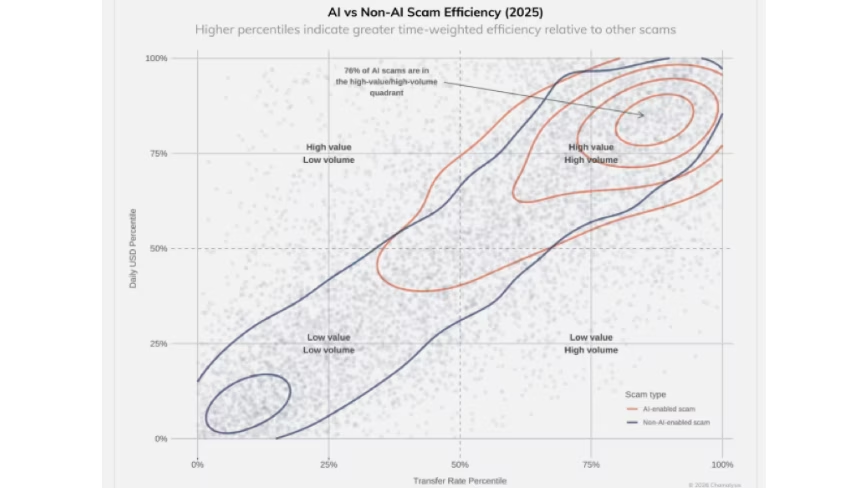
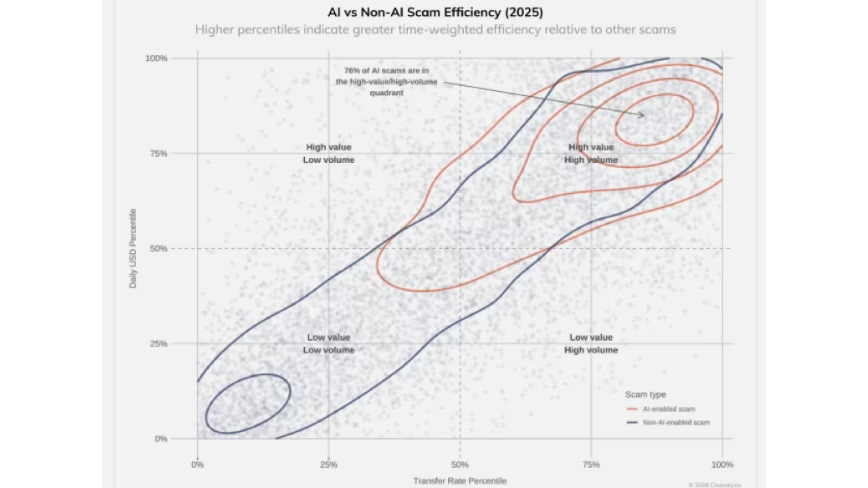
Chainalysis reports impersonation scams grew over 1,400% in 2025, with AI-linked operations generating 4.5x the revenue at 9x the activity of non-AI operations. Deepfake KYC bypasses now cost about $20 and 30 minutes, defeating standard liveness checks 58% of the time. Crypto accounts for 88% of all detected deepfake fraud globally. Enforcement has responded with $4.4B in frozen Tether and nearly 5,800 arrests across 97 countries, but none of that stops a forged identity clearing a check.
Impersonation scams grew more than 1,400% year over year in 2025, according to Chainalysis, with the average payment into those clusters rising more than 600%. Across all scam categories the average crypto payment climbed from $782 to $2,764.
An attack class does not scale like that because more people are running it. It scales because fewer people are running it with better tools.
Fraud Used to Have a Headcount Problem
An investment scam or a romance approach had to be staffed. Someone trained had to hold the conversation, in the victim’s language and across weeks. Those requirements set a ceiling on how many people a network could work at once, and for years the ceiling held.
Advertisement
Generative tooling removed it without changing the underlying deception. The con is the same one the industry has seen since the first fake exchange support agent. What changed is that the expensive part of running it stopped being expensive.
The economics are visible on-chain. Chainalysis found that operations with observable links to AI tooling vendors extracted an average of $3.2 million against $719,000 for those without, while generating 35.1 transfers a day against 3.89. That works out to roughly 4.5 times the revenue on about nine times the activity: the same operation reaching more people and converting more of them. TRM Labs separately observed close to a 500% increase in AI-enabled scam activity over the past year.
Credit: Chainalysis
“Code is no longer necessarily the weakest link in Web3,” says Jimmy Su, Chief Security Officer at Binance. “As smart contract security improves, attackers are shifting their attention to the people, credentials and governance systems surrounding protocols. We saw this firsthand when Binance Security helped prevent a $1.2 million governance attack on BrainTrust. Protecting a protocol today means securing not just its code, but also who can control it, how that control is exercised, and the infrastructure and people behind it.”
The Verification Stack Was Built for a Different Attack
Identity checks were designed against a threat model of printed photographs, recorded video and low-grade physical spoofs. That is why liveness prompts still ask a user to blink or turn their head. The threat model moved and the prompt did not.
Vendor research from Socure puts the current cost of defeating that stack at roughly $20 and about 30 minutes, and finds that injection attacks, which feed a synthetic video stream straight to the verification interface rather than through a camera, defeat standard liveness checks about 58% of the time. Socure and Zyphe, whose figures it cites, both sell detection products in this category.
Advertisement
“Across the crypto industry, impersonation scams are increasing and becoming more sophisticated,” says Lior Aizik, co-founder and COO of XBO. “Scammers have impersonated me by name, using fake profiles to contact people in the industry and request money while pretending to represent XBO. These attacks rely on urgency and trust, not technology.”
The volume lands disproportionately on this sector. Binance Research reports that cryptoaccounts for 88% of all detected deepfake fraud cases globally, that North American deepfake-related losses exceeded $410 million in the first half of 2025, and that around 80% of attacks against the exchange involve some level of KYC fraud.
Detection Is Automated. Recovery Is Not.
Two things are working against this volume, and only one of them is a model.
Automated screening is the first, and it mostly buys throughput rather than certainty: Binance Research reports up to a 100x efficiency gain from applying AI to KYC processing, with face-attack and liveness models retrained against each new generation of spoofing technique.
The other effective response is considerably older: coordinated enforcement and the ability to freeze funds after the fact. Binance Research puts Tether’s total frozen at more than $4.4 billion as of April 2026, and the T3 Financial Crime Unit, a joint venture with TRON and TRM Labs, at more than $300 million in its first year, including $19 million tied to the Bybit hack. Both figures come from the exchange’s research arm rather than from the issuers themselves.
Advertisement
Conventional law enforcement has scaled alongside it. INTERPOL’s Operation First Light 2026 spanned 97 countries as well as produced nearly 5,800 arrests and intercepted $293 million. Europol’s Operation Endgame froze about $47 million while taking down 326 servers and 142 domains and recovering 27 million stolen credentials.
None of that stops a forged identity clearing a check. It does mean the money can sometimes be stopped after it moves, which is something a wire transfer cannot offer and something the sector rarely bothers to argue in its own defense.
The Deception Is Old. The Price Is New.
The cons here are the ones fraud has always used. What changed is the cost of producing them, which makes the defensive question less about detecting novel attacks than about matching the rate at which familiar ones are now generated.
Reporting in this category remains incomplete, so every scam figure above should be read as a lower bound. The gap between what it costs to forge an identity and what it costs to check one is the number worth tracking, because everything else in this category follows it.
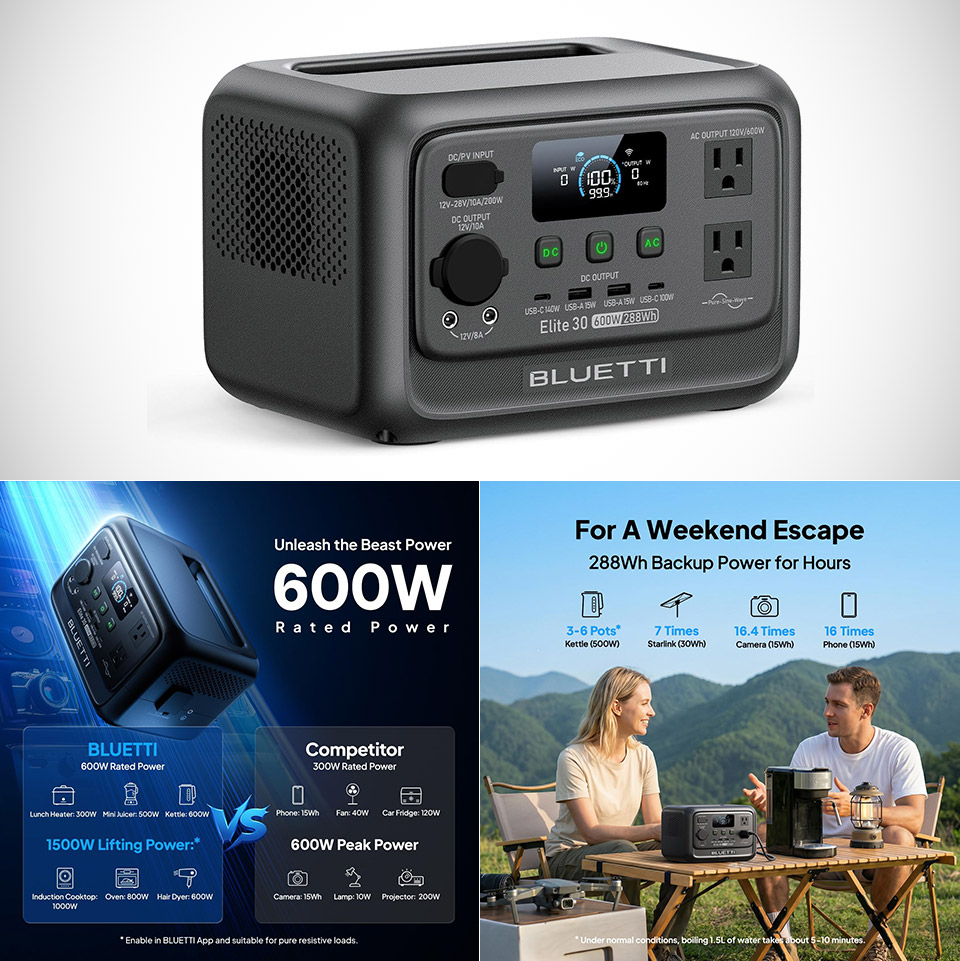
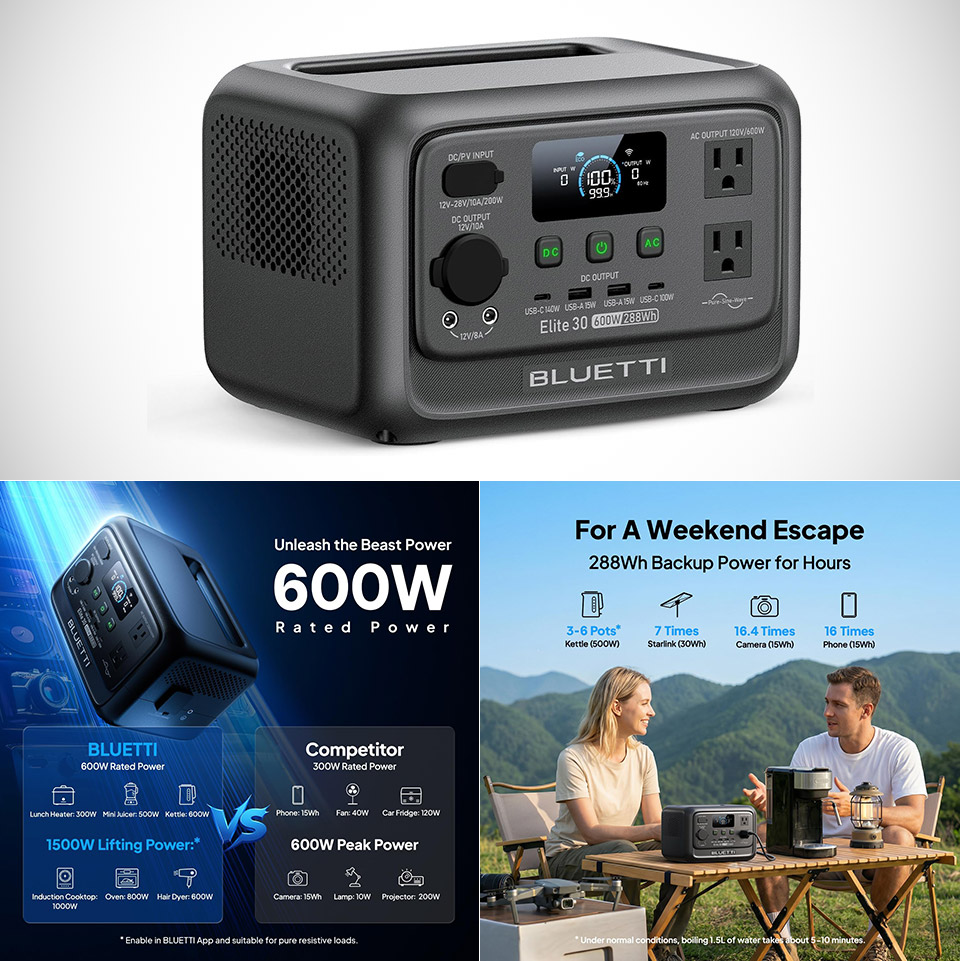
BLUETTI’s Elite 30 V2, priced at $219 (was $299), arrives as one of those rare small power stations that feels useful the moment you pick it up. At just under 10 pounds and measuring roughly 9.8 by 7 by 6.6 inches, it slips into a larger backpack, the trunk of a car, or a corner of a campsite without demanding attention. A molded handle makes carrying it one-handed straightforward, and the overall size stays practical for daily travel or emergency kits.
Inside, there is a 288-watt-hour lithium iron phosphate battery and a 600-watt pure sine wave inverter, which can easily power computers, photography gear, small appliances, CPAP machines, fans, and phone chargers. If a device requires a sudden power increase, they have a ‘Power Lifting’ mode that raises the power ceiling to 1500 watts for resistive loads, giving you a lot of versatility from something that doesn’t appear nearly as large as it is. There are nine ports to meet most demands, including two normal AC outlets, a 140 watt USB-C port, another 100 watt USB-C port, two USB-A ports, a 12 volt vehicle socket, and two DC barrel connectors. The USB-C ports can even deliver high power simultaneously, which is really useful when attempting to charge a laptop and whatever else at the same time.
[288Wh On-the-Go Power] – Only 9.4 lbs lightweight, carry it anywhere during storms! 288Wh capacity meets daily & outdoor needs—camping, road trips…
[600W Continuous & 1500W Surge Power] – Get a full 600W output—twice as much as others. When you need serious power, activate Power Lifting Mode for…
[50% Lower Power Consumption] – Upgraded UltraCell tech & smart cooling system cut power consumption by 50%. Enhances overall energy efficiency…
Recharging is also relatively quick for a unit of this size, with AC power in Turbo mode bringing the battery up to 80% in around 45 minutes and a full charge in around 70 minutes. Solar input can handle up to 200 watts, and you can continue to charge while driving. There are also numerous charging patterns that allow you to balance speed, noise, and available power. The battery’s low standby drain is due to the company’s UltraCell design, which allows it to maintain a charge for much longer when lying idle.
Advertisement
The lithium iron phosphate chemistry provides the durability required for regular use, with BLUETTI claiming the cells will endure over 3,000 cycles to 80 percent capacity and a ten-year lifespan under typical conditions. In addition, there is a 5-year warranty to back it up. The unit is also rather quiet, often under 30 decibels under light load, so it can be placed near a bed or workstation without being a disturbance.
The unit also has built-in UPS functionality that switches to battery power in 10 milliseconds or less, which is extremely fast, and there are several operating modes to support various situations, such as keeping the battery charged for a quick backup, following time of use electricity rates, or prioritizing solar when solar panels are connected – or mixing settings as needed.
The Elite 30 V2 operates brilliantly throughout day trips, weekend camping, remote work sessions, and temporary power outages. It can recharge airplane and drone batteries on-site, keep a laptop running all day with leftover direct DC power, and even power lights or a small fan when camping. Of course, it isn’t perfect and won’t last for weeks or power the TV and lights all day, but for its size and price, the balance of output, ports, and speed is outstanding.
In addition to a historic total solar eclipse, August also features one of the most spectacular meteor showers of the year. On the night of August 12 and into the early morning of August 13, astronomy enthusiasts in the northern hemisphere and parts of the southern hemisphere will be able to admire the Perseids during a particularly favorable viewing window.
Occasionally, Earth passes through the trails of particles left behind by some comets as they travel through the solar system. When these tiny fragments enter Earth’s atmosphere, friction with the air heats them until they burn up. From below, it looks as though the sky is filled with bright flashes streaking across the heavens at high speed. These are meteor showers. There are several throughout the year, and the one in August is called the Perseids.
Although a meteor shower is one of the few astronomical phenomena that can be observed with the naked eye, it is not always easy to track. To enjoy it to the fullest, it’s a good idea to follow some basic recommendations for stargazing.
This Year’s Perseids Are Especially Visible
Traditionally, the Perseids reach a rate of up to 100 meteors per hour during their peak activity—at least, under ideal viewing conditions. This makes them one of the three most intense meteor showers of the year, along with the Geminids in December and the Quadrantids in January.
Advertisement
In 2026, the viewing conditions are particularly favorable. The peak of activity, expected on the night of August 12–13, will coincide with the new moon phase. This means that virtually none of the moon’s illuminated side will be visible from Earth, so there will be no moonlight to interfere with meteor viewing. In other words, the sky will be much darker than usual.
What’s the Best Way to View the Perseids?
The main advice from NASA and the European Space Agency (ESA) for enjoying a meteor shower is to get away from light pollution. Ideally, head out of the city and find a spot with dark skies, as well as a horizon that’s as unobstructed as possible to ensure a wide field of view.
Keep in mind that it takes the human eyes 20 to 30 minutes to fully adjust to the dark. Once that time has passed, it will be easier to spot faint meteors. While observing, it’s also advisable to avoid using your cell phone or other bright screens, as they reduce your eyes’ sensitivity.
Another important tip is to avoid using telescopes and binoculars. Although they might seem useful, NASA explains that these instruments narrow your field of view, whereas meteors can appear anywhere in the sky. It’s best to observe with the naked eye.
Advertisement
Although the Perseids get their name because they appear to radiate from the constellation Perseus, it is not necessary to look toward it. Both NASA and the ESA point out that meteors can streak across any part of the sky. Ideally, lie down or use a reclining chair to observe a wide portion of the sky, preferably after midnight, when the meteor shower’s radiant reaches a higher point above the horizon and the frequency of visible meteors increases.
Finally, the agencies remind us that patience is also part of the experience. Meteors do not appear at a steady rate. Several minutes may pass without any activity, and then suddenly, several may be seen in quick succession. Staying under a dark sky for at least an hour offers the best chance of enjoying the show.
This story originally appeared onWIRED en Españoland has been translated from Spanish.

















































You must be logged in to post a comment Login