[Aizysse Baga] worked with [Adelaide] on the Divacore record, which was to be released on a mini-CD. The original plan was to include additional CD+G data, featuring artwork to go with the music. CD+G, or CD+Graphics, was often used to display synchronized lyrics for karaoke releases, and stored data in formerly-unused subcodes next to the track start, track number, and running time data. This format allowed storing a slideshow of images with a resolution of 288 x 192 with a 16 color palette.
Note the quality difference between the 16-color CD+G and the 256-color CD+EG images.
The duo got handy with art and some smart dithering to get great 16-bit artwork packed in to the audio CD release, with the aid of a custom Python encoder. CD-TEXT metadata was thrown in for good measure. Then, the existence of the more advanced CD+EG became apparent. This was a 256-color extension to the CD+G format that was backwards compatible to boot. It was a format that was barely ever implemented on any commercial releases, and very little hardware could even display it. Naturally, Divacore had to have it. Much work was done to understand the Red Book documentation on the standard and figure out how to implement even higher quality artwork for the record.
After so much work to understand and implement the CD+G and CD+EG data, the question was whether it would survive the CD reproduction process for the final release. Thankfully, the final discs came out perfectly, and the full 256-color CD+EG artwork can be seen in all its glory if you happen to play Divacore on a Sega Saturn or a super-obscure Victor VS-G2 or VS-G3. Throw it in a less-sophisticated karaoke machine or something like an Amiga CD32, and you’ll still get to see the 16-color versions for your trouble.
We love to see ancient formats brought back to life, particularly those that never got their time in the sun. If you’re working hard to resurrect something the mainstream media world has forgotten, let us know on the tipsline.
The AI boom has encouraged everyone and their uncle to launch a data center business. But spinning up a data center isn’t easy.
Even if you solve the problem of securing the GPUs, network switches, and storage, you still have to get everything configured, running and be able to cater to customers’ various needs. Getting getting a data center ready to provide cloud-computing services AI inference and training services can take months of work. And the longer you take to get to market, the higher the cost of having all those precious GPUs sitting idle.
Network automation startup Netris claims it can make that problem disappear for neoclouds. The company provides software that runs on network switches, and it also offers a platform that connects to switches to help neocloud operators reduce the time it takes to go live by automating setup, configuration and operations. The platform also provides network abstraction, so hardware configurations can be changed as required, and it isolates servers and resources at the hardware layer so neoclouds can serve multiple customers (multi-tenancy).
If that sounds like a solution to an obvious problem, you’re not wrong. Until recently, data centers were largely the domain of large infrastructure operators like Equinix, NTT, Digital Realty, Oracle, Microsoft, AWS, or Google. Those companies pretty much solved network setup, configuration and multi-tenancy for themselves by hiring ranks of engineers or building the automation themselves. Small neocloud businesses rarely have such resources at their disposal.
Advertisement
“As a GPU cluster operator, you need to make configuration changes to every link, every day. At traditional data centers, they were using something called SDN [software-defined networking] to do this, but SDN is falling short, because it’s a software technology,” Netris’ CEO Alex Saroyan told TechCrunch. “For AI, software is not okay, because the amount of traffic is so high, everything must be hardware accelerated. So you need something like SDN, but completely hardware accelerated. This is what we do, and this is what what we’ve been doing for eight years.”
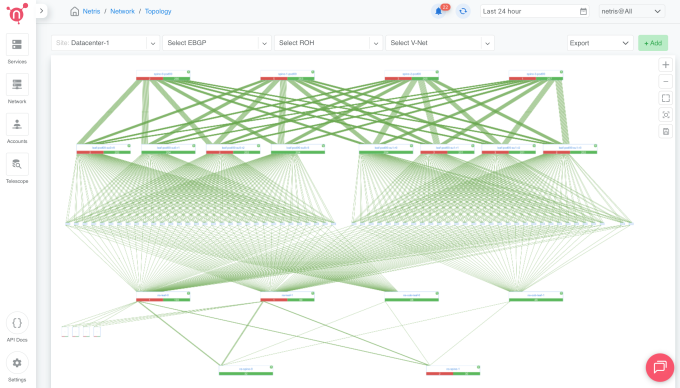
An abstracted view of a data center’s topology. Image Credits: NetrisImage Credits:Netris /
Saroyan said Netris’ platform is vendor-agnostic, compatible with networking equipment and standards used at data centers, both for Nvidia and AMD’s servers.
The startup’s promise has found many believers, one of which is Nvidia. Two years ago, the chipmaking giant was so impressed by a demo of Netris’ technology that it recommended the company to several customers. Today, Netris is live at more than 35 GPU clusters around the world (about a million GPUs total), operated by the likes of Lightning AI, Foxconn, Visionbay, Hewlett Packard Enterprise, Tensorwave, Telus, and others.
To build on that momentum, Netris has now raised $15 million in a Series A round from Andreessen Horowitz, TechCrunch has exclusively learned.
Notably, there’s no AI at work here. Saryoan said the company only uses algorithms it had developed previously for running and configuring automation and operations.
Advertisement
“We started way before AI. We understood the challenge early on, and we started developing this algorithm early on. AI is not deterministic, right? Sometimes it likes to do things on its own. It’s good for creative work, but for changing many thousands of switch configurations, you don’t need to be creative. You need to be very persistent and repeatable.”
a16z partner Guido Appenzeller is joining the company’s board. Looking forward, Netris aims to use the funding to hire more engineers and sales staff, add support for more hardware vendors, and implement more functionality in its algorithm.
When you purchase through links in our articles, we may earn a small commission. This doesn’t affect our editorial independence.
If you’re over seeing announcements about Amazon’s Prime Day sale and Amazon’s own on-sale devices, I can’t blame you. It’s everywhere these days, and every website is trying to replicate the sale. If you’re feeling like you want to escape from the Amazon ecosystem grind, though, I’ve got an idea (and a sale!) for you.
One of the biggest markets Amazon has changed is book shopping. (I’ll always miss my beloved Borders bookstores.) If you’d like to get your reading experience away from Amazon, you can put the Kindle deals down and start shopping for a whole different e-reader. There’s an excellent option for you that offers a better price for a color screen, comes with page-turner buttons, and can double as a digital notebook.
What gadget is that, you may wonder? It’s the Kobo Libra Colour, and it’s not the only e-reader the brand has on sale.
The Best Color E-Reader Deal
The Kobo Libra Colour is my favorite color e-reader. It has a colorful 7-inch screen with an adjustable warm front light, and 32 GB of storage to hold hundreds of books. I really like Kobo’s e-readers, and you’ll get all the features you’d find on a Kindle: a dedicated store to buy e-books, a membership (Kobo Plus, starting at $8 a week) you can join to get access to a library of e-books and audio content, and the ability to add library books right onto the device.
But what I especially like about the Kobo Libra Colour is how many more features you get for a price similar to the Kindle Colorsoft. Both have color screens, but the Libra Colour has page-turner buttons and a thicker side with said buttons, making it easy to hold and control your pages (no more rapidly tapping around your screen to find your page). I also love that if you purchase the Kobo Stylus 2 ($70), it can double as a digital notebook. I really like that you can annotate your books on the page with Kobo, which Kindle doesn’t allow you to do.
Advertisement
Kobo recently raised its prices, so you’re not getting as much of a discount as you used to. But that’s also why I’d jump on this sale now, so you don’t have to pay the new price tag instead of the cheaper one.
Another On-Sale Kobo
Looking for something a little cheaper, and aren’t married to a color screen? Kobo’s Clara BW is also on sale.
The Clara is smaller than the Libra Colour, with just a 6-inch black-and-white screen, but it has an adjustable warm front light. It’s similar to the Kindle Paperwhite in that sense, but it’s the size of the basic Kindle. It’s not on as big a discount as the Paperwhite, so that one is a better buy if you’re open to any black-and-white e-reader, but if you’re looking for a cheaper way to get out from under Amazon’s boot, this is a great option.
It’s absolutely irritating to be living under the thumb of an administration filled to the brim with facile subservients who think they’re the biggest and best people to ever walk the earth. It’s a bunch of boys pretending to be men, right up until they have to talk to the boss, at which point they return to their innate yes man positioning.
It’s even worse that this entire government pretends to be the biggest badasses around (DEPARTMENT OF WAR! SOCIAL MEDIA BLOODSPORT!). Everyone knows it isn’t, but everyone in this administration pretends otherwise. It’s the pettiest, weakest presidency we’ve ever endured, continually propped up by lackeys who think we’re fooled by its manliest-of-the-men facade. Even the most tentative jab will reveal the facade is mostly balsa and rice paper.
But even if this government is loaded with weak men and weak-willed men who serve/worship them, it still has a considerable amount of power. That allows it to perpetually punch down, targeting the people least likely to fight back.
This is the level of “government” this abhorrent death cruise of a presidency delivers on a daily basis: the multiplied force of the federal government being brought to bear against a single human being who dared to criticize a foreign politician. Yes! You are reading that correctly!
The Trump administration detained a Colombian immigrant this week in Phoenix after he spoke out against a Trump-endorsed candidate in his home country’s upcoming presidential election.
Franklin Humberto Coral Garrido, a progressive online activist known as Beto Coral, is a supporter of President Gustavo Petro of Colombia, a leftist who has clashed with President Trump. He has publicly criticized Abelardo De La Espriella, a right-wing candidate backed by Mr. Trump. Mr. Coral was arrested by immigration authorities on Tuesday, the same day Secretary of State Marco Rubio issued a memo determining that he was deportable from the United States.
That’s all it takes to get on Trump’s radar. And, apparently, that’s all it takes for bitch boy Rubio to fire up his MS Office Suite to compose a memo making this singleperson a priority for immigration officers. It’s even stupider that it first appears. Not only was Rubio prompted (most likely by his boss) to write this memo authorizing Coral’s detention, but he told his underlings this was justified entirely by Coral’s decision to utilize the rights afforded to him by the US Constitution:
“Coral Garrido has used his presence in the United States to conduct political activity in support of the Petro government” and has advocated against a candidate for president, Mr. Rubio wrote, according to a copy of the memo obtained by The New York Times.
That is not an arrestable/detainable offense! Like it or not, MAGA bigots, constitutional rights are given to US residents, even if they’re not currently citizens. There’s a very good reason for that — one that will never be fully appreciated by the MAGA faithful until they travel outside of this country and are subjected solely to local laws like cane beatings, summary executions, etc. for things that would at least get you a nominally fair trial in the US. The memo written by Rubio says things it definitely shouldn’t say, like this guy needs to be detained because he engaged in free speech.
Advertisement
Whether this is a leading indicator or just the tip of the ICEberg hardly matters. What does matter is that the government isn’t allowed to do this. And criticism of a foreign presidential hopeful should never form the basis for arrest or detention. Our freedom to criticize our own government is enshrined, cherished, and treated with the utmost respect (for the most part) by our court system. We — and by that I also mean any person currently residing on US soil — should be doubly free to criticize foreign governments without fear of reprisal.
But reprisal is all this government has. It can’t win hearts and minds, nor does it care to. It likes Stockholm Syndrome and the beaten dog dynamics of Trump’s relationship with his political appointees. It doesn’t care what anyone else thinks. The problem here is that the administration believes “not caring” is the same thing as “being right.” For now, though, rights still matter. Rubio’s proactive toadying doesn’t wish the Constitution into the cornfield. And if natural-born Americans think this administration won’t come after them if they displease Trump, they’re wrong. We’re only 18 months into this presidency that has already compared mild dissent to outright terrorism and insurrection. It’s not going to stop just because it’s run out of outspoken migrants to detain.
Typically, when you’re sitting on a plane on the tarmac, you switch your phone to flight mode while you’re sitting through yet another “quirky” (boring) safety video. You’ll watch some inflight entertainment, read the airline magazine if you get really desperate, and wonder if anyone ever buys those random watches for sale in the “duty free” section. Then, finally, upon landing, you’ll be connected back to the Internet and you’ll finally feel like you can breathe again.
Only, this time, you forgot to set your plane on flight mode. You’re sitting at 30,000 feet, and… your phone has signal? You’re online, and you’re getting notifications and emails just like you’re on the ground. You’ve accidentally discovered that your flight has an on-board cell tower.
Connection
When you’re cruising on a passenger airliner, you would typically expect to see little to no cellular signal by sheer virtue of altitude and speed. For one thing, you’re blasting past at immense speed and not staying in any one coverage zone for very long at all. Meanwhile, while you’re probably within 10 kilometers or so, vertically speaking, cell towers generally have their antennas aimed at the ground, not the sky. There simply isn’t much signal available, and you’re zooming around a bit too fast to hang on to any cell tower before it’s disappeared out of range.
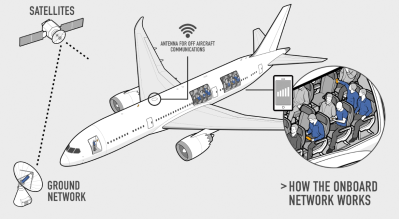
The connectivity back to the Internet is effectively the same as any inflight WiFi system. The difference is that passengers are served with cellular connectivity instead of WiFi. Credit: AeroMobile
Some airlines have gotten around this problem by providing on-board Internet connectivity over WiFi. The aircraft features an uplink to one of various satellite networks that provide Internet access, and that is provisioned to customers in the cabin over a WiFi router with a captive portal. Typically, for some painful charge in double digit US dollars, you can purchase a few hours of access to your emails and the Web, often with quite shaky connectivity.
However, there is sometimes a way to dodge the painful fees for onboard WiFI, while still getting online. A handful of airlines have equipped some of their fleets with cellular connectivity via a system called AeroMobile. They still rely on a satellite uplink for Internet access, and these planes generally still have onboard WiFi as well. However, if you happen to switch your phone out of flight mode, you might notice it connecting to a cell tower onboard—the AeroMobile picocell, in fact. Your phone connects to this tiny cell tower over cellular data links—originally 3G, later 4G or 5G depending on the hardware onboard—instead of WiFi. You escape the airline’s captive portal and data charges, instead paying your home carrier for data and whatever fee you normally get billed for international roaming. The ability to do this depends on your home mobile carrier, too, and whether they have an agreement with AeroMobile.
Advertisement
AeroMobile’s service depends on customers actually switching out of “Flight Mode” in order to allow the phone to use its cellular radios to connect to the picocell onboard the aircraft. Credit: AeroMobile
AeroMobile has been around for a long time now, first demonstrating its hardware with GSM and GPRS data links on aircraft as far back as 2005. The company’s voice and data offerings have stepped up over the years as mobile technology has moved on, albeit often some years behind the state-of-the-art in the cellular world. The first planes with 3G didn’t fly until 2015, well over a decade after the technology was becoming established on the ground. As a subsidiary of Panasonic Avionics, AeroMobile-equipped aircraft communicate with a range of satellites that Panasonic has access to over Ku-band and L-band links. In recent years, the company has been developing the capacity for its aircraft to seamlessly switch between links to geostationary and low-earth orbit satellites, with the former offering the best coverage, and the latter Eutelsat OneWeb satellites offering much reduced latency and higher link speeds. Ultimately, user experience depends on flight route, local conditions, and other factors; speeds and reliability can vary from good to spotty on any given day. There’s also the fact that, on any given flight, tens or hundreds of other users may be trying to get online over the same link, which can quickly dry up what little bandwidth may be available in some black spots on the world map with poor satellite coverage.
If you’re flying soon, it’s still unwise to rely on in-flight internet connectivity. Whether you’re hooking up over WiFi or cellular, there are still often issues with coverage, or with systems being inoperative on certain flights and at lower altitudes, even on airlines with the best-equipped fleets. You’re also unlikely to regularly get high enough speeds for comfortable streaming, so you’re better off downloading The Thick Of It prior to take-off rather than trying to watch it live off a server while you’re scooting over downtown Astana. However, now and then, when you’re lonely and high above this marbled sphere, you might be just able to hang out on Discord and flirt with a few friends back home thanks to Panasonic and a steady link to the satellites above. Have fun up there.
Banks aren’t short on AI ambition. Across the industry, there are almost weekly announcements about new deployments, new partnerships, and new capabilities.
But amidst the lofty pronouncements, not enough attention is given to building the underlying architecture that makes any of it sustainable.
The UK Treasury Committee has already warned that the financial system is not adequately prepared for a major AI-related incident, and from where I sit, that warning is aimed squarely at how modernization programs are being run.
Advertisement
Latest Videos From
Katherine Yeung
Chief Risk and Compliance Officer at 10x Banking.
This is a governance problem which stems from unmade decisions; most banks have yet to make the strategic, organisation-wide commitment that should determine what gets built, before anyone starts building.
There is a real opportunity to be grasped by inviting the risk team to be part of design before you begin delivery.
Advertisement
Risk teams are being invited to the table too late
In traditional program structures, risk and compliance are brought in to validate decisions already made. Platforms are selected, designs agreed and timelines set, and the role of the risk function has typically been to check these things, rather than shape them. That model was never ideal, but now, in the AI-era modernization push, is structurally backwards at best and dangerous at worst.
A genuinely AI-ready bank requires continuous data lineage, runtime-embedded controls and a real-time, cloud-native core. None of these can be retrofitted cheaply once architecture decisions have already been made. By the time a compliance team discovers that a new platform can’t meet AI governance or data traceability requirements, the cost of fixing it is prohibitive
Advertisement
Sign up to the TechRadar Pro newsletter to get all the top news, opinion, features and guidance your business needs to succeed!
If the risk function is part of the design process from the outset, banks can build a risk-conscious architecture rather than a risk-adjacent one. The difference in outcome is substantial, and increasingly, the difference between an institution that can operate confidently with AI and one that can’t.
How legacy cores create invisible risk
The story of legacy architecture’s constraints on innovation is well told, but it also creates blind spots that risk professionals can’t see, let alone manage.
Advertisement
Batch-processing cores are the clearest example of this. When a core updates positions overnight rather than in real time, AML and fraud systems are operating on stale data. Suspicious activity that occurs between batch runs is invisible until the next cycle, a direct operational liability as the volume and speed of financial crime increases.
Fragmented data pipelines create a related problem. Continuous lineage (the ability to trace every decision to its data source) is a prerequisite for AI governance. On architectures where data moves through multiple disconnected systems before reaching an analytics layer, that lineage is structurally impossible to maintain without a modern, cloud-native architecture.
Finally, third-party AI deployment adds an additional layer of exposure. When models are embedded in platforms a bank doesn’t have full control over, it leaves compliance teams operating with limited visibility into how decisions are being made.
Advertisement
Under the EU AI Act, which requires traceability and explainability for high-risk AI systems which may credit decisioning and fraud detection, that becomes a direct regulatory risk, and that’s just one of a raft of emerging AI regime banks must navigate.
Risk is moving from chronic to acute
What has changed is the speed at which risk moves.
Banks now have to contend with an increase in state-based cyberattacks on financial supply chains, a trend accelerated by geopolitical instability, with agentic AI substantially increasing the speed and scale of those attacks.
Advertisement
Under regimes such as DORA, which introduce near real-time cyber incident reporting, means institutions need detection and response infrastructure that operates on live data, capable of identifying and escalating incidents as they happen rather than after the fact. Batch architectures don’t meet this standard, and the window to remediate is narrowing.
The EU AI Act raises the bar further on traceability and explainability, particularly for credit decisioning and fraud detection, both areas where AI adoption is moving fastest.
Banks not designing against these requirements are accumulating risk, not avoiding it. The regulatory deadlines are known. The technical requirements are understood. The question is whether the architecture being selected today is capable of meeting the obligations that will be enforced tomorrow.
Advertisement
What risk-intelligent modernization looks like
I have sat in enough program steering committees to know that the moment risk professionals are brought into a modernization program shapes everything that follows.
When we arrive after the architecture is set, we are negotiating against decisions that are already expensive to reverse. When we are in the room from the start, we can design the non-negotiables in rather than bolt them on.
The practical starting point is three questions that every bank should answer before any platform decision is made:
What risk posture must we preserve throughout migration? The answer defines the non-negotiables for any new architecture: data integrity, audit continuity, access controls, and the governance structures that cannot lapse during transition.
Advertisement
What are we engineering against on a ten-year horizon? Regulatory requirements in 2036 will look different from those in 2026. The architecture being selected today needs to be capable of meeting obligations that do not yet fully exist, which means flexibility and real-time data capability are not optional extras. Some of the newer, digitally-native fintechs have demonstrated that building with this horizon in mind from the outset produces materially different, and more resilient, architecture than retrofitting compliance onto an existing estate.
What governance must change so we don’t embed legacy risk into a modern platform? New infrastructure running old processes is window-dressing. If you modernize technology without modernizing governance, you recreate the same control failures in a different environment.
Modernization is not risk-free. But the risk of standing still now exceeds the risk of moving carefully, and the cost of getting the architecture wrong compounds with every year it goes unfixed.
This article was produced as part of TechRadar Pro Perspectives, our channel to feature the best and brightest minds in the technology industry today.
The views expressed here are those of the author and are not necessarily those of TechRadarPro or Future plc. If you are interested in contributing find out more here: https://www.techradar.com/pro/perspectives-how-to-submit
The fully adaptive Active Noise Cancelling monitors ambient noise continuously and updates its filter at 48,000 times per second, which in practice means the ANC adjusts to what is actually happening around you rather than applying a fixed profile and hoping for the best.
Advertisement
Transparency mode sits at the other end of that, letting environmental sound mix into the listening experience when awareness matters more than isolation, and switching between the two takes a single button press on the ear cup.
Plug in via USB-C and the built-in DAC delivers lossless audio alongside three distinct sound profiles, covering the Beats Signature profile for music, an Entertainment profile tuned for films and games, and a Conversation profile optimised for calls and podcasts.
The 40-hour battery life means a full working week of commuting without needing to charge, and the Fast Fuel feature provides four hours of playback from a 10-minute top-up when that figure runs low.
Advertisement
Comfort over long sessions is handled by UltraPlush over-ear cushions in engineered leather, and both Apple and Android users get native compatibility features, including one-touch pairing and Find My support on the Apple side.
For anyone who wants a serious over-ear headphone with ANC, lossless audio, and a 40-hour battery at a price that has just dropped by nearly a quarter, the Beats Studio Pro makes a compelling case, and our best headphones, best wireless headphones, and best noise-cancelling headphones guides are there for anyone still mapping the wider field.
The Beats Studio Pro harness clear, neutral sound quality, strong noise-cancellation, and an excellent wireless performance into their slightly tweaked design. While they impress with good performance across the board, it’s not quite at the level to supplant the likes of Sony.
In the desert outside Zhongwei, in the northwestern region of Ningxia, four dedicated power lines now run from a field of solar panels to a cluster of computers.
They do not pass through the public grid. That detail, dull as it sounds, is the whole point.
China is encouraging its sprawling data centre industry to plug directly into wind and solar generation, rather than draw power off a grid still heavily fed by coal. The push is part policy, part demonstration.
Beijing’s 2026 government work report named tighter integration between computing infrastructure and electricity supply as a priority, and a national green-data-centre plan now requires new projects in the country’s designated computing hubs to source most of their power from clean sources.
Advertisement
The 💜 of EU tech
The latest rumblings from the EU tech scene, a story from our wise ol’ founder Boris, and some questionable AI art. It’s free, every week, in your inbox. Sign up now!
The Zhongwei plant is the project everyone points to. China Datang Corp commissioned a 500-megawatt solar farm there, describing it as the country’s first large-scale green-power project built to supply a data centre cluster directly.
It entered formal operation in early May, after green-power direct supply began in February, according to Chinese state media.
Advertisement
What makes it unusual is the delivery. The site uses what Datang calls a dual-track structure: four dedicated 110-kilovolt lines carry electricity straight to the computing facilities, with additional demand covered through bilateral market trades.
Solar output is prioritised during the day, wind is expected to cover the evenings, and storage smooths the gaps.
The solar plant alone should generate around 970 gigawatt-hours a year, roughly half the cloud base’s projected demand.
The numbers grow once the wind component arrives. The 500MW solar array is the first slice of a 2-gigawatt first phase that pairs it with a 1.5GW wind farm and storage, at a planned cost of about 8.7 billion yuan, or some $1.27bn.
Advertisement
The wind build is still under construction, scheduled for full grid connection in September.
Once phase one is complete, annual generation is expected to reach 4.3 terawatt-hours, more than the cloud base’s forecast consumption of 2.29 terawatt-hours. A second phase would push the total to 4.6GW.
The logic sits inside China’s “east data, west computing” strategy, which steers energy-hungry processing toward western regions where wind and solar are plentiful and land is cheap. Demand is the pressure behind all of it.
AI has driven an explosion in computing capacity, and with it electricity use, at exactly the moment Beijing is trying to hit peak carbon emissions by 2030.
Advertisement
The ambition is steep. Authorities want renewables to supply roughly four-fifths of the AI data-centre sector’s power by 2030, up from around a tenth in 2023.
The gap between a single working project in the desert and that national target is the part the policy has not yet closed.
Curtailment, grid bottlenecks, and the intermittency of wind and solar remain real, and China’s green-power goals for AI have already run into the grid before.
For now, Zhongwei is the test case. If desert wind and sun can be matched to digital load without leaning on the conventional grid, the model travels. If they cannot, it stays a handsome demonstration in Ningxia.
Advertisement
The wind turbines are due in September, that is when the figures stop being projections.
joshuark shares a report from Car and Driver: A new study conducted by the New York Times shows that the increase in vehicle hood height seen over the last two and a half decades, mainly due to the rise in popularity of large SUVs and trucks, has resulted in several thousand deaths that otherwise may not have happened. The study shows that while automakers and regulators have focused on occupant safety, they have turned a blind eye to pedestrian safety, which has fallen since around 2009. Researchers looked at four main datasets in their investigation: crash test data from the National Highway Traffic Safety Administration’s (NHTSA) Crash Report Sampling System (CRSS) from 2016 to 2024; NHTSA’s Fatality Analysis Reporting System (FARS); vehicle measurement data from Expert AutoStats; and vehicle registration data from S&P Global from 2002 to 2024. The researchers concluded that the increased danger to pedestrians is caused by two main culprits.
First, large SUVs and trucks have taller hoods, raising the point of impact above most people’s center of gravity and pushing them to the ground, typically hard asphalt, rather than up and onto the hood, which is designed to absorb impacts. Second, with larger A-pillars designed to protect occupants in rollover crashes, modern cars tend to have larger blind spots than cars sold at the turn of the century (presuming the 21st century). The shift toward vehicles with taller hoods led to roughly 3000 deaths between 2016 and 2024. This number is conservative because it does not include crashes that take place in parking lots, driveways, or private roads, which aren’t part of the federal database.
The data also showed an estimated 2.8 percent increase in the odds of a pedestrian fatality for every one-inch increase in vehicle hood height. Between two different scenarios, one decreasing the hood height of every vehicle in the dataset by 3 inches, and the second using a random sampling of hood heights from 2002 across 10,000 simulated crashes, between 2624 (for scenario two) and 3077 (for scenario one) lives could have been saved from 2016 to 2024.
Preliminary position calls for designation under the Digital Markets Act
The European Commission has reached the preliminary position that Azure and AWS should be designated as gatekeepers under the Digital Markets Act (DMA).
The gatekeeper designation would mean requirements imposed on the cloud giants, with fines of up to 10 percent of worldwide turnover if those requirements are not met.
Advertisement
According to the Commission, AWS and Azure, “the largest and second largest cloud computing services in the EU respectively,” are a gateway between businesses and their customers in the bloc.
“They both have vast and entrenched user bases and appear to benefit from lock-in effects and high switching costs, in addition to a large ecosystem.”
Although the cloud giants did not meet the DMA’s quantitative thresholds for designation (such as user numbers), their market positions have attracted scrutiny. Should the gatekeeper designations stick, obligations regarding interoperability, access to data, and competition would apply.
The view is preliminary at this stage, and Amazon and Microsoft have the opportunity to respond before anything becomes final.
Advertisement
A Microsoft spokesperson told The Register: “We continue to engage constructively with the Commission. The cloud sector in Europe is innovative, highly competitive and an accelerator for growth across the economy.”
The spokesperson added: “We remain concerned that ignoring the growing power of Google Cloud and Gemini will tilt the market in a harmful way.”
AWS also disagreed with the Commission’s preliminary position. A spokesperson told The Register: “The Commission’s preliminary findings disregard the breadth of cloud services available to European customers and risk deterring European investment and innovation. AWS faces healthy competition and customers across Europe have more choice, lower prices, and greater flexibility than ever before.
“The EU already has comprehensive cloud regulation through the Data Act, and adding another heavy layer of overlapping regulation under the DMA undermines European competitiveness and access to cutting-edge information technology. We will continue to engage with the Commission to reach the right outcome for customers and Europe’s digital future.”
Advertisement
Other parties responded more positively. A spokesperson for the Open Cloud Coalition told The Register: “Our members welcome the Commission’s preliminary finding naming Microsoft and AWS as cloud gatekeepers. We particularly note the finding that existing customer lock-in may fuel enterprise AI, a development that mirrors long-standing market concerns over Microsoft’s licensing and ecosystem practices.
“Moving quickly to deliver remedies is now a priority to ensure choice and growth for European cloud customers.”
In 2024, Microsoft described the Open Cloud Coalition as a lobbying group for Google.
Henna Virkkunen, executive vice-president for tech sovereignty, security and democracy, stated: “Cloud services have become a cornerstone of Europe’s economy – and a prerequisite for AI – with over half of EU businesses now relying on them, combined with record investment in public cloud infrastructure.
Advertisement
“Given their central role in Europe’s digital future, these services must operate in fair, open and competitive markets that foster trust and secure Europe’s tech sovereignty.”
Should the preliminary findings be confirmed and Microsoft and Amazon be designated as gatekeepers for their cloud services (they already have gatekeeper status for other services), the pair will have six months to ensure compliance with the DMA’s obligations. ®
Organizations continue to invest in phishing defenses, identity protection, and multi-factor authentication, yet account takeover attacks remain one of the most disruptive security incidents facing enterprises today.
On July 8, 2026, BleepingComputer will host a live webinar titled “Stop chasing alerts: Automating email security with behavioral AI” presented by Dan Nickolaisen, Solutions Architect Manager at Abnormal AI, and Eric Danneker, Director of Cyber Vigilance and Defense at Novant Health.
The webinar will examine how attackers gain access to legitimate accounts, why traditional security controls often struggle to detect account compromise quickly, and how behavioral AI can help security teams accelerate investigations and response.
Modern account takeover attacks frequently rely on trusted identities, legitimate cloud services, and compromised business accounts rather than obviously malicious activity. As a result, attackers can blend into normal business operations while maintaining access to email, collaboration platforms, and corporate resources.
Advertisement
Security teams are often left investigating suspicious messages, unusual login activity, and user reports long after attackers have established a foothold.
Abnormal AI helps organizations identify abnormal account behavior and automate investigation workflows, enabling analysts to detect compromised accounts faster and respond more efficiently.
Attendees will learn practical approaches for identifying account compromise earlier, reducing manual investigation work, and limiting the impact of account takeover attacks.
Compromised accounts are difficult to distinguish from legitimate users
Unlike traditional malware attacks, account takeover incidents often involve legitimate credentials, trusted devices, and normal business communications.
Advertisement
This makes compromised accounts significantly harder to identify using traditional security controls alone.
This webinar will explore how behavioral AI can help security teams identify unusual behavior patterns, investigate suspicious activity automatically, and accelerate remediation before attackers can expand their access.
The upcoming webinar will cover:
How phishing, BEC, and account takeover attacks lead to compromised business accounts
Why attackers increasingly rely on legitimate identities and trusted services
The challenges security teams face when investigating potential account compromise
How behavioral AI can automate detection, investigation, and remediation workflows
Practical techniques for reducing response times and limiting the impact of account takeovers
Join us to learn how organizations can detect compromised accounts faster and improve their ability to respond before small incidents become major security events.








-Reviewer-Photo-SOURCE-Nena-Farrell.jpg)

















































You must be logged in to post a comment Login