

Crypto World
What is MiCA? Europe’s crypto regulation explained



MiCA is the European Union’s first comprehensive rulebook for crypto, and on July 1, 2026, its transition period ends for good. This guide explains what MiCA does, why USDT got delisted while USDC did not, and what the hard deadline means for exchanges and users.
Summary
- MiCA becomes fully enforceable across the European Union on July 1, 2026, after which crypto firms without a MiCA license can no longer legally serve EU users.
- The regulation introduced a single framework for crypto across all EU member states, with strict rules for stablecoins, exchanges, and other crypto service providers.
- MiCA compliance kept USDC listed on regulated European exchanges, while USDT was delisted after its issuer chose not to seek authorization.
MiCA, short for Markets in Crypto-Assets, is the European Union’s first comprehensive law governing crypto-assets and the companies that deal in them, creating one common rulebook across all twenty-seven member states in place of the patchwork of national approaches that came before. Formally known as Regulation (EU) 2023/1114, it entered into force in mid-2023 and has rolled out in phases ever since, and it now sits at a decisive moment: on July 1, 2026, the transition period that let existing crypto firms keep operating under old national rules expires for good, and Europe’s market supervisor has been blunt that there will be no extensions.
After that date, any company offering crypto services to European Union clients without a proper MiCA license is simply breaking the law. This guide explains what MiCA is, the categories it creates, why some stablecoins survived in Europe while others were delisted, what a crypto company must do to comply, and what the hard 2026 deadline means for exchanges and ordinary users alike.
The significance of MiCA is hard to overstate, because the European Union is one of the largest economic blocs on earth and MiCA is the most ambitious attempt yet to bring crypto fully inside a traditional financial-regulation framework. Before MiCA, a crypto exchange or token issuer operating in Europe faced a confusing mix of national rules, with one regime in Germany, another in France, another in Malta, and gaps everywhere in between.
MiCA replaces that fragmentation with a single, harmonized system: get authorized once, and you can passport your services across the entire bloc. The trade-off is that the bar to get authorized is high, the obligations are heavy, and the deadline to clear them is now days away rather than years off. The result is a market being reshaped in real time, with a small number of licensed winners, a large number of firms facing exit, and a stablecoin landscape that already looks very different inside Europe than outside it.
What MiCA actually regulates
MiCA divides the crypto world into categories and applies different rules to each, so the first step in understanding it is learning what those categories are. At the top level, MiCA governs two kinds of actors: the issuers of crypto-assets and the providers of crypto-asset services. For issuers, MiCA sorts tokens into three buckets.
The first is electronic money tokens, or EMTs, which are stablecoins pegged to a single official currency, such as a euro-pegged or dollar-pegged coin. The second is asset-referenced tokens, or ARTs, which are stablecoins backed by a basket of things, multiple currencies, commodities, or other assets, rather than a single currency. The third is a catch-all category of other crypto-assets, which covers utility tokens, governance tokens, and unbacked cryptocurrencies like Bitcoin and Ether, the assets most exchanges handle every day.
Each bucket carries different obligations. The two stablecoin categories face the strictest treatment, because regulators view stablecoins as the part of crypto most capable of threatening the wider financial system, a concern sharpened by the 2022 collapse of the TerraUSD algorithmic stablecoin that wiped out tens of billions of dollars. EMT and ART issuers must hold proper reserves, grant holders redemption rights, and meet governance and disclosure standards.
The other crypto-assets face lighter rules, mainly requirements to publish an honest whitepaper before offering a token to the public and to avoid market abuse. Notably, MiCA largely excludes non-fungible tokens, unless they are issued in a large fungible series that makes them function more like ordinary tokens, and it excludes assets already covered by existing financial law, such as securities. The category a token falls into determines almost everything about how MiCA treats it, which is why getting the classification right is the starting point for any issuer.
The stablecoin rules and why USDT got delisted
The most visible effect of MiCA so far has been on stablecoins, and the clearest way to understand the rules is through what happened to the two largest dollar stablecoins. Under MiCA, a stablecoin can only be offered by European Union-regulated platforms if its issuer is authorized, which for a single-currency stablecoin means holding an e-money or credit institution license and meeting MiCA’s reserve, redemption, and governance requirements.
The reserve rules are strict: an EMT must back its tokens fully, holding one hundred percent of reserves in safe, segregated accounts, while an ART must keep at least a substantial portion segregated at regulated credit institutions. MiCA also bars stablecoin issuers from paying interest or yield to holders, a deliberate choice to stop stablecoins from competing with bank deposits and drawing money out of the banking system.
This is where the two giants diverged. Circle, the issuer of USDC, pursued authorization through a European subsidiary and obtained MiCA approval for USDC and its euro stablecoin EURC, making them compliant and freely offered across European Union exchanges. Tether, the issuer of USDT, the largest stablecoin in the world, did not apply for MiCA authorization and confirmed its token was not compliant. The consequence was swift: major European Union-regulated exchanges, including the regional arms of the largest global platforms, delisted USDT and other non-compliant stablecoins for their European users.
The nuance worth understanding is that USDT is not banned from existence in Europe; users can still hold it in self-custody and trade it on decentralized exchanges. What changed is that a MiCA-licensed exchange can no longer offer it, which fragments liquidity and pushes European users toward compliant alternatives like USDC. Every stablecoin authorized under MiCA so far has been an EMT, a single-currency token, and USDC’s compliance versus USDT’s non-compliance has become the textbook illustration of the rules in action.
CASPs: the rules for exchanges and service providers
Beyond token issuers, MiCA’s other major target is the companies that provide crypto services, which the regulation calls crypto-asset service providers, or CASPs. This category is broad: it covers exchanges, brokers, custodians, wallet providers that hold customer assets, trading platforms, and firms that advise on or place crypto-assets.
If your business touches customer crypto in almost any commercial way, you likely need a CASP authorization to keep serving European Union clients. The obligations that come with that authorization are extensive and closely mirror those imposed on traditional financial firms, which is the entire point: MiCA aims to make crypto service providers behave like regulated financial institutions rather than lightly governed startups.
A CASP must meet requirements covering customer identity verification and anti-money-laundering controls, the safekeeping and segregation of customer assets, governance and capital standards, market-conduct rules that prohibit insider trading and market manipulation, and clear disclosure of risks to customers. Authorized CASPs also become subject to the European Union’s operational-resilience framework, which mandates cybersecurity and incident-reporting standards, and to the crypto travel rule, which requires them to pass along sender and recipient information on transfers, the same obligation that has applied to bank wires for decades.
The reward for shouldering all of this is passporting: once a firm is authorized in any one member state, it can offer its services across all twenty-seven without seeking separate licenses in each, turning a fragmented continent into a single market. The burden is that running these programs at scale, across a global customer base, is expensive and demanding, which is exactly why so many firms are struggling to clear the bar before the deadline.
The July 2026 deadline and the great narrowing
Everything about MiCA now points toward a single date, and understanding the phased rollout explains why that date matters so much. MiCA did not arrive all at once. The stablecoin rules for EMTs and ARTs took effect in mid-2024. The full CASP authorization regime took effect at the end of 2024, the point from which firms needed a MiCA license to operate.
But MiCA included a grandfathering provision, a transition period that let firms already operating legally under their national rules continue doing so while they applied for full MiCA authorization. Member states set their own transition windows within the limits MiCA allowed, ranging from short windows ending in 2025 to the full eighteen-month period ending on July 1, 2026. That final date is the bloc-wide cutoff, the moment the transition ends everywhere at once.
What makes the deadline dramatic is how few firms have actually cleared the bar. As the cutoff approached in 2026, roughly a couple of hundred firms held some form of full MiCA authorization across the entire union, but the number cleared to run an actual crypto trading platform was strikingly small, in the low double digits, with a number of member states having issued zero trading-platform licenses at all. Industry executives openly warned that a large majority of exchanges currently operating may fail to secure a license and be forced to exit the European market, and reports emerged of major global exchanges facing rejection in specific countries.
Europe’s market supervisor reinforced the message with no room for ambiguity: no member state may extend the transition beyond July 1, 2026, and after that date, operating without authorization is a breach of European Union law, not a paperwork gap. The picture, then, is of a great narrowing, a market being compressed from a crowded field into a small set of licensed survivors, with the rest required to wind down their European operations or leave.
A worked example: what a token and an exchange each face
To make the rules concrete, it helps to walk through how MiCA treats two typical cases, a stablecoin issuer and an exchange, because the abstract categories become much clearer in motion. Imagine a company issuing a euro-pegged stablecoin and wanting European users to hold and trade it on regulated platforms.
Under MiCA, that token is an electronic money token, so the issuer must hold an e-money or credit institution license, back every token fully with reserves held in safe, segregated accounts, grant holders the right to redeem their tokens for the underlying currency on demand, publish a compliant whitepaper, and accept that it cannot pay holders any interest or yield. If the company does all of this and secures authorization, its stablecoin can be offered across the bloc; if it does not, regulated exchanges must refuse to list it, exactly the fork in the road that separated the compliant dollar stablecoin from the non-compliant one. The token’s fate under MiCA is decided entirely by whether its issuer accepts this package of obligations.
Now imagine an exchange that wants to keep serving European customers. Its path runs through CASP authorization. It must apply to a national regulator in some member state, prove it meets MiCA’s standards for governance, capital, and the safekeeping and segregation of customer assets, stand up the identity-verification and anti-money-laundering machinery that turns it into an obliged entity under European law, implement the travel rule so it passes sender and recipient information on transfers, meet the operational-resilience and cybersecurity requirements, and submit to ongoing supervision and market-conduct rules. If the regulator grants authorization, the exchange can passport that single license across all twenty-seven member states and operate bloc-wide.
If it cannot meet the bar or applies too late, it must stop serving European Union clients once the transition ends, winding down in an orderly way. The two journeys share a logic: MiCA offers a single, valuable prize, legal access to the entire European market, in exchange for accepting obligations modeled on those that govern banks and regulated financial firms.
What this worked example reveals is the deeper character of MiCA. It is not a light-touch registration that lets crypto firms keep operating much as before with a new label. It is a serious authorization regime that demands real reserves, real controls, real segregation of customer money, and real accountability, and it forces every issuer and service provider to decide whether the prize of European market access is worth the cost of meeting those demands.
For well-resourced firms with a long-term commitment to Europe, the answer is often yes, and they have built the compliance machinery to clear the bar. For many smaller or offshore operators, the cost is too high or the timeline too short, which is why the market is narrowing toward a smaller set of licensed survivors. The categories and rules described earlier are not bureaucratic abstractions; they are the concrete hurdles that decide, token by token and firm by firm, who gets to operate in Europe after the transition closes.
What MiCA leaves unsettled
For all its ambition, MiCA leaves important questions open, and the gaps are as revealing as the rules. The largest unsettled area is decentralized finance. MiCA is built around identifiable issuers and service providers, the companies it can authorize and supervise, but a genuinely decentralized protocol has no company at its center, no firm to hold a license or answer to a regulator. MiCA states that fully decentralized arrangements, those provided without any intermediary, fall outside its scope, which sounds clean until you ask what “fully decentralized” actually means.
The market supervisor has not yet defined the term precisely, and most real protocols sit somewhere in the middle, with a governance token, a development team, a foundation, or a front-end operator that a regulator might decide counts as an intermediary. The result is genuine uncertainty about which DeFi protocols MiCA captures and which it does not, a gap that will be filled by future guidance and enforcement instead of the text itself.
Other tensions are surfacing as the rules meet reality. MiCA places caps on how widely very large stablecoins denominated in non-European currencies, such as dollar stablecoins, can be used as a means of payment within the bloc, a provision aimed at protecting European monetary sovereignty but one that complicates life for a market where most trading is dollar-denominated.
There are overlaps with other European financial laws, such as payment services rules, that can double the compliance burden for some stablecoin activities and have prompted worries about the competitiveness of euro stablecoins. And politically, the dossier has grown charged, with some member states floating the idea of a mechanism to switch off foreign stablecoins seen as a systemic threat.
None of these unsettled questions undermines MiCA’s core achievement of creating a single framework, but they are reminders that a law this sweeping cannot anticipate everything, and that MiCA will keep evolving through guidance, enforcement, and amendment for years after the headline deadline passes.
MiCA in the global picture
MiCA does not exist in isolation, and seeing it alongside parallel efforts elsewhere reveals where global crypto regulation is heading. The same years that produced MiCA also produced the United States’ first comprehensive federal stablecoin law, the United Kingdom’s move toward its own crypto regime under its financial regulator, and Hong Kong’s stablecoin ordinance, among others.
These frameworks differ in detail, but they converge on a striking number of core principles: stablecoin issuers should hold full, high-quality reserves; they should be licensed and supervised; holders should have clear redemption rights; service providers should enforce identity checks and anti-money-laundering controls; and the whole apparatus should be brought inside the regulatory perimeter that governs traditional finance. MiCA, having arrived early and comprehensively, has functioned as something of a reference point that later frameworks echo and respond to.
This convergence matters for anyone trying to understand the trajectory of the industry. The era in which crypto operated in a regulatory vacuum, where an exchange could serve a global audience with minimal oversight, is closing, and MiCA is one of the clearest markers of that shift. The picture that emerges is of a maturing market in which access increasingly depends on compliance, in which the same stablecoin can be freely available in one jurisdiction and delisted in another based purely on its issuer’s regulatory posture, and in which the cost of operating legally has risen sharply.
For Europe specifically, MiCA’s promise is a safer, more transparent market with clear rules and a public register of authorized firms and tokens that anyone can consult. Its cost is a heavier compliance burden, a narrower field of providers, and reduced access to some popular global assets. Whether that trade favors consumers or stifles innovation is the live debate, but the direction is set: in Europe, crypto is now a regulated activity, and after July 1, 2026, that is true without exception.
What it means for everyday users
For an ordinary person using crypto in Europe, MiCA changes the landscape in concrete ways worth understanding before the deadline instead of after. The most immediate effect is on which platforms and tokens you can use. If you rely on an exchange that has not secured a MiCA license, that platform may be forced to stop serving European Union clients after July 1, 2026, which in practice can mean frozen new deposits, halted trading features, and eventually a forced withdrawal of your funds, sometimes during a period of low liquidity and high fees. The protective move is to check, today instead of on July 2, whether the platforms you use have secured or are clearly on track to secure authorization, and to favor those that have. An unauthorized service operating after the deadline offers reduced legal protection and potential restrictions on access to your own assets.
The second effect is on stablecoins. If you hold a non-compliant stablecoin on a European Union-regulated exchange, you may find it delisted, with trading pairs removed and liquidity drying up, which is why many European users have shifted toward MiCA-authorized options. You can still self-custody whatever you like, but the convenient on-ramps and trading pairs increasingly favor compliant tokens. The broader takeaway is that MiCA, for all its complexity, ultimately aims to make the European crypto market safer and more transparent for users by ensuring the exchanges they trust meet real standards and the stablecoins they hold are genuinely backed. The cost of that safety is fewer choices and more friction, and a transition period that, for some platforms and tokens, ends abruptly.
The practical wisdom is simple: understand which of your platforms and assets are compliant, make any moves before the deadline instead of during the disruption, and treat MiCA authorization as a meaningful signal that a service has accepted real regulatory accountability.
Frequently Asked Questions
What does MiCA stand for and what is it?
MiCA stands for Markets in Crypto-Assets. It is the European Union’s first comprehensive law for crypto-assets and the companies that deal in them, formally Regulation (EU) 2023/1114. It replaces the previous patchwork of national rules with one harmonized framework across all twenty-seven member states, covering token issuers and service providers like exchanges, custodians, and wallet providers. Its goals are to protect consumers, prevent market abuse, ensure stablecoins are properly backed, and bring crypto inside the same kind of regulatory perimeter that governs traditional finance, while letting authorized firms operate bloc-wide.
Why was USDT delisted in Europe but not USDC?
Under MiCA, a stablecoin can only be offered by European Union-regulated platforms if its issuer is authorized and meets MiCA’s reserve, redemption, and governance rules. Circle pursued authorization through a European subsidiary and obtained MiCA approval for USDC and its euro stablecoin EURC, so they remain available. Tether did not apply for MiCA authorization and confirmed USDT was non-compliant, so European Union-regulated exchanges delisted it. USDT is not banned outright; it can still be self-custodied and traded on decentralized exchanges, but licensed European platforms can no longer offer it.
What happens on July 1, 2026?
That is when MiCA’s transition period ends across the entire European Union. The transition, or grandfathering, let firms already operating under national rules keep going while they applied for full MiCA authorization. After July 1, 2026, any company providing crypto services to European Union clients without a proper MiCA license is breaking European Union law. The market supervisor has stated there will be no extensions. Because relatively few firms have secured licenses, especially to run trading platforms, many exchanges may be forced to exit the European market or wind down their services there.
What is a CASP under MiCA?
A CASP is a crypto-asset service provider, MiCA’s term for companies that offer crypto services such as exchanges, brokers, custodians, wallet providers holding customer assets, and trading platforms. To serve European Union clients, a CASP needs MiCA authorization, which comes with obligations modeled on traditional finance: identity checks and anti-money-laundering controls, segregation and safekeeping of customer assets, governance and capital standards, market-conduct rules against manipulation and insider trading, operational-resilience requirements, and the crypto travel rule. Once authorized in one member state, a CASP can passport its services across all twenty-seven.
Does MiCA regulate DeFi and NFTs?
Only partly, and with significant uncertainty. MiCA largely excludes non-fungible tokens unless they are issued in a large fungible series that makes them behave like ordinary tokens. For decentralized finance, MiCA says fully decentralized arrangements provided without any intermediary fall outside its scope, but it has not precisely defined “fully decentralized.” Since most protocols have a governance token, a development team, a foundation, or a front-end operator, regulators may decide some of them have an intermediary that MiCA captures. So the treatment of many DeFi protocols remains unsettled and will be clarified through future guidance and enforcement.
How does MiCA affect ordinary crypto users in Europe?
Mainly through which platforms and tokens you can use. If an exchange you use has not secured a MiCA license, it may have to stop serving European Union clients after July 1, 2026, which can mean halted deposits and trading and eventually forced withdrawals. Non-compliant stablecoins may be delisted from regulated exchanges, with liquidity shifting to compliant ones like USDC. The protective steps are to check whether your platforms are authorized, move before the deadline instead of during any disruption, and treat MiCA authorization as a signal that a service has accepted real regulatory accountability. You can still self-custody assets freely.
This article is educational information, not legal or financial advice. MiCA implementation, license counts, stablecoin compliance status, and deadlines can change, and details reflect reporting available as of June 25, 2026. Confirm current requirements and the status of specific platforms and tokens through official sources such as the European Securities and Markets Authority register before relying on anything described here.

Crypto World
DCENT S Wallet vs Tangem: Full Comparison of Design, Security, Supported Coins, and Mobile App
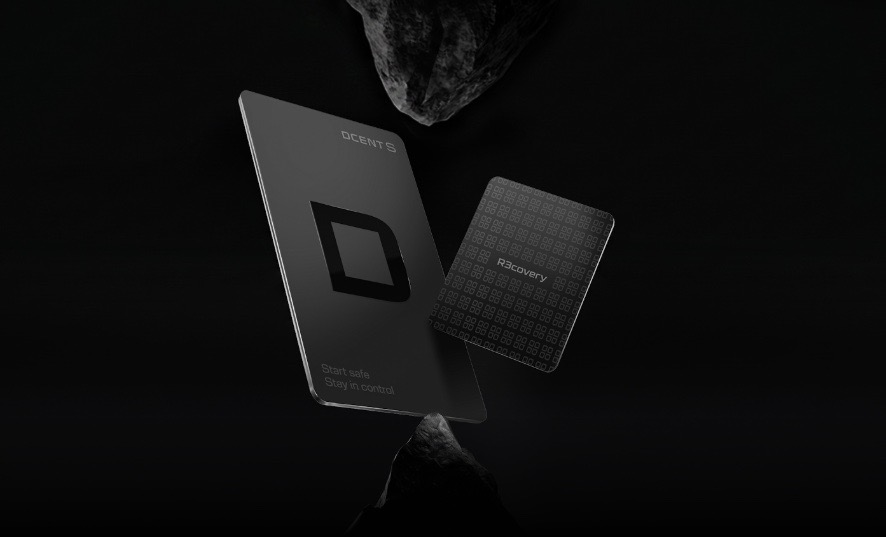
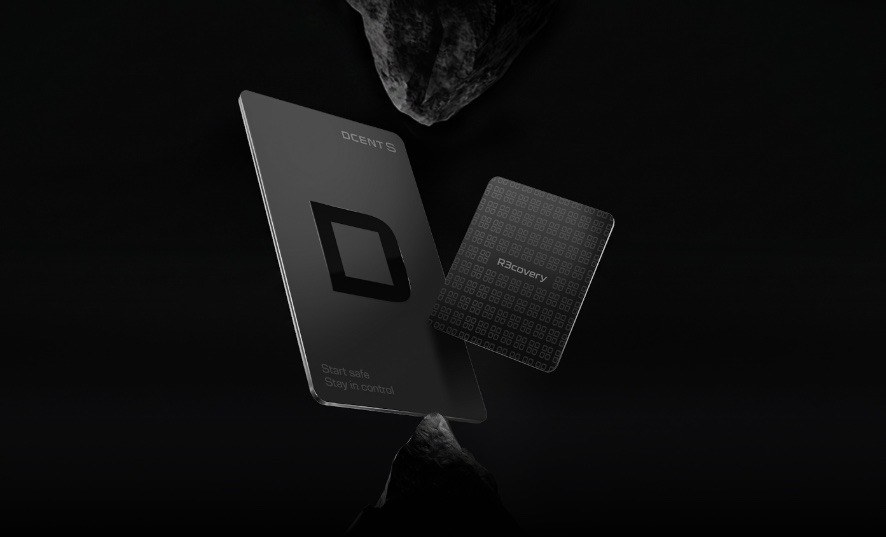
The hardware wallet market has seen a quiet revolution over the past few years. Even though traditional USB-style devices like Ledger and Trezor still dominate the conversation, a new category of card-shaped cold wallets has emerged. These devices look like credit cards, fit in your wallet, and use NFC to sign transactions. No cables, no batteries, no Bluetooth pairing. Just tap and go.
Two names stand out here; DCENT S and Tangem. Both use EAL6+ certified secure elements, and both promise to make self-custody easier than ever. But they take fundamentally different approaches to one critical area – backup and recovery. This single difference shapes everything else about how these wallets work and who they are for.
DCENT S launched in July 2026 as the latest offering from IOTRUST, a South Korean company with years of hardware wallet engineering experience. Tangem has been around longer and comes from Switzerland, with a strong focus on simplicity and beginner accessibility. Both have loyal followings, but they serve slightly different users.
This comparison breaks down every important aspect of these two wallets so you can decide which one fits your needs. We will look at design, security, backup systems, supported assets, daily usability, mobile apps, and overall value.
DCENT S vs Tangem: Quick Comparison
Design & Build Quality
Both wallets use a credit-card-sized form factor. The DCENT S measures 85.6 by 54 millimeters and comes in at just 0.9 millimeters thick. That is thinner than most standard payment cards. Tangem is similarly sized and feels just as slim and lightweight. Both devices fit easily into any wallet slot alongside your other cards.
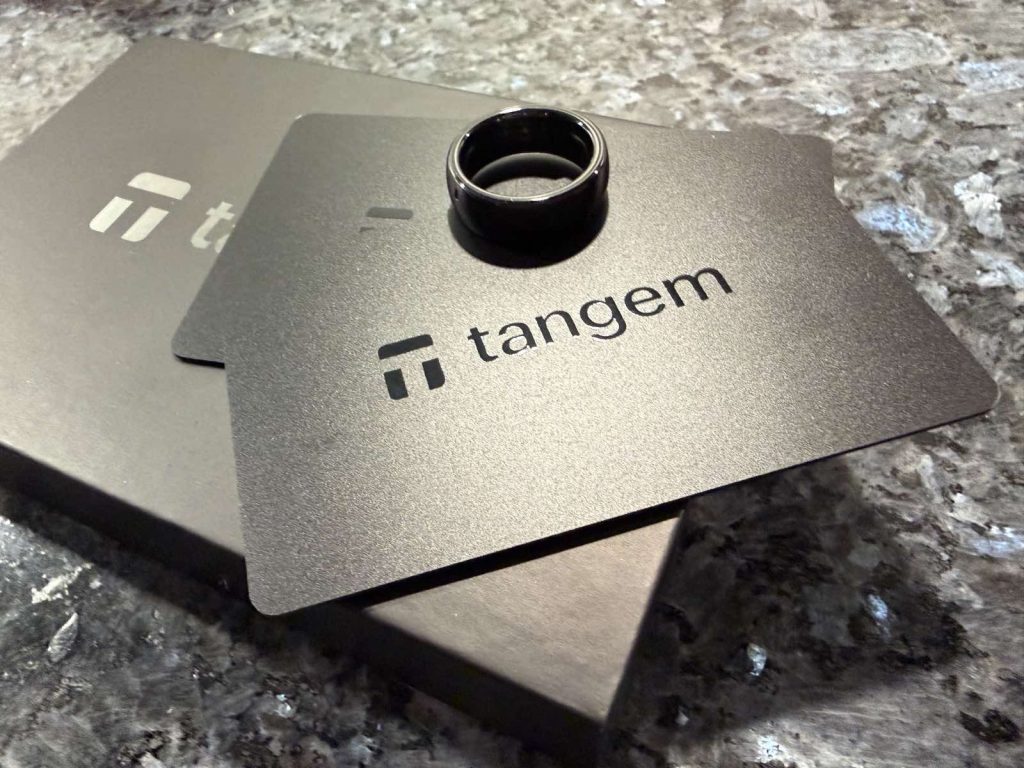
Tangem offers an additional form factor that D’CENT does not; a wearable ring. If you prefer something even more convenient than a card, the Tangem ring lets you carry your wallet on your finger. It is a nice option for people who do not want to carry another card or who simply like the novelty of a crypto ring.
The build quality on both is excellent. DCENT S carries an IP69 dust and water resistance rating, while Tangem goes slightly higher with IP69K. In practical terms, both can survive being dropped in water, exposed to dust, and subjected to everyday wear and tear. Tangem also advertises resistance to X-rays, electrostatic discharge, and electromagnetic pulses, which adds another layer of durability for people who travel frequently or work in environments where such exposure is possible.
Temperature tolerances are similar. DCENT S operates from minus 30 to plus 50 degrees Celsius, while Tangem works from roughly minus 25 to plus 50 degrees Celsius. Either wallet will function in hot cars, freezing winters, or tropical climates.
The one difference that stands out is that Tangem offers a 25-year warranty on their hardware, while DCENT S provides a limited lifetime warranty. Both are generous, and neither company expects you to replace your wallet anytime soon.
Security & Private Key Protection
This is where both wallets are remarkably similar – and that is a good thing. Both use EAL6+ certified secure elements. This is the same level of security certification used for government IDs, passports, and EMV payment cards. It protects against both invasive physical attacks and non-invasive side-channel attacks.
The private key generation process is identical in concept. When you set up either wallet, the secure element generates your private key on-device. The key never leaves the chip under any circumstances. It never touches your smartphone, never goes to the cloud, and never gets stored on company servers.
Both wallets are battery-free and get powered entirely by your phone’s NFC field during signing sessions. This means there is no always-on power source that could be exploited. The card is inert until you tap it against your phone, which significantly reduces the attack surface compared to Bluetooth-enabled wallets that remain discoverable.
Tangem adds anti-counterfeit verification through their app, which lets you confirm that your card is genuine before you use it. DCENT S does not emphasize this feature in their marketing, though the secure element itself provides strong protection against cloning attempts.
Firmware security is another point where Tangem has an edge in transparency. They have had their firmware independently audited by Kudelski Security in 2018 and Riscure in 2023. DCENT S is newer to the market, and while their secure element is certified, they have not published equivalent third-party audit results at this stage.
Both wallets lock themselves automatically after repeated incorrect PIN entries, and both include tamper protection that locks the card if someone attempts to physically extract the chip.
Backup & Recovery
This is where the two wallets diverge completely, and it is the single most important difference between them.
DCENT S uses what they call the R3covery Card. Every box contains two cards – the main DCENT S for everyday transactions and a dedicated recovery card. The recovery card cannot sign transactions. Its only purpose is to restore your wallet if you lose your primary card. The backup is stored inside another EAL6+ secure chip, so your recovery data is never displayed as words, never written on paper, and never typed anywhere.
If you lose your DCENT S, you tap the R3covery Card against your phone, restore the wallet, and then move everything to a new DCENT S card. The recovery card itself remains a high-value target because whoever holds it can restore your wallet. The company recommends storing the two cards in different physical locations.
Tangem takes a different approach. Instead of a dedicated recovery card, they sell wallet sets that include two or three identical cards (or combinations of cards and a ring). During setup, the private key is securely copied to all devices in the set. Any of these duplicate cards can function as the primary wallet. If you lose one card, you simply use another from your set.
The Tangem approach means you do not need to order a replacement card just to restore access. You already have a backup ready to go. The downside is that every card in your set can sign transactions. If someone gets hold of one of your backup cards and knows your PIN, they have full access to your funds. With DCENT S, the recovery card cannot sign anything, so even if stolen, it is useless without the main card and PIN.
There is a trade-off here. Tangem offers immediate redundancy – you have multiple working cards from day one. DCENT S offers a recovery-only backup that cannot be misused for transactions but requires you to obtain a new primary card after loss.
Supported Coins & Networks
DCENT S supports over 100 blockchain networks and more than 4,900 tokens. Tangem supports more than 90 blockchain networks and over 14,000 tokens.
In practice, both wallets cover all the major assets you are likely to hold. Bitcoin, Ethereum, XRP, Solana, Stellar, Polygon, and BNB Chain are supported on both. New chains are added through app updates on both platforms, so you do not need to update the physical card firmware.
Where DCENT S distinguishes itself is in XRP support. The company has been working with the XRP Ledger since 2018, and they make a point of emphasizing full XRPL functionality. Trust Lines, decentralized applications, swaps, sending, receiving, and holding XRP are all fully supported. If you are active on the XRP Ledger, DCENT S feels like it was built specifically for you.
Tangem supports XRP as well, but they do not make it a central part of their marketing. For most users, both wallets cover everything they need. The difference in token count is more about counting methodology than actual compatibility.
Ease of Setup & Daily Use
Both wallets are exceptionally easy to set up. Tangem claims a two-minute setup time, while DCENT S estimates three minutes. In reality, both are fast enough that the difference is negligible. You download the app, tap the card, create a PIN, and you are ready to send and receive crypto.
Daily use is where the similarity continues. Both wallets require an NFC-enabled Android or iPhone. You open the app, create a transaction, tap the card against your phone, wait about one second for the signing to complete, and the transaction is broadcast. No cables, no pairing, no charging.
Neither wallet has a display, which means you cannot verify transaction details directly on the device. You rely on the app to show you the transaction details before you sign. This is a trade-off for the card form factor – traditional hardware wallets with screens offer an extra layer of verification that these card wallets cannot provide.
For people who frequently use their crypto on mobile devices, both wallets feel natural. The tap-to-sign workflow is almost identical to using a contactless payment card. It takes the friction out of self-custody and makes it feel like a normal part of your daily routine.
Mobile App Experience
The DCENT app and Tangem app both serve as the primary interface for managing your assets. They let you send and receive crypto, view your portfolio, and track transaction history. Both apps are available for Android and iOS.
Tangem’s app has been around longer and benefits from more mature feature development. It offers built-in swapping through integrated providers, staking support for certain assets, and the ability to connect to decentralized applications. The portfolio tracking and market price features are polished and regularly updated.
DCENT’s app is part of a broader ecosystem that includes their other hardware wallet products. It is clean, functional, and gets the job done. The app supports swapping, portfolio tracking, and all the basic functions you need. It may not have quite as many built-in services as Tangem, but it covers the essentials well.
Both apps are beginner-friendly and do not assume prior experience with cryptocurrency. If you can use a basic banking app, you can use either of these.
Price & Value
Pricing for both wallets depends on the configuration you choose. Tangem offers two-card and three-card sets, with higher prices for larger sets. The ring version is also priced higher than the card version. DCENT S comes as a single primary card plus the R3covery Card in every box.
DCENT S launched with free U.S. shipping, delivered duty paid, a 30-day money-back guarantee, and a limited lifetime warranty. Tangem typically offers similar shipping options and warranty coverage, though their standard warranty is 25 years rather than lifetime.
When comparing value, the backup method matters. With Tangem, you are paying for multiple working cards upfront. With DCENT S, you get one working card and one recovery-only card. If you lose your primary DCENT S, you need to buy a replacement. If you lose a Tangem card, you already have another one in your set.
Tangem and DCENT S take different approaches to backup. Tangem focuses on immediate multi-card redundancy, while DCENT S separates daily use from recovery by pairing the main card with a dedicated R3covery card.
DCENT S vs Tangem: Pros & Cons
DCENT S Pros:
- Dedicated recovery card that cannot sign transactions
- Seedless setup available
- Full XRPL support with Trust Lines, dApps, and swaps
- Thinner card design at 0.76mm
- Limited lifetime warranty
- Korean hardware engineering with design and assembly in South Korea
DCENT S Cons:
- Fewer built-in app features compared to Tangem
- No third-party security audit published yet
Tangem Pros:
- Multiple identical cards included, immediate backup ready
- 25-year warranty
- Wider token support (14,000+)
- More mature app with built-in staking, swapping, and dApp connectivity
- Available in ring form factor
- Independent firmware audits by Kudelski and Riscure
Tangem Cons:
- Every backup card can sign transactions (higher risk if stolen)
- No dedicated recovery-only card option
- Slightly thicker than DCENT S
- Less emphasis on XRP-specific features
Which Wallet Should You Choose?
After spending time with both wallets and looking closely at what each one offers, I lean toward the DCENT S for most users. The deciding factor is the backup system.
Tangem gives you multiple identical cards that all work as primary wallets. This is convenient, no question about it. If you lose one card, you grab another from your set and keep going. But here is the catch – every single one of those cards can sign transactions. If someone steals one of your backup cards and figures out your PIN, they have full access to your funds. The redundancy is nice, but the security model is less segmented.
DCENT S takes a different approach that I find more thoughtful. The R3covery Card cannot sign transactions. Its only purpose is to restore your wallet. This means even if someone gets hold of your backup card, they cannot move a single coin without also having your primary card and PIN. That separation between daily use and emergency recovery is a smarter security design. You store the two cards in different places, and you have built-in protection against a single point of failure.
The XRP support on DCENT S is another strong reason to choose it. Full XRPL functionality with Trust Lines, decentralized applications, and swaps makes it the obvious choice if you hold XRP or interact with the XRP Ledger. Tangem also supports XRP, but DCENT S places more emphasis on XRP-oriented workflows and recovery-focused positioning.
There is also something to be said for a company that has been building hardware wallets since 2017 and serves users across 220 countries. IOTRUST has engineering experience that predates many of their competitors. The DCENT S is designed and assembled in South Korea, which speaks to the quality control and manufacturing standards you get with the product.
At the end of the day, both wallets represent a major step forward in making self-custody accessible. But the DCENT S offers a more secure backup architecture, better XRP support, and the peace of mind that comes from knowing your recovery card cannot be used against you. That is why I would choose it over Tangem.
The post DCENT S Wallet vs Tangem: Full Comparison of Design, Security, Supported Coins, and Mobile App appeared first on Cryptonews.


With stablecoin supply above $300 billion and payment use reaching an estimated $390 billion in 2025, more than twice the previous year, competition increasingly centres on distribution, liquidity, reserve income, and access to payment networks.
Open USD has brought these commercial forces together through a consortium of more than 140 participants, including Visa, Mastercard, Stripe, Coinbase, and BlackRock. Participating companies will be able to distribute the asset through exchanges, wallets, merchant products, and payment services while receiving a share of reserve earnings.
The model places Open USD against established issuers and smaller competitors seeking partnerships with the same financial companies.
BeInCrypto spoke with Louisa Bai, Head of Stablecoins at Mysten Labs, Marc Boiron, CEO of Polygon Labs, and Kevin Cui, Executive Director and Chief Executive Officer of OSL Group, about stablecoin competition, regional use cases, currency demand, and blockchain settlement.
Open USD Links Distribution With Reserve Income
Open USD gives participating companies a financial incentive to support adoption through their own products. Reserve earnings can be returned to consortium members, linking token distribution to commercial revenue.
“OUSD is primarily built to share stablecoin reserves across its partners, including Visa, Stripe, Coinbase, Mastercard, and leading blockchains such as Sui,” said Louisa Bai, Head of Stablecoins at Mysten Labs. “Its partner network and revenue-sharing model could increase competition in a market with deeply entrenched incumbents.”
USDT and USDC retain an advantage built through liquidity, trading pairs, exchange listings, and widespread use across crypto markets.
“Their moat comes from liquidity depth and years of exchange listings,” Bai said. “Mid-sized issuers face the greatest pressure because they lack the liquidity of USDT and USDC and the partner economics offered by OUSD.”
Open USD also depends on cooperation between companies with different commercial priorities. Decisions covering reserves, governance, supported networks, and distribution will require agreement across banks, payment companies, exchanges, and crypto firms.
Its progress will depend on whether shared reserve income produces sustained adoption across participating products.
Different Stablecoins Will Serve Different Products
Stablecoin control will remain divided between issuers, payment companies, exchanges, applications, and blockchains.
Issuers manage reserves and redemption, while payment companies control merchant access and customer distribution. Exchanges provide liquidity, and blockchains determine transaction speed, fees, and settlement capacity.
“Different stablecoin assets aimed at different use cases will coexist, together with different forms of control,” Bai said.
PYUSD remains closely connected to PayPal and its consumer products, while Open USD may develop around business payments and merchant settlement. Exchange-backed coins can focus on trading, while bank-supported assets can serve treasury management and institutional transfers.
This division allows stablecoins to develop around specific commercial environments rather than a single dominant operating model.
Regional Demand Splits Between Dollar Access and Local Settlement
Stablecoin adoption follows currency stability, remittance costs, regulation, and access to banking. Latin America currently provides some of the strongest examples of stablecoins functioning as everyday money across savings and cross-border payments, according to Marc Boiron, CEO of Polygon Labs.
“Latin America, and it’s not close,” Boiron said. “When a currency loses value overnight and sending money home costs 6% and takes three days, a digital dollar is a household decision.”
Boiron pointed to the Mexico-US and Brazil-US corridors as major sources of current volume. He described the Gulf as an early regulatory leader, Japan as a careful builder of bank-connected products, and the US as a market gaining more room for regulated issuance and payments.
Emerging markets such as Argentina, Brazil, and Pakistan use dollar stablecoins as protection from inflation and currency depreciation.
In Nigeria, Paga plans to use Sui-based stablecoin payments to support international transfers for freelancers and businesses paying overseas suppliers.
Local-currency coins serve a different economic need. Markets with trusted currencies and regulators seeking domestic settlement onchain have stronger incentives to develop assets denominated in yen, dirhams, euros, or other local units.
“A stablecoin inherits the reputation of the currency behind it,” Boiron said.
He expects dollar coins to lead in markets where people seek protection from inflation, while local-currency stablecoins can develop in places such as Japan and the Gulf, where domestic currencies retain public trust.
Business adoption depends on liquidity and reliable fiat conversion, while distribution and licensing determine how easily merchants and exchanges can support a new asset. Boiron said businesses need coins already present in the wallets and payment services they use, backed by issuers acceptable to banks and auditors.
“It comes down to liquidity, distribution, and whether there is a licensed issuer standing behind it,” he said.
Europe follows MiCA rules covering issuance, authorization, reserves, and distribution. Exchanges have restricted several assets, including USDT, while providers adjusted their offerings to European requirements.
The resulting market divides between dollar access in weaker-currency economies and local settlement in regions where domestic units retain trust.
Dollar Stablecoins Will Retain Their Lead
Dollar coins still dominate supply and liquidity, while local-currency assets are developing around domestic settlement and regional trade.
“Non-dollar stablecoins remain concentrated in foreign-exchange trading within DeFi,” Bai said. “Locally denominated assets such as JPYC will continue to develop, while USD is likely to remain dominant in the near term.”
Meanwhile, Cui expects local-currency stablecoins to grow alongside dollar coins as companies adopt them for domestic payments and regional trade.
“Local-currency stablecoins are developing a durable role alongside dollar coins by reducing FX exposure and allowing businesses operating in euros, reais, or yen to retain their own unit of account,” said Kevin Cui, Executive Director and Chief Executive Officer of OSL Group.
Local coins may gain adoption where companies earn and spend in the same currency, while dollar coins continue serving international settlement and savings demand.
Blockchains Provide the Settlement Base
Blockchains determine how efficiently stablecoins move between users, companies, and financial applications.
Boiron offered a complementary view of the chain’s role, arguing blockchains create more value by supporting widely used assets across many products than by issuing coins tied to one ecosystem.
“The most valuable stablecoin is the one everyone else already accepts,” Boiron said.
Chains therefore compete through transaction performance, developer tools, and support for several major stablecoins.
“Sui’s role in stablecoin growth is settlement, with fast execution built for the transaction volumes mass adoption requires,” Bai said. “Stablecoins need fast finality, capacity for large user numbers, stable fees, and strong user experience.”
Sui introduced gasless stablecoin transfers in May 2026, allowing users to send supported assets without holding SUI separately for transaction fees. Confidential transfers entered public beta in June, allowing issuers to conceal balances and transaction values while preserving access for compliance and auditing.
Sui also recorded more than six million transactions per second during a July public experiment using programmable tunnels. These offchain payment and state channels process activity away from the main network before settling final results on Sui.
Such features can support payroll, merchant payments, treasury transfers, and institutional settlement.
Open USD shows how stablecoin competition is expanding beyond issuance. Reserve income, distribution partnerships, payment access, and blockchain performance will influence which assets gain adoption.
Dollar coins will retain their advantage in global markets, while local assets develop around domestic payments and regional commerce. The strongest providers will combine reliable reserves with liquidity, distribution, and efficient settlement.
The post Open USD Raises Competition in the Global Stablecoin Payments Market appeared first on BeInCrypto.


Bitget has integrated Siebly.io software development kits covering two API systems and multiple trading products as the exchange seeks to reduce the work required to build crypto applications.
Summary
- Bitget has added Siebly SDKs for its V3 Unified Account and V2 Classic APIs.
- Developers can build spot, futures, copy-trading and market-data applications with less integration work.
- The partnership supports Bitget’s strategy of connecting crypto, tokenized equities and real U.S. stocks.
According to Bitget, the developer platform now provides SDKs for its V3 Unified Trading Account API and V2 Classic API. The software gives JavaScript and TypeScript developers ready-made access to spot trading, futures, copy trading, live market data and private account functions.
The integration is intended for teams building trading bots, automated strategies and market-data applications. Bitget explained that the SDKs remove the need to create every exchange connection from the beginning, a process that can consume development time and introduce technical errors.
Developers can also use Bitget’s WebSocket API through the toolkit. Unlike repeated HTTP requests, a WebSocket maintains an active connection between an application and the exchange, allowing market updates and responses to move with less network overhead.
Security options include HMAC, RSA and Ed25519 authentication, according to the exchange. These methods let developers choose how their applications verify requests when accessing trading accounts or other protected parts of Bitget’s infrastructure.
Siebly SDKs cut integration work
Siebly has designed the Bitget toolkit around a consistent development structure used across the exchanges it supports. According to both companies, this format can make it easier for software teams to move projects between trading venues without rebuilding every part of the integration.
“Developers building automated trading systems need SDKs that are consistent, secure, and tested in production environments,” Siebly.io lead developer Tiago Siebler said. “By collaborating with Bitget, we are making it easier for developers to integrate with one of the industry’s leading trading ecosystems.”
Automated trading systems depend on APIs to retrieve prices, place orders and monitor account activity without constant manual input. Bitget and Siebly positioned the pre-built libraries as a way to simplify those connections while retaining access to public feeds and private trading functions.
The V3 integration also supports Bitget’s Unified Exchange, or UEX, strategy, which places several asset classes and trading products within the same platform. Bitget CEO Gracy Chen linked the SDK partnership to the exchange’s effort to serve both traders and the developers creating tools for them.
“UEX is about delivering a better trading experience for users and developers worldwide independent of the assets they trade,” Chen said. “Collaborating with Siebly makes it easier to build reliable tools across Bitget’s unified account architecture, helping traders spend less time on integration and more time building strategies on Bitget.”
Bitget is connecting crypto and stock products
Earlier in July, Bitget launched a Cross-Asset Unified Account that places cryptocurrencies and tokenized U.S. equities inside one margin system, as previously reported by crypto.news. Bitget said the structure supports more than 370 eligible assets, including 100 tokenized U.S. equities called rTokens.
Under the account model, customers can hold eligible stock tokens and use them as margin for futures or margin trades, according to Bitget’s announcement. The exchange also allows supported rTokens to be pledged as collateral for stablecoin loans, enabling users to access funds without first selling those positions.
The Siebly integration gives developers another route into the account architecture behind those services. While Bitget has not disclosed a launch target for applications built with the new SDKs, the supported functions cover several products already available through the exchange.
Bitget has also introduced Stock+, a product within its Stocks 2.0 offering that lets eligible customers purchase real U.S. shares with cryptocurrency. According to the exchange, deposited digital assets are converted into Circle’s USDC stablecoin before the share purchase is processed.
Unlike synthetic stock products or derivatives, Stock+ gives customers ownership of the underlying shares through regulated brokers, Bitget said. Eligible holders can receive cash dividends and adjustments from stock splits, while orders follow U.S. pre-market, regular-session and after-hours schedules.
The exchange had tested the combined-product model through a global trading competition announced in June. Crypto.news reported that Bitget’s two-month UEX Futures League offered 240,000 USDT in prizes and allowed participants to trade crypto futures and traditional-market contracts for difference from one account.
Bitget divided the contest into two monthly rounds, each carrying 120,000 USDT. The crypto futures stage ran from June 1 through June 30, while the CFD round was scheduled from July 1 to July 31, with team rankings determined by return on investment.
According to the exchange, the eight highest-ranked teams from each stage would advance to the invitation-only UEX Global Alpha Tournament. Bitget planned to bring 16 teams to an undisclosed location, where the three leading traders from each group would take part in live sessions.
Taken together, Bitget’s announcements place the Siebly SDK rollout within an existing product expansion that spans automated crypto systems, unified collateral, tokenized equities and direct stock ownership. The immediate change for developers is access to standardized tools for connecting applications to those trading and account functions.


Morpho has officially launched its fixed-rate lending protocol Midnight on Base, adding a new credit layer to its onchain lending network as it seeks to bring fixed-rate, fixed-term borrowing closer to traditional financial markets.
Summary
- Morpho has launched Midnight on Base, bringing fixed rate and fixed term lending to its onchain credit network.
- The protocol allows lenders and borrowers to negotiate loan terms directly instead of relying on variable rate pricing models.
- Morpho said Midnight is built to support institutional and retail lending, with more than $11 billion already deposited across its lending network.
The Block reported that Midnight is now live after Morpho first introduced the protocol through its white paper in May, expanding the project’s lending stack beyond Morpho Blue, its variable-rate lending protocol. The rollout begins on Base, with Morpho planning to extend support to additional blockchain networks over time, although the company has not provided a timeline.
Unlike most decentralized lending protocols that rely on floating interest rates, Midnight allows borrowers and lenders to negotiate loan terms directly, including interest rates, maturity dates, and counterparties. Morpho co-founder and CEO Paul Frambot said the protocol was built to mirror the structure of traditional credit markets, where fixed-rate borrowing remains the standard.
“Fixed-rate lending is fundamental to how global credit markets operate,” Frambot said. “Without it, onchain markets remain incomplete.”
According to Morpho, Midnight complements rather than replaces Morpho Blue. While Blue continues to provide variable-rate lending through isolated lending markets, Midnight introduces fixed-rate, fixed-term credit using an intent-based peer-to-peer matching system that separates pricing and risk management from onchain execution.
Midnight introduces a different lending model
Morpho said lenders and borrowers can negotiate their own loan conditions instead of relying on pricing formulas embedded within a protocol. The company said the design is intended to support institutional and retail participants while enabling financing backed by tokenized real-world assets, structured credit products and repo-style transactions.
Responding to questions about competing protocols including Pendle Finance, Term Finance and Notional Finance, Frambot told The Block that earlier fixed-rate products were largely built on top of variable-rate lending systems.
“In past attempts, fixed rates were built on top of variable rates, which was imperfect,” Frambot said. “The right approach is to build fixed rates at the primitive level, and layer variable-rate products on top.”
Morpho had already outlined this approach when it published the Midnight white paper in May. At the time, the project described Midnight as an intent-based primitive for peer-to-peer lending that introduces customizable loan terms while remaining noncustodial and open source. Unlike Morpho Blue’s pool-based architecture, Midnight matches lending intents directly between participants and externalizes both pricing and risk management.
The protocol’s documentation also described fixed-term loan positions as transferable assets, allowing secondary markets to form around existing credit positions instead of keeping loans locked until maturity. Morpho argued that this structure could make onchain credit markets behave more like conventional bond and term loan markets.
Existing network provides early liquidity
Morpho believes Midnight’s architecture addresses one of the main problems faced by previous fixed-rate lending protocols.
In an earlier blog post, the project said previous designs required lenders to commit capital before borrowers arrived, leaving liquidity fragmented across different maturities. According to Morpho, Midnight instead uses an offer-based system where lenders continue earning variable yields through Morpho Blue until their fixed-rate offers are accepted.
Once an offer is matched, liquidity is sourced only for that transaction, while positions sharing the same maturity remain fungible. Morpho said this allows users to enter or exit positions before maturity without dividing liquidity across separate markets.
Frambot also identified the protocol’s offer-book architecture as another distinguishing feature. Because Midnight launches within Morpho’s existing lending ecosystem, he said the protocol can immediately connect with more than 30 independent curators already managing billions of dollars through Morpho Blue. He added that multi-market offers, programmable compliance tools and callback functionality allow capital to remain productive in variable-rate markets until a fixed-rate match occurs.
Institutional lending remains a key focus
Midnight arrives as Morpho continues expanding its institutional lending business.
In June, Morpho Association raised $175 million in one of decentralized finance’s largest funding rounds, with Paradigm, a16z Crypto and Ribbit Capital leading the investment alongside Apollo Funds, Circle Ventures, VanEck, Ledger Cathay and several other investors. Fortune reported at the time that the transaction valued Morpho at approximately $2 billion, although the company did not disclose a valuation in its official announcement.
Morpho said the funding would support technical development, commercial integrations and wider adoption of its open credit infrastructure. Frambot said at the time that the project was building an open credit network capable of connecting capital providers with borrowers without relying on fragmented lending systems.
The company also said its lending network now holds more than $11 billion in deposits. According to Morpho, companies including Coinbase, Kraken, Bitwise Asset Management and Société Générale’s regulated digital asset subsidiary, SG Forge, already use its infrastructure to build onchain credit products. Earlier company announcements also listed Binance, Anchorage Digital and Galaxy Digital among organizations integrating Morpho’s lending software.
Coinbase’s onchain lending product already operates on Morpho Blue. Asked whether the exchange intends to integrate Midnight into that service, a Coinbase spokesperson told The Block that the company has nothing to announce at this stage.
Although Coinbase did not comment further, Frambot said multiple platforms, institutions and partners have expressed interest in using Midnight.


Yesterday, crypto exchange OKX appointed to its board Andrew Cuomo — the New York governor whose administration created the BitLicense that OKX never received.
Maybe that’s what it takes to finally get that state license.
Cuomo and his administration created the BitLicense back in 2014, and OKX, the world’s fourth largest crypto exchange, has been chasing one ever since.
However, despite having well over a decade to apply, OKX still doesn’t appear on the New York Department of Financial Services (NYDFS) register. Somewhat embarrassingly, competitors, including Coinbase, Gemini, Mastercard, MoonPay, and other crypto companies, do.
With yesterday’s news, however, the path for OKX to win its approval might finally have opened up.
Tough to get, even for the world’s fourth largest crypto exchange
The license is famously difficult to obtain.
Kraken, facing the same daunting application in 2015, called the BitLicense “a creature so foul, so cruel that not even Kraken possesses the courage or strength to face its nasty, big, pointy teeth” and left the state.
Fortune, for context, reported that the BitLicense’s first three years of availability produced just four licensees.
OKX founder Star Xu boasted that Cuomo’s new board seat will help him build “the world’s most trustworthy large digital asset exchange.” This is something that could take some work.
Indeed, between 2018 and early 2024, US customers conducted more than $1 trillion worth of transactions through OKX, even though OKX’s official policy at that time prohibited US persons from transacting on the exchange.
In fact, one OKX employee advised an American in 2023: “I know you’re in the US, but you could just put a random country and it should go through.”
For its part, OKX blamed the episode on “legacy compliance gaps.”
Read more: Flaws in New York regulator’s BitLicense operation prompt action
OKX gets Cuomo plus a BitLicense enforcement superintendent
While Cuomo is certainly OKX’s most influential BitLicense-related hire, he’s not the first.
Bloomberg previously reported that Cuomo, then a paid OKX adviser regarding the federal probe, had urged the exchange to add former NYDFS superintendent Linda Lacewell to its board.
Around that time, lo and behold, Lacewell joined OKX and even became the exchange’s chief legal officer by March 2025, five weeks after OKX’s guilty plea.
The company said her promotion would “bolster our global regulatory presence and reinforce OKX’s position as a licensing juggernaut.”
The NYDFS is the agency that granted the BitLicense OKX does not have.
‘Certain regulatory approvals’ are forthcoming
In June 2026, Intercontinental Exchange, owner of the New York Stock Exchange, announced a 50/50 joint venture with OKX, co-chaired by Cuomo.
The venture expects to operate a US broker-dealer and futures firm, pending “certain regulatory approvals.”
Those “certain regulatory approvals” aren’t difficult to imagine.
Cuomo said in the release, “The next chapter of financial markets will be defined by how well innovation and government regulation can move forward together.”
Well, the chapter before this one ended in a guilty plea for OKX for New York financial misconduct. The next one probably will not, if Cuomo can help.
A BitLicense application costs $5,000 while operating an unlicensed money transmitting business in New York and other states cost OKX more than $500 million in federal penalties.
What OKX is paying the two New Yorkers who oversaw that licensing regime, the company hasn’t disclosed.
Got a tip? Send us an email securely via Protos Leaks. For more informed news and investigations, follow us on X, Bluesky, and Google News, or subscribe to our YouTube channel.
Ethereum’s market dominance climbed back above 10% on Tuesday after weeks below that level, while the token outperformed every other top-10 cryptocurrency with an almost 9% gain in the last seven days.
The move has rekindled bullish sentiment around ETH, even though one analyst is cautioning that no single event appears to have triggered the latest rally.
ETH Retakes 10% Market Share as Sentiment Improves
Data from CoinGecko shows Ethereum’s market cap at around $233.2 billion, with the total crypto market up nearly 2% and valued at just over $2.34 trillion. That put ETH’s share of the market at slightly more than 10%, a figure BIT analyst Markus Thielen described as a “psychologically important” threshold in a July 21 update.
Thielen also noted that when ETH dominance rose in the past, it often coincided with conditions that favored bullish traders. Indeed, at the time of writing, ETH had gained over 4% in 24 hours, but according to the analyst, there was “no immediate catalyst” behind the rise in dominance.
Some big names in the market appear to have picked up on the changing mood, with BitMEX co-founder and avid crypto trader Arthur Hayes spending over $2.5 million on 1,332.5 ETH earlier today. That was his second multi-million dollar splurge on the token in a week after earlier buying 1,293 others for a similar amount on June 16.
BIT’s weekly market watch, also published on July 21, argued that last week’s softer-than-expected US inflation data had reversed a rough start to the week, one that had briefly pushed Bitcoin (BTC) under $62,000 after conflict between the US and Iran flared again. BTC closed that week above $65,000, up almost 4%, while ETH added over 7% in the same period, ending up above $1,900 and marking its second consecutive week of outperforming Bitcoin. This also lifted the ETH/BTC ratio to 0.0293 from a June low of 0.0264.
Institutional Positioning Shifts Toward Ethereum
At the time of writing, the world’s second-largest cryptocurrency was still trading well over the $1,900 mark, having gained about 8.8% in one week and more than 12% in the last 30 days.
That weekly performance was the best among the top ten digital assets by market cap, with XRP and BTC following closely after jumping more than 6% in XRP’s case and about 5.7% in BTC’s case in that period. ETH’s daily trading volume also saw a huge uptick, adding more than 31% to the previous day’s amount to hit $11.6 billion.
Beyond spot prices, BIT’s report said perpetual funding rates have remained close to neutral despite ETH’s gains, while implied volatility stayed relatively subdued.
It also noted that institutional investors appeared to favor call options, with buy-call activity accounting for more than three-quarters of Ethereum block trades, while retail participants largely opted for call spreads to gain upside exposure with limited cost.
The post Ethereum Reclaims 10% Market Dominance as ETH Outperforms Top Cryptocurrencies appeared first on CryptoPotato.


Russia’s State Duma passed legislation establishing the country’s first comprehensive framework for regulating cryptocurrencies with most of the new rules set to take effect on Sept. 1.
The law creates a legal framework for crypto exchanges, depositories and other digital asset providers, while setting rules for who can buy crypto and under what conditions, Russia’s state-owned news agency TASS reported Tuesday.
Only organizations included in a special registry will be permitted to operate as cryptocurrency exchanges, although firms will be allowed to continue operating without registration until July 1, 2027.
Under the new law, banks will be required to refuse transfers if they suspect an unauthorized entity is operating a cryptocurrency exchange.
The legislation also guarantees judicial protection for holders of digital currencies regardless of whether the assets were previously declared.
Retail investors will be allowed to buy the most liquid cryptocurrencies through licensed intermediaries, subject to an annual limit equivalent to roughly $3,800 per intermediary. Qualified investors will be able to purchase any crypto without restrictions.
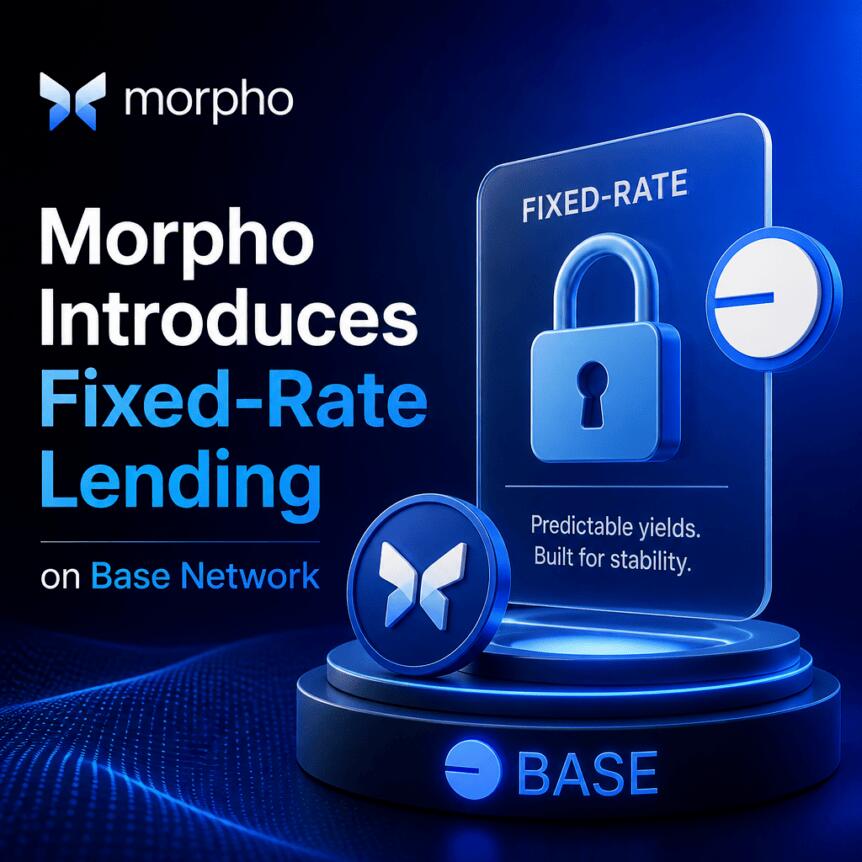
Onchain lending just gained a new option on Base: Morpho has launched Morpho Midnight, a fixed-rate, fixed-term lending market that sits alongside its existing variable-rate venue, Morpho Blue. The move introduces an intent-driven model where loans are structured around competing offers—rather than being priced by a protocol-defined utilization curve.
According to an announcement shared with Cointelegraph, Midnight is live on the Base mainnet and begins by supporting cbBTC and USDC across multiple maturity dates. Morpho says the rollout is intentionally contained to support a progressive deployment focused on security.
Key takeaways
- Morpho Midnight brings fixed-rate, fixed-term borrowing to Base, complementing Morpho’s variable-rate Blue pools.
- Loan pricing is offer-driven: lenders and borrowers propose interest rates, maturities, and other terms instead of relying on algorithmic pool utilization curves.
- Midnight is positioned to better match needs found in traditional credit markets, where funding costs and repayment schedules are known in advance.
- The initial deployment supports cbBTC and USDC with multiple maturity dates, and Morpho says additional integrations and features may come as the rollout expands.
Fixed terms arrive on Base, but with a different pricing engine
DeFi lending has historically struggled to replicate the predictability offered by conventional finance. In many onchain markets, borrowing costs rise or fall with changing utilization—meaning lenders and borrowers face pricing that can shift over time.
Morpho’s Midnight is designed to address that gap by shifting from pool-based algorithmic pricing to a marketplace of offers. As Morpho explained to Cointelegraph, the system lets participants propose interest rates, maturities, and other loan parameters. Instead of relying on a continuously running utilization curve, Midnight issues loans as fixed obligations matched through competition among offers.
For institutions and businesses, this matters because fixed repayment schedules can make it easier to manage funding costs, expected returns, and risk exposure. While the DeFi sector can approximate fixed income through complex strategies, a dedicated fixed-rate lending venue can reduce reliance on workarounds.
Morpho also emphasized that Midnight is not intended as a replacement for Morpho Blue. Blue remains focused on open-ended, variable-rate lending pools, while Midnight is structured to externalize loan risk, interest rates, and duration to market participants—turning those elements into negotiated terms.
How Morpho framed the “Midnight” design before launch
Morpho first discussed the fixed-rate approach as part of a broader “Morpho V2” roadmap. In a 2025 post referenced by Morpho’s development timeline, the protocol described an intent-based, peer-to-peer marketplace where users could submit custom offers. In that framing, capital could continue earning variable yield until it becomes matched to a fixed-rate offer—before locking into the fixed obligation.
In April, Morpho named the fixed-rate system Midnight and clarified again that it would complement, not replace, Morpho Blue. Later, Morpho released Midnight’s whitepaper and codebase in May. In connection with that release, Morpho said the “offered capital” model was meant to avoid a recurring problem in fixed-rate DeFi: liquidity lockups and fragmentation across maturity dates.
That design goal is important because fixed-rate markets can face an inherent mismatch—capital providers may not always want to commit for the exact maturities demanded by borrowers. By centering loan terms around offers, Midnight aims to make maturity selection more market-responsive while still offering borrowers defined terms.
Rollout status: live on Base with cbBTC and USDC
According to the Morpho spokesperson who spoke to Cointelegraph, Midnight is already live on the Base mainnet. The first version supports cbBTC and USDC, and it offers loans across multiple maturity dates.
Morpho said it kept the launch deliberately contained as part of a progressive rollout strategy, prioritizing security. The spokesperson also told Cointelegraph that crypto-native lenders, borrowers, and curators active on Morpho Blue have shown interest in moving into Midnight’s fixed-term environment.
Beyond existing Morpho participants, Morpho indicated that several enterprises and institutions are building products on the protocol in beta. Morpho did not provide details of those initiatives at this stage, saying announcements are expected as those products go live.
Where this fits in Morpho’s broader growth and DeFi lending trends
Midnight’s launch arrives after a period of rapid expansion for Morpho. Earlier in June, Morpho announced a $175 million funding round led by Paradigm, with participation from a16z crypto (Andreessen Horowitz) and Ribbit Capital. At the time, Morpho said it planned to expand integrations with banks, asset managers, and large platforms, while adding features associated with traditional credit markets—an aim that aligns with Midnight’s fixed-rate proposition.
Morpho’s infrastructure is already used by major crypto platforms for variable-rate lending. In April, Cointelegraph reported that Coinbase launched Morpho-powered USDC loans for United Kingdom users. Those loans reportedly allowed borrowers to take positions against Bitcoin (BTC), Ether (ETH), and cbETH on Base, using variable rates and with no fixed repayment schedule—an example of the open-ended borrowing model that Midnight is designed to complement.
In other words, Midnight extends Morpho’s toolkit toward a segment of lending that may feel more familiar to legacy finance workflows, where counterparties often value certainty in pricing and maturity. Still, the practical impact for users will depend on liquidity at specific rates and maturities, as well as how quickly lenders and borrowers coordinate around those offer terms.
Readers should watch how Midnight’s liquidity develops across maturity dates and whether more assets beyond cbBTC and USDC are added as the rollout expands. The key uncertainty is whether fixed-term demand can consistently find matching offers at attractive terms—because the economics of fixed-rate lending live and die by market participation.
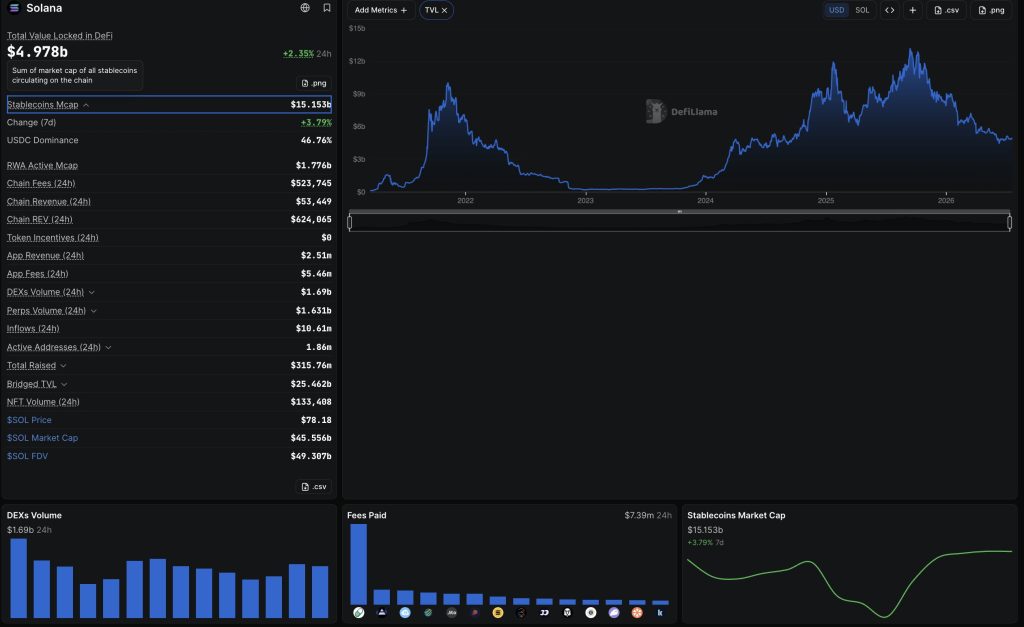
In Solana news today, the network’s total stablecoin market cap crossed $15Bn for the first time, according to Token Terminal data. The question the number forces onto the table is whether this supply base holds structural depth or remains tethered to cyclical retail flows.
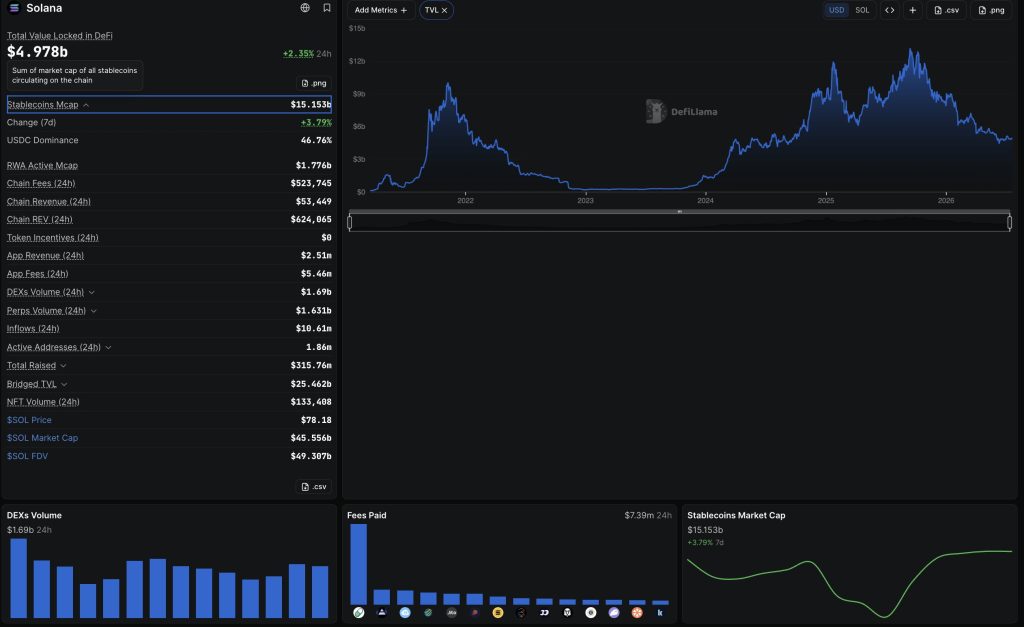
USDC accounts for a large share of Solana’s stablecoin supply, with DeFiLlama reporting USDC at $7.09Bn and total Solana stablecoins at $15.16Bn. Circle’s $250M USDC minting on Solana has been reported as part of a pattern of supply growth contributing to the $15Bn milestone.
This Stablecoin surge across the Solana network comes as SOL USD spiked +3% over the past 24-hours, reaching over $78, with a daily trading volume of $1.94Bn.
Solana News: Beyond USDC/USDT and the New Stablecoins on the Block
The more structurally significant development sits outside the USDC/USDT duopoly. The non-USDC/USDT stablecoin segment on Solana hit an all-time high of $4.81Bn, driven by USD1 and USDG, according to SolanaFloor data. That segment now accounts for nearly one-third of Solana’s total stablecoin market cap.
USD1, a dollar-pegged stablecoin associated with World Liberty Financial, and USDG (Global Dollar) are the primary drivers of that growth.
USDT sits at $2.91Bn on Solana per DeFiLlama, leaving the remaining $4.81Bn distributed across these newer entrants. The diversification of the issuer base matters: it signals that dollar liquidity on Solana is no longer a two-party dependency.
Anchorage Digital’s USDGO reached a $1Bn market cap on Solana, up approximately 20x since January 2026. USDGO is a regulated, USD-pegged stablecoin launched on Solana in February 2026.
Two Demand Drivers, One Supply Stack
JUST IN: Total stablecoin market cap on @solana surpasses $15B, marking an all-time high.
Leading currencies: USD, EUR, & more
Leading assets: USDC, USDT, USD1, USDGO, & more
Leading issuers: Circle, Tether, Paxos, & more
~5% of all stablecoins are currently issued on Solana. pic.twitter.com/pGrojYxwfP— Token Terminal
(@tokenterminal) July 20, 2026
Solana’s stablecoin boom is being driven by two overlapping forces that reinforce each other but do not depend on each other. The first is renewed retail activity: DEX trading volume on Solana rose 13.1% week over week, daily transactions climbed 17.3%, and TVL expanded 12.5%, per DeFiLlama metrics.
Memecoin cycle activity is generating real on-chain dollar demand, with Jupiter and Raydium as notable liquidity venues. More than $900M in new stablecoins were minted in a single 24-hour window per Token Terminal.
The second driver is settlement-layer adoption. BlockEden reports Solana processed $650Bn in adjusted stablecoin volume in February 2026, surpassing Ethereum and Tron combined. That figure predates the current $15Bn supply milestone by several months, implying settlement throughput has likely expanded further since then.
DeFi protocols on Solana benefit directly from deeper stablecoin liquidity, tighter spreads, higher utilization rates, and more capital-efficient collateral pools, all of which follow from a larger on-chain dollar base. The growing dominance of Solana in tokenized assets, which hit a record $6Bn in Q2, compounds this dynamic: real-world asset settlement and stablecoin liquidity are co-locating on the same chain.
The regulatory context is not peripheral here. Stablecoin legislation moving through Congress, including a Crypto Clarity Act framework discussed toward a Senate vote, could create clearer rules of the road for stablecoin issuers. A clear federal standard accelerates institutional issuance and removes regulatory ambiguity that has kept some treasury desks from deploying at scale on public chains.
Discover: The Best Token Presales
What the $15Bn Figure Does and Does Not Confirm
In other Solana news, the $15Bn supply level confirms that Solana has accumulated a dollar base large enough to sustain serious DeFi and settlement activity independent of any single issuer.
It does not confirm that this base is cycle-resistant. A meaningful portion of current stablecoin demand on Solana is memecoin-adjacent, speculative liquidity that migrates when retail attention rotates.
The non-USDC/USDT segment’s 15x growth since January 2025 is impressive, but some of that reflects specific product launches (USDGO’s February debut, USD1’s expansion) rather than purely organic demand accumulation.
The credible bear case is a memecoin cycle cooling combined with stalled stablecoin legislation, which would simultaneously slow both retail-driven USDC minting and institutional USDGO deployment.
The bull case is that institutional settlement demand, evidenced by USDGO’s trajectory and Solana’s stablecoin volume market share, provides a structural floor that persists through retail drawdowns.
Circle’s aggressive minting cadence and Anchorage Digital’s institutional positioning suggest at least one major issuer is betting on the latter.
Discover: The Best Crypto to Diversify Your Portfolio
The post Solana News: Stablecoin Supply Hits $15Bn With New Issuers Reshaping the Mix appeared first on Cryptonews.
A decentralized exchange (DEX) backed by Robinhood is expanding into tokenized stocks and derivatives as platforms compete to build onchain markets for traditional assets.
Arcus, a DEX built by the team behind decentralized trading platform dYdX and backed by Robinhood Crypto, launched tokenized stocks and perpetual futures on Robinhood Chain on Tuesday, according to an announcement shared with Cointelegraph.
The company previously launched spot markets when Robinhood Chain went live on July 1. Arcus offers more than 95 stock tokens, perpetual markets and crypto assets through a self-custodial trading account, with Paxos-issued stablecoin USDG serving as its primary collateral and settlement asset.
The launch comes as crypto companies and financial platforms increasingly compete to build infrastructure for tokenized real-world assets (RWAs), while regulatory questions around access and product structure remain a key challenge for the sector.
Related: Bernstein raises Robinhood price target, cites tokenization and prediction markets
Self-custody shapes approach to onchain trading
Arcus’s launch includes tokenized versions of stock in major US companies such as Nvidia, Tesla, Apple, Microsoft, Meta, Google and Amazon, as well as perpetual markets tied to equities, exchange-traded funds, commodities, indexes and crypto assets.
The platform uses a self-custodial model, allowing users to retain control of their assets rather than deposit them with a centralized exchange. Arcus uses Privy, a wallet infrastructure company that helps applications create and manage crypto wallets, allowing users to sign up through email or social logins.
Source: Robinhood Chain
Users who already hold crypto can connect existing self-custodial wallets, including MetaMask, Ledger and WalletConnect, with the company citing support for additional Ethereum-compatible wallets.
Tokenized stocks face regulatory questions
Arcus said its stock tokens are unavailable in the US, Canada, the UK and other restricted jurisdictions, highlighting the different regulatory approaches to tokenized securities across markets.
Cointelegraph contacted Arcus for clarification on the restrictions but did not receive a response by publication time.
Regulators in markets including the US and UK have been examining how blockchain-based representations of traditional assets fit within existing financial frameworks, with questions around custody, ownership and market structure being addressed.
The launch adds another player to the growing race to build infrastructure for tokenized assets, with platforms including Coinbase-backed Base exploring ways to bring traditional financial products onchain.
Magazine: Is Robinhood Chain’s success bullish or bearish for ETH the asset?

Nvidia vs. Apple: Which tech giant is the better buy?

DCENT S Wallet vs Tangem: Full Comparison of Design, Security, Supported Coins, and Mobile App

Why wide-open Ballon d’Or race could crown an unexpected winner


-
 NewsBeat5 days ago
London Mayor Sadiq Khan handed a peerage by Keir Starmer alongside 15 other Labour figures… just days before the PM leaves No10
-

 Fashion4 days ago
Weekend Open Thread – Corporette.com
-

 Politics3 days ago
The House | The City of London can help the new chancellor deliver growth in every postcode
-

 Politics6 days ago
Young campaigners urge incoming PM to act on outdoor junk food ads
-

 Crypto World6 days ago
CFTC blocks Kalshi from unwinding Michigan trades after court order
-
 Crypto World4 days ago
Two July Windows Left: The CLARITY Act’s Senate Fight and What Failure Means
-

 Crypto World3 days ago
Ripple Payments Joins MiCA With 14 Firms, Does It Mean Anything For XRP?
-

 Business6 days ago
Nvidia Stock Slips After Big Tuesday Rally as Huang Confirms Vera Rubin Chip Is Now in Production Today
-

 Politics2 days ago
Democrats look to World Cup watch parties to register thousands of voters
-
 Entertainment6 days ago
Disney’s Most Ambitious Failed Star Wars Attraction Is Coming to SDCC
-

 Crypto World4 days ago
Ripple wins EU-wide access as ESMA adds it to MiCA register
-

 Crypto World7 hours ago
Grayscale Files For Worldcoin ETF, WLD Registers Sharp Rise
-

 Crypto World5 days ago
Injective Submits SEC Transfer-Agent Registration to Onchain Ownership Records
-

 Business6 days ago
Palantir Shares Rise After Expanded Nvidia Partnership and Fresh Analyst Upgrades Ahead of Earnings Day
-

 Tech16 hours ago
Sail Virtually Aboard The “Itanic” With IA-64 Emulator
-
 Tech13 hours ago
Turtle Beach Command Series KB7 review: a nifty screen-equipped gaming keyboard
-

 Tech7 days ago
Dark Secrets Emerge When Jailbreaking LLMs
-

 NewsBeat4 days ago
Registration is now open for March for Men with Kev 2026
-

 News Videos7 days ago
XRP BOMBSHELL… XRP OMBOARDED FOR TRANSACTIONS!!!
-

 NewsBeat1 day ago
Unregistered fitter used Gas Safe logo on business flyers
You must be logged in to post a comment Login