Connect with us
DAPA Banner

Tech

News Publishers Are Now Blocking The Internet Archive, And We May All Regret It

Published

on

from the our-digital-history dept

Last fall, I wrote about how the fear of AI was leading us to wall off the open internet in ways that would hurt everyone. At the time, I was worried about how companies were conflating legitimate concerns about bulk AI training with basic web accessibility. Not surprisingly, the situation has gotten worse. Now major news publishers are actively blocking the Internet Archive—one of the most important cultural preservation projects on the internet—because they’re worried AI companies might use it as a sneaky “backdoor” to access their content.

This is a mistake we’re going to regret for generations.

Nieman Lab reports that The Guardian, The New York Times, and others are now limiting what the Internet Archive can crawl and preserve:

When The Guardian took a look at who was trying to extract its content, access logs revealed that the Internet Archive was a frequent crawler, said Robert Hahn, head of business affairs and licensing. The publisher decided to limit the Internet Archive’s access to published articles, minimizing the chance that AI companies might scrape its content via the nonprofit’s repository of over one trillion webpage snapshots.

Specifically, Hahn said The Guardian has taken steps to exclude itself from the Internet Archive’s APIs and filter out its article pages from the Wayback Machine’s URLs interface. The Guardian’s regional homepages, topic pages, and other landing pages will continue to appear in the Wayback Machine.

Advertisement

The Times has gone even further:

The New York Times confirmed to Nieman Lab that it’s actively “hard blocking” the Internet Archive’s crawlers. At the end of 2025, the Times also added one of those crawlers — archive.org_bot — to its robots.txt file, disallowing access to its content.

“We believe in the value of The New York Times’s human-led journalism and always want to ensure that our IP is being accessed and used lawfully,” said a Times spokesperson. “We are blocking the Internet Archive’s bot from accessing the Times because the Wayback Machine provides unfettered access to Times content — including by AI companies — without authorization.”

I understand the concern here. I really do. News publishers are struggling, and watching AI companies hoover up their content to train models that might then, in some ways, compete with them for readers is genuinely frustrating. I run a publication myself, remember.

But blocking the Internet Archive isn’t going to stop AI training. What it will do is ensure that significant chunks of our journalistic record and historical cultural context simply… disappear.

Advertisement

And that’s bad.

The Internet Archive is the most famous nonprofit digital library, and has been operating for nearly three decades. It isn’t some fly-by-night operation looking to profit off publisher content. It’s trying to preserve the historical record of the internet—which is way more fragile than most people comprehend. When websites disappear—and they disappear constantly—the Wayback Machine is often the only place that content still exists. Researchers, historians, journalists, and ordinary citizens rely on it to understand what actually happened, what was actually said, what the world actually looked like at a given moment.

In a digital era when few things end up printed on paper, the Internet Archive’s efforts to permanently preserve our digital culture are essential infrastructure for anyone who cares about historical memory.

And now we’re telling them they can’t preserve the work of our most trusted publications.

Advertisement

Think about what this could mean in practice. Future historians trying to understand 2025 will have access to archived versions of random blogs, sketchy content farms, and conspiracy sites—but not The New York Times. Not The Guardian. Not the publications that we consider the most reliable record of what’s happening in the world. We’re creating a historical record that’s systematically biased against quality journalism.

Yes, I’m sure some will argue that the NY Times and The Guardian will never go away. Tell that to the readers of the Rocky Mountain News, which published for 150 years before shutting down in 2009, or to the 2,100+ newspapers that have closed since 2004. Institutions—even big, prominent, established ones—don’t necessarily last.

As one computer scientist quoted in the Nieman piece put it:

“Common Crawl and Internet Archive are widely considered to be the ‘good guys’ and are used by ‘the bad guys’ like OpenAI,” said Michael Nelson, a computer scientist and professor at Old Dominion University. “In everyone’s aversion to not be controlled by LLMs, I think the good guys are collateral damage.”

That’s exactly right. In our rush to punish AI companies, we’re destroying public goods that serve everyone.

Advertisement

The most frustrating bit of all of this: The Guardian admits they haven’t actually documented AI companies scraping their content through the Wayback Machine. This is purely precautionary and theoretical. They’re breaking historical preservation based on a hypothetical threat:

The Guardian hasn’t documented specific instances of its webpages being scraped by AI companies via the Wayback Machine. Instead, it’s taking these measures proactively and is working directly with the Internet Archive to implement the changes.

And, of course, as one of the “good guys” of the internet, the Internet Archive is willing to do exactly what these publishers want. They’ve always been good about removing content or not scraping content that people don’t want in the archive. Sometimes to a fault. But you can never (legitimately) accuse them of malicious archiving (even if music labels and book publishers have).

Either way, we’re sacrificing the historical record not because of proven harm, but because publishers are worried about what might happen. That’s a hell of a tradeoff.

This isn’t even new, of course. Last year, Reddit announced it would block the Internet Archive from archiving its forums—decades of human conversation and cultural history—because Reddit wanted to monetize that content through AI licensing deals. The reasoning was the same: can’t let the Wayback Machine become a backdoor for AI companies to access content Reddit is now selling. But once you start going down that path, it leads to bad places.

Advertisement

The Nieman piece notes that, in the case of USA Today/Gannett, it appears that there was a company-wide decision to tell the Internet Archive to get lost:

In total, 241 news sites from nine countries explicitly disallow at least one out of the four Internet Archive crawling bots.

Most of those sites (87%) are owned by USA Today Co., the largest newspaper conglomerate in the United States formerly known as Gannett. (Gannett sites only make up 18% of Welsh’s original publishers list.) Each Gannett-owned outlet in our dataset disallows the same two bots: “archive.org_bot” and “ia_archiver-web.archive.org”. These bots were added to the robots.txt files of Gannett-owned publications in 2025.

Some Gannett sites have also taken stronger measures to guard their contents from Internet Archive crawlers. URL searches for the Des Moines Register in the Wayback Machine return a message that says, “Sorry. This URL has been excluded from the Wayback Machine.”

A Gannett spokesperson told NiemanLab that it was about “safeguarding our intellectual property” but that’s nonsense. The whole point of libraries and archives is to preserve such content, and they’ve always preserved materials that were protected by copyright law. The claim that they have to be blocked to safeguard such content is both technologically and historically illiterate.

Advertisement

And here’s the extra irony: blocking these crawlers may not even serve publishers’ long-term interests. As I noted in my earlier piece, as more search becomes AI-mediated (whether you like it or not), being absent from training datasets increasingly means being absent from results. It’s a bit crazy to think about how much effort publishers put into “search engine optimization” over the years, only to now block the crawlers that feed the systems a growing number of people are using for search. Publishers blocking archival crawlers aren’t just sacrificing the historical record—they may be making themselves invisible in the systems that increasingly determine how people discover content in the first place.

The Internet Archive’s founder, Brewster Kahle, has been trying to sound the alarm:

“If publishers limit libraries, like the Internet Archive, then the public will have less access to the historical record.”

But that warning doesn’t seem to be getting through. The panic about AI has become so intense that people are willing to sacrifice core internet infrastructure to address it.

What makes this particularly frustrating is that the internet’s openness was never supposed to have asterisks. The fundamental promise wasn’t “publish something and it’s accessible to all, except for technologies we decide we don’t like.” It was just… open. You put something on the public web, people can access it. That simplicity is what made the web transformative.

Advertisement

Now we’re carving out exceptions based on who might access content and what they might do with it. And once you start making those exceptions, where do they end? If the Internet Archive can be blocked because AI companies might use it, what about research databases? What about accessibility tools that help visually impaired users? What about the next technology we haven’t invented yet?

This is a real concern. People say “oh well, blocking machines is different from blocking humans,” but that’s exactly why I mention assistive tech for the visually impaired. Machines accessing content are frequently tools that help humans—including me. I use an AI tool to help fact check my articles, and part of that process involves feeding it the source links. But increasingly, the tool tells me it can’t access those articles to verify whether my coverage accurately reflects them.

I don’t have a clean answer here. Publishers genuinely need to find sustainable business models, and watching their work get ingested by AI systems without compensation is a legitimate grievance—especially when you see how much traffic some of these (usually less scrupulous) crawlers dump on sites. But the solution can’t be to break the historical record of the internet. It can’t be to ensure that our most trusted sources of information are the ones that disappear from archives while the least trustworthy ones remain.

We need to find ways to address AI training concerns that don’t require us to abandon the principle of an open, preservable web. Because right now, we’re building a future where historians, researchers, and citizens can’t access the journalism that documented our era. And that’s not a tradeoff any of us should be comfortable with.

Advertisement

Filed Under: ai, archives, culture, libraries, scanning, scraping

Companies: internet archive, ny times, the guardian, usa today

Source link

Advertisement
Continue Reading
Click to comment

You must be logged in to post a comment Login

Leave a Reply

Tech

Hackers exploit TrueConf zero-day to push malicious software updates

Published

on

Hackers exploit TrueConf zero-day to push malicious software updates

Hackers have targeted TrueConf conference servers in attacks that exploit a zero-day vulnerability, allowing them to execute arbitrary files on all connected endpoints.

The flaw is tracked as CVE-2026-3502 and received a medium severity score. It stems from a missing integrity check in the software’s update mechanism, which can be used to replace the legitimate update with a malicious variant.

TrueConf is a video conferencing platform that can run as a self-hosted server. Although it also supports cloud deployments, it is generally designed for closed, offline environments.

According to the vendor, more than 100,000 organizations transitioned to TrueConf during the COVID-19 pandemic for remote online business activities. Among TrueConf users are military forces, government agencies, oil and gas corporations, and air traffic management companies.

Advertisement

CheckPoint researchers have been tracking a campaign they track as TrueChaos that, since the beginning of the year, has exploited CVE-2026-3502 in zero-day attacks targeting government entities in Southeast Asia.

“An attacker who gains control of the on-premises TrueConf server can replace the expected update package with an arbitrary executable, presented as the current application version, and distribute it to all connected clients,” CheckPoint says.

“Because the client trusts the server-provided update without proper validation, the malicious file can be delivered and executed under the guise of a legitimate TrueConf update.”

The flaw affects TrueConf versions 8.1.0 through 8.5.2, and following CheckPoint’s report to the vendor, a fix was released in version 8.5.3 in March 2026.

Advertisement

“TrueChaos” operation

CheckPoint has moderate confidence in attributing the TrueChaos activity to a Chinese-nexus threat actor, based on tactics, techniques, and procedures (TTPs), the use of Alibaba Cloud and Tencent for hosting the command and control (C2) infrastructure, and victimology.

The attacks spread through a centrally managed government TrueConf server, impacting multiple agencies, pushing malicious files via fake updates to all connected TrueConf clients.

TrueConf update notice
Source: Check Point

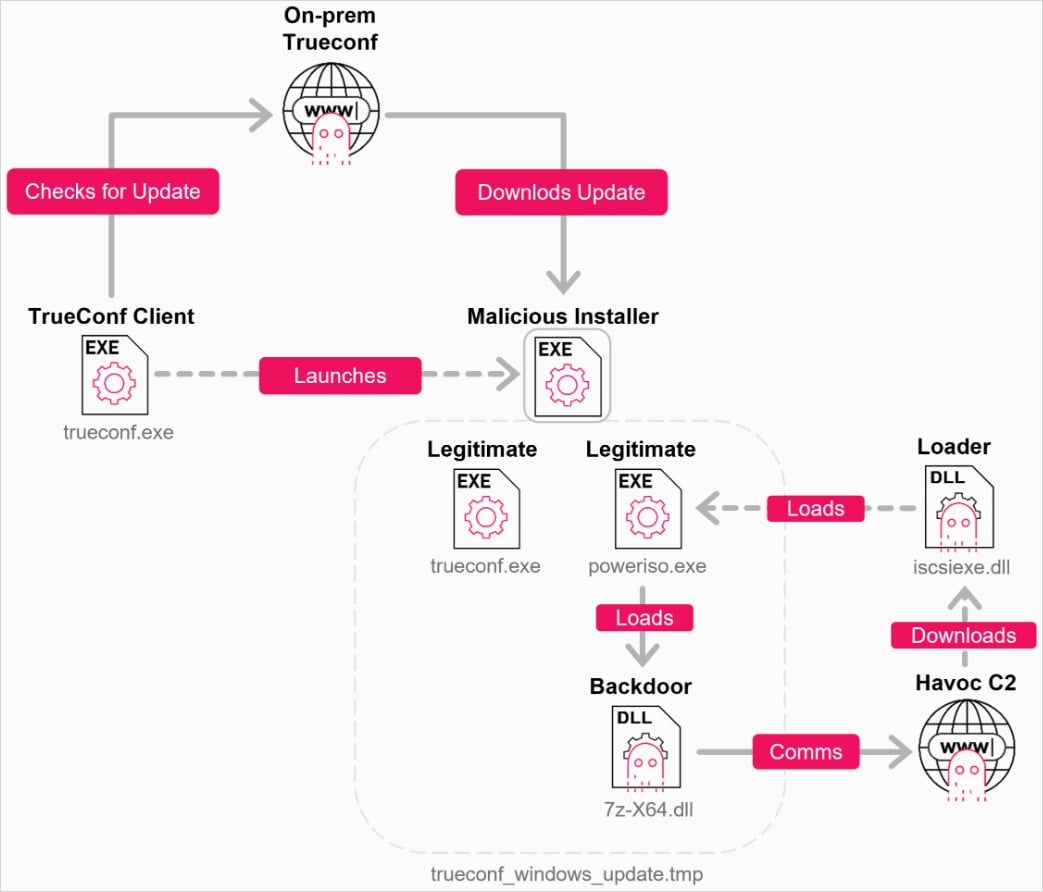
The infection chain includes DLL sideloading and the deployment of reconnaissance tools (tasklist, tracert), privilege escalation (UAC bypass via iscicpl.exe), and the establishment of persistence.

The researchers were unable to recover the final payload, but noted that network traffic pointed to Havoc C2 infrastructure, making it highly likely that the Havoc implant was used.

Overview of the attack chain
Overview of the TrueChaos attack chain
Source: Check Point

Havoc is an open-source C2 framework capable of executing commands, managing processes, manipulating Windows tokens, executing shellcode, and deploying additional payloads on compromised systems.

It has previously been used by the Chinese threat cluster ‘Amaranth Dragon’ in attacks with a similar targeting scope.

Advertisement

CheckPoint’s report shares indicators of compromise (IoCs) as well as multiple infection signals. Strong signs of a breach include the presence of poweriso.exe or 7z-x64.dll, and suspicious artifacts like %AppData%\Roaming\Adobe\update.7z or iscsiexe.dll.

Automated pentesting proves the path exists. BAS proves whether your controls stop it. Most teams run one without the other.

This whitepaper maps six validation surfaces, shows where coverage ends, and provides practitioners with three diagnostic questions for any tool evaluation.

Source link

Advertisement
Continue Reading

Tech

De-fi platform Drift suspends deposits and withdrawals after millions in crypto stolen in hack

Published

on

Decentralized finance company Drift says it has suspended withdrawals and deposits after confirming a security incident. 

The crypto platform said in a post on X that it was “experiencing an active attack,” and that it was working to “contain the incident.”

Security researchers and public blockchain data suggest the losses could be significant. Blockchain security firm CertiK said on X that hackers may have stolen around $136 million, while crypto analytics firm Arkham put the figure at around $285 million stolen.

If confirmed, this would make the Drift hack the largest crypto theft of the year, according to the Rekt leaderboard, a site that tracks crypto thefts by size.

Advertisement

It’s not clear who is behind the attack, and a spokesperson for Drift did not immediately respond to a request for comment.

Security firms say North Korea was behind the most crypto thefts last year, netting at least $2 billion in stolen cryptocurrency, funds the regime is believed to use to finance its nuclear weapons program and skirt international sanctions that restrict its access to the global financial system.

Source link

Advertisement
Continue Reading

Tech

Watch An Electro-Permanent Magnet In Action

Published

on

Electro-permanent magnets (EPMs) are pretty nifty concepts, and if you aren’t familiar with them, they are permanent magnets with the ability to be electrically switched on or off. Unlike an electromagnet — which maintains a magnetic field only while power is applied — an EPM can remain “on” even when power is removed. Want to see one work? There’s a video embedded below that shows one off, but if you’d like to know how they work, we have you covered.

Inside are two types of magnet, one of which is permanent and the other being a semi-hard magnet paired with an electromagnetic coil. A semi-hard magnet’s flux can be changed by exposing it to a strong enough magnetic field, and that’s the key to making it work.

Being able to electrically switch a permanent magnet on or off is a neat trick.

When both magnets work together, the EPM is “on” and acts like a permanent magnet. To turn the EPM off, the polarity of the semi-hard magnet is flipped with a short and powerful electromagnetic pulse, after which the two magnets oppose one another and more or less cancel each other out. So rather than generating a magnetic field, an EPM more accurately reconfigures it.

As intriguing as EPMs are, we haven’t really seen one properly in action until it was brought to our attention that [Dave Jones] of EEVblog tried one out last year. He received a Zubax FluxGrip EPM, which is intended for drone and robotic applications and can hold up to 25 kg. Watch [Dave] fire it up in the video (link is cued up to the 7:30 mark), it’s pretty interesting to see one of these actually work.

Advertisement

EPMs are not prohibitively expensive but they are not exactly cheap, either. But if a switchable magnet sounds up your alley and you can’t afford an EPM, consider an alternative “switchable” magnet design that works by momentarily canceling out a permanent magnet with a paired electromagnet. Unlike an EPM, it’s not a permanent switch but it would be enough to drop a payload.

Advertisement

Source link

Continue Reading

Tech

Celebrate Apple’s 50th birthday with these deals on watches and AirPods

Published

on

Apple has officially kicked off celebrations for its 50th birthday, and we’ve been following along the festivities through our live coverage.

We’ve covered some of the best Apple products the company has released in the last half century (and some of the misses, too) and we’ve even taken a deep dive into the products that didn’t quite make it also.

If you’ve also been following along and you’re also in a bit of a celebratory mood, then you can also join in on the fun by checking out these deals for a few of our favourite current-generation Apple products.

Advertisement

Source link

Continue Reading

Tech

US government hires BlackSky to build next-gen AI surveillance satellites for Earth and beyond

Published

on


The US government has selected BlackSky to design and build the next generation of its space surveillance capabilities. The newly announced contract is an indefinite delivery/indefinite quantity (IDIQ) agreement, meaning the company will provide as many satellites and monitoring services as the Air Force Research Laboratory requires for its missions….
Read Entire Article
Source link

Continue Reading

Tech

Sony's upcoming handheld could outperform Xbox Series S with next-gen upscaling

Published

on


Prominent leaker KeplerL2 recently claimed that Sony’s rumored handheld will feature a faster graphics chip than the Xbox Series S. The device, codenamed Canis, is expected to complement the PlayStation 6, which is not expected to arrive before late 2027.
Read Entire Article
Source link

Continue Reading

Tech

These Cheap Iranian Drones Keep Getting Shot Down, And That’s The Whole Point

Published

on


The current war between Iran, the United States, Israel, and other Gulf countries has seen a huge spike in drone warfare, particularly from Iran. Iran’s use of drones in warfare is quite different from what Western countries do. The United States might use big surveillance drones like the RQ-4 Global Hawk or attack drones like the MQ-9 Reaper. Such drones are expensive and meant to come back to base after the mission is done. 

A lot of Iranian drones, on the other hand, take a different approach. The Shahed-136 is a kamikaze drone that’s supposed to expend its payload by running into a target. As opposed to a Reaper drone, where the system to control it and the aircraft itself costs over $56 million, a Shahed-136 can cost anywhere between $20,000 and $50,000. 

A Shahed, as reported by the US Army, has a wingspan of 8.2 feet and carries an 88-pound warhead. It’s powered by a small aircraft engine mounted in the “tail.” It’s also described as a “loitering” munition meaning that it can stay in the air and hunt for targets. It has a range of a little over 1,200 miles (or 2,000 kilometers). 

Advertisement

Drones are cheap, interceptors are expensive

While an individual Shahed-136 is certainly effective, it can be intercepted easily. As such, it’s mostly used in a swarm configuration. A swarm of Shaheds can saturate air defense systems, forcing Western forces to “waste” interceptor missiles on targets that cost a fraction as much. The Terminal High Altitude Area Defense system, also called THAAD uses a network of radar installations and sensors to intercept airborne threats with missiles. Each interceptor  missile costs approximately $12.7 million, according to U.S. Congress reports.

Advertisement

The THAAD has a reported successful intercept rate of 90%. That’s good for forces and civilians on the ground, but the cost is skyrocketing and the amount of missiles in stock is dwindling. Congress reports: “Another reported concern is that the usage rate of THAAD interceptors during Operation Fury has further depleted limited interceptor stocks.”

Each THAAD battery consists of six launcher trucks, each supplied with 48 missiles. Those trucks and missiles are guided by a TPY-2 radar station and a communications station. It requires 90 soldiers to run and a single battery costs $2.73 billion. Lockheed Martin, the developer of the THAAD, says that between the United States, United Arab Emirates, and Saudi Arabia, there are 10 active batteries.

Advertisement


Source link

Continue Reading

Tech

SpaceX files for record $75 billion IPO as conflicts of interest mount

Published

on

SpaceX has confidentially filed paperwork with the Securities and Exchange Commission to sell shares to the public, according to multiple sources familiar with the registration, setting the stage for what would be the largest initial public offering in history and almost certainly making Elon Musk the world’s first trillionaire. The offering, internally code-named Project Apex, could come as early as June and reportedly aims to raise as much as $75 billion at a valuation of up to $1.75 trillion. That would more than double Saudi Aramco’s $29 billion listing in 2019, the current record holder, and would value SpaceX at roughly 94 times its 2025 revenue.

Twenty-one banks have lined up to manage the deal, with Goldman Sachs, JPMorgan Chase, Morgan Stanley, Bank of America, and Citigroup in senior roles, according to CNBC. Musk, who owns approximately 42 per cent of SpaceX according to PitchBook, has a current net worth estimated by Forbes at $823 billion. At a $1.75 trillion valuation, his stake alone would be worth more than $730 billion, pushing his total wealth past the trillion-dollar mark and placing him further ahead of every other person alive than any individual in modern economic history.

The company filing for this listing, however, is no longer just a rocket business. In February, SpaceX absorbed Musk’s artificial intelligence company xAI in an all-stock transaction that valued the combined entity at $1.25 trillion. That deal, a merger that raised immediate questions about optics, governance, and valuation, folded a company reportedly burning roughly $1 billion a month into one generating substantial cash flow. SpaceX also brought Musk’s social media platform X, formerly Twitter, under the same corporate roof. The result is a conglomerate spanning orbital launches, satellite internet, defence contracts, artificial intelligence, and social media, all controlled by a single individual who is simultaneously the largest financial backer of the sitting president of the United States.

The financial engine behind the valuation is Starlink, the satellite internet service that has become the most commercially successful space venture in history. In 2025, Starlink generated $10.6 billion in revenue on 54 per cent EBITDA margins, accounting for roughly two-thirds of SpaceX’s total revenue of $16 billion. The subscriber base has grown from 10,000 beta users in 2021 to more than 10 million paying customers across 150 countries as of February 2026. The Federal Aviation Administration’s January 2026 approval for up to 44 annual Starship launches has provided the operational headroom investors needed to underwrite a public valuation at this scale.

Advertisement

The 💜 of EU tech

The latest rumblings from the EU tech scene, a story from our wise ol’ founder Boris, and some questionable AI art. It’s free, every week, in your inbox. Sign up now!

The xAI component of the entity going public is, by contrast, a work in progress. Musk himself said in March that xAI was “not built right the first time around” and needed to be rebuilt from its foundations. Since the merger, all 11 of xAI’s original co-founders have departed the company, including researchers who had previously worked at Google DeepMind, Google Brain, and Microsoft Research. Jimmy Ba, who co-authored the Adam optimisation paper, one of the most cited in all of artificial intelligence, left in February. Critics have characterised the merger as a financial bailout that allows xAI’s mounting losses to be absorbed by Starlink’s cash flow ahead of the IPO, a framing Musk has rejected.

The conflicts of interest embedded in this offering are without precedent in American capital markets. In the past five years alone, SpaceX has won $6 billion in contracts from NASA, the Department of Defense, and other federal agencies, according to USAspending.gov. The company is NASA’s primary launch provider for crewed missions to the International Space Station and holds more than $4 billion in contracts for the Artemis lunar-landing programme. The Pentagon is reportedly preparing to award SpaceX a $2 billion contract to build a 600-satellite constellation for missile tracking as part of the Golden Dome missile-defence initiative, a programme Trump announced would cost $175 billion and begin initial operations within three years.

Advertisement

Musk was the largest individual donor to Trump’s 2024 presidential campaign and led the Department of Government Efficiency, or DOGE, a temporary body that unilaterally cancelled more than 10,000 federal contracts it deemed wasteful. Ethics observers noted that none of the cancellations affected Musk’s own companies. Among SpaceX’s current investors is Donald Trump Jr, the president’s eldest son, who holds shares through 1789 Capital, a venture firm that made him a partner shortly after his father won the presidency for a second time. That fund, which has crossed $1 billion in assets, has invested approximately $50 million in SpaceX and xAI and has backed at least four companies that subsequently received government contracts during the current administration. The White House has repeatedly denied any conflicts of interest between the presidency and the Trump family’s business activities.

The governance risks do not end at the political boundary. SpaceX under Musk has operated as a private company with minimal public disclosure for more than two decades. Going public will force it to file quarterly earnings, disclose executive compensation, open its books to auditors, and face shareholder lawsuits of the kind Tesla already contends with regularly. Tesla shareholders are currently suing Musk over the company’s $2 billion investment in xAI, arguing he directed shareholder capital into his own private venture. The SpaceX-xAI merger, in which both the buyer and seller were controlled by Musk, presents a similar structure of self-dealing that public-market investors and regulators already struggling with the pace of AI-era consolidation will scrutinise closely.

One unusual feature of the planned offering is the reported intention to allocate up to 30 per cent of shares to retail investors, roughly triple the typical 5 to 10 per cent. The move echoes Google’s unconventional 2004 IPO, which used a Dutch auction to broaden access, and appears designed to build a base of loyal individual shareholders who may be less inclined to challenge management. For a company whose founder has cultivated a large and vocal online following, the retail allocation could serve as both a democratisation of access and a governance insulation mechanism.

SpaceX’s listing would be the first of what could be a trio of mega-IPOs from the companies that defined the current era of AI and deep tech. OpenAI and Anthropic are both reportedly considering public offerings, though neither has filed. Together, the three listings would represent a concentration of market value in a handful of companies whose products, from orbital internet to frontier AI models, now intersect with national security, global communications, and the basic infrastructure of economic life.

Advertisement

The scale of what SpaceX is attempting is difficult to overstate. A $75 billion raise would exceed the gross domestic product of more than half the world’s countries. A $1.75 trillion valuation would make SpaceX more valuable at listing than every company in the S&P 500 except Apple, Microsoft, Nvidia, Amazon, and Alphabet. And at the centre of it all is a single individual who builds the rockets that carry American astronauts, runs the satellites that provide internet to war zones, leads an AI company he admits needs rebuilding, owns a social media platform that shapes political discourse, and has the mobile-phone number of the president.

Whether that concentration of power, capital, and government dependency can survive the scrutiny of public markets is the question Project Apex will ultimately answer. The defence-tech sector is already drawing record investment on the thesis that the next generation of military capability will be built by private companies rather than government labs. SpaceX is the largest and most consequential test of that thesis. If the IPO succeeds on the terms being discussed, it will not merely be the biggest stock offering in history. It will be a statement about the degree to which twenty-first-century governments have outsourced their most critical capabilities to the private sector, and about the price of getting them back.

Source link

Advertisement
Continue Reading

Tech

Copyright Industry Continues Its Efforts To Ban VPNs

Published

on

from the the-internet’s-infrastructure-is-under-attack dept

Last month Walled Culture wrote about an important case at the Court of Justice of the European Union, (CJEU), the EU’s top court, that could determine how VPNs can be used in that region. Clarification in this area is particularly important because VPNs are currently under attack in various ways. For example, last year, the Danish government published draft legislation that many believed would make it illegal to use a VPN to access geoblocked streaming content or bypass restrictions on illegal websites. In the wake of a firestorm of criticism, Denmark’s Minister of Culture assured people that VPNs would not be banned. However, even though references to VPNs were removed from the text, the provisions are so broadly drafted that VPNs may well be affected anyway. Companies too are taking aim at VPNs. Leading the charge are those in France, which have been targeting VPN providers for over a year now. As TorrentFreak reported last February:

Canal+ and the football league LFP have requested court orders to compel NordVPN, ExpressVPN, ProtonVPN, and others to block access to pirate sites and services. The move follows similar orders obtained last year against DNS resolvers.

The VPN Trust Initiative (VTI) responded with a press release opposing what it called a “Misguided Legal Effort to Extend Website Blocking to VPNs”. It warned:

Such blocking can have sweeping consequences that might put the security and privacy of French citizens at risk.

Targeting VPNs opens the door to a dangerous censorship precedent, risking overreach into broader areas of content.

Indeed: if VPN blocks become an option, there will inevitably be more calls to use them for a wider range of material. The VTI also noted that some of its members are considering whether to abandon the French market completely. That could mean people start using less reliable VPN providers, some of which have dubious records when it comes to security and privacy. The incentive for VPNs to pull out of France is increasing. In August last year the Paris Judicial Court ordered top VPN service providers to block more sports streaming domains, and at the beginning of this year, yet more blocking orders were issued to VPNs operating in France. To its credit, one of the VPN providers affected, ProtonVPN, fought back. As reported here by TorrentFreak, the company tried multiple angles:

Advertisement

The VPN provider raised jurisdictional questions and also requested to see evidence that Canal+ owned all the rights at play. However, these concerns didn’t convince the court.

The same applies to Proton’s net neutrality defense, which argued that Article 333-10 of the French sports code, which is at the basis of all blocking orders, violates EU Open Internet Regulation. This defense was too vague, the court concluded, noting that Proton cited the regulation without specifying which provisions were actually breached.

ProtonVPN also argued that forcing a Swiss company to block sites for the French market is a restriction of cross-border trade in services, and that in any case, the blocking measures were “technically unrealizable, costly, and unnecessarily complex.” Despite this valiant defense, the court was unimpressed. At least ProtonVPN was allowed to contest the French court’s ruling. In a similar case in Spain, no such option was given. According to TorrentFreak:

The court orders were issued inaudita parte, which is Latin for “without hearing the other side.” Citing urgency, the Córdoba court did not give NordVPN and ProtonVPN the opportunity to contest the measures before they were granted.

Without a defense, the court reportedly concluded that both NordVPN and ProtonVPN actively advertise their ability to bypass geo-restrictions, citing match schedules in their marketing materials. The VPNs are therefore seen as active participants in the piracy chain rather than passive conduits, according to local media reports.

That’s pretty shocking, and shows once more how biased in favor of the copyright industry the law has become in some jurisdictions: other parties aren’t even allowed to present a defense. It’s a further reason why a definitive ruling from the CJEU on the right of people to use VPNs how they wish is so important.

Advertisement

Alongside these recent court cases, there is also another imminent attack on the use of VPNs, albeit in a slight different way. The UK government has announced wide-ranging plans that aim to “keep children safe online”. One of the ideas the government is proposing is “to age restrict or limit children’s VPN use where it undermines safety protections and changing the age of digital consent.” Although this is presented as a child protection measure, the effects will be much wider. The only way to bring in age restrictions for children is if all adult users of VPNs verify their own age. This inevitably leads to the creation of huge new online databases of personal information that are vulnerable to attack. As a side effect, the UK government’s misguided plans will also bolster the growing attempts by the copyright industry to demonize VPNs – a core element of the Internet’s plumbing – as unnecessary tools that are only used to break the law.

Follow me @glynmoody on Mastodon and on Bluesky. Originally published on WalledCulture.

Filed Under: cjeu, copyright, encryption, privacy, security, vpns

Companies: canal plus, nordvpn, proton

Advertisement

Source link

Continue Reading

Tech

Google offers researchers early access to Willow quantum processor

Published

on


The Early Access Program invites researchers to design and propose quantum experiments that push the boundaries of what current hardware can achieve. It is a selective program – the processor will not be publicly available – and Google is setting firm deadlines for participation. Research teams have until May 15,…
Read Entire Article
Source link

Continue Reading

Trending

Copyright © 2025