

Tech
Nuro receives driverless testing permit ahead of Uber robotaxi service launch


Nuro has been granted a permit to begin driverless testing of Lucid Gravity SUVs equipped with its autonomous tech on California public roads — vehicles that will eventually be used in Uber’s premium robotaxi service. But the Silicon Valley-based startup, backed by Nvidia and Uber, says it isn’t quite ready to begin.
The California Department of Motor Vehicles, the agency that regulates the testing and deployment of autonomous vehicles in the state, confirmed to TechCrunch on Tuesday that it modified Nuro’s driverless AV permit to include Lucid Gravity vehicles.
Nuro has held a driverless permit for six years, but it only applied to operate a low-speed delivery vehicle — a program that was scrapped when the startup pivoted its business model to focus on licensing its technology to companies like Uber.
This latest driverless permit allows Nuro to test the Lucid vehicles without a human safety operator behind the wheel. Nuro spokesperson David Salguero told TechCrunch the company expects to begin driverless testing later this year, without providing further information on timing.
The driverless permit is one of many regulatory hurdles that Nuro must clear before Uber can launch its premium robotaxi service. Nuro will also have to receive a driverless ride-hailing permit from the California Public Utilities Commission and a deployment permit from the DMV.
For now, Nuro and Uber are testing the Lucid vehicles in autonomous mode with a human safety operator in the driver’s seat. Last month, that testing was expanded to allow Uber employees to request an autonomous ride in a Lucid robotaxi — with a human safety operator still on board — through the Uber app.
As Nuro makes progress on testing, Uber has upped its commitment to Lucid.
Techcrunch event
San Francisco, CA
|
October 13-15, 2026
When the three-way deal was announced in July 2025, Uber said it would invest $300 million in Lucid and buy 20,000 robotaxi-ready Gravity vehicles. That has since been expanded to $500 million and a minimum of 35,000 robotaxis, with the agreement changing to include at least 10,000 Gravity SUVs and 25,000 EVs built on Lucid’s upcoming mid-size platform.
Those EVs will be equipped with Nuro’s autonomous vehicle system, which is powered by Nvidia’s Drive AGX Thor computer. The Lucid Gravity robotaxi, which was revealed in January, is outfitted with high-resolution cameras, solid-state lidar sensors, and radars that help the self-driving system perceive the real-world environment and operate within it.
Uber has also made a multimillion-dollar investment in Nuro.
Lucid has delivered 75 engineering vehicles to Nuro and Uber and testing and mileage accumulation is ongoing in several cities throughout the United States, the EV maker disclosed during its first-quarter earnings call on Tuesday.
Lucid said Tuesday it is on track for commercial robotaxi operations to begin in late 2026. It is possible that those robotaxi operations will not be driverless or will be limited in some other way, depending on regulatory approvals.
Still, Lucid executives struck a positive tone during the call noting that all the development and certifications are moving along as expected.
When you purchase through links in our articles, we may earn a small commission. This doesn’t affect our editorial independence.



AI + ML
RUSI warns fake IDs, shell companies, and crypto laundering could soon operate at industrial scale
The future of sanctions evasion appears to involve fewer shady middlemen and considerably more rented GPUs, according to a new RUSI report on how rogue states are using AI to fake identities, automate shell companies, and launder crypto at scale.
The report, “Algorithms of Evasion: The Rise of AI-Enabled Proliferation Financing,” says countries including North Korea and Iran are deploying AI tools to support sanctions evasion and proliferation financing (PF) schemes, ranging from fake passports and corporate paperwork to cryptocurrency laundering and fabricated online personas.
“AI has the potential to radically increase the scale of PF activities, like sanctions evasion, to levels that overwhelm current PF and sanctions evasion detection and enforcement capabilities,” wrote Dr Aaron Arnold, a Senior Associate Fellow with the Centre for Finance and Security at RUSI, specializing in sanctions and proliferation financing.
Arnold argues that AI is not reinventing sanctions evasion so much as supercharging it. “AI is not necessarily changing PF and sanctions evasion typologies but instead increasing their efficiency and effectiveness,” he wrote.
That includes generative AI systems capable of producing fake passports, bank statements, vessel registrations, invoices, and corporate records, according to the report. RUSI writes that AI “can mass-produce high-quality fraudulent documents” with enough contextual accuracy to fool traditional compliance checks that still rely heavily on manual document verification.
The report also warns that many existing banking identity checks are rapidly becoming unreliable against modern AI tools. “Static biometric checks such as a selfie or voice print are no longer sufficient proof of identity against AI-enabled adversaries,” Arnold wrote, noting that many current systems were designed for human fraudsters rather than synthetic identities and deepfake operators.
The paper highlights North Korea’s growing use of AI-enhanced deception in its overseas IT worker operations. After years of allegedly relying on VPNs and fraudulent documents to secure remote tech jobs abroad, Pyongyang-linked operators have reportedly started using AI-generated CVs and deepfakes during job interviews to obscure their identities.
Crypto, naturally, remains a huge part of the picture. The report points to North Korea’s Lazarus Group and the $1.5 billion Bybit theft in 2025 as evidence that sanctioned states are already deeply embedded in digital asset crime. Arnold warned that AI could make the laundering side even harder to track by constantly shifting transaction patterns to stay ahead of investigators.
Arnold also points to a newer class of threat involving autonomous AI agents capable of handling discrete parts of a sanctions-evasion operation without constant human direction. In theory, he wrote, those systems could manage shell companies, move cryptocurrency through mixers and decentralized finance platforms, or generate deepfake content as needed, potentially making it harder for investigators who traditionally focus on dismantling human networks.
RUSI’s proposed fixes boil down to fighting automation with more automation. The report calls for clearer rules allowing banks to use AI-powered counter-proliferation tools, updated KYC systems capable of spotting deepfakes and synthetic identities, and new “compute-KYC” obligations forcing cloud providers to pay closer attention to who is renting the GPU power behind large-scale AI operations.
The question now is whether regulators can modernize faster than sanctions evaders can automate. ®

California lawmakers are moving to exempt most open-source operating systems from the state’s upcoming age-verification law after backlash from Linux and privacy advocates who warned that the original rules could force decentralized projects to collect users’ ages. The amendment would likely shield major Linux distributions, though SteamOS and other Linux-based platforms tied to proprietary app stores may still face compliance questions. Tom’s Hardware reports: Assembly Bill 1856 (AB 1856), currently moving through California’s legislature ahead of committee reviews in June, would amend the state’s earlier age-assurance law by excluding software distributed under licenses that allow users to “copy, redistribute, and modify the software.” The proposed amendment specifically states: “Operating system provider” does not mean a person or entity that distributes an operating system or application under license terms that permit a recipient to copy, redistribute, and modify the software.
The amendment follows months of backlash after California passed the original Assembly Bill 1043 (AB 1043), formally known as the Digital Age Assurance Act, in late 2025. The law sought to shift online age verification away from individual websites and apps and down to the operating-system level instead. Under the original law, operating systems would be required to request a user’s age or birth date during device setup, then expose an “age bracket signal” to apps and app stores. The law, which defined brackets such as “under 13,” “13-15,” “16-17,” and “18+,” immediately raised questions about how such requirements would apply to decentralized, open-source software ecosystems. […]
AB 1856 does not repeal the original Digital Age Assurance Act. Instead, it narrows the definition of who qualifies as an “operating system provider” under the law. Commercial platforms with proprietary app ecosystems could remain subject to California’s age-assurance requirements even if most open-source Linux distributions are ultimately exempted. California Assembly Member Buffy Wicks introduced the amendment on February 11, 2026. However, the open-source exemption language appeared in later revisions that began drawing attention across Linux and privacy communities. The latest version is dated May 18, 2026, and as of May 19, 2026, the bill was read a second time and ordered to third reading.
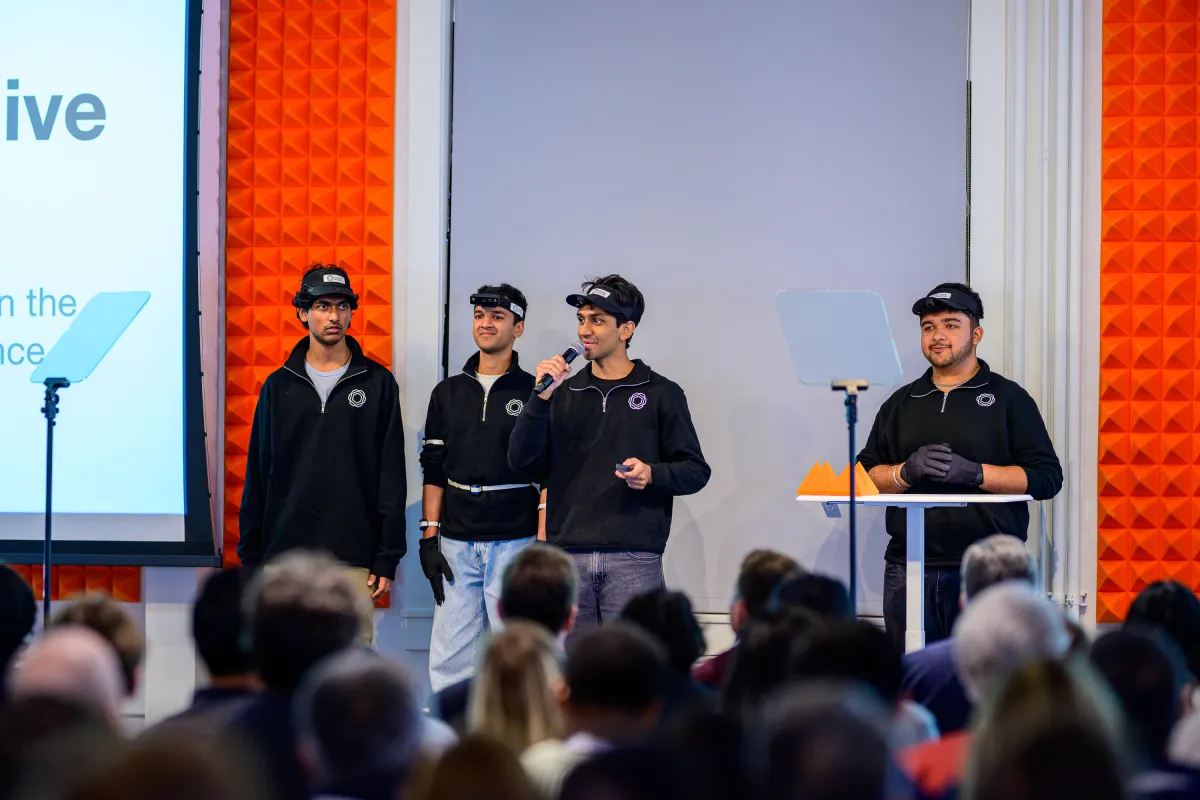
In the last few years, India’s online food delivery market has grown significantly, with both Zomato and Swiggy going public and the number of cloud kitchens increasing. Meanwhile, startups working on home services, such as on-demand household staffing platforms like Urban Company, Snabbit, and Pronto, have gained popularity.
Silicon Valley-based start-up Human Archive is tapping into this trend, partnering with these companies to have workers wear special caps with cameras to collect egocentric (first-person point of view) video data of everyday tasks that could be used to train robots.
Without naming specific partners, the startup said it is working with companies in the home services, hostel, and restaurant sectors to collect egocentric data, and it says it has more than 1,000 active headsets deployed across multiple locations.
On the back of that traction, Human Archive said Tuesday it has raised $8.2 million in funding from Wing Venture Capital, NVP Capital, Y Combinator, and angels from OpenAI, Nvidia, Google, Mercor, AfterQuery, BAIR, SAIL, Brad Boa, and Meta.
The startup was founded by two Berkeley and two Stanford students — Samay Mani, Rushil Agarwal, Shloke Patel, and Raj Patel, the latter two being cousins. (Raj Patel is CEO.) All four have research backgrounds spanning robotics, hardware, and tactile data.
The company’s founding is a direct bet on where the AI industry is heading. As robotics labs and frontier AI companies race to build machines that can perform physical tasks in the real world, they face a critical bottleneck — a shortage of high-quality, real-world training data showing humans doing everyday work. Human Archive’s bet is that the workers staffing India’s booming gig economy represent an untapped and scalable source of exactly that data.
While Human Archive is working with multiple partners, the startup said it was rejected by many Indian home services companies, including Pronto and Urban Company, for a collaboration.
The company’s rejection by major players became public fodder last weekend, when Indian outlet Entrackr reported that Pronto is actively seeking partnerships to collect worker data for robotics training, and that Snabbit had held early discussions with Human Archive before the project fell apart.
Urban Company CEO Abhiraj Singh Bhal responded on X, stating the company would not engage in such arrangements — prompting Patel to fire back that Urban Company would soon be forced to reconsider or risk losing relevance to customer churn. Co-founder Rushil Agarwal was blunter still, posting that Pronto founder Anjali Sardana had laughed at him and called him “stupid” when he raised the idea of a data partnership. Pronto acknowledged the conversations but said it chose not to move forward.
Across the country, other startups are collecting egocentric data from different work environments, including factory floors. To differentiate itself, Human Archive is using and developing additional devices, such as tactile gloves, a full-body motion capture suit, and wrist cameras to capture data including motion, and tactile force, synchronously aligned with RGB-D (color imagery paired in real time with depth information), to sell to AI labs. The startup believes that video data alone is not sufficient, but that pairing it with other sensor data makes it much more valuable.
Initially, Human Archive used makeshift setups or off-the-shelf rigs to capture the data. Now, it is working on custom hardware that works together and captures different kinds of data. It already has more than 50 different devices deployed to collect different data points.
“To capture data, we started with iPhones, then we built our own custom rigs and caps. Now we have more than seven different hardware products that we use interchangeably across different modalities. After data collection from different devices, we worked on synchronizing data from all these different sources,” Patel said in a call.
The company said it is developing ways to fine-tune AI models with its own data and test them on robots to evaluate task effectiveness. By doing this, the startup can demonstrate the quality of its data to potential customers and post-train internal models.
Zach DeWitt, a partner at Wing VC, said the startup has a unique advantage in collecting data from multiple sensors.
“No one else in the world has been able to synchronize and collect headset RGB-D, force feedback, full-body motion capture, and synchronized chest and wrist camera data at scale. They’ve been doing internal model training on this data, and every major lab and university is interested in running experiments on it due to the novelty of the sensors and the scale of the new dataset they are releasing soon,” he told TechCrunch.
Collecting data in India and expansion plans
Despite rejection from notable players in the home services industry, Human Archive teamed up with smaller startups to offer discounted services to customers. When a worker arrives at a home, consumers are offered a choice through the app: pay a discounted price in exchange for consenting to data collection, or pay the full price for an unrecorded visit.
Patel mentioned that customers have been happy to opt for the former, as disputes about service quality are common, and video recordings can help resolve them.
The company pays workers a base rate of $1 per hour for participating in egocentric data collection. A report from the Economic Times suggests that other companies pay ₹250–₹400 per hour (roughly $2.63–$4.20). Patel said competitors pay more than Human Archive, but its on-the-ground presence in India allows it to keep compensation lower.
“Human Archive’s network provides immediate, flexible earning opportunities globally, lowering the barrier to participating in the AI economy. We see this as a critical bridge that funds immediate livelihoods while building the infrastructure for a safer, more productive future,” DeWitt said.
Beyond wage payment, there are privacy concerns around data collection via video recording. It is not clear what information Human Archive gives workers about how their footage is used. The company said that its commercial contracts are compliant with India’s Digital Personal Data Protection (DPDP) Act, as it displays a privacy policy notice, along with consent information detailing the purpose of data collection and how it is processed. The company said all data is anonymized, and faces are blurred from recordings. Last week, Moneycontrol reported that India’s Ministry of Electronics and Information Technology is looking into the consent mechanisms and data collection practices of startups collecting egocentric data through home service workers.
While Human Archive largely collects data in India, it has started expanding into Southeast Asia and the U.S. The company is also building a platform for anyone to participate in data collection and earn money. It also wants to offer customers in the U.S. services like cleaning or cooking in exchange for data collection by participating workers — though these programs are just in an early pilot stage.
Multiple well-funded startups are racing to build physical AI. Doing so requires massive amounts of training data showing humans at work — and Human Archive is one of the players competing to serve that demand. Whether its approach can scale will hinge on the partnerships it strikes and the uniqueness and volume of the data it can collect to satisfy the appetite of physical AI labs.
When you purchase through links in our articles, we may earn a small commission. This doesn’t affect our editorial independence.


The Spanish government has issued an order to block the gambling platforms Polymarket and Kalshi, according to a report by The Wall Street Journal. The ban is being instituted as the country investigates the legality of prediction market platforms, as they operate in Spain (and everywhere else) without a gambling license.
The country’s ministry in charge of consumer affairs said it blocked the websites as a precautionary measure pending an official investigation. This investigation will determine if the platforms violate Spain’s gambling laws. It’s set to complete within the next four months and could mandate that these companies require specific administrative licenses to operate.
Kalshi and Polymarket have also been making waves on this side of the pond. Several US states have tried to regulate or outright ban prediction market platforms, with a Minnesota ban set to take place on August 1. Rhode Island, Illinois, Arizona, Connecticut, Nevada and New Jersey have all challenged the legality of such prediction markets.
Minnesota has just become the first state to ban prediction markets.
Gov. Tim Walz has signed a bill that makes operating or advertising prediction markets a felony.
This sets a major precedent for those seeking to regulate or ban Polymarket, Kalshi, and other sites.
— More Perfect Union (@MorePerfectUS) May 20, 2026
However, the federal government isn’t having any of it. The US Commodity Futures Trading Commission (CFTC) has started suing states for attempting to ban or regulate prediction markets. The CFTC believes it has sole jurisdiction to regulate these platforms, and not the states. Also, remember when states rights was a thing?
Who knows why the federal government has become so enamoured with prediction markets. It is worth noting that the platforms have made headlines in recent months after suspicious activity has raised concerns of insider trading in Washington.
To that end, it’s fairly easy for anyone “in the know” to rig a Polymarket or Kalshi bet. Case in point? A US soldier has been charged with using classified information regarding the capture of Venezuela’s Nicolas Maduro to win more than $400,000 via gambling platforms. This is what happens when people gamble on real world events. Sporting events have official organizations and referees, but most real world situations do not.
🇫🇷 Some guy pointed a hairdryer at a weather sensor, bet on the temperature spike on Polymarket, and walked away with $34,000. Twice.
Météo France filed a complaint, Polymarket switched sensors, and the man is probably on a beach somewhere.
Source: PA News pic.twitter.com/Jfy15Nn2j8
— Mario Nawfal (@MarioNawfal) April 24, 2026
People are people and will also influence real world events given half the chance, which is something these platforms most definitely invite. Someone allegedly used a hairdryer to rig Polymarket weather bets in France, with the hairdryer being used to warm up a temperature sensor.
In any event, Kalshi and Polymarket are making money hand over fist. Kalshi was recently valued at $22 billion and Polymarket was recently valued at $15 billion.

from the this-is-why-we-can’t-have-nice-things dept
NPR is imposing a new round of buyouts and layoffs as it tries to survive the brutal Trump GOP attacks on public broadcasting. According to NPR, it’s being forced to trim $8 million of its $300-million annual budget because of the illegal (for whatever that word is worth any more) Trump administration attacks on NPR, PBS and their member station funding earlier this year.
The original executive order resulted in Congress obliterating the entire Corporation for Public Broadcasting (CPB) budget of $1.1 billion for fiscal years 2026 and 2027. With no money left to function, the CPB voted to dissolve itself last January. A judge subsequently ruled that the defunding was illegal and violated the First Amendment, but the ruling came too late to save the CPB.
According to NPR, it received $113 million in private donations ($80 million of it coming from Connie and Steve Ballmer) to offset the losses, but that money won’t be used to save the jobs of human beings doing actual reporting. Instead, it can only be spent on “technological innovation” (read: likely given to Microsoft for enterprise services):
“Paradoxically, just prior to the announcement of these cost-cutting measures, NPR received a pair of private gifts totaling $113 million — representing the network’s second- and third-largest in its 56-year history. Most of that money, however, is dedicated to technological innovation.”
While NPR doesn’t really take all that much money from the public anymore (roughly 1% of NPR’s annual budget comes from the government), the CPB distributed over 70 percent of its funding to about 1,500 public radio and TV stations. Much of them providing popular and useful educational programming.
As we’ve noted previously, right wingers, corporations, and authoritarians loathe public broadcasting because, in its ideal form, it can untether public interest journalism from the often perverse financial incentives inherent in our consolidated, billionaire-owned, ad-engagement-based corporate media.
A media, if you hadn’t noticed, that is easily bullied, cowed, and manipulated by bad actors looking to normalize, downplay, or validate no limit of terrible and illegal bullshit (see: CBS, Washington Post, the New York Times, and countless others). In functional countries, taxpayer-funded journalism functions as a public interest firewall from corporatism and authoritarianism.
In the United States, decades of attacks and defunding have left us with outlets like NPR that barely even qualify as a “public broadcaster.” And as NPR became a more traditional, corporate ad-driven outlet you could watch in real time how it became friendlier and friendlier to right wing narratives for fear of being accused of a “liberal bias” (for all the good it wound up doing them).
But after decades of under-funding and attacks, what passes for U.S. public media is a distant shadow of the idea’s full potential. And now even that’s been left reeling. Should we survive authoritarianism, maybe there will be a few useful lessons buried in the rubble.
Filed Under: funding, journalism, media, public broadcasting
Companies: cpb, npr

HiFiMAN helped turn planar magnetic headphones into a serious personal audio category, and the company has never been shy about taking weird swings. Nanometer-thin diaphragms, Stealth Magnets, and open-back designs that look like they escaped from an engineering lab with no adult supervision — this is familiar territory. But the HiFiMAN HE1000 WiFi is not just another wireless headphone with a luxury badge and a bigger invoice.
The high-performance wireless headphone market has already moved well past “good for Bluetooth.” The Focal Bathys MG pushed wireless ANC into more serious audiophile territory at $1,499, while the DALI IO-12 went even higher at $1,750 with its SMC driver technology and hi-fi-first tuning. Mark Levinson’s No. 5909 also helped prove that premium wireless headphones could be more than airport jewelry for people who alphabetize their boarding passes.
HiFiMAN, however, has taken a bigger and riskier step. At $2,699, the HE1000 WiFi is an open-back planar magnetic headphone with built-in WiFi streaming, Bluetooth, USB audio, Stealth Magnet drivers, and support for high-resolution playback well beyond what conventional Bluetooth headphones can deliver. It is less “wireless ANC rival” and more “high-end headphone system with the cable surgically removed.”
The question is whether WiFi streaming actually moves the HE1000 closer to wired high-end headphone performance, or whether HiFiMAN has spent two years building one of the smartest ideas in wireless headphones and left just enough unfinished to make the price sting.

Specifications and Technology
The HE1000 WiFi is more than a passive planar magnetic headphone with wireless connectivity added on. HiFiMAN has integrated a complete playback chain inside the earcup, including its HYMALAYA Mini DAC, headphone amplifier, and WiFi streaming platform. The HYMALAYA Mini DAC measures only 8mm, which makes the internal packaging impressive given the limited space available inside a headphone.
The DAC section is specified with THD+N of 0.0055% and 105dB of channel separation. Via USB-C, the HE1000 WiFi supports up to 768kHz/32-bit PCM and DSD512, which is far beyond the resolution of most commercially available music files. Those figures are technically impressive, but the more relevant question is how well the DAC, amplifier, wireless platform, and planar drivers work together as a complete system.
As expected from a headphone carrying the HE1000 name, the driver section includes HiFiMAN’s nanometer-thickness diaphragm and Stealth Magnet technology. These are designed to reduce unwanted acoustic interference, improve transient response, and preserve clarity. The engineering is familiar from HiFiMAN’s higher-end planar magnetic headphones, but the WiFi implementation makes this version meaningfully different from the passive HE1000 models.
The main feature is WiFi streaming. Bluetooth has improved, and the HE1000 WiFi still supports it, but Bluetooth remains limited by codec bandwidth and compression. WiFi gives the headphone a wider path for high-resolution and lossless playback over a home or office network, which is the core argument for this product. The goal is straightforward: deliver more of the sound quality associated with a wired planar headphone while retaining the freedom of wireless listening.
That does not automatically make the HE1000 WiFi better than every premium Bluetooth headphone, nor does it remove the usual questions about app support, setup, stability, battery life, and daily usability. But it does give HiFiMAN a different technical angle in a category where most wireless headphones are still built around Bluetooth first. At its asking price, that difference needs to be clearly audible and easy to live with.
They can also be used over standard Bluetooth, with a Qualcomm QCC5181 chip that supports LDAC for up to 96kHz playback. That is more than enough for Spotify, YouTube, and most casual listening sessions where convenience matters more than chasing every last bit. Bluetooth also gives the HE1000 WiFi a meaningful battery life advantage over WiFi mode, but we’ll get to battery longevity shortly.
Design & Comfort

A quick word on what comes in the package. Technically, it is not really a box, but the same kind of faux leather-wrapped display case HiFiMAN has used with other HE1000 models. It looks the part, although the previous hardback owner’s manual has been replaced by a more ordinary paperback version. Accessories are also minimal: one six-foot USB-C to USB-A cable. That is about it. When the headphone is wireless, HiFiMAN clearly decided the accessory drawer did not need to audition for Hoarders.
HiFiMAN has used its Gen. 2 headband on the HE1000 WiFi, which is a bit of a mixed bag. The upside is weight reduction, with the newer design shaving roughly 20 to 30 grams compared to some older HiFiMAN headbands. The trade-off is that it does not offer the same 360-degree earcup swivel found on the wired HE1000 and Arya models. It does feel reasonably sturdy, however, and should survive the occasional knock without requiring a grief counselor.

The earcups retain the familiar egg-shaped profile used across the HE1000 and Arya lines, but they are slightly deeper here to accommodate the internal circuitry. That extra depth does not hurt comfort. One of the long-standing advantages of this design is the amount of space inside the pads, with little risk of the driver or earpad pressing against the outer ear.
Materials are a mix of metal and plastic, which helps keep weight under control while still giving the HE1000 WiFi some visual connection to HiFiMAN’s higher-end models. At 452 grams, or almost exactly one pound, it is not especially light, but it is manageable for an open-back planar headphone with built-in amplification, DAC, Bluetooth, and WiFi streaming hardware.
The catch is that the build quality and finish do not fully communicate a $2,699 asking price. It feels solid enough, and comfort is generally strong, but this is not the kind of physical object that immediately makes the near-three-grand number feel self-explanatory. The HE1000 WiFi is clearly betting that the sound quality and wireless execution will do the heavy lifting. At this price, they need to.
The color? I like it, although I can see it being somewhat divisive. It is more interesting than another safe silver or black finish, and there is a faint luxury-car interior vibe to it — Rolls-Royce or Bentley from a distance, with the understanding that nobody from Crewe is losing sleep over the upholstery.
Comfort is far less debatable. The suspension strap distributes the weight evenly across the head, making longer listening sessions easy to manage without obvious hotspots or fatigue. Clamp force is on the firmer side, but I actually prefer that here. The HE1000 WiFi stays put when you move your head, which is rather important when the whole point is wireless freedom.

The controls are sensibly arranged and easy to understand. From top to bottom, there is a volume rocker, a function button that switches between WiFi, USB, and Bluetooth modes, and a power button. The function button includes an indicator light for the selected mode, while the power button uses colored lighting to show charging and battery status. The volume control could use finer adjustment, but the overall layout is simple and practical, which is exactly how it should be.
Battery life, unfortunately, is where things get less flattering. In my testing, the HE1000 WiFi managed roughly five hours over WiFi and about 12 hours over Bluetooth, the latter falling well short of HiFiMAN’s quoted figure of up to 23 hours. Charging takes around the claimed four hours, which is not exactly a rapid turnaround. In daily use, that means you need to charge them at the end of the night or risk starting the next day with a very expensive pair of silent earmuffs.
HE1000 WiFi Setup: Brilliant Idea, Clumsy Execution?
Most wireless headphones are easy to get running. Power them on, open the Bluetooth menu on your phone, select the model, and you are usually listening within seconds. Not exactly NASA.
The HE1000 WiFi is different, and not always in a good way. Connecting the headphones to my home network proved more troublesome than expected, and the process feels less polished than it should for a product at this level.
HiFiMAN seems aware of the issue, because the company has released several setup videos to guide users through the process. That helps, but it also says something. Getting the HE1000 WiFi online requires users to navigate local network pages that look rather basic, follow multiple steps, and make sure the headphones are properly connected before WiFi playback becomes available. For some audiophiles, especially those comfortable with networking and streaming hardware, this may not be a major obstacle. For everyone else, it could be the point where the WiFi promise starts to feel more like homework.
That matters because the HE1000 WiFi’s best argument is its WiFi mode. If setup friction pushes owners toward Bluetooth or wired use out of frustration, the product loses some of its reason for being. Bluetooth works, and it is useful, but nobody is spending $2,699 on these because they needed another Bluetooth headphone.
There is also the issue of software support. Not every music app can cast over WiFi in the way the HE1000 WiFi requires, and some services reserve that functionality for paid tiers. Spotify and YouTube Music, for example, require premium subscriptions for casting support. That does not make the HE1000 WiFi unusable, but it does mean buyers need to understand exactly how they plan to stream before assuming WiFi playback will be seamless across every app they use.
Firmware updates are another sore spot. Bluetooth updates run through HiFiMAN’s GAIA app, but WiFi module updates require manually downloading files and uploading them through a browser-based local interface. That feels clumsy for a headphone built around WiFi.
HiFiMAN needs to fold the entire update process into one app. These issues do not ruin the HE1000 WiFi, but they do make the experience feel less polished than the hardware concept deserves.

Listening
The HiFiMAN HE1000 WiFi delivers a listening experience that very few headphones currently offer. Being able to listen to lossless music without being tied to a desk, or dealing with a cable brushing against your shirt every time you move, is genuinely liberating. You can walk around the house or office and still listen at a level that feels closer to a serious headphone rig than a typical wireless setup. Yes, you could plug a passive headphone into a DAP and get some of that mobility, but not carrying anything at all is a different proposition.
That is the HE1000 WiFi’s strongest argument. It gives you real freedom without reducing the experience to background listening. That alone helps offset some of the complaints about setup, build quality, and day-to-day usability. The better news is that the headphones also sound very good on their own terms.
The jump from Bluetooth to WiFi is not subtle. Detail retrieval improves, staging opens up, and the presentation feels more composed. To give the HE1000 WiFi the best possible chance, I spent most of my listening time in WiFi mode, playing lossless FLAC files from my phone.
What became clear rather quickly is that the HE1000 WiFi does not simply follow HiFiMAN’s older house sound. There is still plenty of planar speed and openness, but the tuning has moved in a slightly different direction. Let’s start with the bass.
Bass
Throughout the review process, I compared the HE1000 WiFi with the HE1000 Unveiled, which I had on hand and know well. The first meaningful difference showed up in the bass.
The HE1000 WiFi does not deliver the kind of exaggerated low-end weight found in many wireless headphones, especially ANC models, but there is a subtle midbass lift that gives music some added warmth and body. It is not overdone, and it helps the headphone sound a little fuller without turning the presentation thick or sluggish.
Sub-bass extension is also strong, with only a slight sense of roll-off below roughly 30Hz. On Hans Zimmer and James Newton Howard’s “Why So Serious?,” the deep 20Hz rumble was still present enough to be felt, not merely heard. That is not something every open-back planar handles convincingly, and it gives the HE1000 WiFi more low-end authority than expected.
Midrange
A bass lift usually comes with a trade-off, and with the HE1000 WiFi, that shows up in the midrange. Compared again with the HE1000 Unveiled, the wireless model sounds a little more restrained through the mids and does not deliver the same top-tier clarity or immediacy. Vocals are smooth and well controlled, but they do not step forward with the same transparency, and guitar solos do not quite dig in with the emotional pull you get from the HE1000 Unveiled or Audio-Technica ATH-ADX7000.
That is not a deal-breaker. The HE1000 WiFi has a relaxed, easygoing midrange that many listeners may actually prefer, especially for longer sessions. It is not trying to spotlight every breath, string scrape, or studio chair creak like a detective with a grudge. It is more forgiving than that.
The context matters as well. We are comparing the HE1000 WiFi against serious wired audiophile headphones that live in rarefied air. The fact that HiFiMAN’s wireless implementation can stay in the conversation at all is impressive. It may not match the best passive models for midrange openness or resolution, but it gets close enough to make the cable start looking less essential.
Treble
Some previous HiFiMAN headphones, including the Arya Organic, could lean a little hot in the upper frequencies. The HE1000 WiFi avoids that trap. There is still plenty of treble energy and sparkle, but it walks the line between excitement and sharpness without turning cymbals into dental work.
Extension is excellent, with enough air and control to give woodwinds, hi-hats, and upper harmonics real presence. L’Impératrice’s “La lune” was a good example, with the faint triangle hits cutting through the mix cleanly and sounding natural rather than etched for effect.
There are no obvious peaks or dips that call attention to themselves, which helps the HE1000 WiFi maintain a more natural and cohesive presentation. HiFiMAN got the treble balance right here: lively, open, and detailed, but not aggressive enough to make you start bargaining with the volume control.
Soundstaging & Imaging
The HE1000 WiFi does not throw an especially wide soundstage, but what it does inside that medium-sized space is far more important. Imaging is impressively precise, especially for a wireless headphone, and placement feels stable rather than vague or artificially stretched.
As with other egg-shaped HiFiMAN designs, the tall driver geometry helps create a convincing sense of height when the recording calls for it. The center image is clearly locked in, and individual layers remain easy to follow even during busier passages.
TOOL’s “Chocolate Chip Trip” is a useful stress test here, because the track is basically Danny Carey throwing percussion, electronics, and spatial chaos around the room to see what survives. The HE1000 WiFi keeps those sounds organized, with effects appearing from distinct positions rather than collapsing into a confused blob. It may not be the widest presentation HiFiMAN has ever produced, but the focus and positional accuracy are excellent.

The Bottom Line
The HiFiMAN HE1000 WiFi is one of the more compelling wireless headphone concepts to come along in years because it does something most premium wireless models still do not: it treats sound quality as the main event, not a bonus feature hiding behind ANC, app tricks, and faux-luxury packaging.
What makes it unique is the WiFi streaming implementation. The ability to walk around the house or office listening to lossless music through an open-back planar headphone without a cable hanging off your body is not a small thing. It changes how and where you listen. The HE1000 WiFi delivers much of the speed, openness, bass control, treble refinement, and imaging precision listeners expect from a serious HiFiMAN planar design, but without chaining you to the desk like a suspect in a bad procedural.
It is not perfect. The setup process is clumsy, firmware updates feel less polished than they should, battery life is underwhelming, and the build quality does not fully sell the premium positioning. The midrange is also smoother and less immediate than the HE1000 Unveiled, so those expecting the same level of transparency from HiFiMAN’s best passive designs should temper expectations.
But taken as a complete product, the HE1000 WiFi is still a bold and largely successful swing. It is for listeners who want high-end planar sound with real freedom of movement, who mostly listen at home or in an office, and who are willing to tolerate some early-adopter friction for a genuinely different experience.
The bigger question is whether the less expensive Arya WiFi, which we are also reviewing, can deliver enough of the same magic for a lot less money. If it gets close, HiFiMAN may have an even more interesting problem on its hands.
Pros:
- Excellent sound quality for a wireless headphone
- WiFi streaming delivers a clear step up over Bluetooth
- Lossless playback without being tethered to a desk
- Strong bass extension with tasteful midbass warmth
- Smooth, non-fatiguing midrange
- Treble is lively, airy, and well controlled without getting sharp
- Precise imaging and strong layer separation
- Comfortable for long listening sessions
- Secure fit with firmer clamp force
- Supports WiFi, Bluetooth, and USB modes
- LDAC support over Bluetooth
- Clever all-in-one design with built-in DAC, amplifier, and streamer
Cons:
- Setup process is more complicated than it should be
- WiFi firmware updates require an awkward browser-based process
- Battery life is disappointing, especially in WiFi mode
- Charging time is slow
- Build quality and finish do not fully feel premium
- Volume control could use finer adjustment
- No 360-degree earcup swivel like some wired HiFiMAN models
- Midrange lacks the clarity and immediacy of the best passive HE1000 models
- Not all music apps or free service tiers support WiFi casting
- Early-adopter product that still needs software polish
Our Ratings
★★★★★★★★★★ Sound Quality
★★★★★★★★★★ Comfort
★★★★★★★★★★ Usability
★★★★★★★★★★ Build Quality
★★★★★★★★★★ Value
Where to buy:
Related Reading:


Sliding behind the wheel of the Ferrari Luce brings an immediate sense of openness. Four doors open onto room for five passengers, a first for the marque, thanks to the electric platform that tucks the battery pack low beneath the floor and rear seats. No central tunnel interrupts the flow, so legs stretch out and shoulders settle easily whether up front or in back. Ferrari will open European orders later this year with a starting price around €550,000 ($640,000). Deliveries in the United States begin in the second quarter of 2027.
There are four electric motors delivering a whopping 1000 horsepower to all four wheels, while the battery will cheerfully consume 122 kilowatt-hours of energy to provide you with a reasonable range of over 330 miles in Europe and closer to 280 miles in the United States. It will take you from 0 to 60 in 2.5 seconds and hit 190 on the dot.

LEGO – Speed Champions Ferrari 812 Competizione 76914
- Iconic LEGO Collection – The LEGO Speed Champions collection is full of iconic toy car models, including the Pagani Utopia (76915) and Porsche…
- LEGO Ferrari Collectible – Features a LEGO Speed Champions collectible model car replica of the Ferrari 812 Competizione plus a driver minifigure with…
- Race Driver Minifigure – The set includes a LEGO race driver minifigure to be placed behind the wheel of the race car toy for superfast action on the…
Jony Ive’s mindful material choices makes this cabin feel like a place you’d like to be. Take recyclable aluminum, for example, which, after some TLC from the machining and anodizing process, appears simple yet classy throughout the controls and pieces of flair. Then there’s the Italian leather, which wraps around the seats and main surfaces with a delightful softness to the touch, and the Gorilla Glass, which emerges in a variety of neat tiny bits and pieces to provide a smooth, stable sensation. The Alcantara on the storage compartments offers another layer of tactility, reducing daily contacts with the vehicle.
You’re right in there when you start messing with the controls, because the metal bits that come out of the machining have a great weight and a distinct click when you press or turn them. Along with them are digital displays, which are clutter-free and include only the most important information. Everything is properly put out, allowing you to keep your eyes on the road and your hands in a comfortable position.



It’s all about the steering wheel and the rev counter that follows you around, while the wheel itself is made of recycled aluminum for weight and a leather grip for feel, with some beautiful glass highlights to keep things calm. As you adjust the steering column, the rev counter follows you, keeping the speedometer, rev counter, and major dials all in the same place. The ring of metal and parabolic glass above the OLED screens provide excellent clarity from all angles, not to mention the extra excitement of a tactile needle sweeping over the speedo.



The audio system is one of the most used features in this vehicle, with twenty-one speakers that have been adjusted to be both nice and versatile. You may experiment with numerous settings to find the ideal sound for you, even isolating the sound to a single seat for a more intimate listening experience. When you’re driving, you can hear all of the engine’s lovely mechanical noises, plus or minus a little bit depending on how you configure it.



Inside the cabin, everything is tailored to your preferences, so whether you’re just driving about town or taking a lengthy road trip, the bolsters and adjustments make it simple to become comfortable. Sight lines are still very decent, and all of the storage places are neatly tucked away so as not to disrupt the overall serenity.


Network incidents often force IT teams to move between monitoring dashboards, infrastructure tools, ticketing platforms, identity systems, and communication platforms just to understand what happened and coordinate a response.
On June 2, 2026, BleepingComputer will host a live webinar titled “From alert to resolution: Fixing the gaps in network incident response” with Edgar Ortiz, a Solutions Engineering Leader and Computer Scientist at Tines.
The webinar will explore why network incident response workflows still slow down during high-pressure incidents and how automation and AI-assisted workflows can help IT teams reduce delays and improve operational coordination across complex environments.
As organizations continue adopting additional monitoring, infrastructure, and operational platforms, responders are increasingly required to manually collect context, determine ownership, prioritize incidents, and coordinate actions between teams. These fragmented workflows can slow response times and increase the risk of outages and service disruptions.
Tines helps organizations build intelligent workflows that connect systems, automate repetitive operational tasks, and streamline incident response processes.
Attendees will learn how automation, AI, and intelligent workflows can help reduce investigation delays and simplify incident coordination across multiple platforms.
Fragmented workflows continue to slow response times
Network incidents often require IT teams to manually jump between monitoring systems, infrastructure dashboards, ticketing platforms, and communication tools to investigate alerts and coordinate next steps.
The webinar will show how automation and AI-assisted workflows can help teams reduce manual coordination, streamline investigations, and respond more efficiently during incidents.
The upcoming webinar will cover:
- How network incidents typically evolve from initial alert to service impact
- Where triage, enrichment, and routing break down in real-world workflows
- How to automatically enrich alerts with network, identity, and threat context
- Techniques to prioritize and route incidents without manual intervention
- How to move from fragmented response to coordinated resolution across systems
Learn how IT teams can reduce response delays and improve operational coordination with automation and AI-assisted workflows.
➡ Register now to secure your spot!
Tech
Climate progress at 30,000 feet: Alaska Airlines’ Ryan Spies on the flight path to sustainable aviation


Ryan Spies, Alaska Airlines’ managing director of sustainability, isn’t a climate perfectionist. Yes, he drives an EV — but he also eats a relatively carbon-intensive cheeseburger now and then.
What matters more, he says, is when people work to drive larger-scale change: engaging in collective action, being mindful of who you vote for, and being intentional with your dollars. Spies also encourages consumers to contact companies directly with sustainability concerns.
“Any company I’ve been at, if a customer writes in with a complaint or a suggestion or a passionate plea, those make their way around inside a company,” Spies said. “That moves needles.”
It’s a philosophy that shapes how he approaches his day job leading sustainability efforts at Alaska — which operates nearly 1,500 daily flights across its mainline, Hawaiian Airlines and regional subsidiaries. Spies oversees climate reporting and public policy, employee engagement, operational efficiency and waste reduction.
A central focus is scaling up production and use of sustainable aviation fuel, or SAF. Alaska is a founding driver of the Cascadia Sustainable Aviation Fuel Accelerator, an initiative launched in January that aims to establish the Pacific Northwest as a global leader in SAF development.
Keep reading to learn more about Spies’ sustainability journey. His quotes have been edited for clarity and length.
What was the moment you realized you had to work in sustainability?
It was probably 20 years ago. I was a civilian engineer for the Navy, which wasn’t working on sustainability at all, and I saw “An Inconvenient Truth,” Al Gore’s film. I have always considered myself an environmentalist and someone who understands that we need to take care of the planet, but I didn’t have an idea of the stark crisis that we were going to be up against. That spurred me to leave my job, go back to school, get an MBA, and focus on strategy and how do we get corporations to do their part, and use the power of business to do good.
What’s your biggest worry when it comes to solving climate change?
A lot of people understand that it’s a big problem, but most people don’t feel empowered to do something about it. And look, I’m a father of three little kids. I understand that we all have day-to-day challenges, and these big existential challenges are not something that we can dedicate a lot of mind or time space to. So my biggest worry is that it just falls off of a level of importance. I don’t expect everyone to do something every day about it, but I would hope that we find a way to enable things like our government and governments around the world to tackle these big challenges.
What gives you the most hope for the planet?
I see how fast solutions to the climate crisis can scale and be implemented. Sixteen years ago when I started in this space in a real way, the promise of renewable energy was there, that it could save you money over the long term, but you wouldn’t quickly turn around and make money. Today I see the exponential growth of those solutions and the reduction in costs to make them the most affordable solutions. If you want to install new energy today, the absolute best choice is solar and storage. There’s no longer an economic argument against them.

If you could invent one climate solution overnight, what would it be?
It’s how do you make the most energy-dense battery in the world. If you can do that, you can pair it with clean renewable energy. EVs are a great example of where there’s been a lot of progress: They’re clearly an advantaged way to travel, and I love that, but in the airline business, we’re not close to that. It’s purely a physics problem. The densest batteries today are 300 watts per kilogram. Jet fuel is 14,000 watts per kilogram. It’s just not close.
Coffee with any climate leader, past or present — who do you pick?
I’ve had coffee with Al Gore, so I’ve already achieved that. It was at New York Climate Week. I was invited to this leaders’ breakfast and the surprise guest was Mr. Gore. It was great to be able to talk to him.
What’s an underrated sustainability solution that deserves more attention?
The idea of collective action is tremendously important — it takes so many people in different roles and organizations to actually move big things. Here in the Pacific Northwest, we started this collaboration with many of our partners called the Cascadia Sustainability Aviation Accelerator. We look at ourselves as a leader here in Washington state and the region, but we cannot solve the sustainable aviation fuel problem alone. We know that we need the state, we know that we need Boeing, we know that we need big corporates, we know that we need the universities.
What’s one metric you watch obsessively as a climate leader?
The price of oil is on all of our minds. And it’s a hard one because it’s so much of our costs at the airline, but on the other hand, the higher that price goes, the less demand there is and that’s probably a good thing for climate, for accelerating alternative solutions. I’m keyed in on that every day, and that was before the Strait of Hormuz closed, and will be long after it reopens. That’s a global metric that moves mountains.
The scope of the climate challenge is daunting – how do you approach this work?
Control what you can control, influence where you can, use your passionate voice, but also understand the pragmatic realities. Businesses are here to make money, and you’re not going to always win with a climate argument. When I think about influencing other leaders, other parts of the organization, to me it is about meeting them where they’re at and understanding what their priorities are and seeing how our priorities align. Ultimately, most folks are not thinking about climate and how their job can affect it. That’s what my job is.
What impact do you hope your work has in 20 years?
Meaningfully moving us away from a carbon-heavy lifestyle. We have the power to make these changes happen, and I think we’re all going to benefit from them. Even if you don’t care about climate or don’t think it’s going to affect your life, it will, and so how do we meaningfully improve the lives of every person on the planet and all the ones who are still to come. I hope my work plays a part in that.


Varonis announced an integration with the Claude Compliance API, bringing Claude Enterprise and Claude Platform activity into Varonis’ Atlas AI Security Platform.
Organizations across industries rely on Claude Enterprise for day-to-day knowledge work and analysis, and Claude Platform to build, deploy, and operate applications, tools, and AI agents. Varonis Atlas provides the visibility and oversight that enterprises need to adopt AI with confidence.
The Compliance API integration deepens Varonis’ support for Claude, enabling security and governance teams to monitor usage, investigate misuse across full sessions, and assess AI-related risk with data context.

Experience how Varonis Atlas finds AI risk, fixes exposure, and stops dangerous AI behavior before it becomes a breach.
Request a free trial with full access to Atlas’ AI inventory, posture management, security testing, runtime guardrails, and compliance reporting functionality.
Extending visibility and oversight to Claude Enterprise
Claude Enterprise is used across departments, including legal, engineering, marketing, finance, and support for everything from analyzing documents and summarizing research to drafting content and generating code.
Varonis Atlas monitors Claude Enterprise usage, detects potential misuse and threats, and helps ensure compliance.
Continuous AI Monitoring: Continuously monitor conversation content, including chats, uploaded files, and projects for centralized investigations and oversight.
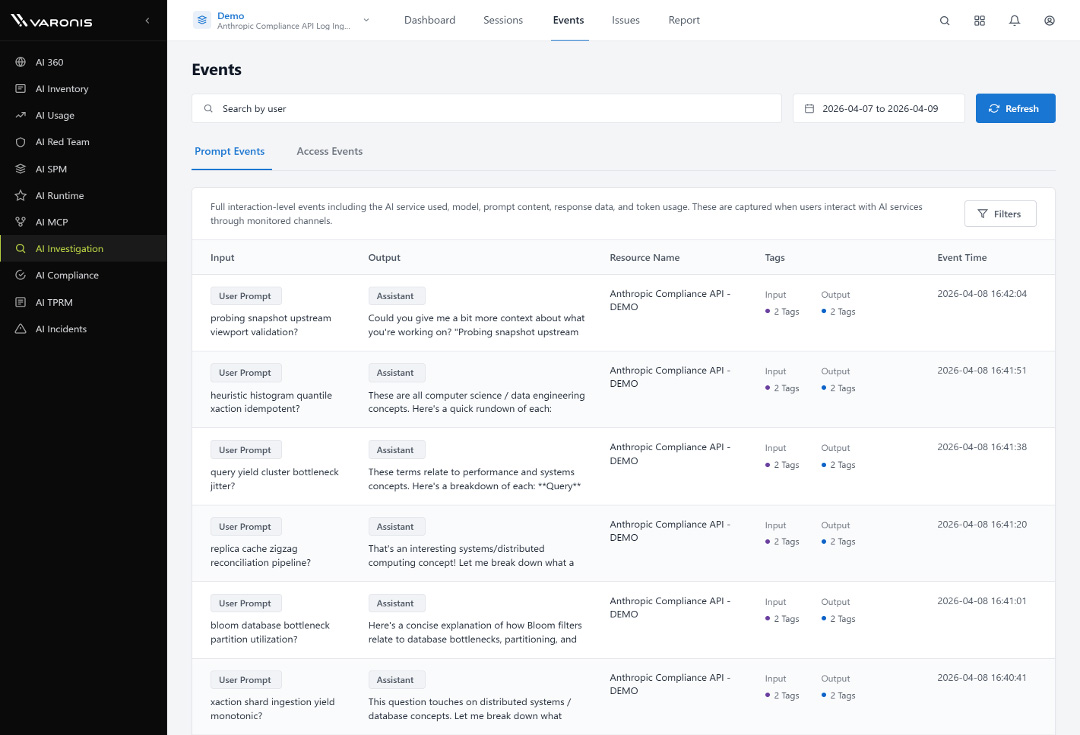
AI Detection and Response: Detect sensitive data exposure, jailbreak attempts, and suspicious prompt patterns as they occur across a session — not as standalone events.
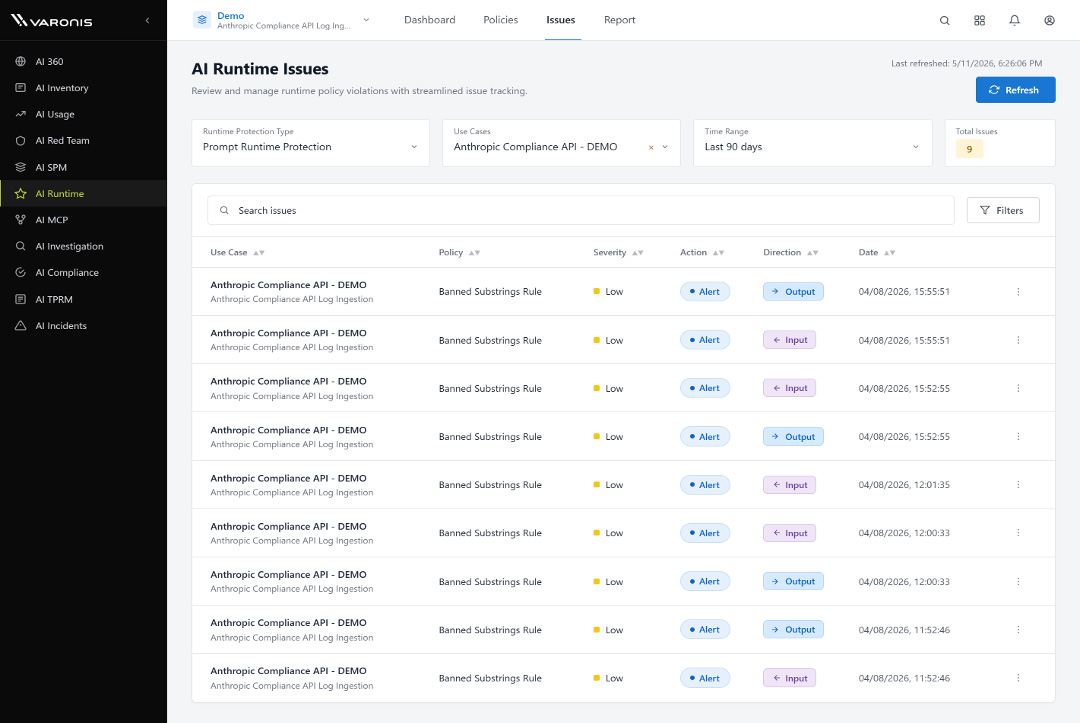
Session-level investigations: View complete Claude chat sessions in chronological order to understand activity, intent, and misuse in full context.

Supporting secure development on Claude Platform
Claude Platform embeds Claude into custom applications, products, and agents — powering AI-driven features such as assistants, workflows, and internal tools.
Varonis Atlas provides visibility into admin, configuration, and resource activity.
AI Observability: Visibility into audit and admin events from Claude Platform stored for investigation.
Real-Time Alerts: Surface risky behavior tied to policy violations and session activity as it happens.
Proactive AI Pen Testing: Stress-test assistants and agents for vulnerabilities such as prompt injection and jailbreaks.
In addition, Varonis Atlas can stress-test assistants and agents for vulnerabilities such as prompt injection and jailbreaks.
Secure AI and the data that powers it
Varonis Atlas connects AI activity to the underlying data, including permissions, sensitivity, classification, and access. Security teams understand not just what AI systems exist, but what data they can reach and whether that access is safe.
Complete Data Context. Atlas is built on the Varonis Data Security Platform, combining AI security with deep data context — sensitivity, permissions, and access activity. Organizations can discover AI risk, remediate exposures proactively, enforce guardrails, and manage governance at scale.
Complete Coverage. Atlas is designed to cover any AI system you build or run, including hosted AI platforms, custom LLMs, chatbots, MCP, and every major agentic framework.
Complete Lifecycle. Atlas secures AI across the entire lifecycle, from posture management and security testing to runtime protection and governance.
Varonis Atlas is available today. Watch the demo or, with a free trial, get full access to Atlas’ AI inventory, posture management, security testing, runtime guardrails, and compliance reporting functionality.
Sponsored and written by Varonis.
Regulators Try to Keep Up With Insurers’ Private Investments

Bermuda, the tiny island nation with huge crypto ambitions
Alyssa Farah Griffin calls Donald Trump Jr.'s wedding his 'funeral' in shocking on-air slip


-

 Crypto World5 days ago
Blockchain.com files with SEC for U.S. IPO
-

 Fashion4 days ago
Holiday Weekend Open Thread – Corporette.com
-

 Business4 days ago
Dell Technologies DELL Stock Surges 15% on AI Server Momentum and Analyst Upgrades in 2026
-

 Crypto World4 days ago
Bitcoin Accumulation Weakens as BTC Realized Losses Hit $600M
-

 Crypto World4 days ago
Space X IPO Is ‘Bad News’ for Tech Stocks: But What About Bitcoin?
-

 Politics4 days ago
Makerfield: a tale of two social-media histories
-

 Crypto World3 days ago
Robinhood crypto COO Tanya Denisova exits
-

 Business2 days ago
NYT Strands Answers May 24 2026 Revealed for Puzzle No. 812 Theme Summer Essentials
-

 Crypto World5 days ago
MicroStrategy’s Saylor Says Miners No Longer Set Bitcoin Price, Another Force Has Taken Over
-

 Tech5 days ago
WhatsApp ads could make Irish debut after discussions with DPC
-

 Crypto World4 days ago
AI infrastructure race heats up as IREN pitches full-stack strategy, WhiteFiber lands $160M deal
-
 Tech4 days ago
A 0.12% parameter add-on gives AI agents the working memory RAG can’t
-

 Tech5 days ago
You Can Now Add ChatGPT To PowerPoint
-
 NewsBeat5 days ago
Charity run by Reform leader Malcolm Offord accused of ‘law breaking’ over Scottish registration
-

 Business4 days ago
Trump Invests $1M-$5M in Kura Sushi USA Chain With 27 California Locations
-

 Tech1 day ago
Microsoft’s quiet Claude Code retreat and the real cost of enterprise AI
-

 Sports5 days ago
2026 CJ Cup Byron Nelson leaderboard: Brooks Koepka finds putting stroke in Round 1
-

 Crypto World6 days ago
Exa Labs raises $250 million in funding led by a16z
-
Business4 days ago
Goldman Sachs reinstates Ageas stock coverage with neutral rating
-

 Crypto World4 days ago
Verus Bridge Hacker Returns $8.5M ETH, Keeps $2.8M as Bounty
You must be logged in to post a comment Login