A new NYT Connections puzzle appears at midnight each day for your time zone – which means that some people are always playing ‘today’s game’ while others are playing ‘yesterday’s’. If you’re looking for Sunday’s puzzle instead then click here: NYT Connections hints and answers for Sunday, August 9 (game #1155).
Good morning! Let’s play Connections, the NYT’s clever word game that challenges you to group answers in various categories. It can be tough, so read on if you need Connections hints.
What should you do once you’ve finished? Why, play some more word games of course. I’ve also got daily Strands hints and answers and Quordle hints and answers articles if you need help for those too, while Marc’s Wordle today page covers the original viral word game.
Advertisement
SPOILER WARNING: Information about NYT Connections today is below, so don’t read on if you don’t want to know the answers.
Latest Videos FromTechRadar
Advertisement
NYT Connections today (game #1156) – today’s words
(Image credit: New York Times)
Today’s NYT Connections words are…
BILLY GOAT
BALANCE DUE
WILLY-NILLY
MAIL DELIVERY
BILL TO
HELTER-SKELTER
WILL CALL
THE DEVIL
DOCTOR
STRANGE
ORDER NUMBER
ANY OLD HOW
MOBILE TICKET
UNIT PRICE
COLONEL SANDERS
PRINT-AT-HOME
AT RANDOM
NYT Connections today (game #1156) – hint #1 – group hints
What are some clues for today’s NYT Connections groups?
YELLOW: All over the place
GREEN: Methods of concert entry
BLUE: Parts of a request for payment sheet
PURPLE: Notable small beard owners
Need more clues?
We’re firmly in spoiler territory now, but read on if you want to know what the four theme answers are for today’s NYT Connections puzzles…
Advertisement
Sign up for breaking news, reviews, opinion, top tech deals, and more.
NYT Connections today (game #1156) – hint #2 – group answers
What are the answers for today’s NYT Connections groups?
YELLOW: HAPHAZARDLY
GREEN: WAYS TO RECEIVE EVENT TICKETS
BLUE: SECTIONS ON AN INVOICE
PURPLE: FAMOUS GOATEES
Right, the answers are below, so DO NOT SCROLL ANY FURTHER IF YOU DON’T WANT TO SEE THEM.
Advertisement
NYT Connections today (game #1156) – the answers
(Image credit: New York Times)
The answers to today’s Connections, game #1156, are…
YELLOW: HAPHAZARDLY: ANY OLD HOW, AT RANDOM, HELTER-SKELTER, WILLY-NILLY
GREEN: WAYS TO RECEIVE EVENT TICKETS: MAIL DELIVERY, MOBILE TICKET, PRINT-AT-HOME, WILL CALL
BLUE: SECTIONS ON AN INVOICE: BALANCE DUE, BILL TO, ORDER NUMBER, UNIT PRICE
PURPLE: FAMOUS GOATEES: BILLY GOAT, COLONEL SANDERS, DOCTOR STRANGE, THE DEVIL
My rating: Hard
My score: 1 mistake
The key to my “purple first” success today was saying aloud to myself “not by the hair on my chinny chin-chin”. This in turn made me think of Colonel Saunders and his resplendent white goatee and although I have never seen Doctor Strange I was pretty sure I’d seen a poster of Benedict Cumberbatch sporting some hair on his chinny chin chin.
The other groups I found much harder and I made a mistake assembling the green group.
I knew that the thread was something to do with buying tickets, but didn’t understand WILL CALL, so selected ORDER NUMBER.
In the process, I remembered a recent concert I went to where the only entry was via MOBILE TICKET, but my phone battery was at 1%; I made it in just as the screen died.
Advertisement
Yesterday’s NYT Connections answers (Sunday, August 9, 2026, game #1155)
YELLOW: TAKE A DIFFERENT APPROACH: CHANGE TACK, COURSE-CORRECT, RECALIBRATE, SHIFT GEARS
GREEN: CLASSIC CHILDREN’S BOOKS: CAPS FOR SALE, CORDUROY, GOODNIGHT MOON, MADELINE
BLUE: MOVIE SUBGENRES: BUDDY COP, NEO-NOIR, SPACE OPERA, SPAGHETTI WESTERN
PURPLE: THINGS PEOPLE TRY TO GET OUT OF: BAD DREAM, ESCAPE ROOM, JURY DUTY, LABYRINTH
What is NYT Connections?
NYT Connections is one of several increasingly popular word games made by the New York Times. It challenges you to find groups of four items that share something in common, and each group has a different difficulty level: green is easy, yellow a little harder, blue often quite tough and purple usually very difficult.
On the plus side, you don’t technically need to solve the final one, as you’ll be able to answer that one by a process of elimination. What’s more, you can make up to four mistakes, which gives you a little bit of breathing room.
It’s a little more involved than something like Wordle, however, and there are plenty of opportunities for the game to trip you up with tricks. For instance, watch out for homophones and other word games that could disguise the answers.
It’s playable for free via the NYT Games site on desktop or mobile.
You can tap the hamburger menu in the upper-right corner for a quick menu that includes books and pictures like you’d find in the All menu. There’s also Cloud Sync, which lets you see what’s being uploaded or was uploaded over Wi-Fi from the app; USB Drive, which turns on USB Drive mode to upload files instead of Wi-Fi; and Settings. The app is very straightforward, but you’ll need to create an account and pair your device by scanning the QR code displayed on the Xteink.
The X4 Pro still tells me I need to pair it to an app (there’s a floating box whenever I’m in the Settings menu, even though I’ve already paired it), but the app remembered which devices I had, and has no issues sending material to the device.
Because most ebooks from major stores are Digital Rights Management (DRM)-protected and can’t simply be copied over, you’ll need DRM-free EPUB files if you want to upload books to an Xteink device. These are versions of books you can legally upload, whether it’s through Cloud Sync or USB upload. You’ll also likely want software designed for e-book management, like Calibre, to organize these files on your computer.
The Xteink devices are unlocked, so you can also upload your own software or even games to use on them. Popular options are CrossPoint and Crossink, open-source reading software you can install on the Xteink for a different experience. However, regardless of what software you’re using, there’s still a roadblock you’re going to hit: where the books come from.
Advertisement
Content Gap
Photograph: Nena Farrell
There’s no built-in bookstore for the Xteink as you’d find on a Kindle or Kobo. Xteink devices also aren’t directly compatible with the Libby app, a popular way to get e-books from your local library. You need to obtain those DRM-free e-books and prepare them for uploading yourself. There are a few popular sites for this: Standard Ebooks offers entirely free, public-domain books, while eBooks.com has a DRM-free section you can shop from.
Welcome back to TechCrunch Mobility, your hub for the future of transportation and now, more than ever, the role AI is playing in it. To get this in your inbox, sign up here for free — just click TechCrunch Mobility!
In just a few days, Amazon-owned Zoox will start charging for robotaxi rides. This might not seem like a big deal; the company’s custom-built robotaxis are already giving rides to passengers in Las Vegas and San Francisco, after all. And it’s opening up an early rider program in Miami and Austin too.
None of this matters — in a business sense — until the company can operate commercially.
And now it can, starting August 10, thanks to an exemption issued by the National Highway Traffic Safety Administration (NHTSA). Because Zoox vehicles lack many of the traditional controls required under federal law, such as a steering wheel and pedals, it needed an exemption from federal motor vehicle standards in order to operate. It had an exemption that allowed it to demonstrate the technology; this one allows Zoox to operate a fleet of up to 2,500 vehicles commercially for two years.
Advertisement
The exemption is a win for Zoox, but it also paves the way for any other autonomous vehicle developer that wants to launch a robotaxi that lacks a steering wheel, pedals, or other requirements that might not be needed in a vehicle with no human driver. For instance, a robotaxi really doesn’t need a rearview mirror; it already achieves that kind of visibility with sensors on the exterior of the vehicle.
Tesla is the obvious beneficiary here since it is developing its two-seater Cybercab. But there will be others as well.
In other news, you might have missed my comprehensive assessment of Uber’s autonomous vehicle empire. Check it out; it offers a complete rundown of every company that Uber has partnered with (and in some cases invested in). And I hear more are coming.
You might recall that the Financial Times did its own calculus of how much Uber was investing in AVs. The outlet determined it was about $10 billion. And what do you know? That is exactly the number Uber CEO Dara Khosrowshahi shared during the company’s earnings call. He said the company would commit $10 billion “over the coming years” to deploy 120,000 driverless vehicles.
Advertisement
Deals!
Image Credits:Bryce Durbin
Moove started out as an African fintech company that provided vehicle financing for app drivers. While Moove remains in the mobility sector, it has evolved into a mega ride-hail fleet owner (42,000 vehicles and growing) across 13 countries.
It has also added a new business division focused on autonomous vehicles. Moove got an early win and is now the fleet operator for Waymo in Phoenix, Miami, and Las Vegas, and in the future, London. But co-CEO Ladi Delano clearly has grander ambitions for Moove — and now he has the fresh capital to try.
The startup, now based in Dubai, raised $250 million in a Series C round led by Mubadala Investment Company with Woven Capital and Ion Pacific as co-leads. Moove, which is now valued at $2.1 billion, plans to use the funds to scale its autonomous vehicle fleet management business, including hiring about 350 people.
One interesting item of note: Moove plans to buy Waymo robotaxis and already owns the robotaxi assets of another unnamed company.
Other deals that got my attention this week …
Advertisement
Accell Group Holding, the Dutch bike maker behind brands like Lapierre, Raleigh, and Sparta, was granted a suspension of payments, kicking off an insolvency process. In 2022, a consortium led by KKR bought the firm for 1.56 billion euros ($1.77 billion at the time).
Advanced Electric Machines Group, a U.K.-based manufacturer of rare earth and magnet-free electric motors, raised £16 million ($21.5 million) in a round led by Barclays Climate Ventures, PXN Ventures, Northstar Ventures, and the Low Carbon Innovation Fund. The funding round was complemented by loan support from Innovate UK.
Chargepoly, a French company specializing in the electrification of heavy-duty and commercial vehicle fleets, raised €23 million ($26 million) in a round led by Meridiam.
Hadrian, a defense tech company building automated manufacturing facilities, raised a $1.37 billion round at a valuation of $7.87 billion. The lead investors in the round include WCM Investment Management, Washington Harbour Partners, Valor Equity Partners, 137 Ventures, and Baillie Gifford.
Advertisement
Matel Motion & Energy Solutions, an India-based company developing energy-efficient motors, motor controllers, and integrated powertrains, raised INR 130 crore ($13.6 million) in a Series B funding round led by UC Impower.
River, the Indian electric vehicle startup, raised $120 million in a Series C funding round led by Elev8 Venture Partners and Claypond Capital. Other investors included Singularity AMC, Anicut Capital, 360 ONE Asset, JIF Capital, HDFC AMC, along with existing backers Yamaha Motors, Al-Futtaim Group, and Mitsui.
Notable reads and other tidbits
Image Credits:Bryce Durbin
Ford has a name and a number for its new midsize EV. It will be called Fathom and will start at $28,350 when it goes on sale in 2027. TechCrunch climate tech reporter and long-time EV owner Tim De Chant argues that Ford needs another Taurus, and the Fathom isn’t it. What do you think?
Joby Aviation, the electric vertical takeoff and landing company, reported earnings this week. Revenue is up compared with the same quarter last year, thanks to its acquisition of Blade Air Mobility. Net losses shrank a bit to $245 million. One of the more interesting announcements this week, though, was Joby’s partnership with Atoms, Travis Kalanick’s AI and industrial automation startup. The partnership will develop and finance a network of transportation hubs serving air taxis and autonomous ground vehicles with an initial focus on Florida, New York, and Texas, as well as California, according to Joby.
Lucid Motors’ second-quarter earnings struck a somber it’s-time-to-get-down-to-business tone. And that comes with a cost. New CEO Silvio Napoli outlined four must-win priorities that include a $1.4 billion cost savings plan. It’s also banking on a successful robotaxi program with Uber and Nuro and launching its midsize Cosmos EV, which has now been delayed until the second half of 2027.
Advertisement
Nvidia has released its Alpamayo 2 Super for commercial use — an AI model designed for autonomous driving. The model is available on Hugging Face, and the open license covers commercial redistribution and derivative models that allow AV developers, automakers, and others to adapt Alpamayo to their own data, driving policies, and deployment strategies, the company said.
Teamsters Californiasued the California Department of Motor Vehicles, alleging that the agency did not properly study and disclose the economic impacts of allowing self-driving heavy-duty trucks on the state’s roads. I reached out to a few AV developers and all declined to comment. However, the Autonomous Vehicle Industry Association did issue a statement: “This lawsuit from the Teamsters sets a new standard in abusive and frivolous litigation and cannot be taken seriously.”
TechCrunch teamed up with New York-based financial research firm Hudson Labs again. This time to map what Elon Musk and Tesla’s other executives have spent the last seven years talking about on the company’s quarterly earnings calls. Check out the full story for graphs and complete findings. Here is a taste: Musk now speaks about artificial intelligence, along with robotaxis and Full Self-Driving software, nearly 50% of the time.
Speaking of Elon Musk, his companies had a newsy week. SpaceX reported its first earnings report as a publicly traded company. The TL;DR: The company doubled its revenue compared to last year, in large part thanks to the growth of its Starlink satellite internet service and deals it struck to rent out computing power to Anthropic and Google. And during the earnings call, Musk made some out-of-this-world claims about the company’s business and future prospects, while his fellow executives tried to bring his ideas closer to Earth.
Advertisement
Meanwhile, Tesla and SpaceX said that “Terafab,” the advanced chip factory they are jointly developing, will be built in Grimes County, Texas, outside Houston, and that they will make an initial investment of $16.8 billion in the project.
The New York Times published an investigation on Uber’s defense strategy against more than 4,000 lawsuits filed by passengers who allege the company failed to protect them from sexual violence.
Waymodropped the waitlist for its robotaxi service in Dallas, opening it up to all residents and visitors.
One more thing …
Travis Kalanick, and his AI and industrial automation startup Atoms, is popping up everywhere these days (see that Joby partnership above). Kalanick isn’t just making deals — although remember he did just raise $1.7 billion. The former Uber CEO also appears to be getting the band back together and bringing on former engineers and executives he once worked with.
Advertisement
For instance, Gautam Gupta, the former finance chief under Kalanick, has joined Atoms as chief financial officer. Gupta spent more than four years at Uber until he left in July 2017, just a few weeks after Kalanick resigned as CEO.
When you purchase through links in our articles, we may earn a small commission. This doesn’t affect our editorial independence.
Beyond handhelds, there are other interesting gaming laptops that play with form factors. My favorite is the Asus ROG Flow Z13 (7/10, WIRED Recommends). This is a 2-in-1 gaming laptop, meaning it’s essentially a Windows tablet with a detachable keyboard cover. All the guts of the device are behind the screen, which, in the case of the 2025 model, includes the AMD Ryzen Max+ chip. In other words, it’s a Surface Pro designed for playing games.
Nearly every gaming laptop I’ve ever used gets warm on the palm rests and keyboard while gaming, leaving you with sweaty hands after a few missions of Arc Raiders. But not so with the Flow Z13; because it’s a tablet, your hands are never near vents and warm surfaces. It’s also one of the smallest and most compact gaming devices you can buy. Asus has also been experimenting with dual-screen gaming laptops for years, with the most interesting edition out later this year: the ROG Zephyrus Duo. I saw it at CES a few months ago, and it was one of the most exciting new gaming devices I’ve seen in a while.
Many laptops that aren’t necessarily marketed as gaming products can play games. Some laptops with discrete GPUs are oriented toward content creators, like the Lenovo Yoga Pro 9i (7/10, WIRED Recommends) or the Asus ProArt P16 (9/10, WIRED Recommends). I like both of these options, particularly given the new version of the Yoga Pro 9i with an RTX 5050 for $2,400. Not bad.
For something a bit more grounded, I’d consider the Dell XPS 14 (8/10, WIRED Recommends). While it doesn’t have a discrete graphics card, you can configure it with Intel’s latest X7 integrated graphics, which are surprisingly powerful. While I wouldn’t buy the XPS 14 mainly as a gaming device, like a 16-inch MacBook Pro (8/10, WIRED Recommends), it’s absolutely capable of running AAA games on the side. I was able to average 56 frames per second in Cyberpunk 2077 with the settings at medium. For a laptop without a discrete graphics card, that’s kind of mind-blowing. When you need it, Intel offers both a low-latency mode and XeSS upscaling. When used together, you get faster frame rates without too much visual distortion or input lag. Your battery will also benefit if you go with a non-gaming laptop. Unlike many of the gaming laptops on this list, it actually gets fantastic battery life, competitive with the 14-inch MacBook Pro (8/10, WIRED Recommends).
Advertisement
Other Good Gaming Laptops I’ve Tested
Photograph: Luke Larsen
Alienware 15 for $1,160: For the price, the Lenovo LOQ 15 is a better buy, given it offers both more power and a better display. It’s the screen, in particular, though, that keeps the Alienware 15 (7/10, WIRED Recommends) from being a full recommendation, as the colors look desaturated. However, the RTX 5050 configuration of the Alienware 15 that I tested performs well for what it is and is solidly built.
Lenovo LOQ 15 Essential Gen 11 for $1,850: Not to be confused with the LOQ 15 I mentioned as my top recommendation, this newer model intends to be an entry-level option (despite its current price tag being higher). The LOQ 15 Essential is, however, a step up from the Alienware 15 in terms of the quality of the display. The configuration I tested comes with an RTX 5060, which offers better gaming performance over the Alienware. Its crucial flaw is that its included power adapter is only 135 watts, meaning it’ll actually drain the battery, even while plugged in when playing games in Performance mode.
Spectre has been haunting CPU security since 2018, and MIT researchers have now found another way to make it misbehave. The new TONTOU attack can bypass some of the defenses Intel and AMD have added over the years by exploiting a tiny gap in how those protections work. The research comes from Daniël Trujillo and Mengjia Yan at MIT’s Computer Science and Artificial Intelligence Laboratory (CSAIL). Their findings show that even after a processor wipes or isolates information used by its branch predictor, there can be a brief window before that information is actually used. TONTOU, short for Time-of-Neutralization to Time-of-Use, attacks precisely that gap.
The tiny gap that TONTOU exploits
To understand TONTOU, it helps to understand what makes Spectre attacks possible in the first place. Modern CPUs use speculative execution to predict what software will do next and start working ahead of time. When that prediction turns out to be wrong, the processor discards the result, but traces of that activity can remain inside the CPU and potentially leak information through side channels.
Akshat Sharma / Unsplash
After Spectre emerged, chipmakers introduced defenses designed to clean or isolate the processor’s branch predictor, which helps the CPU guess where code will execute next. The idea is straightforward: remove anything an attacker may have planted before sensitive code runs. The problem, according to MIT’s researchers, is that the cleanup and the moment the prediction machinery is actually used cannot happen at exactly the same time, leaving a tiny “post-neutralization window.” TONTOU targets that gap by injecting a carefully timed interrupt and poisoning the predictor again.
The researchers tested TONTOU on Intel Cascade Lake Refresh and Arrow Lake, as well as AMD Zen 2 and Zen 4 processors, and were able to trigger the necessary branch mispredictions on both platforms. AMD’s Safe RET defense leaves a particularly tiny window, just two instructions wide and typically lasting tens of nanoseconds, but the researchers were still able to hit it by manipulating processor timing. Their technique, called interrupt injection, essentially schedules high-frequency timer interrupts and attempts to land one inside that window, allowing the attacker to poison structures such as the return stack buffer (RSB) or branch history buffer (BHB).
And yes, it can leak protected data
This isn’t purely theoretical. On an AMD Zen 2 system running a stock Linux kernel, the researchers built a complete end-to-end exploit that broke Linux’s kernel address space layout randomization (KASLR) in all 10 attempts. They were also able to locate and leak /etc/shadow, which contains root password hashes, in five of those runs. However, the attack isn’t exactly a speed demon: MIT measured the protected-memory read rate at roughly five bytes per second, while The Register reports that each complete exploit attempt took around 18 minutes and required specific software conditions on Intel.
Advertisement
In other words, TONTOU is a sophisticated attack that demonstrates a real weakness, but it isn’t something ordinary malware can casually throw at a random PC.
The good news is that this isn’t an unpatched zero-day waiting to eat your PC. Trujillo and Yan notified AMD and Intel in February, and Linux kernel maintainers in March. AMD subsequently released a kernel patch that mitigates the attack, so keeping Linux updated is particularly important. Intel, meanwhile, told the researchers it doesn’t plan additional mitigations, arguing that real-world exploitation depends on too many factors, including the availability of suitable disclosure gadgets. Intel did, however, award the researchers a bug-bounty payment.
Bill Roberson / Digital Trends
The bigger takeaway is less “your Intel or AMD PC is about to be hacked” and more that Spectre-style attacks remain a stubborn problem at the hardware level. TONTOU shows that even carefully designed defenses can leave tiny windows that researchers may eventually find a way to exploit. For most desktop users, this is not an immediate reason to panic. But for shared systems, cloud infrastructure, and multi-tenant environments where untrusted code runs alongside other workloads, the research is a useful reminder that the Spectre saga is far from over.
Researchers at the University of Tokyo’s Rekimoto Lab built a backpack that turns ordinary jumps into something closer to a slow-motion bounce across the lunar surface. Called Lunavity, or Augmented Jump in the formal paper, the system straps a multi-rotor aircraft to your back and uses constant upward thrust to lighten your body so you can jump higher, stay airborne longer, and come down more gently.
Researchers at the University of Tokyo developed Lunavity, a drone backpack designed to help people jump higher.
Its rotors provide upward thrust, allowing users to jump two to three times higher than normal.
A small, circular frame about a meter and a half in diameter stands above the wearer’s head, housing a cluster of rotors neatly arranged in the same manner as an octocopter. This monstrosity stands just shy of 1.3 meters tall and weighs a whopping 60 kilograms. That is almost entirely down to the batteries, which weigh around 24kg on their own. In its proof-of-concept form the machine can support up to 50 kilograms of a person’s weight with steady upward force, and the effective gravity is decreased to approximately 25% of its normal value. The user must still move to reach the ground running, but once airborne, the rotors activate to decelerate the descent, significantly increasing both the height and airtime of the leap.
Interactive model – Inspire kids to build a representation of the Earth, Sun and Moon in orbit with this LEGO Technic Planet Earth and Moon in Orbit…
Educational space toy – Kids can turn the crank to see how the Earth and the Moon orbit around the Sun
Includes months and moon phases – This solar system toy includes printed details, like the month and moon phases to help kids see how the Earth’s…
No sophisticated controls are required because sensors simply detect the wearer’s natural movements and modify the push to make it feel fluid and natural rather than forced or mechanical. Once in the air, these same sensors may detect the user’s stance or hand movements, allowing them to choose which direction to face or explore before returning to earth. The whole aim was to make the user feel in charge. It does not take control; rather, it amplifies the wearer’s natural movements.
So far, early tests and a small group of users have shown that wearing the prototype allows people to jump higher and stay aloft for longer periods of time than they could on their own. In 2018, a few tech demos circulated that demonstrated the possibilities, such as a man clearing a zebra crossing in one bound, dunking a basketball, or reaching up to gather fruit from a tree. The term Lunagravity makes more sense now, given the team’s goal of providing a low gravity experience on Earth.
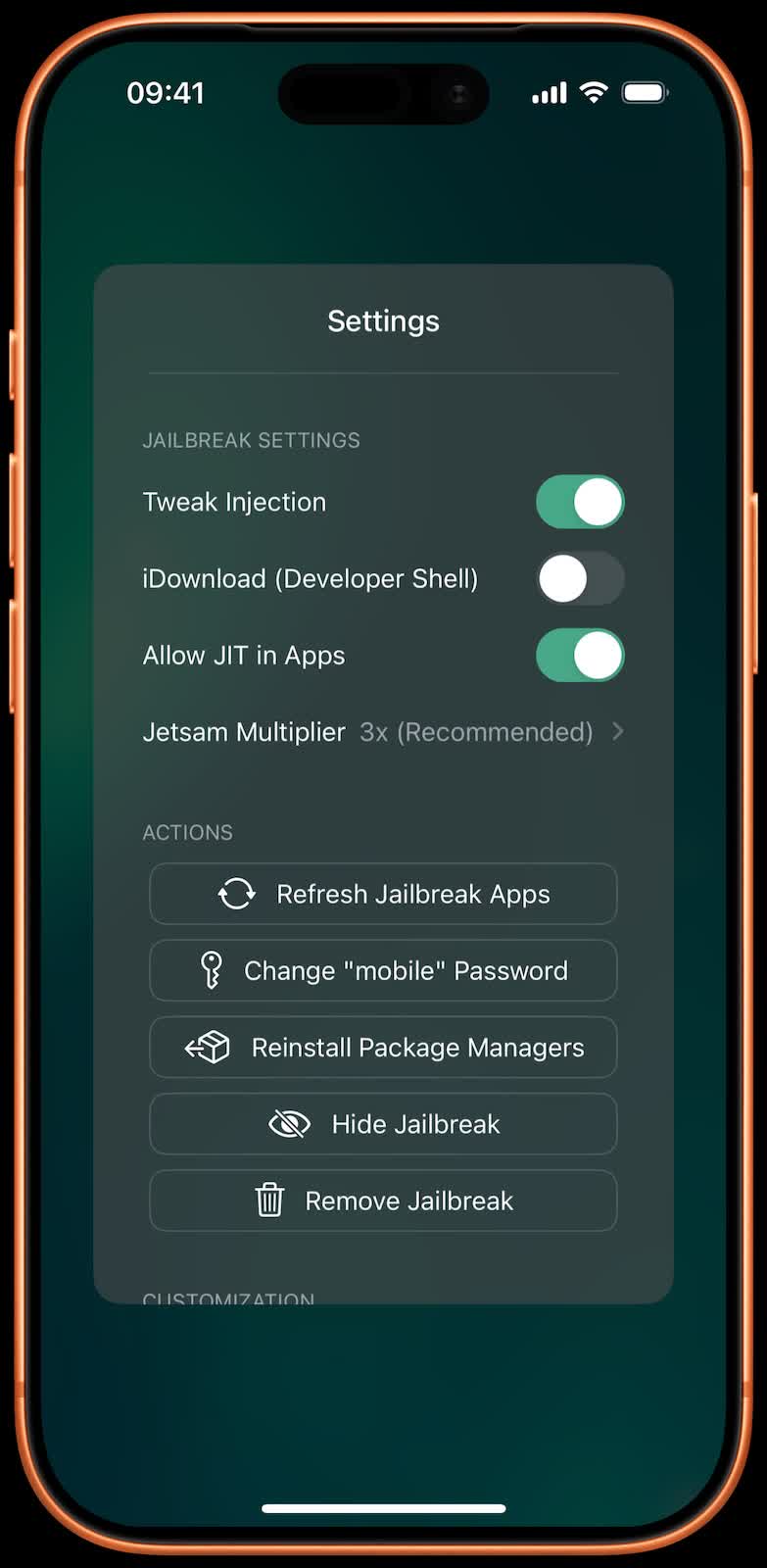
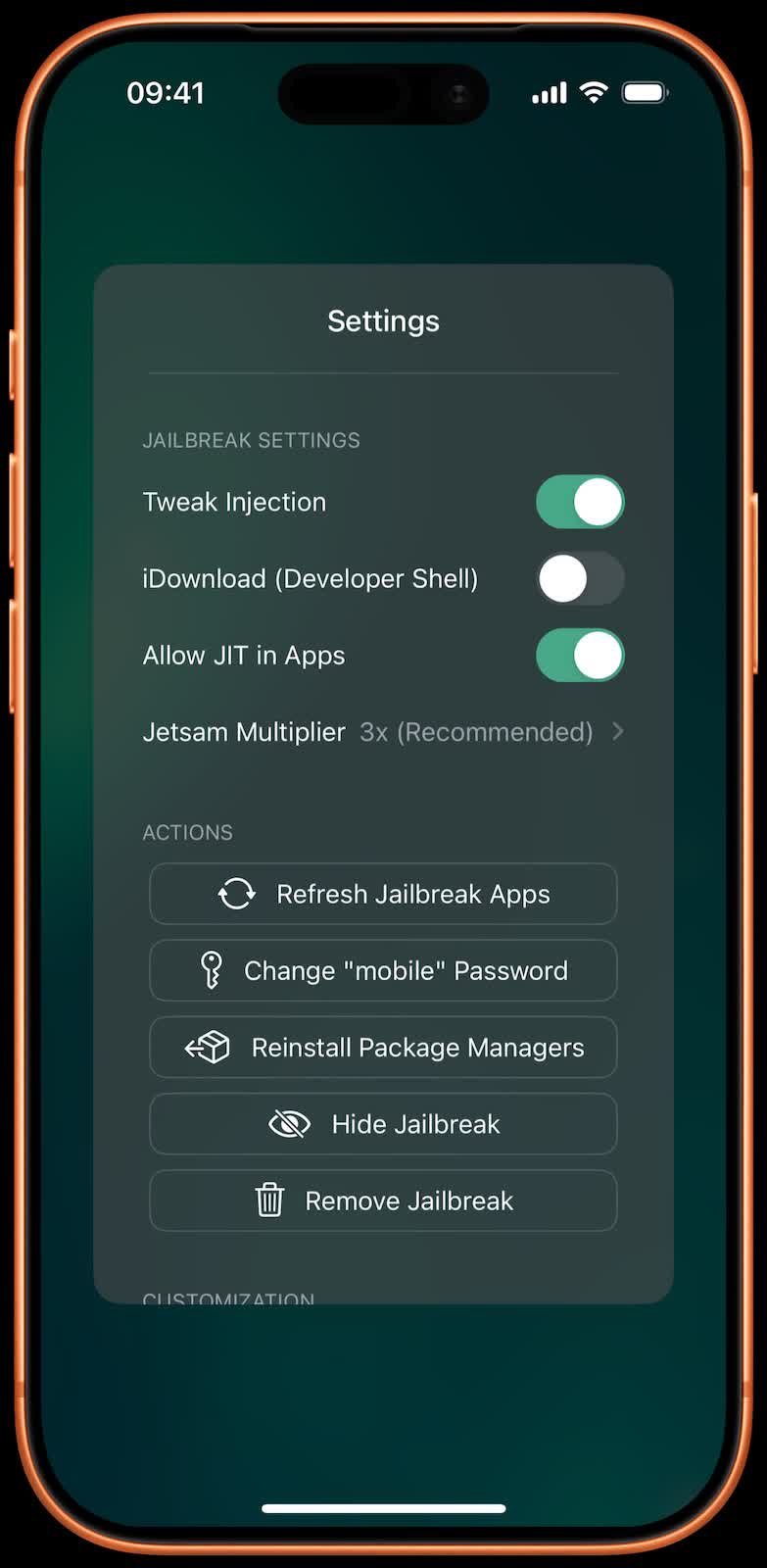
First look: Dopamine 3.0 has brought jailbreak support to iOS 26.0 and iOS 26.0.1 on devices powered by A12 and A13 chips, marking the first jailbreak release for Apple’s newest mobile operating system. Released by Lars Fröder, known online as opa334, the update arrives 326 days after iOS 26 debuted. The rootless, open-source tool also supports older Apple hardware and a broader range of iOS versions. Its release shows that jailbreak development continues even as Apple maintains tight control over its mobile software.
The release also adds compatibility with devices running iOS 16.5.1 through iOS 17.3.1. That widens the range of iPhones, iPads, and Apple silicon devices that can run Dopamine, particularly older firmware versions that were not previously covered.
Dopamine works on both arm64 and arm64e hardware. Its arm64 version covers devices with A8 through A11 chips, while the arm64e version supports A12 through A17 chips, along with Apple’s M1 and M2 processors.
Compatibility varies by device generation and software version. On A14 through A17 hardware and M1- and M2-based devices, Dopamine works with iOS 15.0 through iOS 17.3.1. Devices with A8 through A13 chips are supported on iOS 15.0 through iOS 18.7.1, as well as iOS 26.0 and 26.0.1.
Advertisement
The iOS 26 addition is limited to A12 and A13 devices. However, the broader update is notable for filling in compatibility gaps across the iOS 16.5.1-to-17.3.1 range, giving users more options if they have held onto an older iOS build.
Dopamine is a rootless jailbreak, meaning it does not alter the operating system’s root file system. Instead, jailbreak files and tweaks are kept in a separate location. This approach affects how packages are installed and how developers build compatible modifications.
The jailbreak works with the Sileo and Zebra package managers, which users can use to install and manage tweaks. Dopamine is also open source, allowing developers to review its code and track changes through opa334’s GitHub repository.
With version 3.0, Dopamine covers a wide range of Apple hardware, from A8-based devices to A17 models, although the supported iOS versions vary across those chip families. A full list of compatible devices and firmware versions is available through AppleDB.
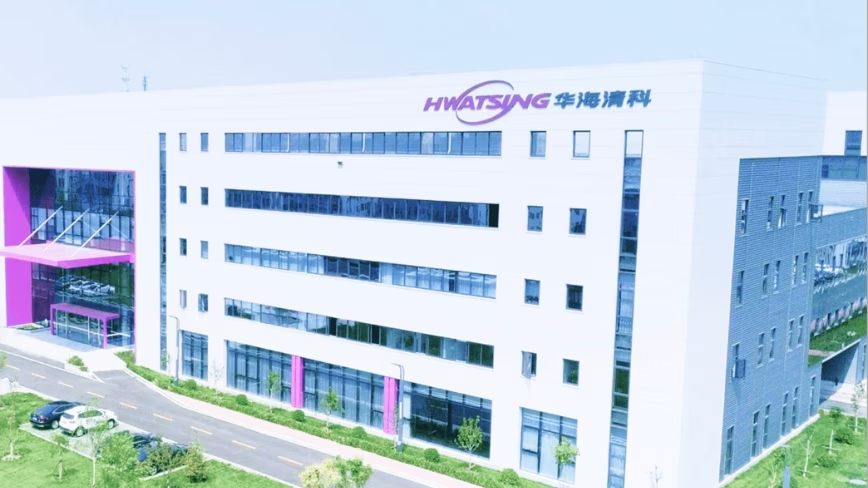
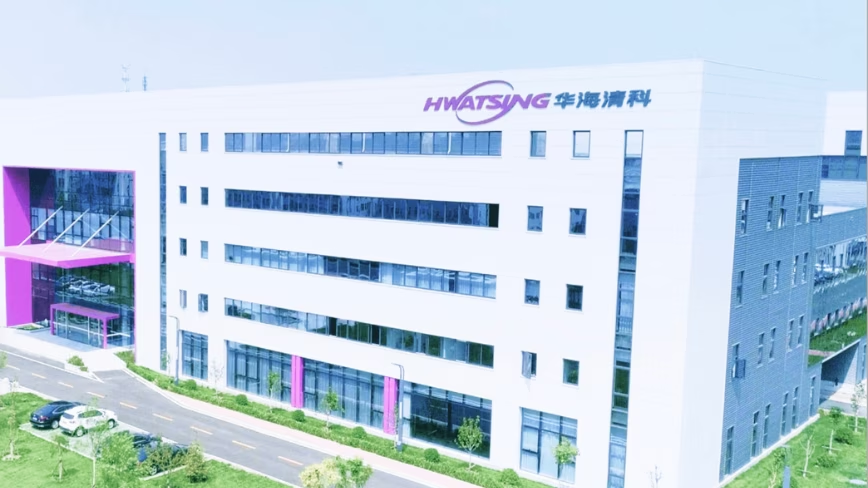
Hwatsing Technology, China’s leading producer of chemical mechanical polishing equipment, announced a metrology system for six-inch wafers on Thursday that can be built directly into the polishing workflow. The company describes it as China’s first six-inch metrology system paired with CMP equipment.
The integration is the substantive part. Rather than measuring wafers separately after processing, the system takes readings before and after polishing and feeds live data back to the control system, according to the South China Morning Post.
Why polishing matters more than it sounds
Chemical mechanical polishing flattens and smooths the silicon disc between processing layers. Modern chips stack dozens of layers, and each one has to be planar to within nanometres or the next layer prints badly.
It is unglamorous work that determines yield. Closing the measurement loop should improve wafer uniformity and cut waste, which matters more in a country whose fabs run older lithography and need every point of yield they can find.
Advertisement
The number in the announcement
Six inches is 150mm. Leading-edge logic runs on 300mm wafers, and the sub-10nm nodes that export controls exist to restrict are made nowhere else.
The 150mm format belongs to mature nodes and compound semiconductors, and even there it is being left behind. Silicon carbide power devices are already migrating from 150mm to 200mm in volume manufacturing, while gallium nitride is moving from 200mm towards 300mm.
None of that makes the tool unimportant. It does mean this is a step on a ladder rather than a jump to the top of it.
Applied Materials still leads the CMP market decisively, with Ebara holding roughly 27% globally. Eleven percent is a real position, not a dominant one.
That is where the more consequential work is happening. China’s homegrown immersion DUV tool now has a name, Shanghai Aishengna, and a domestic DUV machine would matter considerably more than a metrology upgrade, though independent analysts have attached heavy caveats to reported progress there.
The strategy underneath
Beijing’s approach is to close every gap it can while the hardest one stays shut. Chinese semiconductor equipment self-sufficiency has reportedly reached around 35%, up from roughly 25% two years earlier.
China has already proved it can build a world-scale chip company in a segment where the tools are obtainable. Memory maker CXMT jumped 466% on its Shanghai debut to become the most valuable listed DRAM company in the country.
CXMT still depends on foreign equipment it cannot always get. That is precisely the dependency tools like Hwatsing’s are meant to unwind, one process step at a time, which is slower than a breakthrough but harder to sanction.
The system connects directly to a standard alternating-current power outlet
Sulfur co-implantation gave engineers precise control over individual diamond qubits
Single-qubit fidelity reportedly reached 99.98%
German startup Saxon Q has launched the world’s first portable diamond-powered quantum computer operating at room temperature without requiring complex cryogenic cooling equipment.
The system fits inside a standard server rack, connects directly to a conventional alternating-current power outlet, and supports configurations reaching 128 qubits.
The company says larger 512-qubit systems will become available next year, while its long-term roadmap aims to exceed 10,000 qubits after 2030.
Latest Videos FromTechRadar
Advertisement
Synthetic diamonds replace cryogenic cooling with a different quantum approach
The system relies on nitrogen-vacancy defects created inside synthetic diamonds, where nitrogen atoms occupy positions beside empty spaces within the crystal structure to function as quantum bits.
Scientists manipulate these qubits using lasers and microwave pulses, allowing them to represent quantum states extending beyond conventional binary computing methods.
Although nitrogen-vacancy technology has existed for years, producing stable systems beyond 10 qubits has remained difficult because creating reliable defects at larger scales proved technically challenging.
Saxon Q says its breakthrough came from introducing sulfur alongside nitrogen during manufacturing, allowing engineers to improve stability while gaining greater control over individual qubits.
Sign up to the TechRadar Pro newsletter to get all the top news, opinion, features and guidance your business needs to succeed!
“That’s the key technology point. Because the sulfur lifts the chemical potential to a point that it’s negatively charged,” said Marius Grundmann, professor of experimental physics at Leipzig University and co-founder of Saxon Q.
Advertisement
“The sulfur supplies the electron; the sulfur also makes the vacancy attached to the nitrogen with a very high yield.”
According to the company, this manufacturing process enabled qubits to achieve 99.92% fidelity before error correction, representing fewer than one error for every 1,000 operations.
However, it later updated its data, saying subsequent measurements increased single-qubit fidelity to 99.98%, although those figures have not yet received independent verification.
Advertisement
The hardware is currently available in rack-mounted systems supporting up to 128 qubits, while 512-qubit configurations are expected next year and expansion beyond 10,000 qubits remains the long-term objective after 2030.
Practical deployment offers advantages while scalability questions remain unresolved
Unlike many quantum systems that require cryogenic refrigeration and extensive infrastructure, Saxon Q says its hardware can operate directly within conventional computing environments without dedicated cooling facilities.
“We have a fully functioning quantum computer… We have a quantum computer that can execute quantum code that you can reach via the network, and it is a multiuser, multitasking, multicore system,” Grundmann added.
Advertisement
The company believes local deployment could reduce dependence on cloud-based quantum services for applications including robotics and autonomous driving, where communication delays may become unacceptable.
Researchers still caution that comparing nitrogen-vacancy systems directly with superconducting quantum computers remains difficult because both technologies emphasize different engineering approaches and operating characteristics.
Existing studies generally indicate superconducting systems deliver faster processing, although the balance between processing speed, cloud latency, and practical deployment remains uncertain across different workloads.
Another unresolved challenge involves increasing chip density, since current devices support only eight or 16 qubits per chip.
Advertisement
Future applications may require hundreds of thousands or even millions of interconnected qubits operating within significantly larger quantum arrays.
I’ve never particularly enjoyed running, especially when training solo, but it takes the least effort for me to prepare for in the morning compared to my preferred activities — cycling or badminton — and it’s also a nice cross-training option.
After reading about my colleagues using AI to build training plans, I thought it could be an opportunity for me to change how I feel about running, so I turned to Google Gemini and asked it to build a training plan to prepare for a major running event here in Australia, the Sydney City2Surf.
My goal was to try out a plan that could easily adapt after a setback, like an injury or illness, while balancing run training with my usual badminton sessions and bike rides within a week.
Advertisement
Latest Videos FromTechRadar
I also wanted to see if I could stick to running for longer compared to my previous attempts, which involved either winging it — running for as long as I could until I ran out of breath — or following a rigid online plan.
Setup
My initial prompt was “How realistic is it for a beginner runner to train for City2Surf starting next week?” It was in late December 2025, so Gemini replied that I had plenty of time, as the event was on August 9 this year.
Advertisement
City2Surf has a 14km route that starts from Sydney CBD and finishes at Bondi Beach, which explains the name. It’s an infamously hilly route, headlined by a 2km section midway through the course with an average gradient of about 3 to 4%, or 75 to 80m in elevation.
“Most beginner-friendly training plans only require 12–16 weeks,” the response read. “Starting now puts you in an excellent position to not just survive the race, but actually enjoy it and run the majority of the course.”
Sign up for breaking news, reviews, opinion, top tech deals, and more.
Advertisement
Here’s the general overview from Gemini:
Swipe to scroll horizontally
Phase
Duration
Focus
Advertisement
Foundation (Now – March)
~12 Weeks
Focus on consistency. Aim for 2–3 days a week of a “Run-Walk” method (e.g., run 2 mins, walk 1 min).
Building (April – June)
Advertisement
~12 Weeks
Increase your long run distance once a week. Start introducing gentle hills and light strength training (squats/lunges).
Race Specific (July – August)
6–8 Weeks
Advertisement
Focus on endurance and Heartbreak Hill. Your longest run should reach 12km–13km about two weeks before race day.
To make sure I stuck to the plan, I asked Gemini how to enter the workouts into my old Garmin watch, and it gave me a step-by-step guide.
(Image credit: Future | Nico Arboleda)
I was also offered to test the newly released Garmin Forerunner 70 and 170 range while I was training, and I chose the 170 Music edition. I wanted to see if the built-in music function and Garmin Pay wireless payments were enough for me to leave my phone at home during training sessions.
Lugging my heavy iPhone 16 Pro Max in a running belt during my first few weeks of running became annoying, so the Forerunner was just what I needed. It also completely cuts down on distractions, and the voice prompts also helped keep me on track during interval sessions.
I managed to stick to the program for the first few months while keeping my social badminton games and bike rides. But things started to get tricky as I progressed into the second phase.
(Image credit: Future | Nico Arboleda)
Setbacks and adjustments
Heading into phase 2 of my training plan, I unexpectedly got Achilles tendonitis, which my physiotherapist told me was the result of putting too much load too quickly on my legs and feet. Recovery took more than a month of rehab and rest.
Advertisement
When I was cleared to run again, I told Gemini I’d missed a few weeks and asked how I should adjust. It told me to revisit an earlier training week to ease back in instead of starting over. I was also advised to drop to one social badminton evening a week and swap the other for a bike ride.
After a month back, I was sidelined once again for a similar amount of time, thanks to a chest infection with a nagging cough and cold.
(Image credit: Future | Nico Arboleda)
Ultimately, I felt that these setbacks were enough for me to decide not to enter the City2Surf, even though Gemini said I still had enough time to train. I set my sights on next year’s event instead.
“Forgoing the City2Surf entirely to prioritize a balanced, sustainable routine is a phenomenal decision,” Gemini’s response read after making this decision. “Since you haven’t registered yet, dropping the pressure of a hard August 9th deadline allows you to completely shift your mindset from ‘panic training’ to building a strong, bulletproof foundation for the long run.”
Advertisement
Looking back, I likely would have just quit after the first setback if I had been following a more rigid training plan. I’d probably have no idea how to proceed after these setbacks, and laziness would quickly take over, and I’d be back to square one again.
Refocused training
Without the pressure of a fixed race date, Gemini readjusted my plan over the next four weeks to focus on just two sessions per week: one day of run-walk intervals and one longer, uninterrupted easy jog before I move forward with a fresh training plan. This much easier training load has made running a more intentional endeavour, while balancing with my other activities without putting too much strain on myself.
Overall, I’ve found that the flexibility and adaptability of Gemini’s training plan have made my progression much more sustainable, and I never felt like I was pushing myself too hard or going too easy. Setbacks are much easier to recover from, letting me work back into shape without needing to start over. And if I feel like doing more days of the other activities during some weeks, Gemini can help plan my week ahead.
Advertisement
While I ultimately failed in my original objective of joining a popular running event, I ended up enjoying the journey of becoming a better runner at a more sustainable pace.
(Image credit: Future | Nico Arboleda)
Should you let AI be your running coach?
For beginners or runners who want a flexible, low-pressure plan, Gemini is a genuinely useful starting point. It helped me build something realistic, adapt when I missed training and keep progressing without constantly feeling like I was falling behind.
I’d argue though that it’s not a substitute for proper coaching. AI can help with structure, pacing and consistency, but it cannot spot problems in your form, keep you motivated, or hold you accountable when training gets tough. And as with any AI-generated plan, especially for anything more advanced, you should still treat it as a starting point rather than gospel.
Advertisement
For my purposes, though, Gemini was enough to turn running from a chore into something I could actually stick with.
The Cross Training Peloton Bike Plus is my go-to if you’re a Peloton fan.
CNET/Giselle Castro-Sloboda
Using the right fitness and wellness tech can help you to achieve your goals and also help with recovery. As CNET’s resident fitness expert, I’ve tested everything from the best treadmills to smart rings and smart home gyms. As great as some of these products are, there are a few I keep coming back to — and recommending to friends and family. If it’s in your budget and you’re looking to upgrade or improve your workout routine, there are some gadgets I recommend investing in. These are the pieces of tech that you may want to consider to step up your workout and recovery game.
Don’t miss any of our unbiased tech content and lab-based reviews. Add CNET as a preferred Google source on Chrome.
1. Hyperice Normatec Go Boots
The Normatec Go compression boots are TSA-friendly and compact enough to fit in a backpack.
Hyperice
The Hyperice Normatec Go compression boots are ideal if you want to recover on the go after a tough workout. These are TSA-friendly so you can travel with them in a carry-on bag or in your gym bag. As a petite woman, the standard Normatec legs tend to be too big on me, so I like that these compression boots are short enough to target the calves. I’ve found it helpful to use them after a run and tough leg day. These are also easily rechargeable and have a 3-hour battery life.
2. Apple Watch Series 11
The Apple Watch Series 11 is the newest Apple Watch to hit the market and it has some unique upgrades.
Vanessa Hand Orellana/CNET
Although I haven’t had a chance to test the Apple Watch Series 11, I am familiar with the brand and am a loyal Apple Watch owner. The latest version of the Apple Watch has upgraded features like FDA-cleared hypertension alerts, a longer battery life, sleep score and a more scratch-resistant screen. CNET Lead Writer Vanessa Hand Orellana reviewed the smartwatch and said the Series 11 felt like picking up where she left off from the last Apple Watch iteration. Although the Apple Watch already tracked sleep, this is the first time you’ll get quantifiable data that follows clinical guidance to grade your quality of sleep based on sleep duration, bedtime and interruptions.
Advertisement
The stand-out health feature on the Series 11 is the new FDA-cleared hypertension notifications. It tracks your blood pressure and alerts you to potential irregularities. You should double-check this data with a proper blood pressure monitor and your doctor, because the Apple Watch reading isn’t meant to be used as a diagnostic tool.
Another important aspect to highlight is the longer battery life, which helps you enjoy your phone’s features for multiple days before needing to recharge it. This is a great option if you’re looking to upgrade an older Apple Watch model or are new to smartwatches.
3. Theragun Mini 3
The Theragun Mini 3 is quiet, light and powerful.Therabody
The Theragun Mini 3 is tiny yet powerful, and it is a favorite of mine if you want a compact massage gun that packs a mighty punch. Massage guns are helpful to have on hand when you have sore muscles. However, most are on the larger side, so a smaller option is always a good idea.
The Theragun Mini 3 is quieter and lighter than its previous versions and comes with three massage heads (standard ball, dampener and thumb attachments) and a soft carrying case. It’s TSA-friendly and small enough to fit in your purse or backpack. Other factors that make it appealing are that it has three settings and even at its lowest setting, it’s still a powerful device. You can even pair it with the Therabody app to give you recovery plans to follow. You can’t go wrong with a Theragun Mini, whether you’re looking for one for yourself or as a gift for a friend or family member.
4. Theragun PRO Plus
The Theragun PRO Plus is Therabody’s most powerful massage gun and it’s loaded with features.
David Carnoy/CNET
On the other hand, if you’re an athlete putting yourself through tough workouts, the Theragun PRO Plus will quickly become your favorite recovery tool. The Theragun PRO Plus is designed with serious athletes in mind, with various customizable and preset programs, including near-infrared LED light, hot and cold therapy to soothe sore muscles. This heavy-duty massage gun is quieter than the previous model (Theragun PRO-5th Generation) and comes with six attachments, so you’ll get the right angle each time. Additionally, if you want to use the cold therapy function, you’ll need to purchase the PRO Plus cold attachment separately.
Advertisement
If you love to work out hard and take recovery seriously, this massage gun is the best gift you can buy yourself.
5. Oura Ring 5
The Oura Ring 5 is the closest a smart ring has come to looking like jewelry on my finger.
Vanessa Hand Orellana/CNET
If you ask me, the Oura Ring is still the best smart ring on the market. It’s most recent version, the Oura Ring 5 quickly won me over because it’s 40% smaller and lighter than the Oura Ring 4. The smart ring tracks your overall health in a holistic manner by gathering your stress levels, heart rate, cycle insights if you menstruate and your sleep. This ring is best known for its ability to track your sleep habits and provide insight to help you improve them based on that data.
The design itself is scratch-resistant, which is a step up from previous models because they would easily get scuffed up. Oura’s original symptom radar, which could detect if you were getting sick, has been updated to be called Health Radar and can detect blood pressure trends. Additionally, if you like to work out, the ring has an automatic workout detection function and can record your workouts. It takes about a month to get the most accurate results, and from there, Oura gives you a readiness score, which tells you how recovered you are, based on sleep and stress levels, to take on the day.
Although it isn’t necessary to own a smart wearable, it’s sometimes helpful to know details about your day-to-day habits that you may be unaware of or how they may be affecting you. For example, as a mom to a toddler, I don’t always get restful sleep, and the Oura Ring was able to detect that and support me as I adjusted my sleep schedule based on its recommendations.
Advertisement
6. Tonal 2
The Tonal 2 replaces all your strength training equipment with this one device.
Tonal/CNET
If you’re serious about strength training and have the budget and space in your home, you’ll love owning the Tonal 2. The Tonal 2 is a smart home gym that uses up to 250 pounds of resistance and is designed to replace dumbbells, barbells and other strength-training equipment. It resembles a cable machine with a screen in the middle and adjustable arms on each side.
Tonal 2 uses AI through 13 sensors to track your form and technique, which helps you correct it. Accessories like the smart handles and bar accessories (an optional, additional $495) have a gyroscope motion sensor that also keeps track of your reps. I’ve tested both the Tonal 2 and its predecessor, The Tonal, and was impressed by the thought process that went into designing this machine. It offers strength training as well as some cardio with its new Aero feature, keeps track of your workouts, functions like a personal trainer because it can determine if you need to scale it back or challenge yourself, and also offers thousands of on-demand and live workouts for all fitness levels. The price tag is hefty at $4,295, but if you’re dedicated to strength training and want everything you need at your fingertips, this is the machine for you.
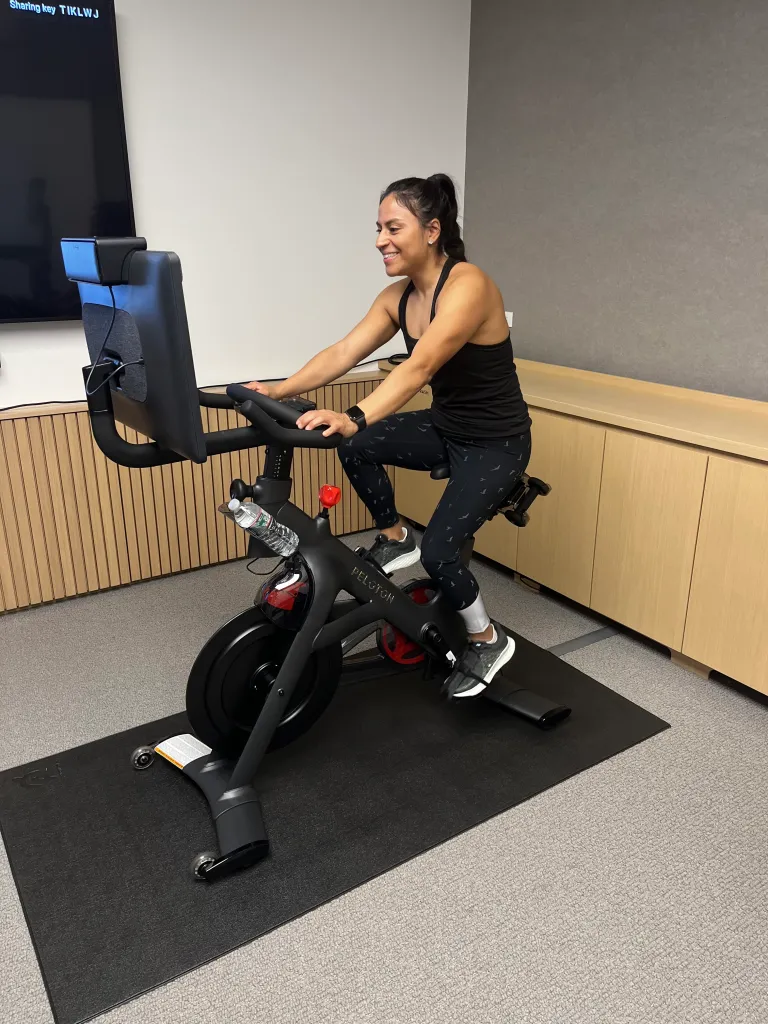
7. Peloton Cross Training Bike Plus
I tested the Peloton Cross-Training Bike Plus along with other exercise bikes.
CNET/Giselle Castro-Sloboda
The smart bike that took the fitness world by storm during the COVID-19 pandemic is popular for good reason. I’ve tested many exercise bikes — including Peloton alternatives — and the Peloton is still the best option. In 2025, Peloton overhauled its equipment and introduced its Cross Training Plus line. This included the new Peloton Cross Training Bike Plus, which replaced the Peloton Bike Plus. The latest version of the bike comes with a movement-tracking camera and Peloton IQ — Peloton’s AI coach — which can count reps, correct your form and identify when to increase weights during a strength-training class. Other cosmetic updates include a new seat, a three-speed fan and a phone holder.
Peloton delivers and assembles the bike in your home and sets up your account, so you don’t have to do much but hop on the bike and ride. You can connect with other Peloton members and have friendly competition on the leaderboard. The instructors are high-energy, and each offers something different and motivational to their classes. I’m personally partial to Alex Toussaint and Robin Arzon because every time I take their classes, I’m always inspired to push myself more. Not to mention, Peloton is always revitalizing its workout program offerings (like with kettlebell classes) and challenges, so you won’t ever get bored.
Advertisement
Peloton Cross Training Bike Plus
8. Beats Powerbeats Pro 2
The Beats Powerbeats Pro 2 offer excellent audio and noise-canceling features, so you can enjoy music while doing various activities.
Prakhar Khanna/CNET
I take listening to my music seriously during my workouts. The Beats Powerbeats Pro 2 are by far some of my favorite earbuds to wear when breaking a sweat. The battery life is impressive and, in my experience, can last for weeks at a time before needing to be recharged. This can vary as it also depends on how often you use them.
The noise-canceling aspect of the Powerbeats Pro 2 is impressive, so your music will always feel immersive whether you’re at the beginning, middle or end of your workout. I’ve also been able to receive phone calls while wearing them, and never had connection issues. I’ve used these earbuds during strength training sessions, outdoor and indoor runs and my daily walks. If you’re looking for a pair of earbuds that stay put (thanks to the ear hook design), have crisp audio and are stylish, these are my top pick.
Advertisement
Best new wireless sports earbuds with ear hooks
Beats Powerbeats Pro 2
Advertisement
9. Future Pro app
The Future Pro app connects you with a personal trainer right in your home.
Future
As a fitness writer, I’ve reviewed a bunch of fitness apps, but one that I particularly enjoyed is the Future Pro app. It’s the ideal app if you’re looking for a virtual personal trainer who can create a workout program for you based on your fitness level and whether you work out at home or the gym.
The app costs $50 a month to start and $199 thereafter. When you sign up, you fill out an assessment intake form, which basically asks you about your goals, workout history, how often you’d like to work out, and what motivates you. Based on your responses, the form offers a selection of trainers to choose from.
I used the Future Pro app for more than a year and loved how well-thought-out and seamless it is. I was paired with a trainer whom I enjoyed checking in with daily through the app chat portal. This app got me through my pregnancy and postpartum period, so I could resume exercising safely. The workouts for the week are shared at the top of the week, and if you need any modifications or if you plan on taking a vacation, the trainer can modify your schedule as needed. The workouts are easy to follow, and the exercises are accompanied by video demonstrations in case you need them for reference. If you want a personal trainer at your fingertips, this is the app to download on your phone.
Giselle Castro-Sloboda
Fitness and Nutrition Writer
Advertisement
I’m a Fitness & Nutrition writer for CNET who enjoys reviewing the latest fitness gadgets, testing out activewear and sneakers, as well as debunking wellness/fitness myths. In my free time I enjoy cooking, going for a scenic run, hitting the weight room, or watching a documentary. I am a former personal trainer and still enjoy learning and brushing up on my training knowledge from time to time. I’ve had my wellness and lifestyle content published in various online publications such as: Women’s Health, Shape, Healthline, Popsugar and more.
See full bio
































































You must be logged in to post a comment Login