
Join Mikko Hyppönen and security leaders from the NFL, CHANEL, and Atlassian for a two-hour digital summit on what AI-speed attacks change, what defenders should stop doing, and how to validate, decide, fix, and re-validate at machine speed.
Tech
OpenAI is preparing a $500 ChatGPT Pro Max plan with faster Codex



OpenAI appears to be preparing a new ChatGPT Pro Max subscription that could cost $500 per month, but it’s unclear when it’ll begin rolling out.
OpenAI users, particularly power users, have been requesting more usage than the existing $200 plan offers for a while, so the $500 plan isn’t just coming out of nowhere.
Right now, we don’t know when you’ll be able to subscribe to the $500 plan, but as spotted by TestingCatalog, the unannounced plan has started appearing in ChatGPT’s subscription interface alongside Plus and existing Pro options.
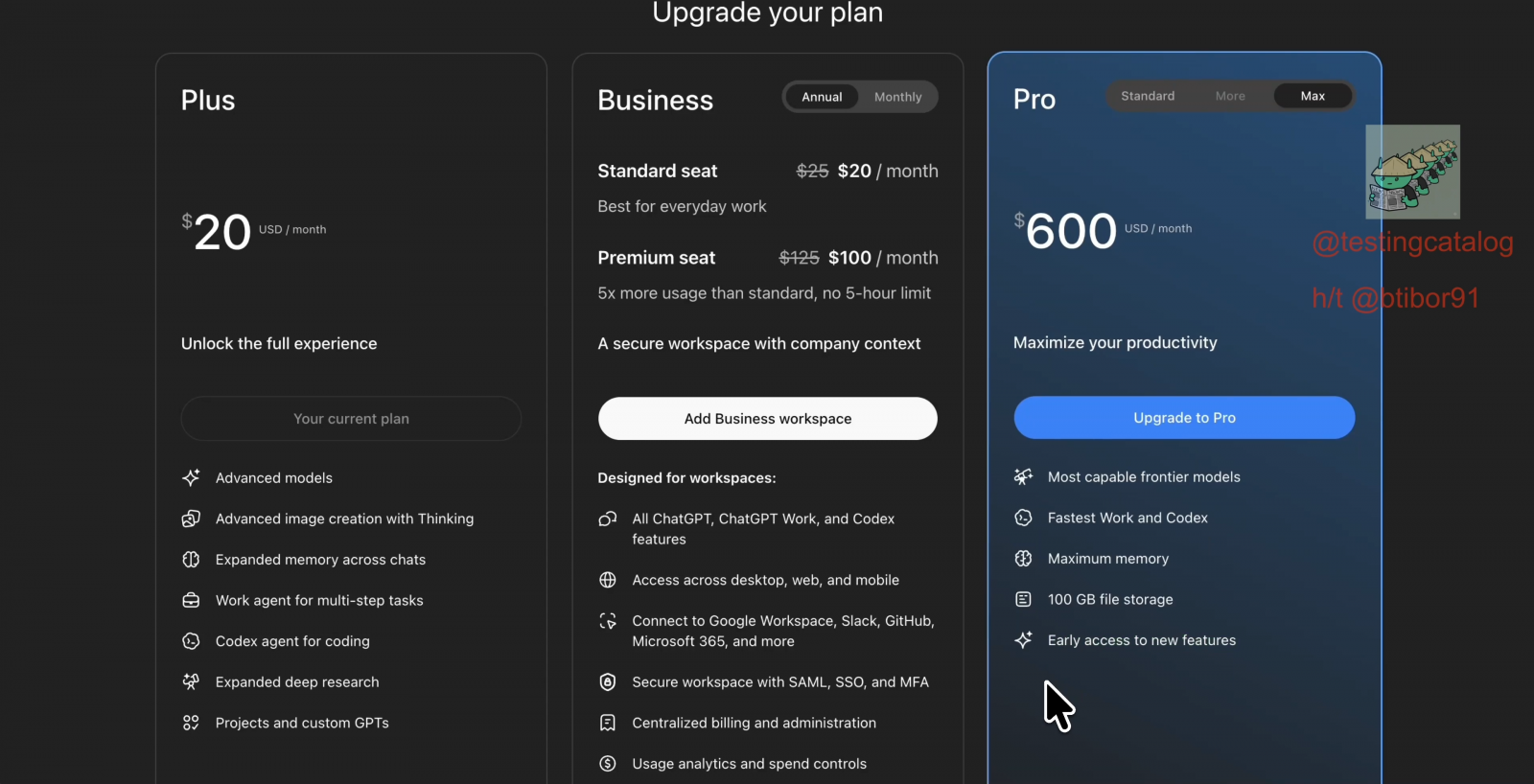
Source: OpenAI / TestingCatalog on X
One version of the page lists Pro Max at $500 per month, while another shows $600 after local taxes or VAT are included.
So far, the most interesting difference in OpenAI’s description is “Fastest Work and Codex.”
I also noticed that ChatGPT’s new plan teases access to the company’s most capable frontier models, maximum memory, 100GB of file storage, and early access to new features.
It is worth noting that the $200 plan also promises early access, so we are not sure if that capability is going away and becoming exclusive to the $500 plan.
OpenAI has not announced Pro Max, so we don’t know its exact usage limits yet. It could also offer substantially higher allowances than the existing Pro plans.
ChatGPT Pro Max could use Cerebras for faster AI
There’s another interesting possibility behind the “Fastest Work and Codex” wording, and the guess is that it could use Cerebras.
For those unaware, OpenAI has been deploying more Cerebras hardware for ultra-fast AI inference, but we haven’t seen anything recently from the company on that front.
The most recent development was from early this year, when Codex-Spark launched on Cerebras at more than 1,000 tokens per second, and OpenAI later demonstrated GPT-5.6 Sol running at up to 750 output tokens per second in its Cerebras-powered Ultrafast mode.
It is entirely possible that Cerebras is a likely candidate for powering at least some of Pro Max’s faster Work and Codex experience, although neither OpenAI nor Cerebras has confirmed that connection.
Right now, ChatGPT offers Pro tiers at $100 and $200 per month, but new sign-ups and upgrades to the ChatGPT Pro $200 plan have been temporarily paused since September 10.


Continue Reading

French soccer legend Zinedine Zidane begins his tenure as Les Bleus’ head coach on Friday with a tricky first test in the UEFA Nations League away to Turkey.
Zidane has big boots to fill, succeeding his former teammate Didier Deschamps, who consistently led the French to the latter stages of major tournaments throughout his 14 years in charge, notably winning the World Cup in 2018.
Zidane’s first job will be to lift his players after the disappointment of losing in the semifinal to Spain in this summer’s World Cup — a tournament they had looked well placed to win after making a superb start to the competition. Turkey, meanwhile, is looking to make amends after falling well short of expectations at the World Cup, crashing out early in the group stage.
Turkey hosts France at the Kocaeli Stadium in İzmit on Friday, Sept. 25. Kickoff is at 9:45 p.m. TRT local time in Turkey, which is 7:45 p.m. BST in the UK. It’s a 2:45 p.m. ET or 11:45 a.m. PT kickoff in the US and Canada and a 4:45 a.m. AEST start on Saturday in Australia.

Livestream the Turkey vs. France match in the US
Today’s game is on Fubo in the US, while Vix will also be covering the match with Spanish commentary.

Carries international soccer for $89 per month
Fubo
You’ll need Fubo’s Pro plan to watch today’s game. A subscription currently costs $89 per month and comes with a 5-day free trial. Click here to see which local channels you get in your region with Fubo. Read our Fubo review.

The logo for Spanish language broadcasting network Vix in orange on a white background. / Vix
Watch international soccer for $7
Vix
Vix currently starts at $7 per month for ad-supported streaming, and costs $11 per month for its premium, ad-free service tier.
How to watch the Turkey vs. France match with a VPN
If you’re traveling abroad and want to keep up with all the action while away from home, a VPN can help enhance your privacy and security when streaming.
VPNs encrypt your traffic and prevent your internet service provider from throttling your speeds, and can also be helpful when connecting to public Wi-Fi networks while traveling, adding an extra layer of protection for your devices and logins. VPNs are legal in many countries, including the US and Canada, and can be used for legitimate purposes such as improving online privacy and security.
However, some streaming services may have policies that restrict VPN use for accessing region-specific content. If you’re considering a VPN for streaming, check the platform’s terms of service to ensure compliance.
If you choose to use a VPN, follow the provider’s installation instructions to ensure you’re connected securely and in compliance with applicable laws and service agreements. Some streaming platforms may block access when a VPN is detected, so verifying if your streaming subscription allows VPN usage is crucial.
Best VPN for streaming
ExpressVPN
-
Cutting-edge privacy and security -
Excellent for streaming -
Easy to use across platforms -
Strong commitment to transparency -
Privacy-friendly jurisdiction (British Virgin Islands)
-
Expensive -
No multihop connections -
New price structure doesn’t add much value
ExpressVPN is our current best VPN pick for people who want a reliable, safe VPN that works on a variety of devices. It’s normally $15 a month for the basic plan, but if you sign up for an annual subscription, you can save money.
Note that ExpressVPN offers a 30-day money-back guarantee.
- Price
- $78 for two years
- Latest Tests
- No DNS leaks detected, 18% speed loss in 2025 tests
- Jurisdiction
- British Virgin Islands
- Network
- 3,000 plus servers in 105 countries
Can I livestream the Turkey vs. France match in the UK?
Prime Video is showing a select number of UEFA Nations League matches this week via pay-per-view in the UK, with this game among those selected for broadcast.

Showing select UEFA Nations League games in the UK
Prime Video
You won’t need to be a Prime subscriber to access Amazon’s coverage, but there is a £2.49 fee to watch this game.
If you don’t want an Amazon Prime membership, Prime Video standalone subscriptions start at £9 a month or £95 per year in the UK and include access to Prime Video’s content library of shows such as A Very Royal Scandal, Reacher, The Boys and more, as well as live Champions League action. The service is also included with a Prime membership.
Livestream the Turkey vs. France match in Australia
The UEFA Nations League now has a new home Down Under, with matches being shown on beIN Sports. Today’s game is set to be broadcast on beIN Sports 2 and beIN Sports Connect.

Watch Nations League games from AU$15 per month
beIN Sports
beIN Sports is available in Australia for AU$17 a month or a yearly commitment of AU$240. If you’re an Amazon Prime subscriber, you can purchase beIN as a Prime Video channel add-on for a slightly cheaper AU$15 per month.
Livestream the Turkey vs. France match in Canada
If you want to stream this game live in Canada, you’ll need to subscribe to DAZN Canada.

Watch international soccer in Canada from CA$30 a month
DAZN
An annual DAZN subscription currently starts at CA$25 a month or CA$250 a year and will also give you access to the UEFA Champions League, Europa League and Europa Conference League, plus EFL Championship soccer, Six Nations rugby and WTA tennis. Monthly subscription passes start at CA$35 per month.
In addition to dedicated apps for iOS and Android, there’s a wide range of support for set-top boxes and smart TVs.

With the introduction of the iPhone Duo, U.S. smartphone customers can now choose from seven contemporary folding smartphones, including one from Google, two from Motorola, and three from Samsung.
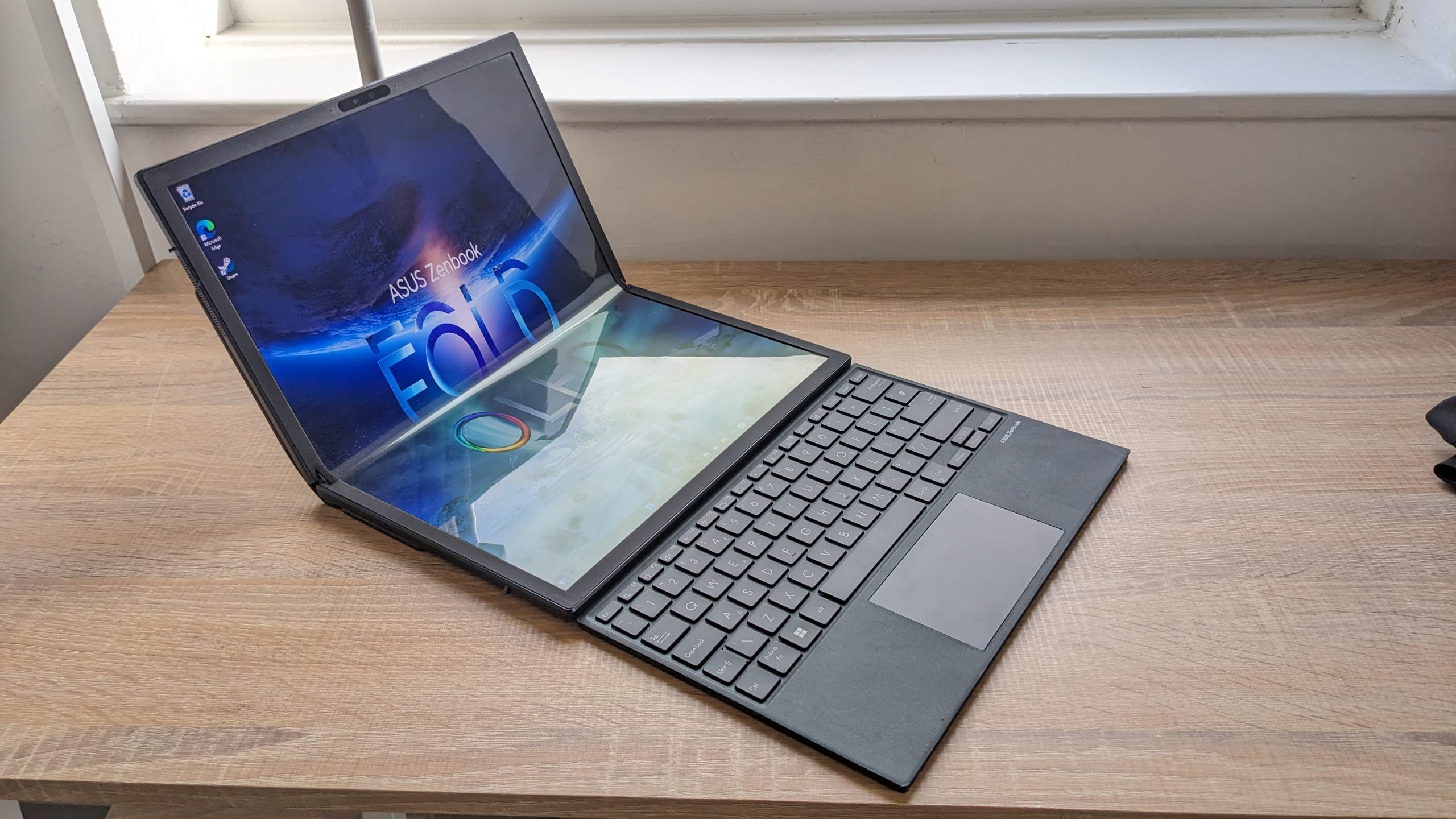
The number of laptops with foldable screens ever produced is far fewer: one each from Asus, Huawei, HP and two from Lenovo.
While the Galaxy Z Fold and Z Flip have entered an annual upgrade cycle for Samsung, the foldable-screen laptop pipeline has been quiet. The most recent – Lenovo’s ThinkPad Fold 16 Gen 2 – hit the market in November 2023, more than a year after its unveiling.
Latest Videos FromTechRadar
Surely, we haven’t seen the last of laptops with foldable screens, but a range of structural, technological, and economic issues have conspired to keep folding laptops from becoming more mainstream

A RAMpocalypse victim
At their launches, foldable-screen laptops were among the most expensive in their line-ups. The Asus Zenbook 17 Fold OLED launched at $3,500 in 2022. A year later, the HP Spectre Foldable PC launched at $5,000, about 2.5x the price of a Galaxy Z Fold Ultra.
Obviously, anyone spending this much is going to demand performance, including substantial RAM and flash storage, the two components that have seen their prices skyrocket during the AI data center-fueled ‘RAMpocalypse’. While PC vendors can eat a bit of margin on such high-end products, it’s reasonable to assume that successors launched today would require untenable prices.
On the other hand, it’s been more difficult for vendors to justify the premium because of the lack of a “device-class” jump. In other words, one of the great promises of foldable-screen phones is that you can have the functionality of a tablet in a form factor that stores in your pocket.
This isn’t just about more screen real estate. Full participants in Apple’s ecosystem understand the differences in experience between the largest iPhones and the iPad mini, which were magnified when Apple finally went full desktop GUI on the iPad in iPadOS 26.
In contrast, when it comes to foldable-screen laptops, the jump from an approximately 13” Windows experience in clamshell mode to a 16” or 17” Windows experience in unfolded mode is less dramatic. (That said, there are some niceties such as the taller aspect ratio compared to most 16” laptops and the option of a portrait mode.)
This also helps to explain why we haven’t seen any foldable tablets from Samsung or Lenovo. Curiously, most of the work around extending Windows on a folding display has been around the scenario of adapting Peek preview to make more efficient use of virtual dual screens, UI improvements that of course also apply to laptops with actual dual screens such as the Asus Zenbook Duo, which received an update this year.

Some assembly required
Furthermore, while foldable-screen phones require the extra step of unfolding to take full advantage of their screen real estate, their front displays enable everyday usage even when folded; even flip models like the latest from Samsung are improving their folded utility, In contrast, foldable-screen laptops include more significant prep trade-offs.
For example, while Lenovo’s first ThinkPad X1 Fold was able to store the Bluetooth keyboard between the halves of the folded display, the Gen 2 kept it separate, protected for travel by a case that doubles as a stand for the screen. When it’s time to move on, you have to reassemble the bundle, that is, after making sure to remove the keyboard lest you risk damaging the device.
In contrast, the few early glimpses of laptops with rollable screens that we’ve seen from Lenovo can make their full screen area available without any keyboard shuffling. Even though these motorized designs make you wait until the screen retracts before closing the lid, most users will likely find the trade-off worth it.
When comparing foldable-screen phones to foldable-screen laptops, it makes sense that — other things being equal — the smaller device will reap the greater relative value from extra screen real estate on demand.
But these dynamics have meant that there’s been far more working in favor of smartphones; the next generation of laptops with bending displays will require some rethinking

No Game, Only Stuff: Rockstar has made it quite clear that GTA VI will not ship on a physical disc for consoles. However, the company is well aware that people still want to “touch” game stuff, so much so that they are willing to spend hundreds on completely worthless plastic toys and collectibles.
Rockstar recently announced a collectible set focused on Grand Theft Auto VI, the upcoming blockbuster whose extended gameplay reveal crashed Netflix and which will almost certainly make billions in profits over the next few years. Grand Theft Auto VI: The Goodtime State – Vice City Collection is a premium, albeit completely inconsequential, package featuring some potentially questionable items inspired by Leonida’s most popular TV show, Macca the Gator.
Rockstar recently announced a collectible set focused on Grand Theft Auto VI, the upcoming gaming blockbuster that crashed Netflix and will certainly make billions in profits over the next few years. Grand Theft Auto VI: The Goodtime State – Vice City Collection is a premium, albeit completely inconsequential, package featuring some potentially questionable items inspired by Leonida’s most popular TV show, Macca the Gator.
The limited-edition collector’s box is already available for pre-order with a hefty $400 price tag. Rockstar said pre-orders will remain open while supplies last, which means the box could soon become a highly sought-after collectible among scalpers and GTA enthusiasts.
Leonida is the Florida-inspired fictional state where GTA VI’s crime adventure takes place, and Macca is the rosy mascot everyone is talking about down there. The GTA VI Vice City Collection includes a 6-inch figure of the aforementioned anthropomorphic gator, matte black sunglasses, a Leonida-themed A-Frame snapback hat, a pin set, a bag, a poster, and everything in between.

The box also includes three items that suggest a rather questionable use case: a Macca the Gator magnetic mirror, a Vice City swizzle spoon, and a Vice City razor blade keychain.
These “toys” would be perfect for preparing a particular type of substance that GTA and crime movie fans should know pretty well, although we doubt Tony Montana would ever use a rosy gator-themed razor to arrange his daily dose of the good stuff.
Despite the steep price, Rockstar confirms that the GTA VI collector’s box will not include the game itself. The package is clearly meant to cater to longtime fans of the Grand Theft Auto series, or even latecomers interested in “owning” a tangible piece of GTA VI memorabilia, at a time when big corporations are working hard to turn digital games into limited licenses they can revoke whenever they want.
Until now, and before GTA VI’s massively hyped business operation, Rockstar had always released mainline GTA games in full physical format on every available platform. Now, the Take-Two subsidiary is asking fans to stay tuned as more GTA-themed gadgets and apparel become available through the company’s official store.
I’m still looking to complete my GTA collection after buying physical copies of the three games in the original 3D-era trilogy (GTA III, Vice City and San Andreas), although I only buy physical and play on PC. I hope Rockstar eventually offers me a rum swizzle.
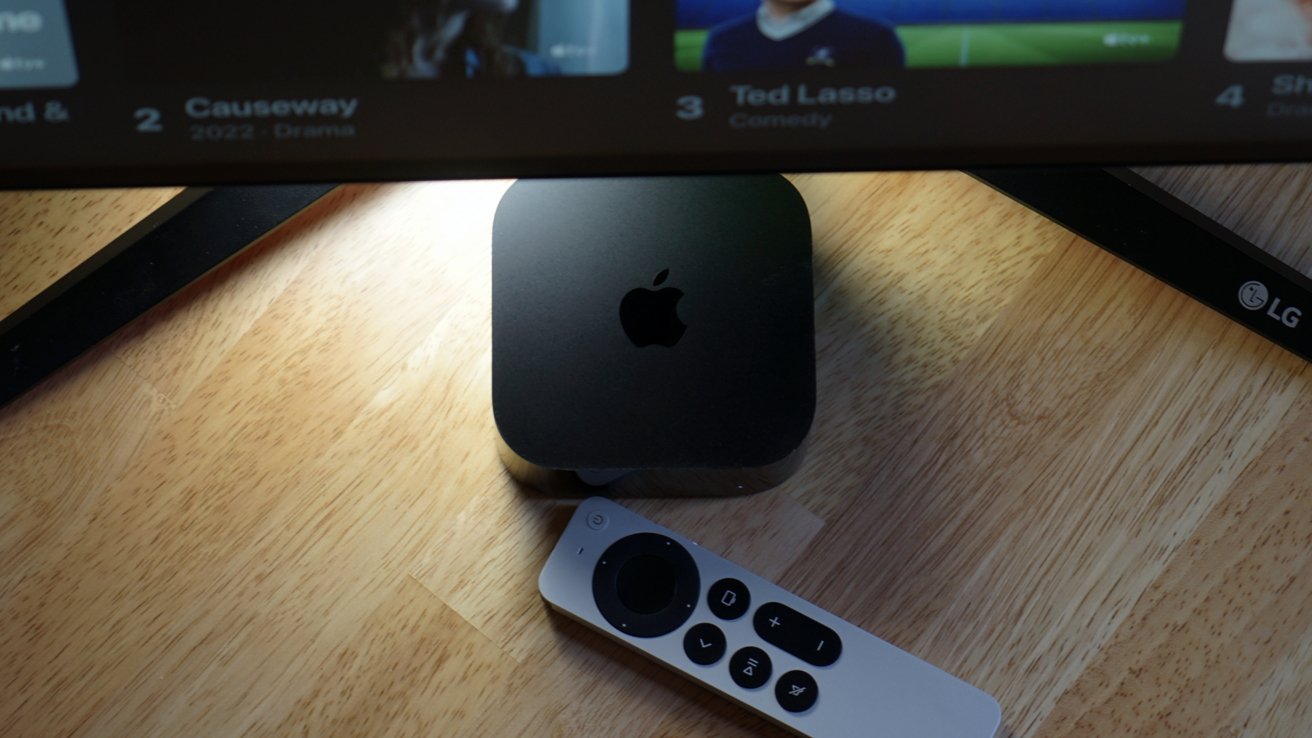
An image of the new Apple TV 4K hardware appears to have leaked, showing that there’s nothing new on the outside. But big changes are rumored for the inside.
The current Apple TV 4K was released in October 2022, and a new model has been rumored to be in the cards for some time. The model on store shelves today features an aging A15 Bionic chip and just 4GB of RAM.
Now, the image file reported by MacRumors has revealed the new Apple TV 4K’s upgrades will all be internal, with Apple choosing to stick with its tried and tested design of a small, featureless black box.
The good news is that previous leaks have suggested it will be a box very much ready for 2027 and beyond. Rumored upgrades will make the new Apple TV 4K a more capable streaming and gaming device while bringing Siri AI to the TV for the first time.
The presence of the image file also suggests that the new Apple TV 4K will be released sooner rather than later. It was already expected to launch at some point this fall.
Much-needed upgrades
Previous Apple TV 4K rumors have pointed to some big improvements in terms of performance. The iPhone 18 Pro’s A20 Pro is expected to be a huge upgrade for gamers, while a doubling of RAM to 8GB will also be beneficial for larger apps.
Both of these upgrades will also allow Apple to bring Siri AI to the Apple TV 4K. Users will be able to ask Siri questions and have it find content or launch apps with a reliability not currently offered by the ailing digital assistant.
On the connectivity front, Apple’s N1 chip is set to bring super-fast Wi-Fi 7 to the Apple TV 4K for the first time. The same chip will be responsible for Bluetooth 6 support, allowing for a stronger, more reliable connection to accessories. One of those accessories is also set to be a revised Siri Remote.
One aspect of the new Apple TV 4K that remains unknown is its price. Apple hiked the price of the current model to $199 in June 2026. Streaming fans will hope for a price cut when the new model launches.

I’ve noticed a lot more businesses using AI agents to process customer support requests. But now it’s getting weird.
Google’s Live Avatar feature is now available for those with Gemini Enterprise. This comes days after Google announced Gemini 3.8 Live and Gemini 3.8 Live Extended Thinking.
What exactly is Live Avatar? It combines an interactive visual experience with a conversational AI agent to do things like filing insurance claims through a video chat — which was Google’s example in its announcement. Businesses or those with Google Enterprise can choose from a few avatars to put a face to an AI agent’s voice.

Live Avatar seems pretty handy for businesses. It can create live video avatars with lip synching for conversational videos and process live audio, screen sharing and video feeds simultaneously. Live Avatar can run tools and API calls while continuing conversations with customers. But imagine a cartoon or realistic-looking avatar’s lips moving to match the bot’s voice to handle your request. Creepy.
Live Avatar also aims to create more fluid dialogue with native speech-to-speech for “more natural interruption recovery without dropping conversation context or backend transactions.”
Google didn’t immediately respond to a request for comment on when it will be available to the general public or how it plans to safeguard the information the AI agent receives during video calls (like, in the insurance example, your address, name and live video when filing a claim).
Google has a few safeguards in place to prevent misuse, like choosing from curated, prebuilt avatars. If you want to create a custom avatar, you’ll have to go through a verification process, Google’s announcement says. All audio and video are watermarked with SynthID to keep all AI content verifiable.

Nscale has closed a $3.36B pre-IPO convertible note round led by Third Point, with Nvidia, Apollo, Citadel and the Abu Dhabi Investment Council among the investors, three weeks after it was reported to be seeking up to $3.5B. The London company filed to list on the New York Stock Exchange last week under the ticker NSCL.
Nscale has raised $3.36B in a pre-IPO convertible note round led by Third Point, Bloomberg reported. Nvidia, Apollo, Citadel, Hudson Bay Capital, the Abu Dhabi Investment Council and 8090 Industries took part. The company is based in London and filed last week to list in New York.
It asked for more than that.
Three weeks ago it was reported to be seeking $3.5B, split between convertible notes led by Third Point and a larger cheque from Nvidia. What closed is about $140M short of that. Goldman Sachs acted as placement agent.
Nvidia’s money arrives later.
The total includes a $2.36B tranche and a separate $1B commitment from Nvidia expected in mid-November. The notes convert into ordinary shares when the listing completes, or into non-voting shares in Nvidia’s case. The listing itself may raise as much as $3B on top of what has just been committed.
Nvidia has done this before.
It bought SB Energy stock at 90% of its IPO price this month, also in non-voting form, also before a listing. It now holds around $99B of shares in companies that buy its chips. Nscale is one of them.
The conversion terms name a number.
The notes are priced at the IPO price minus a double-digit percentage discount, and that discount is adjusted up to a $30B valuation, above which the conversion price does not move. The filing is reported to seek up to $35B. Nobody has explained which way that gap cuts.
The accounts are still young.
Revenue reached $140.6M in the first half of this year, more than thirteen times what it took in the same period last year, against a net loss of $1.02B. The contracted backlog stands at $103.4B, up from $38B at the end of last year. Most of that backlog is revenue not yet earned.
The company is British.
It was spun out of a cryptocurrency mining operation in early 2024, and its board includes Sheryl Sandberg and Nick Clegg, a former British deputy prime minister. Twenty-two banks are working on the offering. All of them are preparing a listing that will not happen in London.


The Pentagon wants $30.3m over five years to build an AI lie detector that reads the body without touching it. The programme, called Polygraph+ or Polygraph Next, appears in the Defense Counterintelligence and Security Agency’s 2027 budget request.
Inside Defense first reported the plan. MIT Technology Review’s Amit Katwala asked experts whether it could work. The agency, known as DCSA, runs background checks for the federal government. It did not respond to MIT Technology Review’s request for details.
What the budget says
DCSA asks for $6.42m in 2027, then between $5.65m and $6.45m a year up to 2031. Congress has not yet approved the request.
The programme aims to “modernize federal polygraph and credibility assessment technologies”, the budget document says. It lists “standoff sensing”, or taking physical readings from a person without attaching a device, along with AI and machine learning scoring, automated scoring and decision aids.
The tools would be used to vet staff and for “insider threat detection”. DCSA also plans cloud storage and data analysis tools to refine the software.
Leak hunts and prototypes
Under Defense Secretary Pete Hegseth, the Pentagon has turned more often to polygraph tests to find the sources of leaks to the press, MIT Technology Review reported. In September, The New York Times reported that about 50 officers on the Joint Staff had been tested.
The Pentagon has tested this kind of technology before. In 2023, its Defense Innovation Unit picked two companies to build prototypes. Presage Technologies says it can measure heart and breathing rates with ordinary cameras. Altec Research’s prototype tracks head movement, facial skin temperature and pore activity.
The science problem
A polygraph does not detect lies. It records breathing, pulse, blood pressure and sweat, and an examiner reads the changes. In 2003, the US National Research Council called the evidence for its accuracy “weak at best”.
The American Polygraph Association says the test is 80% to 94% accurate. At that level, a screening programme could still produce many errors. The Pentagon employs 2.8 million people, MIT Technology Review noted.
Kyri Kotsoglou, a legal scholar at Northumbria University in the UK, calls adding AI to the polygraph “the worst of both worlds”. It adds uncertainty on top of invalidity, Kotsoglou told MIT Technology Review.
“Even if you have all the records in the world from polygraph tests, you don’t know whether those polygraph tests are right or not,” Marion Oswald, a law professor who has written with Kotsoglou, told MIT Technology Review.
Sophie van der Zee, who studies deception at Erasmus University in Rotterdam, said AI could combine several measures into one score that is harder to game.
“There is still no Pinocchio’s nose,” van der Zee told MIT Technology Review.
Earlier AI lie detectors have not lasted, MIT Technology Review reported. The EU funded iBorderCtrl, a border pilot built on a system that scored deception from video. It faded away, like the US AVATAR border project.
Other tools that use AI to read people are already in use, from AI voice analysis of US prison calls to facial recognition alerts in UK shops and AI camera searches by US police.
Tech
Meta Made 43M Misleading Statements, New Mexico Jury Finds, Including on Its Cambridge Analytica Response

A New Mexico jury on Friday “found Facebook liable for deceiving users” about its privacy protections, reports the Associated Press.
A New Mexico newspaper calls it “another massive legal victory” against Facebook, reporting that the jury found Facebook “had committed tens of millions of violations of the state’s Unfair Practices Act in connection with its lies to consumers about how their personal information was handled by the company and third-party users.”
The state has asked the company be ordered to pay the maximum civil penalty of $5,000 per violation meaning a judge could potentially order the company to pay billions in penalties to the state. The jury also found the company had been dishonest about its investigation of and response to the 2013 Cambridge Analytica data breach scandal, in which approximately 300,000 Facebook users took an online personality quiz, only to have the app that hosted the quiz harvest data from tens of millions of their “friends.” The data was then transferred to the British consulting firm, which used it to create targeted political ads during the 2016 U.S. presidential election.
More details from Reuters:
The verdict followed a two-week trial over a lawsuit filed by New Mexico’s attorney general in 2021, three years after news reports revealed that the firm, Cambridge Analytica, had harvested personal data from as many as 87 million Facebook users through a third-party app… At a press conference after the verdict was announced, New Mexico Attorney General Raúl Torrez said the case revealed “in stark detail the way in which this company plays fast and loose with the rules.”
Jurors found 26 of 29 statements identified by the state were misleading, including comments about user data… Judge Francis Mathew will now determine civil penalties after jurors found more than 43 million violations, based on the number of people affected by the company’s misleading statements… [New Mexico Attorney General] Torrez said his office is evaluating how much to seek but will push for the maximum penalty based on the jury’s findings. The state will also ask [Judge] Mathew to direct Meta to make changes, which could include corrections to its past misstatements as well as an audit of the way it manages user data, Torrez said.


Read more of this story at Slashdot.

Child predators are arguably the most reviled demographic in society.
So when someone like Chris Hansen, the former NBC Dateline journalist and host of the To Catch a Predator series, decides to take up the mantle of exposing them to the public, he is naturally praised as a hero.
But, as is revealed in Lance Oppenheim’s Primetime—a dramatized snapshot of Hansen’s life at the show’s peak—it’s not as simple as that. Exposing allegedly bad people for public entertainment brings up a lot of ethical concerns and unintended consequences. And while many of the vigilantes carrying out these sting operations claim they are doing a public service, their motivations become a lot more suspect when fame and money are involved.
To Catch a Predator launched in 2004. In the show, Hansen’s team would pair up with civilian watchdog group Perverted Justice, using adult “decoys” to pose as minors online and exchange messages with men in chatrooms and private DMs. After the conversations became sexual, the crew would set up a sting, inviting these men to a home to meet the decoy, only to have Hansen confront them, uttering his catchphrase, “Have a seat.” The men were technically free to leave instead of sitting for an on-camera interview, but often police were waiting outside to arrest them.
The show developed an intense fandom that remains active to this day in subreddits like r/tcap, which has 52,000 weekly visitors, despite the fact that NBC stopped airing the original series in 2007.
In A24’s Primetime, a darkly told character study in theaters September 25, Hansen (Robert Pattinson) clearly enjoys the praise and seems desperate for more accolades. He brags to his two young sons that he’s about to be on prime-time television, despite them not understanding the importance of that, and complains that the show has “never won an Emmy or any of the significance it deserves.” When a fan recognizes Hansen on a flight and becomes bloodthirsty, asking the TV host if he ever wants to “bleed” the predators he’s outing, Hansen smiles and admits that what he does by disgracing them on national television is “a little worse.”
In real life, Hansen cofounded the streaming service Trublu in November 2022, where he continues his investigations into alleged child predators. But these days, he’s far from alone. His work has inspired copycats, who thrive on social media and streaming platforms like YouTube, Kick, and Facebook. These groups and individuals are largely disorganized, and as such, hard to track, but a 2022 Washington Post investigation identified at least 160 in the US. Arguably, the people running these operations are more reckless, in part because they’re driven by virality.
One of them, who goes by Skeet Hansen, was featured in the 2025 MTV documentary Predators, about the Dateline show. In the film, directed by David Osit, Skeet Hansen responds to the criticism of the movement by saying, “There’s never been a detective that solved a murder that didn’t get paid for it. So why shouldn’t I be able to monetize off of catching these guys like the original show and making this content for people’s entertainment?”
One of many issues with that argument is that these hunters aren’t professional investigators—and sometimes they get things wrong.
In April, YouTuber and Kick streamer Vitaly Zdorovetskiy apologized after publicly—and wrongly— accosting a man of Indian descent. He accused the man of wanting to “rape a 16-year-old” in a mock Indian accent and called him “Mr. Mumbai.” In March 2025, The New York Times reported that Zdorovetskiy’s tactics for ambushing suspected creeps included beating some of them up, dressing like the Joker; the Times piece found that there have been more than 170 violent vigilante attacks by predator-hunting groups since 2023.

Apple’s diminutive speaker is returning for a second generation, sporting the same spherical design in a few new colors.
The upcoming HomePod mini lineup swaps the current-gen yellow and orange for a new powder pink and forest green. Blue, black, and white will be making a return, though.
The information originates from Apple’s code, spotted by MacRumors contributor Aaron Perris. It showcases the product in the aforementioned colors.
Apple has yet to announce the HomePod mini 2. However, the images in the code suggest a release could be coming soon.
The first-generation HomePod mini made its debut in October 2020. Shortly after, Apple retired the full-sized, first-generation HomePod.
Apple allowed the HomePod mini to carry the lineup for nearly two full years. In January 2023, it released a second-generation full-sized HomePod.

Tech11 seconds ago
Watch UEFA Nations League Soccer: Livestream Turkey vs. France From Anywhere

Politics2 minutes ago
Trump Criticized For Naming Strait Of Hormuz After Himself

Sports3 minutes ago
Trainer points to jockey error as Haaland aims for redemption in 2026 Murray Bridge race





-

 Crypto World3 days ago
Goldman Sachs and Deutsche Bank Agree: The S&P 500 Rally Isn't Over
-

 Tech5 days ago
Researchers escape OpenAI Codex sandbox to run commands on host
-

 Fashion2 days ago
8 iPhone Accessories That Add Personality
-

 Crypto World5 days ago
Who Needs CLARITY Anyway? ARB Could See 70X Increase: Hodler’s Digest
-

 Tech6 days ago
Trump suggests rebranding AI with a new name, says he’s also creating an AI Force
-

 Business5 days ago
Analog Devices (ADI) Bets $1.35 Billion on Chips that Let Machines Think for Themselves
-

 Crypto World3 days ago
This Bearish Netflix Stock Trade Can Cash In On Video Streaming Giant’s Woes
-

 Crypto World5 days ago
Coinbase, Robinhood, Circle Seen as Tokenized-Stock Winners
-
 Crypto World4 days ago
Trump-Xi Polymarket Odds for Handshake Hit 50%
-

 Entertainment3 days ago
These 17 Fall Amazon Dresses Seriously Look Like Anthropologie
-

 Tech5 days ago
Google’s $899 Googlebook is a bet that you’ll buy a new laptop for Gemini
-

 Crypto World2 days ago
Crude Oil Prices Pressured by Diplomatic Hopes in the Middle East
-
 Business3 days ago
Oil Price Today (September 23): Crude oil below $100 on hopes of US-Iran talks. What did Trump say?
-
 Crypto World2 days ago
Bitcoin price tests $83,600 Supertrend support after $87K rejection
-
 NewsBeat7 days ago
Ed Sheeran protegees Katseye UNFOLLOW star… days after Macklemore was dropped from his tour over Free Palestine remarks
-

 Crypto World2 days ago
Bitcoin Threatens Sub-$84,000 Breakdown as Long Liquidations Spike
-
 Crypto World4 days ago
Meta Jumps 11% As Muse Shines and Investors Show an Appetite for Advancing AI
-
 Crypto World3 days ago
Did Jim Cramer Just Give GameStop Stock the Kiss of Death When He Said the Turnaround Is Working?
-
 Crypto World5 days ago
Bitcoin price holds above $81K as key catalysts line up
-

 Crypto World5 days ago
ARB Price Signals Spur Speculation of 70x Upside in Hodler Digest
You must be logged in to post a comment Login