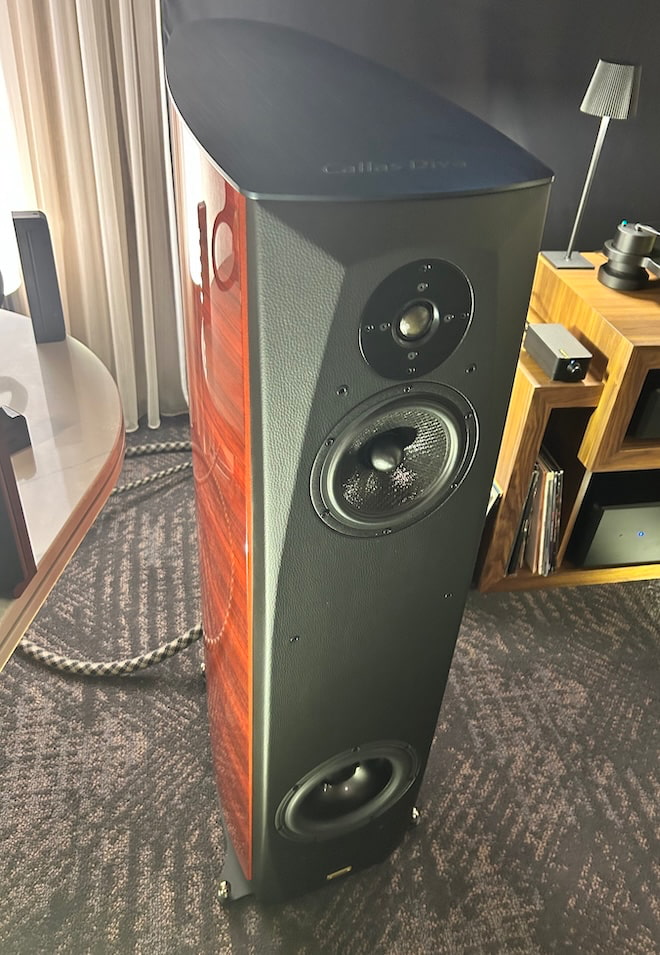
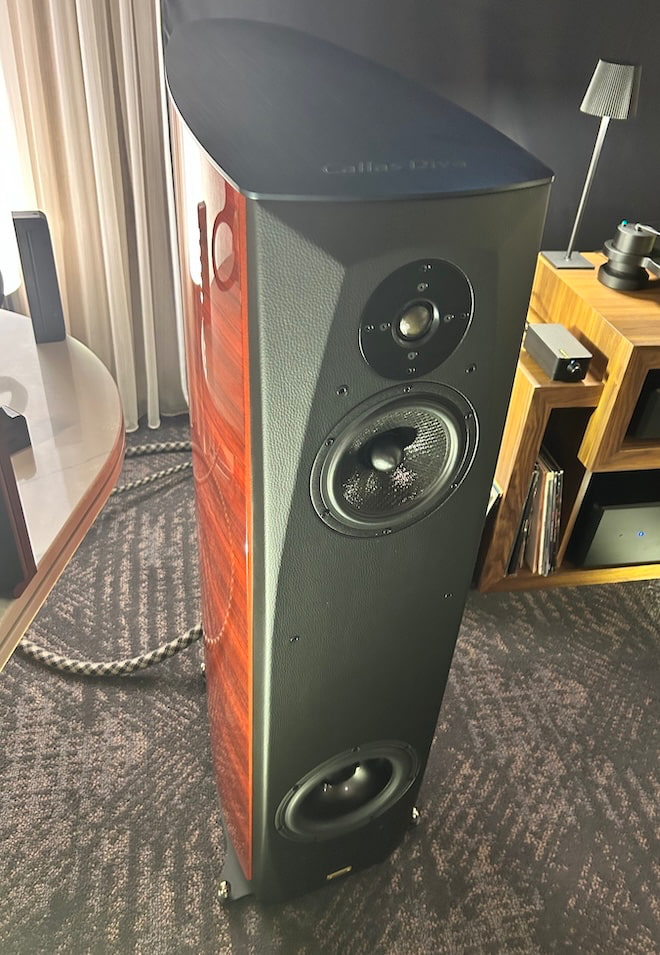
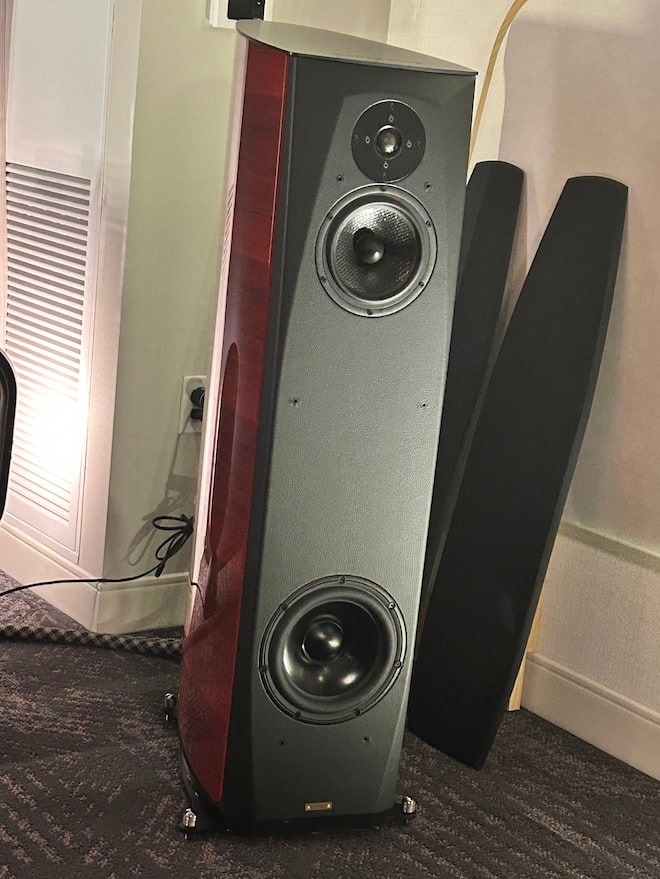
Italian loudspeakers tend to follow their own playbook, and the Opera Callas Diva Special Edition distributed in the U.S. by Fidelity Imports, leans into that identity without apology. Priced at $13,999, this is a reflex, floor-standing design with a rear-firing radiation system (dipole), built around the kind of materials and construction choices that set Italian brands apart: hand-crafted wood cabinetry, leather-clad baffles, and tank-like assembly that feels more atelier than assembly line.
Whether the leather actually changes the sound is still a matter of debate, but as with most things Italian, it’s as much about feel and intent as measurable outcome.
There’s also a clear voicing philosophy here. Like most offerings from Sonus faber and Opera, the goal isn’t clinical neutrality; it’s a more romantic, expressive presentation that leans into tone and texture. That doesn’t mean these speakers lack drama; if anything, they just deliver it with better timing and less shouting over Sunday gravy at Nonna’s house. Think Sophia Loren, not a reality TV meltdown—controlled, confident, and fully aware of the effect… the kind of presence that makes a room go quiet when she crosses her legs, looks your way, and lets you wonder if you’re worth the match.
Fidelity Imports is pushing Opera hard in the U.S. right now, and it’s not difficult to understand why. Paired with electronics from Unison Research, the system synergy is obvious—cohesive, deliberate, and unmistakably Italian. Bellissima, but not in a way that begs for attention. It just assumes you’re paying attention already.
Advertisement
Italian Engineering in a Tailored Suit, Not a Tracksuit
The Opera Callas Diva Special Edition is a reflex loaded, floor standing loudspeaker that combines a traditional forward firing driver array with a rear firing dipole tweeter system. It’s a hybrid approach that aims to balance direct sound with controlled rear radiation, adding spatial cues without turning the room into an echo chamber.
Up front, the speaker uses a single 8-inch long throw woofer paired with a 7-inch midrange driver featuring a re cooked polypropylene cone and phase plug. High frequencies are handled by a 1-inch Scan Speak 9700 tweeter, notably run without ferrofluid and incorporating a double decompression chamber, choices that typically favor openness and low mechanical damping over sheer robustness.
Around back, Opera adds two 1-inch tweeters in what it describes as a “natural dipole” configuration. This rear array expands the soundstage by introducing ambient high frequency energy, effectively making the system a 3-way plus rear dipole design rather than a conventional forward only speaker.
The crossover network is relatively straightforward, using 12 dB per octave slopes across all drivers, woofer, midrange, front tweeter, and rear tweeters, with crossover points centered approximately at 200 Hz and 2,000 Hz. This suggests a focus on phase coherence and smoother driver integration rather than aggressive filtering.
Frequency response is rated at 30 Hz to 25 kHz, covering full range playback without immediate reliance on a subwoofer. Sensitivity is specified at 90 dB (2.83V at 1 meter), making the speaker reasonably amplifier friendly, though the 4 ohm nominal impedance with a minimum above 3.2 ohms means it will benefit from stable current delivery.
Advertisement
Power handling is listed at 240 watts without clipping, and placement guidelines recommend at least 10 cm, about 4 inches, from the rear wall, which is modest considering the inclusion of rear firing drivers.
Physically, the Callas Diva Special Edition is substantial: 116 x 37 x 53.5 cm (H x W x D), approximately 45.7 x 14.6 x 21.1 inches, and each speaker weighs 65 kg, about 143 pounds, including its metal base. This is not a lightweight cabinet, so think carefully about which relative still has the energy to help you move it after sausage and peppers. And don’t forget the cannoli. Marone!
Advertisement. Scroll to continue reading.
Italian Soul, British Precision, No Passport Required
Fidelity Imports had a lot of rooms at AXPONA. Enough that you start making choices. I only had time for a few. This one, and the Ruark Audio room were the ones that actually made me stop, close my eyes and listen, and silently wish that I didn’t have 30 more rooms to cover on the next two floors.
Part of it was the system; Opera speakers, Unison Research electronics, and the new Michell Gyro Turntable spinning records like it knew that a certain American competitor was MIA and that this was its moment to make everyone take notice.
Advertisement
But it was also the reaction. People didn’t just walk in and walk out. They slowed down. Took a step closer. Leaned in to look at the front baffle, then drifted over to the turntable like it might tell them something if they got close enough. Weird that. Especially because it happened more than a few times.
Nobody rushed. Nobody talked too loud. That’s usually a sign. People stood along the back of the room and listened.
I wasn’t the only one who noticed. And in a show full of rooms fighting for attention, this one didn’t have to. Steve Jain needs to make this set-up a permanent hi-fi show experience.
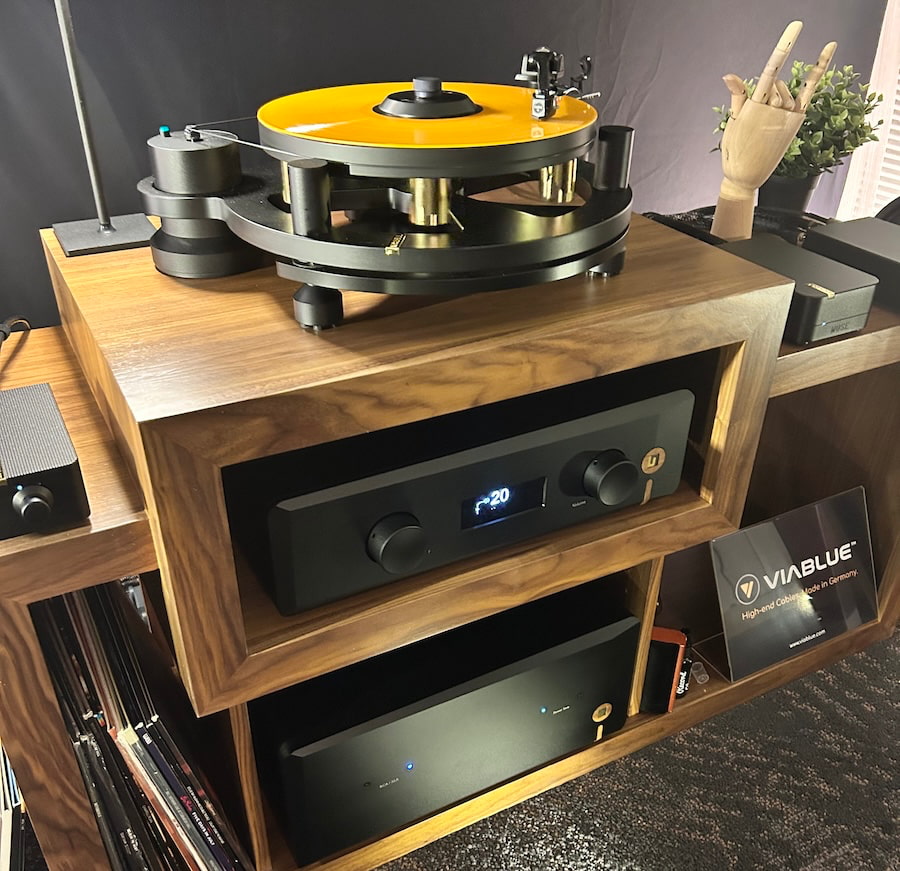
Michell Gryo Turntable with Unison Research Unico PRE V2 and Unico DM V2 power amplifier at AXPONA 2026
The room was driven by the Unison Research Unico PRE V2 and Unico DM V2 power amplifier. Together, they retail for $18,498 USD. That’s not inexpensive, but in the context of AXPONA, it sits well below many of the larger systems on display.
Advertisement
The Unico DM V2 is a high power, dual mono hybrid design using Unison Research’s A.S.H.A. Class A-AB output stage. The emphasis is on current delivery and stability into more demanding loudspeaker loads rather than chasing extreme specifications.
The Unico PRE V2 is a fully balanced preamplifier with a tube based input stage. It includes a well equipped MM/MC phono stage with selectable gain and loading, making it a viable option for vinyl playback without requiring an external phono stage.
There is no built in streaming platform or Bluetooth support. That appears to be a deliberate choice, leaving digital source selection to external components.
The PRE V2 does include an internal DAC based on the Sabre ES9018K2M converter. It uses a balanced output stage designed to integrate with the tube input section, with the goal of maintaining consistent tonal balance between digital and analog inputs.
Advertisement
Digital connectivity includes USB-B, two S/PDIF, and two optical inputs. USB supports PCM up to 384 kHz and native DSD up to 256, along with DoP up to 128. S/PDIF and optical inputs support resolutions up to 192 kHz.
The Unico DM V2 is rated at 220 watts into 8 ohms and 340 watts into 4 ohms in stereo operation, with stability down to 2 ohms. In bridged mono configuration, it delivers 650 watts into both 8 ohm and 4 ohm loads.
Advertisement. Scroll to continue reading.
My biggest takeaway from this room? Synergy matters. A lot.
Advertisement
Having spent time with and reviewed some of Unison Research’s tube amplifiers, the new pairing has a lot more palle, but it doesn’t trade away the qualities that made those designs stand out. The tonal balance, clarity, and sense of flow are still intact. It just brings more control and authority when the music asks for it.
Unison deserves your attention. So do these Opera loudspeakers. They’re expressive without being aggressive. They don’t grab your Members Only jacket and threaten you with brute force. They take a different approach and pull you in, keep you there, and let the music do the work.
There’s something to that. Not everything needs to hit you over the head to make its point.
Given how often we’ve seen AI-generated fake citations show up in legal filings and even legal decisions, you’d think the lesson would have sunk in by now: if you’re going to use AI to help draft something, you have to actually check what it produces. Apparently that lesson has not reached every government ministry.
South Africa has withdrawn its first draft national AI policy after revelations that it contained fictitious sources in its reference list which appeared to have been AI-generated.
“The most plausible explanation is that AI-generated citations were included without proper verification. This should not have happened,” Minister of Communications and Digital Technologies Solly Malatsi said.
“This failure is not a mere technical issue but has compromised the integrity and credibility of the draft policy,” he wrote in a post on X on Sunday.
Compromised the integrity and credibility of the policy? Bit of an understatement, I’d say.
And, look, it’s perhaps no surprise that those looking to put in place an AI policy would be using the tech themselves, but it’s difficult to think that they can regulate it well when they don’t even appear to understand how to use it well (and when not to use it at all).
Advertisement
Naturally, the minister’s takeaway is that the tech needs more regulation:
“This unacceptable lapse proves why vigilant human oversight over the use of artificial intelligence is critical. It’s a lesson we take with humility,” he wrote.
That really feels a lot like blaming the tech for humans making dumb decisions with the tech. He’s not wrong that we need human oversight of the tool. The power of AI tools is only recognized when they are there to assist humans, not replace them, but it’s not clear how a policy position fixes that.
To me, this is more evidence that we need to do a much better job educating people about what these tools can and can’t do. And that’s harder than it sounds, because the companies selling these products have spent years aggressively overselling what AI can do while burying the caveats about how it should actually be used. The gap between what vendors promise and what the tools actually deliver is a big part of why people keep reaching for them in exactly the wrong contexts.
Malatsi’s instinct — regulate harder — is understandable, but it addresses the wrong problem. The behavior you’re trying to regulate here isn’t malicious; it’s lazy and uninformed. Regulation is reasonably good at deterring bad intent. It has a much worse track record against ignorance. People are going to keep trying to force these tools to do things they’re not good at, regardless of what the rules say, because convenience and overconfidence are powerful forces. The better outcome comes when people learn, through repeated direct experience, that the tool fails in these situations — and when the companies selling these tools are honest about where they fail.
Advertisement
There are still genuinely useful ways to deploy AI, even if stories like this make people think that the tech is never good at anything. But using it to generate citations for official government policy documents, without verifying a single one, is not among them.
Of course, rather than actually dealing with any of this, expect a new crop of startups offering tools that claim to review your AI-generated content for hallucinated citations — and are just as unreliable.
The App Store includes a lot of AI-coded apps, but Apple is still wary of loosening the leash.
Apple is facing the problem of allowing apps that use AI agents in the App Store, and is having internal discussions about how to incorporate them without breaking long-standing App Store guidelines.
Artificial intelligence has led to a swathe of apps hitting the App Store, as developers embrace agentic coding. While Apple is fine with using AI to produce apps, it continues to have trouble bringing apps using AI to the App Store itself, due to the potential of breaking its rules.
Apple is now trying to work out how to include apps that use AI agents in the App Store so that it can profit from them, reports sources ofThe Information.
Advertisement
So far, Apple has been blocking apps that have the capability of being used for vibe coding, namely using AI to write code and to create programs. However, the App Store Review Guidelines forbid apps from coding and producing other apps on the iPhone and iPad itself.
The sticking point is that the App Store Review process is meant to check and safeguard users from potential harm, such as malware. If allowed to pass the review process, coding apps could be used to make malware, which wouldn’t have been inspectable by Apple beforehand.
There is also the matter of those agentic coding apps creating other apps for the user. While it wouldn’t be checkable by Apple, it’s also something that can save users from buying other apps from the App Store, endangering its revenue.
Working with the rules
Apple is trying to come up with ways to reconcile this problem. So far, this has apparently consisted of designing a system for apps to adhere to privacy and security standards.
Advertisement
Such a system would prevent some of the more elaborate agentic AI systems from being on iPhone. That means no OpenClaw-style software with massive reach across the user’s system.
Apple has an obvious monetary reason for enabling the apps, especially when they are growing in popularity. But at the same time, those apps have the potential to harm the ecosystem too.
WWDC in June is expected to include a lot of AI-related content, but it is unclear if this AI thrust will involve the App Store.
Third-party AI party
Some of this work to firm up its AI proposition runs alongside another effort giving users a lot more options when it comes to task processing. It is rumored that Apple will be giving users the ability to choose which third-party models can run on their iPhone, as an alternative to Apple Intelligence.
Advertisement
While Apple already has ChatGPT integrated in a way that allows various Apple Intelligence features to run through it instead, including Siri queries, more AI models will apparently be supported in the 27-generation Apple operating systems.
The selected agents will be able to handle things like user queries directed to Siri, Writing Tools, and even the generation of files through Image Playground.
This is something that Apple has been thinking about for some time, especially concerning the App Store. There have been rumors going back to 2024 about an AI App Store, but more recent speculation has been about a section within the store itself.
By contrast to Apple’s current App Store quandry, the models Apple will allow to work with Siri and have deeper access into iOS and macOS will be those approved by Apple. Those models will obviously face more stringent inspection from Apple, and won’t have the capability to code at all.
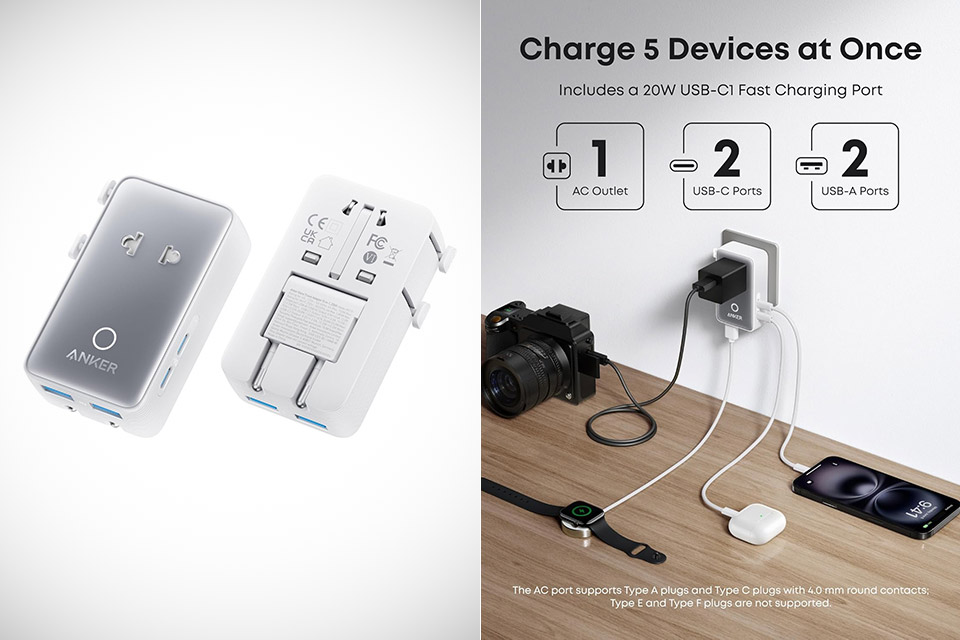
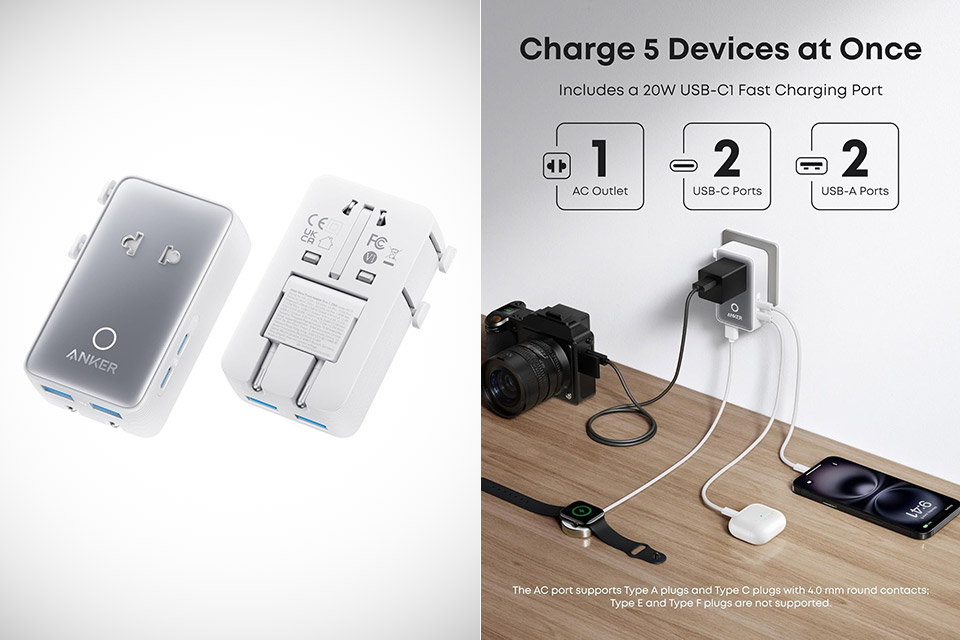
Any regular traveler understands how aggravating it can be to spend hours looking for the correct plug adapter, only to struggle to find enough outlets to charge all of your devices at once. Fortunately for us, Anker has devised a clever little solution that checks off both boxes in one slim package. The Nano Travel Adapter priced at $19.99 (was $26), is just under an inch thick and weighs less than four ounces, thanks to its four USB ports on the sides and bottom, as well as a conventional AC outlet on the front.
Changing the plug to suit different countries is a simple on the rear; simply slide it to the one you need. You will find selections for the United States, Europe, the United Kingdom, and Australia. From there, you can access more than 200 countries and regions, though you may need to do some research to identify the specific ones that are covered. Once you’ve connected it in, a blue LED light on the front indicates that everything is working properly.
Universal Plug Compatibility: Type A (US / Canada / Japan / China), Type C (EU), Type G (UK / Singapore), and Type I (Australia).
Power 5 Devices at Once: Includes 1 AC outlet, 2 USB-A ports, and 2 USB-C ports. The USB ports support up to 20W total output or 15W max when shared…
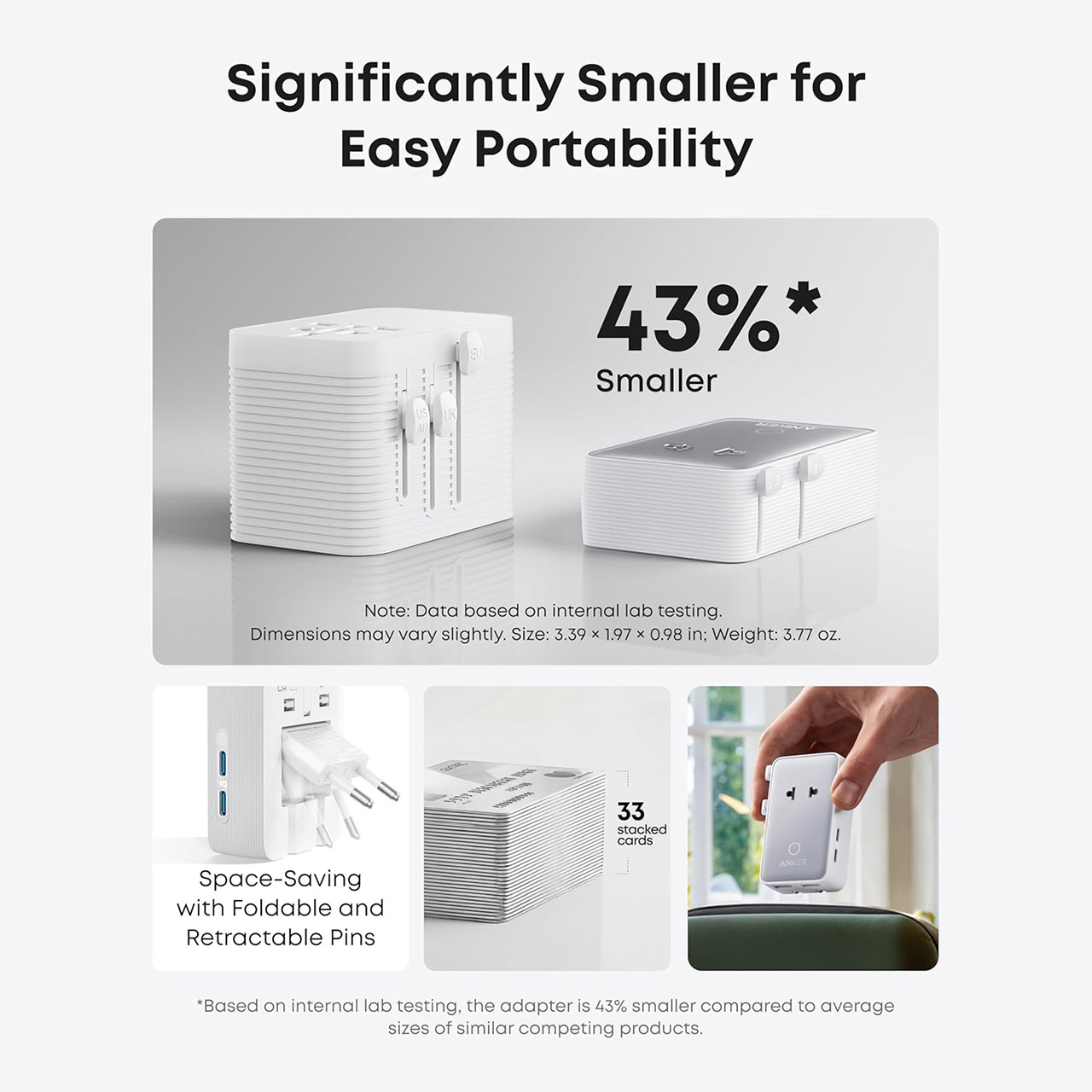
Exceptionally Compact: Measuring just 3.39 × 1.97 × 0.98 in (86 × 50 × 25 mm), it has a credit card-sized footprint and is 43% smaller than…
The AC outlet accepts two-prong US plugs and can handle up to 750 watts (far greater in other countries; verify local voltage limits). Hair dryers and shavers are safe to use, but only if they match the local voltage. When it comes to electronics, they all run on 100-240 volts, which is what this converter is truly built for.
Advertisement
There are four USB ports in all, two of which are USB-C, with one reaching 20 watts (enough to charge a smartphone quickly) and the other topping out at 15 watts. The two USB-A ports can each supply 12 watts, and when all USB ports are active, they can deliver a total of 15 watts between them. This means that all of your stuff will be charged, but it may take longer than if you used a dedicated charger for each gadget.
Real-world tests show a phone, earbuds, tablet, and power bank all topping off overnight from one outlet. Laptops stay off the list since they demand more juice than this adapter provides. Instead, bring the laptop’s own charger and plug it straight into the AC outlet.
Build quality holds up well after weeks of daily use in different locations. The sliding prongs lock securely with an audible click and resist accidental retraction. The entire unit sits flush against the wall for added stability in crowded sockets. No major scratches or loose parts appeared even after repeated packing and unpacking.
Accel led the London chip startup’s round, with Pat Gelsinger joining as an angel investor, weeks after Anthropic was reported to be in early discussions to become a customer.
Fractile, the London-based startup designing inference chips that put compute and memory on the same die, has raised $220 million to take its hardware to production, the company said on Tuesday.
The round closes above the $200 million reported target the company was understood to be sounding out in late March, as Electronics Weekly first noted, and lifts Fractile into the cohort of European chip companies pitching themselves as alternatives to Nvidia at the inference layer.
The investor profile is what gives the round its weight. Accel is understood to have led, with former Intel chief executive Pat Gelsinger participating as an angel and operating adviser.
Advertisement
The 💜 of EU tech
The latest rumblings from the EU tech scene, a story from our wise ol’ founder Boris, and some questionable AI art. It’s free, every week, in your inbox. Sign up now!
Existing backers Kindred Capital, the NATO Innovation Fund, and Oxford Science Enterprises, which co-led Fractile’s $15 million seed in July 2024, are part of the round.
The technology argument runs against the prevailing architecture. Conventional AI accelerators, including Nvidia’s H- and B-series GPUs, separate the compute die from high-bandwidth memory and pay an energy and latency tax shuttling data between them.
Advertisement
Fractile’s design instead performs the matrix multiplications that dominate transformer inference inside SRAM cells located alongside the compute logic, an in-memory-compute approach the company says removes most of the DRAM dependence that is currently the binding constraint on inference cost.
Fractile claims the resulting chip can run frontier models up to 100 times faster and 10 times cheaper than current GPU setups; more recent investor materials, frame the comparison as 25 times faster at one-tenth the cost.
Whether those numbers hold under production loads is the central technical question. The company has so far disclosed simulation and small-silicon results rather than at-scale benchmarks against deployed GPU clusters. F
ractile’s first commercial chip is not expected to be available until 2027, a timeline the company has reiterated publicly, and the $220 million is sized to take the design through tape-out, software-stack build, and early customer integration rather than full production ramp.
Advertisement
The customer side is where the round arrives at the right moment. Anthropic is in early discussions to buy Fractile chips when they are available, multiple outlets reported earlier this month.
If the relationship formalises, Fractile would become Anthropic’s fourth named compute supplier alongside Nvidia, Google’s TPUs, and Amazon’s Trainium and Inferentia parts.
Fractile is also part of a small group of European chip startups whose pitch is that the inference market is structurally distinct from training and therefore winnable.
Advertisement
TNW has tracked three such companies across the past year. The argument is that training will continue to require the largest, most exotic systems and that Nvidia’s CUDA moat is strongest there, while inference, the workload that actually consumes most of the dollars once a model is deployed, rewards specialised architectures tuned for throughput and energy per token rather than peak FLOPs.
The competitive set on that thesis is becoming crowded. Groq has shipped its language-processing units to multiple model providers and recently raised at a $6.9 billion valuation; Etched is building transformer-specific silicon; Cerebras and SambaNova have raised against the same workload from different angles.
Google itself is assembling a four-partner inference-chip supply chain with Broadcom, MediaTek, and Marvell to challenge Nvidia at the inference layer. Fractile’s claim is that its in-memory architecture wins on the metric that matters most for cost-sensitive inference, watts per useful token.
The round follows Fractile’s February announcement of a £100 million ($132 million) three-year expansion of its London and Bristol operations, including a new hardware-engineering site in Bristol, and fits the wider UK sovereign-AI push that also produced the BT, Nscale, and Nvidia data-centre partnership in April.
Advertisement
Founder and chief executive Walter Goodwin, an Oxford Robotics Institute PhD now in his late twenties, has been the public face of the pitch.
The team has drawn engineers from Graphcore, Nvidia, and Imagination Technologies, and is building its software stack alongside the silicon. Tape-out and customer integration are the next visible milestones.
Palo Alto Networks usually finds five vulnerabiilties a month, but on Wednesday said it scanned its entire codecase using the latest frontier models, including Anthropic’s Mythos, and found 75 security holes, covered in 26 CVEs.
This comes a day after Microsoft said it used its new agentic bug hunting system called MDASH to find 17 vulnerabilities across its products – on a record-setting Patch Tuesday that saw Redmond disclose a whopping 30 critical CVEs.
Plus, last week Mozilla said it fixed 423 Firefox bugs in April, which is more than five times higher than the 76 fixes issued in March and almost 20 times higher than its 21.5 monthly average last year. The browser maker previously said Mythos found 271 flaws in Firefox 150.
Advertisement
It shouldn’t be all that shocking. Security vendors have long warned about attackers using AI, and how this means defenders need to operate at AI speed to protect their own networks and systems (aka buying their AI-infused products).
Triage, disclosure, building patches that do not break production, and getting customers to deploy them is the expensive end, and nobody has funded it for this volume
Now that models have become really good at finding bugs in code, security shops are using AI to scan their own software, hopefully to uncover and fix flaws before the baddies do. And this trickles down to two things: more patches, and more work for admins.
Zero Day Initiative’s chief vuln finder Dustin Childs agrees with this assessment.
Advertisement
“At first, yes, this means more patches and thus more work for admins,” he told The Register. “The goal over time would be to eliminate as many as possible, and, over time, that monthly number goes down.”
What will make this whole AI bug hunting season “really painful,” he continued, is if the patches don’t work or – worse yet – break things.
“Many customers don’t trust patches as it is, so if AI-related patches break things, they are less likely to apply as time goes on,” Childs added. “This will be true even if AI only finds the bugs and doesn’t make the patches.”
Bug hunting on steroids
This isn’t to say security companies should avoid AI to find and fix flaws. “All vendors should use what tools they have to find and remediate bugs before they are exploited in the wild,” Childs said. “Ideally, they would find the bugs before they even ship, but I’m not holding my breath for that to happen.”
Advertisement
Both Microsoft and Palo Alto Networks (PAN) are part of Anthropic’s Project Glasswing, which means they are among the select group of entities allowed to test Mythos, the much-hyped LLM, to find security holes in their own products.
Palo Alto Networks began testing Mythos on April 7, and has since continued using the LLM and other frontier models, including Claude Opus 4.7 and OpenAI’s GPT-5.5-Cyber, according to product manager Lee Klarich.
“Today, we released our May ‘Patch Wednesday’ security advisories,” Klarich said in a Wednesday blog, adding that “this is the first time where the majority of findings were the result of frontier AI models scanning our code.”
The LLMs scanned over 130 Palo Alto Networks products and platforms platforms, and as noted above found 75 issues, covered in 26 CVEs.
Advertisement
None of these bugs are under exploitation, and as of Wednesday the company has fixed all bugs in its SaaS-delivered products and coded patches for all customer-operated products.
Maybe 5 months before ‘AI-driven exploits the new norm’
“We intend to fix every vulnerability we find before advanced AI capabilities become widely available to adversaries,” Klarich said in his blog, adding that his company expects “a narrow three-to-five-month window for organizations to outpace the adversary before AI-driven exploits start to become the new norm.”
A day earlier, Microsoft said its new multi-model agentic scanning harness (codename MDASH) helped researchers find 16 new vulnerabilities across the Windows networking and authentication stack, as disclosed in May’s Patch Tuesday event. This included four critical remote code execution flaws in components such as the Windows kernel TCP/IP stack and the IKEv2 service.
“Unlike single-model approaches, the harness orchestrates more than 100 specialized AI agents across an ensemble of frontier and distilled models to discover, debate, and prove exploitable bugs end-to-end,” Microsoft VP of agentic security Taesoo Kim said in a Tuesday blog.
Advertisement
Tom Gallagher, VP of engineering at Microsoft Security Response Center, admitted that “this month’s release sits on the larger side of a hotpatch month.” Gallagher said he expects AI-assisted bug hunting to increase Patch Tuesday releases as both Microsoft and third-party researchers use these tools to boost vulnerability discovery.
And yes, all of this ultimately means more patches and more work.
More patches = more work
“Finding bugs has always been the cheap end of the pipeline,” Luta CEO Katie Moussouris told The Register. “Triage, disclosure, building patches that do not break production, and getting customers to deploy them is the expensive end, and nobody has funded it for this volume.”
Moussouris helped convince Redmond’s top brass that Microsoft needed a bug bounty program in 2013, and three years later started her own bug bounty consultancy.
Advertisement
She noted Palo Alto Networks’ staggering jump in CVEs this month. “Multiply that across every vendor and the bottleneck becomes admins and vulnerability management teams,” Moussouris said.
And she also stressed that people should be using these new models to find vulnerabilities. “It is exactly what defenders should be doing,” Moussouris said.
“Both PAN and Microsoft landed on the same answer: no single model catches everything. PAN ran Claude Mythos, Claude Opus 4.7, and GPT-5.5-Cyber because each finds bugs the others miss,” she added.
“Microsoft orchestrates over 100 specialized agents across multiple models. Add threat intel and codebase context, and Microsoft rediscovered 96 percent of five years of confirmed bugs in a critical Windows component. The asymmetry is temporary, PAN puts adversary parity at three to five months, so any vendor not scanning their own code now is letting someone else find their bugs first.”®
Ransomware group Nitrogen claimed to have exfiltrated 8TB of data, included files related to projects involving Intel, Apple, Google, Dell, Nvidia and other companies.
Taiwanese electronics manufacturer Foxconn has confirmed a cyberattack affecting its North American operations, after a hacking group claimed to have stolen 8TB of data from the company.
Nitrogen, a ransomware group that targets companies in areas such as construction, financial services, manufacturing and technology, claimed on Monday (11 May) to have stolen 11m files from the prominent tech supplier and manufacturer.
Nitrogen claimed that the extracted files included confidential instructions, internal project documentation and technical drawings related to projects involving Intel, Apple, Google, Dell, Nvidia and other companies.
Advertisement
The hacking group also reportedly posted a collection of sample files on the dark web.
Foxconn is a key manufacturing contractor for electronic components or entire devices, most notably Apple iPhones and iPads, as well as Nintendo gaming systems and Sony devices – including most PlayStation consoles – to name but a few.
Foxconn has a number of factories in North America, including US-based facilities in Wisconsin, Ohio, Texas, Virginia and Indiana, and several across Mexico. While the company confirmed the attack, it didn’t specify which facilities were affected – although reports suggest the company’s Wisconsin site being affected, as well as its Houston, Texas site.
Days before Nitrogen claimed the cyberattack, Foxconn released a statement that IT systems at its Mount Pleasant, Wisconsin facility experienced a “technical issue affecting operations”.
Advertisement
In a statement provided to SiliconRepublic.com, Foxconn confirmed that “some” of the company’s factories in North America suffered a cyberattack.
“The cybersecurity team immediately activated the response mechanism and implemented multiple operational measures to ensure the continuity of production and delivery,” read the statement.
“The affected factories are currently resuming normal production.”
The researchers analysed Nitrogen’s ransomware program and reported that a programming error prevents the group’s decryptor from recovering victims’ files, with the researchers adding that paying a ransom is therefore futile.
As per the agreement, the cyber extortion group has returned stolen data and deleted copies, and has agreed not to extort the institutions affected in the hack, Instructure said. The company did not say what it had given the hacker group in exchange for the terms.
Advertisement
Don’t miss out on the knowledge you need to succeed. Sign up for the Daily Brief, Silicon Republic’s digest of need-to-know sci-tech news.
West Pharmaceutical Services disclosed that it was the target of a cyberattack that resulted in data exfiltration and system encryption.
The company said that it detected a compromise on May 4th. An investigation into the incident determined that the attacker stole data from the network.
“On May 7, 2026, West Pharmaceutical Services, Inc. determined that […it] has experienced a material cybersecurity attack, in which certain data was exfiltrated by an unauthorized party and certain systems were encrypted,” West Pharmaceutical Services notes in a filing with the U.S. Securities and Exchange Commission (SEC).
“Upon initial detection of an intrusion on May 4, 2026, the company promptly activated its incident response protocols, including proactively taking systems offline globally for containment purposes, notifying law enforcement, and engaging external cyber-forensic experts.”
Advertisement
An investigation is currently underway to determine the exact nature and scope of the incident, and the type of data the attacker stole.
West Pharmaceutical Services is a publicly traded, S&P 500 American pharmaceutical manufacturing company with annual revenues exceeding $3 billion and more than 10,800 employees globally.
The company specializes in injectable drug packaging, syringe and vial components, containment systems, and drug delivery devices.
The cyberattack triggered a response that inevitably disrupted the company’s global business operations.
Advertisement
The firm says it has restored its core enterprise systems that support shipping and manufacturing operations, and manufacturing has been partially restarted.
Complete restoration of all systems has not yet been achieved, and no timeline for finalizing this restoration was provided at this time.
Similarly, the company has not made any estimates about the incident’s material impact on its financials.
It’s worth noting that West Pharmaceutical Services stated that it has taken steps to mitigate the risk of the dissemination of the exfiltrated data, but hasn’t specified exactly what those steps are.
Advertisement
BleepingComputer has contacted the firm with a request for comments about the attack, its impact, and its current incident management plan. A company spokesperson said that immediately after detecting the intrusion, incident response and crisis management protocols were activated.
“Following initial detection of an intrusion on May 4, 2026, West Pharmaceutical Services promptly implemented a series of technical and organizational measures to contain and mitigate the potential impact. This included the proactive shutdown and isolation of affected on-premise infrastructure for containment purposes, restriction of access to enterprise systems, and activation of further incident response and crisis management protocols, including notifying law enforcement.”
West Pharmaceutical Services also engaged Palo Alto Networks’ Unit 42 for incident response, containment, and recovery efforts, in coordination with other external experts and legal counsel.
No ransomware groups have taken credit for the attack on West Pharmaceutical Services at the time of writing.
Advertisement
AI chained four zero-days into one exploit that bypassed both renderer and OS sandboxes. A wave of new exploits is coming.
At the Autonomous Validation Summit (May 12 & 14), see how autonomous, context-rich validation finds what’s exploitable, proves controls hold, and closes the remediation loop.
A Nevada energy company recently informed a nearby California utility provider that it will no longer supply electricity to 49,000 Lake Tahoe customers after May 2027. Although the decision is not tied to a specific AI data center, data centers have grown their footprint in Nevada significantly in recent years. Read Entire Article Source link
The final stragglers testified on Wednesday in the Musk v. Altman trial. The witnesses generated few waves, aside from the revelation that Microsoft has so far spent over $100 billion on its partnership with OpenAI. Rather than focus on that, I wanted to bring you a candid observation that my colleague Maxwell Zeff and I can’t stop talking about after spending nearly three weeks watching the trial.
The courtroom is littered with butt cushions.
Several of the hard, wooden benches on the right side of US district Judge Yvonne Gonzalez Rogers’ courtroom are reserved for OpenAI and Microsoft’s attorneys, executives, and other members of the defense. About 10 people, including OpenAI CEO Sam Altman and general counsel Che Chang, have benefitted from thick black cushions—the plushest of them from the brand Purple; $120 from Target—that spare their butts from hours of sitting. Some cushions have rounded corners, while others are square. On Wednesday, Chang even put one behind his back, a less common but not unprecedented move in the courtroom.
OpenAI President Greg Brockman and his wife, Anna, have watched a considerable portion of the trial—and have both been prolific users of pristine white pillows. Judging from the tags bursting from the seams, the pillows seem to be from the sleeping goods brand Coop, which sells a two pack of alternative down-filled throw pillows for $35.
Advertisement
On Wednesday, an OpenAI bodyguard carried a purple handbag into the courtroom, with a pillow for each of the Brockmans. Anna gave her husband just a minute to suffer in pillow-less oblivion before she discreetly passed one to him and then situated her own. I felt bad for OpenAI chief futurist Joshua Achiam, who later took Brockman’s seat but wasn’t left with either of the pillows. (Achiam eventually did obtain one of the more standard black cushions.)
OpenAI did not immediately respond to WIRED’s request for comment.
One longtime technology lawyer told WIRED that using cushions or pillows isn’t exactly “customary,” but noted, “it’s not totally out of left field.” Personally, he said, he has never seen lawyers use pillows or cushions during his trials, but then again, he’s “never been involved in a trial that has lasted as many days as that one.”
The core litigators in this case sit in comparatively luxurious leather chairs, though a couple do show signs of fraying, so maybe the padding isn’t as robust as it appears.
Advertisement
My last time in this courtroom for an hours-long stretch was in 2021, covering portions of the Epic Games v. Apple trial. But capacity was limited back then because of Covid concerns, so I had plenty of room to stretch out. This time around, the courtroom has been filled nearly to its maximum capacity—about 150 people—including bench seats for up to 90.
I thought about bringing my own cushion roughly an hour into my first day of the trial at the end of April, because, well, these benches are deeply uncomfortable. But I didn’t want to come off as weak. None of the other two dozen or so reporters regularly in attendance—including one who is pregnant—seemed to bring cushions, at least, initially. So I went through a run of six days with my bottom and back getting sorer by the minute.
Last week, after a particularly brutal morning, I finally decided to bring in some help. I couldn’t find the well-padded seat cushion meant for stadium bleachers, so I settled for a “cooling” cushion passed out at the steaming-hot outdoor venues at the Tokyo Olympics. About two seconds into using it on Wednesday morning for the first time, I ruled it counterproductive. It was too small and too thin to offer any relief. My back got particularly stressed when furiously typing notes about the Musk-inspired jackass trophy, which reportedly once had its own pillow.
Four hours in, I gave up on the pillow entirely. But I noticed one New York Times reporter who eventually caved, as well as the courtroom artist—who has a particularly colorful cushion—remained seated on their pillows. Maybe I’ll find a better remedy for next week, when Gonzalez Rogers will hear arguments about potential penalties.
A new NYT Strands puzzle appears at midnight each day for your time zone – which means that some people are always playing ‘today’s game’ while others are playing ‘yesterday’s’. If you’re looking for Wednesday’s puzzle instead then click here: NYT Strands hints and answers for Wednesday, May 13 (game #801).
Strands is the NYT’s latest word game after the likes of Wordle, Spelling Bee and Connections – and it’s great fun. It can be difficult, though, so read on for my Strands hints.
Want more word-based fun? Then check out my NYT Connections today and Quordle today pages for hints and answers for those games, and Marc’s Wordle today page for the original viral word game.
Advertisement
SPOILER WARNING: Information about NYT Strands today is below, so don’t read on if you don’t want to know the answers.
Latest Videos From
NYT Strands today (game #802) – hint #1 – today’s theme
What is the theme of today’s NYT Strands?
• Today’s NYT Strands theme is… Men in tights
Advertisement
NYT Strands today (game #802) – hint #2 – clue words
Play any of these words to unlock the in-game hints system.
CHEER
FROST
TOWN
GUIDE
YEAR
SHIN
NYT Strands today (game #802) – hint #3 – spangram letters
How many letters are in today’s spangram?
• Spangram has 9 letters
Advertisement
NYT Strands today (game #802) – hint #4 – spangram position
What are two sides of the board that today’s spangram touches?
First side: left, 4th row
Last side: right, 1st row
Right, the answers are below, so DO NOT SCROLL ANY FURTHER IF YOU DON’T WANT TO SEE THEM.
Advertisement
NYT Strands today (game #802) – the answers
(Image credit: New York Times)
The answers to today’s Strands, game #802, are…
ARCHERY
DISGUISE
FOREST
FRIAR
OUTLAW
SHERIFF
SPANGRAM: ROBINHOOD
My rating: Easy
My score: Perfect
“Men in tights” could only mean one thing surely? Superheroes and their sidekicks. It was with confidence therefore that I tapped out “robin” — the name of Batman’s sidekick back in the tights era. Alas, it was not to be.
Sign up for breaking news, reviews, opinion, top tech deals, and more.
Advertisement
Fortunately I spotted “hood” on the top row and realized that the “men in tights” we were seeking were from an era far beyond the 1960s.
From here on it was just a case of remembering the significant factors of the ROBIN HOOD tale — although the only version I’m familiar with involved a fox, a tortoise and a bear who was into jazz.
Advertisement
Yesterday’s NYT Strands answers (Wednesday, May 13, game #801)
SPUNK
PLUCK
GRIT
NERVE
GUMPTION
FIBER
HEART
SPANGRAM: WHATITTAKES
What is NYT Strands?
Strands is the NYT’s not-so-new-any-more word game, following Wordle and Connections. It’s now a fully fledged member of the NYT’s games stable that has been running for a year and which can be played on the NYT Games site on desktop or mobile.
I’ve got a full guide to how to play NYT Strands, complete with tips for solving it, so check that out if you’re struggling to beat it each day.




























































You must be logged in to post a comment Login