If you run a company whose entire value proposition is the ability to see patterns, predict outcomes, and connect dots that others miss, you’d think someone in the building might have flagged that suing a small independent magazine over unflattering-but-accurate reporting would only guarantee that millions more people read it.
And yet, here we are.
Palantir Technologies, the infamous surveillance and data analytics giant chaired by Peter Thiel, has filed a lawsuit against Republik, a small Swiss online magazine, over a pair of investigative articles published in December. The articles, produced in collaboration with the investigative collective WAV, detailed a years-long, multi-ministry charm offensive by Palantir to sell its software to Swiss federal authorities. The campaign was, by all accounts, a comprehensive failure. Swiss agencies rejected Palantir at least nine times, with concerns ranging from data sovereignty to reputational risk to the simple fact that nobody needed the product.
The reporting was based on documents obtained through 59 freedom of information requests filed with Swiss federal agencies. The key finding was an internal Swiss Armed Forces report that concluded Palantir’s software posed unacceptable risks because sensitive military data could potentially be accessed by U.S. government intelligence agencies. As the Republik article details:
Advertisement
The authors of the report state that using Palantir’s software would increase dependence on a U.S. provider. It also poses the risk of losing data sovereignty and thereby national sovereignty.
Above all, however, the army’s staff experts say it remains unclear who has access to data shared with Palantir. The following sentence from the Swiss Army report is particularly relevant: “Palantir is a U.S.-based company, which means there is a possibility that sensitive data could be accessed by the US government and intelligence services.”
As if it’s any sort of surprise that European governments are wary of betting on US tech companies with close ties to the US government. It’s not like reports of US spies co-opting US tech companies for surveillance efforts haven’t been front page news over the past twenty years. And now, this administration—with its willingness to antagonize everyone in Europe, and its close ties to Palantir and Thiel? It’s no freaking wonder that the Swiss government was like “yo, maybe pass.”
So how does a sophisticated data intelligence company respond to well-sourced investigative journalism based on official government documents?
By suing the journalists, of course.
Advertisement
But here’s the thing that makes this even more absurd: Palantir isn’t even claiming the articles are false. The company isn’t suing for defamation. It isn’t seeking damages. Instead, it’s invoking a Swiss “right of reply” statute, alleging that Republik didn’t give the company a sufficient opportunity to respond. Palantir wants the court to force the magazine to publish lengthy counter-statements to each article.

According to the FT:
Palantir’s lawsuit, filed in January, is not seeking damages or making libel claims against Republik, but instead alleges that the company was not given sufficient right to reply under Swiss media law. The company objects to Republik’s presentation of the public documents and believes its right to reply has been wrongfully denied.
….
Republik’s managing director Katharina Hemmer said Palantir had wanted the magazine to publish a very lengthy counterstatement to each article. Republik believed the proposed statements did not fairly address or rebut the reporting, she said, adding that the magazine stands by its reporting.

Advertisement
To which I say: good. Because Palantir’s demand here is absurd. Oh boo-fucking-hoo, the big defense contractor didn’t like the coverage? Pull on your big boy pants and get over it. Switzerland’s right of reply law exists so people can correct factual errors, not so corporations can force publications to run PR copy because they didn’t like the tone of accurate, document-based reporting.
And it’s worth noting: Palantir has already used other avenues to respond. The company published a blog post complaining that the Republik article “paints a false and misleading picture” and “hinders important discussions about the modernization of European software.” They’ve got the platform. If Palantir wants to push back on the story, they have many methods of doing so. Hell, they can do so on X any time they want—on what Musk and company like to call the global town square for free speech.
But that’s apparently not enough. Instead, a multibillion-dollar American defense and intelligence contractor is hauling a small independent Swiss magazine into court, not because anything the magazine published was wrong, but because Palantir wants to force the publication to run its talking points under legal compulsion.
Compelled speech isn’t free speech, guys. And this is nothing more than a blatant intimidation campaign to frighten away reporters from reporting the truth about Palantir.
Advertisement
The European Federation of Journalists has called this exactly what it is: a SLAPP suit—a strategic lawsuit against public participation, designed to use the weight and cost of litigation to intimidate and punish journalists for doing their jobs.
“The investigation conducted by WAV and Republik into Palantir is largely based on official documents that journalists were able to access thanks to Swiss freedom of information law,” notes EFJ President Maja Sever. “The legal action brought by this powerful multinational firm against a small Swiss media start-up is, in our view, an attempt at intimidation aimed at discouraging any critical analysis of Palantir’s activities.”

And in case you didn’t catch the irony: the Swiss military rejected Palantir in part because of fears about a heavy-handed American entity with uncomfortably close ties to U.S. intelligence. Palantir’s response to the reporting of that rejection? Behave like a heavy-handed American entity trying to bully a small foreign publication into submission. If anyone at Palantir had run this decision through their own pattern-recognition software, you’d hope a few red flags would have popped up.
Meanwhile, the lawsuit has done exactly what anyone with a passing familiarity with the Streisand Effect could have predicted. The original Republik articles were about the Swiss government politely but firmly declining Palantir’s advances—an embarrassing but relatively contained story.
Now, thanks to the lawsuit, the story has gone international. The Financial Times is covering it. The European Federation of Journalists is covering it. A UK member of parliament has already cited the Republik investigation during a debate on British defense contracts with Palantir, using the story to suggest that the British government “pivot away” from Palantir.

Advertisement
The Republik investigation itself is genuinely worth reading, and not just because Palantir desperately doesn’t want you to.
It paints a picture of a company that spent seven years working every angle to get Swiss federal agencies to buy its products—approaching the Federal Chancellery during COVID, pitching the Federal Office of Public Health on contact tracing, presenting anti-money laundering software to financial regulators, making repeated runs at the military—and getting turned away at every door. Sometimes embarrassingly, such as the Federal Statistical Office director apparently just ignoring Palantir’s outreach entirely.
For a company that brags about its ability to “optimize the kill chain” and whose CEO once told investors that “Palantir is here to disrupt… and, when it’s necessary, to scare our enemies and occasionally kill them,” getting politely rejected by the Swiss statistical office has to sting a little.
But suing the journalists who reported on it? When the entire basis of your lawsuit is “we want you to publish our talking points” rather than “anything you published was wrong,” it makes pretty clear you don’t actually have a substantive response to the reporting. If Palantir thinks the picture is false, the remedy is to demonstrate that the documents are wrong—not to drag a small magazine through expensive litigation until it capitulates or goes broke.
Advertisement
Seriously, how fucking fragile are the egos in the Palantir executive suite that they can’t handle a bit of mildly embarrassing reporting? Grow up.
A Zurich court is expected to rule on the case in March. Whatever the outcome, Palantir has already lost the only contest that matters: the one for public perception. For a company that sells the ability to see around corners, they apparently never thought to search “The Streisand Effect.”
Odds are, you’ve taken pills before; it’s a statistical certainty that some of you reading this took several this morning. Whenever you do, you’re at the mercy of the manufacturer: you’re trusting that they’ve put in the specific active ingredients in the dosage listed on the package. Alas, given the world we live in, that doesn’t always happen. Double-checking actual concentrations requires expensive lab equipment like gas chromatography. It turns out checking for counterfeit pills is easier than you’d think, thanks to a technique called Disintegration Fingerprinting.
The raw voltage signal from the sensor is stored as a “disintegration fingerprint” of particles detected per minute.
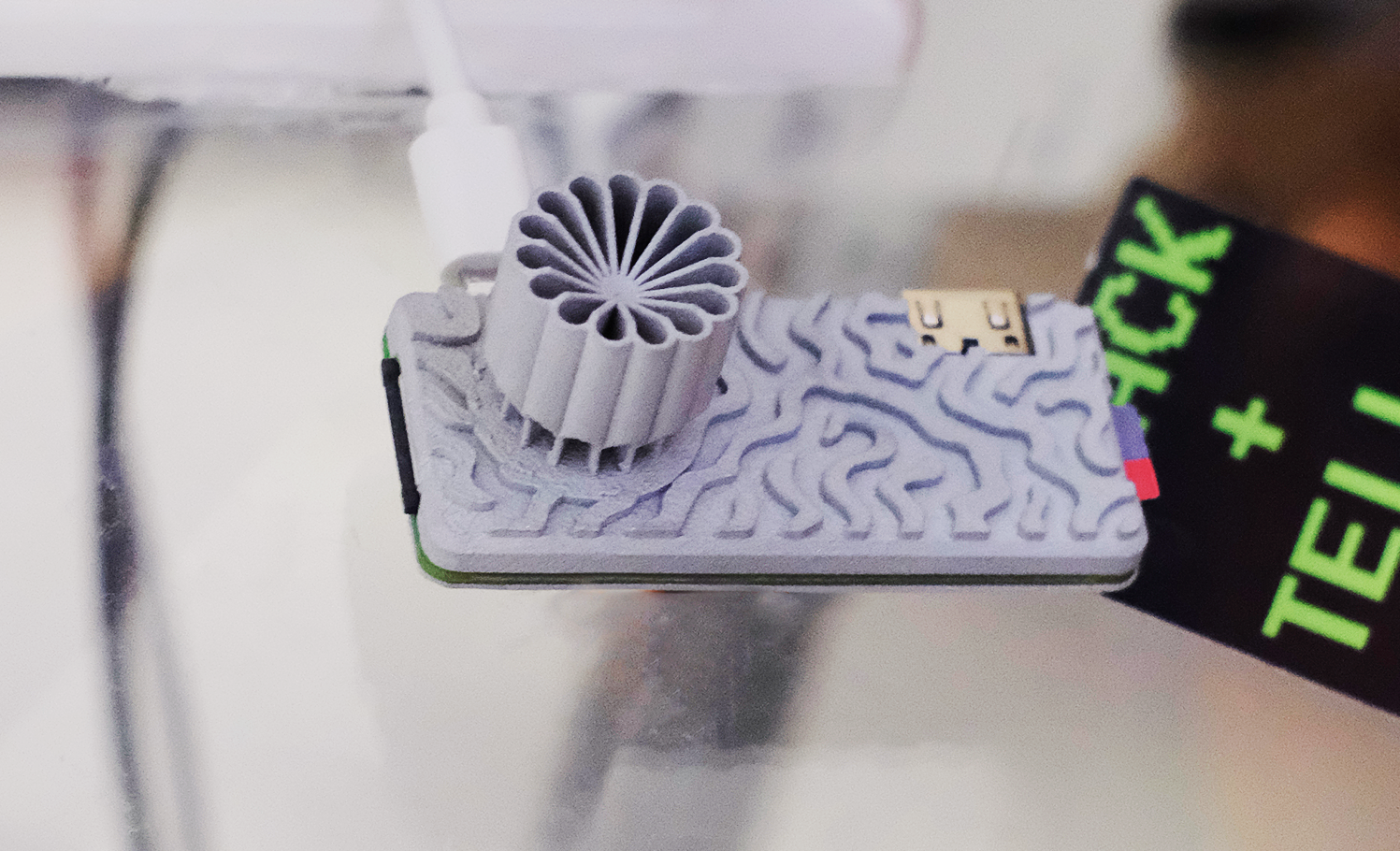
It’s delightfully simple: all you need is a clear plastic cup, a stir plate, and a handful of electronic components — namely, a microcontroller, a servo, and an IR line-following sensor. You’ve probably played with just such a sensor: the cheap ones that are a matched pair of LED and photodetector. It works like this: the plastic cup, filled with water, sits upon the stir plate. To start the device, you turn on the stir plate and actuate the servo to drop the pill in the water. The microcontroller then begins recording the signal from the photo-diode. As the pill breaks up and/or dissolves in the water, the swirling bits are going to reflect light from the IR LED. That reflectance signal over time is the Disintegration Fingerprint (DF), and it’s surprisingly effective at catching fakes according to the authors of the paper linked above. Out of 32 different drug products, the technique worked on 90% of them, and was even able to distinguish between generic and brand-name versions of the same drug.
Of course, you do need a known-good sample to generate a trustworthy fingerprint, and there’s that pesky 10% of products the technique doesn’t work on, but this seems like a great way to add some last-mile QA/QC to the drug distribution chain, particularly in low and middle-income countries where counterfeit drugs are a big problem.
An artist’s conception shows Portal Space Systems’ Starburst spacecraft at left and its larger Supernova platform in the distance at right, both outfitted with Paladin Space’s Triton payload for orbital debris tracking and removal. (Portal Space Systems Illustration)
Bothell, Wash.-based Portal Space Systems is partnering with an Australian venture called Paladin Space on a commercial service that would round up and dispose of potentially dangerous orbital debris.
The concept — known as Debris Removal as a Service, or DRAAS — is meant to address one of the most pernicious problems facing spacecraft operators: how to dodge tens of thousands of pieces of space junk that are zipping through Earth orbit.
Since its founding in 2021, Portal has been focusing on the development of maneuverable orbital vehicles that could rendezvous with other satellites, either for servicing or for disposal. Its flagship is the Supernova in-space mobility platform, which will be equipped with an innovative solar thermal propulsion system. There’ll also be a smaller version of the spacecraft, called Starburst. Starburst-1 is due for launch as early as this year, and Supernova is scheduled to make its debut in 2027.
Meanwhile, Paladin Space has been working on a reusable payload called Triton, which is designed to track and capture tumbling pieces of orbital debris that are less than 1 meter (3 feet) in size. That small-to-medium size category accounts for most of the debris that’s being tracked in orbit.
“Triton is built to remove dozens of those objects in a single mission, which fundamentally changes the cost structure of debris remediation and provides the greatest benefit to satellite operators,” Paladin CEO Harrison Box said today in a news release.
Advertisement
A space debris hit to the space shuttle Endeavour’s radiator was found after one of its missions. The entry hole was about a quarter-inch wide, and the exit hole was twice as large. (USGS Photo / circa 2007)
The Portal-Paladin partnership calls for installing Triton hardware on Starburst spacecraft. Portal’s orbital platform would go out in search of space junk, and Paladin’s payload would grab the debris. When Triton’s trash bin is full, it would be dropped off for safe disposal while the spacecraft remains in orbit for continued servicing.
The companies are targeting an initial deployment in 2027, focusing on heavily trafficked bands of low Earth orbit. Future missions may take advantage of Supernova’s added capabilities to service a wider variety of orbits.
Other efforts to remove orbital debris are in the works: A Japanese company called Astroscale executed two orbital test missions (ELSA-d and ADRAS-J) and is now gearing up for follow-up demonstration missions (COSMIC, ADRAS-J2 and ELSA-M). A Swiss company called ClearSpace is working with the European Space Agency on an experimental mission that would take a defunct satellite out of orbit.
Portal CEO Jeff Thornburg said DRAAS will be much more than a one-off demonstration. “This is about making debris removal operational, not experimental,” he said. “Satellite data underpins communications, navigation, weather forecasting and national security. Maintaining that infrastructure requires active debris management. For the first time, we can do that as a repeatable service.”
Portal has already attracted millions of dollars in financial support from SpaceWERX, a division of the U.S. Space Force that focuses on bridging the gap between commercial technologies and military needs. Its partnership with Paladin targets a different market for in-space services. NASA has estimated that debris avoidance maneuvers cost U.S. satellite operators roughly $58 million annually.
Advertisement
At least one potential customer is going public about its interest. Portal said Starlab Space, a joint venture that is working on a commercial space station, has signed a letter of intent to integrate the DRAAS service into future station operations. Starlab’s team includes Airbus, Voyager Technologies, Northrop Grumman, Mitsubishi and Palantir.
“Safety is the foundation of everything we’re building at Starlab,” said Brad Henderson, Starlab’s chief commercial officer. “We’re engineering a station designed to last for decades, one that must meet the highest standards of integrity to protect our crew and the science that will live aboard. Capabilities that reduce collision risk and limit the need for frequent collision avoidance maneuvers directly serve that mission.”
There are two main kinds of coffee subscription providers: roasters and retailers. Both roasters and multi-roaster retailers sell great coffee. This guide contains a mix of both.
Roasters are cafés and small-batch producers who buy raw beans from farmers all over the world and roast them to perfection. By buying from a roaster, you’re directly supporting the people who make your favorite coffees. The downside is you usually won’t have as broad a selection. Roasters usually sell only their own coffee, but that often means special blends and single origins are available from a roaster that you can’t get from a retailer. Your local roaster down the street may also have subscription offers, giving you the chance to buy local without leaving your house—and often catch a discount.
Advertisement
Retailers or Multi-Roaster Subscriptions are coffee subscription providers who buy their beans from many different roasters, then ship bags of coffee to you. A multi-roaster retailer will often have a much broader selection of high-quality coffee available (from multiple brands) to ship to your doorstep—often selected and curated carefully by coffee experts. The downside on some subscriptions is that you’re not buying directly from a roaster, which means the coffee may not be as fresh. (That’s where this guide comes in. We can tell you how fresh they are, because we always test each one and take note of the roast dates on each coffee bag.)
Subscription Beans vs. Locally Roasted Beans
Look: If you live in a big city with great coffee—and let’s be clear, nearly every midsize city in the United States has at least a couple of excellent roasters—the best way to try fresh roasts and new beans, and learn about them, is to … go to your local roaster. Look up your local coffee roasters or visit your favorite coffee shop and ask where they get their beans. Buy the beans. Talk to people. It’s fun, if you like talking to people.
Heck, this is also true when you’re traveling. The best coffee you can find is often the cup you drink when you’re on the road, in a new place, tasting something new. Even if you don’t live on the road, it’s fun to explore different shops when you do travel.
Advertisement
But the wonder of the internet is that you’re not limited to only the best of what’s local. Subscriptions allow you to take the temperature of the most interesting roasters from all over the country, without going anywhere in particular. Heard about that one roaster in Delaware or North Carolina making crazy coffee with co-ferments and natural fermentation? A roaster in Guatemala highlighting beans from their neighbors? Let them surprise you. Are you new to the world of premium coffee, and you’d like some help from the curators at Trade Coffee or Podium Coffee Club to learn what you like?
This is why you might take a subscription. The world is at your door—even the world you’ve never even visited. I’m also lazy enough to order subscriptions from roasters a 15-minute drive away, but this is between you and your local ecologist.
But also, sometimes it’s homesickness for what used to be local. One of the best, most interesting, and kinda attitudinal roasters I know in this country is a tiny spot in South Jersey called Royal Mile. They used to be my favorite local coffee shop, when I lived in Philly and would drive to Jersey to get the coffee. Now they aren’t local at all, because I moved. But through the magic of the internet and the US Postal Service, I can still get their truly wild, surprising, mad-scientist single-origin bags anytime I want. What a privilege.
How We Test Coffee Subscriptions
Advertisement
To test these subscriptions, we try a variety of beans from each service, both our own picks and any curated options. We brewed each bag in different ways to see which beans were best suited to which brewing method. Over subscriptions he tested, Scott Gilbertson covered the spectrum of grinds with espresso, moka pot, French press, pour over, and Turkish or cowboy coffee. Matthew Korfhage wanders through espresso, AeroPress, drip, cold brew, pour-over, and a wealth of somewhat unclassifiable devices.
It’s worth doing the same if you have access to different brewing methods, especially if you opt for a subscription that offers a lot of variety. A roast that makes a great shot of espresso does not necessarily make the best pour-over coffee, and vice versa. Some roasters, like the excellent Equator Coffee, offer one subscription specifically for espresso, one for decaf, and another for light single-origin roasts that lend themselves to drip and pour-over. It can also be rewarding to take notes on your favorites. Some of these services offer a way to do this on the site, which is handy, though a paper notebook works well enough. If you’d like some more pointers on brewing, be sure to read our guide to brewing better coffee at home.
Are Coffee Subscriptions Worth It?
A delivery coffee subscription service often does offer discounts on shipping or the base cost of each bag, as compared to buying single bags for delivery. But usually, subscriptions will be premium beans, so it won’t be as cheap as the less-fresh, often preground coffee from your grocery store.
Advertisement
But if you’re the sort who likes to try the best freshly roasted single-origin Ethiopian or Guatamalan beans from roasters all over the country? This is where coffee subscriptions shine. You’re also often getting the best speciality bags a roaster has to offer, or a curated selection from a certified Q-grader—meaning you’re a lot more likely to find new roasts and origins you wouldn’t have come across on your own.
But a coffee subscription gives me access to beans from all over the country and world. It’s a mix of ease and adventure, and a chance to be a barista at my own home multiroaster café. I enjoy that I can get fresh-roasted beans from a coffee farm in Guatemala who roasts their own impossibly fresh beans onsite, alongside world-famous beans from other farmers right down the road—or taking a world tour each month with beans from my favorite globe-hopping roaster, Atlas Coffee Club.
But for others, a coffee subscription is just a way to get a steady drip of their favorite bag from their favorite roaster, guaranteed to arrive every week or every two weeks. Simple convenience is its own form of worth it.
Advertisement
How Does WIRED Select Coffee Subscriptions to be Reviewed?
There’s a lot of good coffee out there. And I am never not trying coffee—drip, espresso, cold brew, I’m consistently drinking it and testing out new roasters. I’ve been writing about coffee for 15 years on both coasts, and I’ve always been on the lookout for new and exciting growers, roasters, and beans.
Coffee can be subjective, of course, and everyone has their preferences. I include my personal favorite roasters among this list, rotate in new discoveries I figure readers might be interested in, and also solicit favorites from other very… wired… WIRED reviewers with different palates. But when deciding what subscriptions to include in our small, curated list, I also ask: What does this subscription offer that others don’t? I’m often looking for coffee subscriptions that best serve particular types of drinkers—a new service, a new delivery method, a clever way to cater to what you (whoever you may be) really want at your doorstep each week.
Advertisement
Often, a unique or uniquely useful or just kinda cool subscription model or roaster will be the first I’m in line to test. Other times, I get sent a sample bag of beans and it sends me over a moon. Always feel free to send a note about a particularly terrific roaster or subscription, at [email protected].
How Have Tariffs Affected Coffee Prices?
Ain’t gonna lie. Tariffs don’t help coffee prices. Pretty much all coffee roasted and sold in the United States is imported. If it costs more to bring into the Unites States, it will eventually cost more to buy.
This is one of many factors that affected coffee prices throughout last year, including extreme weather in Brazil and Vietnam, increasing demand, and relatively flat supply. All of these factors, including tariffs, have contributed to coffee prices rising drastically since the beginning of 2025. By fall 2025, commodity coffee bean prices were 40 percent higher than the same time the previous year. In late 2025, fully a quarter of our dozen top-pick coffee subscriptions raised prices by a buck or two a bag.
Advertisement
This year has been kinder. While still up considerably since 2024, coffee commodity prices seem to have stabilized a bit after a small bipartisan delegation of lawmakers introduced a bill that would specifically exempt coffee from tariffs. In November 2025, most of the largest coffee tariffs were rolled back by presidential decree. The Supreme Court then rolled back all tariffs in February, and nixed a presidential attempt to unilaterally instate another round of 10 percent tariffs, raising the specter of tariff refunds.
But lingering effects remain, and it’s not clear coffee prices have gone back down after last year’s hikes. This is true especially because many roasters absorbed higher costs for a number of months before hiking consumer prices. The best I can say is that none of my top coffee subscription picks raised prices in 2026.
Subscriptions can absorb high coffee commodity prices in part by selecting which beans get sent. In many cases, subscriptions are able to charge less than the individual bags you see at the supermarket, because of guaranteed sales (kinda the same way subscribing to a magazine costs less than buying at the newsstand.)
There are so many coffee subscriptions out there, and honestly, a lot of them are very good coffee. Some are even amazing coffee. This list would need to be three times as long to capture every one of them at the least. I have way more subscriptions I’ve loved than I have space to talk about them, so here I’ve gathered some past picks that we here at WIRED like; some of these provide very specific services too. Have a favorite we haven’t tried? Send an email to [email protected]
Gento Coffee for $48 for two bags: Gento is part of a new and welcome trend: growers who roast their own coffee and ship directly from the source. In Guatemala, Gento takes this a step further, roasting beans from other local growers that rank among the most esteemed bean farms in the world. But in this case, the beans might only travel down the road to be roasted. The single-origin subscription is really the play, here. Alongside roasts from Gento’s own beans from the Prentice family farm, you might find roasts from esteemed Guatemalan growers like Genaro Juarez and Patrona Perez. If those names don’t mean anything to you yet, they will after you try them.
Advertisement
Photograph: Matthew Korfhage
Camber Coffee for $20+ per 12-ounce bag: Bellingham, Washington, roaster Camber Coffee slipped under the radar for me for maybe too long—but amid its 10-year anniversary celebrations, I finally remedied this. Camber makes distinguished, aromatic, balanced single-origin coffees and a truly chocolatey espresso blend called Big Joy that lives up to its name: it’s like a fudge brownie in espresso form. Subscriptions net you 10 percent off list price on each bag.
Sunday Coffee Project for $27 per box ($45 for two): Portland’s Sunday Coffee Project is a roaster without a café, a fun art project, and a home to some of the most distinctive, funky, fruity, interesting coffee I know in this country. This could be a yeast-fermented Thai light roast that tastes a whole lot like Sangria, or an Ethiopian so floral you’ll swear you got invited to a spring wedding. Plus, your coffee comes in a little art box, designed to look like a coffee-themed children’s cereal complete with games on the back and a little cartoon character on the front: maybe a sheep lifting weights or a snake playing tennis. It’s a wee roaster, and they’ve dialed back their offerings from weekly new roasts to monthly new roasts. But if you like light and adventurous coffee, a box from Sunday Coffee Project may be your favorite thing you get in the mail that month.
Advertisement
Courtesy of Trucup
Trücup for $17 per 12-ounce bag: Are you sensitive to the acids in coffee, but you love coffee? Trücup makes unique, low-acid coffee through what it calls a natural steam process, which makes it a great option for caffeine lovers with sensitive stomachs or those who suffer from gastroesophageal reflux disease or heartburn. (Standard disclaimer: If you’ve been diagnosed with GERD, talk to your physician before you try any coffee.) Either way, even those with well-fortified stomachs may want to take note. WIRED Reviewer Scott Gilbertson loves this coffee for a more mellow cup in the afternoon or evening.
Grounds and Hounds for $19: We’ve recommended this as a top pick in the past, for its mix of feel-good donations to animal shelters and excellent roasts. Grounds and Hounds offers small-batch roasted blends and single-origin beans, with 20 percent of its profits going to benefit animal shelters. The brand has some of WIRED reviewer Scott Gilbertson’s personal favorite coffees, especially the dark roasts. (Try the Snow Day Winter Roast when it’s available.) Subscriptions are mostly recurring, individual-bag subscriptions.
Advertisement
Wonderstate Coffee for $19 to $21 per 10.5 ounce bag: Wisconsin’s Wonderstate, previously named Kickapoo, is quite possibly the nation’s first fully solar-powered roaster—and has a long and vocal commitment to providing higher pay to farmers. It’s also a quite excellent roaster. The most recent batch of single origins I tried had a tendency toward light, subtle, mild-mannered, and lightly tannic brews—a cosmopolitan palate that’s also Midwestern-polite.
Photograph: Scott Gilbertson
French Truck Coffee for $18 to $22 a bag: French Truck Coffee got its start in New Orleans and now has a dozen of its signature yellow storefronts scattered around town. WIRED operations manager Scott Gilbertson is a fan of the Big River blend, which has a deep, rich, and very robust flavor profile that’s especially well-suited to pour-over brewing. In fact, French Truck has some of the most detailed brewing instructions around.
Birds & Beans Coffee for $18+ a bag: Like birds? Clear-cut coffee farms can be hard on them. But Birds & Beans is a coffee roaster devoted to making sure its coffee is grown in Smithsonian-certified, bird-friendly farms with tree cover that helps birds thrive. The dark roasts in particular are delicious and genuinely dark: Scarlet Tanager is a favorite of WIRED operations manager Scott Gilbertson.
Advertisement
Stone Creek Coffee for $40 (two bags): Milwaukee-based Stone Creek Coffee delivers its fresh, flavorful coffee in big 1-pound bags, with a variety of blends and single-origin options available. The Cream City blend in particular is a delightful medium roast with some warmer flavor notes like chocolate and brown sugar rounded out by some fruity flavors, according to former WIRED coffee writer Jaina Grey, giving the coffee an almost cacao nib flavor. Add a little milk and it’s almost like drinking hot cocoa. A monthly subscription delivers two bags a shipment.
Grit Coffee for $17+ a bag: From its roastery in Charlottesville, Virginia, Grit Coffee roasts up excellent blends, including an excellent, roasty, chocolatey Side Hustle blend with a subtle high note of acidity to balance it out. But what really differentiates Grit from other roasters is grit. The roaster makes long-term, often 10-year commitments to its coffee farmers.
Photograph: Jaina Grey; Getty Images
Lady Falcon for $49 (two bags): Lady Falcon Coffee Club may draw you in with the art nouveau-style bags. But the luscious, velvety coffee within is what will keep you coming back, according to former WIRED reviewer Jaina Grey. Each coffee blend is thoughtfully mixed to heighten the flavors present in the contributing coffees, and the flavor notes are spot-on.
Angels’ Cup for $28 a bag: Angels’ Cup is more like a distance-learning coffee school than a box subscription service, and the Black Box subscription is like a blind coffee tasting from afar. You will learn what you actually like and dislike about coffee, along with some education through the app, roaster’s notes, and notes from fellow tasters.
Advertisement
Mistobox for $20+ a bag: With more than 500 different coffees from 50-plus roasters, Mistobox makes a good gift subscription, especially if you don’t know what kind of coffee to get someone. Somewhere in those 500 choices, your coffee fanatic should find something that will make them happy. One of the most compelling and surprising offerings: Misto lets you choose the most you’re willing to pay per shipment, and your offerings will change accordingly. Delivery frequency can also be customized down to the day. But as it appears they’re in the process of transferring to a new back end, we’ll give them a moment before assessing the new website and ordering system.
When you have multiple keyboards installed, you can manage them on iOS by opening Settings, then choosing General > Keyboard > Keyboards. To swap between keyboards you’ve installed, tap and hold the globe icon that appears in the lower left corner of all your keyboards.
On Android, you can find your keyboards via System > Keyboard > On-screen keyboard from Settings. To switch between them, tap and hold on the globe icon that appears in the lower right corner whenever a keyboard is on the screen.
The Best Phone Keyboards to Try
Gboard (Android, iOS) is a good option to start with here. It’s preinstalled by default on Pixel phones, but it’s also an excellent keyboard pick for iPhones and Android phones not made by Google. It’s fast and clean, works really well for GIFs, emoji, and stickers, and supports glide typing (where you swipe over letters to form words rather than tapping on each individual letter).
Then there’s SwiftKey (Android, iOS), which is developed by Microsoft. As you might expect, there’s Copilot AI integration built right in, so if you’re stuck for something to say, you can use generative AI to do your writing for you. SwiftKey will also learn your writing style as you go, meaning autocorrections and suggestions get more accurate over time.
Advertisement
SwiftKey comes with a range of settings to play around with.
Photograph: David Nield
Typewise (Android, iOS) demonstrates how third-party keyboards can be a little out of the ordinary. It offers an unusual layout that makes use of hexagonal letter and character tiles, and which Typewise says can seriously speed up your typing speed. There’s also support for multiple languages, AI integrations, and custom gestures.
You may be familiar with Grammarly from the web and the desktop (and from the recent news about its missteps), but the grammar and spell checker service is also available as a keyboard on iOS and as a keyboard extension on Android. As well as checking on your writing, Grammarly puts AI front and center: You can get writing suggestions from a prompt, for example, or change the tone of an existing message with a couple of taps.
If you’re interested in customization options above everything else, then consider Mister Keyboard for iOS. It’s stacked with ways to tweak the look and layout of your iPhone’s keyboard, and to access features like emoji and the clipboard. Either pick one of the preset themes, or take pixel-by-pixel control over the keyboard.
Advertisement
Mister Keyboard isn’t available for Android, but there is theming support in Futo Keyboard for Android. It also includes smart autocorrect and text editing tools, and prides itself on its privacy. The keyboard app doesn’t ask for permission to connect to the internet, so you know that your keystrokes aren’t being sent anywhere.
The Securities and Exchange Commission has closed its investigation into electric vehicle startup Faraday Future, despite SEC staff on the case recommending an enforcement action last year, TechCrunch has learned.
Four sources familiar with the investigation, who were granted anonymity to speak about the government case, told TechCrunch that the SEC informed the company and people involved in the probe about the closure this past week.
The dismissal of the case comes amid a historic drop in enforcement actions by the SEC, which only initiated four cases against publicly-traded companies in its 2025 fiscal year, a recent report shows. The SEC did not respond to an after-hours request for comment.
The investigation into Faraday Future lasted for nearly four years. The SEC was looking at whether the EV startup made “false and misleading statements” when it went public in a 2021 merger with a special purpose acquisition company (SPAC), and was also probing whether Faraday Future faked the sales of its first electric vehicles in 2023 — a claim that’s been made by at least three former employee whistleblowers.
Advertisement
The financial regulator sent the startup multiple subpoenas, regulatory filings from Faraday Future show. The SEC also took depositions of multiple former employees and executives in 2024 and 2025, three of the people familiar with the case have told TechCrunch.
In July 2025, Faraday Future revealed the SEC had sent the company and multiple executives — including founder Jia Yueting — letters known as “Wells Notices.” The SEC sends Wells Notices when staff working a case have decided to recommend the agency take enforcement action.
It’s not clear if Faraday Future ever responded to the Wells Notices sent last year. As recently as February, the company disclosed in regulatory filings that it had not. “The Company and executives plan to engage with the SEC to explain why enforcement action is not warranted,” Faraday Future wrote in such a filing last month. A company spokesperson said Sunday that Faraday Future would share more information later Sunday.
Techcrunch event
Advertisement
San Francisco, CA | October 13-15, 2026
The Department of Justice also sent Faraday Future requests for information after the SEC opened its investigation in 2022. Faraday Future has referred to this as an “investigation” in regulatory filings; the DOJ has never confirmed if it opened a full probe, and it did not respond to an after-hours request for comment.
Advertisement
It is rare for the SEC to not pursue an enforcement action after sending a Wells Notice. One study done at the Wharton School in 2020 showed that around 85% of targets who receive a Wells Notice wind up in court with the SEC.
The SEC investigated nearly every electric vehicle startup that went public in a SPAC merger over the last six years. In almost all of those cases, the agency reached a settlement with the startups. It dismissed an investigation into Lucid Motors in 2023, and as TechCrunch first reported in February, the SEC ended a probe into bankrupt EV startup Fisker late last year.
Origins of the investigation
Faraday Future was founded in California in 2014 by Jia, a businessman who at the time was running a booming tech conglomerate in China known as LeEco. It was one of many new companies trying to become the “next Tesla” or, optimistically, a “Tesla killer.”
Faraday snapped up talent from Tesla, other automakers, and also tech companies like Apple, and at one point employed as many as around 1,400 employees. But things got bumpy quickly. The company turned heads, in both good and bad ways, at the 2016 Consumer Electronics Show, with a flashy concept car and the lofty goal of being as disruptive as the iPhone.
Advertisement
The company revealed its first vehicle the following year: a luxury electric SUV called the FF91. By the end of 2017, though the company was nearly out of cash and had laid off or furloughed hundreds of workers. Jia’s company in China had collapsed, and he self-exiled to California as the government in his home country placed him on a debtor blacklist. (It was at this time that a close business associate to Jeffrey Epstein pitched the sex criminal on investing in Faraday Future, as well as other EV startups, as TechCrunch recently revealed. Epstein never invested.)
Faraday Future was rescued by an investment from major Chinese real estate conglomerate Evergrande. But that relationship fell apart quickly, too, with Evergrande walking away by the end of 2018 and Faraday Future laying off even more employees.
Jia nominally stepped aside as CEO in 2019 and also filed for personal bankruptcy to settle billions of dollars of LeEco debt he had personally guaranteed. But behind the scenes, he was still largely in charge of the company.
This became an issue when Faraday Future went public in 2021 and raised about $1 billion. Members of the newly-appointed public company board believed that Faraday’s executives had misrepresented Jia’s control over the day-to-day operations — especially after a short seller report was published that scrutinized Faraday Future — and formed a special committee to investigate.
Advertisement
That committee hired an outside law firm and a forensic accounting firm, and within the first few months it started reporting its findings directly to the SEC, the three people familiar with the investigation told TechCrunch.
Between January and April 2022, Jia was sidelined as a result of the board’s investigation, a senior VP named Matthias Aydt (who is now co-CEO with Jia) was placed on probation for six months, and another VP named Jerry Wang (who is Jia’s nephew) was suspended. (Wang ultimately resigned after “failure to cooperate with the investigation,” according to company filings, but is now back with Faraday Future.)
The committee’s work also showed that Faraday Future had, in the two years before it went public, survived in part on multi-million-dollar loans made to the company by low-level employees with connections to Jia — known as “related party transactions” in legal parlance.
On March 31, 2022, Faraday Future disclosed that the SEC had opened its investigation. The startup revealed the requests for information from the DOJ in June.
Advertisement
Dodging another bullet
Through the rest of 2022, and amid the early stages of the SEC investigation, employees and people close to Jia waged a campaign to regain control of the board and his company. This eventually resulted in death threats against some directors, who ultimately resigned, paving the way for people close to Jia to run the company once more.
Faraday Future finally delivered the first few FF91 SUVs in early 2023. Former employees have sued the company alleging that these were not true sales, and that the company had misled investors. The SEC investigators working the case subpoenaed Faraday Future about issues related to these sales, filings show.
Former executives and employees were initially deposed by the SEC in 2024, according to the people familiar with the investigation. The SEC sat some of them for longer depositions in the first half of 2025, the people said.
The Wells Notice sent in July 2025 said SEC staff had made “a preliminary determination to recommend that the Commission file an enforcement action against the Company alleging violations of various anti-fraud provisions of the federal securities laws.”
Advertisement
Specifically, the Wells Notice referenced “purported false or misleading statements” made during the SPAC merger process about “related party transactions” and Jia’s “role in the Company.” Jia, his nephew Wang, and two other unnamed employees also received Wells Notices.
Faraday Future is still trying to sell the FF91, but it has also recently changed its business in a few ways. The company is importing more affordable hybrid and electric vans from China. It also appears to be selling re-badged versions of Chinese robots, and turned a publicly-traded biotechnology company into a firm focused on crypto.
Those efforts have not stopped the company’s struggles. On Friday, the company announced it had received a warning from the Nasdaq that its stock price was under the minimum of $1, which could eventually lead to the company being de-listed.
Research underway at UW Medicine’s Institute for Protein Design. (GeekWire Photo / Lisa Stiffler)
Nobel Laureate David Baker will lead a new University of Washington initiative that’s launching with $7 million to develop designer enzymes and proteins to solve challenges in medicine, technology and sustainability.
The funding comes from the Washington Research Foundation (WRF), a nonprofit organization based in Seattle that supports research and entrepreneurship in the state. WRF granted nearly $200,000 last year to the UW Institute for Protein Design (IPD), which Baker leads, to create a plan for the new program.
The goal of the four-year initiative is to accelerate IPD’s work by educating new scientists, translating discoveries into commercially viable tools and supporting the launch of startups.
Baker received the 2024 Nobel Prize in Chemistry for using AI and machine learning to create never-before-seen proteins. He is the director of the IPD and a UW biochemistry professor.
Enzymes, which are a category of proteins, have key applications in global industries such as pharma, agriculture, energy and manufacturing. They’re able to orchestrate the transformation of molecules and dramatically speed up essential chemical reactions.
Advertisement
“With AI, we can now design these molecules from scratch, tailored precisely to the task at hand,” Baker said in a statement. “This grant from WRF will help us push this technology further and train a new generation of scientists to bring designed enzymes from the computer to the lab to the market.”
IPD has already launched more than 10 startups, including PvP Biologics, acquired by Takeda; Icosavax, acquired by AstraZeneca; A-Alpha Bio; and Neoleukin Therapeutics.
The project will start receiving grant dollars from the Washington Research Foundation around June of this year. Further support is coming from the philanthropist and former Citibank CEO Sanford Weill; the Fund for Science and Technology, which is part of Microsoft co-founder Paul Allen’s philanthropies; and the IPD Breakthrough Fund. The UW is providing IPD with additional office and lab space in Seattle’s South Lake Union as part of the initiative.
The grant comes from the foundation’s BioInnovation Grants program, which launched last year and has funded three additional efforts to advance Washington state’s life sciences sector. The program has committed more than $32 million across five institutions.
The result of the mod is less a novelty case mod and more a proof-of-concept for what a hybrid Xbox/PC box could look like in practice, arriving months before Microsoft’s own Project Helix promises official support for PC titles on next-gen Xbox hardware. Read Entire Article Source link
Get caught up on the latest technology and startup news from the past week. Here are the most popular stories on GeekWire for the week of March 15, 2026.
The Washington Research Foundation is investing $7 million in Nobel laureate David Baker’s UW lab to turn AI-designed proteins into real-world tools. … Read More
Five months after releasing its “responsible AI plan” providing guidelines for the technology’s use, the City of Seattle has tapped the brakes on artificial intelligence. … Read More
Former Microsoft leader to run a nonprofit using AI to talk with animals; three Amazon leaders resign and a longtime Google engineer joins LinkedIn. … Read More
GeekWire spoke with legal experts and wealth advisors to learn more about how the new income tax may impact different people in Washington’s tech ecosystem. … Read More
For this installment in our Agents of Transformation series, GeekWire examined the rising trend of vertical AI agents — tools built to do one job exceptionally well by combining models with domain-specific data, workflows, and context. … Read More
Seattle startup Certiv emerged from stealth with $4.2 million in funding to build security software that monitors and controls AI agents on employee computers. … Read More
Jeff Bezos’ space venture seeks FCC’s go-ahead for a constellation that would complement TeraWave network — and set up another rivalry with SpaceX. … Read More
Despite world-class AI-biotech research, a Nobel Prize-winning protein design lab and proximity to global AI expertise, Washington’s life sciences sector is still learning to tell its story. … Read More
Carbon Robotics names a CFO; Nordstrom gets a VP of AI; and a Microsoft gaming GM goes to Netflix while one of its longtime legal leaders retires. … Read More
The developer behind the open-world RPG Crimson Desert has issued an official apology after players discovered several instances of AI-generated art in the game. Pearl Abyss posted on X that it released the game with some 2D visual props that were made with “experimental AI generative tools” and forgot to replace them before launch.
Just a day after Crimson Desert’s launch, players took to social media to post reports of potential generative AI usage. Pearl Abyss said on X that “following reports from our community, we have identified that some of these assets were unintentionally included in the final release.” Now, the game’s Steam page has an AI generated content disclosure, which says that, “generative AI technology is used in a supplementary capacity during the creation of some 2D prop assets” which are later replaced.
Moving forward, Pearl Abyss said it will conduct a “comprehensive audit of all in-game assets and are taking steps to replace any affected content.” The developer said that these updated assets will roll out in upcoming patches, and that the team would internally review how it communicates with its player base to provide more “transparency and consistency.”
Pearl Abyss isn’t the only developer to fail to disclose the use of AI-generated assets in its games. Late last year, Sandfall Interactive was stripped of its Game of the Year and Debut Game awards from the Indie Game Awards for the use of generative AI in Clair Obscur: Expedition 33 for placeholder textures that were mistakenly left in the game. Like Pearl Abyss, Arc Raiders’ developer Embark Studios is going back and replacing AI-generated material in its game after some backlash from its player base.
As both the iPad Air M4 and iPad Pro M4 sport the same chip, what really separates the two tablets? Is it a guarantee that the Pro iteration is best?
To help you decide between the two, we’ve compared our experiences between the iPad Air M4 and iPad Pro M4 and noted the key differences below.
Remember, the iPad Pro M4 has been succeeded by the iPad Pro M5. For a closer look at the newer model, visit our iPad Pro M5 vs iPad Pro M4 comparison to see what’s new with the latest model.
The recently announced iPad Air M4 is available to buy now, with a starting RRP of £599/$599 for the 11-inch, 128GB iteration.
SQUIRREL_PLAYLIST_10208285
Advertisement
As it’s been succeeded by the iPad Pro M5, the iPad Pro M4 is no longer readily available to buy from Apple’s official site. In fact, tracking down an iPad Pro M4 can be quite difficult, unless you’re happy to opt for a refurbished or renewed model. If so then the price will vary somewhere between the £660 – £800 range, depending on the condition and provider.
Remember, neither of these starting RRPs includes any accessories such as an Apple Pencil or Magic Keyboard. Those will need to be purchased separately.
Design
Both come in a choice of two sizes: 11- or 13-inches
Although the 13-inch iPad Pro M4 is the thinnest, the 11-inch is also thinner than the iPad Air M4
Both have landscape front-facing cameras
Both the iPad Air M4 and iPad Pro M4 come in a choice of two screen sizes: 11- or 13-inches. Regardless of the iPad Air M4 size you opt for, the tablet will be just 6.1mm thick.
Advertisement
In comparison, the 13-inch iPad Pro M4 is the thinnest of the lot, at just 5.1mm thick whereas the 11-inch version is 5.3mm. The 13-inch iPad Pro is so thin, that you’ll actually notice the USB-C cable will jut out ever so slightly when it’s plugged into the device.
Advertisement
iPad Pro M4 thickness. Image Credit (Trusted Reviews)
Otherwise, the 11-inch iPad Air weighs up to just 465g (for the cellular iteration) while the 13-inch is slightly heavier at up to 617g (again, for the cellular model). The iPad Pro M4 sits in-between the two iPad Airs, as the 11-inch weighs up to 446g while the 13-inch is 579g.
iPad Air M4. Image Credit (Trusted Reviews)
Although all iPad Pro M4 models are lighter than the iPad Air, which means the tablet feels barely noticeable whether in hand or slotted away in your bag, it’s still worth noting that we found the iPad Air to still be a compact model – especially the smaller 11-inch version.
Finally, both the iPad Air and iPad Pro are equipped with a Touch ID fingerprint scanner that’s built into the power key and a USB-C port at the bottom. In addition, both are equipped with a landscape front camera, which makes taking video calls feel more intuitive than before.
Advertisement
Winner: iPad Pro M4
Screen
iPad Pro has an OLED panel for brighter and more vibrant colours
ProMotion is only available on the iPad Pro
Even so, the iPad Air’s LED-backlit panel is enough for everyday use
As we mentioned above, both the iPad Air and iPad Pro M4 come as either an 11- or 13-inch iteration. Fortunately, regardless of the size you choose, the screen technologies will remain more or less the same. That’s an improvement over the iPad Pro M3, where the smaller 11-inch model had a lower resolution LCD panel compared to the 12.9-inch mini LED.
iPad Pro M4 screen. Image Credit (Trusted Reviews)
So, let’s dive into the screen technologies on offer here. Unfortunately the iPad Air’s screen isn’t as well equipped as the iPad Pro’s, with an LED-backlit panel and not quite enough brightness levels for HDR video. In fact, put the iPad Air next to the OLED-equipped iPad Pro and the difference is unmistakable, as the pricier tablet boasts a higher maximum brightness and more vibrant colours too.
Not only that, but the iPad Pro also benefits from ProMotion technology, which means it sees a 120Hz refresh rate. Unfortunately, the iPad Air still caps out at just 60Hz. While this isn’t necessarily a dealbreaker, when you’re comparing it to the 120Hz iPad Pro, the iPad Air feels dated.
Advertisement
Advertisement
iPad Air M4 screen. Image Credit (Trusted Reviews)
Finally, the iPad Pro M4 has the option to sport a nano-texture glass display which goes a long way in reducing glare and providing a matte finish. However, this is only available on the 1TB or 2TB models, and will cost an additional £150/$150.
Winner: iPad Pro M4
Performance
Although both have M4 chips, the iPad Air’s silicon has one less CPU and GPU-core
iPad Air features the N1 and C1X chips (latter only in cellular models)
You can upgrade your iPad Pro M4 with more memory, storage and additional cores in the chip
The newly launched iPad Air may appear to have the same M4 chip as the 2024 iPad Pro, however there are a few differences between the two silicons. Firstly, the iPad Air M4 has an eight-core CPU and a nine-core GPU, whereas the standard iPad Pro M4 has a nine-core CPU and 10-core GPU. Plus, you can even add an additional CPU-core thanks to the 1TB and 2TB iterations – although they come at a higher price.
iPad Pro M4. Image Credit (Trusted Reviews)
Advertisement
Even so, the iPad Air M4 is still a very capable tablet that can even handle exporting large files in Final Cut, doing AI-based tasks and editing images with ease.
However, we were seriously blown away with the sheer amount of power on offer with the iPad Pro M4. While it’s likely overkill for anyone who wants an iPad for reading and the occasional video stream, the iPad Pro M4 is brilliant for those seeking serious power for more intensive tasks.
Advertisement
With this in mind, we’d argue that the iPad Air M4 is likely the better choice for more casual users who don’t necessarily have a need to splurge. Plus, the iPad Air M4 benefits from Apple’s own N1 chip which brings Wi-Fi 7 to the tablet, and cellular models sport Apple’s C1X modem too.
Winner: iPad Pro M4 in terms of sheer power
Software
Both run on iPadOS and include Apple’s Liquid Glass UI
You can use your Mac’s trackpad and keyboard to control the iPad Air M4
There aren’t many differences between the iPad Air and iPad Pro M4’s software, as both support Apple’s most recent iPadOS 26 which saw the design shift to Liquid Glass. While it’s not quite macOS, iPadOS does operate a little more like a traditional computer, and has a windowed interface for layering apps and multitasking.
Advertisement
iPad Air M4 Home Screen. Image Credit (Trusted Reviews)
A new feature we especially appreciate with the iPad Air M4 is Universal Control which allows you to control your iPad using your Mac’s trackpad and keyboard. It’s clever and means the iPad Air can easily double as a makeshift laptop.
One area which somewhat lets the iPad Air and iPad Pro M4 down is Apple Intelligence, which is pretty underwhelming overall.
Advertisement
Winner: Tie
Battery Life
Apple hasn’t made many improvements with either the iPad Air or iPad Pro M4
Both promises around 10-hours of battery life
The 11-inch iPad Pro M4 has a slightly larger battery than the thinner 13-inch model
Advertisement
Unlike some of the best Android tablets, Apple doesn’t tend to fit its iPads with mighty batteries. Even so, both the iPad Air and iPad Pro M4 are promised to see up to 10-hours of battery life and, during our respective reviews, we found this to be more or less the case. Of course, do remember that the actual battery life will vary depending on your own usage.
Annoyingly, only some regions will benefit from a charging adapter in the box and the UK isn’t one of them.
Winner: Tie
Advertisement
iPad Air M4. Image Credit (Trusted Reviews)
Verdict
Remember that the iPad Pro M4 has now been succeeded by the iPad Pro M5, so tracking down the former is slightly harder (though you’ll likely be able to nab a decent price cut if you do). Check out our iPad Pro M5 vs iPad Pro M4 guide to see what’s new with the top-end model.
Otherwise, we’d advise that if you want an everyday iPad for general browsing and streaming, and perhaps light work or studying, then the iPad Air M4 seems like a brilliant choice with a decent price tag. On the other hand, if you tend to use more demanding apps for photo or video editing, gaming or the like, then you’ll likely be better suited to the iPad Pro M4 instead.
You must be logged in to post a comment Login