
Tech
Party Invite Phishing Scams Are the New Missed Connections


This past April, while attending his nephew’s bar mitzvah on Cape Cod, Eric Umansky woke up to an inbox full of emails from people from his past. They all wanted to know the same thing: Was he actually throwing a party Saturday night?
The New York–based journalist wasn’t sure what party they were referring to, or why random acquaintances he’d met in passing 15 years ago were emailing him. On deadline and already stressed about work, he checked his phone, where more messages inquired about a supposed Paperless Post invite he’d sent for a “Special Private Dinner Party” at 7 pm on May 2.
Except Umansky hadn’t sent the invite, and he wasn’t planning to host a party anytime soon.
As it turned out, he was an early victim of an email scam that has since become more widespread. What Umansky didn’t expect was the positive effect it would have on his social life.
In May, after receiving increased reports, the Federal Trade Commission issued a consumer alert warning about scammers sending “unexpected messages that look like they’re from well-known invitation platforms like Evite or Paperless Post,” noting how some messages “make you enter your email username and password to see event details” while others “tell you to enter a phone number and share a special code to RSVP.”
Umansky wasn’t sure how it happened; he thought he’d taken the necessary precautions to safeguard his email, including using two-factor authentication. All he could think to do was post a message on Facebook, LinkedIn, and his other social networks to notify people that he was, in fact, not having a party and, more importantly, “don’t come to my house.”
Phishing scams, which have proliferated across the last two decades, remain one of the biggest security risks faced both by individuals and companies. Email scams, in particular, can now be highly sophisticated, incorporating social engineering techniques like creating urgency or fear in a target and even leveraging the personal relationships between two people to manipulate a victim, what’s known as “spear phishing.” AI has only made those deceptions harder to weed out.
But in some recent cases, like Umansky’s, the fake party invite is having an unintended outcome: It is encouraging people to check in to see whether the message was actually real and, in doing so, has reignited dormant relationships.
“It was so striking to me after it happened that I actually had a thought that I was like, ‘Oh, is this a net positive?’” says Umansky, who over the last several months has reconnected with a handful of old friends and colleagues over lunch and via text. He recently spent an hour on Zoom with a former coworker who now lives in Mexico City. They hadn’t talked to each other in over a decade. “I was like, Oh, you know, I actually want to catch up with you about something. There was an idea I wanted to bat around with him, which we talked about for maybe 10 minutes. The rest of the time we talked about our lives.”
According to a 2024 study published in the scientific journal Communications Psychology examining social withdrawal, which surveyed 2,400 adults in the US, UK, and Canada, people are sometimes unwilling to contact old friends because they believe the other person won’t want to hear from them or they fear the interaction will be awkward. The research noted that “high priority placed on work and productivity in North America has led people to cut back on social connections and social time to meet increasing demands at work,” in addition to other life transitions, such as parenthood or moving to a new city.

Nscale has closed a $3.36B pre-IPO convertible note round led by Third Point, with Nvidia, Apollo, Citadel and the Abu Dhabi Investment Council among the investors, three weeks after it was reported to be seeking up to $3.5B. The London company filed to list on the New York Stock Exchange last week under the ticker NSCL.
Nscale has raised $3.36B in a pre-IPO convertible note round led by Third Point, Bloomberg reported. Nvidia, Apollo, Citadel, Hudson Bay Capital, the Abu Dhabi Investment Council and 8090 Industries took part. The company is based in London and filed last week to list in New York.
It asked for more than that.
Three weeks ago it was reported to be seeking $3.5B, split between convertible notes led by Third Point and a larger cheque from Nvidia. What closed is about $140M short of that. Goldman Sachs acted as placement agent.
Nvidia’s money arrives later.
The total includes a $2.36B tranche and a separate $1B commitment from Nvidia expected in mid-November. The notes convert into ordinary shares when the listing completes, or into non-voting shares in Nvidia’s case. The listing itself may raise as much as $3B on top of what has just been committed.
Nvidia has done this before.
It bought SB Energy stock at 90% of its IPO price this month, also in non-voting form, also before a listing. It now holds around $99B of shares in companies that buy its chips. Nscale is one of them.
The conversion terms name a number.
The notes are priced at the IPO price minus a double-digit percentage discount, and that discount is adjusted up to a $30B valuation, above which the conversion price does not move. The filing is reported to seek up to $35B. Nobody has explained which way that gap cuts.
The accounts are still young.
Revenue reached $140.6M in the first half of this year, more than thirteen times what it took in the same period last year, against a net loss of $1.02B. The contracted backlog stands at $103.4B, up from $38B at the end of last year. Most of that backlog is revenue not yet earned.
The company is British.
It was spun out of a cryptocurrency mining operation in early 2024, and its board includes Sheryl Sandberg and Nick Clegg, a former British deputy prime minister. Twenty-two banks are working on the offering. All of them are preparing a listing that will not happen in London.


The Pentagon wants $30.3m over five years to build an AI lie detector that reads the body without touching it. The programme, called Polygraph+ or Polygraph Next, appears in the Defense Counterintelligence and Security Agency’s 2027 budget request.
Inside Defense first reported the plan. MIT Technology Review’s Amit Katwala asked experts whether it could work. The agency, known as DCSA, runs background checks for the federal government. It did not respond to MIT Technology Review’s request for details.
What the budget says
DCSA asks for $6.42m in 2027, then between $5.65m and $6.45m a year up to 2031. Congress has not yet approved the request.
The programme aims to “modernize federal polygraph and credibility assessment technologies”, the budget document says. It lists “standoff sensing”, or taking physical readings from a person without attaching a device, along with AI and machine learning scoring, automated scoring and decision aids.
The tools would be used to vet staff and for “insider threat detection”. DCSA also plans cloud storage and data analysis tools to refine the software.
Leak hunts and prototypes
Under Defense Secretary Pete Hegseth, the Pentagon has turned more often to polygraph tests to find the sources of leaks to the press, MIT Technology Review reported. In September, The New York Times reported that about 50 officers on the Joint Staff had been tested.
The Pentagon has tested this kind of technology before. In 2023, its Defense Innovation Unit picked two companies to build prototypes. Presage Technologies says it can measure heart and breathing rates with ordinary cameras. Altec Research’s prototype tracks head movement, facial skin temperature and pore activity.
The science problem
A polygraph does not detect lies. It records breathing, pulse, blood pressure and sweat, and an examiner reads the changes. In 2003, the US National Research Council called the evidence for its accuracy “weak at best”.
The American Polygraph Association says the test is 80% to 94% accurate. At that level, a screening programme could still produce many errors. The Pentagon employs 2.8 million people, MIT Technology Review noted.
Kyri Kotsoglou, a legal scholar at Northumbria University in the UK, calls adding AI to the polygraph “the worst of both worlds”. It adds uncertainty on top of invalidity, Kotsoglou told MIT Technology Review.
“Even if you have all the records in the world from polygraph tests, you don’t know whether those polygraph tests are right or not,” Marion Oswald, a law professor who has written with Kotsoglou, told MIT Technology Review.
Sophie van der Zee, who studies deception at Erasmus University in Rotterdam, said AI could combine several measures into one score that is harder to game.
“There is still no Pinocchio’s nose,” van der Zee told MIT Technology Review.
Earlier AI lie detectors have not lasted, MIT Technology Review reported. The EU funded iBorderCtrl, a border pilot built on a system that scored deception from video. It faded away, like the US AVATAR border project.
Other tools that use AI to read people are already in use, from AI voice analysis of US prison calls to facial recognition alerts in UK shops and AI camera searches by US police.
Tech
Meta Made 43M Misleading Statements, New Mexico Jury Finds, Including on Its Cambridge Analytica Response

A New Mexico jury on Friday “found Facebook liable for deceiving users” about its privacy protections, reports the Associated Press.
A New Mexico newspaper calls it “another massive legal victory” against Facebook, reporting that the jury found Facebook “had committed tens of millions of violations of the state’s Unfair Practices Act in connection with its lies to consumers about how their personal information was handled by the company and third-party users.”
The state has asked the company be ordered to pay the maximum civil penalty of $5,000 per violation meaning a judge could potentially order the company to pay billions in penalties to the state. The jury also found the company had been dishonest about its investigation of and response to the 2013 Cambridge Analytica data breach scandal, in which approximately 300,000 Facebook users took an online personality quiz, only to have the app that hosted the quiz harvest data from tens of millions of their “friends.” The data was then transferred to the British consulting firm, which used it to create targeted political ads during the 2016 U.S. presidential election.
More details from Reuters:
The verdict followed a two-week trial over a lawsuit filed by New Mexico’s attorney general in 2021, three years after news reports revealed that the firm, Cambridge Analytica, had harvested personal data from as many as 87 million Facebook users through a third-party app… At a press conference after the verdict was announced, New Mexico Attorney General Raúl Torrez said the case revealed “in stark detail the way in which this company plays fast and loose with the rules.”
Jurors found 26 of 29 statements identified by the state were misleading, including comments about user data… Judge Francis Mathew will now determine civil penalties after jurors found more than 43 million violations, based on the number of people affected by the company’s misleading statements… [New Mexico Attorney General] Torrez said his office is evaluating how much to seek but will push for the maximum penalty based on the jury’s findings. The state will also ask [Judge] Mathew to direct Meta to make changes, which could include corrections to its past misstatements as well as an audit of the way it manages user data, Torrez said.


Read more of this story at Slashdot.

Child predators are arguably the most reviled demographic in society.
So when someone like Chris Hansen, the former NBC Dateline journalist and host of the To Catch a Predator series, decides to take up the mantle of exposing them to the public, he is naturally praised as a hero.
But, as is revealed in Lance Oppenheim’s Primetime—a dramatized snapshot of Hansen’s life at the show’s peak—it’s not as simple as that. Exposing allegedly bad people for public entertainment brings up a lot of ethical concerns and unintended consequences. And while many of the vigilantes carrying out these sting operations claim they are doing a public service, their motivations become a lot more suspect when fame and money are involved.
To Catch a Predator launched in 2004. In the show, Hansen’s team would pair up with civilian watchdog group Perverted Justice, using adult “decoys” to pose as minors online and exchange messages with men in chatrooms and private DMs. After the conversations became sexual, the crew would set up a sting, inviting these men to a home to meet the decoy, only to have Hansen confront them, uttering his catchphrase, “Have a seat.” The men were technically free to leave instead of sitting for an on-camera interview, but often police were waiting outside to arrest them.
The show developed an intense fandom that remains active to this day in subreddits like r/tcap, which has 52,000 weekly visitors, despite the fact that NBC stopped airing the original series in 2007.
In A24’s Primetime, a darkly told character study in theaters September 25, Hansen (Robert Pattinson) clearly enjoys the praise and seems desperate for more accolades. He brags to his two young sons that he’s about to be on prime-time television, despite them not understanding the importance of that, and complains that the show has “never won an Emmy or any of the significance it deserves.” When a fan recognizes Hansen on a flight and becomes bloodthirsty, asking the TV host if he ever wants to “bleed” the predators he’s outing, Hansen smiles and admits that what he does by disgracing them on national television is “a little worse.”
In real life, Hansen cofounded the streaming service Trublu in November 2022, where he continues his investigations into alleged child predators. But these days, he’s far from alone. His work has inspired copycats, who thrive on social media and streaming platforms like YouTube, Kick, and Facebook. These groups and individuals are largely disorganized, and as such, hard to track, but a 2022 Washington Post investigation identified at least 160 in the US. Arguably, the people running these operations are more reckless, in part because they’re driven by virality.
One of them, who goes by Skeet Hansen, was featured in the 2025 MTV documentary Predators, about the Dateline show. In the film, directed by David Osit, Skeet Hansen responds to the criticism of the movement by saying, “There’s never been a detective that solved a murder that didn’t get paid for it. So why shouldn’t I be able to monetize off of catching these guys like the original show and making this content for people’s entertainment?”
One of many issues with that argument is that these hunters aren’t professional investigators—and sometimes they get things wrong.
In April, YouTuber and Kick streamer Vitaly Zdorovetskiy apologized after publicly—and wrongly— accosting a man of Indian descent. He accused the man of wanting to “rape a 16-year-old” in a mock Indian accent and called him “Mr. Mumbai.” In March 2025, The New York Times reported that Zdorovetskiy’s tactics for ambushing suspected creeps included beating some of them up, dressing like the Joker; the Times piece found that there have been more than 170 violent vigilante attacks by predator-hunting groups since 2023.

Apple’s diminutive speaker is returning for a second generation, sporting the same spherical design in a few new colors.
The upcoming HomePod mini lineup swaps the current-gen yellow and orange for a new powder pink and forest green. Blue, black, and white will be making a return, though.
The information originates from Apple’s code, spotted by MacRumors contributor Aaron Perris. It showcases the product in the aforementioned colors.
Apple has yet to announce the HomePod mini 2. However, the images in the code suggest a release could be coming soon.
The first-generation HomePod mini made its debut in October 2020. Shortly after, Apple retired the full-sized, first-generation HomePod.
Apple allowed the HomePod mini to carry the lineup for nearly two full years. In January 2023, it released a second-generation full-sized HomePod.

If you worry AI could eventually make your Walmart bill depend on who you are, or charge you more than the shopper next to you, Walmart wants to clear that up. CEO John Furner says Walmart will not use personal information to set different prices for individual shoppers.
What is Walmart promising about AI pricing?
Furner made three commitments in an open letter:
- First, your income, shopping history, urgency, or what Walmart thinks you can afford won’t change what you pay, and neither will the time of day.
- Second, Sparky, Walmart’s AI shopping assistant, won’t use what you tell it to raise your price or hide cheaper options.
- Third, you decide how much personal information to share, and Walmart says it will be clear about how that data is used.

The prices can still rise when items cost more to buy or ship. Furner also defended the digital shelf labels spreading across Walmart’s 4,600 stores, saying they keep shelf prices accurate while saving employees time previously spent replacing paper tags. Walmart adds that the labels have no cameras, microphones, or facial recognition.
RELATED COVERAGE:
Why is Walmart saying this now?
The pledge comes as regulators and lawmakers examine how personal data could influence pricing. The letter arrived the same day public comments were due on a proposed Federal Trade Commission policy. It warns that businesses may be breaking the law if they don’t explain how personal data shapes prices. The concerns aren’t hypothetical either, as Instacart’s AI pricing tests showed.

Lawmakers from both parties are also pressing retailers, and Rep. Frank Pallone sent pricing questions to 25 companies, including Walmart. Meanwhile, Financial Times reported that Walmart received two patents this year for automated pricing tools. One described using data like payment methods and even ID numbers to recommend prices.
Furner says people will keep overseeing pricing, and Walmart will test its tech against these promises. For now, the bottomline is that AI can personalize your experience, but your data will not become a reason to charge you more.


People have been using coal to generate heat and power for centuries, but these days, some see it as an antiquated and dirty means of energy production. That doesn’t mean that there aren’t any coal power plants, as they outnumber nuclear power plants by a lot. According to the U.S. Energy Information Administration, there are 219 operational coal power plants in the nation, while there are only 57 nuclear power plants with 96 nuclear reactors. That might suggest that coal plants are more efficient at producing energy than nuclear plants, but that’s not the case.
Those 219 coal power plants generate 199,952 megawatts of energy, which is more than the 103,581 megawatts generated by the 57 nuclear power plants. Of course, if the country swapped out its coal plants for nuclear ones, the total energy production would reach almost 400,000 megawatts. Unfortunately, it’s not as simple as demolishing a coal power plant and building a nuclear power plant in its place. Because of their complexity, nuclear power plants take a long time to build, so it can take years before they become operational. So, while nuclear energy production far exceeds the capabilities of coal energy production (and there are several reasons why) right now coal is the leader.
Coal is not an efficient energy source, as we can only harvest around 33% of coal’s stored energy during energy production, while 66% is lost to waste heat. Conversely, clean nuclear energy is remarkably more efficient, as converting fissile materials into electricity uses 92% of the fuel, far exceeding coal’s efficiency as the most efficient energy production method currently in use, including solar and wind.
Nuclear produces far more energy than coal
There are different types of nuclear power plants around the world, but generally, each one produces 1 gigawatt per hour of electricity. That’s enough energy to power 876,000 homes for a year. Coal power plants also vary in size and capacity, but on average, you can expect to produce about 380 megawatts. While it might seem simple to replace a nuclear power plant with three average-sized coal power plants, it’s not that easy. For one, both types of plants require fuel in order to function. This requires mining operations, which are dangerous and expensive.
Coal plants use coal — it’s in the name — while nuclear plants utilize enriched uranium-235 to produce energy. The main difference between coal and U-235 is the amount needed to power each plant. Coal plants in the U.S. burn through 1.1 billion tons of coal annually, and it’s not a renewable energy source. Once humanity uses it up, it’s gone for good.
Nuclear power plants function differently, requiring refueling once every 1.5 to 2 years. U.S. nuclear power plants purchased 21,000 tons of uranium in 2025, so while it’s far below what’s required for coal plants, it’s still a lot of material. Ultimately, determining which is better largely comes down to efficiency, and nuclear energy far surpasses what coal can provide. In comparing the two, it’s really no contest because 92% efficiency far exceeds 33%, not to mention total energy output and the amount of material required, which are also in nuclear energy’s favor.
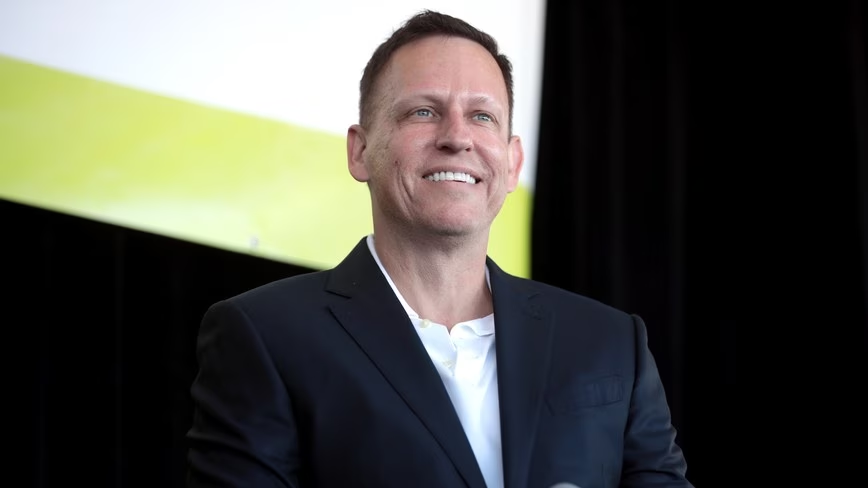
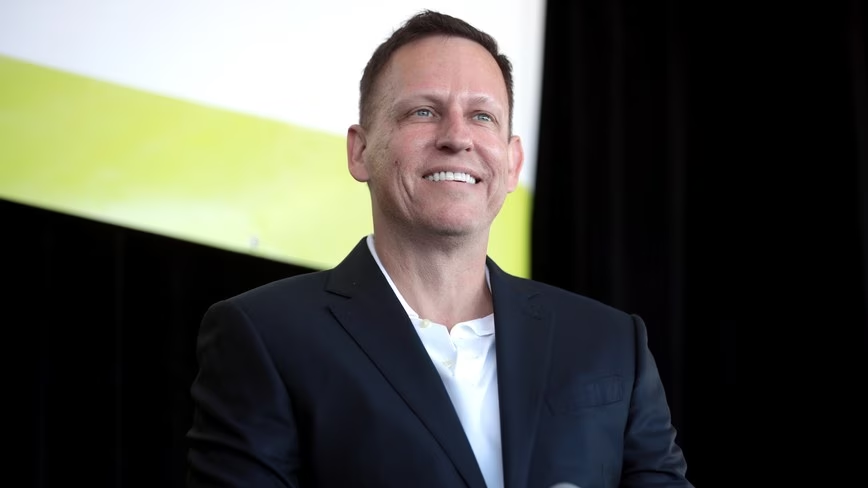
Peter Thiel has called Pope Leo XIV a “useful idiot” for the Chinese Communist Party over the pope’s call to regulate AI. The PayPal and Palantir co-founder spoke to Axel Springer chief executive Mathias Döpfner on the MD Meets podcast, released on Thursday.
The interview came before Thiel received the Axel Springer Award in Berlin on Thursday. Axel Springer owns Politico, which reported the remarks first, and Business Insider. Fortune reported on his comments about Germany.
“The Communist Party of China is not going to listen to the pope. There’s a chance people in the U.S. will. And so in effect, the Pope’s encyclical was working for the Communist party,” Thiel said.
“I’m not saying he was an agent of the communists, but he was at least acting as a useful idiot for the CCP,” he added.
The encyclical
Pope Leo published his first encyclical, Magnifica Humanitas, in May. In it, he called on world leaders to regulate AI. Thiel argued that the text would do nothing to slow China, Politico reported. Instead, it could lead the US and its allies to impose heavy rules on AI, he said.
The Vatican did not respond to requests for comment from Politico or Business Insider. The Vatican has since expanded its AI campaign with an AI4Peace association.
It is not the first time Thiel has attacked the pope over AI. Speaking in Colorado in July, he said the pope was acting as a “Chinese communist agent” by calling for regulation, Politico reported.
‘What we’re doing to ourselves’
Thiel also said Americans themselves, not China, are mostly to blame for the growing US backlash against AI. He was “inclined to believe” China could be fuelling some anti-AI content, he said. But China was not the main force behind the shift.
“This is mainly what we’re doing to ourselves. It’s often somewhat too easy to simply blame it on China,” Thiel said.
Germany’s ‘fear of success’
Thiel, who was born in Frankfurt, also criticised German entrepreneurs. German founders tend to sell their companies before they grow into global businesses, he said.
“If you have something that works, you’re not going to scale it to this extreme degree like an Elon Musk or Mark Zuckerberg,” he said.
Among the richest Germans of Generation X or younger, all had inherited their wealth, Thiel said. In the US, most had built it themselves.
Thiel is a partner at Founders Fund, which has invested in OpenAI, Palantir and Scale AI, among other AI companies.
from the ctrl-alt-speech dept
Ctrl-Alt-Speech is a weekly podcast about the latest news in online speech, from Mike Masnick and Everything in Moderation‘s Ben Whitelaw.
Subscribe now on Apple Podcasts, Overcast, Spotify, Pocket Casts, YouTube, or your podcast app of choice — or go straight to the RSS feed. To get extended episodes with additional coverage, support us on Patreon.
In this week’s episode, Mike and Ben cover:
And in the extended episode for Patreon supporters, they cover:
Our fun links this week include Jev, the super fast new AI classifier, and Persodex, the context layer for your Contacts (PS. hit Ben up if you’re in New York in mid-October).
Follow us on Instagram, YouTube, and Bluesky for video clips from this week’s episode!
If you’re already a Patreon supporter, you can get the extended episode on Patreon.
Filed Under: age verification, ai, artificial intelligence, content moderation, ofcom, trust and safety
Companies: aylo, discord, youtube


Can you visualize 100 feet in front of you? It’s about a third the length of a football field, or about seven to ten car lengths lined up bumper to bumper. If you’re behind the helm of a boat, you have to know how to picture it for the sake of the 100-feet rule, a boating safety regulation that puts a limit on how fast your boat can travel around people, property, other boats, or the shoreline.
The exact wording and distance requirements tend to vary from state to state, but the basic idea is the same in every body of water in America: If you’re passing through a designated area or maneuvering around certain obstacles or people, you have to reduce your speed. It’s about going beyond the rules of no wake zones to prevent collisions, avoid damaging wakes, and ultimately keep people safe out there on the water. A boat moving too fast through a confined area or around other boats or swimmers can create a dangerous wake, even if boat itself never even came close to hitting anything.
Different states have different distance laws

Some states take the 100-feet rule even further. Georgia, for example, says wakesurfers and wakeboarders have to stay 200 feet away from structures, vessels, and swimmers; that’s in addition to the 100-feet rule for boats. Michigan has something similar, enforcing the 100-feet rule as well as a 200-feet rule for personal watercraft (or PWC), a 500-feet rule for wakeboarders, and a 150-feet rule for crossing behind other vessels (regardless of if they’re towing or not). Missouri is especially strict with a 50-feet rule around any vessel or person on/in the water.
It might sound like a lot to keep track of, but the fact remains: If you’re going to take a boat out on the water, it’s your responsibility to make sure you know the laws. Boats don’t have brakes, so it’s really in the operator’s best interest to go above and beyond the 100-feet rule whenever possible. Not to mention, most people tend to drive their boat less than they drive their car, so reaction times are likely going to be slower. Cars have the the 3-second rule, but boats don’t, so it’s in your best interest to regard the 100-feet rule as a minimum, not a maximum.

Wars in Europe and the Middle East. An economy in intensive care. Masked mobs inciting violence and AI threatening our very survival. And what does Andy Burnham offer us? Fluff, hype and beers!: MICHAEL GOVE

Scaloni Reveals He Pushed Hard for Messi’s Final Argentina Farewell Match on October 6 in Buenos Aires
Nscale closed a $3.36B pre-IPO round led by Third Point, with $1B from Nvidia still to come





-

 Crypto World3 days ago
Goldman Sachs and Deutsche Bank Agree: The S&P 500 Rally Isn't Over
-

 Tech5 days ago
Researchers escape OpenAI Codex sandbox to run commands on host
-

 Fashion2 days ago
8 iPhone Accessories That Add Personality
-

 Crypto World5 days ago
Who Needs CLARITY Anyway? ARB Could See 70X Increase: Hodler’s Digest
-

 Tech6 days ago
Trump suggests rebranding AI with a new name, says he’s also creating an AI Force
-

 Business5 days ago
Analog Devices (ADI) Bets $1.35 Billion on Chips that Let Machines Think for Themselves
-

 Crypto World3 days ago
This Bearish Netflix Stock Trade Can Cash In On Video Streaming Giant’s Woes
-

 Crypto World5 days ago
Coinbase, Robinhood, Circle Seen as Tokenized-Stock Winners
-
 Crypto World4 days ago
Trump-Xi Polymarket Odds for Handshake Hit 50%
-

 Entertainment3 days ago
These 17 Fall Amazon Dresses Seriously Look Like Anthropologie
-

 Tech5 days ago
Google’s $899 Googlebook is a bet that you’ll buy a new laptop for Gemini
-

 Crypto World2 days ago
Crude Oil Prices Pressured by Diplomatic Hopes in the Middle East
-
 Business3 days ago
Oil Price Today (September 23): Crude oil below $100 on hopes of US-Iran talks. What did Trump say?
-
 Crypto World2 days ago
Bitcoin price tests $83,600 Supertrend support after $87K rejection
-
 NewsBeat7 days ago
Ed Sheeran protegees Katseye UNFOLLOW star… days after Macklemore was dropped from his tour over Free Palestine remarks
-
 Crypto World2 days ago
Bitcoin Threatens Sub-$84,000 Breakdown as Long Liquidations Spike
-
 Crypto World4 days ago
Meta Jumps 11% As Muse Shines and Investors Show an Appetite for Advancing AI
-
 Crypto World3 days ago
Did Jim Cramer Just Give GameStop Stock the Kiss of Death When He Said the Turnaround Is Working?
-

 Crypto World5 days ago
Bitcoin price holds above $81K as key catalysts line up
-

 Crypto World5 days ago
ARB Price Signals Spur Speculation of 70x Upside in Hodler Digest
You must be logged in to post a comment Login