Connect with us
DAPA Banner
DAPA Coin
DAPA
COIN PAYMENT ASSET
PRIVACY · BLOCKDAG · HOMOMORPHIC ENCRYPTION · RUST
ElGamal Encrypted MINE DAPA
🚫 GENESIS SOLD OUT
DAPAPAY COMING

Tech

Primebook 2 Pro Review: The Budget Laptop That Challenges Chromebooks

Published

on

We’re halfway through 2026, and if there’s one thing we’ve all noticed this year, it’s rising tech prices. Everything is more expensive than last year, all thanks to AI, which has scooped up all memory production, driving prices to insane levels. This has almost killed the budget smartphone space, and the same is happening to laptops. Even Apple raised MacBook prices by well over ₹1 lakh in some configurations. Imagine this: you’re a student or a parent, and you need a budget-friendly laptop to complete schoolwork. Maybe it’s completing a project, or studying for the next exam on a bigger screen; you get the point.

That’s exactly the problem PrimeBook aims to solve. For the uninitiated, it’s an Indian startup that focuses on making Android laptops, similar to Chromebooks, that help you write documents, study using online tools like YouTube, and don’t cost a bank. One example is the PrimeBook 2 Pro, which features a 14-inch full HD display and runs on the Helio G99 processor. Since you get all that for ₹26,999, I knew I had to test it. I’ve been using the Primebook 2 Pro for the better part of two weeks, and this review should help you decide whether it’s worth it.

Primebook 2 Pro Review

Hisan Kidwai

Advertisement

Summary

The Primebook 2 Pro is a unique machine. The design is way more premium than I expected. The keyboard is great to type on, and even the performance is serviceable. Where Primebook still needs to work on is the optimization. People shouldn’t need to request apps they want to install. Still, it’s a capable studying machine

Advertisement

Design & Hardware

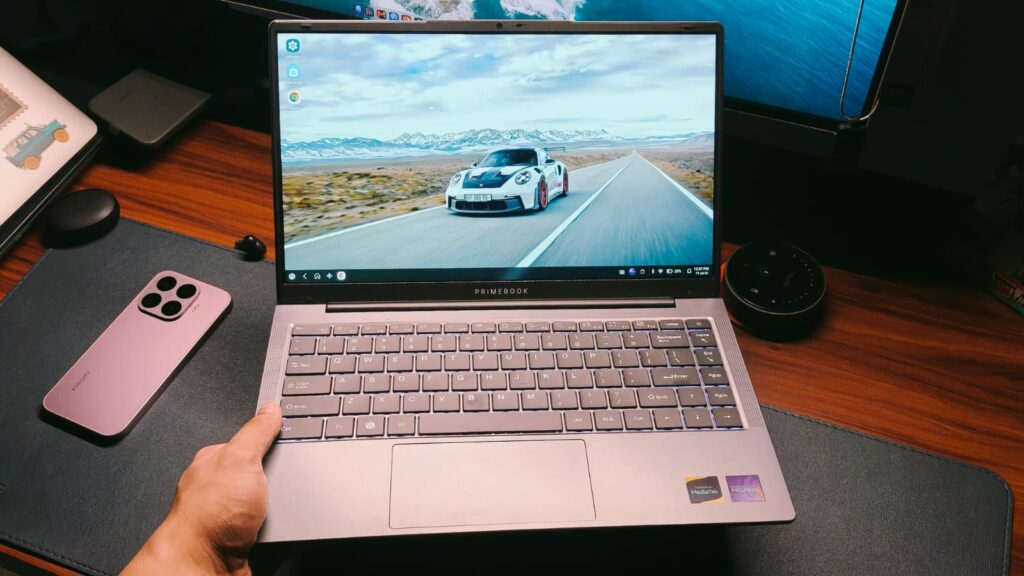
A person holding the primebook 2 pro

It’s very hard to judge a laptop’s design on such tight budgets because, you know, brands simply don’t have the budget for extensive R&D. While this is what I’ve thought about many of the budget laptops I’ve tested, the PrimeBook 2 Pro is actually designed rather well. Don’t get me wrong, you won’t get the premium metal design, but for the price, the plastic build is excellent. The silver color mimics aluminum, which I quite like, and I observed no flex in the chassis, no matter the pressure. The top has a matte finish that looks sophisticated and doesn’t pick up any fingerprints. I could use the laptop in a trendy cafe without looking out of place.

Open the laptop, and you’re greeted by the same premium feel, except this time the keyboard deck has a MacBook-esque finish. The lid extends slightly below the chassis, making it easier to open. The hinge, however, isn’t much to write home about. It keeps the screen steady, but I found it to be quite stiff. I always had to use two hands to open the laptop, which is a nitpick. Still, the best part about the PrimeBook 2 Pro is the portability. The 14-inch form factor was perfect for slipping into any backpack, and the 1.38 kg weight was light enough to carry the laptop anywhere.

As far as ports are concerned, Primebook hasn’t taken the MacBook route. That’s because you get dual USB-A ports for connecting accessories, a USB-C port for charging, a microSD slot, and a 3.5mm headphone/microphone combo jack. While I couldn’t find the speeds for the mentioned ports, it’s hard to complain much at this price.

Keyboard & Trackpad

Closeup of the trackpad and keyboard of the primebook 2 pro

When making a budget laptop, the keyboard is usually first on the chopping board to cut costs. While I agree with this sentiment, the keyboard is one of the main ways to interact with the laptop, and I’m glad Primebook 2 Pro doesn’t follow the norm. Its keyboard is perfectly fine. There are no highlight features, but, most importantly, no glaring issues. I got used to the layout pretty quickly. The feedback, while not as tactile as my MacBook, was good enough for long typing sessions. There’s an extra row of shortcuts to get home, end task, and scroll the page, all of which were useful during my testing.

Where things went south was with the trackpad. First up, its sensitivity is way too high. A small flick raced the pointer from one end to the other when all I was trying to do was click the publish button on an article. The second issue is the gestures. Remember the extra row on the keyboard for page-up and page-down. Yeah, you’d be using that quite a lot since scrolling with two fingers moves the page by just an inch. I tried finding settings to adjust both of these things, but I couldn’t. So keep that in mind.

Display & Camera

Closeup of the display showing an image of mount fuji

The PrimeBook 2 Pro features a 14-inch FHD IPS display with a 60Hz refresh rate. For the price, it’s pretty serviceable. The text was easy to read, even the smaller fine print. The colors were decent, making it a good experience to watch YouTube. Even the viewing angles were quite good. There was some color shifting when viewed from an angle, but not as much as with TN panels. The anti-reflective coating also did its job well, keeping background reflection at bay. The only complaint regarding the display would be the brightness. It’s not enough to overcome the light on a sunny day inside a brightly lit cafe.

The best way I can describe the alleged 1440p webcam is that you can use it for video calls. Don’t expect it to represent how your face actually looks or to have any sharpness, and you’d be good to go.

Advertisement

Performance & Battery

A person watching youtube

Inside the Primebook 2 Pro is the MediaTek Helio G99 processor, which, I agree, isn’t the newest kid on the block. It’s paired with 8GB of LPDDR4X RAM and an unnamed 128GB UFS storage. PrimeOS runs smoothly on the hardware. I could open and close applications reasonably quickly without waiting long. Most of my work happens in Chrome, so I used the laptop for a bit of news writing, along with my usual suite of research tabs. It kept over 10 tabs in memory without stuttering, so I believe studying with the 2 Pro should work out fine.

Where I did notice the 4-year-old processor was when running YouTube. The UI loaded quickly and fine, but when I clicked to play a video, there was a brief hitch before it actually played. This was the case with every video I tried playing. The issue became even more noticeable when I opened WhatsApp Web, which I believe many students would. The laptop took a long while loading my messages, and navigating between the different message tabs was a less-than-ideal experience.

The PrimeBook 2 Pro is powered by a 60Wh battery. When coupled with the non-flagship internals, the laptop’s battery life is excellent. When working on Chrome, it lasted me two full days of use, with the screen on time hovering around the 9-hour mark.

PrimeOS

PrimeOS app store

It’s time to talk about PrimeOS. It’s Primebook’s custom Android-based operating system that takes the big-screen Android experience and adds a few desktop-inspired features. It was my first time using PrimeOS, and it’s a decent take. Apps are neatly tucked away into a Finder-like place. The file manager is inspired by both macOS and Windows and does a very good job of organizing files into easily understandable tabs. App support, though, is a bit complicated. Primebook claims you get access to the “entire Android app ecosystem,” but I couldn’t find all the apps. Sure, most of the important apps like PowerPoint, Docs, and others are included, but it’s not a complete list. If you need more apps, you’ll need to request them specifically, which is a bit counterintuitive in my opinion. It’s worth checking that the apps you need are available before buying.

Beyond that, since not everything can run on Android, Primebook offers Cloud PC functionality. It lets users emulate Windows or Linux on their laptop, albeit with a fee. Subscriptions start at ₹99 for Linux and ₹499 for Windows. Sadly, I did not get the opportunity to test the functionality during my review period. There is also PrimeCoding, the brand’s own beginner-friendly coding platform. The implementation is simple but useful for beginners learning the basics of programming. Do I see PrimeOS becoming big in the next few years? Yes.

Verdict

Closed laptop

At ₹26,990, the PrimeBook 2 Pro is a unique machine. It’s neither a traditional Windows laptop nor a Chromebook. It’s something in between, and there are a lot of good things about the laptop. The design is way more premium than I expected. The keyboard is great to type on, and even the performance is serviceable. Where Primebook still needs to work on is the optimization. People shouldn’t need to request apps they want to install. Everything that runs on Android should already be there. Still, the Primebook 2 Pro is a capable machine that, if you’re looking for something to study on, will work just fine and serve you for a few years.

Source link

Advertisement
Continue Reading
Click to comment

You must be logged in to post a comment Login

Leave a Reply

Tech

Volvo is rolling out Apple Music to over 2 million cars with a simple OTA update

Published

on

The line between your smartphone and your car continues to blur. Volvo has announced that it is rolling out an over-the-air software update that brings Apple Music directly to the infotainment systems of more than 2 million vehicles worldwide. Instead of relying on Apple CarPlay or plugging in an iPhone, eligible drivers will be able to stream music natively from their car’s built-in system, making Apple Music another integrated feature of Volvo’s software experience.

The update is arriving for a wide range of Volvo models, including the EX90, ES90, XC90, S90, V90, XC60, S60, V60, XC40, EX40 and EC40, covering model year 2020 onwards. Availability, however, may vary depending on the vehicle.

At first glance, adding another music streaming app may not sound particularly significant. But it highlights how modern cars are increasingly being treated like connected computing platforms, where new features arrive through software updates rather than requiring new hardware.

Apple Music becomes a built-in part of the driving experience

The biggest advantage of native Apple Music support is convenience. Drivers no longer need to connect an iPhone through Apple CarPlay or Bluetooth just to access their playlists. Once signed in, they can browse Apple’s catalogue of more than 100 million songs directly from the vehicle’s infotainment display, creating a more seamless experience during everyday commutes and long road trips.

Advertisement

To celebrate the rollout, Volvo is also offering promotional access to Apple’s streaming service. Customers who are new to Apple Music can receive up to three months free, while eligible returning subscribers who have been away from the service for at least one month can claim two months free. The offer remains available until July 6, 2027.

Some of Volvo’s premium electric vehicles also receive an audio upgrade. The EX60, EX90 and ES90 will support Spatial Audio with Dolby Atmos when equipped with the optional Bowers & Wilkins sound system, allowing compatible Apple Music tracks to be played in immersive surround sound. Volvo also says the newly launched EX60 will ship with Apple Music pre-installed when deliveries begin later this year.

Cars are becoming software platforms, not just vehicles

This announcement is about far more than music streaming. Over-the-air updates have fundamentally changed how automakers deliver new features. What once required a dealership visit can now arrive overnight through a software download. Tesla popularized this approach years ago, and traditional manufacturers have steadily followed by treating vehicles more like smartphones that continue evolving after purchase.

For Apple, the partnership extends the reach of its services business beyond phones, tablets and computers. For Volvo, it strengthens its growing reputation as a software-first automaker, particularly as it continues building vehicles around Google’s Android Automotive platform.

Consumers also stand to benefit. Native apps reduce dependence on smartphones, simplify the driving experience, and make infotainment systems feel less like accessories and more like an integrated part of the vehicle.

As software becomes one of the biggest differentiators in the automotive industry, partnerships like this are likely to become increasingly common. The next major upgrade to your car may not involve a more powerful engine or a larger battery. It may simply arrive while your car is parked overnight.

Advertisement

Source link

Continue Reading

Tech

Turtle Beach Command Series KB7 review: a nifty screen-equipped gaming keyboard

Published

on

Why you can trust TechRadar


We spend hours testing every product or service we review, so you can be sure you’re buying the best. Find out more about how we test.

Turtle Beach Command Series KB7: one-minute review

Want a high-performing gaming keyboard with an integrated touchscreen for streaming and seamless customization? Then the Turtle Beach Command Series KB7 could be exactly what you’re looking for.

I replaced my usual mechanical keyboard with this TKL model for a few days, and instantly found it to be a joy to use. The low-profile Hall effect switches supply precise, responsive, and buttery smooth typing, with a muted sound that’s great for focusing in-game or for general day-to-day productivity. It’s less ‘clicky’ and snappy than some may like, but the lowkey sound and feel was ideal for me.

Advertisement

Source link

Continue Reading

Tech

XGIMI Improves Lifestyle Projector Performance with Elfin Flip 4K and 1080p Laser Models

Published

on

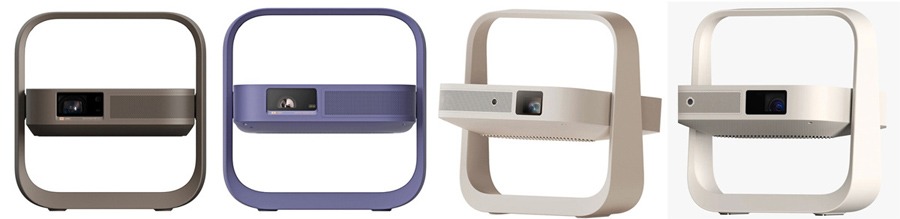
XGIMI has expanded its Elfin Flip portable projector lineup to four models with the introduction of the Elfin Flip 4K and Elfin Flip Laser, joining the existing Elfin Flip and Elfin Flip Plus. The two additions move the series beyond entry-level LED projection, offering buyers a choice between a 1080p triple-laser projector and a more advanced 4K model.

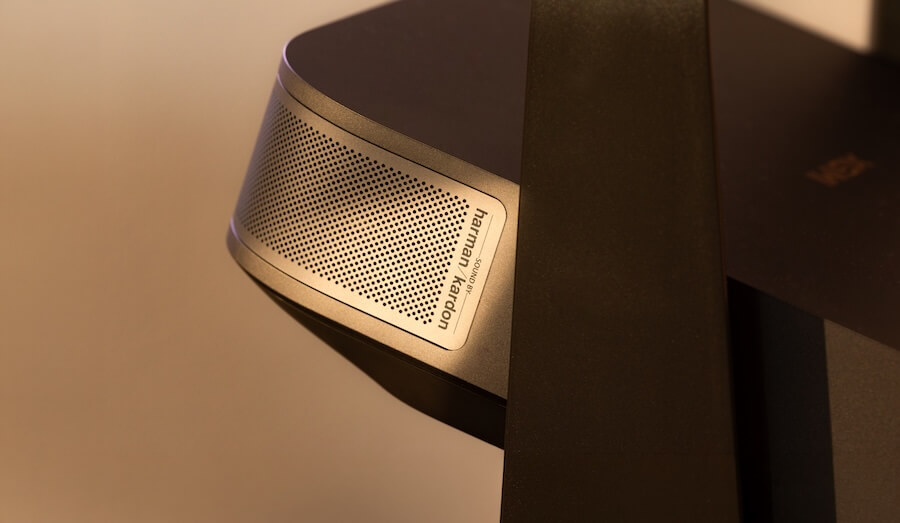
Both new projectors use RGB triple-laser light engines rated at 1,600 ISO lumens and include a single 7-watt Harman Kardon speaker with Dolby Audio. That represents a substantial step up from the Elfin Flip Plus, which uses an LED light source rated at 500 ISO lumens and relies on two 3-watt speakers. This is considerably more than another model number and a mildly revised shade of beige.

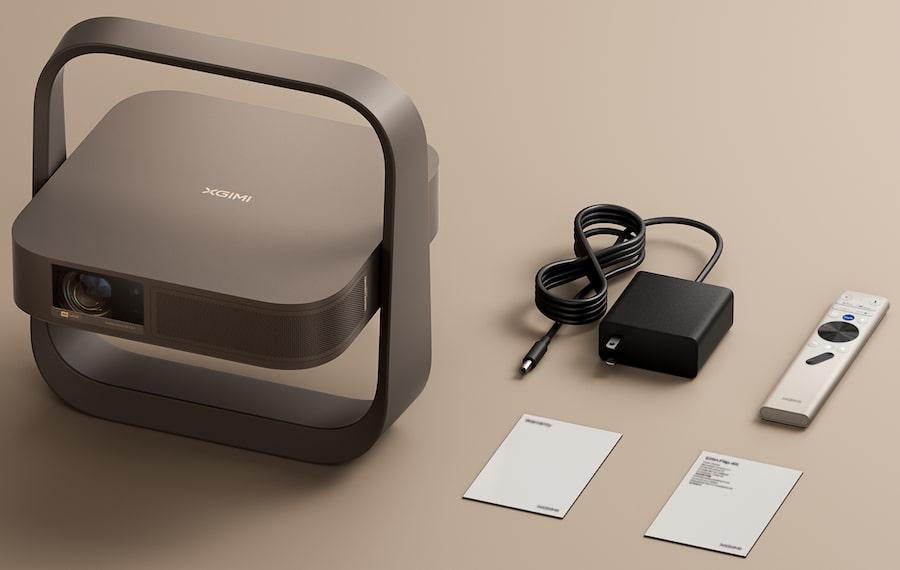
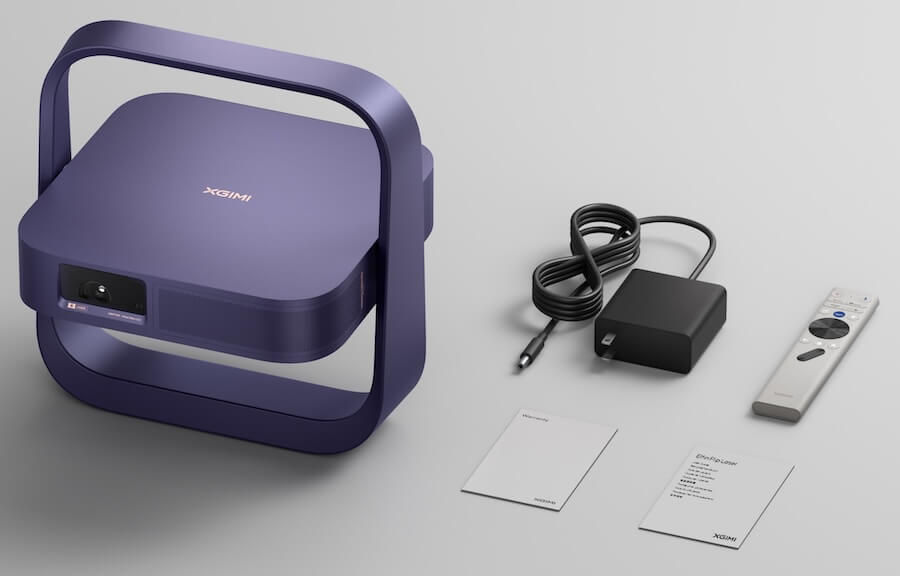
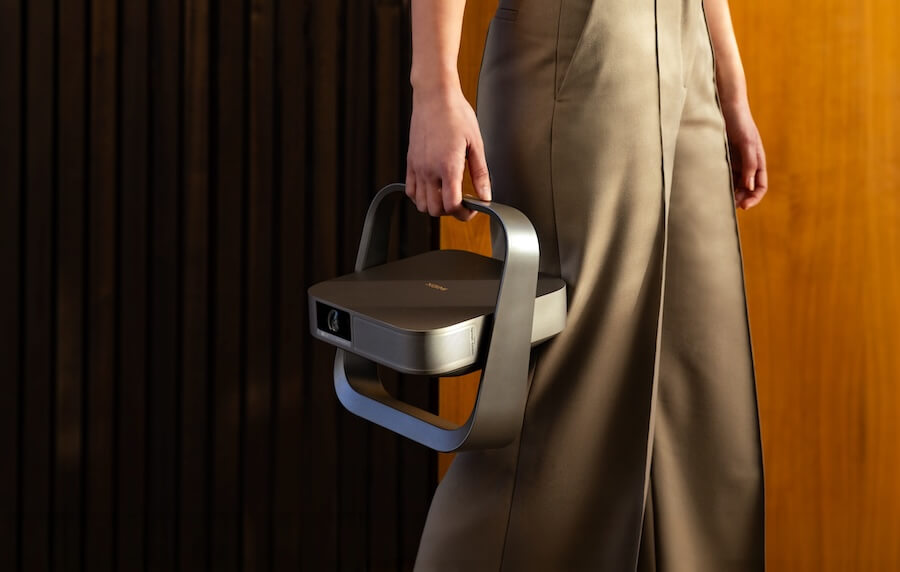
XGIMI has packaged those upgrades inside the familiar book-sized Elfin Flip design, retaining the integrated stand and carry-handle concept that makes the projectors easy to move between rooms and aim at a wall or ceiling. The expanded range now stretches from affordable 1080p streaming to brighter 4K laser projection without requiring owners to drag a black plastic shoebox around the house.

Related Reading: XGIMI Unveils New MoGo 3 Pro, Elfin Flip, AURA 2, HORIZON S Series Projectors For 2024

Advertisement

Elfin Flip 4K

xgimi-elfin-4k-projector-lifestyle

The Elfin Flip 4K sits at the top of the lineup with 4K display resolution via pixel shifting, an RGB triple-laser engine delivering up to 1,600 ISO lumens of brightness, a 20,000:1 dynamic contrast ratio, 110% coverage of the BT.2020 color gamut, and ΔE<1 color accuracy—specifications that rival those of dedicated home theater installations. Its optical zoom and 0.98–1.3:1 throw ratio enable precise screen sizing without requiring users to reposition the projector.

Weighing just 1.55 kg and measuring 9.64 inches wide, it delivers a large-screen viewing experience with zero visual compromise.

The Elfin Flip 4K’s flip-to-start operation and slim profile reinforce its portability: pick it up, place it, and the picture is ready. XGIMI’s Intelligent Screen Adaptation technology handles the rest automatically through Uninterrupted Auto Keystone, Auto Focus, Intelligent Screen Alignment, Intelligent Obstacle Avoidance, Wall Color Adaptation, and Intelligent Eye Protection.

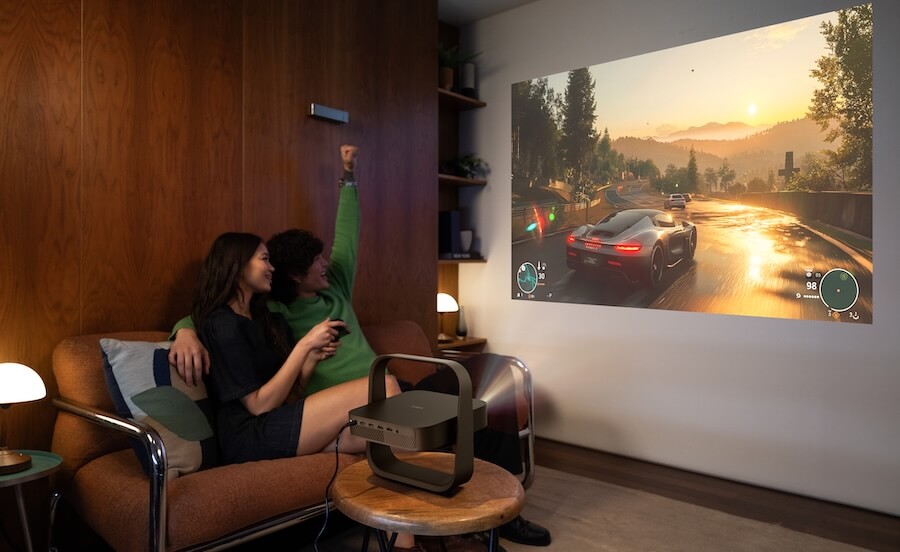
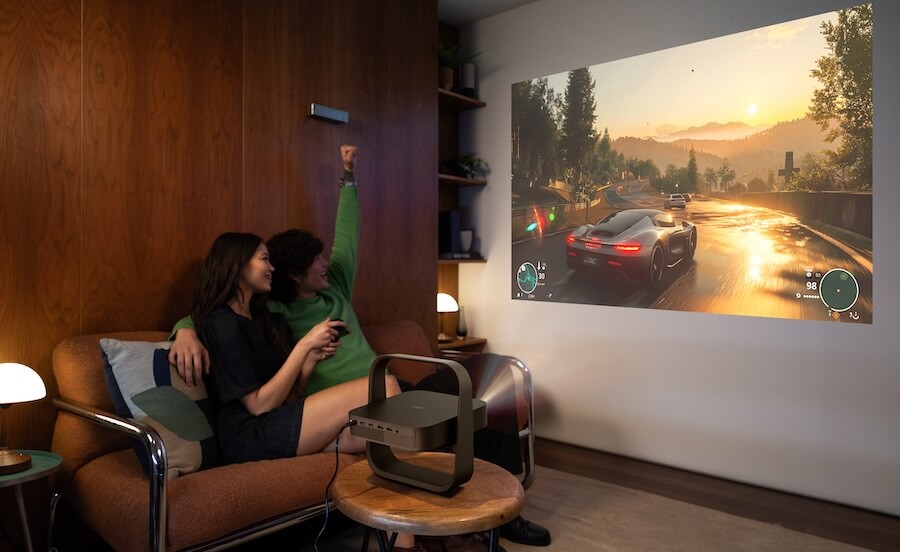
Gaming Support: For the first time in the Elfin series, the Flip 4K supports console-level gaming performance, with input lag as low as 1 ms at 1080p/120 Hz. It also supports VRR and ALLM, along with Black Equalizer, Virtual Crosshair, and a dedicated Gaming Picture Mode.

The Flip Laser

xgimi-elfin-laser-projector-lifestyle

The Elfin Flip Laser sits immediately below the Flip 4K in the lineup. It uses the same RGB triple-laser light engine, carries the same 1,600 ISO-lumen brightness rating, and includes the same Harman Kardon speaker system and smart features.

The primary differences are its 1080p display resolution, lower 10,000:1 dynamic contrast ratio, and lack of the Flip 4K’s advanced gaming features.

Advertisement

Audio & Smart Features

xgimi-elfin-4k-projector-sound

The Elfin Flip 4K and Elfin Flip Laser each include a 7-watt Harman Kardon speaker with Dolby Audio support, designed to deliver room-filling sound without requiring external audio equipment. Our suggestion: get a soundbar.

Advertisement. Scroll to continue reading.

With Google TV, users also have direct access to Netflix, Hulu, Amazon Prime Video, and thousands of additional streaming apps, making the Elfin Flip Series a complete all-in-one home entertainment solution.

Pro Tip: The previously released Elfin Flip Plus and Elfin Flip remain the more affordable entry points in the lineup, but both use LED light sources rather than RGB triple-laser engines. Their speaker systems also offer less power and do not benefit from Harman Kardon tuning. Automatic setup features may vary by model.

XGIMI Elfin Flip Series Comparison

xgimi-elfin-series-projectors
XGIMI Model Elfin Flip 4K  Elfin Flip Laser Elfin Flip Plus Elfin Flip
Product Type  Portable Lifestyle Projector Portable Lifestyle Projector Portable Lifestyle Projector Portable Lifestyle Projector
Price $999 $799 $379 $299
Light Source RGB Triple Laser RGB Triple Laser LED LED
Display Technique DLP DLP DLP DLP 
Display Chip 0.39” DMD 0.23″ DMD 0.23″ DMD .23” DMD)
3D Viewing Option No No No No
HDR Support HDR10, HLG HDR10, HLG HDR10 HDR10
Gaming Support / Latency Game Mode, VRR on, AK off
1ms at 1080P@120Hz
Game Mode, VRR on, AK off
20ms at 1080P@60Hz
1080P/60Hz, Game Mode ≤ 20ms (AK off)
1080P/60Hz, Game Mode ≤ 56ms (AK on)
None
MEMC Yes Yes No No
Brightness (ISO Lumens) 1600  1600  500  400
Resolution 3840 x 2160 pixels (via Pixel Shifting) 1920 x 1080 pixels 1920 x 1080 pixels 1920 x 1080 pixels
Color Gamut BT.2020 110% BT.2020 110% Rec.709 121% Rec.709 113%
Contrast Ratio 20,000:1 (DBLE ON) 10,000:1 (Dynamic Contrast) 4000:1 (EBL ON) Not Provided
Lens High Light Transmission Coated Lens High Light Transmission Coated Lens High Light Transmission Coated Lens High Light Transmission Coated Lens
Eye Protection Yes Yes Yes
Auto Keystone Correction Uninterrupted Auto Keystone Uninterrupted Auto Keystone Uninterrupted Auto Keystone Auto Keystone
Focus Auto Focus Auto Focus Auto Focus Auto Focus
Intelligent Screen Alignment Yes Yes Yes
Intelligent Obstacle Avoidance Yes Yes
Intelligent Wall Color Adaptation Yes
Optical Zoom Yes
Digital Zoom Yes Yes Yes Yes
Throw Ratio 0.98-1.3:1 1.2:1 1.2:1 1.2:1
Aspect Ratio 16:9 16:9 16:9 16:9
Projection Method Front, Rear, Front Ceiling, Rear Ceiling Front, Rear, Front Ceiling, Rear Ceiling Front, Rear, Front Ceiling, Rear Ceiling Front, Rear, Front Ceiling, Rear Ceiling
Image Size 40” – 200” 40” – 200” 40” – 200” 80 – 150 inches
CPU MT9660 MT9660 MT9630 MT9660
GPU Mali-G52 Mali-G52 Mali-G52 Not Indicated
RAM 2GB 2GB 2GB 2GB
Storage 64GB 64GB 32GB 16GB
System Google TV Google TV Google TV XGIMI OS
Fast Boot Yes (STR) Yes (STR) Yes (STR) Yes (STR)
Mirroring Display Google Cast / DLNA Google Cast / DLNA Google Cast / DLNA MiraCast/DLNA
Speaker System 1 x 7W Harman/Kardon 1 x 7W Harman/Kardon 2 x 3W 2 x 3W
DTS-Virtual:X
DTS-HD
Dolby Audio Yes Yes Yes Yes
Dolby Digital (DD) Yes Yes Yes Yes
Dolby Digital Plus (DD+) Yes Yes Yes Yes
WiFi WiFi 6 Dual-band 2.4/5GHz, 802.11a/b/g/n/ac/ax  WiFi 5 Dual-band 2.4/5GHz, 802.11 a/b/g/n/ac  WiFi 5 Dual-band 2.4/5GHz, 802.11 a/b/g/n/ac  WiFi 5 Dual-band 2.4/5GHz, 802.11 a/b/g/n/ac 
Bluetooth Ver 5.2 Ver 5.1 Ver 5.1 Ver 5.1
Input Ports 120W DC IN x 1

HDMI x 2 (HDMI1 support eARC)

Advertisement

USB 2.0 x 2

120W DC IN x 1

HDMI x 1 (supports eARC)

USB 2.0 x 2

Advertisement
120W DC IN x 1

HDMI x 1 (ARC)

USB 2.0 x 1

DC x 1
Advertisement

HDMI x 1

USB x 1

Output Ports Audio x 1
Noise Level ≤28dB@1m ≤28dB@1m ≤28dB@1m ≤28dB@1m
Power Dissipation ≤120W ≤120W ≤120W <65W
Power AC100-240V, 50/60Hz AC100-240V, 50/60Hz AC100-240V, 50/60Hz AC100-240V, 50/60Hz, 19V/3.42A
Product Size (HWD) 254 x 245 x 78 mm 

10 x 9.65 x 3.07 in

Advertisement
254 x 245 x 78 mm

10 x 9.65 x 3.07 in

235 x 226 x 71 mm 

 9.3 x 8.9 x 2.8 In

Advertisement
235 x 218 x 64 mm

9.25 x 8.6 x 2.5 in

Product Weight 1.55 kg 
3 lbs 7 oz
1.38 kg
3 lbs 1 oz
1.1 kg 
2.4 lbs
1.18 kg 
2 lbs 10 oz
xgimi-elfin-4k-projector
XGIMI Elfin 4K Projector
xgimi-elfin-laser-projector
XGIMI Elfin Laser (1080p) Projector

The Bottom Line 

XGIMI offers projectors for everything from casual streaming to dedicated home theaters, but the Elfin Flip Series occupies an increasingly popular middle ground: compact lifestyle projectors that can move between rooms without looking like surplus equipment from a high-school audiovisual department. The Elfin Flip 4K is the standout, combining pixel-shifted 4K resolution, an RGB triple-laser light engine, 1,600 ISO lumens, optical zoom, Google TV, automatic setup, and serious gaming support inside a slim, book-sized design for $999. That combination of portability, optical zoom, wide color coverage, and 1080p/120 Hz gaming performance is what makes it genuinely different.

The Elfin Flip 4K is best suited to apartment dwellers, renters, gamers, and families who want a large image in a bedroom, living room, or temporary media space without permanently mounting a projector. The Elfin Flip Laser offers the same 1,600 ISO-lumen brightness and RGB triple-laser color performance for $799, but drops to 1080p, reduces dynamic contrast, and eliminates the 4K model’s optical zoom and advanced gaming features. Unless the Laser is substantially discounted, spending another $200 for the Flip 4K is not a difficult decision.

There are compromises. Neither laser model includes a built-in battery, so “portable” means easy to carry from room to room rather than movie night in the middle of a field without access to an extension cord. HDR support is limited to HDR10 and HLG, with no Dolby Vision, and 1,600 ISO lumens still does not turn either model into a replacement for a television in a brightly illuminated room. The single 7-watt Harman Kardon speaker may be adequate for casual viewing, but claims of room-filling sound should be approached with the same caution normally reserved for airport sushi. Both models support HDMI eARC, so budget for at least a soundbar if dialogue clarity, bass, and convincing movie sound matter.

Advertisement

The Elfin Flip Plus remains the value option at $379, offering 1080p resolution, Google TV, automatic setup, and 500 ISO lumens. The standard Elfin Flip is also priced at $379 or less, although its lower 400 ISO-lumen output makes the Plus the more sensible purchase whenever the two are selling for the same amount. Casual viewers working with a dark room and tighter budget should start there; buyers seeking the best combination of brightness, resolution, flexibility, and gaming performance should move directly to the Elfin Flip 4K.

xgimi-elfin-4k-projector-carry
XGIMI Elfin Flip 4K

Price & Availability

Source link

Advertisement
Continue Reading

Tech

Longtime Web-Weirdness Site Fark Faces Ad Pinch

Published

on

sandbagger writes: Fark.com is ancient in internet terms. It’s not social media. It’s not quite a news site. It’s a holdover from the dot-com era and is invisible to Google, which makes its community great but has necessitated begging. “[W]e won’t survive this year without more TF subscribers,” wrote founder Drew Curtis in a post on Bluesky. “Spread the word.”

For the unfamiliar, Fark is one of the web’s OG community news sites that features a wonderfully weird mix of user-submitted links, absurd headlines, Photoshop contests and comment-section mayhem. It has also been featured numerous times on Slashdot over the decades, from a 2007 review of founder Drew Curtis’ book and a 2010 story about his skepticism of “the wisdom of crowds” to a full Slashdot interview with Curtis in 2015. For longtime readers of both sites, Fark feels like an old neighbor from an earlier, stranger and arguably more fun era of the internet.

Source link

Continue Reading

Tech

The FDA Says It Didn’t Apologize to Supplier Linked to Diarrhea Outbreak, Actually

Published

on

In the middle of a diarrhea shitstorm, the Food and Drug Administration and lettuce supplier Taylor Farms appear to be facing off in a passive aggressive battle of technicalities.

On July 17, the California-based company issued a voluntary recall on iceberg lettuce sourced from Central Mexico. The recall came after people across at least five states were sickened with cyclosporiasis, a parasitic infection that causes explosive diarrhea.

The next day, the FDA said that it had detected the parasite in a sample of Taylor Farms lettuce that wasn’t part of the initial recall. The day after that, the company and the FDA said that the result was actually a false positive.

“Today, the FDA apologized to us,” Taylor Farms then posted on its X account on July 19.

Advertisement

The FDA did not quite agree with that interpretation, however. On July 20, an agency official told reporters that it did not offer the company an “official apology.” Instead, the official said, “mostly we were providing factual information” about how difficult it is to test for and trace the sources of cyclospora outbreaks.

The agency emphasized that the recall—which spans 27 states, and includes certain lettuce sold to Taco Bell and Walmart—still stands. “To clarify, this false-positive lab sample DOES NOT change the basis for FDA’s ongoing outbreak investigation or the overwhelming epidemiological data supporting the current voluntary recall by Taylor Farms,” it posted on X.

In its July 19 post, Taylor Farms also wrote that the FDA “has not identified a single positive product test result for Cyclospora.” While true, this elides the difficulties involved in accurately testing for the parasite.

Many foodborne illness investigators determine the source of outbreaks without ever testing products. Instead, investigators use epidemiological evidence, such as interviewing people who have tested positive, to determine commonalities.

Advertisement

Taylor Farms has reportedly taken issue with how the FDA and CDC has conducted their weeks-long investigation into the source of the outbreak. A spokesperson told The New York Times that, last week, the company met with White House and FDA officials to discuss what it called “shortfalls” in the government organizations’ response processes. The Times reported that Taylor Farms executives attempted to cast doubt on the FDA and the Centers for Disease Control and Prevention’s conclusions in the meeting, which took place on July 16, the day before Taylor Farms issued its recall.

Taylor Farms did not respond to WIRED’s requests for comment.

Since May, thousands of people have been sickened with cyclosporasis, as health officials have struggled to pinpoint the source of the outbreak. Authorities in Michigan say that they have counted 6,148 cases in that state alone, though experts previously told WIRED that the number of cases nationwide is likely higher than what’s been reported.

Source link

Advertisement
Continue Reading

Tech

Apple starts round four of its iOS 27, macOS 27 developer betas

Published

on

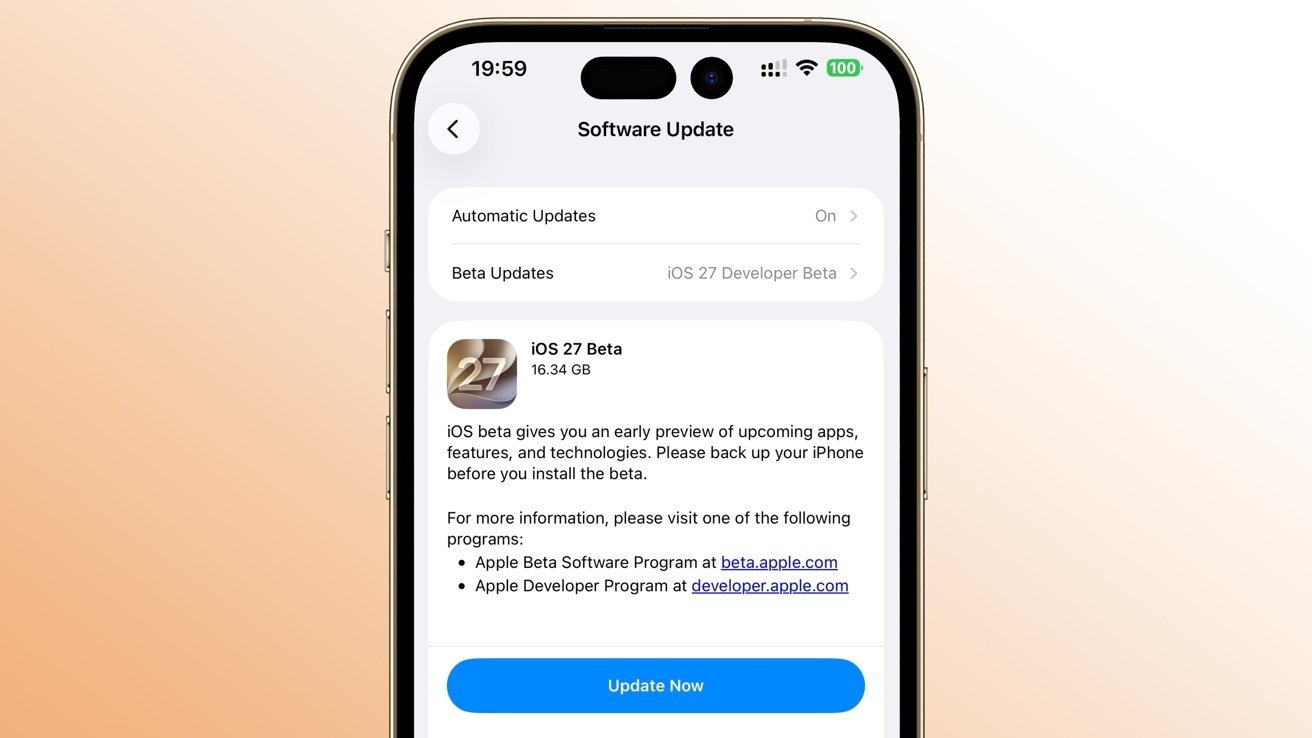
Apple is moving on with its developer beta program, with new fourth builds of iOS 27, macOS 27, tvOS 27, watchOS 27, visionOS 27, and iPadOS 27 now undergoing testing.

The fourth round is here, and participants in Apple’s developer program can download the new builds to their devices right now.

The third developer builds arrived on July 6, while the second occurred on June 22 for most of the operating systems. The watchOS 27 counterparts landed later, on June 23 and June 25.

The first developer builds of iOS 27, iPadOS 27, macOS 27, tvOS 27, visionOS 27, and watchOS 27 were made available on June 8.

Advertisement

The fourth builds are:

  • iOS 27 beta 4 is 24A5390f, replacing 24A5380h
  • iPadOS 27 beta 4 is 24A5390f, replacing 24A5380h
  • macOS 27 beta 4 is 26A5388g, replacing 26A5378j
  • tvOS 27 beta 4 is 24J5325d, replacing 24J5315i
  • watchOS 27 beta 4 is 24R5325h, replacing 24R5315i
  • visionOS 27 beta 4 is 24M5326g, replacing 24M5316k

The initial changes included tweaks to Liquid Glass, the long-awaited overhaul of Siri, child-protective features, and many other smaller changes.

The second iOS 27 developer beta included an update to Apple TV in the Home app, showing it like a connected HomePod or HomePod mini. The Apple Wallet also added a new insights option, albeit in a non-functional fashion.

The third included some visual tweaks, with more customization options added for Siri AI on newer iPhone models.

At your own risk

While AppleInsider regularly warns readers that people trying out beta software should do so on secondary, spare hardware instead of their mission-critical or daily driver devices, it’s something that actually matters more this time around.

Advertisement

It’s because Apple’s early developer betas are for an operating system that is still under active development. There’s a higher chance of buggy, broken, and potentially harmful elements being distributed.

The initial builds are also intended to help developers learn about the operating system changes before the final public release later in 2026. It’s not meant to be used by consumers.

Unless you have a vested interest in using them, such as app development, don’t install the early developer betas.

Instead, members of the public should seek out the public betas, when they become available.

Advertisement

Find any changes in the new builds? Reach out to us on X at @AppleInsider or @Andrew_OSU, or send Andrew an email at [email protected].

Source link

Advertisement
Continue Reading

Tech

Frontier LLMs couldn’t help Hugging Face fight off evil agents

Published

on

CYBER-CRIME

Chinese open-weight model GLM 5.2 happily obliged

Apparently, being a leading destination for AI development doesn’t mean AI will bail you out. AI agents broke into Hugging Face’s production infrastructure, but commercial LLM guardrails blocked the forensic investigation, forcing it to turn to a Chinese open-weight model instead.

The intrusion, “driven, end to end, by an autonomous AI agent system,” compromised a “limited set” of Hugging Face’s internal datasets and “several” credentials used by its services, according to a Thursday security incident disclosure.

Advertisement

While the ML platform says that it’s still investigating whether any partner or customer data was exposed in the breach, there’s “no evidence of tampering with public, user-facing models, datasets, or Spaces, and our software supply chain (container images and published packages) was verified clean.”

It also doesn’t know which model the attackers used to power a swarm of AI agents, which, we’re told, executed many thousands of individual actions across short-lived sandboxes, using self-migrating command-and-control staged on public services.

“This matches the ‘agentic attacker’ scenario the industry has been forecasting,” according to the Hugging Face blog.

Additionally, after unsuccessfully using unnamed frontier models to start the forensic analysis, the Hugging Face security team ultimately ran the log analysis on GLM 5.2, an open-weight model developed by Chinese AI firm Z.ai, on the platform’s own infrastructure.

Advertisement

The advanced commercial models didn’t work because their analysis required submitting real attack commands, exploit payloads, and command-and-control artifacts – all of the things that the LLMs’ guardrails have been trained to block so that the AI systems can’t be used in real-life attacks.

“The attacker was bound by no usage policy, while our own forensic work was blocked by the guardrails of the hosted models we first tried,” the security team wrote, noting that it’s not arguing against safety measures on hosted models and has shared this information with the LLM providers.

Using GLM 5.2 had another benefit, Hugging Face noted: “No attacker data, and none of the credentials it referenced, left our environment.”

This also serves as an important reminder to defenders, according to the AI platform. “Have a capable model you can run on your own infrastructure vetted and ready before an incident, both to avoid guardrail lockout and to keep attacker data and credentials from leaving your environment.”

Advertisement

Think of a burglar that never gets tired, never needs sleep, and instead of jiggling one door handle at a time, is trying a thousand of them simultaneously

The Hugging Face intrusion is yet another indication that attacks carried out by autonomous AI agents are no longer a future threat, but rather the current state of AI-based intrusions.

Last week, The Register spoke with TrendAI VP of AI and security threat research Tom Kellermann about another recent attack, during which a jailbroken Google Gemini did 90 percent of the work – including spinning up a new C2 server in just six minutes. The human did just 10 percent.

Additionally, earlier in July, Sysdig threat hunters documented what they say is the first-ever documented agentic ransomware infection with an LLM – not a human – driving the entire extortion operation, from gaining initial access to compromising a production database server and destroying data.

Advertisement

“Think of a burglar that never gets tired, never needs sleep, and instead of jiggling one door handle at a time, is trying a thousand of them simultaneously,” Zero Networks field CTO Chris Boehm said in an email to The Register about the Hugging Face intrusion.

“That’s basically what happened here. Not one guy typing commands into a terminal, a swarm of little automated processes hammering away nonstop, hopping between hiding spots to make it harder to trace,” Boehm said.

He added, the “part that actually unsettles” him most is that the platform’s security team couldn’t get commercial AI tools to help analyze the attack, “because those tools were built to refuse anything that looked like a real attack command. It didn’t matter that it was the good guys asking.”

Boehm said the takeaway for security teams is twofold: “These agents can now move faster and more relentlessly than any human ever could, and the safety tools we’re building aren’t always ready to help us respond at that speed.”®

Advertisement

Source link

Continue Reading

Tech

Malicious cloud customers can bring down the power grid

Published

on

AI and ML

Datacenters tax utilities normally, so just imagine what they could do if workloads were designed to destroy

AI datacenters wreak havoc on the power grid under normal circumstances, so what happens if a bad actor controls all the GPUs and wants to cause harm? Cybersecurity researchers in China have devised a way for malicious tenants to attack their infrastructure provider, potentially causing blackouts or damaging equipment. 

The attack, dubbed Bit2Watt, imagines an adversary masquerading as a legitimate cloud tenant to launch GPU workloads that have the potential to damage datacenters and supporting electrical systems. It’s intended to demonstrate the need to extend cybersecurity defenses to datacenter workload scheduling.

Advertisement

The researchers, Zhouhao Ji, Kaikai Pan, and Wenyuan Xu, from Zhejiang University in Hangzhou, China, describe their technique in a preprint paper titled “Bit2Watt: A Cyber-Physical Vulnerability Exploiting GPU Workloads Across Power and Computing Infrastructures.”

AI training workloads represent a known challenge for datacenter operators. As Microsoft, Nvidia, and OpenAI noted in a 2025 research paper arguing the need for power stabilization during AI training, the transition from GPU computation to GPU data synchronization causes large power swings to occur. And if the frequency spectrum of these power swings is “harmonized with critical frequencies of utilities, [that] can cause physical damage to the power grid infrastructure.”

Meta’s paper on the training of Llama 3 also cites the risk AI training poses to the power grid.

It says, “During training, tens of thousands of GPUs may increase or decrease power consumption at the same time, for example, due to all GPUs waiting for checkpointing or collective communications to finish, or the startup or shutdown of the entire training job. When this happens, it can result in instant fluctuations of power consumption across the datacenter on the order of tens of megawatts, stretching the limits of the power grid.”

Advertisement

Bit2Watt weaponizes this scenario by proposing that an adversary could use malicious GPU workloads to destabilize the datacenters and electrical infrastructure.

“Our results indicate that GPU loads can reach modulation frequencies exceeding 6,000 Hz, compared with only a few hertz observed in conventional household loads such as air conditioners,” the Zhejiang University authors state in their paper. “Such high-frequency modulations can substantially induce voltage excursions, harmonic distortion, and damping degradation.”

The authors claim an attack on a 1-MW local power grid consisting mainly of distributed energy resources like photovoltaics could use 1,000 GPUs to create a total harmonic distortion of 46.8 percent, which would squander nearly half the electrical current on non-productive work and would throw off about 20 percent more heat than normal. 

“This not only threatens the availability of the computing equipment but also produces a negative damping ratio of -0.27, introducing an unstable mode into the system,” the authors contend. “Once the protections are triggered and computing loads are shed, it can trigger cascading failures, potentially leading to blackouts exceeding 80 percent in large-scale power systems.”

Advertisement

The attack is relatively covert, the authors argue, because it can be launched within authorized workload execution paths and would likely be missed by cloud-provider monitoring frameworks. Thus, they propose that infrastructure providers coordinate defenses across the cyber and physical layers to look for malicious computation patterns. They also emphasize the need for local energy buffering systems to handle power demand spikes.

Bit2Watt also potentially opens the door for a side-channel attack called Watt2Bit. The researchers note that the electrical and thermal stress on hardware from a malicious workload creates denial of service events and enables the covert exfiltration of data via power modulation. As a proof of concept, they showed they could recover a 50-bit test sequence using frequency-shift keying (FSK) encoding.

“These findings underscore a fundamental shift: as power and computing infrastructures converge, security must be addressed across domains, requiring coordinated defenses that consider workload behavior, power electronics, and grid dynamics,” the authors conclude. ®

Source link

Advertisement
Continue Reading

Tech

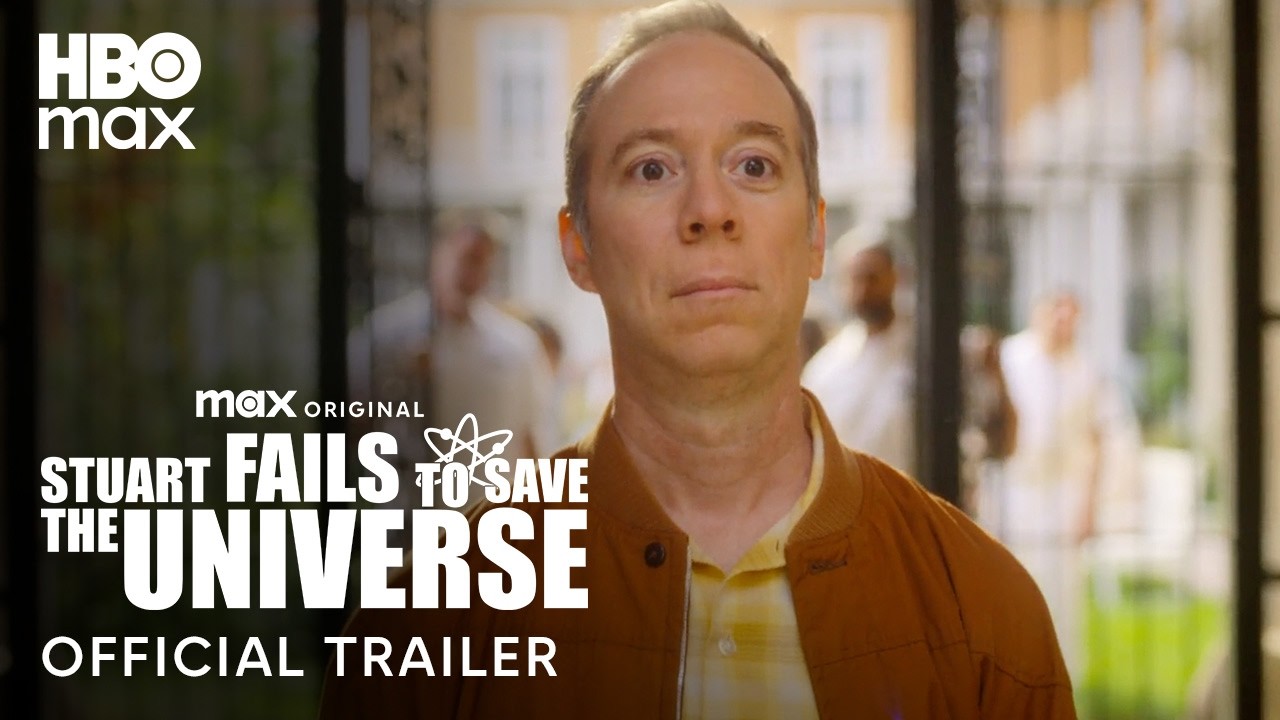
What is the release date for Stuart Fails to Save the Universe on HBO Max?

Published

on

Who’d have thought that the first big spinoff to come out of The Big Bang Theory (not including Young Sheldon and Georgie & Mandy’s First Marriage, as they’re Sheldon-adjacent) would focus on awkward comic store owner Stuart (Kevin Sussman)?

Our new heroic lead, on-off girlfriend Denise (Lauren Lapkus), as well as friends Kripke (John Ross Bowie) and Bert (Brian Posehn), are brought back together when Stuart triggers a multiverse Armageddon by accidentally breaking a device built by Sheldon (Jim Parsons) and Leonard (Johnny Galecki).

Source link

Advertisement
Continue Reading

Tech

The Best Drive-In Movies Ever Made: Monsters, Muscle Cars and Bad Taste

Published

on

The drive-in movie theater was born in New Jersey on June 6, 1933, which feels exactly right. Only this state could give America Sinatra, The Sopranos, the Pine Barrens, the Taylor Ham versus pork roll blood feud, Wawa parking-lot diplomacy, Friday the 13th, and the drive-in, then look at the rest of the country like it needs to merge faster or get out of the left lane.

Richard Hollingshead Jr. tested the idea in his own driveway with a Kodak projector, a screen, some cars, and the very American belief that almost any activity can be improved if you don’t have to leave your vehicle. By the late 1950s and early 1960s, thousands of drive-ins were scattered across the country, glowing in weird places that eventually became strip malls, storage facilities, car washes, vape shops, and urgent-care centers with suspiciously cheerful signage.

Today, the surviving number is somewhere between “fewer than 300” and “roughly 330,” depending on who is counting, which theaters are still operating, and whether anyone picked up the phone. That is a long fall from the glory days, but maybe inevitable. Land became too valuable, multiplexes got bigger, VCRs happened, and eventually someone decided the drive-in needed gourmet snacks, $11 coffee, artisanal pretzels, and the kind of concession menu that uses the word “curated” without shame.

No.

Advertisement

The real drive-in was not about prestige. It was not about black levels, Dolby Atmos, recliner seats, or a lavender oat latte served by a man with a tiny hat and a screenplay. It was about monster movies, fast cars, biker gangs, radioactive insects, beach-party nonsense, slashers, revenge, bad science, worse decisions, and movies loud enough to survive the speaker bolted to your window.

And yes, that speaker sounded terrible. Nobody cared. You were in a car. The windshield was the screen. The audio was an afterthought. Sometimes the movie was too.

Unless you were a movie nerd, and some of us were already broken that way, the drive-in was also a place where teenagers discovered that privacy was relative, bench seats were a design miracle, and horniness was not a gendered activity. Some people came for the movie. Some came for the date. Some came in the trunk, which used to be called “sneaking in” and in 2026 is probably an ICE raid.

But the films mattered. Not always because they were “great” in the respectable sense. Many were too cheap, too lurid, too strange, too violent, too stupid, or too poorly supervised to survive inside polite cinema. Outside, under the stars, with bad popcorn and worse judgment, they became something else.

Advertisement

They became drive-in movies.

Not every great movie is a great drive-in movie. And not every great drive-in movie is technically good.

That is not a flaw.

Advertisement. Scroll to continue reading.
Advertisement

That is the business model.

Midnight Movies and Cult Damage

The Rocky Horror Picture Show (1975)

rocky-horror-picture-show-50th-4k

The Rocky Horror Picture Show is less a movie now than a civic disturbance with fishnets, and Tim Curry’s Dr. Frank-N-Furter is the reason it still walks into the room before anyone else does.

It belongs here because it turned midnight screenings into participatory chaos: costumes, callbacks, rice, newspapers, toast, toilet paper, and behavior that would get you removed from most respectable theaters. At a drive-in, I’m still not sure how you hit the screen from your car with toast, but ambition deserves respect.

Scary? Not really. Essential? Absolutely.

Where to buy: $39.99 at Amazon

Advertisement

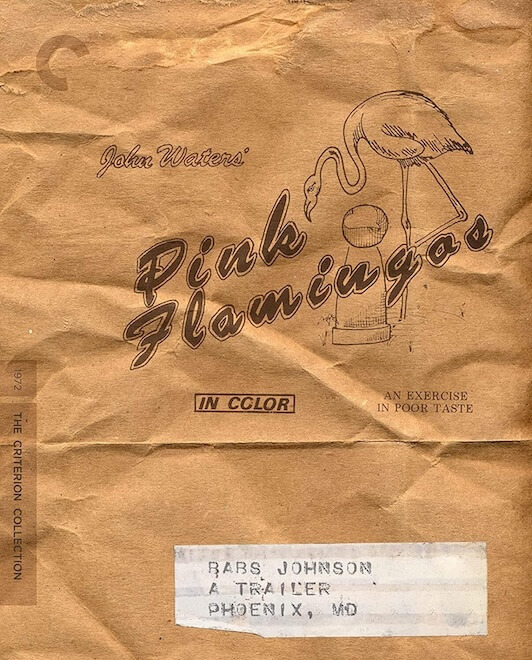
Pink Flamingos (1972)

pink-flamingos-1972

John Waters did not make Pink Flamingos to win approval. He made it to contaminate the water supply.

Divine stars as Babs Johnson, competing for the title of “filthiest person alive,” which is not exactly AFI Top 100 material unless the AFI was having a breakdown. It is gross, funny, aggressive, and proudly allergic to good taste.

This belongs in the drive-in conversation because midnight movie culture needed films that felt dangerous, transgressive, and slightly illegal even when you paid for the ticket. Bring disinfectant. Maybe a priest.

Where to buy: $39.95 at Amazon

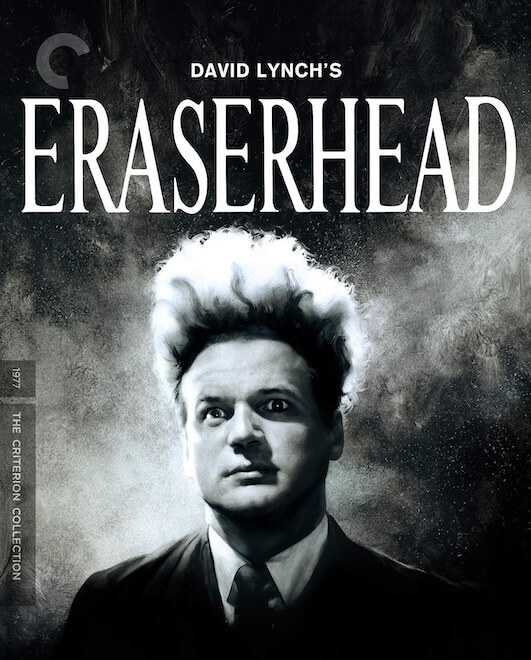
Eraserhead (1977)

eraserhead-1977

David Lynch’s Eraserhead is what happens when anxiety gets pregnant and moves into an industrial apartment with no windows and worse plumbing.

It is not a monster movie, car movie, or exploitation picture in the usual drive-in sense, but midnight movie culture runs straight through it. The film is strange, funny in the way bad dreams are funny, and deeply unpleasant in ways that suggest your nervous system has filed a formal complaint.

Advertisement

This is not popcorn horror. This is “why is my soul making that noise?” horror.

Advertisement. Scroll to continue reading.

Where to buy: $29.99 at Amazon

Monsters, Mutants and Bad Science

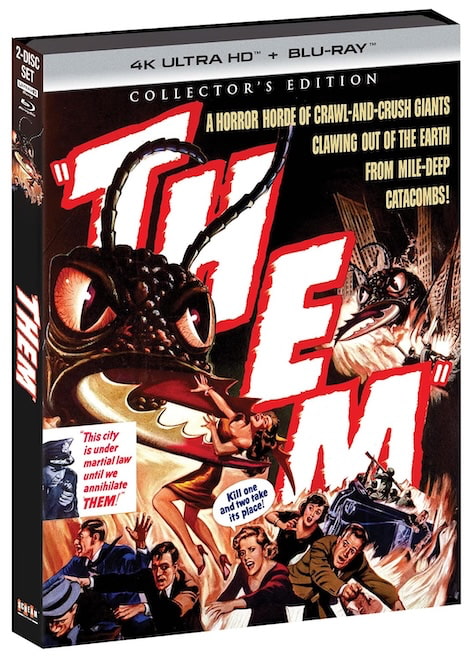
Them! (1954)

them-1954-4k

Before giant bug movies became easy punchlines, Them! did it properly.

Nuclear testing creates giant ants in the New Mexico desert, because apparently irradiating the planet had a few side effects. Imagine that. What makes Them! endure is that it plays the material straight. The ants are ridiculous if you are determined to be joyless, but the film treats the threat with real tension.

Advertisement

Personal favorite for a reason. Them! has legs. Six of them on the ants, and two rather memorable ones on Joan Weldon, who brings actual poise to a movie about irradiated insects eating their way through the Southwest.

And unlike Grease, which later turned the L.A. River basin into Thunder Road with leather jackets and hair product, Them! made better use of the city’s concrete nightmare fuel. The climax moves into the Los Angeles spillways and storm drain system, turning civic infrastructure into a giant ant colony. That is urban planning with mandibles.

Where to buy: $44.98 at Amazon

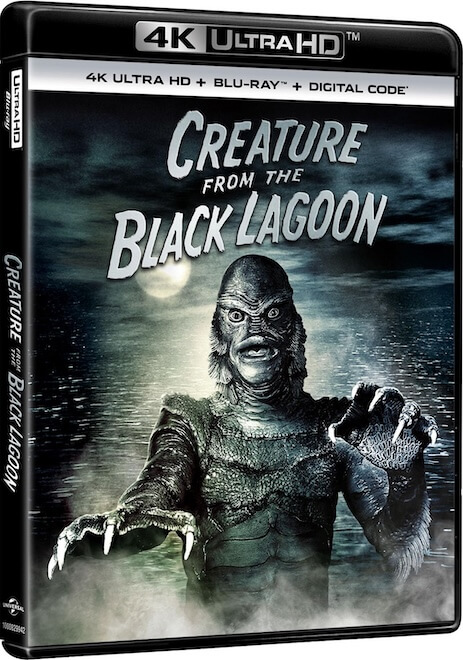
Creature from the Black Lagoon (1954)

creature-black-lagoon-4k-1954

The Gill-man remains one of Universal’s great monsters because he is both ridiculous and elegant.

Creature from the Black Lagoon has everything the drive-in era needed: jungle atmosphere, underwater photography, scientists making poor choices, and a monster who clearly did not ask to be dragged into humanity’s nonsense. It is short, atmospheric, and visually strong enough to survive distance, bad projection, windshield glare, and someone walking back from the snack bar with fries.

Advertisement

A good drive-in monster needs a silhouette. The Gill-man has one.

Where to buy: $29.98 at Amazon

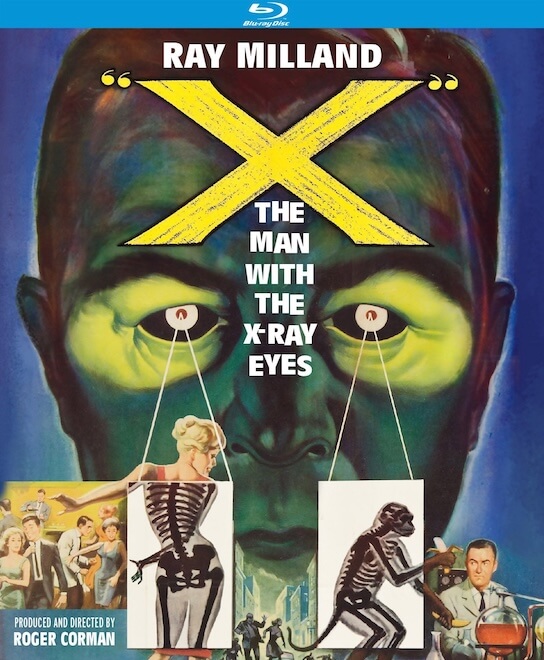
X: The Man with the X-Ray Eyes (1963)

x-ray-eyes-1963

Roger Corman and Ray Milland give drive-in science fiction an unusually nasty philosophical edge.

Milland plays a doctor who develops eye drops that let him see beyond normal human vision. At first, it sounds useful. Then it becomes a curse, because in Corman’s world, knowledge is wonderful right up until it starts peeling your sanity like an onion.

Advertisement. Scroll to continue reading.
Advertisement

X: The Man with the X-Ray Eyes has the title of a cheap exploitation picture, but it is smarter, stranger, and more unsettling than the poster suggests. Corman sold the sizzle and still delivered steak. Thin steak, but steak.

Where to buy: $43.98 at Amazon

The Blob (1958)

the-blob-1958-4k-steelbook

Before Steve McQueen became the Cooler King in The Great Escape and made a motorcycle, a baseball glove, and solitary confinement look cooler than most actors’ entire careers, he was here fighting space jelly in small-town Pennsylvania.

The Blob is classic drive-in marquee bait: a monster from outer space, adults who refuse to listen, teenagers forced to save the day, and a creature that looks like dessert fighting back. The fact that the climax ends up around a diner only makes it more perfect. Of course the Blob attacked a diner. Even alien goo understands that late-night pie is where America lets its guard down.

The genius is that nobody overcomplicates it. Blob lands. Blob eats. Town panics. McQueen squints heroically. The diner gets involved.

Advertisement

Where to buy: $25.99 at Amazon

The Scary Ones That Still Have Teeth

Carnival of Souls (1962)

carnival-souls-1962

Carnival of Souls is proof that you do not need money to make something deeply unsettling. You need atmosphere, patience, and a face in the dark that looks like it has been waiting for you since birth.

Herk Harvey’s low-budget horror film follows a woman who survives a car accident and becomes drawn to an abandoned carnival pavilion. The plot is simple. The mood is everything.

This is not loud drive-in monster business. It is a ghost story with freezer burn, and it still feels like something you found on late-night television after everyone else in the house went to bed.

Where to buy: $39.95 at Amazon

Advertisement

Messiah of Evil (1973)

messiah-evil-1973

Messiah of Evil is the kind of 1970s horror film that makes wallpaper feel suspicious.

A young woman travels to a coastal town looking for her missing father and finds locals who seem less like residents and more like people waiting for a signal from something awful. The film is dreamy, disjointed, and genuinely creepy, with a supermarket sequence that deserves more respect than it gets.

Advertisement. Scroll to continue reading.

It feels like a nightmare taking place in a town that forgot to wake up. Explanation would only ruin it, and horror already has enough paperwork.

Where to buy: $22.16 at Amazon

Advertisement

Black Christmas (1974)

black-christmas-1974

Before Halloween, before the slasher rules hardened into formula, there was Black Christmas.

Bob Clark’s film is still one of the creepiest slashers ever made because it does not over-explain its killer. The obscene phone calls are vile, the sorority-house setting is claustrophobic, and the ending remains brutally effective.

And yes, this is the same Bob Clark who later directed Porky’s and A Christmas Story, because apparently one career could contain obscene phone calls, shower peeping, and Ralphie nearly shooting his eye out without anyone in Hollywood asking for a wellness check.

Porky’s also gave Kim Cattrall her infamous “Lassie” moment, which is probably not the scene you want to use when evaluating Mark Levinson electronics unless you enjoy explaining things to your neighbors and local law enforcement.

Where to buy: $39.98 at Amazon

Advertisement

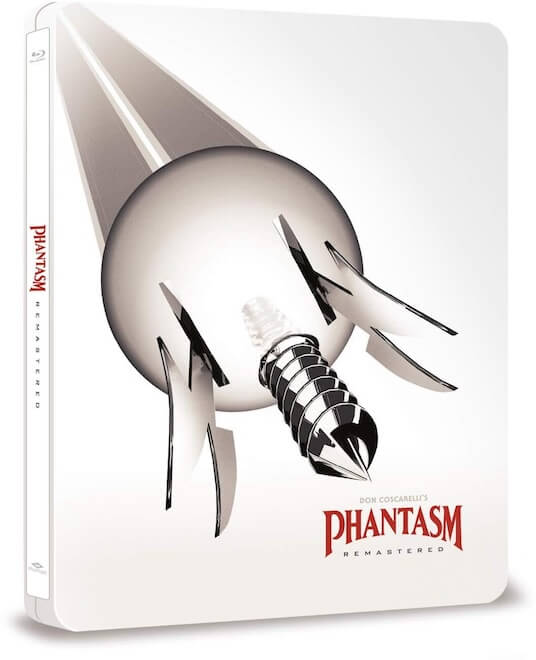
Phantasm (1979)

phantasm-remastered

Phantasm does not explain itself.

Don Coscarelli’s cult horror classic has graveyards, alternate dimensions, flying silver spheres, Jawas from hell, and Angus Scrimm as the Tall Man, one of the great horror figures of the era. It operates on dream logic, which is a polite way of saying you may not know what is happening, but you will remember it.

A normal movie gives you plot. Phantasm gives you a chrome ball drilling into someone’s skull and dares you to complain.

Where to buy: $49.98 at Amazon

Cars, Bikers and Bad Decisions

Faster, Pussycat! Kill! Kill! (1965)

faster-pussycat-1965

Russ Meyer’s Faster, Pussycat! Kill! Kill! is not subtle, polite, or especially interested in behaving itself. Good. Drive-in movies were not built for manners.

Advertisement. Scroll to continue reading.
Advertisement

Three go-go dancers tear across the desert in sports cars, leaving violence, seduction, and bad decisions in their wake. Tura Satana’s Varla remains one of exploitation cinema’s great screen presences: dangerous, stylish, and fully aware that everyone else in the movie is already losing.

Personal favorite. Obviously. The title alone has better posture than most actors.

Where to buy: $39.95 at Amazon

The Wild Angels (1966)

the-wild-angels-1966

Roger Corman understood the biker movie before polite culture knew what to do with it.

The Wild Angels stars Peter Fonda as Heavenly Blues, leader of a motorcycle gang that tears through California with nihilism, noise, and a general disregard for anyone’s insurance premiums. It is crude, influential, and essential because it helped turn biker films into a full-blown exploitation lane.

Advertisement

This is not romantic outlaw nonsense. It is ugly, chaotic, and half in love with the very thing it claims to critique.

In other words, very drive-in.

Where to buy: $11.54 at Amazon

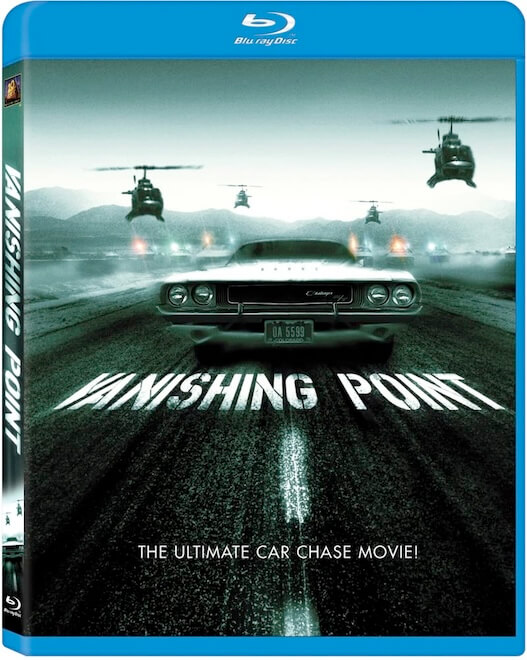
Vanishing Point (1971)

vanishing-point-1971

Barry Newman plays Kowalski, a former cop, race-car driver, and Vietnam veteran hired to deliver a white Dodge Challenger from Denver to San Francisco, because apparently FedEx was too emotionally stable.

Newman was never a household name, unless your household had strong opinions about Vanishing Point or watched Petrocelli in the 1970s, but that helps the movie. He looks less like a star and more like a man who has already accepted that speed, drugs, bad decisions, and state troopers are now the same problem.

Advertisement

The open road is not freedom here. It is a trap with better scenery and worse gas mileage.

Where to buy: $29.99 at Amazon

Advertisement. Scroll to continue reading.

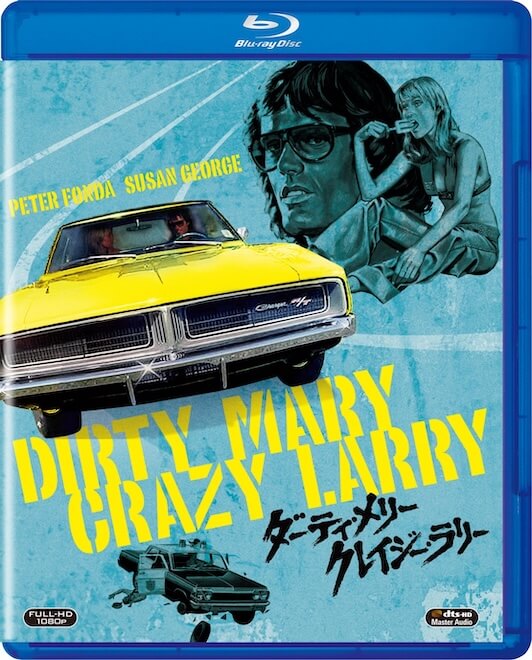
Dirty Mary Crazy Larry (1974)

dirty-mary-crazy-lary-1974

That title sounds like three nicknames found on a police blotter, which is exactly the point.

Dirty Mary Crazy Larry is drive-in car-chase junk food: loud, greasy, fast, and probably terrible for you if consumed too often. Peter Fonda and Susan George play criminals on the run after a supermarket heist, with Adam Roarke along for the ride and Vic Morrow chasing them down.

Advertisement

Morrow, best known for Combat! and later as Jennifer Jason Leigh’s father, brings some gravel as the lawman in pursuit. He was killed in 1982 during the filming of Twilight Zone: The Movie, along with two child actors, in one of Hollywood’s most infamous on-set disasters. Different helicopter tragedy than the one that killed Boris Sagal, Katey Sagal’s father, because apparently Hollywood needed two of those.

Where to buy: $34.28 at Amazon

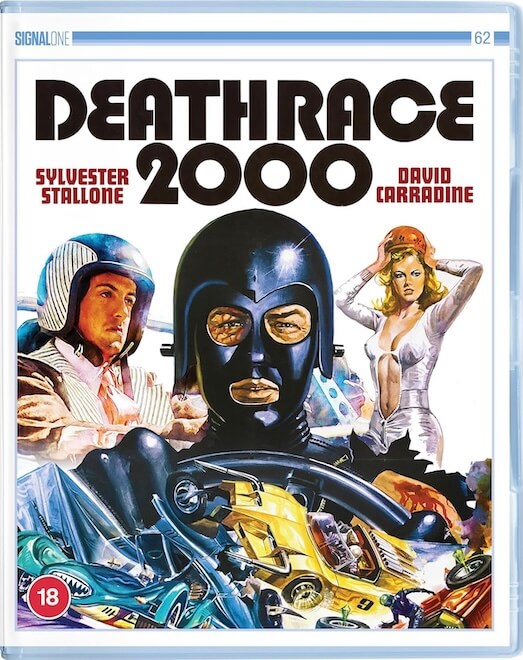
Death Race 2000 (1975)

deathrace-2000

Roger Corman produced a movie about a future America where vehicular homicide is national entertainment, and somehow we still call it satire.

Death Race 2000 is cheap, nasty, funny, and smarter than it looks, which is the Corman sweet spot. David Carradine brings the cool as Frankenstein, Sylvester Stallone brings the volume as Machine Gun Joe, and the whole thing turns bloodsport into media spectacle with all the delicacy of a cinder block through a windshield.

Cars, violence, politics, jokes, and a title that screams poor citizenship.

Advertisement

Where to buy: $39.95 at Amazon

Trash, Revenge and Exploitation

The Toxic Avenger (1984)

toxic-avenger-1984

Troma’s most famous creation is a mop-wielding mutant from New Jersey, because of course he is.

The Toxic Avenger is disgusting, juvenile, violent, and frequently indefensible. It is also weirdly sincere beneath the sludge. A bullied janitor falls into toxic waste, mutates into a hideous hero, and starts cleaning up Tromaville with a level of force that would make most municipal agencies nervous.

This is not polished cult cinema. This is radioactive garbage with a cape.

It belongs here because sometimes the drive-in needed a hero who looked like a lawsuit.

Advertisement
Advertisement. Scroll to continue reading.

Where to buy: $39.99 at Amazon

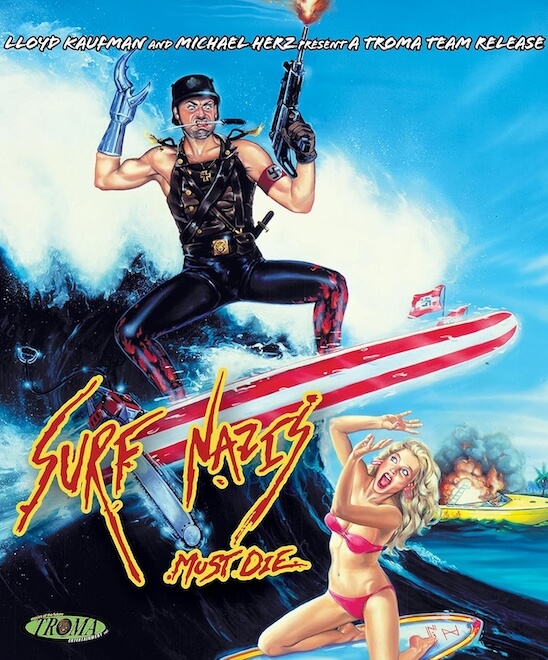
Surf Nazis Must Die (1987)

surf-nazis-must-die-1987

Surf Nazis Must Die is not here because it is great.

It is here because the title alone could sell tickets to people who had already made several poor decisions that evening.

A post-apocalyptic California coastline is overrun by neo-Nazi surf gangs, and revenge eventually arrives in the form of a woman who has had enough. It is a Troma-distributed artifact of bad taste, cheap anger, and exploitation marketing so blunt it practically hits itself with a folding chair.

Advertisement

The movie is clumsy. The title is immortal.

Sometimes that is enough to earn a parking space.

Where to buy: $39.95 at Amazon

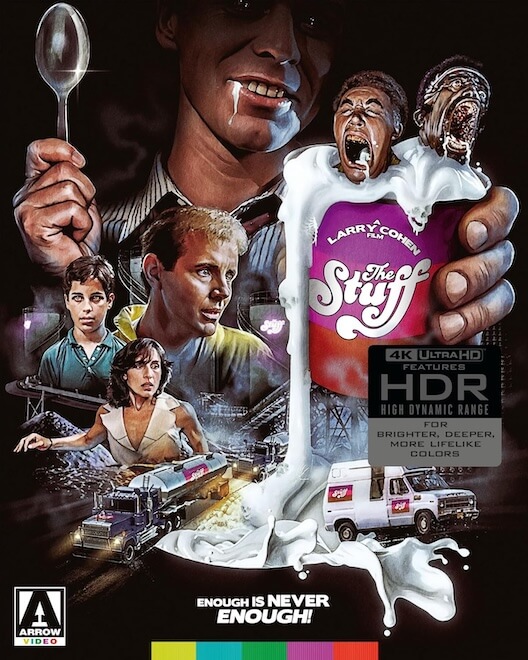
The Stuff (1985)

the-stuff-1985

Larry Cohen’s The Stuff is one of the great junk-food horror satires.

A mysterious dessert-like substance bubbles out of the ground, gets marketed to the public, and becomes a national obsession. It is delicious, addictive, and possibly alive. Which, given the state of some supermarket shelves, feels less like fiction every year.

Advertisement

The film works because it turns consumer culture into a monster movie without losing the B-movie hook. The title is perfect. The premise is ridiculous. The satire has teeth.

If dessert climbs out of the earth, maybe do not build a brand around it.

Where to buy: $24.99 at Amazon

Advertisement. Scroll to continue reading.
Advertisement

Coffy (1973)

coffy-1973

Pam Grier did not enter exploitation cinema. She kicked the door open and made the room behave.

In Coffy, she plays a nurse who goes after the drug dealers and criminals responsible for destroying her sister’s life. The movie is violent, stylish, angry, and built around Grier’s charisma. She is not just the star. She is the engine, the steering wheel, and the brick through the windshield.

The film is very much of its era, with all the complications that brings, but it remains one of the essential revenge films of the drive-in and grindhouse circuit.

Where to buy: $32.40 at Amazon

Switchblade Sisters (1975)

switchblade-sisters-arrow-video-1975

Jack Hill’s Switchblade Sisters is teen-gang melodrama with knives, betrayal, power struggles, and the kind of leadership problems that would make a school board meeting look serene.

The film follows a girls’ gang navigating loyalty, violence, and internal politics, and it has far more energy than polish. That works in its favor. It feels dangerous, theatrical, and proudly overheated.

Advertisement

This is exploitation cinema with attitude. Not realistic. Not respectable. Not asking for either.

A proper drive-in movie should occasionally make you wonder who approved this and whether they were later promoted.

Where to buy: $17 at Amazon

The Bottom Line

The best drive-in movies were not trying to impress critics. They were trying to get cars through the gate.

Advertisement

They had titles you could read from the road, posters that lied with confidence, monsters that wobbled but still worked, cars that sounded better than the dialogue, and revenge plots that required neither nuance nor a therapist. They were loud, cheap, weird, horny, scary, and occasionally brilliant by accident.

Today, you can buy craft coffee and gourmet popcorn at a “reimagined outdoor cinema experience” where nachos apparently need a mission statement. Good for them. I hope the margins are excellent.

Advertisement. Scroll to continue reading.

Give me the old version: giant ants, murderous surfers, toxic waste, biker scum, go-go dancers with bad intentions, radioactive dessert, and a movie title that sounds like it was shouted by a man selling fireworks out of a van.

Advertisement

That was the drive-in.

Not respectable.

Better.

Source link

Advertisement
Continue Reading

Trending

Copyright © 2025