The DOJ has gone past bleeding talent. Now, it’s just bleeding whatever.
It’s one thing to do a bit of MAGA swagger before a captive audience and walk out with a criminal indictment that contains no evidence of criminal activity. It’s quite another thing to present that case to a court, where you’ll have to answer questions from judges and opposing counsel.
Matthew Petracca wasn’t really the sort of person someone would expect to be elevated to the position of Assistant US Attorney for the Eastern District of North Carolina. Sure, he had some past experience with the state’s Department of Justice, but he definitely wasn’t a seasoned prosecutor by any stretch of the imagination. He was, however, a registered Republican and that may have been the only thing that mattered.
But Donald Trump really wanted to see former FBI director James Comey punished for daring to choose loyalty to the public over loyalty to Trump during Trump’s first presidency. The first attempt to lock him up fell apart for several reasons, but most notably because another one of Trump’s handpicked prosecutors — his former insurance lawyer, Lindsey Halligan — managed to set fire to pretty much everything she touched before deciding to exit to the DOJ.
Advertisement
This case is even stupider than the first vindictive prosecution attempt — one that attempts to convert obviously protected speech into a true threat against the sitting president. Ellis Boyle — the US Attorney for the EDNC — definitely wants this to happen. Boyle has made it clear he doesn’t actually work for the Department of Justice. He works for the Department of Whatever The Fuck Trump Wants.
Boyle wears Trump’s hallmark red ties, mimics the double thumbs up in photos, and ends his emails with, “Thank you for your attention to this matter,” echoing the president’s social media sign-offs. He peppers press releases with the same sort of charged language, like catching “thugs” and “bad hombres,” that Trump uses on Truth Social.
Trump pushed Boyle. Boyle pushed his office. And Petracca got stuck with this case. But only temporarily. Unlike his two bosses, Petracca was expected to present this case to a court. Faced with that reality, Petracca chose to exit as gracefully as he could under the circumstances.
Friday’s court filing requests that Assistant U.S. Attorney Matthew Petracca, who was listed as the government’s lead lawyer on the Comey case, be removed from the docket. Federal prosecutor Timothy Severo was swapped in.
Petracca has also been taken off at least three other cases since last week, according to court filings, which do not specify why he is stepping aside.
This doesn’t look like a move made by the DOJ to replace a prosecutor it felt couldn’t handle these cases. Instead, according to this reporting by NBC News, it looks like Petracca is leaning towards getting out of the DOJ business altogether.
Advertisement
Petracca had contemplated leaving the Justice Department altogether, according to two people familiar with the matter, but instead remained a DOJ employee after taking a week off. Petracca had not responded to a previous request for comment on his status at the Justice Department, and did not respond to an additional request for comment on Friday.
Leaving would be the smart thing to do. Any junior prosecutor stuck with this loser of a case should leave as well. If Ellis Boyle wants to be Trump’s mini-me, the least he can do is show up in court and defend his office’s transparently vindictive actions in person. Anything other than dismissing the charges with prejudice is just going to further destroy the DOJ’s reputation. And it really doesn’t have any reputation to spare at this point… and Trump’s still going to be running/ruining it for another couple of years.
Petracca’s best course of action would have been to quit as soon as he was handed this case. He didn’t and now his name will forever be associated with this vindictive, unconstitutional indictment. But if he wants to salvage what’s left of his integrity, he’ll need to leave this iteration of the DOJ entirely and put as much space between him and it as possible.
I studied physics in college, and I’m always surprised how fundamental some of the concepts are. Take waves for example. You really wouldn’t expect the same underlying concept to be at work on surface of a pond, the string of a guitar, light passing through two slits, and then in the probabilistic behavior of electrons orbiting inside nuclei. But here we are, in a world filled with wave-like phenomena.
What little control theory I know, I’ve learned in the school of hard knocks. But it’s equally amazing that the same basic concepts govern the tuning of car shock absorbers, PID controllers, active audio filters, and other more complex systems where feedback matters. Crucial in all of these systems is the judicious balance of amplification and damping.
And last week on vacation, learning to drive a covered wagon pulled by a heavy draft horse, I saw the same patterns again. The horse likes to pull, and when the wagon comes over the crest of the top of a hill, it starts to roll forward into his harness, pushing him from behind. This makes the horse uneasy, and he slows down, the wagon pushes him harder, and positive feedback gets out of control.
The man who was teaching me to drive the wagon said, “it’s not like a car” in that you don’t tap the brakes to slow down and then let go. Rather, you hold on the brakes for a lot longer than you think is necessary – until the horse tells you that he feels like pulling again – and then you let up only a tiny bit at a time. Otherwise, you end up in the under-damped case, where you let the wagon go too much, it slows the horse, you slam the brakes, the horse pulls hard, and you let up on the brakes, and the cycle continues anew.
Advertisement
What he meant by “not like a car” was that the brakes aren’t just slowing down the wagon, they’re adding damping to keep the horse-wagon system from oscillating. Once that clicked in my mind, everything was smooth sailing. After a couple of days, I even started adding some feed-forward to my mental PID controller, letting the brakes go a little bit more when the horse was approaching the bottom of a hill, and he obviously wanted to pick up a little more speed before the grade ahead.
The horse seemed happy that I was finally getting it, but I don’t think he had any understanding of tuning PID loops. He did have me pondering, on a long stretch of rolling hills on a summer morning, if there were a good minimal set of patterns that explained a maximal breadth of phenomena. I’m starting with the physics of waves and the control of feedback systems, but what’s next?
Good news! (Maybe?) Federal legislators have introduced a bill that, if passed, would finally guarantee the right to record law enforcement officers. Here’s Reason’s CJ Ciaramella with the details:
Sen. Richard Blumenthal (D–Conn.) and Rep. Maxwell Frost (D–Fla.) introduced the “Right to Record Act of 2026,” which they say would create new consequences for individual federal officers who violate a person’s First Amendment right to document and record police.
The legislation would create a right to sue a federal law enforcement or immigration officers who engage in wide range of retaliatory behavior, including threatening and harassing videographers, surveilling them, and seizing and destroying their equipment.
So, there’s a lot to discuss here. First off, the only reason a bill like this is necessary is the current iteration of the Supreme Court. This court has repeatedly shrugged off cases that may have finally established the right to record law enforcement officers (and other public officials). Most (but not all!) lower courts have already established this right.
The Supreme Court is the holdout. Maybe that’s just because it doesn’t feel it’s necessary to step in when the issue seems to have been pretty much settled at the district level. If that’s the case, the excuse is lazy and convenient. It takes the Supreme Court to fully settle an issue when there are outliers bucking against the trend. So far, it has refused to do so.
Advertisement
Next up is the caveat in the introduced law: it only affects federal law enforcement officers.
While it would be nice for the proposed law [PDF] to codify the right to record any law enforcement officer, there are good reasons for introducing the bill with this specific wording.
One of the compelling reasons has been created by federal officers, especially those engaged in Trump’s mass deportation efforts. Not content to simply overreact to protests and friction with violence and actual murders, officers have been witnessed deliberately targeting journalists and observers for the obvious reason of deterring further recordings and seizing/destroying what’s already been captured.
The lawmakers cited recent allegations of federal officers targeting videographers in New Jersey, Memphis, and elsewhere across the country, as well as the importance of video evidence in refuting the false government narratives of several shootings of U.S. citizens by immigration agents.
[…]
Advertisement
[D]epartment of Homeland Security (DHS) officials have repeatedly suggested that [recording officers] is doxing and obstruction of justice. Over the past two years, videos from around the country—from Oregon to Maine to the Florida Keys—have shown federal immigration agents arresting or threatening to arrest people for filming them.
This right needs to be recognized if it’s going to mean anything when federal officers violate it. That brings us back to this same Supreme Court, which in recent years has made it impossible to successfully sue federal officers for violating rights. Part of this is due to this version of court steadily narrowing the Supreme Court’s 1971 Bivens ruling to allow lower courts to immediately reject anything that doesn’t exactlymatch the facts of the original case.
The rest of it is due to this court’s conservative majority having almost no interest in establishing rights, while being more than happy to eliminate rights that have been recognized for decades.
That’s the other meaningful part of this bill: it creates a cause of action the courts can’t just shrug off. If it is shown the “right to record” has been violated, individual officers and their employer (the US government itself) can be held liable for these violations. The bill’s text also eliminates the federal government’s “sovereign immunity” option, which means it has to take the loss if its employees are ruled to have violated this right.
Advertisement
This is Congress beating the Supreme Court at its own game. The nation’s top court loves to tell citizens whose rights have been violated that if they don’t like the fact federal officers are 99.9% immune from civil suits they should take it up with Congress. Well, Congress is taking it up. And if the bill becomes law (which seems extremely unlikely), the Supreme Court (and lower courts) can’t talk their way around the rights violations by pretending (1) the right isn’t established or (2) the remedy lies elsewhere.
The bill provides a long list of actions that are presumptive violations of the right to record. This includes everything from merely trying to deter recordings to threatening observers, pursuing them to other locations, placing them under surveillance, or demanding to see their identification. That’s not the entire list either. It also covers attempts to seize or destroy recordings and engaging in any actions that appear to be retaliatory.
In the current climate under the current administration, there’s almost zero chance this will be passed by Congress. But this administration won’t last forever (assuming this Republic can be kept). And this effort needs to be made, even if it results in little more than more congressional reps and federal officials going on record expressing their disdain for the public and their rights. As long as this Supreme Court retains its current makeup, the best option may be legislation, rather than litigation. This puts the administration on the defensive and calls the Supreme Court’s bluff.
The Learn to Code with React Bundle has 9 courses to help you learn more about React, Redux, and JavaScript. Used by the likes of Instagram, Facebook, Netflix, and Imgur, React is an efficient and flexible JavaScript library for building user interfaces. Meanwhile, Redux is a predictable state container that helps you manage the data your pages display. Together, these two tools play a key part in building professional, well-functioning apps; and you’ll explore mastering them both in this training. It’s on sale for $25.
Note: The Techdirt Deals Store is powered and curated by StackCommerce. A portion of all sales from Techdirt Deals helps support Techdirt. The products featured do not reflect endorsements by our editorial team.
SpaceX shares started trading on the Nasdaq on June 12, 2026. The long-private aerospace manufacturer and space transportation company priced its initial public offering at $135 per share. When markets opened, the stock jumped to $150 and climbed as high as $176.50 during the session before closing near $161. That performance gave Elon Musk’s SpaceX a market value above $2 trillion by the end of the day.
The initial public offering generated $75 billion in new capital, a record for a single IPO. Elon Musk’s personal income, aided by his ownership stake in the company, had a big influence in boosting that high figure. According to sources, he has more than 4.8 billion SpaceX shares and 350 million stock options. At closing prices, the holdings were already valued more than $820 billion. Trackers put his net worth at $1.1 trillion, which includes his massive Tesla shareholding and other assets. This individual not only crossed the trillion-dollar mark for the first time, but also confirmed that he was the first person to accomplish so.
NASA rocket model kit – Launch into a creative project with the LEGO Icons NASA Artemis Space Launch System model building project for adult space…
What’s in the box? – This creative building set includes everything you need to craft a multistage rocket with 2 solid-fuel boosters, an Orion…
Features and Functions – This NASA-themed rocket model features retractable launch tower umbilicals, rocket support and crew bridge, detachable…
For the first time, SpaceX was responsible for the majority of his fortune. Previously, his Tesla stock was the source of large returns, following the massive increases recorded during the 2010 IPO. However, the public listing has turned this around. Despite his economic ownership of approximately 40%, Musk wields tremendous power thanks to a dual-class share structure that gives him between 82 and 85 percent of the vote. The company has yet to turn a profit, citing losses of more than $8.7 billion in the most recent reporting period despite investing on Starlink satellite expansion, rocket development, and AI work for other ventures. The additional funds from the public offering will enable it to continue spending on these fronts without having to repay private investors.
Musk founded SpaceX in 2002, after selling his prior internet and payment companies for around $200 million. He invested the money in Tesla’s reusable rocket technology and electric car development. A string of successful launches, landings, and satellite deployments boosted their operating record and valuation. Around 4,400 of their current and former employees stood to benefit immediately, since years of equity grants resulted in massive paper gains once the shares began trading.
Advertisement
The sheer enormity of one person’s fortune has undoubtedly drawn some interest. Some lawmakers have often proposed raising taxes on vast riches, comparing them to entire countries’ annual GDPs. Others have mentioned job prospects, contracts, and technological breakthroughs related with Musk’s companies. The demand for shares was enormous, with orders reaching more than $250 billion, and they ensured that at least 20% of the offering went to ordinary retail investors. The stock’s first-day performance demonstrated investors’ confidence in the current launch business, as well as their aspirations for future projects like orbital infrastructure (data centers, etc.) and longer-range space transportation.
Musk has always claimed that his main goal is to make life multiplanetary. The funds raised will allow them to pursue more rocket capacity, satellite networks, and, eventually, crewed missions to the Moon and Mars. How they carry out these plans will influence whether the valuation remains stable or shifts when new data becomes available. Quarterly reports will show how they use the new capital and how investors evaluate the company as private updates give way to standard disclosures. [Source]
Next time you visit your grandparents, you might want to put your headphones away. Cardiologists have long warned about the risks smartphones, headphones and other consumer devices pose towards cardiovascular implantable devices (CIDs). Concerns revolve around the magnetic fields these devices emit, which can inadvertently trigger a magnet-safe mode on defibrillators and pacemakers that potentially prevents them from detecting tachycardia or other cardiovascular irregularities.
Modern CIDs are designed to automatically switch into this mode when near strong magnetic fields to ensure patient safety during magnet-intensive medical procedures like MRIs. And while CIDs are designed to return to normal after the magnetic field is removed, even a temporary disruption can have major consequences.
For those whose hearts have yet to become bionic, CIDs typically switch into magnet mode when they encounter a magnetic induction field of 10 Gauss or more. For reference, your aunt’s souvenir fridge magnet from her trip to Palm Beach likely emits a magnetic field of 100 Gauss. A relatively manageable problem when CIDs were first designed, the mass proliferation of small rare-earth magnets across consumer electronics has begun to pose unique risks to medical implants.
Scientists have begun to quantify the effects smart devices can have on CIDs. One 2022 study found that the magnetic fields of Apple’s AirPods are strong enough to trigger magnetic modes in implanted cardiovascular devices. Published in Circulation: Arrhythmia and Electrophysiology, the study found that the magnetic fields of devices like AirPods, iPhone 12 Pro Max, Apple Pencil and Microsoft Surface Pen disrupt defibrillators, pacemakers and other CIDs. These results mirror those found in similar electronics, including cell phones,smart watches and electronic cigarettes.
Advertisement
It’s important to note that these reports don’t necessarily preclude those with heart conditions from using AirPods. While patients are always advised to prioritize the suggestions of their cardiologist, Apple’s support page recommends that customers keep AirPods and other electronic devices at least 6 inches away from their cardiovascular device. And while this means you probably can’t blast Childish Gambino while listening to your grandmother’s heartbeat, it also isn’t a death knell for seniors who rock AirPods, either.
The FDA, for its part, offers several suggestions for consumers with CIDs when they’re handling electronic devices. First, always keep electronic devices at least six inches from a CID. This unfortunately means those with heart conditions will need to refrain from carrying their smartphones and AirPods in their front shirt pockets. Although “substitute teacher chic” is in vogue, nixing such fashion choices from your wardrobe could ensure you don’t accidentally disrupt your pacemaker’s settings. If concerned, the FDA suggests consulting your home monitoring system to ensure your CID is operating properly. Those experiencing dizziness, loss of consciousness, or any other heart-related symptoms should consult with their physician immediately.
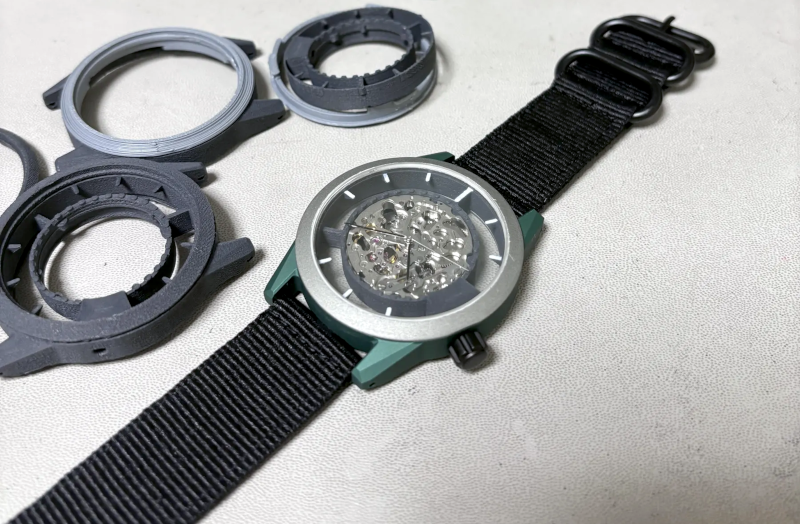
We were excited to see [Z0hn]’s project about 3D printing a custom watch from scratch — both because it was an exciting idea, and because the pictures looked great. While we still liked the project, we quickly realized it wasn’t really printing a watch so much as it was printing a case that holds an off-the-shelf movement. But it still looked great.
Many homebrew watches are cool and fine to wear to your next hackerspace board meeting. But this watch wouldn’t raise an eyebrow out among the normal public. Conventional watches use press-fit backs, tiny screws, or make the back screw into the housing. None of those are great for 3D printing, so this watch uses a bayonet connector, which is easy to create, robust, and reliable.
The watch looks easy to modify, so if you don’t like, for example, the unusual crown placement, you can change it. The movement is a Miyota 8N24 and, of course, the crystal is off-the-shelf, too.
Advertisement
While not exactly a printed watch, it was still pretty cool, and there are lessons to be learned here if you want to pull off the same feat. Or just go full on hacker. You could, too, try your hand with an open source movement.
The team behind the AI Octopus Euro 2024 predictor has updated its simulator for the 2026 FIFA World Cup, this time allowing users to throw natural-language scenarios at the model and see how the tournament might shake out.
“Sensible questions work – a red card, a key injury, a heat wave, a squad switching base camp – but so do the daft ones, e.g. ‘What if the tournament were played with rugby rules?’” said Luzmo CTO and co-founder Haroen Vermylen.
Advertisement
The system is simple: enter a scenario in a prompt box, and the predictor spits out how the results might go. The raw data includes squad quality based on player information, heat and altitude factors, injury data, and so on. A Monte Carlo simulation of the tournament is used to generate win/lose/draw probabilities, and the score line is derived from 5,000 match runs.
The engine behind the Euro 2024 AI Octopus was written in TypeScript. This time around, the team used Rust. “We moved to Rust to also be able to run things more quickly, as now there is a real-time component to this,” Vermylen told The Register.
“Before it could run for five minutes or so. Now we want the predictions to actually come out within two to three seconds of actual simulation time.”
OpenAI models parse the request and generate summaries, and an agent is used to create or transform scenarios, call the calculation engine, answer questions, and so on. A user doesn’t need to be a data scientist to ask questions and understand the answers.
Advertisement
It’s certainly rapid, recalculating the results based on suggested scenarios (even one in which we pondered the effect of politically dubious emissions from a certain world leader). Not that all scenarios will work. Vermylen told us that filtering was in place to ignore profanities and “to avoid scenarios that would just be harmful to certain groups.”
And then there is the age-old issue of an AI parser simply not understanding the prompt. Clarity is key. Using natural language is a great alternative to a UI with settings and sliders, but that ease of use can result in misunderstandings.
As the tournament progresses, the data will be refined. At the time of writing, the baseline reckons that Spain will beat England in the final. Spain currently has an 18 percent chance of lifting the trophy and a 26.8 percent chance of reaching the finals. Those figures can, of course, be altered by feeding in scenarios.
For example, we asked: “What if the Spanish team eats a bad paella?” Spain’s chance of winning the tournament then dropped to 1.5 percent, with France as the projected champion.
Advertisement
We also asked it what would happen if we replaced the England team with Register writers. Suffice to say that scenario did not end well.
We asked Vermylen what was next. “The Olympics would be nice… or the Eurovision. We’d like to give the United Kingdom a win.” ®
The point-and-click adventure game based on the horror anthology series arrives in August.
PHL Collective/DreadXP
The Creepshow game isn’t dead after all. Though things have been quiet around the video game spin-off of Shudder’s horror anthology series since it was announced a few years ago, the Steam page just went live with a release window that’s surprisingly soon: August 2026. Creepshow is a point-and-click adventure that’s “gone all kinds of wrong,” according to developer PHL Collective. It’s being published by TheMortuary Assistant publisher, DreadXP.
In Creepshow the game, “Follow Danny and his friends as a bad day at the mall spirals into something much darker. Their search for the truth behind Danny’s father leads them to The Reader, a mysterious fortune-teller with a taste for treacherous tales.”
Advertisement
Going back to the original anthology films from the 1980s, Creepshow has always blended horror with a dash of humor, and the description indicates the video game will stick to that tone. It features “pulp-inspired visuals, dark humor, comic-book environments, horror mini-games, and endings you won’t see coming.” There’s no information on console releases, so for now it looks like it’ll only be coming to PC.
Four years on from their first appearance at the FIFA World Cup, Qatar will hope to fare rather better in North America than they did in 2022.
The Maroons were the first nation to play at the finals without ever previously qualifying when they hosted the tournament in 2022, but they quickly set another unwanted record as they became the first host country to be eliminated after two games. Now managed by experienced Spanish head coach Julen Lopetegui, Qatar will hope to use the lessons from their home humbling to pick up their first-ever points at the tournament, although their opener against Switzerland is the first of three tricky games in Group B.
This is Switzerland’s sixth successive appearance at the finals and they will be confident of getting off to a winning start, having been within a penalty shoot-out of reaching the semi-finals of Euro 2024. Manager Murat Yakin has now been in charge for five years and has picked a good blend of experience and youth, with familiar faces including Manuel Akanji, Granit Xhaka and Ricardo Rodriguez joined by the likes of Johan Manzambi and Dan Ndoye.
Advertisement
So, read on as we show you exactly how to watch Qatar vs Switzerland for free in the FIFA World Cup 2026.
How to watch Qatar vs Switzerland for free
Qatar vs Switzerland is available to watch for free in multiple countries, including the UK, Australia, Brazil, Belgium, Ireland, Netherlands, Switzerland and Turkey.
Abroad? Can’t access your free stream? Unblock your free World Cup stream with Norton VPN — more on that below.
Advertisement
Use a VPN to watch Qatar vs Switzerland live streams
It’s the World Cup, and if you’re traveling, you might discover your usual Qatar vs Switzerland stream is suddenly unavailable due to geo-restrictions.
Don’t worry, that’s exactly where a VPN can help. A virtual private network lets you connect to servers around the world so you can securely access your usual World Cup coverage as if you were back home.
Of course, most broadcasters have streaming services that you can access through mobile apps or via your phone’s browser.
You can also stay up-to-date with all of the key World Cup moments on the official social media channels on X/Twitter (@FIFAWorldCup), Instagram (@FIFAWorldCup), TikTok (@FIFAWorldCup) and YouTube (@FIFA).
We test and review VPN services in the context of legal recreational uses. For example: 1. Accessing a service from another country (subject to the terms and conditions of that service). 2. Protecting your online security and strengthening your online privacy when abroad. We do not support or condone the illegal or malicious use of VPN services. Consuming pirated content that is paid-for is neither endorsed nor approved by Future Publishing.
Becoming a Voices of Change fellow empowered me to believe I could be a teacher with all my flaws — that “perfection” is not necessary. In fact, it is antithetical to good teaching. I remember sitting in our first workshop where we learned how to write a pitch and discussed what successful pitching looks like.
My takeaway from that workshop was that this fellowship was going to push me in ways I’d always been afraid of, that I’d have to practice a kind of vulnerability that went deeper than what I modeled for my students. I’d have to face myself.
The fellowship taught me that what makes me unique is what makes me the best teacher I can be. My individual voice and reflections were what I had to offer, and not just the restatement of well-researched best practices. During my fellowship, I learned that the more vulnerable and specific I was in telling my story as a classroom teacher, the more my voice as a writer would shine through. This sense of authenticity translated into my teaching, as I felt empowered to be myself and to see my differences as gifts.
My essay describing the time when two birds flew into my classroom taught me that play is education, and to this day, I can breathe when things go awry because, through writing that essay, I reaffirmed to myself that it’s okay for curriculum to slow down, for community building to be at the center.
Advertisement
My essay exploring the power of neurodivergence led me to connect with other neurodivergent teachers and reminded me that my experiences are what make me the best teacher I can be. I used to be sad that my brain was built differently, but both the process and the outcome of that essay taught me that being different is a gift to share with others. I was most afraid to write that essay, but now I am most proud of it. I was once again reminded of the power in speaking my truth, especially when I’m most afraid to.
Overall, my essays taught me to pay attention to every moment of teaching, that sometimes the most mundane days of instruction offer kernels of truth and exploration. Topics such as boredom, artificial intelligence and allyship have been explored ad nauseam, but my editor empowered me to see that despite this, I still have a voice worth sharing, even when I didn’t think so.
As a result, I developed a confidence in myself that I carry with me to this day. I became more embodied as a human being, more present, because I realized that what made me me was actually what would allow me to connect more meaningfully with my students and the world. In extending that expansiveness and empathy towards myself, I had more empathy to give my students on their off days and more encouragement to give them on their better days. Ultimately, realizing that the most important stories I had to tell were topics I was too afraid to address publicly made me see that the core of education will always be about courage. Courage to be all of myself, to try new activities outside of and inside the classroom. I had to be ready to share myself to have the biggest impact as a writer. Similarly, I would have to do the same to be the best teacher I could be.
Since completing this fellowship, my identity as a human being has expanded. I now see myself not just as a teacher, but as a writer, a thinker, and an observer who has something to say. I feel more comfortable being me, and even empowered to do so. With each essay, I chipped away at my fears and accepted that the joy was in the process itself. Now, I tell my students something I have had to tell myself repeatedly during this fellowship: trust your voice.
Advertisement
This story is part of an EdSurge series chronicling diverse educator experiences. These stories are made publicly available with support from the Chan Zuckerberg Initiative. EdSurge maintains editorial control over all content. (Read our ethics statement here.) This work is licensed under a CC BY-NC-ND 4.0.
Fatema Elbakoury (she/her) is a high school English language arts teacher at June Jordan School for Equity in San Francisco.

























































You must be logged in to post a comment Login