






Traditionally set in North America, the Silent Hill series has been known to stray beyond the continent on occasion, most notably with the recent Silent Hill f, which takes place in sixties Japan.
Review info
Platform reviewed: PS5
Available on: PS5, PC
Release date: September 24, 2026
With Townfall, we’re headed to nineties Scotland, but that’s not the only change: we also get a new perspective — in more ways than one.
Not only is the game in first-person, rather than third-person, but it’s developed by a series newcomer, Screen Burn Interactive, formerly known as No Code. This small Scottish outfit doesn’t exactly have a long resume, but it’s already proved itself with its two previous outings. 2017’s Stories Untold was an interesting, modern take on the text adventure, while 2019’s Observation, another first-person horror, won the Bafta for Best British Game in 2020.
Latest Videos FromTechRadar
Now the team brings its Caledonian spirit to bear on Konami’s flagship horror franchise, but does the new locale and camera angle represent another step in the right direction for a series keen on extending its recent purple patch?
Everybody’s aff to the rapture

We open in typical horror story fashion: a man crawls out of the water onto a dock, not knowing where he is or where he came from.
Best bit

Sneaking around the streets of St. Amelia. Its layout is ripe for creating your own paths to avoid enemies, and escaping their clutches by running down back alleys and hiding in cupboards is always a thrill. Plus, you get to explore a town that’s been lovingly and realistically rendered, with homes, shops, and features that offer a glimpse back to a simpler time.
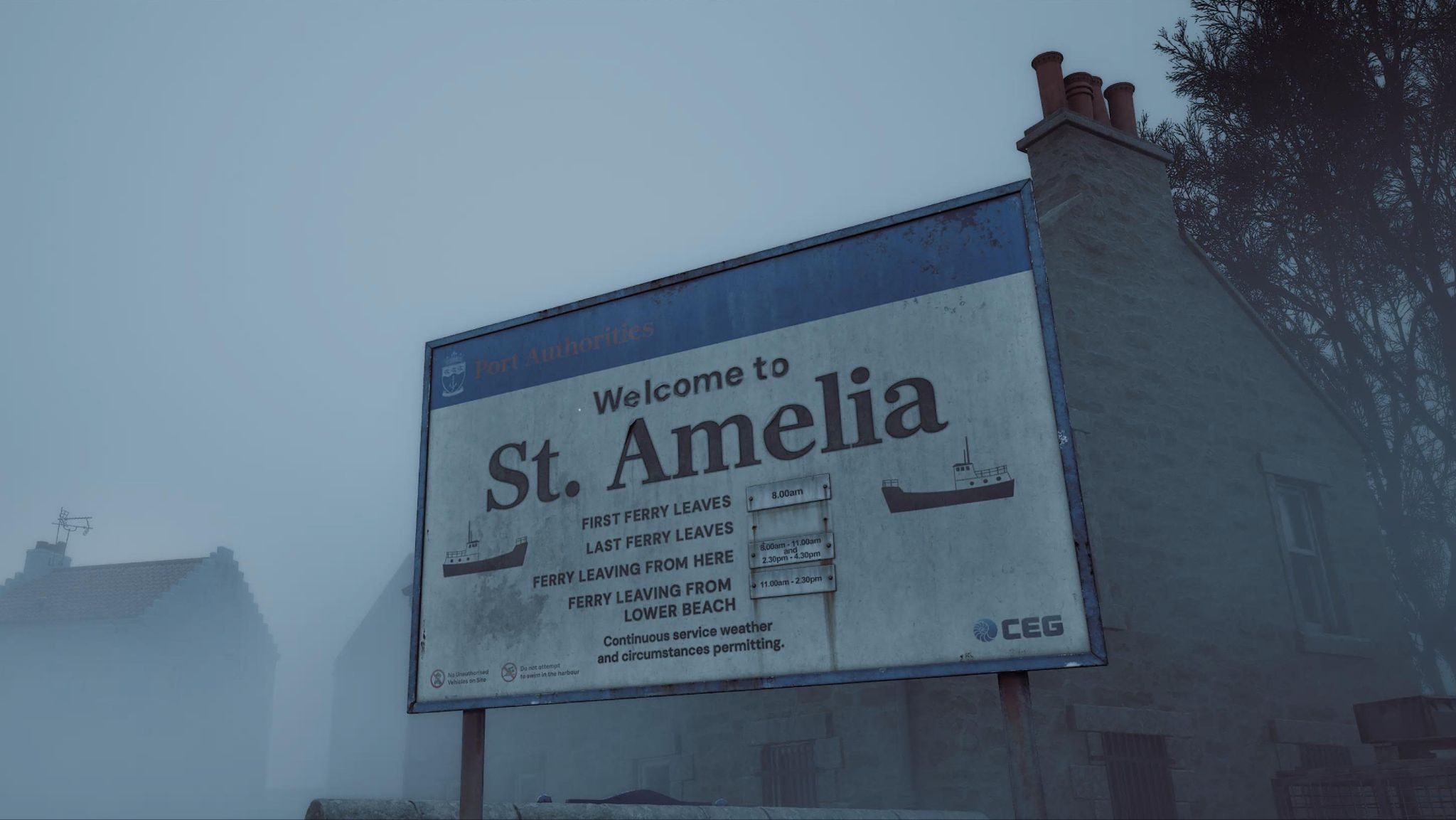
This man is Simon Ordell, wearing an outfit almost identical to Travis Grady’s from 2007’s Silent Hill: Origins, and denoting his everyman-ness. As you make your way up from the harbour, a cutscene plays, and a tarp blows away from a sign, revealing the town’s name: St. Amelia
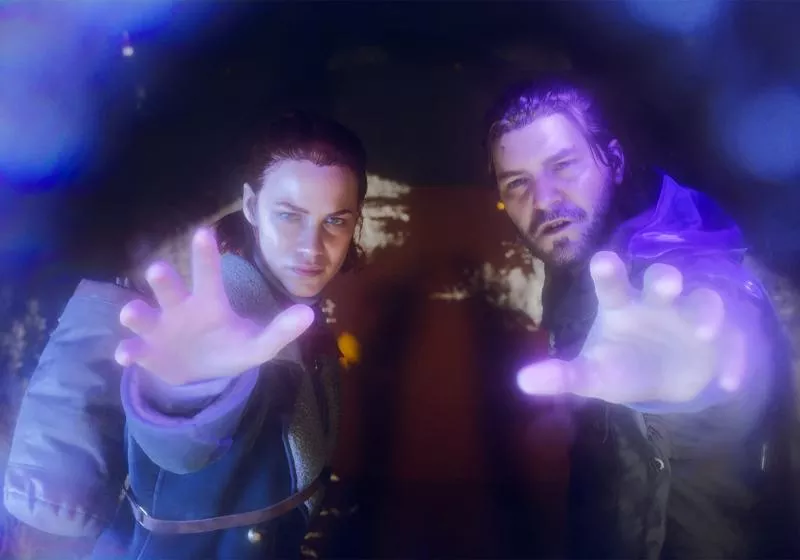
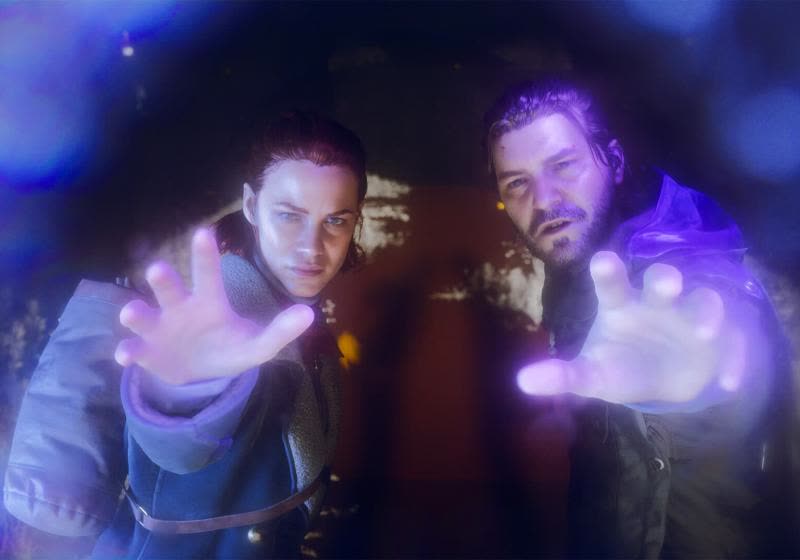
And so the game proper begins, as you make your way through the seemingly abandoned town to find out what’s going on. Along the way, you’ll take control of two additional characters besides Simon — Zoe and Richard — and the plot unfolds gradually to reveal the trio’s connection to one another.

The first thing that struck me as I paced through the streets was the fantastic art direction. As expected from a Scottish team, Screen Burn has nailed the feel of a small Scottish town.
St. Amelia is lovingly crafted and perfectly captures its mid-nineties period, containing plenty of features recognizable to those this side of the pond, from period-correct storefronts and pebble-dashed houses to public telephone booths and post boxes.
Virtually every frame looks cinematic (there’s even a letterbox mode enabled by default). The perennial fog is, of course, present and correct here, and looks better and moodier than ever. Hues of white, red, and blue are prominent throughout as well, and look eerily beautiful as they shine through the mist and are backlit by streetlamps. This is a game made for screenshotting, although unfortunately it doesn’t have a native photo mode.
I played through the game in Performance mode, as is often my preference, and I couldn’t discern any visual downgrade from Quality mode. Naturally, though, Performance mode offered a much better frame rate, and I only encountered one section where things got a little choppy, but this was brief and far from ruinous.

Complementing the visuals is the score, another feature that’s always stood out in Silent Hill titles. Here, though, regular series composer and sound designer Akira Yamaoka is, for once, not involved. Instead, the honors go to Pilotpriest, who’s done a fantastic job of replicating the off-kilter sounds and melancholic melodies fans have come to know and love, while adding a modern twist.
Pieces are more sparse and muted than before, often with heavy doses of reverb. They match the tone of the gameplay brilliantly, and compositions open up during cutscenes when some emotional weight needs carrying.
Unfortunately, the characters’ facial animations are less capable at this. They’re often stilted, which can work when they seem detached and dejected, but they fail to sell terror or emotional breakdowns when required.
This is doubly a shame since it lets down the largely great performances of the voice actors, of which Kezia Burrows’ Zoe is worthy of highlighting. She has a greater range of traits and emotions to convey than the other two, and she does so with aplomb.
Another disappointing aspect of the game’s design is the monsters — this for a series renowned for its strikingly original creations. Virtually every one is some kind of faceless alabaster humanoid with no details of note, and some are mere rehashes of past favorites, such as the fleshy straight-jacketed figure, although this time it has a plank driven through its head.
Less attention has been paid to their symbolism, too: there are suggestions that they reflect aspects of the inner turmoil of the main characters, à la most Silent Hill monsters, but there’s little about their design that shows this in an interesting way.
Monster hunting

Looks aside, though, the monsters are more dangerous than ever. There are a handful of basic pawns, such as those that wander around slowly, and the aforementioned straight-jacketed plank heads that move much faster and more erratically and are equally troublesome.
If either catches you, you’ll have a basic button-mashing QTE to avoid them if you have enough health, but if not, it’ll be instant death. In certain sections, a larger monster appears with blobs on its back, which is unkillable as far as I could tell. There’s no chance to QTE your way out of its grip if it catches you, either.
Sneaking around enemies, therefore, can be a tense and terrifying experience, accompanied by a huge sense of relief when you succeed. Often, the environmental design expertly facilitates this stealth gameplay. The outside sections in particular are laden with cut-throughs and hiding places, and more impressive is the fact that this design is so firmly planted in the real world.
You’ll be sneaking around abandoned cars and peeking out over low walls, scooting down narrow back alleys and distracting enemies with bottles or radios. There’s a surprising degree of player freedom that makes these sections more satisfying to play through than your typical survival horror fare.

What also helps is the excellent player movement. All three move in the same way, which is to say they’re responsive and agile, as well as being reasonably fast when sprinting, although this is no arena shooter — but then again, I wouldn’t want it any other way in a horror game. There’s also an option to use motion controls for aiming, with fast and precise movements, and it is my preferred method.
There’s a peek mechanic, too, which again is very useful. It may be lifted straight from classic first-person horror games, most notably Alien: Isolation, but it gives you a great deal of freedom to not just strafe laterally, but also to peer up over barriers or down over ledges, whether standing or crouched.
To detect threats more easily, Simon picks up a handheld TV (or CRTV) early on that can tune into enemy locations. They’re rendered in silhouette against a red background, serving as the game’s ‘detective mode’. This gives you a real advantage, but its screen is just obscure enough to avoid you using it the whole time.
You also lose focus on your surroundings while equipped, again preventing you from relying on it wholesale. Keeping track of multiple enemies can be hard as well, since you have to toggle between them one at a time, and those long passed or on a different level remain in the CRTV’s memory.

Zoe, on the other hand, is saddled with a pager, a far less effective item since it doesn’t directly reveal enemy movements. Instead, bars around the sides fill up to show their approximate direction and proximity. Both gadgets, though, are effective at grounding Townfall in the real world. At certain points, the CRTV can be tuned to show recorded messages that help develop the story or provide hints. The pager, meanwhile, receives mission- and story-related communication.
This grounding is something the game as a whole does well. From the environments and puzzles, right down to the save system, which has always been a quirky thing in Silent Hill games. Usually, it’s something obscure and surreal, such as interacting with a well or a red square on a wall, but here you use landlines (no mobile phones in St. Amelia 1996) and dial 100 — the in-game number for the coastguard.
The map screen is as helpful and skeuomorphic as ever. Scrawls in red marker pen appear to show rooms you’ve entered, locked doors, and story clues. You can also zoom and pan around it with ease.
When the sneaking goes wrong, you aren’t completely defenceless. You don’t exactly have a military arsenal at your disposal, but some humble series staples are here, including wooden planks and metal pipes. They degrade this time, though, so they won’t last long. Firepower comes later, but ammo is scarce, making the game’s intentions for a stealthy play style clear.

All this isn’t to say the weapons are useless. On the contrary, they’re very effective, and just the right amount of difficult to use. Melee combat is a basic affair, with one button for attack and one for block, but a lot of enemies can be disposed of quite quickly. The revolver and shotgun are even more effective, as you would imagine, but reload times are slow. All weapons feel impactful and satisfying to use, too, and the controls aren’t awkward.
Healing items are more generously distributed. There’s gauze for minor wounds and first aid kits for major ones. You can also combine alcohol with the former for a larger heal, while empty IV bags can be combined with IV fluids to automatically revive you if you die.
Aside from combat and sneaking, you’ll of course be solving puzzles. These are more ingenious than past efforts, and expertly combine that aforementioned verisimilitude with the series’ penchant for the weird.
One of my favorites had me reading out patient charts as Zoe to an aggressively condescending doctor, chastising her and me if I gave the wrong information. I then needed to find medicines dotted around the medical center, beginning yet another monster-avoidance section, which was as tense and as exciting as those in the streets of St. Amelia.
There are plenty of documents and computer emails to read and collect, providing clues to puzzles. There’s also a handy mechanic where you can hold a button to bring up the relevant clue while interacting with a puzzle, although, bizarrely, this is limited to only a few occasions.
Nothing personal

While I certainly had a good time with Townfall, certain sections drag on a little too long. But on the whole, the game does well to vary the environments and puzzles (the enemies less so) throughout to keep you hooked.
I didn’t find normal difficulty too troubling: the puzzles are pitched just right, and those I spent a long time figuring out weren’t frustrating or unfair; in fact, they’re proved more satisfying to solve than the series’ typical offerings.
Sneaking and combat, on the other hand, are more challenging. Enemies can come upon you quickly, and since there can be long stretches before you reach a save point, you can find yourself trudging back through the same section if you perish. But mostly, their presence adds real stakes and rewards you with a sense of achievement once you make it past them.

It took me just over 20 hours to complete a single playthrough, and that was at a gentle pace. There’s little beyond the main objectives at hand to seek out, aside from some mysterious coded postcards that’ll have fans scrabbling to decipher, as well as hidden phone numbers to find. There are also unlockable outfits and weapons, and five different endings to get.
Townfall isn’t particularly scary. There’s the occasional jump scare, but it doesn’t rely on them for cheap thrills. The game is a slow burn, with plenty of quiet, contemplative moments as you explore your surroundings. As with many Silent Hill games, the horror is more psychological.
But herein lies a problem. While the story is commendable for sustaining the mystery for as long as possible, there’s a lack of character exploration, contrary to many other stories in the franchise.
The characters’ dialogue is mostly cryptic, so you never get much of a grasp on their thoughts and feelings until the end — and even then, there are still plenty of questions left unanswered, as they should be. But the three of them are by turns confused and forlorn throughout.
This mixture works to conjure that strange, uncanny tone the series is known for, but it also means the trio fails to elicit the same level of emotional investment garnered by past protagonists, such as Harry and Heather Mason, James Sunderland, and Mary.

Social commentary seems to be Townfall’s primary concern: the main theme is one of corporate negligence and its devastating impact on a community, which is certainly relevant in today’s world. And it’s true that once the three collide and everything comes to a head, it starts to resonate emotionally. But this is a long time coming, and Zoe ultimately feels underserved by the story’s conclusion, a shame given the aforementioned excellence of her actor’s performance.
It’s entirely possible, though, that other endings will give her a larger role than the one I reached, although I have no idea how these are achieved yet.
Ultimately, I found Townfall less impactful than Silent Hill 2 or Shattered Memories. It won’t haunt me for as long as those entries, but it’s an intriguing journey nonetheless, with mysteries that remain after completion to keep fans busy with their theories.
No doubt some will also see Townfall as departing too far from the Silent Hill formula, a debate that’s already begun. But to my mind, the new setting and perspective fit the mold perfectly, so despite a few reservations, it still marks another triumphant reimagining of the series.
Should you play Silent Hill: Townfall?
Play it if…
Don’t play it if…
Accessibility features
Compared to other modern releases, Townfall’s accessibility features are a little lacking. There are no content filters for blood and gore, and visual assists for color and contrast, and the like, are also missing. You can toggle subtitles and closed captions separately, though, and you can adjust the opacity of their backgrounds.
There are three difficulty modes to choose from: Story, which reduces the threat posed by enemies; Normal, which is how the developers intend the game to be played; and Nightmare, which increases enemy power and makes your flashlight detectable by them.
Puzzle difficulty is handled separately, although there are only two modes for this, with the only difference being red highlights of salient text clues.
How I reviewed Silent Hill: Townfall

I played Townfall for just over 20 hours, completing the game once through on normal difficulty. I also toggled the puzzle difficulty between Normal and Hinted modes at various points.
I played the game on a standard PS5, largely in Performance mode, although I also tested Quality mode for a time, too. I used a Lenovo Legion R27qe monitor and the Skullcandy Crusher PLYR 720 headset for audio.
I’m a long-time fan of the Silent Hill series and have played many games in the series, including the recent Silent Hill f and the 2024 remake of Silent Hill 2. The original Silent Hill 2 and Silent Hill: Shattered Memories rank among the best horror games of all time, in my mind.
First reviewed September 2026

-SOURCE-Caramel-Quin.jpg)


-SOURCE-Kat%2520Merck.png)


-SOURCE-Scott-Gilbertson.jpg)








































You must be logged in to post a comment Login